Join me in the cold, dark, life-sustaining NE Pacific Ocean to discover the great beauty, mystery and fragility hidden there.

Posts tagged ‘northern vancouver island’

Buffalos Mating . . . Underwater!

That’s right, it’s mating season for buffalos   . . .  Buffalo SCULPINS that is!

Now that I’ve lured you to this posting with the procreation of a huge, shaggy terrestrial mammal on your mind  . . . let me show you the spawn of this wondrous fish.

The Buffalo Sculpin –  Enophrys bison – has earned the association with buffalo/bison due to the horn-like spine found on each gill plate (operculum). The species can be up to 37 cm long.

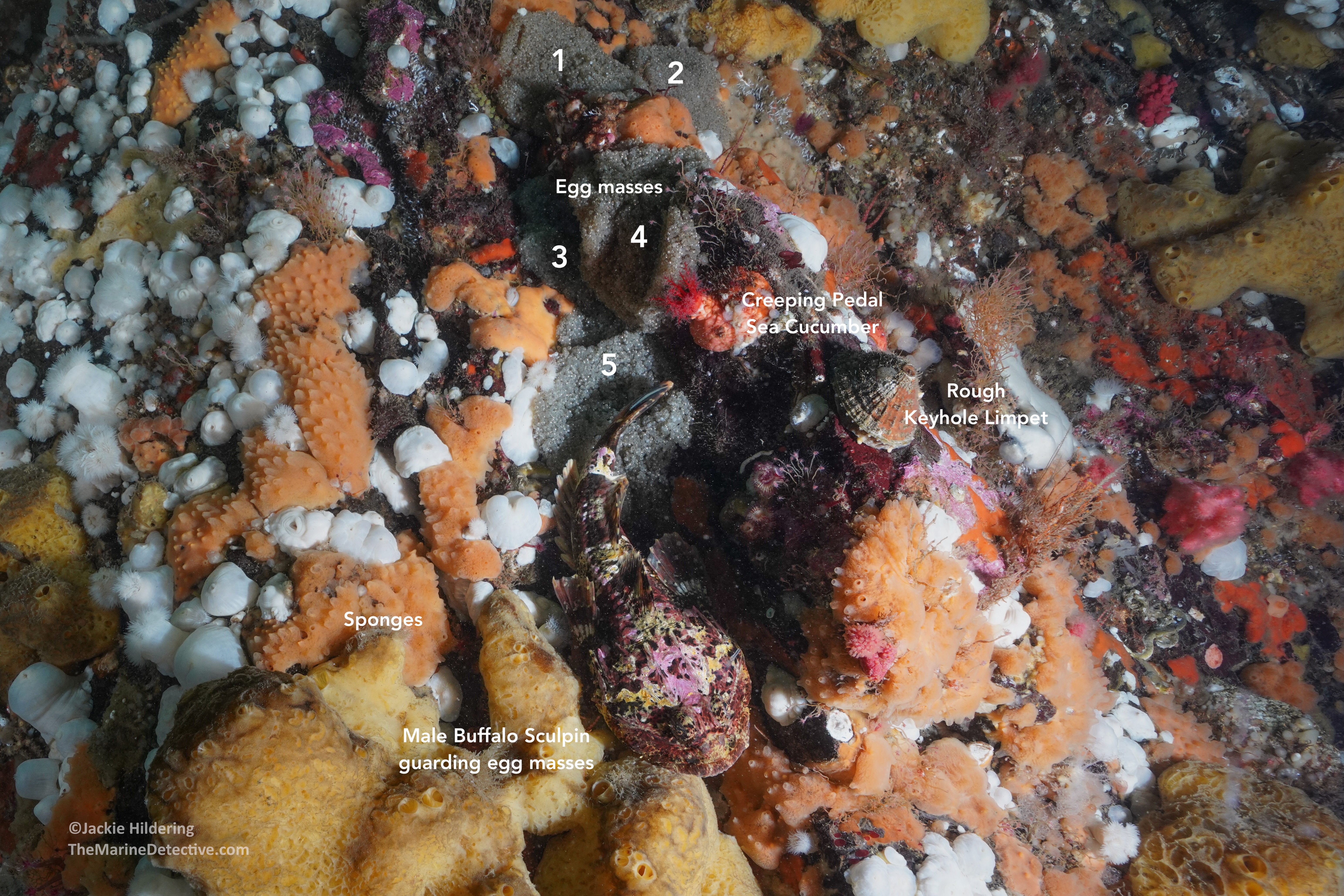
Male Buffalo Sculpin guarding eggs © Jackie Hildering. 

As is the case for many species in the sculpin family, male Buffalo Sculpins guard the eggs from predators. They also fan the fertilized eggs with their pectoral fins to aerate them and stop growth of algae / bacteria.  Sometimes they guard the eggs laid by multiple females (see below for a male that appeared to be trying to guard EIGHT egg masses). When you consider that a female can lay between 19,000 and 32,000 eggs, the males have a lot of fertilizing and guarding work to do!  Their guard duty lasts 5 to 6 weeks until the eggs hatch. 

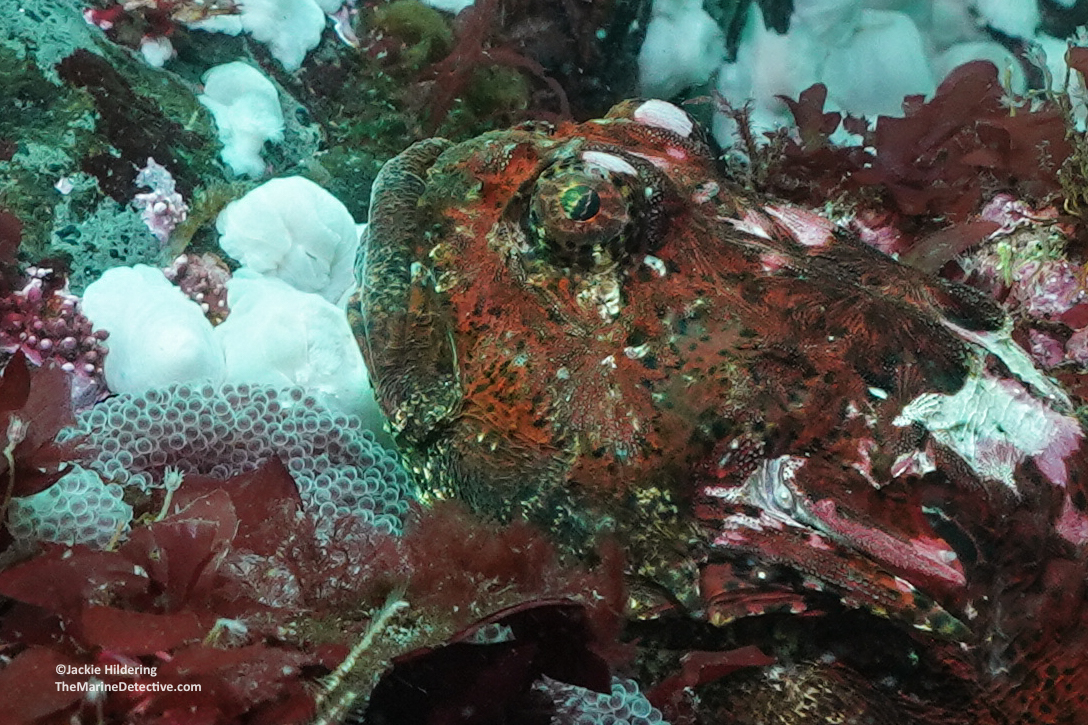
Another male guarding eggs. If you look carefully, you will see the horn-like spines on the fish’s right gill plate. It is these horn-shaped gill protrusions that led to this species getting both its scientific and common name. ©Jackie Hildering. 
Same male as in the image above. ©Jackie Hildering. 

Many of the photos below show how you the males lie with their flat heads directly upon a cascade of eggs. The clusters of eggs laid in the spring allow me to find this incredibly camouflaged fish much more easily than I normally could. When I see a golden, orange or greenish shiny mass of eggs, I know a male Buffalo Sculpin has to be very near by. The bright colour of the eggs suggests that they might be toxic to many species, further protecting them from predation. 

Very interestingly too, there is a species of fish known to parasitize on the care provided to the fertilized eggs by Buffalo Sculpins. Spinynose Sculpins (Asemichthys taylori)  will lay  their eggs on top of the Buffalo Sculpin eggs. The Spinynose Sculpin eggs will hatch faster and it is even possible that the presence of their eggs slows the development of the Buffalo Sculpin eggs.  This “nesting parasitism”, is a “behavior previously unknown among marine fishes.” (Kent, Fisher, & Marliave, 2011).

As you can see, Buffalo Sculpins’ red, brown and pink colouration makes them very difficult to discern from the similarly brilliantly coloured life around them.  They will remain absolutely still so as not to give away their presence. Their relative, the Red Irish Lord, has the same survival strategy. (See this previous blog item for photos and information on the Red Irish Lord.) 
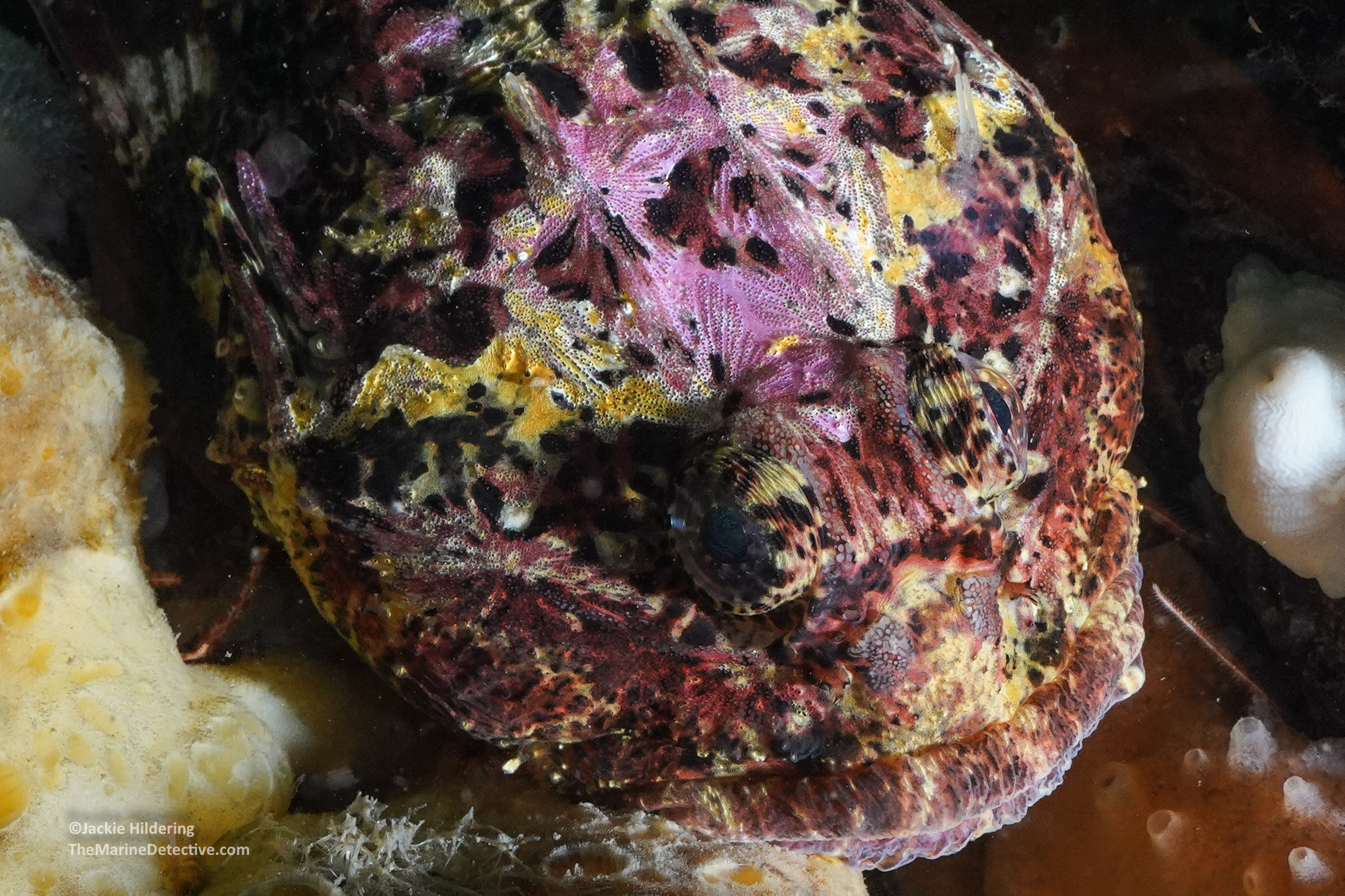
The camouflage, in addition to reducing the risk of predation by bigger fish and seals, allows the Buffalo Sculpin to be a very successful ambush hunter of shrimp, crabs, amphipods and small fish. It has been suggested that they eat mainly algae since this has so often been found in their gut but I am willing to bet that the algae ends up in their stomachs as a result of the Buffalo Sculpins grabbing prey ON the algae!

A cascade of eggs below this brilliantly coloured male Buffalo sculpin’s chin, April 1st., 2012 See below. He as still guarding these eggs on April 21st and was guarding other eggs on May 6th, 2012. ©Jackie Hildering. 
The two differently coloured egg masses suggest that this male is guarding the eggs from two different females. April 1, 2012. ©Jackie Hildering. 
The same male guarding eggs 3 weeks later. April 21st, 2012.©Jackie Hildering. 
Same male with a new egg mass – May 6, 2012. Checked in on him on May 20th, 2012 and he was no longer guarding eggs. ©Jackie Hildering

Range: Monterey California to Kodiak Island, Gulf of Alaska. Most often found to a depth of 20 m but have been found to 227 m.

Spawn: February and March.

Sources: Kent, Daniel & Fisher, John & Marliave, Jeffrey. (2011). Interspecific nesting in marine fishes: Spawning of the spinynose sculpin, Asemichthys taylori, on the eggs of the buffalo sculpin, Enophrys bison. Ichthyological Research – ICHTHYOL RES. 58. 10.1007/s10228-011-0223-5.


Whoa! Photo below is of one male Buffalo Sculpin guarding the egg masses of at least 3 different females.
©Jackie Hildering. 

And here’s a male appearing to guard EIGHT egg masses. 
Find the Fish Friday Answers.001


The following photos of male Buffalo Sculpins guarding eggs are intended to show how varied both the colouration of the fish and the eggs can be.  All photos ©Jackie Hildering. 

DSC03226
_JH15078
DSC07368 2
JWH_2250
JWH_2263
JWH_2287
JWH_3438
OLYMPUS DIGITAL CAMERA
SEA&SEA 1200HD

Fins Verses Feathers – Bigg’s Killer Whales Harass Rhinoceros Auklets

In the Northeast Pacific, “Bigg’s Killer Whales” (formerly known as “Transients”) are believed to have diverged from the “resident”  (inshore fish-eating) and “offshore” (offshore fish-eating) ecotypes some 700,000 years ago (Morin et al, 2010), to refine a culture of stealth and unpredictability in order to hunt their marine mammal prey.

I would suggest that we humans are the last species that should be judging others for how much they eat. However, often Bigg’s Killer Whales are profiled and misunderstood for interpretations of their feeding behaviour. This includes that they don’t always eat what they kill.

From Kuker and Barrett-Lennard (2010)  “Like many other predators, transient killer whales sometimes demonstrate ‘surplus killing’, killing greater numbers of prey than they consume (DelGiudice 1998, Wobeser 2000, Short et al. 2002). In surplus killing incidents, the whale plays with animals, such as sea birds (Stacey et al. 1990) and harbour seal pups (Gaydos et al. 2005). The whales may breach on the victim or toss and ram it until it dies, but it is not consumed. This behaviour could be part of the process of learning to hunt, in which adults are training young to capture and handle prey, or it could be simply play behaviour (Ford et al. 1998, Gaydos et al. 2005).”  

Below is my account of one such surplus killing events witnessed on August 31st, 2011. It was not a good day for some Rhinoceros Auklets (Cerorhinca monocerata) in Johnstone Strait, British Columbia, Canada.

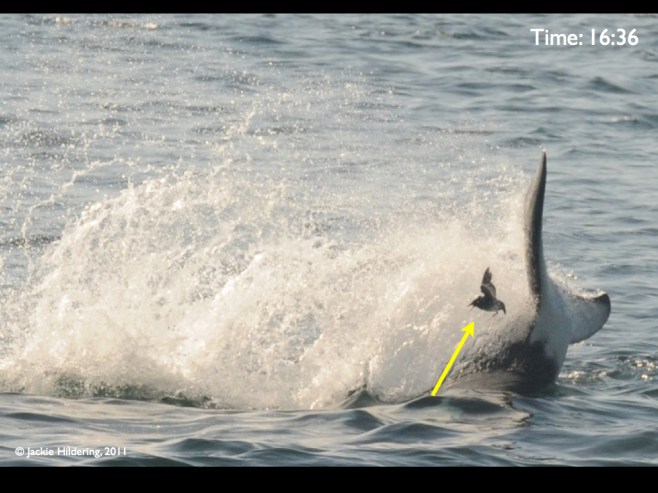
Young Bigg’s Killer Whale grabs Rhinoceros Auklet. Photo: Hildering. All photos taken with telephoto lens and cropped.

That day, I witnessed a very socially active group of Bigg’s Killer Whales repeatedly harassing these birds – mouthing them and slapping them. At least 3  juvenile Rhinoceros Auklets were involved. Since these are diving birds, they cannot “alight” and escape the teeth and fins below them. Yet, I believe they survived.

Bigg’s Killer Whale surfaces right beside a Rhinoceros Auklet. Photo: Hildering.

I personally had never seen such a prolonged display of this play behaviour before. In fact, I had never seen Bigg’s Killer Whales socialize quite so rambunctiously! [Update 2020, now that seals and sea lions are more readily available, members of this population appear to be far less stealthy]. 

Clearly, when their bellies are full and social needs dominate, this type of Orca is anything but stealthy. On August 31st, this incredibly socially active group of 20+ Bigg’s took about 1.5 hours to travel only +/- 4.5 km (2.5 nautical miles) – slapping birds, rolling over one another, tail slapping, vocalizing and breaching along the way. The whales would go on to bound past the community of Alert Bay, Cormorant Island. I have have previously written about this in the blog item “Might As Well Jump.” 

Jared Towers of the Department of Fisheries and Ocean has confirmed the IDs of the Bigg’s Killer Whales in the August 31, 2011 encounter to be:  T010s, T034s, T035s, T037s, T046Bs, and T146s.

Insight into this behaviour is provided by Dr. John Ford and Graeme Ellis. The following interpretation of the behaviour is from the chapter “Seabirds: Playthings and Practice, or Between-Seal Snacks?” in Transients: Mammal-Hunting Killer Whales of British Columbia, Washington, and Southeastern Alaska, 1999. 

“It is not unusual to see transients chasing and harassing seabirds. During most of these incidents, the whales do not seem intent on eating the birds. Rather, they let the bird escape or they abandon it after it has been injured or killed. Seabird harassment appears to be a favourite activity of juvenile transients. The young whales will sometimes swim upside down and on their sides, looking for birds paddling at the surface above. Once a victim is sighted, they will try to slap it with their tail flukes, jump on it, or seize it in their mouth. This interaction may continue for several minutes, before the bird is eaten, incapacitated, or left dead in the whale’s wake. We and others have recorded at least 10 seabird species that have become casualties of transients. Frequent victims are common murres, which are flightless for several weeks during the late summer and are like “sitting ducks” for transients.  Other species include black brant, common loon, white-winged scoter, surf scoter, cormorant (species uncertain), western grebe, marbled murrelet, rhinoceros auklet, and red-breasted merganser.  Seabirds seem to be more important as objects of play or harassment than as a dietary item. Juveniles playing with seabirds no doubt learn useful skills in prey capture and handling that may enhance their success in hunting harbour seals and other wily prey.”  

Bigg’s Killer Whale tail-slapping a Rhinoceros Auklet. Photo: Hildering. 


Sources:

Barrett-Lennard, L.G., Heise, K. 2007. The Natural History and Ecology of Killer Whales: Foraging Specialization in a Generalist Predator. In Estes, J.A., Brownell, R.L., DeMaster, D.P., Doak, D.F., Williams, T.M.  Whales, whaling and ocean ecosystems. University of California Press, Berkely, C.A.

Ford, J.K.B., and Ellis, G.M. 1999. Transients: Mammal-Hunting Killer Whales of British Columbia, Washington, and Southeastern Alaska. UBC Press, Vancouver, and U. of Washington Press, Seattle. 96 pp

Kuker, Katie & Barrett-Lennard, Lance. (2010). A re‐evaluation of the role of killer whales Orcinus orca in a population decline of sea otters Enhydra lutris in the Aleutian Islands and a review of alternative hypotheses. Mammal Review. 40. 103 – 124. 10.1111/j.1365-2907.2009.00156.x.

Sharks Among Us #4 – The Salmon Shark

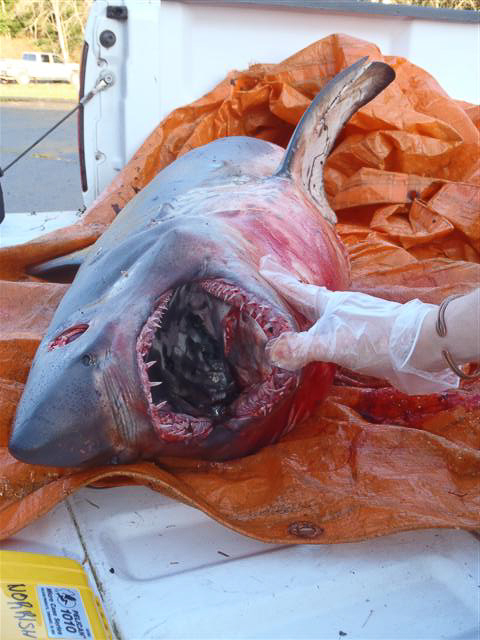
This is a Salmon Shark (Lamna ditropis) that washed up dead on a beach in Carrot Park in Port Hardy, B.C. on November 23rd, 2011. 

Salmon Shark found dead on Port Hardy beach on November 23, 2011. Photo: Mandy Ludlow.

Local Department of Fisheries and Oceans staff conducted an external examination and collected the unfortunate shark so that a full necropsy could be done at a later date.  Although salmon sharks are common in the North Pacific, examining the body may allow science to find out more about the species and how this individual died. 

The dead Salmon Shark was just over 1.5 metres (length from the nose to fork in the tail = fork length). The species can be 3.7 m and weigh up to 454 kg.

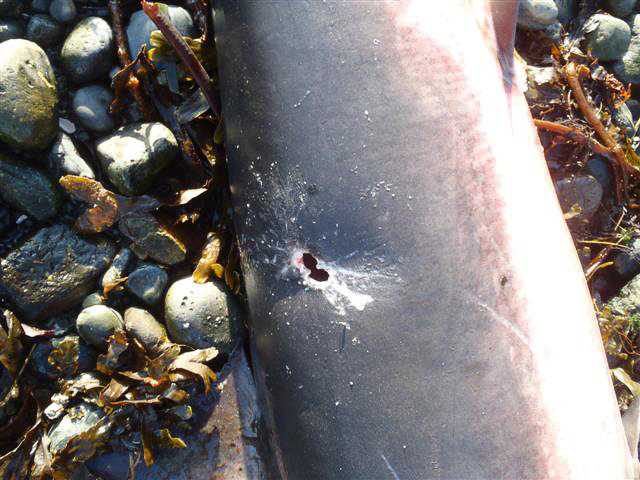
Cut in the pectoral fin suggesting the shark died as a result of by-catch in the longline fishery. Photo: Mandy Ludlow.

Salmon Sharks are of no threat to humans, however, the species does suffer impacts from humanity. 

The Port Hardy Salmon Shark had external injuries that suggest it may have been caught in a fishing net and possibly even shot.  It had a large cut on its tongue and on one of its pectoral fins and there was a circular hole behind the dorsal fin.  Many shark species suffer the threat of  by-catch in nets since they are targeting the same species we humans are fishing for.  

If it is determined that this shark indeed was caught in a net, this may be particularly interesting since I believe there are no openings for net fisheries at this time of year. 

Cut also found on the shark’s tongue. Photo: Mandy Ludlow.

Although Salmon Sharks feed on many species of fish, they are indeed a very successful predator of salmon.

Salmon Sharks can regulate their body temperatures to be higher than the temperature of the surrounding water. The Salmon Shark, in fact, has a higher body temperature than any other shark species. Apparently, even when the water is 2° C, their internal temperature can be 16° C.

This ability to thermoregulate is why, in part, Salmon Sharks can be incredibly fast. The US Navy has recorded speeds of up to 80 km/hr.  

I was heartened by the response of the majority of people to the death of this shark. It seems society might be moving beyond the “Jaws Effect” where we demonized sharks because we have bought into their fictitious portrayal.  

Many of us now seem to embrace shark fact rather than fiction, realizing that sharks pose little threat to humans; that they have been shaped by some 200 million years of evolution; that globally they are struggling to survive; and that they have an essential role in marine ecosystems.

Hole behind the dorsal fin. Photo: Mandy Ludlow.

Sharks, as top-level predators, strongly shape food webs.   Loss of such predators has proven to have profound effects on the number and diversity of other species.   

The unenlightened are still out there though. It may be an inevitability that sharks get caught in fishing nets but they need not then be shot or butchered. Locally, I have seen evidence of both. 

[Update: December 22nd, 2011 – The necropsy revealed that this was a female shark. It is also now known that the shark was caught in a hook and line sable fish fishery and that the hole behind the dorsal was the result of a hook. It is rare that there is shark bycatch in this type of non-net fishery.]

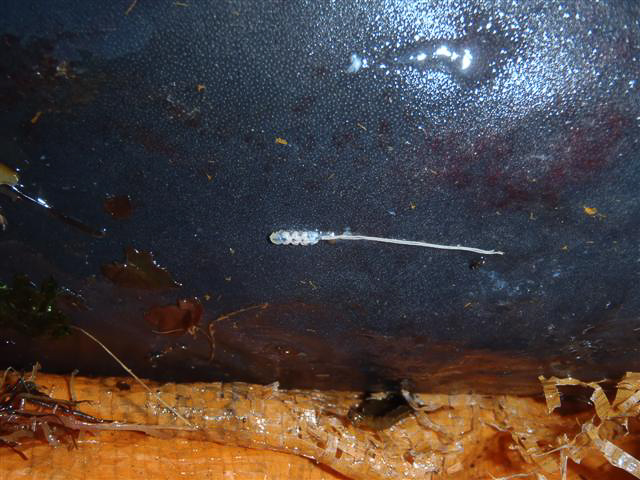
Skin parasite (ectoparasite). I have no expertise here but had suggested that this a copepod from the Caligidae family.

For further information on Salmon Sharks, please refer to the natural history information from ARKive below.  

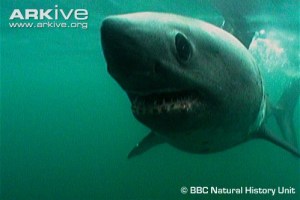
Salmon shark image from ARKive site. Click image for two ARKive videos of salmon sharks hunting. Credit: BBC Natural History Unit.

Salmon Shark Information
from ARKive

Description

A formidable hunter, the salmon shark (Lamna ditropis) is sometimes mistaken for the white shark (Carcharodon carcharias), but can be distinguished by its shorter snout and the dusky blotches that mark the white abdomen of adults (3) (4). The rest of the salmon shark’s stocky, spindle-shaped body is dark bluish-grey or blackish, with white blotches around the base of the pectoral fins. The first dorsal fin is large, while the second dorsal and anal fins are tiny and are able to pivot. Its crescent-shaped tail gives it impressive propulsion through the water (2) (3), while its large, well-developed eyes enable it to spot potential prey (2), and its large, blade-like teeth are well suited to gripping slippery fish(2) (3).

Range

The salmon shark occurs in the North Pacific Ocean. From Japan, North Korea, South Korea and the Pacific coast of Russia, its distribution extends east to the Pacific coast of the U.S.A., Canada, and probably Mexico (3).  See this species on Google Earth.

Habitat

The salmon shark is a coastal and oceanic shark, inhabiting waters between 2.5 and 24 degrees Celsius, generally from the surface down to depths around 152 metres, although one individual has been recorded at 255 metres (3).

Biology

Occurring singly or in schools of several individuals (3), salmon sharks are long distance, high-speed predators (2), occasionally seen at or near the surface in some areas. They can maintain their body temperature well above that of the surrounding cold water of the North Pacific, and may have the highest body temperature of any shark (3). This allows them to maintain warm swimming muscles and internal organs, so they can still hunt effectively in cool waters (2).

The salmon shark is considered to be one of the main predators of the Pacific salmon, and its voracious feeding on this fish has earned it its common name (3). However, it is an opportunistic feeder that consumes a wide variety of fish that also includes (amongst many others) herring, sardines, pollock, Alaska cod, lanternfishes and mackerel. It also feeds on some squid and is sometimes attracted to by-catch dumped back into the ocean by shrimp trawlers (3).

After spending the summer in the north of their range, the salmon shark migrates south to breed. In the western North Pacific they migrate to Japanese waters whereas in the eastern North Pacific, the salmon shark breeds off the coast of Oregon and California, USA. The young are born in spring after a gestation period of around nine months (3). The salmon shark is ovoviviparous (young hatch inside the female; they are nourished by their yolk sac and then ‘born’ live), and oophagy (when the growing embryos eat unfertilized eggs to gain nutrients) has been recorded in this shark (4). Most litters contain between two and five young. Male salmon sharks are thought to mature at about five years and live to at least 27 years; females reach maturity at eight to ten years and are known to live to at least 20 years (3).

Threats

The salmon shark is often caught as by-catch in Japanese, United States and Canadian fisheries. When caught, often just the fins are taken for shark fin soup and the rest is discarded, although sometimes the flesh may be sold for consumption in Japan and the United States (4). Many fishermen view salmon sharks as pests, as they often damage fishing gear, making them more likely to be killed if captured (4). In addition to the threat of by-catch, some recreational fishing for this shark occurs in Alaskan and Canadian waters (4), and some commercial fishing has taken place in the past, such as in Prince William Sound, Alaska (5).

Conservation

In 1997, the Alaska Board of Fisheries closed all commercial shark fishing in state waters and implemented strict regulations in the state sports fishery for salmon sharks (4). Measures such as these are vital in protecting this species’ future, until further research can determine the conservation status of this magnificent predator.

Additional information:

Click here for two ARKIve videos showing Salmon Sharks hunting.

Click here for the petition to ban shark fin products in Canada and here for video by astounding 18-year-old Madison Stewart about the vilification of sharks and the atrocities of shark-finning . . . 73 million sharks killed/year for their fins = 190 sharks killed/minute.

Olive Ridley Sea Turtle off the Coast of BC!

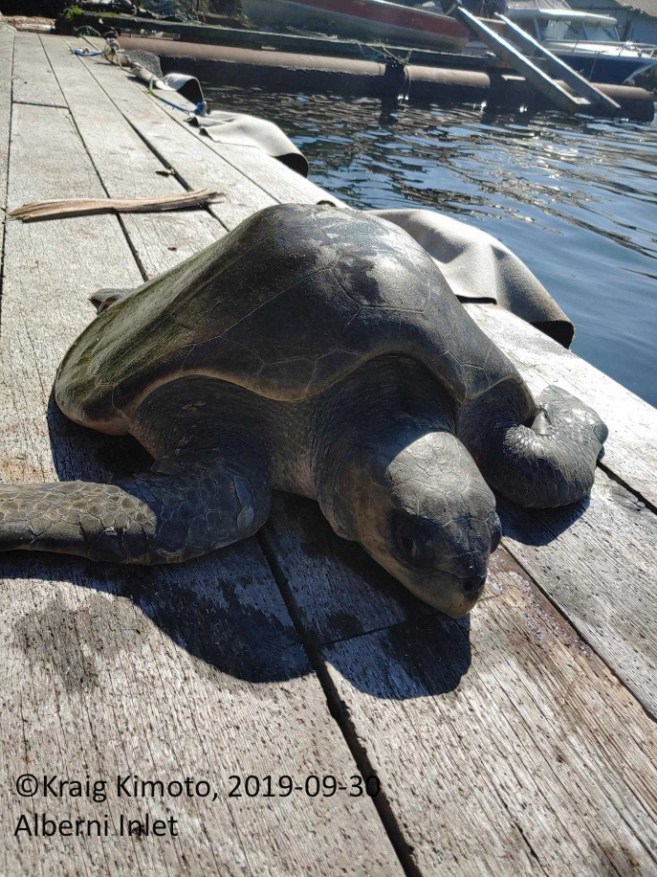
[Update: Another Olive Ridley Sea Turtle was found in BC waters on September 30, 2019 in the Alberni Inlet. It is in care with Marine Mammal Rescue. It is the 4th Olive Ridley Sea Turtle ever known to be off the coast of BC. Has been named “Berni” and progress can be tracked at this link. ]

4th Olive Ridley Turtle known to be found off BC’s coast. Found 2019-09-30 in Alberni Inlet by Kraig Kimoto.

Below, initial blog item about the first ever Olive Ridley Sea Turtle found off the coast of British Columbia in 2011.


An Olive Ridley Sea Turtle (Lepidochelys olivacea) washed up on the southwest side of Vancouver Island in the Pacific Rim National Park on November 23rd, 2011. It was alive when found but tragically has died Since sea turtles other than Leatherbacks can go into a comatose-like state due to “cold stunning”, great care was taken to ensure the turtle was indeed dead. The necropsy determined that the turtle had suffered blunt force trauma, which suggests there had been a collision with a boat. 

This 2011 sighting is the first known sighting of this sea turtle species in British Columbian waters although, since they have been sighted in Alaska and Washington, it was anticipated that B.C. is part of their range. With the find of this unfortunate Olive Ridley Sea Turtle, B.C. can officially state that there are  3 species of sea turtle known to be in our waters. The other two are the Leatherback Sea Turtle (endangered and belongs in our waters) and Green Sea Turtle (endangered and also a species that would go into cold shock).  The Olive Ridley is the smallest of the world’s sea turtles with a maximum size of 1 metre. 

For facts about the natural history and conservation concerns for Olive Ridley Sea Turtles, click here for the Cetacean Sightings Network’s fact sheet. Click here to directly link to the International Union for Conservation of Nature’s (IUCN) assessment report determining this species is “Vulnerable”; one risk level below Endangered on the IUCN Red List of Threatened Species. The report includes natural history information in addition to relaying conservation concerns.

I was unsuccessful in finding out the origin of this turtle species’ unique name. “Olive” is due to the colour of the carapace but why “Ridley”?

From the Westerly News article about the 2011 historic sighting: Westerly News; November 25, 2011; “Sea turtle found in Pacific Rim park – A first for B.C. waters”

A sea turtle species never before observed in B.C. waters was discovered at Wickaninnish Beach in Pacific Rim National Park reserve this week.

A species of sea turtle never before seen in B.C. waters arrived on Wickaninnish Beach this week.

Parks Canada, the Department of Fisheries and Oceans, and the Vancouver Aquarium worked together to confirm the event as the first-ever sighting of an olive ridley sea turtle in B.C. waters.

“B.C. residents can be proud to learn that we now officially have three sea turtle species in our waters,” stated a media release from the three organizations involved.

A visitor to Pacific Rim National Park Reserve discovered the stranded and badly injured turtle on the beach on Tuesday. The visitor alerted park staff who examined the turtle and noted it had a broken shell and very few signs of life, only occasional flipper and eye movements.

Staff took the turtle away for monitoring and transport and on Wednesday staff from Fisheries and Oceans Canada’s Marine Mammal Response Network took the turtle for further examination.

The Vancouver Aquarium Marine Science Centre provided help identifying and assessing the turtle, stabilizing the animal and recommending treatment.

“Since there was a small chance the turtle was affected by cold-stunning, a comatose state that develops in sea turtles that are exposed to sub-optimal temperatures, the turtle was transported to the aquarium where Dr. Martin Haulena and his team could do an examination,” stated the media release.
At the aquarium’s hospital, the team provided emergency treatment including fluids. An electrocardiogram and ultrasound were performed to look for a heartbeat.

Although there were faint electrical deflections noted, they were very weak and very infrequent. It was confirmed dead the very next morning.” On Thursday, B.C. Ministry of Agriculture pathologist, Dr. Stephen Raverty, performed a necropsy at the Animal Health Centre in Abbotsford in collaboration with Fisheries and Oceans Canada and Vancouver Aquarium veterinary staff.

The necropsy found that the turtle was a sub-adult female that died of blunt force trauma of an unknown source. Two small pieces of hard plastic were found in the turtle’s stomach. “Although not the cause of death for this turtle, the finding was an important reminder that the ingestion of marine debris is a significant threat to sea turtles.”

Future plans for the turtle’s body include genetic testing to confirm its species and to determine which population she belonged to. “It is not yet clear which population the turtle comes from, but [the] closest olive ridley nesting areas are on Pacific beaches of Mexico and Central America.”

The olive ridley is a small sea turtle that typically lives in tropical and warm waters.

“Scientists had been anticipating evidence that the olive ridley sea turtle was found in B.C. waters,” stated the media release, “since other sightings have been confirmed in Alaska and Washington.”

“Parks Canada, Fisheries and Oceans Canada and the Vancouver Aquarium appreciate the public’s role in reporting this important marine animal sighting.  Reports of dead, injured, distressed marine mammals and sea turtles can be reported to the Marine Mammal Response Network hotline 1-800-465-4336. Sightings of live, free swimming sea turtle and cetaceans can be reported to the Vancouver Aquarium’s BC Cetacean Sightings Network at 1-866-ISAWONE. When inside a national park, reports can be made directly to Parks Canada staff.

Further links related to sea turtle standings in British Columbia:

The Tide is High . . .

The tide is high and I’m holding on . . . in attempting to explain the following.

Truth is, even thought I taught science for years and live by the tides, I get a little dizzy when I strive to explain how our winter tides can be particularly high and low.

Why this is topical is because, this Friday, November 25th, there will be an extremely high tide and a very large tidal exchange. Tide tables for Alert Bay indicate that the ocean will bulge to a 17.44′ (5.3 m) high at around 12:30. Then it will drop by 17.16′ (5.2 m) to a 0.28′ (8.5 cm) low tide around 7:30 PM. It is relevant that this is happening in the winter.

To challenge my teacher skills, I will try to be as succinct as possible in explaining what is causing this.

  • Tides are caused by the gravitational pull of the moon and the sun.
  • The strength of this gravitational pull is constantly changing because the earth is rotating on its axis (cycle of a day; 23 hours and 56 min) while orbiting around the sun (cycle of a year; 365.24 days) and the moon is orbiting around the earth (cycle of a month; 27.3 days).


  • I will not get into the detail of how this happens, but because of the movement of the moon relative to the earth, a “tidal day” is about 24 hours and 50 minutes long so the cycle of high and low tides is about 50 minutes later each day. In our position on earth, we get “mixed semi-diurnal tides”  which means that over 24 hours and 50 minutes we get a high tide, then a low tide, another high tide (of a different height that the first high tide), and then another low tide (of a different height that the first low tide). 
  • When the moon and sun are in line with the earth, their gravitational forces combine and the high tides are higher and the low tides are lower. These strong tides are known as Spring tides (but they have NOTHING to do with the season “Spring”!) There are two scenarios when the moon and sun are in a line. (1) Full Moon and (2) New Moon. Please see diagram below. 


  • This Friday, we have a New Moon. The moon will be in a line between the sun and the earth. The sun and the moon will therefore combine their forces on the ocean making for a really high tide and a really low tide.
  • HOWEVER, it is also significant that it is winter for us now. The gravitational pull is even greater because, the way the earth travels in its yearly elliptical orbit around the sun, it is closest to the sun during the northern hemisphere’s winter. The earth is closer to the sun so there is an even greater gravitational pull.
  • Wait, if the earth is closest to the sun in the winter WHY is it colder for us right now?! This is because of the way the earth tilts. Our half of the world is tilted away from the sun right now. The southern hemisphere is basking in the rays.

How was that explanation?

How about this animation? Does it offer any greater clarity?


Okay, how about this . . . Blondie, from 1980!  

Your reward for “hanging on” in wanting to understand why  . . . the tide is high! 


Update:

As a very valued by-product of his reading this blog, Rod Gray dared go where I did not and shared an explanation of why we have 2 high tides and 2 low tides per day in our area (i.e mixed semidiurnal tides):

“The “main” high tide, the one caused by the earth rotating under the bulge in the ocean caused by the moon’s gravitational pull is easy enough to understand, but what about the other tide, caused by a bulge on the other side of the earth? The (very simplified) explanation goes like this:

To say that the moon orbits the earth is not precisely correct. Actually, the moon and the earth both orbit around a common point which is their center of combined mass. This point happens to be within the earth, but not at its center. Thus, the position of the earth (within the earth/moon system) is not stationary, but travelling in a relatively small circle (whose period is that of the moon’s orbit around the earth). Therefore, just as a person on a merry-go-round feels an apparent centrifugal force (seemingly) pulling them away from the center, the ocean (on the opposite side from the bulge caused by the moon’s gravity) also bulges in response to the apparent centrifugal force caused by the earth “orbiting” around the earth/moon center of gravity. In other words, one of the high tides is caused by the pull of the moon, and the other high tide is caused by centrifugal force.”

Yeah Rod!  And thank you!

Giant Pacific Octopus – Video

Giant Pacific Octopus subtly changing colour and texture. Video by Erika Grebeldinger.

Remarkable video of a Giant Pacific Octopus juvenile subtly changing texture and colour to better match its surroundings.

When full grown, this species can be over 7 m from arm tip to arm tip and over 73 kg = the biggest species of octopus in the world.

The video was taken by fellow Top Island Econauts Dive Club diver Erika Grebeldinger during one of our dives last month. It is testament to the calibre of her diving and concern for the environment that she was able to “capture” such natural behaviour. It the octopus had been agitated, s/he would have flashed red, postured and/or inked.

Having previously posted this video on Facebook, I love Will Soltau’s observation of how the octopus leaves no footprint and what a different world it would be if we humans were more like octopus in this respect.

Thank you so much for sharing Erika!

Video below added on November 25th, 2011 from You Tube – Octopus walking on land in California at the Fitzgerald Marine Reserve.


Might As Well Jump

When serving as a marine naturalist, one of the questions I am most often asked about whales is “Why do they jump?”

When whales jump it is called “breaching” and the answer to why they do it is not a simple one. Why whales do something depends on context; there is not just one trigger for breaching. This is no different than interpreting human behaviour. For example, if someone is tapping their foot, it could indicate irritation, having an itch, impatience or hearing a good tune!

The breaching of whales can be related to socializing, feeding, mating, communication and/or defence. Of course, when whale calves breach, it  is often related to “play” behaviour which leads to good brain development and coordination. Ultimately,  I believe that the high energy behaviour of breaching must somehow lead to a gain in food and/or increased success in passing on DNA.

Let me share two very specific and recent “cases” of breaching with you; one of which was witnessed by many residents of Alert Bay.

While out in our area with Orcella Expeditions last week, we saw an adult humpback whale breach some 30 times and also witnessed a mature male mammal-eating killer whale (“transient” or “Biggs killer whale”) breach within 30 meters of Alert Bay’s shoreline.

I have never seen anything quite like these two awe-inspiring events.

Humpback whale, ‘KC” on August 30th, 2011. One of the some 30 times he breached in less than 2 hours. Photo: Hildering

The humpback that breached so often was “KC” (BCY0291) who was born in 2002. Initially, I believe the breaching was triggered by the presence of highly vocal fish-eating killer whales (“residents”). Humpbacks do not have teeth with which to defend themselves  but they do have whale barnacle studded fins and a whole helluva lot of heft to throw around so even the mammal-eating type of killer whales very rarely interact with adult humpbacks.

My interpretation is that KC was not habituated to the killer whale dialect he heard that day (I15 and I31 calls) and was making sure he made clear “do NOT mess with me!”. He was posturing to the killer whales. After his killer whale encounter,  he turned around and came upon another humpback whale and again started breaching and making very forceful exhalations called “trumpeting”. Was this communication to the other whale about the presence of the killer whales?  Was it related to a dominance display that may have to do with mating?  I may never know for sure but it is very interesting that KC’s incredible bout of breaching seemed to lead to other humpbacks breaching as well.

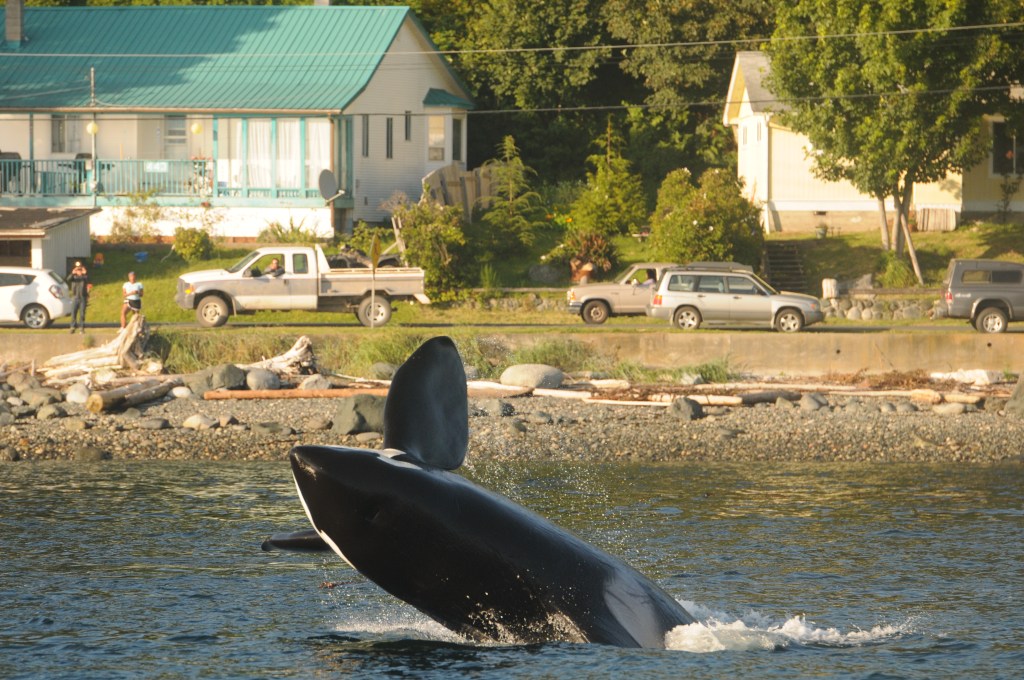
Mature male mammal-eating killer whale “Siwash” breaching in front of Alert Bay on August 31, 2011. Photo: Hildering.
And then . .  there was the mind-blowing, highly witnessed breaching of the 27 year-old killer whale “Siwash” (aka T10B ) in front of Alert Bay. Siwash was travelling with a group of 20+ other mammal-eating killer whales. As mammal-eaters, this type of killer whale has to be stealthy and unpredictable and therefore, they are most often far less vocal and surface active than the fish-eating killer whales. This certainly wasn’t the case as they bounded past Alert Bay last Wednesday evening! They were swimming on their backs; fin slapping and travelling right past the shore; calves were “cat and mousing” small diving birds – whacking them around; and there were even male sex organs to be seen at the surface!

What was going on?  Let me state the obvious – they were socializing. Their bellies must have been full enough to allow them to throw stealth to the wind. These particular whales would most often not travel together so the socializing might even be related to mating.

But ultimately . . . in trying to understand the behaviour of these sentient beings, we have to have the humility to accept that we  may only ever have hypotheses for why they do what they do. It is the stuff of awe and wonder that the mighty Max̱’inux̱ were so visible to the very people that have such a strong cultural connection to them, as they swam by Alert Bay  . . . . “Home of the Killer Whale.” 

Bottomless Biodiversity

It is understandable that the human psyche has trouble being mindful of what cannot easily be seen.  However, when it comes to marine conservation, this “out of sight, out of mind” perception carries a particularly high cost. 

The waters of the northeast Pacific are dark, making it very difficult to see into the depths.  This means many people are inclined to believe that more life is found in tropical waters, where you can peer right down to the ocean bottom and see colourful fish swimming about.

However, the exact opposite is true.

White-and-orange-tipped Nudibranch. Photo: Hildering.
 

Puget Sound King Crab. Photo: Hildering.
 

It is plankton – the fuel of the food chain – that creates the dark, emerald waters of the northeast Pacific. The plant-like plankton, known as “phytoplankton”, need light, oxygen and nutrients to grow.

While our area does not have more light than the tropics, cold water dissolves more oxygen and nutrients are better circulated due to the current caused by large tidal exchanges.

Basket Star. Photo: Hildering.


In fact, here, we’re so fortunate to have the potential of maintaining the formula for the greatest abundance and diversity of marine life: cold, clean, high-current waters that are dark with a thick, rich soup of plankton.

What motivates me to descend into these cold waters with my camera, is to collect the photographic evidence of just how rich and colourful our marine neighbours are . . . bringing the life into sight and, very hopefully, creating mindfulness of the great need for marine conservation. 

Hooded Nudibranch. Photo: Hildering.


Juvenile decorated warbonnet inside a boot sponge. Photo: Hildering.


Humpback whales BCX0022 (aka Houdini) and BCZ0004 (aka Stripe). Photo: Hildering.
 

To learn more about zooplankton, see the fantastic BioMEDIA site. Shows images of zooplankton and the adult organism it will turn into.
Extraordinary Privilege – From on high to down deep.

Humpback whale BCY0768 viewed lunge feeding from 700+ feet above the whale. Telephoto and cropped. Photo: Hildering

Do you have 2.5 minutes?

I’ve compressed the highlights of my marine adventures of  that last 24+ hours into a little slide show. What an extraordinary privilege it has been.

Yesterday, while in a helicopter some 1,000 feet above them, I watched humpback whales lunge feed. 

Today, on the way to our weekly dive, there was a bit of a diversion . . . 3 matrilines (family groups) of fish-eating killer whales needed to pass before we could proceed.

While getting into our dive gear, in the sunshine, a few Pacific white-sided dolphins swam by. 

Then . . . there was the dive with so much more beauty and bounty.

Sometimes, I feel like I might explode with the wonder and privilege of it all. 

Thankfully, I have avenues like this to share and to feel like I might be able to make these adventures count; to enhance understanding and conservation for all this beauty and biodiversity.

Please share in the wonder with me.

Click this link to go from high above the northeast Pacific, into her depths.

(Last video in the gallery at this link). 

Diamondback nudibranch (sea slug) among red soft coral, sponge and brooding anemones. This specimen only about 5 cm long. Photo: Hildering


Beethoven the Humpback Whale! What’s in a Name?

Da-da-da-dum!  

We now have a Humpback that we’ll refer to as “Beethoven” thanks to the great creativity of Maureen and Dave Towers of Seasmoke Whale Watching.

Let me explain why we think this nickname is particularly clever.

The convention in assigning a British Columbian catalogue number to Humpback Whales is that it reflects the amount of black or white on the underside of the whale’s tail. 

The Humpbacks are determined to be an:

  • “X” if there is lots of black on the underside of the tail (less than 20% white)
  • “Y”  if there is an intermediate amount of white on the underside of the tail (20 to 80% white); or
  • “Z” if there is lots of white on the underside of the tail (more than 80% white)

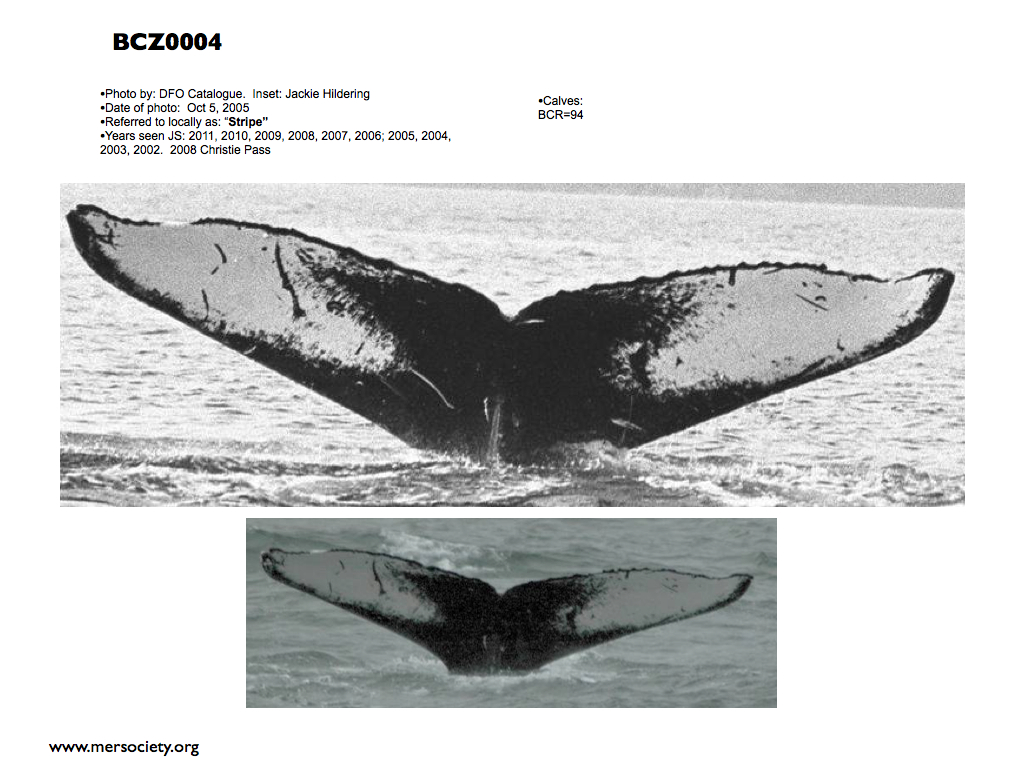
For example, BCZ0004 is the 4th Humpback with a lot of white on his/her tail to be photographed in BC and catalogued. 

(Note: Up to 2010, these catalogue numbers would be assigned by Fisheries and Oceans Canada (DFO), to which we at the Marine Education and Research Society (MERS) would contribute our ID photos. Since 2010, DFO has not catalogued Humpbacks whereby there are now also numbers such as BCZuk2012#3. Please see the end of this blog for an explanation of the “uk”).

BCZ0004?  It’s not such an easy name to remember is it?  So, years ago, we started assigning nicknames to the whales with the guideline that the name should somehow give a clue to the identification of the whale. The hope was that this would help people discern the whales as individuals. For example, I am responsible for giving BCZ004 the nickname “Stripe”.  See the ID page from our MERS Humpback catalogue below and determine if you think this name is fitting.

Click to enlarge. BCZ0004 aka “Stripe”. ID photos from DFO catalogue and Hildering.

Okay , so it’s not a creative name but – it worked!  People associated the stripe-like marking with the whale and could identify “Stripe” as an individual. 

Here you have the female “Chunky”, aka BCX0081.

Click to enlarge. BCX0081 aka “Chunky”. ID photos from DFO catalogue and Hildering.

Not to be confused with “Vader”, aka BCX0989, who also has a distinct v-shaped marking (may the force be with you for this one). 

Click to enlarge. BCX0989 aka “Vader”. ID photo contributed to MERS by Jacqueline McGill.

And then there are the more creative names, like “Niagara” for BCY0057 whose tail has a white spot shaped like a waterfall. 

Click to enlarge. BCY0057 aka “Niagara”. ID photos from DFO catalogue and Dr. Alexandra Morton.

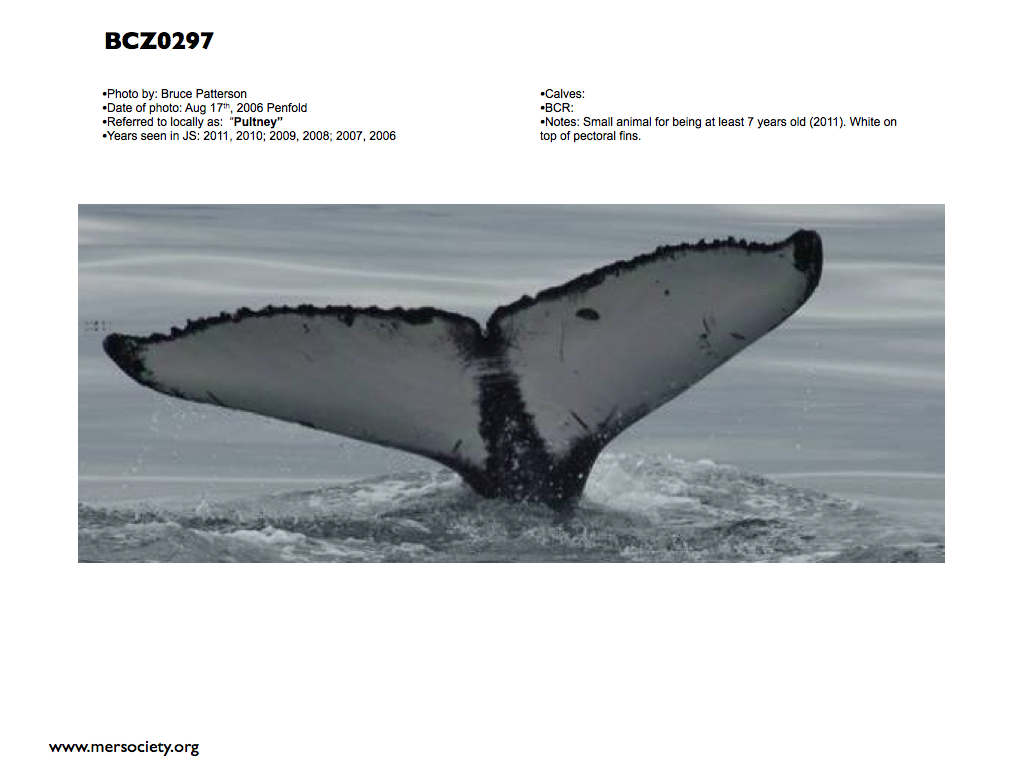
“Pulteney”, aka BCZ0297, has been named with the Pulteney lighthouse in mind. See the lighthouse on BCZ0297’s tail?

Click to enlarge. BCZ0297 aka “Pultney”. ID photo contributed to MERS by Bruce Paterson.

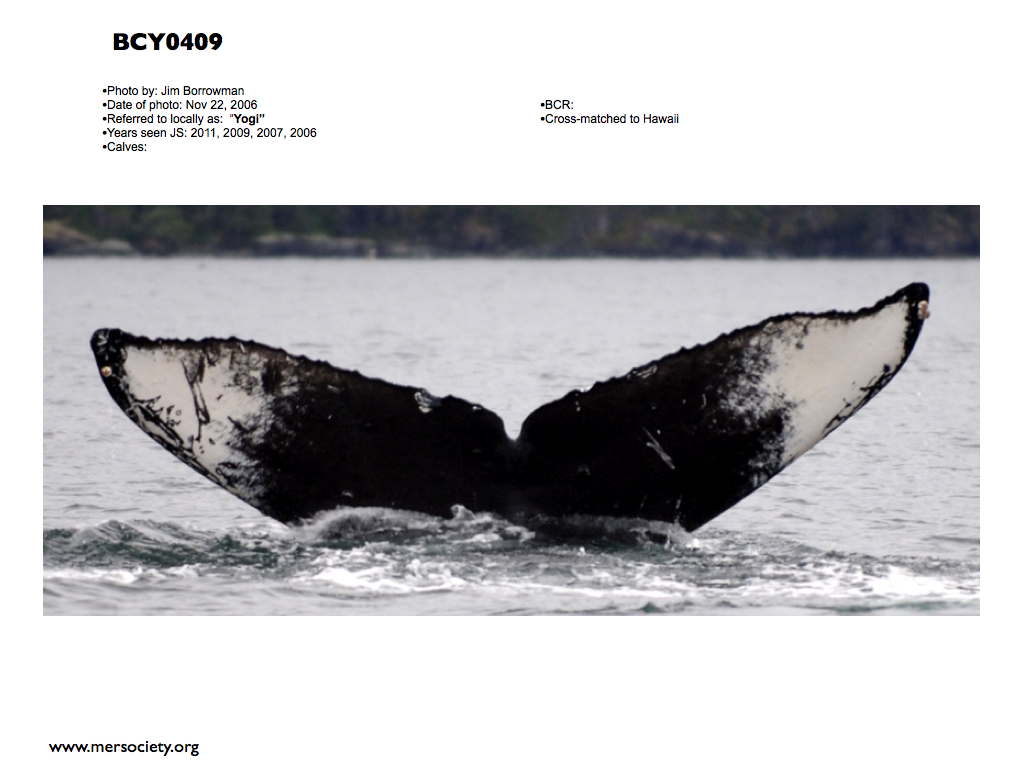
Sometimes, the name may seem even more like taking a Rorschach Test (ink blotch test). For example, see the shape of a bear’s head on the left part of “Yogi’s” tail (aka BCY0409)? 

Click to enlarge. BCY0409 aka “Yogi”. ID photo by Jim Borrowman, Stubbs Island Whale Watching.

For the greater good, we often get local children involved in the naming and as a result have Humpbacks with highly creative nicknames like “Rocket”, “Sprinter”, “Hunter”, “Shark Tooth”, “Barracuda” and “Ashes”.

Otherwise, it is the person who first shares the sighting of the whale with MERS that has the joy of suggesting a fitting nickname. 

Such was the case with Dave and Maureen. They were the first to photograph the whale below on July 19th and relay the sighting to MERS. It is a Humpback that we had not previously sighted in the area. 

Click to enlarge. Photo by Dave Towers, Seasmoke Whale Watching.

See the dot-dot-dot-stripe on the tail?  

While “Dot-Dot-Dot-Stripe” is a very literal name, in musical notation for conductors “dot-dot-dot-stripe” signifies . . . da-da-da-dum. 

Da-da-da-dum!  Like in Beethoven’s Fifth Symphony! 

Hence, there is now a Humpback whale nicknamed “Beethoven”.

Thank you Dave and Maureen – a gold star to you!

Note, regarding “uk” codes: Until 2010, Fisheries and Oceans Canada (DFO) ultimately assigned a catalogue number to Humpbacks in British Columbia. We at MERS contributed our data for this centralizing cataloguing and would assign a temporary “uk” (unknown) designation for whales not already in the DFO catalogue e.g. BCZuk2012#2 has a mostly black fluke, is not in the 2010 DFO catalogue, and was first documented by MERS in 2012. We are currently (2018) collaborating with colleagues to achieve an updated province-wide catalogue for Humpback Whales sighted off British Columbia’s coast.

The MERS Humpback catalogue can be downloaded via this link.