Join me in the cold, dark, life-sustaining NE Pacific Ocean to discover the great beauty, mystery and fragility hidden there.

Posts tagged ‘orca’

What’s At Stake – Images Speaking Louder Than Words

Three minutes of images speaking louder than words . . .

This short slide show of my images testifies to the astonishing marine biodiversity of Northern Vancouver Island and what is put at risk with projects like the Enbridge Northern Gateway Project which would bring super-tanker traffic of toxic bitumen and condensate to B.C.’s fragile coast, and to the waters on which we depend for oxygen, food, buffering of climate change gases, aesthetics and so much more.

I have submitted this slide show for inclusion on “Hope, the Whale”, a 25′ whale sculpture being brought to the Vancouver Enbridge public hearings (January 14 to 18, 2013) “to symbolize the expansive and growing community of people with a vision of an oil-free coast in BC. The sculpture is designed to be a welcoming, collaborative, visual, interactive and peaceful approach to supporting a healthy environment. The whale will amplify our a collective messages of hope and a vision for a healthy ocean, water, land, communities, green economy, cultures and people.” See this link to contribute your message.

For more information, see my testimony to the Joint Review Panel included in my blog item “Super Natural or Super Tanker?” at this link.

WILD New Year

For you – that we may live lives of greater depth in 2013 and beyond.

Happy New Year! 

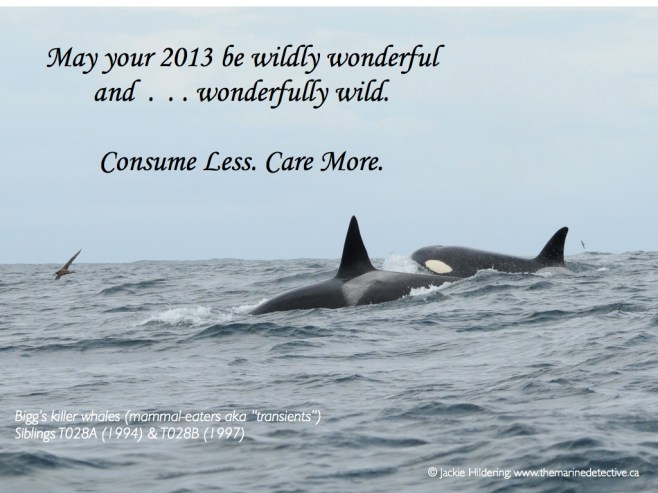
Siblings T028A (born 1994) and T028B (born 1997) - mammal-eating killer whales (known as "Bigg's killer whales / "transients").

Siblings T028A (born 1994) and T028B (born 1997) – mammal-eating killer whales (known as “Bigg’s killer whales / “transients”). Photo: Hildering

Might As Well Jump

When serving as a marine naturalist, one of the questions I am most often asked about whales is “Why do they jump?”

When whales jump it is called “breaching” and the answer to why they do it is not a simple one. Why whales do something depends on context; there is not just one trigger for breaching. This is no different than interpreting human behaviour. For example, if someone is tapping their foot, it could indicate irritation, having an itch, impatience or hearing a good tune!

The breaching of whales can be related to socializing, feeding, mating, communication and/or defence. Of course, when whale calves breach, it  is often related to “play” behaviour which leads to good brain development and coordination. Ultimately,  I believe that the high energy behaviour of breaching must somehow lead to a gain in food and/or increased success in passing on DNA.

Let me share two very specific and recent “cases” of breaching with you; one of which was witnessed by many residents of Alert Bay.

While out in our area with Orcella Expeditions last week, we saw an adult humpback whale breach some 30 times and also witnessed a mature male mammal-eating killer whale (“transient” or “Biggs killer whale”) breach within 30 meters of Alert Bay’s shoreline.

I have never seen anything quite like these two awe-inspiring events.

Humpback whale, ‘KC” on August 30th, 2011. One of the some 30 times he breached in less than 2 hours. Photo: Hildering

The humpback that breached so often was “KC” (BCY0291) who was born in 2002. Initially, I believe the breaching was triggered by the presence of highly vocal fish-eating killer whales (“residents”). Humpbacks do not have teeth with which to defend themselves  but they do have whale barnacle studded fins and a whole helluva lot of heft to throw around so even the mammal-eating type of killer whales very rarely interact with adult humpbacks.

My interpretation is that KC was not habituated to the killer whale dialect he heard that day (I15 and I31 calls) and was making sure he made clear “do NOT mess with me!”. He was posturing to the killer whales. After his killer whale encounter,  he turned around and came upon another humpback whale and again started breaching and making very forceful exhalations called “trumpeting”. Was this communication to the other whale about the presence of the killer whales?  Was it related to a dominance display that may have to do with mating?  I may never know for sure but it is very interesting that KC’s incredible bout of breaching seemed to lead to other humpbacks breaching as well.

Mature male mammal-eating killer whale “Siwash” breaching in front of Alert Bay on August 31, 2011. Photo: Hildering.

And then . .  there was the mind-blowing, highly witnessed breaching of the 27 year-old killer whale “Siwash” (aka T10B ) in front of Alert Bay. Siwash was travelling with a group of 20+ other mammal-eating killer whales. As mammal-eaters, this type of killer whale has to be stealthy and unpredictable and therefore, they are most often far less vocal and surface active than the fish-eating killer whales. This certainly wasn’t the case as they bounded past Alert Bay last Wednesday evening! They were swimming on their backs; fin slapping and travelling right past the shore; calves were “cat and mousing” small diving birds – whacking them around; and there were even male sex organs to be seen at the surface!

What was going on?  Let me state the obvious – they were socializing. Their bellies must have been full enough to allow them to throw stealth to the wind. These particular whales would most often not travel together so the socializing might even be related to mating.

But ultimately . . . in trying to understand the behaviour of these sentient beings, we have to have the humility to accept that we  may only ever have hypotheses for why they do what they do. It is the stuff of awe and wonder that the mighty Max̱’inux̱ were so visible to the very people that have such a strong cultural connection to them, as they swam by Alert Bay  . . . . “Home of the Killer Whale.” 

Mysterious Killer Whales Come Inshore

Mature male offshore killer whale photographed on March 27, 2011 for research purposes by J. Hildering (telephoto lens). Note ragged edge to the dorsal fin – damage from sharks?


Many Port McNeill (N. Vancouver Island, BC) residents were whale watching on the evening of March 30th and they didn’t have to leave their homes to do so!

A group of 12 offshore killer whales was extremely active right in front of the community; even repeatedly spyhopping (popping their heads out of the water). To have whales this visible near your home is a great gift but, all the more remarkable is that these were very mysterious, threatened whales.

“Offshores” are a distinct type of killer whale that does not mate with the killer whales that eat marine mammals (“transients”) nor with those that feed on fish, mostly salmon (“residents”).

About 300 individual northeastern Pacific offshores have been photographed but studying them is usually very difficult. As their name suggests, they are most often near the continental shelf and they are very wide-ranging. Offshores weren’t even identified till 1979 and weren’t confirmed to be a distinct population until 1989.

So little is known about them. Only very recently did the research of Dr. John Ford et al illuminate what the whales might be doing around the continental shelf and why their teeth are worn down so much more than the teeth of other killer whales. DNA analysis of prey samples confirmed that the diet of offshores includes Pacific sleeper sharks (4m+), a species with very abrasive skin that are found around the continental shelf.  In some cases the offshore killer whales’ teeth are so worn down by the the sharks’ skin that it is believed they become dependent on the help of other offshore killer whales to catch and eat this prey. The offshores’ scarred bodies served as a further hint that they may do battle with sharks.

Their diet is believed to also include other shark species (e.g. salmon sharks, blue sharks) and halibut.

Inshore sightings of these whales provide a very unique opportunity to learn more about them e.g. what they are eating when inshore and why they are so full of toxins.  It is puzzling that offshores killer whales appear to becoming inshore more often and this may be due to a shift in diet or range in their prey.

Luckily one of the world’s leading killer whale researchers, Graeme Ellis of the Pacific Biological Station, was able to join the offshores in front of Port McNeill for this research opportunity.  He was alerted to their presence by the superstars at the Orca Lab (Leah Robinson and Marie Fournier) who first heard these whales’ unique vocals in the Robson Bight area on March 25th.

I too was extraordinarily privileged to be able to contribute some ID photographs from sightings on March 27th and . . . I don’t think I’ll ever quite be the same after watching these mystery whales surfing in 3’ waves.

It all just goes to show that you never know who you’ll meet on Northern Vancouver Island!

[Great thanks to residents of Port McNeill and Angela Smith of Ocean Rose Adventures for helping get photos of a lone male offshore killer whale in Port McNeill Bay on March 27].

For more information on offshore killer whales see:


Brutal, Breath-Taking Beauty – Transient Killer Whales

In our work as the Marine Education and Research Society, Jared Towers, Christie McMillan and I went out on December 4th, 2010 on the waters of Northern Vancouver Island in the hopes of finding a Humpback Whale. We didn’t. Instead Nature gifted us with two sightings of Transient (mammal-eating) Killer Whales; a total of 16 animals (now also known as “Bigg’s Killer Whales“).

First we found the T55s and T19s. The lighting on this December day was so beautiful; when these whales blew, rainbows appeared to erupt around them.

A Mother Hunting: Transient Killer Whale mother T140 and her calf chasing Pacific White-Sided Dolphins. Note Telegraph Cove in the background. Image: ©Jackie Hildering

Then, when in transit back to Alert Bay, we found T139, the T140s and T141s.  We had also seen +/-300 Pacific White-Sided Dolphins in the area so knew that there was a possibility that these Killer Whales might choose to have dinner. The display we then witnessed was both brutal and breath-taking.

One of the mature females erupted out of the water higher than I have ever witnessed. She cleared the surface by at least 1.5 body lengths, apparently having rammed the dolphin that was spinning through the air ahead of her. Other spectacular leaps followed, one where mother and calf leapt at the same time – mother high, her calf lower but in almost perfect synchronicity.

Once aware that the Transient Killer Whales were there, the dolphins cascaded away with incredible energy. We could see them still in full flight, several kilometres away, even more than 10 minutes after the initial attack.  But yes, at least one dolphin did not get away. It is the role of Transient Killer Whales to eat other marine mammals; they need to feed their babies too.

I share some of these photos of these encounters at the link below. Realize that the images were taken with a 400 mm lens.

Even after my 12 years on (and under) these waters, I am left stunned at the area’s beauty, biodiversity and the opportunity to learn. 

Click here for more photos from the December 4, 2010 encounter.

two-by-three-ratio-0772

dsc_0779

dsc_0809


Seeing Whales – Seeing Red

I saw A12 swim by today. A12, also known as Scimitar, is an old female killer whale of the “Northern Resident” population of fish-eating, inshore killer whales. She is about 69-years-old (known as the result of the photo-identification work of Dr. John Ford, Graeme Ellis and the late Dr. Michael Bigg).

A12 is the grand dame of the first family of killer whales I ever saw; an experience that had an impact on me that I will never fully be able to explain. It led me to make a radical career change, moving back to Canada to work as a marine educator on the very waters where I first saw A12.

Seeing her today was as powerful an experience for me as it was the first time I saw her but  . . . there was sadness too and, there was anger.

Last year her son A33 “Nimpkish” went missing. He was around 38-years-old. Mother fish-eating killer whales never leave their sons so we knew there was very little chance of ever seeing him again. Indeed, no one ever has.

With A33 gone, A12 would still sometimes travel with her daughter A34 and A34’s calves and grand-calves but she was also often on her own. Then, as of July 22nd, she was frequently seen with “the three brothers” (the A36s); three mature male killer whales whose mother went missing in 1997. As the only surviving offspring, these males were always together. A12 is closely related to them and it was remarkable to see how the mother with no son, interacted with the sons with no mother.
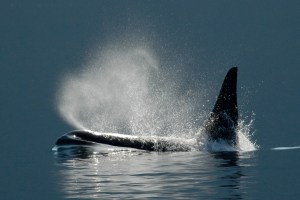
Today, there were only two of the three brothers near A12. The eldest, A32 (aka “Craycroft”) who was around age 46, is now missing.

Another male killer whale gone.

And this is what laced my experience today with anger. But why?  Whales, like everything else, die.

I assure you I am not being overly sentimental. It will never be conclusive what made these whales die but, but, BUT we humans definitely had an influence. Their health, in fact, is an accurate mirror of how our actions impact the environment.

The whales, with their position high in the marine food chain, are full of chemicals like fire retardants and pesticides (the work of Dr. Peter Ross). Despite the many lessons learned with the likes of chemicals like PCBs and DDT, which were banned in 1977, we still do not appropriately test new chemicals and we use chemicals with reckless abandon. The toxic reality is that the ocean is a soup of chemicals – including the old and new (e.g. PBDEs) “persistent organic pollutants” that do not break down; “travel” to the colder areas of the world; build up in the food chain (bioaccumulate and biomagnify), and reduce animals’ ability to fight disease and reproduce.

A32 was above average age for a male killer whale but “average age” has been determined from the data available only after our use of these chemicals. It is not believed to be natural that male killer whales (and the males of many other marine mammal species) die at a much younger age than the females. Their earlier demise has to, at least in part, be due to their toxin loads being much higher than the loads in the females. The females’ toxin levels are lower because females download these fat-soluble toxins in the fatty mother’s milk, to their calves (of course with negative impacts to the calves).

These chemicals had to have an impact on the missing mature males and, the situation literally becomes all the more toxic, when coupled with lack of food. When the whales do not have enough food and use up their fat reserves, the toxins become more concentrated. And 2008 was an appalling year for Chinook salmon, the salmon species essential to the survival of killer whales of the “resident” populations. The work of Dr. John Ford has shown that there is a direct correlation between the survival of these killer whales and the availability of Chinook salmon and, of course, we humans impact the survival of salmon  . . . by habitat loss, over-harvesting, climate change, current open net-cage salmon farming practices, etc.

So today, as I witnessed A32 no longer being with his brothers, I felt the wave of rage come up inside me. Missing whales causes reflection on the state of the environment due to human over-consumption, lack of precaution and disconnect from Nature.

But the wave passed shortly after the whales did. For there is still every reason for hope. As long as people care enough to change, there is hope. The potential for change is endless and there is ample evidence of humanity, increasingly, moving in a direction that considers the link between our daily actions and whales like A12, A33 and A32.

Indeed, there is ample reason for hope as long as there are people like you who read to the end of a lengthy blog entry like this.

Take one further step and click on this link to find out how easy it is to help the whales, and ourselves.

Thank you.
Killer Females – Menopause and Nature’s Plan for Older Females

The most valuable lessons I have learned about being female, I have learned from Killer Whales. For example, it is through my knowledge of these highly cultured whales that I know Nature’s plan for older females.

Let’s face it, human society does not generally help in this regard. As time etches lines into our interiors and exteriors – society does not tell us we are a-okay!  No, the general messaging is about loss, faded youth and endings. Firm up! Dye that hair! Want some Botox baby? We’re sweeping you aside, ‘cause you’re old!

Thank goodness I believe in Mother Nature.

One of my teachers – A12 aka “Scimitar”; born around 1941 and now passed away. She was a Northern resident (fish-eating) Killer Whale who was the grand dame of the A12 matriline.

As I weather the physiological and psychological changes of this time of my life, I know there is purpose in all this. Humans and Killer Whales are among the very few animal species where the females go through menopause; where they can live beyond their child-bearing years as “post-reproductive females”.

In the case of Killer Whale females, they can give birth between the ages of around 12 to 40 but are believed to be able to live to at least age 80. Thereby, female Killer Whales may live almost twice as long as they have babies. On the face of it, this appears to violate one of Mama Nature’s great laws. That is, if you’re going to use our food, you better pass on our genes.

But Nature makes sense. Therefore, the role of post-reproductive females must be so valuable that it “justifies” their using the population’s resources.

Science in fact believes that the old female Killer Whales are the teachers and decision-makers. These grandmas, wizened by their years, are believed to teach mothering skills, how and where to hunt; and they are known to share food, especially with their eldest son. These activities would benefit the population by ensuring that the offspring are better able to survive and mate . . . passing on shared genes. Since first posting this blog a decade ago, there has been further science published on this. Please see sources below. 

The likely role of the old females has been acknowledged in science with the convention being that each family group of Killer Whales is named for the eldest female (e.g. the A12s). Also, the collective name for a group of Killer Whales is “matriline” which loosely translates into “follow your mother”.

Female Killer Whales have taught me that I am not less as I age but rather that there is teaching to be done and leadership to be embraced.

These years are to be lived . . . as a killer female.

Another one of my teachers – A30 aka “Tsitika” with one of her sons, A39 “Pointer”. ©Jackie Hildering.

Studies related to my reflections above: