Let me show you via my photos and a “conversation” with the crab in the next three photos.
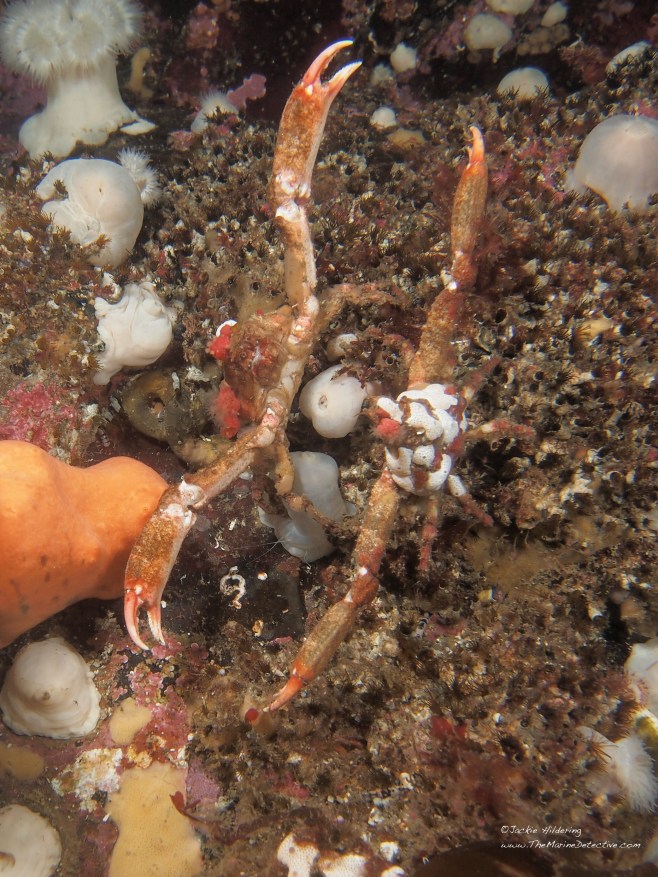
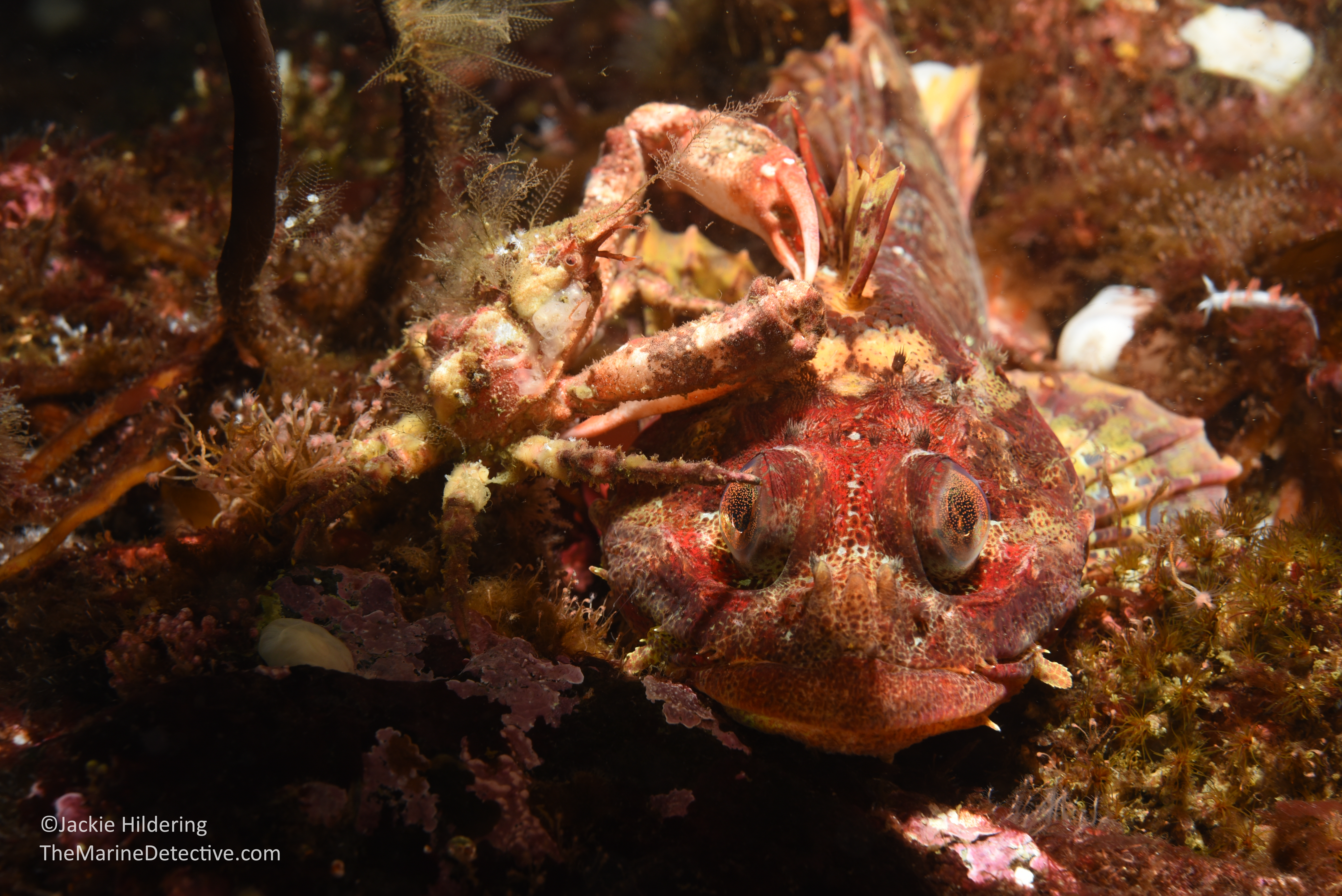
Oh hello mature male Sharpnose Crab. I almost didn’t see you there!
Please may I take a photo of how you have fabulously decorated yourself to camouflage against predators, using bits of algae, sponges, tunicates and hydroids?
It’s fascinating how your species, and others who decorate themselves, have little hooks (setae) on your exoskeleton to which attach life from around you AND that you change outfits when your change backgrounds. Do you sometimes also use the camouflage as easy-to-reach snacks?
Oh, oh! Wait!
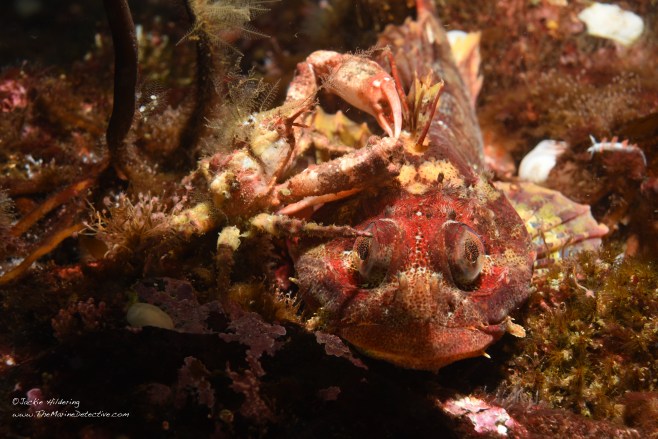
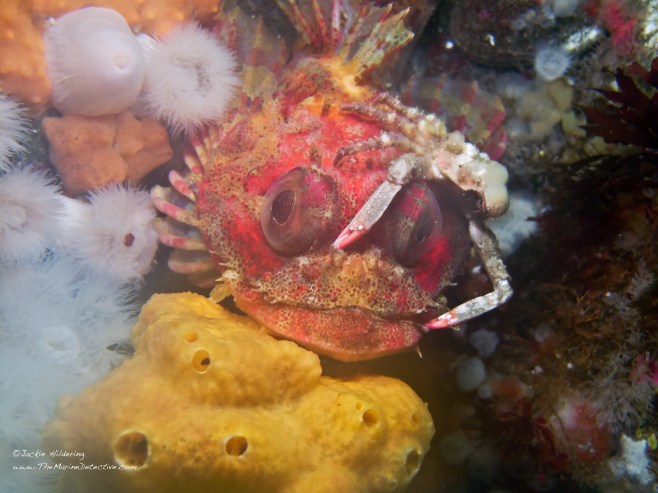
You don’t know you are walking onto the head of a Red Irish Lord, an ambush hunter who is extraordinarily camouflaged too.
Careful! You are on the menu for this fish species.
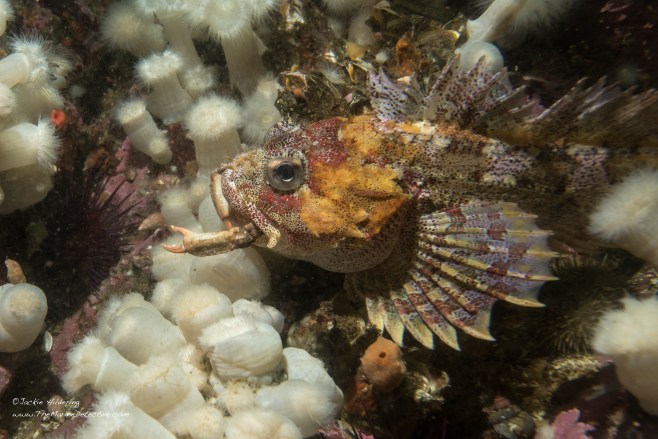
The Red Irish Lord will try to grab you, ideally from the back of your shell. That’s what happened to the crab in the next two photos.
Indeed, that’s the same species of fish. Red Irish Lords have incredible diversity in colour to blend in so that you, and I, have great difficulty detecting them.
When the fish does not have the advantage of a sneak attack, you can defend yourself by spreading out your claws really wide. Like what you see below.
Then, it’s difficult for the Red Irish Lord to fit you into his / her mouth.
Yes, I too imagine the Sharpnose Crab in the above two photos saying, “You want a piece of me?!”
It’s said of your species that you “put little effort into decoration”. Such judgement!
In another species, the Moss Crab (Loxorhynchus crispatus), a correlation has been found between size and how much decoration there is. Once big, especially with claws spread wide, mature crabs cannot easily be gulped up whereby there may be less need for camouflage. Mature males are up to 12.3 cm across the carapace/shell and mature females are up to 7.9 cm across the carapace.
For your species, the Sharpnose Crab (Scyra acutifrons) there can be a HUGE difference in pincher size between mature males and females. Size across the carapace can be up to 4.5 cm but mature males have a far greater reach with their claws than mature females.
By the way what’s with the posturing with mature males of your kind when they do what is shown in the photo below?
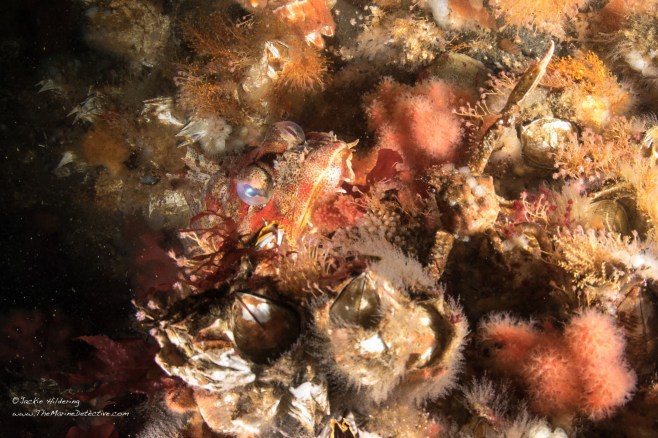
Yours is NOT the only crab species that can be gulped up. I think it might be a Graceful Kelp Crab who has been engulfed by the Red Irish Lord below.
Below is another crab in danger of making a fatal choice as it advances down the face of the Red Irish Lord. See how precarious this is? The fish will remain motionless, waiting, waiting till you are in the ideal position to ambushed from behind. Then your claws are of little use to you.
There you go dear human readers.
I do not know the fate of either of the crabs on the heads of the Red Irish Lords. I had to return to the world where we humans can also make really bad choices.
Why no, my referencing human bad choices on November 4th 2020 is purely coincidental. Insert innocent eye batting here. What choices could I POSSIBLY be referencing? ☺️
Be kind. Be colourful. Be careful. Be truthful. Be safe. 💙
Regarding the photo above, see the Red Irish Lord and the two crabs with outstretched claws?
Here are just five fabulous fish faces from my dive on July 12. These are just the fish who tolerated my taking photos. I am sharing with you to add to the sense of biodiversity hidden in these waters.
Also, I really value what I feel is mirrored back from these fish . . . the “What the hell are YOU and what are you doing here?” It’s good to feel like a visitor in others’ habitat rather than than a human at the epicentre of the universe. It’s below the waves, with the fish, that I best know my place and where I best feel humility. I also feel apology, not just for the disturbance of taking photos but as an ambassador for my species.
Sometimes I think as I look at the life below the surface “I’m trying. Please know, I’m trying”.
Thank you for caring and for trying too.
[Please note that I did not realize when compiling these photos that I have a blog on every species represented here. I suggest that the most insight would be gained from reading this blog first and then accessing the further links I provide here showing video, etc.]
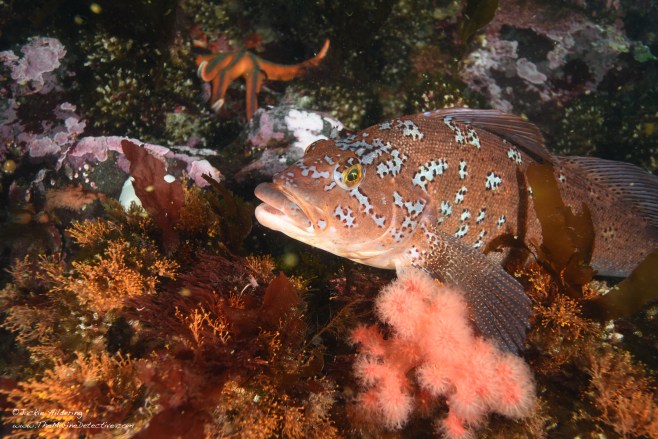
Fish #1
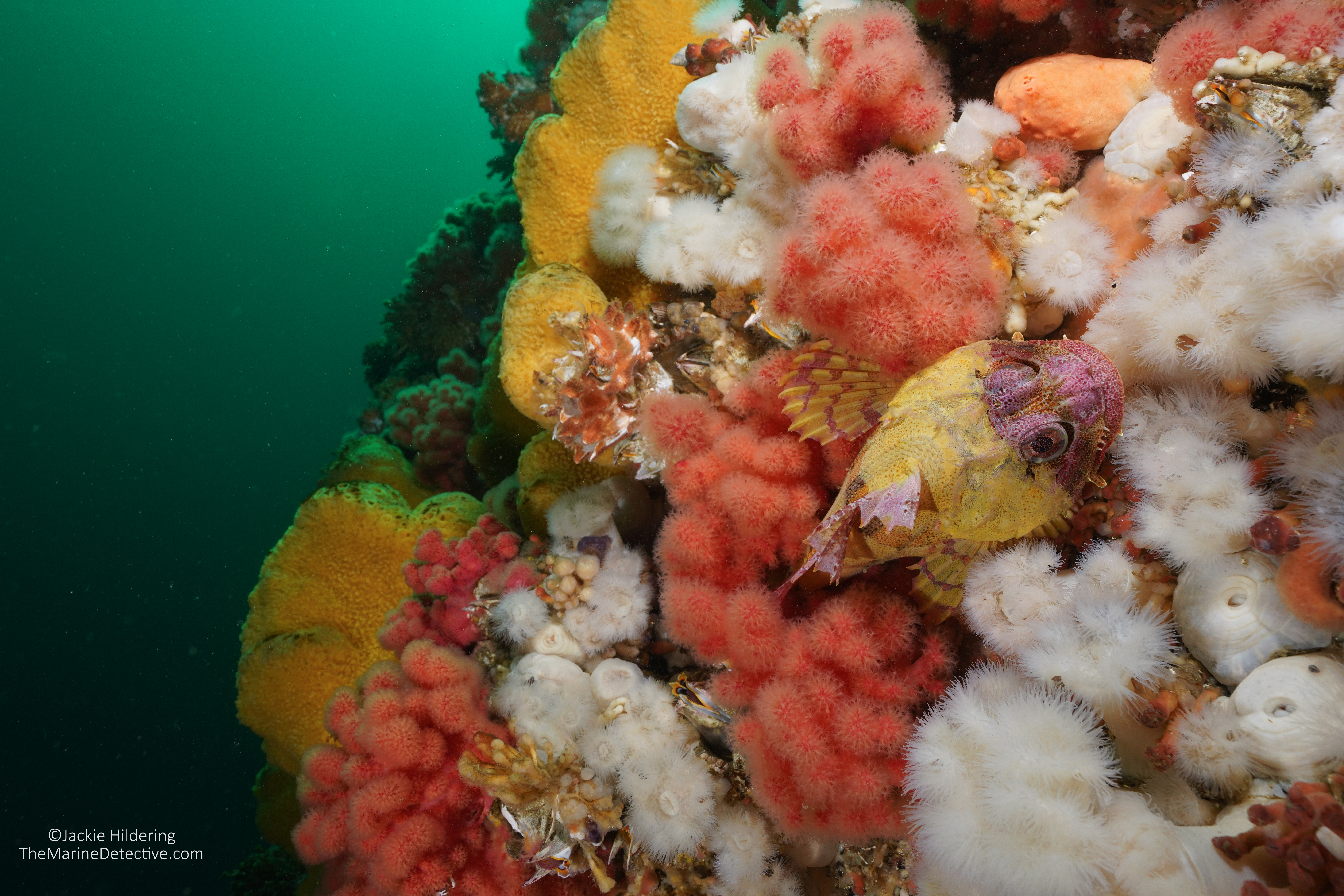
Male Kelp Greenling with a Striped Sunflower Star to his right.
This species seems to so often be chasing one another and they have extraordinary courtship where the males change colour. Males will guard the fertilized eggs.
Video of the courtship is in my blog “Kelp Greenling Colour and Courtship” at this link.
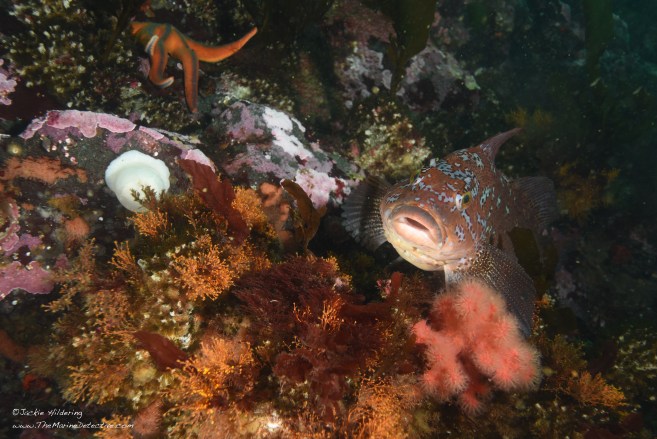
Photo above is another perspective on the same fish. Note that the bright orange life you see here are animals, not plants. They are Orange Hydroids. The soft coral beside the Kelp Greenling’s head is Red Soft Coral.
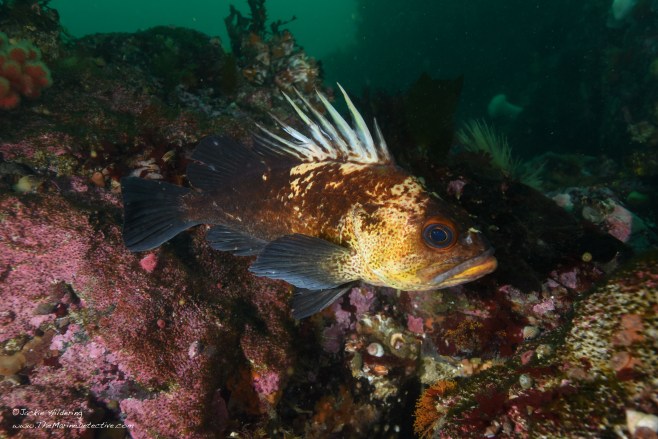
Fish #2 Quillback Rockfish
Quillbacks, like so many of BC’s 34 rockfish species, have been over-exploited.
Rockfish are slow to mature, and are very localized in where they live. Therefore, they are particularly vulnerable to overfishing.
As divers, we’ve seen how Rockfish Conservation Areas can make a real difference for the number, diversity and size of rockfish.
There is no egg-guarding in this species because the young develop inside the females and are born into the water i.e. they are viviparous.
Please see my previous blog “Rockfish Barotrauma” at this link on the importance of Rockfish Conservation Areas and also on how to reverse what happens to rockfish when they are brought up from depth i.e. how to easily reverse barotrauma.
Quillback Rockfish = Sebastes maliger to 61 cm.
Fish Face #3
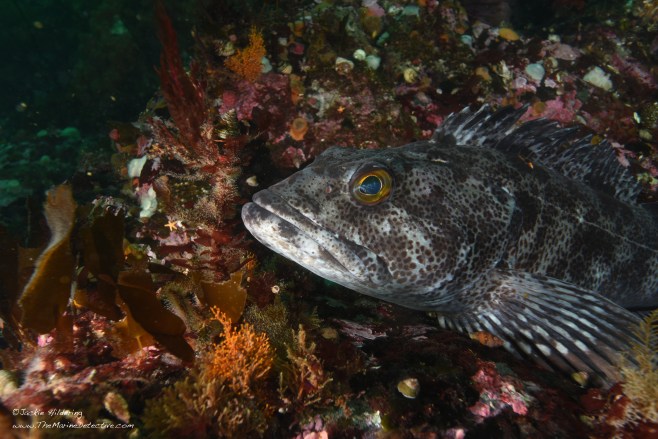
Lingcod
Lingcod males also guard the fertilized eggs. They are extraordinary large masses that look like Styrofoam. We survey for the egg masses each year to get a sense of potential recovery since this species was overexploited. It’s believed the same males guard eggs in the same spot year upon year. This again helps understanding of how many fish have homes whereby fishing intensely in one area can lead easily to overexploitation. My blog “Fastidious, Fanged Fathers” at this link shows the egg masses with information on Ocean Wise’s Lingcod Egg Mass Survey.
Lingcod = Ophiodon elongatus, females larger, to 1.5 m.
Fish Face #4
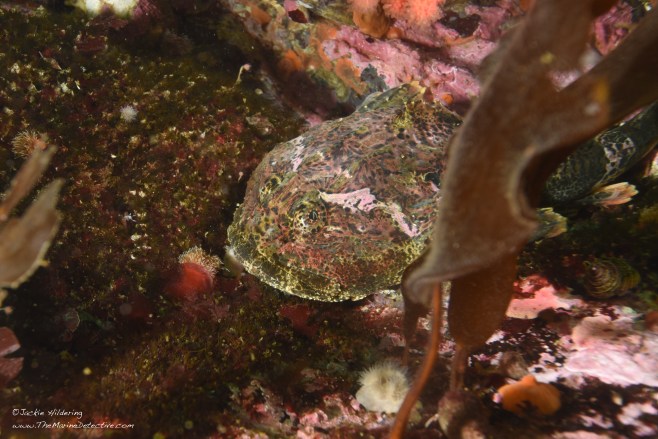
Buffalo Sculpin
Yes, this is a fish, not a rock with eyes.
There is so little understanding about how species like this can change their colour as they do.
It won’t surprise you that the most research is done on “commercially important” species with regards to stock management. Males also guard the fertilized eggs in this species. See my blog “Buffalos Mating Underwater” at this link for photos showing the diversity of colour / camouflage and for photos of the eggs.
Buffalo Sculpin = Enophrys bison to 37 cm long.
Fish #5
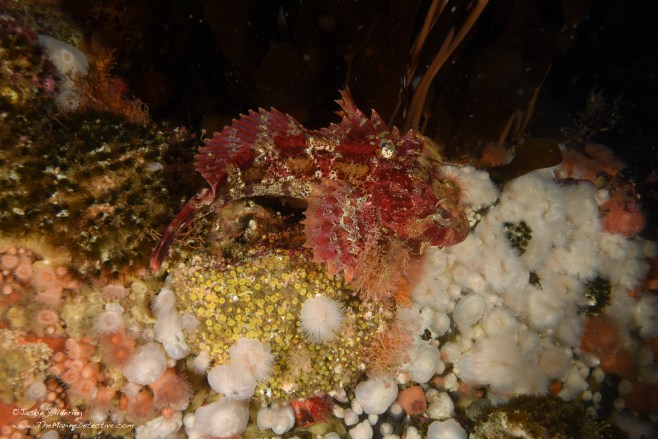
Red Irish Lord
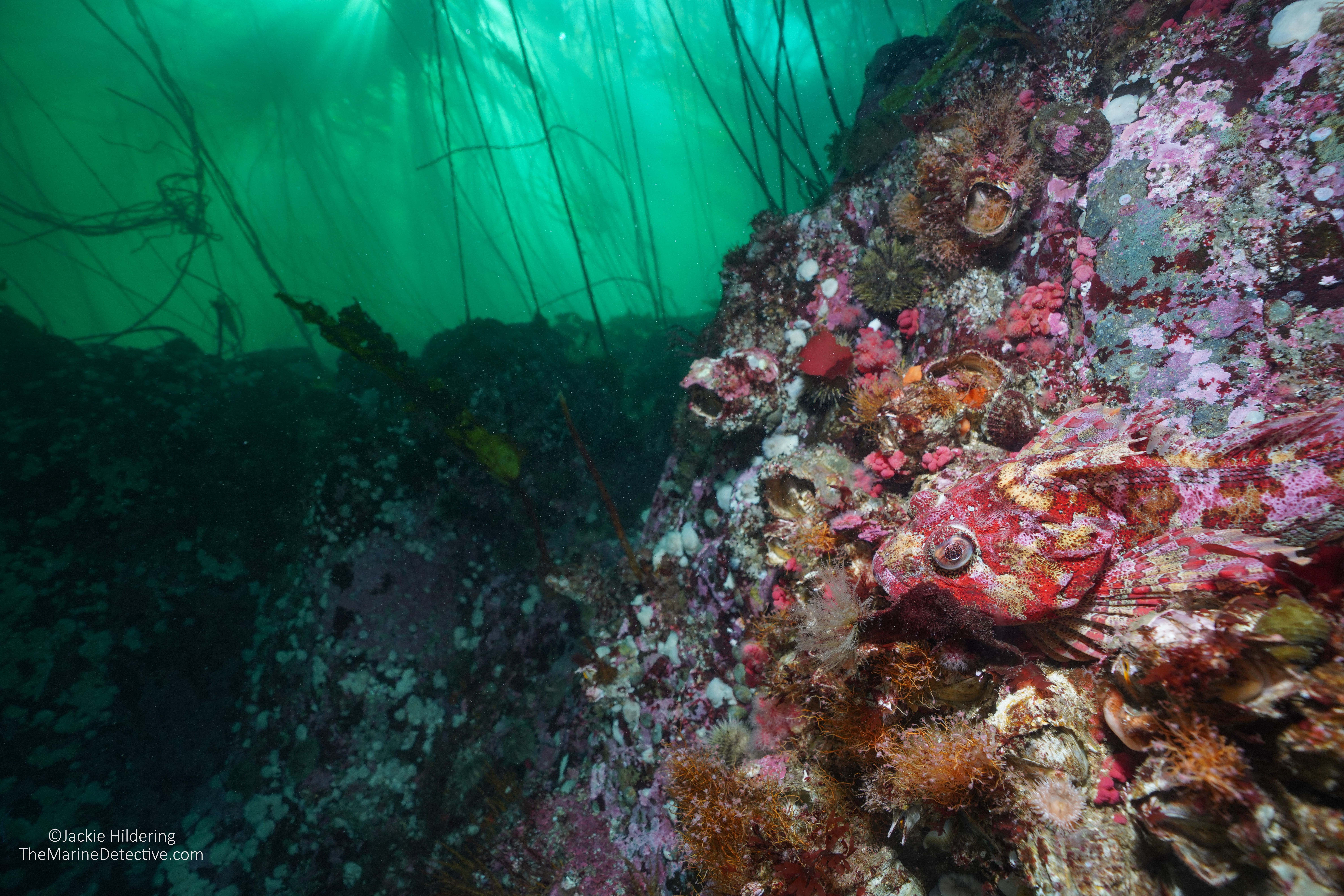
I must have disturbed this Red Irish Lord with my bubbles for him/ her to be easily visible like this. They are usually fully camouflaged.
Note the shell the Red Irish Lord is on. This is a Giant Rock Scallop whose shell has been drilled into by Boring Sponge. Astounding isn’t it to think that Giant Rock Scallops (Crassadoma gigantea to 25 cm across) start off as plankton; are free-swimming to ~2.5 cm; and then attach to the bottom with their right side and can grow to 25 cm. They may live as long as 50 years but there have been problems with human over-harvesting.
Red Irish Lord parents take turns caring for their fertilized eggs (Hemilepidotus hemilepidotus; up to 51 cm).
Please see my blog “In the Eye of the Lord – the Red Irish Lord That Is” at this link.
Lingcod = Hemilepidotus hemilepidotus, to 51 cm long.
And the final photo and thoughts for you dear reader:
Same Red Irish Lord as in the photo above.
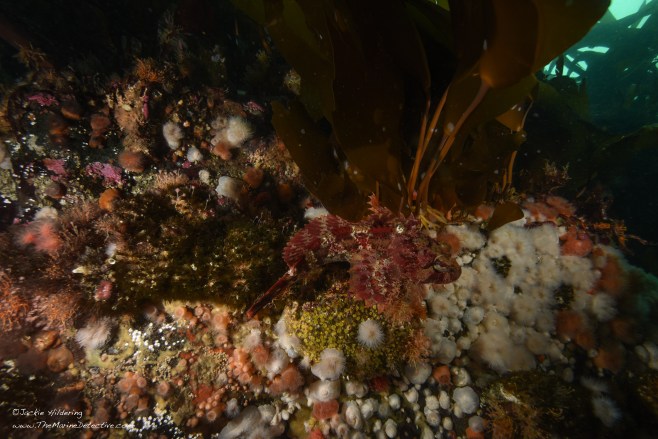
Under the canopy, beams of light shimmering through as they would in a forest of trees, bringing energy to the algae which feed the depths. This is all at only 5m depth. This is life you could imagine when you close your eyes and think of the dark sea off our coast. This is the world where Humpbacks feed, where families of Orca follow the same lineages of Chinook Salmon generation after generation, where species exist without our knowledge let alone our respect. This is their world. This is the world to which all life on earth is connected.
To follow up on yesterday’s blog about Candy-Stripe Shrimp and their association with Crimson Anemones, here’s another ambassador from my last dive who shatters the notion that these waters do not explode with colour and biodiversity.
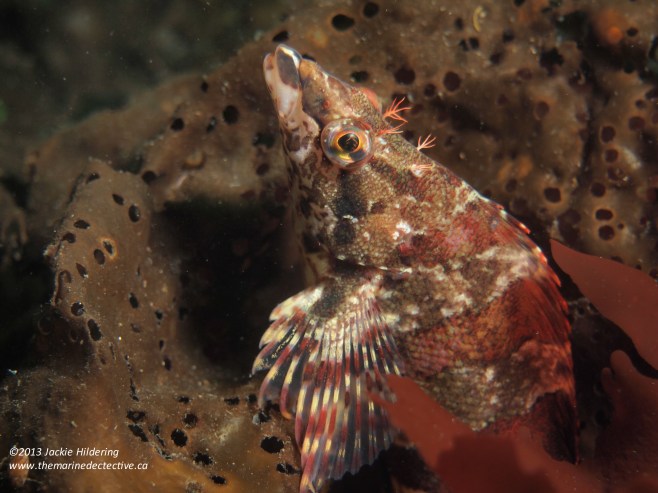
This little Longfin Sculpin was at only 1 m depth. I saw him/her immediate when I descended and had such good fortune that the fish did not dart away. It’s usually what they do.
Longfin Sculpin = Jordania zonope to 15 cm long. May 20th, 2020 near Telegraph Cove.
May 20th, 2020 near Telegraph Cove.
JUST LOOK at the colour, the patterns, the texture . . . and the gossamer fins.
Here’s another individual from a different dive to give you a sense of the variation in colour and patterns. This colouration and banded pattern often helps them camouflage because so much of the life in these waters is brightly coloured.
June 9, 2019 Hanson Island
BUT Longfin Sculpins are among the local fish species that change colour at night. They darken to match their nocturnal surroundings so they have a better chance of . . . seeing another day.
The photo below shows how extreme this colour change is.
March 5th, 2013 Port Hardy.
This is known as “nocturnal protective colouration” and this adaptation is not unique to species of fishes but is also found in birds, mammals, insects, etc
The males are apparently also darker when courting females and protecting eggs. They are very territorial when egg-guarding.
A Longfin Sculpin in “Spider Man” mode. September 9, 2011 Pearse Island.
Further information from Dr. Milton Love’s Certainly More Than You Want to Know About the Fishes of the Pacific: “Young settle out of the plankton when around 2.3 to 3 cm long and then live a life where they are mostly solitary (other than to mate and egg guard) and rarely swim more than 0.5 m off the bottom. They use their pectoral fins to crawl around and hang on, even able to kind of “Spider Man” it by hanging on to vertical walls, head oriented downward. They are reportedly highly territorial with domains being from 0.3 to 0.5 metres squared / individual) . . . There have been some observations of the species cleaning the mouths of Lingcod, amid their many and very sharp teeth.”
Below, is one of Jan Kocian’s amazing captures (and cartoons) of a Longfin Sculpins serving as a cleaner fish to a Lingcod.
Scalyhead Sculpins have also been documented by as cleaner fish to Lingcod.
More often than eating snacks found on Lingcod 🙂 , Longfin Sculpins’ diet is “benthic arthropods” which include crabs, hermit crabs, isopods and shrimp. This is the diet of many sculpin species but one study found that Longfin Sculpins take bites out of their prey where other species like Scalyhead Sculpins swallow them whole.
There’s a whole lotta fish procreation going on in the NE Pacific Ocean right now. This might be a surprise to those who think mating is more of a spring-fling-kinda-thing.
It may be a further surprise that, for many marine fish species here, the males are the protectors of the next generation. The females leave after laying the eggs and the males remain, guarding the fertilized eggs from predators and often also fanning the eggs to ensure they are well aerated.
For a lot of these fish species, the male chooses the nesting site and entices multiple females to lay eggs there so that he can fertilize them. He then has the work of guarding these multiple egg masses and may need to be on the alert for sneak fertilization attempts by other males.
For species with nests of multiple egg masses, you can often tell how many females have laid eggs there because individual females have different coloured eggs. Therefore, the colour of fish eggs is not a good characteristic to determine the species that laid them. Instead, do a quick scan, chances are a piscine papa is somewhere near the eggs, staring at you.
Through the photos below, meet some of these fabulous fish fathers. No deadbeat dads here!
[Note that this is in no way a comprehensive list of NE Pacific Ocean fish species in which the males guard the eggs.]
Whitespotted Greenling
The encounter documented below shows how my dive buddy and I recently had a Whitespotted Greenling come after us, so intent was he on protecting his egg masses. I was very slow in cluing in that this was why he was swimming around us and deserved getting a little nip in the head. Notice how small he is relative to us and yet how this did not deter him in trying to get rid of us.
Male Whitespotted Greenling shortly after he nipped my big head in his intensity to guard his egg masses.
Dive buddy Jacqui Engel pointing at the male Whitespotted Greenling before I clued in and got out of his territory with eggs. Image shows how small the fish is compared to us and how big his drive to protect the egg masses must be that he would pursue us like he did.
My observations of egg guarding on NE Vancouver Island: September to the end of December
Kelp Greenling
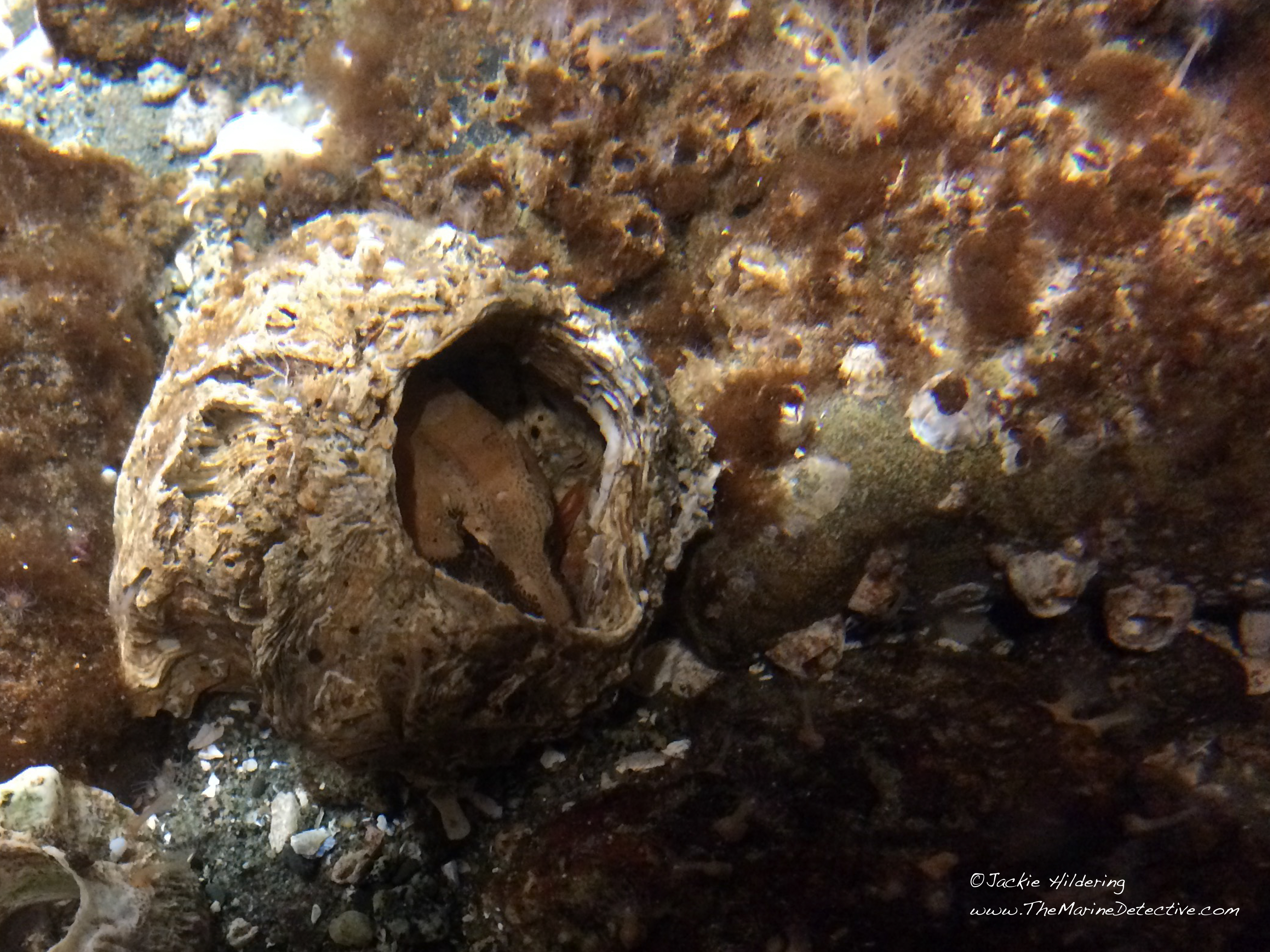
Most often Kelp Greenling eggs are in the empty shells of giant barnacles as shown below. Although they are a bigger member of the Greenling family, male Kelp Greenlings do not appear to protect their eggs quite as vigorously as Whitespotted Greenlings. They appear to have a really long breeding season in our area.
My observations of egg guarding on NE Vancouver Island: October to March
Below, slideshow of courting
Red Irish Lord
Oh Red Irish Lords how I love thee. There is no better ambassador for how colourful life is in these waters since they are brilliant shades, yet astoundingly camouflaged. Red Irish Lords are often easier to find when guarding their eggs since these are less camouflaged. They most often egg guard with their heads positioned right atop the eggs, remaining absolutely motionless. It is commonly believed that the fathers guard the eggs but apparently it is more often the mothers but that the parents may take turns. Source: DeMartini and Sikkel 2006: ” Red Irish Lord exhibits primarily maternal and facultatively biparental guarding of the spawn.”
Note the variation in the colour of the fish too. More photos showing the diversity of colour at this link.
Buffalo Sculpin
There are Buffalo Sculpin males guarding eggs at this time of year too but more mating appears to be happen in April and May. Usually, Buffalo Sculpins are even harder to spot than their Red Irish Lord cousins but the variably coloured, bright egg masses give away their location. They too have a strategy of staying right atop the eggs and remaining motionless when faced with annoying human divers.
Soon we will be participating in the Vancouver Aquarium’s annual Lingcod Egg Mass Count. Armed with an underwater slate, we will join divers along the Coast in helping determine the health of lingcod populations by looking at the number and size of the egg masses and if they are being guarded by males. And oh what fastidious fathers lingcod males are! The dedication to protecting the egg masses does vary from male to male but, generally, they do not leave their watch until the eggs hatch which can be more than 24 days. They could be guarding masses from multiple females separated by more than 7 m, and if laid by a female 5 years old and older, the egg masses can be the size of a watermelon and weigh up to 14 kg! That’s a lot to protect! (As is also the case for many rockfish, the older the female lingcod, the more eggs she lays). My best lingcod story is that I was marking down “unguarded” on my slate only to have it knocked out of my hands by the male that was very much guarding the egg mass I had been observing! Lots more info on this species at my blog item Lingcod – Fastidious Fanged Fathers.
My observations of egg guarding on NE Vancouver Island: January to April (Vancouver Aquarium’s Egg Mass Survey is from early February to the beginning of April).
Here’s a case where it is not just the male that guards the eggs. Mr. and Mrs. Wolf-Eel take turns wrapping their long tails around the large egg mass. I hope to one day have the opportunity to get a better image than this but, as a strategy for survival, the egg mass is often deep within the wolf eel couple’s den. Lots more information on this remarkable species at my previous blog item Wolf-Eel – No Ugly Fish!
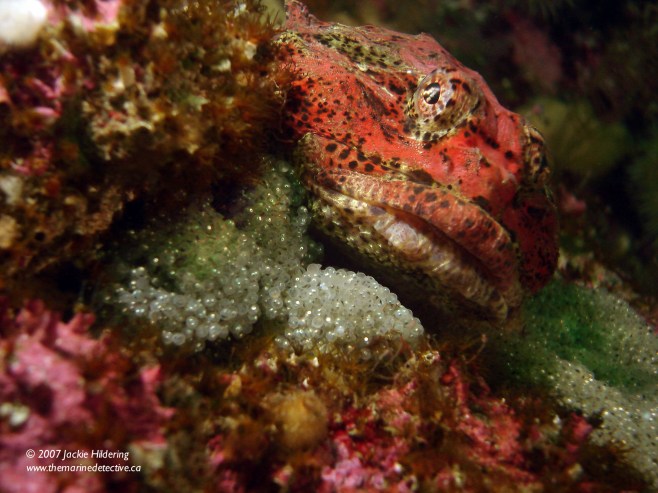
I’ve only once been lucky enough to find a male of this huge sculpin species guarding eggs. They can apparently be very aggressive guarders but this very successful male (he was guarding the eggs of several females) was very tolerant of my presence. They have been documented to mate throughout the year. My one encounter with a male cabezon guarding eggs was in May.
In all these years of diving, I have yet to find a male Painted Greening guarding eggs so that I know for sure the eggs are from this species. Yet something else to be on the lookout for!
And, the stuff of dreams . . . to one day chance upon a male grunt sculpin while he is releasing the hatching eggs from . . . his mouth! For more on that, see my previous blog item Grunt Sculpin – Little Fish, BIG Attitude. The females apparently also do take on shifts in taking care of the eggs.
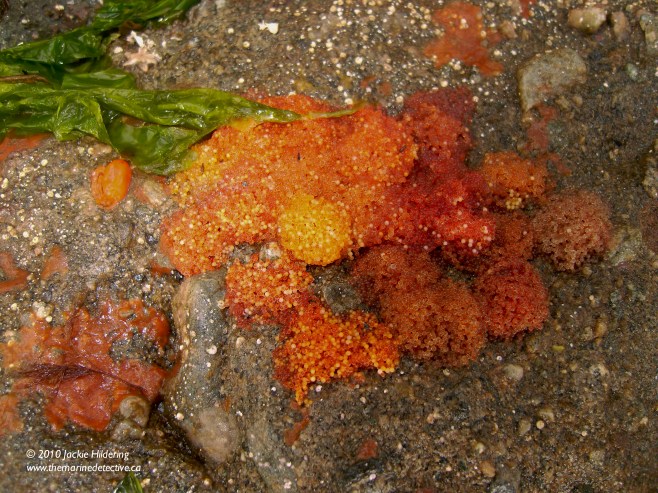
I have never seen scalyhead sculpin eggs while diving, likely because they are hidden away and because they are much smaller. The image of the eggs below was taken during a beach walk where students ensured they put the rock back as best they could to reduce the chances of the eggs drying out. Notice the different colours of the looney-sized egg masses? The eggs in this nest are from at least 4 females.
Very interesting in this species is that fertilization is internal.
My observations of egg guarding on NE Vancouver Island: Spring.
One study showed that the eggs hatched after 11 and 15 days. This study also documented courtship where the males rolled their heads in a circle and flared their orange branchiostegal membranes (on the underside of their throat) which apparently are only orange during mating season. Females were seen to have no response or to snap their heads horizontally in rapid succession, sometimes also quivering. During breeding season the males are also reported to have red-brown spots inside their mouth and a brown anal fin with small yellowish-white spots. (Source: Ragland, H., & Fischer, E. (1987). Internal Fertilization and Male Parental Care in the Scalyhead Sculpin, Artedius harringtoni.Copeia,1987(4), 1059-1062. doi:10.2307/1445578)
If you find an ice cream scoop mound like this, you have likely found the eggs of the black prickleback and the guarding male is likely very near. When taking students on beach walks, I emphasize the importance of not displacing animals by using this species as an example. Fish like the black prickleback are adapted to being able to wait out the tide in very little water and if the well-intentioned pick up the fish to put him in deeper water, they could be moving papa away from the eggs he was guarding.
Last updated: March 4, 2024 Meet the fish that so often has people exclaiming “It lives HERE?!”
Yep, the tiny Grunt Sculpin is a powerful ambassador for raising awareness about the depth of biodiversity hidden in the cold, dark, rich waters of the north east Pacific.
We are programmed to associate warm waters with exotic-looking fish species but read below for the Grunt Sculpin’s astounding adaptations and masterful mimicry.
The species reaches only a maximum of ~9 cm.
It is adapted to look like a Giant Acorn Barnacle (Balanus nubilis)! When facing outward, its pointy nose looks like a closed Giant Acorn Barnacle and when the fish turns around, its tail looks like the foot of the barnacle that rakes in plankton.
Adapted to look like a Giant Acorn Barnacle!
Closed Giant Acorn Barnacles. See how similar this is to the nose of a Grunt Sculpin?
Foot of a Giant Acorn Barnacle. The tail of a Grunt Sculpin looks so much like this!
This little fish has giant attitude. It can be highly territorial, hopping around on its pectoral fins in a strutting, jerky fashion.
You may think the males are the master strutters? Ha! The female is as fierce as can be. Reportedly, she will chase a male into a crack, an empty barnacle shell, or another place of no escape and guard him there until she is ready to lay her eggs. When she has laid them, the male is released to do his duty.
She watches him to ensure he fertilizes the eggs (up to 150 at a time) and then, according to some sources – she saunters off leaving the male to care for the eggs but may return once in a while to take on a shift
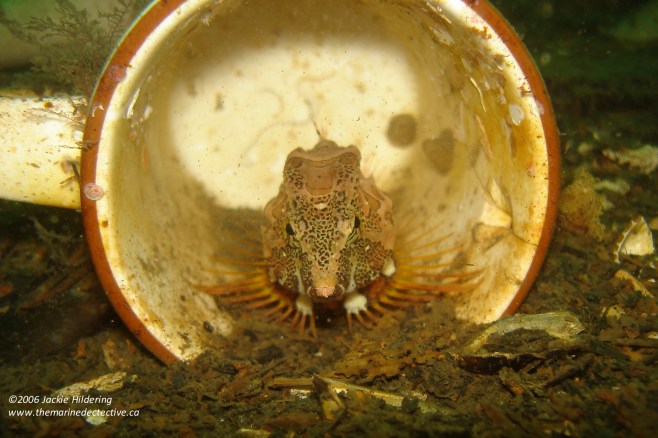
If you can’t find an empty barnacle shell. A cup will apparently do!
From Casey Cook, aquarist with the Aquarium of the Pacific (pers com 2022-12-19): “The female often pushes the male into guarding so she can roam. She will get very vocal, and demanding – making sure he does the job!”
From Fishes of the Salish Sea – Volume Three: After the eggs are fertilized ” . . . she then moves off leaving the male behind to guard the nest, although she may return occasionally to help with parental duties. When the time for hatching approaches, the guarding fish takes the eggs inside its mouth, swims out of the nest, and spits out the eggs into the water column. This breaks the egg shells and frees the larvae that then swim off as zooplankton.”
Very young Grunt Sculpin. The Red-Gilled Nudibranch in the upper part of the image is only about 2 cm
About Grunt Sculpins’ diet also from Fishes of the Salish Sea: “With its small, pointed mouth, it is adept at removing a wide variety of small invertebrates from the water column, especially copepods, amphipods, isopods and shrimps., but it also consumes significant numbers of fish eggs and larvae.”
The Grunt Sculpin’s pointy “bill-like” head is reflected in the species’ scientific name.
With regards to classification, the scientific name Rhamphocottus richardsonii reflects the Greek word for beak “rhamphos” which is appropriate for the Grunt Sculpin’s bill-like snout. This makes some people think that the species looks like a seahorse but note that they are not closely related at all. The Grunt Sculpin is the only member of its genus. It is truly one of a kind.
Juvenile Grunt Sculpin #1 of 3 photos.
Juvenile Grunt Sculpin #2 of 3 photos.
Juvenile Grunt Sculpin #3 of 3 photos.
Oh, and are you wondering about the name “Grunt” Sculpin? Apparently the species grunts when it is taken out of the ocean. You would too! Likely it also grunts when being defensive underwater. It is also the sound I make in my delight when I find one. It will be a very loud grunt indeed if I ever find one guarding eggs or with its tail-end extended out of a barnacle.
Below, more of my photos of Grunt Sculpins. 🙂
Grunt Sculpin next to a Gold Dirona (nudibranch species). See him /her?Grunt Sculpin and a Clown Dorid (another nudibranch species).
A Grunt Sculpin “strutting” over the ocean bottom. See the cloud of silt lifted off as a result?
Another Grunt Sculpin in an empty barnacle shell.
And another.
You can’t see me.
Grunt Sculpin hiding in a broken mussel shell. Juvenile Grunt Sculpin
I wonder if this one is female and about ready to lay her eggs?
And some more photos of individuals to show how similar their markings are.
That’s right, it’s mating season for buffalos . . . Buffalo SCULPINS that is!
Now that I’ve lured you to this posting with the procreation of a huge, shaggy terrestrial mammal on your mind . . . let me show you the spawn of this wondrous fish.
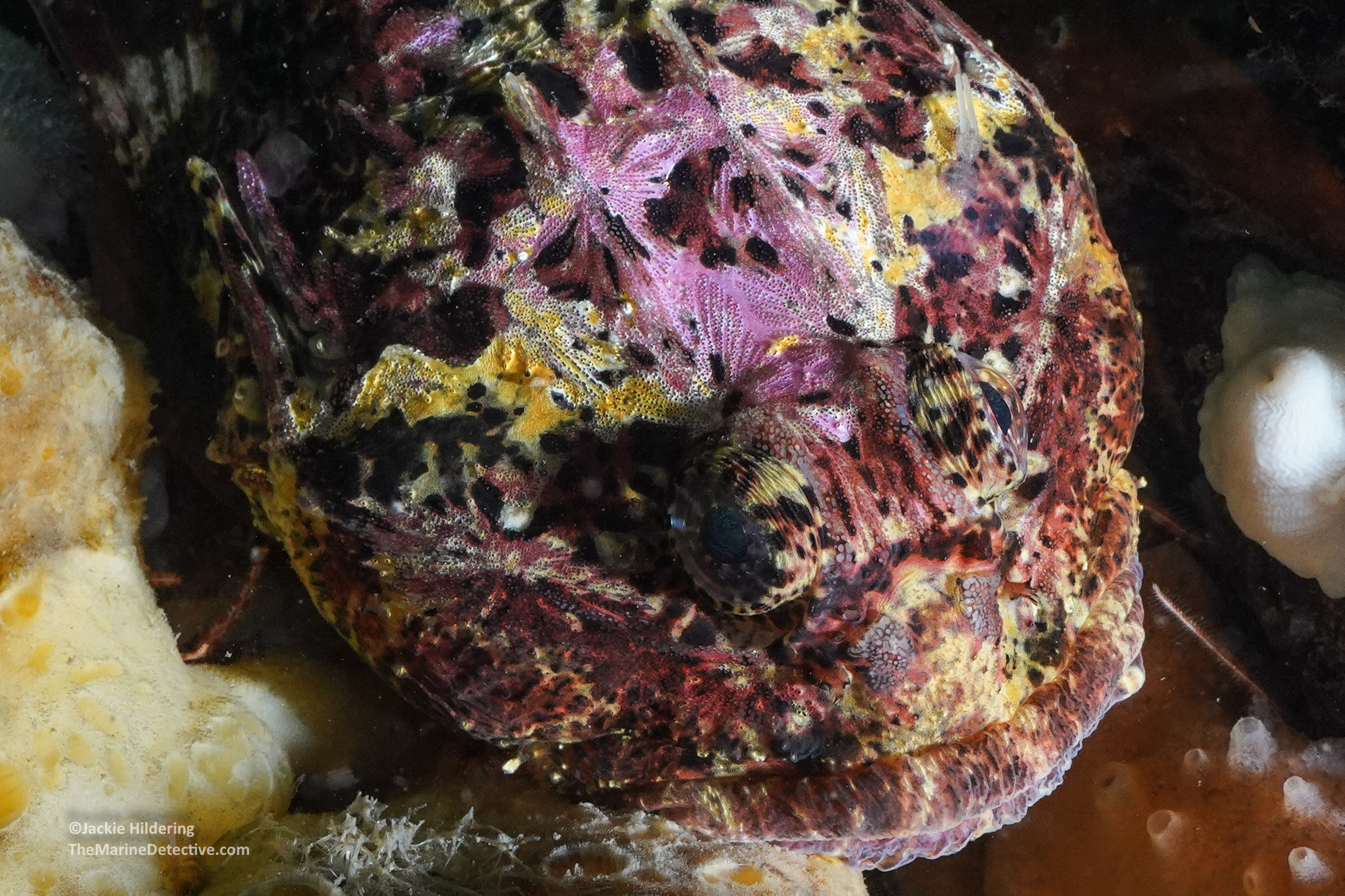
The Buffalo Sculpin – Enophrys bison – has earned the association with buffalo/bison due to the horn-like spine found on each gill plate (operculum). The species can be up to 37 cm long.
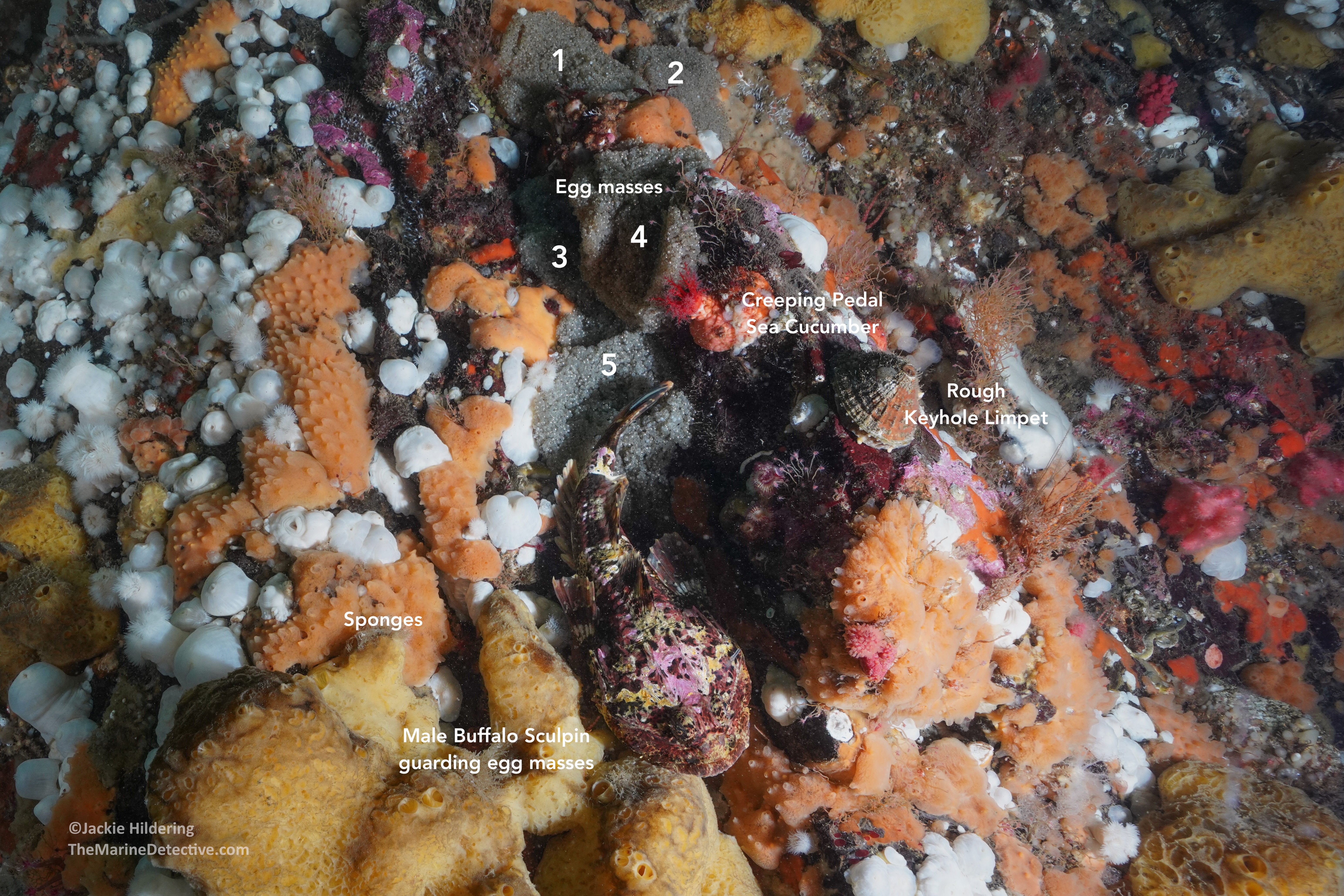
As is the case for many species in the sculpin family, male Buffalo Sculpins guard the eggs from predators. They also fan the fertilized eggs with their pectoral fins to aerate them and stop growth of algae / bacteria. Sometimes they guard the eggs laid by multiple females (see below for a male that appeared to be trying to guard EIGHT egg masses). When you consider that a female can lay between 19,000 and 32,000 eggs, the males have a lot of fertilizing and guarding work to do! Their guard duty lasts 5 to 6 weeks until the eggs hatch.
Many of the photos below show how you the males lie with their flat heads directly upon a cascade of eggs. The clusters of eggs laid in the spring allow me to find this incredibly camouflaged fish much more easily than I normally could. When I see a golden, orange or greenish shiny mass of eggs, I know a male Buffalo Sculpin has to be very near by. The bright colour of the eggs suggests that they might be toxic to many species, further protecting them from predation.
Very interestingly too, there is a species of fish known to parasitize on the care provided to the fertilized eggs by Buffalo Sculpins. Spinynose Sculpins (Asemichthys taylori) will lay their eggs on top of the Buffalo Sculpin eggs. The Spinynose Sculpin eggs will hatch faster and it is even possible that the presence of their eggs slows the development of the Buffalo Sculpin eggs. This “nesting parasitism”, is a “behavior previously unknown among marine fishes.” (Kent, Fisher, & Marliave, 2011).
As you can see, Buffalo Sculpins’ red, brown and pink colouration makes them very difficult to discern from the similarly brilliantly coloured life around them. They will remain absolutely still so as not to give away their presence. Their relative, the Red Irish Lord, has the same survival strategy. (See this previous blog item for photos and information on the Red Irish Lord.)
Close-up on the head of a male Buffalo Sculpin that was guarding 5 egg masses.
Same male as in the photo above. Egg masses are numbered in the image.
The camouflage, in addition to reducing the risk of predation by bigger fish and seals, allows the Buffalo Sculpin to be a very successful ambush hunter of shrimp, crabs, amphipods and small fish. It has been suggested that they eat mainly algae since this has often been found in their gut.
I had speculated in the original version of this blog that the algae may end up in their stomachs as a result of Buffalo Sculpins grabbing prey ON the algae! But Greg Jensen provided the feedback that they had done experiments that found that adult Buffalo Sculpin eat Sea Lettuce (Ulva). He emphasized that despite the great abundance and diversity of algae in the Northeast Pacific Ocean, there are very few fish that are known to eat it – just Buffalo Sculpins and some prickleback species (Source: Gregory C. Jensen, personal communication, March 25, 2026).
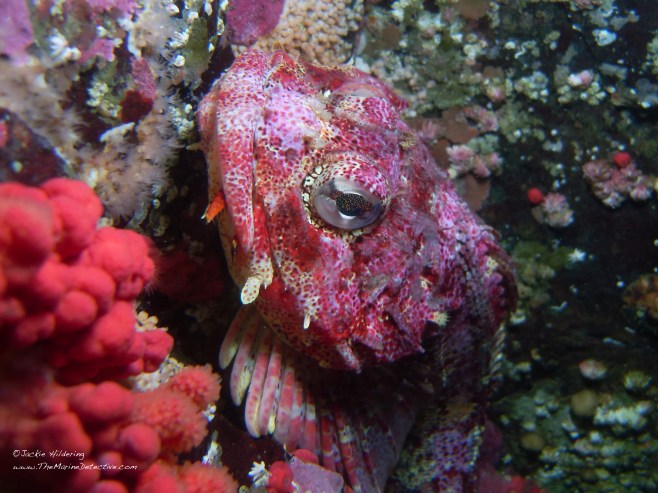
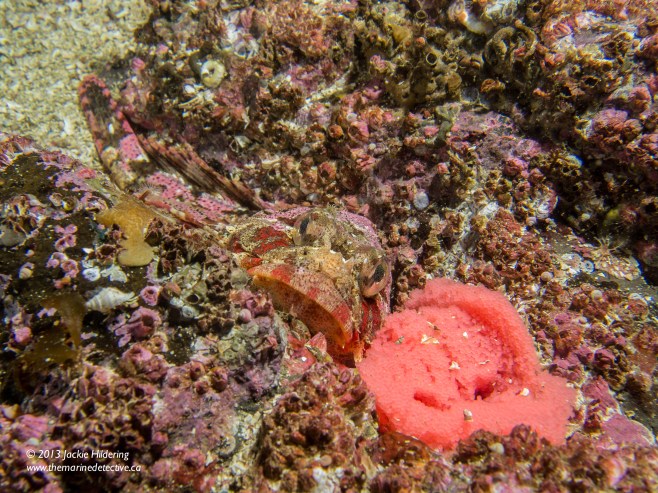
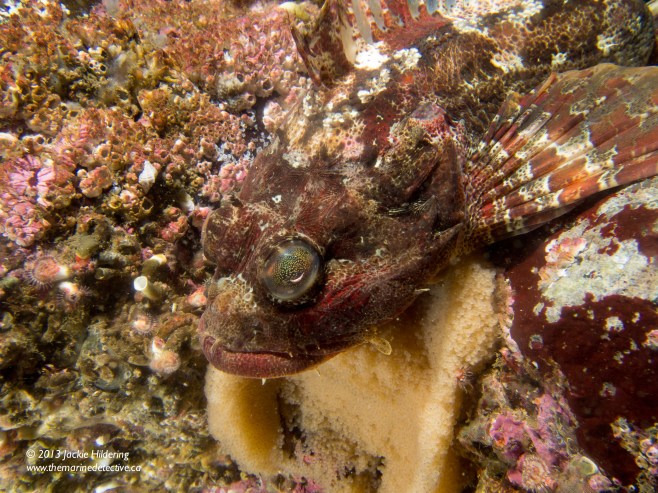
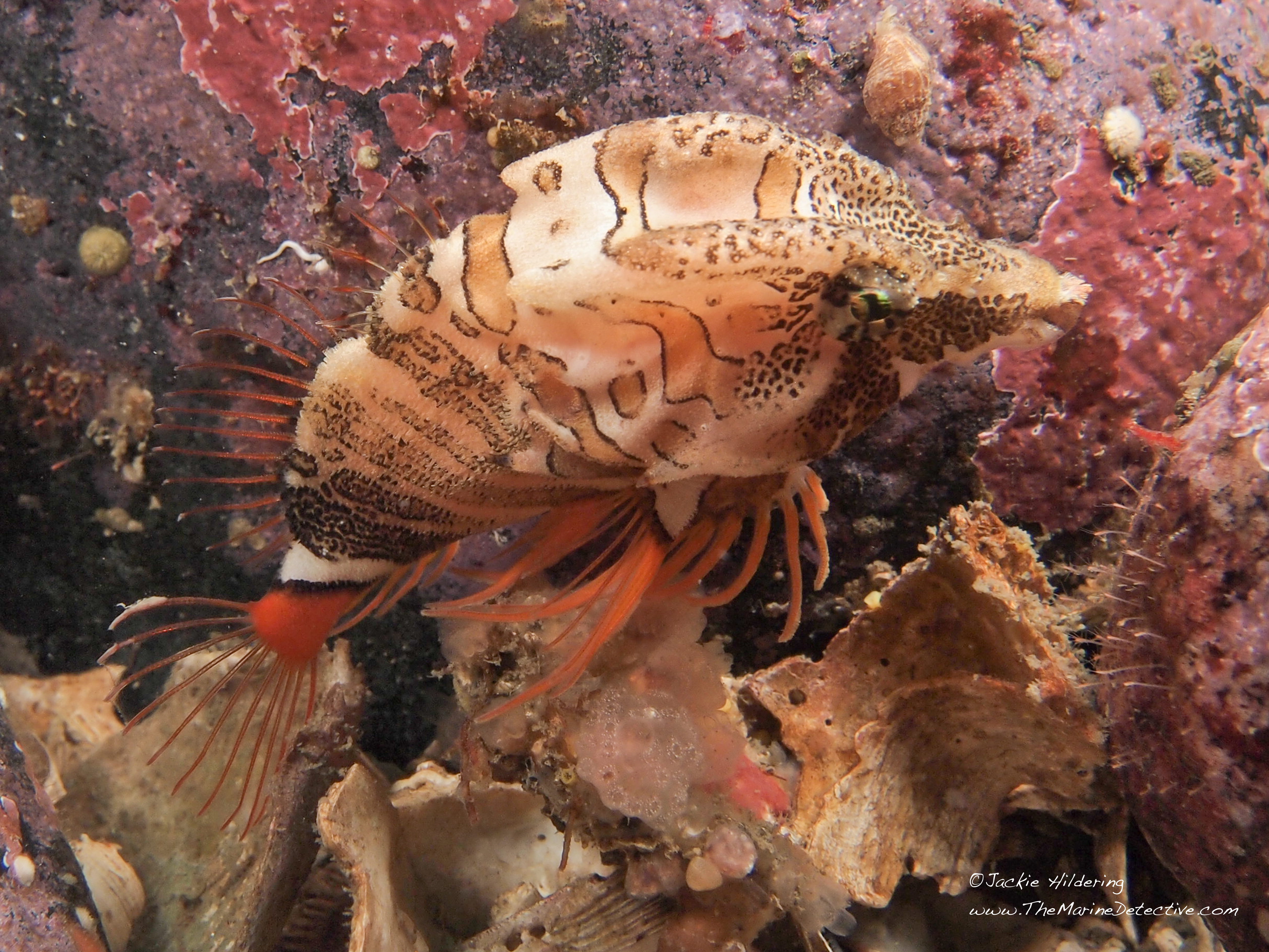
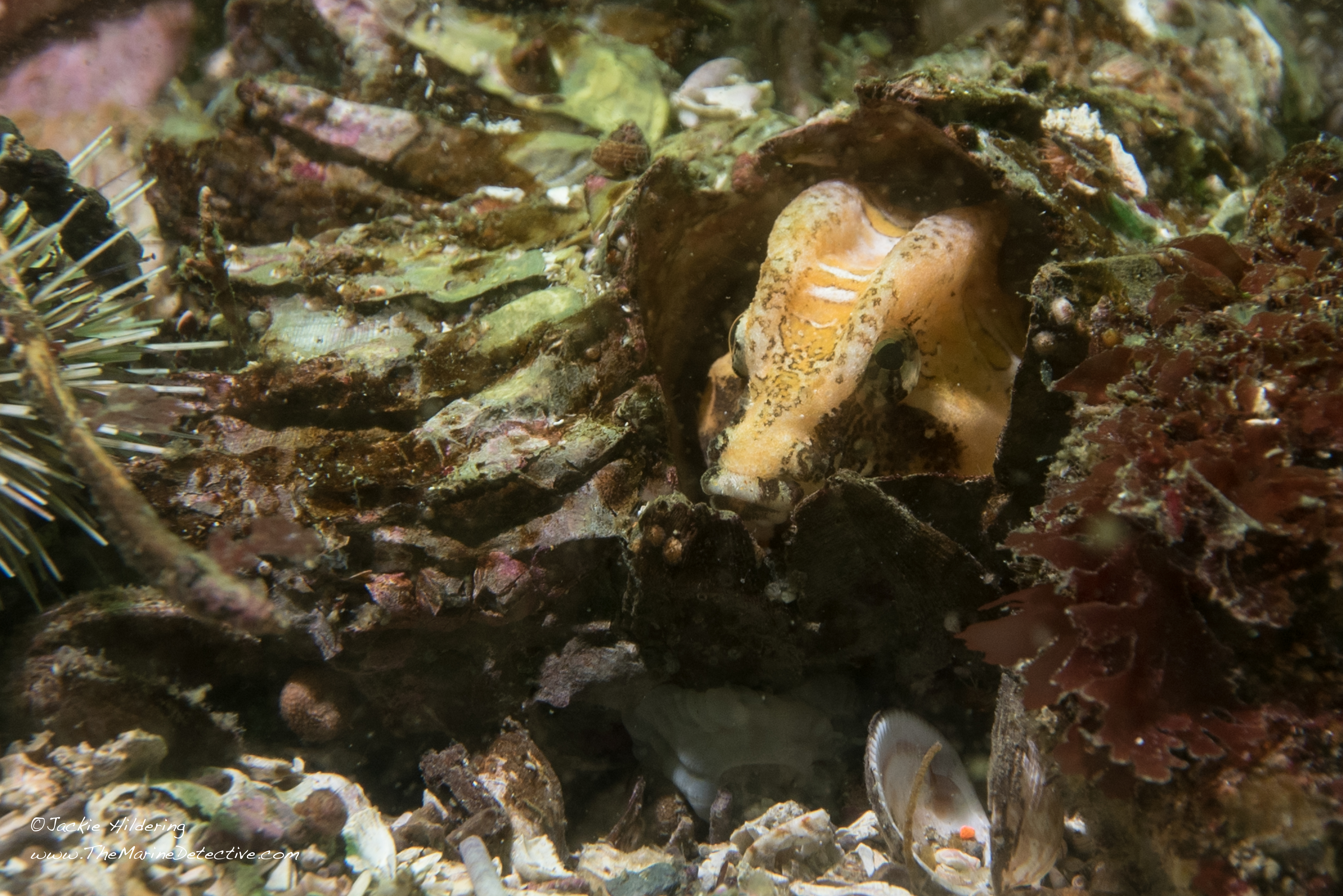
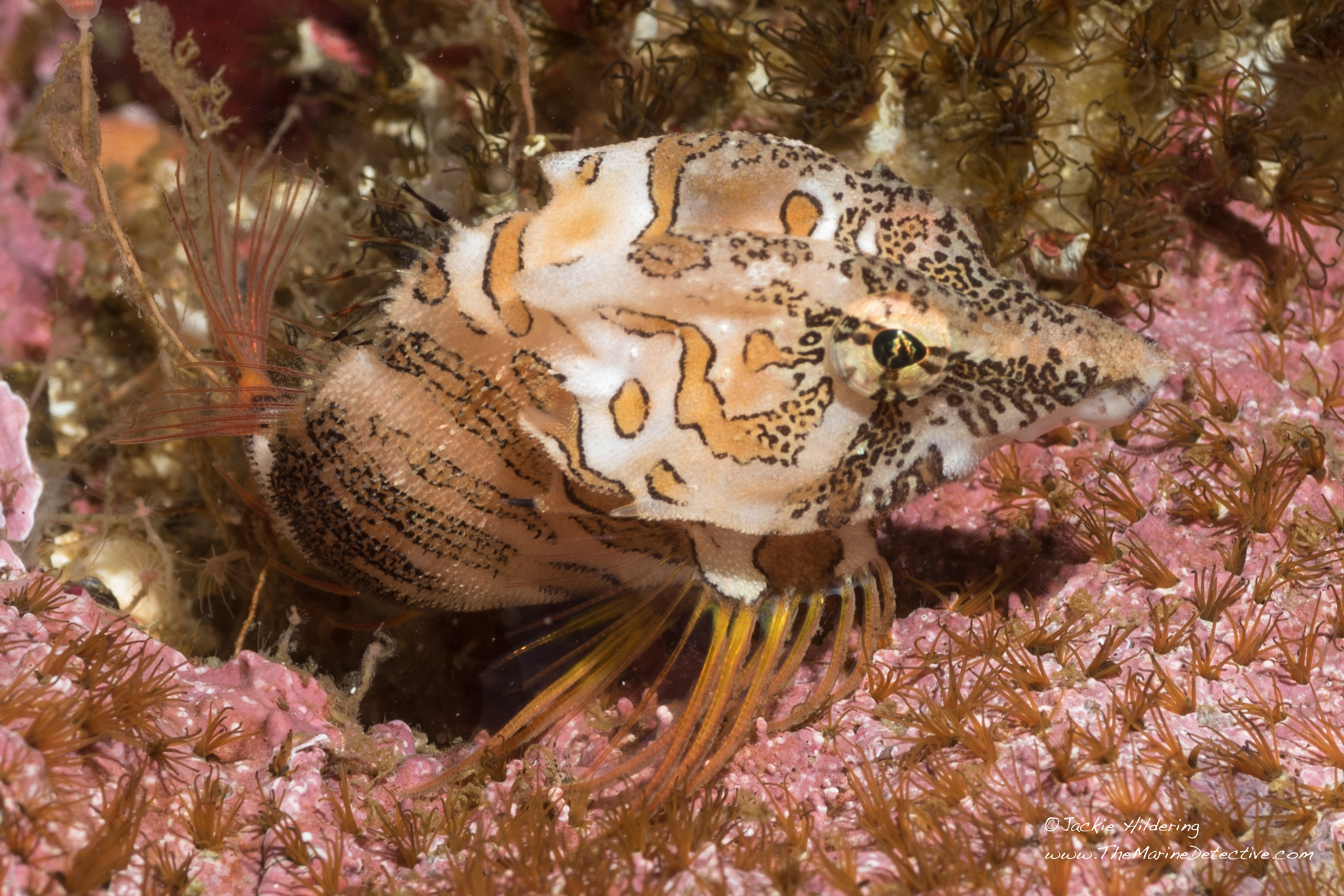
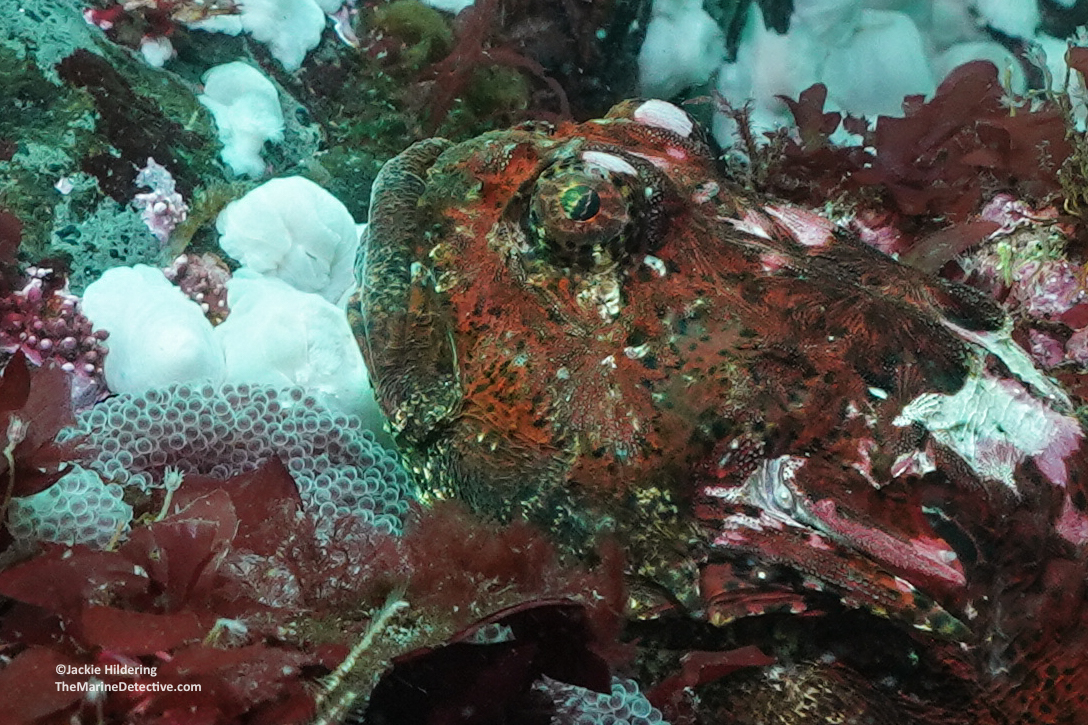
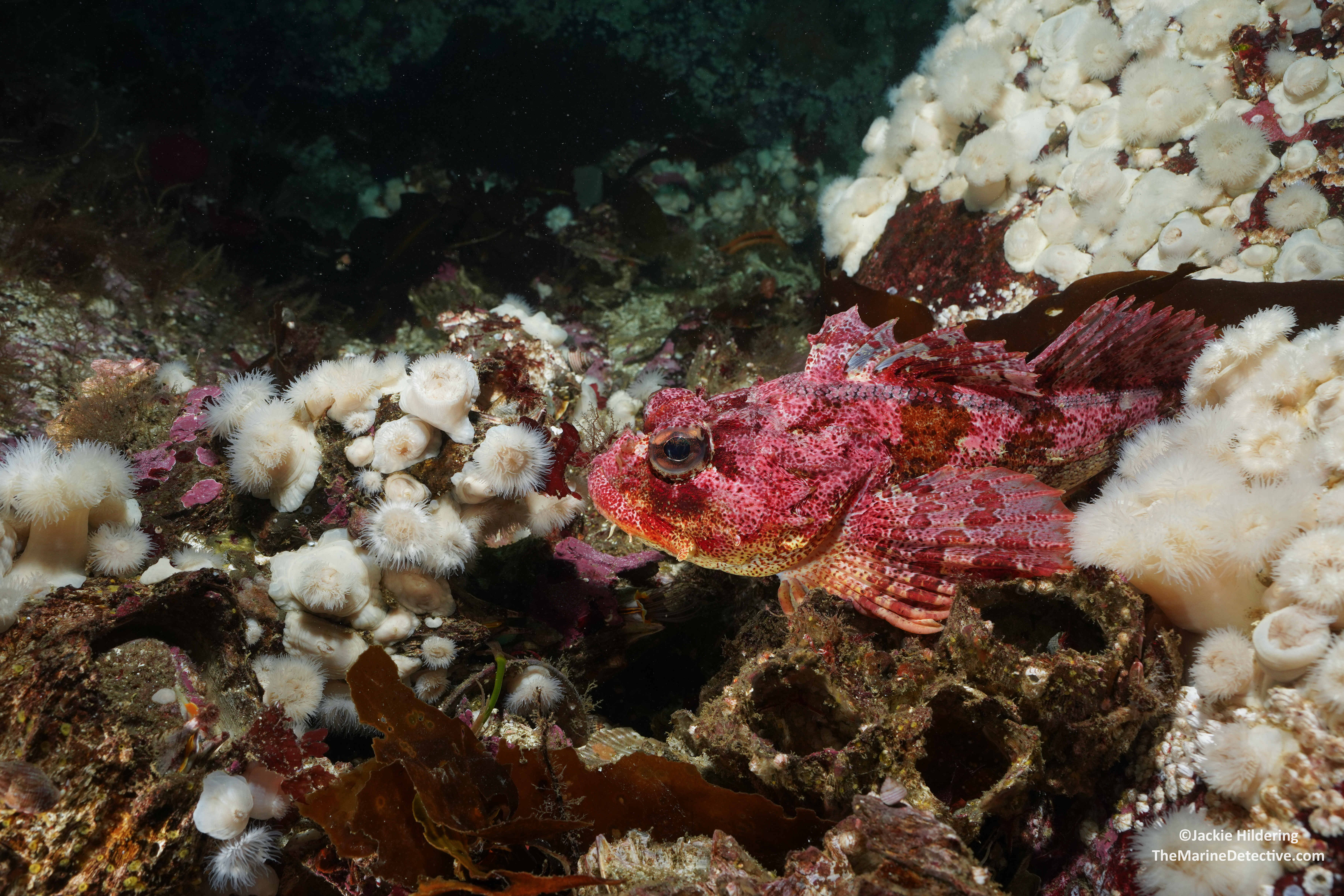
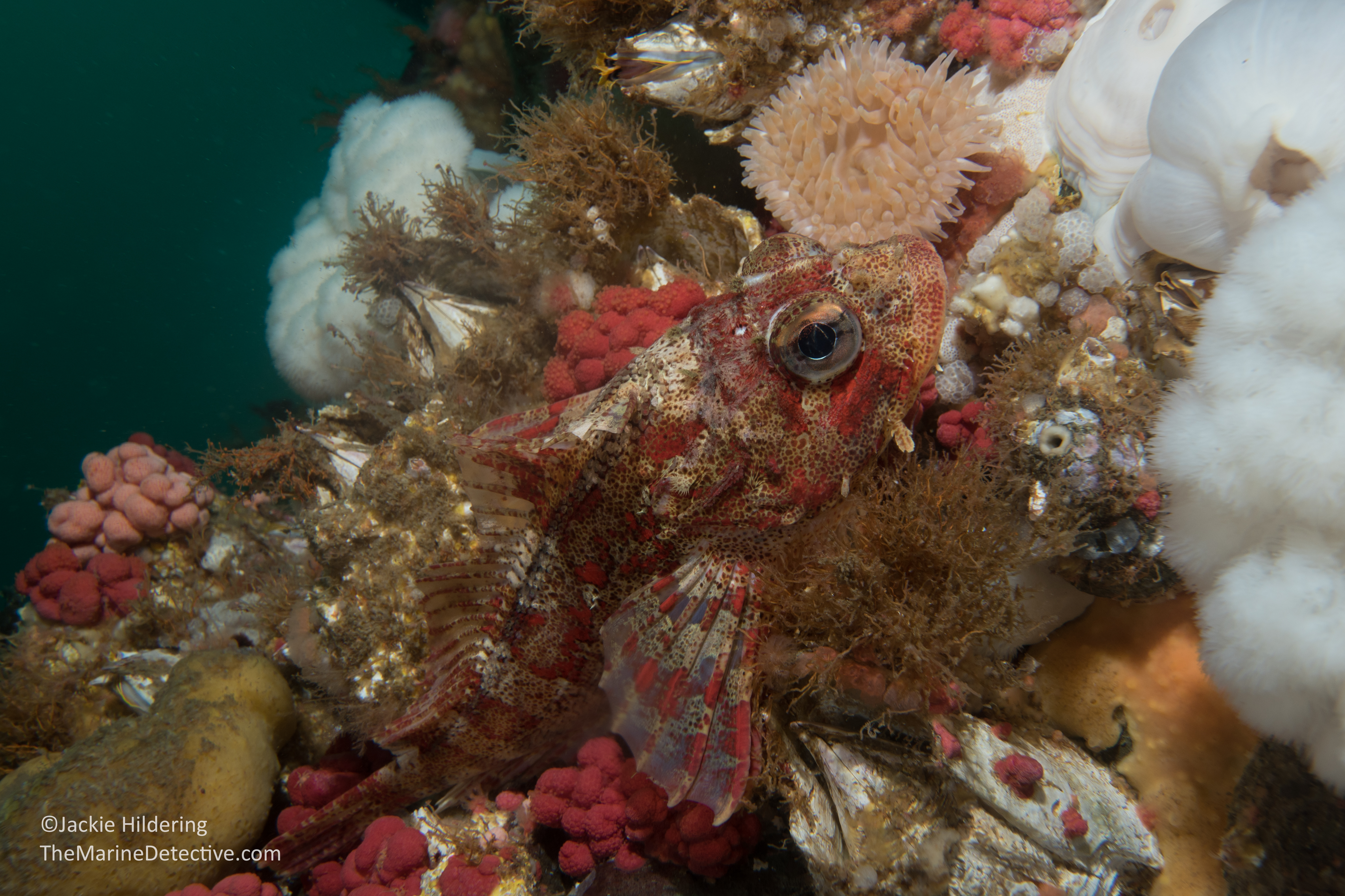
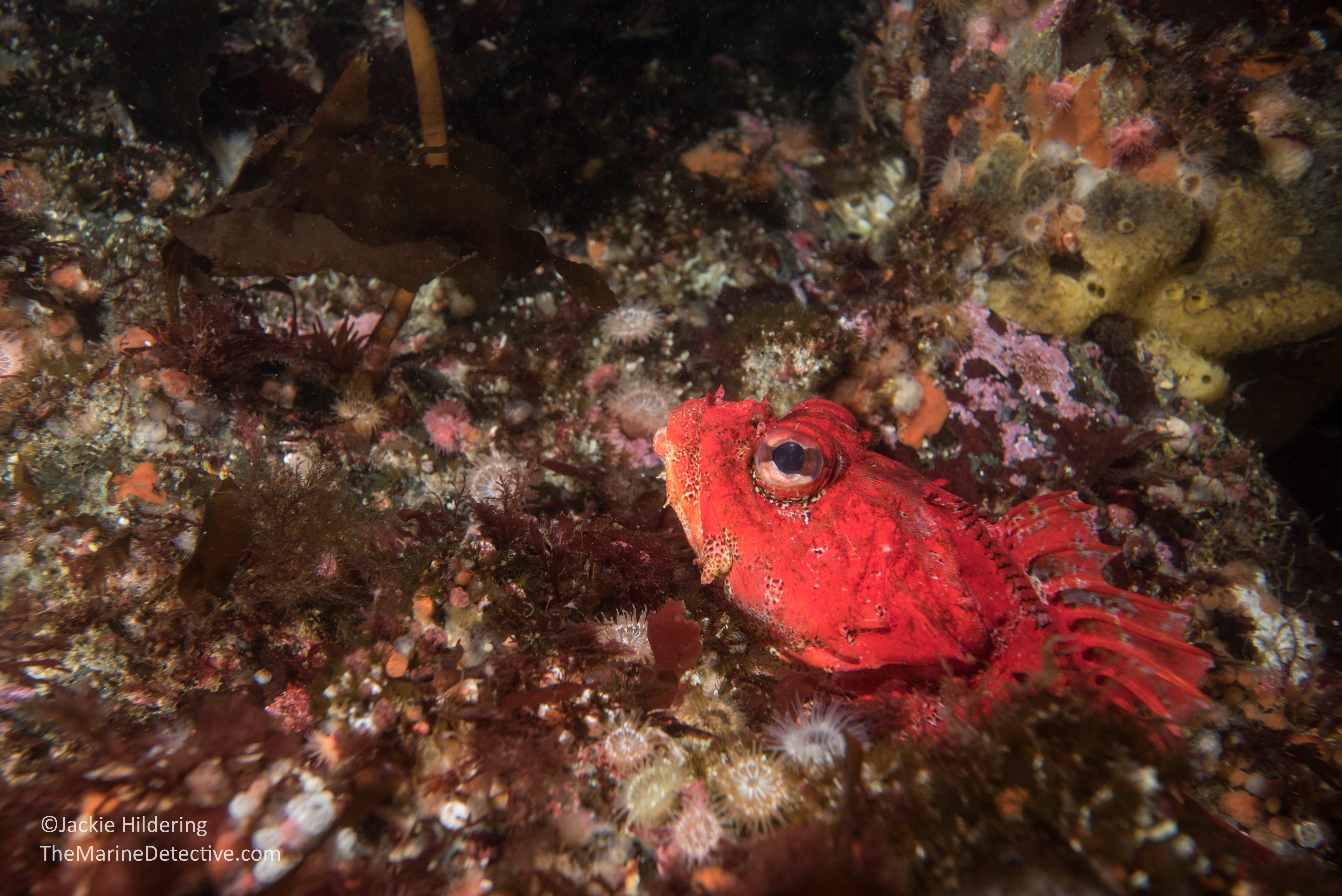
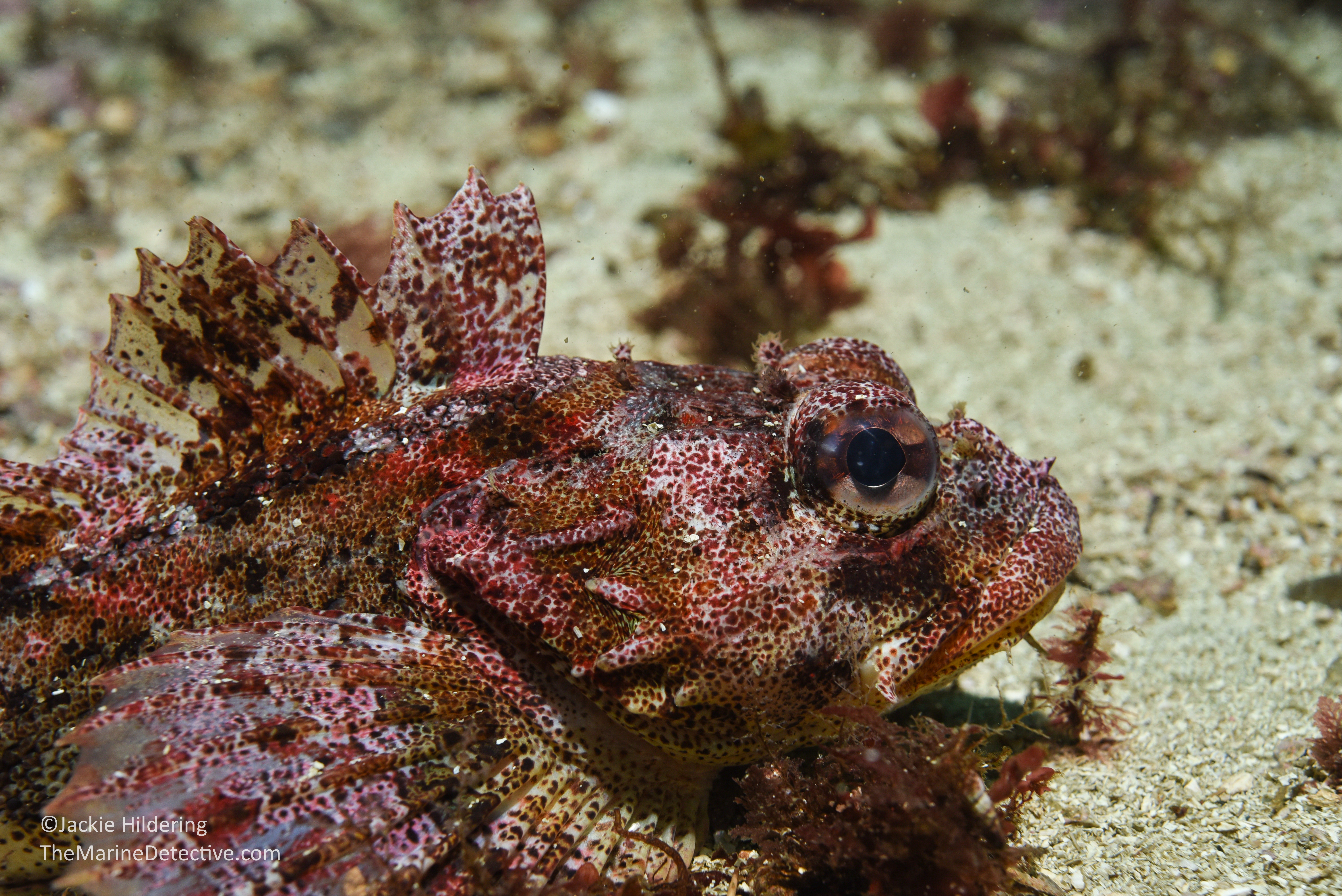
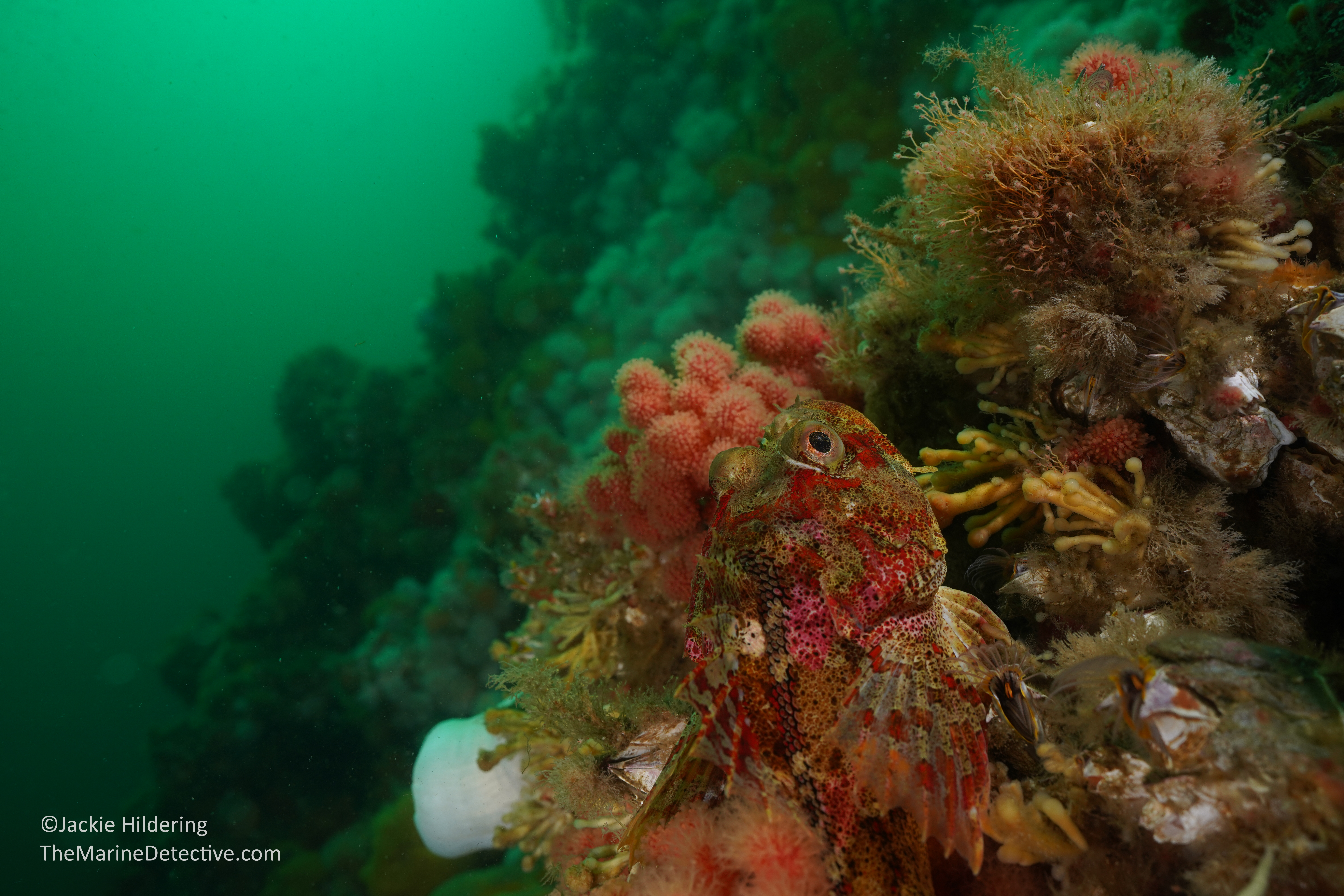
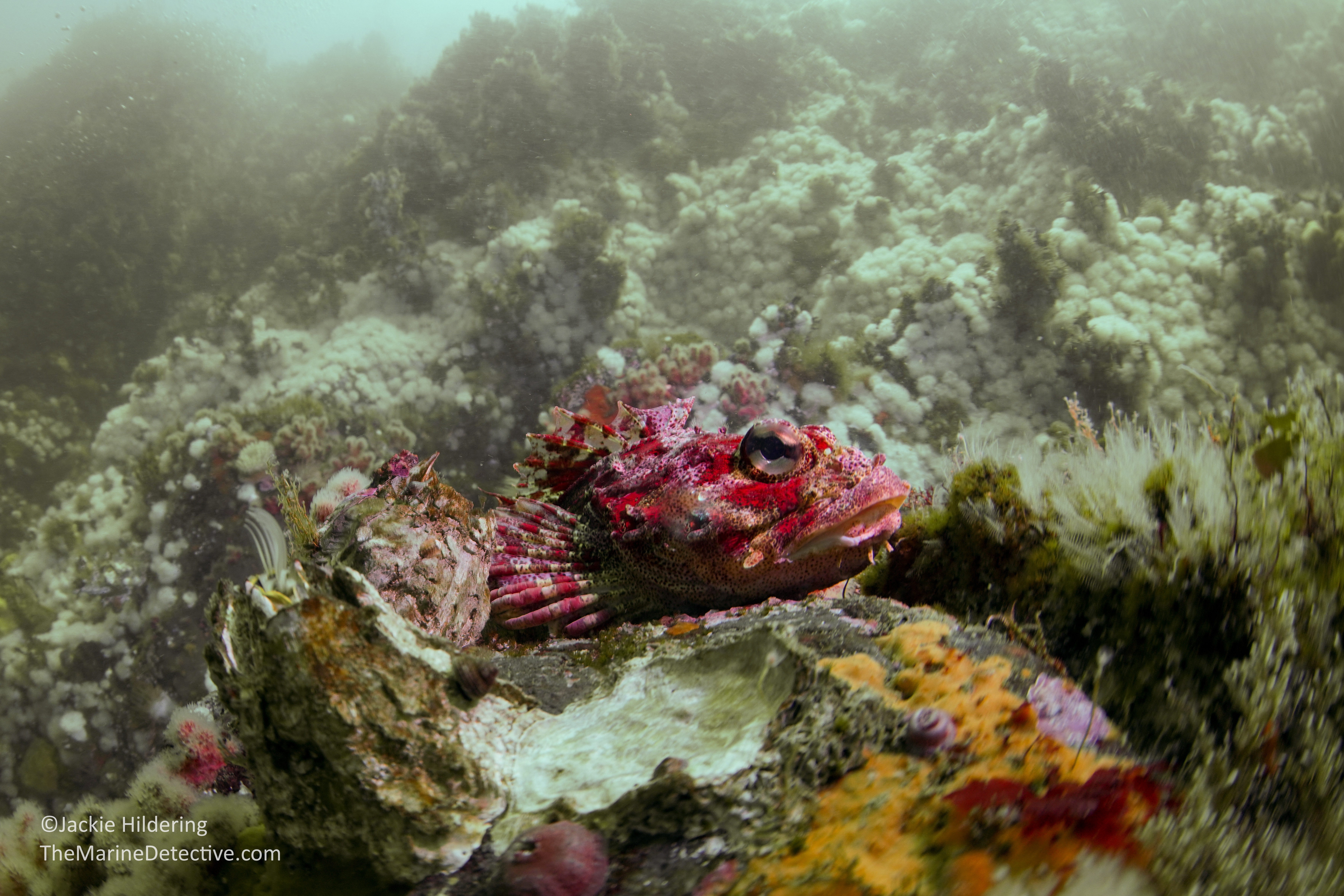
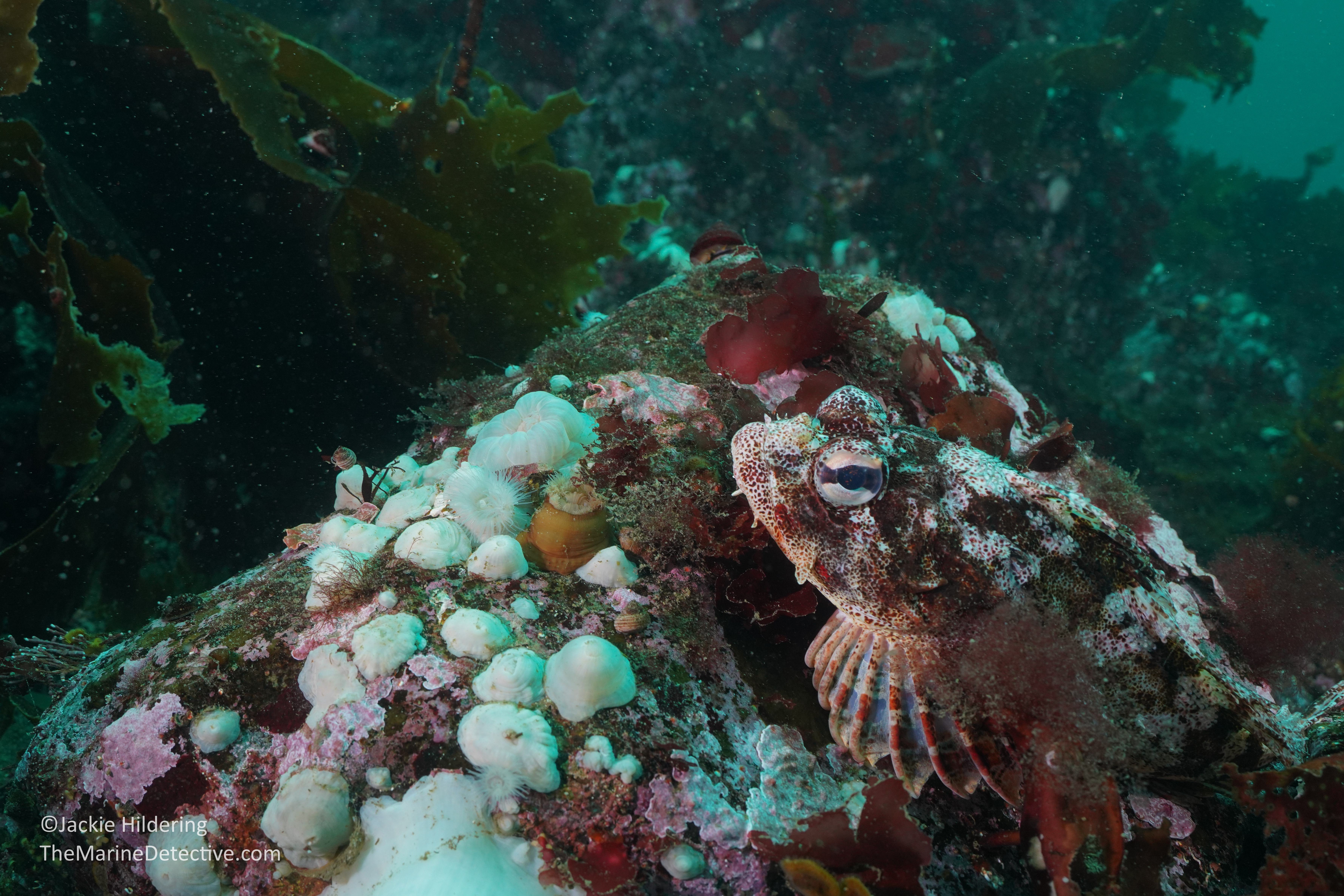
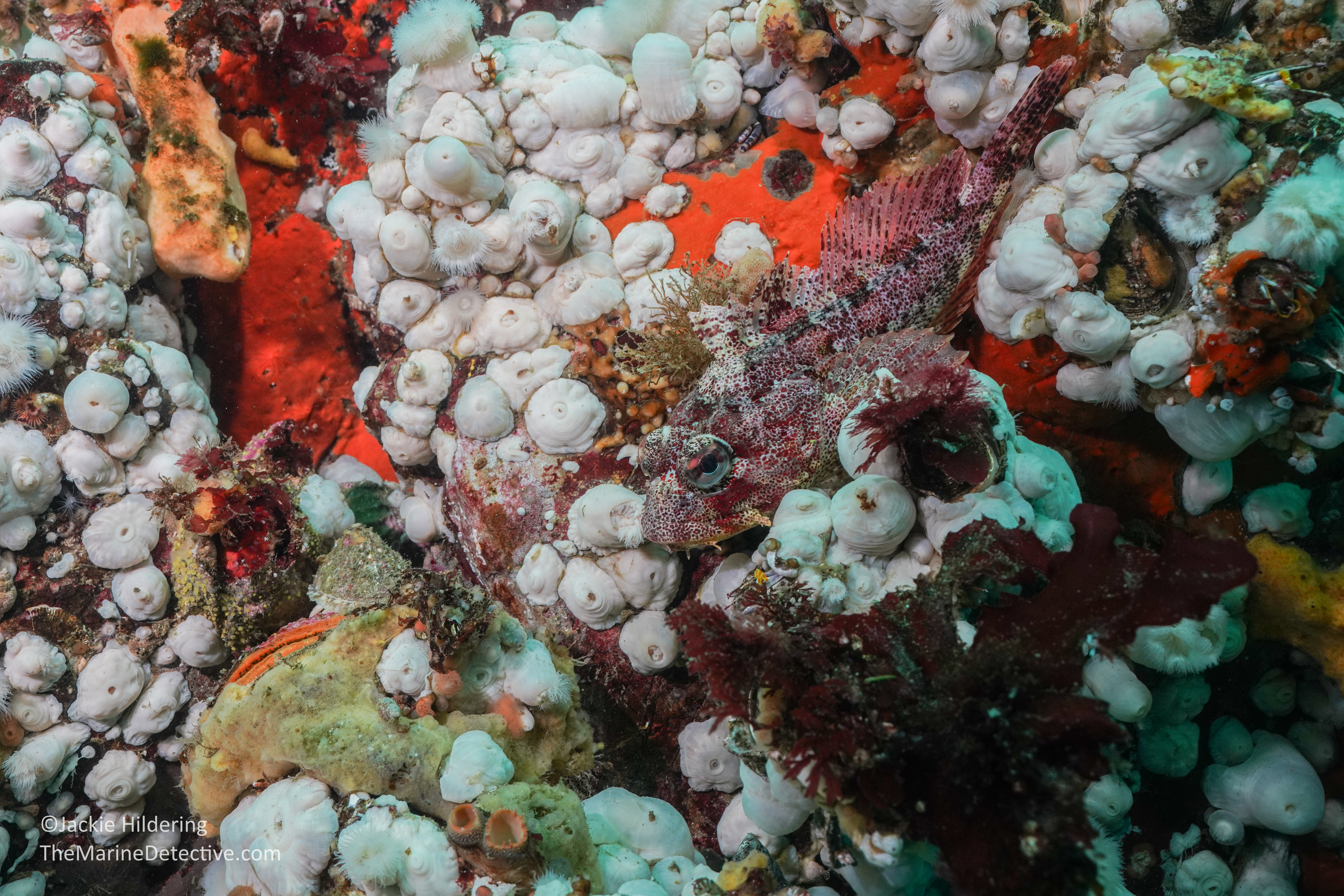
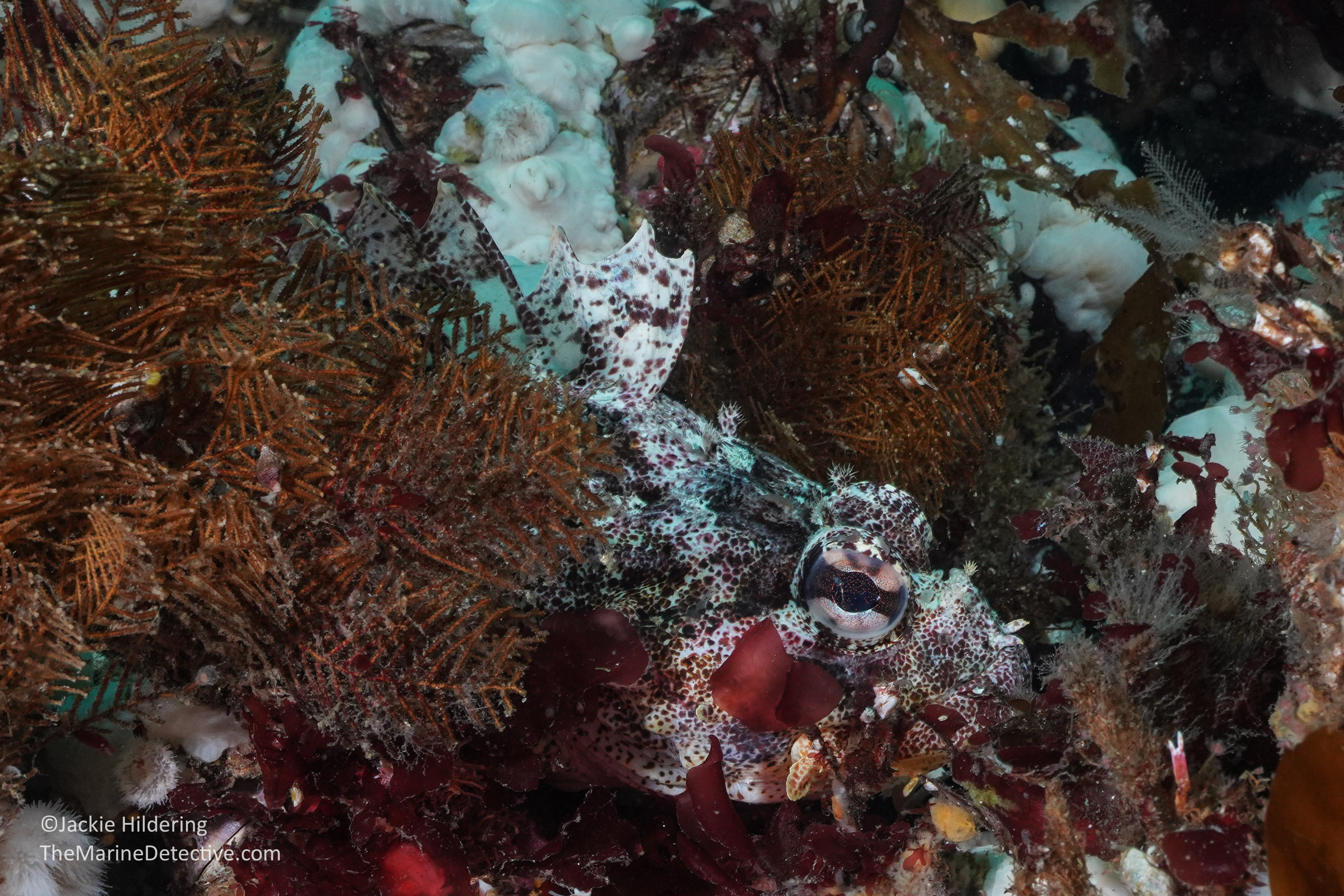
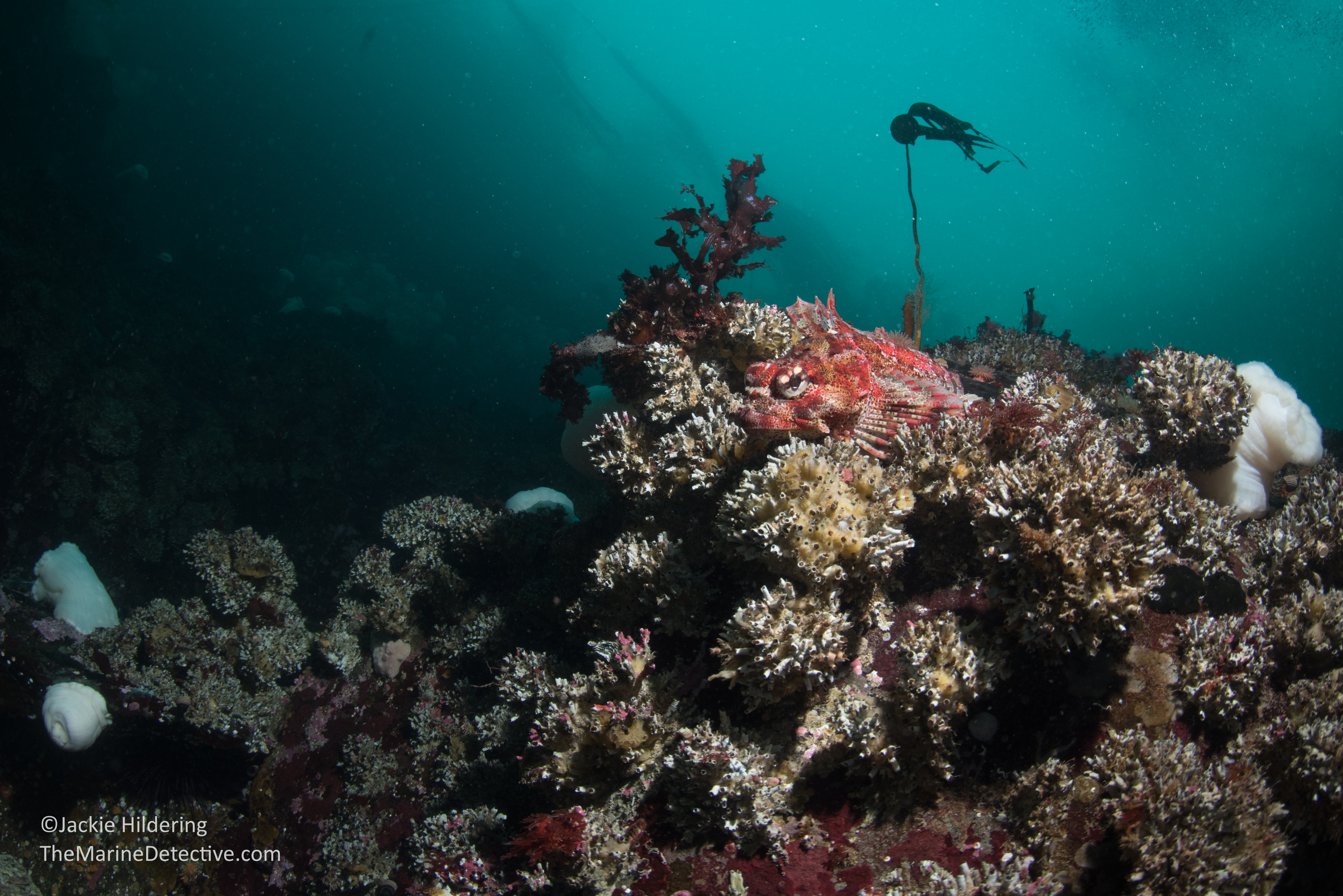
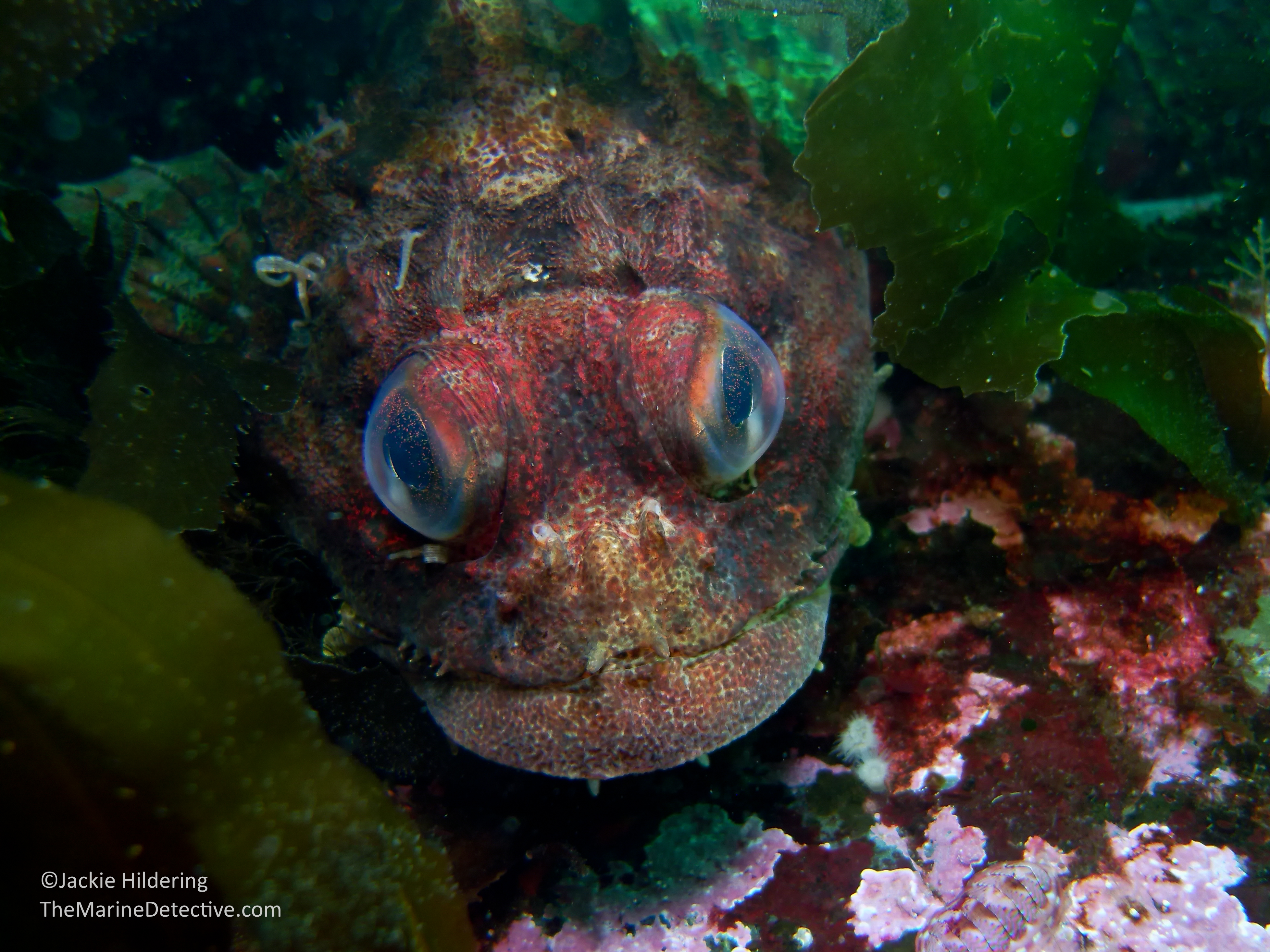
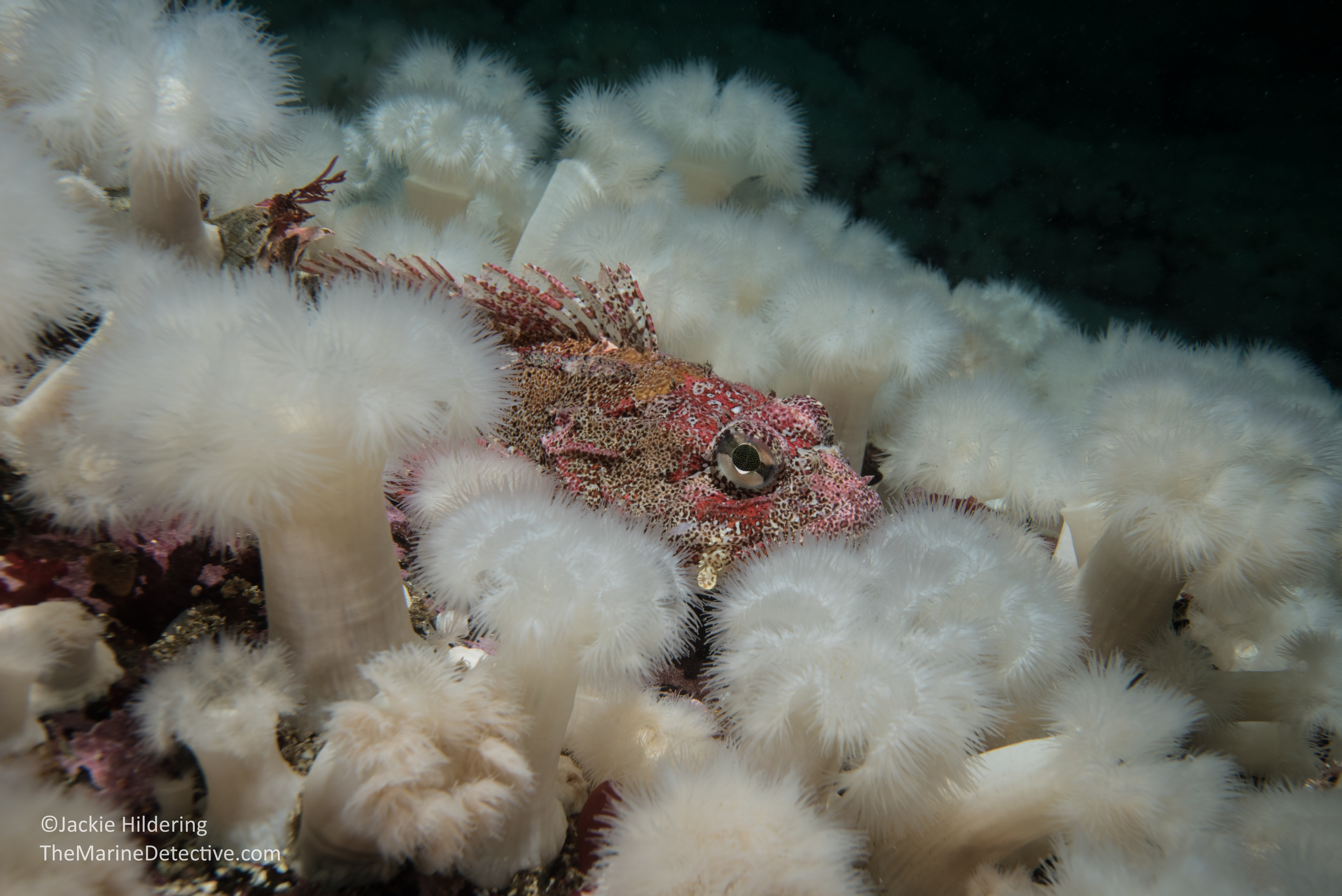
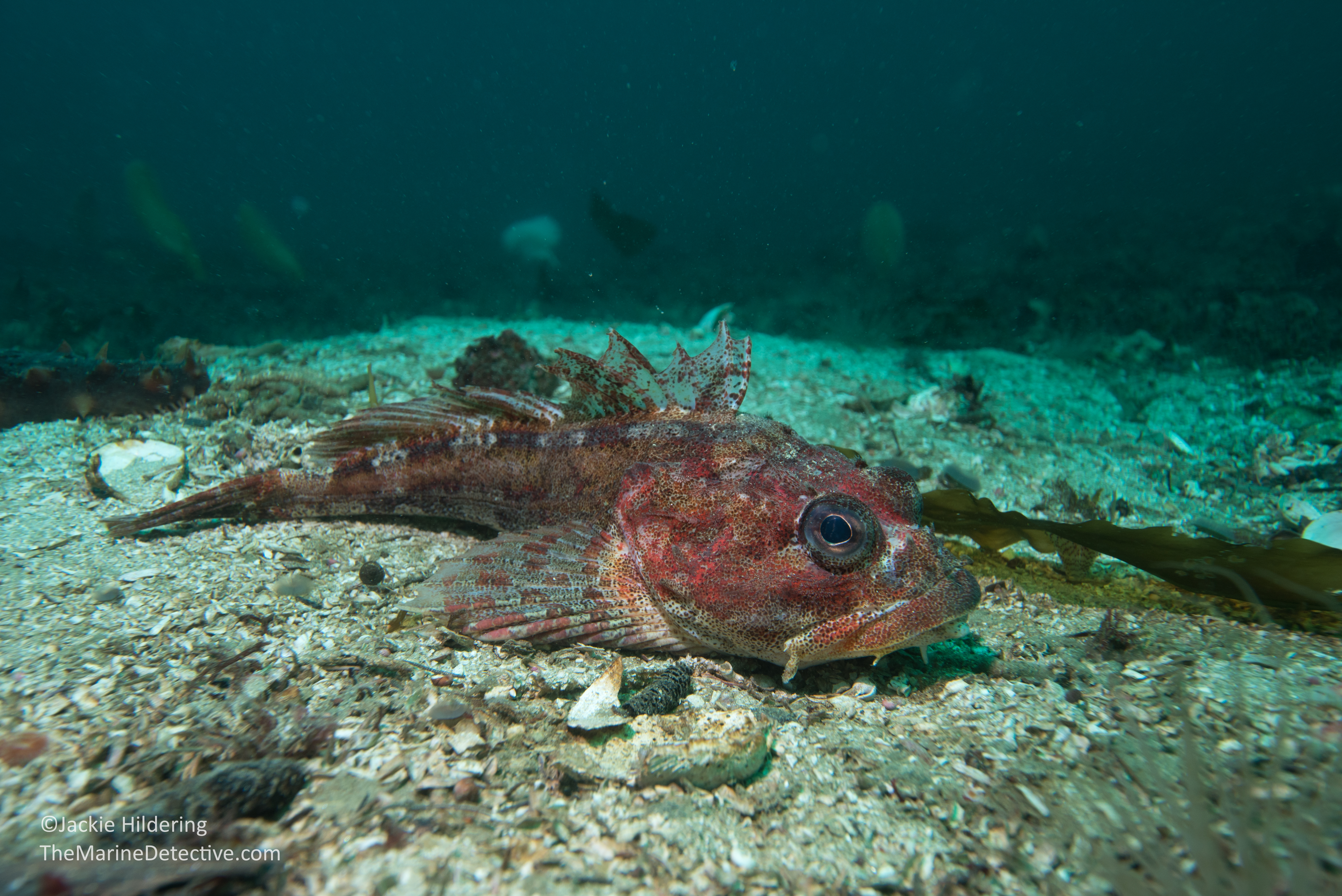
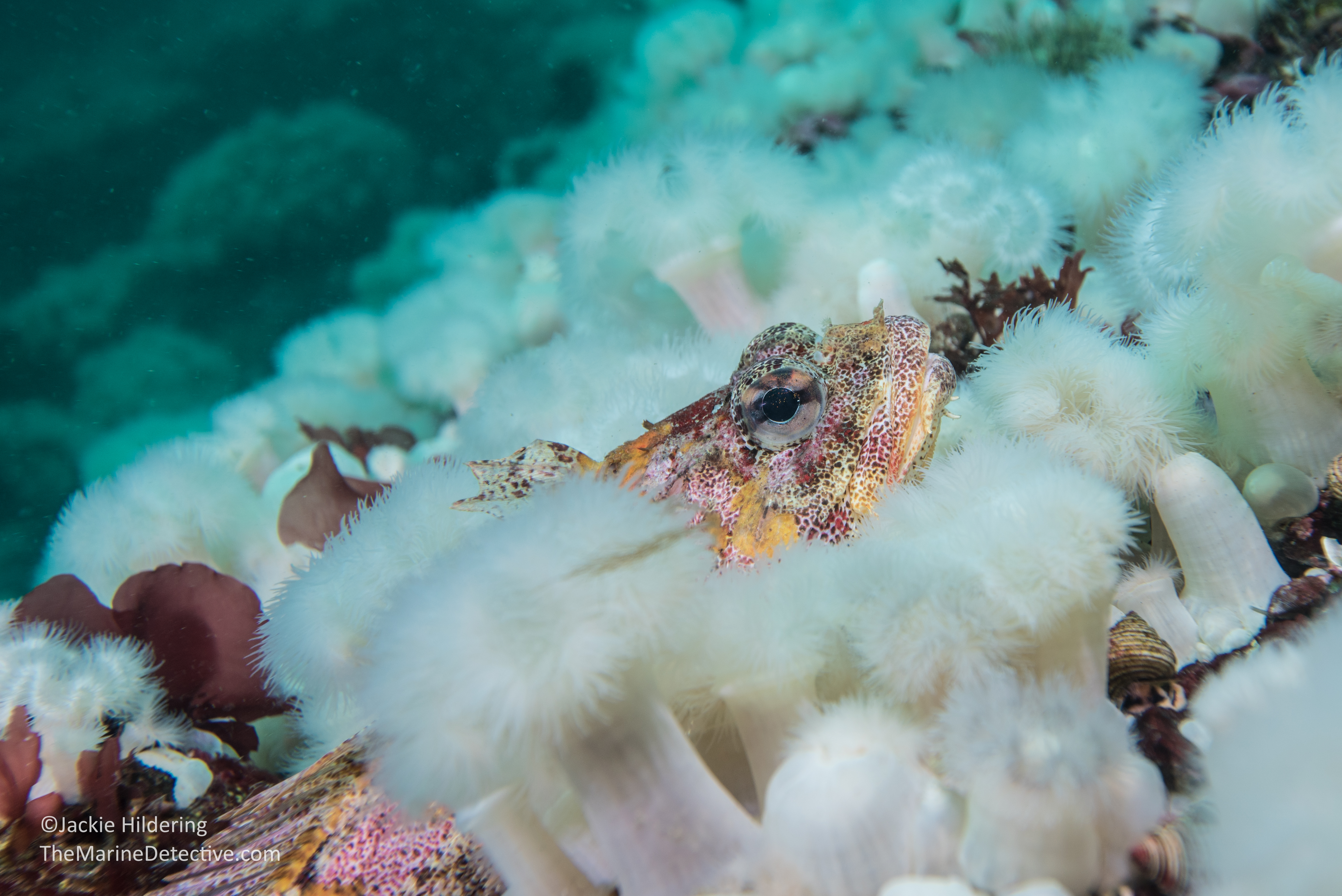
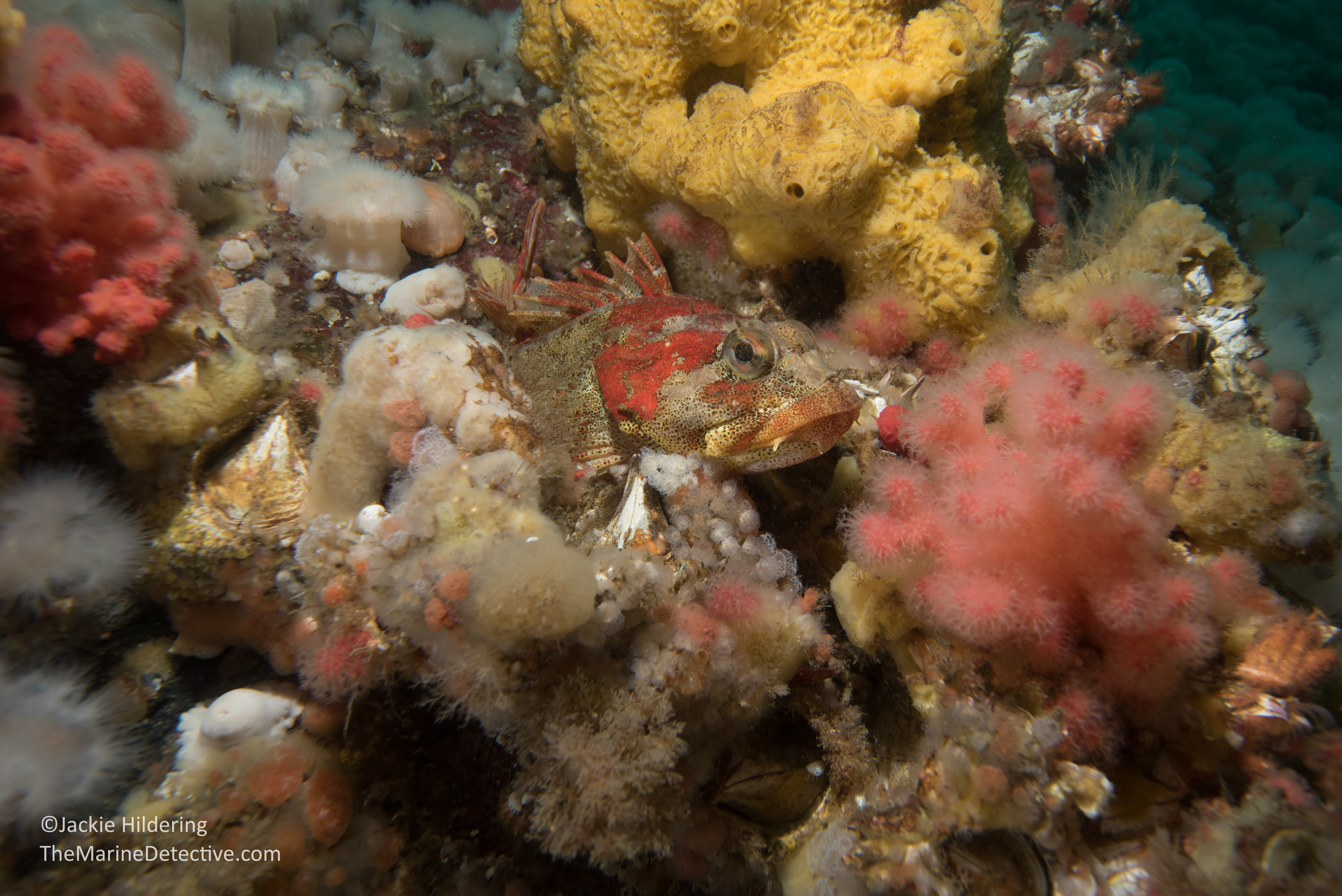
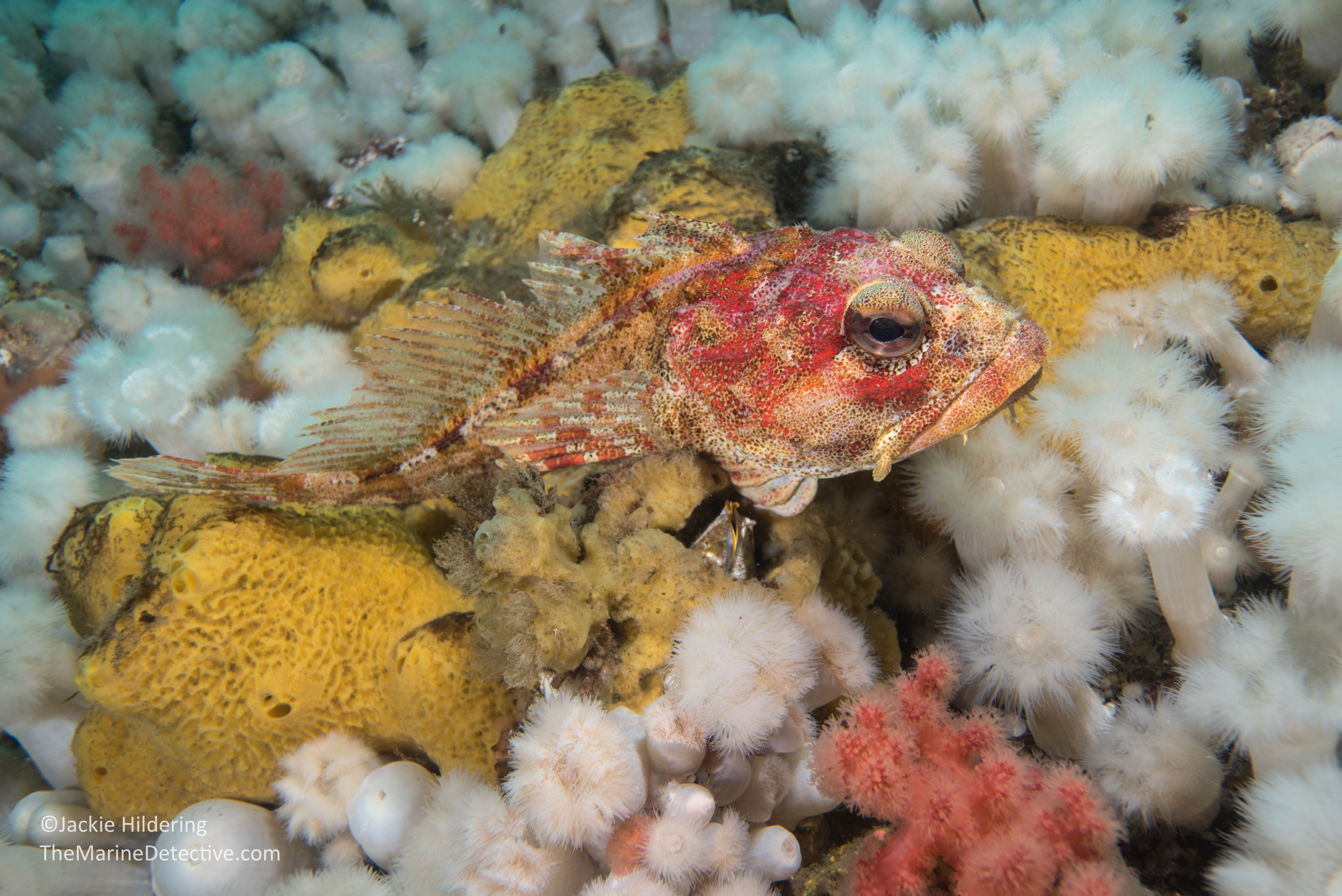
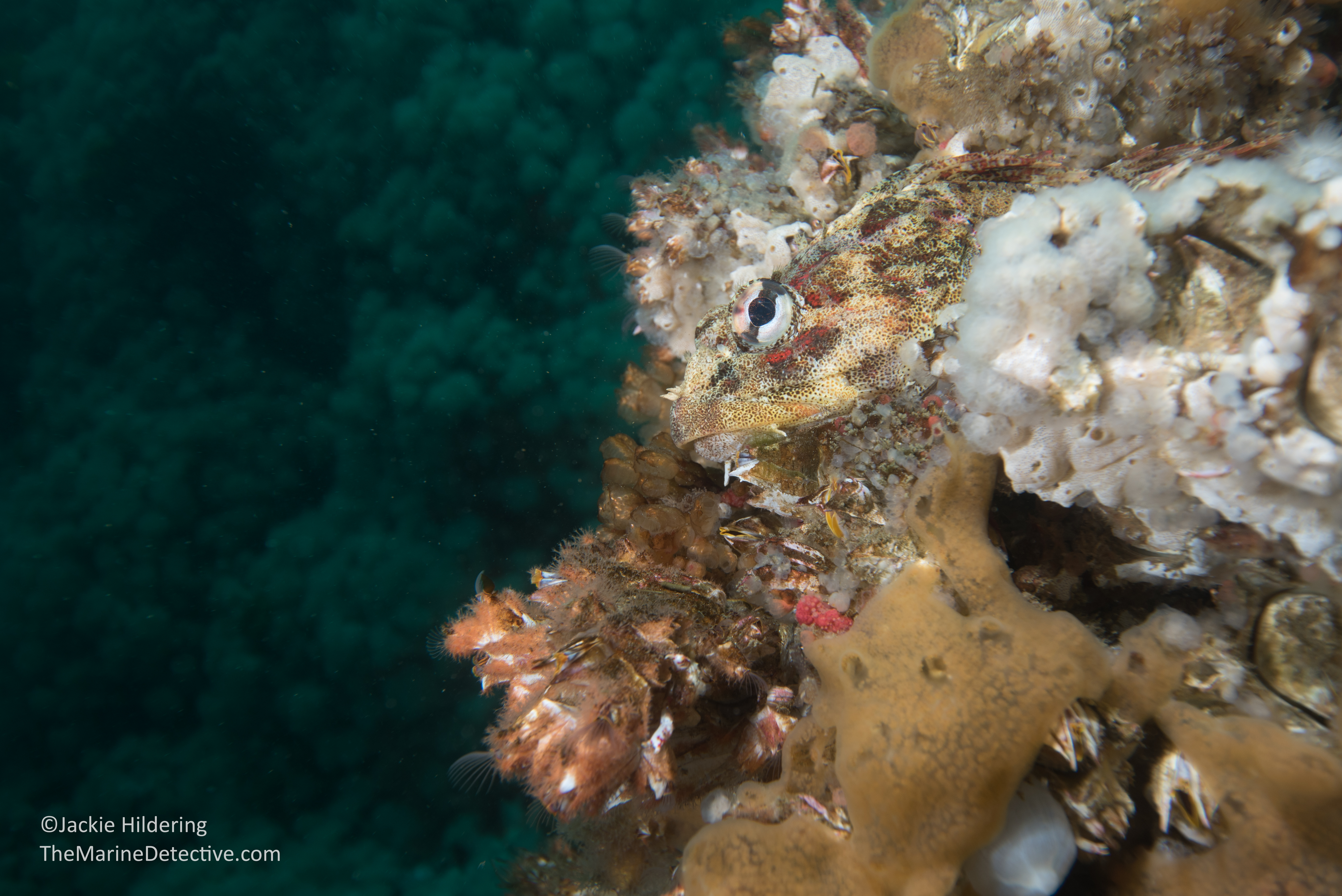
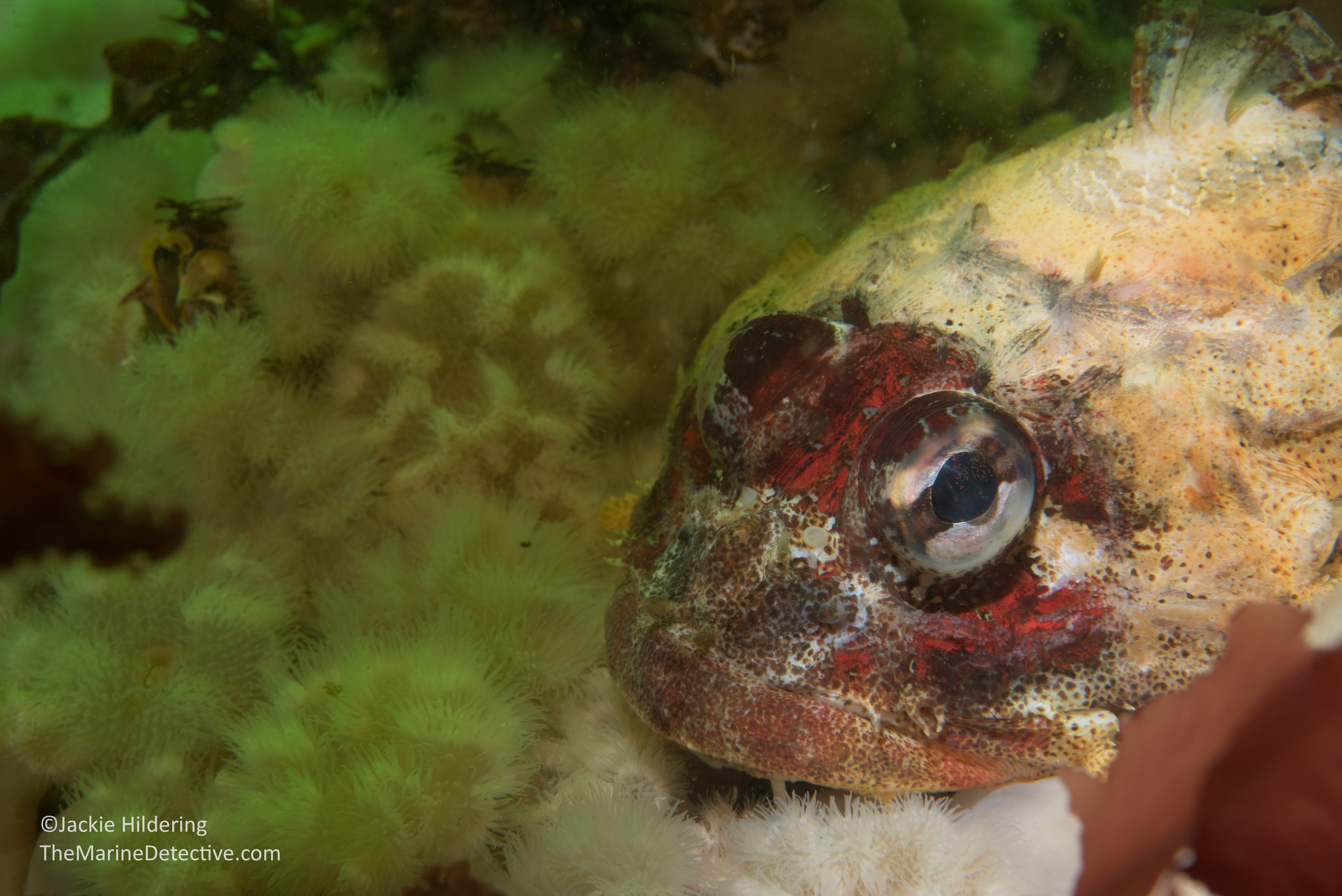
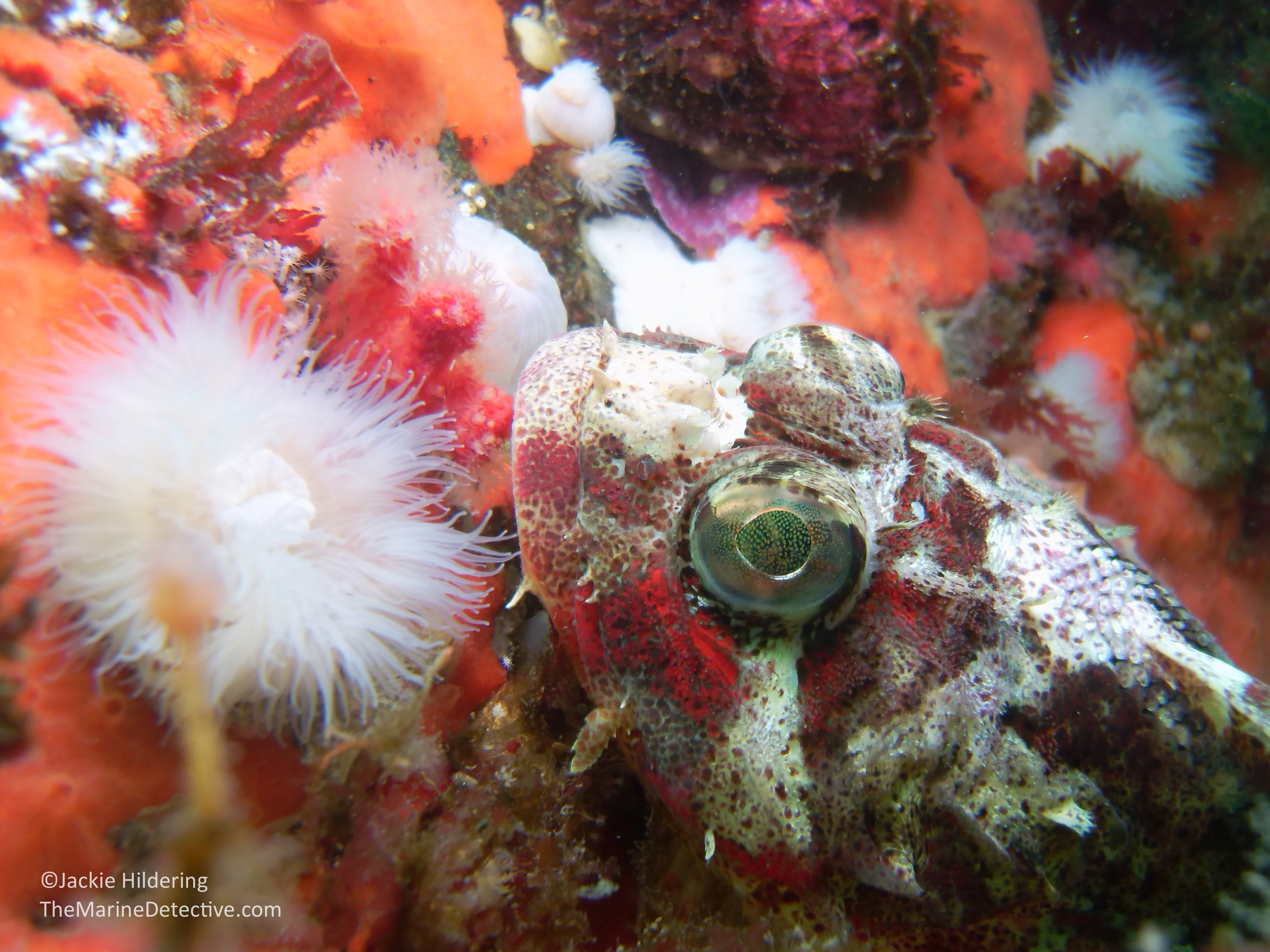
The Red Irish Lord (Hemilepidotus hemilepidotus; up to 51 cm) is a fish of incredibly stunning diversity of colour. Right down to its flecked, bulging eyes, this ambush predator is a master of camouflage.
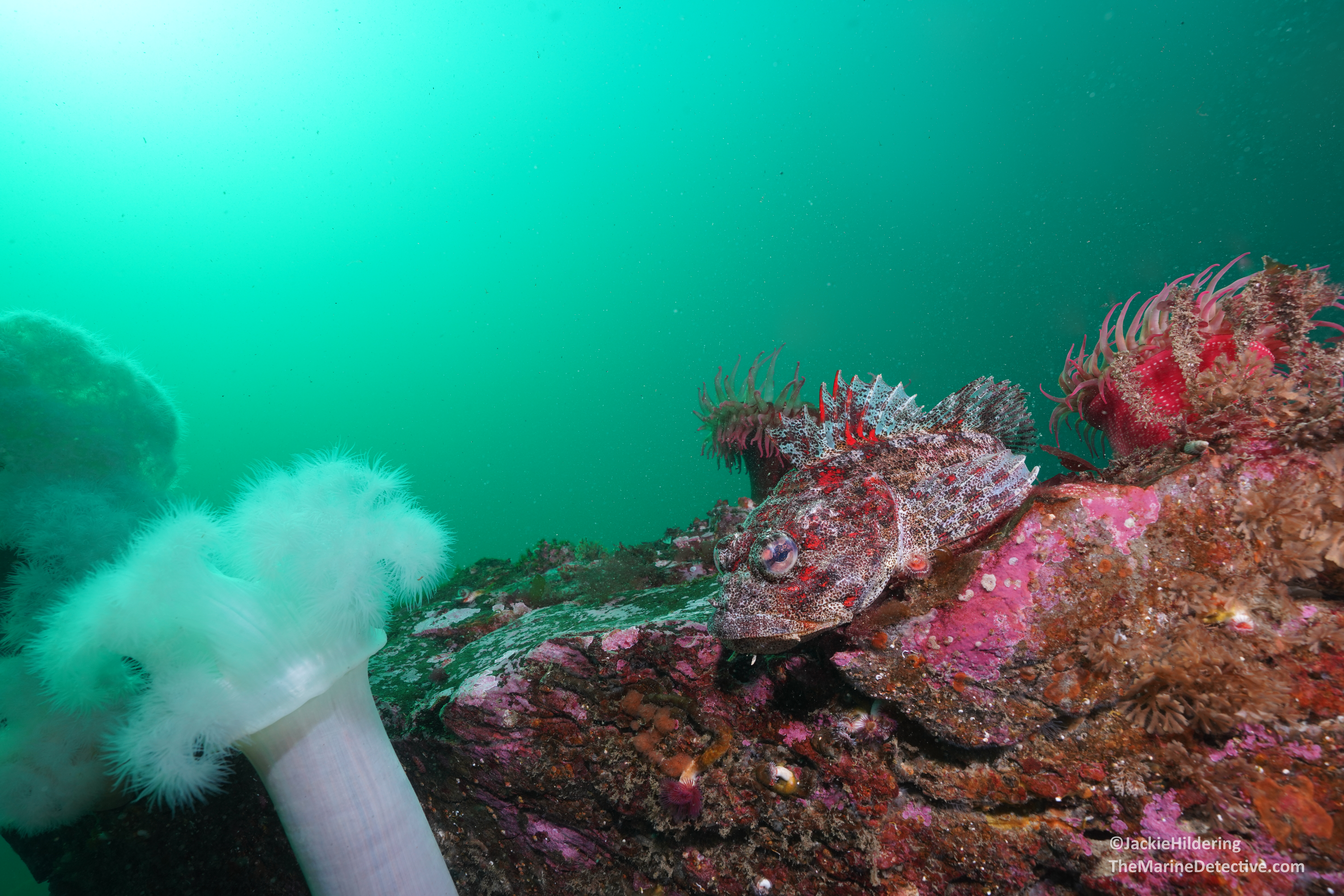
But how can you be camouflaged when you’re a fish of insane red and/or orange colouring? When you live in the rich, cold waters of the Northeast Pacific where Nature has doled out colour so liberally, you fade into the background even when so vibrantly coloured.
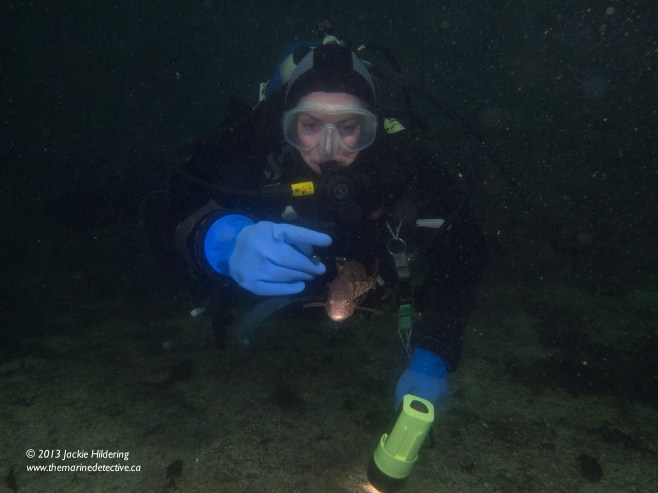
They are a favourite species for we underwater photographers since, as ambush hunters, they remain still even when annoying divers are flashing lights in their eyes or when a crab is sitting on their heads (see below).
The diversity of colour in this species is awe-inspiring. See below for examples of the diversity of colour and pattern and their ability to camouflage. You will even see that there are crabs that walk on their heads. I have a whole blog entitled “Crabs Making Bad Choices” dedicated to that at this link.
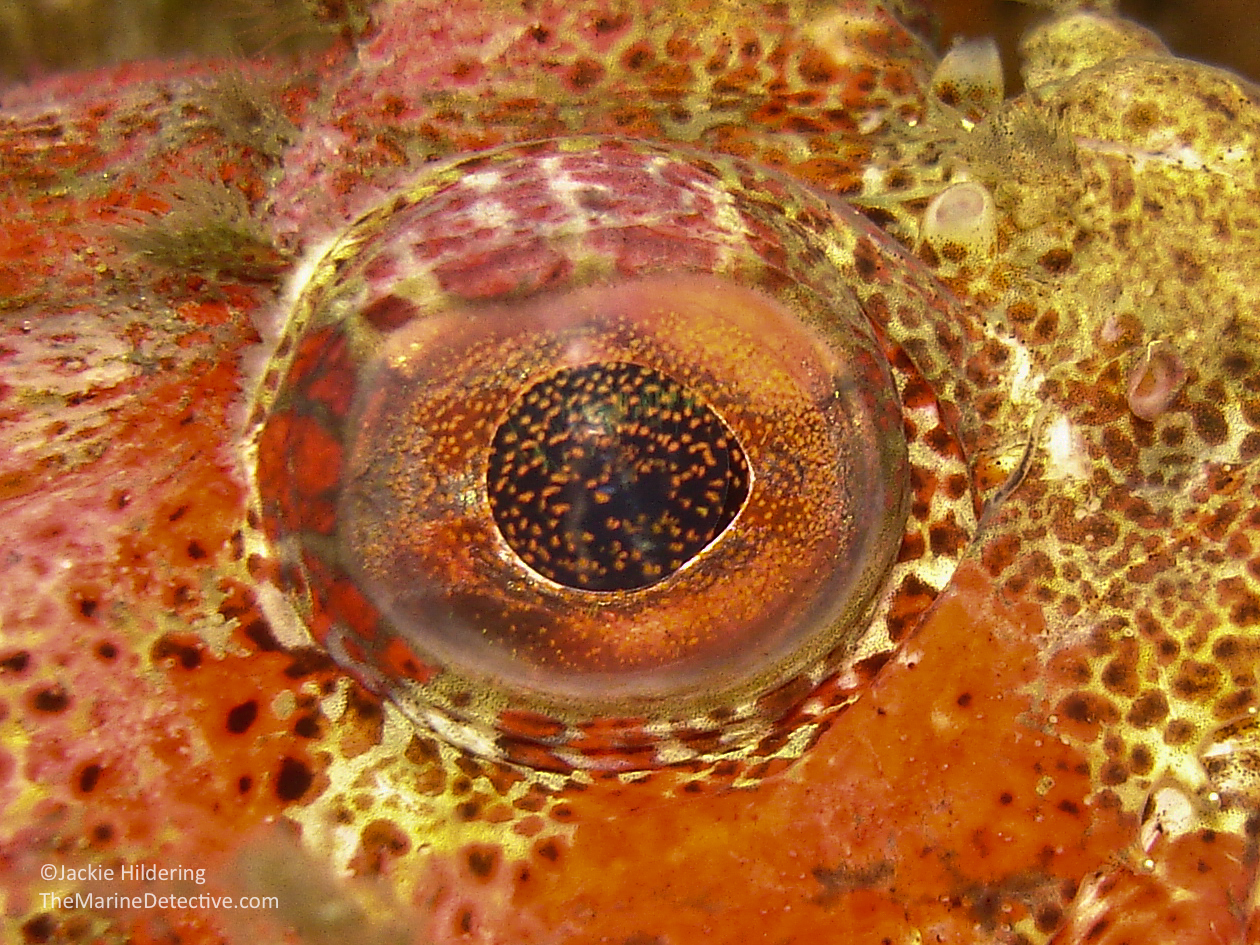
I hope that your sense of wonder is further stimulated in realizing that the Red Irish Lords are able to change even the colour of the flecks in their eyes to match their surroundings!
The remarkable eyes of the Red Irish Lord. The flecks you see are corneal chromatophores which can change colour to add the to species’ ability to camouflage.
See too how Red Irish Lords are among the fish who guard their fertilized eggs.
Both male and female Red Irish Lords guard the eggs. More information in my blog at this link.
A Red Irish Lord who is hoping the Sharpnose Crab inches down just a bit further so that s/he can feed (and that the annoying photographer would go away!). See my blog “Crabs Making Bad Choices” for more photos of such interactions at this link.
Another Red Irish Lord and a mature male Sharpnose Crab making bad choices.
Slide show and gallery of photos below give a further sense of the diversity of colour and camouflage in this species.
Scalyhead Sculpins are a tiny fish but the males have a giant parenting role (species Artedius harringtoni).
I found what I believe were this species’ eggs while guiding a recent beach study (Port Hardy, BC).
To share this information, and my photos, I’ve tried something new. Below, you’ll find a slideshow that I have narrated to explain how Scalyhead Sculpins are super dads.
Yes, that’s right, you get to hear my voice this week (oh-so-human stumbled speech and all!). Please realize I am speaking as I would to a +/- 10 year old.















































 The Marine Detective