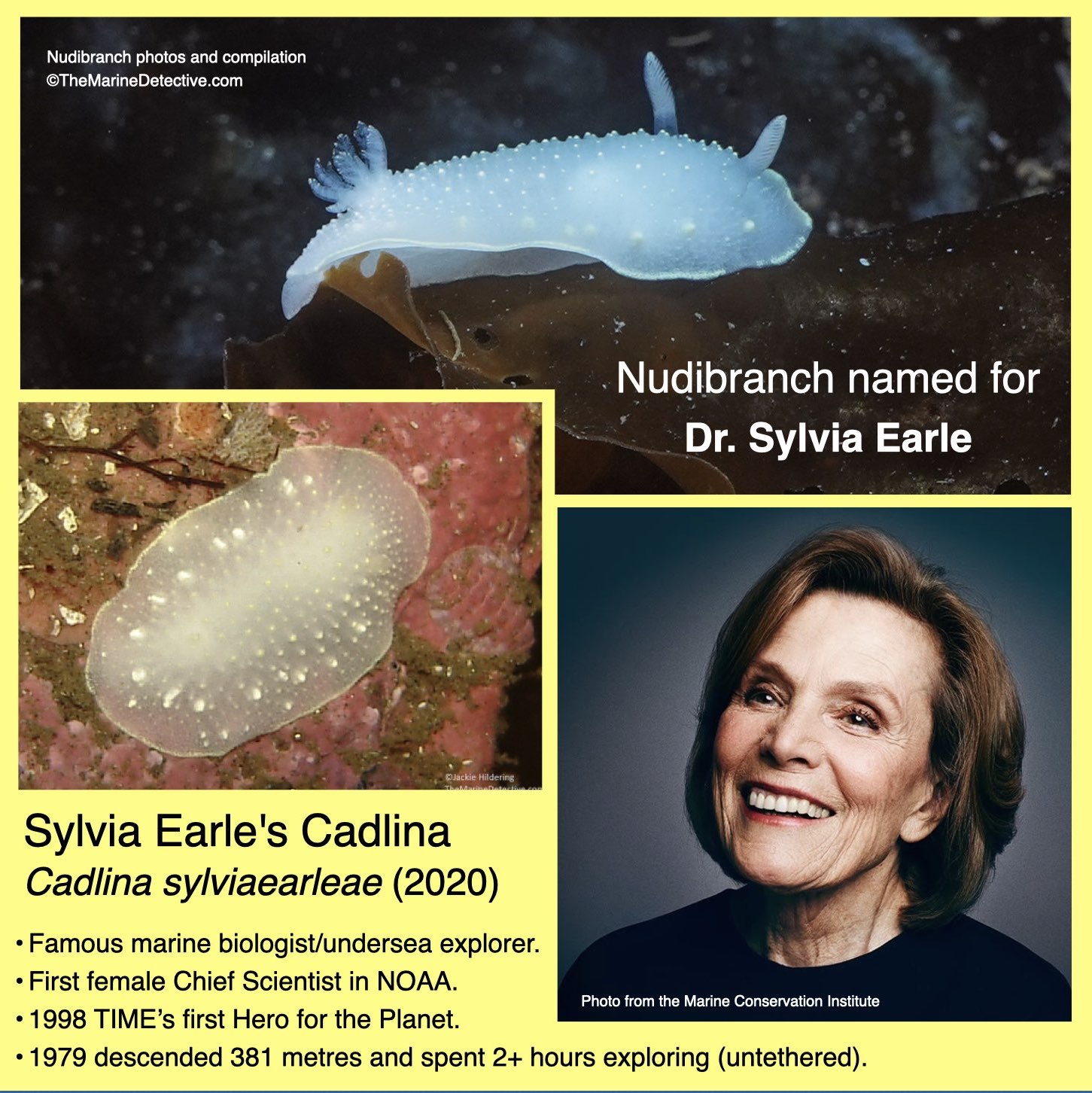
I am very late to this party. Back in 2020, a nudibranch was named in honour of Dr. Sylvia Earle when there was reclassification of the Yellow-margin Dorid and the research was published by Korshunova et al.
There is now Sylvia Earle’s Cadlina (Cadlina sylviaearleae).
Despite my great admiration for Dr. Earle and for sea slugs, I did not realize these two had come together until I recently posted one of the photos you see below. Karolle Wall very kindly let me know that this was no longer a Yellow-margin Dorid (Cadlina luteomarginata).
What follows is focused on the reclassification and how difficult it is to discern these species from external characteristics. If you have an electron microscope, it will be easier. 😉 You would be able to see the differences in the radula (tooth-like structures).
What was historically Cadlina luteomarginata is now at least four described “yellow-margin dorid” species. Sylvia Earle’s Cadalina is described as a sister species to Cadlina luteomarginata. What Karolle pointed out as a helpful discerning characteristic is the space between those distinctive tubercles on the nudibranch’s side.
From Korshunova et al., 2020 “Until recently, C. luteomarginata has been considered a single species with a whitish notum and yellow marginal line with a broad range in the north-eastern Pacific from Alaska to California (e.g. MacFarland, 1966; Behrens, 1991; Behrens & Hermosillo, 2005). Present integrative morphological and molecular analysis reveals that there is considerable hidden diversity among Cadlina from the north-eastern Pacific.”
Sylvia Earle’s Cadalina (Cadlina sylviaearleae) “Opaque whitish, with some small dorsal tubercles tipped with yellow. Rhinophores with slight yellow tint. Gills are semitransparent white, similar to ground colour . . . differs both molecularly and in a number of morphological features from all other described Cadlina species.” (Korshunova et al., 2020).
Size to at least 2,5 cm. “Known from British Columbia to Oregon”. (Behrens et al., 2022)
Differences with the Yellow-margin Dorid (Cadlina luteomarginata) as originally described by MacFarland (1905, 1966) “Considerably less tuberculated notum [upper surface of the body], more weakly developed yellow line around notum and by patterns of the radula”. (Korshunova et al., 2020).
Size up to 8.3 cm. “Species confirmed from British Columbia to Mendocino, California, possibly to Punta Eugenia, Baja California” (Behrens et al., 2022).
More from Nudibranchs and Sea Slugs of the Eastern Pacific, 2022: “Recent molecular analysis work has revealed a number of cryptic species with the genus Cadlina. At least four species have been previously lumped under the name Cadlina luteomarginata and it is unclear at present whether these species can be reliably identified by their external characteristics . . . All are sponge predators.”
Personal note: Reading about these species and writing this blog took me over 3 hours. Why do this? Time evaporates and I get lost for a while in science and the sea. I suppose that’s enough reason. A great bonus would be if this is of use to others too.
Yes, yes I do feel somehow better now that I have compiled the following for you. Thanks for asking.
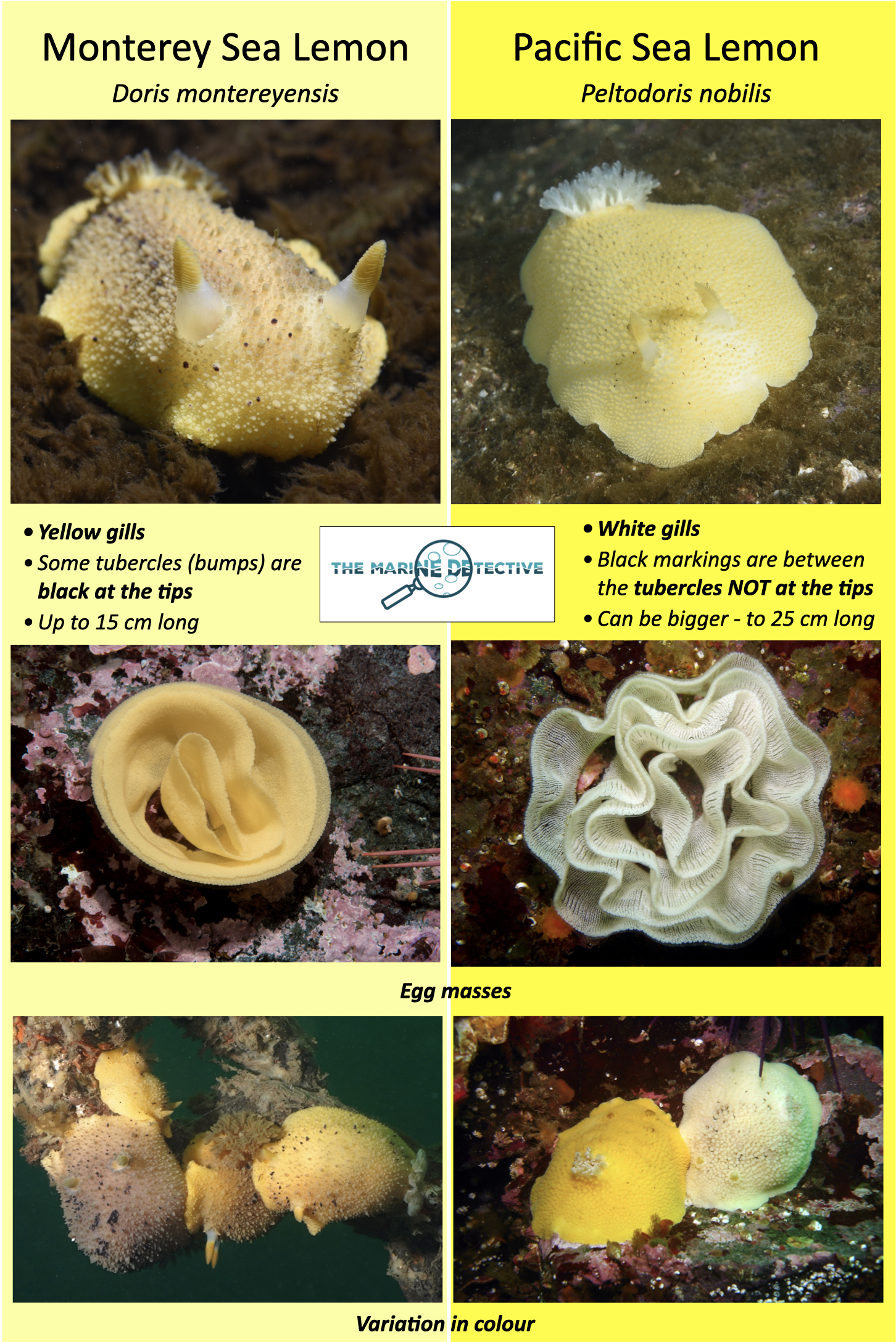
Monterey Sea Lemons and Pacific Sea Lemons are commonly confused with one another (and other yellow dorid-like nudibranchs).
On a recent dive, I was able to get photos of the two species oriented the same way AND when their gills were not retracted! I hoped that by putting these photos side-by-side, it would be useful to others to identify the species.
The easiest differences to discern who is who, are the colour of the gills (yellow or white) and whether the black markings are at the tips of some of the tubercles or not.
I’ve added photos to show (1) their very different egg masses and (2) the variation of colour within the species.
You’re welcome.
The Pacific Sea Lemon is also known as the Noble Sea Lemon.
The name of the Monterey Sea Lemon (aka Monterey Dorid) does not help with clearing up confusion as it is very commonly seen far to the north of Monterey.
[Update! As a result of writing this blog, I learned that the species has been reclassified AGAIN. As of ~February 12, 2024, this is no longer Berthella chacei. It is now Boreoberthella chacei. I’ve updated the text below and will just reference the species as the “White Berthella”.]
There’s a whole lot of mating going on right now with the sea slug species, Boreoberthella chacei also known as “Chace’s Sidegill” and the “White Berthella”.
Two mating White Berthellas and an egg mass.
Not a nudibranch
The Berthella are examples of sea slugs that are NOT nudibranchs. I’ve emphasized previously that “nudibranch” is not synonymous with “sea slug”.

Dive buddy Jacqui Engel and White Berthellas laying egg masses / ribbons.
The nudibranchs are just one of the seven subgroups of sea slugs (the Heterobranchia). Thereby, all nudibranchs are sea slugs. But not all sea slugs are nudibranchs. I realize those two sentences may make your brain feel sluggish. Sorry / not sorry. 😉
Characteristics shared among nudibranchs are that they are sea slugs that all DO have naked gills on their backs (hence “nudi” and “branch”) and adults DON’T have an internal shell.
Berthellas belong in a different group of sea slugs than nudibranchs. They are sidegill sea slugs (the Pleurobranchida order). They DON’T have naked gills and DO have an internal shell. The shell ofWhite Berthellas is thin and white and is at least half the length of their bodies. Their gills, as the name “sidegill” suggests, extend from their side.
Specifically, the gills are on the right side, between the mantle and the foot. See them in the photo above?
Perspectives on the White Berthella that show how the rhinophores extend out from under the mantle. Rhinophores are the structures extending from a sea slug’s head that allow them to smell their way around. Berthella can retract these when there is an annoyance around. Yep, an annoyance like me. You can also see the beautiful “oral veil”.
Mating time
It’s typically in February and March that I see mating and egg masses for White Berthellas near northeast Vancouver Island.
Mating White Berthellas with egg masses.
I find it a marvel that they find one another. Throughout the rest of the year I see them quite spread out from one another. There can be some within a few metres of one another but with other sea slugs species, they are often within centimetres of one another.
With other sea slug species, Nature has ensured they are often very close by the species having VERY specific prey e.g. Pomegranate Aeolids ONLY feed on Raspberry Hydroids. Thereby, there are often others of your kind, nearby on this prey.
White Berthellas are reported to feed on sponges (specifically plakinid sponges like Slime Sponge, Oscarella carmela). They don’t seem to aggregate near these sponges, maybe because they are more diffuse? They must find one another by smell detected by their rhinophores and then crawl to be within proximity (this species does not swim).
When they find one another, they appear to jostle for position in aggregations. Pairing up right-side-to-right side means that they can attach by their “gonopores” and mating can occur. Both partners become inseminated and both will lay eggs. Like other sea slugs, they are simultaneous hermaphrodites. It makes a lot of sense when you are a sea slug to maximize how many eggs are laid, especially if your young hatch out to be part of the planktonic soup of the ocean. I believe that more than one egg mass is laid per parent.
Each dot you see in the photo is an egg capsule that is only ~1.6 mm long and it contains 1 or 2 fertilized eggs. Imagine how many fertilized eggs are in the egg masses in the photos below!
The veliger larvae hatch out at the age of around 18 days in 11 to 14 degrees Celcius (it would take longer around northeastern Vancouver Island where temperatures are colder). These larvae have eyespots and shells and are around 153 micrometer long; that’s 0.153 mm! (Goddard, 1984).
Reclassification
The White Berthellahas only been recognized as being a distinct species since 2020 (Ghanimi et al, 2020). It was thought that it was one of two “morphotypes” of the California Sidegill. As mentioned in the update at the top of this blog, very recently the species has been reclassified AGAIN. it is now Boreoberthella chacei.
The White Berthella (Boreoberthella chacei) is up to 7 cm long. The body is white and has little white bumps (tubercles) randomly distributed all over its body and rhinophores. Known range is Alaska south to San Diego, California and the Sea of Japan (Behrens et al., 2022)
The California Sidegill (now also reclassified as Boreoberthella californica) is bigger on average at up to 12.7 cm. Body is white to tan and is smooth. The little white dots are uniformly spread and are not on the rhinophores. Known range is Ventura County, California to the Pacific Coast of Panama and the Galapagos Islands (Behrens et al., 2022)
The egg masses of each sea slug species are distinct. As you can see below in the compilation from the research paper, this is the case for these two species of Berthella.
Side note: How it made me smile to see that my photo of White Berthella egg masses was referenced in the research paper discerning the two species!
Leather Star and Leafy Hornmouths (marine snails) near mating and egg-laying White Berthellas.
I finally observed some of the most cryptic nudibranchs on our coast!
The Cryptic Nudibranchs you see here are only about 1 cm long and look at how astoundingly evolved they are! They are virtually invisible on the Kelp-encrusting Bryozoan which is growing on Bull Kelp at this time of year. This species of nudibranch is also known as Steinberg’s corambe (Corambe stinbergae to 1.7 cm).
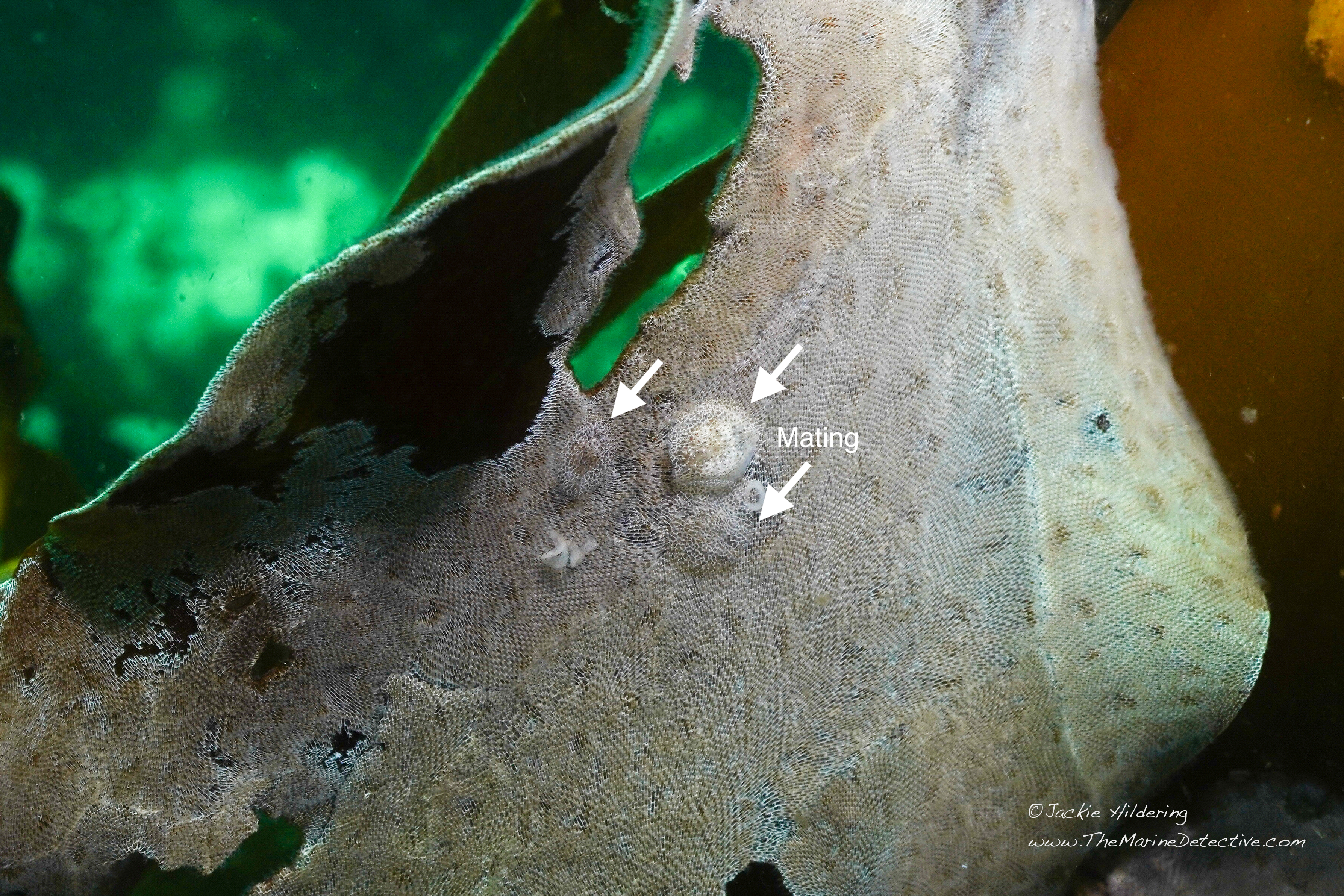
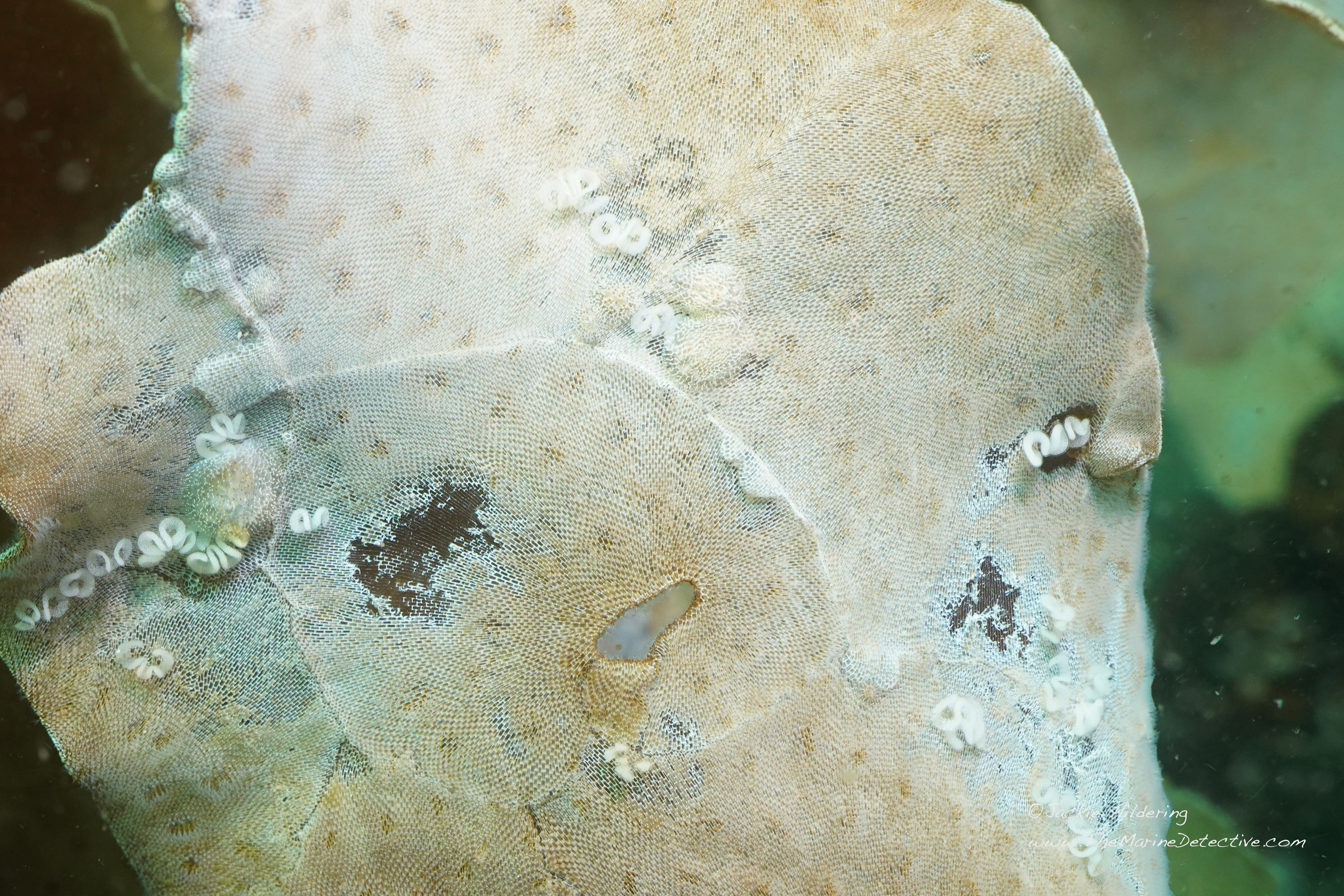
You can see in the photos here that we found some of the nudibranchs mating and there were many of their egg ribbons (each of those coils has a lot of eggs that result from both parents becoming inseminated and laying eggs).
You can also see where they have been feeding on the bryozoans (colonies of animals).
I have looked for them for years knowing their range is from Alaska to Baja California, Mexico.
Mating: Right-side-to-right-side attached via the gonophores. Both hermaphrodite parents lay eggs.
What made the difference in now being able to find them:
(1) Getting the clue from Robin Agarwal to look at the kelp fronds that were REALLY tattered with the Kelp-encrusting Bryozoan colonies .
(2) Having a skilled dive buddy willing to join me in burying our heads in old, tattered kelp in the surge for 30 minutes instead of looking at all the big, colourful life at this dive site. Thank you Janice Crook!
(3) Once we knew what the egg ribbons looked like (those s-shaped little masses), we had a really good clue and knew better where to look even more closely for the nudibranchs.
Now on to finding the SECOND really cryptic nudibranch species that feeds on Kelp Encrusting Bryozoans – Corambe pacifica to 1.5 cm long and whose egg masses are tiny, flat coils.
For more photos and my previous blog on what Kelp-encrusting Bryozoans look like, please see my other blog “Kelp Lace? Bryozoans”.
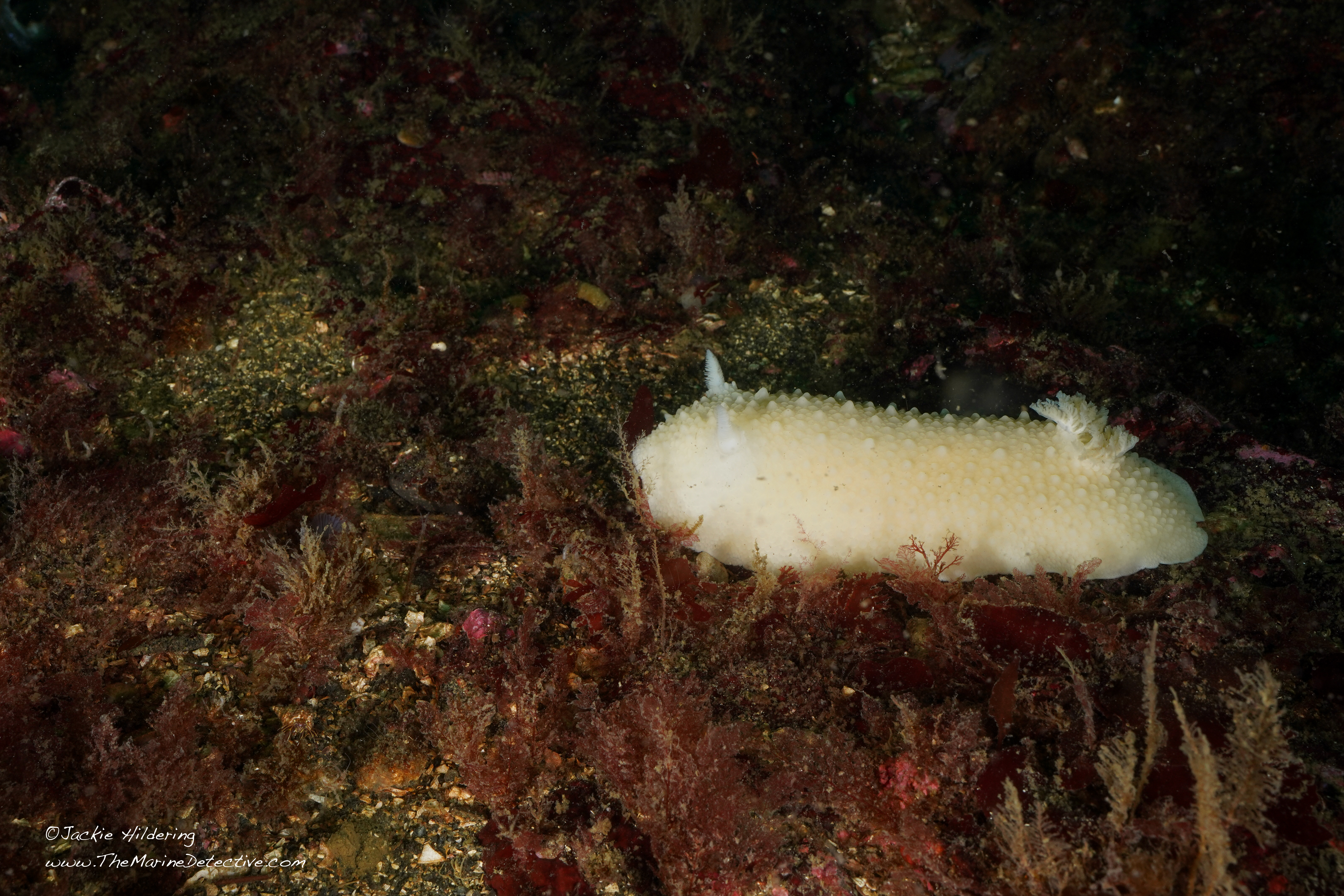
These are Great White Dorids. Yes, they are a species of nudibranch and the individuals featured here are mating, prowling for sponges AND succeeding in laying their astounding egg masses.
Mating Great White Dorids: Reproduction of nudibranch species is always right-side-to-right-side; attached by structures called “gonophores”. As reciprocal hermaphrodites, both parents become inseminated and lay eggs.
EACH dot you see in the egg masses (photos below) contains 8 to 12 fertilized eggs. They are laid by both parents because it makes a lot of sense to be a hermaphrodite when you are a sea slug and your eggs hatch into the sea. More fertilized eggs = more chances of some young surviving.
Even after so many years, I find the intricacy and diversity of sea slug egg masses something of jaw-dropping wonder. Not such a good thing when you are supposed to hold a regulator in your mouth while diving. 🙂
Scientific name of this species is Doris odhneri. They can be up to 20 cm long and their egg masses can be at least that size too.
Body design is classic for the sub-classification of nudibranchs that is “the dorids”. Those tufts on their hind ends are the gills and the projections on their heads (which all nudibranchs have) are the sensory rhinophores (rhino = nose). It’s how they smell their way around to find mates, food and whatever else is important in their world.
Notice in the next photo how dorid species are able to retract their gills when disturbed by the likes of an annoying underwater photographer.
Gills retracted.
Amazing too to think of the importance of smell in the sea isn’t it? Why is the individual in the following photo reared up like that? I believe it allows a better position to smell / detect the chemicals of food and/or a mate. Maybe they are even releasing pheromones? Note that is me musing. There is no research I know of to support this.
Same individual as in the first photo in this blog. I asked super sea slug expert, Dave Behrens, about this behaviour years ago and his response was: “I will agree the “rearing” is unusual in this group of dorids. Rearing is common amoung phanerobranch dorids (those that cannot withdraw their gill) . . . Although we will never know for sure, the behavior is thought to be a way for the slug to elevate itself above the substrate in search of chemical clues for its favorite prey.”
In featuring this species, the Great White Dorid, you see that not all nudibranch species are super colourful. But they are all super GREAT.
Species is also referenced as the GIANT White Dorid or Snow White Dorid, or White Dorid or White-Knight Nudibranch . . . etc. Known range is from southern Alaska to California but it’s a species I don’t see often where I dive around northeastern Vancouver Island.
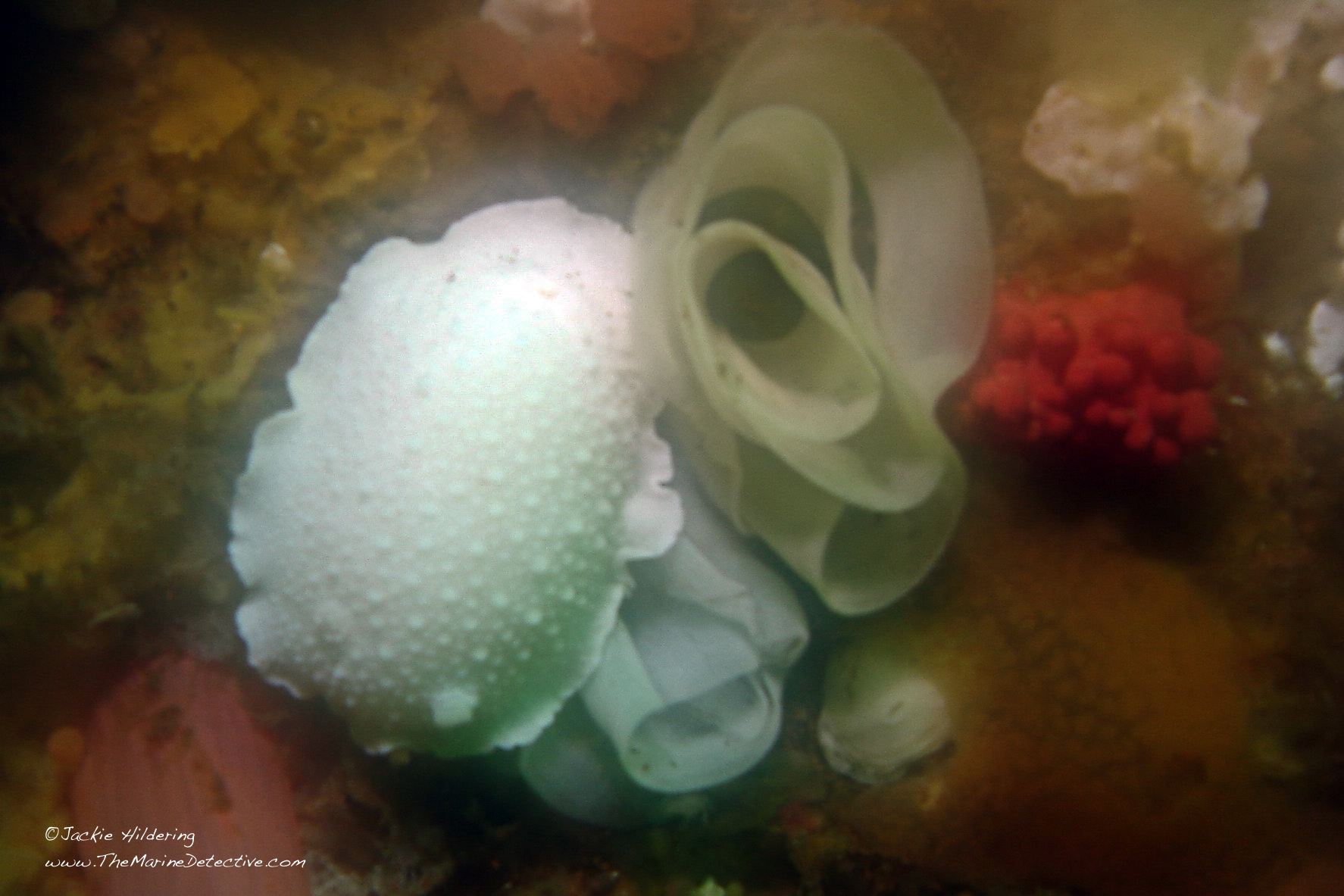
Another perspective on a Great White Dorids astonishing egg mass. Prowling for sponges, a mate, or both. 🙂 Poor photo (because my camera housing had moisture in it that condensed in front of the lens) BUT this image shows a Great White Dorid laying an egg masss. It’s one of the times I caught a Great White Dorid in the act whereby I could know what the egg masses look like for this species (albeit that there are some closely related species of nudibranch that lay very similar looking egg masses).
Last updated: May 3, 2026 The information below is about 3 species of headshield sea slug (Order Cephalaspidea) that have similar egg masses. All three also have a very thin internal shell (bubble shell).
Here’s a species that deserves the descriptor “Great” without doubt – the GREAT Winged Sea Slug.
I will never forget the first time I saw one of these tiny sea slugs “flying” underwater. My brain came close to exploding. I did not know of their existence prior to one flapping past my mask.
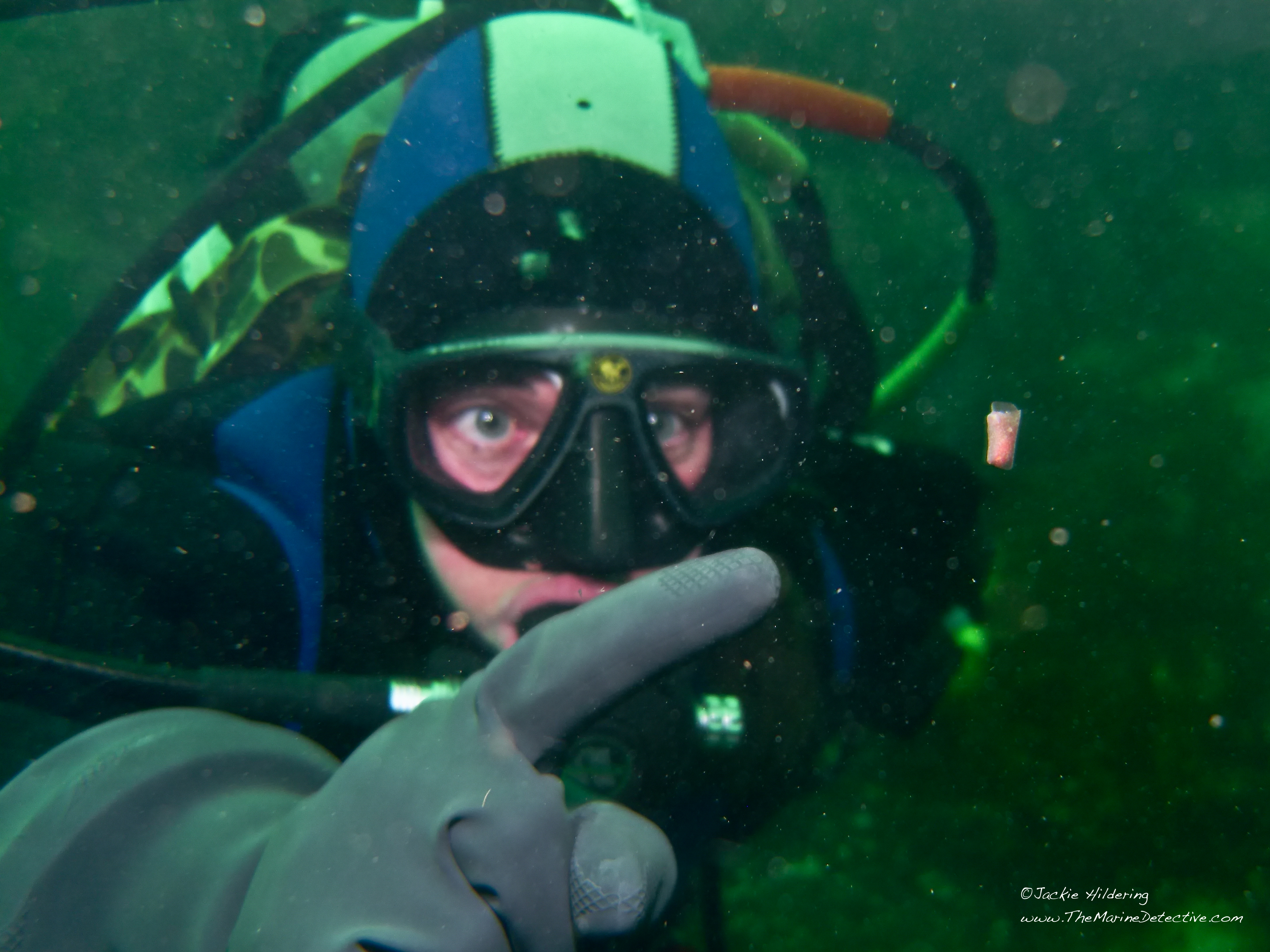
Dive buddy Natasha Dickinson pointing at a Great Winged Sea Slug.
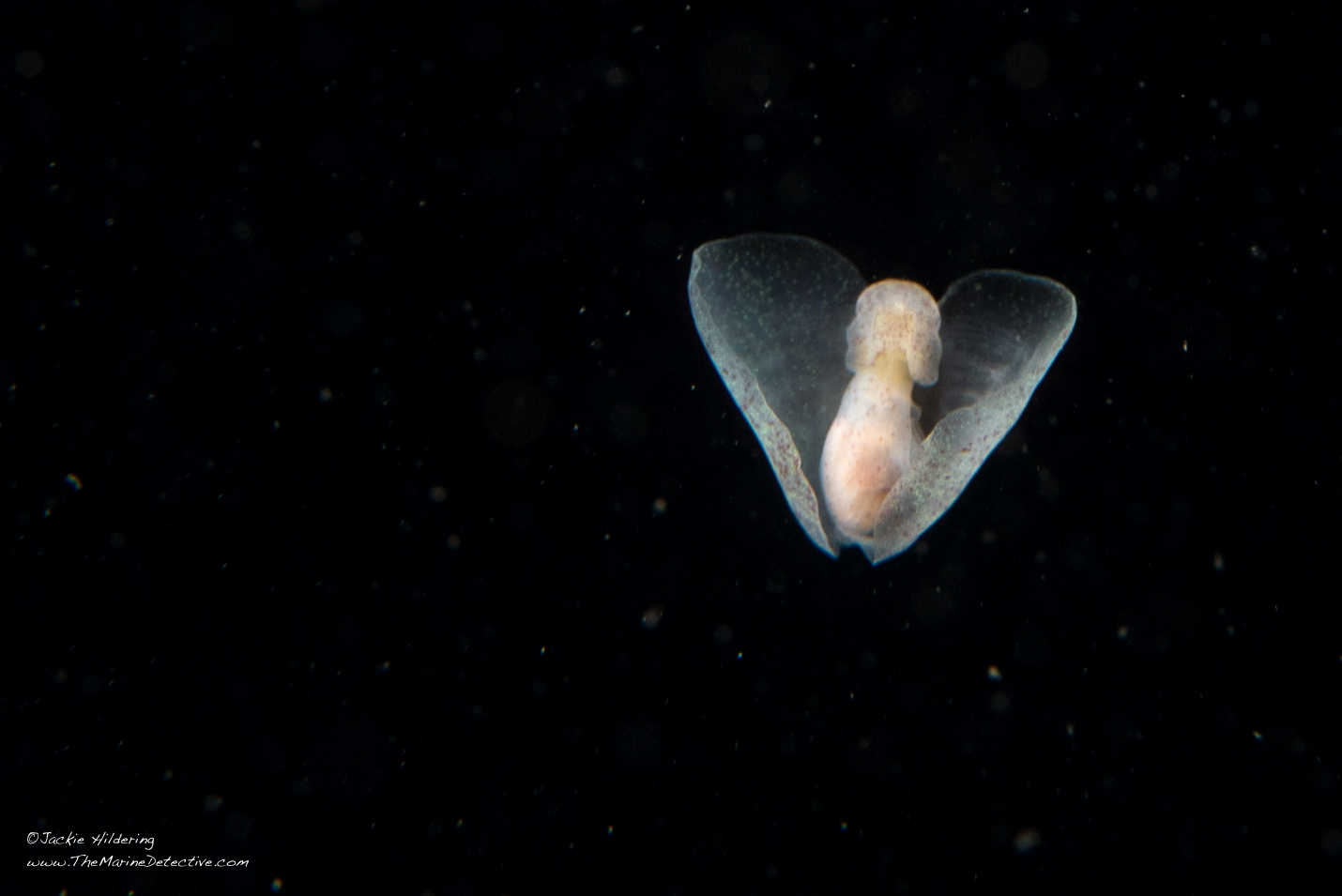
Gastropteron pacificum is usually no bigger than your thumbnail. Maximum length is ~2 cm long and with “wingspan” to 4 cm. The species is also referenced as the Pacific Wingfoot Snail and the Pacific Batwing Sea Slug. But, as mentioned, I prefer the reference to their greatness.
Just marvel at how they can propel themselves, as captured in this video.
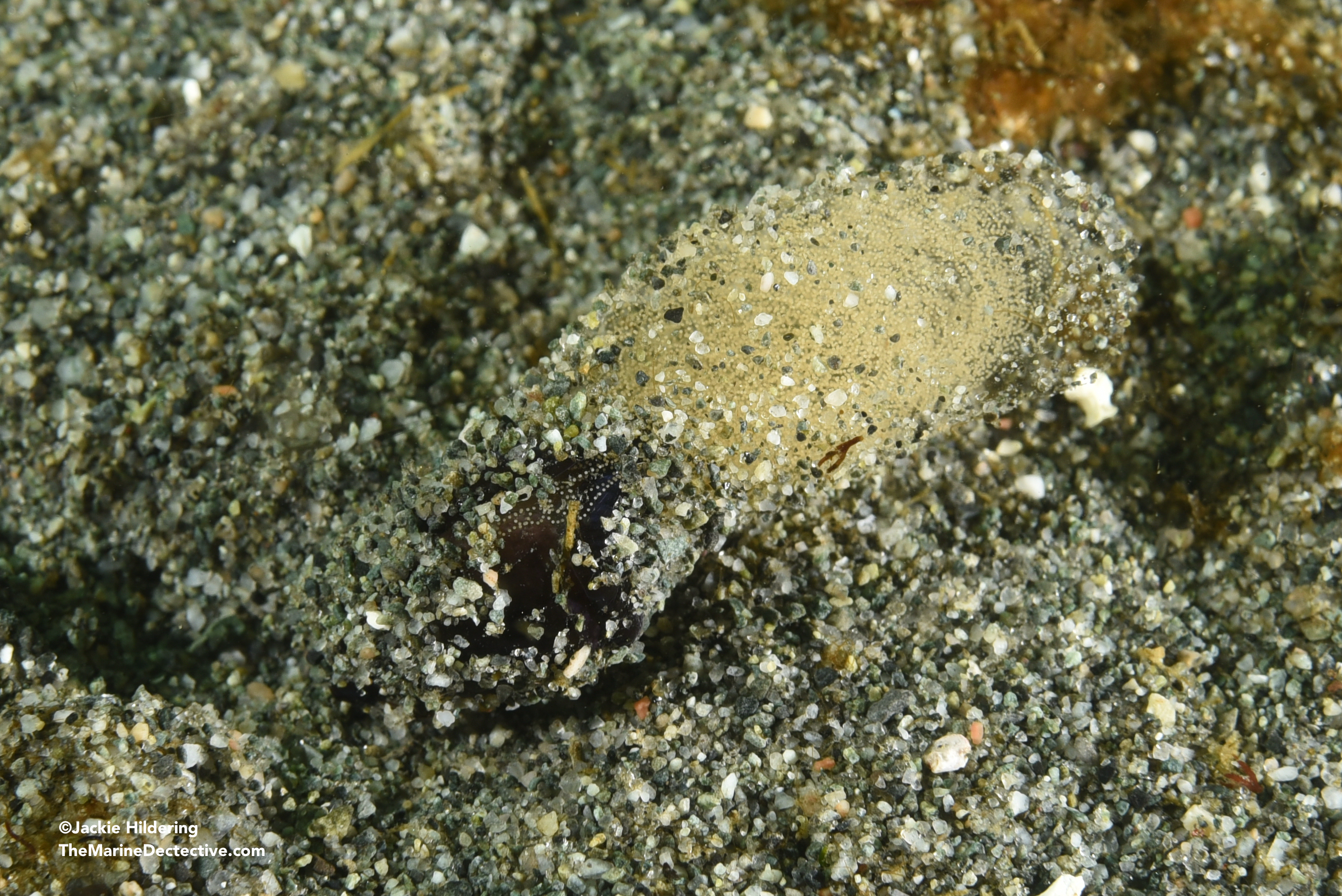
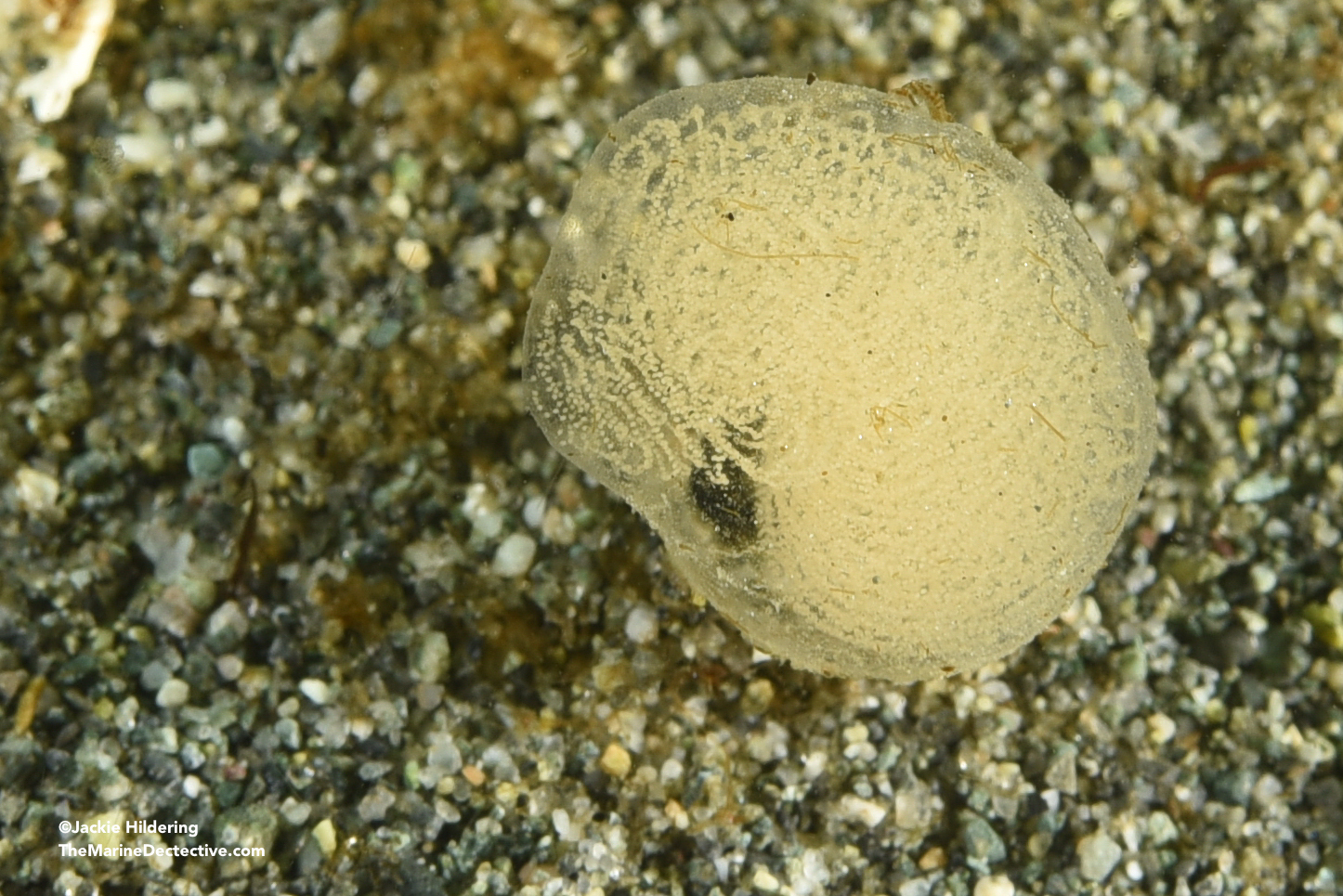
I will ALSO never forget the first time I saw them spawning, so many of them on the sandy ocean floor, their egg masses expanding to be bigger than they are.
I try to document this every year, looking in areas with sand in from late March into May. I have found them, and their eggs, as shallow as 2m depth.
And sure enough, on March 31st, there they were again. They are gathering to mate!
March 31, 2020 – “Beach Camp” near Port McNeill at only about 3m depth.
The photos below show you what the peak of the spawn looks like. Photos are from May 26th, 2019. Just look at the number of them! How do they find one another? How many eggs in an egg mass? So many questions!
I bet you also want to know how it can be that their masses of fertilized eggs are bigger than the sea slugs themselves. I presume the masses must expand with seawater but . . . I do not know.
As is the case for most terrestrial and sea slugs, Great Winged Sea Slugs are simultaneous hermaphrodites whereby both parents become inseminated and lay eggs. It’s a great strategy to maximize chances of reproductive success when finding a mate is particularly challenging and your babies hatch into the planktonic soup of the ocean.
Among my many wonderings about this species is: Why have I never seen Great Winged Sea Slugs swimming during the time they are aggregating to mate? I learned from research by Claudia Mills in Friday Harbour (published in 1994), that only sexually mature animals swim AND that they were only observed doing so between September and February i.e. not while mating.
Why swim? In may work well to escape annoying divers and/or bottom feeding fish like Ratfish. The timing suggests that it allows for population dispersal – spreading out for food and/or mates. You would think that the fact that hatch as plankton would spread them out enough. Also, HOW do they then assemble in numbers like this? Is it possible that these sea slugs smell one another’s scent trails even in the ocean?
You can see faint trails here.
Please know that this species IS a sea slug but it is NOT a nudibranch. Great Winged Sea Slugs don’t have naked gills and adults do have an internal shell when adults. Great Winged Sea Slugs belong to the group of sea slugs known as “bubble shells” of the order “Cephalaspidea”. You can even see the bubble shell in some of these images. Ronald Shimek creatively described these sea slugs as having “an internal shell that looks quite like a soap bubble and is about as durable.”
The wing-like structures are called parapodia. When the sea slug is not swimming, these “wings” wrap around the body forming a water-filled cavity. See what looks like a siphon? Part of the “head-shied” folds into a siphon directing water into the cavity. There’s also an exhalant siphon.
The photo above is from the first time I ever noted this species. I was able to follow one as it drifted to the bottom and then saw the siphon appear. This added to the sensation that my brain was going to explode with awe. I shared the photos with experts and learned that, at that time (2007) it was not known what any members of the family feed upon. This added to my appreciation / understanding of how little is known about marine species that are even common and in the shallows. Bill Rudman responded with “I suspect they may feed on small flatworms or other invertebrate with no hard parts – but that is just a guess.” Apparently Gastopteron are known to feed on detritus and diatoms but it a laboratory setting, To my knowledge, there has not been confirmation of the diet of the species when in the wild.
More about the eggs via Jan Kocian: ” Anne Hurst (1967) described the egg masses and veligers of Gastropteron pacificum. She considered the egg mass to be of “Type C,” that is, “in the form of an ovoid or globular jelly bag attached by a jelly string. Ths is common amongst cephalaspideans” (Hurst, 1967: 256). The egg mass of G. pacificum “is almost globular and of clear jelly. It contains widely separated rounded capsules containing spherical pink eggs. The smooth-walled capsules each have a short string-like protrusion from one point on their surfaces and this does not appear to be attached elsewhere. As the eggs develop to form a ball of cells, the pink colour becomes concentrated and at one side of it is a group of yellowish cells, the whole being surrounded by a narrow layer of greenish cells” (Hurst, 1967: 268) . . . Egg capsule dimensions range from 181-220 µ, and the animals take 14-15 days to hatch.”
Regarding diet, when I asked Bill Rudman of the Sea Slug Forum in 2007 what this species fed on, the answer was: ” . .. Gastropteron is one of the largest species in the family. At present we have no idea what any species feeds on, so this species might be easier than many to catch feeding. Can you put it on your ‘to do’ list? It would be very interesting to know. I know of no identifiable stomach contents being reported so I suspect they may feed on small flatworms or other invertebrate with no hard parts – but that is just a guess.”
I hope, dear reader, that these words and images offer an additional chance to get lost in the natural world for a little bit. It offers me such comfort to see the steady flow of the natural world around me – from the courting of song birds, to the emergence of plants, and the mating of sea slugs.
Know that, right below the surface, there’s a world or greatness . . . where slugs fly.
Note that if you see similar egg masses in the intertidal zone,I believe they are more likely to be from one of two other sea slug species that are also headshield sea slugs (order Cephalaspidea) – Albatross Aglaja or Spotted Aglaja. See below.
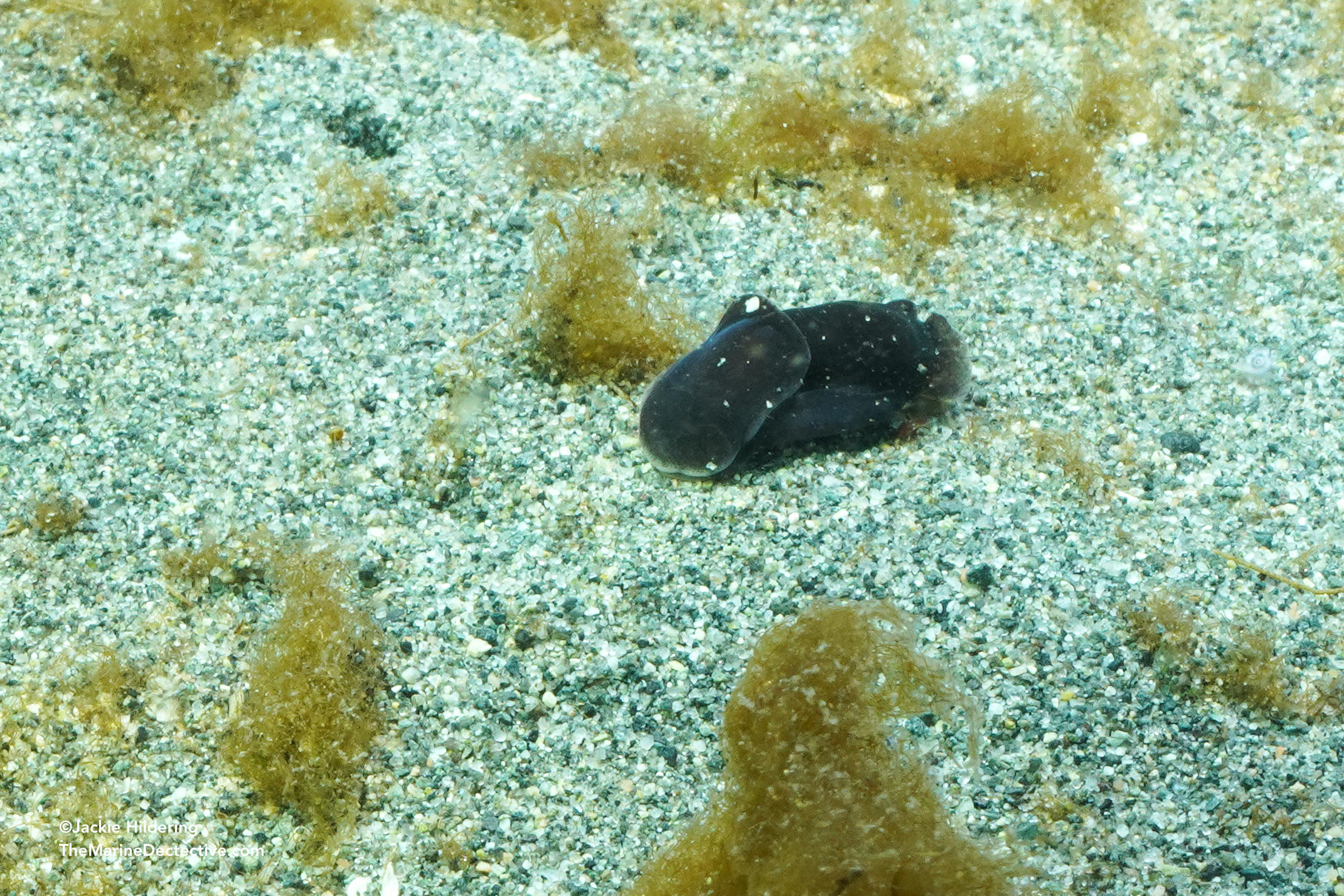
Albatross Aglaja
Melanochlamys diomedea to 1.5 cm long.
So often under the sand. Known to feed on nematode worms and kinorhyncha, aka mud dragons (Source: Zamora-Silva and Malaquiasm, 2016). The former common name of this species was the Diomedes’ Aglaja.
Albatross Aglaja laying eggs. You can get a sense of how small it is relative to the size of the grains of sand.
Albatross Aglajas crawling through the sand in the shallows.
Albatross Aglaja laying egg mass – you can just see a little bit of the sea slug in the centre of the egg mass.
Yeah! One above the surface whereby you can see the “headshield”,
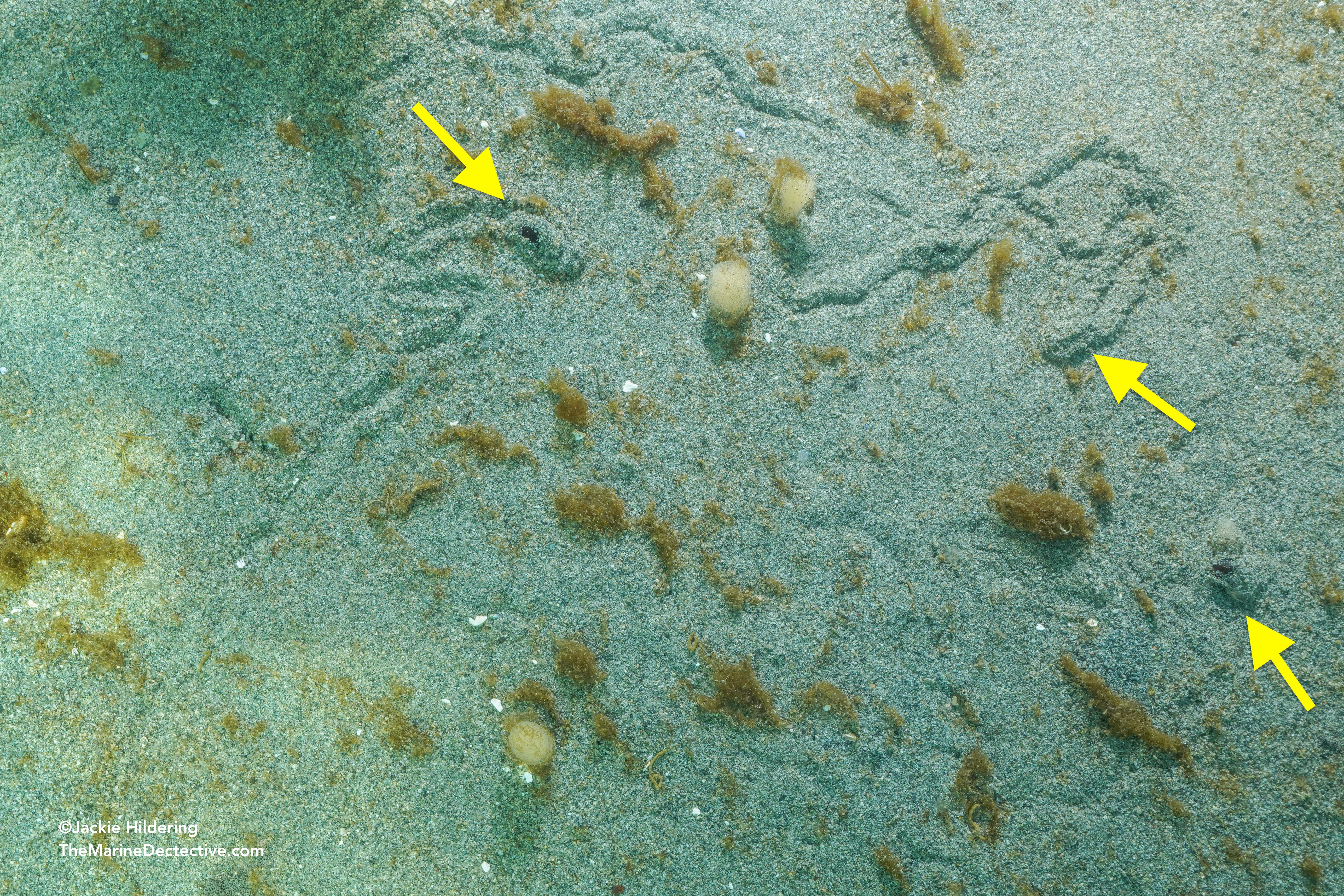
See the tracks that help you find the Albatross Aglajas? Arrows indicate where three of them are amid their egg masses.
The species has been found in Norway which was not part of its known range. Malaquias et al, 2025 put forward that: “The exact origin of the specimens remains unclear but the absence of records from the northwestern Atlantic coasts of Canada and USA, combined with the increase in ship traffic across the Canadian Arctic support the hypothesis that a European population was introduced via shipping routes connecting the northeastern Pacific through the Arctic Northwest Passage.”
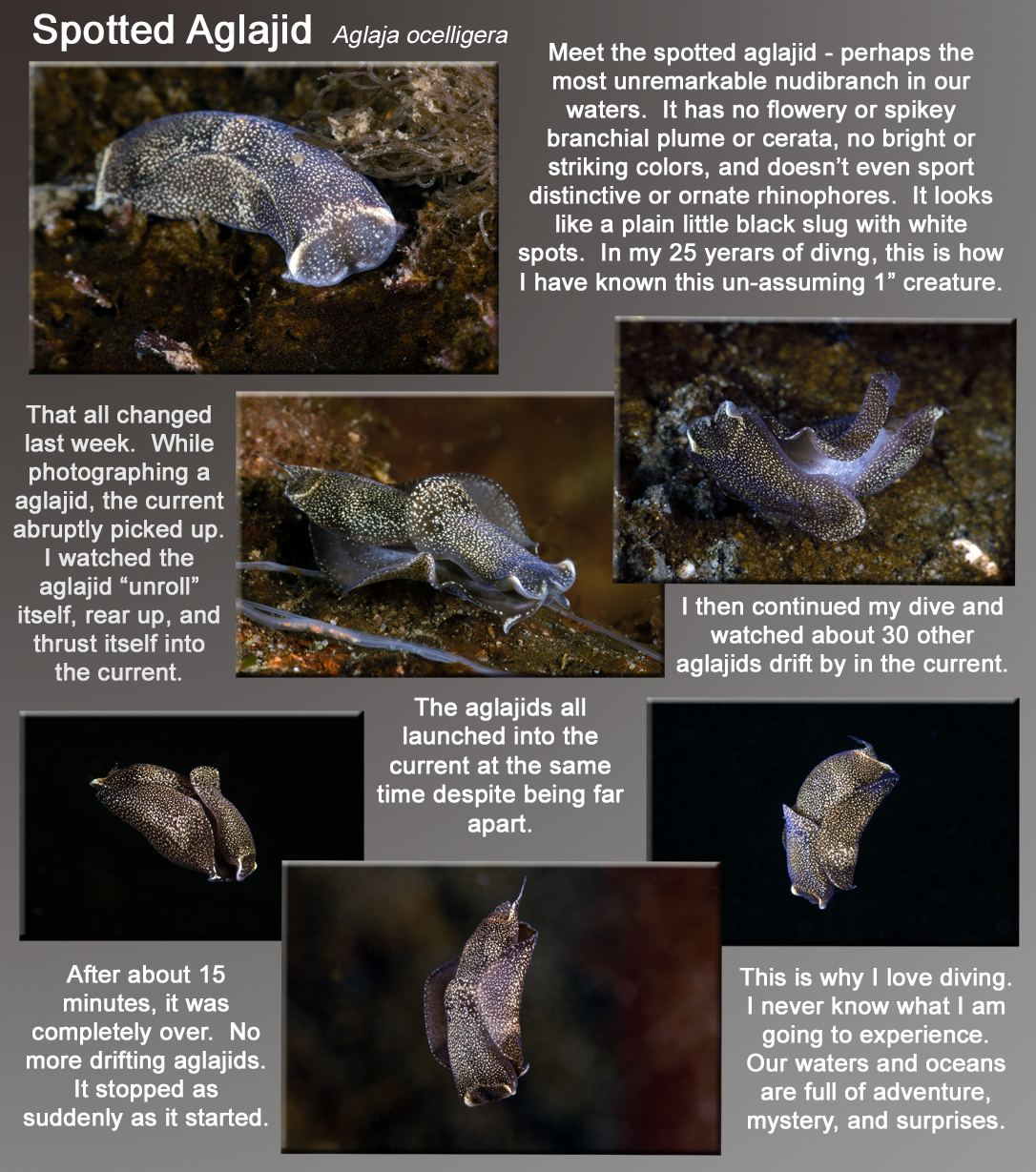
Usually also under the sand. Said to feed on other bubble shell sea slugs, which may include the Albatross Aglaja. Both the Spotted Aglaja and Albatross Aglaja do not have a radula (rasping tongue) whereby they are said to suck in their prey whole.
A rare good look at a Spotted Aglajid since they are usually burrowed in sand. Notice how one tail is longer than the other.
Two Spotted Aglajids above the sand, presumed one is following the other’s scent trail to get together to mate.
A Spotted Aglajid laying eggs! “Aglajids lay their eggs in the most interesting way. They release the egg stream around their rotating body, creating a coil or tube-like mass. They then dive into the sediment placing an anchor so the eggs, above, won’t wash away.” Source: Dave Behrens.
Rudman, W.B., 2007 (Mar 23). Comment on Benthic behaviour Gastropteron pacificum by Jackie Hildering. [Message in] Sea Slug Forum. Australian Museum, Sydney. Available from http://www.seaslugforum.net/find/19738
My attempt at summarizing the cassification of the group to which sea slugs belong. Last updated 2020-04-17. Source: World Register of Marine Species.
Regarding the photo below: The Opalescent Nudibranch is a nudibranch. Nudibranchs DO have external gills (hence “nudi” = naked and “branch” = gills). Adults do NOT have an internal shell. The Great Winged Sea Slug is a “bubble shell” sea slug (Cephalaspidea). They do NOT have naked gills and adults DO have an internal shell. There! Now don’t you feel better knowing that: (1) Not all sea slugs have naked gills and hence not all sea slugs are nudibranchs; (2) However, all nudibranchs are sea slugs.
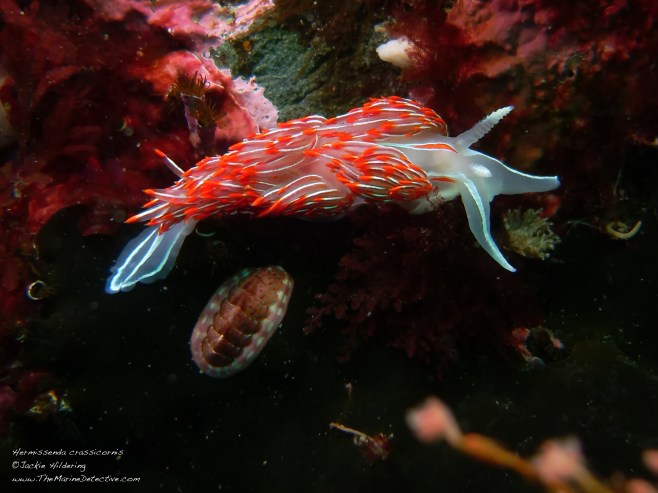
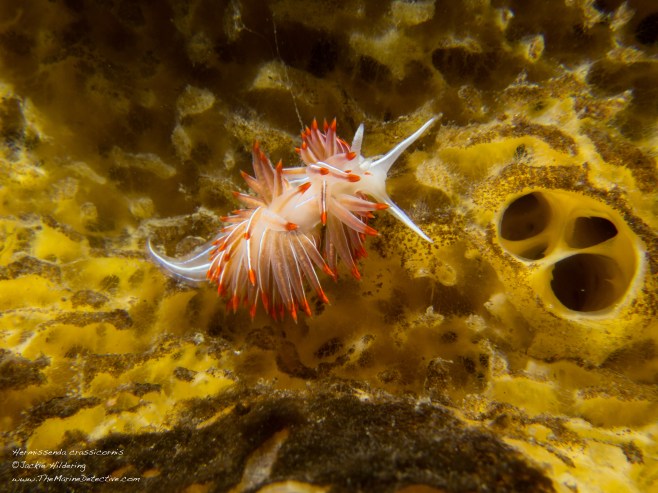
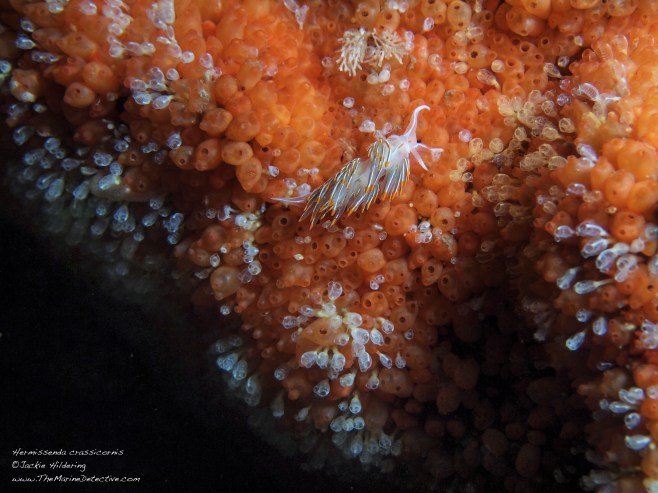
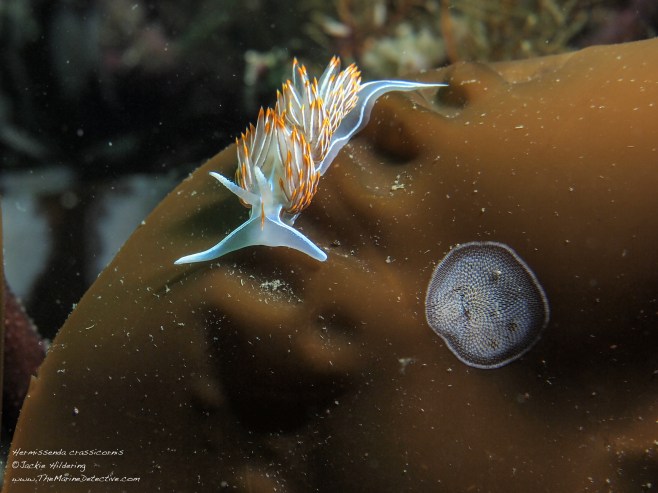
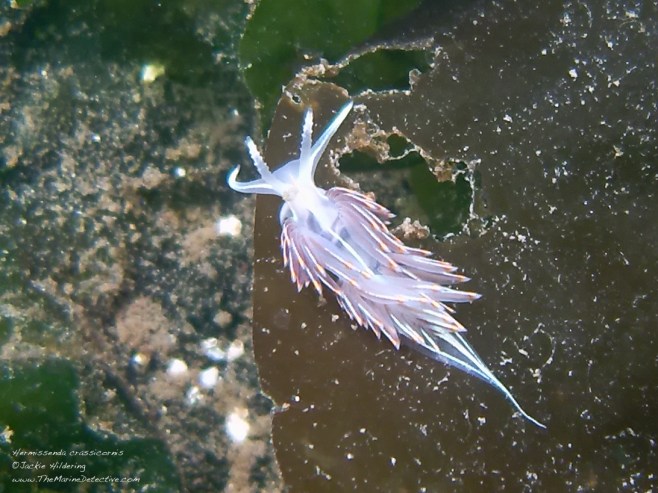
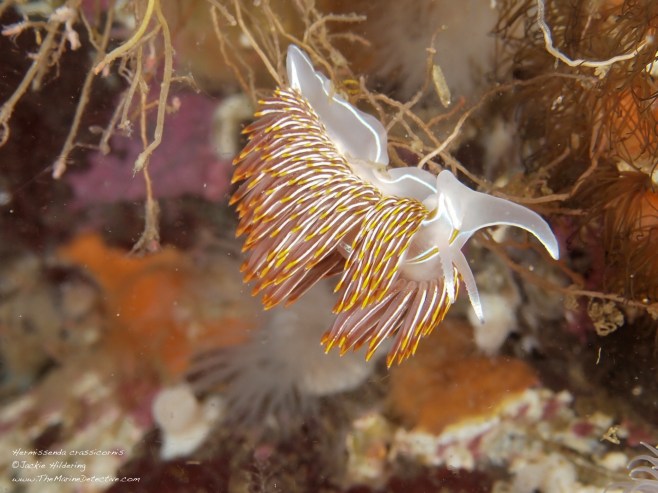
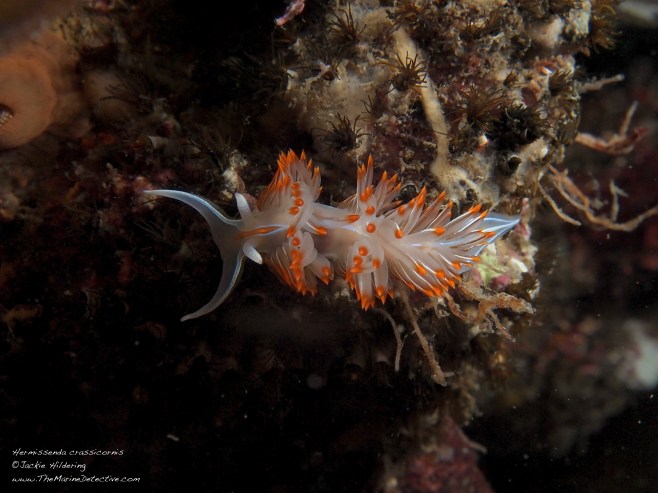
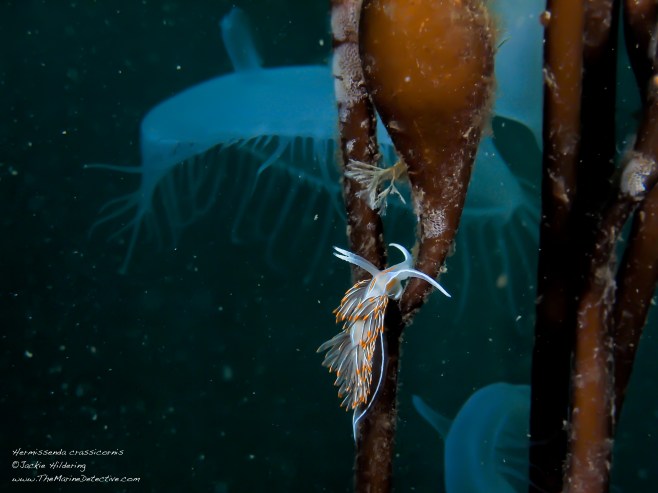
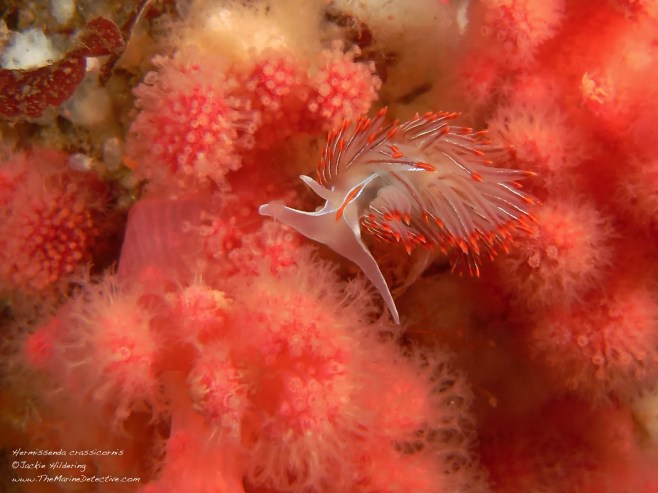
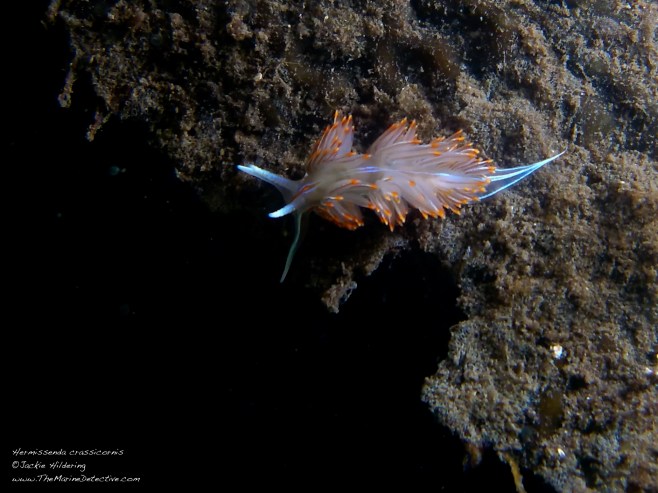
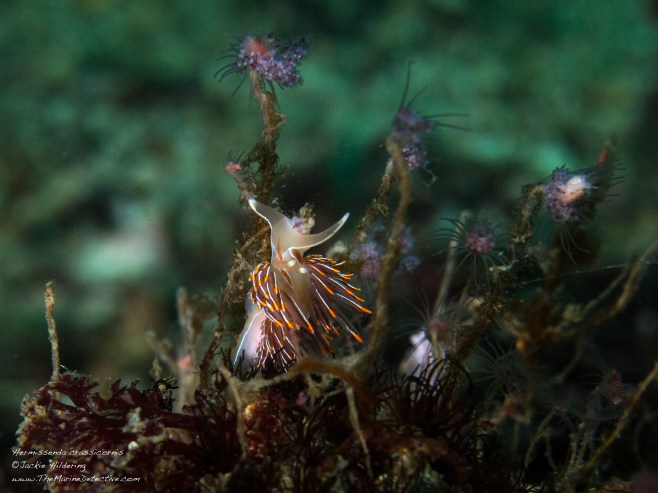
Last update: January 18, 2026. Note that instead of calling the species most likely on the coast of British Columbia (Hermissenda crassicornis) by the common name “Thick-horned Nudibranch”, many have taken to calling it the “Northern Opalescent“. This includes me. ______________________
As a result of making the following post on social media, I learned that there has been a change in classifying the “Opalescent Nudibranch”. With the reclassification, I will be referencing the species found in British Columbia waters as the “Northern Opalescent Nudibranch” rather than the “Thick-horned Nudibranch”. Because . . . who wants to be thick when you can be opalescent? ☺️
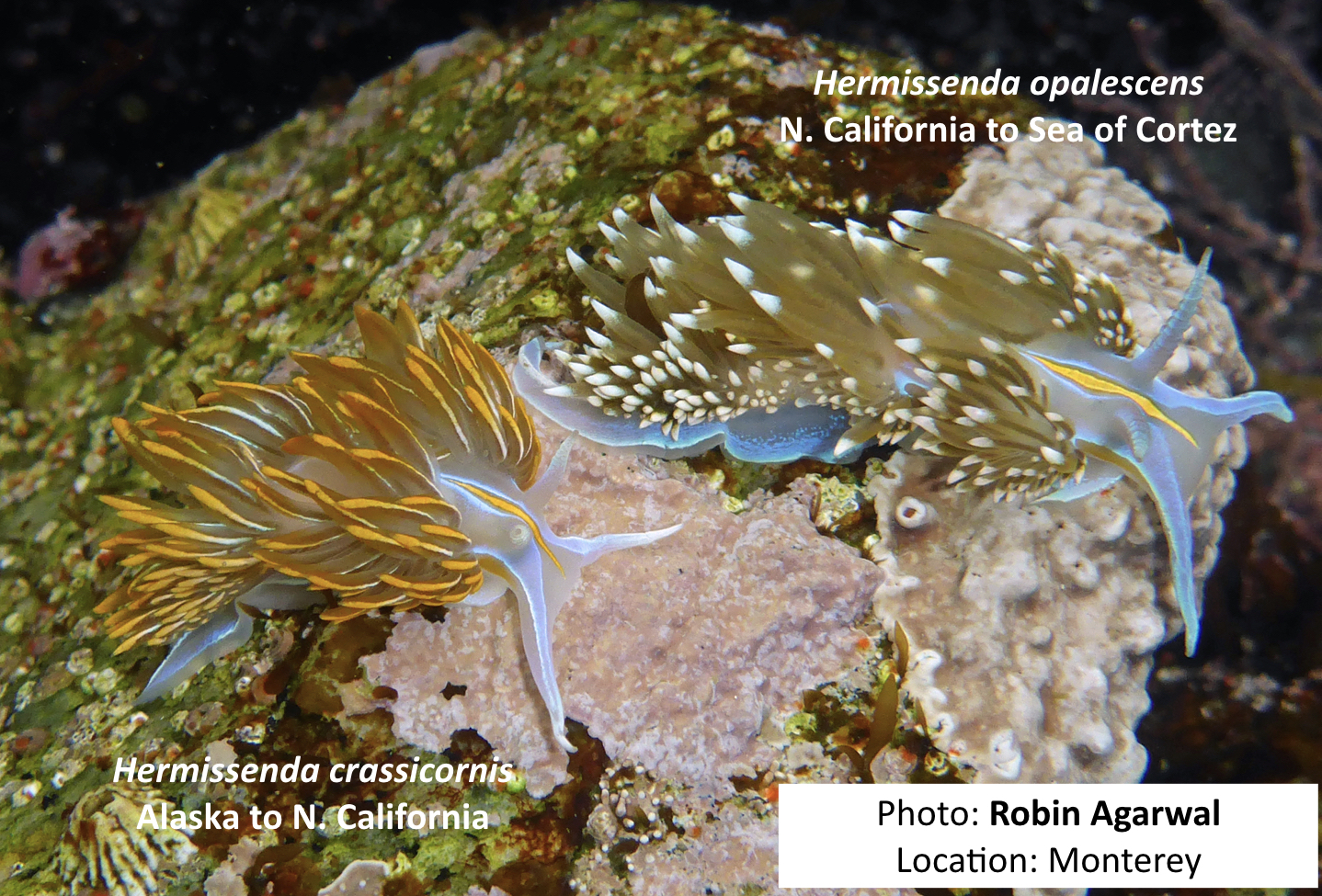
It was Robin Agarwal who educated me and shared the following incredible photo from Monterey, California.
As you can see, the species on the left is more similar to the one I posted and which we call the “Opalescent Nudibranch” in British Columbia.
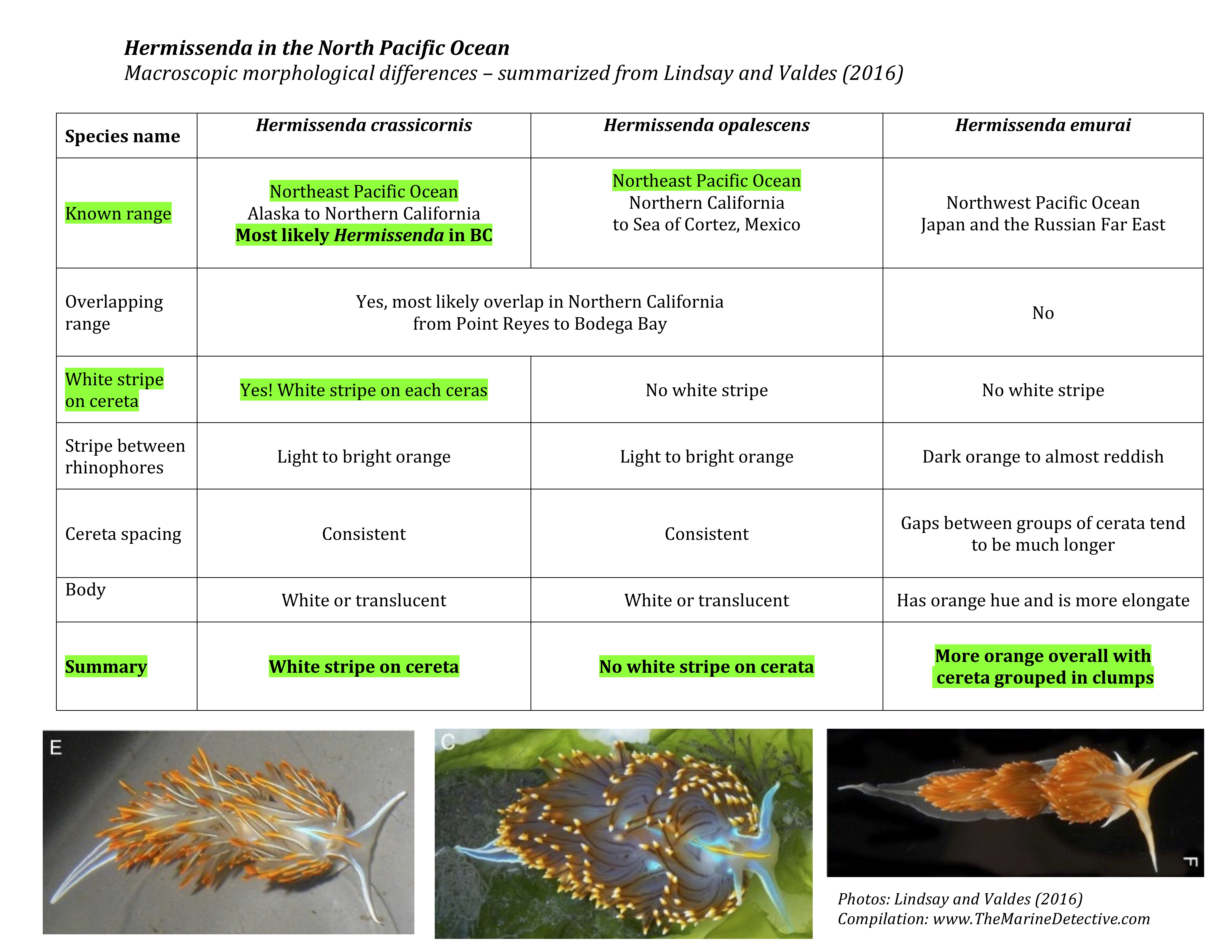
However, it has been determined (2016) that there are 3 species in the “Hermissenda” genus (all are up to about 9 cm long). One is found in the Northwest Pacific Ocean from Japan to the Russian Far East so there is no worry about confusing that one on our coast. But, for the other two species, their range overlaps in Northern California where Robin took the photo.
This has of course led to the need for two common names to differentiate them there. The species on the right is being referenced as the “Opalescent Nudibranch” (reinstating the species name Hermissenda opalescens). The one on the left has retained the name Hermissenda crassicornis and is being referenced as the “Thick-Horned Nudibranch” where the species ranges overlap.
However, off British Columbia’s coast we are only likely to see the species on the left with its range being from Alaska to Northern California. Thereby, I anticipate this beautiful species will keep on being referenced as the “Opalescent Nudibranch” in the vernacular.
The table is just for you my fellow nudibranch nerds.
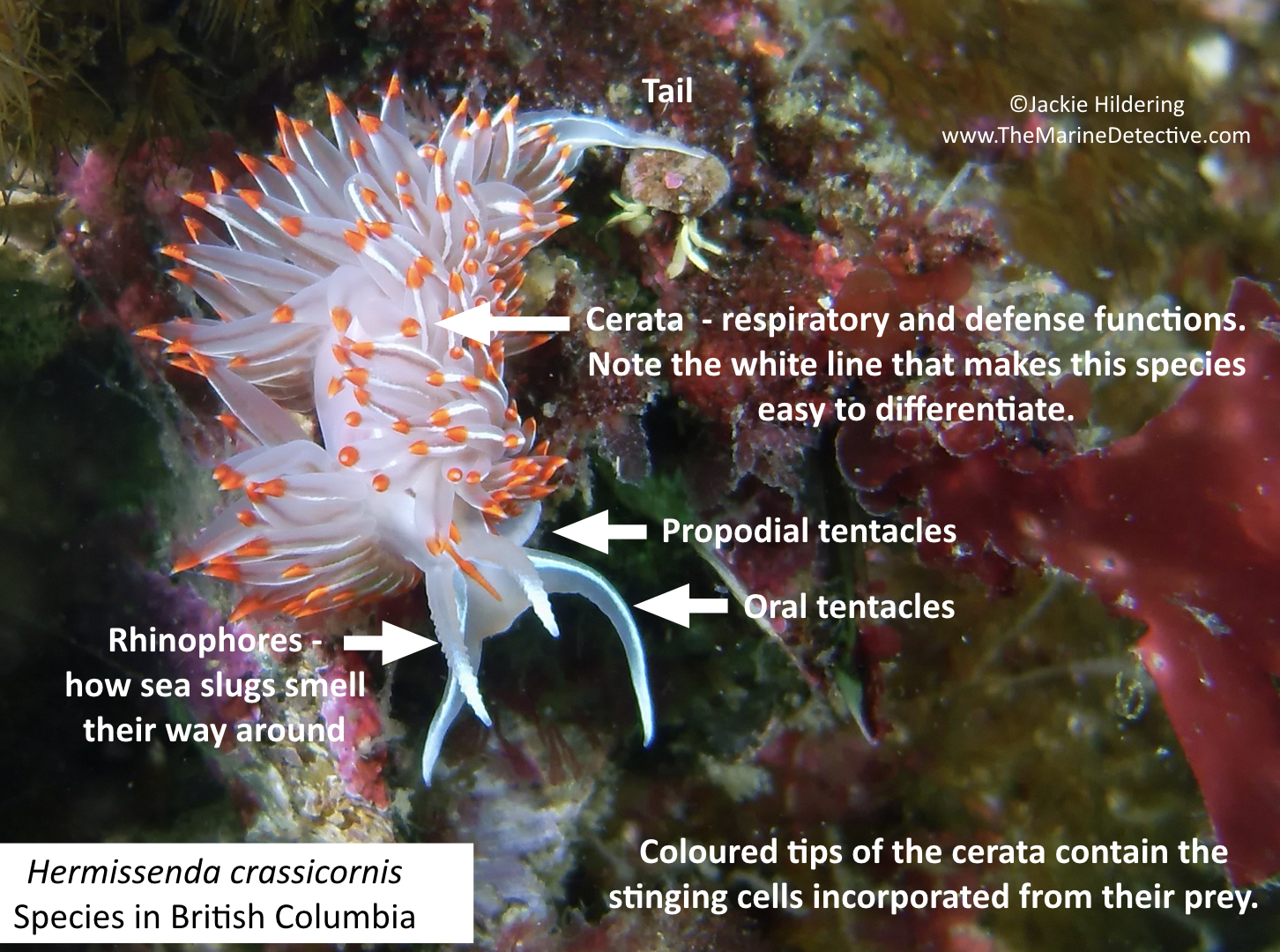
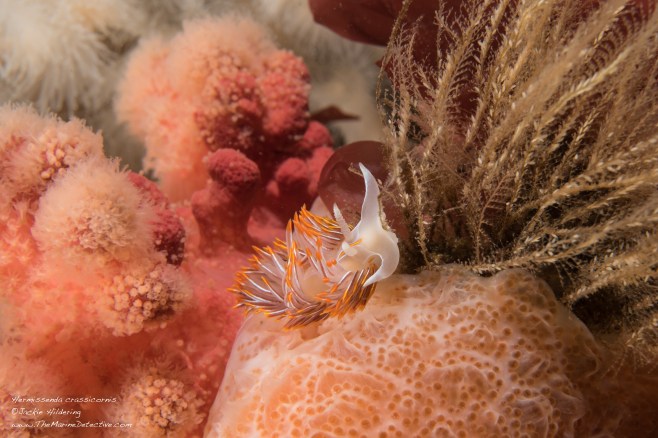
But, I’ll cut to the conclusion. Don’t be fooled by the colour of the two species found in the Northeast Pacific Ocean. The colour of the cerata in BOTH species can vary from light brown to dark brown to bright orange. Cerata are the structures on some sea slugs species’ backs that have both a respiratory and defence function. The tips contain the stinging cells (nematocysts) of the nudibranch’s prey e.g. hydroids.
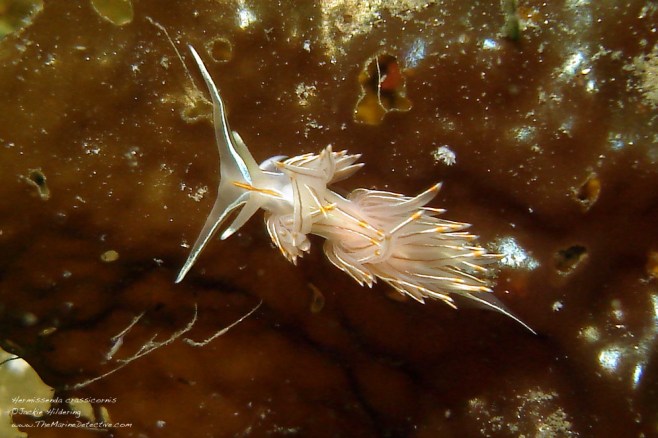
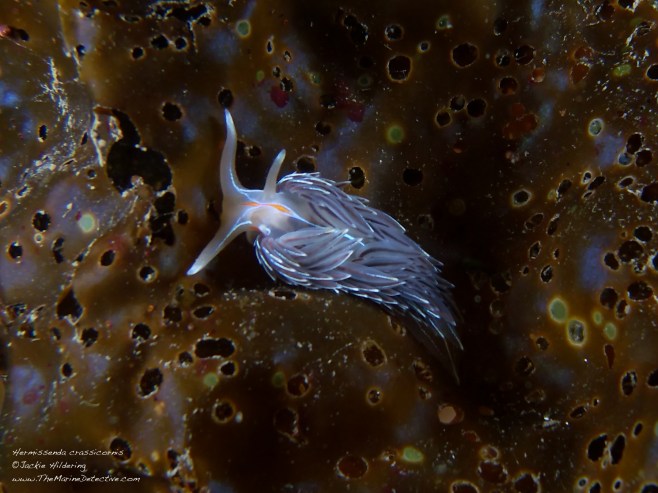
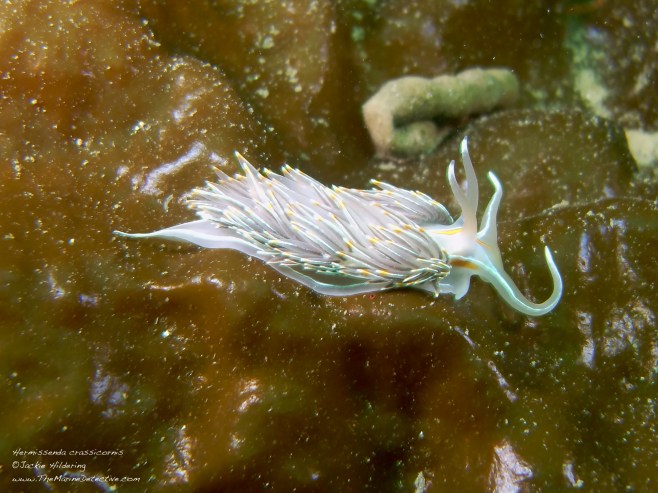
The easy way to differentiate the two Hermissenda species in the Northeast Pacific Ocean, is to look for white lines on the cerata. The species most often found off the BC Coast has white lines. The other does not. See my photo below to note this easily identifiable feature (and, if you need some amusement, have a look for the little hermit crab).
See my previous blog at the link for “Attack of the Sea Slugs” in which one Northern Opalescent Nudibranch attacks another.
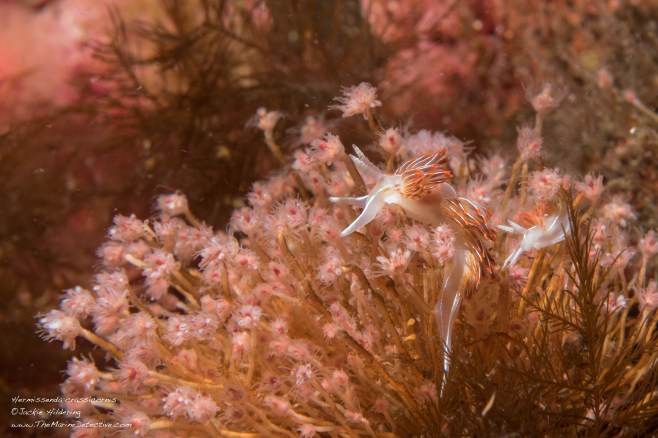
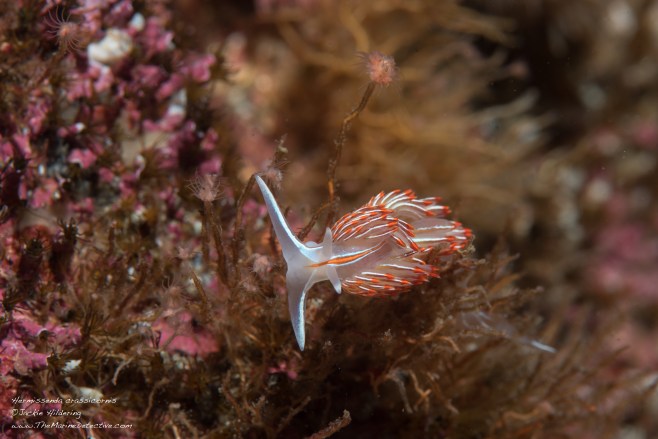
Photos below of the Northern Opalescent Nudibranch (Hermissenda crassicornis). I share these to show the variation of colour in the species. But also, because by any name and classification, there can never be enough photos of such a stunning ambassador for the colour and biodiversity found in these cold, dark seas.
Here’s a bit of a mystery that took me more than a year to sort out.
On April 27th, 2016, I found this egg mass while diving in Browning Pass with God’s Pocket Resort. This is to the north of where I live and is somewhere I only have the joy of diving a couple of times a year.
I recognized it was likely a sea slug egg mass but did not know the species.
More than a year passed. On May 7th, 2017, I had a chance to dive the same site again and so hoped to find the species who laid the eggs. We quickly swam to where I had found the egg mass the year prior, into the shallows (~5m), and hovered over the ocean bottom strewn with bits of shell remains.
And I found these . . .
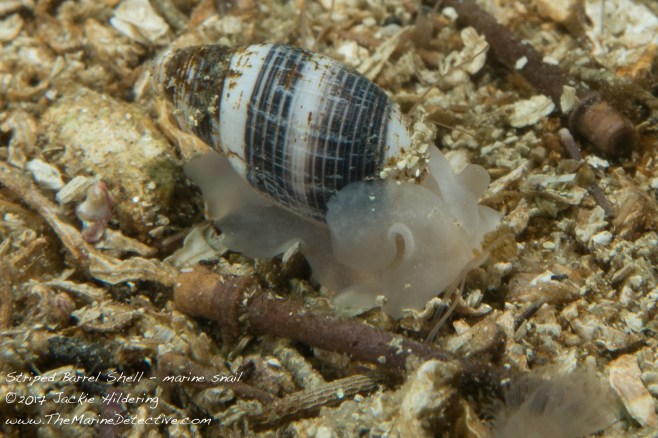
Tiny snail-like animals, plowing through the bits of shell and urchin remains. One, two, three . . . six of them!
I tried to calm myself down, to get photos, and to watch how, despite their soft bodies and the sharp bits of shell, they were able to even push under the surface.
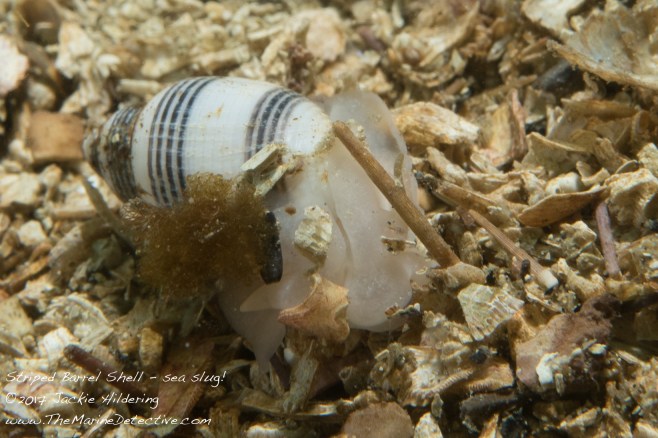
They were Stripe Barrel Shells (Rictaxis punctocaelatus) with shells only to 2 cm long)!
These are often mistaken as being a marine snail (prosobranch) like a whelk but they are a type of “bubble shell” sea slug. They are also not nudibranchs. They have a thin shell and do not have “naked gills”. Therefore they do not belong in the “nudibranch” sub-group of sea slugs (opisthobranchs). For the classification super nerds, see this link or the graphic at the end of this blog for my attempt at offering clarity.
Please know that I am not suggesting that this is a rare species. Rather, they are hard to find. Their size makes them hard to see; divers often do not target the sand or shell-covered bottoms where they live; AND . . . . they are often just under the surface.
I was incredibly fortunate therefore to find them out and about – maybe feeding on algae and/or trying to smell where a mate might be (and we think WE’RE challenged in finding a partner!)
And how about those eggs? Are they a match?
Yes, they are! I was able to confirm this thanks to the knowledge and brilliant documentation of Jeff Goddard on the Sea Slug Forum (see below).
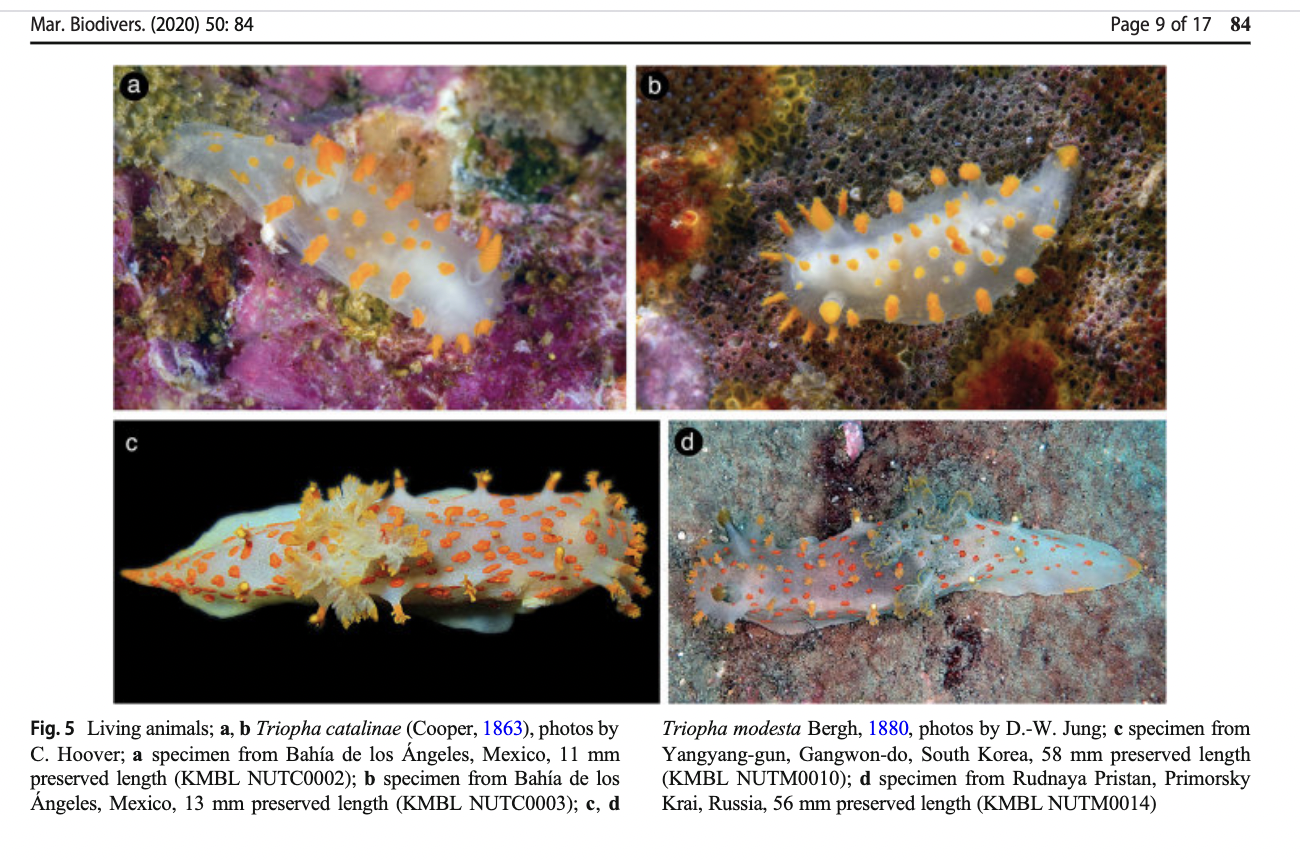
Update September 24, 2020 – Species has been reclassified into two.
Triopha modestahas been determined to be a trans-Pacific species (Korea, Japan, Siberia, and Alaska to California) and is far more likely to be off the coast of British Columbia and has both flat and branching tubercles and globular bits on their side.
Triopha catalinae has been determined to be a species only found in the eastern Pacific Ocean (SE Alaska to the Gulf of Mexico) and they have large, conical or rounded dorsal tubercles.
In having noted the recent “Creepy Clown” Halloween-related absurdity in the far off periphery of my life, I thought I would share the beauty of the clowns abundant below the surface at this time of year – Clown Dorids.-
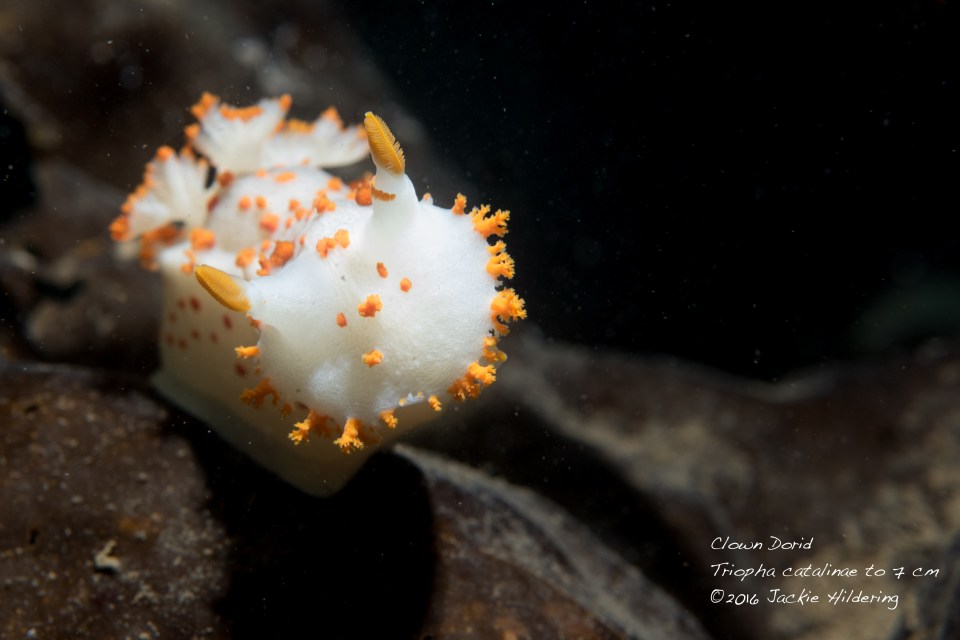
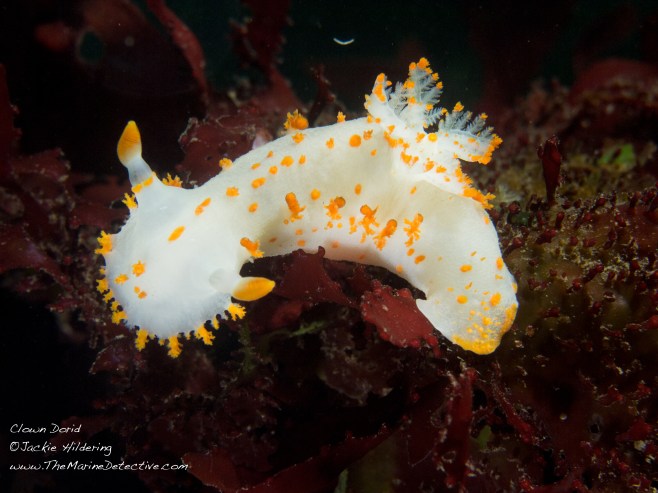
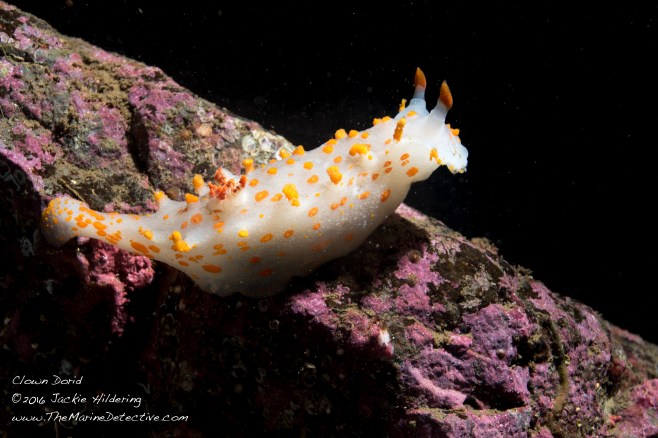
Clown Dorids are a species of nudibranch (Triopha modesta to 7 cm).
Nudibranchs are sea slugs with naked gills and those in the dorid suborder most often have their plume of gills on their posterior (around the anus in fact). See the orange frills in the Clown Dorids in these images? Those are their gills.
Clown Dorid with gills are on the right. It’s “rhinophores”, by which it smells its way around, are on the left, atop its head.
Many dorid species fully retract their gills when disturbed. Clown Dorids can only partial retract their gills.
That’s all! Clown Dorids cannot fully retract their gills like most other dorid species.
Note too the beautiful “oral veil” with papillae that aid Clown Dorids in finding food.
Image allowing a good look at the Clown Dorid’s oral veil.
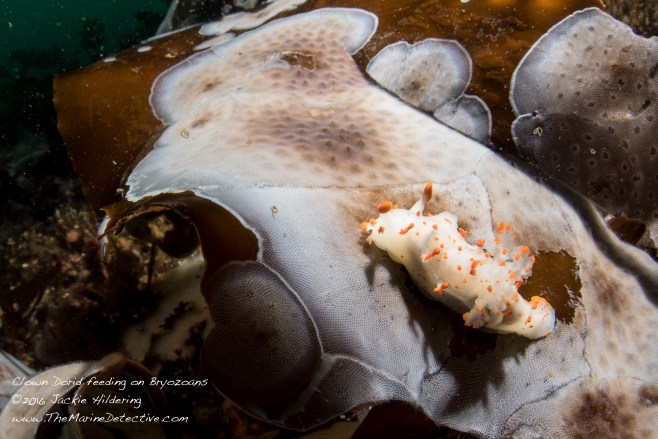
Also unlike many dorids, Clown Dorids do not feed on sponges. They feed exclusively on bryozoan species; those crusty colonies of organisms often found on kelp.
Clown Dorid likely feeding on Kelp-Encrusting Bryozoan.
There were a particularly large number of Clown Dorids on my dive this past October weekend with many egg masses.
Sea slugs are reciprocal hermaphrodites. This of course makes good sense as a reproductive strategy when you are a slow slug and your offspring hatch out to be plankton. Reciprocal hermaphrodites have both male and female sex organs whereby both individuals are inseminated and lay eggs = way more eggs!
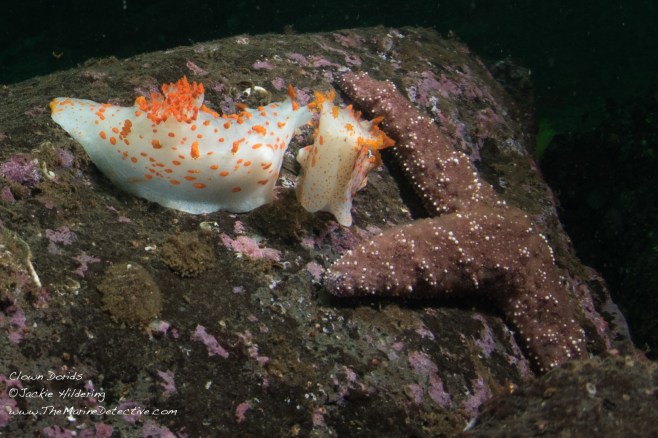
Clown Dorids that have found one another (relying on smell and touch) and maneuvering into the mating position.
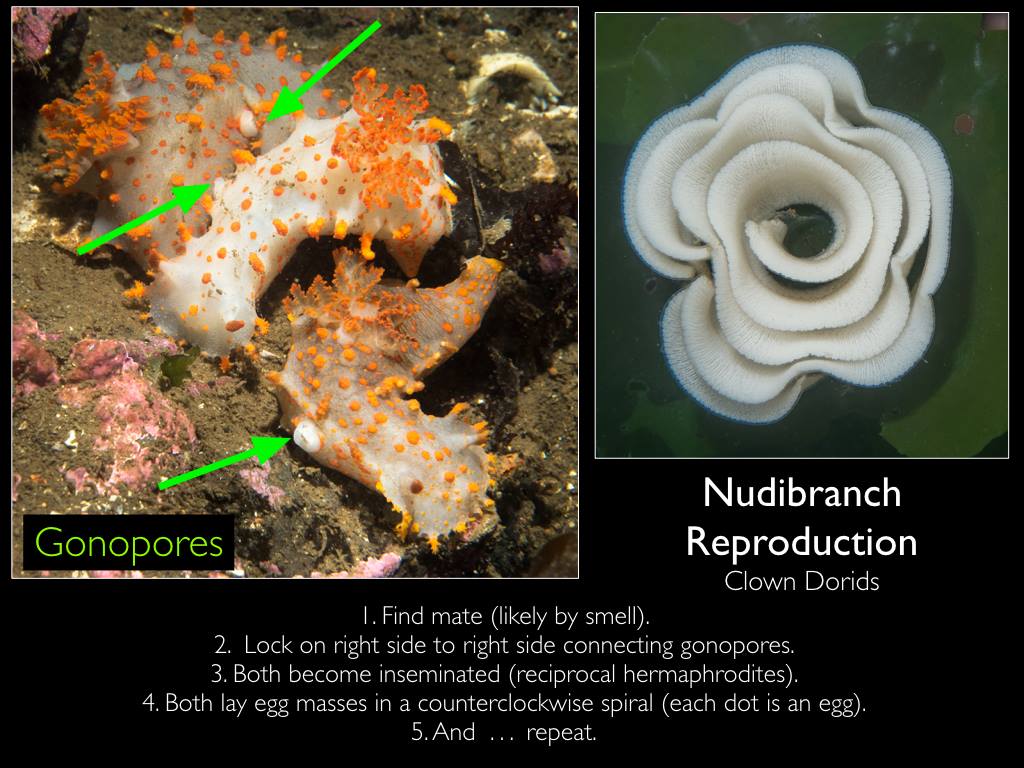
Nudibranchs mate right side to right side. If you look very carefully in the photo below, you can see a bump on the individuals’ right side. This structure is the “gonopore” and is usually retracted. They lock onto one another with their gonopores and both become inseminated.
Clown Dorids extending their mating organs and about to lock on right side to right side. (Ochre Star beside them.).
The gonopore is easier to see in the following image.
Clown Dorid – note the “gonopore” on the right near the nudibranch’s head. [Update since the reclassification, I believe this one is a Triopha catalinae].
The egg masses of each species of sea slug look different. However, it is very difficult to discern the eggs masses of some closely related dorids. The ideal is to find an individual laying the eggs.
However, in all these years, I have never managed to get a photo of a Clown Dorid laying eggs. Dive buddy Paul Sim has though. See his great image below.
Summary from my social media post on December 13, 2016: Oh the fabulous way sea slugs ensure their kind survives! Imagine the challenges as a sea slug – you’re slow, you can only sense light and dark . . . . so when you finally find a mate it sure makes sense to be a simultaneous hermaphrodite so you both end up laying eggs. And the beauty of the egg masses! They are species specific i.e. the egg mass of each species of sea slug looks different. AND, wondrously, for almost all nudibranch species (at least in the northern hemisphere), these masses are almost always laid in a counterclockwise direction (sinistral) starting at the centre, with equal space between the whorls (i.e. an Archimedes spiral).
More information:
Reproductive structures of Clown Dorids from the Sea Slug Forum – click here.
Colour and diet in Clown Dorids from A Snail’s Odyssey – click here.
My dry suit has been hosed down and is drying in the sun; my regulator is soaking in fresh water; the washing machine is chug chug chugging with the clothes used over the last days of diving; and my head and heart are full of so much I want to share.
I’m back from another trip organized to God’s Pocket Dive Resort just beyond Port Hardy . . . more than 11 hours spent underwater over the last days. Such an escape. Such an immersion in wonder and that sense of humility that comes with submerging in the force that sustains this planet. Such an opportunity to learn.
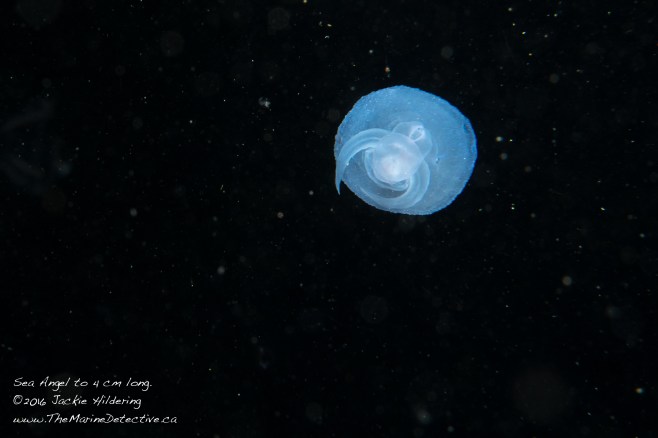
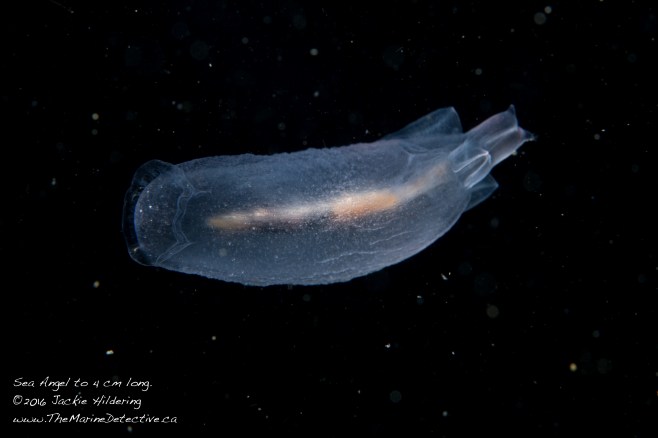
I saw my first Sea Angel.
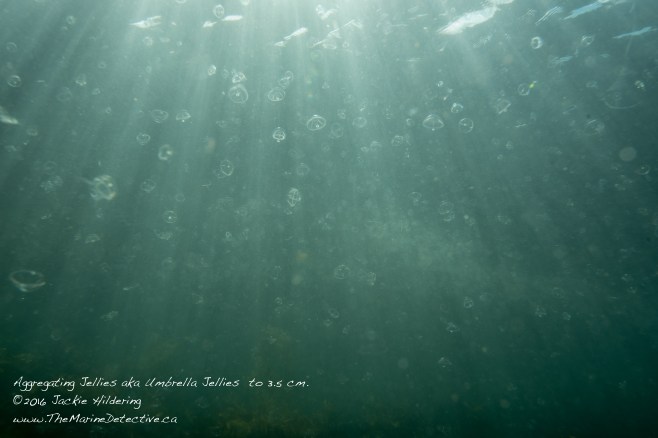
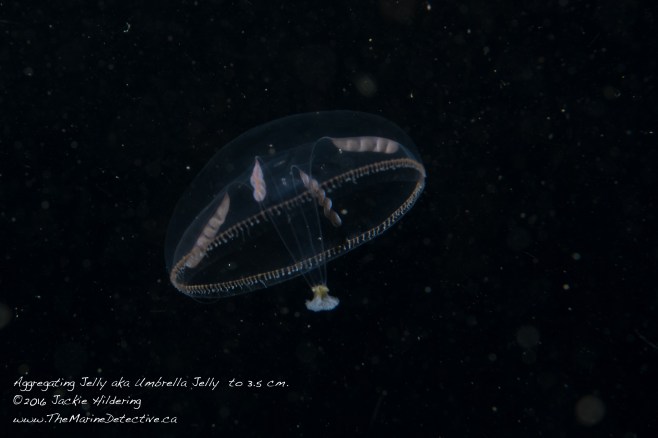
My buddy and I had been drifting along for about an hour. We had schooled with rockfish; hung next to Orange Sea Pens as they bowed in the current; and marvelled at the abundance of anemones and their babies, studding the forests of kelp. We had done our safety stop with a seeming snowfall of pulsing Aggregating Jellies streaming down around us in the sun’s beams.
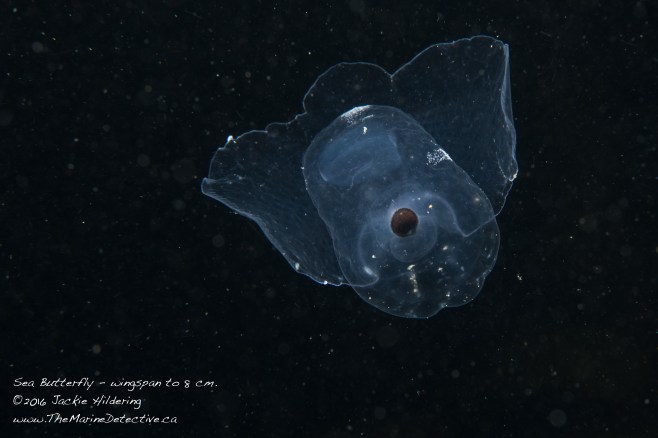
We had already been further awed by Sea Butterflies “flying” by our masks. Sea Butterflies are planktonic sea slugs! They are “pteropods” – swimming shell-less molluscs whose “wings”(ptero) are their feet (pods). This genus does have an internal gelatinous “pseudoconch” (false shell) and the brown dot you see in my image is the gut. Sea Butterflies feed by forming a mucus web up to 2 m in diameter in which they trap smaller plankton and bits of organic matter. Oh to see that. It was apparently first documented in the 1970s by researchers while SCUBA diving.
Sea Butterfly – Corolla spectabilis. Dark spot is the gut. See this link for more species information and a video (with excited diver vocals) of a swimming Sea Butterfly.
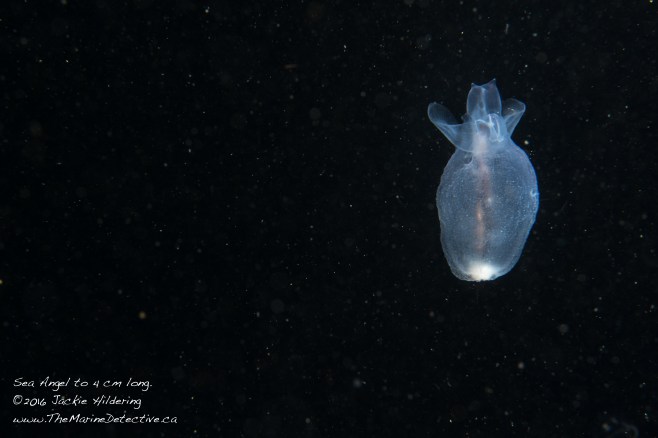
All those jellies and Sea Butterflies pulsing around us and then, just when I was about to break the surface back into the world where gravity has such a stronger hold on me, I saw it! So small, tiny wings pulsing . . . a Sea Angel!
This is another species of planktonic, “winged” sea slug (but the adults of this species are completely shell-less; they do not even have pseudoconch). Sea Angels are a rarity so far to the north and are only occasionally seen at the surface (found to depths of 1.5 km). Their presence is likely due to warmer waters (El Nino and possible climate change) and a big northwest wind that had raged a couple of nights prior. The wonder of it, to see something so otherworldly, to know of its rarity in this area, and to get a sense of its planktonic fragility – surviving from a larval stage, escaping predation by fish, and to be carried by the currents in the vastness of the sea.
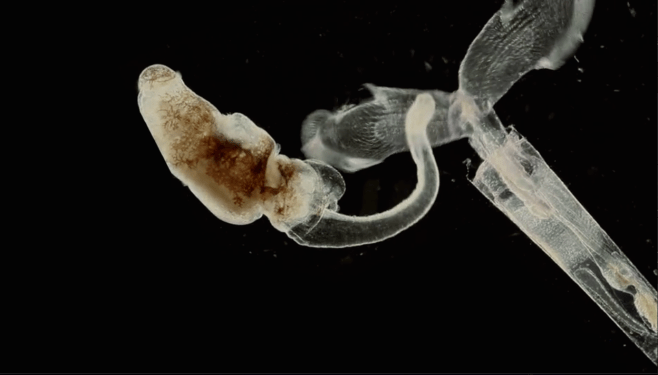
It may be hard to imagine but this species is a voracious predator! Cliopsis feeds on other planktonic snails by grabbing them with a long proboscis (which can be up to two times its body length), a sharp radula and hooks made of chiton!
Screen grab from the “Plankton Chronicles” showing a Sea Angel feeding! See amazing 1.5 min clip at this link.
When a Sea Angel comes into contact with a Sea Butterfly’s feeding web, it reels it in, dragging the Sea Butterfly with it. When close enough, the Sea Angel then uses its probosis to “cut” the Sea Butterfly from its psuedoconch and eats it.
The marvel of it all, the delicate balance of this planktonic world about which so few of us have knowledge but which can be so impacted by our activities. There is concern about the impact of ocean acidification (caused by our carbon use) on the development of these organisms.
As always, don’t be despondent. See the beauty, know your connection, and recognize the common solutions and great gains of caring more . . .. and consuming less.




































 The Marine Detective