Dear readers, the following is a rework of a little rhyme I wrote in 2009.
Many of you will recall that 2009 was such a bad year for wild salmon in British Columbia that it led to the $26 million Cohen Inquiry into the Decline of the Fraser River Sockeye.
The attempted messaging in my little poem may be all the more relevant now with the threat of tanker traffic coming to our fragile Coast.
The good news, I believe, is that with such threats more and more of us are united in understanding that, while resource use is a necessity, it has to be sustainable. It is impossible to have infinite economic growth on a finite planet.
With sincere apologies to Dr. Seuss:
A world without salmon would be oh so sad, This is very important, so listen here Dad!
Without salmon, we will have broken the link, That Nature intended to keep us in the Pink. (And Sockeye, and Chum, and Chinook and Coho!)
Salmon bring the wealth of the ocean back to the Coast, Right back to their birthplace so without them – we’re toast!
Their bodies are gifts to the future – that’s really key, Delivering food for their babies and even the trees.
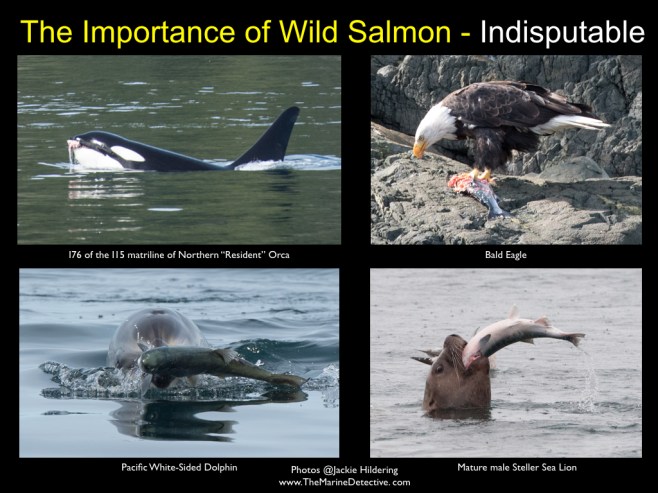
They feed fish-eating orca, sea lion and eagle, Wolf, seal, deer, shark and . . . an occasional beagle!
They help bring the tourists. They fill fishers’ nets. There ought to be enough so that all needs are met.
So little investment, so great the return. Safe passage, and food – this, salmon surely earn?
But, instead of precaution, loud voices at desks, Say, “Why it’s Nature that’s made this big mess.”
“It’s salinity, cycles . . . the phase of the moon! Or some other reason we’ll think up real soon.”
What possible gain would justify such a gamble? The cost of losing wild salmon would be so substantial.
Without salmon, grizzles stare into empty rivers, No fat salmon to save them from winter shivers.
The orca diminish without their Chinook, Peanut-shaped foreheads reveal this tragic truth.
And Bobby and Susie and even Aunt Myrtle, Are left holding fishing poles, till they turn purple.
Shhhh can you hear that? No, I don’t hear a thing, For without salmon, birds around rivers don’t sing.
The People of the Salmon were able to thrive. Dance, song, carvings . . . the wisdom to know what keeps us alive.
Salmon are the glue in a vastly connected web, Why without them big trees would even be dead.
Then, there goes habitat, oxygen production and buffering of greenhouse gas. Why to flirt with the health of salmon you would really have to be an . . . . (you know).
The survival of salmon shows how we humans are doing. Do we know our place on the planet? No. Nature is booing!
The solution is simple. It really isn’t hard. It’s not tree hugger verses resource user. Let down your guard!
Logger, storekeeper, teacher, and you under that streetlight! We keepers of paradise need to unite in what’s right.
Make a stand for the salmon, the whales, wolves and Coast. We all know clean water and food is what matters most.
Choose for sustainability, not short-term economic gain. Otherwise explaining things to our children could really be a pain.
Use vote, vision and voice, to help wild things grow. And when it comes to gambling with salmon – just say “No!”
Then, because a whole lot of us care a whole awful lot, It will be clear that BC’s natural splendour can’t be bought.
Since writing this blog, I have been asked “Salmon feed trees?”. Indeed, when they spawn in their natal rivers which can be more than a 1,000 km from the sea, salmon bring the richness of the ocean not only to animals but to plants. The nutrients from their bodies feed the trees and plants including . . . salmon berry! Animals like bears further the reach of salmon nutrients by taking spawned-out salmon from the rivers deeper into the forest where they can feed undisturbed. They eat their favourite bits and leave about 50% of the carcass in the forest which benefits the plants, song birds, and even animals like pine martens. Of course, bears also poop in the woods, which leaves more salmon nutrients in the forest. So the bears are like gardeners, bringing fertilizer much deeper into the forest!
It was initially Tom Reimchen’s research of the early 1990s that brought the knowledge of “Salmon Forests” to the world. He quantified how much salmon was in the trees by measuring the amount of “marine derived nitrogen”. That research has expanded to where nitrogen and carbon isotopes are measured to quantify the uptake of salmon-derived nutrients by mosses, herbs, shrubs, trees, insects, songbirds, and wolves. So while salmon don’t grow on trees . . . trees most definitely grow on salmon.
This knowledge solved the mystery of how you can have giant trees in a rain forest when nutrients get washed away by the rain. It’s the salmon who replenish the nutrients by delivering the richness of the sea through their spawning behaviour – just the way Nature intended. And of course, without those giant trees – imagine the reduced habitat and production of oxygen and buffering of carbon dioxide.
This makes clear how far reaching the role of salmon is; how interconnected the web of life is, and just how much depends on the health of wild salmon. No better man to fully explain this “exquisite interconnectedness” than Dr. David Suzuki. See the 5 minute clip below. There is also a David Suzuki children’s book called “Salmon Forest.”
I have also been asked, “Deer eat salmon?!” They do. They feed directly on the spawned out carcasses of salmon and also benefit indirectly by feeding on the vegetation that has been fed by salmon.
I published this blog near the beginning of the onset of Sea Star Wasting Disease (SSWD) in 2013. It has been updated since 2013 with research developments. See the original blog at the end, which includes photos of the progression of SSWD.
Background: Since 2013, more than twenty species of sea star have been impacted by Sea Star Wasting Disease from Mexico to Alaska. There is local variation in the intensity of the disease and which species are impacted. It is one of the largest wildlife die-off events in recorded history. Sea stars contort, have lesions, shed arms and become piles of decay. Sunflower Stars (the world’s biggest sea star species) remain devastated with far-reaching impacts on kelp forests and the marine ecosystem.
Where to relay sea star data(of great value in understanding the survival, species impacted, range, and potentially, contributing factors of Sea Star Wasting Disease (SSWD):
August 4, 2025 – Very big breakthrough: After more than 10 years, the causative agent for Sea Star Wasting Disease (SSWD) has been found. Bacteria – Vibrio pectenicida (in the same family as bacteria that causes Cholera in humans).
Media release includes: “Now that scientists have identified the pathogen that causes SSWD, they can look into the drivers of disease and resilience. One avenue in particular is the link between SSWD and rising ocean temperatures, since the disease and other species of Vibrio are known to proliferate in warm water . . .”
Research paper includes: “Vibrio spp. have been coined ‘the microbial barometer of climate change’, because of the increasing prevalence of pathogenic species associated with warming water temperatures. Given that existing evidence indicates a relationship between increasing seawater temperature and SSWD incidence, an important next phase of research will be to empirically define this relationship, a goal now possible as a result of the identification of a causative agent.”
Prentice, M. B., Crandall, G. A., Chan, A. M., Davis, K. M., Hershberger, P. K., Finke, J. F., Hodin, J., McCracken, A., Kellogg, C. T. E., Clemente-Carvalho, R. B. G., Prentice, C., Zhong, K. X., Harvell, C. D., Suttle, C. A., & Gehman, A. M. (n.d.). Vibrio pectenicida strain FHCF-3 is a causative agent of sea star wasting disease. Nature Ecology & Evolution. ____________________________
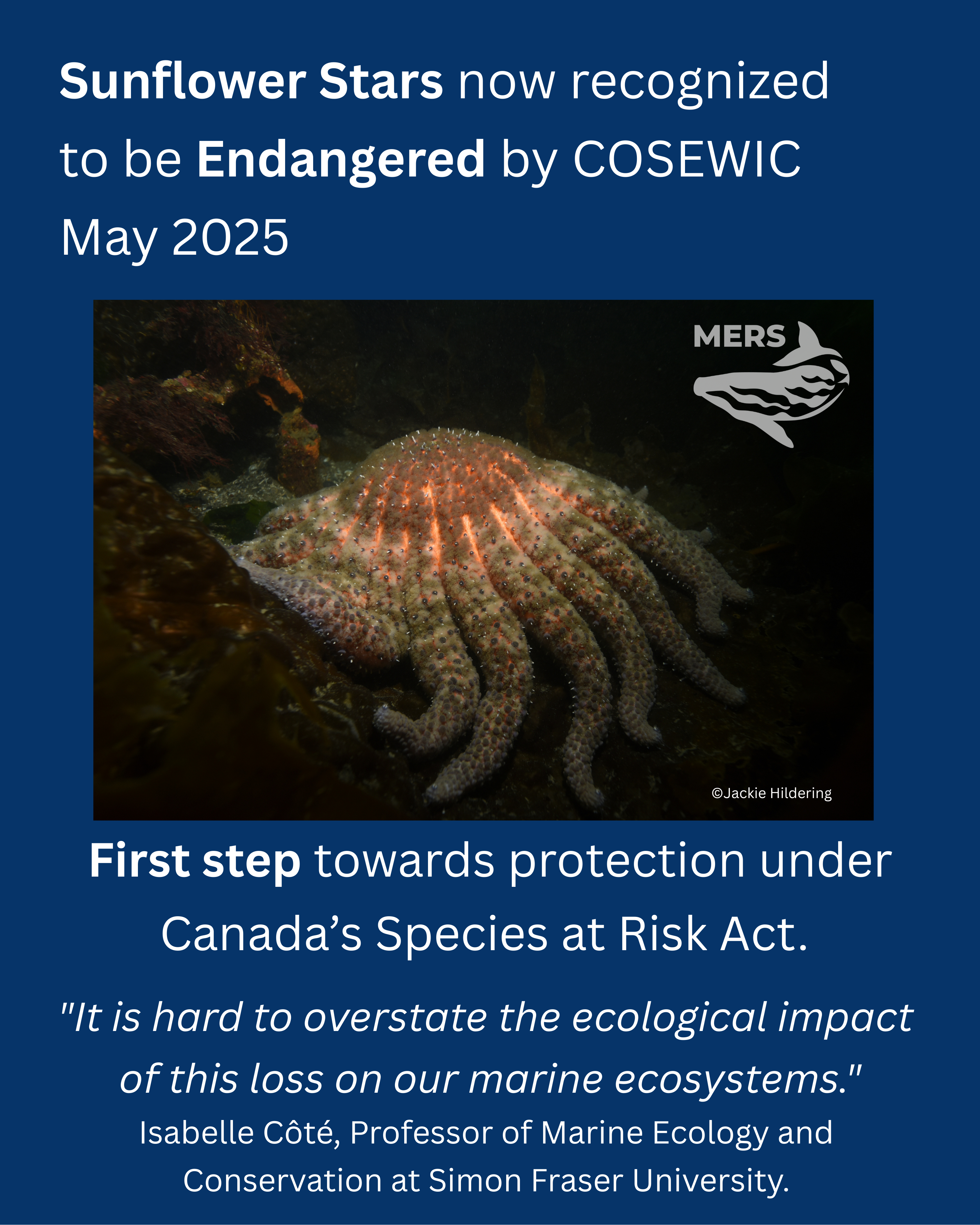
May 15, 2025 – Very important development: The Committee on the Status of Endangered Wildlife in Canada (COSEWIC) is recommending to the Government of Canada that Sunflower Stars be protected as an endangered species under Canada’s Species at Risk Act. This was decided at their May 8, 2025 meeting.
Why share the information about Sea Star Wasting Disease and put the effort into tracking and educating about the research?
It is often marine species that testify to environmental problems first, serving as indicators for the resources upon which we too depend. The hypothesis remains that the sea stars have succumbed in an unprecedented way because of changed ocean conditions (stressors). Too few of us realize the importance of sea stars in the ocean food web (see video below) let alone the importance of what they might be indicated about environmental health.
Quote from Drew Harvell, Cornell University professor of ecology and evolutionary biology who studies marine diseases: “these kinds of events are sentinels of change. When you get an event like this, I think everybody will say it’s an extreme event and it’s pretty important to figure out what’s going on . . . Not knowing is scary . . . If a similar thing were happening to humans, the Centers for Disease Control and Prevention would commit an army of doctors and scientists to unraveling the mystery.“
Below, January 30, 2019 video by the Hakai Institute re. Sunflower Stars and Sea Star Wasting Disease.
Research on Sea Star Wasting Syndrome in reverse chronological order:
Sunflower Stars are already recognized as Critically Endangered by the International Union for Conservation of Nature but this does not offer them protection in Canada or the US. In Canada, an “unsolicited assessment” has been provided to the Committee on the Status on Endangered Wildlife in Canada (COSEWIC) in hopes of expediting the protection of Sunflower Stars under Canada’s Species at Risk Act.
The March 15 announcement by NOAA includes: “While Sea Star Wasting Syndrome is not well understood, it appears to be exacerbated by rapid changes in water temperature, warmer ocean temperatures, and other physical stressors. Outbreaks are likely to recur as the climate continues to warm. Outbreaks may also be more frequent or spread more quickly . . . Populations of the species appear relatively more viable are in cooler, and possibly deeper, waters to the north, including Alaska, British Columbia, and the Salish Sea in the Pacific Northwest. Losses due to the syndrome in these waters were not as high as in more southerly waters.”
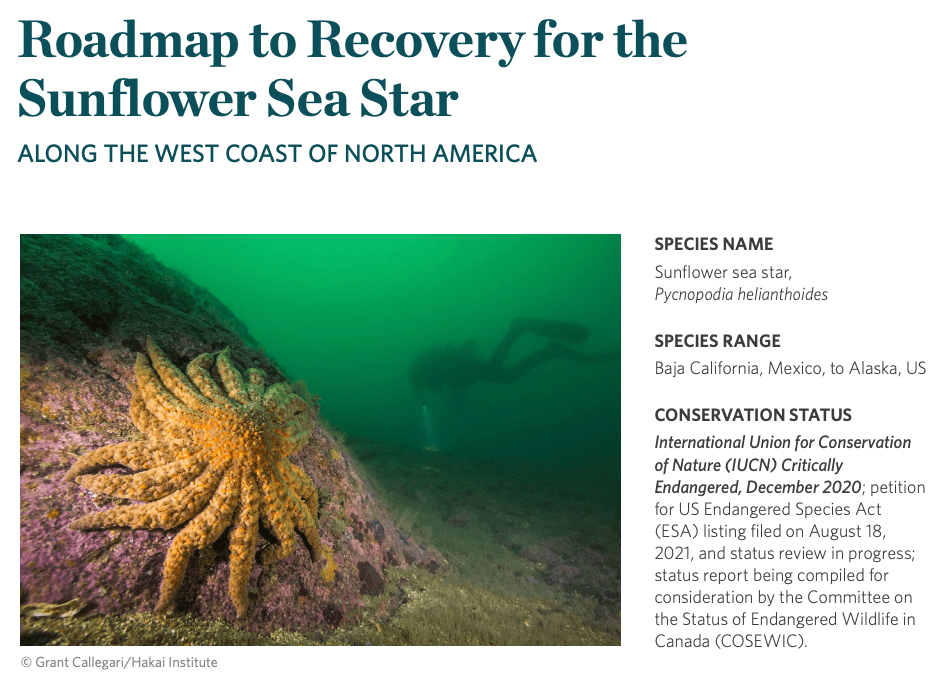
December 2022: Roadmap to recovery for the sunflower sea star (Pycnopodia helianthoides) along the west coast of North America. The Nature Conservancy (Heady et al). From the Executive Summary: “A sea star wasting disease (SSWD) event beginning in 2013 reduced the global population of sunflower sea stars by an estimated ninety-four percent, triggering the International Union for the Conservation of Nature (IUCN) to classify the species as Critically Endangered. Declines of ninety-nine to one hundred percent were estimated in the outer coast waters of Baja California, California, Oregon, and Washington. From the Salish Sea to the Gulf of Alaska, declines were greater than eighty-seven percent; however, there is uncertainty in estimates from Alaska due to limited sampling. A range-wide species distribution analysis showed that the importance of temperature in predicting sunflower sea star distribution rose over fourfold following the SSWD outbreak, suggesting latitudinal variation in outbreak severity may stem from an interaction between disease severity and warm waters. Given the widespread, rapid, and severe declines of sunflower sea stars, the continued mortality from persistent SSWD, and the potential for the disease to intensify in a warming future ocean, there is a need for a Roadmap to Recovery to guide scientists and conservationists as they aid the recovery of this Critically Endangered species . . . The area of greatest concern and need for immediate action common to all geographic regions is understanding disease prevalence and disease risk. Here we use the term “disease” to describe SSWD, also known as Sea Star Wasting Syndrome or Asteroid Idiopathic Wasting Syndrome, which affects some twenty species of sea stars and the cause(s) of which remain unknown and under debate in the literature. Much work is needed to improve our understanding of SSWD, the cause(s) of SSWD, how SSWD impacts wild sunflower sea stars, SSWD dynamics in a multi-host system, and to discover and develop measures to mitigate SSWD impacts and risks associated with conservation actions.”
December 29, 2021 – assessment report for the International Union for the Conservation of Nature = Gravem, S.A., W.N. Heady, V.R. Saccomanno, K.F. Alvstad, A.L.M. Gehman, T.N. Frierson and S.L. Hamilton. 2021. Pycnopodia helianthoides. IUCN Red List of Threatened Species 2021.
This research suggests that the pathogen is not a virus but a bacteria. The research puts forward that warmer oceans and increased organic matter appear to lead to increases in specific bacteria (copiotrophs) that then use up the oxygen at the interface of the sea star and the bacteria, and the sea stars can’t breathe. The hypothesis includes that “more heavily affected species were rougher and therefore had a much larger boundary layer (the layer at the animal-water interface) than those species which were less affected.”
Quote from lead author: “The main takeaway is the speed with which a multi-host infectious disease can cause decline in the most susceptible host [Sunflower Stars] and that warming temperatures can field bigger impacts of disease outbreaks.” Abstract includes: “Since 2013, a sea star wasting disease has affected >20 sea star species from Mexico to Alaska. The common, predatory sunflower star (Pycnopodia helianthoides), shown to be highly susceptible to sea star wasting disease, has been extirpated across most of its range. Diver surveys conducted in shallow nearshore waters (n = 10,956; 2006–2017) from California to Alaska and deep offshore (55 to 1280 m) trawl surveys from California to Washington (n = 8968; 2004–2016) reveal 80 to 100% declines across a ~3000-km range. Furthermore, timing of peak declines in nearshore waters coincided with anomalously warm sea surface temperatures. The rapid, widespread decline of this pivotal subtidal predator threatens its persistence and may have large ecosystem-level consequences.”
The paper’s discussion includes: “Cascading effects of the P. helianthoides loss are expected across its range and will likely change the shallow water seascape in some locations and threaten biodiversity through the indirect loss of kelp. P. helianthoides was the highest biomass subtidal asteroid across most of its range before the Northeast Pacific SSWD event. Loss or absence of this major predator has already been associated with elevated densities of green (Strongylocentrotus droebachiensis), red (Mesocentrotus franciscanus), and purple urchins (Strongylocentrotuspurpuratus) across their range, even in regions with multiple urchin predators. Associated kelp reductions have been reported following the outbreak . . . SSWD, the anomalously warm water, P. helianthoides declines, and subsequent urchin explosions . . . have been described as the “perfect storm.” This “storm” could result not only in trophic cascades and reduced kelp beds but also in abalone and urchin starvation.”
Sunflower Stars are of great ecological importance in maintaining kelp forests. Burt et al in 2018 quantifies the importance of Sunflower Stars in maintaining kelp forests. Sunflower Stars feed on Green Urchins which graze on kelp. Findings included that the decline of Sunflower Stars “corresponded to a 311% increase in medium urchins and a 30% decline in kelp densities”. The loss of kelp forests can impact many other ecologically and commercially important species that relay upon them as habitat and food. Note too that our reliance on kelp forests includes oxygen production and carbon dioxide buffering.
This research, specifically on Ochre Stars, found that the genetic makeup of the species has changed since the outbreak. Young Ochre Sea Stars are more similar genetically to adults who survived than to those who succumbed. This “may influence the resilience of this keystone species to future outbreaks”. The findings of an additional March 2018 paper (Miner et al) include ” . . . we documented higher recruitment of P. ochraceus [Ochre Stars] in the north than in the south, and while some juveniles are surviving (as evidenced by transition of recruitment pulses to larger size classes), post-SSWD survivorship is lower than during pre-SSWD periods.
Sunflower Star with Sea Star Wasting Syndrome. Tissue wastes away. Legs often break off and crawl away briefly before rotting away. Photo – Neil McDaniel; http://www.seastarsofthepacificnorthwest.info
___________________________________________
The content below is from my original blog November 10, 2013:
There has already been much reporting on the gruesome epidemic spreading like wildfire through several species of sea star in the NE Pacific Ocean.
“Sea Star Wasting Syndrome” is incredibly virulent and is causing the mass mortality of some sea star species in British Columbia and beyond. “Sea stars go from “appearing normal” to becoming a pile of white bacteria and scattered skeletal bits is only a matter of a couple of weeks, possibly less than that” (Source #1).
What I have strived to do is bundle the state of knowledge, relying heavily on the expertise of two extraordinary divers and marine naturalists: (1) Neil McDaniel, marine zoologist and underwater photographer / videographer who maintains a website on local sea stars and has put together A Field Guide to Sea Stars of the Pacific Northwest, and (2) Andy Lamb, whose books include Marine Life of the Pacific Northwest.
I am hoping that kayakers, beach-walkers and fellow divers will help monitor and report on the spread of the disease but I am also hoping that all of us may learn from this tragedy that has impacted “one of the most iconic animals on the coast of British Columbia . . . more abundant and diverse in our waters than anywhere else in the world” (Source #3).
Sea Star Wasting Syndrome reminds us of the fragility of ocean ecosystems; how very quickly disease could spread in the ocean; and how we are all empowered to reduce stressors that increase the likelihood of pathogens manifesting as disease (e.g. climate change) or even that pathogens enter the environment (e.g. sewage).
Species impacted?
High mortalities (note that the first 4 are members of the same family – the Asteriidae):
Sunflower star (Pycnopodia helianthoides) hardest hit in southern British Columbia. From communication with Neil McDaniel ” . . .so far I estimate it has killed tens, possibly hundreds of thousands of Pycnopodia in British Columbia waters.”
Update January 21st, 2014: Possibly: Rose star (Crossaster papposus) – I have noted symptoms in this species on NE Vancouver Island as has Neil McDaniel in S. British Columbia).
Symptoms and progression of SSWD:
Neil McDaniel shared the following 7 images for the progression of the disease in Sunflower Stars [Source #2 and #14]. See the end of this blog item for images showing symptoms in other sea star species as well as a 1 minute time-lapse clip showing the progression of the syndrome in a Sunflower Star over 7 hours. [Note that the progression of the Syndrome on NE Vancouver Island appears that it may be different from what has been observed further to the south.]
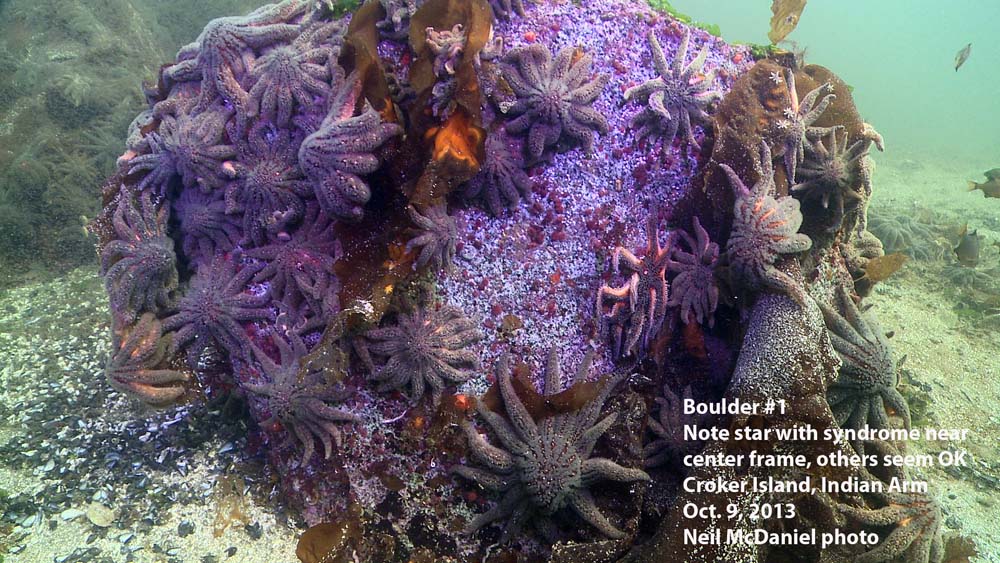
1. In this image most of the Sunflower Stars appear healthy “other than one just right of center frame is exhibiting the syndrome, looking “thinned-out” and emaciated.”
3. This image “shows how the body wall begins to rupture, allowing the gonads and pyloric caeca to spill out.”
As the animals become more stressed, they often drop several rays (which wander off on their own for a while). At this point the body wall becomes compromised and the pyloric caeca and/or gonads may protrude through lesions. As things progress, the animals lose the ability to crawl and may even tumble down steep slopes and end up in pile at the bottom. Soon after they die and begin to rot
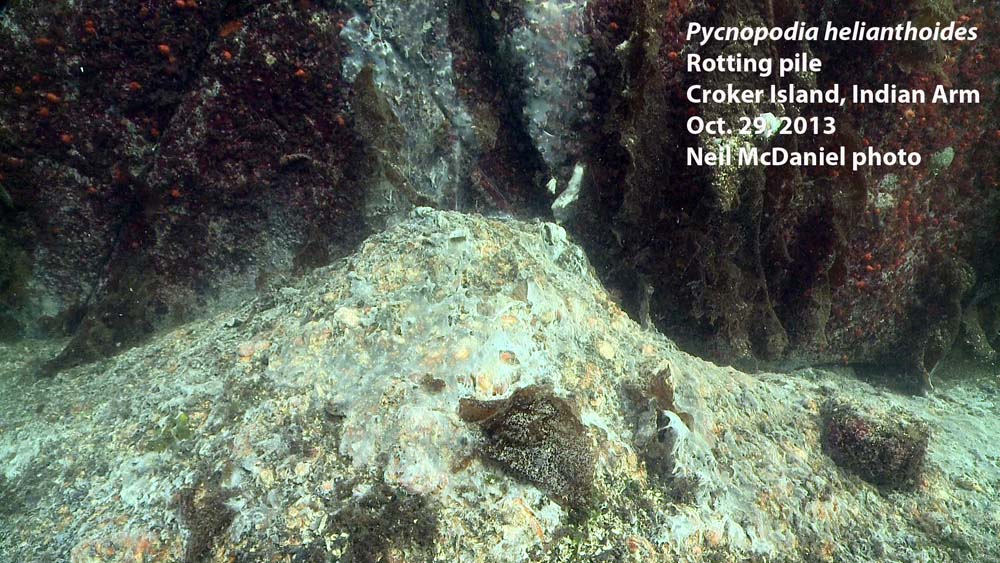
5. As things progress, the animals lose the ability to crawl [and hold grip surfaces] and may even tumble down steep slopes and end up in pile at the bottom. Soon after they die and begin to rot.
6. The bacteria Beggiatoa then takes over and consumes all of the organic matter, leaving a scattering of skeletal plates on the bottom. The syndrome develops quickly and in only one to two weeks animals can go from appearing healthy to a white mat of bacteria and skeletal plates
The 1-minute time-lapse video below shows the progression of the Syndrome in a sunflower star over 7 hours.
Cause(s)? To date, the cause(s) have not yet been identified. Scientific opinion appears to be that most likely the cause is one or more viruses or bacteria. As with any pathogen (like the flu virus), the expression of a pathogen as disease is influenced by the number and proximity of individuals and could be exacerbated by environmental stressors.
Has this happened before? Never to this large a scale. “Although similar sea star wasting events have occurred previously, a mortality event of this magnitude, with such broad geographic reach has never before been documented.” (Source #17).
“Southern California in 1983-1984 and again (on a lesser scale) in 1997-98” (Source #4 and #13)
Florida (Source #5).
Update November 30: Sunflower die offs [on much smaller scale] have been noted in the past in Barkley Sound. In 2008 ochre star die offs were documented in Barkley Sound. In 2009 Bates et. al. reported on this and observed that the prevalence of disease “was highly temperature sensitive and that populations in sheltered bays appeared to sustain chronic, low levels of infection.” (Source #14 and #15).
“Similar events have occurred elsewhere over the last 30 years. Sea stars have perished in alarming numbers in Mexico, California and other localities” (Source #2).
“In July, researchers at the University of Rhode Island reported that sea stars were dying in a similar way from New Jersey to Maine . . a graduate student collected starfish for a research project and then watched as they “appeared to melt” in her tank” (Source #5).
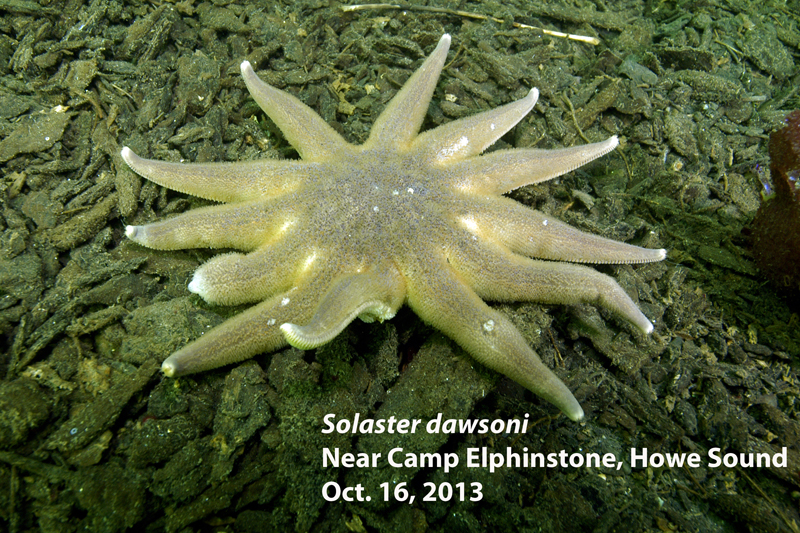
Shellfish Health Report from the Pacific Biological Station (DFO) conducted on 1 morning sun star and 7 sunflower stars collected on October 9, 2013 at Croker Island, Indian Arm; case number 8361.
Bates AE, Hilton BJ, Harley, CDG 2009. Effects of temperature, season and locality on wasting disease in the keystone predatory sea star Pisaster ochraceus. Diseases of Aquatic Organisms Vol. 86:245-251 http://www.ncbi.nlm.nih.gov/pubmed/20066959
Morning sun star with lesions indicating the onset of sea star wasting syndrome. Photo and descriptor – Neil McDaniel; http://www.seastarsofthepacificnorthwest.info Click to enlarge.
I am typing with salt still encrusted to my face and hair. I really should warm up from my dive and wash off the NE Pacific before sharing this with you but this is the kind of story you want to shout from the seamount tops. However, be warned, there is a bit of a dark side to the story too.
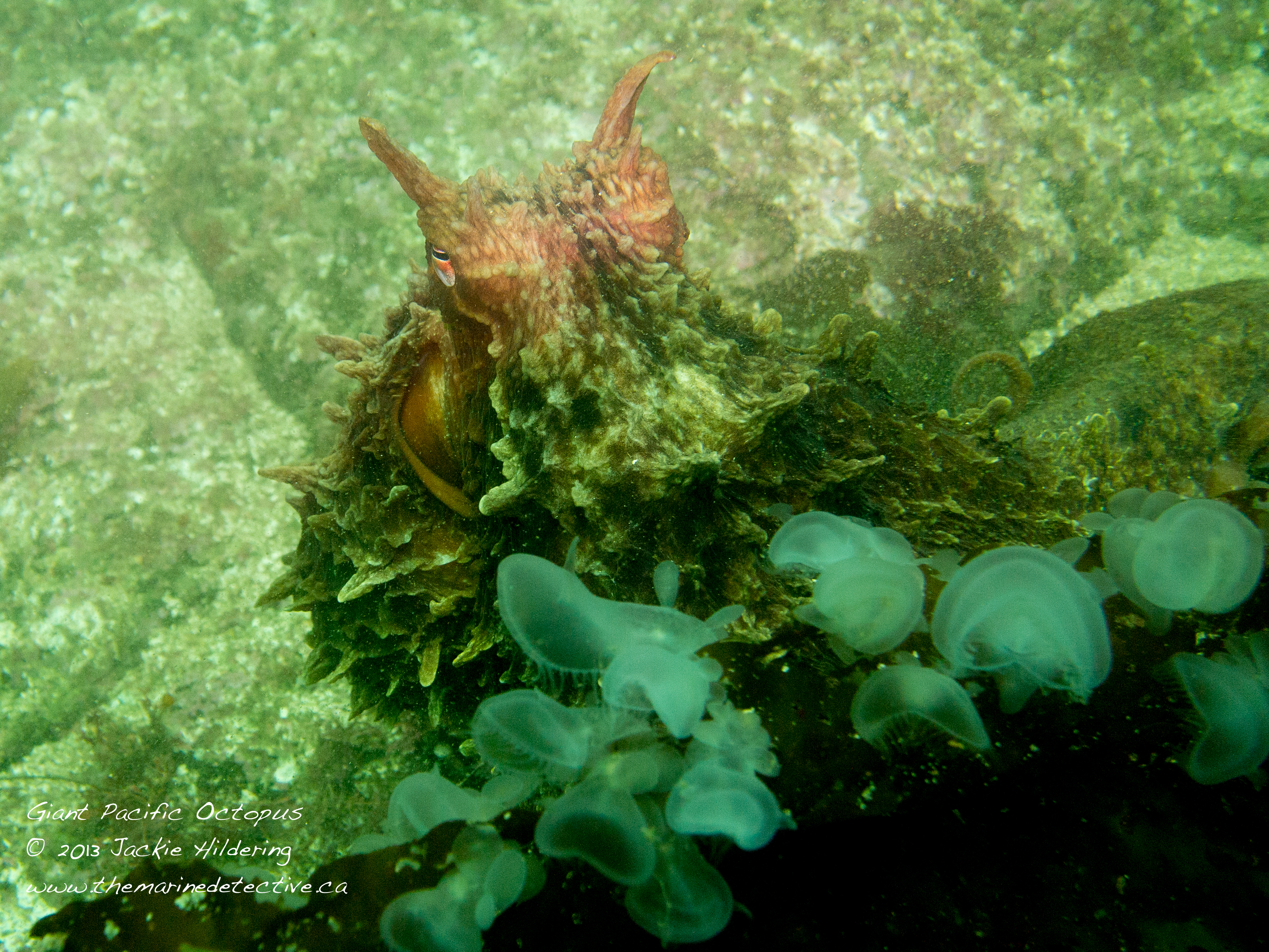
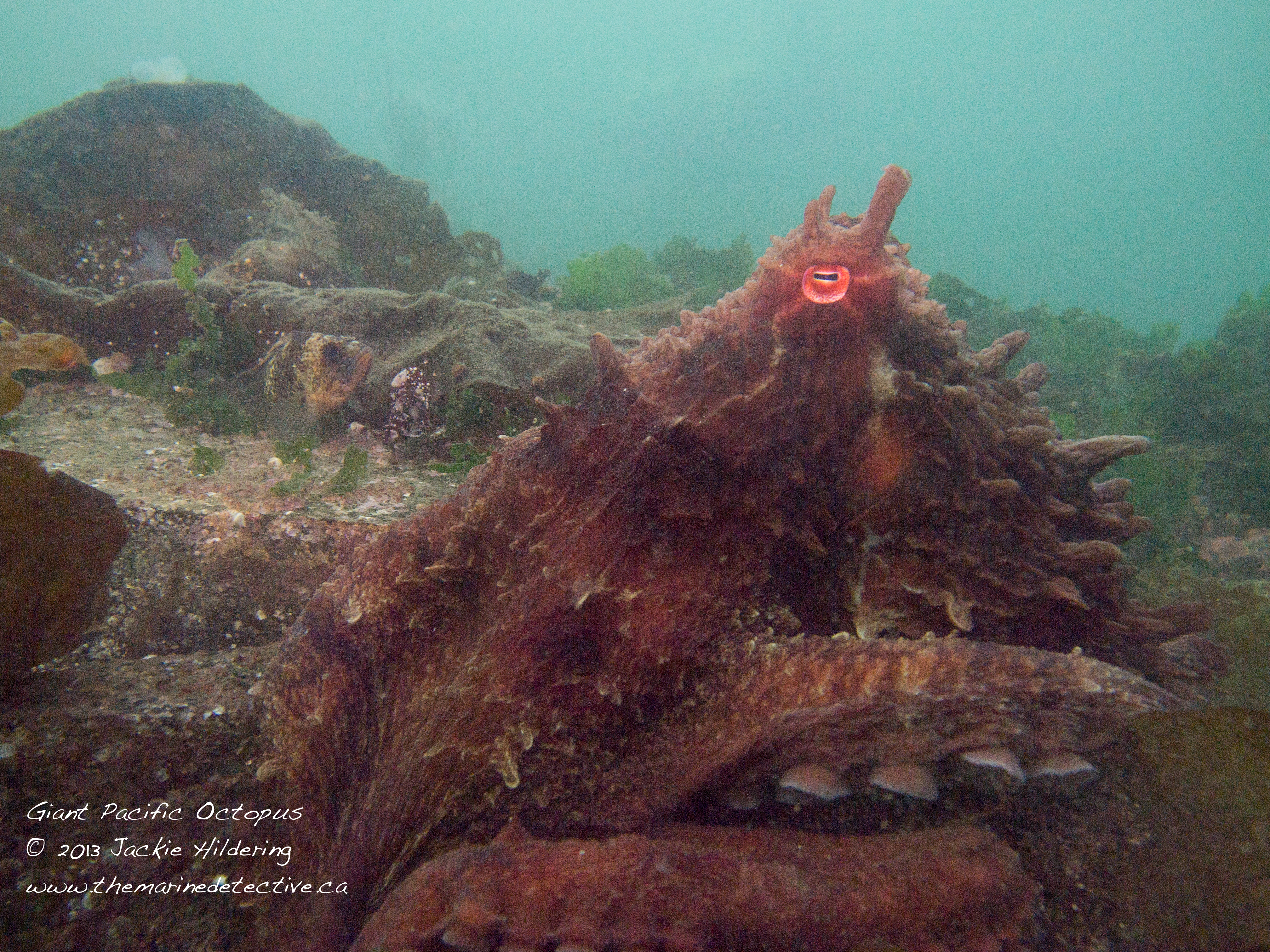
Today, while doing a shore dive in Port Hardy with the intention of surveying the health of sea stars*, I had the most wondrous experience I have ever had with not one, but two giant Pacific octopuses.
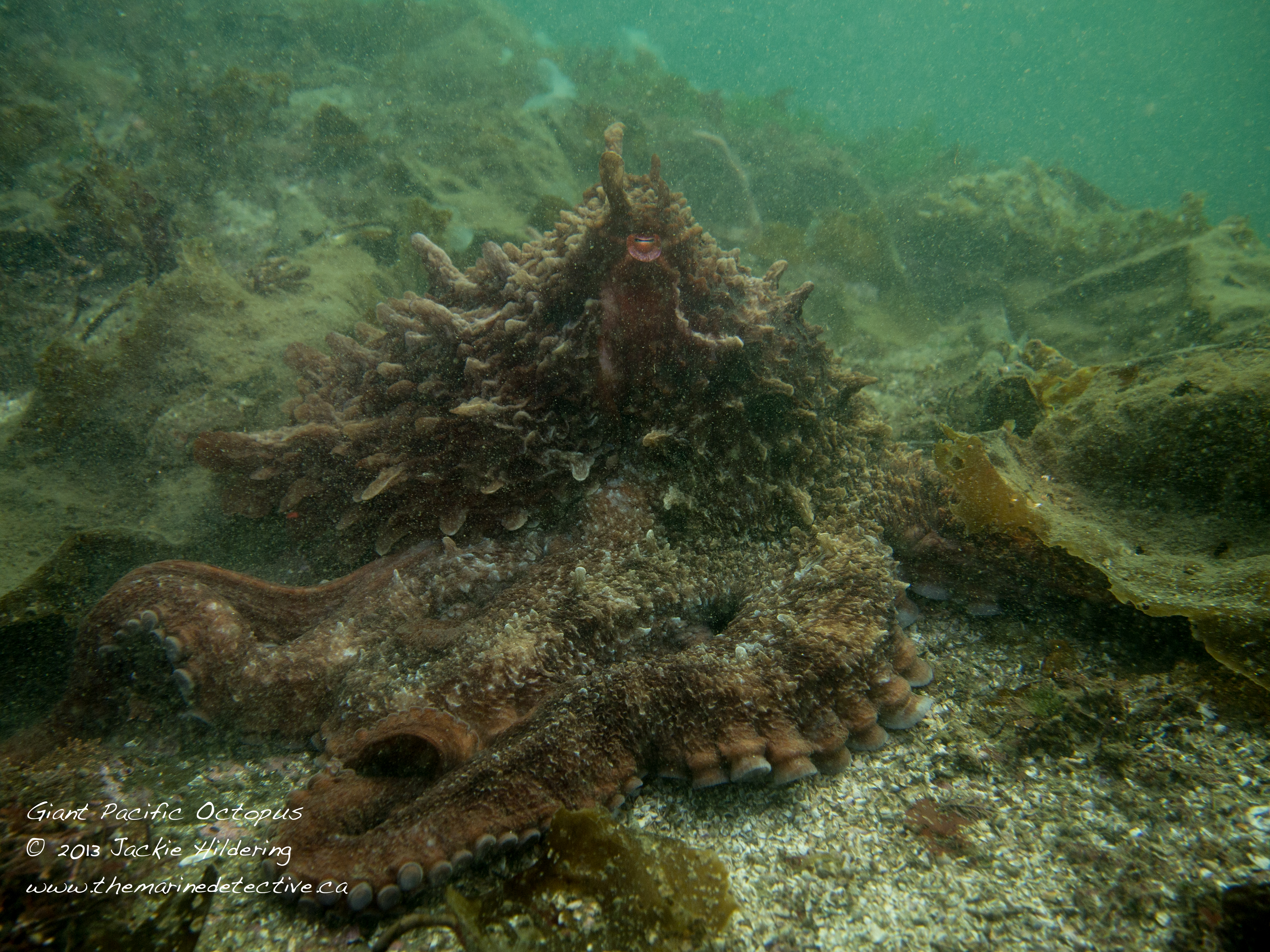
While photographing a sea star I must have disturbed the first octopus because when I looked down, wondering what had caused a massive disruption of hooded nudibranchs from the kelp, there she/he was in full glory – posturing to show me his/her impressive size, hooded nudibranchs undulating all around.
I even ended up with a hooded nudibranch stuck to my mask, which I gently shook off as I am a poor surrogate for kelp!
After I recovered from the shock of this all and mumbled an apology in the guilt of triggering the chaos, I looked at the octopus for a bit . . . and she/he looked at me. We both settled down, apparent in the case of the octopus in that he/she was no longer posturing and reverted to camouflage colours rather than alarm vibrance.
After some minutes, the assessment appeared to be made by this sentient being that I was not a risk; and that there was no need to hide (nor ink!). As a result, for half an hour I was able to (respectfully) follow along as the octopus hunted.
I was allowed to learn about hunting strategy and see how the colour and texture changed as it moved and how the mantle would flash white as it pounced upon prey.
The only thing that stopped this deeply awe-inspiring experience was that dive buddy, Alex Spicer, found a second octopus in the open!
This much smaller octopus was using giant kelp like a hammock.
The divers among you know what a rare gift it is to find one, let alone two, (unhabituated) octopuses out of their dens, certainly during daytime. The underwater photographers and videographers among you would be twitching all the more, knowing what an incredible opportunity this offers to capture the beauty of these giant wonders.
Here’s the dark side. Thankfully it is a literal dark side. My strobes (flashes) didn’t work properly and it was my own doing. It’s been a crazy week of work and, in the flurry resulting from wanting to fit in a dive, I forgot the cables that hook the strobes to the camera.
Yes, I was given what may be the opportunity of a lifetime but failed to fully capture the beauty of it, leaving you with only the grainy images below. However, I got to fully live the experience and had anything changed in the course of events that led to today’s dive, likely I wouldn’t have been octopused at all.
I hope the images are still enough to illuminate the joy and wonder I felt.
[Be sure you scroll down for the photo of the little guy in the kelp hammock!]
Apologies for a longer absence here. It has been a full summer of marine research, education and inspiration.
I will have the joy of sharing much with you in the coming months.
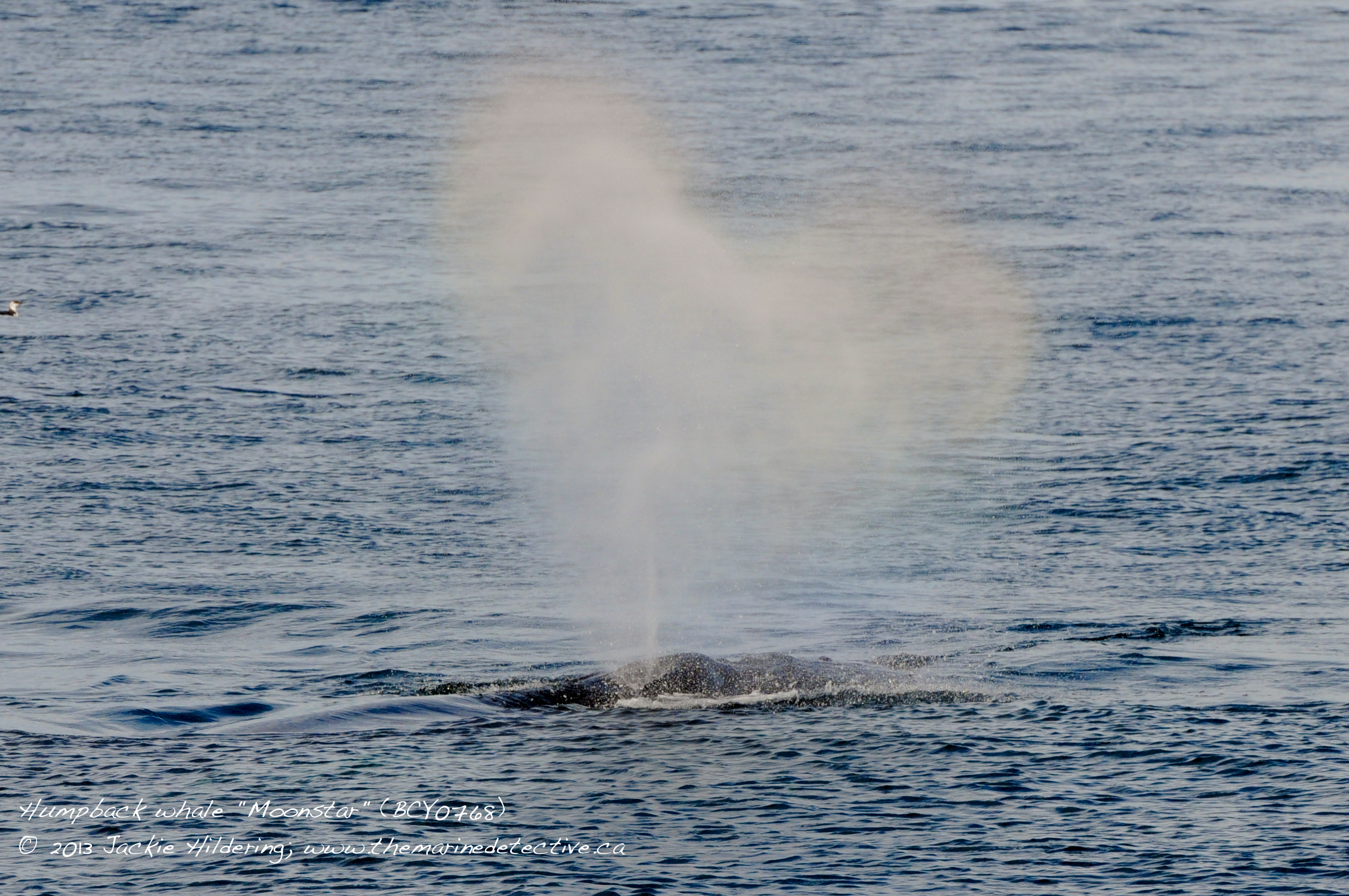
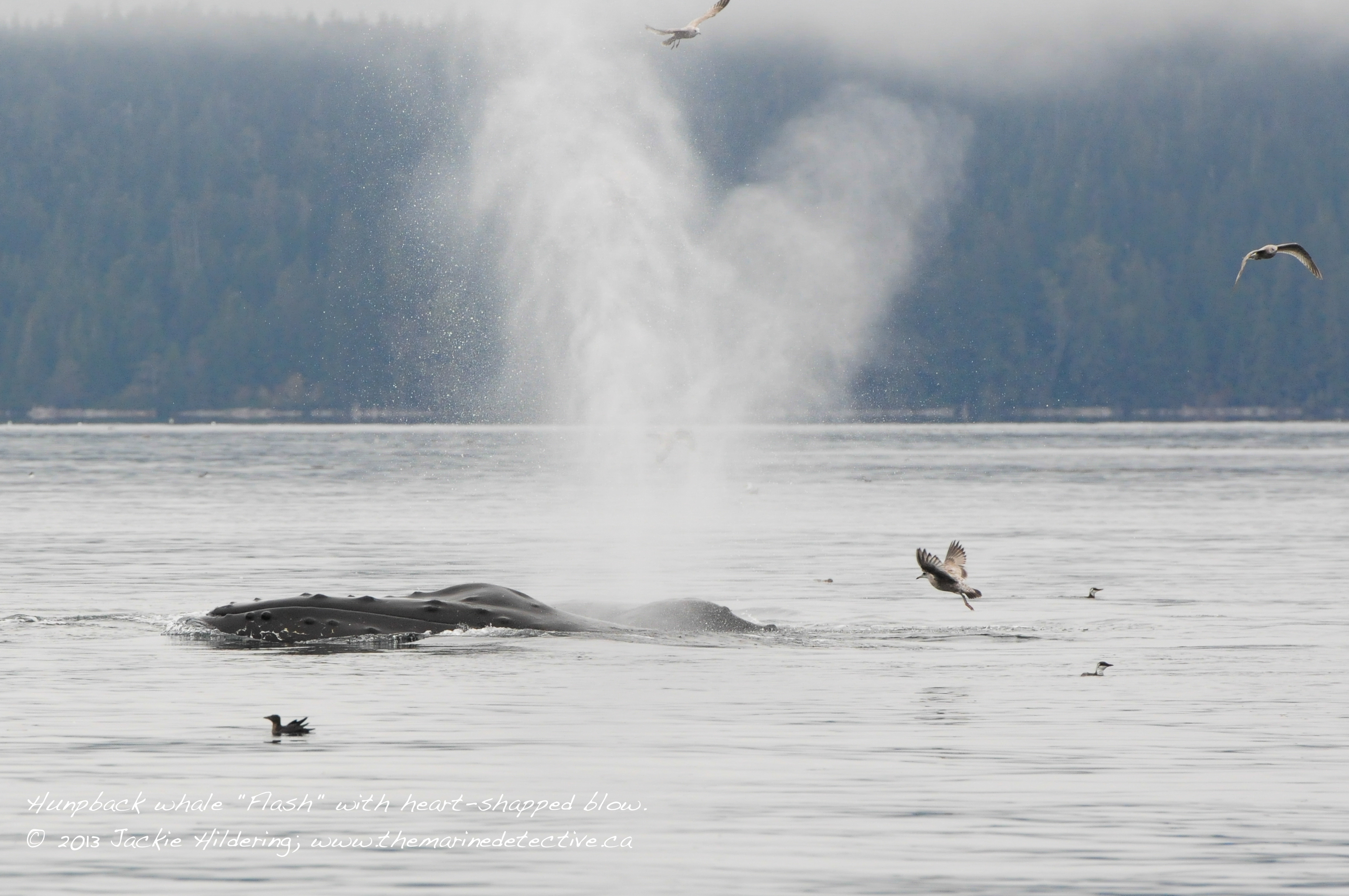
For now – three remarkable images taken in the last months where the whales’ blows are heart-shaped.
With whales being ambassadors for marine ecosystems in so many ways, these images may be particularly engaging – suggesting that we should love the Oceans as if our lives depend on them because . . . they do!
Also to make your heart sing, see the clip below (or access it at this link). I was able to capture the vocals of northern residents AND humpbacks from one of the most mind-blowing days I have ever had the privilege of experiencing on the water. Enjoy!
[These images and video were previously shared on the TMD FaceBook page].
How does studying whale acoustics lead to increased knowledge about the depth range of nudibranchs?
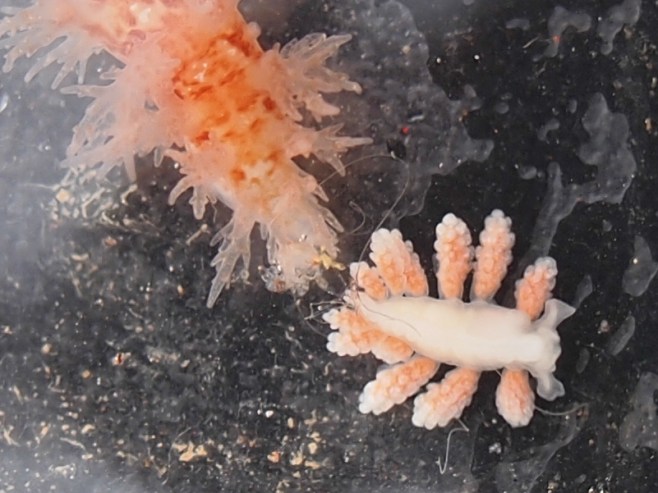
Just a little more is now known about the orange doto’s depth range. Photo: Hildering.
Let me take you deep and share an experience from my recent time offshore in the eastern North Pacific on a DFO cetacean survey.
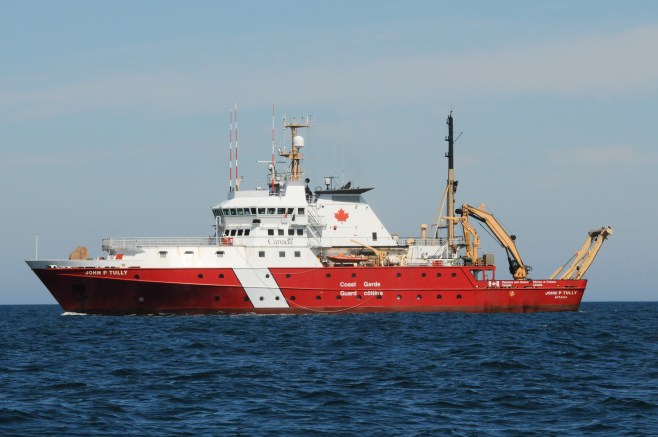
This is the Canadian Coast Guard Ship – the J.P. Tully.
CCGS J.P. Tully. Photo: Hildering
Among the offshore science expeditions undertaken upon the Tully, are surveys by DFO’s Cetacean Research Program. These line transect studies provide an estimate of cetacean abundance, as well as an opportunity to ID individual whales and collect feeding and genetic information. The knowledge about abundance and location is of particular importance for the large whales that were hunted so intensely and require protection under Canada’s Species at Risk Act.
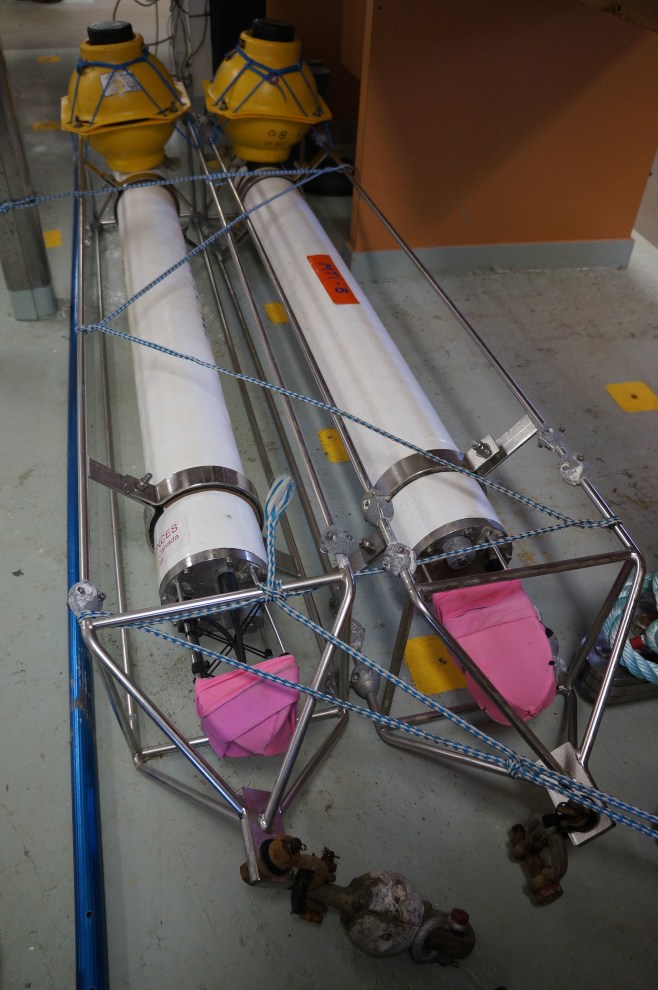
These are Autonomous Underwater Recorders for Acoustic Listening (AURAL-M2s).
AURAL-M2s. Photo: Sheila Thornton.
AURALs are hydrophones that can be deployed to 300 m, making time-spaced recordings (e.g. 15 minutes every hour) for up to a year. Such acoustic monitoring is a very important supplement to the cetacean vessel surveys. The AURALs are of course placed very strategically, in remote, offshore locations. By passively recording whale calls, the AURALs can provide information about the location and seasonality of whale species which may aid in determining critical habitat.
The AURALs are a wonder of technology. It is of course no problem to get something to the bottom of the ocean but, getting it back to the surface so you can retrieve your equipment and data is not so simple. It is achieved with an acoustic release (“D” in the diagram below). Once the vessel is positioned so that there is no chance of the device coming up under it, a sound signal is sent to the device and the AURAL releases from its anchor and floats to the surface thanks to the big yellow buoy.
AURAL-M2. Click to see an enlarged, labeled schematic on the Multi-Electronique webpage.
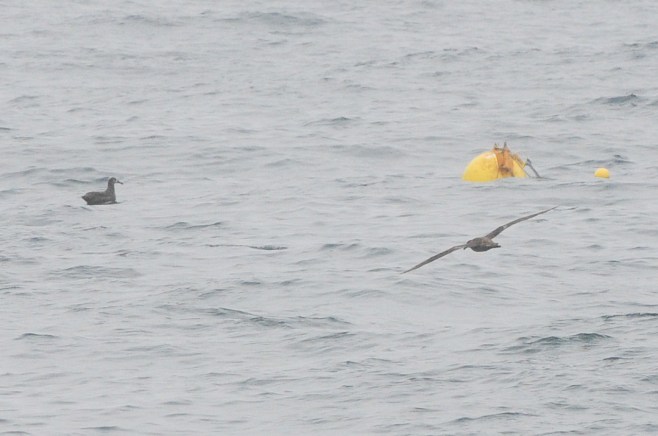
These are two perplexed black-footed albatrosses! A big yellow orb has just popped up to the surface as a result of the acoustic release signal. This AURAL was at 226 m depth at the Bowie Seamount, 180 km west of Haida Gwaii. It had been there for a year.
Black-footed albatross just after the buoy with the AURAL recording device came up from 226 m.
Here, the highly skilled Coast Guard crew get the AURAL back aboard the ship so that the data can be retrieved and, ultimately, analyzed for whale vocals.
Coast Guard deck crew expertly retrieves the AURAL. Photo: Hildering
But, there was also a year’s worth of growth on the buoy and who knows what you might find . . .
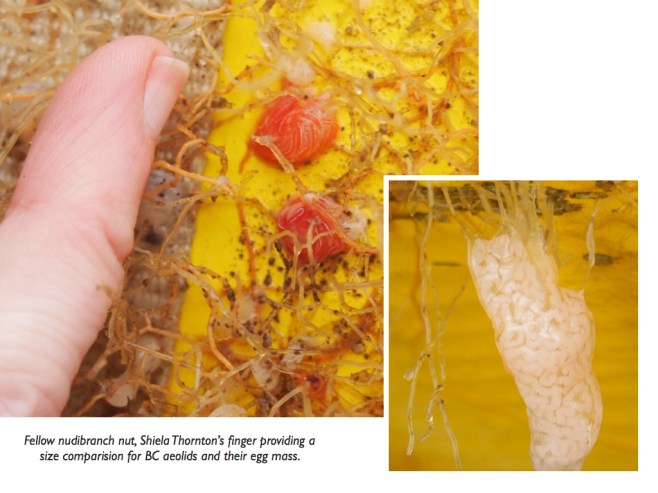
Nudibranchs! Three species found and even one species with eggs!
3 nudibranch species on the AURAL that had been at 226 m. BC aeolid; bushy-backed nudibranch and orange doto. Click to enlarge. Photo: Hildering.
Top: BC aeolid (Catriona columbiana to 1.5 cm); eggs also found.
By examining the AURAL that had been at 226 m, it confirms that these 3 species of nudibranch have a range to at least that depth.
Sheila Thornton (marine mammal researcher and fellow nudibranch nut) providing a size comparison for the BC aeolids and their egg masses that were found on the AURAL. Click to enlarge. Photo: Hildering
I shared the find with those who have nudibranch expertise much greater than my own (Dave Behrens via Andy Lamb) and learned that for two of the species, there had been no previous record for them at this depth.
It has long been known that some nudibranch species range to depths of at least 700 m. However, you can imagine what a a challenge it is to get species specific depth information. We camera carrying scuba divers can’t help beyond 40 m depth (deeper if diving with mixed gases).
So it’s not a big scientific discovery. Compared to the data the AURAL will reveal about endangered whales, it’s just a sea-slug-sized discovery.
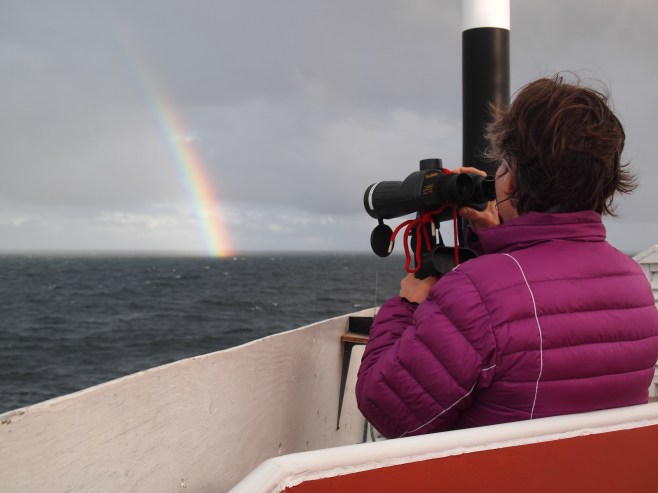
This is me – back on survey duty looking for much bigger organisms but delighting in how collecting data to help save whales, led to learning a bit more about the little guys.
Spotter duty on the DFO Cetacean Program’s offshore survey. July 2013. Christie McMillan photo.
The current known number of sightings of North Pacific Right Whales in the waters of British Columbia from 1951 to 2026 is six (see list below, of the six sightings, one involved two whales). Individual IDs were determined for only three of these whales, whereby it is not known if the other sightings involve repeat sightings of the same individuals. At a minimum, three different North Pacific Right Whales have been documented since 1951. If there are no duplicate sightings, it could be as many as seven individuals.
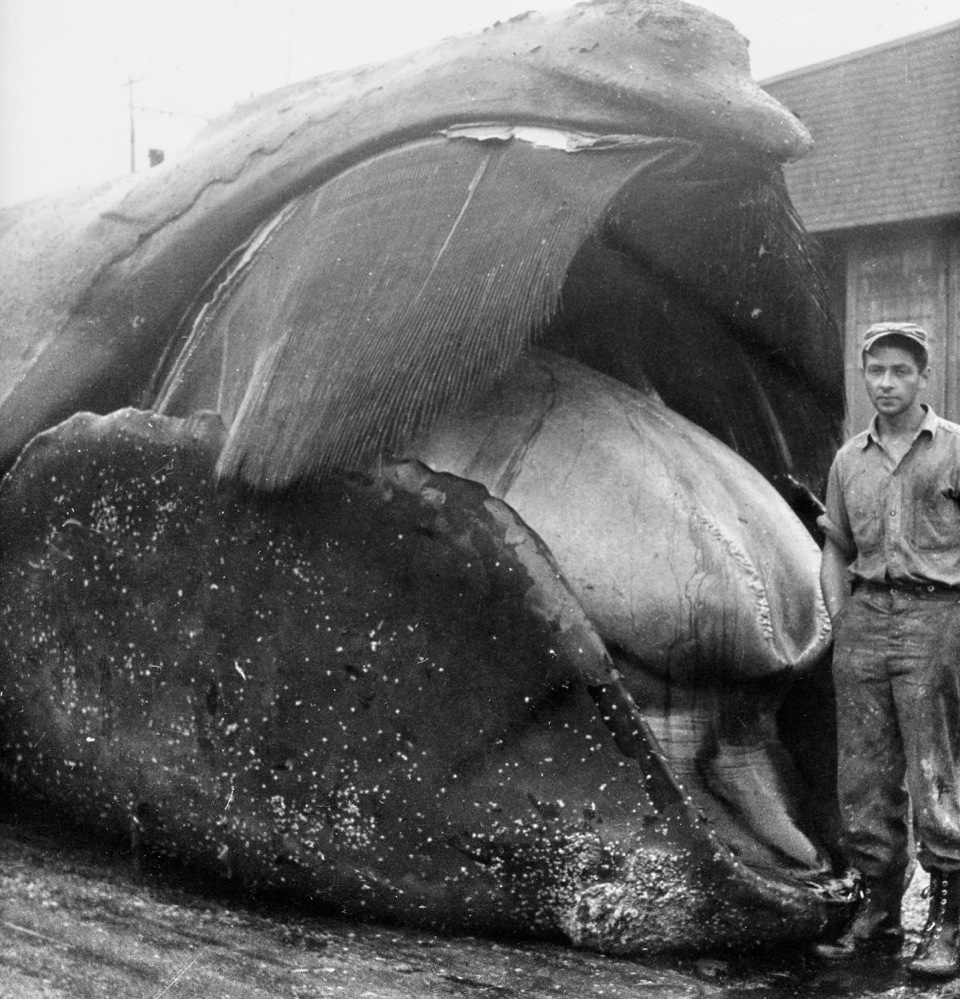
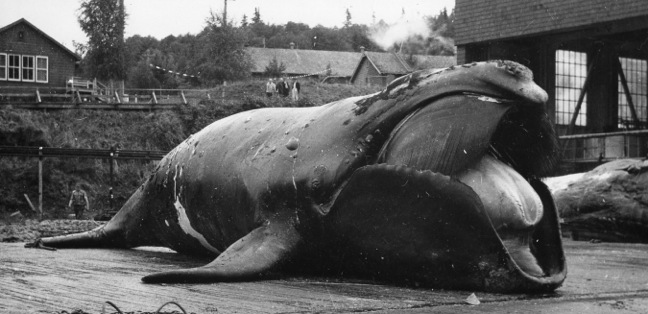
North Pacific Right Whale at the Coal Harbour whaling station in 1951. This was the last Right Whale seen in BC waters until June 2013. Photo: Gordon Pike, the DFO biologist responsible for monitoring whaling at Coal Harbour. Credit: Pacific Biological Station, DFO.
Tracking of sightings of North Pacific Right Whales in BC waters See news stories related to these sightings near the end of the blog.
1. June 9th, 2013 – First known sighting of a North Pacific Right Whale in BC waters since 1951. Callosity and scar patterns did not match any of the 22 distinct individuals in the MML’s North Pacific right whale catalogue, and the whale has been assigned the new identifier MML90.” (Source: Ford et al., 2016).
2. October 25th, 2013 – Second North Pacific Right Whale sighting in BC waters (different whale than the one seen in June). “… photo-identification images did not match any individual in the MML’s North Pacific right whale catalogue, and it has been assigned the new identifier MML92.” (Source: Ford et al., 2016).
3. June 4th, 2018 – North Pacific Right Whale sighting off the west coast of Haida Gwaii by the Canadian Coast Guard. Referenced in NOAA’s Five-Year Review of North Pacific Right Whales (2024) with the text: “Unable to make an individual ID from photos.”
[Unverified Spring 2020 – one seen from the air?]
4. June 2020 – Sighting from a cargo ship. See video below. Referenced in NOAA’s Five-Year Review of North Pacific Right Whales (2024) with the text: “Unable to make an individual ID from video; Animal had a large scar on the left side of its back.”
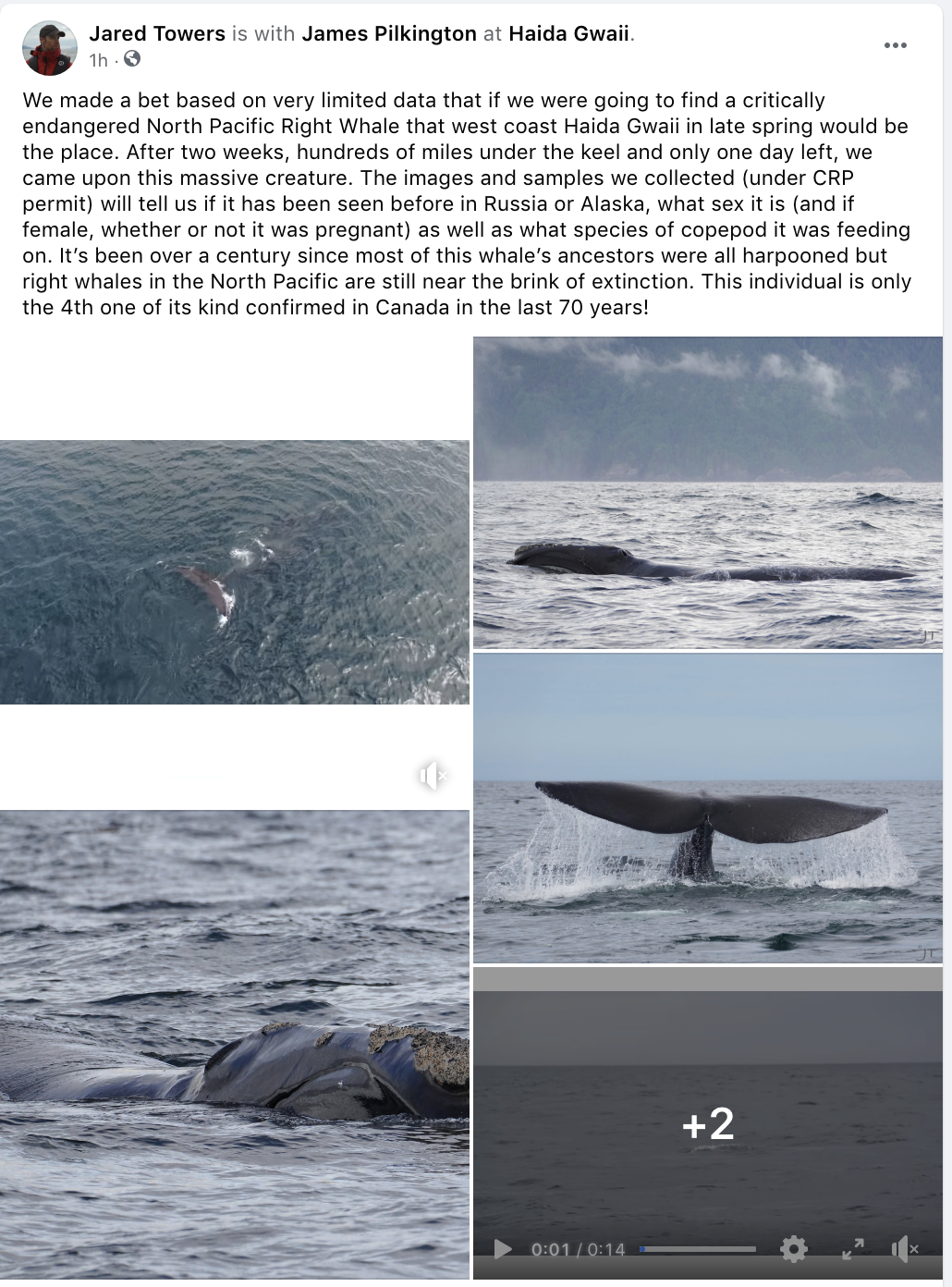
5. June 2021 – North Pacific Right Whale sighting off the west coast of Haida Gwaii by DFO Team Jared Towers and James Pilkington. ID photos were taken, but I do not know the catalogue number of this individual. Referenced in NOAA’s Five-Year Review of North Pacific Right Whales (2024) with the text: “Confirmed new individual; Biopsy, prey, and scat samples collected (analyses ongoing).”
6. July 2021: TWO North Pacific Right Whales sighted by an Observer on a seismic survey vessel. Referenced in NOAA’s Five-Year Review of North Pacific Right Whales (2024) with the text: “Unable to make an individual ID from photos. Seismic operations shutdown when whales were present.”
Original blog from June 2013
On June 9th 2013, while surveying off the west coast of Haida Gwaii for DFO’s Cetacean Research Program, biologist James Pilkington sighted one of the world’s most critically endangered mammals – a North Pacific Right Whale (Eubalaena japonica).
The species was once common but endured a catastrophic assault by whaling whereby there are now only about 30 left in the whole eastern North Pacific.
Reflecting on this whaling history makes clear how much positive change there has been in our attitudes to whales and this may have particular potency for those of us on Northern Vancouver Island due to BC’s last whaling station having operated in Coal Harbour from 1948 to 1967.
But, the devastation started far before that.
In 1835, intensive whaling began in the North Pacific and the most desirable target was the RIGHT whale. It was the right whale to kill since they were easy pickings with high reward.
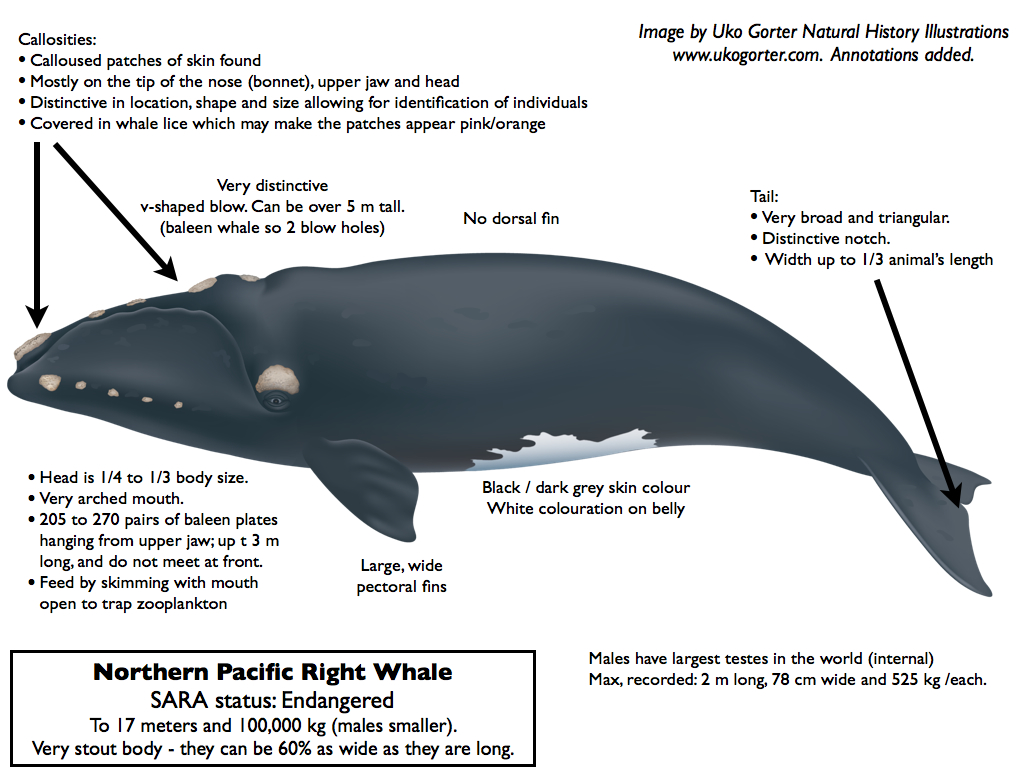
Right Whales feed by using their huge baleen plates (up to 3 m long) to skim zooplankton into their mouths, slowly powering themselves forward with massive tails. When feeding on the surface in this manner, they made life very easy for whalers – being slow moving, often near the coast and easy to approach. The long, fine baleen had very high commercial value as “whale bone”, largely used to stiffen women’s clothing.
Also making them a preferred species for whalers is that Right Whales are particularly stout, weighing as much 90,000 kg at about 17 m. They have very thick blubber which provided whalers with vast amounts of oil, desirable for lighting in that era. The large blubber layer also meant that right whales floated when killed, making them easier to harvest than other whale species.
Annotated diagram of a North Pacific Right Whale. Image by Uko Gorter Natural History Illustrations.
Being easy to kill and having high commercial value, meant the Right Whales of the world were done a great deal of wrong. For the North Pacific Right Whale alone, the estimate is that 11,000 were killed between 1835 and 1849 and that the species was determined to be “commercially extinct” by 1900.
Protection was very late for animals so very endangered. The first International Whaling Convention only came into effect in 1935 and was not ratified by Japan and Russia. An additional Convention came into effect in 1949 strengthening protection, but there was still illegal Soviet whaling in the North Pacific from 1961 to 1979.
In British Columbian waters, despite the knowledge that they were the rarest of the rare, BC whalers killed the only 6 confirmed North Pacific Right Whales sighted in the last century. Five of these were killed before 1933 and 1 was killed in 1951.
What might make this hit literally close to home is that the 1951 whale, a 12.5 m mature male was killed by Coal Harbour whalers (see photograph, 1951 North Pacific right whale with Gordon Pike, the DFO biologist responsible for monitoring whaling at Coal Harbour).
It was said to be an accident; that they did not know it was a North Pacific Right Whale but got the directive to kill him anyway.
What a difference 62 years makes.
North Pacific Right Whale at the Coal Harbour whaling station in 1951. Photo credit: Pacific Biological Station, DFO.
The last thing on the minds of those observing the North Pacific Right Whale in June 2013 was killing it. From the moment James Pilkington noted the distinct v-shaped blow, hope soared that the “holy grail of whales” had been found and that the opportunity to study it might aid conservation.
DFO’s cetacean researchers, Dr. John Ford and Graeme Ellis joined James and shot the whale with cameras not harpoons, allowing the whale (a sub-adult) to be identified as an individual from the raised patches of skin called callosities that are unique to every right whale. They managed to get DNA and scat samples. DNA confirmed the whale was a young female and had not been previously documented. She has been assigned the ID MML90 (See Ford et al).
And when the sighting was relayed to the media, the societal change became so very clear. What was once the right whale to kill, is now the right whale to provide us with hope about the resilience of nature.
However, I believe that to truly know the significance of this sighting, it may take another 62 years.
Will society then be able to look back with the same sense of positive change, having learned that there are still many ways to kill a whale and impact the ecosystems for which they are ambassadors?
Will we have significantly reduced our fossil fuel addiction that drives climate change, impacting the whales’ food supply? Will we have realized that our individual demand for energy literally fuels the threat of tanker traffic, and therefore oil spills, on our Coast? Will we have curbed our consumer lifestyles of disposable goods that lead to a literal sea of plastic?
With such changes, the potential increases for the recovery of North Pacific Right Whales and the health of the marine ecosystem on which we too depend. This will be our ultimate reward for better knowing right, from wrong.
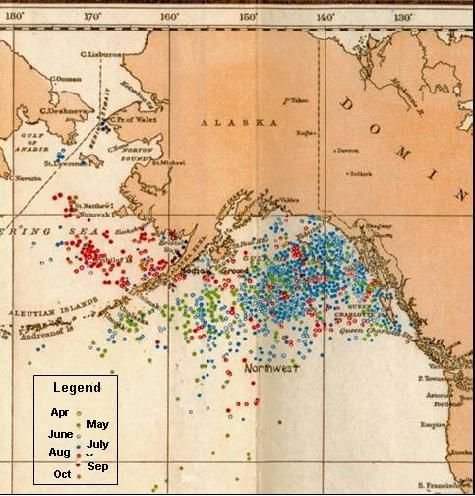
North Pacific Right Whale catches from 1785 to 1913 in the eastern North Pacific from the records of American whale ships. Photo by Environment and Climate Change Canada’s species at risk registry (via National Observer article at this link).
See video below of the June 2013 sighting of the first North Pacific Right Whale in 62 years below. Narration is by Dr. John Ford.
Coverage of sightings in BC waters:
July 2021 sighting of 2 individuals near Haida Gwaii:
2013 sightings of two individuals – June and October:
Scientific paper on the two 2013 sightings. Includes that the 2nd sighting in 2013 was of a previously undocumented whale (now assigned ID MML92) and that the whale had severe scarring, likely from entanglement. DNA was not collected so the sex of this whale is not known.
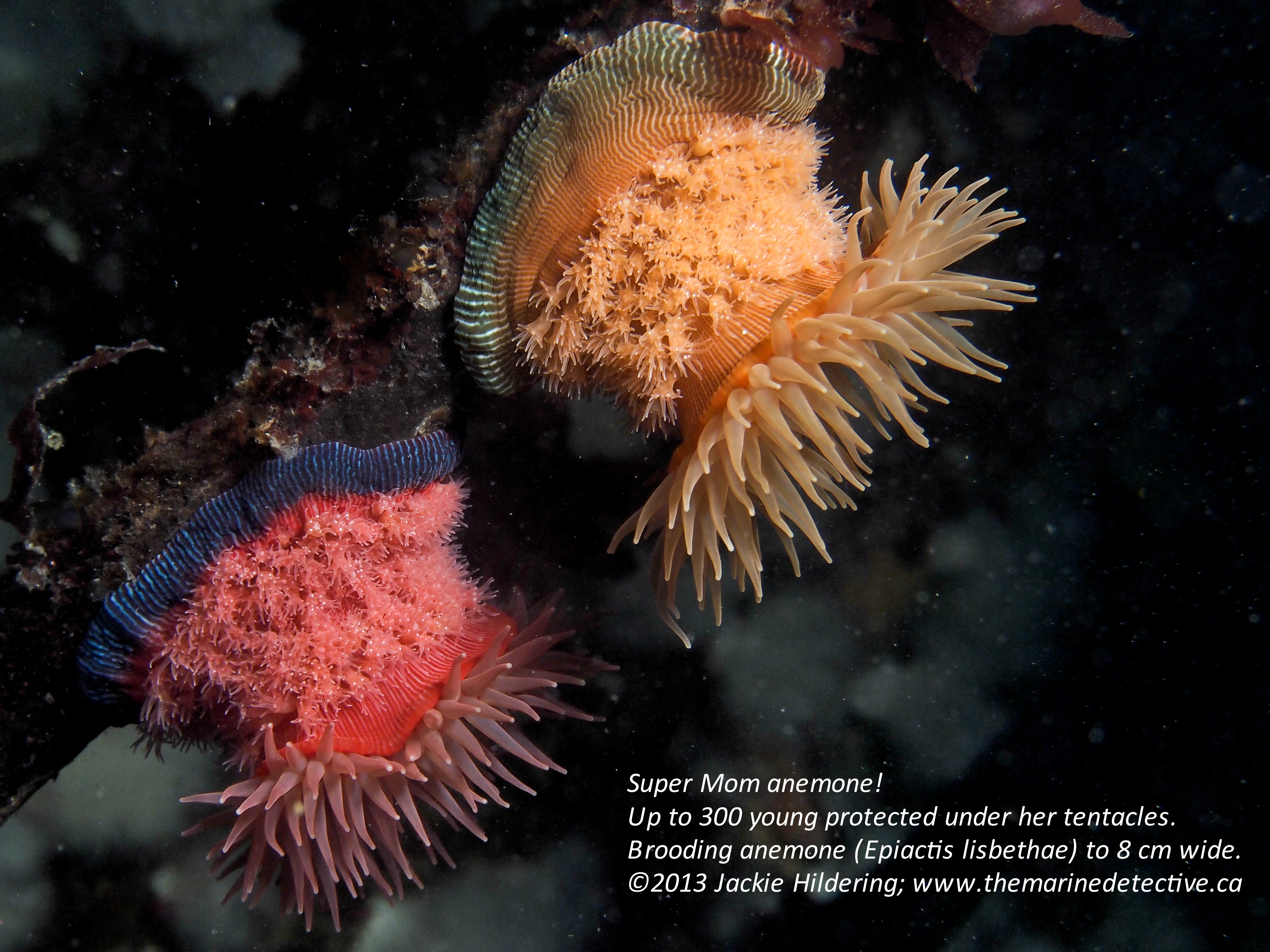
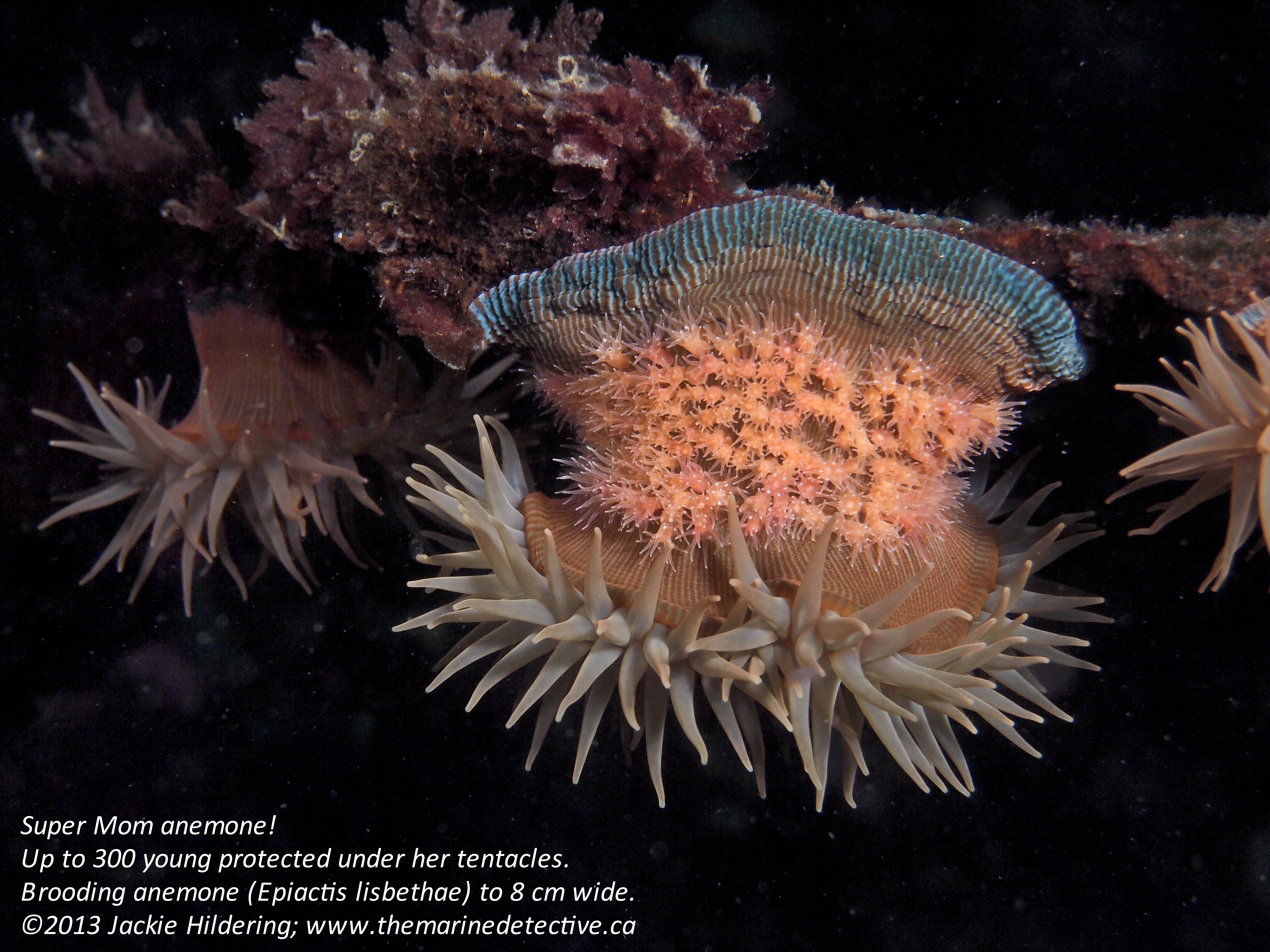
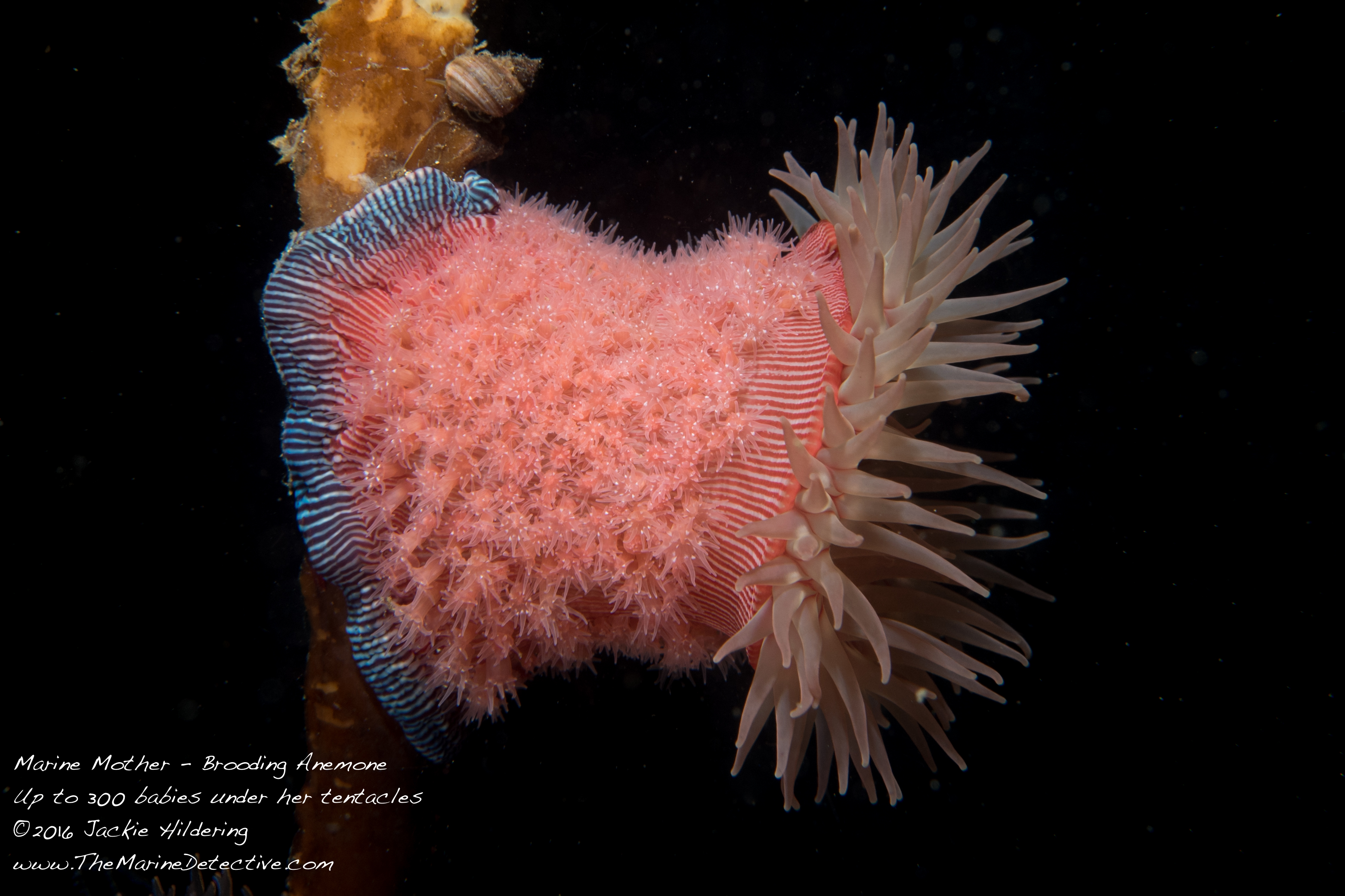
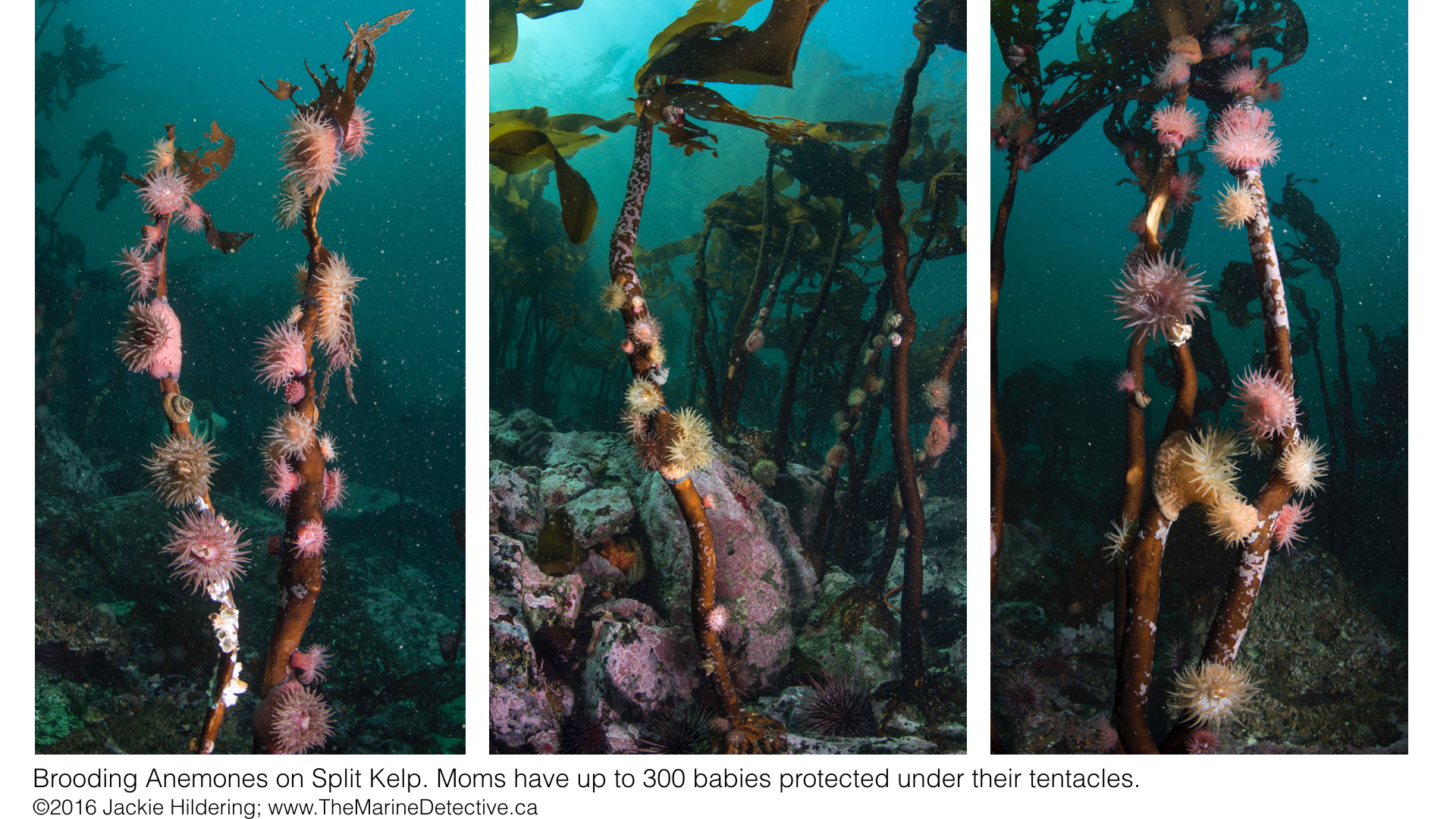
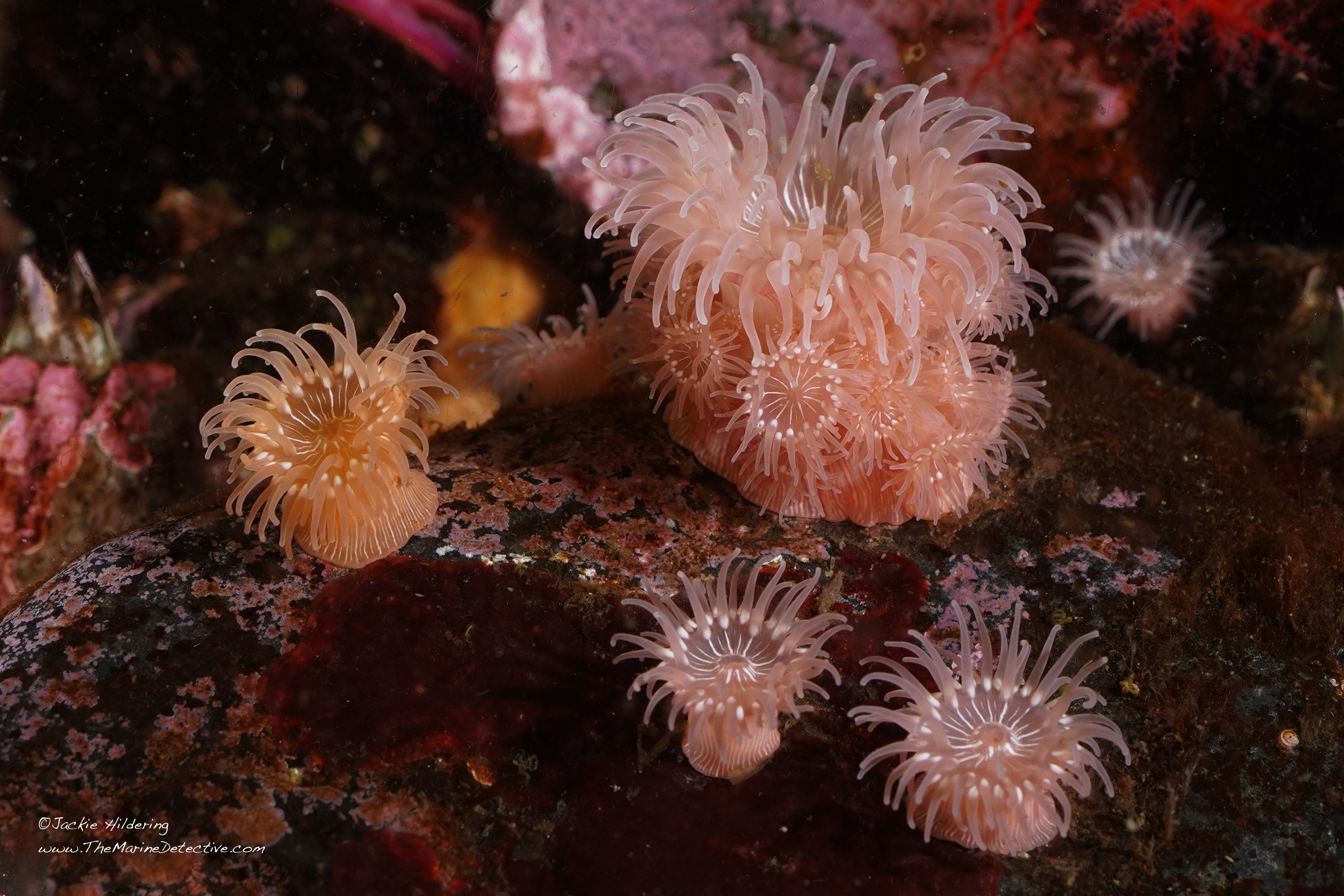
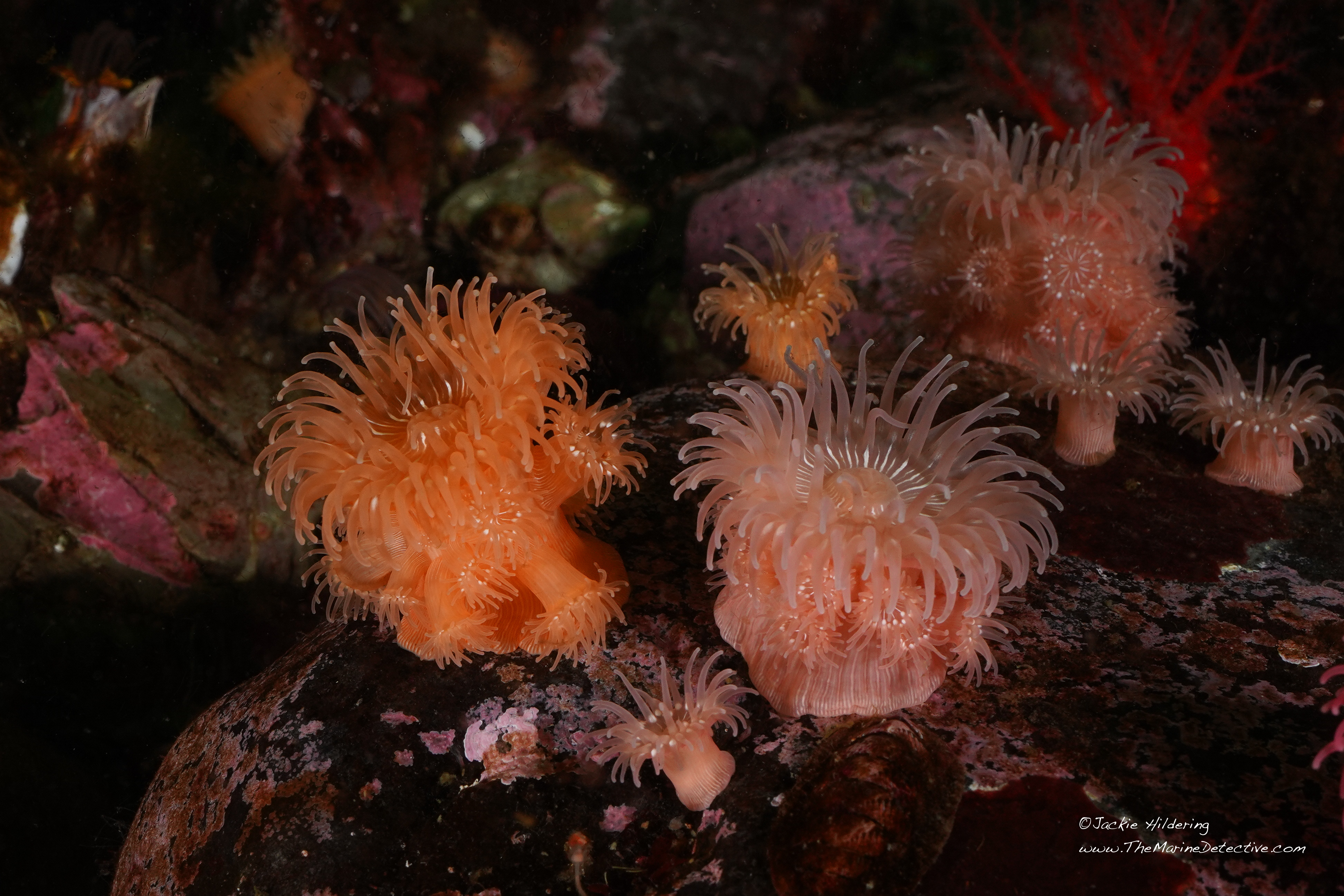
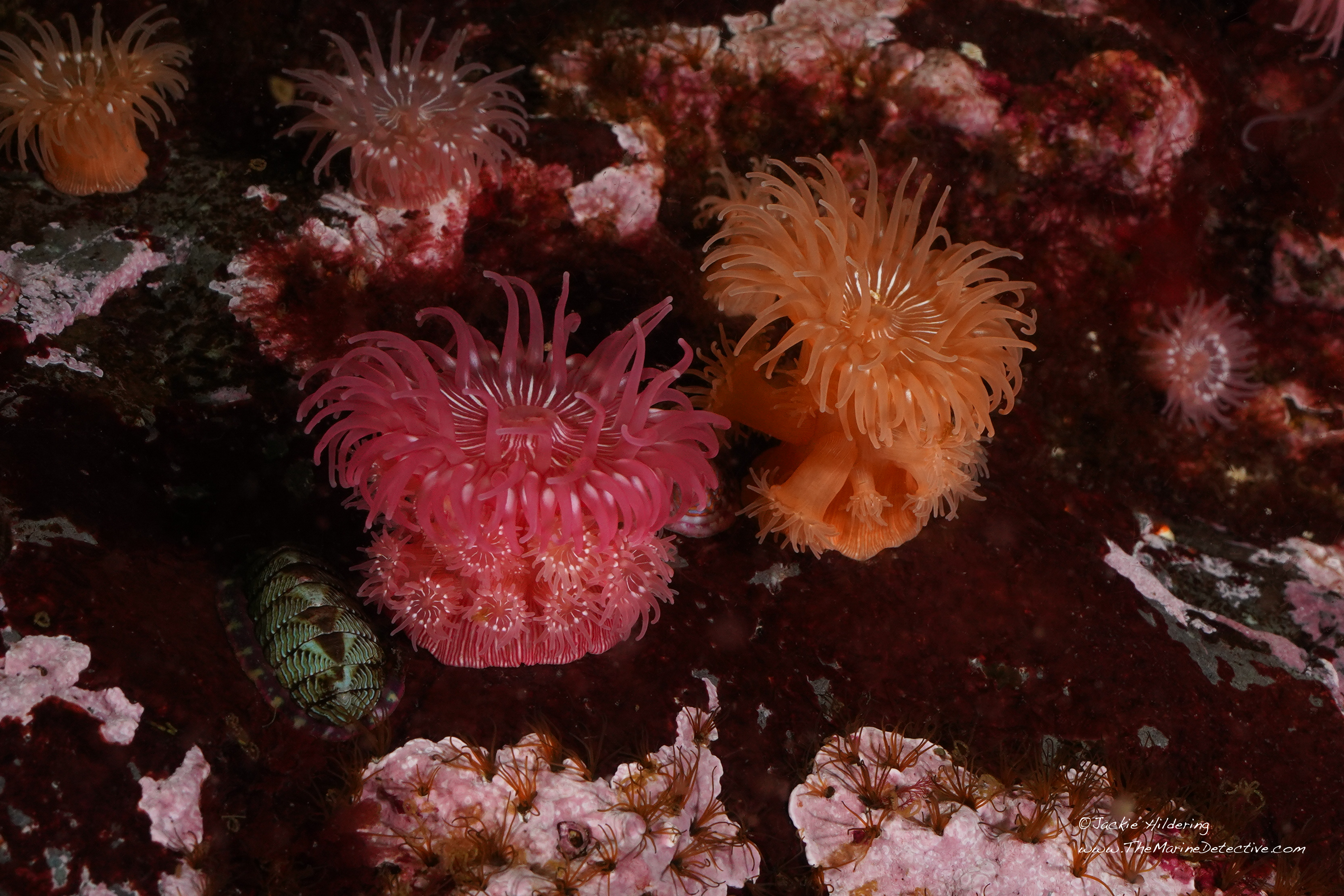
This is a Brooding Anemone (Epiactis lisbethae to 8 cm across).
She may not have a backbone but she’s a Super Mom!
As many as 300 young can be clustered around her in up to 5 rows, benefitting from the protective canopy of her tentacles which contain stinging cells (nematocysts). The offspring remain here until big enough to stand a good chance of surviving on their own. They then crawl toward independence, claiming their own piece of the ocean bottom.
I am awestruck by this species’ beauty and reproductive strategy. It is also a reminder of how little we know about marine species that the Brooding Anemone was not recognized as a distinct species until fairly recently (1986), and it still so often gets confused with the Proliferating Anemone (Epiactis prolifera).
I share my marine “detectiving” about this species with you to provide a further example of how extraordinary our marine neighbours are and maybe, thereby, help inspire greater conservation efforts.
But yes, the timing of the blog is no accident. It may be that reflection upon an anemone Super Mom stimulates thought about our human mothers – just in time for Mother’s Day.
So here goes . . . bear with me as I build to clarifying the reproduction of our featured species.
Anemones have many reproductive strategies.
For many species, reproduction can be asexual as well as sexual with strategies like budding off offspring; splitting into two; or pedal laceration where a torn piece of the bottom of the anemone can grow into another anemone!
Some species are hermaphrodites with highly diverse ways by which offspring develop into adults.
In species that have separate sexes, many are broadcast spawners where Mom and Dad release their eggs and sperm into the ocean around them. Fertilization and development thereby happens in the water column.
Then, for only some 20 species of the world’s more than 800 kinds of anemone, there are those in which the female captures the males’ sex cells as they drift by and draws them into her digestive cavity to fertilize her eggs. She “broods’ her young.
Some such anemone species are internal brooders. The young develop inside Mom until they hatch and are expelled into the water column as planktonic larvae.
But then there’s Super Mom – the Brooding Anemone (Epiactis lisbethae). She’s an external brooder.
After she has fertilized the eggs inside her digestive cavity with the sperm she has captured, the young develop inside her until they hatch into planktonic larvae. THEN, they swim out of her mouth, settle on her body under the tentacles and grow into little anemones that feed themselves.
When the offspring are big enough to stand a good chance of survival without the protection of Mom’s tentacles, they shuffle away to independence, leaving space for next season’s young.
The brooding anemone’s young are all of the same generation and are therefore all about the same size.
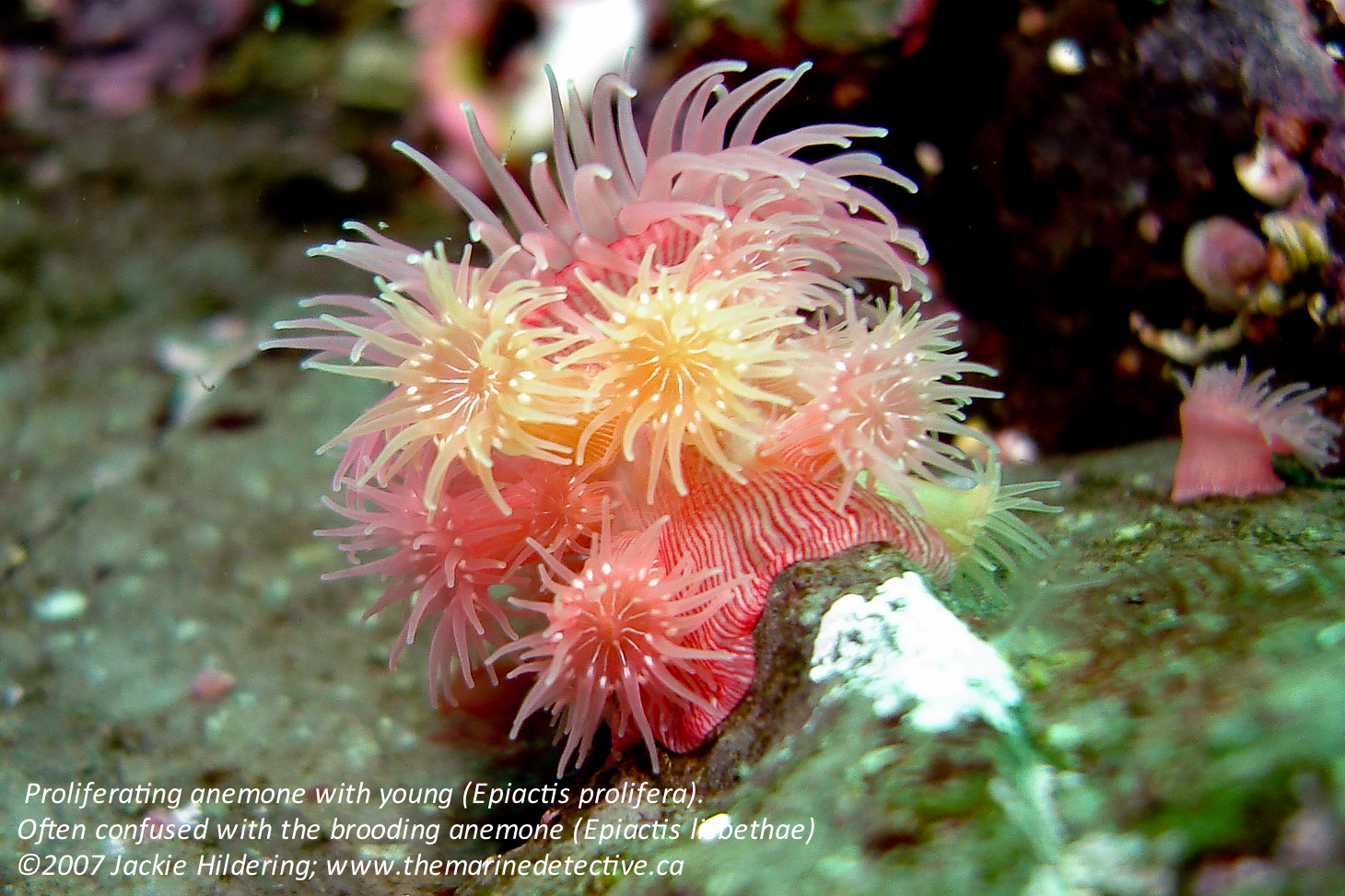
However, there is a second externally brooding anemone species in the eastern North Pacific where you most often see young of different sizes huddled under Mom’s tentacles. This species – the Proliferating Anemone (Epiactis prolifera) is the one that very, very frequently gets confused with the Brooding Anemone.
A
Proliferating Anemone with young (Epiactis prolifera). Often confused with the Brooding Anemone (Epiactis lisbethae).
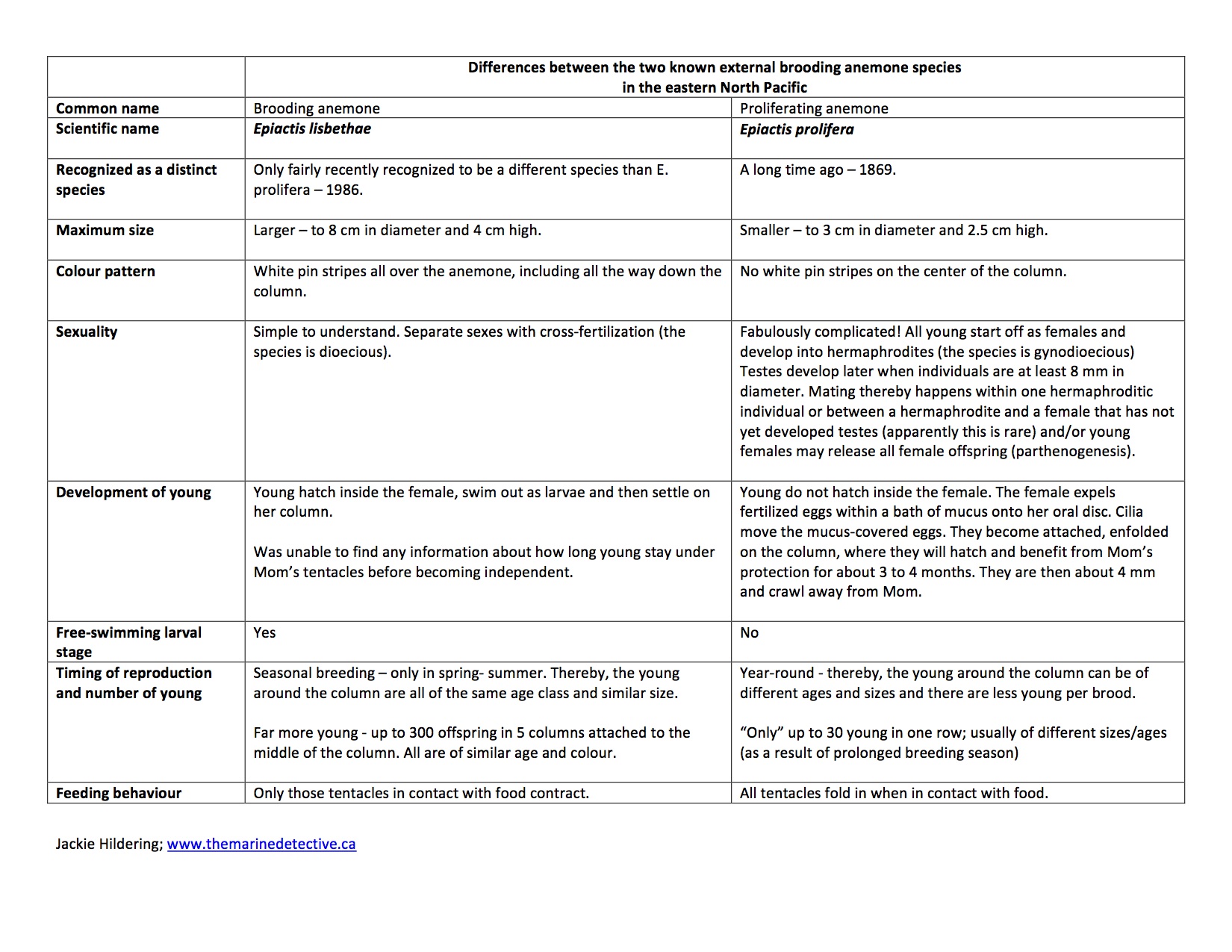
I have strived to clarify the many differences between these two externally brooding anemone species in the table below but to summarize: the Proliferating Anemone is smaller and does not have striping all the way down the column; adults are hermaphrodites; breeding happens year round; there are far fewer young clustered under mom’s tentacles; and they start off there as fertilized eggs, not as free-swimming larva.
The main similarity between these two species is and yes, I am going to use a tongue twister here since I believe it is inevitable when discussing anemones: with anemone mothers like these, baby anemones are protected from their anemone enemies!
Now off you go, share some ocean love with a Super Mom!
There are so many human females out there worthy of awe. Where, were we to consider how many young they have shielded and helped to independence, the number might well be 300 or more!
Click to enlarge. Table summarizing the differences between Brooding and Proliferating Anemones.
Next 3 photos show Proliferating Anemone babies under their mother’s tentacles, some shuffling off after 3 to 4 months there. Epiactis prolifera – often confused with the Brooding Anemone.
Does this tutu make my bottom look big?! At God’s Pocket Dive Resort on my 50th birthday.
[Warning, this is not a scientific posting but one of those occasional personal musings aimed at self-expression and, hopefully, making you smile.]
Go ahead – mock me!
I now often wear a tutu when I go diving.
It’s a flamboyant, neon green tutu.
Hum, maybe “flamboyant” as an adjective for “tutu” is unnecessary – but I digress.
I first wore my neon green tutu over my dry suit while diving on my 50th birthday.
It delights me that my birthday happens to coincide with Earth Day but oops – again I digress.
Wearing the tutu was to celebrate all that life has brought me, especially how cold water diving in this beautiful, beautiful place has shaped my life.
It clearly also makes a statement about my believing you can never be too green – or too flamboyant!
Of course, I knew I would also be rewarded with looks of disbelief and hilarity from my fellow divers especially when I asked, “Does this tutu make my bottom look big?”
Sincerely, it also has proven to have value for safety as it makes me much easier to see in a dark underwater world of black neoprene clad divers.
Underwater poser! Photo by Diane Reid.
But more than that, I wear a tutu because, for all of us, life is sometimes hard.
What the wisdom gained from these 50 years has taught me is that through it all – the sinking to the depths, the surfacing for air, the need for buddies, the loss of buddies, the weight of it all, the being adrift – it is more important than anything else to listen to your inner 8-year-old.
I can hear her now. She’s loud – wanting to know when we are next going diving, loving the wonder and sense of discovery that submerging brings.
She reminds me always of how my actions impact life around me and she voraciously loves to learn.
She’s bossy and wants, as soon as possible, to share what she has learned about living things with others, hoping they’ll care as much as she does.
She knows the importance of frivolity and lightness and to being ever true to what you feel.
She loves wearing tutus and hopes to make people laugh by modelling the joy of being green.
Life is hard? Wear a tutu! Great thanks to Diane Reid for the photo! Dive buddy Natasha Dickinson attempting to hide in the background.















 Sources:


 The Marine Detective