Join me in the cold, dark, life-sustaining NE Pacific Ocean to discover the great beauty, mystery and fragility hidden there.
Gold Dirona and Alabaster Nudibranch Egg Masses

Updated with photos: 2025-12-18
An egg hunt mystery FINALLY came to an end for me, coincidentally, just before Easter when many of you were involved in egg hunts too.

I dare say however that my hunt involved vastly more beautiful eggs; that the hunt was much more challenging and –  ultimately, much more rewarding!

One of my very, very favourite things to do, satisfying my “The Marine Detective” nature, is to solve the ultimate “whodunit” and match sea slug species with their egg masses / ribbons.

Every sea slug species’ egg mass is distinct, comprising a fascinating diversity of intoxicatingly beautiful shapes and patterns.

It delights me (for reasons I can’t fully explain) that for many sea slugs in the northeast Pacific Ocean, I am able to see an egg mass and immediately know which species laid it.

There are big clues because sea slugs most often lay eggs on their food. So if I know their prey preference I can narrow down which  species laid the eggs.

Easiest of course is to have have the good fortune to find a sea slug in the act of laying their eggs.

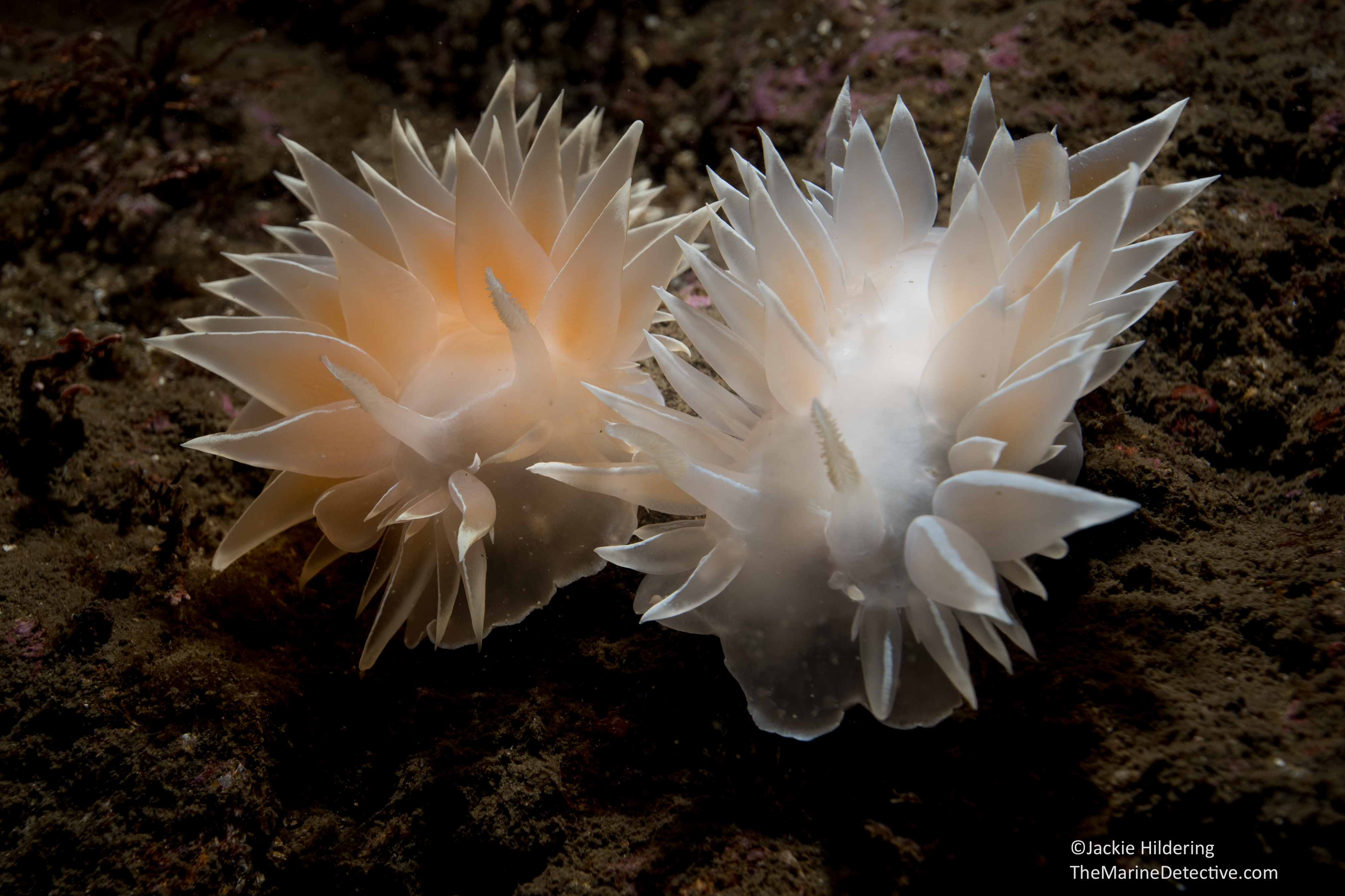
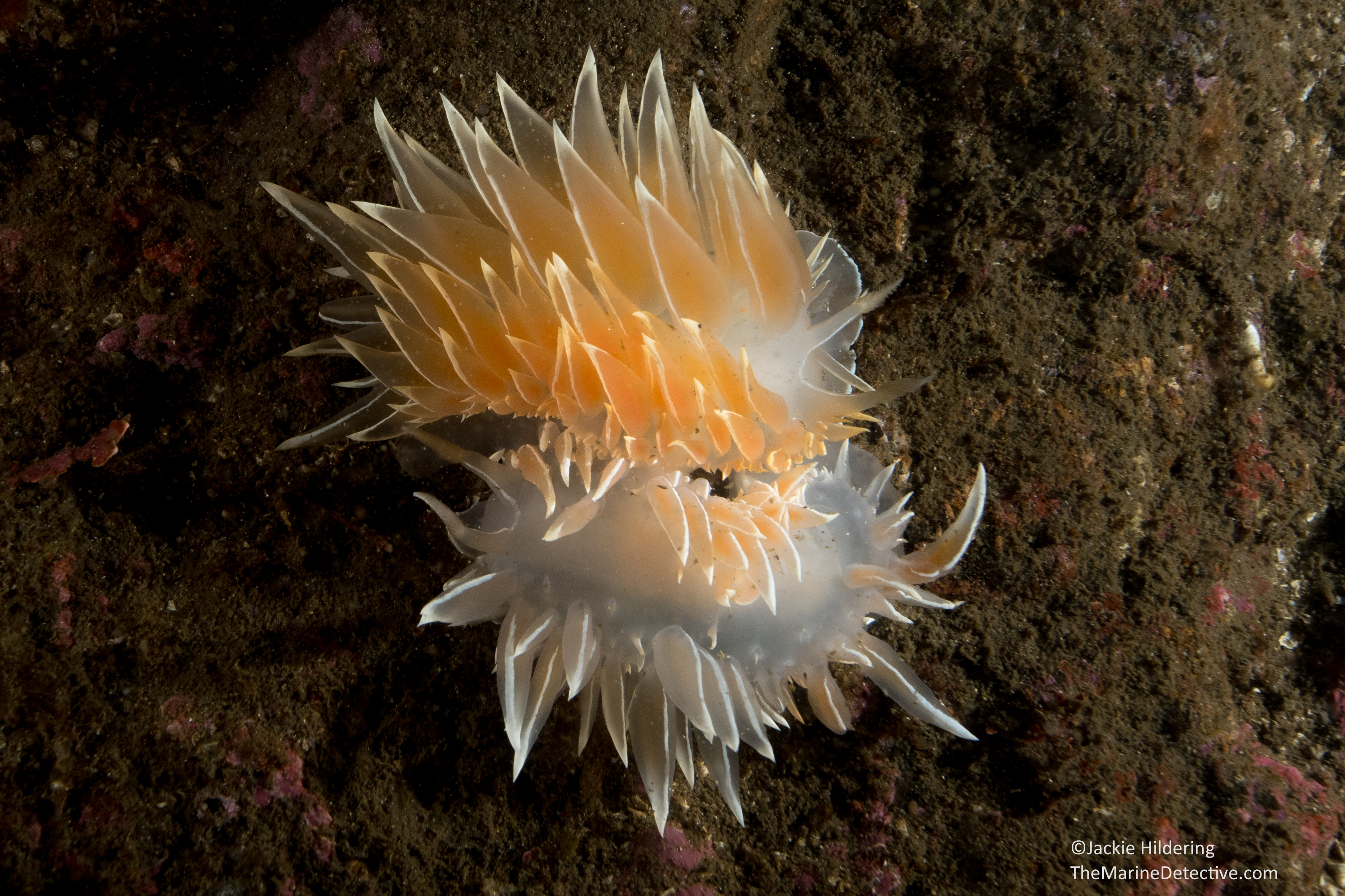
But for YEARS, I have been unable to differentiate the egg masses of two of the most beautiful sea slug species in these waters – the Gold Dirona (Dirona pellucida to 12 cm) and the Alabaster Nudibranch (Dirona albolineata to 18 cm and also referenced as the “White-Lined Dirona” or “Frosted Nudibranch”).

You’ll note that they are very closely related (same genus) and it is thereby not surprising that their egg masses would look very similar. Both also often lay their eggs on the same species of Agarum kelp. In all these years, while I have often found both species mating, I have never found either species laying their eggs.

But then, this week . . . just when I was noting the abundance of both species, how many egg masses there were and wishing, WISHING, I could find just one of them laying eggs – my dear dive buddy Jacqui Engel waved me over and pointed out a Gold Dirona laying eggs.

Gold dirona laying eggs.

I was so jubilant, I screamed underwater. Yes, I am The Marine Detective for a reason, such things really do delight me to this degree.

Finally!  Mystery solved, I would be able to differentiate the egg masses of the two species.

But then, Nature was even kinder to me.

On the very same day on the very same dive, after so many years, I also stumbled across an Alabaster Nudibranch laying eggs!

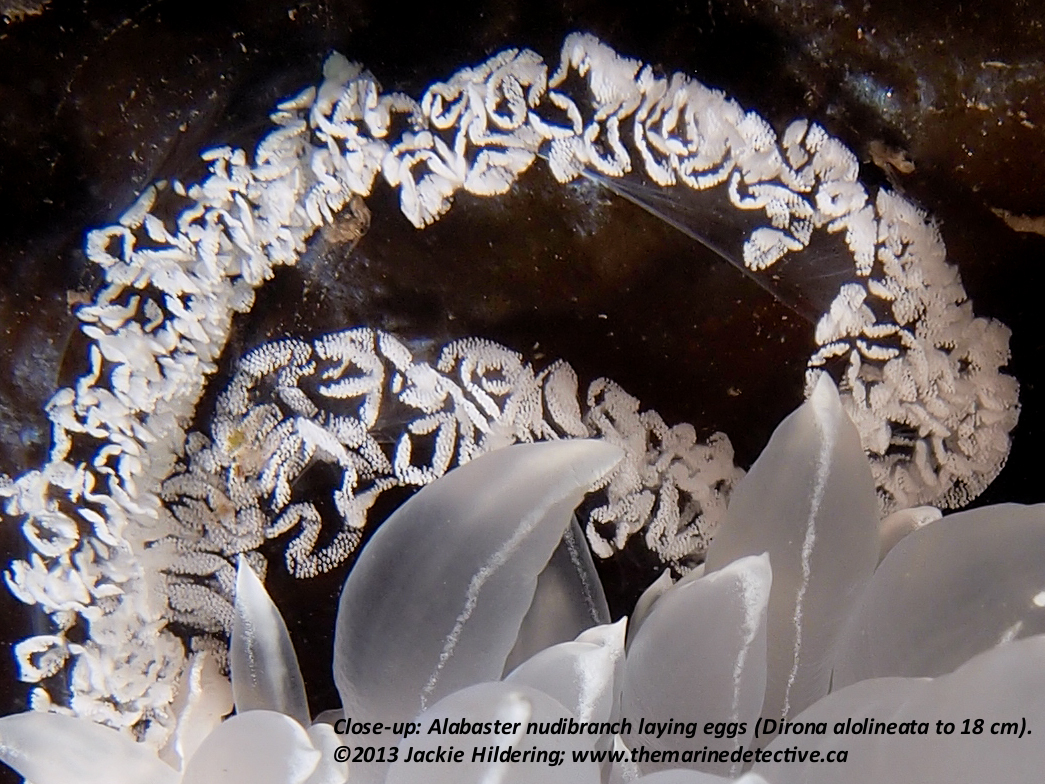
Alabaster nudibranch laying eggs.

Disbelief! Joy! Manic photo-taking!

I think you may marvel at how very similar the masses are but the difference, at least to me is clear.

The “pieces” of the Gold Dirona’s egg mass are more compact and more like rice kernels.

Gold dirona laying eggs.

The segments of the Alabaster Nudibranch’s egg masses are more scallop-edged and diffuse.

Please know that these differences would not be as clear if the eggs were older.

It’s estimated that there are ~350,000 eggs in one Alabaster Nudibranch egg mass. Source: WallaWallaEd. I do not know if this is the number of egg capsules (the dots you see), or if it includes the number of eggs in each egg capsule.

Sea slugs are reciprocal hermaphrodites which means that both become inseminated and lay eggs. One individual lays more than one egg mass as well. So many eggs are needed to ensure species survival when your young hatch out to become part of the planktonic soup of the Ocean.

Alabaster nudibranch laying eggs.

If you have read to this point – thank you!

Likely we are kindred in our love of marine biodiversity and the beauty that is sea slugs.

For as much as I love chocolate Easter eggs, I would forego them for the rest of my existence if it would allow my appetite for marine mysteries to be further satisfied!


Gold Dironas mating. ©Jackie Hildering.
Alabaster Nudibranchs mating ©Jackie Hildering.
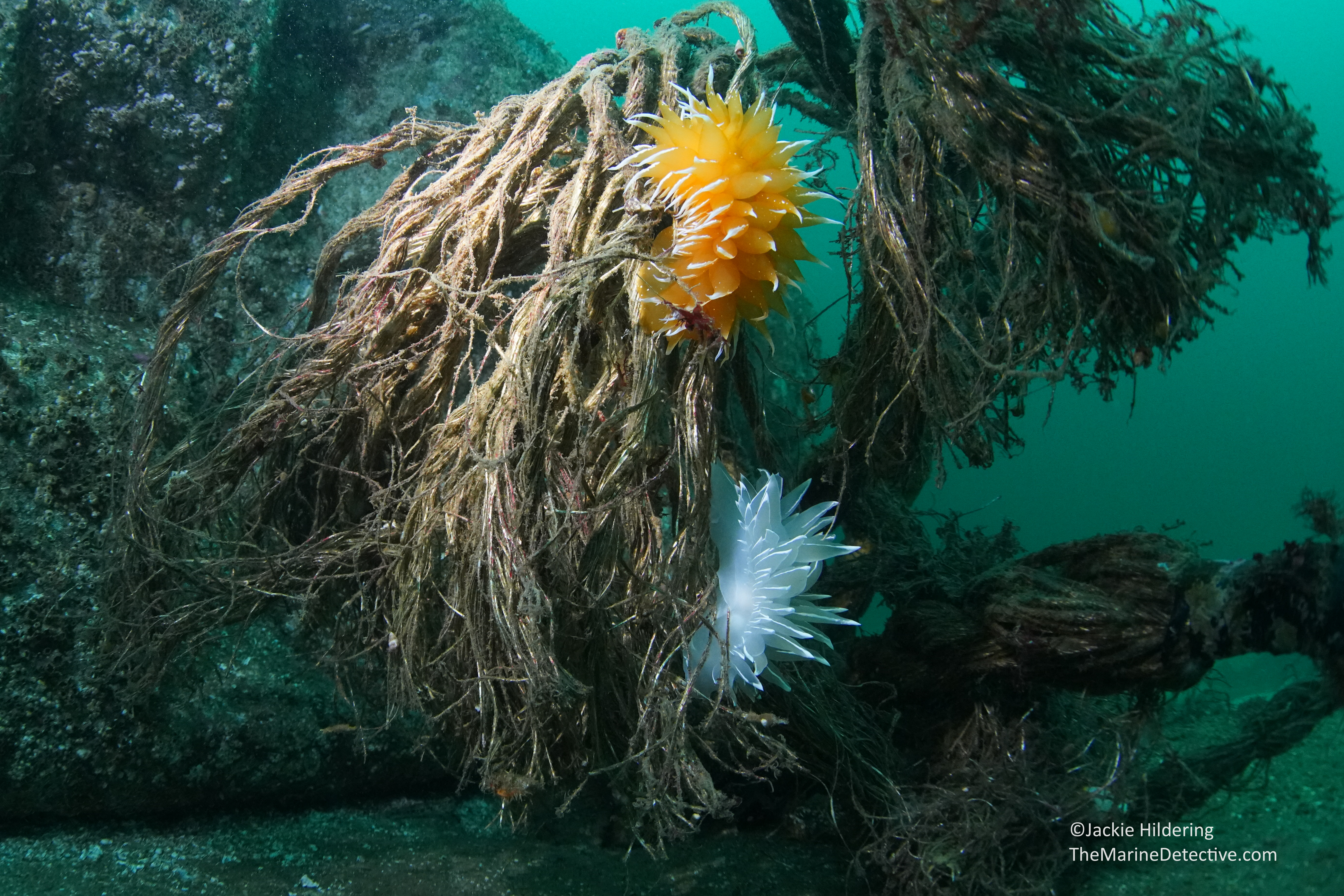
Gold Dirona with Alabaster Nudibranch below on a frayed rope. ©Jackie Hildering.
Alabaster Nudibranch left and Gold Dirona right. But see photos below. Alabaster Nudibranchs are not always fully white and this can lead to ID confusion. ©Jackie Hildering.

Colour variation in Alabaster Nudibranchs

Alabaster Nudibranch – colour varies to include orange, yellow, and pink hues. ©Jackie Hildering.
Also an Alabaster Nudibranch. ©Jackie Hildering.
This photo and the next. Alabaster Nudibranchs moving into mating position right-side to right-side. ©Jackie Hildering.

Mistaken identity?
Gold Dirona above and Alabaster Nudibranch below. Discussion about this interaction on the Sea Slug Forum at this link.

Oh Deer! A rare meal for mammal-hunting killer whales?

This is not a tall tale. If anything it is a short tail as in – deer tail.

First an orientation on Killer Whale (Orcinus orca) diet and how prey specialization has shaped distinct cultures over great expanses of time.

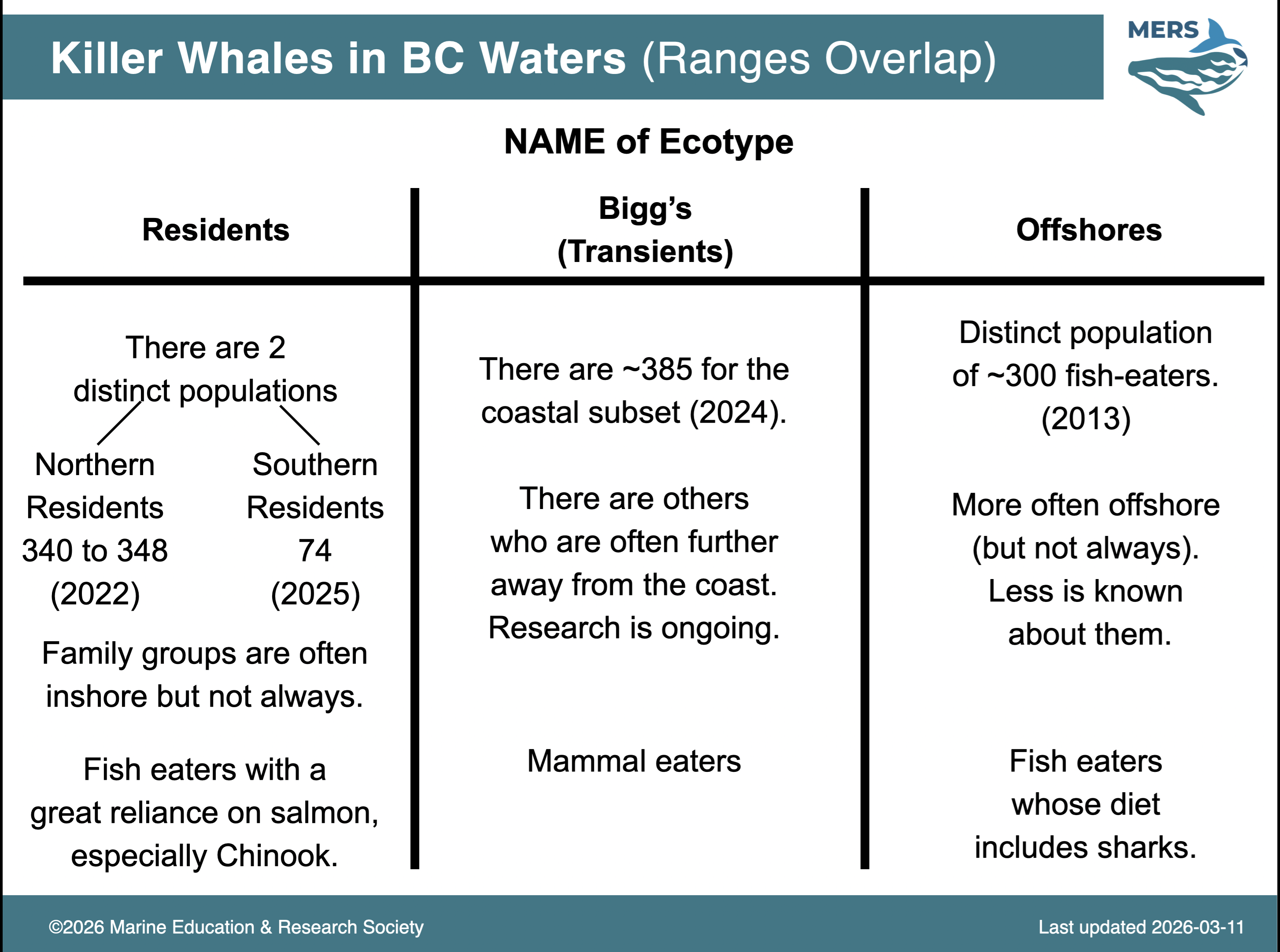
There are different “ecotypes” of Killer Whales that do not mate with one another because what works, for example, to chase salmon does not work to stalk seals. They have distinct cultures and distinct languages. [Click here for detail on the different ecotypes of Killer Whales off British Columbia, Canada.]

The fish-eating Killer Whale ecotypes in the NE Pacific Ocean (Northern and Southern “Residents” and “Offshores”) can afford to be extremely vocal because fish species often have poor hearing.

However, the mammal-hunting ecotype (“Bigg’s Killer Whales“, previously know as “Transients”) must generally live a life of stealth and unpredictability in order to successfully hunt their prey. To be vocal or be really surface active, when they are hungry, would have a high cost. It would be like ringing a dinner bell announcing “Hello, we’re here to eat you!”

In fact, recent research supports that the NE Pacific mammal-hunters diverged from the other ecotypes of Killer Whales some 700,000 years ago and puts forward that they should be recognized as a distinct species (Morin et al 2010).

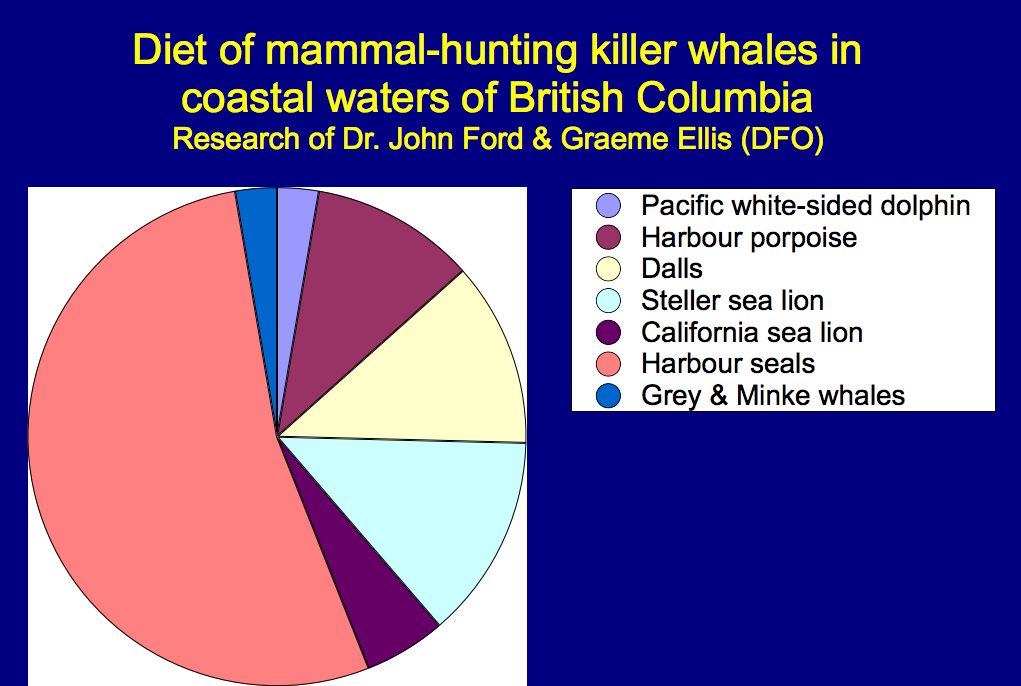
Research of Dr. John Ford and Graeme Ellis on the diet of mammal-hunting killer whales in the Northeast Pacific Ocean. Source: Presentation "The Complicated Predator" by Dr. Lance Barrett-Lennard; October 2005.

Research of Dr. John Ford & Graeme Ellis on the diet of mammal-hunting Killer Whales in the Northeast Pacific Ocean. Source: Presentation “The Complicated Predator” ; Dr. Lance Barrett-Lennard; October 2005.

Pacific Harbour Seals are predictable in where they haul out and they do not have defences like speed and sharp teeth. Therefore, it is not surprising that off the coast of British Columbia, Pacific Harbour Seals are documented to be the prey item of choice for the mammal-hunting Killer Whales (see graph above).

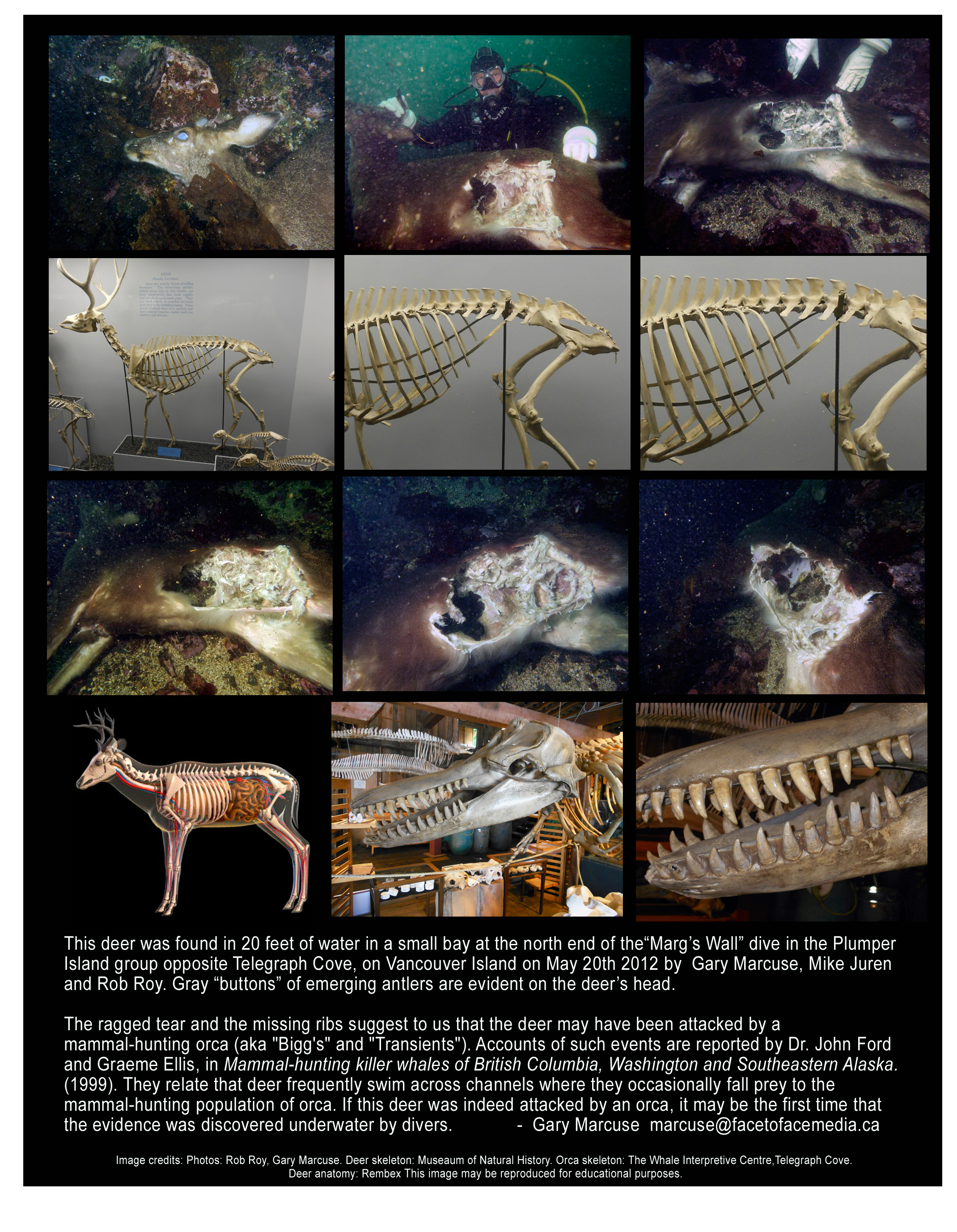
Far less commonly, these Killer Whales have also been documented to feed on River Otters, Northern Elephant Seals, Sea Otters and – VERY, VERY occasionally – a terrestrial mammal like deer.

Please see below for images of a deer carcass found underwater by fellow divers Gary Marcuse, Rob Roy and Mike Juren in May of 2012. There is no way of  knowing with certainty if that this deer was attacked by Killer Whales but it is plausible. Deer swim from island to island and are even more defenceless than a seal if they have the bad luck that stealthy mammal-eating Killer Whales find them.

Deer-Underwater

Killer Whales are big dolphins – smart and social and even though they tend to be very conservative, doing what has worked for their kind for 100,000s of years, they also play – learning from interacting with their environment. I have reflected on this previously in my blog where I observed them mouthing and hitting diving birds. (Read “Fins vs. Feathers” by clicking here).

Deer could never make up a significant part of the diet of Bigg’s Killer Whales but they would learn from such an attack. If this deer did indeed meet its end in the mouth of a mammal-hunting Killer Whale, I would not be surprised if it was a juvenile mammal-hunting Killer Whale who undertook the “interaction”.

To share the expertise of Killer Whale researchers supreme, Dr. John Ford ad Graeme Ellis, from their 1999 publication “Transients -Mammal-Hunting Killer Whales” (and note that an attack on a moose has only ever been documented ONCE):  

“Although the primary prey of transient [now Bigg’s] killer whales are marine mammals, the whales’ interest extends to other warm-blooded animals, including marine birds .  . . and even terrestrial mammals. Our first record of land mammal predation dates from June 1961, when Canadian fishery officers observed killer whales feeding on a deer carcass in Jackson Pass on the central coast of British Columbia. Deer frequently swim from island to island along the inside passages, and it is probable that this one fell victim to a foraging group of transients. More recently, off the east coast of Vancouver Island, several killer whales were observed circling a small rock on which two deer had taken refuge. On another occasion, a lighthouse keeper assisted an exhausted deer out of the water as it was being pursued by killer whales. In these case, there has been no photographic confirmation that transients were involved, but it seems almost certainly the case.

Other land mammals are also of interest . .  on occasion . . . a killer whale was observed to surge part way onto shore in an apparent attempt to attack a dog that was barking loudly at the passing group.  . . .

One of the most surprising attacks on a terrestrial mammal took place in 1993 in Icy Strait, south-eastern Alaska. Two fishermen observed a group of three or four killer whales attack and kill one of a pair of moose that were swimming across the channel. The other moose managed to escape the attack but later became entangled in a kelp bed and drowned.”

So am I worried, as a very avid and very mammalian scuba diver, that I have the same chances of being attacked as a deer swimming between islands? Absolutely not. There has never been a case of Killer Whales in the wild killing a human.

To again relate John Ford and Graeme Ellis’ expertise:

“Divers in this region typically wear thick suits made of neoprene rubber, which contains acoustically reflective nitrogen bubbles. Thus, if a transient [Bigg’s killer whale] tries to inspect a diver with echolocation, its unlikely to get a typical mammalian echo. Although scuba divers may not appear appetizing to [them], this may not be the case for swimmers, so it is advisable to leave the water should transients [Bigg’s] appear in the vicinity.” 

I also love the perspective of a fellow diver and friend, Peter Mieras, who states that Killer Whales “are too smart to go after junk food in wrappers.”

Oh deer!


Sources:

Wolf-Eel – No Ugly Fish!

Don’t say it, please don’t say it. This is not an ugly fish. It hurts when people say this about Wolf-Eels. Such is the way when there is misunderstanding and disrespect for something you love. There is no ugly in Nature – only perfection. If the features of an animal appear foreign to you, it is because it fulfils a role in Nature that is truly awe-inspiring; possibly even beyond your imaginings.

Mr. and Mrs. Wolf Eel on February 16, 2013 near Port Hardy. © 2013 Jackie Hildering

Mr. and Mrs. Wolf-Eel near Port Hardy ©Jackie Hildering.

I hope to make this point by sharing with you why the Wolf-Eel  is “designed” as it is and how very wrong many of us are in our perceptions about this species. The Wolf-Eel (Anarrhichthys ocellatus), which can be as long as 2.4 m, is not an eel. Wolf-Eels belong in the Wolf Fish family (Anarhichadidae). They are desperately misunderstood. Wolf-Eels are not dangerous nor “mean”. The opposite is true. They are reclusive, anything but ferocious, quite sedentary and slow moving.

Mature male wolf-eel - about 2.2 m long. © 2008 Jackie Hildering

Mature male Wolf-Eel, about 2 m long. Can be 2.4 m ©Jackie Hildering.

Yes, they have large, fleshy, ossified heads and the species has sharp teeth but this is so they can do what so few marine species can – they can feed on spiny sea urchins, snapping them effortlessly into pieces without suffering a single puncture. They also feed on other hard-shelled animals like shellfish and crabs. Even the roofs of Wolf-Eels’ mouths are impenetrable with ossified, tooth-like projections (see photo below).

Each wolf-eel has distinct spots around their eyes which helps recognize them as individuals. © 2012 Jackie Hildering

Mature males are bigger and have fleshier heads. Each Wolf-Eel has distinct spots around their eyes which helps recognize them as individuals ©Jackie Hildering.

The upper jaw of a wolf-eel. Impenetrable to even urchin spines! © 2005 Jackie Hildering

The upper jaw of a Wolf-Eel. Impenetrable to even urchin spines! ©Jackie Hildering.

To my knowledge there has never been an attack on a diver UNLESS, and here comes the predictable thing, we choose to habituate them. Wolf-Eels spend a great deal of time on the ocean bottom in dens where, as divers, we have the enormous privilege of  “visiting” the same spot and seeing the same individuals for years. It is not just their address that makes them recognizable as individuals. Each Wolf-Eel has a unique pattern of black spots near their eyes.

Grandpa Wolf-Eel on February 16, 2013 near Port Hardy. © 2013 Jackie Hildering

Grandpa Wolf Eel near Port Hardy ©Jackie Hildering.

Some divers choose to feed them, leading to the Wolf-Eels associating us with food and that’s where accidents can happen and where the wild behaviour that lets animals survive, becomes compromised. It also makes them tragically easy targets for any spear diver wanting to poach them. There is no legal fishery for this species but there is a demand for them in the Asian market which is why there are also attempts to farm Wolf-Eels i.e. aquaculture. Not surprisingly, Wolf-Eels might also be defensive when accidentally caught by anglers. I found one account from 1959 where a commercial fisherman was bitten and “The teeth penetrated the hip-waders and broke the skin on both sides of the ankle.”

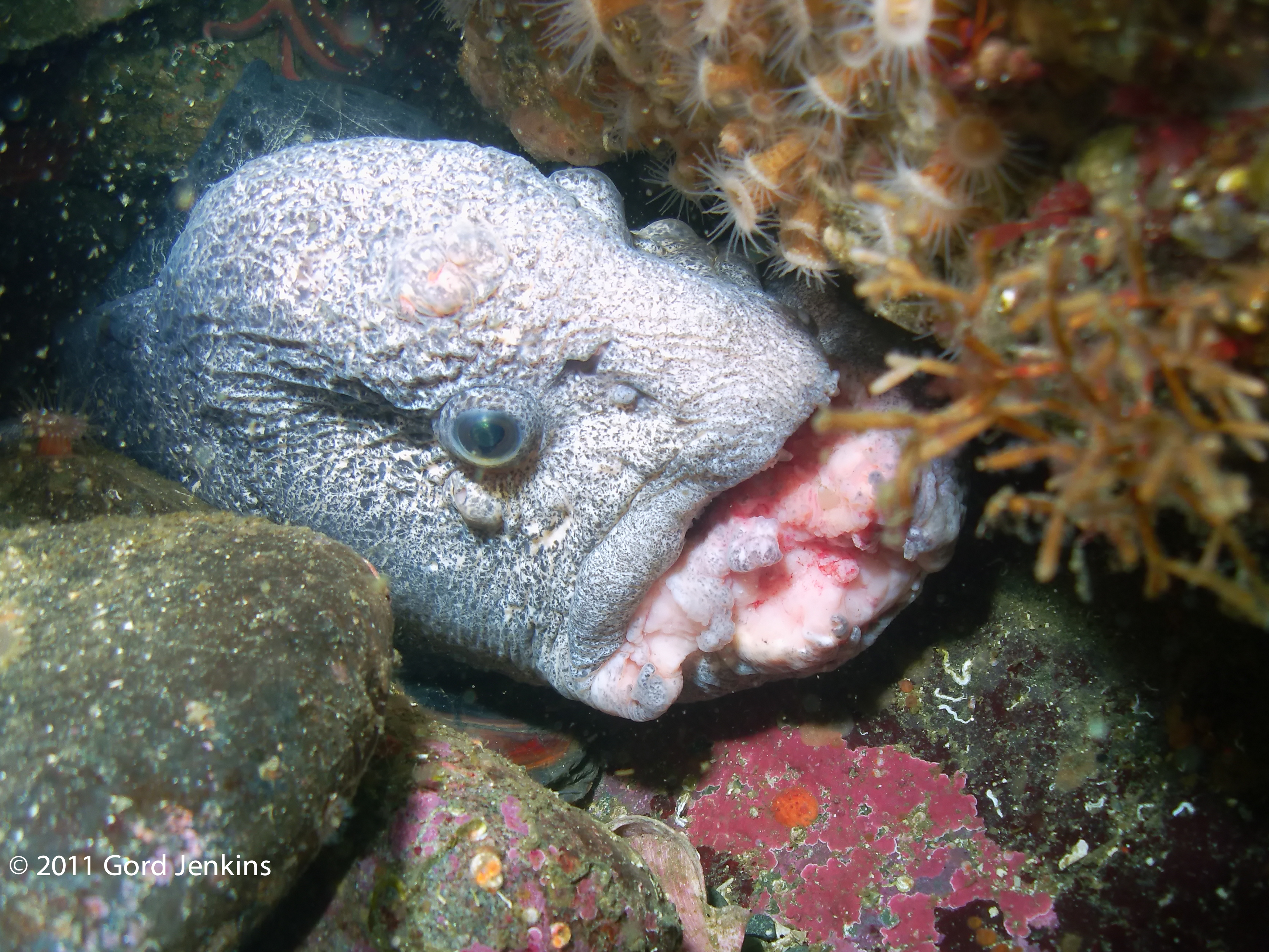
Mature male bearing the scars of battle. © 2011 Gord Jenkins.

Mature male bearing the scars of battle ©2011 Gord Jenkins.

The mature males do carry battle wounds supporting that they don’t just hang out in dens waiting for a snack to come by, but rather that they will occasionally duke it out with other male Wolf-Eels.It was long thought that Wolf-Eels always mate for life but, this is not always the case. The males do compete for females who will sometimes opt to swap dens and go live with the competitor. Sound like any other species you know? Wonder if it happens at mid-life? 😉

Wolf-Eels have long-lasting pair bonds, coming together when they are around 4-years-old and having their first clutch when they are around 7. In aquariums, their life expectancy is known to be at least 28 years. Both male and female juveniles are brownish orange and look even more eel-like, lacking the big head of the adults. As adults, the females are smaller and a darker brownish grey (both remarkably camouflaged for when they are in their rocky dens).

They do also sometimes need to do battle for den space with a Giant Pacific Octopus.  This is likely another driver for the male’s having such fleshy heads – they are better able to survive the wounds inflicted by such battles.

Clearly, another unique feature about this species is their eel-like body. They are the only member of their family that have this body shape. The long tail serves in locomotion, powering them forward with big, slow, s-shaped waves while being stabilized with the long dorsal and pectoral fins (see video below). Having a long tail also allows them to den-up, curling up and around in narrow spaces between rocks and . . . wait for it . . . it lets them hold onto their eggs.

Mr and Mrs Wolf-Eel tending their egg mass © 2005 Jackie Hildering-

Mated pair tending their egg mass. Note how much darker and smaller the female is ©Jackie Hildering.

Female Wolf Eel guarding eggs. March 2016 @Jackie Hildering.

Female Wolf-Eel guarding eggs. ©Jackie Hildering.

Mating apparently most often occurs between October and December, with the female releasing eggs after the male prods against her swollen abdomen. He then wraps around her to fertilize the 7,000 to 10,000 white to yellow eggs that she will mould into a ball shape. This mass does not need to adhere to anything because the parents will take turns wrapping their tails around the mass, holding and turning it for good aeration until the +/- 3.5 cm young hatch some 13 to 16 weeks after fertilization.

Juvenile wolf eel. © 2010 Jackie Hildering-

Juvenile Wolf Eel ©Jackie Hildering.

The juveniles settle into the adult sedentary lifestyle between the ages of 6 months and 2 years (presumably dependent on food supply and den availability). One juvenile is even known to have travelled a minimum of 1,000 km; having been tagged in Port Hardy, BC and found back in Willapa Bay, Washington two years later. It was long thought that Wolf-Eels always mate for life but, this is not always the case. The males do compete for females who will sometimes opt to swap dens and go live with the competitor. Sound like any other species you know? Wonder if it happens at mid-life?

The Wolf-Eel is indeed akin to us in so many ways. It is a homebody that likes crunchy snacks and prefers that they come right by the front door; they are great parents and are docile unless fighting for home or partner. They invest in durable relationships and – they are only as strange looking as we terrestrial bipeds would appear to them.

And if all of that is not enough for you, see the photo below for the indisputable reasoning for by Wolf-Eels are NOT ugly fish!

Statler the Muppet is cute and loveable. Ergo - so are wolf-eels. Case closed!!

Statler the Muppet is cute and loveable. Ergo – so are Wolf-Eels. Case closed!!


Range: Sub-tidal to 226 m; Baja California (Mexico) to the Aleutian Islands (Alaska); west to Russia and south to the Sea of Japan.

Mr. and Mrs. Wolf Eel on February 16, 2013 near Port Hardy. © 2013 Jackie Hildering

Mated pair near Port Hardy ©Jackie Hildering.

Me and a mature male wolf eel.

Me and a mature male Wolf-Eel ©2012 Norris Colby.

Mature male wolf-eel. © 2007 Jackie Hildering

Mature male Wolf-Eel ©Jackie Hildering.

Mature male wolf-eel. © 2007 Jackie Hildering

Mature male Wolf-Eel ©Jackie Hildering

For these and more images of the Wolf-Eel, please see my gallery at this link. 

Remarkable video of a mature male Wolf-Eel eating a Giant Pacific Octopus by Andrew Eve.

Sources:

Every Breath You Take . . . .

XX

Er – sorry about that. Thanks to the blog title, you likely now have The Police’s stalker-ish lyrics playing annoyingly in your head.

Let me take the Sting out of that for you.

The only lines of the song that apply to this blog item are: “Every breath you take” and “Every move you make” because  . . . this blog is about marine algae.

giant kelp DSC06372

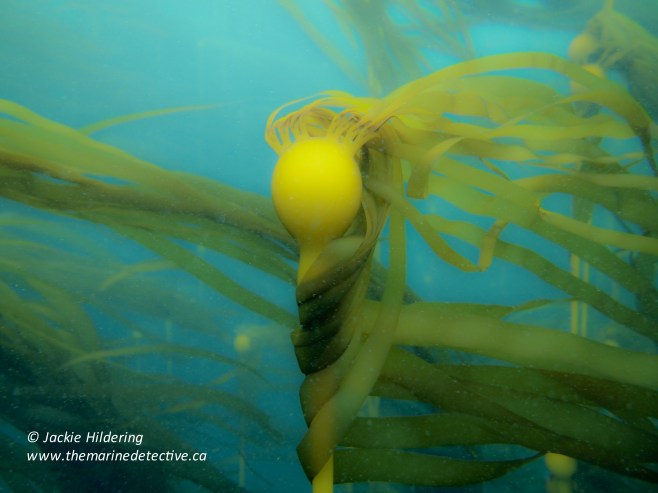
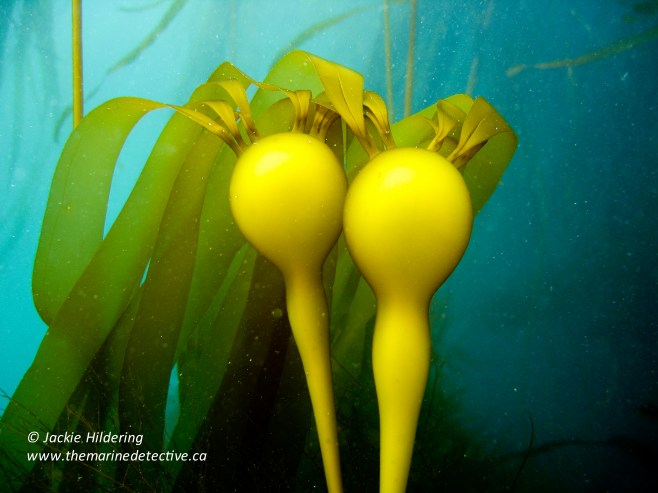
Fronds of kelp ©Jackie Hildering

Yes, that’s right – marine algae; the plant-like material of our oceans that ranges in size from the phytoplankton that give the NE Pacific Ocean its emerald colour and soupy richness, to the giant kelp species that provide habitat as ocean forests.

Breathe in.  A conservative 50% of the life-sustaining oxygen in that breath came from marine algae.

These organisms are also attempting to scrub away the devastating impacts of our fossil fuel addiction, photosynthesizing carbon dioxide into oxygen and serving as carbon sinks.

Bull Kelp Forest

One of the images that started it all. ©Jackie Hildering

Life on earth simply could not survive without marine algae and this conclusion is valid even without considering their role as the basis of ocean food webs (and recognize that an estimated 50% of all species on earth are marine).

Why then, while we seem to have some understanding of how dependent we are on the terrestrial plants living up here with us, do so many of us appear to be ignorant of the vital importance of the marine algae that inhabit 71% of the earth’s surface?

Bull kelp forest in current © Jackie Hildering

Bull kelp forest in current ©Jackie Hildering

Why are we seemingly not as driven to save marine algae from the impacts of pollution as we are to stop deforestation? Is it that damn illusion that land is separate from sea?

Or, somewhere deep within or briny beings, do we feel a connection?

I have experience that suggests this might be the case.

It’s an accidental discovery . . . I never really planned to become an underwater photographer. Having the great privilege of living in this beautiful place, initially I focused largely (quite literally) on photographing big marine mammals. I was using charismatic megafauna to try to inspire conservation.

 © Jackie Hildering

But then  . . . I was gifted an underwater camera and quite early on, I started photographing kelp.

For me, kelp is the entry point into the marine world into which I love to disappear and its beauty has long intoxicated me. In fact, I have a kelp forest tattooed on my lower left leg!

But never, ever could I have anticipated the way the images would be received by non-divers. They have proven to be vital tools in “taking” people underwater with me and I believe no whale image I have taken has done as much to engage, create wonder, appreciation and, hopefully, respect and positive action for what lies below the surface.

© 2012 Jackie Hildering-5121314

Sun streaming through bull kelp forest ©Jackie Hildering

Why are these images received as they are?  Many answers are possible from a pure aesthetic appreciation of kelp’s form and colour to the fact that kelp forests are literally at the surface, recognizable but submerged in mystery.

But, maybe, just maybe there’s a deep connection born out of knowing that we are dependent on marine algae for every breath we take.

And that – gives me hope.

For more kelp images, please click here for my gallery.

Note: Seaweeds, kelp and phytoplankton photosynthesize but are (most often) not classified as plants. They are algae. For an explanation of the classification, distinction and scientific debate, see:  “The Seaweed Site – “What are algae?” 

What’s At Stake – Images Speaking Louder Than Words

Three minutes of images speaking louder than words . . .

This short slide show of my images testifies to the astonishing marine biodiversity of Northern Vancouver Island and what is put at risk with projects like the Enbridge Northern Gateway Project which would bring super-tanker traffic of toxic bitumen and condensate to B.C.’s fragile coast, and to the waters on which we depend for oxygen, food, buffering of climate change gases, aesthetics and so much more.

I have submitted this slide show for inclusion on “Hope, the Whale”, a 25′ whale sculpture being brought to the Vancouver Enbridge public hearings (January 14 to 18, 2013) “to symbolize the expansive and growing community of people with a vision of an oil-free coast in BC. The sculpture is designed to be a welcoming, collaborative, visual, interactive and peaceful approach to supporting a healthy environment. The whale will amplify our a collective messages of hope and a vision for a healthy ocean, water, land, communities, green economy, cultures and people.” See this link to contribute your message.

For more information, see my testimony to the Joint Review Panel included in my blog item “Super Natural or Super Tanker?” at this link.

WILD New Year

For you – that we may live lives of greater depth in 2013 and beyond.

Happy New Year! 

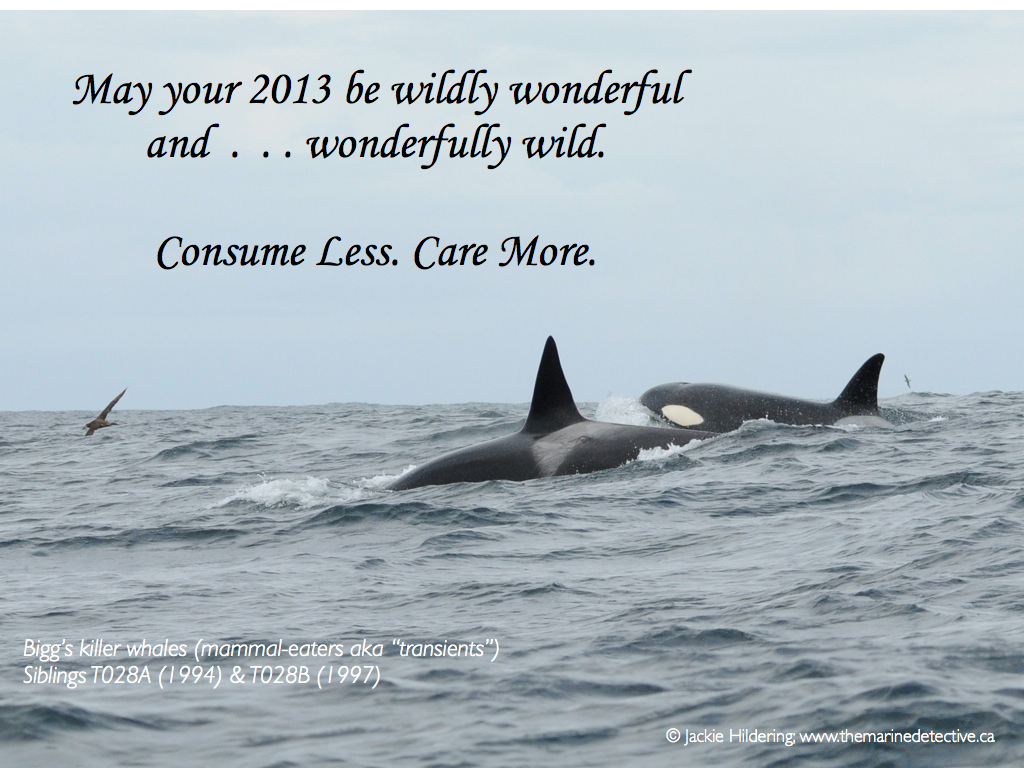
Siblings T028A (born 1994) and T028B (born 1997) - mammal-eating killer whales (known as "Bigg's killer whales / "transients").

Siblings T028A (born 1994) and T028B (born 1997) – mammal-eating killer whales (known as “Bigg’s killer whales / “transients”). Photo: Hildering

Mind-Blowing Crittercam Video – Humpback Calf Nursing Underwater and Watching Mother Group Bubble-Net

Update October 26, 2018. Additional Crittercam video of a calf nursing from CNRS/ Cétamada recorded on the breeding ground on the east coast of Madagascar at Ste Marie Island.


Update December 19, 2012: The National Geographic video I had posted below has been pulled from YouTube.
Explanation from D.Gold who posted it there:
“Note to The Marine Detective and readers: Sorry to say, I removed this video from my youtube account today. I received a request. National Geographic has plans for broadcasting the footage. A scientist and producer asked that I take the youtube down for now. The quality will be much better when you see it on their channel anyway. I think they picked up on this getting a fair amount of attention thru this website and the social media in the past week. The reason I posted the video is expressed perfectly by the Marine Detective’s blog post, “Mind-Blowing Crittercam Video – Humpback Calf Nursing Underwater and Watching Mother Group Bubble-Net”.  . . I feel much the same as you do  . . .. I wanted to share the education of this presentation on my channel, but alas, this particular youtube will not be available. Keep searching and hopefully Nat Geo will show “The most goose-bump inducing, mind-blowing, awe-inspiring, consciousness-raising” footage.: “

Screen grab from

Crittercam video screen grab showing humpback calf nursing underwater.  Screen grab from Birgit Buhleier’s presentation.

My original post December 9, 2012:

The most goose-bump inducing, mind-blowing, awe-inspiring, consciousness-raising video I have ever seen I viewed in October 2009 in Quebec at the 18th Biennial Conference on the Biology of Marine Mammals, and I have been waiting for it to appear on-line ever since.

Today, I found it and think it will have the same impact on you.

The quality of the video is not ideal as it is the result of someone filming the original footage but – it will do!

What you will see, starting at time-stamp 2:50 is the result of Dr.Fred Sharpe’s research team having, rather randomly, put a Crittercam (camera on a suction cup) on a humpback whale calf in Alaska.

Video screen grab of calf with Crittercam watching mother and 11 other adult humpbacks cooperative bubble-net feeding.

Crittercam video screen grab of calf watching his mother and 11 other adult humpbacks cooperative bubble-net feeding.

In 6 minutes of video, the 6 to 7 month-old calf “gifts” the world with the following:

  • Footage of him nursing underwater which reveals how synchronized this is, with mother tapping her calf with her tail seemingly to signal “and stop now”.  You will even see the calf burp and, with streams of milk streaming past the calf, you will gain an understanding of how rich and copious the milk must be to support the incredible growth rate of baleen babies.
  • Then, at timestamp 5:48, you’ll see what caused the large international crowd of marine mammal scientists to collectively gasp when Fred Sharp shared this with us in 2009. The calf settles down at the ocean bottom at around 150 ‘ (46 m) and watches specter-like shapes rise to the surface  . . . adult humpback whales, including mom, cooperative bubble-net feeding.

Only 6 minutes of video – such depth revealed.

The presentation that had been filmed was given by Birgit Buhleier, National Geographic’s naturalist and underwater video producer,  aboard the National Geographic vessel “Sea Lion” in SE Alaska in the summer of 2012.

Please if you find the footage somewhere else, let me know!  

Time stamp: 2:50 – Humpback calf nursing underwater; 5:48 calf watching mother group bubble net-feeding

Success! No Tidal Turbines in Whale Epicentre

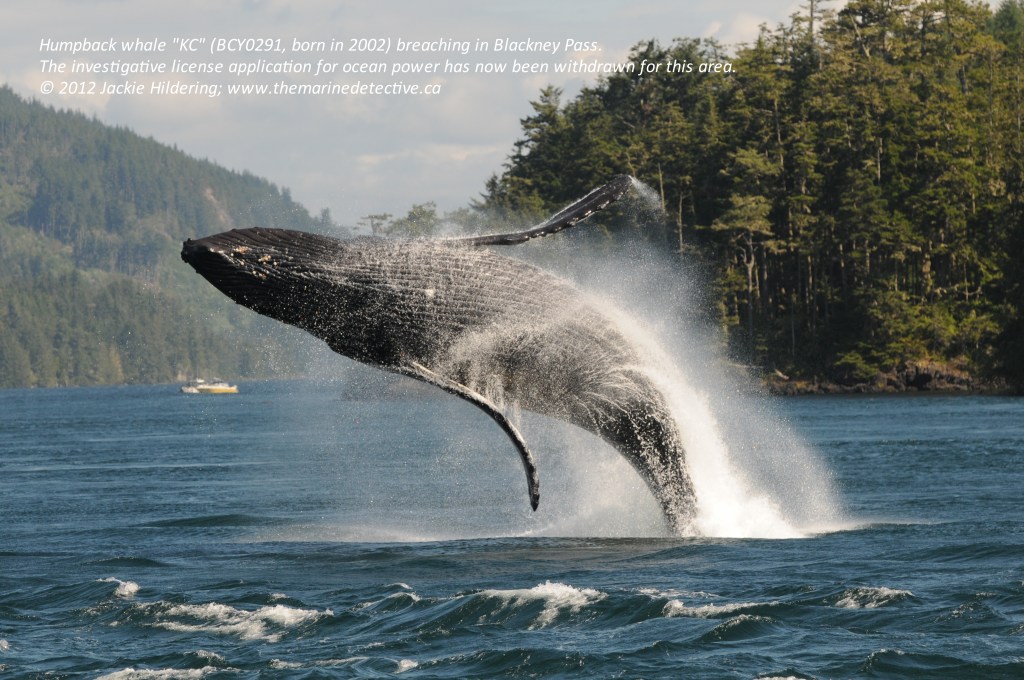
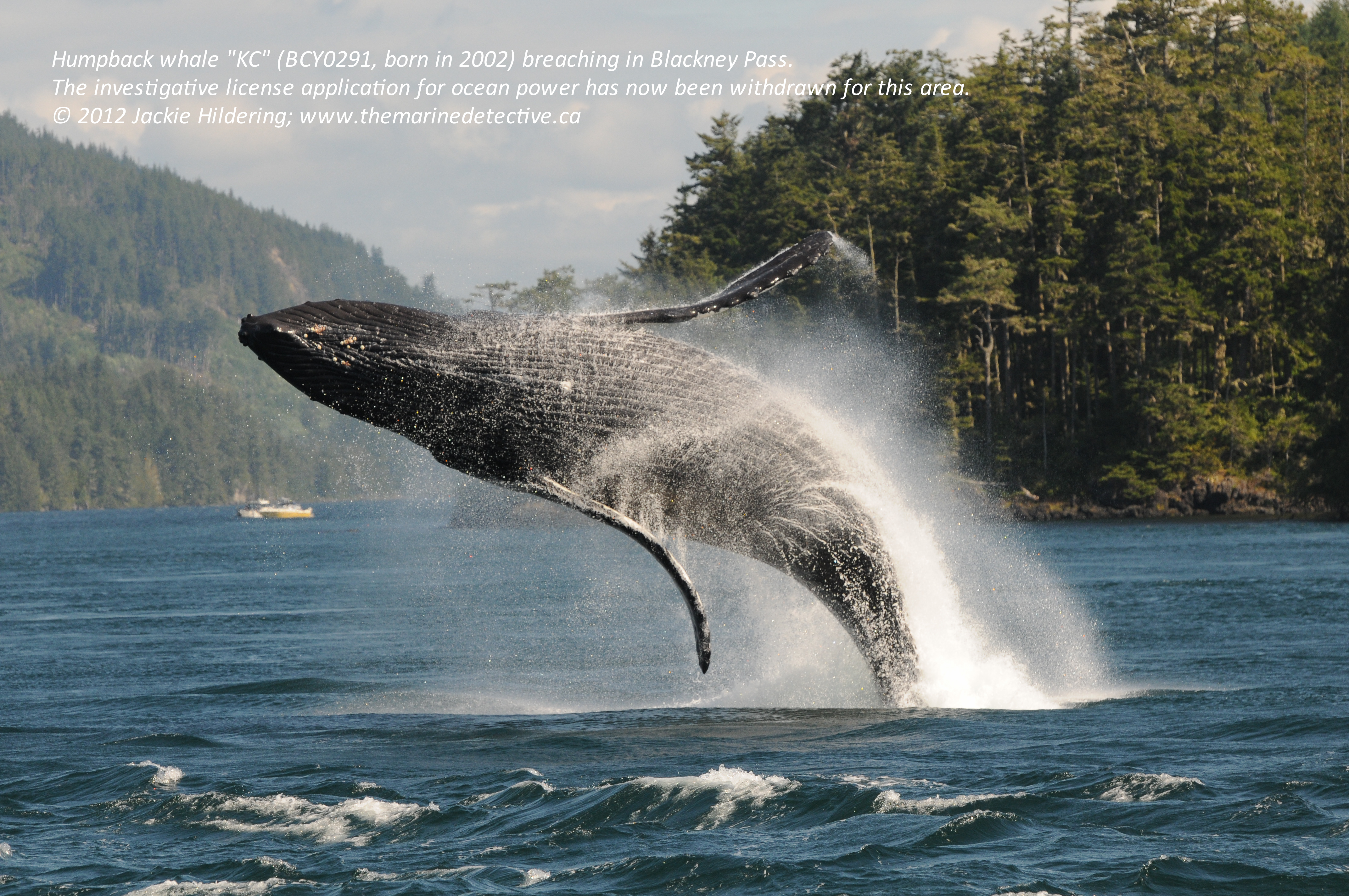
“KC” breaches in Blackney Pass. Photo: Hildering

As follow-up to last week’s call to action, “Tidal Turbines in Whale Epicentre? Hell No!” , I am so pleased to relay the following media release from myself, the OrcaLab and the proponent, SRM Projects Ltd

The short of it is, due to the efforts of many (including you) and the integrity and ethics of the proponent – the application for an investigative license for ocean power in whale critical habitat has been withdrawn. 

Please read further below.

 Media Coverage:

For details of how this resolve was achieved see this OrcaLab blog item. 

Humpback whale “KC” (BCY0291, born in 2002) breaching in Blackney Pass.
The investigative license application for ocean power has now been withdrawn for this area.
© 2012 Jackie Hildering; http://www.themarinedetective.ca

Tidal Turbines in Whale Epicentre? Hell No!

[Updates: November 18, 2012 – the application for an investigative license for ocean power in whale critical habitat has been withdrawn. Please see the media release at this link.
November 14, 2012 – To our surprise, the deadline to provide comment regarding the land tenure has been extended, it is now also December 2nd.
November 13, 2012 – As testimony to how serious this is – international Whale and Dolphin Conservation (WDC) has picked this up and put out an action alert.]


For a bundling of media items on this see the end of the blog.] 

There are times when expletives like “Hell No!” are justified and I am sure you will agree this is one of those very unfortunate times and – your action is needed.

Blackney Pass off Johnstone Strait is an epicentre of whale activity and there is an application for an “Investigative License of Occupation – Ocean Power ” for this very area. Yep, that’s right . . . an application for “actual installment of technical investigative and monitoring equipment” that could lead to turbines being in critical whale habitat. The proponent is SRM Projects Ltd of Nanaimo, B.C.

While I of course support initiatives to reduce the use of climate-changing fossil fuels, to have turbines in critical whale habitat would be pure, simple, total, utter insanity. No matter how advanced the turbine technology, no amount of mitigation could compensate for the noise, prey reduction, and other disturbance to the whales.

The deadline for your two quick submissions is December 2nd. Below, I have strived to make commenting very expeditious for you, but first, a bit more on how preposterous the application is, just to fuel you up for those comments. 

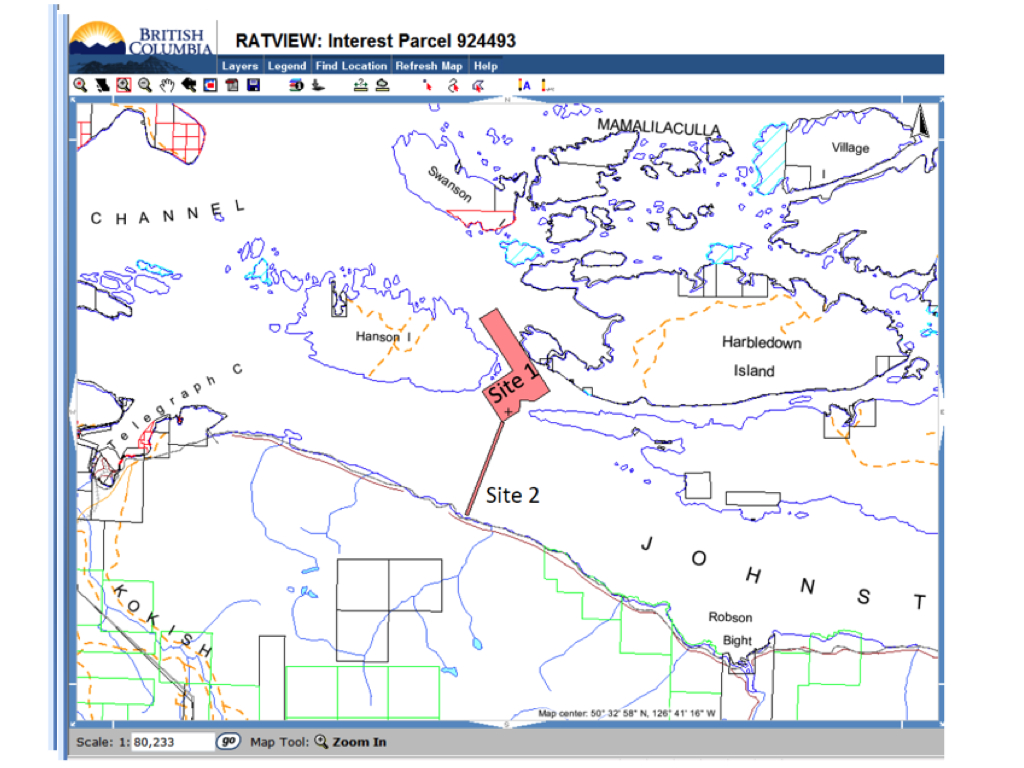
Here is the map showing the area for the “license of occupation“.

Source: Application for OCEAN ENERGY/INVESTIGATIVE AND MONITORING by SRM Projects Ltd of Nanaimo, B.C.  Click image to enlarge.

Here is the map showing the application site relative to the critical habitat map for northern resident killer whales from the Final Amended Recovery Strategy for Northern and Southern Resident Killer Whales in Canada. [Why was it amended you might ask? Because the federal government had to be taken to court TWICE to enforce their legal obligation to protect killer whale habitat – first ruling December 7, 2010; appeal ruling February 9th, 2011.]

Proposed site (red) relative to acknowledged northern resident killer whale critical habitat (cross hatched area). Source Amended Recovery Strategy for Northern and Southern Resident Killer Whales in Canada. Click image to enlarge.

The very ocean current that makes this area of interest for staking a claim for ocean energy is what makes this such a rich area for marine life. Multiple currents collide causing a merry-go-round in which plankton and fish are concentrated. The threatened northern resident killer whales feed here with great regularity, as do members of the threatened population of humpback whales, Steller sea lions, Dall’s porpoise, etc.

The importance of this area for killer whales can be supported by almost 4 decades of data collected by Department of Fisheries and Oceans and the OrcaLab. More recently, with regard to the humpbacks, I and my fellow researchers from the Marine Education and Research Society, can testify to how often these giants are in this area.

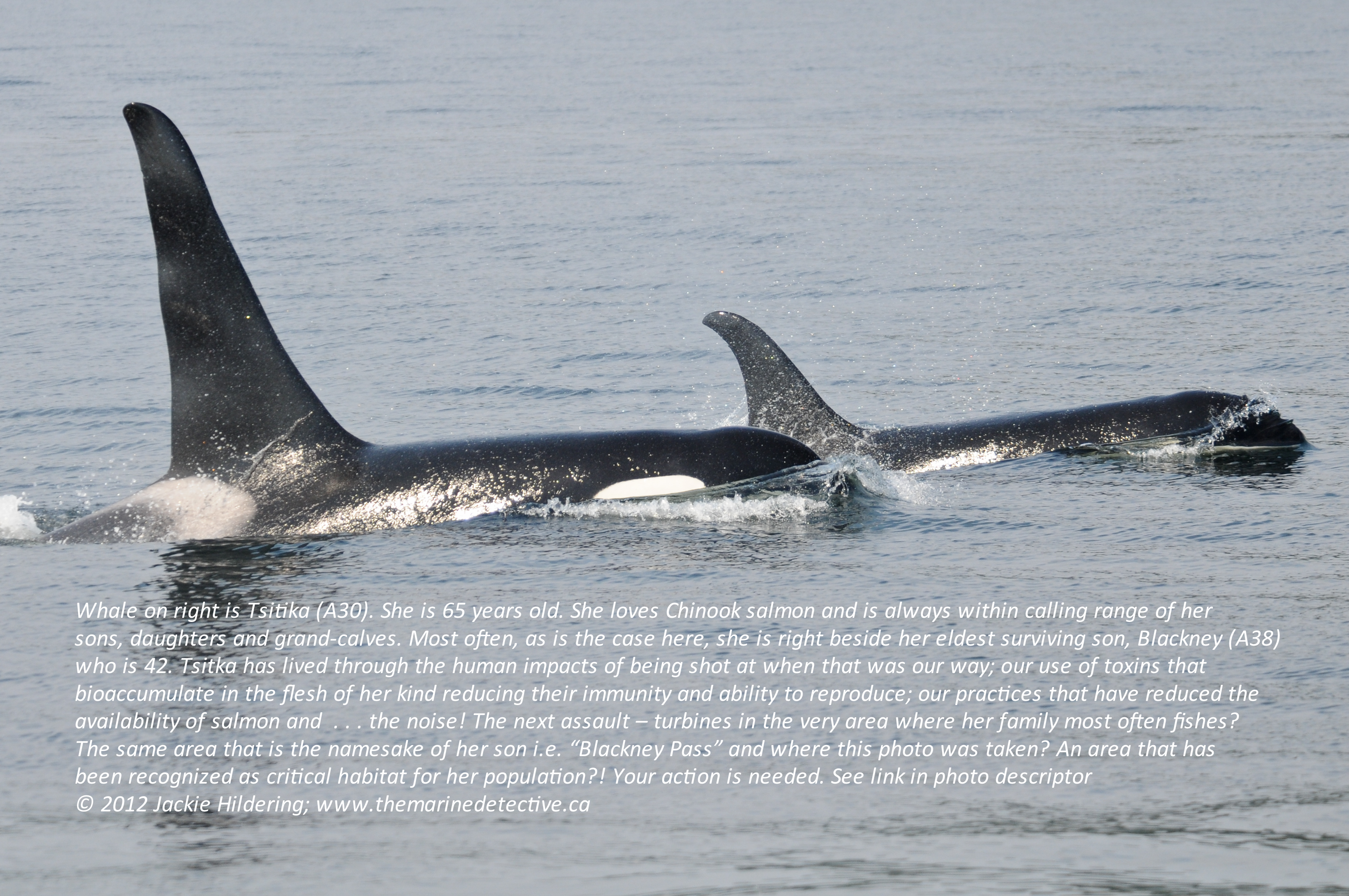
But it is the whales that speak with the most convincing voices of all. Here is the OrcaLab’s September 16th, 2012 visual and acoustic recording of the I15 and A30 matrilines of northern resident killer whales in the very area “in question”.

For researchers, whale watchers and on-line followers of the OrcaLab’s monitoring of whales, we all know that this kind of activity is not exceptional in this area and we know what is at stake.

As final stark evidence of how often there are whales in this area, note where, of all the places the OrcaLab could have put their whale-monitoring cameras and hydrophones, they are positioned. Then again, note the location of the proposed ocean power project.

Proposed site (red) relative to positions of the OrcaLab, and their hydrophones and cameras. Testimony to just how often there are whales here. Click image to enlarge.


One would hope that government agencies would surely deny this application but  . . . we have so many recent examples of this being tragically misplaced faith and we cannot count on there being any legislation in place for sound environmental assessment that would confirm environmental impacts. May I point out again that the government had to be taken to court TWICE to be order to acknowledge and protect killer whale critical habitat?!

Therefore, we collectively need to make our “Hell No!” heard now.

Essential action needed by December 2nd – submission to two government agencies. 

  1. By December 2nd, regarding the land tenure,  click this link, go to the bottom of this Integrated Land Management Bureau page, and comment on the project. Sample text below in green. [Note that, to our surprise, this deadline changed on November 14th, the date that was the initial deadline for comment to this agency.]
  2. By December 2nd, regarding the license of occupation, click this link and email your comment to Forests, Lands and Natural Resources Operations. You could use the same text as you did for the above.

If you can, come to the Port McNeill “community information session” given by the proponent, SRM Projects Ltd of Nanaimo, on November 20th in Room 4 of the Old School from 6:30 to 7:45 PM. There will also be an information session in Campbell River on November 22nd but this will focus on SRM’s proposals for the Discovery Passage and Seymour Narrows. It will be in the Rivercorp Boardroom, 900 Alder Street from 7:00 to 8:30 PM.

  • Sample text for both of the above. “With regard to Land File Number 1412946, the application for SRM Project Ltd’s “Investigative License of Occupation – Ocean Power” in the Blackney Passage / Johnstone Strait area, I write you to express that this application must not be granted. This is scientifically confirmed critical habitat for northern resident killer whales and it has been legally ruled that this must be protected as per Canada’s Species at Risk Act. In addition, the area is of great importance to humpback whales and many other marine species. No matter how advanced the turbine technology, no amount of mitigation could compensate for the noise, prey reduction, and other disturbance to the whales.”  You may even want to reference this blog and provide the link e.g. “For further details of the reasons for my great objection to this application see the rationale and resources provided at http://wp.me/pPW6V-LE.”

With this application being so ludicrous, I can’t help but wonder if I am missing something. Is this just part of a staking frenzy or is it some sort of distractor so that attention is taken away from something else?

SRM LTD’s projects are listed here. Again, reductions to our voracious fossil fuel consumption are very much needed but, at the cost of having turbines in whale critical habitat? Unequivocally – no. 

So much insanity  . . . so little time.  Sigh.

Huge gratitude and respect to Angela Smith for being the one to take note of the notification of this application and to Leah Robinson for ensuring I had many of the details I needed for this blog.

Media items:

References:

This posting on my FaceBook page has had success in creating further awareness. Feel free to share! Whale on right is Tsitika (A30). She is 65 years old. She loves Chinook salmon and is always within calling range of her sons, daughters and grand-calves. Most often, as is the case here, she is right beside her eldest surviving son, Blackney (A38) who is 42. Tsitka has lived through the human impacts of being shot at when that was our way; our use of toxins that bioaccumulate in the flesh of her kind reducing their immunity and ability to reproduce; our practices that have reduced the availability of salmon and . . . the noise! The next assault – turbines in the very area where her family most often fishes? The same area that is the namesake of her son i.e. “Blackney Pass” and where this photo was taken? The area that is designated as critical habitat for her population?

I, Mermaid. You Too?

Northeast Pacific mermaid. Even underwater they are dedicated to marine conservation. Photo: Jacqui Engel.

So I don’t look much like the mermaids of folklore, but I am absolutely the real thing.

I, in fact, look more like a Steller sea lion when suited up in my dive gear (not that they are convinced).

This resemblance to sea lions may even soon be strengthened if the joys of menopause lead to my growing long, stiff facial hairs like their vibrissae. Hum, maybe that won’t be all bad since I will be able to sense vibrations in water from afar .  . . but back to the topic at hand.

Northeast Pacific mermaid displaying underwater euphoria. Photo: Jacqui Engel.

In having now painted anything but the image of a waifish, goddess-like denzin of the deep for you, I will likely need to provide some very strong evidence that I am indeed – a mermaid.

Not that I need you to believe me.

The important thing is for you to be able recognize if YOU are a mer-person too. In fact, a great deal is at stake if you don’t recognize it.

No doubt that you are infinitely thankful that I am here to help since there’s a lot of misinformation out there about we mer-people. You know – all that tail-like-a-fish, having no immortal soul, must marry a human stuff.

Mermaid 3

Note mermaid blissed-out expression even when only near the Ocean’s surface. Photo: Peter Jucker.

Reality is, we look pretty much like other people . . . most of the time.

However, if, for some terrible reason, we are removed from the sight and smell of the ocean for any significant period, this provides one of the two times when it is really easy to identify a mer-person.

The clues?  Agitation, a predilection to negativity, perpetual longing references to “Mother Ocean”, dry coughing, eating lots of salty chocolate, combative if blocked from getting back into or onto the Ocean and, indeed when in this state, we will deal out many a curse and could even drag someone underwater.

The only other time it is really easy to tell we are mer-people is when we have just returned from Mother Ocean. The contrast to our non-marine state is apparently extreme. We present as being deeply peaceful, patient, centered, highly eloquent, rational, and blissed-out.

Rare two-headed mermaid. Head on right = Jacqui Engel who may not be so happy with me after I post this photo.

The physiology behind this has been the subject of many scientific studies. The research shows that mer-people’s heart rate and blood pressure is reduced by 31.721% when in or on the Ocean and that the endorphin content of our blood also rises by 47.913% (give or take a thousandth of a percent). 

As a mermaid, I of course know how I feel when submerging into the Ocean or when I drift on her surface. It feels like escaping from the insanity of terrestrial human life for a while; living raptly in the moment; and returning to quiet, extreme beauty, and sensibility.

Extraordinarily rare 3-headed mermaid. Head on left = Terina Hancock. Head in middle = Natasha Dickinson. Here too there may be some issues with the other heads not being so happy with me. Photo: Jacqui Engel.

It was a surprise to me though how quickly those around me understood my mermaid needs. Many is the time I have been told “Jackie, you need to go diving” or “Jackie, I think you need to go study humpback whales today”.  Conversely, I will get to hear “You seem better today. Did you go diving?”

Why, after having gone diving, I apparently even have a much better sense of humour and a tendency to engage in a bit of self-mockery. Hum, I wonder if this might be apparent here since I did go diving yesterday?

Can you believe it?! Another 3-headed mermaid! Head on left = Jacqui Engel. Head in centre = Natasha Dickinson. Photo by mermaid with very long arms.

Does any of this sound like it applies to you? Ask those around you to confirm if you manifest the signs.  Look around your home. Do you see many marine symbols and/or artifacts? 

I suspect that there are many fellow mer-people here in the demographic of the “The Marine Detective” community.

Speaking from my own experience, it is very important that your mer-personness gets diagnosed as soon as possible.

It’s not only for your own good and the sanity of the humans around you. It’s for the health of our Ocean.

As mer-people, we above all others know the essential soul-calming, life-giving, inspiration-inducing, positive and essential source that is Mother Ocean.

While on land, make it count! Be the walking protectors for all that is dependent upon the sea.

Speak for our marine brethren who cannot speak for themselves!

Mer-people unite!