Giant Pacific Octopus subtly changing colour and texture. Video by Erika Grebeldinger.
Remarkable video of a Giant Pacific Octopus juvenile subtly changing texture and colour to better match its surroundings.
When full grown, this species can be over 7 m from arm tip to arm tip and over 73 kg = the biggest species of octopus in the world.
The video was taken by fellow Top Island Econauts Dive Club diver Erika Grebeldinger during one of our dives last month. It is testament to the calibre of her diving and concern for the environment that she was able to “capture” such natural behaviour. It the octopus had been agitated, s/he would have flashed red, postured and/or inked.
Having previously posted this video on Facebook, I love Will Soltau’s observation of how the octopus leaves no footprint and what a different world it would be if we humans were more like octopus in this respect.
Thank you so much for sharing Erika!
Video below added on November 25th, 2011 from You Tube – Octopus walking on land in California at the Fitzgerald Marine Reserve.
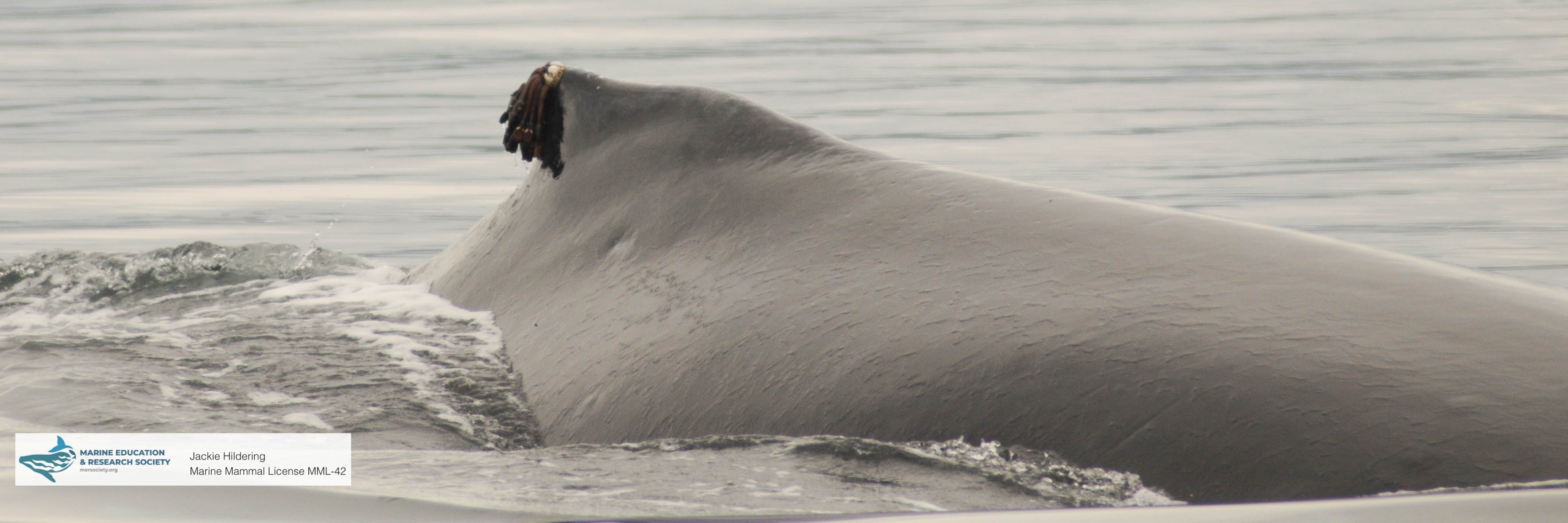
When we saw Jigger in 2009, we noted the barnacle growing on the right top of her dorsal fin. Such barnacles are a distinct species only found on Humpback Whales. The Humpback Whale Barnacle is Coronula diadema (to 5 cm tall and 6 cm wide.
Then, when we saw Jigger in August of 2010, we noted that her dorsal fin looked very different. My research partner from the Marine Education and Research Society, Christie McMillan, and I were worried that it might be an injury so we tried to get a better photo of the dorsal fin.
Here’s what the dorsal fin looked like from behind (photo taken with a telephoto lens and cropped) When I had this perspective, I thought that what we were looking at might be seaweed growing on the Humpback Whale Barnacle we had seen the year before (note that the barnacles often do fall off between years).
But, it didn’t quite look like seaweed. With patience and good camera lenses, we got a better look.
What on Earth?! They’re gooseneck barnacles growing on the Humpback Whale Barnacle!
Gooseneck barnacles are an order of barnacles that are attached to a hard surface by a long stalk that looks like a goose’s neck. They depend on the motion of the water to feed on plankton as they do not have the “foot” (cirri) that rakes in plankton in many other barnacle species.
That’s when I learned that there is a species of gooseneck barnacle that, in the North Pacific Ocean, most often grows on the Humpback Whale Barnacle!! The species is the Humpback Whale Gooseneck Barnacle, also known as the Rabbit-eared Whale Barnacle (Conchoderma auritum (to 11 cm long).
This is the kind of discovery that causes wonder and euphoria in my world.
To be able to identify a Humpback as an individual is already something of great scientific and educational value.
That this attention to an individual whale leads me to learn that there is a species of gooseneck barnacle that grows almost exclusively on a species of barnacle that only grows on Humpback Whales = sheer wonder.
I can’t wait to find out what else the Humpbacks are going to teach me!
Image from Fertl, Dagmar & Newman, William. (2018). Barnacles.
Update: January 2022. Oh and by the way, when Jigger returned to the feeding grounds around northeastern Vancouver Island the next year, she did not have the two barnacle species on her dorsal fin. But she did have . . . a calf. The calf is “Quartz” and has returned to northeast Vancouver Island every year from 2011 to 2021. From our Marine Education and Research post from January 2022: There are two species here on Dapple’s chin and these barnacle species are very often also on the tips of Humpback Whales’ tails.
1) The big, round barnacles are “Humpback Whale Barnacles” (Coronula diadema to 5 cm tall and 6 cm wide) and they ONLY grow on Humpbacks. When they fall off, they leave those round white marks. The barnacles that grow on Grey Whales are a different species that ONLY grow on Grey Whales (Cryptolepas rhachianecti).
2) Growing atop the Humpback Whale Barnacles are “Humpback Whale Gooseneck Barnacles” (Conchoderma auritum to 11 cm long) aka “The Rabbit-Eared Gooseneck Barnacle” which, in the North Pacific Ocean, MOST OFTEN ONLY GROW ON TOP of Humpback Whale Barnacles! There can be up to 50 Humpback Whale Gooseneck Barnacles on one Humpback Whale Barnacle and each gooseneck barnacle is usually oriented with the opening facing the direction the whale swims allowing for better feeding on plankton. (Source: EFauna BC). With that long, fleshy “neck” it certainly is clear why they are called GOOSENECK barnacles.
That’s two layers of specificity made all the more thought-provoking when you realize that barnacles start off as plankton drifting in the ocean, attach to the correct surface, and then grow a shell. The amount and position of these barnacle species can change quickly. For example, there were no Humpback Whale Gooseneck Barnacles to be seen on Dapple’s chin on August 18th but there they are by September 25th. Thereby, barnacles often cannot help identify individual Humpbacks between years but . . those scars from Humpback Whale Barnacles DO persist.
Please know that barnacles are NOT thought to be a hinderance to the whales. It is believed that there’s symbiosis. The barnacle species have good positioning to feed on plankton and the Humpback Whale and Grey Whale Barnacles are believed to offer defence to these slower moving big baleen whales. Grey Whales and Humpback Whales are built for fight rather than flight from mammal-hunting Orca (Bigg’s Killer Whales) and will posture, trumpet and lash out. The barnacles are likely also of use when the males fight for females in the breeding grounds. Hey, when you don’t have teeth, it helps to have something similar to brass knuckles.
More detail
From E-FAUNA BC: ELECTRONIC ATLAS OF THE WILDLIFE OF BRITISH COLUMBIA “Conchoderma auritum is most often found attached to the shells of Coronula on the humpback whale; sometimes more than fifty are attached to one shell. “Rarely a specimen is found attached to the base of the teeth of an old sperm whale” (Sheffer, 1939). Gordon C. Pike reports finding specimens of C. auritumon sperm and fin whales taken in British Columbia. In each case the barnacles were associated with a deformation or an apathological condition of the jaws, baleen, or teeth. Each barnacle is usually oriented with the opening facing in the direction the whale swims. The food-laden water passes through the opening and over the feeding appendages, then out through the two “ears” which have tubular openings.”
From the Marine Species Identification Portal: Species is “attached to the whale barnacle Coronula diadema and sometimes Coronula reginae. It seems to be a rule that no Coronula is without a Conchoderma. Whether this is a form of symbiosis has been discussed by Broch (1924b). Specimens from northern waters have been taken from humpback whales (Megaptera novaeangliae ) or from teeth of bottle-nosed whales (Hyperodon spp.). In the Antarctic C. auritum has also been found on baleen plates of whales and on their tails. In tropical and subtropical parts of the oceans it can also be found attached to ships’ hulls and other floating objects, to slow moving fishes or to the tail of a large eel, but never on soft objects.” From Mike Horan (pers. com January 2022) “I have also seen the stalked barnacle [Conchoderma auritum] on Bottlenosed Dolphins during the die off of 1987 in New Jersey.”
“Individual whales have been known to collect up to 450 kilograms of barnacles. That’s an enormous mass, but relative to a 30-tonne humpback, it would weigh only about as much as an extra layer of clothes. And as far as scientists can tell, the hangers-on don’t particularly bother a healthy whale. They may slightly increase drag as the whale swims, but they may also be helpful as a set of brass knuckles when adult males battle each other over the chance to mate [and when dealing with mammal-hunting Bigg’s Killer Whales]
Here’s what we don’t know about whale barnacles, at least with any certainty: just about everything else. Like, how do their larvae, no bigger than a grain of salt, find a migratory whale to grab onto in the first place? Once they locate one, how do they navigate around its gargantuan body—hundreds of thousands of times larger than theirs—to find their permanent homestead? “It just seems preposterous,” says John Zardus, a marine biologist at the Citadel in Charleston, South Carolina. He specializes in studying barnacles that live on other living things.
Studying those symbiotic barnacles that live on sea turtles, dolphins, crabs, and other marine animals has given Zardus some idea of how whale barnacles might hack it. Adults mate on the whale, but rather than take their chances during their host’s oceanic migrations, they likely wait to release their larvae until the whales gather in coastal areas to breed. The larvae then go through several developmental stages, which can take up to two weeks, before they’re ready to settle. “It’s not like the larva is being released from a whale and it’s going to [immediately] attach to the whale next door,” Zardus says.
When a larva is ready, a chemical signal is most likely what tips it off that it’s in the presence of whale skin. This could be a pheromone emitted by already settled adult barnacles—a strategy commonly used by other barnacle species—or it could be some molecule that wafts off the surface of the skin itself. If other barnacles are any indication, the larva probably reaches out with its sensitive antennules to familiarize itself with the epidermis. It squeezes a drop of sticky polymer out of one antennule to adhere itself temporarily, then sticks down a second antennule and releases the first one, swinging it over to another spot. By repeating this process, a larva “ends up walking around on the surface, leaving little gluey footprints,” says Zardus. “These larvae can possibly crawl all over the host until they find the right location where they want to be.”
Where they want to be is generally on the whale’s forehead, its tail, or the leading edges of its flippers. Those are the places on a whale’s body that water flows over most efficiently. That gives the barnacle a front-row seat when the whale swims through a cloud of plankton, which the barnacle also gets to eat. When the larva finds a good place to settle down, it exudes a stronger glue onto the skin and cements itself for the rest of its life, which may last about one to three years.
Much of this is informed speculation, Zardus stresses, because living whale barnacles and their larvae are extremely hard to come by. Collecting them from a living whale is out of the question, since it would require cutting into the whale’s flesh. A dead whale that washes up has to be discovered before its barnacles die of hunger, desiccation, or predation . . ..
Other than whale barnacles, nothing else reliably recorded the month-to-month movements of ancient whales, says Taylor. Bone tissue doesn’t care about the chemistry of the water it grew in; baleen does, but it’s hardly ever fossilized. But a well-preserved whale barnacle is the perfect time-traveling tracking device. “We won’t be able to tell you, ‘This whale hung a left at Malibu,’” says Taylor, “but [we can] get a general sense of where animals might have been moving.” . . .
Jigger bulking up before the migration, near Sayward in British Columbia, in November 2021.
Update November 2020: The Orange Peel Nudibranch has been reclassified. Now is Tochuina gigantea.
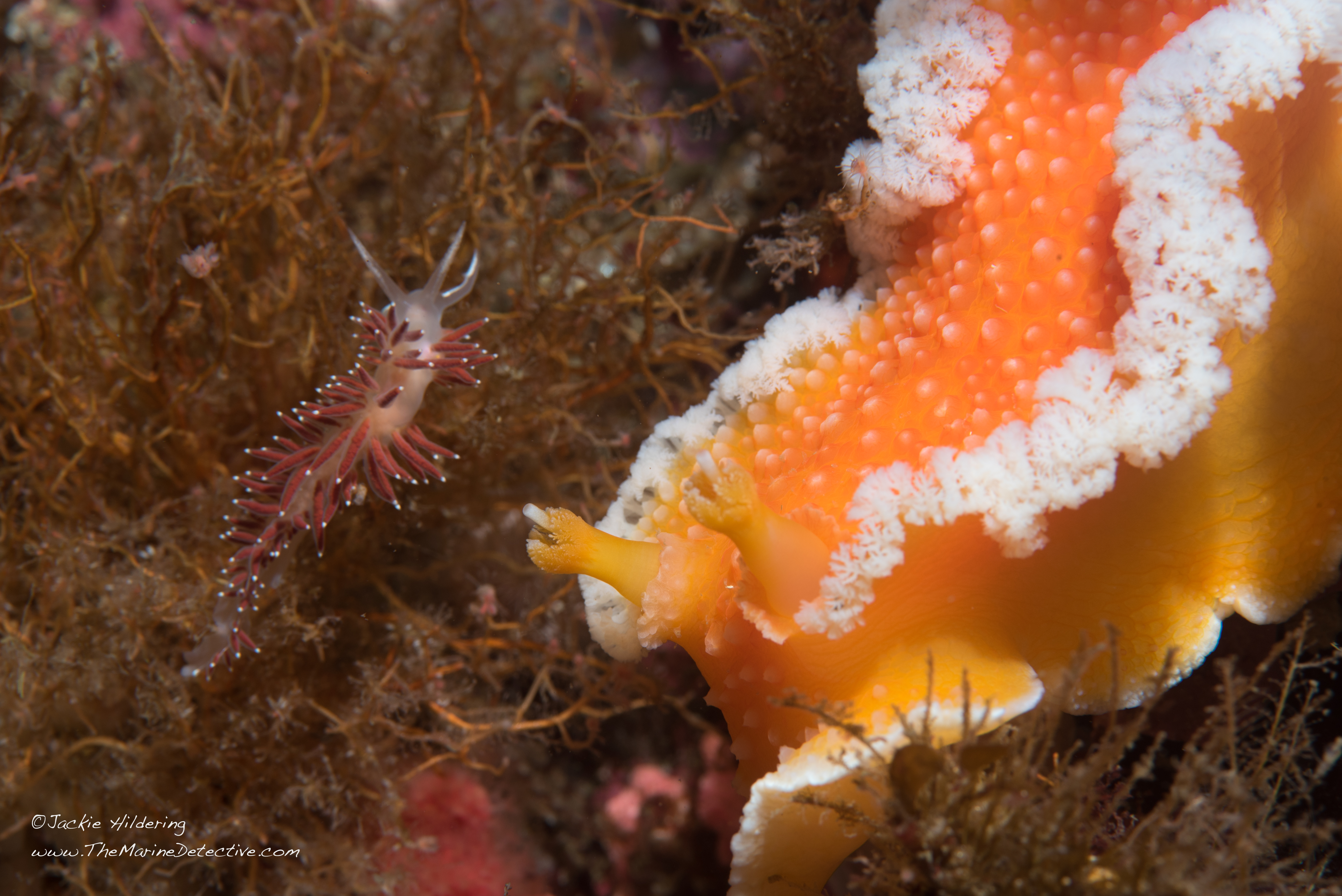
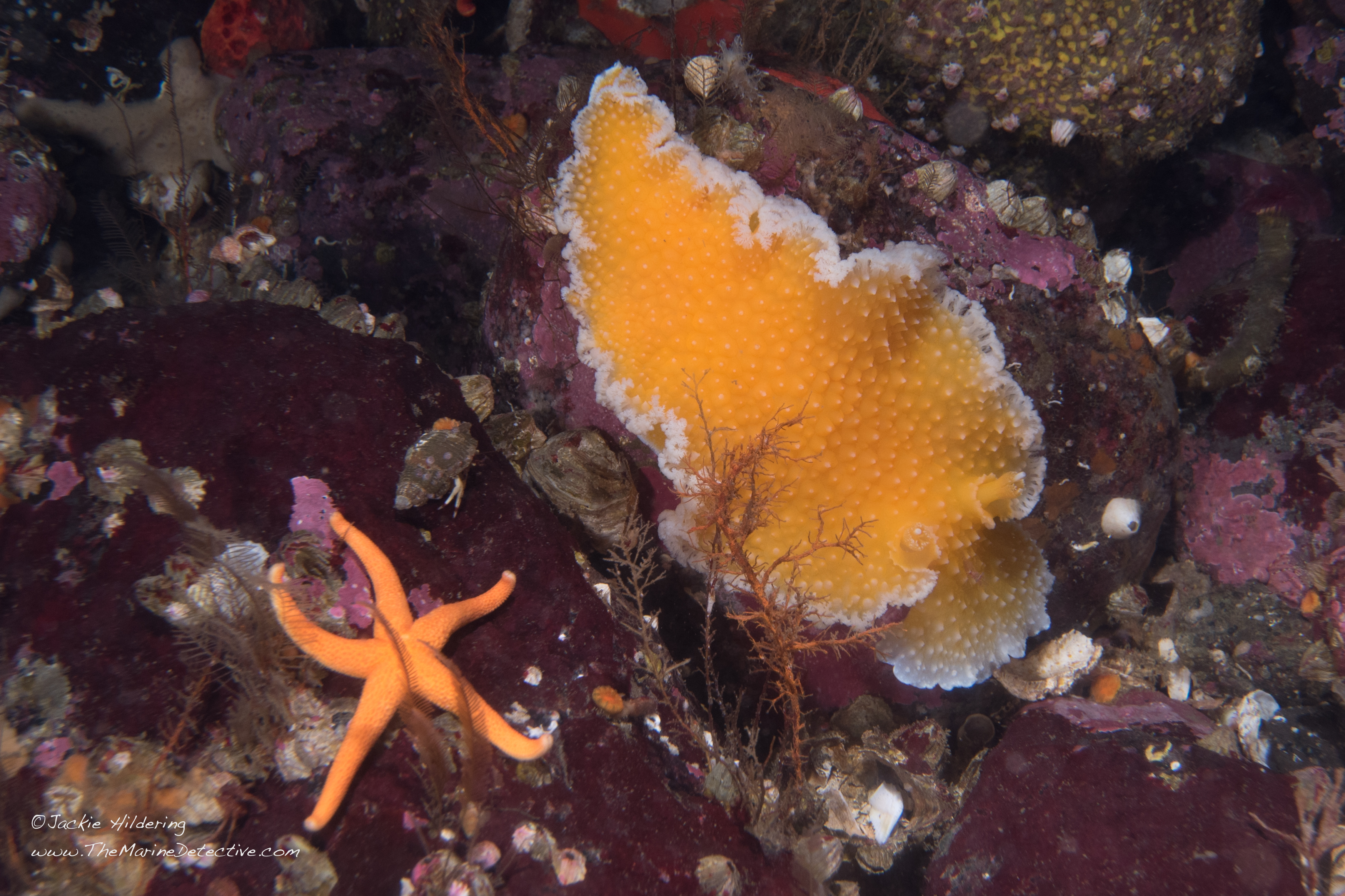
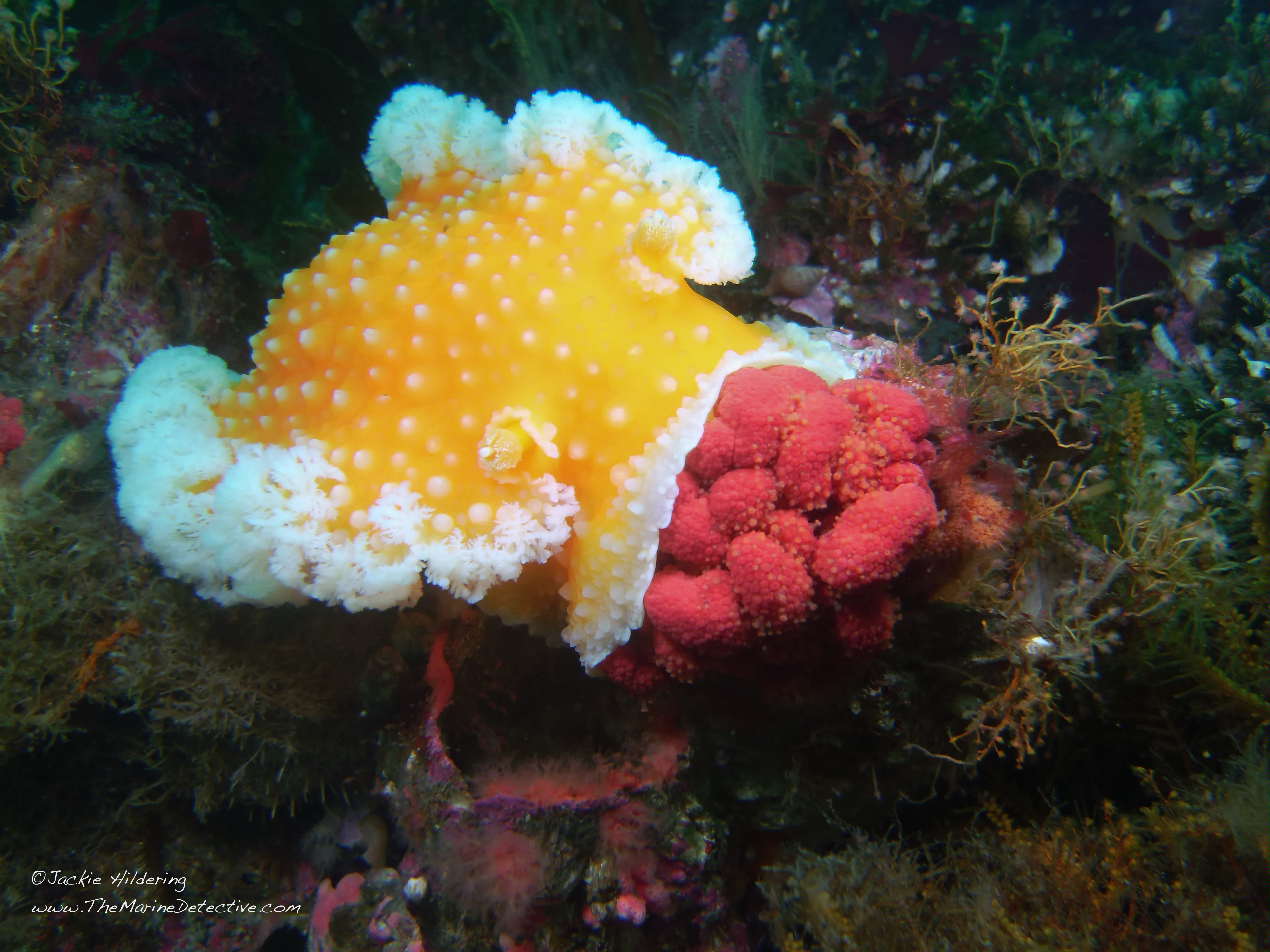
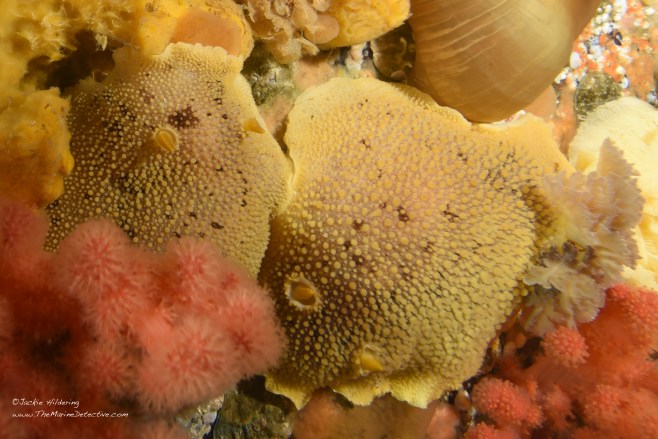
This blog is about Big Orange Love – the reproduction of Orange Peel Nudibranchs.
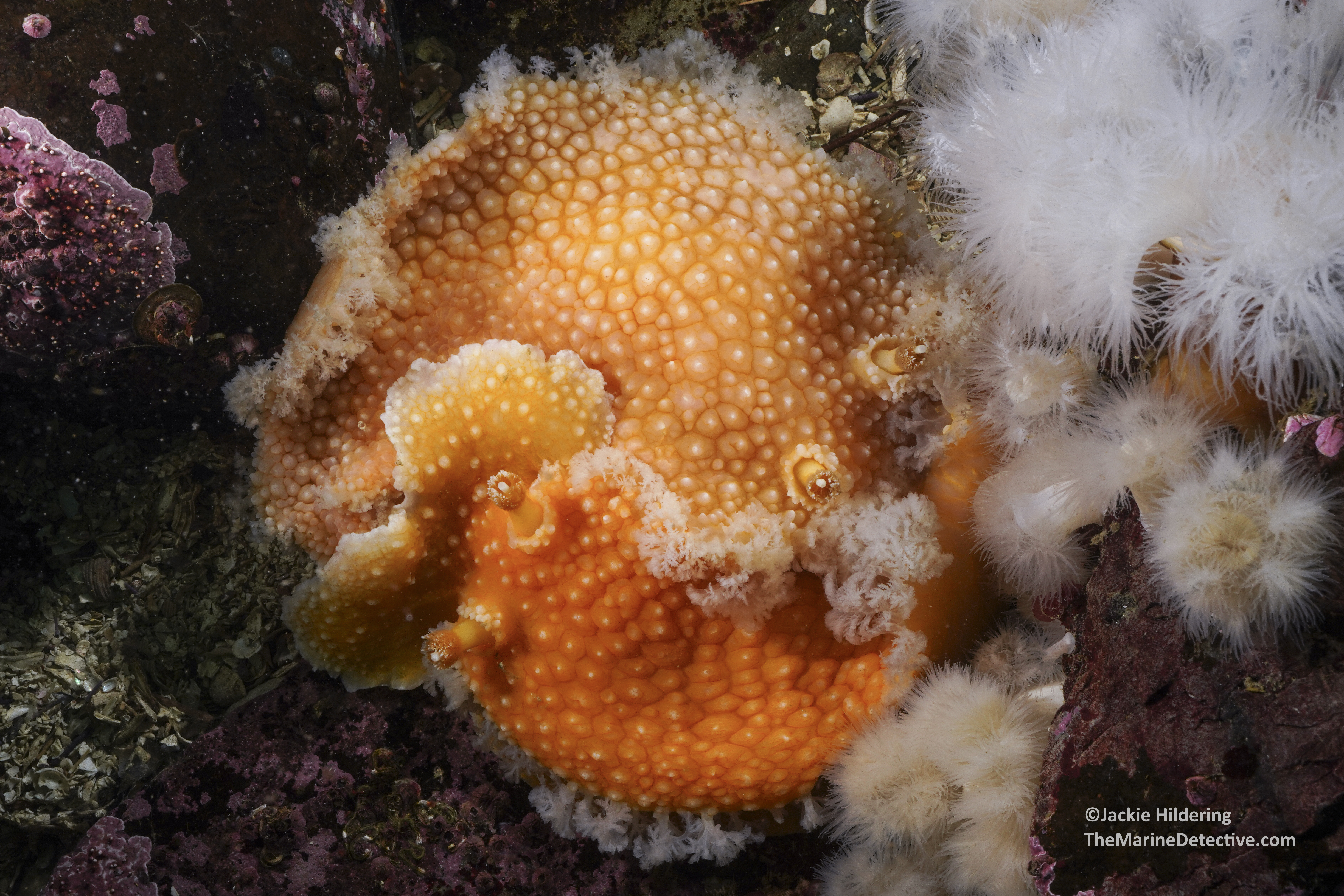
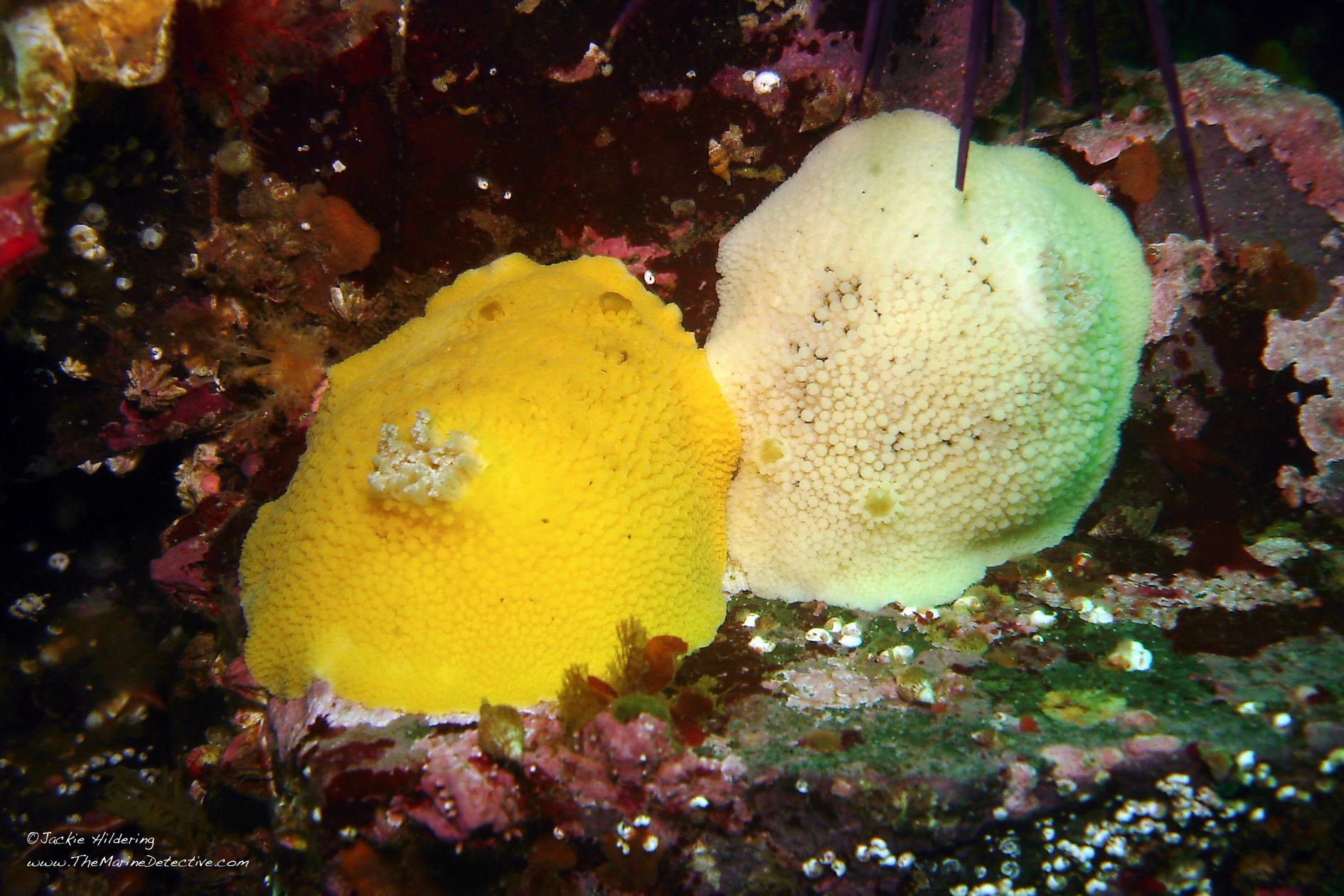
Two Orange Peel Nudibranchs mating – each about 30 cm long. Both will go on to lay the huge masses of eggs you see below. There is no male, or female.
These sea slugs are very aptly named since their skin is reminiscent of both the texture and vibrant colour of an orange. But, the name does nothing to indicate the size to which these giants can grow. They are one of the world’s largest sea slugs with literature reporting them to lengths of up to 30 cm and weight to 1.4 kg.
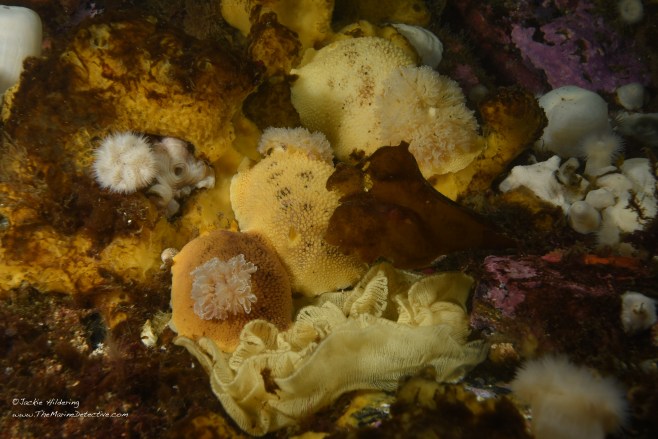
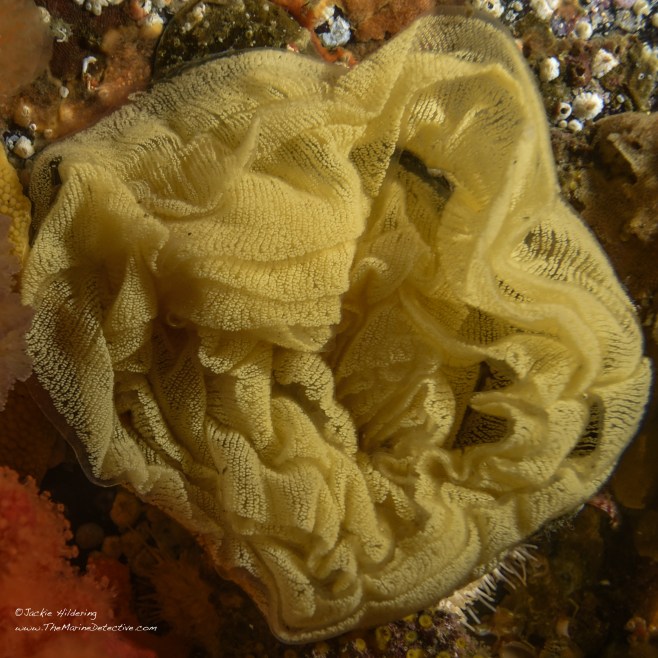
As if this sea slug species’ colour, size and beautifully intricate white gills are not enough to create awe, you should see their eggs! I will never forget the first time I saw the huge tubular mass that looked like udon noodles. I think my brain almost exploded and I was propelled all the more feverishly on my “The Marine Detective” path, wanting to be able to identify the egg masses of all sea slugs in our waters (each species’ eggs look different).
While diving in the Plumper Island Group near Telegraph Cove, British Columbia, I chanced upon a white-ringed ribbon worm (Tubulanus albocinctus) fully out in the open. This is the first time I have been able to see the whole animal and marvelled at it’s length and colour. This “specimen” that I filmed was more than 1 metre long. Apparently, they can reach 6 metres in length!
White-ringed ribbon worm found at about 30' (10m). Photo: Hildering
Ribbon worms have unsegmented bodies but what sets them apart from all other worm species is that they have a “proboscis”. The proboscis is a part of their gut that can be launched out to wrap around prey and then retract pulling the prey into the ribbon worm’s mouth. Venom may also be associated with the proboscis. The white-ringed ribbon worm may prey on segmented worms, small crustaceans and maybe even some small fish. The proboscis can also be used for digging.
In the video clip (link below) you will see how the animal moves with powerful waves of muscular contraction (peristalsis). Small hairs called cilia also help it glide along.
In trying to find some basic facts about this species’ natural history, I discovered that very little is known about it even though it quite common in the Pacific Northeast. Although not able to find research to support this, I believe that the animal’s bright colour is a warning to predators that it tastes bad or is toxic.
I assure you I will be on the lookout for this wonder worm to try to learn more (I would love to see the proboscis in action)!
See the short video clip (30 sec) of my white-ringed ribbon worm encounter at this link.
More on ribbon worms at this link(includes a diagram of the internal anatomy).
Update January 12: A neighbour, Graham MacDonald, shared his observations of white-lined ribbon worms preying on rockweed isopods on a local sandy beach. He has repeatedly observed a black structure extending from the worm to the isopod and moving around on the isopod (likely the probosis). He noted that it appeared that the isopod was suffering (due to toxin or digestive juices?) and that it was a prolonged process. I will definitely be going to sandy beaches to see if I can capture this on film. Thank you Graham.
In late August, some of my Young Naturalists alerted me that they had already seen hooded nudibranchs (Melibe leonina) around Port Hardy (B.C., CANADA).
[It so wonderful that these local children know and greatly appreciate nudibranchs.]
Late August is earlier than we historically have seen the hooded sea slugs gather in large numbers. Usually this happens in late September / early October with them beginning to lay eggs in the spring.
Hooded nudibranchs back in very large numbers. Late August 2010.
This week, I had the opportunity to check how many are already in the area and, it’s official – the hooded nudibranchs are very much back.
To see the video from today, click here (2-minute video).
For explanations on the natural history of hooded nudibranchs, please see my previous blog postings from April 10th, 2010 and May 2nd, 2010.
Hooded nudibranch egg masses (March 2011). Each mass is about 1 cm high. Each little white dot is an egg.
This is a Marine Detective case for those of you who appreciate mini-mysteries as much as whale wonders.
Gillian Butler and Erin Paul of found this remarkable invertebrate off their kayak base camp in Johnstone Strait, northeastern Vancouver Island in September of 2010.
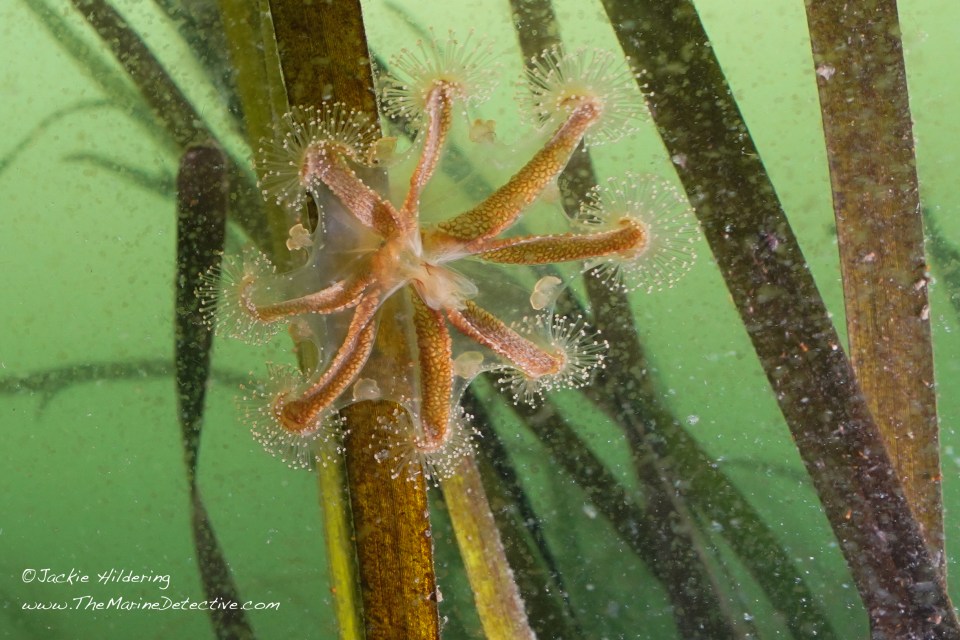
I was thrilled to get the “What’s this?” email from them as this is a type of jelly I know is off our coast but that I had never been able to find!It’s a jelly that is only 3 cm wide and is usually attached to kelp or Eelgrass . . . by its stalk!
Stalked Jelly – photo by Gillian Butler
Yes, it is species of stalked jellyfish (stauromedusae). The species well documented on our coast is the “Oval-anchored Stalked Jelly” (Haliclystus sanjuanensis). Read below for what is believed to be a new (undescribed) species!
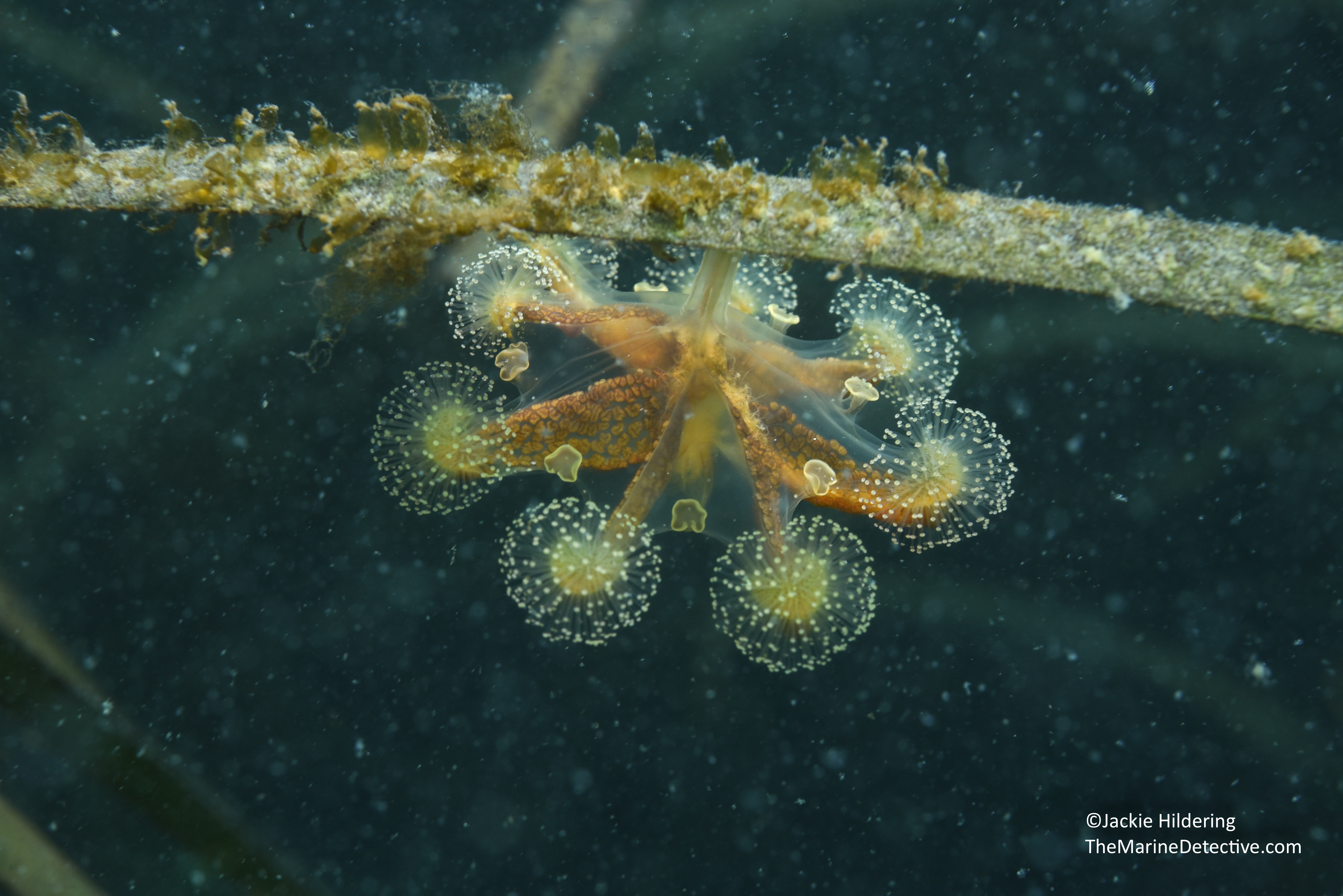
Stalked jellies never become free-swimming, bell-shaped “medusa” like most jellyfish species. Their stalk is sticky allowing them to attach to Eelgrass, seaweed, or rocks in the shallows. They have 8 “arms” that look like they have pom-poms at their ends. These clusters of 30-100 tentacles have stinging cells so that the stalked jelly can catch small crustaceans with the pom-poms and bring this food to their mouth (positioned at the centre of the 8 arms).
They are remarkably mobile which you will see in the Lester B. Pearson College video at the end of this blog. If the stalk becomes detached, the animal can hold on with its tentacles till it reattaches its stalk. The student video will also allow you to see the base of the stalk and how the arms can close up.
Only about 50 species of stalked jelly had been discovered worldwide. New extremely deep-dwelling species been discovered around hydrothermal vents AND . . . potentially also in the shallows in front of my community on northeastern Vancouver Island.
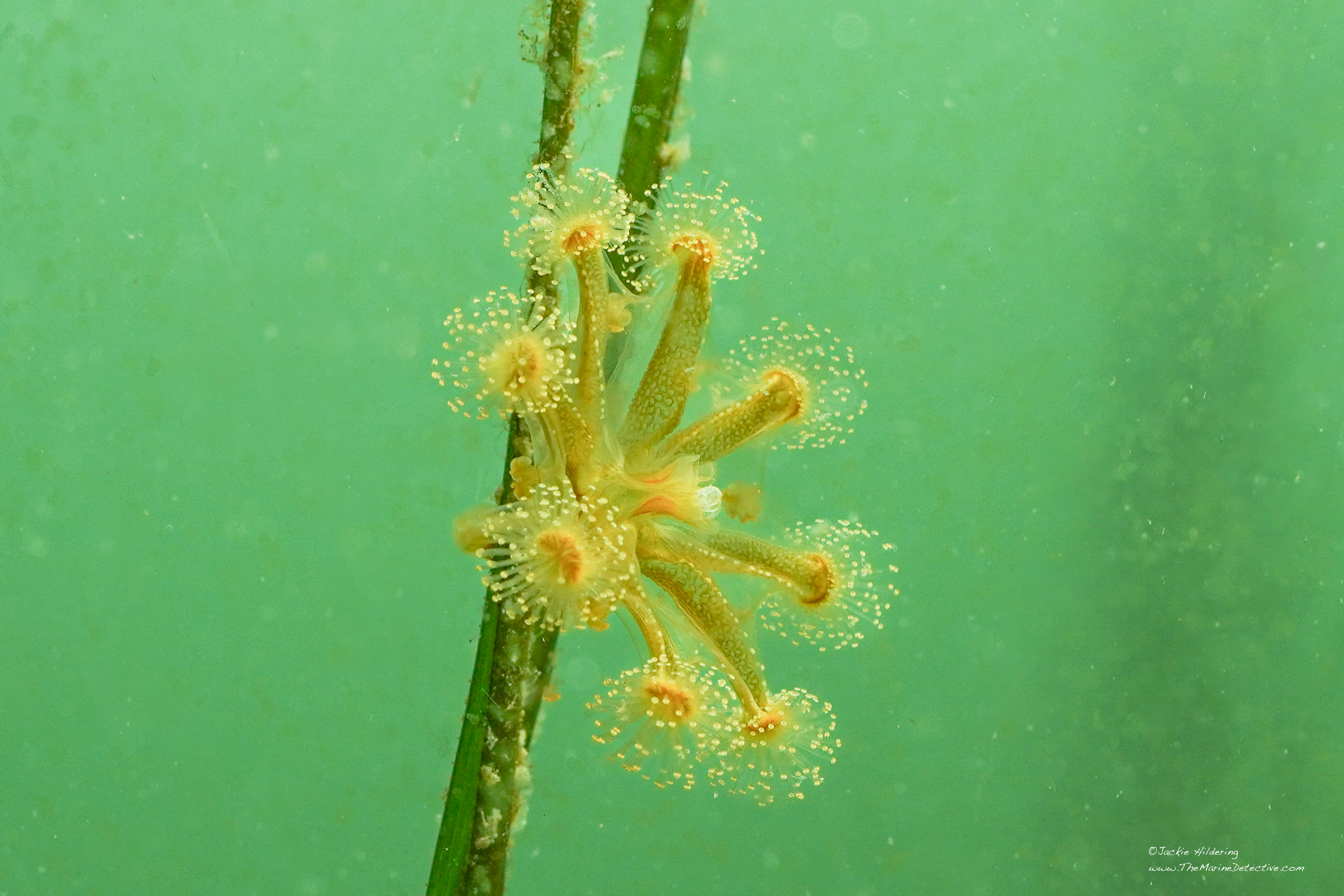
Stalked Jelly found by yours truly on July 1, 2019.
After my photo (above) went into the world in July 2019, it led to contact with researcher Claudia Mills. She let me know this is an undescribed species (also genus Haliclystus). This is such testament to how little we know about the Ocean. Again, this was in the shallows at only approximately 1 metre depth very near to where I live.
Claudia also thought that the stalked jelly that Gillian and Erin found is likely also the undescribed species. Please note that these are NOT the only known sightings of this “new” species. Their range is believed to include the San Juan Islands (Washington) to southeast Alaska and possibly even northern Japan and sightings go back decades. See Neil McDaniel’s photo form the 1970s below.
From Claudia Mills on iNaturalist in 2020: “This undescribed species is easily mistaken for Haliclystus sanjuanensis. It may still be present in some locations in the San Juan Islands, Southern Vancouver Island, or the Canadian Gulf Islands, but we can no longer find it. My internet searches have found this species in quiet bays along northern Vancouver Island and in at least SE Alaska. It might be the same species as is found in the Russian Far East and Northern Japan, but we are trying to figure that out”
I had hoped to find the species again. Finally, I had success on June 27, 2022. See the photos below. These stalked jellies were again at only about 1-metre depth in the same location as the 2019 “find”.
Limitations in finding the species again were:
(1) That I think it is more likely to be found in the summer months when the visibility while diving is limited due to the richness of plankton in the water column; and
(2) Needing a dive buddy who is willing to gear up in thick neoprene in the summer and do a beach dive when it is usually hotter and much more difficult to see around you in the water. Diving from the beach usually involves more exertion than just rolling off a boat into the ocean. Also the visibility tends to be worse for beach dives because these locations often don’t get as much tidal flushing as do dive sites in narrow passes between islands.
YOU could find this species of Oval-Anchored Stalked Jelly too and carefully document it (not touching it and also being really careful in its habitat e.g. avoid stepping on Eelgrass). Your chances are likely best in summer, on a low tide.
You could upload the sighting to iNaturalist where Claudia Mills would ID. On a recent sighting there she shared: “This is the “other” uncommon, species of Haliclystus that we have found in BC and Alaskan waters. It is usually found in (environmentally) undisturbed quiet bays, on kelp or eelgrass in the shallow subtidal.”
For this Oval-anchored Stalked Jelly to be “described” and get a species name, experts like Claudia would write up and publish their research on how the species is physically and genetically different.
Note that this is an older video. I think we would be less inclined to touch the animal directly with current-day understanding and ethics.
Update: May 28, 2023
Found two individuals again in the same location as where I have seen them previously! See the photos below.
Update: June 24, 2024 Found another two individuals again in the same location.
“Some of nature’s most exquisite handiwork is on a miniature scale, as anyone knows who has applied a magnifying glass to a snowflake.“
I was reminded of this Rachel Carson quote today when diving but found myself changing the ending to ” . . . as anyone knows who has seen sea slug egg masses.”
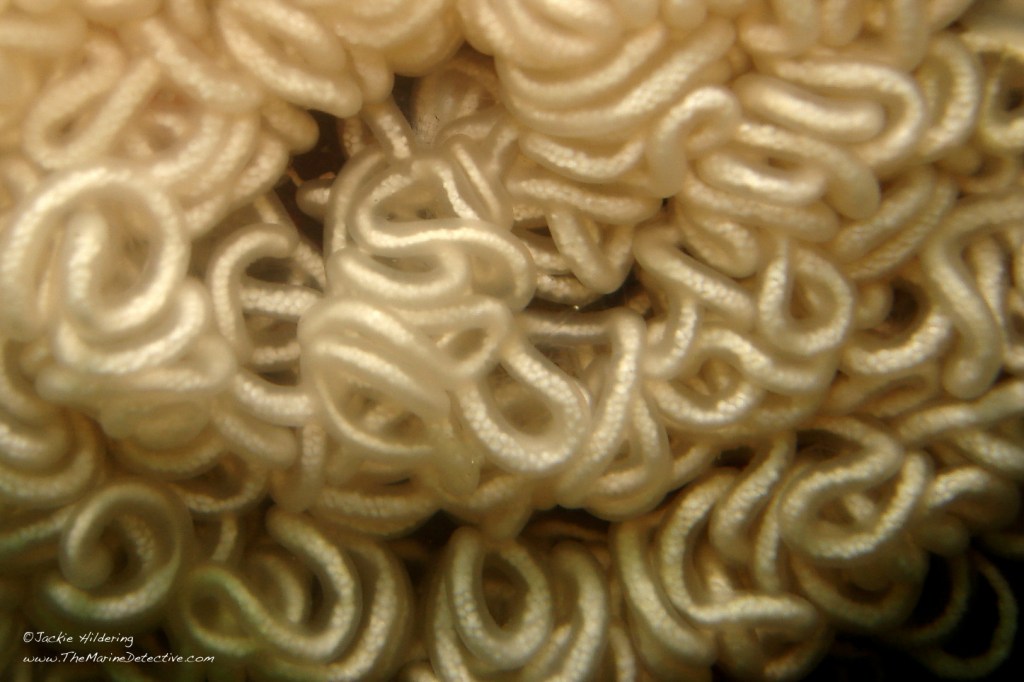
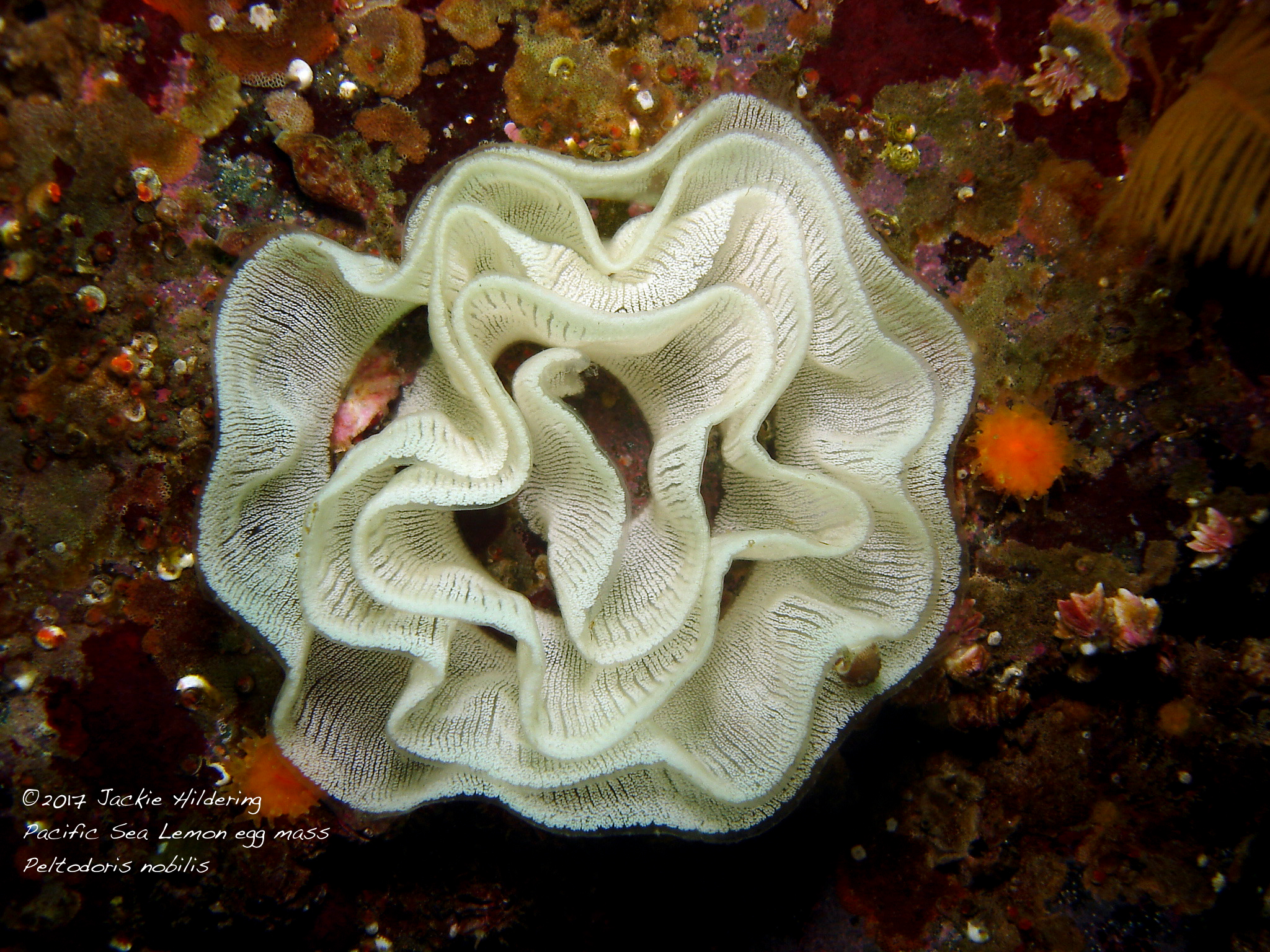
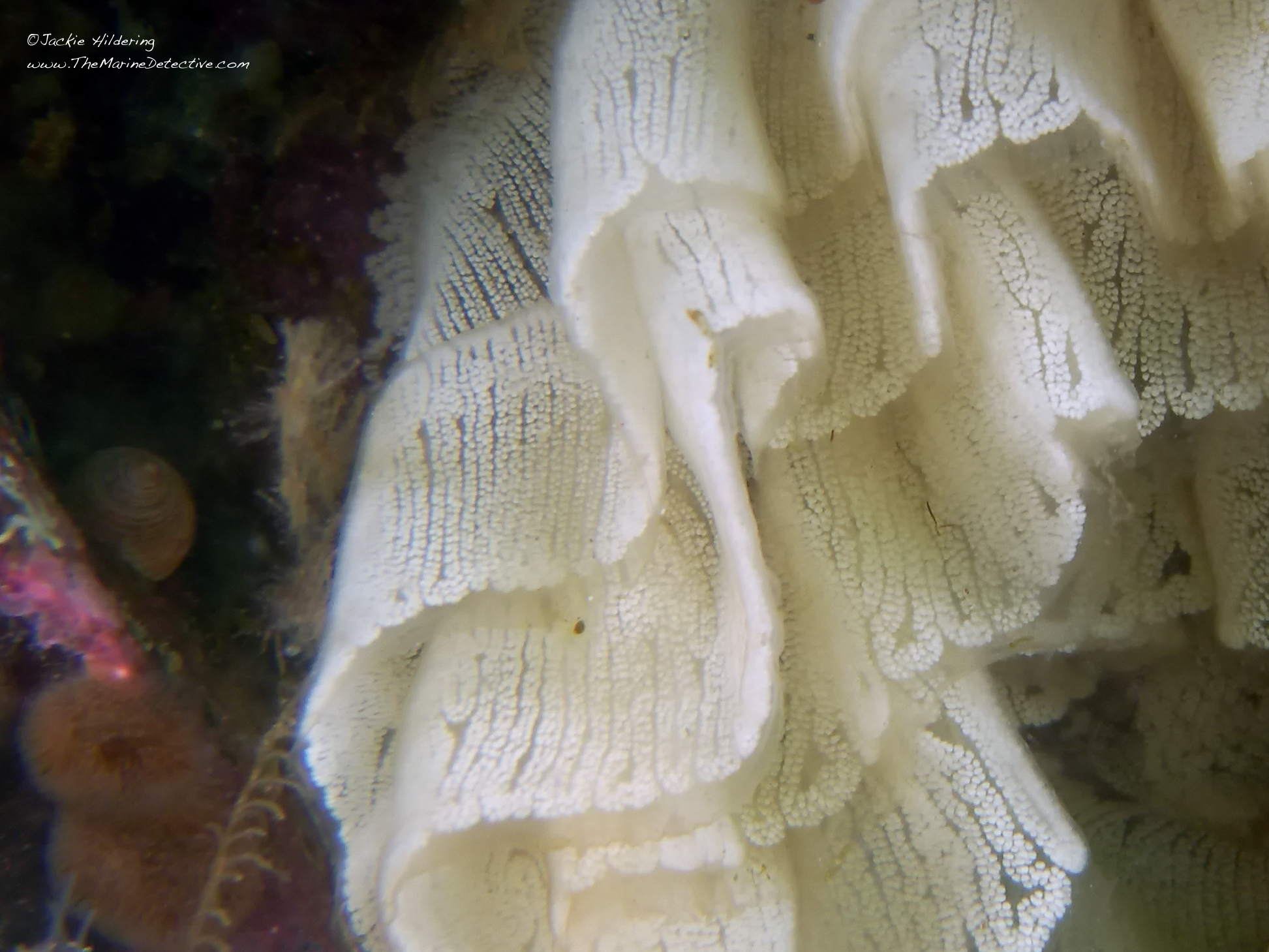
The image here is the egg mass of the Pacific Sea Lemon (Peltodoris nobilis), a sea slug up to 20+ cm. It’s egg mass is up to some 20 cm as well. Every little dot you see contains up to 20 fertilized eggs. So many eggs are needed when your young are hatched into the planktonic soup of the sea.
The egg mass is the result of the Sea Lemons lining up right-side-to-right-side and both becoming fertilized. Being a hermaphrodite is of course a good design when you are a slow-moving slug that relies on smell to find its way. More detailed information about sea slug mating can be found at this previous TMD blog entry.
Looking like rich, textured crocheting, the egg mass is indeed Nature’s exquisite handiwork. Its intricacy rivals that of any spider’s web and, in my perception, surpasses any human nanotechnology.
Seeing such beauty serves as testimony of Nature’s perfection and complexity. How we humans are newcomers to it all, unable to truly grasp the billions of years of design that proceeded our walking upright on earth. It should further motivate us all to walk with much smaller footprints so that we do not blunder and crush the systems that are Nature’s exquisite handiwork.
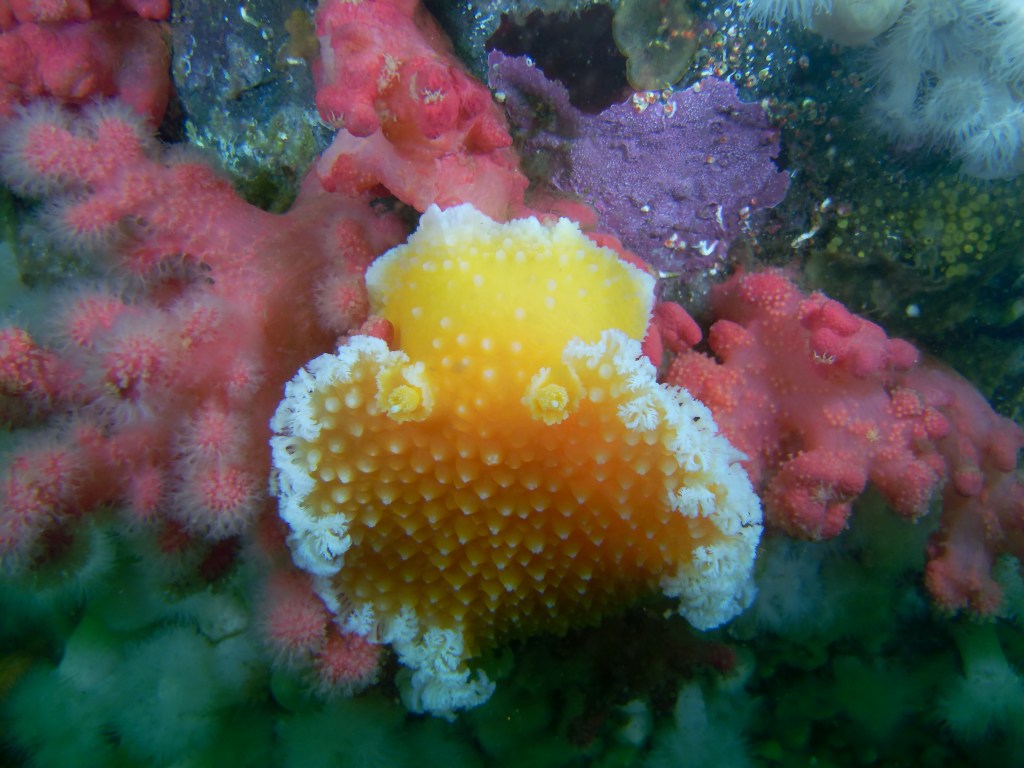
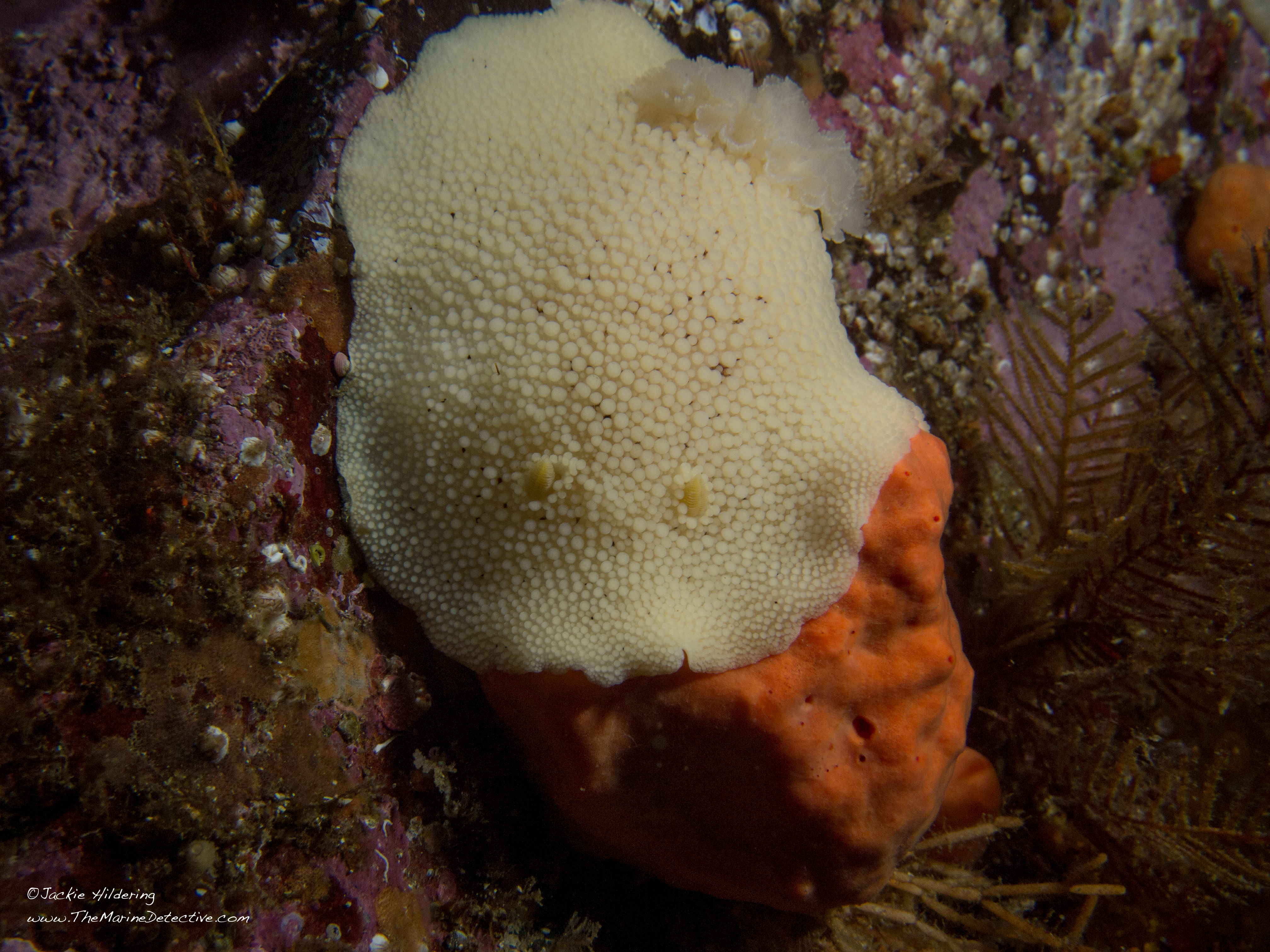
Note: The Sea Lemon is often mistaken for other dorid species such as the Monterey Dorid (Doris montereyensis). The easiest way to ID them correctly is to know that Pacific Sea Lemons have white gills. See the photos below and note how, although the body colour can be different, the colour of the gills is always white. The gills of the Monterey Dorid are yellow. The other difference, albeit more subtle, is that the little brown bits of colour do not extend to the top of the tubercles in Pacific Sea Lemons and the brown does go to the tips in Monterey Dorids. The tubercles are those bumpy little structures all over the sea slugs. Also, every sea slug species’ egg masses looks different which provides further ID clues. The egg masses of Monterey Dorids are not quite as intricate.
[Update 2020: I promise I will provide a blog showing the differences in IDs and egg masses of Pacific Sea Lemons, Monterey Dorids AND two more species which add to the ID confusion – Freckled Sea Lemons and Heath’s Dorids. Just need a bit of time!]
Close up on a Pacific Sea Lemon’s (Peltodoris nobilis) egg mass. Every dot contains up to 20 fertilized eggs.
Peltodoris nobilis egg laying (note the Brittle Star arms coming out of the crack).
Peltodoris nobilis mating – always right side to right side in slugs with gonopores linked so both become inseminated and lay eggs = simultaneous hermaphrodites.
The following photos give more of a sense of the variation in colour in this species.
More mating and eggs masses
3 Pacific Sea Lemons, two mating, one egg mass. Individuals appear to lay multiple egg masses to increase the chances of young surviving to adulthood. Not the white gills.
Mating. These two were right beside the egg mass in the following photo.
Come on. You know you want to, just for 3 minutes.
Come on the dives I did today.
The little slide show I have put together, is a testimony to the grand, jaw-dropping biodiversity of this area (Northern Vancouver Island, B,C., CANADA).
The Minke whale we saw, the fish using a sponge as a hammock, the bald eagle chick that took one of its first flights – all these are animals that I have learned from by knowing a small part of the world’s ocean well enough to be able to recognize individual animals.
Such a privilege and such a joy to share with you.
Globally, more than 1,300 species have been identified.
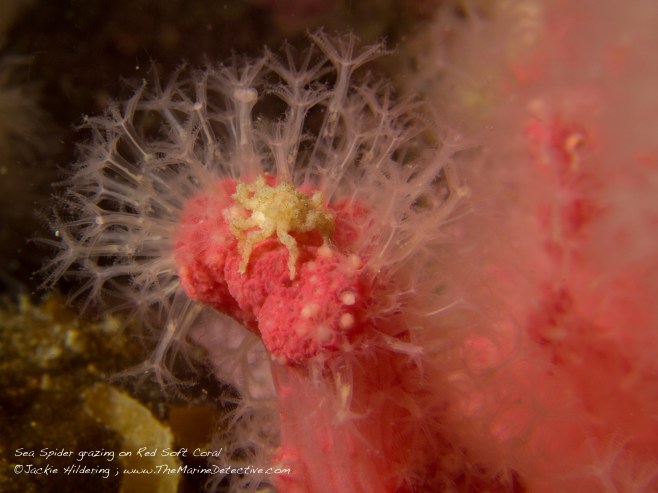
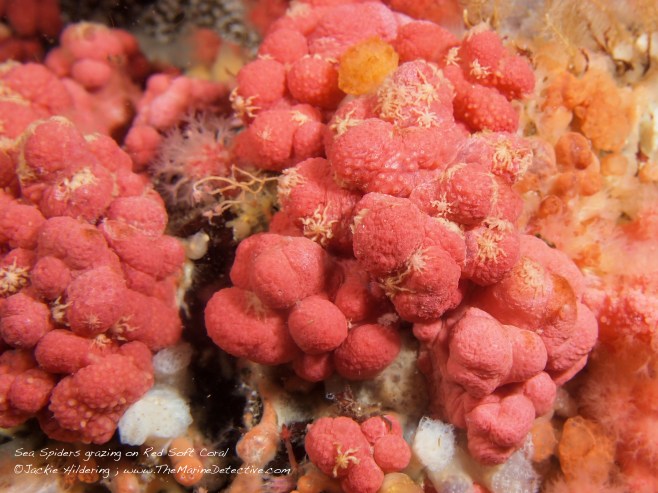
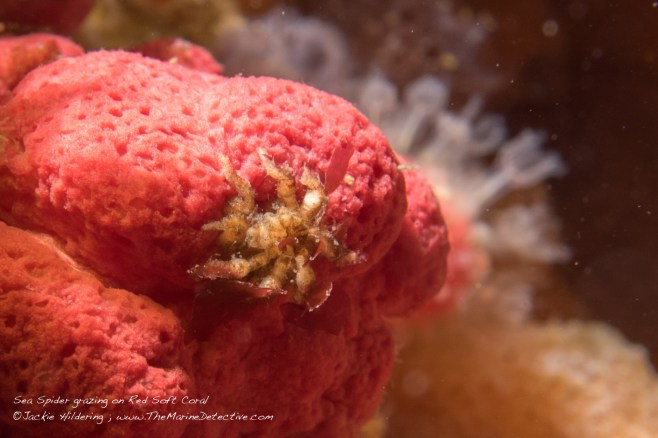
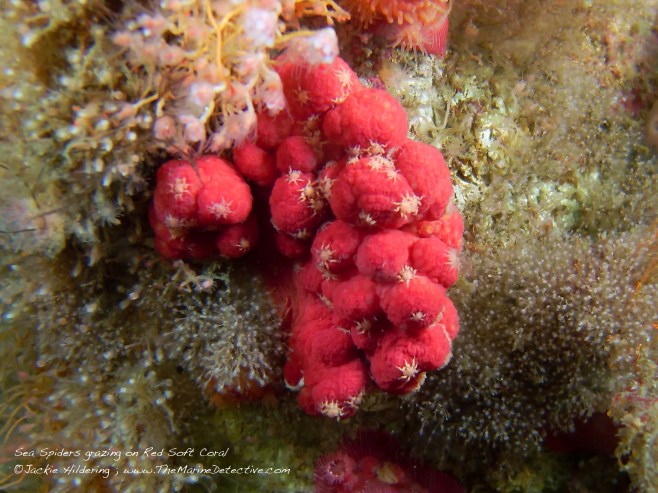
Yellow Hairy Sea Spider likely grazing on the polyps of Red Soft Coral.
But, even though they are invertebrates with jointed legs (arthropods) and most have 8 legs, they are not spiders (arachnids). They are also not crustaceans. They are classified into the a distinct group of arthropods – the chelicerate subphylum. The particular species you see in these images, belongs in the subgrouping (order) called the “pantapoda”. That’s Latin for “all legs”. It’s a good name since this species has almost no abdomen.
“All legs” indeed. Yellow Hairy Sea Spiders on retracted / deflated Red Soft Coral.
They have a mouth part called a proboscis, a flexible tube that they use to mix digestive chemicals with their food and then suck it up.
Yellow Hairy Sea Spider appears to have “decorated” himself with algae.
Some species have additional leg-like appendages near their mouths. Often only the male has these structures so that they can take care of the eggs by carrying them.
The species pictured here are those I see most often around northeast Vancouver Island and they are only about 1 cm across. They have been given the common name “Yellow Hairy Sea Spider” (Tanystylum grossifemorum).
The hairy parts are believed to help the animals feel and sense chemicals.
I have only ever seen this sea spider species on Red Soft Coral colonies (Gersimia rubiformis). They appear to feed on the bushy polyps of the soft coral. As defence, the polyps can retract and have stinging cells but this seems to do little to deter the sea spiders.
One of the things I find fascinating about sea spiders is that they have a very thin external skeleton (exoskeleton) and as a result don’t need a respiratory system; they can “breath” through their skins.
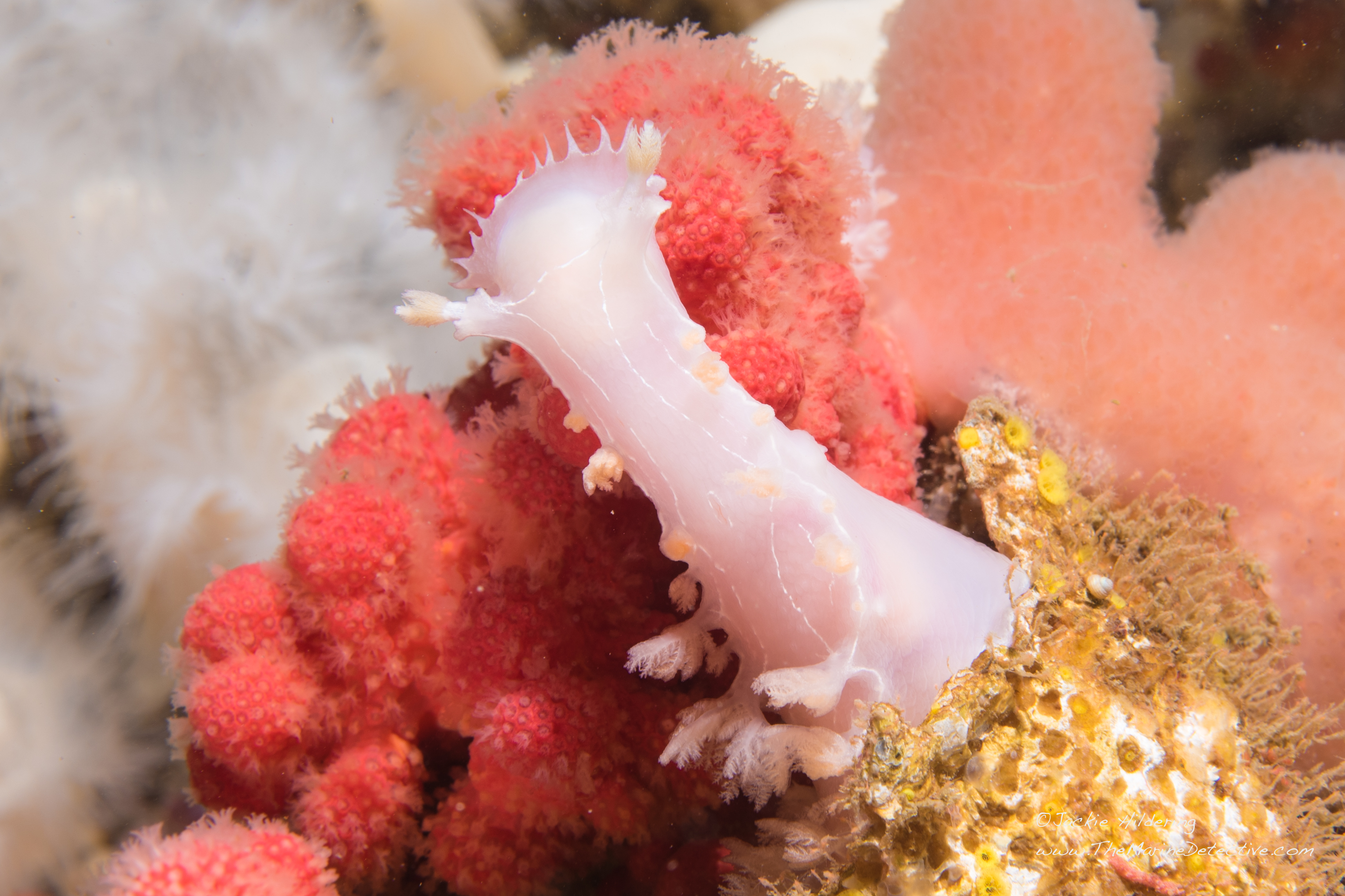
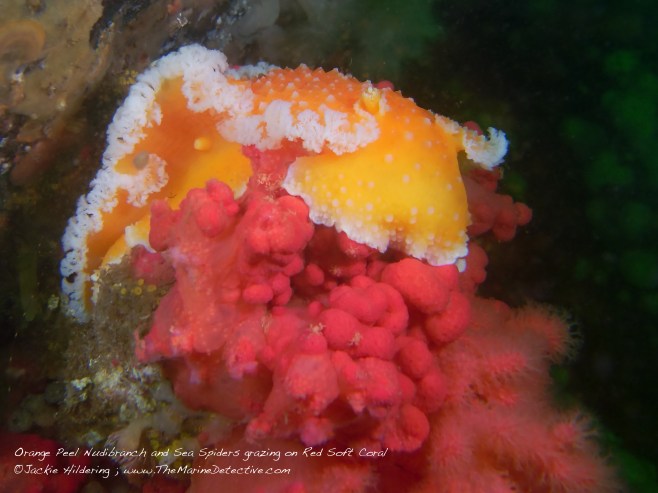
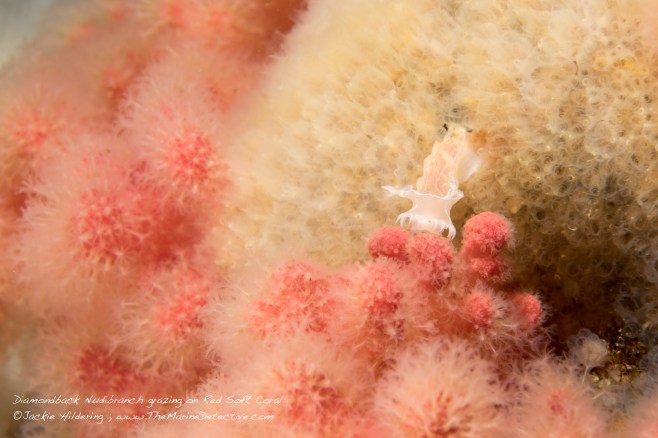
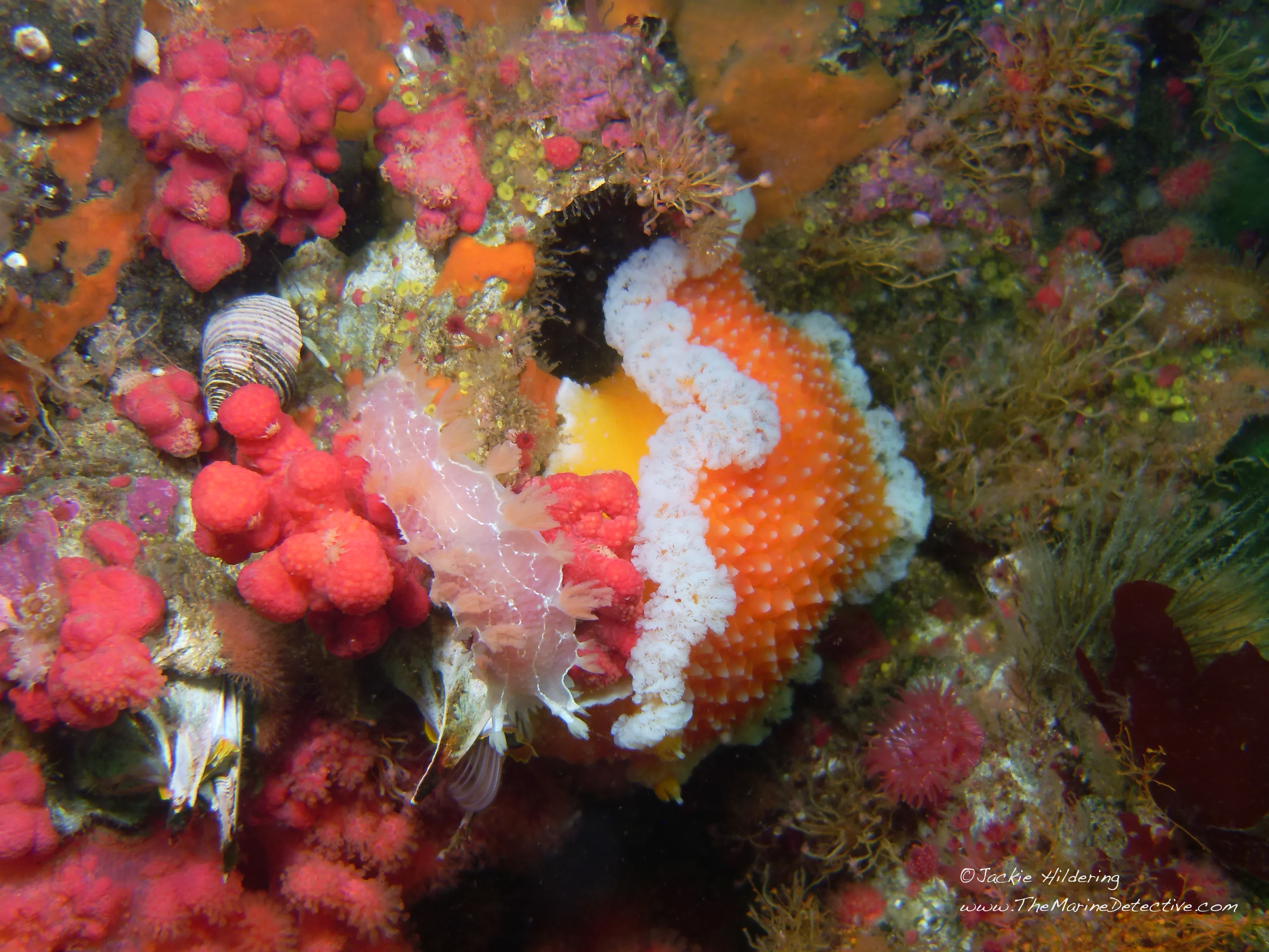
Nudibranch species that also feed on Red Soft Coral include the Diamondback Nudibranch (Tritonia festiva to 10 cm) and the Orange Peel Nudibranch (Tochuina gigantea to 30 cm).
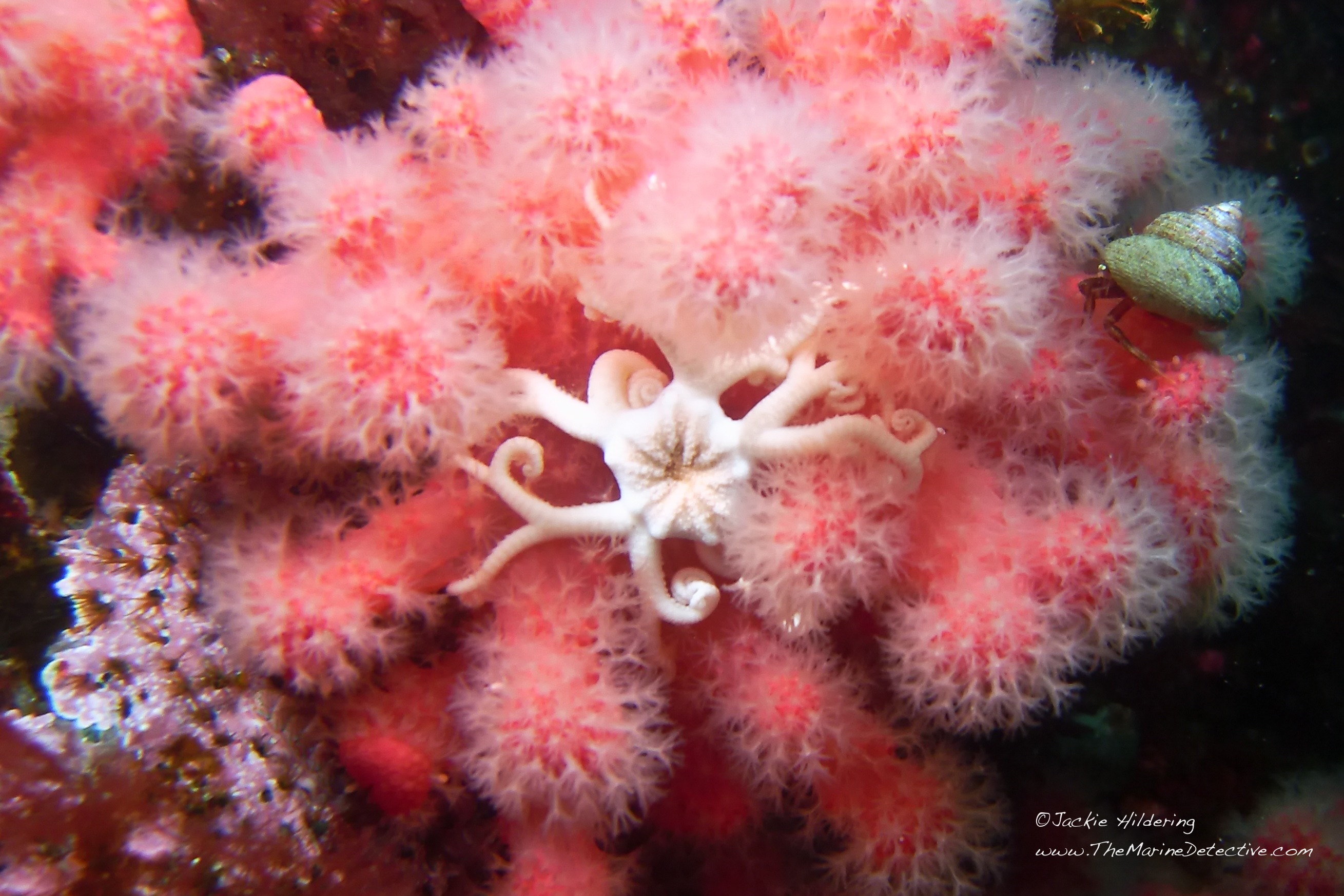
As an aside, there is also a fascinating association between Red Soft Coral and Basket Stars (Gorgonocephalus eucnemis). See below. Basket Star embryos develop INSIDE the polyps of the soft coral! It’s also thought the embryos feed on the soft coral’s eggs which brood inside the parent. When juvenile Basket Stars emerge from the coral’s polyps, they hang onto the outside till about 3 mm in disk diameter. Then, they crawl onto an adult Basket Star, shuffling off when approx. 5 cm. When adult Basket Stars’ 5 seeming infinitely branched arms are fully outstretched, width is up to 75 cm. Age is up to 35 years.
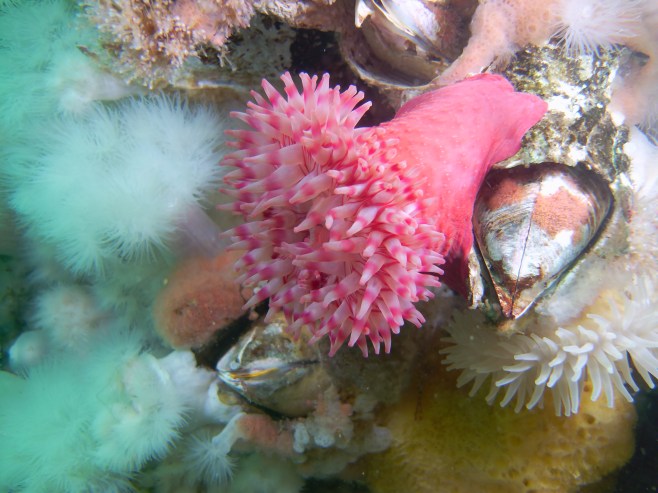
Swimming anemone at Stubbs Island, N. Vancouver Island, BC
Today there was quite a small tidal exchange which allowed us to dive a more challenging site, Stubbs Island.
On larger tides, this island receives so much current that eddies and big upwellings form. All this churning water means there is abundant oxygen and plankton delivery so the density of marine-life on Stubbs Island is truly mind-blowing. There isn’t a centimetre of rock that does not have something growing on it.
I would like to share my images from this dive today. I hope they give a sense of the awe-inspiring beauty and biodiversity of our Northern Vancouver Island marine “backyard”.