How does studying whale acoustics lead to increased knowledge about the depth range of nudibranchs?
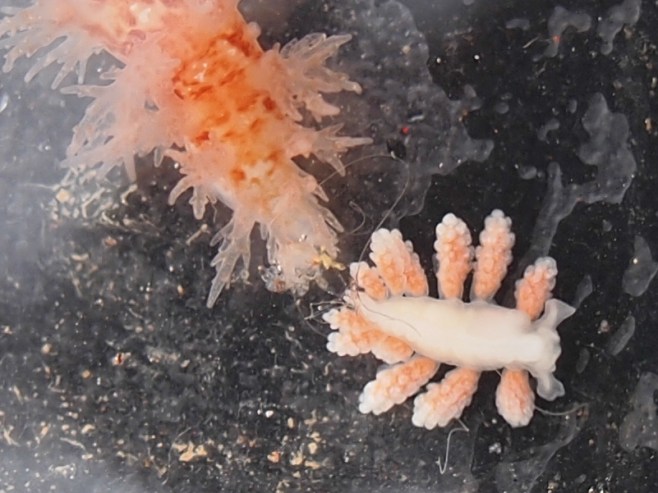
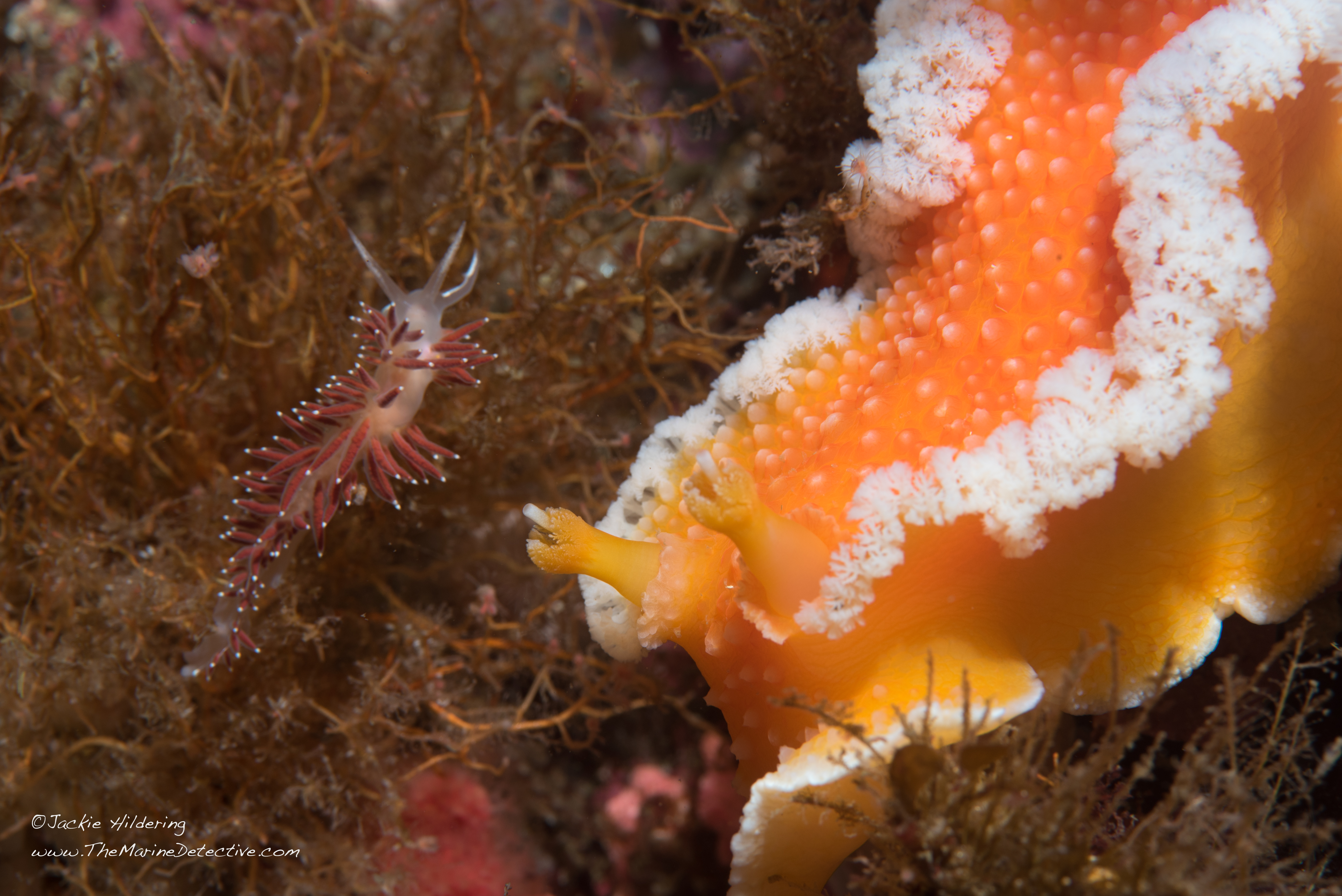
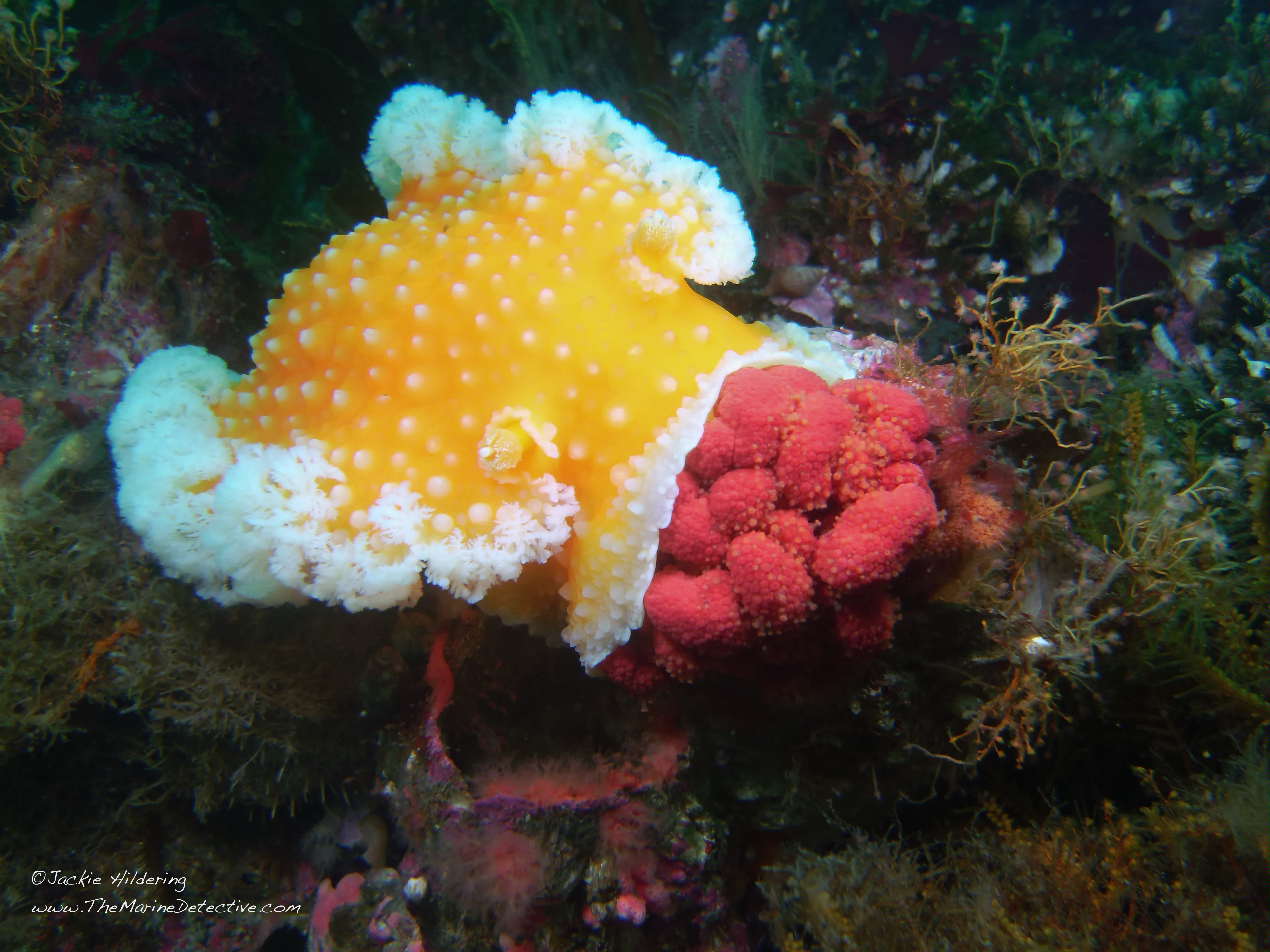
Just a little more is now known about the orange doto’s depth range. Photo: Hildering.
Let me take you deep and share an experience from my recent time offshore in the eastern North Pacific on a DFO cetacean survey.
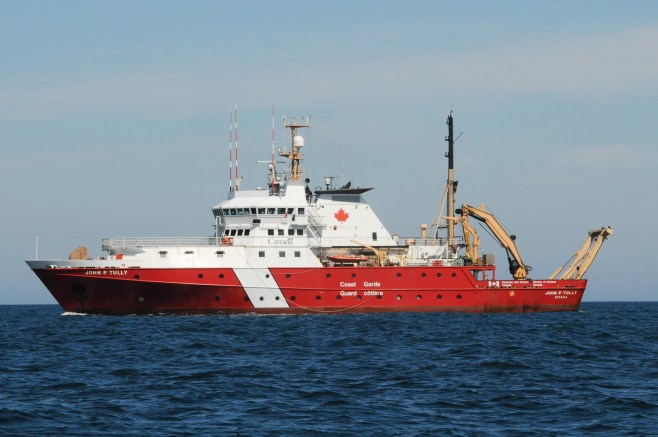
This is the Canadian Coast Guard Ship – the J.P. Tully.
CCGS J.P. Tully. Photo: Hildering
Among the offshore science expeditions undertaken upon the Tully, are surveys by DFO’s Cetacean Research Program. These line transect studies provide an estimate of cetacean abundance, as well as an opportunity to ID individual whales and collect feeding and genetic information. The knowledge about abundance and location is of particular importance for the large whales that were hunted so intensely and require protection under Canada’s Species at Risk Act.
These are Autonomous Underwater Recorders for Acoustic Listening (AURAL-M2s).
AURAL-M2s. Photo: Sheila Thornton.
AURALs are hydrophones that can be deployed to 300 m, making time-spaced recordings (e.g. 15 minutes every hour) for up to a year. Such acoustic monitoring is a very important supplement to the cetacean vessel surveys. The AURALs are of course placed very strategically, in remote, offshore locations. By passively recording whale calls, the AURALs can provide information about the location and seasonality of whale species which may aid in determining critical habitat.
The AURALs are a wonder of technology. It is of course no problem to get something to the bottom of the ocean but, getting it back to the surface so you can retrieve your equipment and data is not so simple. It is achieved with an acoustic release (“D” in the diagram below). Once the vessel is positioned so that there is no chance of the device coming up under it, a sound signal is sent to the device and the AURAL releases from its anchor and floats to the surface thanks to the big yellow buoy.
AURAL-M2. Click to see an enlarged, labeled schematic on the Multi-Electronique webpage.
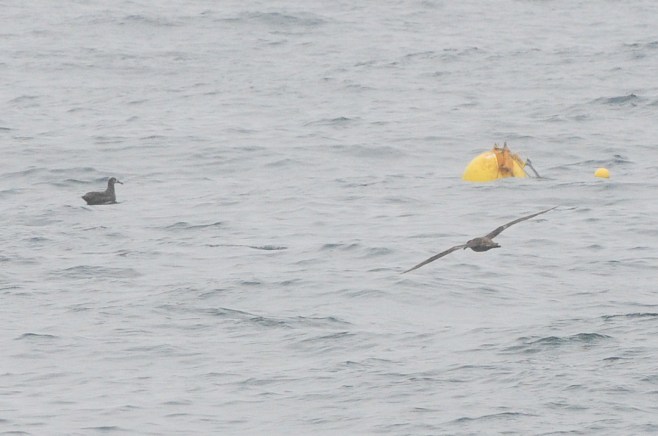
These are two perplexed black-footed albatrosses! A big yellow orb has just popped up to the surface as a result of the acoustic release signal. This AURAL was at 226 m depth at the Bowie Seamount, 180 km west of Haida Gwaii. It had been there for a year.
Black-footed albatross just after the buoy with the AURAL recording device came up from 226 m.
Here, the highly skilled Coast Guard crew get the AURAL back aboard the ship so that the data can be retrieved and, ultimately, analyzed for whale vocals.
Coast Guard deck crew expertly retrieves the AURAL. Photo: Hildering
But, there was also a year’s worth of growth on the buoy and who knows what you might find . . .
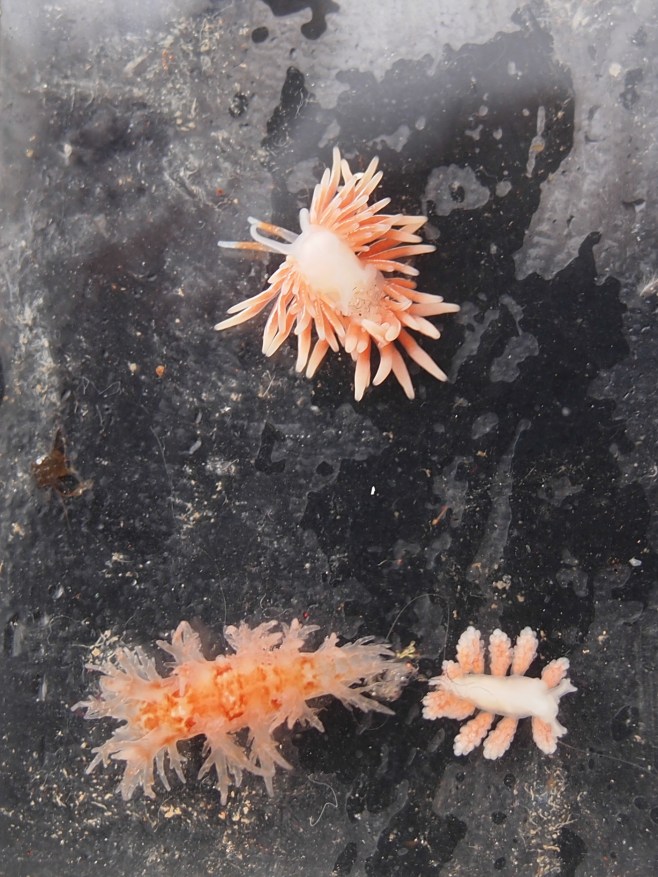
Nudibranchs! Three species found and even one species with eggs!
3 nudibranch species on the AURAL that had been at 226 m. BC aeolid; bushy-backed nudibranch and orange doto. Click to enlarge. Photo: Hildering.
Top: BC aeolid (Catriona columbiana to 1.5 cm); eggs also found.
By examining the AURAL that had been at 226 m, it confirms that these 3 species of nudibranch have a range to at least that depth.
Sheila Thornton (marine mammal researcher and fellow nudibranch nut) providing a size comparison for the BC aeolids and their egg masses that were found on the AURAL. Click to enlarge. Photo: Hildering
I shared the find with those who have nudibranch expertise much greater than my own (Dave Behrens via Andy Lamb) and learned that for two of the species, there had been no previous record for them at this depth.
It has long been known that some nudibranch species range to depths of at least 700 m. However, you can imagine what a a challenge it is to get species specific depth information. We camera carrying scuba divers can’t help beyond 40 m depth (deeper if diving with mixed gases).
So it’s not a big scientific discovery. Compared to the data the AURAL will reveal about endangered whales, it’s just a sea-slug-sized discovery.
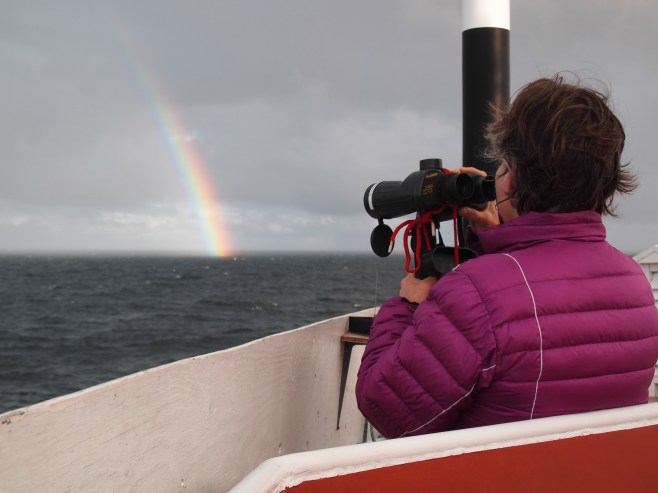
This is me – back on survey duty looking for much bigger organisms but delighting in how collecting data to help save whales, led to learning a bit more about the little guys.
Spotter duty on the DFO Cetacean Program’s offshore survey. July 2013. Christie McMillan photo.
This is a Brooding Anemone (Epiactis lisbethae to 8 cm across).
She may not have a backbone but she’s a Super Mom!
As many as 300 young can be clustered around her in up to 5 rows, benefitting from the protective canopy of her tentacles which contain stinging cells (nematocysts). The offspring remain here until big enough to stand a good chance of surviving on their own. They then crawl toward independence, claiming their own piece of the ocean bottom.
I am awestruck by this species’ beauty and reproductive strategy. It is also a reminder of how little we know about marine species that the Brooding Anemone was not recognized as a distinct species until fairly recently (1986), and it still so often gets confused with the Proliferating Anemone (Epiactis prolifera).
I share my marine “detectiving” about this species with you to provide a further example of how extraordinary our marine neighbours are and maybe, thereby, help inspire greater conservation efforts.
But yes, the timing of the blog is no accident. It may be that reflection upon an anemone Super Mom stimulates thought about our human mothers – just in time for Mother’s Day.
So here goes . . . bear with me as I build to clarifying the reproduction of our featured species.
Anemones have many reproductive strategies.
For many species, reproduction can be asexual as well as sexual with strategies like budding off offspring; splitting into two; or pedal laceration where a torn piece of the bottom of the anemone can grow into another anemone!
Some species are hermaphrodites with highly diverse ways by which offspring develop into adults.
In species that have separate sexes, many are broadcast spawners where Mom and Dad release their eggs and sperm into the ocean around them. Fertilization and development thereby happens in the water column.
Then, for only some 20 species of the world’s more than 800 kinds of anemone, there are those in which the female captures the males’ sex cells as they drift by and draws them into her digestive cavity to fertilize her eggs. She “broods’ her young.
Some such anemone species are internal brooders. The young develop inside Mom until they hatch and are expelled into the water column as planktonic larvae.
But then there’s Super Mom – the Brooding Anemone (Epiactis lisbethae). She’s an external brooder.
After she has fertilized the eggs inside her digestive cavity with the sperm she has captured, the young develop inside her until they hatch into planktonic larvae. THEN, they swim out of her mouth, settle on her body under the tentacles and grow into little anemones that feed themselves.
When the offspring are big enough to stand a good chance of survival without the protection of Mom’s tentacles, they shuffle away to independence, leaving space for next season’s young.
The brooding anemone’s young are all of the same generation and are therefore all about the same size.
However, there is a second externally brooding anemone species in the eastern North Pacific where you most often see young of different sizes huddled under Mom’s tentacles. This species – the Proliferating Anemone (Epiactis prolifera) is the one that very, very frequently gets confused with the Brooding Anemone.
A
Proliferating Anemone with young (Epiactis prolifera). Often confused with the Brooding Anemone (Epiactis lisbethae).
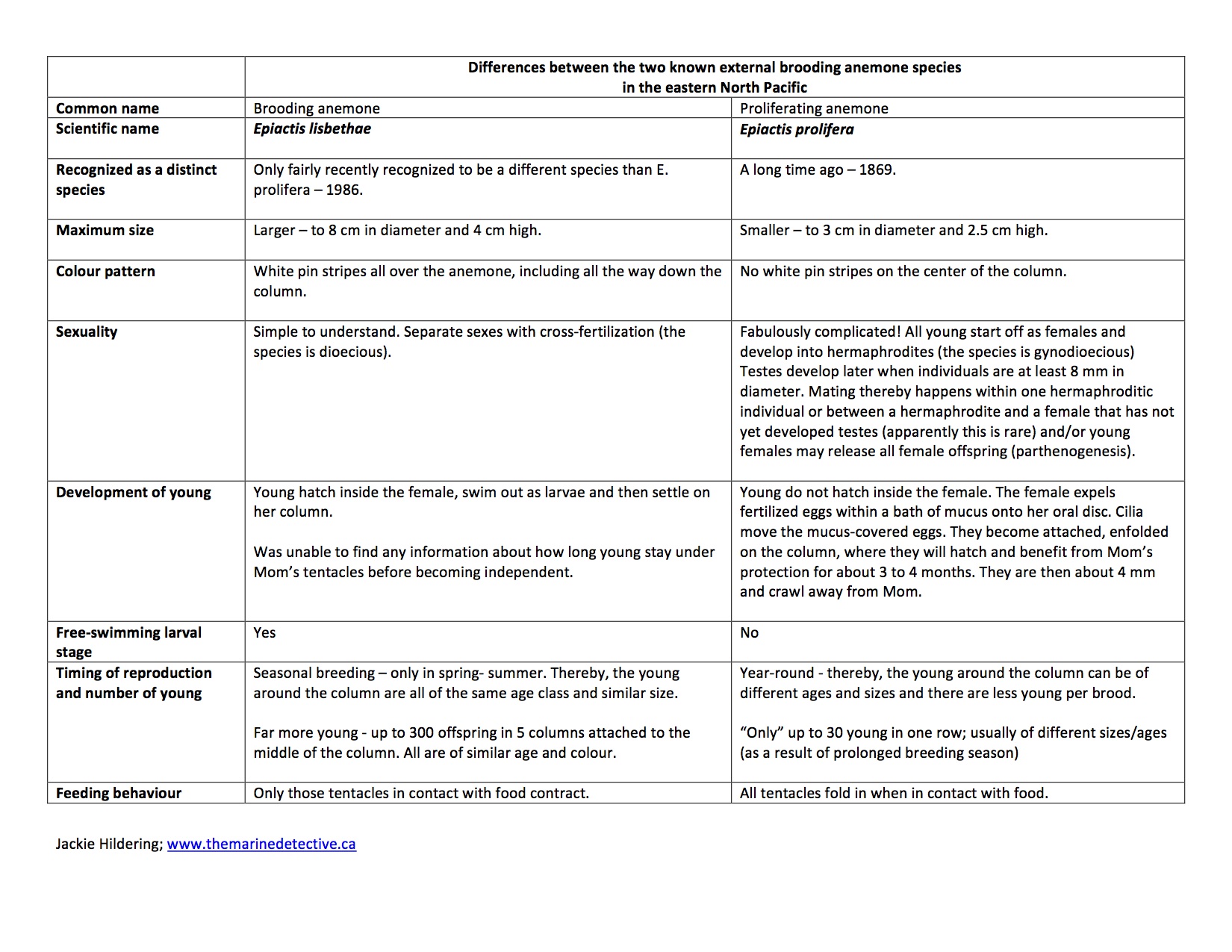
I have strived to clarify the many differences between these two externally brooding anemone species in the table below but to summarize: the Proliferating Anemone is smaller and does not have striping all the way down the column; adults are hermaphrodites; breeding happens year round; there are far fewer young clustered under mom’s tentacles; and they start off there as fertilized eggs, not as free-swimming larva.
The main similarity between these two species is and yes, I am going to use a tongue twister here since I believe it is inevitable when discussing anemones: with anemone mothers like these, baby anemones are protected from their anemone enemies!
Now off you go, share some ocean love with a Super Mom!
There are so many human females out there worthy of awe. Where, were we to consider how many young they have shielded and helped to independence, the number might well be 300 or more!
Click to enlarge. Table summarizing the differences between Brooding and Proliferating Anemones.
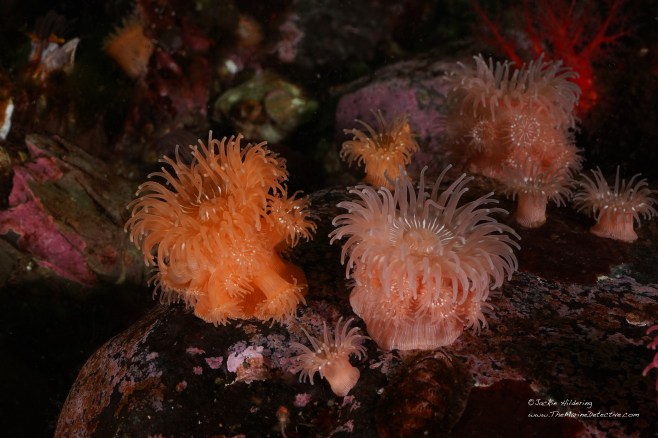
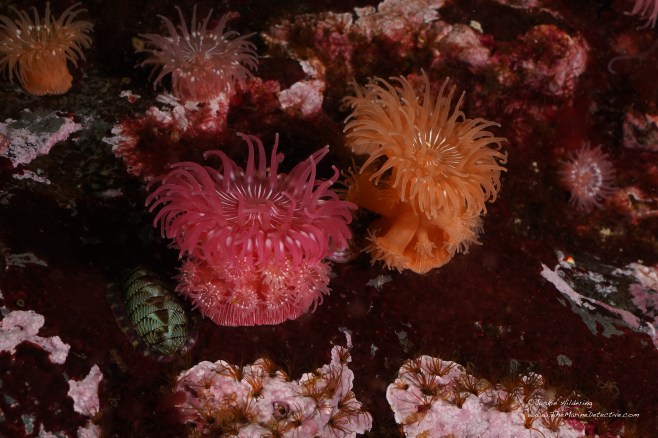
Next 3 photos show Proliferating Anemone babies under their mother’s tentacles, some shuffling off after 3 to 4 months there. Epiactis prolifera – often confused with the Brooding Anemone.
Updated with photos: 2025-12-18 An egg hunt mystery FINALLY came to an end for me, coincidentally, just before Easter when many of you were involved in egg hunts too.
I dare say however that my hunt involved vastly more beautiful eggs; that the hunt was much more challenging and – ultimately, much more rewarding!
One of my very, very favourite things to do, satisfying my “The Marine Detective” nature, is to solve the ultimate “whodunit” and match sea slug species with their egg masses / ribbons.
Every sea slug species’ egg mass is distinct, comprising a fascinating diversity of intoxicatingly beautiful shapes and patterns.
It delights me (for reasons I can’t fully explain) that for many sea slugs in the northeast Pacific Ocean, I am able to see an egg mass and immediately know which species laid it.
There are big clues because sea slugs most often lay eggs on their food. So if I know their prey preference I can narrow down which species laid the eggs.
Easiest of course is to have have the good fortune to find a sea slug in the act of laying their eggs.
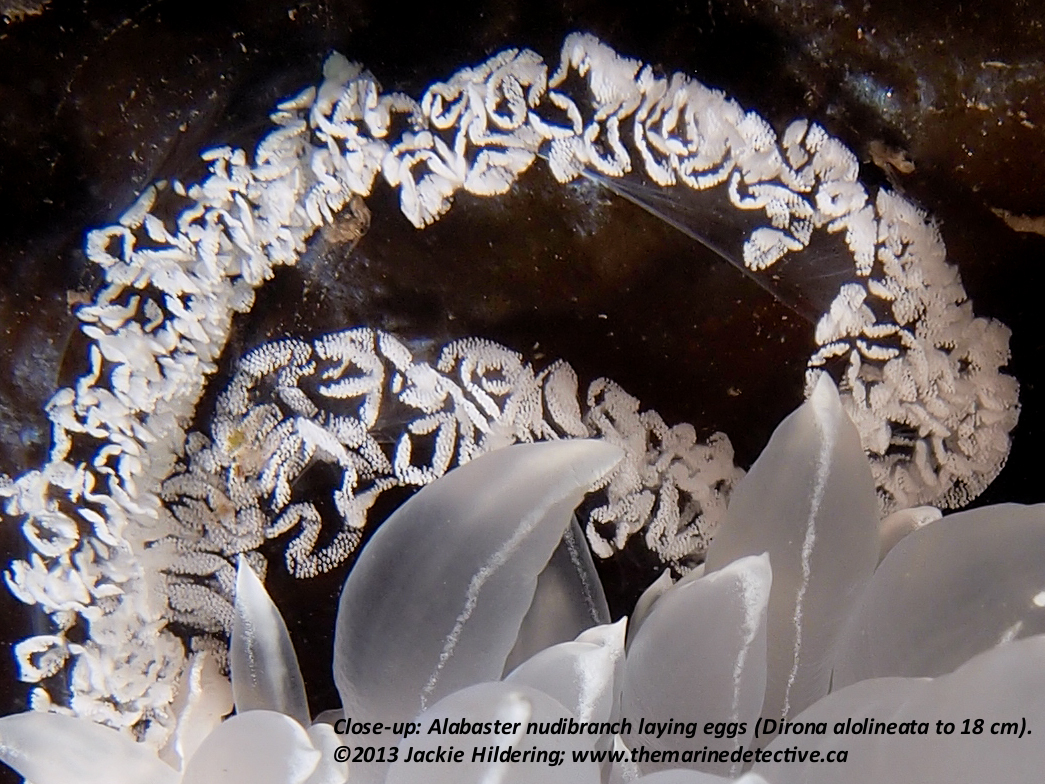
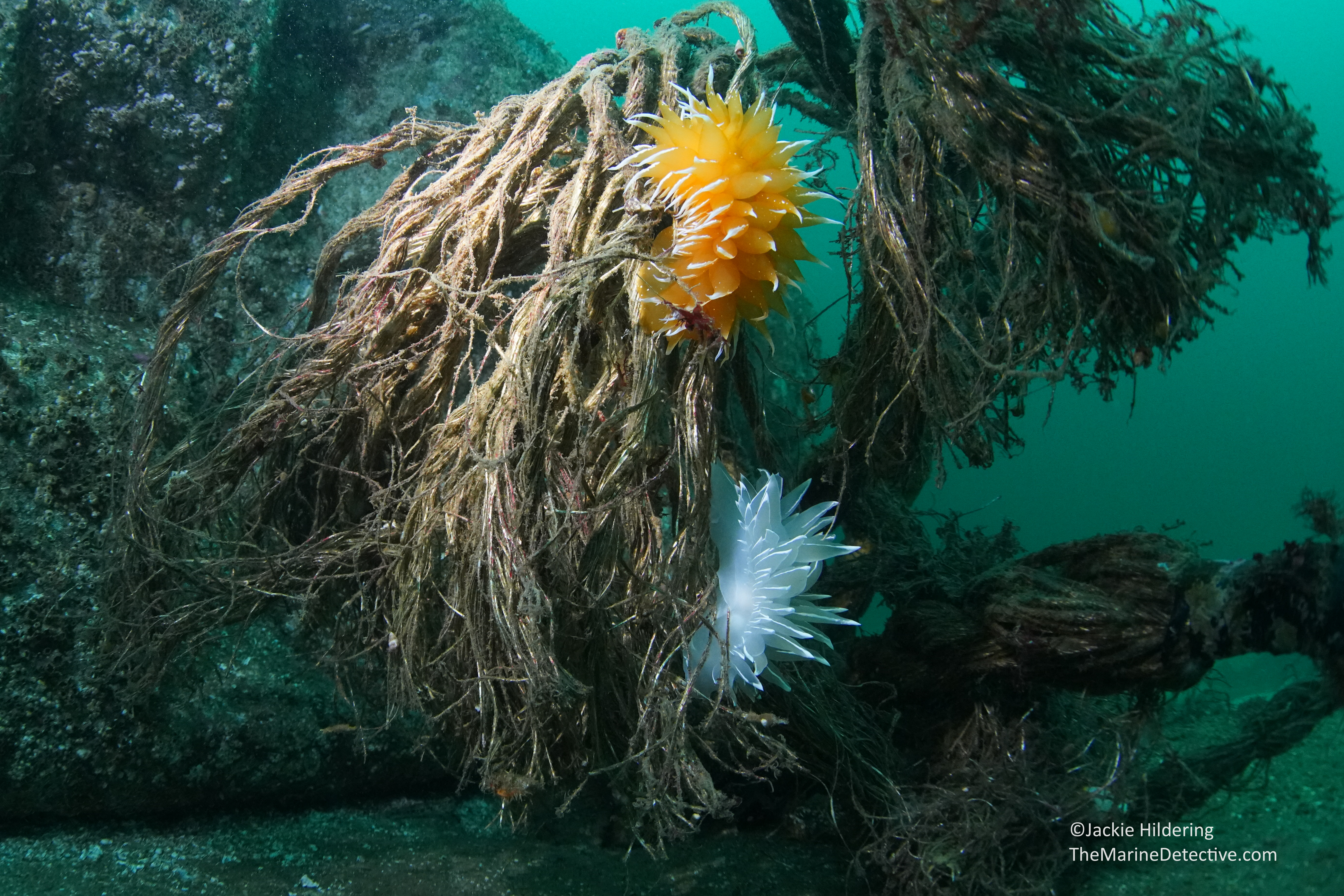
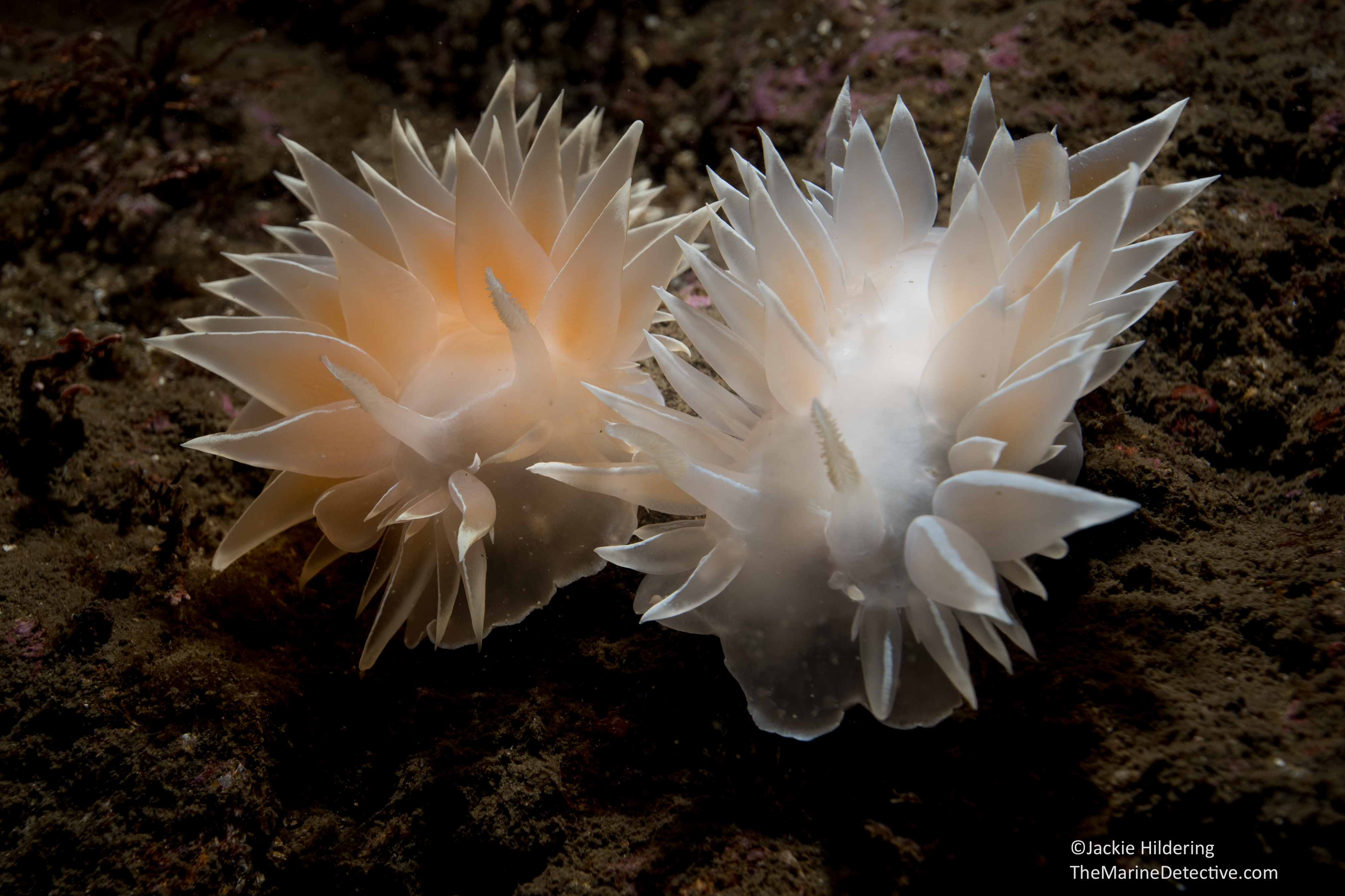
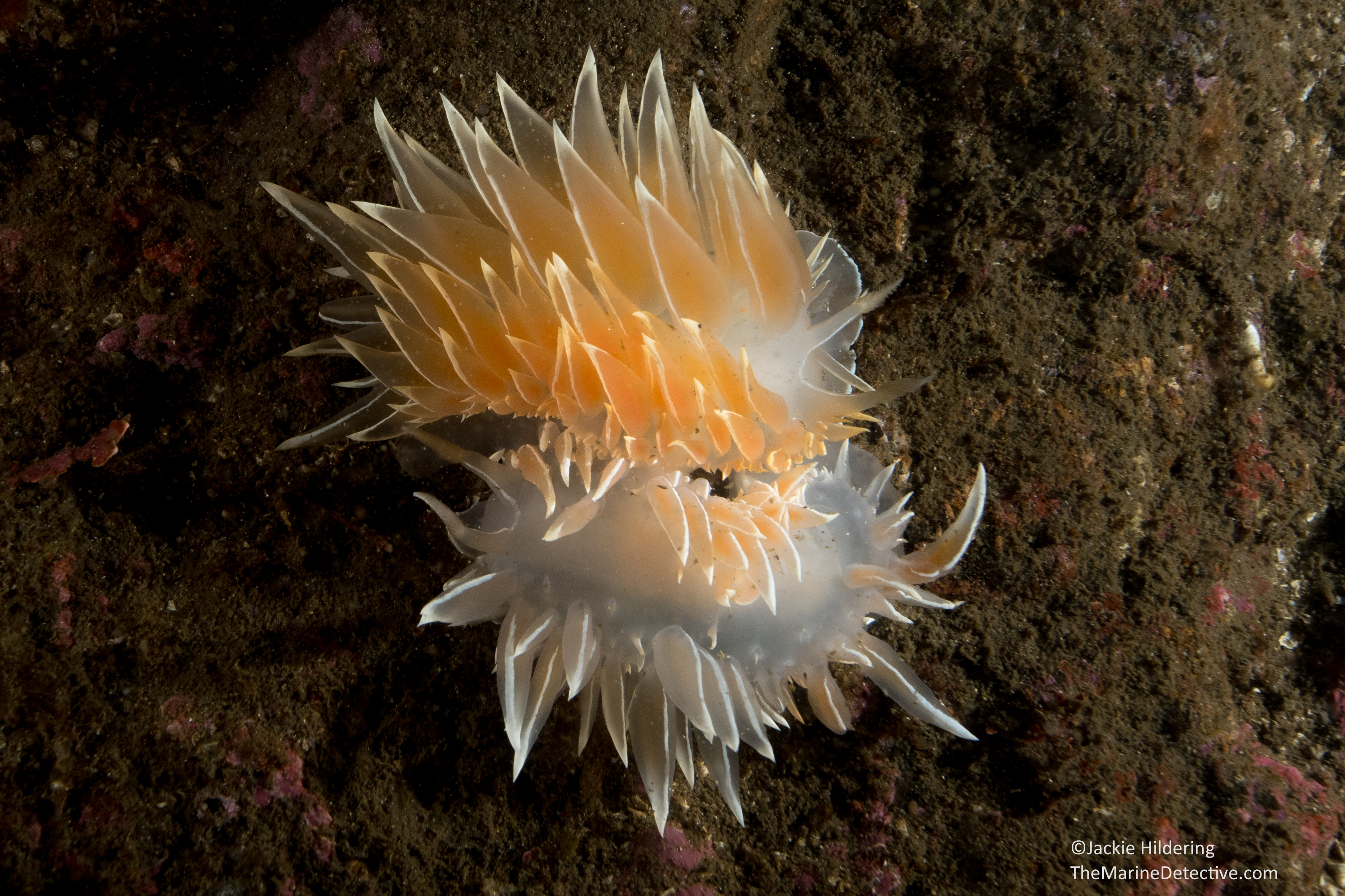
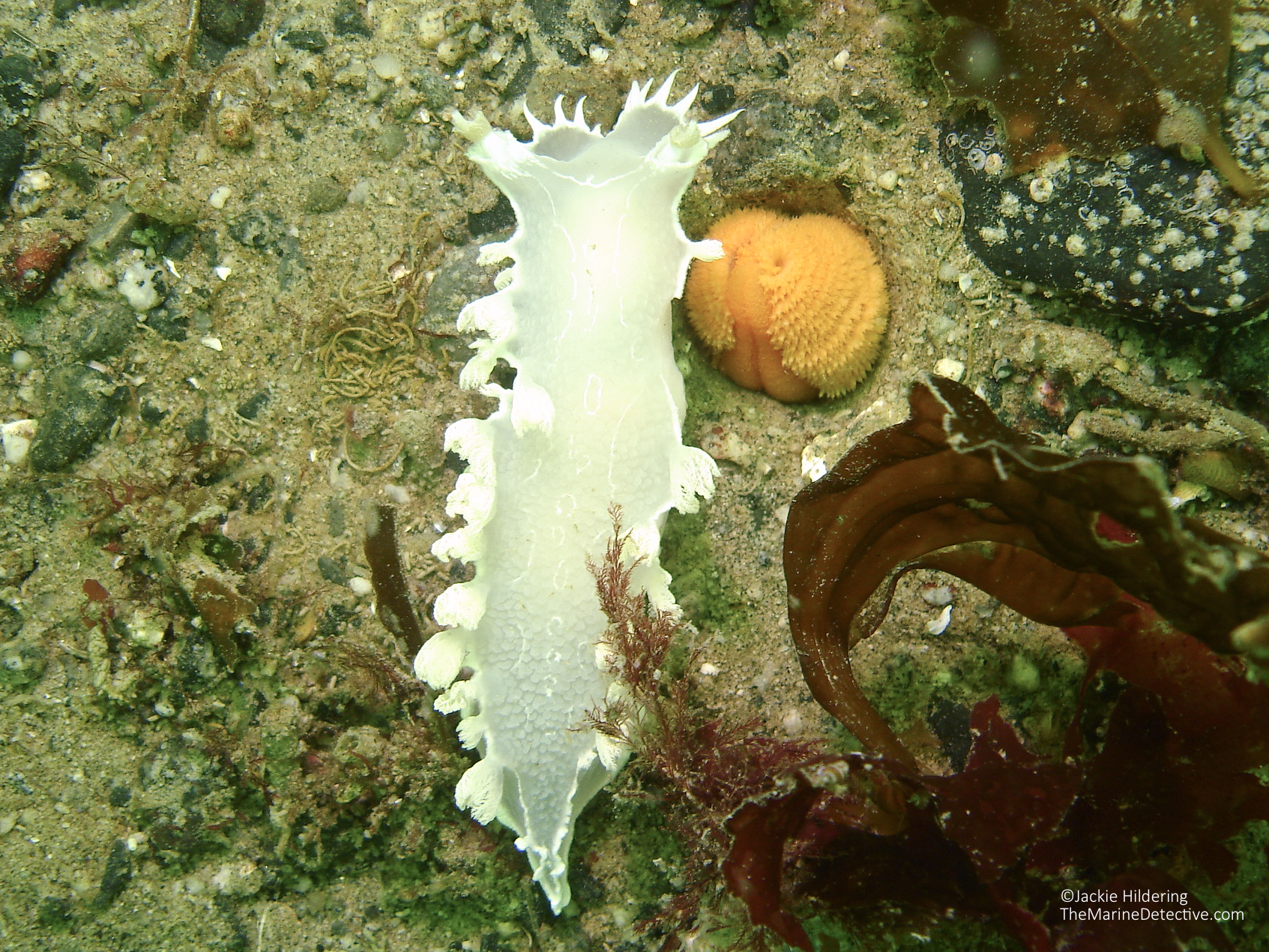
But for YEARS, I have been unable to differentiate the egg masses of two of the most beautiful sea slug species in these waters – the Gold Dirona (Dirona pellucida to 12 cm) and the Alabaster Nudibranch (Dirona albolineata to 18 cm and also referenced as the “White-Lined Dirona” or “Frosted Nudibranch”).
You’ll note that they are very closely related (same genus) and it is thereby not surprising that their egg masses would look very similar. Both also often lay their eggs on the same species of Agarum kelp. In all these years, while I have often found both species mating, I have never found either species laying their eggs.
But then, this week . . . just when I was noting the abundance of both species, how many egg masses there were and wishing, WISHING, I could find just one of them laying eggs – my dear dive buddy Jacqui Engel waved me over and pointed out a Gold Dirona laying eggs.
I was so jubilant, I screamed underwater. Yes, I am The Marine Detective for a reason, such things really do delight me to this degree.
Finally! Mystery solved, I would be able to differentiate the egg masses of the two species.
But then, Nature was even kinder to me.
On the very same day on the very same dive, after so many years, I also stumbled across an Alabaster Nudibranch laying eggs!
Disbelief! Joy! Manic photo-taking!
I think you may marvel at how very similar the masses are but the difference, at least to me is clear.
The “pieces” of the Gold Dirona’s egg mass are more compact and more like rice kernels.
The segments of the Alabaster Nudibranch’s egg masses are more scallop-edged and diffuse.
Please know that these differences would not be as clear if the eggs were older.
It’s estimated that there are ~350,000 eggs in one Alabaster Nudibranch egg mass. Source: WallaWallaEd. I do not know if this is the number of egg capsules (the dots you see), or if it includes the number of eggs in each egg capsule.
Sea slugs are reciprocal hermaphrodites which means that both become inseminated and lay eggs. One individual lays more than one egg mass as well. So many eggs are needed to ensure species survival when your young hatch out to become part of the planktonic soup of the Ocean.
If you have read to this point – thank you!
Likely we are kindred in our love of marine biodiversity and the beauty that is sea slugs.
For as much as I love chocolate Easter eggs, I would forego them for the rest of my existence if it would allow my appetite for marine mysteries to be further satisfied!
I’m excited to share video with you of Gumboot Chitons spawning. These marine neighbours most often seem quite inanimate – having a life where they keep their undersides protected by sucking down hard on rocks but, when it’s time to mate . . . . .
First just a little background: “Chitons” are marine molluscs (soft bodied animals) that, rather than having one of more shells to protect themselves, they have 8 armoured plates surrounded by a thick band of muscle. This allows them to suction onto surfaces very effectively since the 8-plates give such flexibility that they can even get a good grip on surfaces that are not flat.
There are many members of the the chiton class but the Gumboot Chiton (Cryptochiton steller; aka Giant Pacific Chiton) is very unique in its appearance.
It’s another “the biggest of its kind in the world” that inhabits the cold, rich waters of the northeast Pacific. It can be 35 cm long and about 2 kg. They are very slow growing and very long lived! This source reports that chitons that are 15 cm long are likely 20 years old and that they may live to be more than 25. That’s one old gumboot!
The Gumboot Chiton is also the only chiton species that has flesh completely covering the 8 plates. The texture and colour of this “girdle” offers them great camouflage and is where the “gumboot” descriptor comes from. The genus name “Cryptochiton” relates to this camouflage and that the 8 plates are hidden under the girdle. These plates are very uniquely shaped, and well-described with the name “butterfly shells”.
Apparently some First Nations did sometimes chew on this species but I am SURE that this is not the cultural origin of some people referring to this species as “wandering meatloaf”!
I don’t know where I picked this up, but I believe that one of the First Nations’ names for gumboot chitons translates (very) loosely, into “stuck on rock with face forever”. This would be an incredibly good descriptor since most chitons stay “face” down, grazing on algae by scraping with the sharp teeth-like structures of their radula. Thereby, they don’t expose their soft bodies and reduce the chance of predation.
I once found a Gumboot Chiton that had been dislodged by a predator at low tide. It is then that I learned that they have the ability to curl up on themselves like a pill bug!
But outside of a rare experience like this, you don’t often get a chance to see how very alive and animal-like they are.
Unless . . . they are spawning.
Then, up came the bodies of the Gumboot Chitons, into a very unique funnel-like shape. The “gonadal pores” are near the bottom end of the animals, but by positioning themselves in this shape, they channel the sex cells upward.
When spawning, you can clearly see which Gumboot Chitons are male and which are female!
It was just remarkable to see this, feeling truly as if some secret world was being revealed, and the coordinated timing of the spawning was astonishing.
Of course when you are a broadcast spawner, you need to release copious amounts of sex cells and need to do so at the same time or there will be even less chance that egg meets sperm. You can imagine how many eggs need to be fertilized if any of your zooplankton offspring are going to survive since so many animals feed on plankton.
To my knowledge, science has not concluded exactly what the cues are for “Hey fellow Gumbooot Chitons, it’s spawn time NOW!” It has to be temperature, light, tide and/or amount of food that determines the time is right.
Hum . . . seems to me that those cues may be significant between individuals of our species too!
Additional images:
Chiton plates on the right are those of the Gumboot Chiton.
I had a wonderful opportunity to photograph and film a lion’s mane jellyfish (Cyanea ferruginea) today.
The 1.5 minute annotated video clip below will give context to my “Sherlock – You Are Wrong” statement. Enjoy!
Click here to see a short clip of the other big jelly species that can be found in our waters – the egg yolk jelly (Phacellophora camtschatica) at up to “only” 60 cm across.
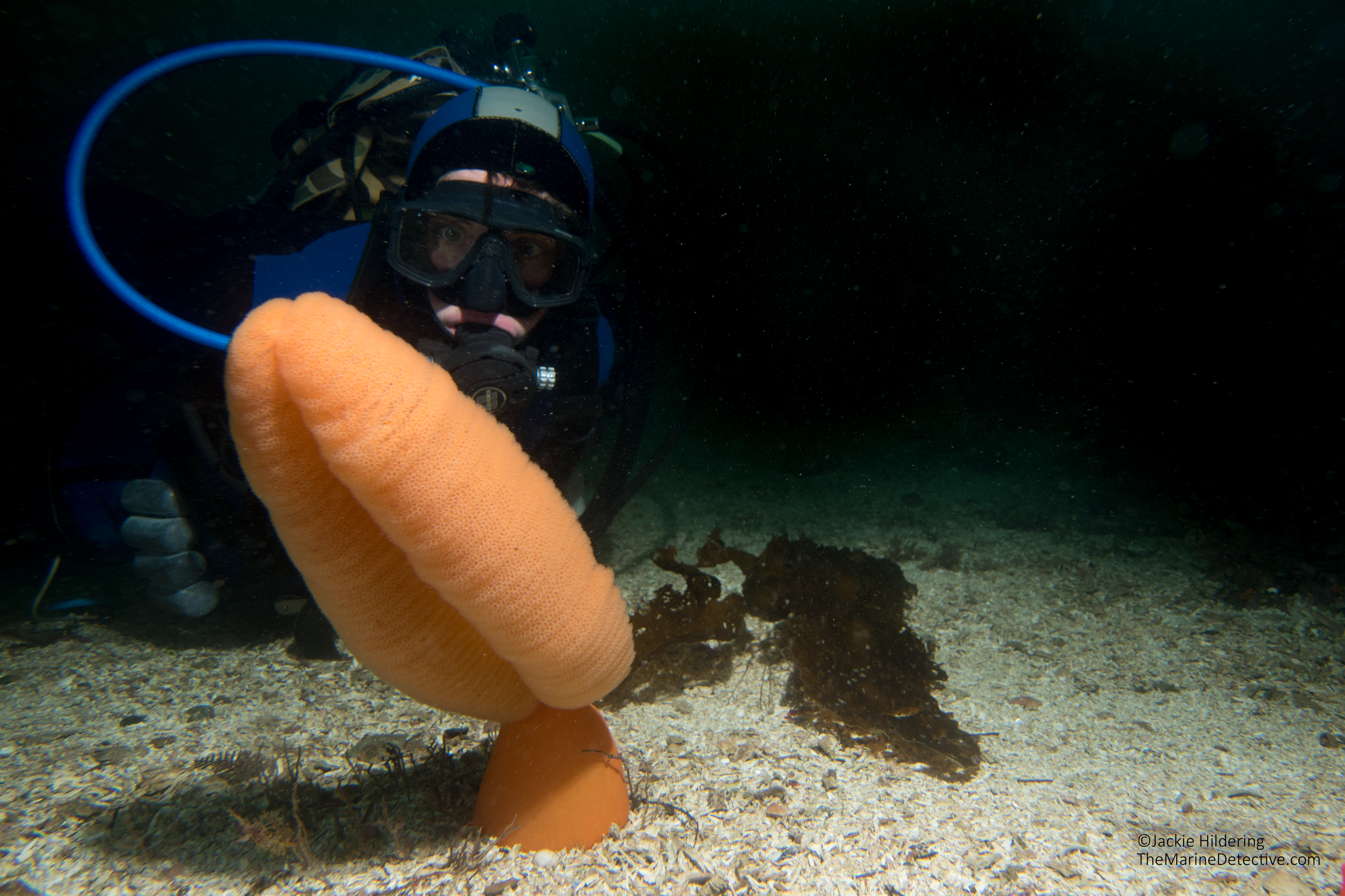
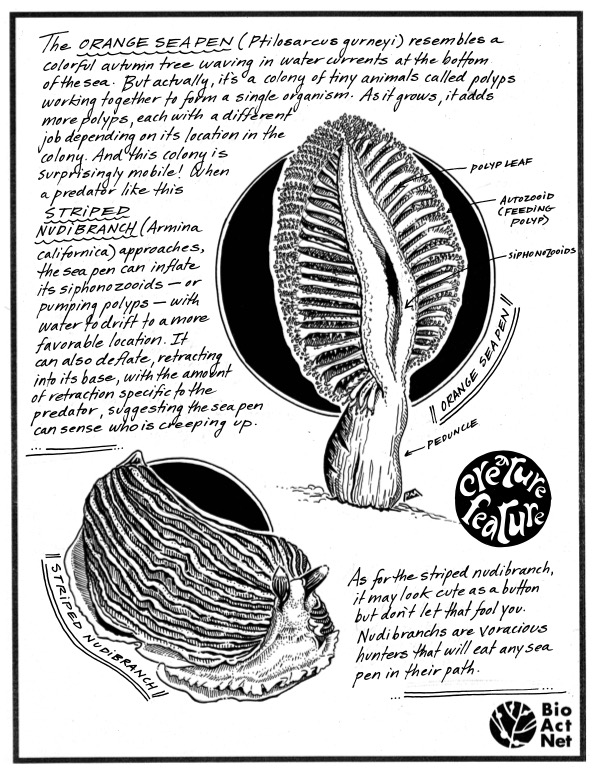
[Last updated November 15, 2023] This blog is about Sea Whips and Orange Sea Pens, the predators that stalk them, and how they can defend themselves.
These are the most surreal-looking organisms. Both species are octocorals – colonies of 8-tentacled polyp-like animals. The polyps filter feed on plankton.
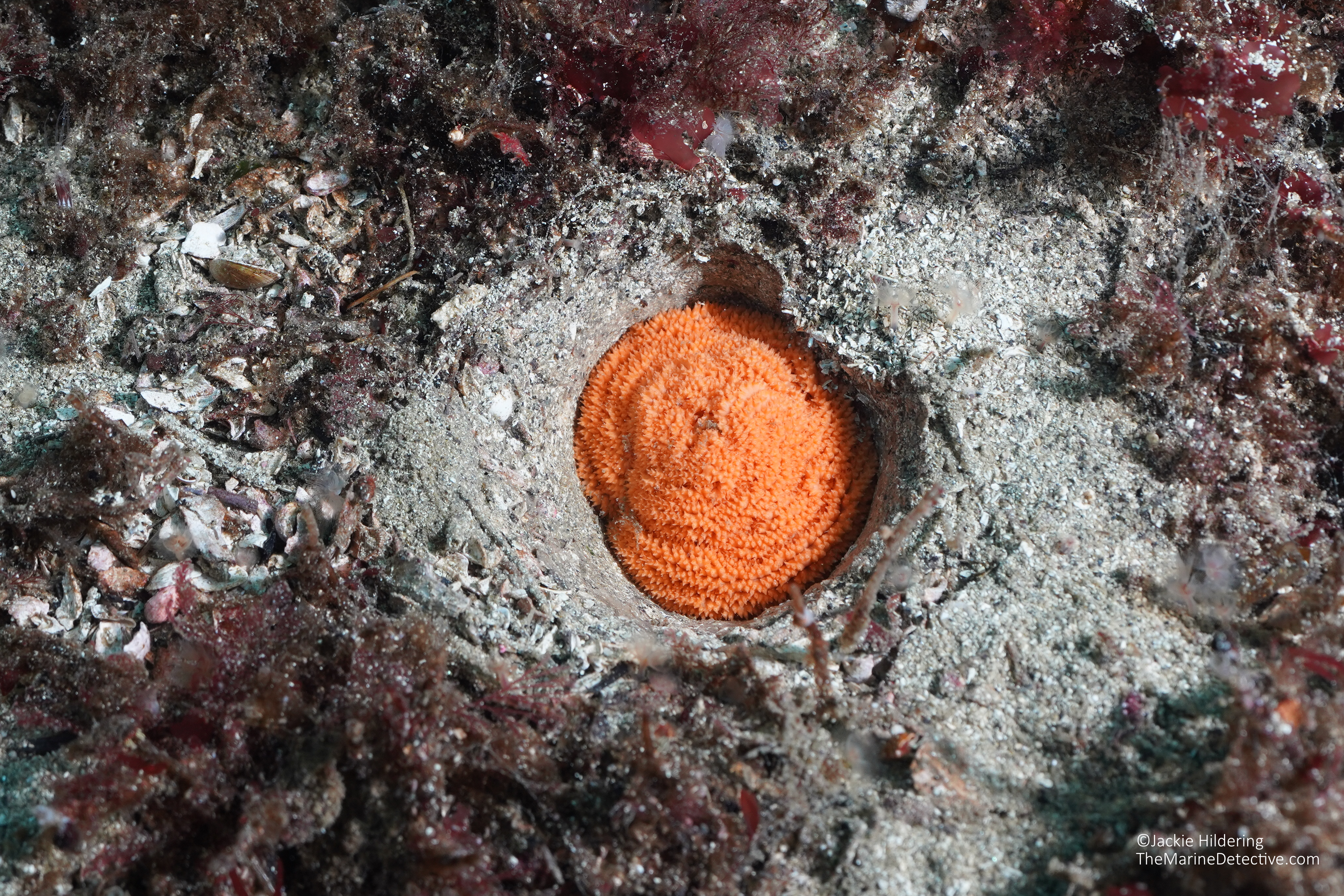
Sea Whips can reach a height of 2.5 meters (Balticina willemoesi).Close-up on the feeding polyps of a Sea Whip. Orange Sea Pens can be up to 48 cm tall (Ptilosarcus gurney).Close-up on the feeding polyps of an Orange Sea Pen.
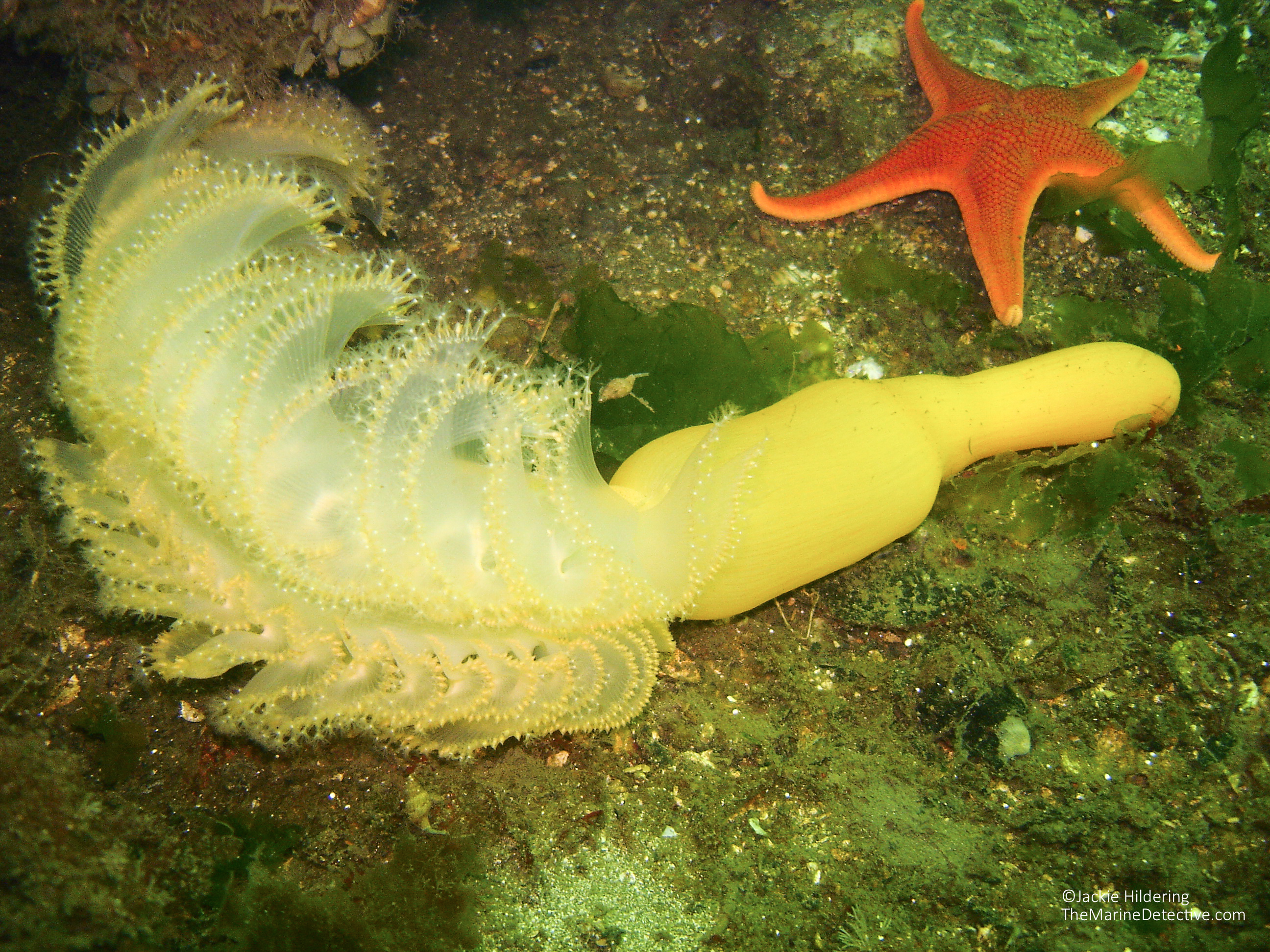
Information on Orange Sea Pens from the Monterey Bay Aquarium “A graceful creature of the seafloor, this sea pen resembles a plump, old-fashioned quill pen. Its colors range from dark orange to yellow to white. Each sea pen is a colony of polyps (small anemonelike individuals) working together for the survival of the whole. The primary polyp loses its tentacles and becomes the stalk of the sea pen, with a bulb at its base—the bulb anchors the sea pen in the muddy or sandy bottom. The various secondary polyps form the sea pen’s “branches” and have specialized functions. Some polyps feed by using nematocysts to catch plankton; some polyps reproduce; and some force water in and out of canals that ventilate the colony.”
Dive buddy Natasha Dickinson with Orange Sea Pen
Remains of an Orange Sea Pen.
Orange Sea Pen Defences
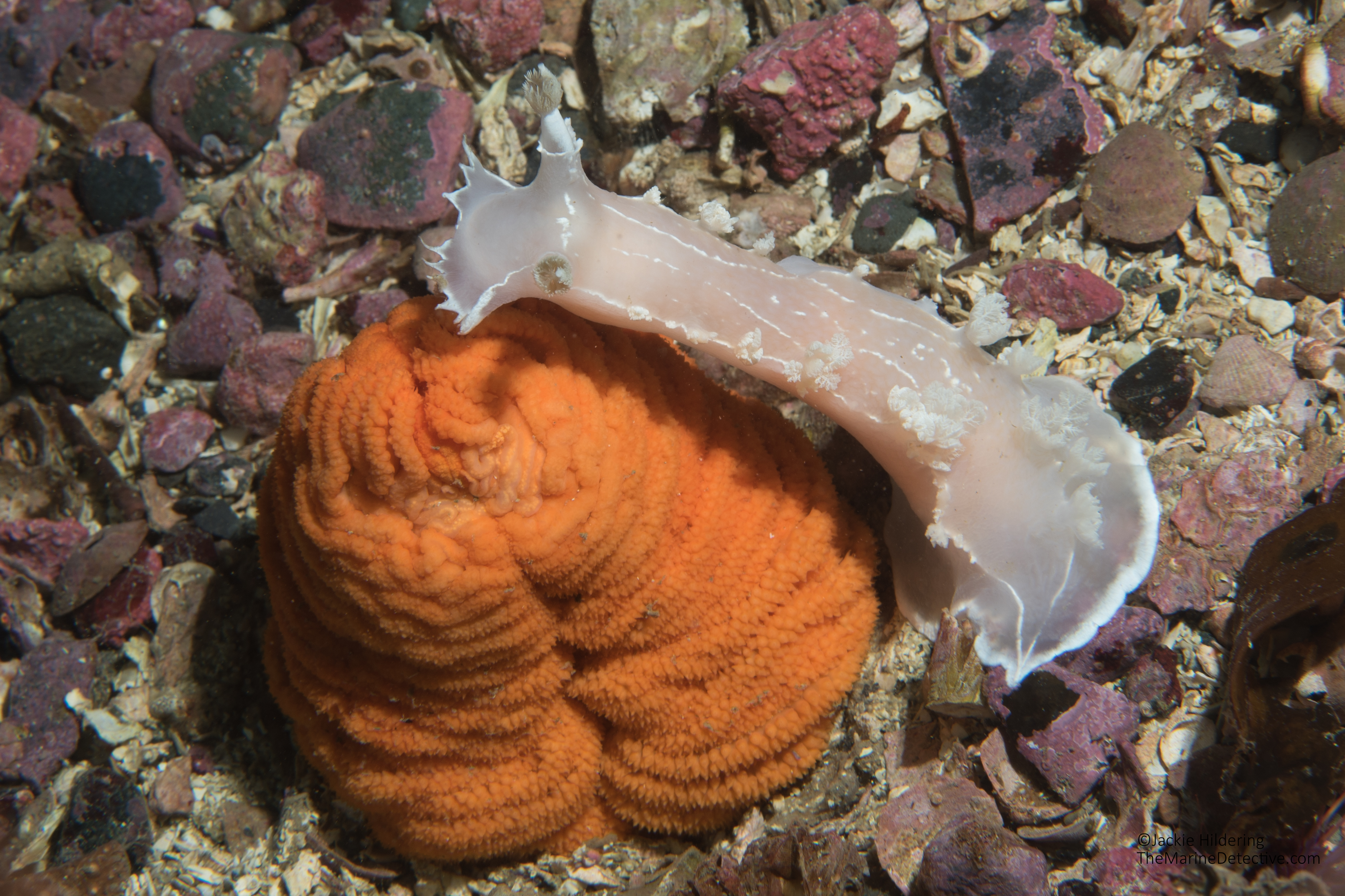
When confronted by sea star and nudibranch predators, Orange Sea Pens can:
1) Deflate, “shrinking” down and into the sand. 2) Inflate, to drift away. 3) Create bioluminescence – making a greenish-blue light that is assumed to somehow deter predators. 4) Produce a toxin but this is poorly understood.
And you thought humans were special!
Deflated and retracted Orange Sea Pen. This can happen within about a minute of first contact from the predator (Wyeth & Willows, 2006 ). From “A Snail’s Odyssey: “A sea pen withdrawn into the sediment does not necessarily mean that it has been attacked or otherwise stimulated. Studies in Puget Sound, Washington show that sea pens Ptilosarcus gurneyi may inflate and deflate several times a day, and at any given time as few as one-quarter of all individuals are up and feeding.”
“The orange sea pen is surprisingly mobile, inflating its siphonozooids with water and drifting like a leaf on the wind when it wants to relocate. It can also deflate, partially retracting into its fleshy base when predators come calling. The amount of retraction has been shown to be specific to the approaching predator, which suggests that the pen can actually sense who is creeping up on it . . . Young sea pens are especially vulnerable to predation. They are incredibly slow-growing, taking over a year to reach about an inch tall. Orange Sea Pens increase their chances of survival with sheer numbers — a single pen can produce about a million eggs during its 10-year lifetime.”
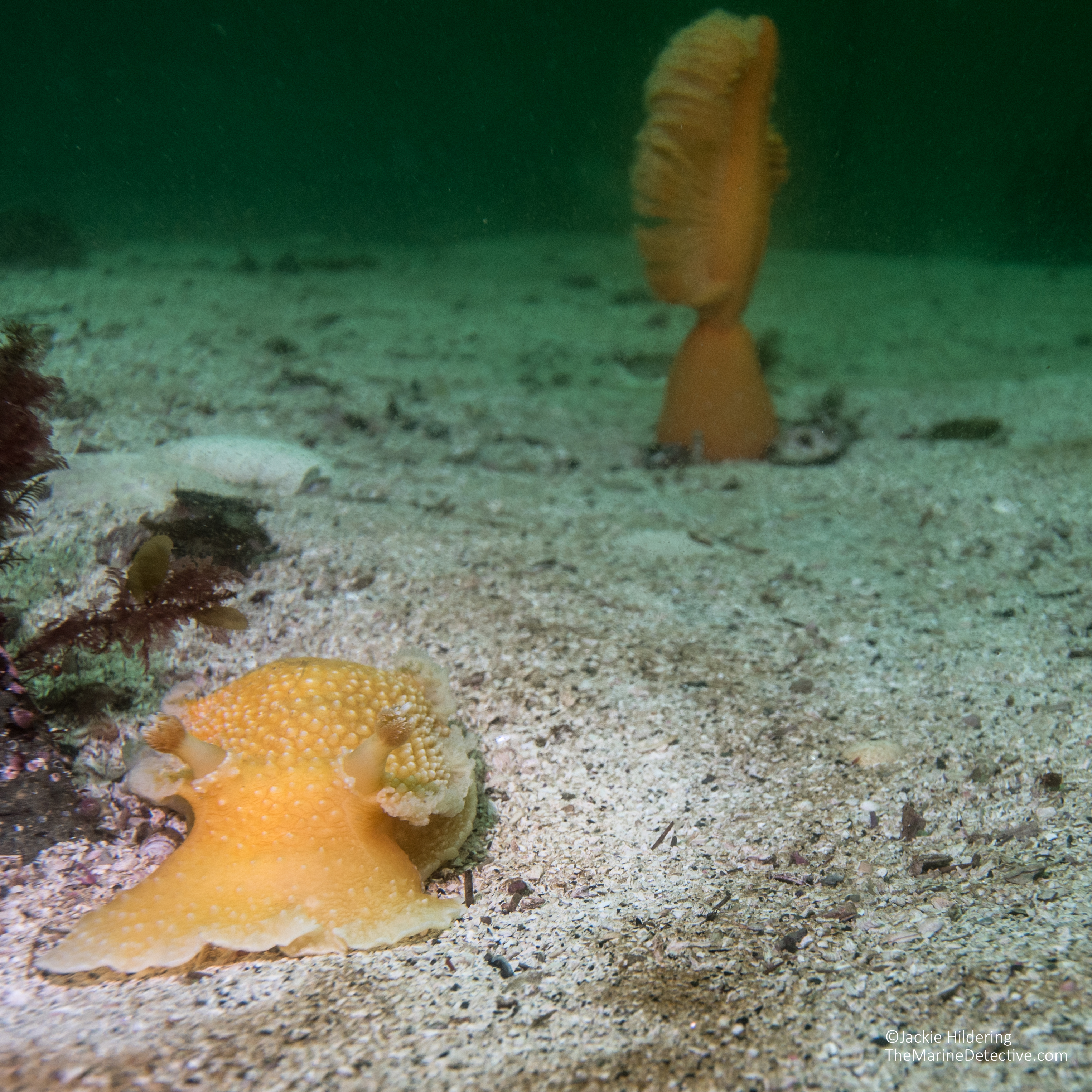
Orange Sea Pen having a bad day? There are 4 predators here and it looks like the Orange Sea Pen was trying to inflate and drift away! But, there was a LOT of current whereby it kept being pushed down. Predators here are a Vermillion Star, two Diamondback Nudibranchs and one Orange Peel Nudibranch.
Orange Sea Pen being attacked by an Orange Peel Nudibranch.
Diamondback Nudibranch (predator) and a partially retracted Orange Sea Pen.
Striped Nudibranch feeding on the “pen” of an Orange Sea Pen. Giant Sea Cucumber on left.
By Romney McPhie. Click here for the PDF and more colouring sheets! Orange Sea Pen with inflated base. May have escaped predation this way – inflating and drifting away from the predator. Retracted Orange Sea Pen and Diamondback Nudibranch. Inflated Orange Sea Pen and Vermillion Star. Diamondback Nudibranch approaches its prey, the Orange Sea Pen. From the Washington State Department of Ecology: “The rows of feeding polyps on the feather-like structures “wave their 8 tentacles in the water to catch drifting plankton. These polyps [are] also responsible for producing eggs and sperm that get released into the water column. The siphonozooids, or pumping polyps, are found in the orange regions on the sides of the rachis [central stalk]. Their function is to take in or expel water, allowing the colony to inflate or deflate.”Diamondback Nudibranch crawling away from a retracted Orange Sea Pen. Orange Peel Nudibranch with Orange Sea Pen in the background.
The 2.5-minute clip below is of Sea Whips and Orange Sea Pens and the predators that stalk them.
Video: 1-minute of an Orange Sea Pen and Graceful Decorator Crab in the current in front of Port McNeill, BC.
The following BBC video below is from southwest Tasmania in Australia. This is not the sea pen species found in British Columbia. However, I have included it as it shows, with time-lapse photography, how sea pens can deflate and retract in response to predation attempts by nudibranchs.
Diamondback Nudibranch approaching and a White Sea Pen (Virgularia sp to 30 cm tall).
Note that I found very little information about the anti-predator responses of Sea Whips. From Malecha and Stone, 2009:
“For those colonies lying on the seafloor, most of the peduncles and the tissues of the rachis below the polyps (approximately 15 cm) were generally not consumed by Tritonia diomedea. Additionally, predation by nudibranchs on erect Halipteris willemoesi [now Balticina willemoesi] in the abraded and control groups did not occur. The disinclination of T. diomedea to prey on the lower portion of sea whips lying on the seafloor and their inability to prey on erect colonies perhaps suggests that H. willemoesi [Balticina willemoesi] may have structural and/or chemical defenses on the tissue above their peduncles that deter epibenthic predators. Typically, chemical defenses are concentrated at the distal portions of colonies where polyp density is greatest, whereas structural defenses are often concentrated near the base of colonies (Harvell & Fenical 1989, Wylie & Paul 1989). The distribution of defenses is perhaps an adaptation to various types of predators and their mode of attack. Therefore, if sea whips have evolved defensive structures located at the base of the colony that are specific to epibenthic, non-swimming predators such as nudibranchs and sea stars, the defenses certainly do not provide protection when sea whips are not erect. Disturbed animals, especially those lying on the seafloor, may be more vulnerable to predation from a wider array of predators since the defenses at their polyps may not be adaptively effective against non-swimming predators. Further study could examine the possible chemical and/or structural defenses of sea whips that are common among octocorals.”
It was 7.2° C (45° F) in the ocean yesterday. Even in summer, I’ve only experienced a high of about 10° C.
Typical for Northern Vancouver Island at this time of year, it was also windy enough for us to abort going out for a boat dive.
Windy, chilly, drizzly, grey . . . what’s a cold-water scuba diver to do?
Get in the cold, dark green water however you can because you KNOW what kind of beauty and wonder are always to be found below the surface, even where you moor your boat!
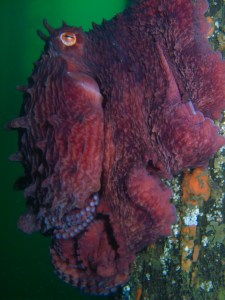
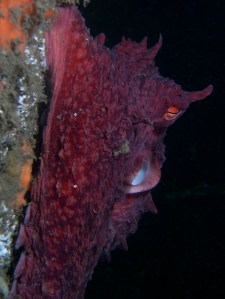
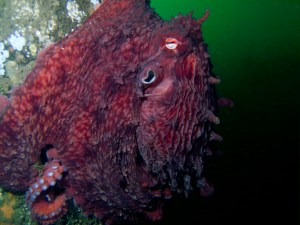
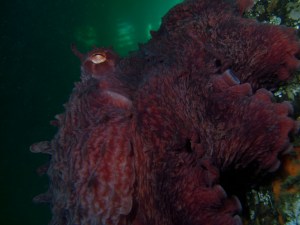
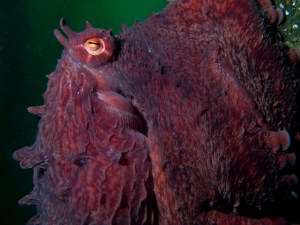
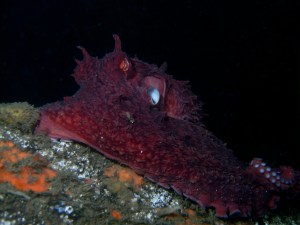
And indeed, under the dock, at only 6 m (20′) we found a Giant Pacific Octopus (Enteroctopus dofleini), curled up on a piling, incredibly tolerant of this ecstatic marine educator. Octopuses are SUCH intelligent animals. I felt as much like I was being scrutinized as he/she must have felt as I observed and photographed this awe-inspiring creature.
This individual was “only” about average size (23 to 42 kg). They can weigh more than 73 kg! I promise many more details on this species in future blog items.
There was so much other beauty under the dock but, for this blog posting, I will leave it at sharing the wonder of this Octo-brr octopus.
Bring on Novem-brrr to Fe-brrr-ary! The cold-water diving is so worth it!
To see these (and additional) images from this octopus photo-shoot at full size, click here.
I would greatly appreciate it if you would let me know, via blog comments, which image (#1 to 6) you believe is the best. This will determine which image ends up in next year’s WILD Northern Vancouver Island Calendar.
Giant Pacific Octopus subtly changing colour and texture. Video by Erika Grebeldinger.
Remarkable video of a Giant Pacific Octopus juvenile subtly changing texture and colour to better match its surroundings.
When full grown, this species can be over 7 m from arm tip to arm tip and over 73 kg = the biggest species of octopus in the world.
The video was taken by fellow Top Island Econauts Dive Club diver Erika Grebeldinger during one of our dives last month. It is testament to the calibre of her diving and concern for the environment that she was able to “capture” such natural behaviour. It the octopus had been agitated, s/he would have flashed red, postured and/or inked.
Having previously posted this video on Facebook, I love Will Soltau’s observation of how the octopus leaves no footprint and what a different world it would be if we humans were more like octopus in this respect.
Thank you so much for sharing Erika!
Video below added on November 25th, 2011 from You Tube – Octopus walking on land in California at the Fitzgerald Marine Reserve.
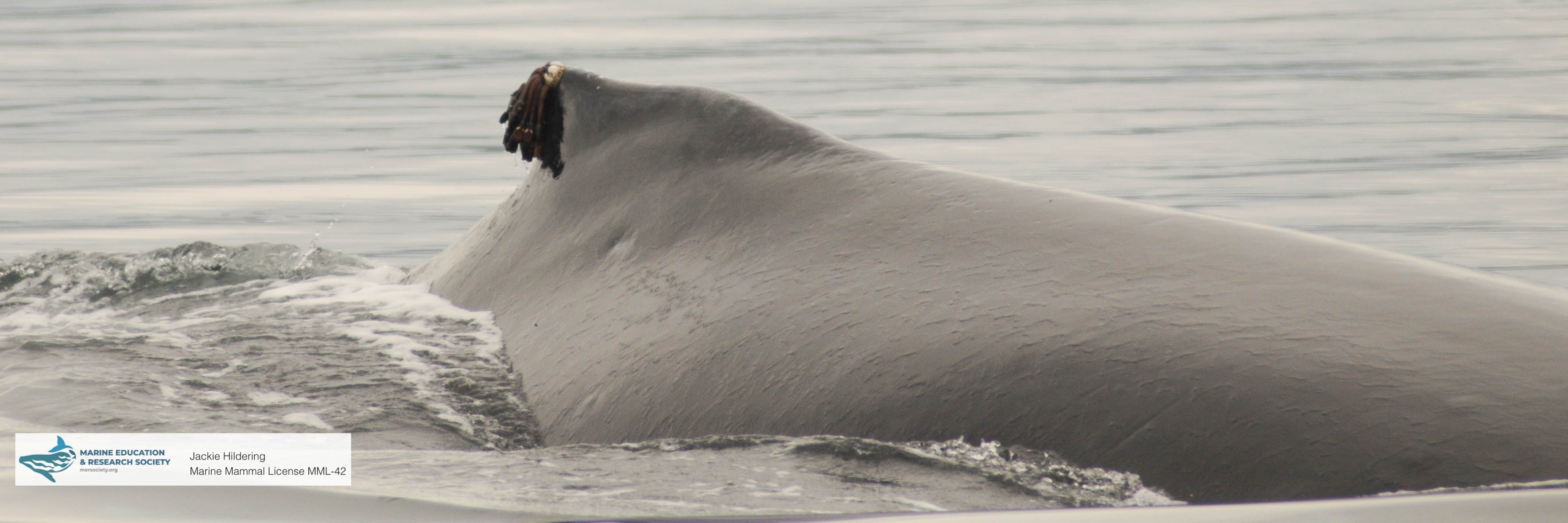
When we saw Jigger in 2009, we noted the barnacle growing on the right top of her dorsal fin. Such barnacles are a distinct species only found on Humpback Whales. The Humpback Whale Barnacle is Coronula diadema (to 5 cm tall and 6 cm wide.
Then, when we saw Jigger in August of 2010, we noted that her dorsal fin looked very different. My research partner from the Marine Education and Research Society, Christie McMillan, and I were worried that it might be an injury so we tried to get a better photo of the dorsal fin.
Here’s what the dorsal fin looked like from behind (photo taken with a telephoto lens and cropped) When I had this perspective, I thought that what we were looking at might be seaweed growing on the Humpback Whale Barnacle we had seen the year before (note that the barnacles often do fall off between years).
But, it didn’t quite look like seaweed. With patience and good camera lenses, we got a better look.
What on Earth?! They’re gooseneck barnacles growing on the Humpback Whale Barnacle!
Gooseneck barnacles are an order of barnacles that are attached to a hard surface by a long stalk that looks like a goose’s neck. They depend on the motion of the water to feed on plankton as they do not have the “foot” (cirri) that rakes in plankton in many other barnacle species.
That’s when I learned that there is a species of gooseneck barnacle that, in the North Pacific Ocean, most often grows on the Humpback Whale Barnacle!! The species is the Humpback Whale Gooseneck Barnacle, also known as the Rabbit-eared Whale Barnacle (Conchoderma auritum (to 11 cm long).
This is the kind of discovery that causes wonder and euphoria in my world.
To be able to identify a Humpback as an individual is already something of great scientific and educational value.
That this attention to an individual whale leads me to learn that there is a species of gooseneck barnacle that grows almost exclusively on a species of barnacle that only grows on Humpback Whales = sheer wonder.
I can’t wait to find out what else the Humpbacks are going to teach me!
Image from Fertl, Dagmar & Newman, William. (2018). Barnacles.
Update: January 2022. Oh and by the way, when Jigger returned to the feeding grounds around northeastern Vancouver Island the next year, she did not have the two barnacle species on her dorsal fin. But she did have . . . a calf. The calf is “Quartz” and has returned to northeast Vancouver Island every year from 2011 to 2021. From our Marine Education and Research post from January 2022: There are two species here on Dapple’s chin and these barnacle species are very often also on the tips of Humpback Whales’ tails.
1) The big, round barnacles are “Humpback Whale Barnacles” (Coronula diadema to 5 cm tall and 6 cm wide) and they ONLY grow on Humpbacks. When they fall off, they leave those round white marks. The barnacles that grow on Grey Whales are a different species that ONLY grow on Grey Whales (Cryptolepas rhachianecti).
2) Growing atop the Humpback Whale Barnacles are “Humpback Whale Gooseneck Barnacles” (Conchoderma auritum to 11 cm long) aka “The Rabbit-Eared Gooseneck Barnacle” which, in the North Pacific Ocean, MOST OFTEN ONLY GROW ON TOP of Humpback Whale Barnacles! There can be up to 50 Humpback Whale Gooseneck Barnacles on one Humpback Whale Barnacle and each gooseneck barnacle is usually oriented with the opening facing the direction the whale swims allowing for better feeding on plankton. (Source: EFauna BC). With that long, fleshy “neck” it certainly is clear why they are called GOOSENECK barnacles.
That’s two layers of specificity made all the more thought-provoking when you realize that barnacles start off as plankton drifting in the ocean, attach to the correct surface, and then grow a shell. The amount and position of these barnacle species can change quickly. For example, there were no Humpback Whale Gooseneck Barnacles to be seen on Dapple’s chin on August 18th but there they are by September 25th. Thereby, barnacles often cannot help identify individual Humpbacks between years but . . those scars from Humpback Whale Barnacles DO persist.
Please know that barnacles are NOT thought to be a hinderance to the whales. It is believed that there’s symbiosis. The barnacle species have good positioning to feed on plankton and the Humpback Whale and Grey Whale Barnacles are believed to offer defence to these slower moving big baleen whales. Grey Whales and Humpback Whales are built for fight rather than flight from mammal-hunting Orca (Bigg’s Killer Whales) and will posture, trumpet and lash out. The barnacles are likely also of use when the males fight for females in the breeding grounds. Hey, when you don’t have teeth, it helps to have something similar to brass knuckles.
More detail
From E-FAUNA BC: ELECTRONIC ATLAS OF THE WILDLIFE OF BRITISH COLUMBIA “Conchoderma auritum is most often found attached to the shells of Coronula on the humpback whale; sometimes more than fifty are attached to one shell. “Rarely a specimen is found attached to the base of the teeth of an old sperm whale” (Sheffer, 1939). Gordon C. Pike reports finding specimens of C. auritumon sperm and fin whales taken in British Columbia. In each case the barnacles were associated with a deformation or an apathological condition of the jaws, baleen, or teeth. Each barnacle is usually oriented with the opening facing in the direction the whale swims. The food-laden water passes through the opening and over the feeding appendages, then out through the two “ears” which have tubular openings.”
From the Marine Species Identification Portal: Species is “attached to the whale barnacle Coronula diadema and sometimes Coronula reginae. It seems to be a rule that no Coronula is without a Conchoderma. Whether this is a form of symbiosis has been discussed by Broch (1924b). Specimens from northern waters have been taken from humpback whales (Megaptera novaeangliae ) or from teeth of bottle-nosed whales (Hyperodon spp.). In the Antarctic C. auritum has also been found on baleen plates of whales and on their tails. In tropical and subtropical parts of the oceans it can also be found attached to ships’ hulls and other floating objects, to slow moving fishes or to the tail of a large eel, but never on soft objects.” From Mike Horan (pers. com January 2022) “I have also seen the stalked barnacle [Conchoderma auritum] on Bottlenosed Dolphins during the die off of 1987 in New Jersey.”
“Individual whales have been known to collect up to 450 kilograms of barnacles. That’s an enormous mass, but relative to a 30-tonne humpback, it would weigh only about as much as an extra layer of clothes. And as far as scientists can tell, the hangers-on don’t particularly bother a healthy whale. They may slightly increase drag as the whale swims, but they may also be helpful as a set of brass knuckles when adult males battle each other over the chance to mate [and when dealing with mammal-hunting Bigg’s Killer Whales]
Here’s what we don’t know about whale barnacles, at least with any certainty: just about everything else. Like, how do their larvae, no bigger than a grain of salt, find a migratory whale to grab onto in the first place? Once they locate one, how do they navigate around its gargantuan body—hundreds of thousands of times larger than theirs—to find their permanent homestead? “It just seems preposterous,” says John Zardus, a marine biologist at the Citadel in Charleston, South Carolina. He specializes in studying barnacles that live on other living things.
Studying those symbiotic barnacles that live on sea turtles, dolphins, crabs, and other marine animals has given Zardus some idea of how whale barnacles might hack it. Adults mate on the whale, but rather than take their chances during their host’s oceanic migrations, they likely wait to release their larvae until the whales gather in coastal areas to breed. The larvae then go through several developmental stages, which can take up to two weeks, before they’re ready to settle. “It’s not like the larva is being released from a whale and it’s going to [immediately] attach to the whale next door,” Zardus says.
When a larva is ready, a chemical signal is most likely what tips it off that it’s in the presence of whale skin. This could be a pheromone emitted by already settled adult barnacles—a strategy commonly used by other barnacle species—or it could be some molecule that wafts off the surface of the skin itself. If other barnacles are any indication, the larva probably reaches out with its sensitive antennules to familiarize itself with the epidermis. It squeezes a drop of sticky polymer out of one antennule to adhere itself temporarily, then sticks down a second antennule and releases the first one, swinging it over to another spot. By repeating this process, a larva “ends up walking around on the surface, leaving little gluey footprints,” says Zardus. “These larvae can possibly crawl all over the host until they find the right location where they want to be.”
Where they want to be is generally on the whale’s forehead, its tail, or the leading edges of its flippers. Those are the places on a whale’s body that water flows over most efficiently. That gives the barnacle a front-row seat when the whale swims through a cloud of plankton, which the barnacle also gets to eat. When the larva finds a good place to settle down, it exudes a stronger glue onto the skin and cements itself for the rest of its life, which may last about one to three years.
Much of this is informed speculation, Zardus stresses, because living whale barnacles and their larvae are extremely hard to come by. Collecting them from a living whale is out of the question, since it would require cutting into the whale’s flesh. A dead whale that washes up has to be discovered before its barnacles die of hunger, desiccation, or predation . . ..
Other than whale barnacles, nothing else reliably recorded the month-to-month movements of ancient whales, says Taylor. Bone tissue doesn’t care about the chemistry of the water it grew in; baleen does, but it’s hardly ever fossilized. But a well-preserved whale barnacle is the perfect time-traveling tracking device. “We won’t be able to tell you, ‘This whale hung a left at Malibu,’” says Taylor, “but [we can] get a general sense of where animals might have been moving.” . . .
Jigger bulking up before the migration, near Sayward in British Columbia, in November 2021.
Update November 2020: The Orange Peel Nudibranch has been reclassified. Now is Tochuina gigantea.
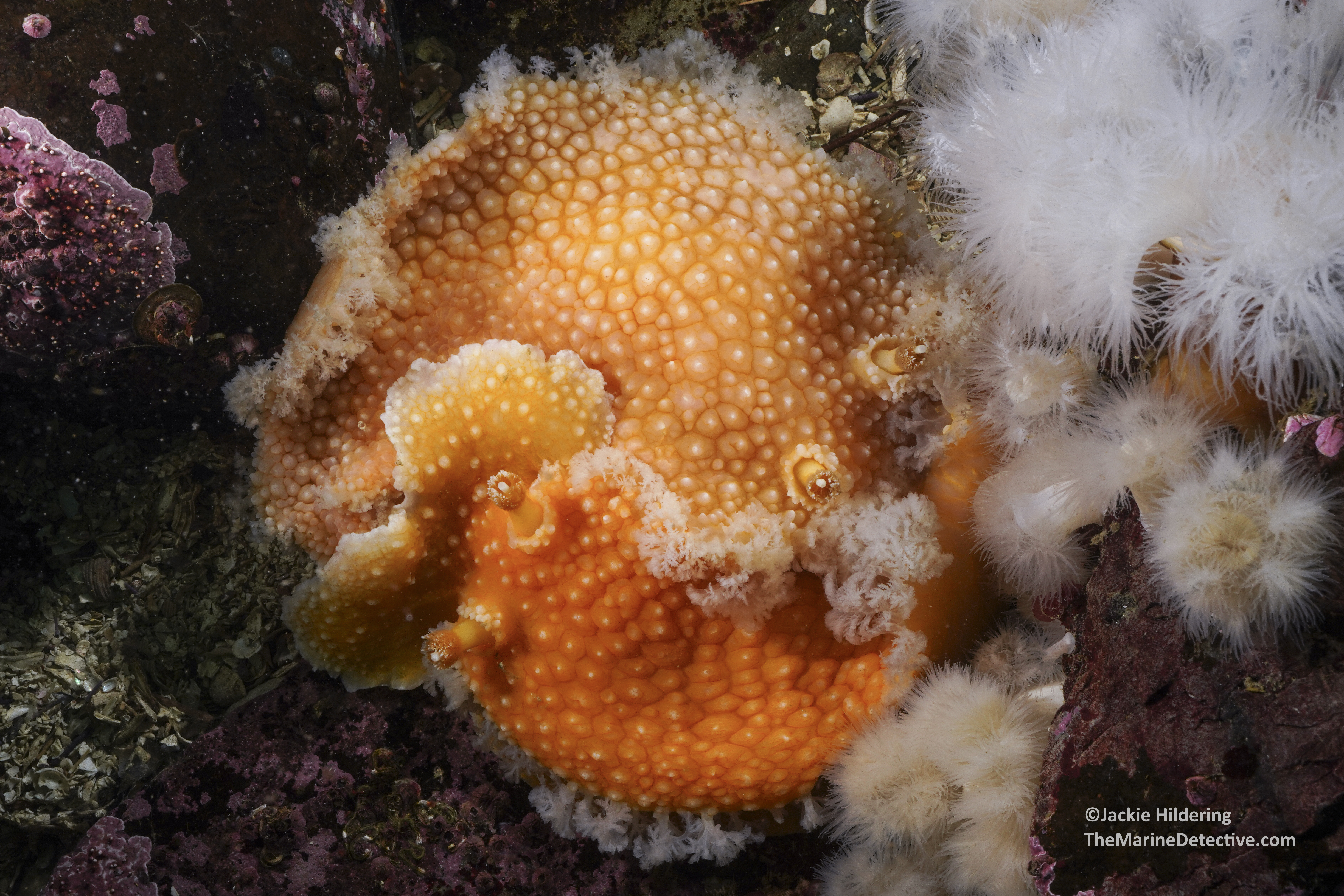
This blog is about Big Orange Love – the reproduction of Orange Peel Nudibranchs.
Two Orange Peel Nudibranchs mating – each about 30 cm long. Both will go on to lay the huge masses of eggs you see below. There is no male, or female.
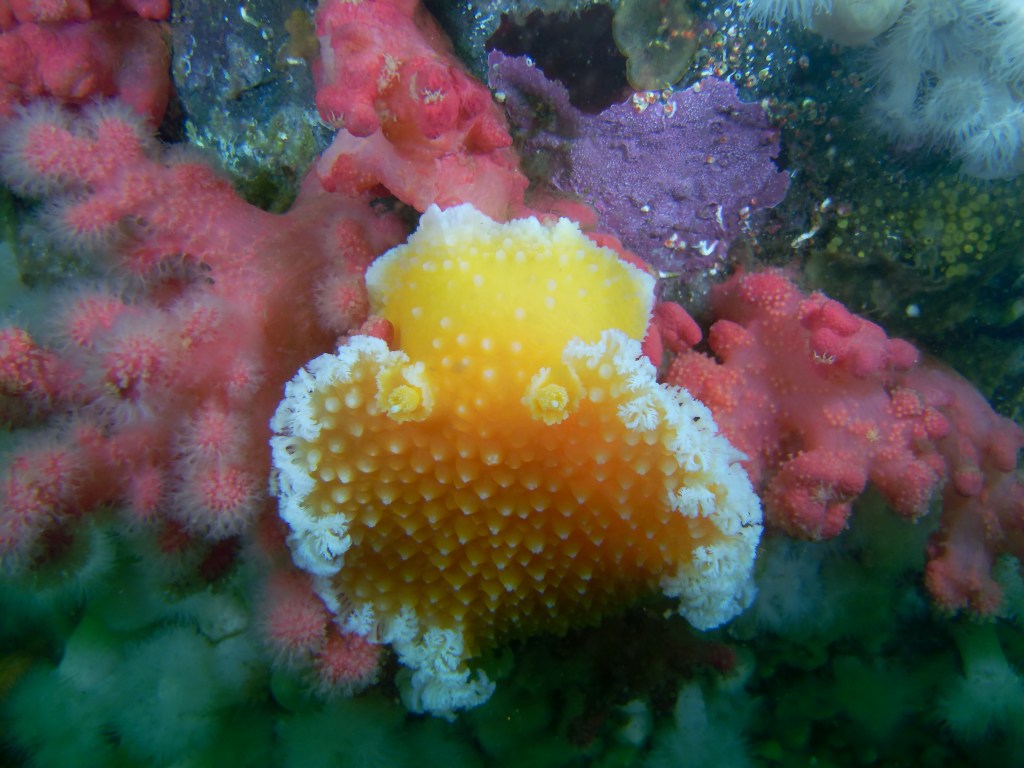
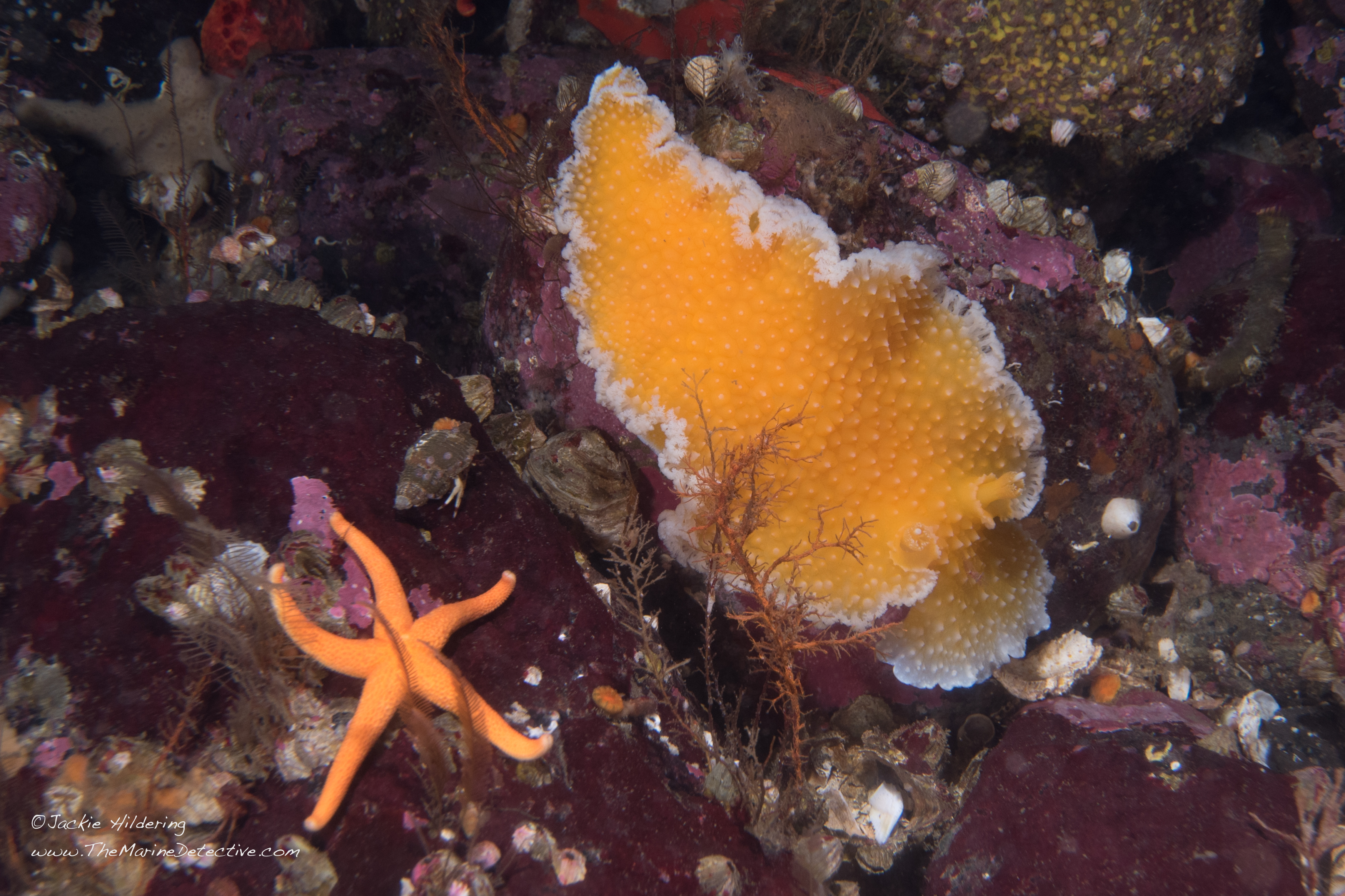
These sea slugs are very aptly named since their skin is reminiscent of both the texture and vibrant colour of an orange. But, the name does nothing to indicate the size to which these giants can grow. They are one of the world’s largest sea slugs with literature reporting them to lengths of up to 30 cm and weight to 1.4 kg.
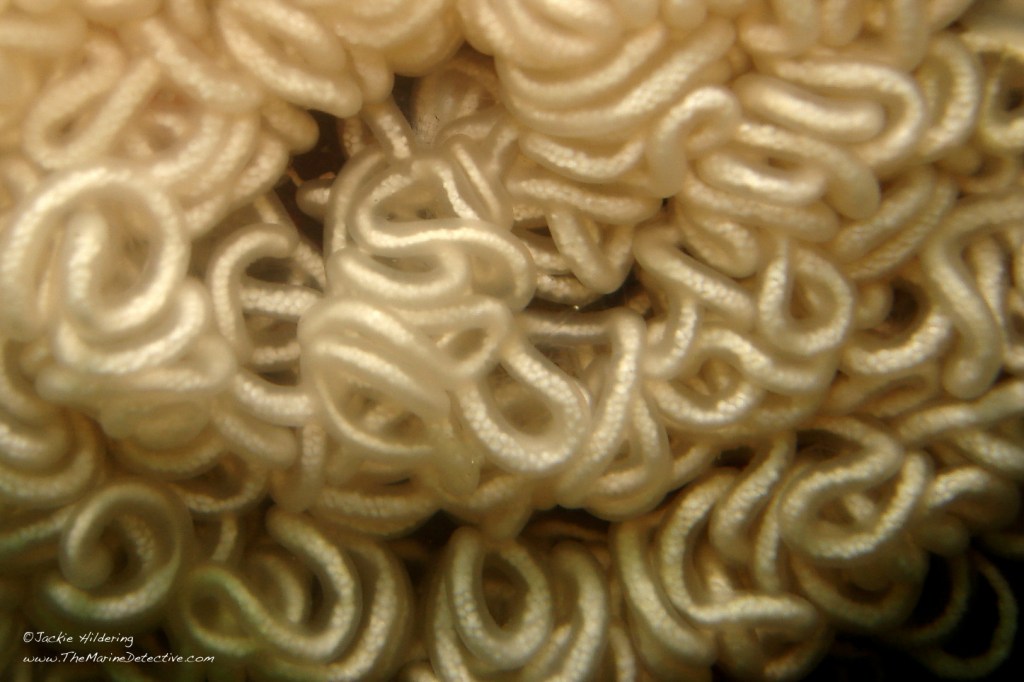
As if this sea slug species’ colour, size and beautifully intricate white gills are not enough to create awe, you should see their eggs! I will never forget the first time I saw the huge tubular mass that looked like udon noodles. I think my brain almost exploded and I was propelled all the more feverishly on my “The Marine Detective” path, wanting to be able to identify the egg masses of all sea slugs in our waters (each species’ eggs look different).








 Sources:





























 The Marine Detective