Join me in the cold, dark, life-sustaining NE Pacific Ocean to discover the great beauty, mystery and fragility hidden there.

Posts tagged ‘northern vancouver island’

Thank Goodness for Second Chances . . . .

It’s Canadian Thanksgiving and I am overwhelmed with depth of gratitude and purpose.

It is an extraordinary privilege to be able to live the life I do and I want so much for it to count.

Thank you dear readers for helping to amplify the beauty, mystery and fragility into the world so that there may be more understanding that there is no divide between land and sea and how our daily actions regarding chemical and energy use connect us – no matter how far away from this place you are.

The photo below is from two days ago – “Frosty” the Humpback Whale in Johnstone Strait, NE Vancouver Island.

To think we could have lost these glorious, majestic, mysterious, winged, singing, acrobatic ambassadors of our life-sustaining seas . . . .

Thank goodness for second chances.

Frosty the Humpback Whale (BCX1187) in Johnstone Strait, October 11, 2014. Just outside Telegraph Cove. Blinkhorn Light in the background. ©Jackie Hildering.

Frosty the Humpback Whale (BCX1187) in Johnstone Strait, October 11, 2014. Just outside Telegraph Cove. Blinkhorn Light in the background. ©Jackie Hildering.

Sea of Love – Broadcast Spawning!

Most often, divers prefer good visibility. But oh to have the good fortune to happen to be in the water when marine invertebrates are spawning!

I’ll never forget the first time the seas suddenly turned white and these green packets drifted by my mask.

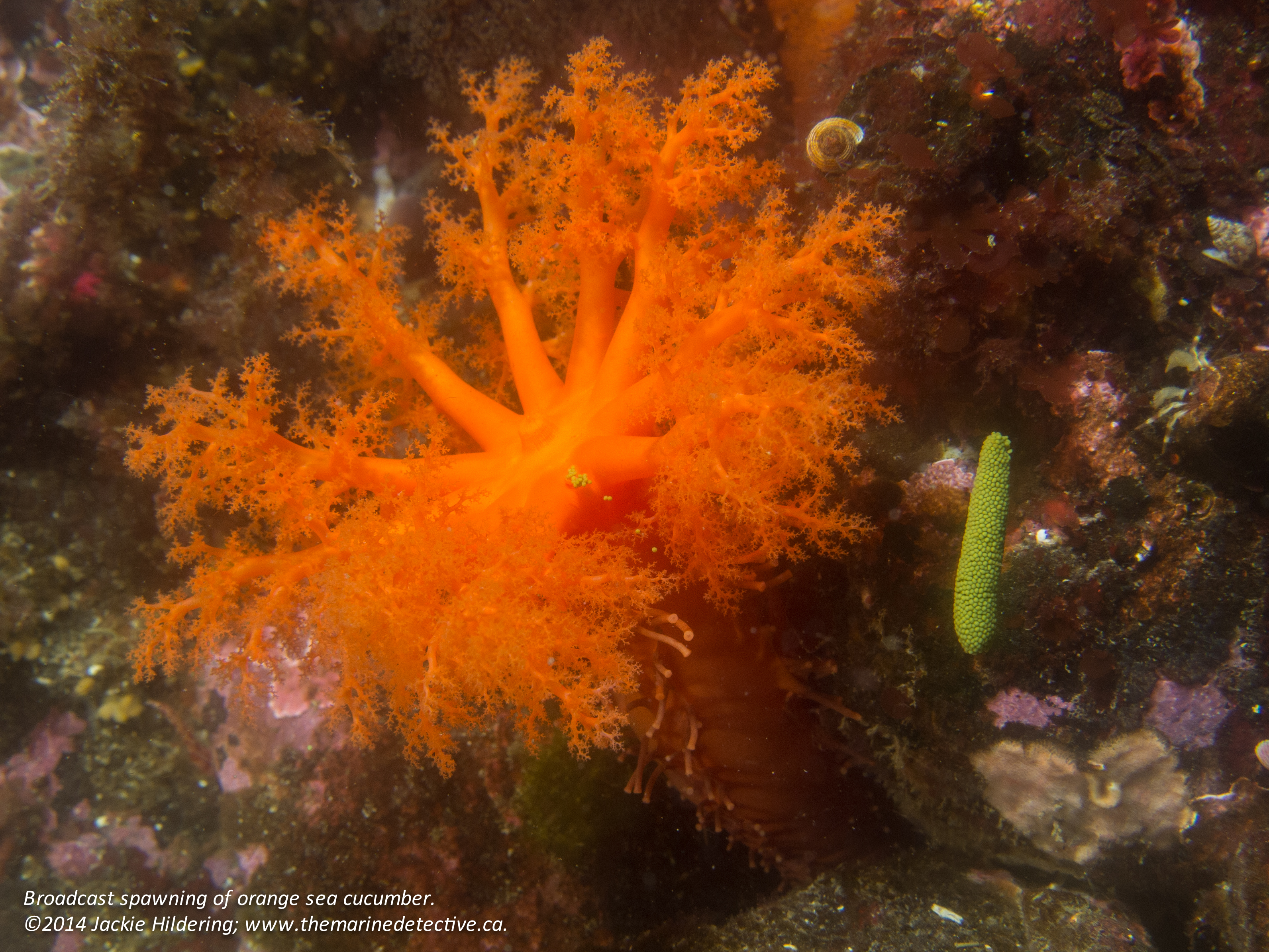
Orange sea cucumber egg pellet
Egg pellet from an Orange Sea Cucumber.

I was euphoric that I happened to be in the water when Orange Sea Cucumbers (Cucumaria miniata) and Giant Plumose Anemones (Metridium farcimen) were broadcast spawning. Witnessing the magnitude of this great force that ensures these species will survive is as awe-inspiring as witnessing the annual spawn of herring or salmon.

Female orange sea cucumber about to release an egg pellet. Click to enlarge. © 2014 Jackie Hildering; www.themarinedetective.ca
Female Orange Sea Cucumber about to release an egg pellet. 
The same female orange sea cucumber 1 minute later, releasing the egg pellet. Click to enlarge. © 2014 Jackie Hildering; www.themarinedetective.ca
The same female Orange Sea Cucumber 1 minute later, releasing the egg pellet.  
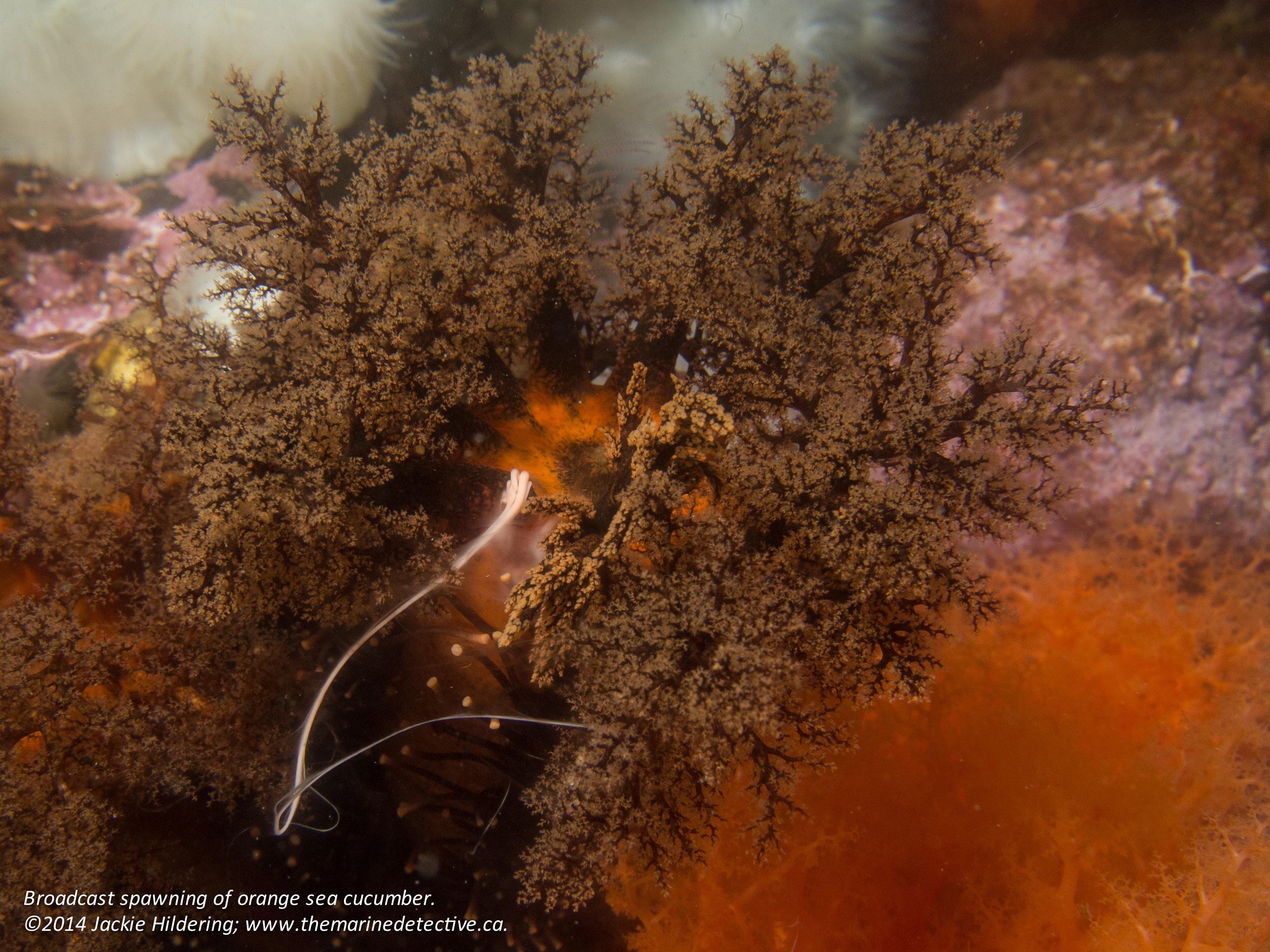
Another spawning male. Orange sea cucumbers can also be this darker colour. Click to enlarge. © 2014 Jackie Hildering; www.themarinedetective.ca
Spawning male Orange Sea Cucumber. Species can also be this darker, brownish colour. 

During broadcast spawning, invertebrate males and females each release their sex cells into the water column – in astoundingly copious amounts.

You can imagine how many gametes must be released for there to be a chance of fertilization and for enough of the resulting larvae to survive and not to be eaten by the many filter feeders such as barnacles, anemones and sea cucumbers!

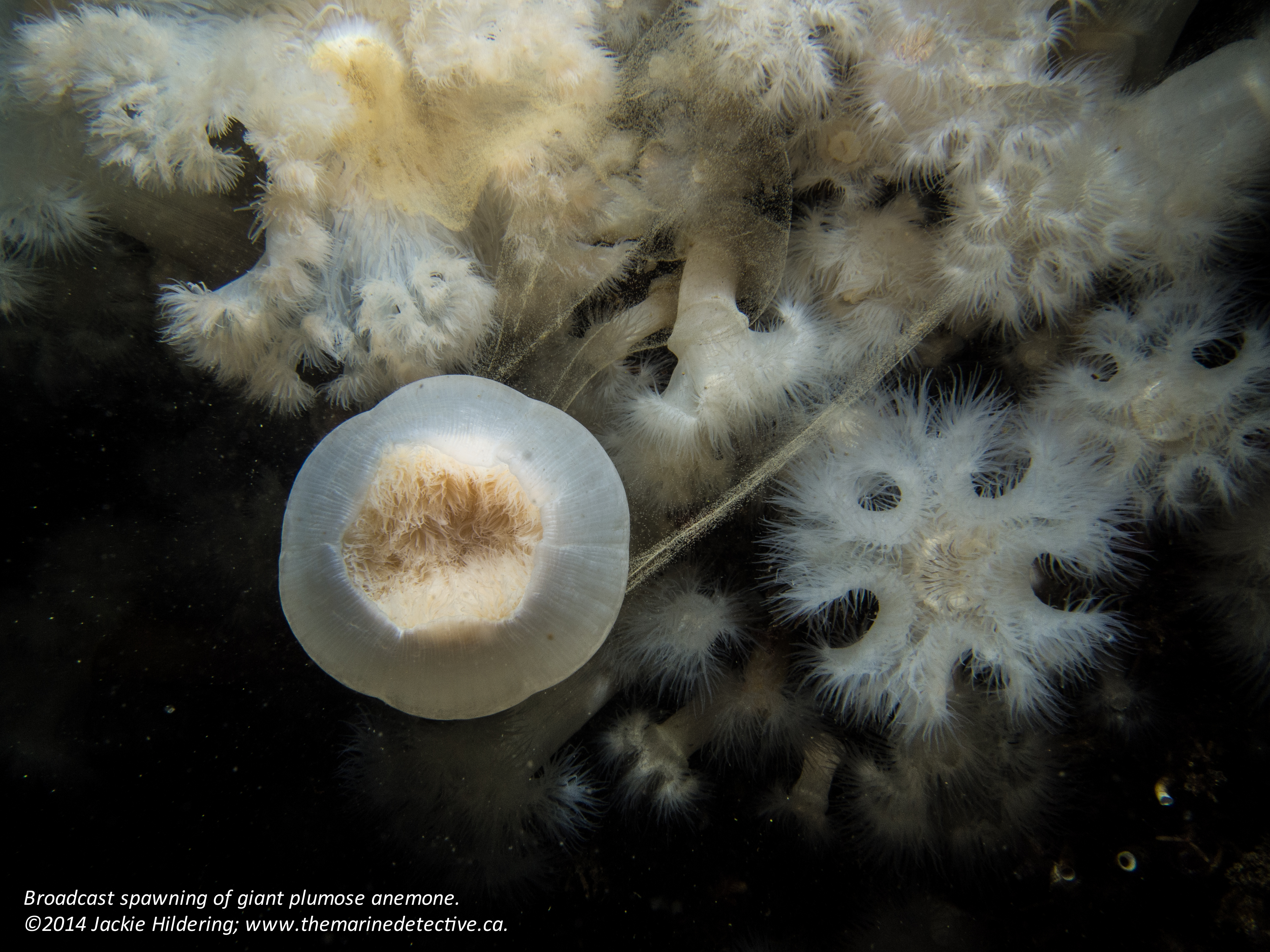
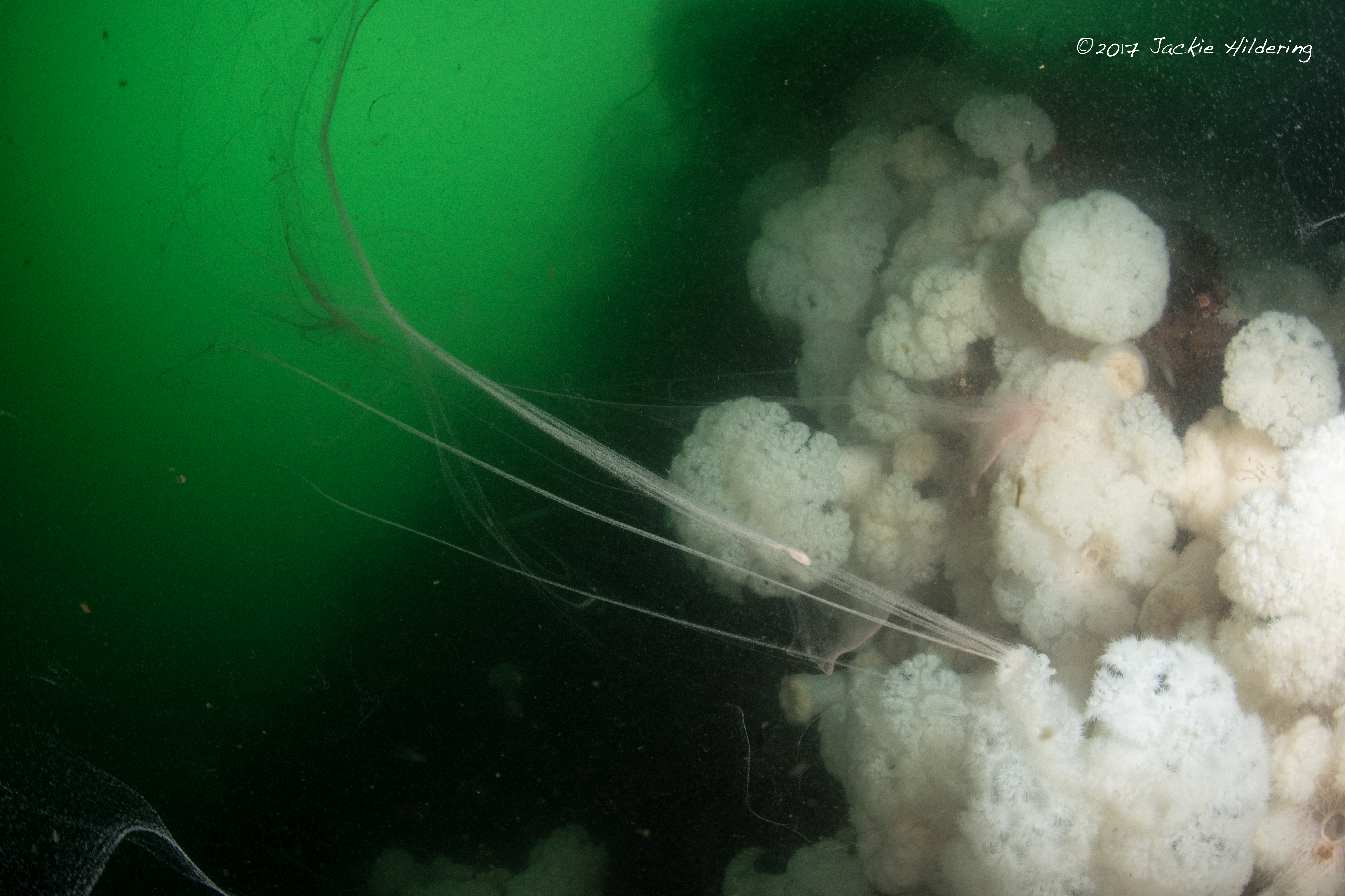
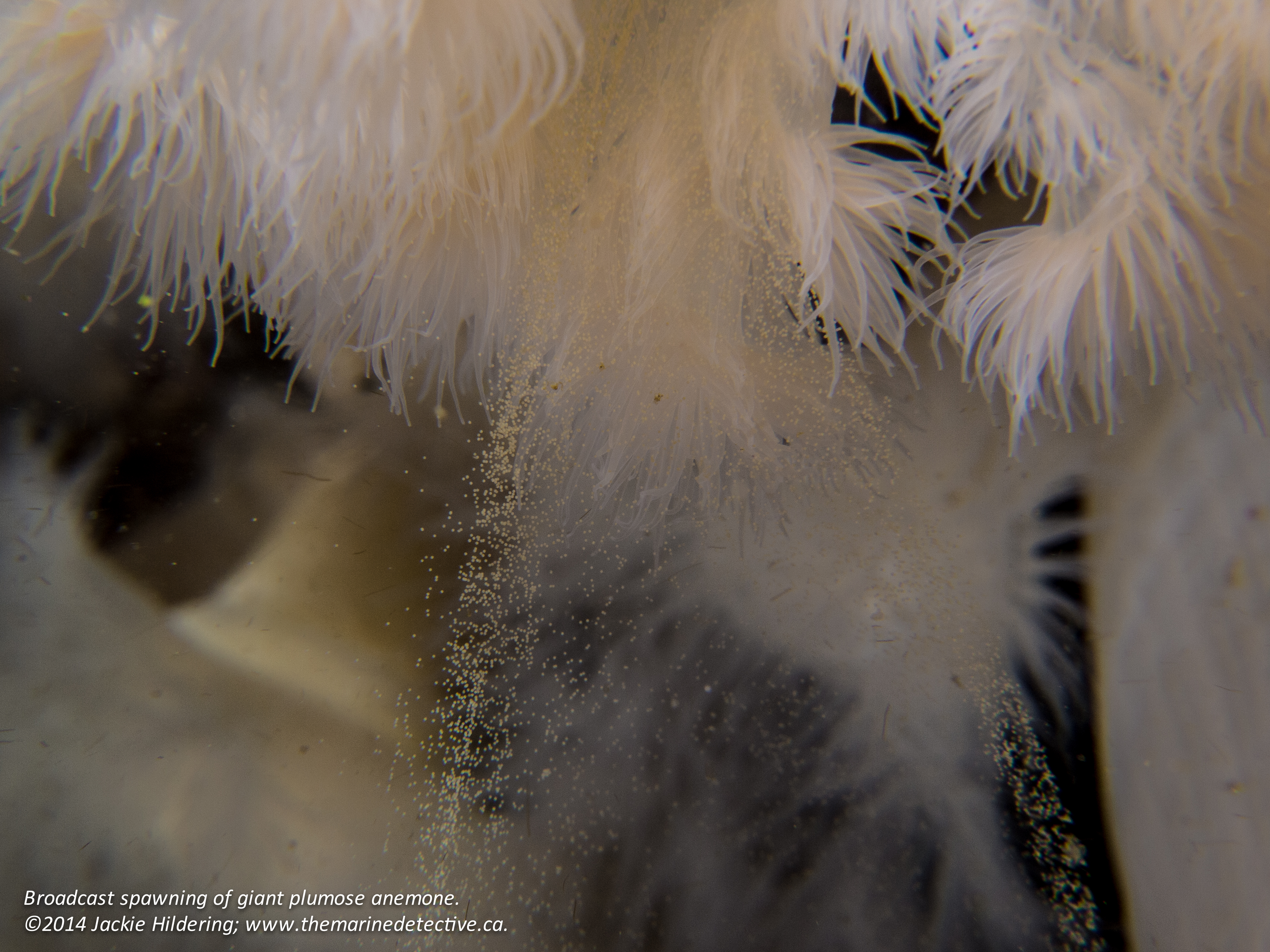
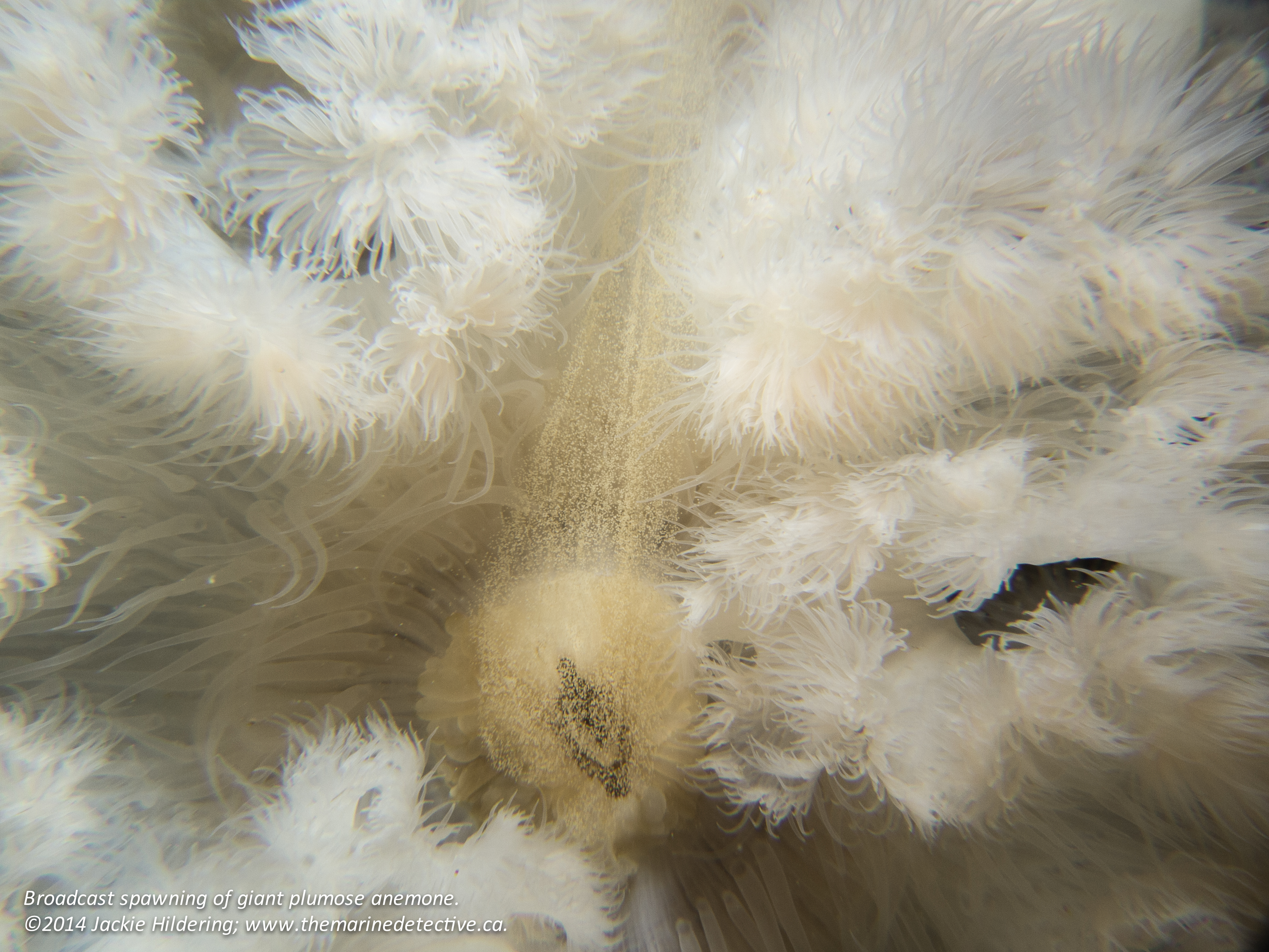
Not only was it the male Orange Sea Cucumbers that were making the cloudy with their astounding numbers of gametes. The Giant Plumose Anemones were broadcast spawning too. Males releasing slow, white jets of their sperm and females then releasing their pinker egg masses. (Note that Giant Plumose Anemones can reproduce asexually as well by pedal laceration but broadcast spawning allows for diversity through sexual reproduction).

Spawning giant plumose anemone. Click to enlarge. © 2014 Jackie Hildering; www.themarinedetective.ca
Spawning male Giant Plumose Anemone. 
Giant Plumose Anemones spawning. Males release the whiter masses of gametes while the females’ masses of eggs have a pinkish colour. See them here? 
Giant plumose anemone releasing gametes. Click to enlarge. © 2014 Jackie Hildering; www.themarinedetective.ca
Close-up of a male Plumose Anemone spawning. 

It is of course a good strategy to have males and females living in close proximity and that timing is everything! The spawn must be synchronized. To release sex cells when others of your kind are not doing so, would be a very failed reproductive strategy indeed.  Probable cues for spawning are ocean temperature; the number of days/hours of sunlight (cumulative temperature); and/or the presence of a plankton bloom.

Apparently for both Orange Sea Cucumbers and Giant Plumose Anemones, the males are the first to release their gametes, triggering the females to spawn.

Research has also found that, in the case of Orange Sea Cucumbers, females release around 130,000 eggs packaged in buoyant egg pellets. The egg pellets drift to the surface and dissociate into the individual eggs after about 20 minutes. Spawning in Orange Sea Cucumbers most often happens within 1.5 hours after slack low tide which adds to the success by allowing for a greater concentration of sex cells, maximizing the chances of fertilization.

Through these images, I hope I have been able to relay the awe I felt at witnessing this biological marvel that has allowed these species to survive on Earth for thousands of times longer than we humans have walked upright.

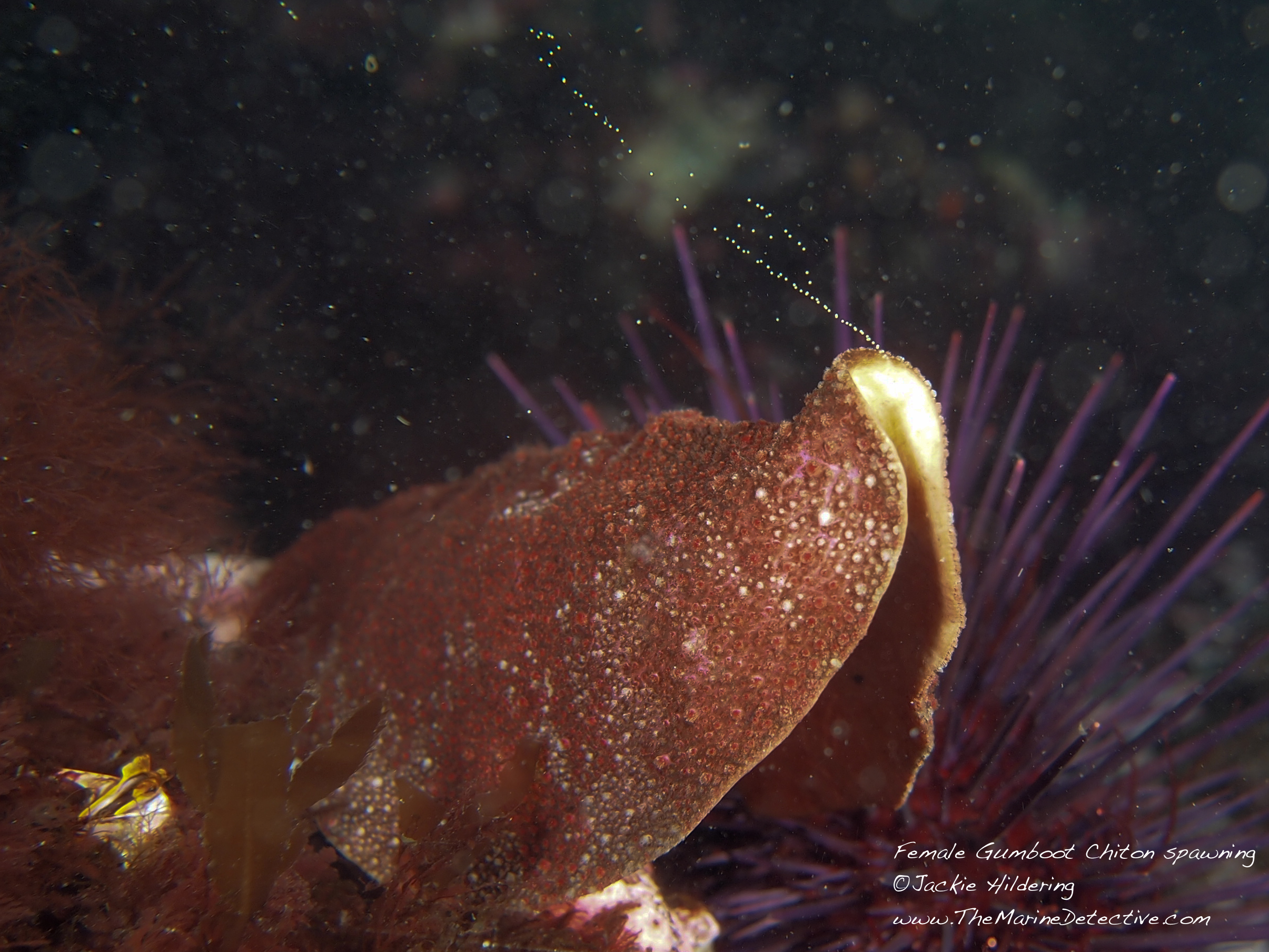
Female Gumboot Chiton spawning. Click this link for video and more information.
Giant Plumose Anemones spawning. Males releasing the whiter masses while females’ eggs have a pinkish colour. See the pink egg mass from a female on the right ?
Giant plumose anemone releasing gametes. Click to enlarge. © 2014 Jackie Hildering; www.themarinedetective.ca
Male Giant Plumose Anemone spawning.
Spawning Orange Sea Star Solaster sp.

Related The Marine Detective posts:

Sources:

Attack of the Sea Slugs!

[Update March 2018 – There has been a reclassification of this species of nudibranch whereby Hermissenda crassicornis  is also being referenced as the “Thick-Horned Nudibranch. Please see my blog at this link for that information.]

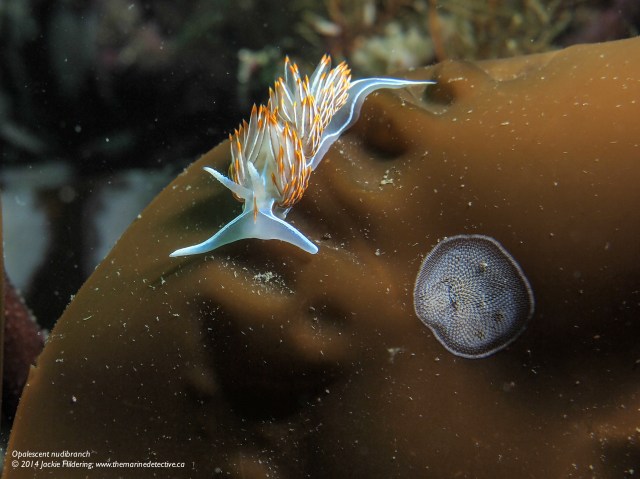
This is an Opalescent Nudibranch (Hermissenda crassicornis).

Opalescent nudibranch. The white batch is a colony of animals known as kelp-encrusting bryozoan. © 2014 Jackie Hildering; www.themarinedetective.ca

Opalescent nudibranch – species up to 8 cm long. The white patch on the right is a colony of animals known as “kelp-encrusting bryozoan”. © 2014 Jackie Hildering; http://www.themarinedetective.ca

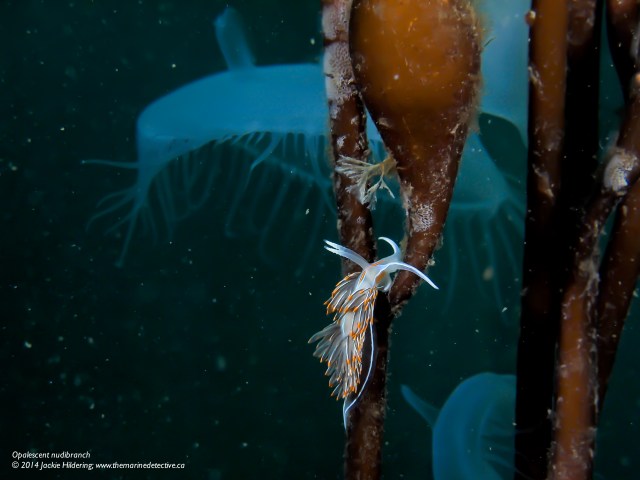
Here is one climbing giant kelp with hooded nudibranchs in the background.

Opalescent nudibranch © 2014 Jackie Hildering; www.themarinedetective.ca

   © 2014 Jackie Hildering; http://www.themarinedetective.ca

I know! Aren’t they astonishingly beautiful? Opalescent Nudibranchs are one of the most powerful ambassadors for shattering the misconception that warm waters are home to more colourful life. They truly help in raising awareness about the incredibly exotic and vibrant life hidden just below the surface in the dark, rich, cold waters of the NE Pacific.

But they help with something else too.

I recently received a video clip of Opalescent Nudibranchs from Tavish Campbell, taken while with Pacific Wild documenting the life that would be at risk if tanker traffic came to Caamano Sound. Tavish, who is a fellow-diver and appreciator of all things marine, asked, “Hey Marine Detective, what’s going on here?!”  What I saw led me to realize how this species is also a very powerful engager for addressing another default notion we humans seem to have.

We tend to bestow judgemental labels on animals depending on our interpretation of their beauty.  We are inclined to think beautiful animals are “nice”, “cute” and “benign”, and foreign looking animals are “mean”, “ugly” and/or “bad”.

While I appreciate that some organisms may be more aesthetically pleasing than others, there is no “ugly” in Nature and there certainly isn’t “bad”.  Organisms look and live as they do because it works. Their appearance and behaviours are the result of expanses of time longer than we humans, as newcomers, can truly appreciate. Organisms’ adaptation allow them to survive and fulfil their niche in Nature’s puzzle so that there is the greatest chance of balance. [Insert “God” instead of “Nature” if this is your preference.]

Therefore, for example, there are no “bad” kinds of orca but rather orca populations whose job in Nature is to eat other marine mammals. There are dolphins that sometimes kill other marine mammals without this being for the purposes of food (no matter how much this conflicts with the “Flipper-like” identities we have imposed on them). Sea otters do things that definitely are NOT cute and .  . . it also means that beautiful sea slugs will also do what they need to in order to survive.

I take such comfort in not needing to judge Nature. It just is. In contrast, human behaviours too often do NOT enhance the potential of balance in Nature or even the chances of our own survival.

So here’s the jaw-dropping video. Ready . . .?

Opalescent Nudibranchs in all their beauty, are extremely voracious predators and, as is evident in the video, will also attack their own kind. Reportedly, fights most often result when the animals come into contact head-to-head. The animal closest to the head or end of the other has the advantage of getting in the first bite and thereby the greater likelihood of killing their opponent and eating them.

But, they are hermaphrodites, they need one another to mate! As hermaphrodites, there is not even male-to-male competition for females! So why, when your chances of finding a mate as a sea slug are already pretty limited, would you kill another of your kind instead of mating with them?

I hypothesize that it would have to do with the balance between needing to eat and needing to mate and/or that there is some sort of genetic competition going on. That’s all I got. Insert rap awe and wonder here. I may not know why they do what they do but I do know, there has to be an advantage to their survival.

What I also know for sure is that this gives a whole new meaning to “slugging it out”!

Opalescent nudibranch egg mass. http://jackiehildering.smugmug.com/Underwater/Sea-slugs/

Opalescent Nudibranch egg mass. Every species of nudibranch has distinct egg masses i.e. they are species specific.  2014 Jackie Hildering; http://www.themarinedetective.ca

For the Birds! Lessons learned from exotic birds, and birders

Just another day on the sidewalk in front of my house.

Just another day on the sidewalk in front of my house.

It’s Saturday morning. I open the curtains. And there they are – three sets of binoculars pointed in my direction. Again.

It’s been like this for 2 months now**, leading neighbours to wonder what is going on and if I am okay.

I am, thanks. I’m just peachy; not a feather out of place. In fact, I have a bird’s eye view of something simply wonderous from which I have learned a great deal.

All the activity on my sidewalk – the binoculars; people coming from Kamloops, Calgary, Victoria, Vancouver and possibly further afield (with at least one person sleeping in his car till daylight so he could be the early bird) – it’s not about me at all. It’s about the birds. Against all odds, multiple species of really rare and exotic birds are here together in our little neighbourhood in Port McNeill.

We’re not used to having this kind of “vagrant” in the ‘hood!

It began in early December when, while on a conference call, I almost lost my mind when a brilliantly yellow coloured bird landed in the shrub in front of my home office window; near the feeder I leave out for the Anna’s Hummingbirds who spend the winter here.

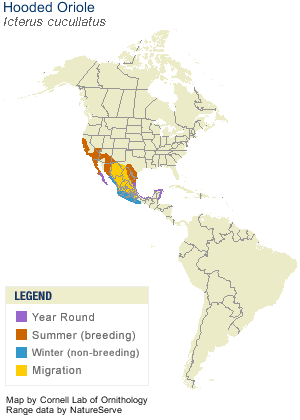
Winter range of Hooded Orioles marked in blue. Source: Cornell Lab of Ornithology -  - see this link for more information and a larger map    http://www.allaboutbirds.org/guide/Hooded_Oriole/id

Winter range of Hooded Orioles marked in blue. Source: Cornell Lab of Ornithology – see this link for more information and a larger map.

I scrambled for my camera uttering colourful nouns, thankfully having the sense to put the phone on mute. I got a picture.

I don’t know much about birds and therefore did not trust my ID. Could it be a . . . could it really be . . . a male Hooded Oriole?!

They are not supposed to be here. They should be in palm trees in the Baja in winter but I dared share the photo and my timid ID with those I know to be BC’s leading bird authorities. The responses came back pretty quickly.

They confirmed how rare this sighting was. Apparently, there have only been two previous recorded cases of Hooded Orioles making it through a BC winter – in Terrace in 1998 and in Prince Rupert in 2007. I was determined to do all I could to give this one a fighting chance since the odds of him finding his way “home” were infinitely small.

The photo I sent to the bird experts, timidly asking if indeed this was a male Hooded Oriole. Jeremy Gatten, would recount in his blog “I received an e-mail from Port McNeill resident Jackie Hildering about a bird that she thought might be a Hooded Oriole.  It's a good thing I was sitting on a couch because the attached photo would have knocked me to the floor if I was on a chair or stool!  The extremely crisp, full-frame shot showed a healthy, vibrant male Hooded Oriole in winter plumage.” http://naturalestnaturalist.blogspot.ca/2014/01/a-dick-and-hoor-longest-hardest-wettest.html

This is my first photo; the one I sent to the bird experts, asking if indeed this was a male Hooded Oriole. Jeremy Gatten, would recount in his blog “I received an e-mail from Port McNeill resident Jackie Hildering about a bird that she thought might be a Hooded Oriole. It’s a good thing I was sitting on a couch because the attached photo would have knocked me to the floor if I was on a chair or stool! The extremely crisp, full-frame shot showed a healthy, vibrant male Hooded Oriole in winter plumage.”

I slightly modified the hummingbird feeder. It appeared to meet his needs and he stayed. The word spread about how predictably such a rare bird could be sighted, and the birders started appearing.

Male Hooded Oriole at the feeder.  © 2014 Jackie Hildering

Male Hooded Oriole at the feeder. See his tongue? © 2014 Jackie Hildering

At first I was very worried about how the attention might disturb the Oriole (and me) but many could learn a thing or two from the nature viewing ethics of bird-watchers.

Winter range of Dickcissels marked in blue. Source: Cornell Lab of Ornithology -  - see this link for more information and a larger map    http://www.allaboutbirds.org/guide/Dickcissel/id

Winter range of Dickcissels marked in blue. Source: Cornell Lab of Ornithology – see this link for more information and a larger map.

They watch from a respectful distance, never setting foot on my property, truly wanting to witness natural behaviour. They rarely strive to get a photo to affirm their experience and certainly would not disturb the bird for the sake of getting the photo. They appear to “just” delight in seeing a rarity and being able to add a bird species to their list. Certainly there is no “get up and personal” – the phrase I loathe most in reference to wildlife viewing.

Then, things got even more exotic.

With all the birder expertise directed at the shrub with Mr. Oriole, a Harris’s Sparrow* was also spotted (winter range is the south central US), and a Yellow-Rumped Warbler (somewhat less noteworthy as this area is part of their summer range) and . . . a female Dickcissel.

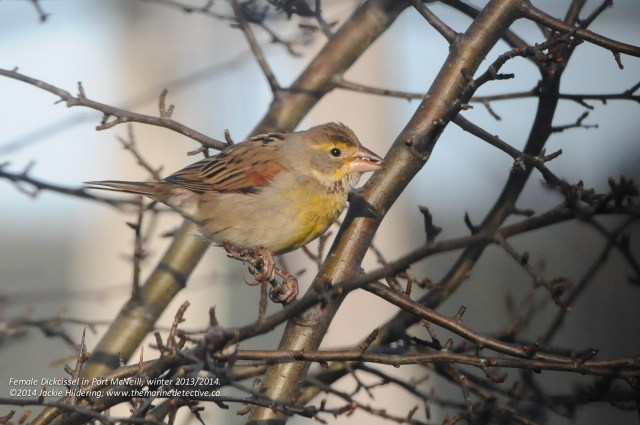
Yes, that’s right – a Dickcissel. I too had no idea such a species existed and certainly would not have been able to discern her from the House Sparrows she often hangs out with. Neighbour Jim Nolan was the first to notice her, and teach me to spell “Dickcissel”! And how exotic is she? Her kind winters in Guatemala and Venezuela.

Female Dickcissel - quite difficult to discern her from the House Sparrows if the light is low and you can't see the yellow markings © 2014 Jackie Hildering

Female Dickcissel – quite difficult to discern her from the House Sparrows if the light is low and you can’t see the yellow markings © 2014 Jackie Hildering

Bring on more birders! And more binoculars on the sidewalk! And more neighbours wondering what on earth was going on.

Bird watchers reference this phenomenon as the  “Patagonia Picnic Table Effect”.  One rare bird attracts birders, who then find another rare bird, which brings in more birders . . . and so on!

In this case it is the “Port McNeill Shrub in Front of My House Effect” and how grateful I am for privilege of a front row seat to the birds, and the birders.

Female Yellow-Rumped Warbler. She's so territorial - chasing the Anna's Hummingbirds away and sometimes even bombs the much bigger Male Hooded Oriole. She is very often near the Oriole. © 2014 Jackie Hilderin

Female Yellow-Rumped Warbler. She’s so territorial – chasing the Anna’s Hummingbirds away and even dive-bombing the much bigger male Hooded Oriole. She is most often near him. © 2014 Jackie Hildering

They have made me reflect more on human behavior and expectations while viewing wild animals. I have become even more attuned to how extraordinary the wildlife of our area is and how, if you are especially watchful and respectful, the reward can be so great.

Clearly, the idiom “birds of a feather flock together” has also been challenged and I am greatly comforted that one rare bird can find another!

Not surprisingly, the birds have further heightened my wonder in Nature and, frankly, in life as well. Why that shrub? Why our neighbourhood in Port McNeill? Random chance? Ideal conditions? I will add this to the many things I will never know for sure.

What I will also allow myself to believe is that the appearance of the birds is evidence that colourful, rare and exotic beings can find my front door!

__________________________________________________

*I never saw the Harris’s Sparrow and have not heard of repeat sightings of this individual from birders.

Note that all photos were taken through the front windows of my home.

See end of blog for range maps for Yellow-Rumped Warblers and Harris’s Sparrows.

** Update April 6, 2014: The female Dickcissel is still a daily visitor. My last sighting of Mr. Hooded Oriole was March 29th. Presumably, he has moved on to new adventures, striving to join with his own kind and find a mate.
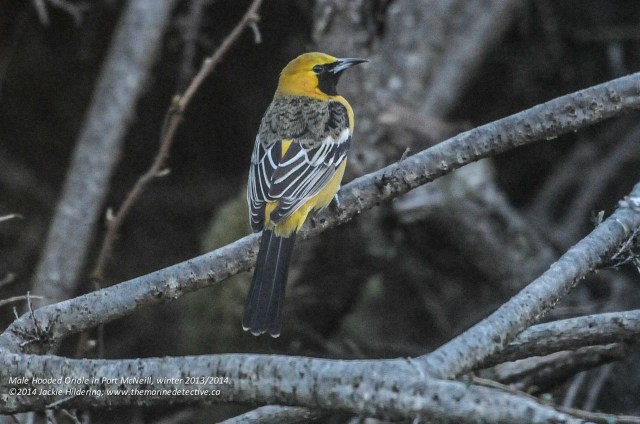
Male Hooded Oriole. © 2014 Jackie Hildering

Male Hooded Oriole. © 2014 Jackie Hildering

© 2014 Jackie Hildering -8883

Female Dickcissel © 2014 Jackie Hildering
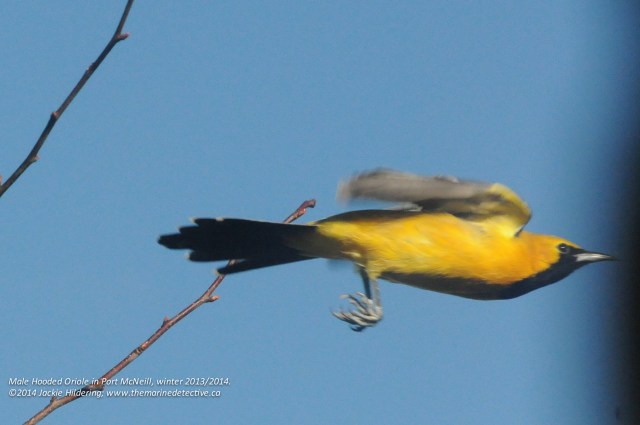
Male Hooded Oriole in flight © 2014 Jackie Hildering
Male Hooded Oriole in flight © 2014 Jackie Hildering

Female Dickcissel - quite difficult to discern her from the House Sparrows if the light is low and you can't see the yellow markings © 2014 Jackie Hildering

Female Dickcissel – quite difficult to discern her from the House Sparrows if the light is low and you can’t see the yellow markings © 2014 Jackie Hildering

Male Hooded Oriole at the feeder. © 2014 Jackie Hildering

Male Hooded Oriole at the feeder. © 2014 Jackie Hildering

Winter range of Harris's Sparrows marked in blue. Source: Cornell Lab of Ornithology - see this link for more information and a larger map  http://www.allaboutbirds.org/guide/harriss_sparrow/id

Winter range of Harris’s Sparrows marked in blue. Source: Cornell Lab of Ornithology – see this link for more information and a larger map.

Winter range of Yellow-Rumped Warblers marked in blue. Source: Cornell Lab of Ornithology -  - see this link for more information and a larger map    http://www.allaboutbirds.org/guide/yellow-rumped_warbler/id

Winter range of Yellow-Rumped Warblers marked in blue. Source: Cornell Lab of Ornithology – see this link for more information and a larger map.

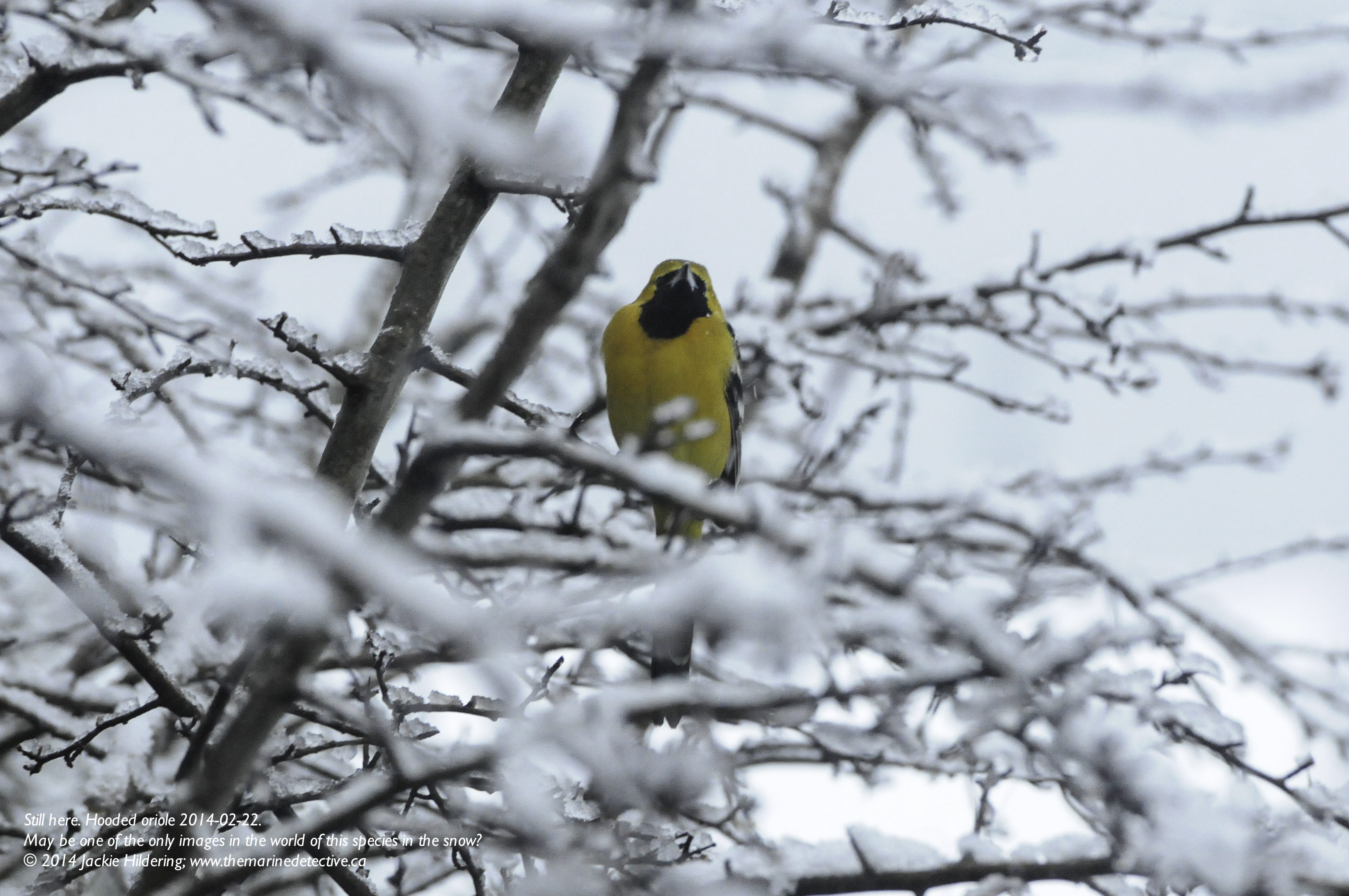
Still here- February 22nd, 2014. Maybe one of the only photos in the world of a Male Hooded Oriole in the snow? © 2014 Jackie Hildering

Still here- February 22nd, 2014. Maybe one of the only photos in the world of a Male Hooded Oriole in the snow? © 2014 Jackie Hildering

Underwater Rainbows

Do you see them?

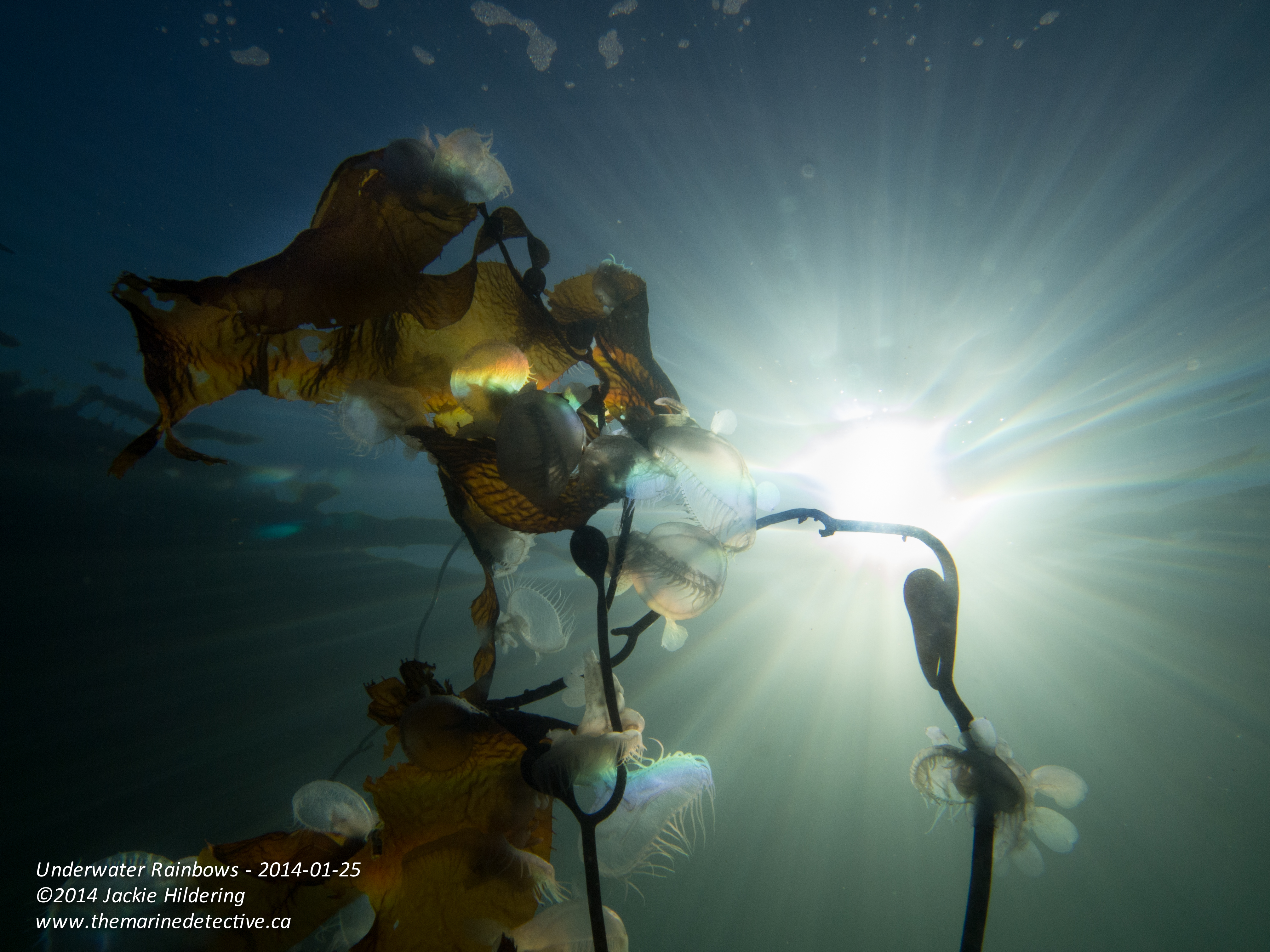
The January sun streaming down, the light refracted against the hooded nudibranchs . . . the underwater rainbows?!

Hooded nudibranchs are already such ethereal, other-worldy creatures, to see the rainbows dancing against their translucent bodies made me catch my breath and desperately want to capture the beauty for you.

May you dream of underwater rainbows and – maybe- fall even a little bit deeper in love with the NE Pacific Ocean.

For information on hooded nubibranchs (includes images and video of them swimming and their eggs), please see my previous blogs at this link. 

Hooded nudibranchs on giant kelp at about 3 m. © 2014 Jackie Hildering
Hooded nudibranchs on giant kelp at about 3 m. © 2014 Jackie Hildering

Hooded nudibranchs on giant kelp at about 3 m. © 2014 Jackie Hildering

Hooded nudibranchs on giant kelp at about 3 m. © 2014 Jackie Hildering

Hooded nudibranchs on giant kelp at about 3 m. © 2014 Jackie Hildering

Hooded nudibranchs on giant kelp at about 3 m. © 2014 Jackie Hildering

Hooded nudibranchs on giant kelp at about 3 m. © 2014 Jackie Hildering

Sea Star Wasting Syndrome Now Documented on NE Vancouver Island

Giant pink sea star in final stages of sea star wasting syndrome. Bear Cove, Port Hardy; December 21, 2013. © 2013 Jackie Hildering

Giant pink sea star in final stages of sea star wasting syndrome. Bear Cove, Port Hardy; December 21, 2013. © 2013 Jackie Hildering

[Update: November 18, 2014 Study published today – cause of Sea Star Wasting Syndrome a densovirus that has been present for at least 72 years? Why has it led to mass mortality now? What makes sense is that, like any virus, the incidents of “pathogenicity” depends on stressors (e.g. temperature change) and proximity of individuals. The virus has also been found in other echinoderms like urchins and sand dollars and it persists in sediment = can be transmitted by those vectors and there is the potential that the other echinoderms are/will be affected. See the study by Cornell University at the link below (lead author Ian Hewson). Includes “If SSaDV is the cause of the current SSWD event, it is unclear why the virus did not elicit wide disease outbreaks in the past during periods in which it was detected; however, there are several possible reasons why the current SSWD event is broader and more intense than previous occurrences. SSaDV may have been present at lower prevalence for decades and only became an epidemic recently due to unmeasured environmental factors not present in previous years that affect animal susceptibility or enhance transmission.”
http://www.pnas.org/content/early/2014/11/12/1416625111.abstract

Good coverage in a 7-minute radio interview
Science Friday; December 5, 2014: “What’s Killing West Coast Starfish?”  http://www.sciencefriday.com/segment/12/05/2014/what-s-killing-west-coast-starfish.html#path/segment/12/05/2014/what-s-killing-west-coast-starfish.html


________________________________

Deepest of sighs.

I am very sad to report that Sea Star Wasting Syndrome is now on NE Vancouver Island.

I first detected symptoms of the Syndrome at Bear Cove in Port Hardy on December 13th. Please see table at the end of this blog for how the species affected appears to be quite different from further to the south. Leather stars seem particularly affected and the Syndrome appears to advance much more slowly.

Leather star with sea star wasting syndrome. (Click to enlarge). Bear Cove, Port Hardy; December 21, 2013. © 2013 Jackie Hildering

Leather star with sea star wasting syndrome. (Click to enlarge). Bear Cove, Port Hardy; December 21, 2013. © 2013 Jackie Hildering
I have tried to think up a terrestrial analogy for what is happening to the sea stars so that non-divers might better get a sense of the weight and ecosystem importance of it. However, I can’t come up with a good terrestrial equivalent of an abundant group of highly visible, apex predators. My best attempt is to suggest you think of sea stars like birds of prey. Imagine what you would feel like if you were to notice they were dying, bodies deflating . . . then melting away and that this would progress very quickly and spread like wildfire.

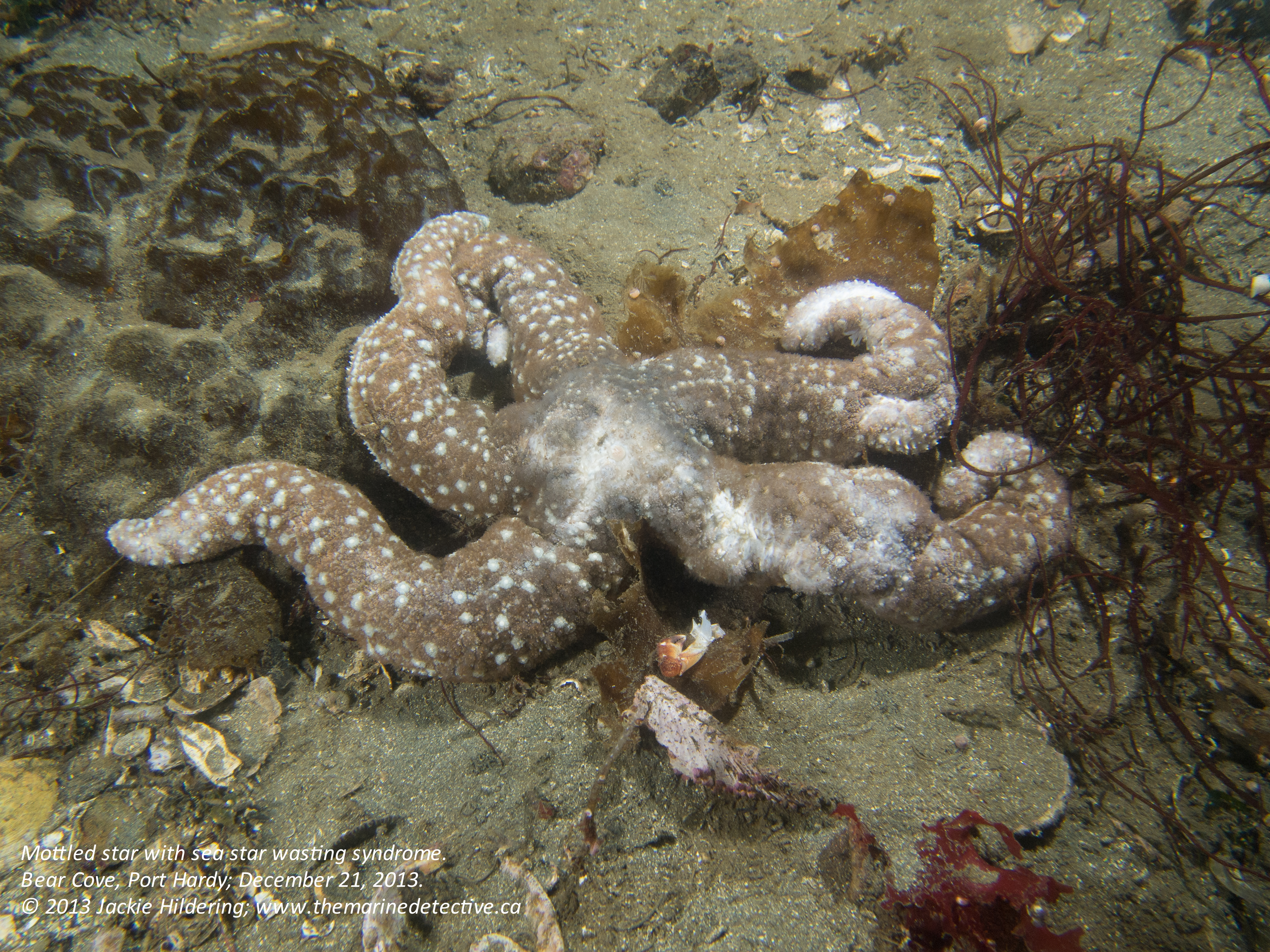
Mottled star with sea star wasting syndrome. (Click to enlarge). Bear Cove, Port Hardy; December 21, 2013. © 2013 Jackie Hildering

Mottled star with sea star wasting syndrome. (Click to enlarge). Bear Cove, Port Hardy; December 21, 2013. © 2013 Jackie Hildering

Please see my previous blog item, “Wasted, What is Happening to the Sea Stars of the NE Pacific Ocean?”, for great detail on the symptoms, species impacted further to the south, spread of the Syndrome, and how to help understand what is happening by relaying data to the Vancouver Aquarium. 

The short of it is:

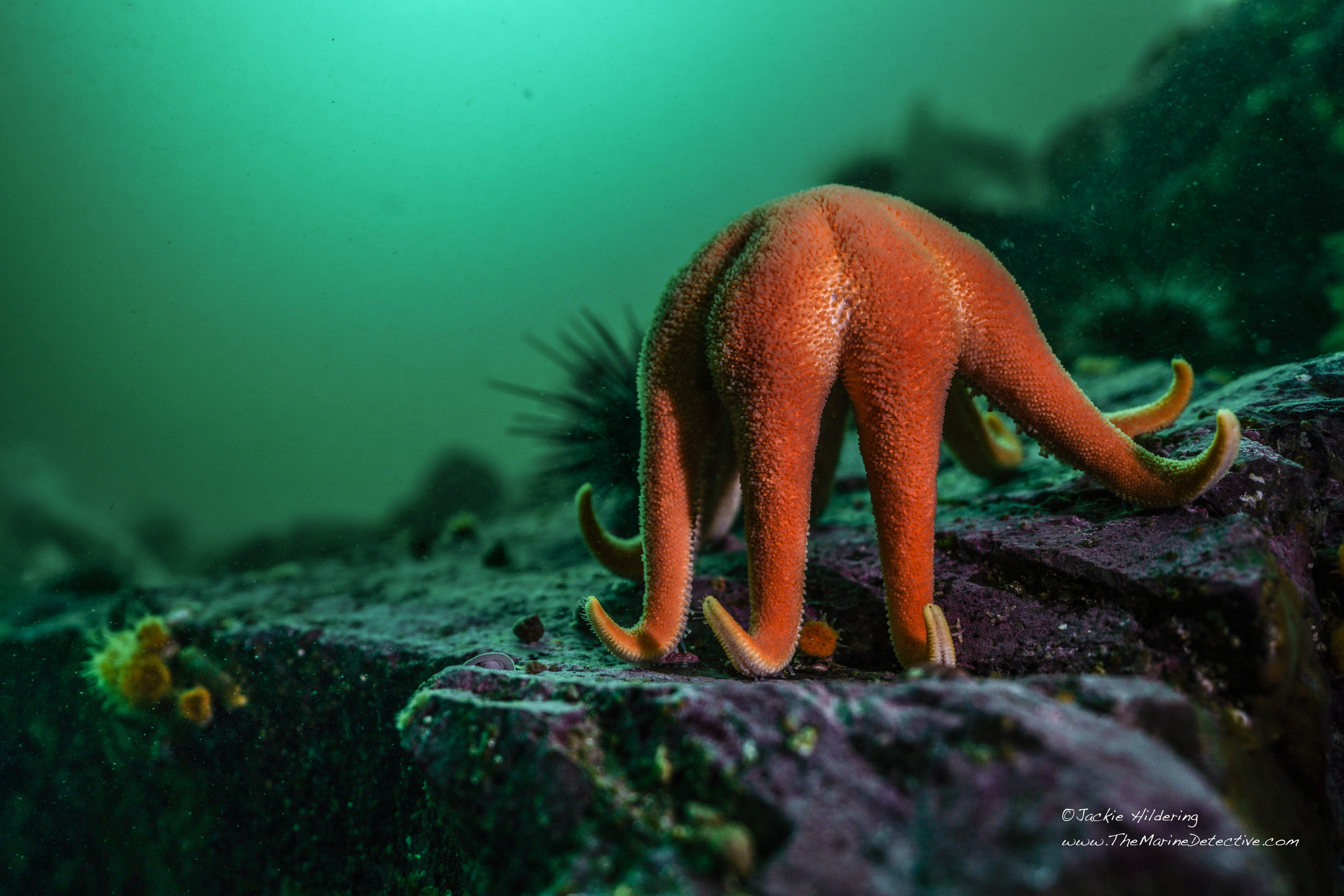
  • The meltdown of sea stars was first detected in June 2013 in Washington State in ochre stars and in sunflower stars in Howe Sound (BC) in late August 2013 but has now been reported at sites from Alaska to the Mexican border.
  • Sunflower star in distress - potentially wasting syndrome. (Click to enlarge.) Photo from a week ago. Bear Cove, Port Hardy; December 13, 2013. © 2013 Jackie Hildering
    Sunflower star in distress – potentially wasting syndrome. (Click to enlarge.) Photo from a week ago. Bear Cove, Port Hardy; December 13, 2013.
    © 2013 Jackie Hildering

    The number of sea stars impacted is orders of magnitude greater than any previous known outbreak.

  • Most likely due to a pathogen (virus and or/bacteria). Cornell University is doing the genomic work. Toxins and environmental conditions have not been ruled out as the cause (or compounding factors).
  • If it is a pathogen, how quickly it spreads is influenced by the number of animals and if they are stressed. There are likely to be layers of stressors.
  • It has put forward by the scientific community that this could be a normal mechanism for overpopulation in sea stars.

The 1-minute time-lapse video below shows the progression of the Syndrome in a sunflower star over 7 hours.

Yep, it’s terrible.

However, I believe very strongly that, in attempting to raise awareness about marine environmental issues, I must always reflect on “what you can do”. If I do not, I contribute to the spread of a devastating human syndrome: Eco-paralysis. Symptoms include people becoming despondent, overwhelmed, and underactive in undertaking positive socio-environmental change, and often saying “It’s all hopeless”. The cause? This I do know. Eco-paralysis is the result of not seeing the common solutions between environmental problems.

Sea Star Wasting Syndrome is a solid indicator of how little we know about our life-sustaining oceans. It emphasizes the importance of humility and precaution in decision-making around the environment and how we are all empowered to reduce environmental stressors (with emphasis on reducing fossil fuel consumption and chemical use).

Having witnessed what I have over the last many weeks, I am all the more driven to assist others in (1) falling deeper in love with the NE Pacific Ocean by revealing the beauty below her surface and (2) feeling the joy that comes from creating change that is better for the environment and, therefore, ourselves.

What was once a sunflower star. (Click to enlarge). Bear Cove, Port Hardy; December 23, 2013. © 2013 Jackie Hildering

What was once a sunflower star. (Click to enlarge). Bear Cove, Port Hardy; December 23, 2013.
© 2013 Jackie Hildering

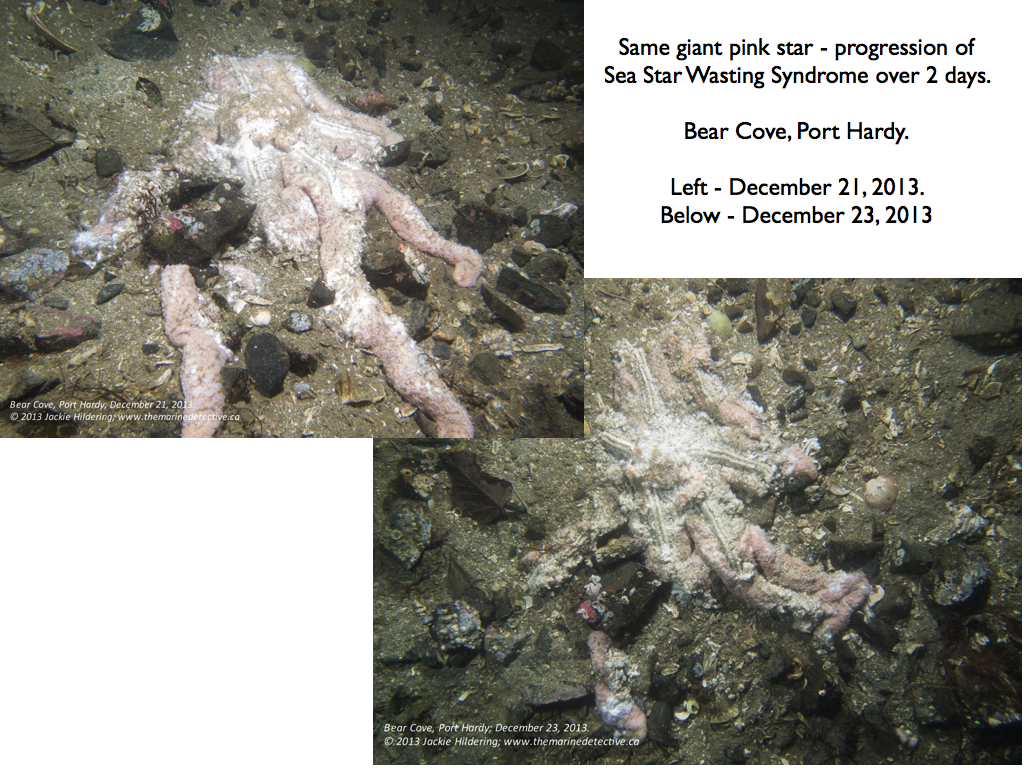
The progression of the Syndrome in 2 days in a giant pink star. (Click to enlarge.)© 2013 Jackie Hildering
The progression of the Syndrome in 2 days in a giant pink star. (Click to enlarge.)© 2013 Jackie Hildering
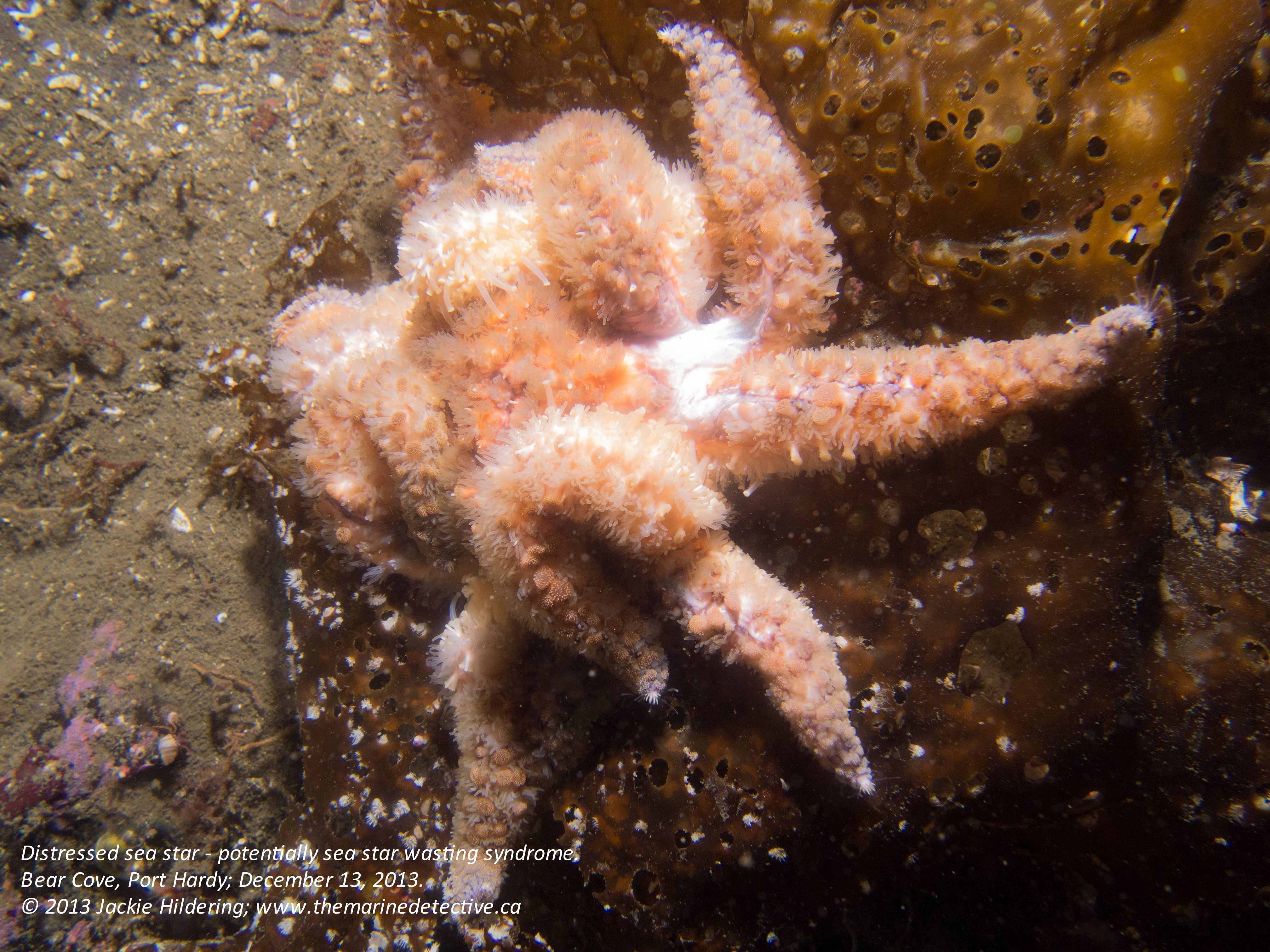
Table showing progression of SSWS at Bear Cove

Table showing a summary of my data re. progression of species impacted at Bear Cove, Port Hardy. Progression of symptoms in a leather star over 16 days at Bear Cove, Port Hardy. (Click to enlarge.) © 2014 Jackie Hildering

Progression of symptoms in a leather star over 16 days at Bear Cove, Port Hardy. (Click to enlarge.)© 2014 Jackie Hildering
Progression of symptoms in a leather star over 16 days at Bear Cove, Port Hardy. (Click to enlarge.)© 2014 Jackie Hildering

Octopused! A story in grainy pictures.

I am typing with salt still encrusted to my face and hair. I really should warm up from my dive and wash off the NE Pacific before sharing this with you but this is the kind of story you want to shout from the seamount tops. However, be warned, there is a bit of a dark side to the story too.

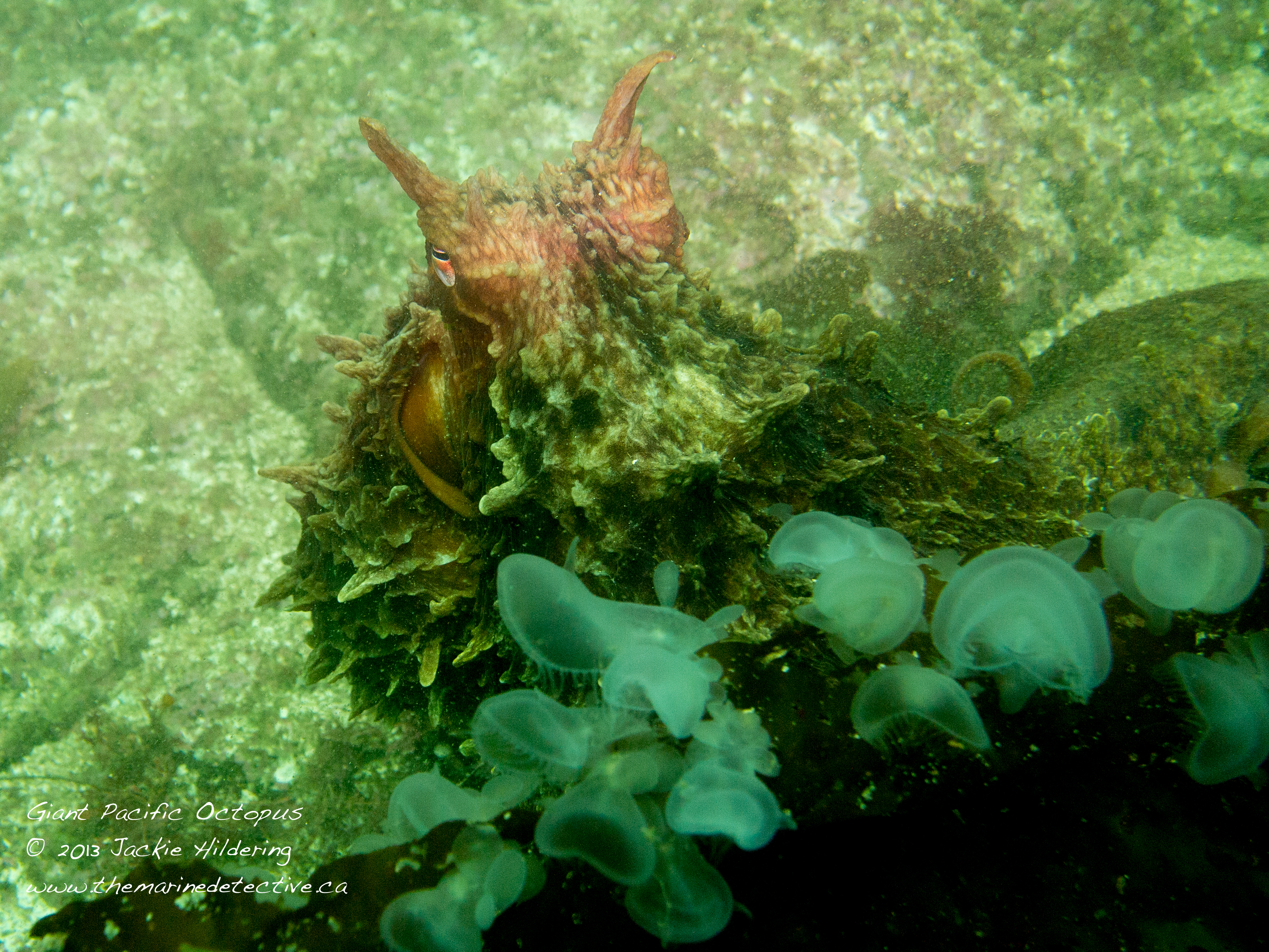
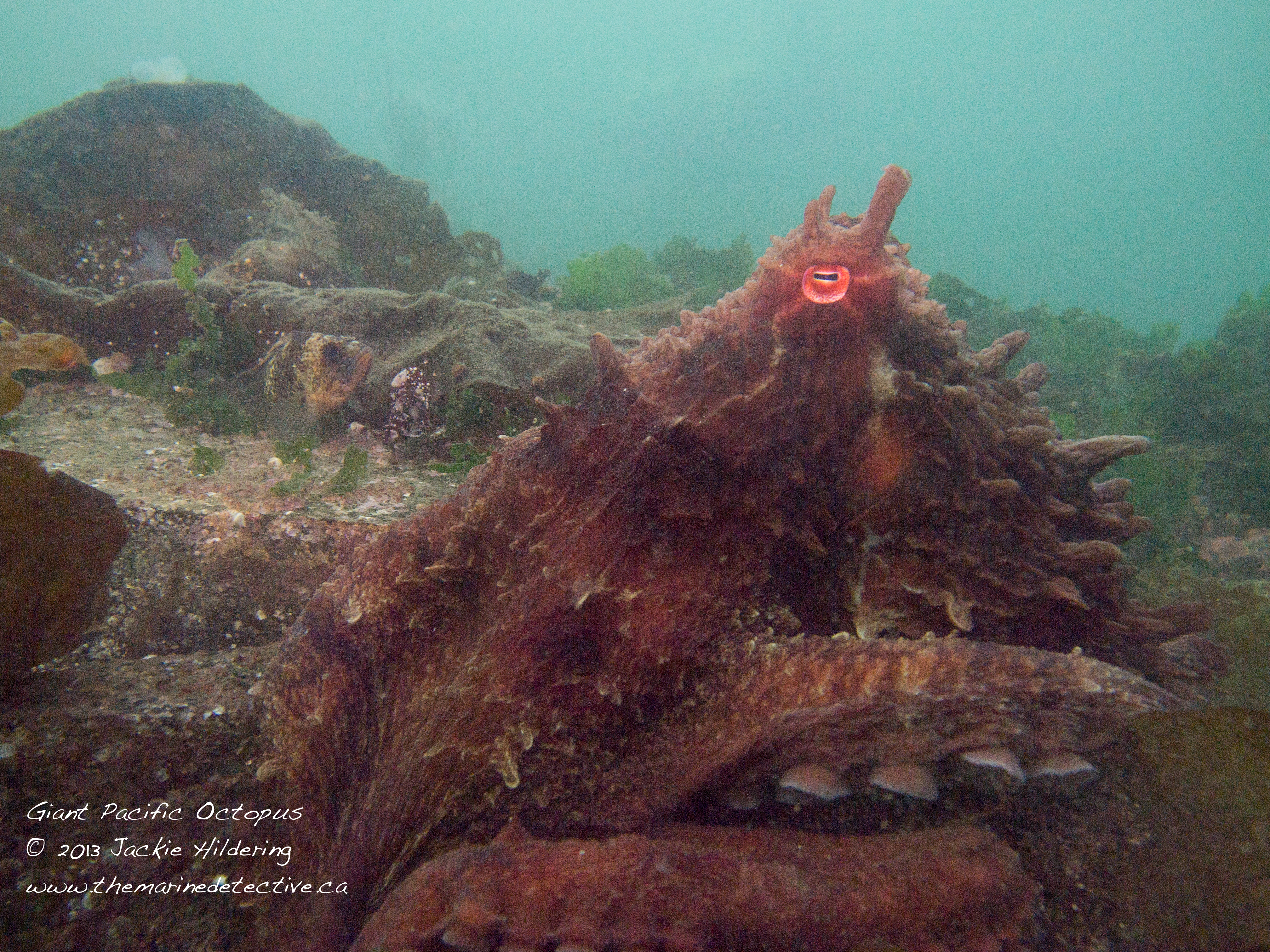
Today, while doing a shore dive in Port Hardy with the intention of surveying the health of sea stars*, I had the most wondrous experience I have ever had with not one, but two giant Pacific octopuses.

While photographing a sea star I must have disturbed the first octopus because when I looked down, wondering what had caused a massive disruption of hooded nudibranchs from the kelp, there she/he was in full glory – posturing to show me his/her impressive size, hooded nudibranchs undulating all around.

I even ended up with a hooded nudibranch stuck to my mask, which I gently shook off as I am a poor surrogate for kelp!

After I recovered from the shock of this all and  mumbled an apology in the guilt of triggering the chaos, I looked at the octopus for a bit  . . . and she/he looked at me. We both settled down, apparent in the case of the octopus in that he/she was no longer posturing and reverted to camouflage colours rather than alarm vibrance.

After some minutes, the assessment appeared to be made by this sentient being that I was not a risk; and that there was no need to hide (nor ink!). As a result, for half an hour I was able to (respectfully) follow along as the octopus hunted.

I was allowed to learn about hunting strategy and see how the colour and texture changed as it moved and how the mantle would flash white as it pounced upon prey.

The only thing that stopped this deeply awe-inspiring experience was that dive buddy, Alex Spicer, found a second octopus in the open!

This much smaller octopus was using giant kelp like a hammock.

The divers among you know what a rare gift it is to find one, let alone two, (unhabituated) octopuses out of their dens, certainly during daytime.  The underwater photographers and videographers among you would be twitching all the more, knowing what an incredible opportunity this offers to capture the beauty of these giant wonders.

Here’s the dark side. Thankfully it is a literal dark side. My strobes (flashes) didn’t work properly and it was my own doing. It’s been a crazy week of work and, in the flurry resulting from wanting to fit in a dive, I forgot the cables that hook the strobes to the camera.

Yes, I was given what may be the opportunity of a lifetime but failed to fully capture the beauty of it, leaving you with only the grainy images below. However, I got to fully live the experience and had anything changed in the course of events that led to today’s dive, likely I wouldn’t have been octopused at all.

I hope the images are still enough to illuminate the joy and wonder I felt.

[Be sure you scroll down for the photo of the little guy in the kelp hammock!]

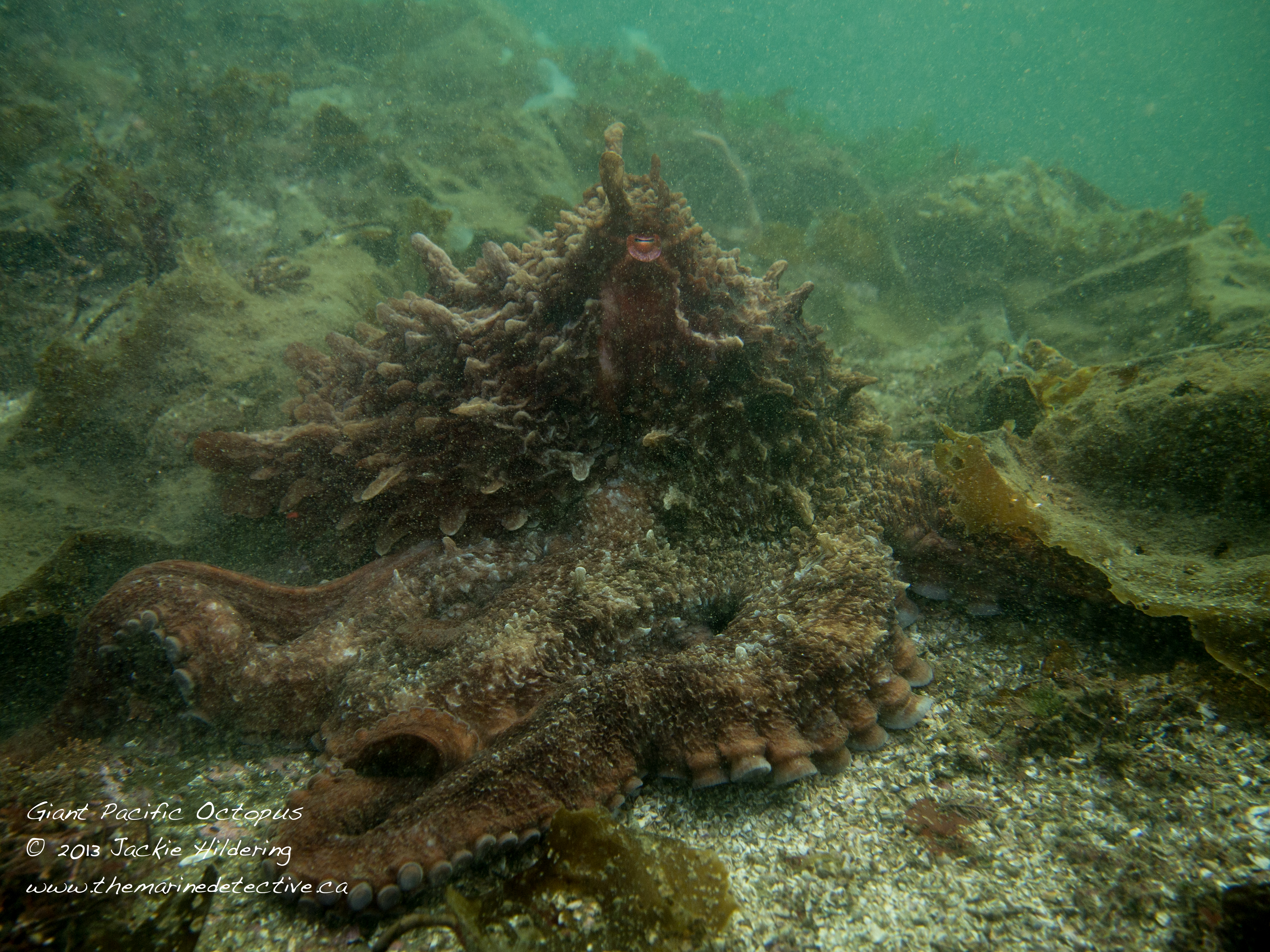
Giant Pacific Octopus #1 shortly after we'd both collected ourselves. © 2013 Jackie Hildering

Giant Pacific Octopus #1 shortly after we’d both collected ourselves. © 2013 Jackie Hildering

Getting checked out by Giant Pacific Octopus #1. Hooded nudibranchs in the foreground. © 2013 Jackie Hildering

Getting checked out by Giant Pacific Octopus #1. Hooded nudibranchs in the foreground. © 2013 Jackie Hildering

Giant Pacific Octopus #1 with quillback rockfish to left. © 2013 Jackie Hildering

Giant Pacific Octopus #1 with mantle flashing white which it seemed to do when it pounced on prey (a crab in this case - I think) © 2013 Jackie Hildering

Giant Pacific Octopus #1 with mantle flashing white which it seemed to do when it pounced on prey (a crab in this case – I think) © 2013 Jackie Hildering

Giant Pacific Octopus #1 with hooded nudibranchs © 2013 Jackie Hildering

Giant Pacific Octopus #1 with hooded nudibranchs © 2013 Jackie Hildering

Giant Pacific Octopus #1 feeling around for prey. Rose anemone in the foreground (aka fish-eating anemone) © 2013 Jackie Hildering

Giant Pacific Octopus #1 feeling around for prey. Rose anemone in the foreground (aka fish-eating anemone) © 2013 Jackie Hildering

Giant Pacific Octopus #1 with hooded nudibranchs in the background © 2013 Jackie Hildering

Giant Pacific Octopus #1 with hooded nudibranchs in the background © 2013 Jackie Hildering

Giant Pacific Octopus #2 - much smaller and using the giant kelp as a hammock. © 2013 Jackie Hildering

Giant Pacific Octopus #2 – much smaller and using the giant kelp as a hammock. © 2013 Jackie Hildering

[*On this dive there was no evidence of Sea Star Wasting Syndrome but I have now documented its presence. See these blog items.]

Submerge . . .

Come away with me . . . spend 3 minutes submerged in the shallows of the eastern North Pacific, photographing jelly species.

There is no place I’d rather be than here, learning about the richness and wonder of life in these cold waters.

With huge gratitude to Roger McDonell – underwater videographer and dive buddy supreme – for having taken this video.


Video taken during our weekly dive as the Top Island Econauts Dive Club.

Super Mom! Up to 300 young under her care.

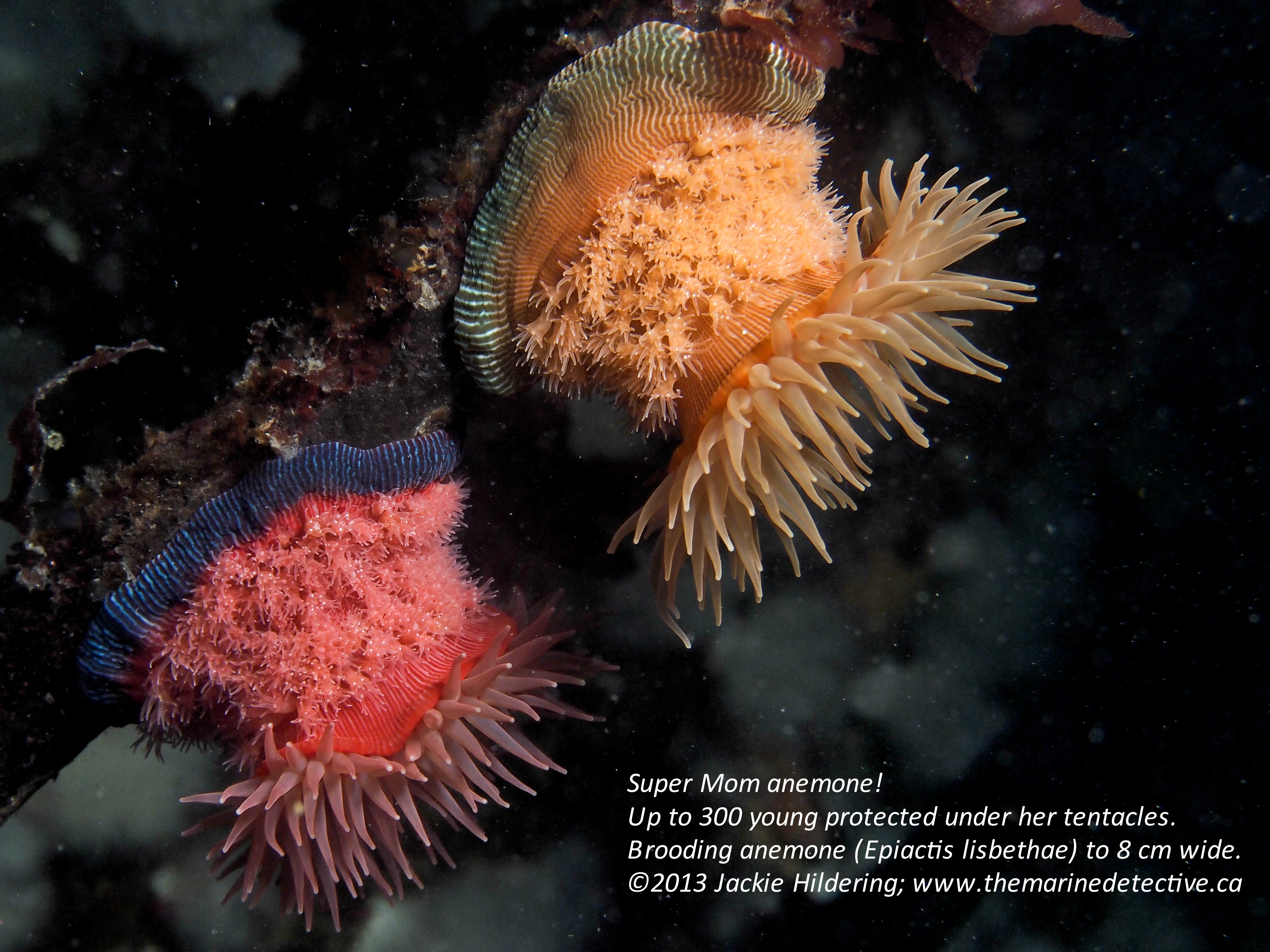
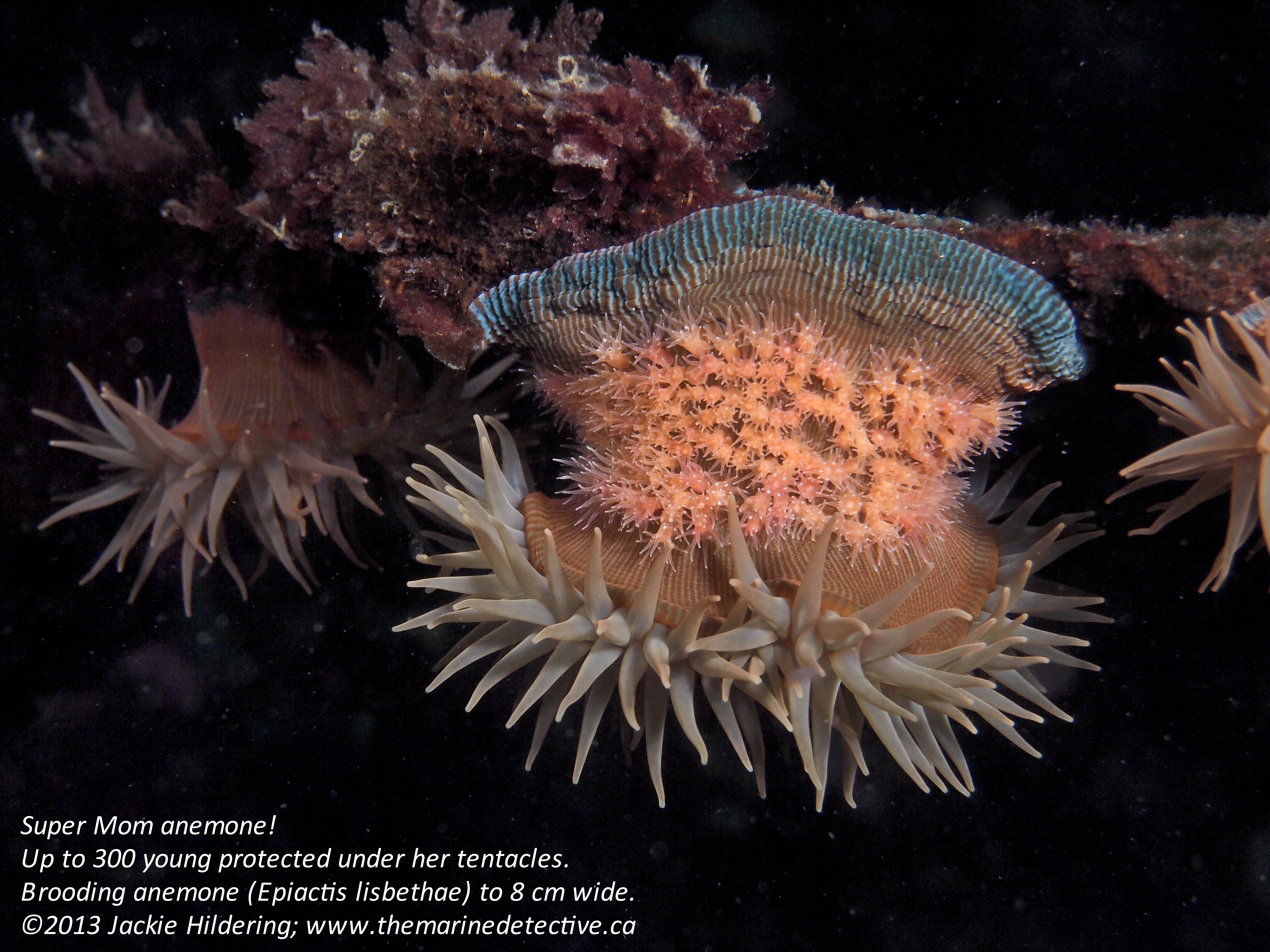
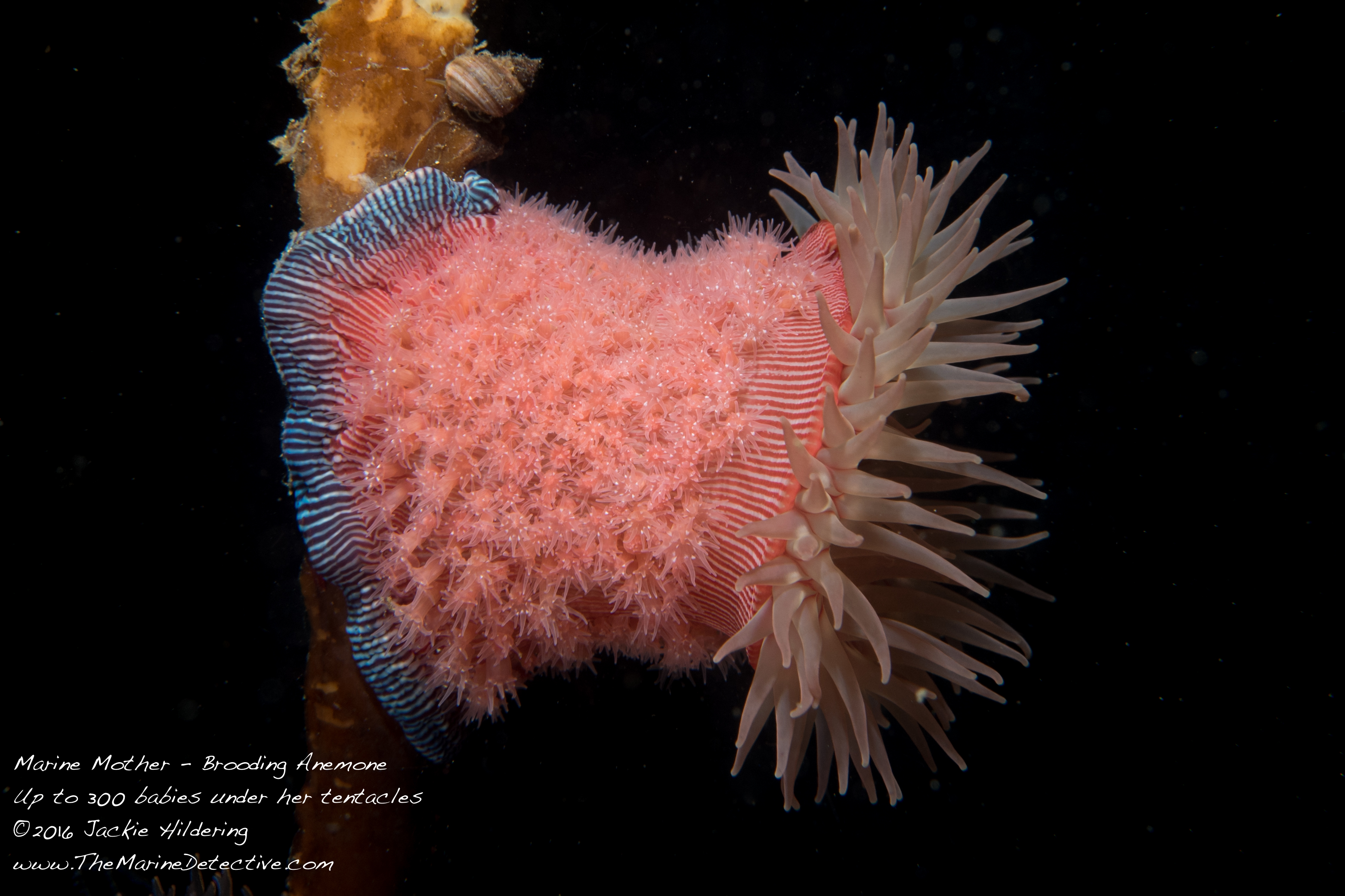
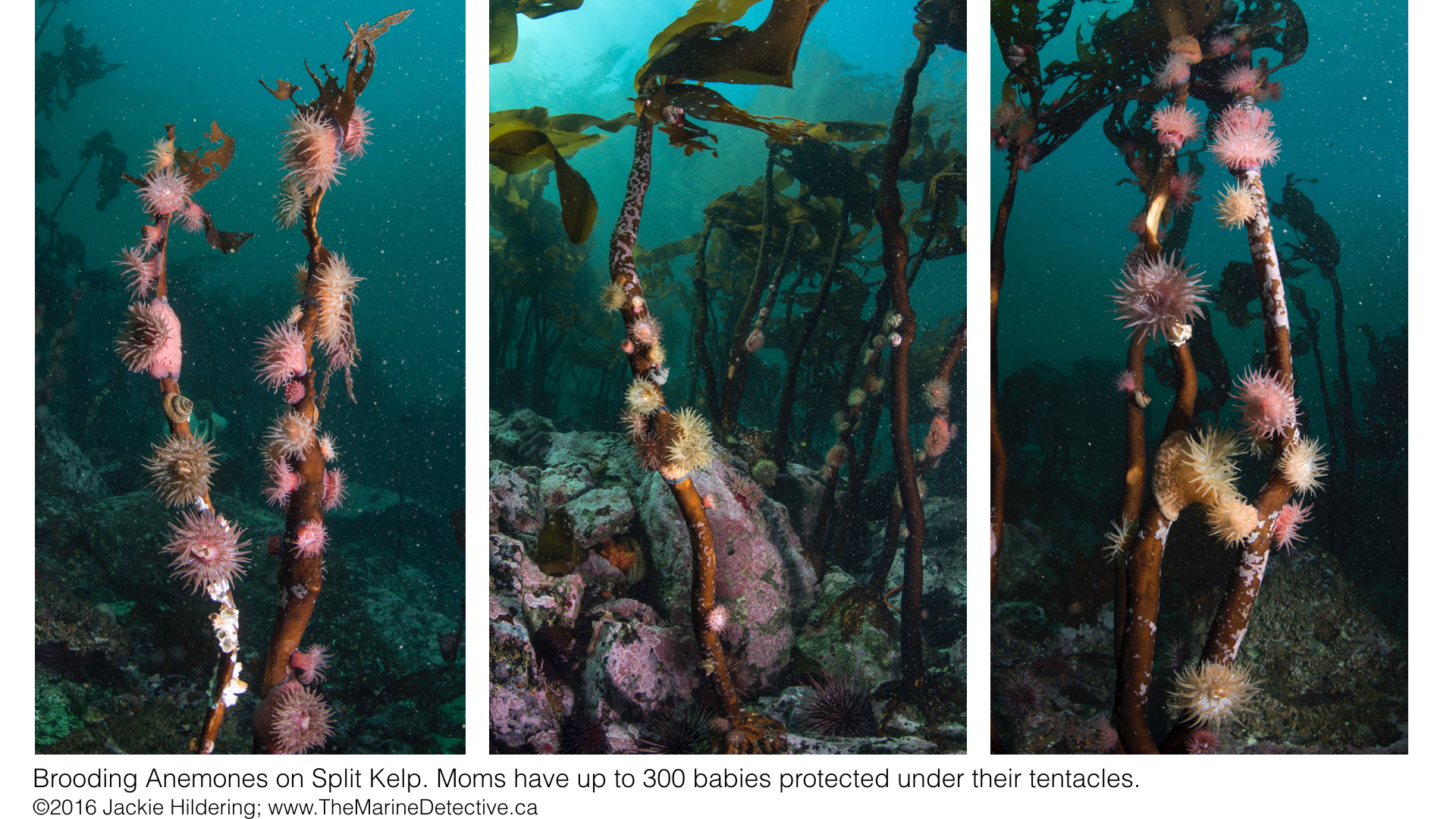
This is a Brooding Anemone (Epiactis lisbethae to 8 cm across).

She may not have a backbone but she’s a Super Mom!

As many as 300 young can be clustered around her in up to 5 rows, benefitting from the protective canopy of her tentacles which contain stinging cells (nematocysts). The offspring remain here until big enough to stand a good chance of surviving on their own. They then crawl toward independence, claiming their own piece of the ocean bottom.

Brooding anemone 1

I am awestruck by this species’ beauty and reproductive strategy. It is also a reminder of how little we know about marine species that the Brooding Anemone was not recognized as a distinct species until fairly recently (1986), and it still so often gets confused with the Proliferating Anemone (Epiactis prolifera).

I share my marine “detectiving” about this species with you to provide a further example of how extraordinary our marine neighbours are and maybe, thereby, help inspire greater conservation efforts.

But yes, the timing of the blog is no accident. It may be that reflection upon an anemone Super Mom stimulates thought about our human mothers – just in time for Mother’s Day.

So here goes . . . bear with me as I build to clarifying the reproduction of our featured species.

© 2013 Jackie Hildering one time use only-4240156

Anemones have many reproductive strategies.

For many species, reproduction can be asexual as well as sexual with strategies like budding off offspring; splitting into two; or pedal laceration where a torn piece of the bottom of the anemone can grow into another anemone!

Some species are hermaphrodites with highly diverse ways by which offspring develop into adults.

In species that have separate sexes, many are broadcast spawners where Mom and Dad release their eggs and sperm into the ocean around them. Fertilization and development thereby happens in the water column.

Then, for only some 20 species of the world’s more than 800 kinds of anemone, there are those in which the female captures the males’ sex cells as they drift by and draws them into her digestive cavity to fertilize her eggs. She “broods’ her young.

Some such anemone species are internal brooders.  The young develop inside Mom until they hatch and are expelled into the water column as planktonic larvae.

But then there’s Super Mom – the Brooding Anemone (Epiactis lisbethae). She’s an external brooder.

After she has fertilized the eggs inside her digestive cavity with the sperm she has captured, the young develop inside her until they hatch into planktonic larvae. THEN, they swim out of her mouth, settle on her body under the tentacles and grow into little anemones that feed themselves.

When the offspring are big enough to stand a good chance of survival without the protection of Mom’s tentacles, they shuffle away to independence, leaving space for next season’s young.

The brooding anemone’s young are all of the same generation and are therefore all about the same size.

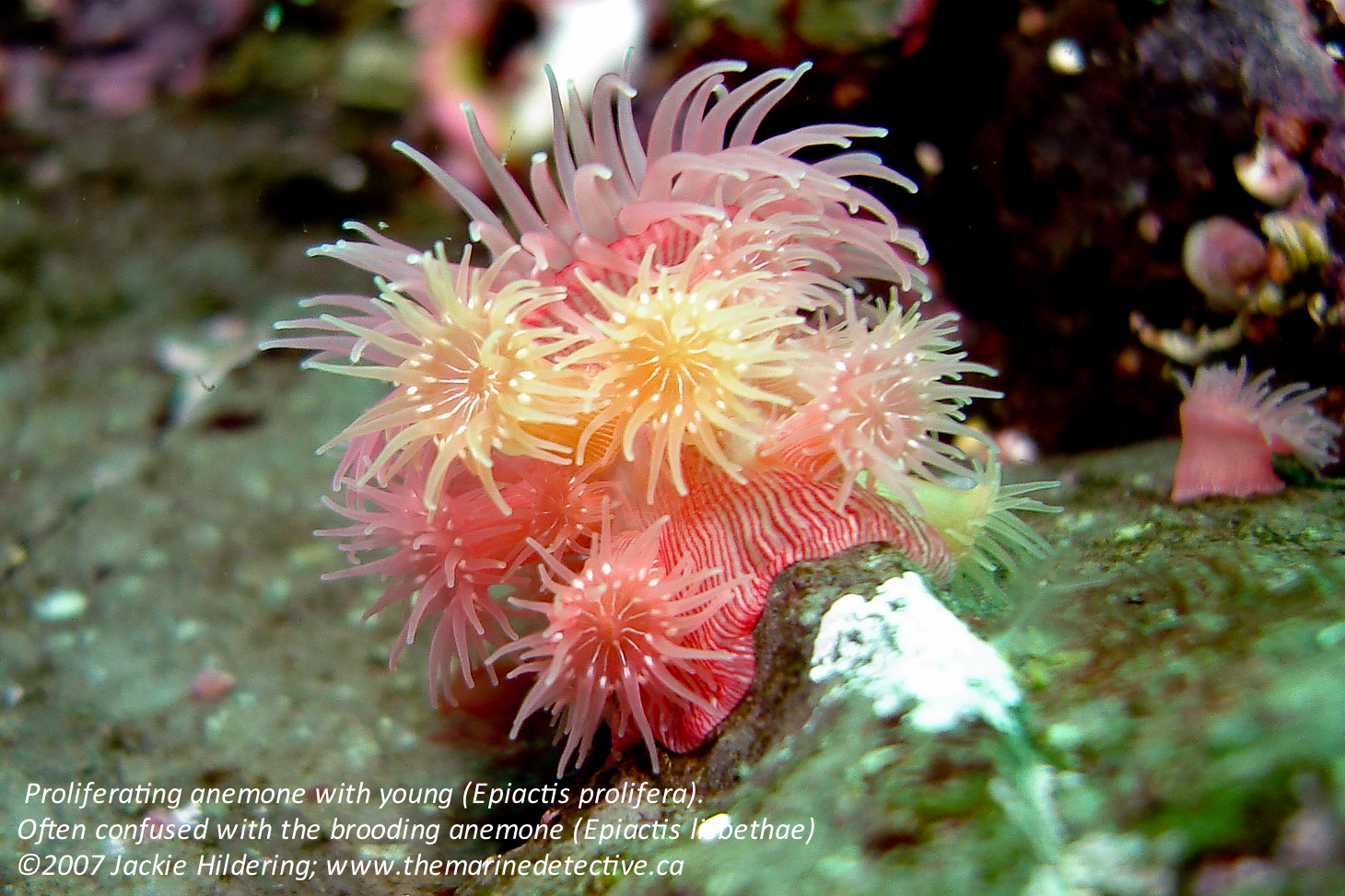
However, there is a second externally brooding anemone species in the eastern North Pacific where you most often see young of different sizes huddled under Mom’s tentacles. This species – the Proliferating Anemone (Epiactis prolifera) is the one that very, very frequently gets confused with the Brooding Anemone.

A

Proliferating anemone.

Proliferating Anemone with young (Epiactis prolifera). Often confused with the Brooding Anemone (Epiactis lisbethae). 

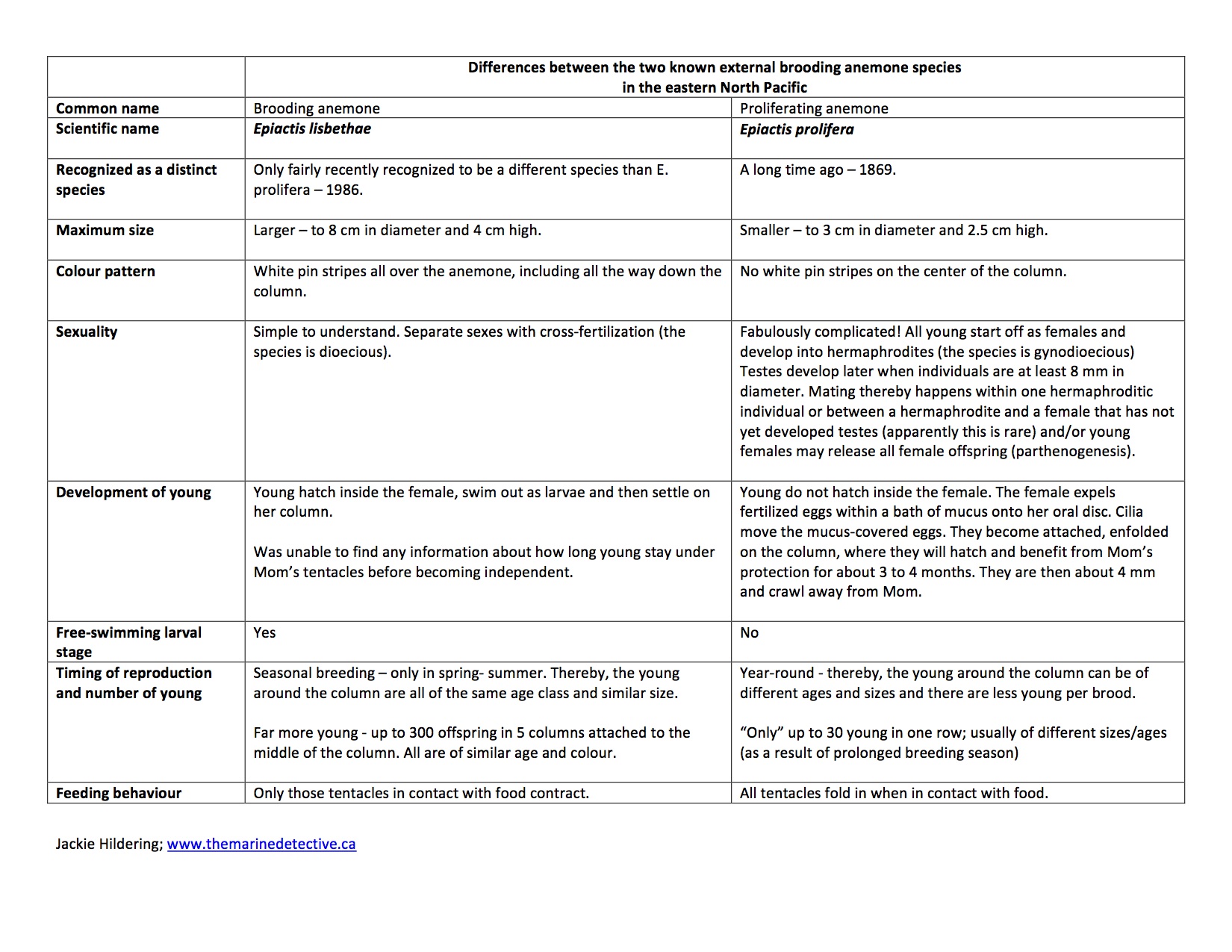
I have strived to clarify the many differences between these two externally brooding anemone species in the table below but to summarize: the Proliferating Anemone is smaller and does not have striping all the way down the column; adults are hermaphrodites; breeding happens year round; there are far fewer young clustered under mom’s tentacles; and they start off there as fertilized eggs, not as free-swimming larva.

The main similarity between these two species is and yes, I am going to use a tongue twister here since I believe it is inevitable when discussing anemones: with anemone mothers like these, baby anemones are protected from their anemone enemies!

Now off you go, share some ocean love with a Super Mom!

There are so many human females out there worthy of awe. Where, were we to consider how many young they have shielded and helped to independence, the number might well be 300 or more!

brooding vs. proliferating table

Click to enlarge. Table summarizing the differences between Brooding and Proliferating Anemones.

Brooding anemone with young (Epiactis lisbethae) - all the same age. ©2016 Jackie Hildering.

Brooding Anemone with young (Epiactis lisbethae) – all the same age. ©2016 Jackie Hildering.

long-horizontal-001


Next 3 photos show Proliferating Anemone babies under their mother’s tentacles, some shuffling off after 3 to 4 months there. Epiactis prolifera – often confused with the Brooding Anemone.  DSC00272

DSC00262

DSC00260Sources:

Gold Dirona and Alabaster Nudibranch Egg Masses

Updated with photos: 2025-12-18
An egg hunt mystery FINALLY came to an end for me, coincidentally, just before Easter when many of you were involved in egg hunts too.

I dare say however that my hunt involved vastly more beautiful eggs; that the hunt was much more challenging and –  ultimately, much more rewarding!

One of my very, very favourite things to do, satisfying my “The Marine Detective” nature, is to solve the ultimate “whodunit” and match sea slug species with their egg masses / ribbons.

Every sea slug species’ egg mass is distinct, comprising a fascinating diversity of intoxicatingly beautiful shapes and patterns.

It delights me (for reasons I can’t fully explain) that for many sea slugs in the northeast Pacific Ocean, I am able to see an egg mass and immediately know which species laid it.

There are big clues because sea slugs most often lay eggs on their food. So if I know their prey preference I can narrow down which  species laid the eggs.

Easiest of course is to have have the good fortune to find a sea slug in the act of laying their eggs.

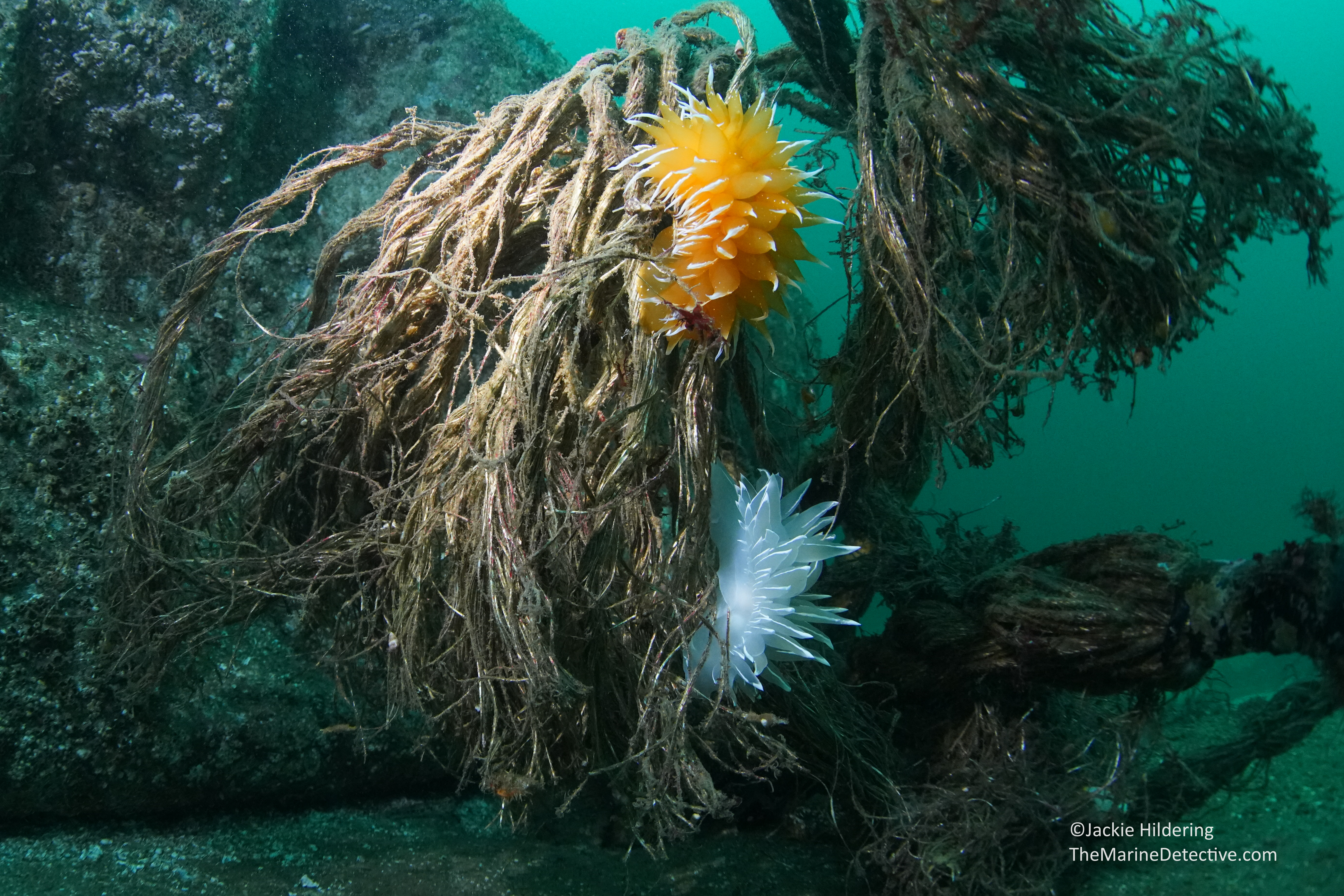
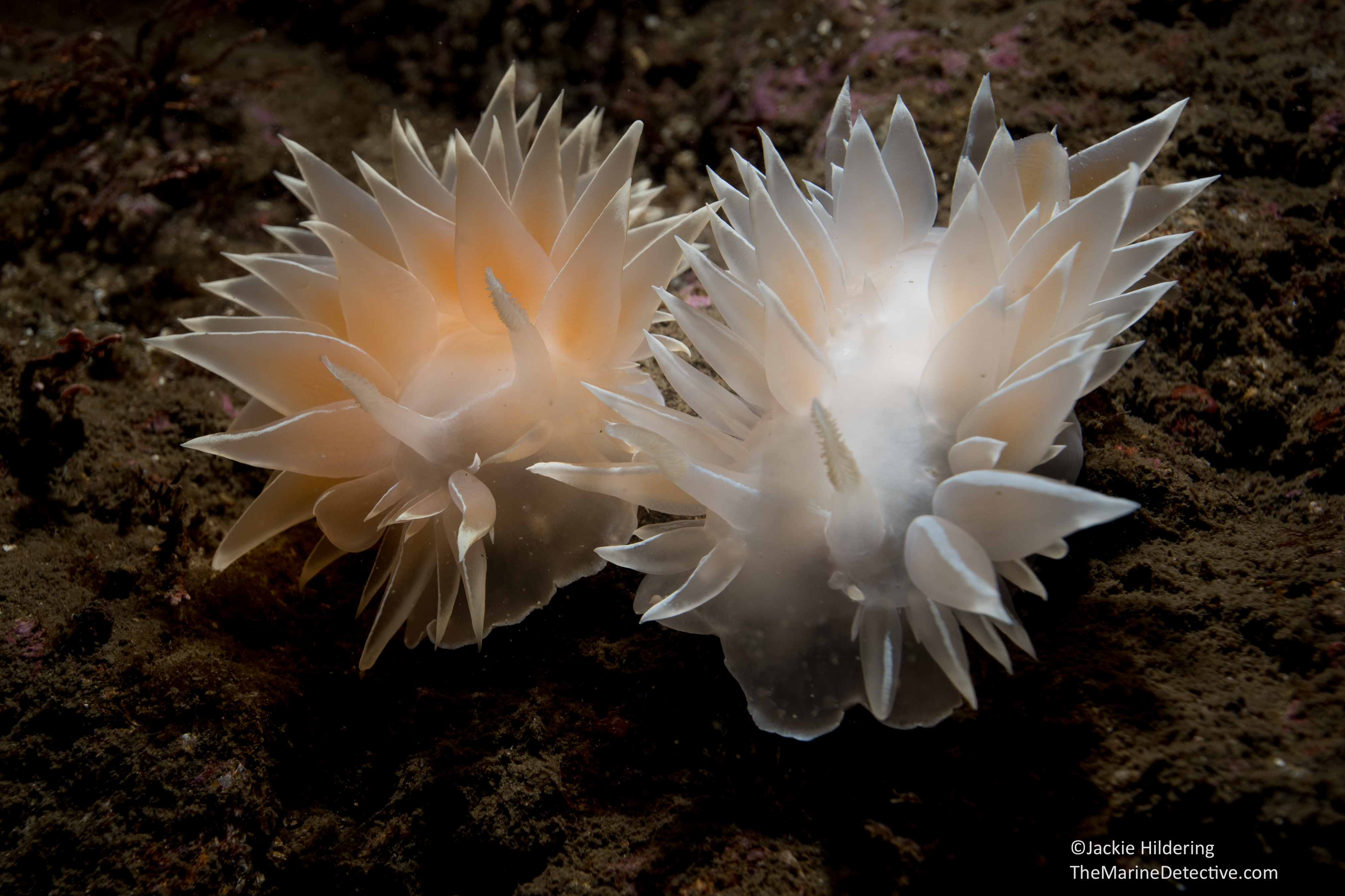
But for YEARS, I have been unable to differentiate the egg masses of two of the most beautiful sea slug species in these waters – the Gold Dirona (Dirona pellucida to 12 cm) and the Alabaster Nudibranch (Dirona albolineata to 18 cm and also referenced as the “White-Lined Dirona” or “Frosted Nudibranch”).

You’ll note that they are very closely related (same genus) and it is thereby not surprising that their egg masses would look very similar. Both also often lay their eggs on the same species of Agarum kelp. In all these years, while I have often found both species mating, I have never found either species laying their eggs.

But then, this week . . . just when I was noting the abundance of both species, how many egg masses there were and wishing, WISHING, I could find just one of them laying eggs – my dear dive buddy Jacqui Engel waved me over and pointed out a Gold Dirona laying eggs.

Gold dirona laying eggs.

I was so jubilant, I screamed underwater. Yes, I am The Marine Detective for a reason, such things really do delight me to this degree.

Finally!  Mystery solved, I would be able to differentiate the egg masses of the two species.

But then, Nature was even kinder to me.

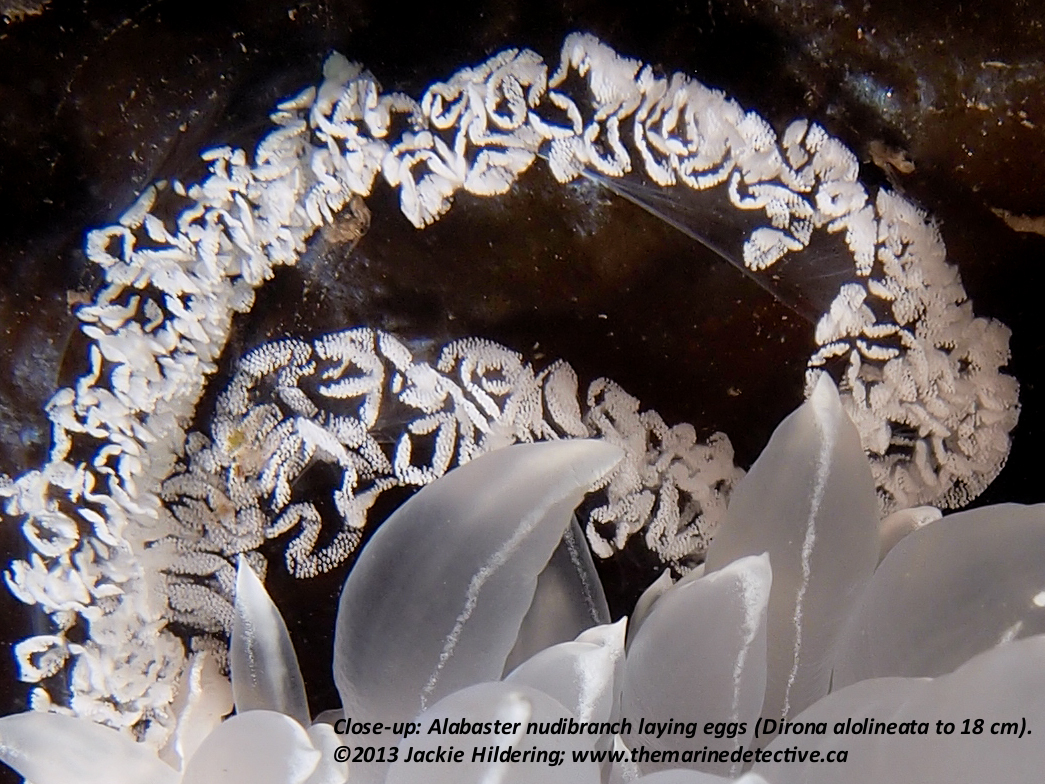
On the very same day on the very same dive, after so many years, I also stumbled across an Alabaster Nudibranch laying eggs!

Alabaster nudibranch laying eggs.

Disbelief! Joy! Manic photo-taking!

I think you may marvel at how very similar the masses are but the difference, at least to me is clear.

The “pieces” of the Gold Dirona’s egg mass are more compact and more like rice kernels.

Gold dirona laying eggs.

The segments of the Alabaster Nudibranch’s egg masses are more scallop-edged and diffuse.

Please know that these differences would not be as clear if the eggs were older.

It’s estimated that there are ~350,000 eggs in one Alabaster Nudibranch egg mass. Source: WallaWallaEd. I do not know if this is the number of egg capsules (the dots you see), or if it includes the number of eggs in each egg capsule.

Sea slugs are reciprocal hermaphrodites which means that both become inseminated and lay eggs. One individual lays more than one egg mass as well. So many eggs are needed to ensure species survival when your young hatch out to become part of the planktonic soup of the Ocean.

Alabaster nudibranch laying eggs.

If you have read to this point – thank you!

Likely we are kindred in our love of marine biodiversity and the beauty that is sea slugs.

For as much as I love chocolate Easter eggs, I would forego them for the rest of my existence if it would allow my appetite for marine mysteries to be further satisfied!


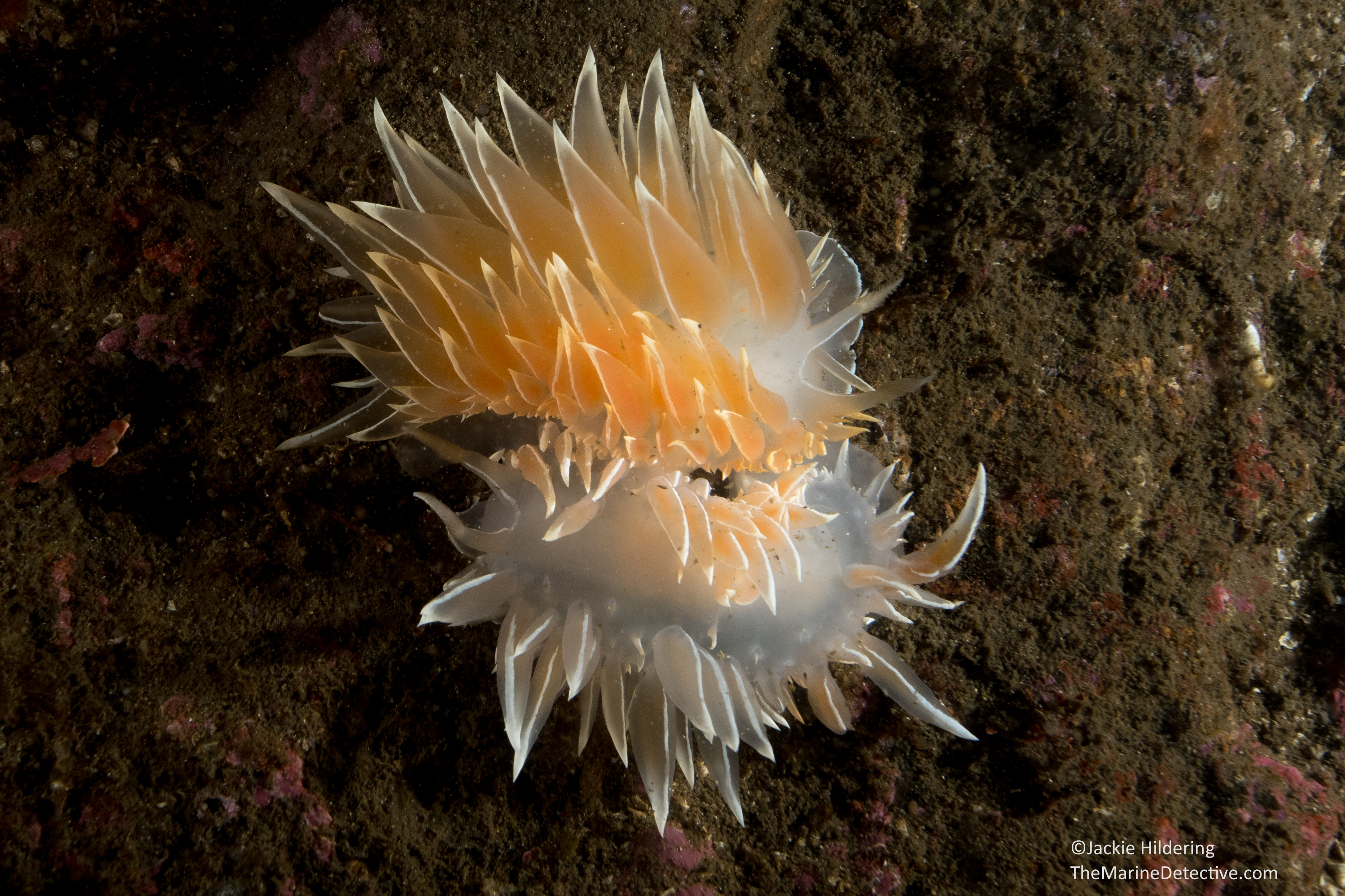
Gold Dironas mating. ©Jackie Hildering.
Alabaster Nudibranchs mating ©Jackie Hildering.
Gold Dirona with Alabaster Nudibranch below on a frayed rope. ©Jackie Hildering.
Alabaster Nudibranch left and Gold Dirona right. But see photos below. Alabaster Nudibranchs are not always fully white and this can lead to ID confusion. ©Jackie Hildering.

Colour variation in Alabaster Nudibranchs

Alabaster Nudibranch – colour varies to include orange, yellow, and pink hues. ©Jackie Hildering.
Also an Alabaster Nudibranch. ©Jackie Hildering.
This photo and the next. Alabaster Nudibranchs moving into mating position right-side to right-side. ©Jackie Hildering.

Mistaken identity?
Gold Dirona above and Alabaster Nudibranch below. Discussion about this interaction on the Sea Slug Forum at this link.