What on Earth is “Alternation of Generations”?
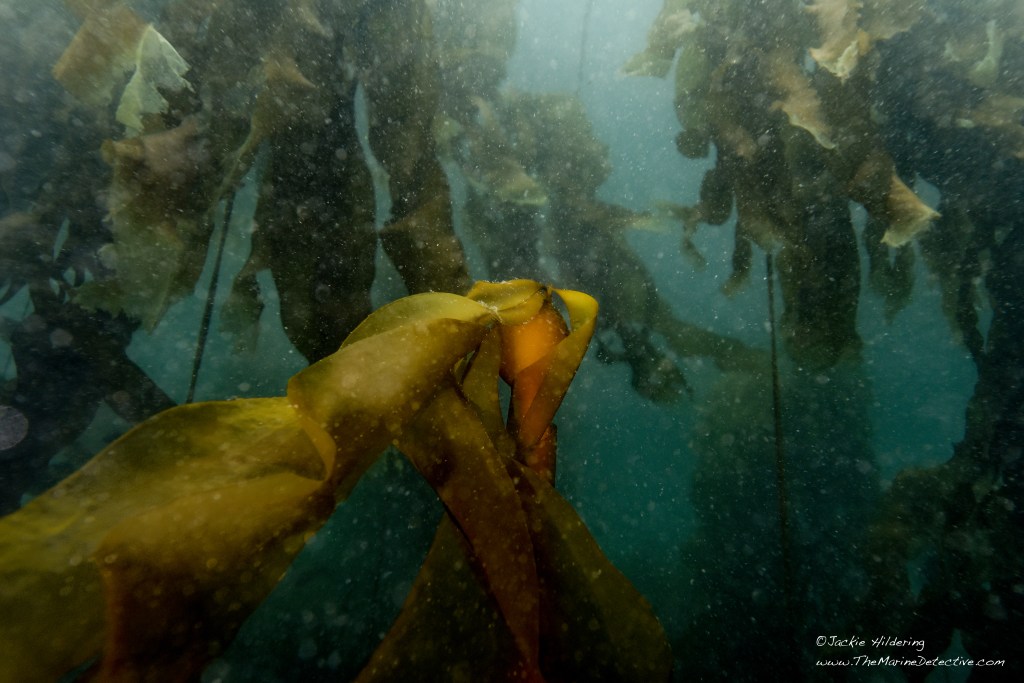
Have you ever wondered how it can be that Bull Kelp forests largely die off in the winter but then reappear in the spring?
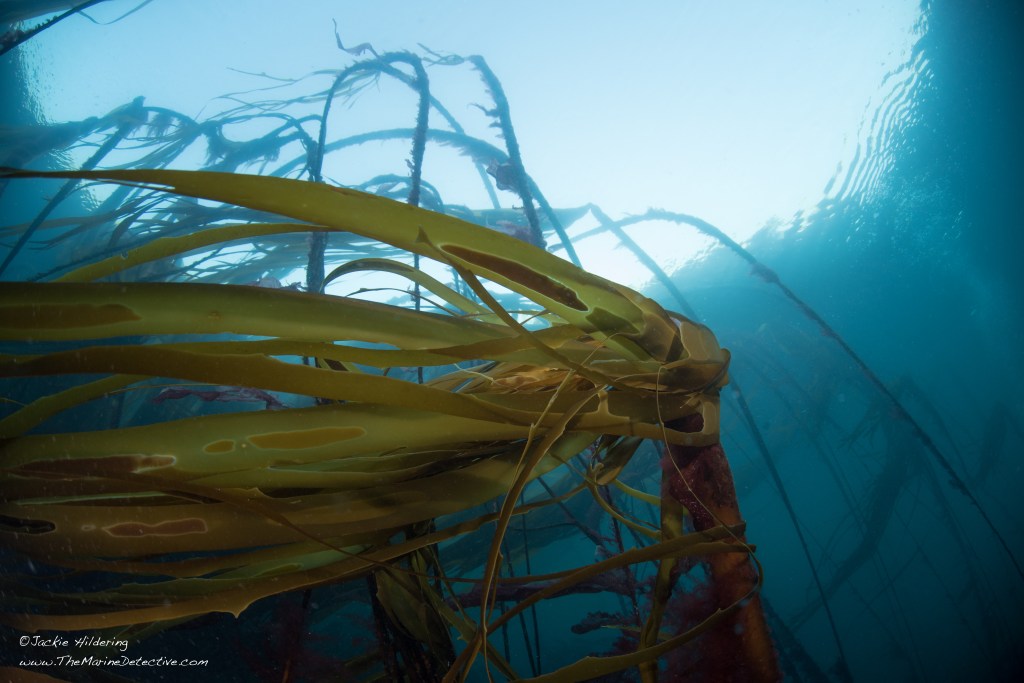
Have you ever wondered about the light patches in the fronds of Bull Kelp as seen in the four images below?


I hope that’s enough of a hook for you to want to know more about the remarkable reproduction of most algae / seaweeds (and ferns and mosses).
Their reproduction involves two versions of the same species. The parent generation looks nothing like their offspring but DOES look like their great-offspring’s generation i.e. there is alternation of generations.
Those light patches in the fronds of Bull Kelp are known as as sori (singular is sorus). They most often drop to the bottom of the ocean, release spores which create a completely different, very tiny version of Bull Kelp (asexually) which then makes the big, long version of Bull Kelp (sexually).
Below you have my attempt at further explaining this aided by a really good graphic.

And for the super science nerds (I see you), more detail from Wernberg et al regarding reproduction in kelp forests: “Recruitment involves multiple microscopic stages (i.e. gametophytes and juvenile sporophytes). Because the sperm has to find an egg, male and female gametophytes must settle in close proximity at densities of ca. 1 square millimetre in order to secure fertilization (Reed, 1990). Gametophytes and microscopic sporophytes can persist in the kelp forest understory for weeks to months, where they serve as a ‘seedbank’ (Hoffman & Santelices, 1991). Microscopic sporophytes start growing once stimulated by high light (Reed & Foster, 1984) . . . Recruitment into the adult population takes anywhere from a few months to 2-3 years depending on the species and local conditions (Pedersen et al, 2012, Teed, 1990). Most juvenile plants succumb to predation, stress, or self-thinning within the first year, but some individuals can remain viable for years without growing (Sjotun, Christie, & Helge Fossa, 2006) until space and light become available.”
But wait, there’s more. Research from Ulaski and Konar (2021) and others showed that Bull Kelp has an alternate life history strategy. Occasionally, the sori release embryonic sporophytes! These embryonic sporophytes can directly develop (on the blades / fronds) into the large version of Bull Kelp again without going through the free-swimming sexual reproduction phase. The percentage of spores vs. embryonic sporophytes released from sori ranged from 0 to 100% and did not seem to be influenced by (1) if the sori came from overwintering or first generation Bull Kelp; and (2) if the sori came from Bull Kelp that was drifting or attached to the bottom (substrate).
From the abstract of the research paper: ” . . . embryonic sporophytes were occasionally released alongside viable spores. Though embryonic sporophytes were released from sori as early as spring, it was not evident that they were bound by seasonal or spatial limits. The percent of propagules that were embryonic sporophytes ranged from 0% to 100% but were not significantly different between first generation and overwintered adults, nor were they different between attached and drifting individuals. Nevertheless, the characteristic of directly releasing embryonic sporophytes from adult sporophytes might have ecological advantages for N. luetkeana.”
And you thought your sex life was complicated! 🙂
Note that of the giant kelp species found off our coast from California to Alaska, Bull Kelp (Nereocystis luetkeana) is an annual whereby most sporophytes die off every year. Giant Kelp (Macrocystis pyrifera) is perennial whereby the sporophyte does NOT die off at the end of the growing season.
If you have read to this point, congratulations! You are amongst the few humans who may have a good comprehension of alternation off generations. You know what is in the photo below.


You also know how it can be that Bull Kelp forests reappear in the spring. They were never really gone. The species was there all along, but just in a different version / generation.
With regard to growth rate, the stipe (stem-like structure) of Bull Kelp can grow up to a maximum height of 36 m. The stipe would have to grow an average of 17 cm a day to reach this length in the 210-day growing period (Druel). If you include the growth of the fronds (the leaf-like structures), the maximum growth rate has been documented to be at least 25 cm per day (Duncan). Giant Kelp grows even faster and bigger = up to 30.5 cm at day to heights of 53.4 m.
Do know that there is concern about diminishing kelp forests due to impacts of changing ocean conditions / climate change / Sea Star Wasting Syndrome. Some sea star species are recovering but the Sunflower Star is not whereby there are more of their prey, including urchins which graze on kelp forests.

The two mages below are from the Beaty Biodiversity Museum via Bridgette Clarkson.


Sources:
- Duncan, M. J. 1973. In situ studies of growth and pigmentation of the phaeophycean Nereocystis luetkeana. Helgolander Meere- € sun. 24:510–25.
- Druehl, Louis and Clarkston, Bridgette. 2000. Pacific Seaweeds – a guide to common seaweeds of the west coast.
- Springer, Yuri & Hays, Cynthia & Carr, Dr & Mackey, Ms & Bloeser, Jennifer. (2006). Ecology and Management of the Bull Kelp, Nereocystis Luetkeana: A Synthesis with Recommendations for Future Research.
- Ulaski, Brian P. and Konar, Brenda (2021). Direct Release Of Embryonic Sporophytes From Adult Nereocystis Luetkeana (Laminariales, Ochrophyta) In A High Latitude Estuary. 36(2). https://doi.org/10.4490/algae.2021.36.5.10
- Wernberg, Thomas & Krumhansl, Kira & Filbee-dexter, Karen & Pedersen, Morten. (2019). Status and Trends for the World’s Kelp Forests. 10.1016/B978-0-12-805052-1.00003-6.
More good sources to understand alternation of generations:
- The Mysterious World of Bull Kelp – How Does Bull Kelp Reproduce
- Video: The Sex Lives of Nonvascular Plants: Alternation of Generations – Crash Course Biology #36
- Article on how a female scientist’s understanding of alternation of generations helped save Japan’s seaweed industry circa ~1949 – “How Pink Slime Saved Sushi Kathleen Drew-Baker’s study of British algae helped rescue Japan’s nori industry“
- Hakai Institute’s video series on monitoring kelp

Bull Kelp in January.
 The Marine Detective
16 Responses to “What on Earth is “Alternation of Generations”?”
I am glad I read the whole article. I learned something I didn’t know. The spore packets ! Thank you. Also I see from your photos you suffer the same visibility as I do here on Whidbey. 🙂
Well that made my day Jan! We only have the poor vis on shore dives generally. There’s some much water rushing in out and of the passes that even in summer the vis on boat dives is quite good.
Great post! May I use some of your photos & info (with proper referencing, of course) in my slides for the Bio class I’m teaching this summer. Real examples kick butt over textbook diagrams!!
Thanks! -definitely for the interesting post -hopefully for your permission
Meg O’Mahony
Sent from Meg’s iPhone
>
Thank you Meg. Yes and indeed with photo credit on each photo and hopefully referencing http://www.TheMarineDetective.com as the source. If worthy, I would love if you could suggest my social media to students for further amplified knowledge and messaging.
Nicely done, Jackie! Very clear explanation of a complex phenomenon!
High praise from a fellow educator. Thank you Mike!
You never cease to create a sense of wonder in these posts. Thank you for all you do!
Thank you so much Victoria for helping make it feel worthwhile.
COOL!!!
Ahhh, another mystery explained!! I always find it fascinating how plants manage to reproduce in different environments. This was so clear. Merci buckets!
Thanks so much for the response Celia. Means a lot to know the blog was of use.
Great information. You take wonderful photos of Bull Kelp!!
Really appreciate the feedback Maggie. Thank you.
Cool!
I remember studying this in botany school, but we never talked about bull kelp. That’s what happens when you live in Alberta – no kelp, and few ferns to talk about. 🙂
Thanks for the refresher!
Smiling. From ferns to kelp forests. 🙂