Join me in the cold, dark, life-sustaining NE Pacific Ocean to discover the great beauty, mystery and fragility hidden there.

Porpoise-full Blog!

This, like my “You Otter Know” blog, is aimed at clearing up species confusion and offering some support to my fellow marine educators.

Yes, I am writing this for much needed educational porpoises. Sorry! I will attempt to restrain myself from further bad puns (but I am counting on you, the readers, to come up with some doozies).

Oh the number of times I have had the joy of an exchange like this:
Me: “Look, a porpoise!”
Response: “Ja, ja, een delfin!” or “Oui, oui, un dauphin” or “Ja, ja,  een dolfijn” or “Yes, yes, a dolphin!”.
Me (armed with images like those below): “Nein – een schweinswal” / “Non – un marsouin” / “Nee – een bruinvis” / “Nope – it really is a porpoise!”

It is so understandable that there is significant confusion. The words dolphin and porpoise were, colloquially, used as if they were synonyms into at least the 1970s.

But, dolphins and porpoises are more distinct than lions and tigers.  Lions and tigers are not only in the same family but in the same genus. Dolphins and porpoises are in different families, having diverged around 15 million years ago.

_JH11109

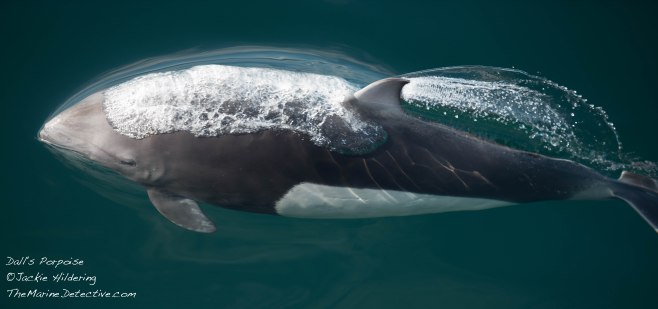
That’s no dolphin! It’s a Dall’s Porpoise. ©2015 Jackie Hildering.

The differences between porpoises and dolphins span from fin and head shape, to behaviour, vocals and average group size.

Read more

We are the environment . . .

Below, please see a collection of my images and texts I have been posting as “#OceanVoice”.

At this critical time of decision-making, they are directed at increasing hope; awareness of our connection to the environment; and positive action for the sake of greater health and happiness

Hoping they thoughts resound with you.

From the depths  . . .

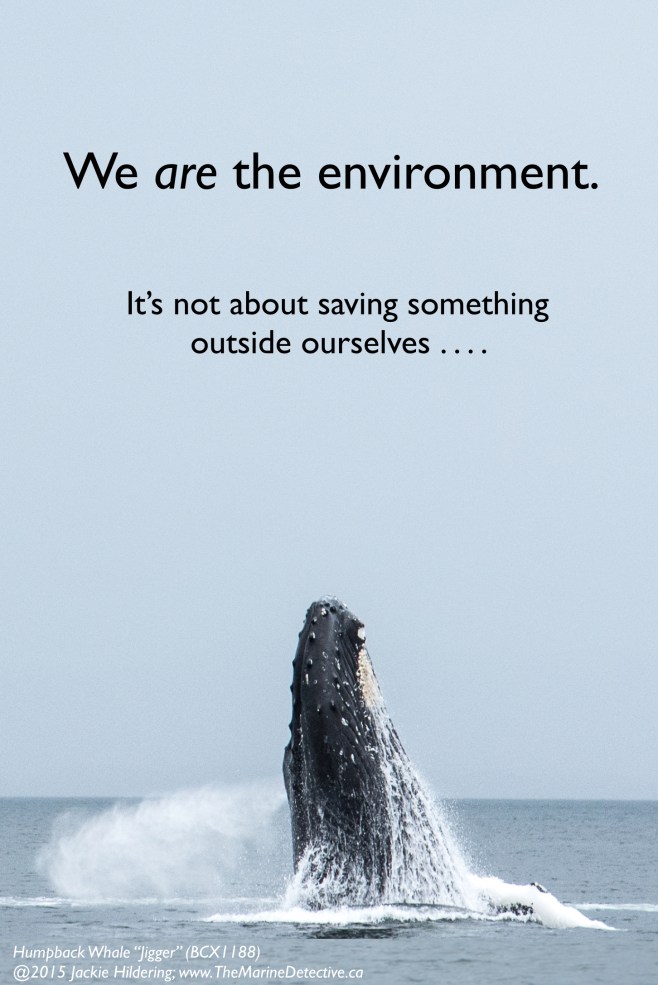
It is such a limitation to think, and feel, and speak in a way that this is somehow about something outside ourselves . . . saving “the environment.” We are the environment. It’s not about saving something outside ourselves . . . whales, wetlands, trees, fish. It’s about choices that benefit ourselves and future generations, providing the greatest chances for health and happiness. It’s about children. That's what all these photos and words are about here on "The Marine Detective" folks. Inspiration. Connection. Understanding our capacity for positive change. Caring More. Consuming Less. Voting for the future. And, knowing our place IN the environment. ©2015 Jackie Hildering; #OceanVoice; www.TheMarineDetective.ca

©2015 Jackie Hildering; #OceanVoice.

Caption for the above image: It is such a limitation to think, and feel, and speak in a way that this is somehow about something outside ourselves . . . saving “the environment.” We are the environment. It’s not about saving something outside ourselves . . . whales, wetlands, trees, fish. It’s about choices that benefit ourselves and future generations, providing the greatest chances for health and happiness. It’s about children. That’s what all these photos and words are about here on “The Marine Detective” folks. Inspiration. Connection. Understanding our capacity for positive change. Caring More. Consuming Less. Voting for the future. And, knowing our place IN the environment.

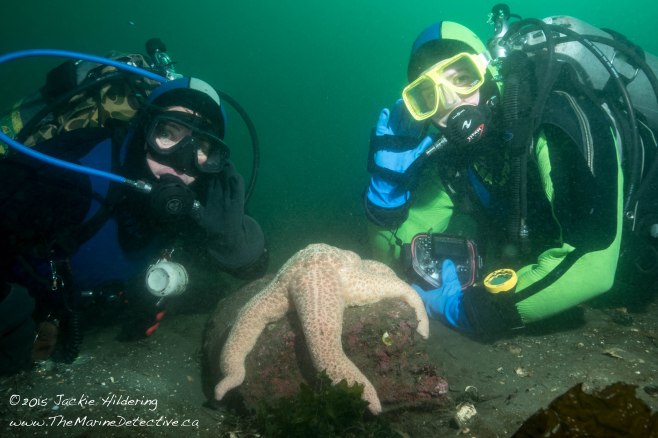
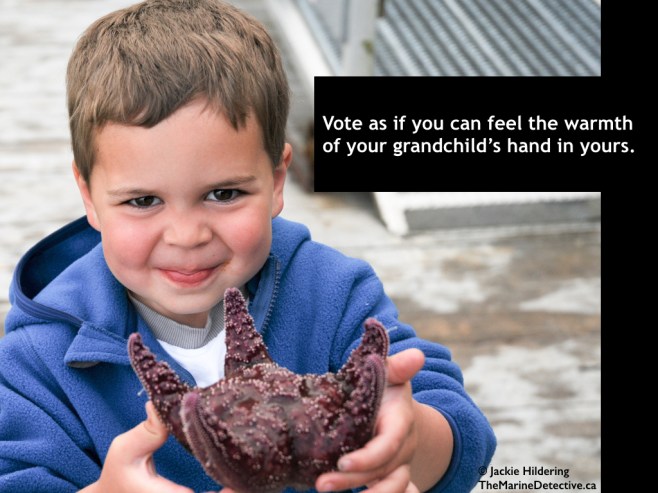
Vote as if you can feel the warmth of your grandchild's hand in yours. Spencer Wilson meets an Ochre Star. As so many here are aware, it is a critical time of decision-making. In this #OceanVoice album, I will share memes directed at increasing hope; awareness of our connection to the environment; and positive action for the sake of greater health and happiness. ©2015 Jackie Hildering; #OceanVoice; www.TheMarineDetective.ca

©2015 Jackie Hildering; #OceanVoice.

Caption for above image: Vote as if you can feel the warmth of your grandchild’s hand in yours. Spencer Wilson meets an Ochre Star.

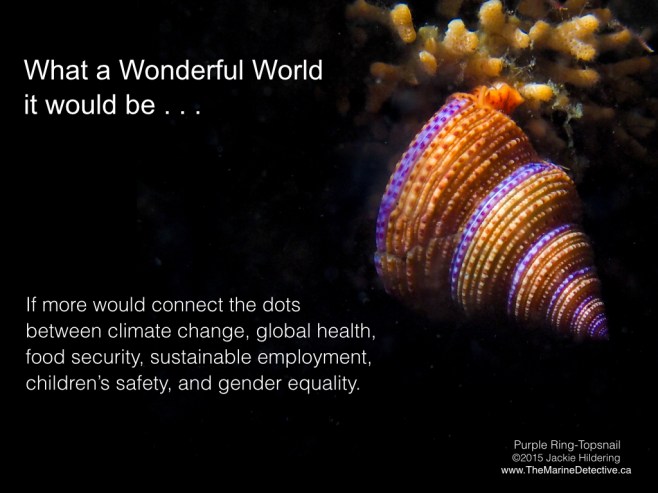
Yes, I'm going there. It is a critical time of decision-making. Those that have the power now use fear as a blunt tool to perpetuate false dichotomies like jobs vs. the environment / social problems vs. environmental problems. "Saving our planet, lifting people out of poverty, advancing economic growth . . . these are one and the same fight . . . Solutions to one problem must be solutions for all." What a wonderful world it would be if more would connect the dots between climate change, global health, food security, sustainable employment, children’s safety, and gender equality*. We have tremendous potential for positive change when fear is replaced with knowledge and empowerment. It is an essential time to reach out - reducing fear; connecting the dots; creating positive change. ©2015 Jackie Hildering; #OceanVoice; www.TheMarineDetective.ca

©2015 Jackie Hildering; #OceanVoice

Caption for above image: Yes, I’m going there. It is a critical time of decision-making. Those that have the power now use fear as a blunt tool to perpetuate false dichotomies like jobs vs. the environment / social problems vs. environmental problems. “Saving our planet, lifting people out of poverty, advancing economic growth . . . these are one and the same fight . . . solutions to one problem must be solutions for all.” What a wonderful world it would be if more would connect the dots between climate change, global health, food security, sustainable employment, children’s safety, and gender equality*. We have tremendous potential for positive change when fear is replaced with knowledge and empowerment. It is an essential time to reach out – reducing fear; connecting the dots; creating positive change.

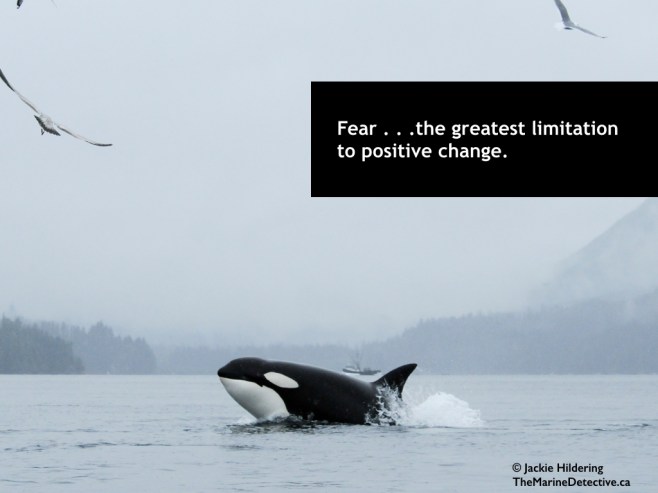
Fear . . . such a limiting factor to positive change. A lesson learned from Killer Whales - how wrong we can be but how quickly we can change when fear and misunderstanding are replaced by knowledge and connection. Yes, fear sometimes saves lives but too often: Fear masks truth. Fear chokes potential. Fear makes us automatons, marching on, ignoring the reality around us. Fear walks hand-in-hand with disempowerment, the same neurons firing, limiting the way we look at the world and ourselves. And above all, FEAR LOATHES CHANGE. Thereby, fear is such a powerful tool to be used by those who benefit from things remaining the same. #OceanVoice - thoughts about hope, our connection to the environment, and positive action for the sake of greater health and happiness. ©2015 Jackie Hildering; #OceanVoice; www.TheMarineDetective.ca

©2015 Jackie Hildering; #OceanVoice

Caption for above image: Fear . . . such a limiting factor to positive change. A lesson learned from Killer Whales – how wrong we can be but how quickly we can change when fear and misunderstanding are replaced by knowledge and connection. Yes, fear sometimes saves lives but too often: Fear masks truth. Fear chokes potential. Fear makes us automatons, marching on, ignoring the reality around us. Fear walks hand-in-hand with disempowerment, the same neurons firing, limiting the way we look at the world and ourselves. And above all, fear loathes change. Thereby, fear is such a powerful tool to be used by those who benefit from things remaining the same. #OceanVoice – thoughts about hope, our connection to the environment, and positive action for the sake of greater health and happiness.

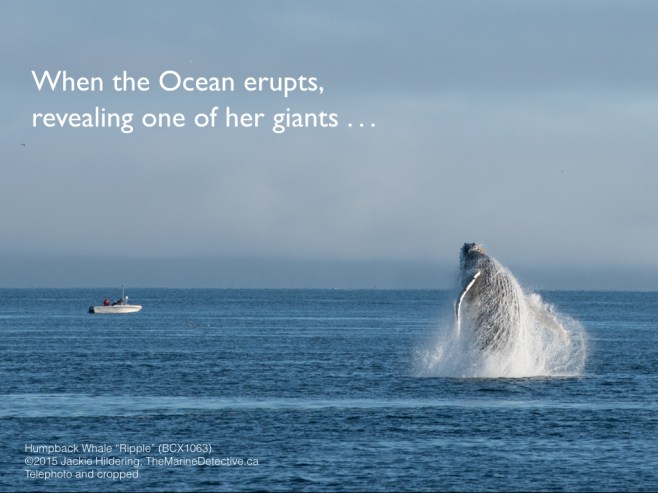
When the Ocean erupts, revealing one of her giants (Ripple the female Humpback Whale breaching; BCX1063). It's an opportunity to be awash in wonder, humility, connection, and gratitude. We all depend on the Ocean and where we go from here depends upon knowing while we are so small, our value systems and daily actions have such big impacts. How we consume; how we vote; how much we recognize our great capacity for positive change and how fear of change limits this . . . it's enough to bring giants back from the brink AND increase human happiness. ©2015 Jackie Hildering; #OceanVoice; www.TheMarineDetective.ca

©2015 Jackie Hildering; #OceanVoice

Caption for above image: When the Ocean erupts, revealing one of her giants (Ripple the female Humpback Whale breaching; BCX1063). It’s an opportunity to be awash in wonder, humility, connection, and gratitude. We all depend on the Ocean and where we go from here depends upon knowing while we are so small, our value systems and daily actions have such big impacts. How we consume; how we vote; how much we recognize our great capacity for positive change and how fear of change limits this . . . it’s enough to bring giants back from the brink AND increase human happiness.

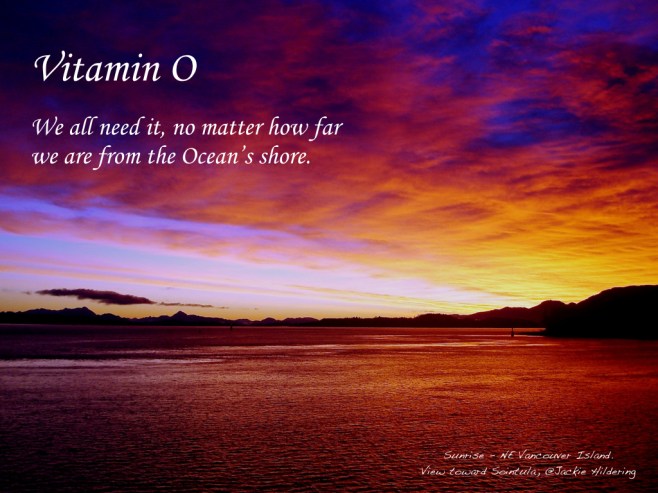
Vitamin O. Where are you as you read this? Are you far from the Ocean's shore or feeling her waves below your feet? It doesn't matter. We are ALL part Ocean from the oxygen in our lungs (50%+); to the fluid in our veins; and many of the nutrients that build us. Our connection to the Ocean is the great common denominator of life on this blue planet. Healing, climate regulating, carbon dioxide buffering . . . life sustaining. Share the Vitamin, especially to our friends further inland? Increased awareness of the importance of the Ocean and celebrating our connection to it . . . why, it could change the world. Acknowledging how little we know, inspired by the mystery and beauty; embracing the appropriate humility and precaution in our daily actions . . . caring more, consuming less, voting for the future . . . . knowing the vital importance of Vitamin O. ©2015 Jackie Hildering; #OceanVoice; www.TheMarineDetective.ca

©2015 Jackie Hildering; #OceanVoice

Caption for above image: Vitamin O. Where are you as you read this? Are you far from the Ocean’s shore or feeling her waves below your feet? It doesn’t matter. We are ALL part Ocean from the oxygen in our lungs (50%+); to the fluid in our veins; and many of the nutrients that build us. Our connection to the Ocean is the great common denominator of life on this blue planet. Healing, climate regulating, carbon dioxide buffering . . . life sustaining.  Acknowledging how little we know, inspired by the mystery and beauty; embracing the appropriate humility and precaution in our daily actions . . . caring more, consuming less, voting for the future . . . . knowing the vital importance of Vitamin O.

Follow Your Dreams . . .

Follow Your Dreams – and make them count.

What’s with the stained and faded photo below?

Follow Your Dreams . . . Northern Resident Killer Whales: Tsitika (A30, 1949 - 2013) and her son Pointer (A39, 1975 - 2014. Photo taken in 1999. ©Jackie Hildering; www.TheMarineDetective.ca

Follow Your Dreams . . .
Northern Resident Killer Whales: Tsitika (A30, 1949 – 2013) and her son Pointer (A39, 1975 – 2014). Photo taken in 1999. ©Jackie Hildering. 

Introspection alert!

This photo has been on a beloved friend’s refrigerator for almost 16 years. I sent it to my nearest and dearest as a New Year’s greeting at the end of 1999 after leaving my “career” as a teacher and school administrator in Rotterdam.

It references following my need to be learning from Nature, not speaking about it as if it were somewhere else, and to find a more effective way to enable understanding of connection and common solutions to socio-environmental problems.

It led me back to BC; to being a deckhand, and to Orca. Orca as extraordinarily powerful ambassadors of of how wrong we can be; how quickly we can change, and the repercussions of humanity gone mad with chemical use and consumerism.

It led to diving and underwater photography as part of my love of this place. When the giants returned from the brink, it led to Humpback research and cofounding the Marine Education and Research Society.

All the while, the aim continued to be making what I learned count  . . . connecting to the wonder of Nature, knowing our capacity for change, acting for the wellbeing of future generations and not fuelling the powers that distract and perpetuate inequality and destruction with fear, overwhelm,  and whispers that who we are, is what we own.

Today, I found myself staring back at this old photo, thinking back and reflecting forward. The two whales have now passed – Tsitika (A30, 1949 – 2013) and her son Pointer (A39, 1975 – 2014). Stained, fuzzy, faded, and slightly torn, the photo brings me back through the years, reminding me of how much I’ve learned from them and this place.

I feel fortified. There are more decisions to be made to take the path less travelled. I need to trust that I will look back in another 16 years feeling that my internal compass allowed me to navigate sometimes stormy, lonely, scary, unknown waters to land again where following dreams that are motivated by good, will lead to greater good.

For all of you who joined me along the way, from the depths . . . . thank you. 

Bubbling Giants: Humpback Whales Bubble-Net Feeding

This is going to be worth the 4 minutes of viewing believe me!

Humpback Whales have many complex feeding strategies. In areas where current and birds do not force the feed together, there are Humpbacks that work as a team to corral the fish. This strategy includes an intense feeding call and making a net of bubbles.

This video was taken while I was with Pacific Wild in Caamano Sound off British Columbia’s Central Coast.

This is exactly the area where there is the potential of increased tanker traffic.

Knowing how important this area is – not only for at-risk Humpback, Fin and Killer Whales; but for human health and so much more – is a huge motivator to do all I can do reduce the demand for fossil fuels.

For more on the feeding strategies of Humpback Whales, please see our Marine Education and Research Society research at this link. It includes that we have published on a never-before-documented strategy we have dubbed “trap-feeding”.

And They Spread Their Giant Wing-Like Fins . . .

TMD Memes.001

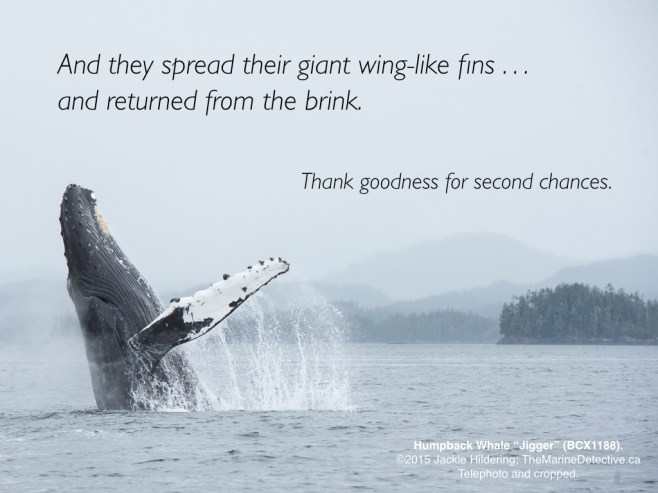
And they spread their giant wing-like fins . . . and returned from the brink.

The whales remind us of our great capacity for positive change . . . when our value systems change and knowledge, connection and humility replace fear and misunderstanding.

The simple solution? Care More. Consume Less.

There are still so many ways to indirectly kill a whale and damage the life-sustaining seas upon which we all depend.

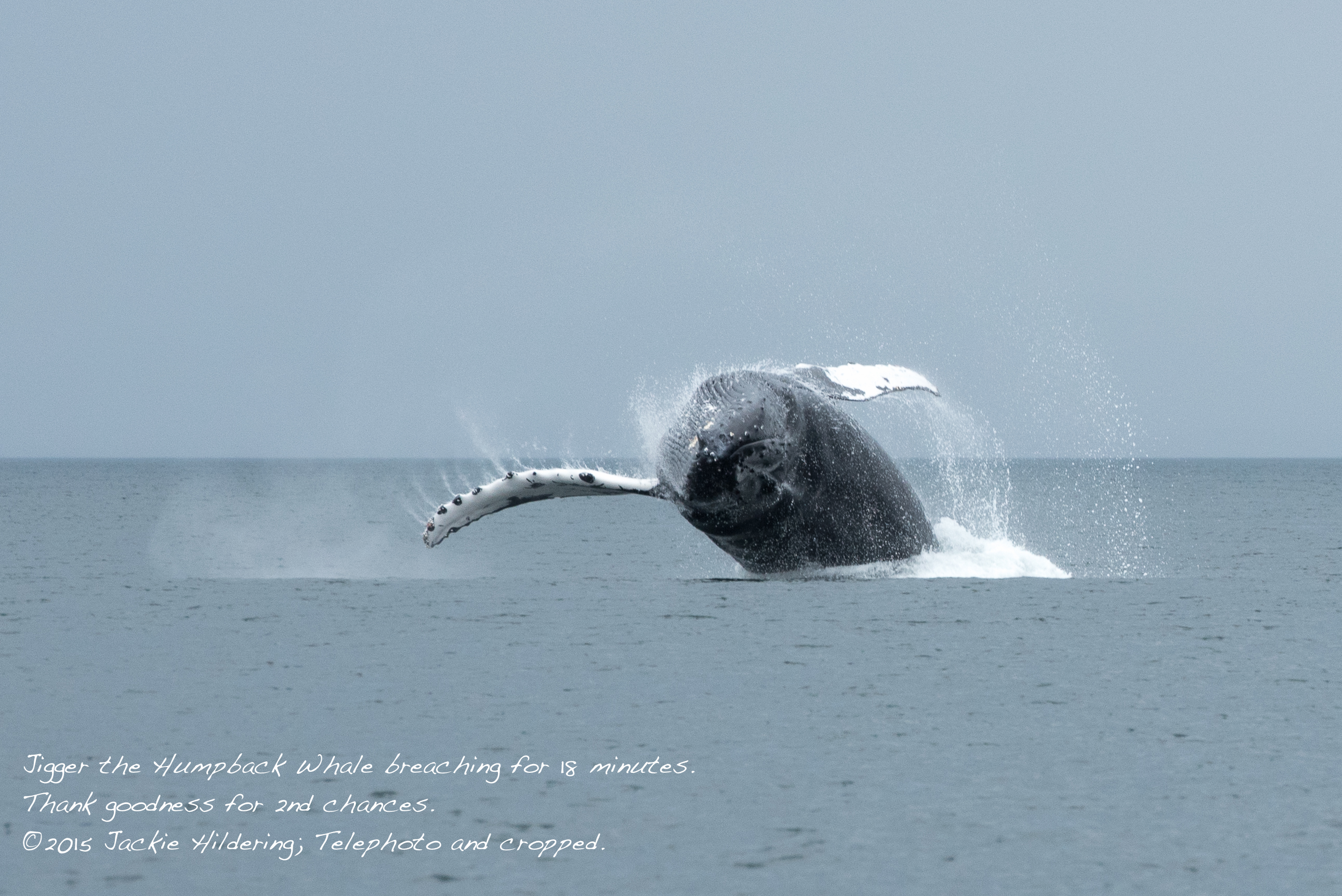
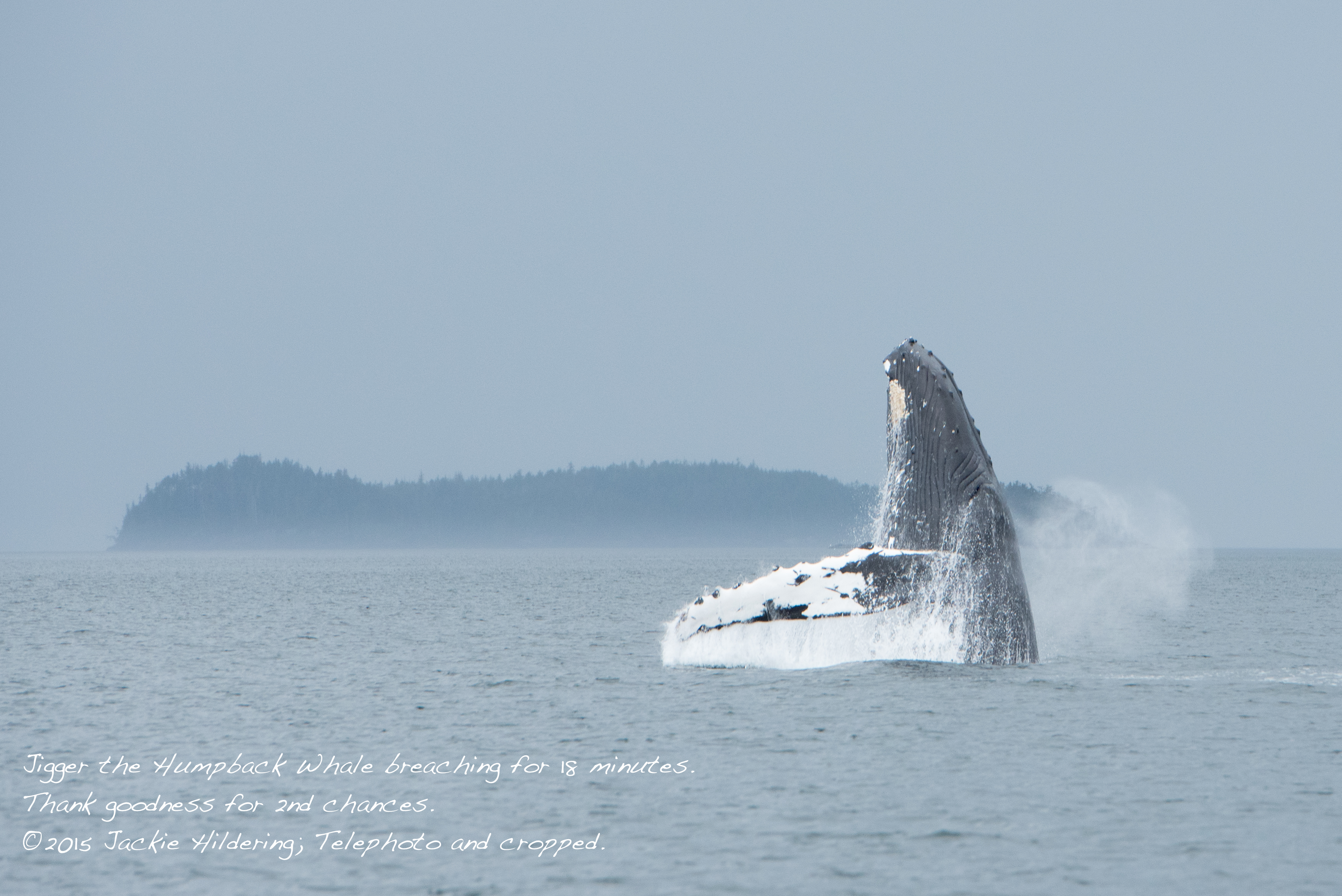
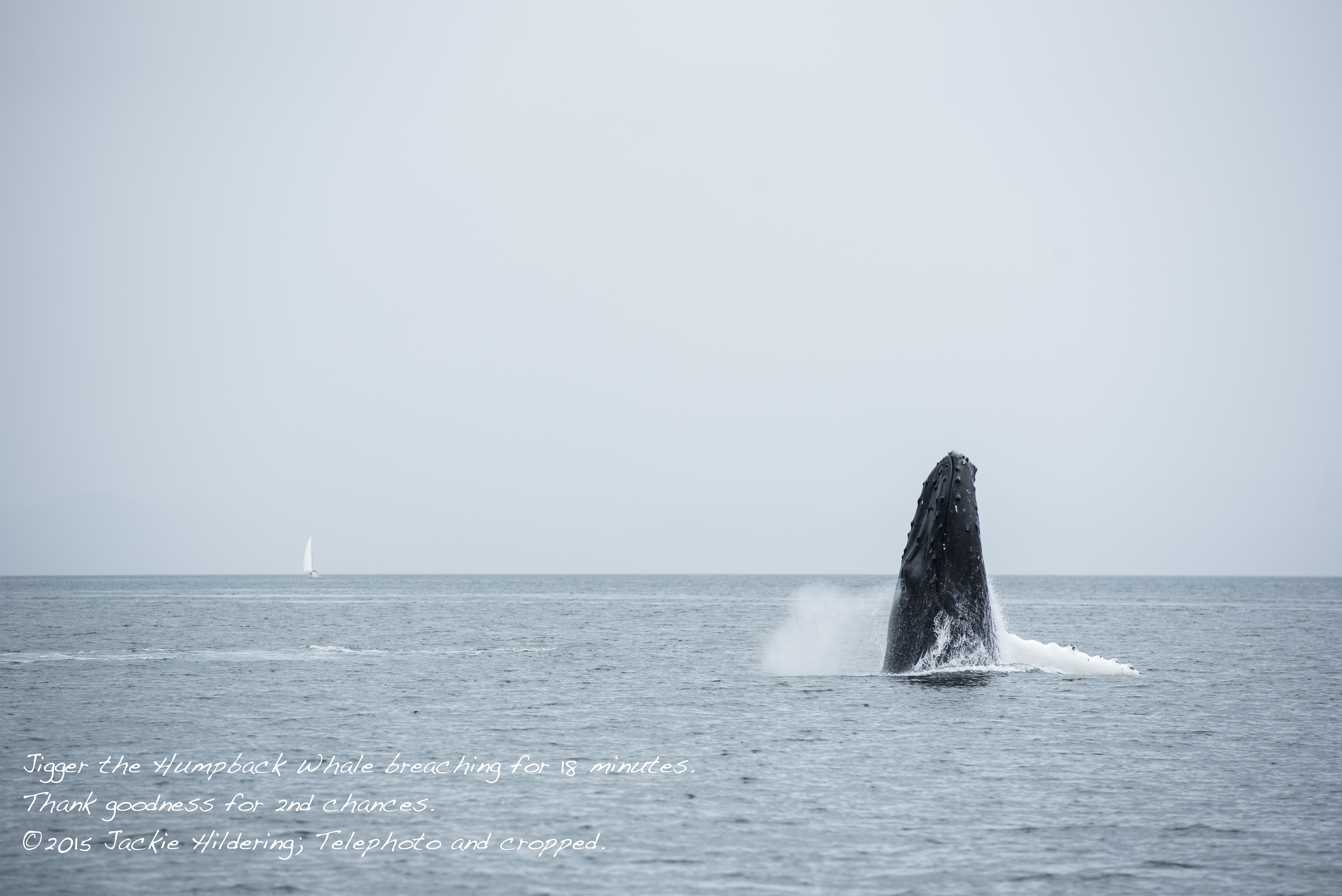
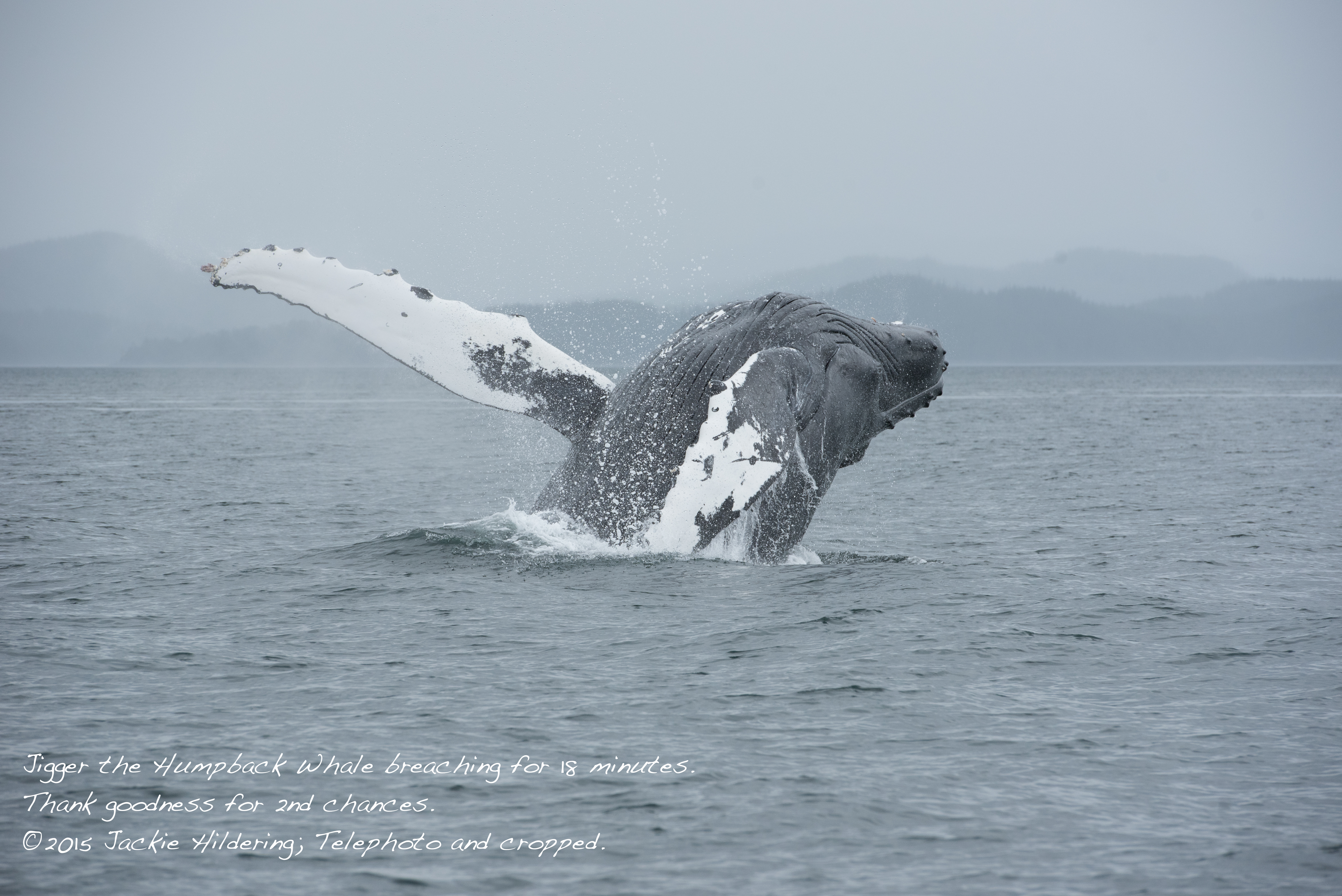
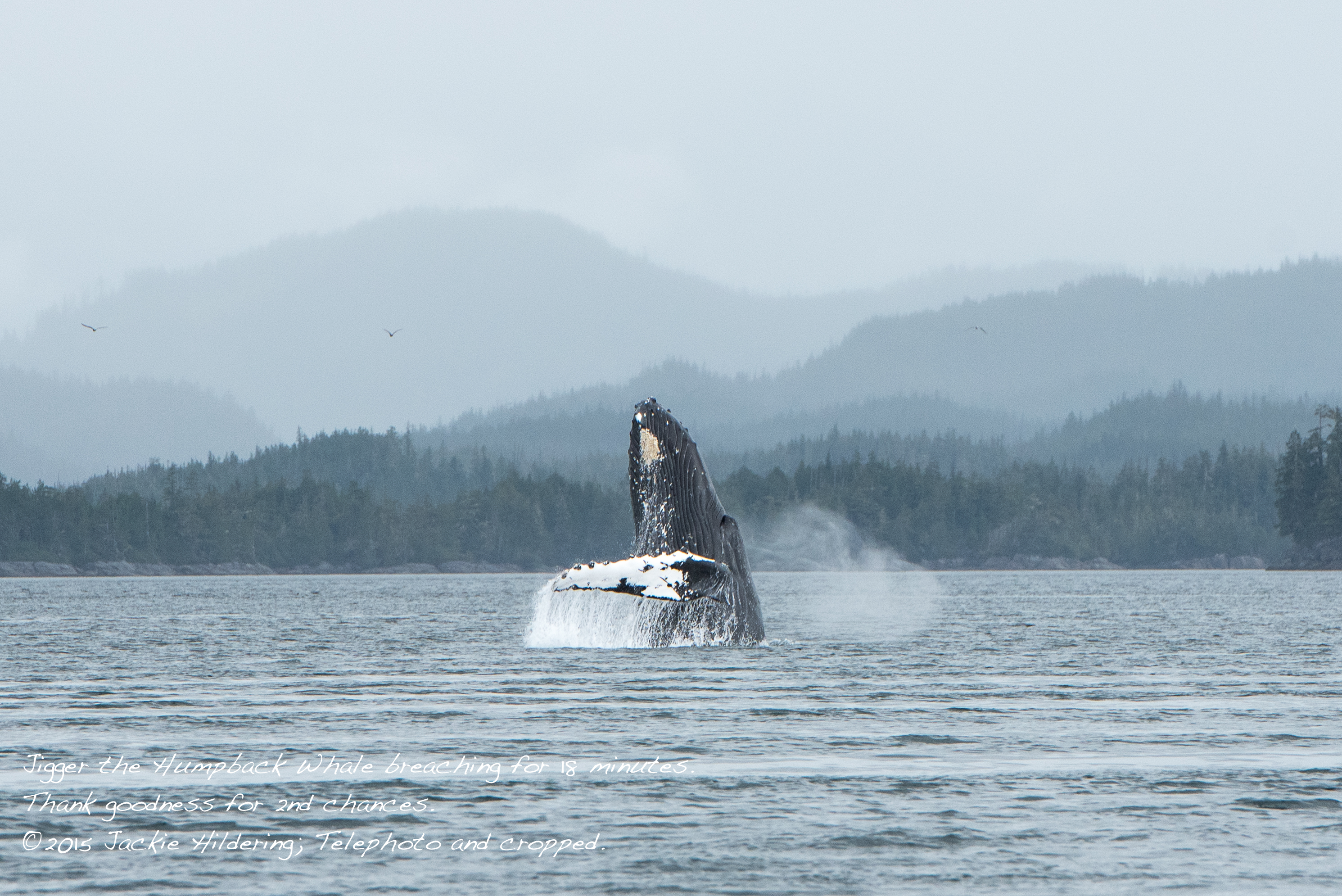
Image is of “Jigger” the mature female Humpback Whale who breached for 18 minutes. More images below.

You simply can’t be the same after seeing something like this, nor would I want to be.

What triggered this behaviour may have been an encounter with another Humpback (“Slash” BCX0177″) but we cannot know for sure.

For the work of our Marine Education and Research Society, please see here and yes, you can support our work by sponsoring a Humpback Whale!

HW_2015-07-25_JH_White Cliffs-15374 HW_2015-07-25_JH_White Cliffs-15389 HW_2015-07-25_JH_White Cliffs-15390 HW_2015-07-25_JH_White Cliffs-15392 HW_2015-07-25_JH_White Cliffs-15396 HW_2015-07-25_JH_White Cliffs-15415 HW_2015-07-25_JH_White Cliffs-15421 HW_2015-07-25_JH_White Cliffs-15424 HW_2015-07-25_JH_White Cliffs-15425 HW_2015-07-25_JH_White Cliffs-15426 HW_2015-07-25_JH_White Cliffs-15454 HW_2015-07-25_JH_White Cliffs-15494

From the depths . . . .

"The Marine Detective" art show at 546 Yates in Victoria. Includes a 15 min rotating slide show of images. Come in, sit down, and disappear into the depths for a little while?

“The Marine Detective” art show at 546 Yates in Victoria. Includes a 15 min rotating slide show of images. Come in, sit down, and disappear into the depths for a little while?

It is the morning after the opening of my first art show and I am awash with a sense of gratitude and community.

As I strived to express last night in my presentation, had anyone told me way-back-when that I would ever have an art show, it would have been the equivalent of being told that I would undertake interplanetary travel.

An art show?! It was very high threshold for me because, rather than just striving to capture the mystery, beauty and fragility of the Ocean to inspire and educate, the images are being put forward as ART.

Therefore, last night was very much for me another “How did I get here?” experience.

But I do know the answer. It is because, however the magic of life works, I have been allowed to fully, deeply understand the importance of the Ocean as the life-sustaining force on the planet.  And, as a teacher, enhancing the potential for our children to have healthy, happy futures will always be what gives my life direction.

"The Marine Detective" images at Art Atelier 546 in Victoria (on 546 Yates Street). Click to enlarge.

“The Marine Detective” images at Art Atelier 546 in Victoria (on 546 Yates Street). Click to enlarge.

How did I get here?  It has to do with geography, opportunity, difficult and daring decisions made, skills, experience and  . . . you.

Please hear me. It has to do with YOU.

Wherever this is going – wherever it has gone – it is because of a force of people who share the values and objectives of “The Marine Detective” and want it to move forward.

The sense of gratitude I am overcome with this morning, and that is so difficult to express, is that I feel I am being held up by an Ocean of people . . . . those who were at the opening last night; the whispers and shouts of support and encouragement on social media; the sharing to expand the reach of the content there; the applause expressed in so many ways; the enablement of diving, photography and whale research; the sharing of calendars and prints into the world so that they might further connect others; the assistance re. potential books, webisodes, whatever  . . . it’s you.

I know that The Marine Detective is a community working for greater understanding and positive action for socio-environmental good.

From the depths, thank you.

Because of you I speak louder; I dare more; I keep at it and, I stay afloat . . . gently propelled to who-knows-where.

Link to photos – here. 

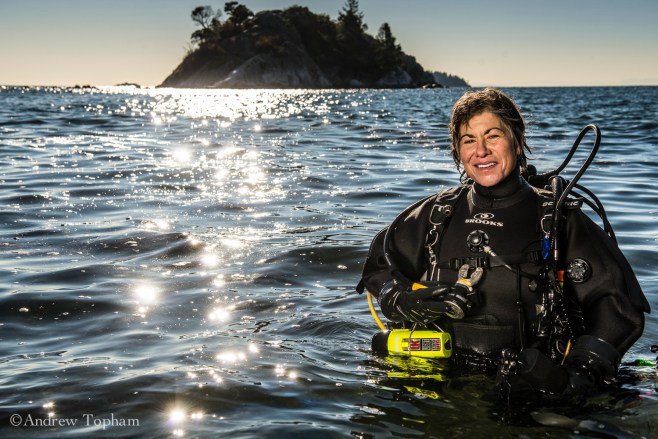
Photo by Andrew Topham, made possible with Melanie Wood.

Photo by Andrew Topham, made possible with Melanie Wood.


Remarkable Giant Pacific Octopus and Wolf-Eel Encounter

Trust me, you are going to love the video below!

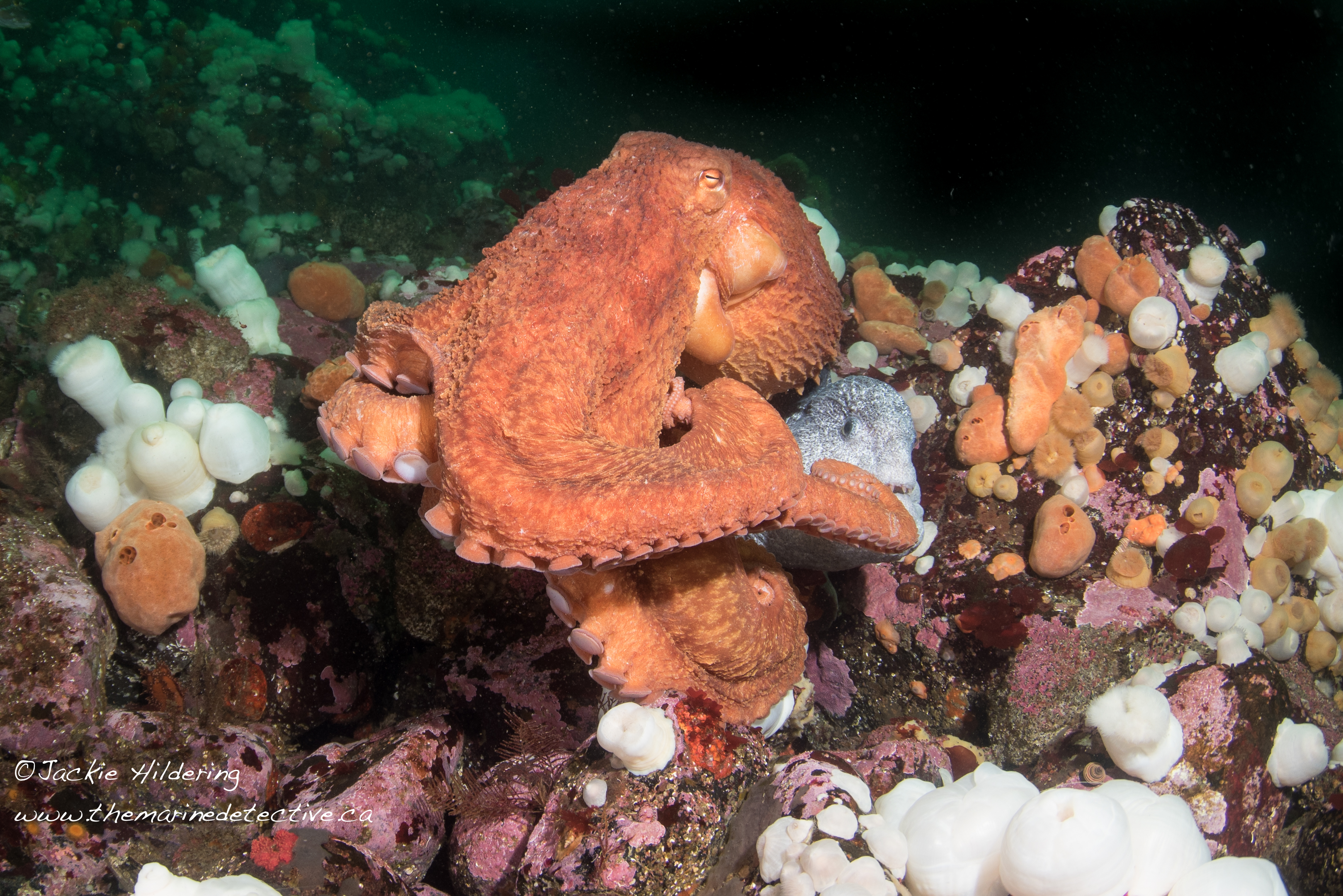
Giant Pacific Octopus passing over a mature male Wolf Eel in his den. See video below. ©Jackie Hildering

Giant Pacific Octopus passing over a mature male Wolf-Eel in his den. See video below. ©Jackie Hildering

It is one of the most remarkable encounters I have witnessed in all my dives.

It’s a fortunate enough thing to be able to watch a large Giant Pacific Octopus when it is hunting. In this encounter, the octopus passes directly over a mature male Wolf-Eel in his den. THEN, a Decorator Warbonnet emerges as well.

It was an exciting day in this wonderful marine neighbourhood.

I hope this 3-minute clip allows you to share in the awe and excitement.

For me, this was the NE Pacific Ocean equivalent of seeing a giraffe, elephant and rhino in close proximity.

Video and photos contributed by dive buddies Katie Morgan and Diane Reid while on our trip with God’s Pocket Dive Resort.

  • For more information on Wolf-Eels (including that they are not an eel at all), see my previous blog here.
  • For more information on Giant Pacific Octopuses, click here for previous blogs and here for a blog specifically on hunting in Giant Pacific Octopus.

Surely Not Again?! Tidal Turbines in Whale Epicentre? Still Hell No!

Here we go again. 

It has just come to my attention that there are two applications for tenure for tidal turbines in killer whale critical habitat. This last arose in November in 2012 with my posting the blog “Tidal Turbines in Whale Epicentre? Hell No!”. The resulting media coverage, your action and the ethics of the applicant resulted in that application being withdrawn.

With these two new applications, your action is again very much needed.

The comment deadline is April 9th, 2015. 

Below, I have edited my November 2012 blog to be applicable to these applications and hopefully I have succeeded in making commenting very expeditious for you. 

Here goes . . . .

There are times when expletives like “Hell No!” are justified and I am sure you will agree this is one of those very unfortunate times and – your action is needed.

There are two applications for “OCEAN ENERGY / INVESTIGATIVE AND MONITORING PHASE” by Weyl Power Ltd. If accepted by the BC Ministry of Forest, Lands and Natural Resource Operations (MFLNRO), this would allow the instalment of technical and investigative monitoring equipment in killer whale critical habitat which could then lead to turbines also being located there.  I believe the applications are still referenced as licenses of occupation“.

See the map for the location of the proposed Weyl Power sites relative to resident killer whale critical habitat as per the Recovery Strategy for Northern and Southern Resident Killer Whales in Canada.

Proposed sites relative to acknowledged northern resident killer whale critical habitat.

Proposed sites relative to acknowledged northern resident killer whale critical habitat. Source of base map: BC Cetacean Sightings Network. Click to enlarge. For more on the determination of this critical habitat see Ford, J.K.B. An Assessment of critical habitats of resident killer whales in waters off the Pacific Coast of Canada. Canadian Science Advisory Secretariat, Research Document 2006/072.

(1) Johnstone Strait between Hanson Island and Telegraph Cove (File: #1414321)

(2)  Broughton Strait, western end of Malcolm Island  (File: #1414325)

While I of course support initiatives to reduce the use of climate-changing fossil fuels, to have turbines in critical whale habitat would be pure, simple, total, utter insanity. No matter how advanced the turbine technology, no amount of mitigation could compensate for the noise, prey reduction, and other disturbance to the whales.

One would hope that government agencies would surely deny the applications, especially after the public outcry after the similar 2012 application in this same area.  However, we have many examples of this being tragically misplaced faith and cannot count on there being any legislation in place for sound environmental assessment that would confirm environmental impacts. Note that the federal government had to be taken to court TWICE to be ordered to acknowledge and protect killer whale critical habitat – first ruling December 7, 2010; appeal ruling February 9th, 2011.

Weyl Power Application -  Johnstone Strait between Hanson Island and Telegraph Cove. File: #1414321

Weyl Power Application – Johnstone Strait between Hanson Island and Telegraph Cove. File: #1414321. Click to enlarge.

The very ocean current that makes this area of interest for staking a claim for ocean energy is what makes this such a rich area for marine life. The importance of this area for killer whales can be supported by almost 4 decades of data collected by Department of Fisheries and Oceans and the OrcaLab.

To allow these applications to proceed would therefore be ludicrous and in direct conflict of Objective 4 of the Northern and Southern Resident Killer Whale Action Plan for Species at Risk which is to “Protect critical habitat for Resident Killer Whales and identify additional areas for critical habitat designation and protection.”

Weyl Power Application -  Broughton Strait, western end of Malcolm Island. File: #1414321. Click to enlarge. Weyl Power Application -  Johnstone Strait between Hanson Island and Telegraph Cove

Weyl Power Application – Broughton Strait, western end of Malcolm Island. File: #1414321. Click to enlarge.

Therefore, we collectively need (again) to make our “Hell No!” heard.

Please comment by the April 9th deadline by going to these two links and scrolling down till you see “To comment on this application please click here”.

  • Weyl Power application for Johnstone Strait between Hanson Island and Telegraph Cove (File: #1414321) – click here.
  • Weyl Power application for Broughton Strait, western end of Malcolm Island (File: #1414325) – click here.

Sample text: With regard to Land File Numbers 1414321 and 1414325, the applications for Weyl Power Ltd’s “OCEAN ENERGY / INVESTIGATIVE AND MONITORING PHASE” in the Broughton Strait to Johnstone Strait area, I write you to express that these applications for tenure must not be granted. The applications are in scientifically confirmed critical habitat for northern resident killer whales and it has been legally ruled that this must be protected as per Canada’s Species at Risk Act. In addition, the area is of great importance to humpback whales and many other marine species.  No matter how advanced the turbine technology, no amount of mitigation could compensate for the noise, prey reduction, and other disturbance to the whales and to approve these applications would be in direct conflict of Objective 4 of the Northern and Southern Resident Killer Whale Action Plan for Species at Risk which is to “Protect critical habitat for Resident Killer Whales and identify additional areas for critical habitat designation and protection”. It is also unacceptable that the public is not provided with information on these applications other than the applicant name and the maps i.e. no information about design or environmental assessment process.”
You may even want to reference this blog and provide the link e.g. “For further details of the reasons for my great objection to this application see the rationale and resources provided at http://wp.me/pPW6V-1cJ.

Please also help spread the word?

So much insanity  . . . so little time.  

References:

Media Coverage:

Take Part; March 22, 2015; “The Clean-Energy Project That Could Harm Endangered Killer Whales – A mystery firm wants to build underwater power turbines in critical orca habitat off Canada’s Pacific coast

Underwater Smoking Log and the Worm That is Not a Worm?

Submerging into the dark, you never know what you are going to see.

It is a large part of what is so intoxicating about diving in cold, dark waters – all the mystery; all the wonder; all the opportunity for learning and sharing.

So what was it today?

This – a smoking log at about 6 m depth!

Teredo navalis spawning. March 8, 2015 ©Jackie Hildering.

Northwest Shipworms spawning. March 8, 2015 ©Jackie Hildering.

The “smoke” was brief but intense and of course it was not smoke at all. It was the spawn of some animal. Many marine invertebrates are broadcast spawners where all individuals in an area release their sex cells at the same time to enhance the chances of fertilization.

I knew the source of the “smoke” had to be a shipworm species since it was coming from a rotting log with lots of tunnels bored into it. I then had to do a bit of reading to be sure of whether it was the invasive Naval Shipworm (Teredo navalis), or the indigenous Northwest Shipworm (Bankia setacea).

Either way, shipworms are not worms at all!

Northwest Shipworm Source: MARINE WOOD BORERS IN BRITISH COLUMBIA D. B. Quayle; 1992

Northwest Shipworm Source: MARINE WOOD BORERS IN BRITISH COLUMBIA; D. B. Quayle; 1992

Shipworms are saltwater clams. They look like a worm in a calcareous tube but have two small shells at the front of their bodies that are specialized to bore through wood, much to our dismay! The clams also have symbiotic bacteria that release an enzyme to help break down the cellulose in the wood.

I believe in this case it was the Northwest Shipworm that was spawning and the initial cue for the synchronous release of sex cells in this species is believed to be a sudden change in temperature or salinity. Once the spawn begins, it is believed that neighbouring Northwest Shipworms drawing water into their siphons detect the spawn and that this further triggers them to release their sex cells.

The Northwest Shipworm it is more common in BC than the Naval Shipworm; the tunnels in the wood looked like those caused by this species; but also relevant in my knowing it was this species is that I saw eggs being released as well as sperm.

With the oh-so-successful Naval Shipworm that originated in the Atlantic but is now boring through wood in all the world’s oceans, only the males release sex cells. Sperm are then drawn into females’ inhalant siphons; the eggs are fertilized and develop in the female’s gills in huge numbers to be released as free-swimming larvae.

Teredo navalis spawning. March 8, 2015 ©Jackie Hildering.

Northwest Shipworms spawning. The white material on the logs is known as “frass”- waste discharged through the clams’ excurrent siphons. March 8, 2015 ©Jackie Hildering.

The Northwest Shipworm does not have this reproductive strategy. With both genders broadcast spawning, you can imagine how many sex cells need to be released for successful reproduction.

After about 3 weeks (at 12 – 15°C), the Northwest Shipworm larvae appear to be able to detect wood. They attach themselves, soften the wood, bore into it, develop into adults and cause economic discontent in we humans. This is especially the case in the logging industry which depends on transporting and storing wood in the Ocean.

Apparently the Northwest Shipworm can burrow 10 cm per month at temperatures greater than 10°C. See here for examples of the damage to wood by this species. If you are a Northern Vancouver Islander, you can see how this wood has been used as a decorative wall covering in the Whale Interpretive Centre.

For me, there was no discontent today. It was a wonder to be swimming by at the exact time this species was spawning. Providing me with a further opportunity to . . .  smoke out facts about our marine life and share them with you!

Related blog post:

Sources:


Gentle Giants. What to do when you find your dive buddy with a Giant Pacific Octopus on her head.

Please note, I have shared our experience below to reduce the misunderstanding and demonization of octopuses NOT to stimulate diver attempts at interactions. What is described below was an unsolicited gift experienced by those with a very high level of dive experience; knowledge of octopuses (and dive buddy) behaviour; and solid safety protocols.


The Kraken?! Devilfish?!

Scary?! Dangerous?! Alien?

Suggest such things about a Giant Pacific Octopus to any scuba diver respectful of marine life who has had an encounter with one of these gentle giants, and there is going to be a very strong response shattering such mythology.

As it always goes, fear and mythology thrive where there is absence of knowledge.

Any negative encounters between divers and Giant Pacific Octopuses that I am aware of, result from divers manhandling them “insisting” on an encounter, or involve octopuses that are habituated as a result of being fed by humans.

©2015 Jackie Hildering

Giant Pacific Octopus, Copper Rockfish and dive buddy Natasha Dickinson.
Read about this remarkable encounter below. ©2015 Jackie Hildering

We, as divers, are so fortunate to come across Giant Pacific Octopuses in their world where they are invertebrate royalty. We are able to meet them on their turf, and thereby know how inquisitive and intelligent they are. We know they are mighty, highly adaptable predators.

And, we know too, when we look into their eyes, that observation and assessment is being reciprocated.

That preamble was necessary before sharing what happened today.

This did . . . .

©2015 Jackie Hildering

1. Dive buddy Natasha Dickinson during the remarkable Giant Pacific Octopus encounter.
See the Copper Rockfish too? ©2015 Jackie Hildering

I had been taking photographs of Lingcod males guarding their egg masses and noted that my dive buddy Natasha Dickinson was signalling me with her light, indicating that she had found something of particular interest.

I took a few more shots and then swam towards her and found . . .  my dive buddy with a Giant Pacific Octopus completely covering her face. Sorry that I missed that shot. I was so in awe of what I saw.

Natasha is an incredibly skilled and experienced diver with a deep respect for marine life. She was clearly not afraid, nor was the octopus.

Natasha had taken the precaution of putting her hand over the regulator in her mouth in case the octopus took an interest in that but otherwise, allowed her to explore.

©2015 Jackie Hildering

2. Natasha is also a master of facial expressions that relay 1000 words. ©2015 Jackie Hildering

I would learn later that, while waiting for me she had been watching the Copper Rockfish that you will see in all but one of the photos in this blog. This rockfish stuck very near the octopus. A buddy?  That I don’t know but escorting a Giant Pacific Octopus on the hunt is a really good strategy. As the octopus flushes out animals from under rocks with his/her arms, the rockfish can grab the prey that do not end up under the octopus’ mantle.

While observing the rockfish, the Giant Pacific Octopus had slowly advanced toward Natasha and she remained where she was, intrigued at what would happened and having a contingency plan.

©2015 Jackie Hildering

3. Octopus flashing white as it pulls on the clasp ©2015 Jackie Hildering

When I started to take photos the Giant Pacific Octopus gradually backed away but had taken a particular interest in a clasp at the end of a bungee cord on Natasha’s gear.

You can see how her arm was entwined around the cord and how there was some flashing of white in the skin. You can also see the Copper Rockfish!

©2015 Jackie Hildering

4. Pulling a little harder! ©2015 Jackie Hildering

©2015 Jackie Hildering

5. One of the photos that suggests this was a female.  ©2015 Jackie Hildering

I believe this octopus was a female, thanks to feedback I received from self-admitted Cephalopod Geek supreme, Keely Langford of the Vancouver Aquarium. Octopus males have a “hectocotylus arm”. In Giant Pacific Octopuses, it is the third arm on their right. The hectocotylus stores the spermatophores – packets of sex cells, two of which are handed over to a receptive female who stores them until ready to fertilize her eggs.

Having the good fortune to get photos of the right side of this octopus, particularly #5 and #7, allowed me to see that the top of third arm on the right is not differentiated and that therefore, this was a female.

©2015 Jackie Hildering

6. Just after letting go. ©2015 Jackie Hildering

Back to recounting our adventure . . . .

After about a minute or two of gently tugging on the bungee cord, Ms. Giant Pacific Octopus let go.

Natasha swam a bit further off, allowing me a few minutes to marvel and photograph this beauty – the Giant Pacific Octopus AND the Copper Rockfish.

©2015 Jackie Hildering

7. Another photo that allowed me a good look at the 3rd arm on the right. ©2015 Jackie Hildering

©2015 Jackie Hildering

8. Ms. Octopus with the Copper Rockfish particularly near. ©2015 Jackie Hildering

©2015 Jackie Hildering

9. At one point, she also slowly advanced towards me but when I retreated a bit, so did she. ©2015 Jackie Hildering

©2015 Jackie Hildering

10. Walking towards me.  ©2015 Jackie Hildering

When Natasha circled back, the octopus flashed a bit of white as you can see in the image below. Recognition?

We both found ourselves waving goodbye when we, regretfully, had to return to our terrestrial world.

©2015 Jackie Hildering

11. Giant Pacific Octopus, Copper Rockfish, Kelp Greenling and dive buddy. ©2015 Jackie Hildering

So what to do when you find a Giant Pacific Octopus on your dive buddy’s head? Observe, marvel, take some photos, share and maybe it can help dispel some of the mythology and vilification about these fabulous marine neighbours.

Eye-to-eye with a gentle giant. My peering into a Giant Pacific Octopus' den earlier this month (using a macro lens). ©Jackie Hildering

12.. Eye-to-eye with a gentle giant. My peering into a Giant Pacific Octopus’ den earlier this month (using a macro lens). ©Jackie Hildering


Giant Pacific Octopus Facts:

  • Enteroctopus dofleini is the world’s largest octopod species with the maximum records for size being 9.8 m from arm tip to arm tip and 198.2 kg.
  • Average life expectancy is only 3 to 4 years.
  • Like other octopuses:
    • They have a beak with venom, three hearts, blue blood, and their skin is capable of detecting chemicals (as our nose does).
    • While many sources report their having 9 brains, octopuses only really have one donut-shaped brain positioned around their oesophagus and then each of their eight arms has many neurons, this is referenced as “distributed intelligence”. Damir Allen explains at this source; “Think of it like a command centre and 8 independent soldiers. They all act semi-independently, and if separated from the main body they will continue to capture food and try to deliver it to a non-existent mouth.”
    • Their ink is not just a distraction for predators but contains the chemical tyrosinase which causes eye irritation and messes up the predators’ senses of smell and taste.
    • They are jet propelled and are capable of incredible camouflage where they can not only change the colour of their skin but also its texture to blend in with their surroundings.
    • They mate only once. From the Vic High Marine website regarding Giant Pacific Octopuses: “Females die directly after they have finished laying and guarding to their egg however males live a slightly longer time. Octopus reproduction starts when a male uses a specialized tentacle [sic, octopuses have arms not tentacles] to pass two spermatophores (sperm packages) to the female. Once given the sperm the female stores the package until she is ready to fertilize the eggs.  Before a female is ready to fertilize the eggs she has to find a suitable den. This search can take the future mother up to one month! Once the perfect place is found the female shuts herself in using rocks. From there she fertilizes each egg and gathers them in bundle of approximately 200. She hangs each group of eggs from the ceiling of the cave. This is a long process because, on average, a female octopus can lay up to 50,000 eggs.  The incubation time for octopus eggs are six and a half months.  During this time the female stays in the cave, not even leaving to eat, attending to the eggs by constantly blowing oxygenated water on to them. When the baby octopuses hatch they are referred to as paralave. These tiny juveniles swim up to the surface joining other zoo plankton and spending weeks feeding on tiny phytoplankton. Once they have developed enough mass they descend to the benthic zone.  As for the mother, she waits until all the eggs have hatched then emerges from the cave and dies shortly afterwards due to the starvation she endured during the months she spent devoted to tending her eggs.
  • Excellent on-line resources on octopuses.
  • Best book on Giant Pacific Octopuses –  The Giant Pacific Octopus and Other Cephalopods of the Pacific Coast by James A. Cosgrove and Neil McDaniel.
  • And the plural really is “octopuses” not “octopi”! See #3 at this link if you are doubtful.

Great thanks to Gwa’sala-‘Nakwaxda’xw Marine Services for making this dive possible.

Media coverage so thankfully resulting from this blog includes: