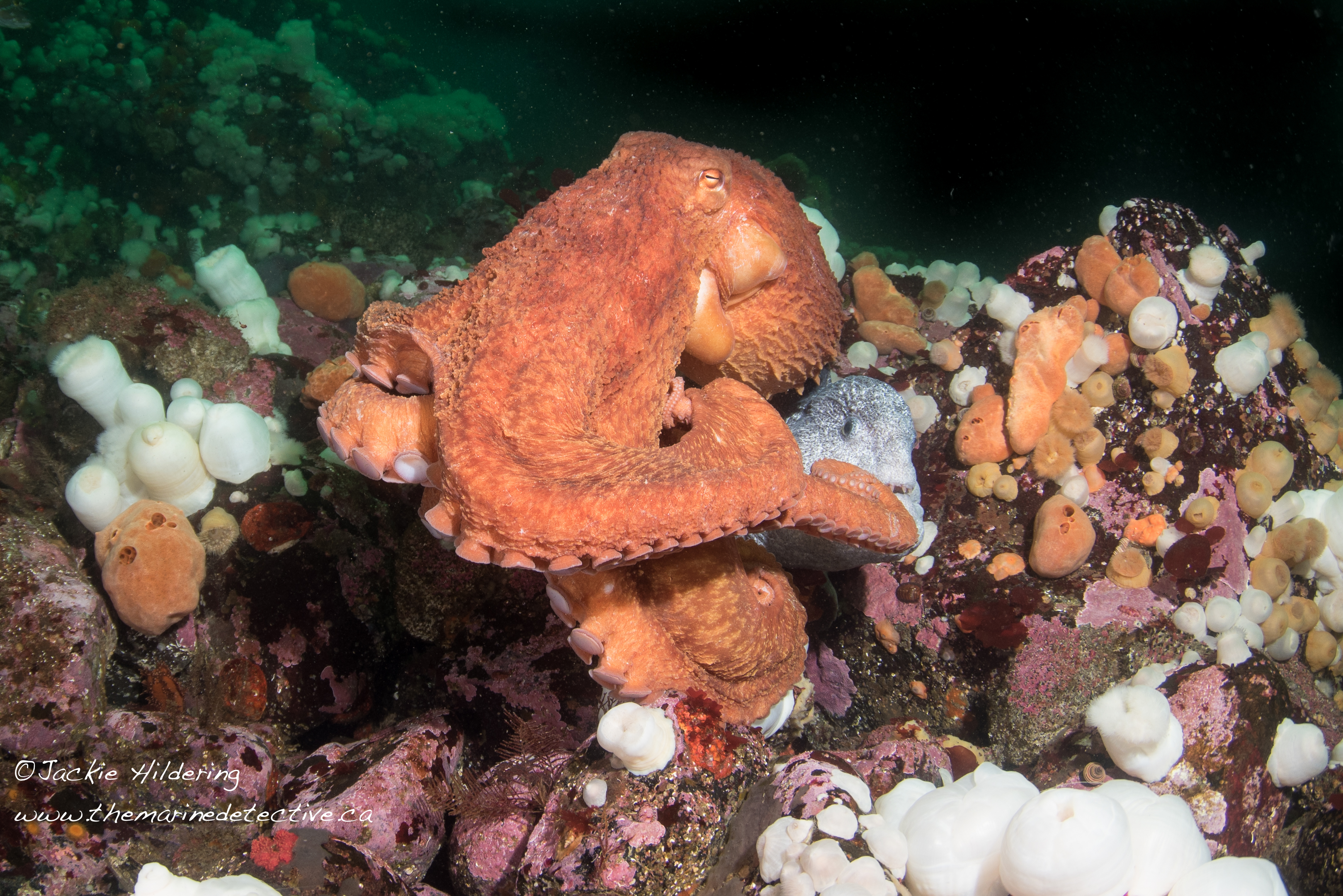
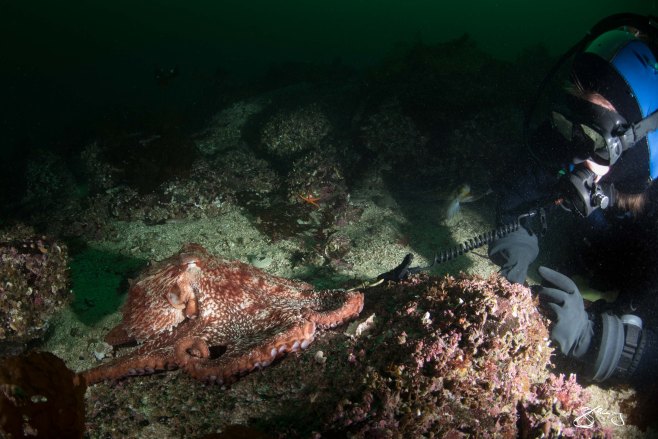
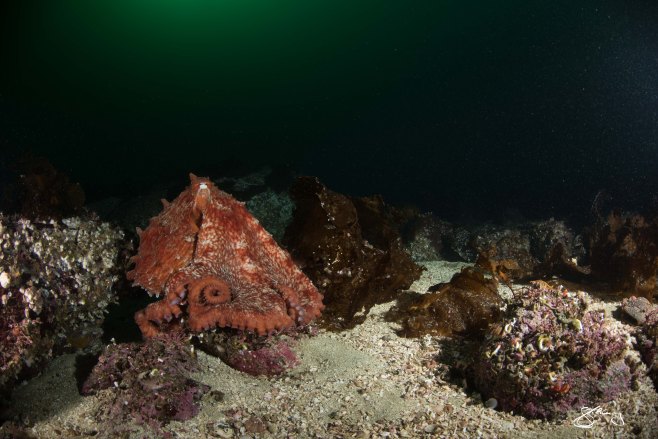
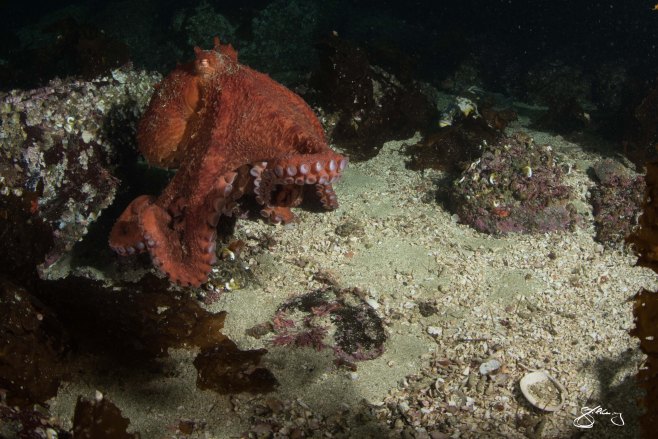
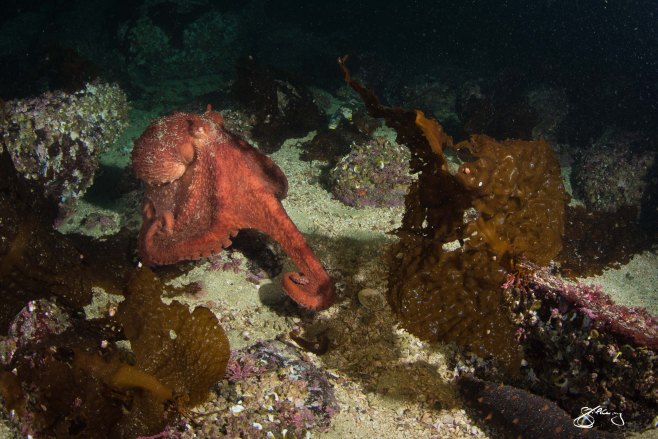
It is one of the most remarkable encounters I have witnessed in all my dives.
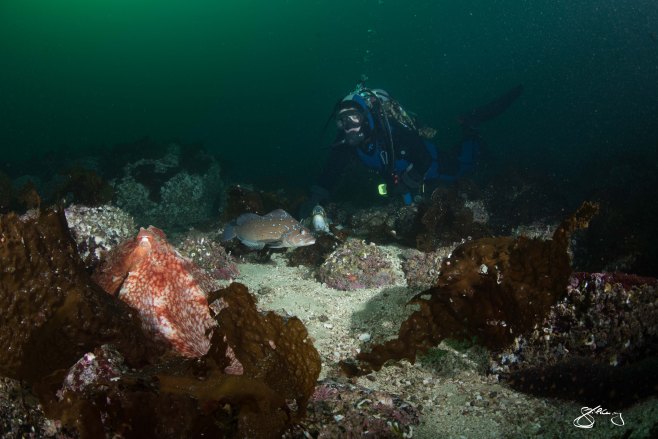
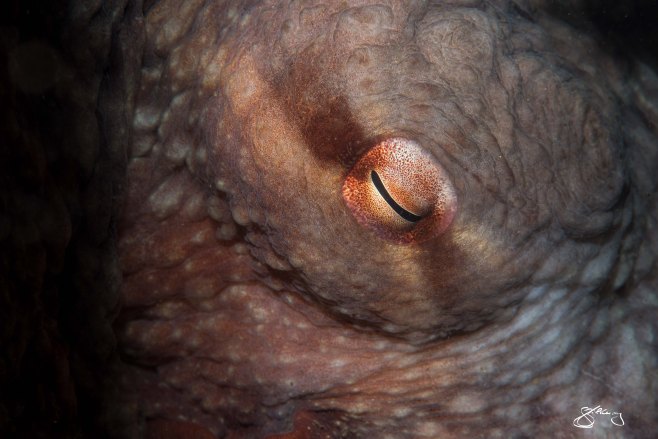
It’s a fortunate enough thing to be able to watch a large Giant Pacific Octopus when it is hunting. In this encounter, the octopus passes directly over a mature male Wolf-Eel in his den. THEN, a Decorator Warbonnet emerges as well.
It was an exciting day in this wonderful marine neighbourhood.
I hope this 3-minute clip allows you to share in the awe and excitement.
For me, this was the NE Pacific Ocean equivalent of seeing a giraffe, elephant and rhino in close proximity.
Video and photos contributed by dive buddies Katie Morgan and Diane Reid while on our trip with God’s Pocket Dive Resort.
For more information on Wolf-Eels (including that they are not an eel at all), see my previous blog here.
For more information on Giant Pacific Octopuses, click here for previous blogs and here for a blog specifically on hunting in Giant Pacific Octopus.
It has just come to my attention that there are two applications for tenure for tidal turbines in killer whale critical habitat. This last arose in November in 2012 with my posting the blog “Tidal Turbines in Whale Epicentre? Hell No!”. The resulting media coverage, your action and the ethics of the applicant resulted in that application being withdrawn.
With these two new applications, your action is again very much needed.
The comment deadline is April 9th, 2015.
Below, I have edited my November 2012 blog to be applicable to these applications and hopefully I have succeeded in making commenting very expeditious for you.
Here goes . . . .
There are times when expletives like “Hell No!” are justified and I am sure you will agree this is one of those very unfortunate times and – your action is needed.
There are two applications for “OCEAN ENERGY / INVESTIGATIVE AND MONITORING PHASE” by Weyl Power Ltd. If accepted by the BC Ministry of Forest, Lands and Natural Resource Operations (MFLNRO), this would allow the instalment of technical and investigative monitoring equipment in killer whale critical habitat which could then lead to turbines also being located there. I believe the applications are still referenced as “licenses of occupation“.
While I of course support initiatives to reduce the use of climate-changing fossil fuels, to have turbines in critical whale habitat would be pure, simple, total, utter insanity. No matter how advanced the turbine technology, no amount of mitigation could compensate for the noise, prey reduction, and other disturbance to the whales.
One would hope that government agencies would surely deny the applications, especially after the public outcry after the similar 2012 application in this same area. However, we have many examples of this being tragically misplaced faith and cannot count on there being any legislation in place for sound environmental assessment that would confirm environmental impacts. Note that the federal government had to be taken to court TWICE to be ordered to acknowledge and protect killer whale critical habitat – first ruling December 7, 2010; appeal ruling February 9th, 2011.
Weyl Power Application – Johnstone Strait between Hanson Island and Telegraph Cove. File: #1414321. Click to enlarge.
The very ocean current that makes this area of interest for staking a claim for ocean energy is what makes this such a rich area for marine life. The importance of this area for killer whales can be supported by almost 4 decades of data collected by Department of Fisheries and Oceans and the OrcaLab.
To allow these applications to proceed would therefore be ludicrous and in direct conflict of Objective 4 of the Northern and Southern Resident Killer Whale Action Plan for Species at Risk which is to “Protect critical habitat for Resident Killer Whales and identify additional areas for critical habitat designation and protection.”
Weyl Power Application – Broughton Strait, western end of Malcolm Island. File: #1414321. Click to enlarge.
Therefore, we collectively need (again) to make our “Hell No!” heard.
Please comment by the April 9th deadline by going to these two links and scrolling down till you see “To comment on this application please click here”.
Weyl Power application for Johnstone Strait between Hanson Island and Telegraph Cove (File: #1414321) – click here.
Weyl Power application for Broughton Strait, western end of Malcolm Island (File: #1414325) – click here.
Sample text: “With regard to Land File Numbers 1414321 and 1414325, the applications for Weyl Power Ltd’s “OCEAN ENERGY / INVESTIGATIVE AND MONITORING PHASE” in the Broughton Strait to Johnstone Strait area, I write you to express that these applications for tenure must not be granted. The applications are in scientifically confirmed critical habitat for northern resident killer whales and it has been legally ruled that this must be protected as per Canada’s Species at Risk Act. In addition, the area is of great importance to humpback whales and many other marine species. No matter how advanced the turbine technology, no amount of mitigation could compensate for the noise, prey reduction, and other disturbance to the whales and to approve these applications would be in direct conflict of Objective 4 of the Northern and Southern Resident Killer Whale Action Plan for Species at Risk which is to “Protect critical habitat for Resident Killer Whales and identify additional areas for critical habitat designation and protection”. It is also unacceptable that the public is not provided with information on these applications other than the applicant name and the maps i.e. no information about design or environmental assessment process.” You may even want to reference this blog and provide the link e.g. “For further details of the reasons for my great objection to this application see the rationale and resources provided at http://wp.me/pPW6V-1cJ.
Please also help spread the word?
So much insanity . . . so little time.
References:
Bigg, M.A., I.B. MacAskie and G. Ellis. 1976. Abundance and movements of killer whales off eastern and southern Vancouver Island, with comments on management. Arctic Biol.Sta., Ste. Anne de Bellevue, Quebec. 20 pp.
Submerging into the dark, you never know what you are going to see.
It is a large part of what is so intoxicating about diving in cold, dark waters – all the mystery; all the wonder; all the opportunity for learning and sharing.
The “smoke” was brief but intense and of course it was not smoke at all. It was the spawn of some animal. Many marine invertebrates are broadcast spawners where all individuals in an area release their sex cells at the same time to enhance the chances of fertilization.
I knew the source of the “smoke” had to be a shipworm species since it was coming from a rotting log with lots of tunnels bored into it. I then had to do a bit of reading to be sure of whether it was the invasive Naval Shipworm (Teredo navalis), or the indigenous Northwest Shipworm (Bankia setacea).
Either way, shipworms are not worms at all!
Northwest Shipworm Source: MARINE WOOD BORERS IN BRITISH COLUMBIA; D. B. Quayle; 1992
Shipworms are saltwater clams. They look like a worm in a calcareous tube but have two small shells at the front of their bodies that are specialized to bore through wood, much to our dismay! The clams also have symbiotic bacteria that release an enzyme to help break down the cellulose in the wood.
I believe in this case it was the Northwest Shipworm that was spawning and the initial cue for the synchronous release of sex cells in this species is believed to be a sudden change in temperature or salinity. Once the spawn begins, it is believed that neighbouring Northwest Shipworms drawing water into their siphons detect the spawn and that this further triggers them to release their sex cells.
The Northwest Shipworm it is more common in BC than the Naval Shipworm; the tunnels in the wood looked like those caused by this species; but also relevant in my knowing it was this species is that I saw eggs being released as well as sperm.
With the oh-so-successful Naval Shipworm that originated in the Atlantic but is now boring through wood in all the world’s oceans, only the males release sex cells. Sperm are then drawn into females’ inhalant siphons; the eggs are fertilized and develop in the female’s gills in huge numbers to be released as free-swimming larvae.
The Northwest Shipworm does not have this reproductive strategy. With both genders broadcast spawning, you can imagine how many sex cells need to be released for successful reproduction.
After about 3 weeks (at 12 – 15°C), the Northwest Shipworm larvae appear to be able to detect wood. They attach themselves, soften the wood, bore into it, develop into adults and cause economic discontent in we humans. This is especially the case in the logging industry which depends on transporting and storing wood in the Ocean.
Apparently the Northwest Shipworm can burrow 10 cm per month at temperatures greater than 10°C. See here for examples of the damage to wood by this species. If you are a Northern Vancouver Islander, you can see how this wood has been used as a decorative wall covering in the Whale Interpretive Centre.
For me, there was no discontent today. It was a wonder to be swimming by at the exact time this species was spawning. Providing me with a further opportunity to . . . smoke out facts about our marine life and share them with you!
Please note, I have shared our experience below to reduce the misunderstanding and demonization of octopuses NOT to stimulate diver attempts at interactions. What is described below was an unsolicited gift experienced by those with a very high level of dive experience; knowledge of octopuses (and dive buddy) behaviour; and solid safety protocols.
The Kraken?! Devilfish?!
Scary?! Dangerous?! Alien?
Suggest such things about a Giant Pacific Octopus to any scuba diver respectful of marine life who has had an encounter with one of these gentle giants, and there is going to be a very strong response shattering such mythology.
As it always goes, fear and mythology thrive where there is absence of knowledge.
Any negative encounters between divers and Giant Pacific Octopuses that I am aware of, result from divers manhandling them “insisting” on an encounter, or involve octopuses that are habituated as a result of being fed by humans.
We, as divers, are so fortunate to come across Giant Pacific Octopuses in their world where they are invertebrate royalty. We are able to meet them on their turf, and thereby know how inquisitive and intelligent they are. We know they are mighty, highly adaptable predators.
And, we know too, when we look into their eyes, that observation and assessment is being reciprocated.
That preamble was necessary before sharing what happened today.
I had been taking photographs of Lingcod males guarding their egg masses and noted that my dive buddy Natasha Dickinson was signalling me with her light, indicating that she had found something of particular interest.
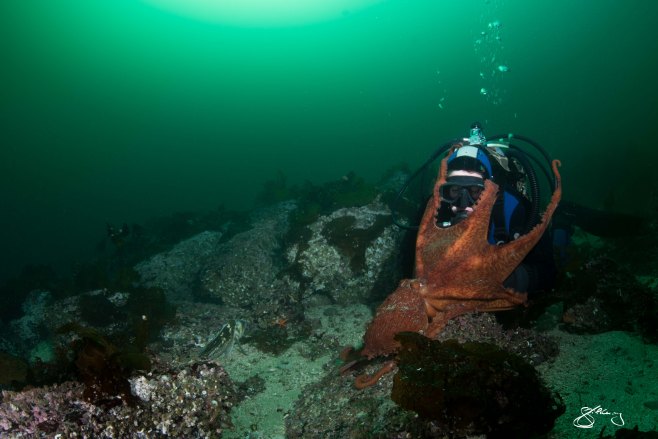
I took a few more shots and then swam towards her and found . . . my dive buddy with a Giant Pacific Octopus completely covering her face. Sorry that I missed that shot. I was so in awe of what I saw.
Natasha is an incredibly skilled and experienced diver with a deep respect for marine life. She was clearly not afraid, nor was the octopus.
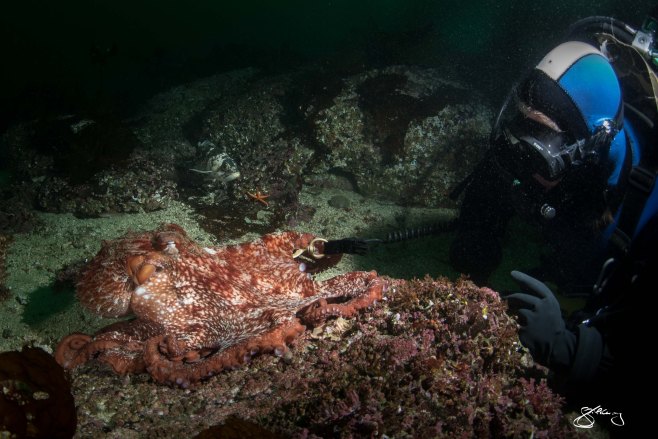
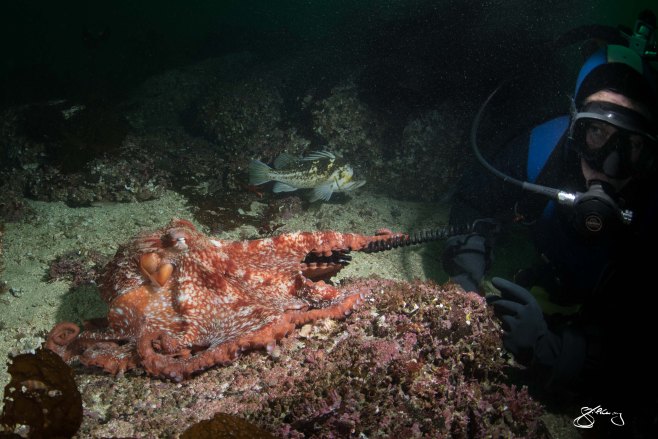
Natasha had taken the precaution of putting her hand over the regulator in her mouth in case the octopus took an interest in that but otherwise, allowed her to explore.
I would learn later that, while waiting for me she had been watching the Copper Rockfish that you will see in all but one of the photos in this blog. This rockfish stuck very near the octopus. A buddy? That I don’t know but escorting a Giant Pacific Octopus on the hunt is a really good strategy. As the octopus flushes out animals from under rocks with his/her arms, the rockfish can grab the prey that do not end up under the octopus’ mantle.
While observing the rockfish, the Giant Pacific Octopus had slowly advanced toward Natasha and she remained where she was, intrigued at what would happened and having a contingency plan.
When I started to take photos the Giant Pacific Octopus gradually backed away but had taken a particular interest in a clasp at the end of a bungee cord on Natasha’s gear.
You can see how her arm was entwined around the cord and how there was some flashing of white in the skin. You can also see the Copper Rockfish!
I believe this octopus was a female, thanks to feedback I received from self-admitted Cephalopod Geek supreme, Keely Langford of the Vancouver Aquarium. Octopus males have a “hectocotylus arm”. In Giant Pacific Octopuses, it is the third arm on their right. The hectocotylus stores the spermatophores – packets of sex cells, two of which are handed over to a receptive female who stores them until ready to fertilize her eggs.
Having the good fortune to get photos of the right side of this octopus, particularly #5 and #7, allowed me to see that the top of third arm on the right is not differentiated and that therefore, this was a female.
So what to do when you find a Giant Pacific Octopus on your dive buddy’s head? Observe, marvel, take some photos, share and maybe it can help dispel some of the mythology and vilification about these fabulous marine neighbours.
They have a beak with venom, three hearts, blue blood, and their skin is capable of detecting chemicals (as our nose does).
While many sources report their having 9 brains, octopuses only really have one donut-shaped brain positioned around their oesophagus and then each of their eight arms has many neurons, this is referenced as “distributed intelligence”. Damir Allen explains at this source; “Think of it like a command centre and 8 independent soldiers. They all act semi-independently, and if separated from the main body they will continue to capture food and try to deliver it to a non-existent mouth.”
They are jet propelled and are capable of incredible camouflage where they can not only change the colour of their skin but also its texture to blend in with their surroundings.
They mate only once. From the Vic High Marine website regarding Giant Pacific Octopuses: “Females die directly after they have finished laying and guarding to their egg however males live a slightly longer time. Octopus reproduction starts when a male uses a specialized tentacle [sic, octopuses have arms not tentacles] to pass two spermatophores (sperm packages) to the female. Once given the sperm the female stores the package until she is ready to fertilize the eggs. Before a female is ready to fertilize the eggs she has to find a suitable den. This search can take the future mother up to one month! Once the perfect place is found the female shuts herself in using rocks. From there she fertilizes each egg and gathers them in bundle of approximately 200. She hangs each group of eggs from the ceiling of the cave. This is a long process because, on average, a female octopus can lay up to 50,000 eggs. The incubation time for octopus eggs are six and a half months. During this time the female stays in the cave, not even leaving to eat, attending to the eggs by constantly blowing oxygenated water on to them. When the baby octopuses hatch they are referred to as paralave. These tiny juveniles swim up to the surface joining other zoo plankton and spending weeks feeding on tiny phytoplankton. Once they have developed enough mass they descend to the benthic zone. As for the mother, she waits until all the eggs have hatched then emerges from the cave and dies shortly afterwards due to the starvation she endured during the months she spent devoted to tending her eggs.“
Excellent on-line resources on octopuses.
A Snail’s Odyssey – Learn About Octopus. Includes excellent information on reproduction in Giant Pacific Octopuses.
Today was the first time ever that, while diving, I made a gesture to my dive buddy indicating that my brain had exploded.
We weren’t deep; the remarkable find that had me awestruck was at 3 to 5 metre depth. It’s a known species and is found throughout the Atlantic, Pacific and Indian Oceans but . . . . it’s certainly extremely rare here around NE Vancouver Island and it is SO otherworldly.
Let me take you on a short journey of discovery.
I was already pretty excited when I found the organism in the photo below. I knew it to be a salp “aggregate” and was delighted that there was an amphipod hitchhiker. See it?
Salps are such unique gelatinous animals! They belong to the group of highly evolved invertebrates known as tunicates. Most tunicate species live attached to the bottom when they are adults but salps remain Ocean drifters for their whole lives. Because of their gelatinous “tunic” they have even been referred to as Ocean Gummy Bears.
Their reproduction is totally otherworldly! They alternate between two forms. The image above is of the “aggregate” form or “salp chain” that, dependent on species, can be made up of millions of individuals. The aggregate form reproduces sexually to form a barrel-shaped solitary form. The solitary form buds off (asexually) to produce the individuals that make up the aggregate form and so on! Salps apparently grow faster than any other multicellular organism! (Source: JelliesZone).
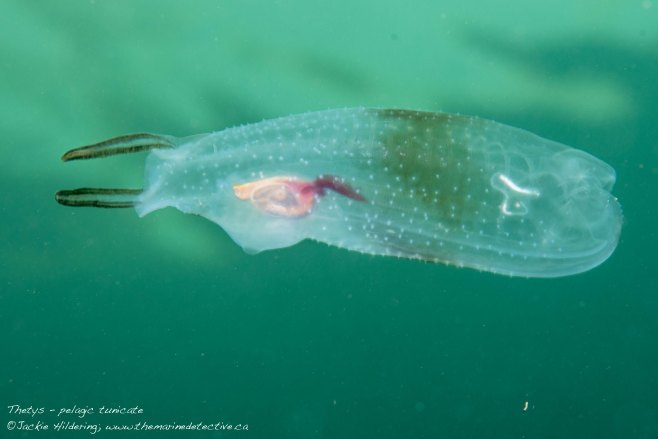
Back to the dive . . . so I was already pretty thrilled to have seen the salp chain of this unique species and THEN I saw something hovering above me, zeppelin like.
Brain exploded. WHAT was this?!
It was about 25 cm long.
It had openings on both ends.
It clearly had internal organs.
And it had unique projections on what I assumed was its back end.
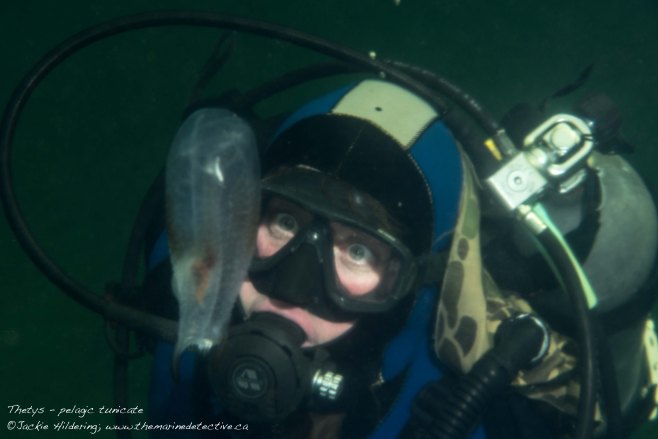
The look on my dive buddy Natasha Dickinson’s face in the image below says it all!
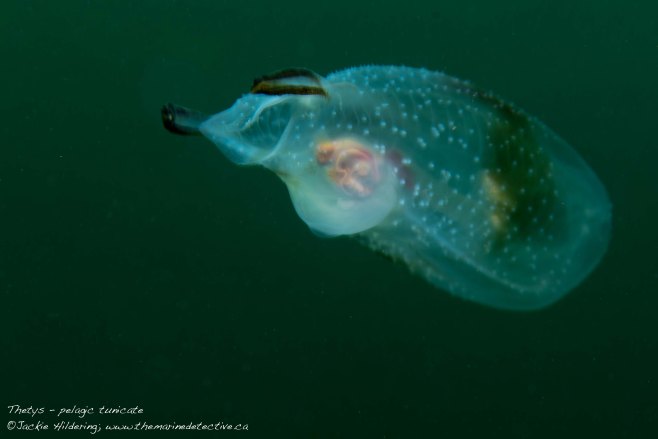
Ahh – it’s wonderful to have friends in deep places. Andy came back very quickly with the ID. It was a salp indeed, in fact, the world’s biggest. Thetys* in the solitary form can grow to 33 cm! The common name is the Twin-sailed Salp.
From Dave Wrobel’s The JelliesZone webpage: “Thetys is truly an impressive member of the zooplankton. It is the largest species of salp along the West Coast and is relatively easy to distinguish from all others. Unlike most gelatinous animals, the body is relatively firm due to the thick spiny test (the test, or tunic, is the hard outer covering typical of many tunicates, hence the name for the group). It retains its shape even when removed from the water. Solitary individuals have 20 partial muscle bands . . . that are used for constricting the body while pumping water for feeding and locomotion. A pair of pigmented posterior projections are very distinctive, as is the darkly colored, compact gut . . . Like other salps, Thetys continuous pumps water through a mucous net to extract phytoplankton and other small particles. Although relatively uncommon in Monterey Bay [and therefore very uncommon so much further north where I sighted this individual], this widespread species can be found in temperate and tropical waters of the Pacific, Atlantic and Indian Oceans, to depths of about 150 meters.”
I came upon research from MIT (2010) that revealed how salps could get enough nutrients to be so big and fast growing. Their mucus nets are astounding in how they are able to trap incredibly small-sized plankton. With this find, the researchers referenced salps as “the vacuum cleaners of the ocean” and confirmed how important they are because of what they do to huge volumes of climate-changing carbon.
In the Oceanus Magazine article Salps Catch the Ocean’s Tiniest Organisms, the researchers explain “As they eat, they [the salps] consume a very broad range of carbon-containing particles and efficiently pack the carbon into large, dense fecal pellets that sink rapidly to the ocean depths, Madin said. “This removes carbon from the surface waters,” Sutherland said, “and brings it to a depth where you won’t see it again for years to centuries.” And more carbon sinking to the bottom reduces the amount and concentration of carbon in the upper ocean, letting more carbon dioxide enter the ocean from the atmosphere, explained Stocker” [thereby reducing the amount in the atmosphere where it impacts climate.]
I of course also hoped to find a good photo or video of the salp chain of this species (the aggregate form) and came upon this 1-minute clip by Patrick Anders Webster (taken off the coast of central California).
Wow!!! Mind-blown again.
And below, an additional video from Patrick from May 2016, also off the coast of California.
[*You may have noticed that the full scientific name for this tunicate species is Thetys vagina as assigned by the German naturalist Wilhelm Gottlieb Tilesius von Tilenau in 1802. Likely at that time, “vagina” did not yet have its anatomical meaning and the species name was chosen for the Latin origin of the word meaning “wrapper” / “sheath”.]
[Update September 2020: Click here for OrcaLab’s live cameras and video highlights of Northern Resident Orca rubbing at the Strider Beach in the Robson Bight Ecological Reserve, NE Vancouver Island.]
[Video used with permission. For licensing / permission to use: Contact – licensing(at)jukinmediadotcom]
I became a resource to the news for interpreting the whales’ behaviour in this video as a result of my posting their IDs and commenting on the behaviour on social media. However, it proved difficult to extinguish some misinterpretation and misinformation, for example, the notion that the behaviour captured in the video was rare e.g. “B.C. orcas’ rare beach-rubbing behaviour caught on video” (CBC News. January 31, 2015).
It’s not rare behaviour at all. It is rare that people get to see it.
Big difference!
That’s what has motivated me to write this blog but before I proceed let me qualify that while I have spent a lot of time staring at Killer Whales through binoculars, I am a Humpback Whale researcher and marine educator. Everything that is known about Killer Whales is due to the long-term population study by DFO’s Cetacean Research Program. It began in 1973 with the late, great Dr. Michael Bigg and as a result, the Killer Whales of British Columbia have been studied as individuals longer than any other marine mammals in the world.
Thanks to the Cetacean Research Program’s work, identifying the whales in Chris’ video was easy. I recognized that they were beach-rubbing and, therefore, they had to be members of the threatened Northern Resident population. “Resident” Killer Whales are inshore, fish-eaters who can best be described as “Chinook-aholics”. The Northern Residents are the only Killer Whales of BC’s four distinct populations that rub on smooth pebble beaches.
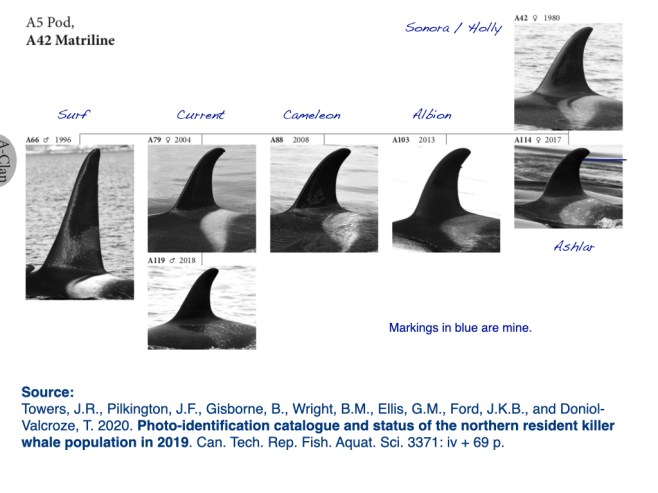
When the video was brought to my attention, I was with two fellow Humpback Whale researcher friends, and we laughed aloud at about 1:56 in the video because there was mature male A66 (“Surf”), almost stationary on the beach. His left side was facing Chris’ camera, making it so easy to see his distinct saddle patch and the nick in his dorsal fin. It simply could not have been easier to identify him.
Screen grab from Chris Wilton’s video showing why it was so easy to identify A66 / Surf. Used with permission.
Ah ha! If Surf was there, his mother and three siblings had to be there too for such is the way of “Resident” Killer Whales; they stay with their mothers for their entire lives, seldom separated by more than a short distance. If the mother dies, the remaining family members stay together. Northern Resident families are in fact named for the eldest female who is believed to be the leader, A42 in this case, and the families are known as “matrilines”. This term loosely translates into “follow your mother”.
Upon viewing the rest of the video, we could confirm that all five member of the A42 matriline were indeed there. Surf was with his mother, Sonora, and her three other offspring.
Absolutely essential to understanding this behaviour is to know that the Killer Whales of the world have culture. Like humans, they have specialized to make use of certain prey and the geography of their area e.g. specializing in eating salmon vs. marine mammals.
In BC, the four Killer Whale populations (Northern Resident; Southern Resident; Offshore; and Bigg’s / Transients), overlap in their ranges but the populations have different languages and do NOT mate with one another. Thereby, they preserve the culture and traditions of their populations. To emphasize just how long-lived these cultural differences and specializations are, know that the mammal-hunting Bigg’s / Transients diverged from the other kinds of Killer Whales 700,000 years ago!
As mentioned, throughout the Northern Resident Killer Whales there is the culture of skidding their bodies over sloping beaches of smooth pebbles. None of the Killer Whale populations with which they have overlapping range in British Columbia have this behaviour. (Note: The AK Pod of Alaskan Residents is also known to beach rub. Please see detail at the end of the blog). As you can see in Chris’ video, in order to get down low and in contact with the rocks, they often super-deflate their lungs to reduce buoyancy, releasing a gush of bubbles. They rub all parts of their bodies. Sometimes they do this for a few minutes, and sometimes for more than an hour.
In OrcaLab’s video below, you can see underwater footage of the behaviour. Video was taken with remote underwater cameras under permit from Fisheries and Ocean’s Canada.
The behaviour can’t be about rubbing off parasites! The skin of Killer Whales sloughs off like ours does and therefore there’s no “fouling” of barnacles like there is on Humpbacks and Grey Whales. And hey, if it was due to ectoparasites, the other Killer Whales in BC would have them and be beach-rubbing too!
Beach-rubbing by the Northern Residents must be a social and recreational behaviour. A whale massage? Certainly it must feel good. Maybe, as an additional benefit, doing something you enjoy together also further solidifies family bonds (social cohesion being needed for community maintenance)? Reportedly, the vocals sometimes made by the Northern Residents while beach-rubbing support that this is a social behaviour since they are the same “looney tunes” made when Northern Resident families reunite.
Again, it is not rare for the Northern Residents to beach-rub at all. It is a regular social behaviour. What’s quite rare is that there were humans present on a beach when the behaviour was happening since where the whales most often are known to rub is a no-go zone.
These best known rubbing beaches are on NE Vancouver Island, in the Michael Bigg Ecological Reserve at Robson Bight in Johnstone Strait. The Northern Resident matrilines that most often feed in this area use these beaches to rub with incredible regularity, including the A42s – the whales that Chris videoed beach-rubbing much further to the south, around central Vancouver Island. These Robson Bight beaches are within recognized critical habitat for this population and are fully protected. The waters around these beaches are a restricted area as well.
But Northern Resident rubbing beaches are found all along our Coast and I believe that individual families have preferences, places they have been rubbing generation after generation after generation. There are Northern Resident families that rarely come into Johnstone Strait and they must have their equivalent of a Robson Bight somewhere else on our coast.
As confirmed by Dr. John Ford, head of DFO’s Cetacean Research Program, the Strait of Georgia where Chris got the video has been known to be part of the range of the closely related families to which the A42s belong (the A5s) since the 1960s and likely for many, many years further back. However, at that time, we would not have been collecting the data.
In 1961, near to where the video was taken, a 50-calibre machine gun was positioned for the purposes of executing Killer Whales and, as of 1964, it became common to attempt to capture them for captivity.
Just 55 years later, in January 2015, Chris and others stood on a beach in the Discovery Islands marvelling at what they were witnessing, recognizing their good luck to see this wild behaviour, and being able to record it in the video that has now gone viral.
Thank goodness that we have this capacity for positive change and that it’s now NOT rare that people feel a strong concern for and connection to Killer Whales. I believe that the wide reach of Chris’ video has led to raised awareness about how cultured and social Killer Whales are and how lucky we are to have them as our marine neighbours. Maybe that awareness will be reflected in further changes that benefit the whales and the marine ecosystem for which they are ambassadors?
Then we’d be rubbing the right way and have more reasons to bubble with happiness.
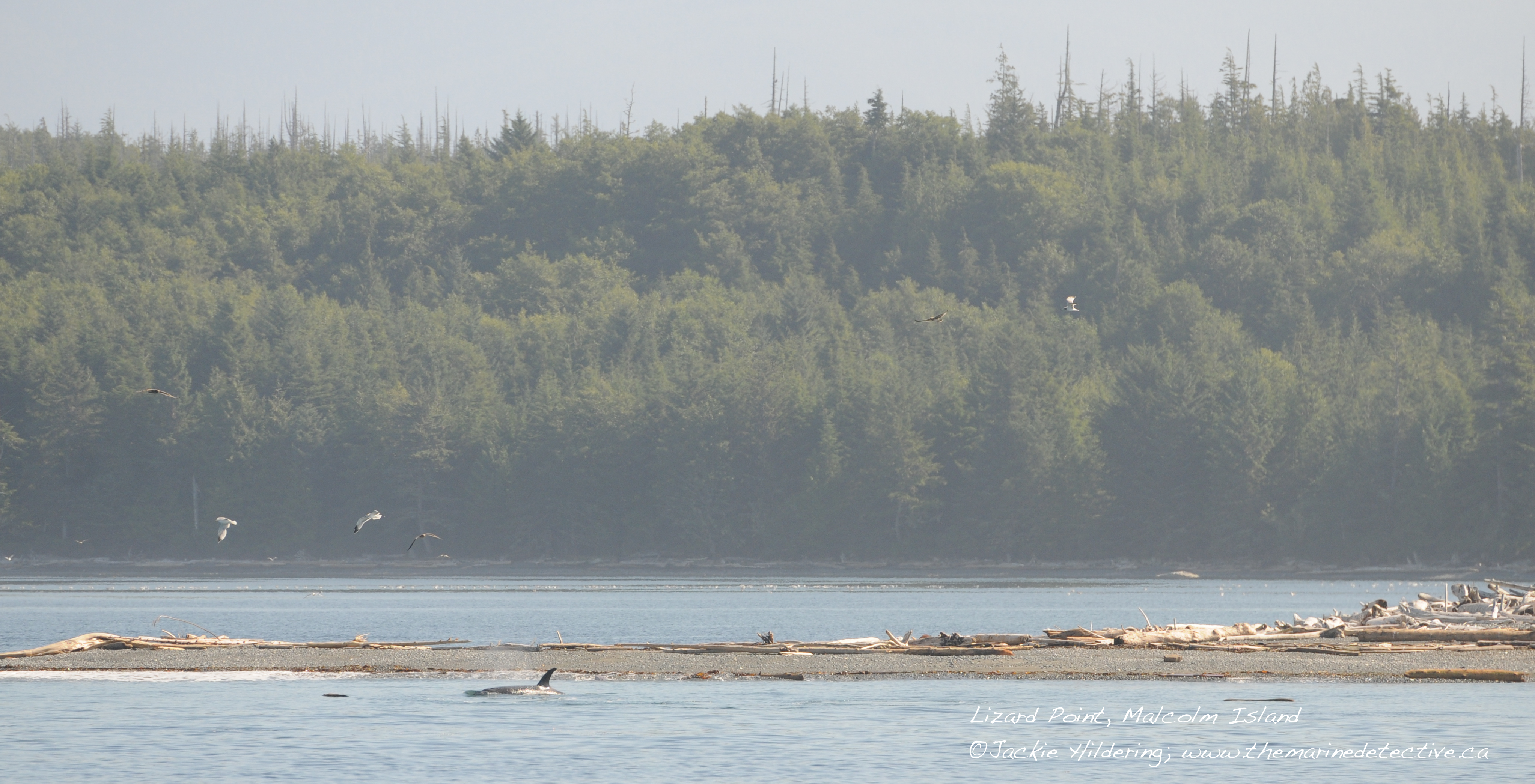
Northern Residents using a rubbing beach on Malcolm Island off NE Vancouver Island. For more information on these beaches see Friends of the Wild Side.
_________________________________
Additional Videos of Beach-Rubbing of Northern Residents:
Video 2021 of the A42s rubbing near Sechelt
Video 2015 by – beach rubbing by A42s near Powell River.
Video January 27, 2018 by Sasha Koftinoff – beach rubbing by A42s near Sechelt.
Video January 27, 2018 by Martin Michael – beach rubbing by A42s + other Northern Residents near Sechelt.
Video January 27, 2018 by Bruce Robinson – beach rubbing by A42s + other Northern Residents near Sechelt.
Video – Feodor Pitcairn’s 2001 “Realm of the Killer Whales” with underwater footage of the beach-rubbing as of timestamp 48:15. This footage was obtained as a result of a special DFO permit.
Notes and Sources: *Scientific convention is to reference Orcinus orca as Killer Whales. Many prefer “Orca” but please know that Orcinus orca loosely translates into “demon of the underworld”. The whales did not name themselves, we did and locked within the names is our misunderstanding and complex history with these remarkable, social, intelligent, big dolphin.
For more footage from the OrcaLab cameras and hydrophones from NE Vancouver Island click here. You can sign-up for text alerts by scrolling down at that link and filling in the field on the bottom left.
This blog led to my being interviewed for BBC’s “Ingenious Animals”. The episode includes a compilation of video of Northern Resident matrilines beach-rubbing. Available at this link as of 41 min.
Information on Beach-Rubbing in Alaskan Residents:
Members of AK pod are known to beach rub using “several different rubbing locations in Prince William Sound as well as in Kenai Fjords and Resurrection Bay.” Source: North Gulf Oceanic Society.
Alaskan Residents’ range overlaps with that of the Northern Residents, especially in Frederick Sound. It is unknown how often the Northern Residents and the AK pod of Alaskan Residents do or do not overlap in their ranges.
Video below shows beach-rubbing in what is very likely Alaskan Residents (members of AK pod) by Eric Eberspeaker – August 2015; Kenai Fjords Wilderness Lodge on the shore of Fox Island. You’ll note there are some very unique human vocals resulting from witnessing the beach rubbing.
It’s December 31st, a time when many of us are reflecting on how we want to feel in the new year.
Do you want to . . . .
Lose heaviness?
Gain optimism?
Be more empowered?
Feel happier?
Change the world for the better?
Me too and in my year-end reflections, I have reminded myself that I know the science of how this can be achieved and have had the privilege of living the experience.
Research has shown that the Japanese practice of “forest bathing” (Shinrin-yoku) measurably increases well-being and decreases our eating ourselves up inside. Even the smell of the forest reduces blood pressure, heart rate and stress hormone production; and increases the production of natural killer cell (NK cells) which combat infections and tumour cell activity (Lee et al).
It’s not really a surprise that being outside and caring for Nature is, well, our natural state of well-being.
It’s where our happiness lies and thereby, the name of this heaviness losing regime is – The Happiness Diet.
Because what’s good for the planet and all the beings we share it with is also good for you. Of course it is.
Grandma Cedar and I. Lots of happy and healthy going on here.
Truly thrive. Feel more alive.
Use less. Care more.
And when you shine with lightness and people ask, “What’s your secret?”, please, please, please – tell them!
For this is a secret that could truly change the world.
Wishing you health, happiness, and WILD adventure in 2015 and beyond.
Source:
J. Lee, Q. Li, L. Tyrväinen et al., “Nature therapy and preventive medicine,” in Public Health-Social and Behavioral Health, J. Maddock, Ed., chapter 16, pp. 325–350, Intech, Rijeka, Croatia, 2012.
It’s Canadian Thanksgiving and I am overwhelmed with depth of gratitude and purpose.
It is an extraordinary privilege to be able to live the life I do and I want so much for it to count.
Thank you dear readers for helping to amplify the beauty, mystery and fragility into the world so that there may be more understanding that there is no divide between land and sea and how our daily actions regarding chemical and energy use connect us – no matter how far away from this place you are.
The photo below is from two days ago – “Frosty” the Humpback Whale in Johnstone Strait, NE Vancouver Island.
To think we could have lost these glorious, majestic, mysterious, winged, singing, acrobatic ambassadors of our life-sustaining seas . . . .
Whale researchers generally have some pretty lofty goals but the methodology being used to study the health of at-risk Killer Whales might have the highest standard of all – literally.
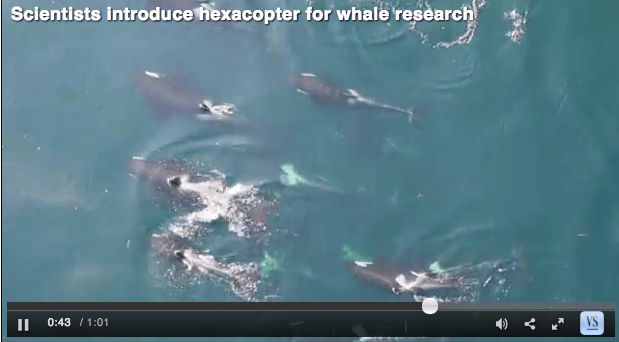
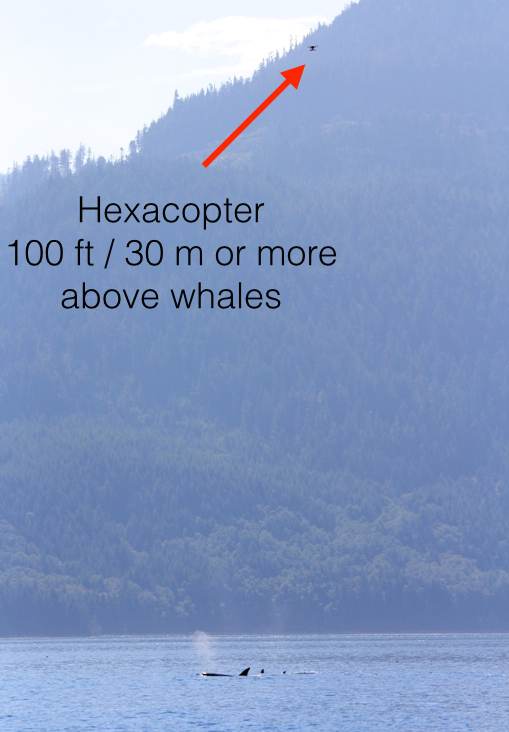
With Johnstone Strait being one of the most predictable and sheltered places to see Killer Whales, many of us seafarers on Northern Vancouver Island had a front row seat in seeing what was “up” with this research. A marine “hexacopter” was used, a drone with a camera mounted to it that soars 30m or more above the whales to obtain high quality video and photos that provide very valuable information about the whales’ fitness.
Ready for take-off: Olympus E-PL2 camera mounted to the APH-22 marine hexacopter. Photo Hildering.
Researchers Dr. Lance Barrett-Leonard, Head of the Cetacean Research Program at the Vancouver Aquarium, and Dr. John Durban and Dr. Holly Fearnbach of United States’ National Oceanic and Atmospheric Administration (NOAA) were very generous in sharing information about their high-flying research with our community. (Are you getting tired of my clever puns referencing height yet?!)
Dr. Holly Fearnbach releasing the helicopter. Dr. John Durban centre and Dr.Lance Barrett Leonard on the right. Photo: Hildering.
Photo by Suzanne Burns showing how benign this method of study is – the research boat is +/- 100m away and the hexacopter with camera is 30m or move above the whales.
All Killer Whales in BC are all at risk (Threatened or Endangered) and by getting the images from on-high, it is possible to better determine if the whales are thin and even if they are pregnant. This provides vital data such as being able to know if pregnancies did not go to term and how much the fitness of “Resident” Killer Whales depreciates in years of low Chinook salmon abundance. “Resident” Killer Whales are inshore fish-eating populations culturally programmed to be “Chinook-aholics” and their survival has been proven to be directly correlated to the abundance of Chinook salmon.
Here are some examples of the data obtained via hexacopter, revealing good news and bad news.
The bad news first . . .
When Killer Whales are in dire condition and lose too much fat, this manifests as “peanut head”, sunken areas near the eye patches. I see this as the equivalent as sunken cheeks in the gaunt faces of underweight humans.
A Killer Whale with “peanut head” where the extreme loss of fat around the head causes sunken areas in the whale’s head. This is a photo of a slide from the presentation given by Dr. Lance Barrett Leonard, Dr. John Durban and Dr. Holly Fearnbach at Telegraph Cove’s Whale Interpretive Centre on August 25th, 2014.
The images obtained with the hexacopter revealed that “Northern Resident” Killer Whales A37 and I63 were in extremely poor condition and, in fact, the whales disappeared from their matrilines (families) shortly after the images were taken. “Resident” Killer Whales stay with their families their entire lives so absence from the matriline most often means death.
The cause of death cannot be determined but know that when fat stores are get used up, manmade fat-soluble persistent organic pollutants (such as brominated fire retardants, PCBs, dioxins, etc) are released and affect the whale’s immune system. The mammal-eating Killer Whale of BC are known to be the most contaminated animals on earth.
In the presentation the research team provided in Telegraph Cove, I was gutted by the images of “Plumper” (A37 of the A36s) and I63 which showed concave eye patches and a tadpole-like body shape. The image of Plumper was contrasted to a healthy mature male Killer Whale (see below). As explained by Dr. Durban, Killer Whales when faced with fat loss, put water into the blubber layer so that they remain stream-lined. Plumper had lost so much fat, that it appeared he had to keep his pectoral fins extended to remain buoyant. Ugh.
Image taken from the hexacopter revealing A37’s very poor condition. He disappeared about 10 days after this photo was taken. A37 aka “Plumper” was one of the last 2 remaining whales in the A36 matriline of “Northern Resident” killer whales. He was 37 years old. The hexacopter study reveals that his brother A46 aka “Kaikash” is in good condition and he has been seen travelling with members of closely related matrilines. The above is a photo of a slide from the presentation by Dr. Lance Barrett Leonard, Dr. John Durban and Dr. Holly Fearnbach at Telegraph Cove’s Whale Interpretive Centre on August 25th, 2014.
Image revealing I63’s very poor condition. She disappeared from her matriline about a week after this photo was taken (I15 matriline of “Northern Resident” killer whales). She was 24 years old. The above is a photo of a slide from the presentation by Dr. Lance Barrett Leonard, Dr. John Durban and Dr. Holly Fearnbach at Telegraph Cove’s Whale Interpretive Centre on August 25th, 2014.
The good news . . .
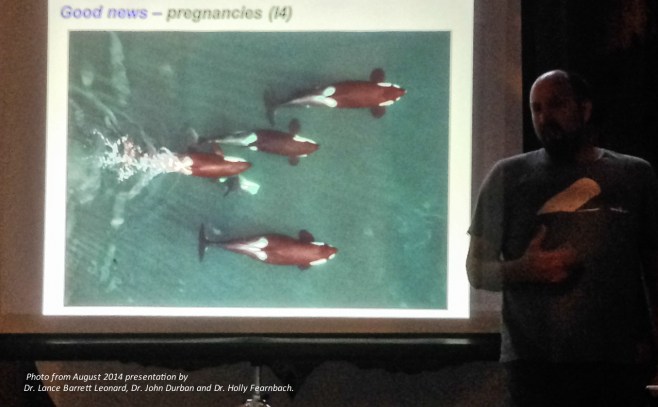
Data collected also revealed fat calves, robust nursing mothers, and pregnant females. Below, Dr. John Durban shares an image of 34-year-old “I4” of the I15 matriline of “Northern Residents” revealing that she is pregnant again.
Happy news! Photo taken from the hexacopter revealing that I4 is pregnant again (she is the whale at the bottom of the image). With gestation being 17.5 months in killer whales and that, around the world killer whales give birth in the winter, I4 is likely about 1 year pregnant in this photo. Photo taken during presentation by Dr. Lance Barrett Leonard, Dr. John Durban and Dr. Holly Fearnbach at Telegraph Cove’s Whale Interpretive Centre on August 25th, 2014. Photo: Hildering.
I am in no way advocating for the unregulated use of drones for viewing whales. The researchers reported that the regulatory paperwork needed to get approval for this research weighed more than the hexacopter did and that they were glad that this was the case.
This research methodology, when applied correctly, is a wonderful example of how advances in technology can lead to advances in knowledge in a way that is benign to wildlife. The sky’s the limit in how we let this knowledge impact our day-to-day actions to improve the health of the marine environment for which Killer Whales serve as powerful sentinels.
How high will you go for the sake of Killer Whales and what they are revealing about the health of our life-sustaining oceans?
Video taken with the Olympus EPL2 camera mounted to the APH-22 marine hexacopter. Note that the whales would not hear what you are hearing in this video as the camera is 30m or more above the whales. If video does not load go to http://tinyurl.com/pjz3hpf
The hexacopter research allowed for an assessment of the fitness of 77 “Northern Resident” Killer Whales (inshore fish-eaters) and 7 “Bigg’s” Killer Whales (mammal-eaters aka “Transients”) by the research team during 2 weeks in August. Here, mature male mammal-eating killer whale T060C is being photographed from on high. Photo: Hildering.
Photo by Laurie Sagle showing how high the hexacopter is above the whales.
The research team: Dr. Holly Fearnbach; Dr. Lance Barrett-Leonard; and Dr. John Durban. Photo: Hildering.
Having finally recovered from having a crashed computer hard drive, I can now share with you some of the wonder and discovery from being on DFO’s offshore survey to aid the recovery of whales.
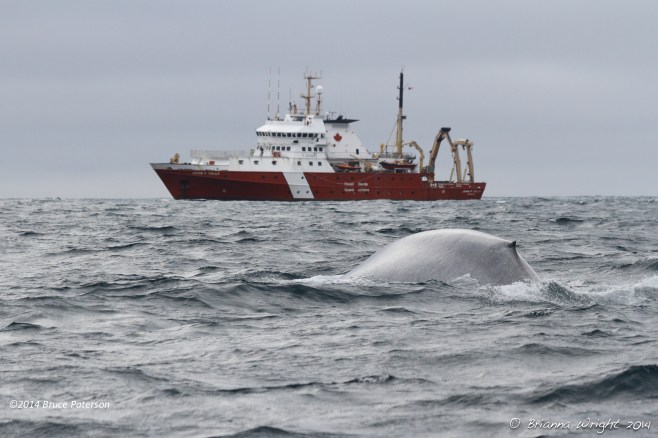
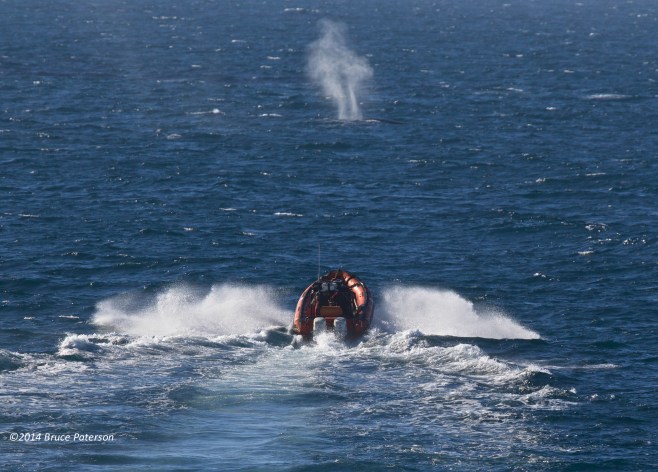
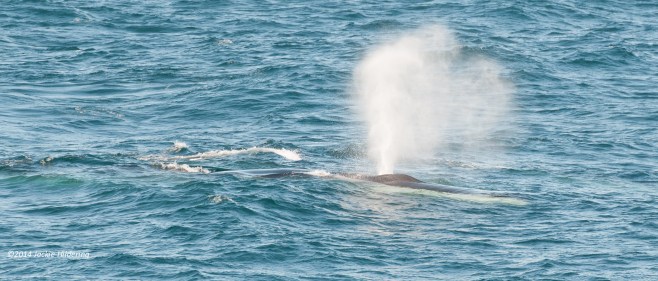
This past July, the Cetacean Research team went as far as 200 nm (370 km) off BC’s shore and it was a great success. The team sighted over 3,000 cetaceans including two endangered Blue Whales (the biggest animal that ever lived).
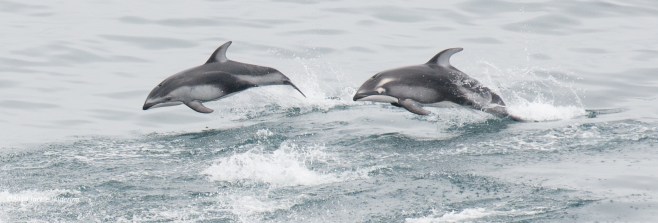
There were so many Dall’s Porpoises out there; some Northern Right Whale Dolphins (I promise that, one year, I will get a good photo) and even a Pacific White-Sided Dolphin with very unique markings.
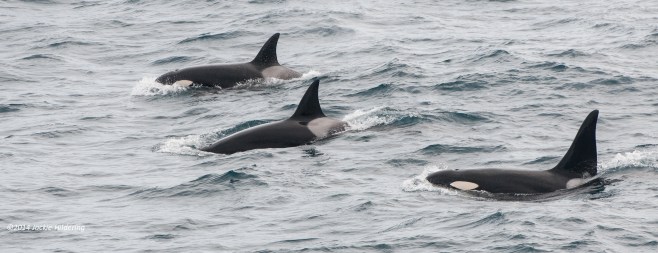
We had many sightings of threatened populations of Killer Whales – Offshore Killer Whales (offshore fish-eaters); Resident Killer Whales (inshore fish-eaters); and Bigg’s/Transient Killer Whales (mammal-eaters). There was even data collected on some pelagic Bigg’s/Transients that have never before been identified in BC.
To see the big marine animals was astounding especially considering how at-risk many of the species are due to past whaling/hunting and current threats like vessel-strike, prey-availability, and entanglement.
Seeing +/- 60 Humpback Whales flick-feeding together, birds all around them, made me go quiet in sheer wonderment at the beauty of it . . . blows as far as the eyes could see. To think that we could have lost them due to whaling . . . .
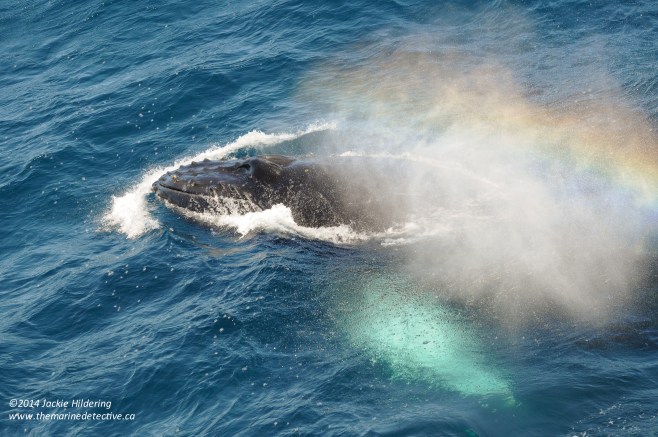
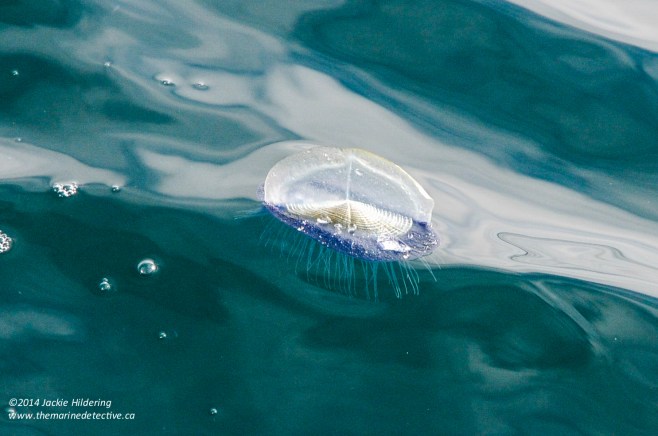
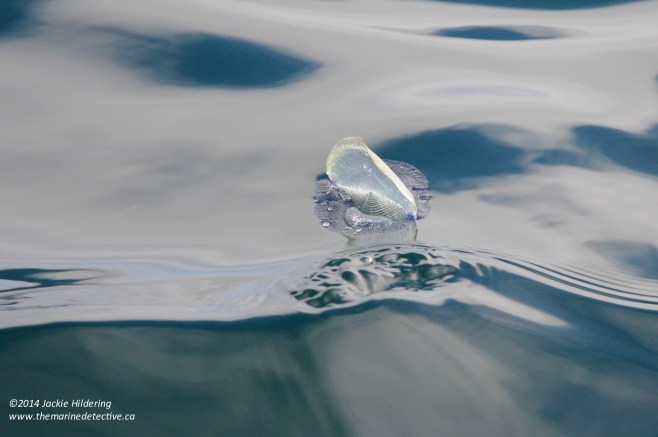
But look closely at the image below. Yes, it’s a humpback with a rainbow blow (rain-blow?) but look more closely. See the little white circles? This is one of the little guys that put me in the same state of rapturous awe as seeing the giants. All around the humpbacks, in fact, over almost ever square meter of ocean out there, there were sailed jellies known as “By-the-Wind Sailors” (Velella velella).
This species of hydroid has a buoyant air-filled float and a triangular, stiff sail. It is a colonial animal with a central mouth under the floats. The tentacles trap fish and invertebrate eggs, small crustaceans (copepods) and species of free-swimming tunicates.
To add to how remarkable this species is, some have the sail facing one way where others in the population have their sail facing the other way – so that they get blown in different directions. (For more species information see the JelliesZone).
But there was another smaller organism way out there that is even more other-worldly, surreal and absolutely mind-blowing – the Buoy Barnacle (Dosima fascicularis).
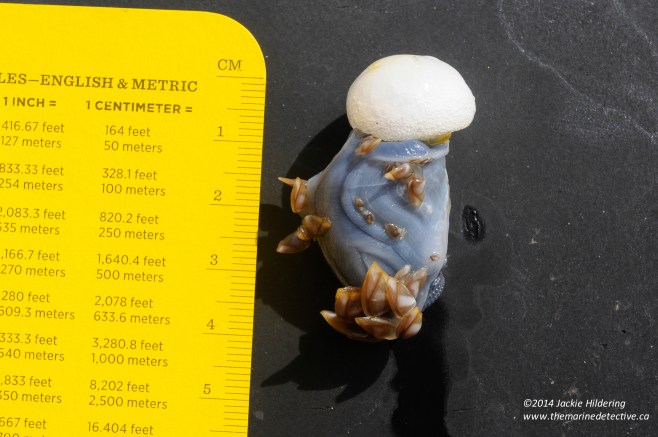
This species of barnacle is the only one in the world known to secrete its own float. This allows the barnacle to hang downward feeding on plankton, drifting along in the high seas. The float is gas filled and looks like polystyrene.
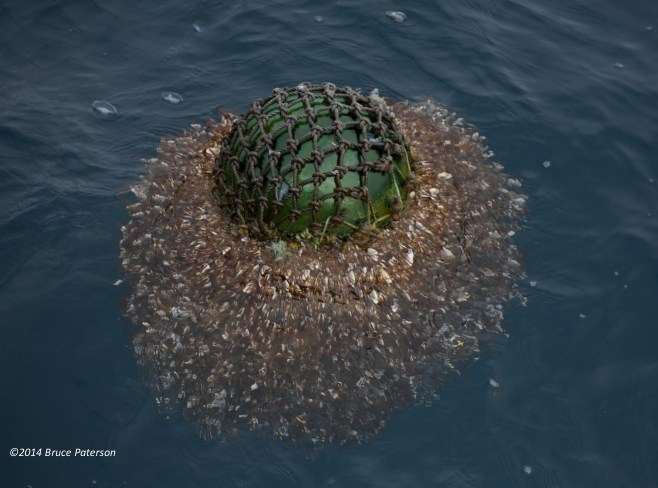
The little barnacles you see on the outside of the Buoy Barnacle in the above image are another species. They are juvenile Pelagic Gooseneck Barnacles (Lepas anatifera). This species attaches to anything that drifts. See below for a good example of that.
Imagine, imagine learning about this species out on the open sea while helping to take ID photos of threatened Fin Whales, Velella velella EVERYWHERE their sails glistening in the sun as they are propelled over the swell, and among them, these upside down barnacles travelling even faster by wind and current.
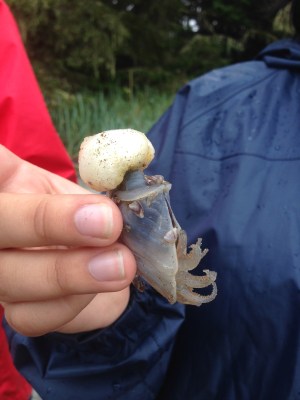
Imagine my further delight when, while still at sea, just after I had observed this species for the first time, I got an email from children back home in Telegraph Cove (via the wonderful interpreters at the Whale Interpretive Centre) wanting to know what the mystery organism was that they had found. It was the Buoy Barnacle. They had even found two attached to one buoy.
Here is the video of their find.
From Blue Whales to Buoyed Barnacles, the biodiversity, mystery and fragility of this Coast is simply staggering.