Join me in the cold, dark, life-sustaining NE Pacific Ocean to discover the great beauty, mystery and fragility hidden there.

Whale Watching – Not “Up-Close-and-Personal!” How to make a good choice?

Click here to jump to the summary of points to consider in making the best choice for a whale-watching company.


This blog is catalyzed by advertisements for whale watching that I perceive to be extremely exploitive of whales, suggesting high adrenaline “up-close-and-personal” encounters.

The problem with such marketing, where boats are in very close proximity with whales, is threefold:

1. It feeds consumer demand for a whale watching experience that is not good for the whales. Close boats (including kayaks) have greater potential for stressing whales; disturbing whales’ natural behaviour; and increasing habituation to vessels whereby risks such as vessel strike are increased. These potential effects have been proven through scientific peer-reviewed research (see references below).

Pacific White-Sided Dolphins with new born calves. ©Jackie Hildering

Pacific White-Sided Dolphins with newborn calves. ©Jackie Hildering; telephoto and cropped image.

2. It creates false expectations and miseducates people. There are Marine Mammal Regulations and guidelines for respectful, legal and safe marine mammal viewing which include distance limits (200m for Orca and 100m for other cetaceans). However, if people see advertising promoting close interactions between boats and whales, they may believe this is what is to be expected on their tour. Thereby, companies who choose to use this marketing approach are creating increased pressure on whale watching boat operators to fulfill these expectations. And note, it is NOT okay to position your boat in order to “have the whales come to us.”

There will be those who succumb to such pressure, and who will conduct their vessel in a way that violates the regulations and thus creates greater disturbance for the animals. I solidly believe that the average consumer wishes to marvel at whales in the wild in a way that is as benign and natural as possible. Were they to know the potential impacts of close encounters or that the company they had chosen was “blurring” what is right, it would very much taint the experience for them.

Pacific Habour Seal mother nursing her newborn. The pup is so young you can see his/her umbilical cord. ©Jackie Hildering

Pacific Harbour Seal mother nursing her newborn. The pup is so young you can see his/her umbilical cord. ©Jackie Hildering; telephoto and cropped image.

3. It creates a “marketplace” where other companies with more solid ethics face the dilemma of how to counteract such advertising and aid consumers in making a better choice. Sometimes, unexpectedly whales do surface within the viewing distance limits but to promote this feeds the “get-up-close-and-personal” monster.
In order to solve this dilemma and counteract the above two points as well, there are whale watching associations where operators have agreed not to show their boats in close proximity to whales.
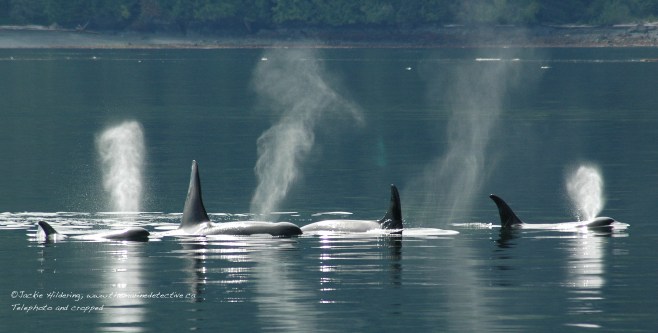
Resting line of the A12 matriline of "Northern Resident" orca (inshore fish-eating population). ©Jackie Hildering

Resting line of the A12 matriline of “Northern Resident” orca (inshore fish-eating population). ©Jackie Hildering; telephoto and cropped image.


Granted, we’ve come a long, long way.  Public attitude towards whales has changed drastically. We’re not shooting whales anymore and we’re not putting them in captivity. Whaling only ended in British Columbia in 1967 and the live capture of orca only ended in 1973/74 (thank you Dr. Michael Bigg).

Now, thankfully, our values and knowledge have largely evolved to where we respect whales as sentient, social, intelligent animals with culture.


So how to make a good choice?

How to choose a whale watching experience that has the least impact on the environment with the greatest potential for learning and conservation?   How to navigate the sea of choice when confronted with the vast array of variables such as location, vessel type, crew, and advertising strategies?

Humpback Whales resting at the surface. ©Jackie Hildering

Humpback Whales resting at the surface. ©Jackie Hildering


Know that the great truth is that the best possible experience is that your viewing of wildlife happens as if you were not there.

The ideal would be to watch cetaceans from land with interpretation from a knowledgeable guide but there are very few places where whales pass by with predictability.

Going out in a private motorized vessel is also an option but most often means a larger noise and fossil fuel footprint per person and not having the many benefits of knowledgeable crew who can educate and operate the vessel in a way that is more benign. Data collected by the Cetus Research and Conservation Society supports that it is by far more often the case that recreational boaters violate the guidelines / regulations than do commercial whale watch operators.
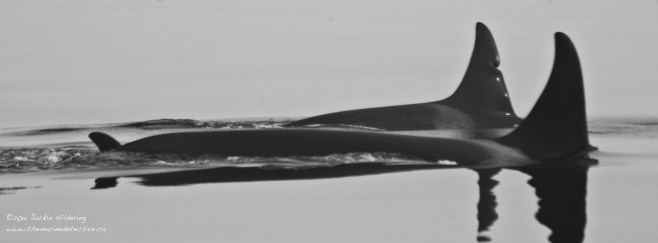
See the little fin at the far left? That is "Cutter" (A86) as a calf in 2006 nursing mother "Clio" (A50). Sibling "Bend" (A72) is the whale with the injured dorsal fin. Bend now has a calf of her own. A30 matriline of "Northern Resident" orca population (inshore fish- eaters) ©Jackie Hildering.

See the little fin at the far left? That is “Cutter” (A86) as a calf in 2006 nursing mother “Blinkhorn” (A54). Sibling “Bend” (A72) is the whale with the injured dorsal fin. A30 matriline of “Northern Residents (inshore fish- eaters) ©Jackie Hildering; telephoto and cropped image.


Of course, it would help consumers and marine wildlife greatly if there were a effective system in place that guarded high standards of operation and that sufficient resources were made available for effective monitoring, education and enforcement of boaters around marine wildlife. Sadly, these resources are not available whereby consumer awareness and operator ethics become all the more important, as does reporting violations to the DFO Incident Reporting Line at 1-800-465-4336.

Steller Sea Lions socializing at the haul-out. ©Jackie Hildering.

Steller Sea Lions socializing at the haul-out. ©Jackie Hildering.


So, here we go . . .

Summary of points for consideration in making a whale watching choice that is better for the whales and environmental sustainability in general.

1. Location:

How close is the vessel departure point from the area where whales are likely to be i.e. how long and how fast will you need to travel? This affects how large your fossil fuel and noise footprint will be.

2. Crew:

How much successful experience and training and what qualifications does the crew have in:

  • Operating vessels around whales?
  • Providing science-based information that would make whale-watching count for the sake of inspiring greater conservation efforts rather than just be about opportunities for photography?

3. Vessel Related:

  • Does the vessel type allow for effective delivery of educational information?
  • How large is the vessel?  This is highly relevant in determining the noise and fossil fuel footprint per person as is the fuel efficiency of the vessel and the engine type.
  • Usually more difficult to determine unless specified on the company’s website: Is the engine of a design where noise is reduced? Do operators shut off the engine whenever possible?

4. Ethics and Approach:

Does the company:

  • Have a holistic and comprehensive approach to environmental sustainability e.g. noise reduction measures, avoiding disposable goods, use of organic, energy-efficient, and biodegradable products, etc?
  • Contribute to marine conservation and research efforts e.g. sightings data being relayed to research initiatives, financial or in-kind support, etc.
  • Use language and images, in advertising and social media, that are respectful of the marine wildlife and the guidelines for viewing them? This includes NOT including imagery that feeds the “up-close-and-personal” monster. 
Mammal-eating orca T39 just having successfully killed a Pacific White-Sided Dolphin. Splash on the left is her calf just having entered the water before her. Splashes in the background, right in front of Telegraph Cove, are the dolphins that got away. ©Jackie Hildering

Mammal-eating orca T39 just having successfully killed a Pacific White-Sided Dolphin. The splash on the left is her calf just having entered the water, learning to hunt alongside her. The splashes in the background, right in front of Telegraph Cove, are the dolphins that got away. ©Jackie Hildering; telephoto and cropped image.


My life radically changed after going on just one whale-watching trip many years ago. I certainly know how profoundly transformative and powerful an experience it can be.

When done right, ensuring guidelines / regulations are adhered to and solid conservation messaging is shared, whale-watching guests are able to have the best possible experience. An experience that is benign and respectful can lead to greater caring; a sense of connection to the animals and the life-sustaining ocean for which they are ambassadors; and the inspiration to undertake action that is better for the environment (and therefore, ourselves).

Consumers have very significant power to shape how whale watching is conducted. By supporting companies striving to operate in a way that is best for the whales and the environment at large, you are not feeding the “get-up-close-and-personal” monster. The resulting reward is to know that your experience will be as wild as can be – best for you, best for the whales and best in not rewarding those who compromise their ethics and the privilege of being a conduit for people to experience the raw beauty of seeing whales in the wild, where they belong.

So please, consider the above points and take particular notice of whale watching companies’ advertisements.  Choosing a company whose marketing reflects respectful whale watching is the first step to ensuring your experience will be as good as you want it to be.
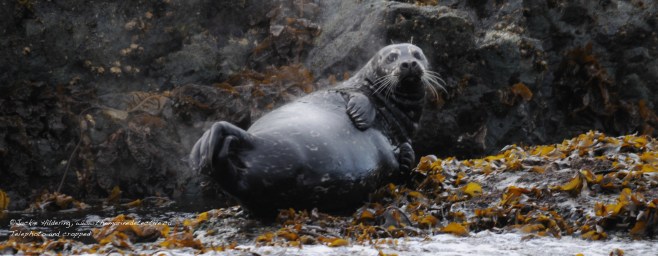
Pacific Harbour Seal about to give birth. ©Jackie Hildering

Pacific Harbour Seal about to give birth. ©Jackie Hildering; telephoto and cropped image.


If you witness an incident of concern regarding marine life, please call the DFO Incident Reporting Line at 1-800-465-4336.
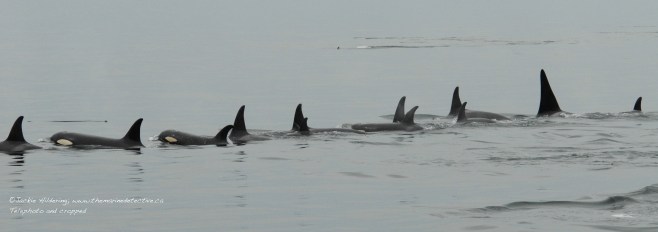

Resting line of "Northern Resident" orca (inshore fish-eaters). ©Jackie Hildering

Resting line of “Northern Resident” orca (inshore fish-eaters). ©Jackie Hildering; telephoto and cropped image.

Pacific Habour Seal resting at the surface. ©Jackie Hildering

Pacific Harbour Seal resting at the surface. ©Jackie Hildering; telephoto and cropped image.

References:

“Posturing” Humpback Whales?

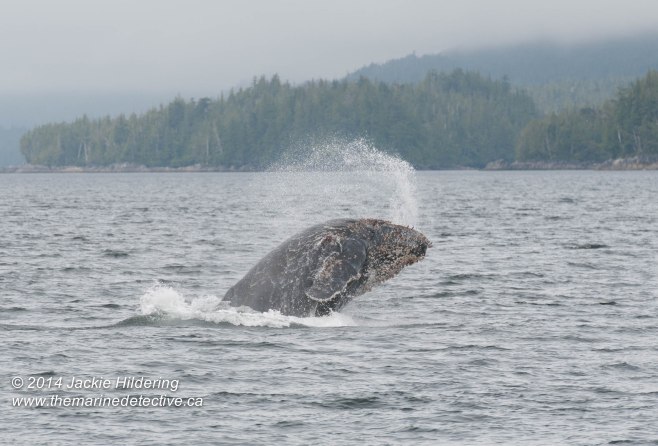
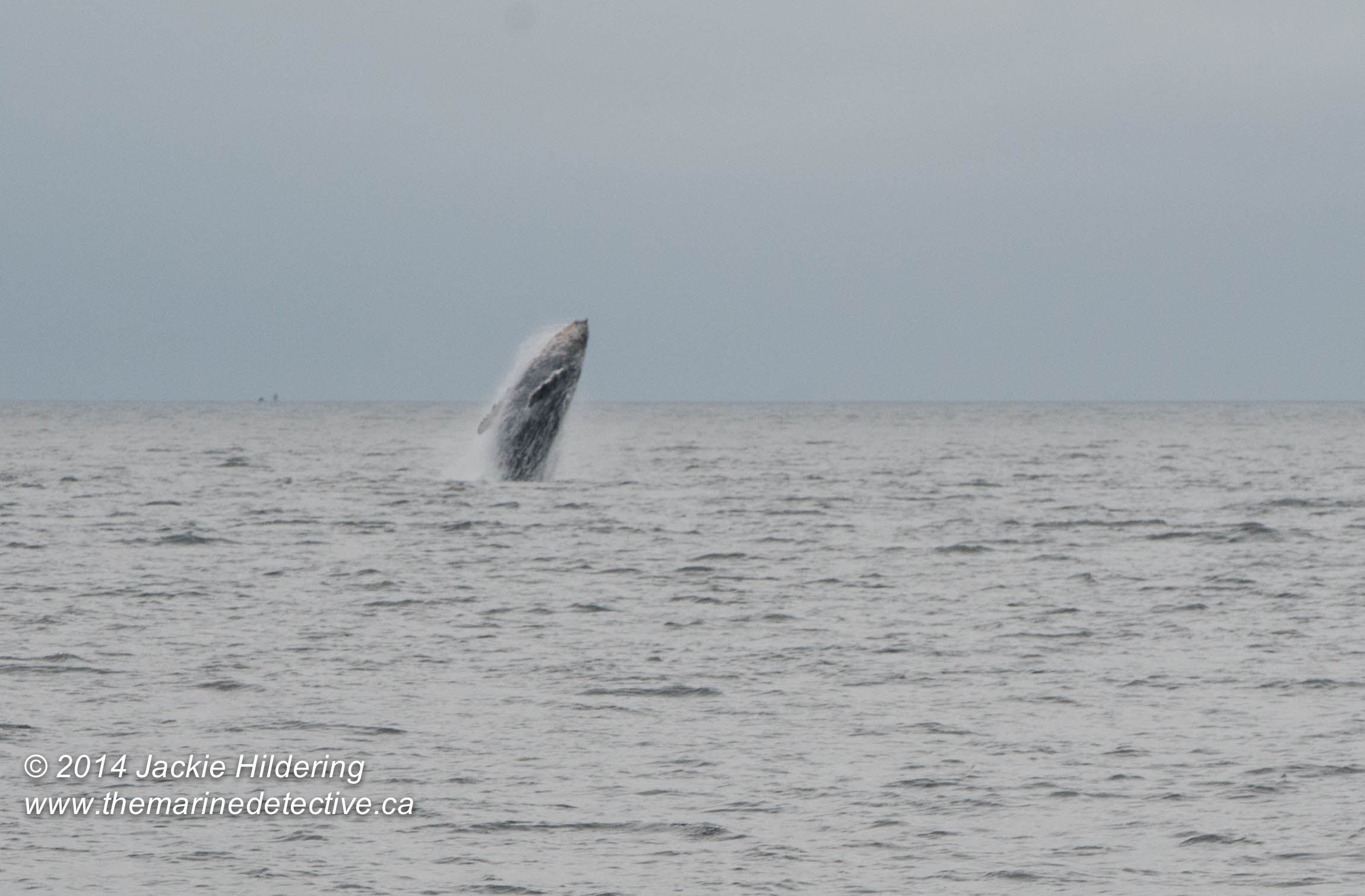
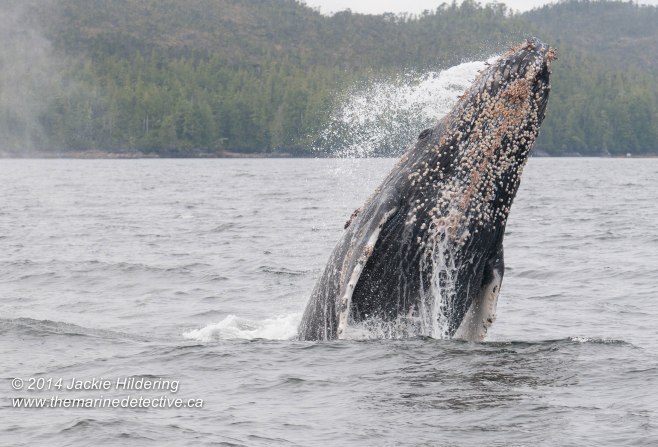
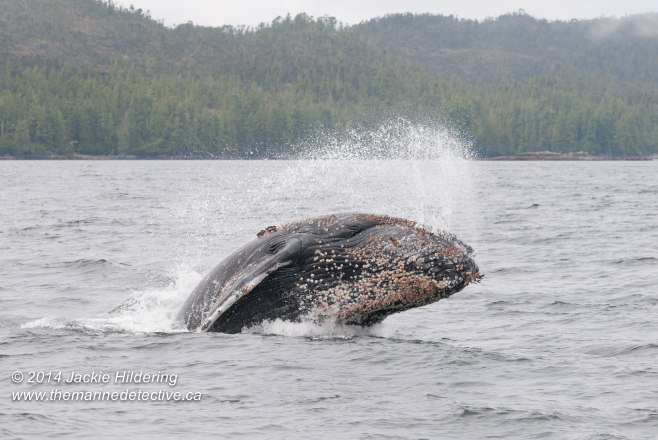
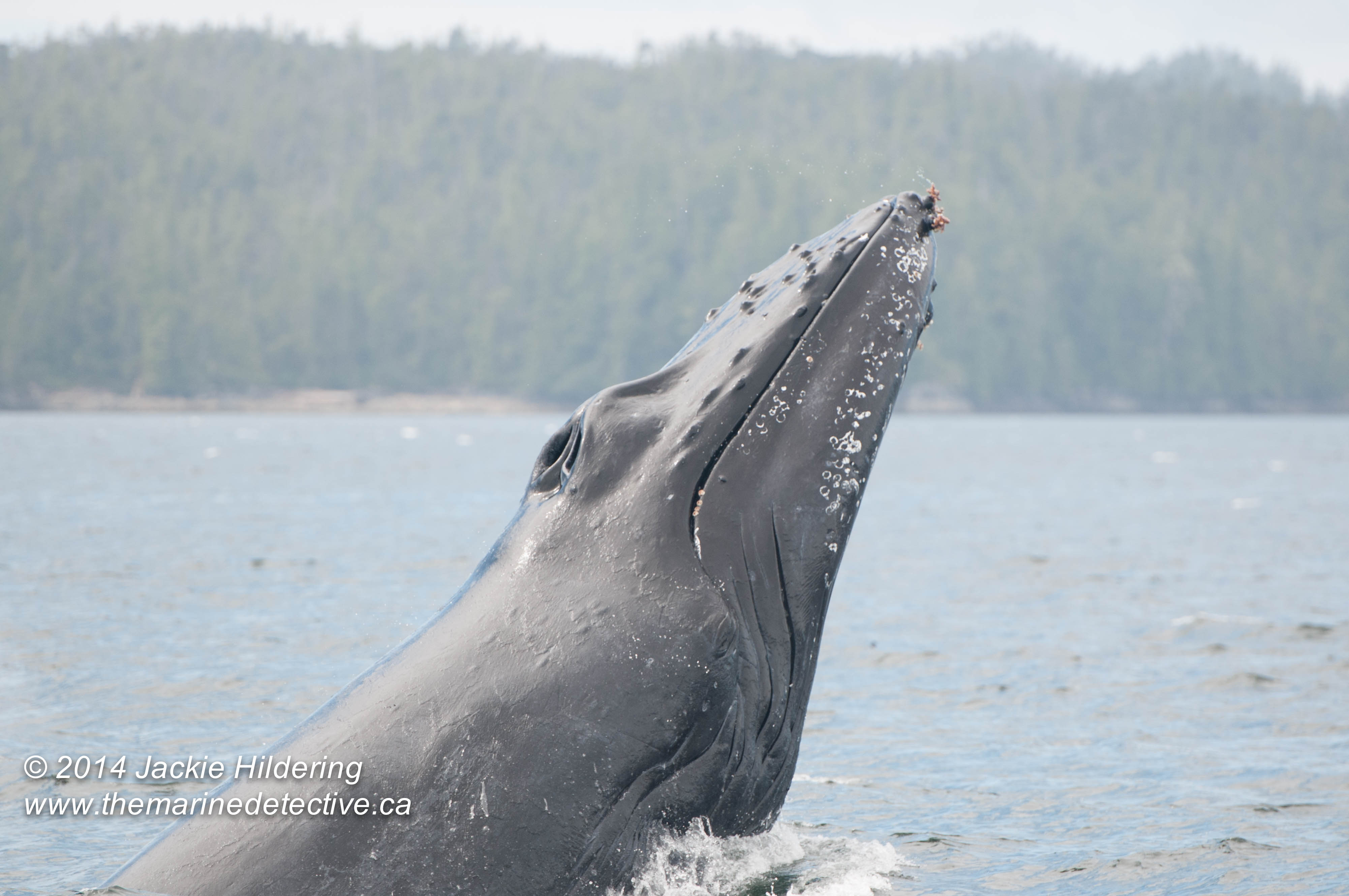
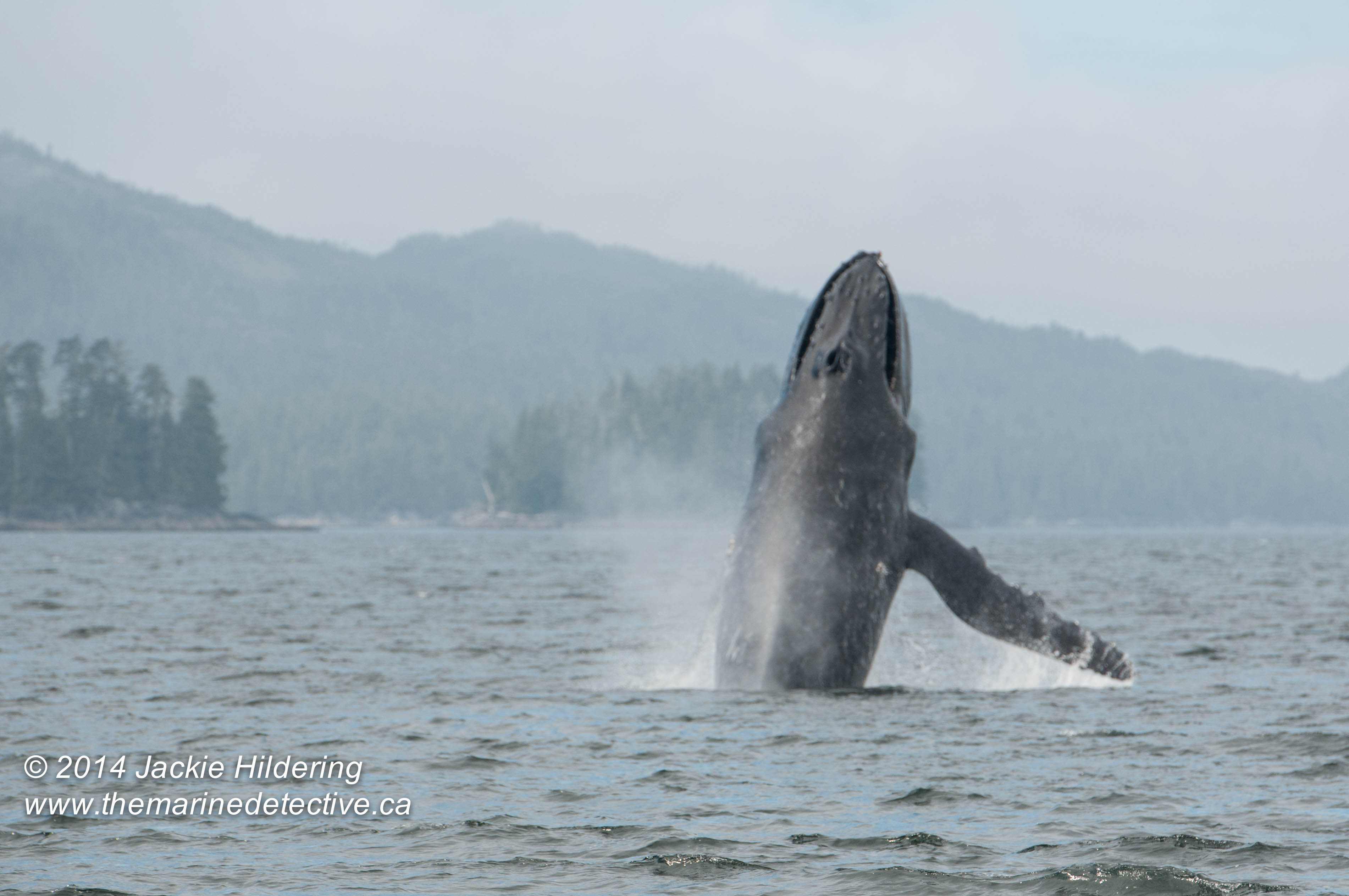
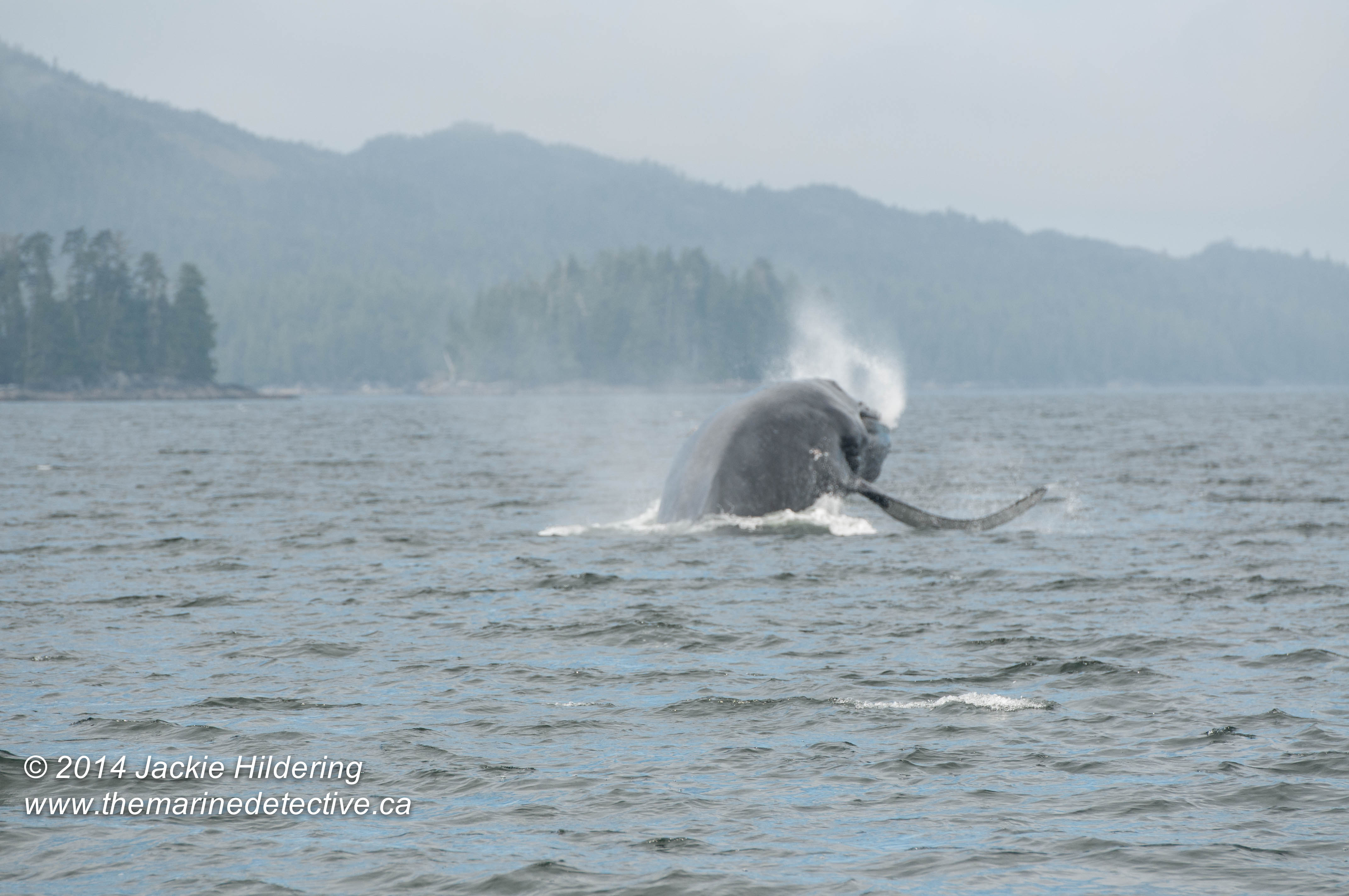
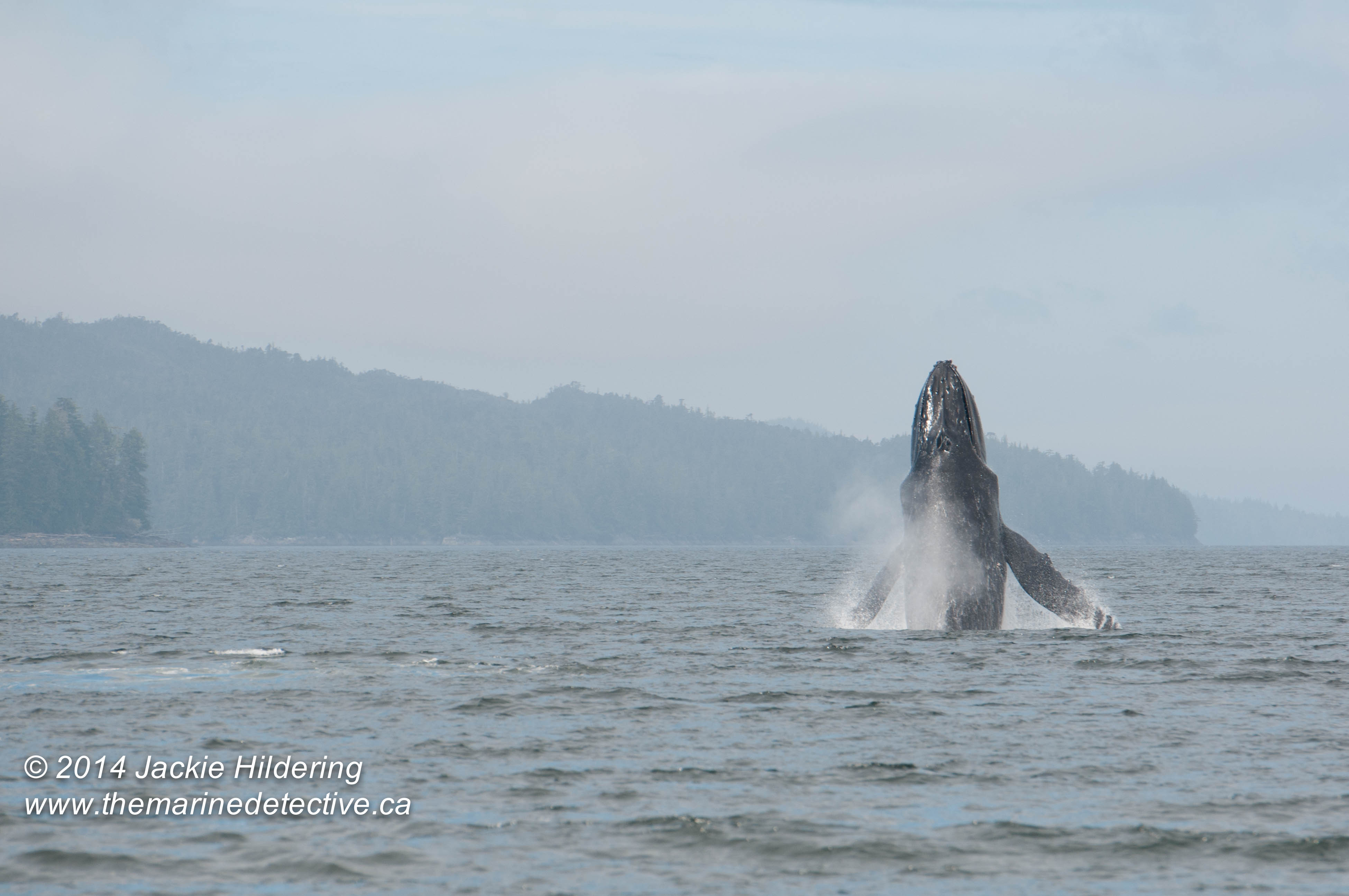
Some experiences are best shared in photos. So here you have 20 images documenting the marvel of how 2 humpback whales interacted with one another for more than an hour. Huge energy was expended by both whales in head lobbing, lobtailing, pectoral fin slapping, and breaching. Back and forth it went, the sounds resounding above and under the water in the Great Bear Sea around Caamano Sound (proposed tanker route).

I witnessed this while with Pacific Wild as an educator for the SEAS program (Supporting Emerging Aboriginal Stewards).

What was this humpback whale exchange about?  In this case, I really don’t know.

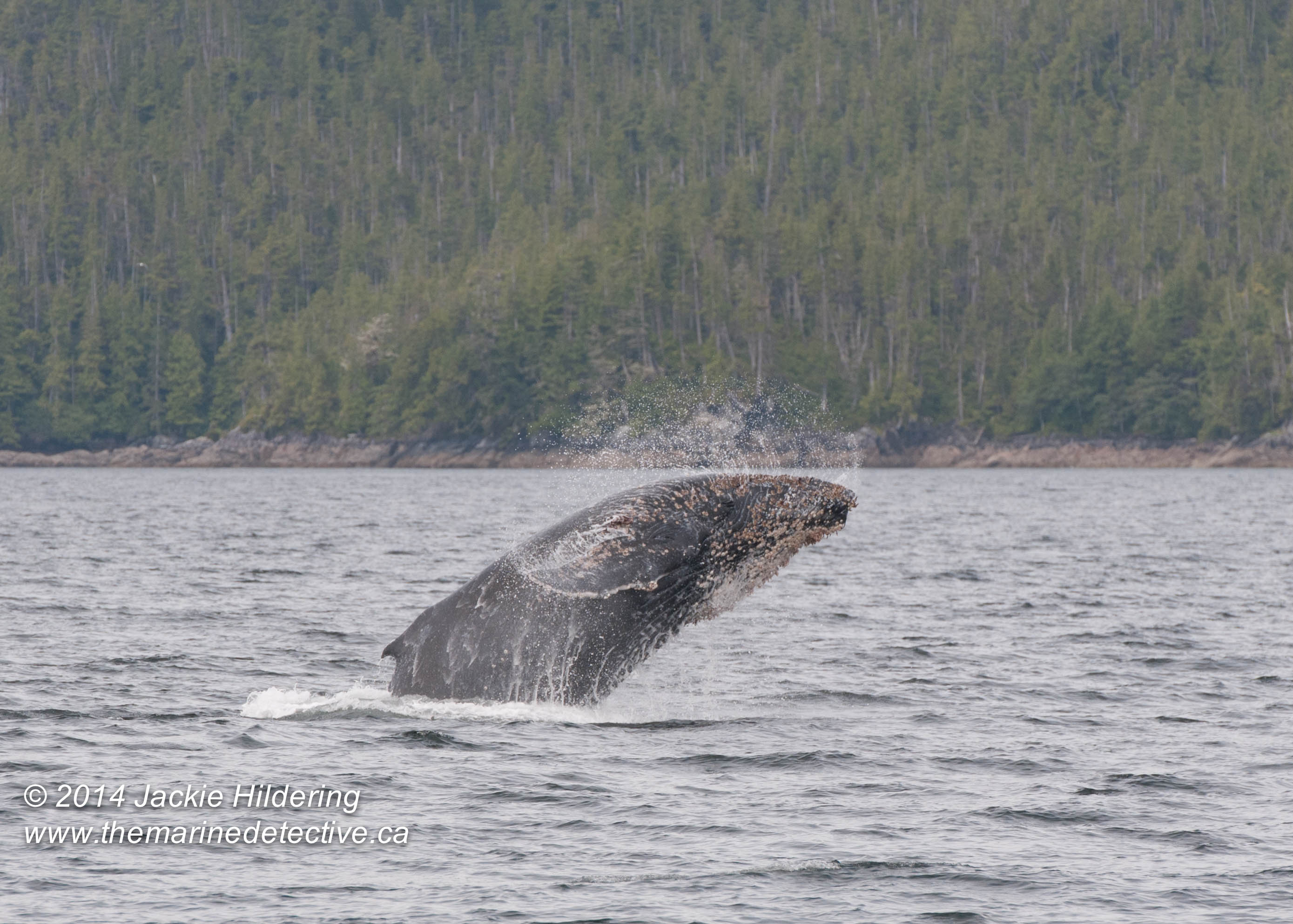
One of the two humpbacks that was incredibly surface active ©Jackie Hildering. All photos Telephoto and cropped.

One of the two humpbacks that was incredibly surface active ©Jackie Hildering. All photos telephoto and cropped.

I have had the privilege of learning from these giants for more than a decade now and have seen such exchanges in all sorts of contexts.

I reference the behaviour as “posturing” since the whales appear to making a display to one another. Outside of play behaviour and learning in young animals, my interpretation is that these incredibly powerful surface active displays between whales may serve the purpose of:

  • Delivering a clear “I’m big don’t mess with me” message to a perceived threat e.g. the presence of mammal-eating killer whales (“Bigg’s”/”transients) or the vocals of fish-eating killer whales (“residents”) to which the humpbacks are not habituated;
  • Communicating the presence of a perceived threat to other humpback whales since the slaps of humpback fins and bodies resound underwater;
  • Striving to display dominance / greater vigour to other humpbacks which may be particularly relevant for mating;
  • Possibly establishing spacing between humpbacks; and/or
  • Some sort of social function that leads to them ultimately joining up and swimming away together as was the case in exchange for which I provide the photos below.

Here we go. Photos provided in chronological order.

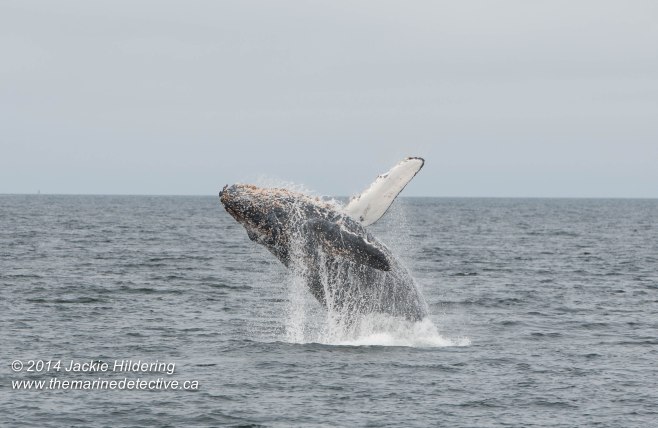
Almost simultaneously, when both whales were within 200 m of one another, Humpback 1 (lots of barnacles and smaller but too big to be the 2nd whale’s calf) started breaching and Humpback 2 (larger) started lobtailing. [Note, there were also two other humpbacks in the area but at a greater distance away and they were not surface active.]

©Jackie Hildering. Telephoto and cropped.

Humpback 1 starts breaching. ©Jackie Hildering. All photos telephoto and cropped.

©Jackie Hildering. Telephoto and cropped.

Humpback 2 starts tail-lobbing. ©Jackie Hildering. All photos telephoto and cropped.

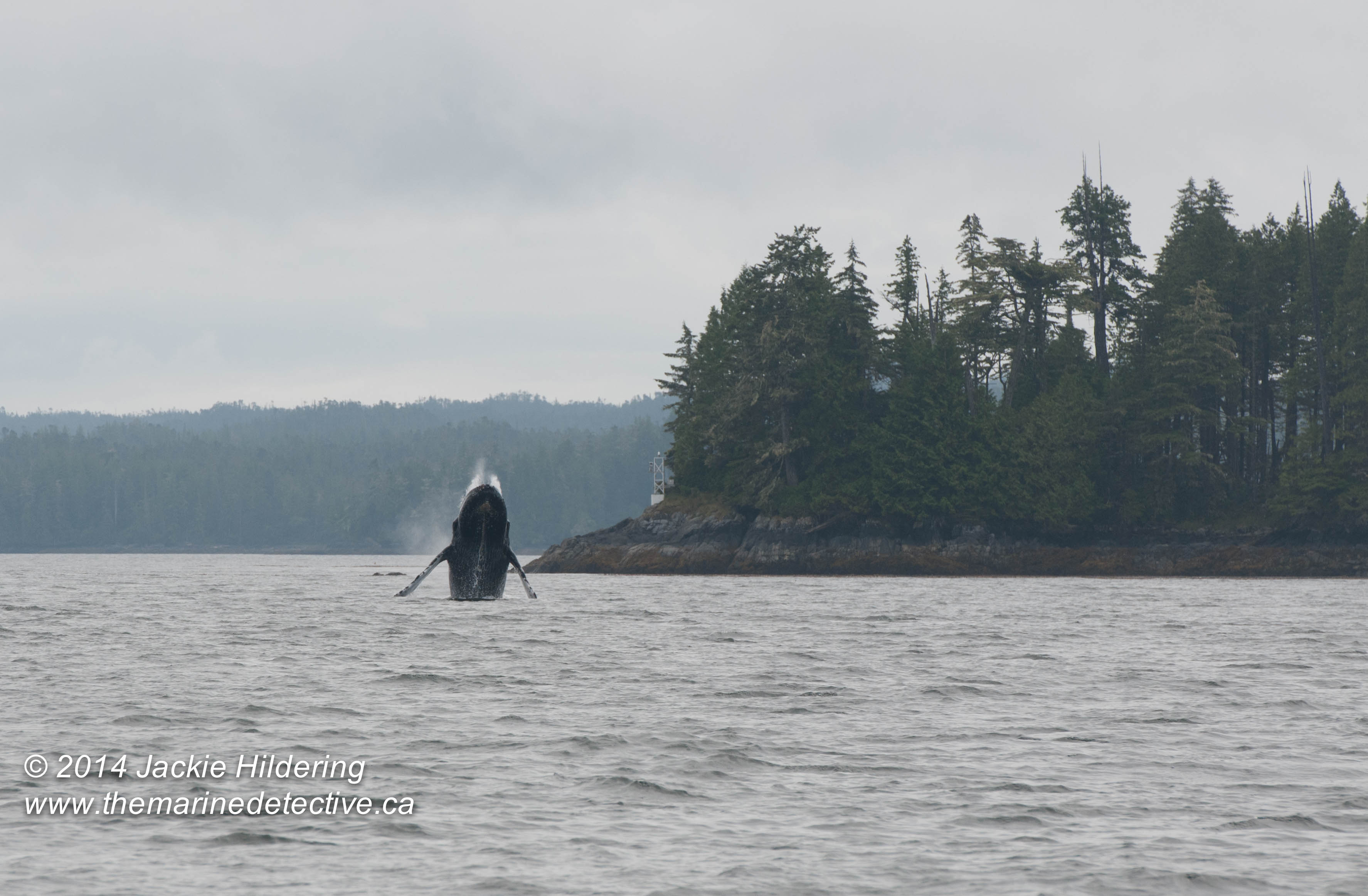
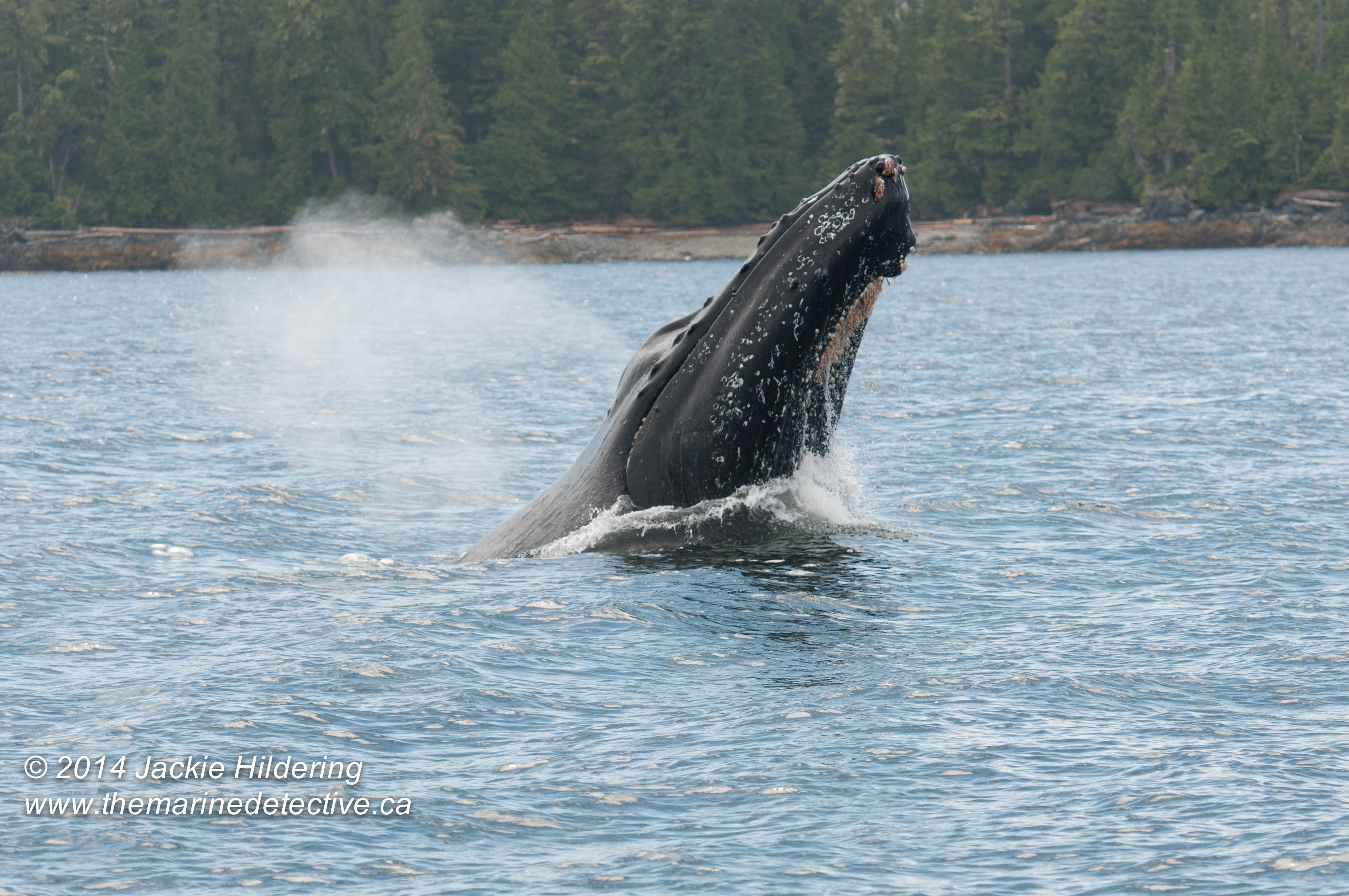
Humpback #1 then began repeatedly head-lobbing, advancing away from Humpback 2.

 All photos telephoto and cropped ©2014 Jackie Hildering.

Humpback 1 head-lobbing. All photos telephoto and cropped ©2014 Jackie Hildering.

©Jackie Hildering. Telephoto and cropped.

Humpback 1 continues to be very surface active.  ©Jackie Hildering. Telephoto and cropped.

©Jackie Hildering. Telephoto and cropped.

Humpback 1 continues to be very surface active. ©Jackie Hildering. Telephoto and cropped.

©Jackie Hildering. Telephoto and cropped.

Humpback 1 still at it. ©Jackie Hildering. Telephoto and cropped.

©Jackie Hildering. Telephoto and cropped.

Humpback 1 breaching. ©Jackie Hildering. Telephoto and cropped.

©Jackie Hildering. Telephoto and cropped.

Some more head lobbing from Humpback 1. ©Jackie Hildering. Telephoto and cropped.
©Jackie Hildering. Telephoto and cropped.

Some more head lobbing from Humpback 1. ©Jackie Hildering. Telephoto and cropped.

HW_2014-08-05-_JH_Rambothem Island-1536

Leandrea, intern at Pacific Wild, listening to how the slaps of fins and body could be heard underwater.

©Jackie Hildering. Telephoto and cropped.

Whale 1 not done yet. Breaching here. ©Jackie Hildering. Telephoto and cropped.

Half an hour later, Whale 2 advanced from the position where the exchange with Whale 1 began. S/he head-lobbed and breached down the same track as Whale 1.

©Jackie Hildering. Telephoto and cropped.

Humpback 2 head-lobbing, advancing down from where the exchange with Whale 1 began. ©Jackie Hildering. Telephoto and cropped.

©Jackie Hildering. Telephoto and cropped.

Humpback 2 – more head lobbing. ©Jackie Hildering. Telephoto and cropped.

©Jackie Hildering. Telephoto and cropped.

Humpback  2 – head lobbing and moving toward Whale 1. ©Jackie Hildering. Telephoto and cropped.

©Jackie Hildering. Telephoto and cropped.

Humpback  2. See his/her eye? ©Jackie Hildering. Telephoto and cropped.

©Jackie Hildering. Telephoto and cropped.

Humpback  2. Imagine the energy expended to lob his/her body like this. ©Jackie Hildering. Telephoto and cropped.

©Jackie Hildering. Telephoto and cropped.

Humpback 2 continues in the direction of Whale 1. ©Jackie Hildering. Telephoto and cropped.

©Jackie Hildering. Telephoto and cropped.

Humpback  2. ©Jackie Hildering. Telephoto and cropped.

©Jackie Hildering. Telephoto and cropped.

Shortly after this, s/he joined with Humpback 1. ©Jackie Hildering. Telephoto and cropped.

Humpback 2 only stopped this highly surface active behaviour after half an hour when close to Humpback 1. And then . . . . then they joined up very close together and swam back in the direction that exchange had begun. What was it all about?!

With these whales being on the Central Coast, I am relaying fluke and dorsal photos to the wonderful Janie Wray and Herman Meuter of Cetacea Lab to find out if they might know the identities of the whales involved in this exchange. They are not known to us at the Marine Education and Research Society.

But will we ever know for sure what such a display was about? In having the extraordinary privilege of learning from the marine environment, one of my most valued lessons is to recognize how little we know and thereby to have the correct humility and precaution in decisions about marine resources.

Humpback whales are giants, they are easy to identify as individuals, they have been studied for some 40 years and still there is so very much we don’t know – including the benefit of expending so much energy in such an exchange.

_________________________________________

For related information see my previous blog “Might As Well Jump

For an ethogram of humpback whale behaviours from the Whale and Dolphin Conservation Society, see here.

Reaching New Heights? A Sea Cucumber Mystery.

This is an open case; one that has me bemused and amused.

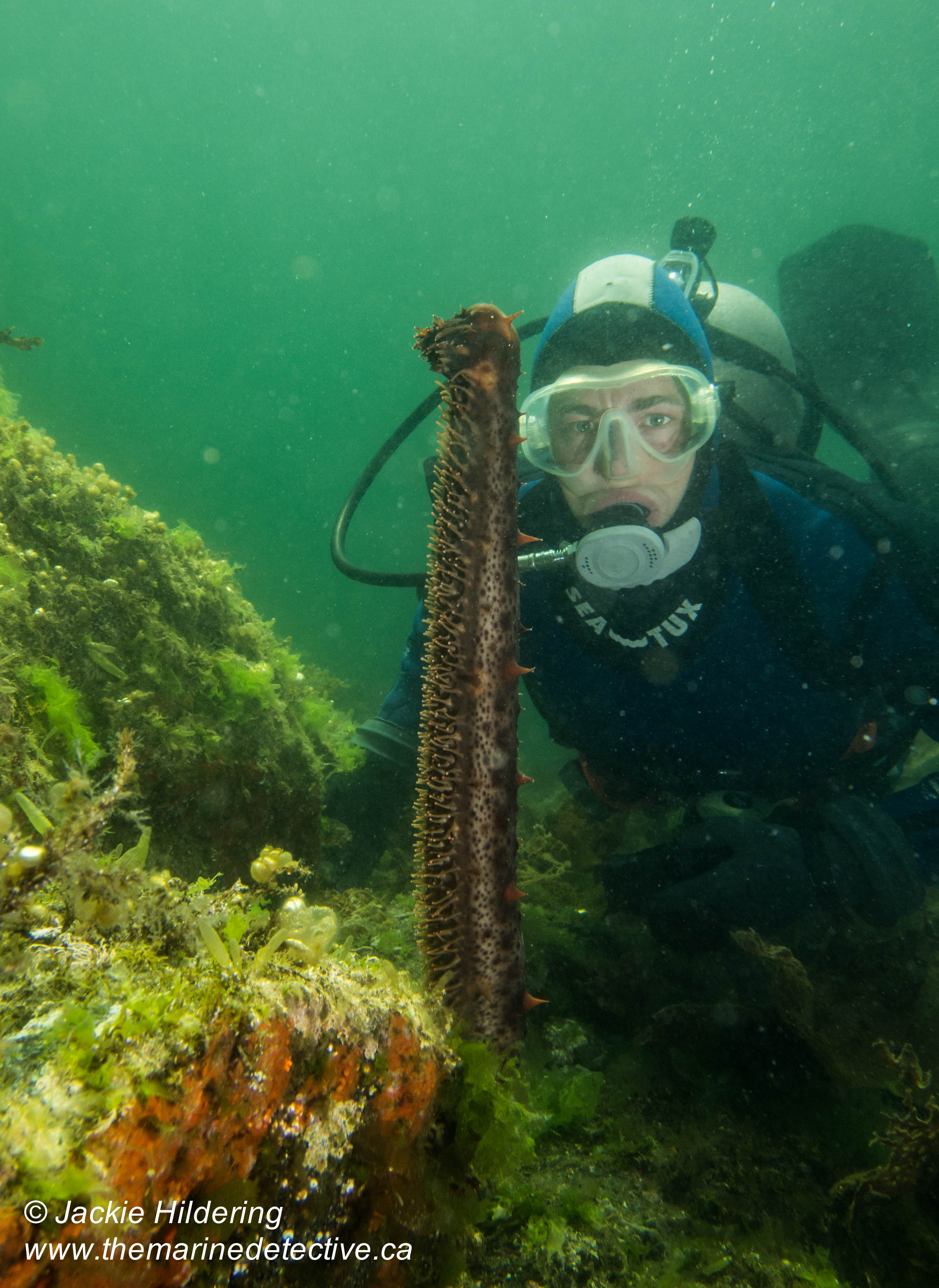
While diving near the Great Bear Rainforest in Jackson Narrows, my buddy Tavish Campbell came upon a Giant Sea Cucumber in this very unusual position (Apostichopus californicus, aka California Sea Cucumber).

It was stretched straight up and down, head end up.

Giant Red Sea Cucumber reaching for new heights? Dive buddy - Tavish Campbell. ©Jackie Hildering

Giant Sea Cucumber reaching for new heights? Dive buddy – Tavish Campbell. ©Jackie Hildering

As you likely know, this species is most often horizontal; “face” down cruising up to around 4 meters a day along the ocean bottom, mopping up nutritious particles with mucus-covered bushy white tentacles. When there is good stuff stuck on the tentacles, these retract into the mouth (with sandy casts coming out the other end).

A Giant Red Sea Cucumber in its usual position, horizontal so that it can feed by mopping up particles. This one has a nudibranch crossing over it (Flabellina trephine). ©Jackie Hildering

A Giant Sea Cucumber in its usual position, horizontal so that it can feed by mopping up particles. This one has a nudibranch crossing over it (Flabellina trophina). ©Jackie Hildering

So why would this individual assume such a remarkably vertical position? Could it be feeding related? It was extending and retracting its mouth tentacles repeatedly but clearly this was not effective in gathering any snacks.

Giant Red Sea Cucumber with buddy Tavish Campbell. ©Jackie Hildering

Giant Sea Cucumber with buddy Tavish Campbell. Mouth tentacles extended. Note all the tube feed revealing its relatedness to sea stars and sea urchins (phylum Echinodermata). ©Jackie Hildering

My best hypothesis is that this was mating related. Giant Sea Cucumbers have separate sexes and rise up in a python-like position to release their sex cells (see figure below from A Snail’s Odyssey). This pose reduces the number of sex cells that settle to the ocean bottom, unfertilized.

cameronfankboner1986fig10

Giant Sea Cucumbers spawning in python-like pose. Source: A Snail’s Odyssey.

Additional strategies to enhance the chances of fertilization are to twist back and forth and/or intertwine with a partner while releasing gametes. (This species will also catapult back and forth when trying to escape predation by Sunflower Stars).

Striving to ensure your DNA gets passed on does not happen randomly however. As with all broadcast spawners, there is a cue so that the release of sex cells is coordinated. (See my other blog “Sea of Love – Broadcast Spawning“). Giant Sea Cucumbers are known to mate in the shallows from April to August repeatedly “dribble spawning”.

Our high-reaching Giant Sea Cucumber friend was indeed in the shallows and it was significantly warmer there. Was the temperature a cue that it was time to mate? Was s/he trying to sense the presence of a partner or others of his/her kind already broadcasting?

Was s/he reaching to new heights to allow even better distribution of sex cells than the python pose?

Was this individual even old enough to mate as they do not sexually mature till age 4? It’s size certainly suggested it was older since maximum size for the species is reported to be 50 cm.

Had we had more air we could have waited and likely concluded what was up with this behaviour.

As is so often the case however I surfaced with even more questions and a greater sense of wonder about the life below. And yes, this time it may be that I was laughing so hard I was sputtering sea water as well.

Unsolved mystery! ©Jackie Hildering


More on the species’ spawning:
From the University of Oregon: Adult A. californicus reach sexual maturity after four years and will typically migrate to shallow waters to spawn from late April to August (Lambert 1997) . . . During spawning, A. californicus will lift the anterior one-third to one-half of the body in a cobra-like manner and release strings of white sperm or light orange eggs from the gonophore just behind the dorsal tentacles (Lambert 1997). The eggs are small and negatively buoyant. Fertilization occurs in open water, and large females typically have fecundities up to 8.92 x 10⁶ (Strathmann 1987).
Larva: Apostichopus californicus is the only local species with pelagic planktotrophic development in which a feeding larva develops in the plankton (Strathmann 1987). This development includes a feeding auricularia larva that swims from 35-52 days (Strathmann 1987).

From A Snail’s Odyssey: “The gametes stream from a single gonopore within the ring of tentacles  and fertilisation takes place in the open water. The eggs are relatively large and yolky in sea cucumbers, and develop to a feeding larval stage known as an auricularia. After a 3 to 5 week period floating in the plankton, the larvae metamorphose and settle to the sea bottom.”


DSC01704

Two Giant Sea Cucumbers in spawning position, April 2021 ©Jackie Hildering. The orange animals are Orange Sea Cucumbers and they were spawning too and what a spectacular spectacle that is. 


Sources / more information:

DSC00780

DSC00767DSC00774DSC00719DSC00705

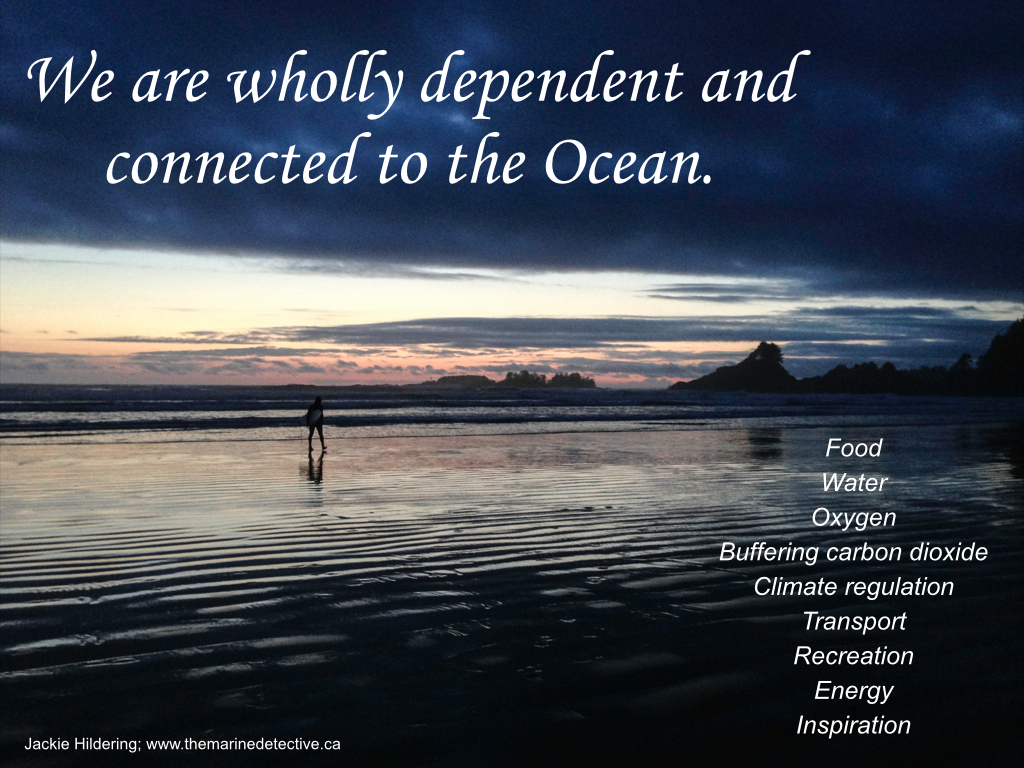
We are Wholly Dependent and Connected to the Ocean

Reflections for Oceans Day 2014.

We are wholly dependent and connected to the Ocean.

Life on land cannot survive without the Ocean.

It is life in the Ocean that will testify to magnitude of environmental problems first.

Change is needed; and we humans have an astounding capacity to make a positive difference.

Oceans Day 2014

Likely as a reader of “The Marine Detective”, you already share the following perspective:

The majority of messaging we get is controlled by those with power in the current paradigm not wanting us to change our value systems, and consumer and voter behaviour.

Therefore, they perpetuate:

  • Fear;
  • Ignorance, uncertainty and inaction by limiting access to independent science;
  • The notion that it is jobs OR the environment;
  • The fallacy that being good for the environment is about loss rather than joy; and
  • The mythology that consuming more will certainly make us happier and more “successful”.

What a different world it would be if:

  • More of us were to consume less and care more;
  • Value time and health over possessions;
  • Think in terms of an economy of chemicals and energy use instead of just money;
  • Know that there is no divide between land and sea and that Ocean sustains human life;
  • Be empowered;
  • And . . . . be happier.

Spread the word?

Happy Oceans Day.

The Case of Stones in Sea Lions’ Stomachs

Did you know that stones are commonly found in the stomachs of Steller sea lions?

These stomach stones or “gastroliths” are as big as 12 cm!

Share your theories about why you think this might be after viewing the video below. It provides you with information to help with this Marine Detective case.

Happy sleuthing to you!


Note that yes, gastroliths have been found in the stomachs of other seal and sea lions species including the California Sea Lion, Zalophus californianus (Source: Drehmer and Oliverira).

Click here for SeaDoc footage of Steller Sea Lions playing with California Sea Cucumbers.


Research into gastroliths in Steller Sea Lions

C. R. Shuert and J. E. Mellish “Size, mass, and occurrence of gastroliths in juvenile Steller sea lions (Eumetopias jubatus),” Journal of Mammalogy 97(2), 639-643, (11 January 2016).

Includes:

Abstract: “In summary, our opportunistic assessment of gastroliths in temporarily captive Steller sea lions showed that a large proportion of juvenile animals (e.g., one-third or more) may haveone or more stones at any given time. The regurgitation of gastroliths correlated best with leaner, but not poorer body conditions, and during the summer months, possibly indicating a weak association as a digestion aid. We found little evidence to suggest that they assist in buoyancy and satiation; it is even more unclear as to what drives an individual to regurgitate them. With a lack of strong conclusions relating to a particular use, we can only conclude that they appear to serve a function in sea lions and are not ingested accidentally. A combined assessment of regurgitated and in vivo gastrolith measurements may shed more light on the subject and allow for direct evaluation and conclusions as to their functionality in sea lions.”

“Gastroliths, defined as stones or concretions in the digestive tract, occur in many extant vertebrate taxa and throughout the fossil record of marine tetrapods (Wings 2007). Most information is anecdotal, with limited data on occurrence and size(e.g., Labansen et al. 2007). Adjusting buoyancy, alleviating hunger, and aiding in digestion are the most popular theories for the presence of gastroliths in marine mammals (Taylor 1993). Gastroliths have been described in all 3 families of  pinnipeds including otariids (e.g., South American sea lions Otaria byroniaDrehmer and Oliveira 2003), phocids (e.g.,  harp seals Phoca groenlandicaNordøy 1995), and odobenids (Gjertz and Wigg 1992)” 

A note about the Marine Mammal Regulations in Canada

Amended Regulations (since July 2018) include that it is illegal to target marine mammals for the purposes of swimming with them (unless permitted by a research license). See the Marine Mammal Regulations at www.SeeABlowGoSlow.org.


Further sources

Drehmer, C J, and L R. Oliveira. “Occurrence of Gastroliths in South American Sea Lions (Otaria byronia) from Southern Brazil.” Latin American Journal of Aquatic Mammals. 2.2 (2003).

Scheffer, V.B. and Neff, J.A. (1948) Food of California sea lions. Journal of Mammalogy 29(1): 67-68

Taylor, Michael A. “Stomach Stones for Feeding or Buoyancy?: The Occurrence and Function of Gastroliths in Marine Tetrapods.” Philosophical Transactions of the Royal Society of London. Series B, Biological Sciences. (1993)

Wings, Oliver. “A Review of Gastrolith Function with Implications for Fossil Vertebrates and a Revised Classification.” Acta Palaeontologica Polonica. 52 (2007): 1-16. Print.


Sea of Love – Broadcast Spawning!

Most often, divers prefer good visibility. But oh to have the good fortune to happen to be in the water when marine invertebrates are spawning!

I’ll never forget the first time the seas suddenly turned white and these green packets drifted by my mask.

Orange sea cucumber egg pellet
Egg pellet from an Orange Sea Cucumber.

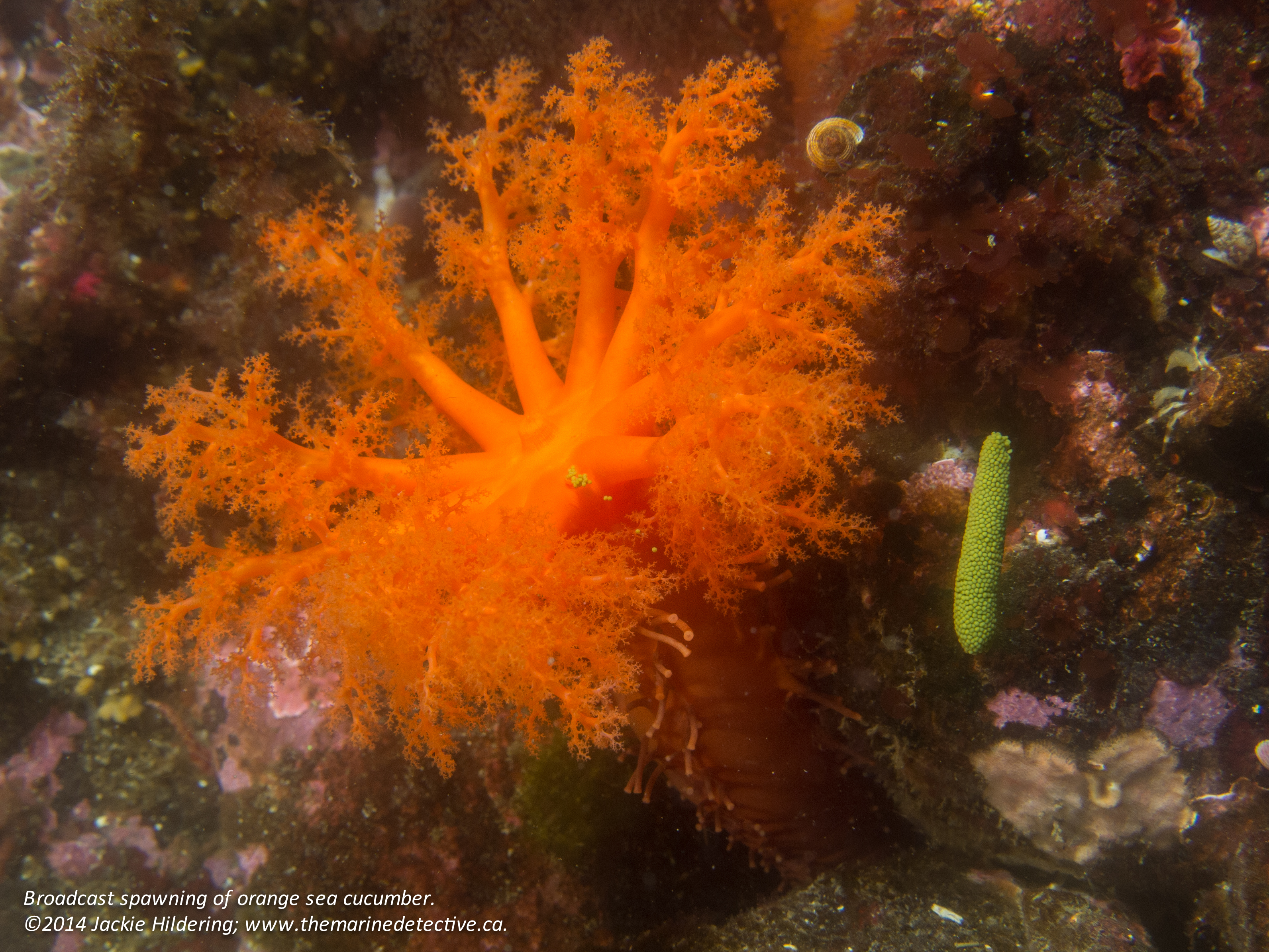
I was euphoric that I happened to be in the water when Orange Sea Cucumbers (Cucumaria miniata) and Giant Plumose Anemones (Metridium farcimen) were broadcast spawning. Witnessing the magnitude of this great force that ensures these species will survive is as awe-inspiring as witnessing the annual spawn of herring or salmon.

Female orange sea cucumber about to release an egg pellet. Click to enlarge. © 2014 Jackie Hildering; www.themarinedetective.ca
Female Orange Sea Cucumber about to release an egg pellet. 
The same female orange sea cucumber 1 minute later, releasing the egg pellet. Click to enlarge. © 2014 Jackie Hildering; www.themarinedetective.ca
The same female Orange Sea Cucumber 1 minute later, releasing the egg pellet.  
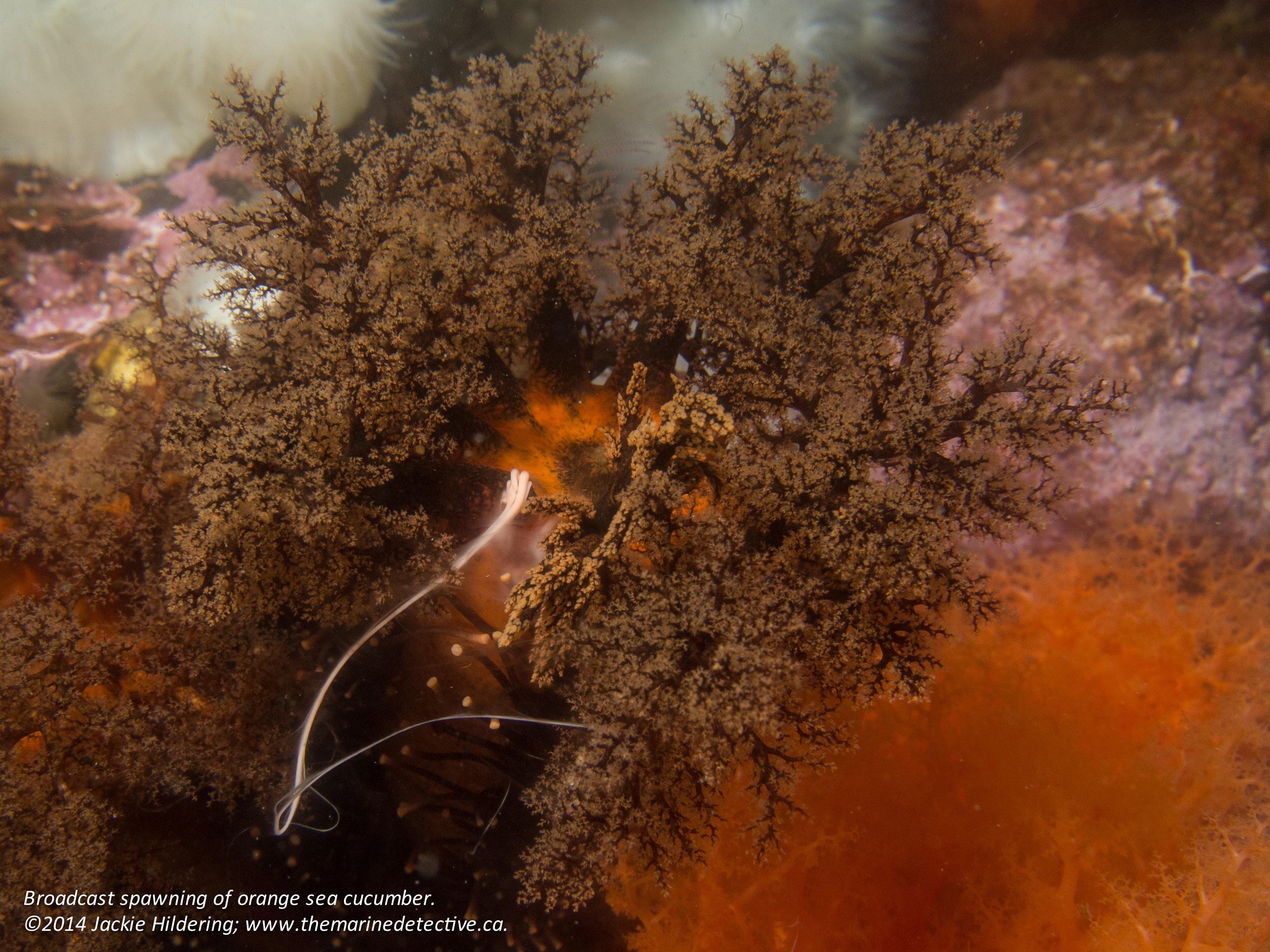
Another spawning male. Orange sea cucumbers can also be this darker colour. Click to enlarge. © 2014 Jackie Hildering; www.themarinedetective.ca
Spawning male Orange Sea Cucumber. Species can also be this darker, brownish colour. 

During broadcast spawning, invertebrate males and females each release their sex cells into the water column – in astoundingly copious amounts.

You can imagine how many gametes must be released for there to be a chance of fertilization and for enough of the resulting larvae to survive and not to be eaten by the many filter feeders such as barnacles, anemones and sea cucumbers!

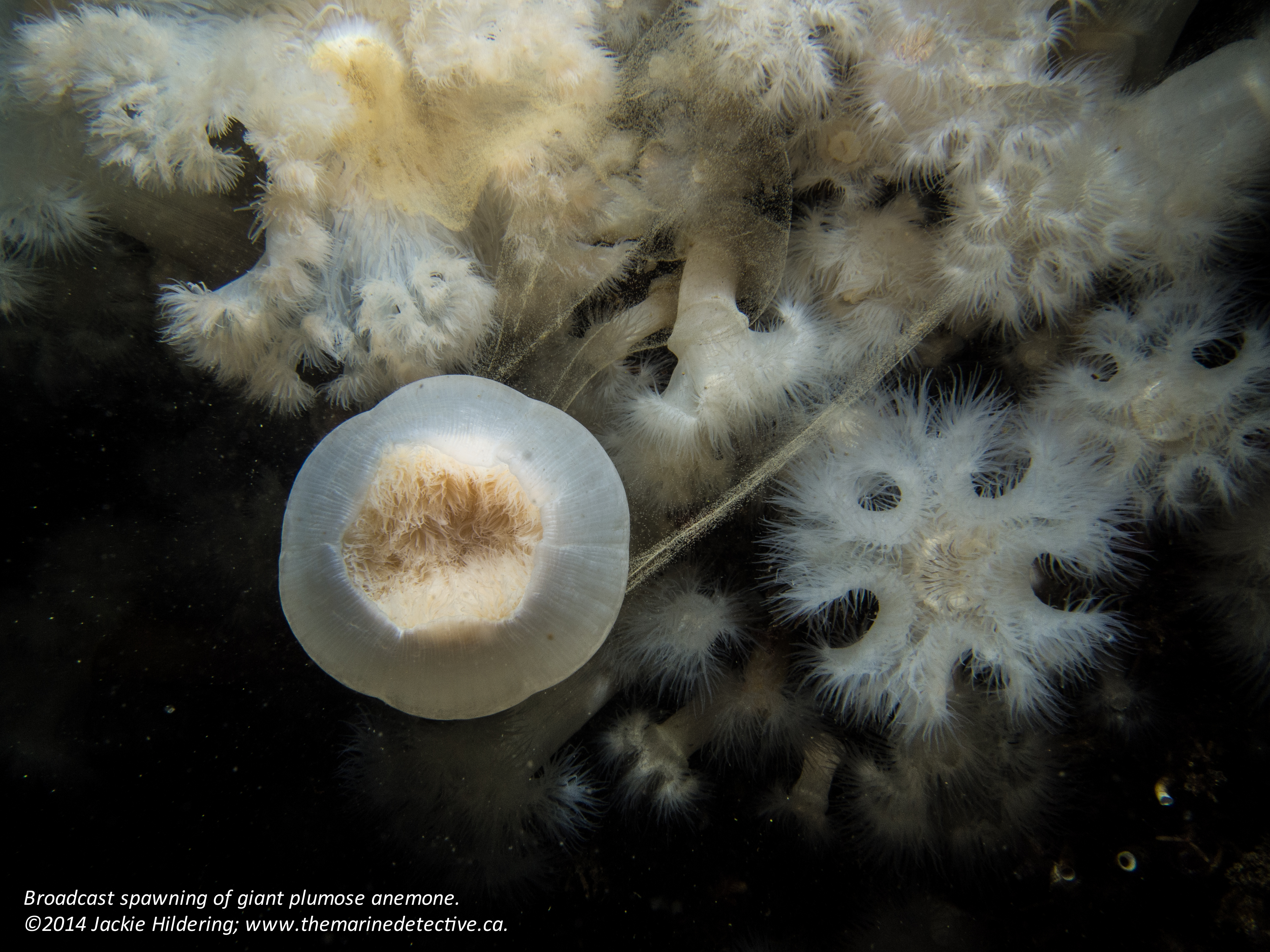
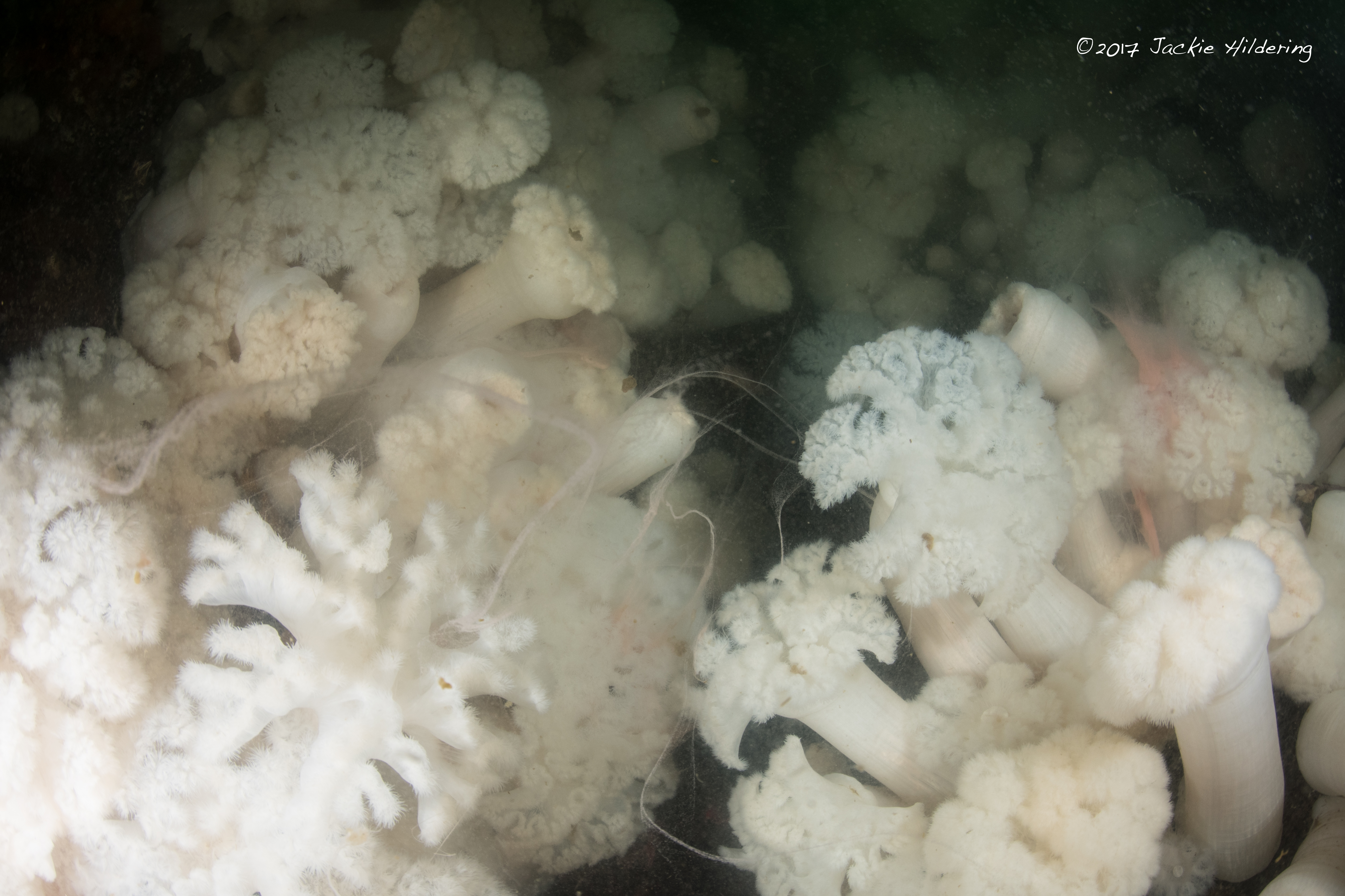
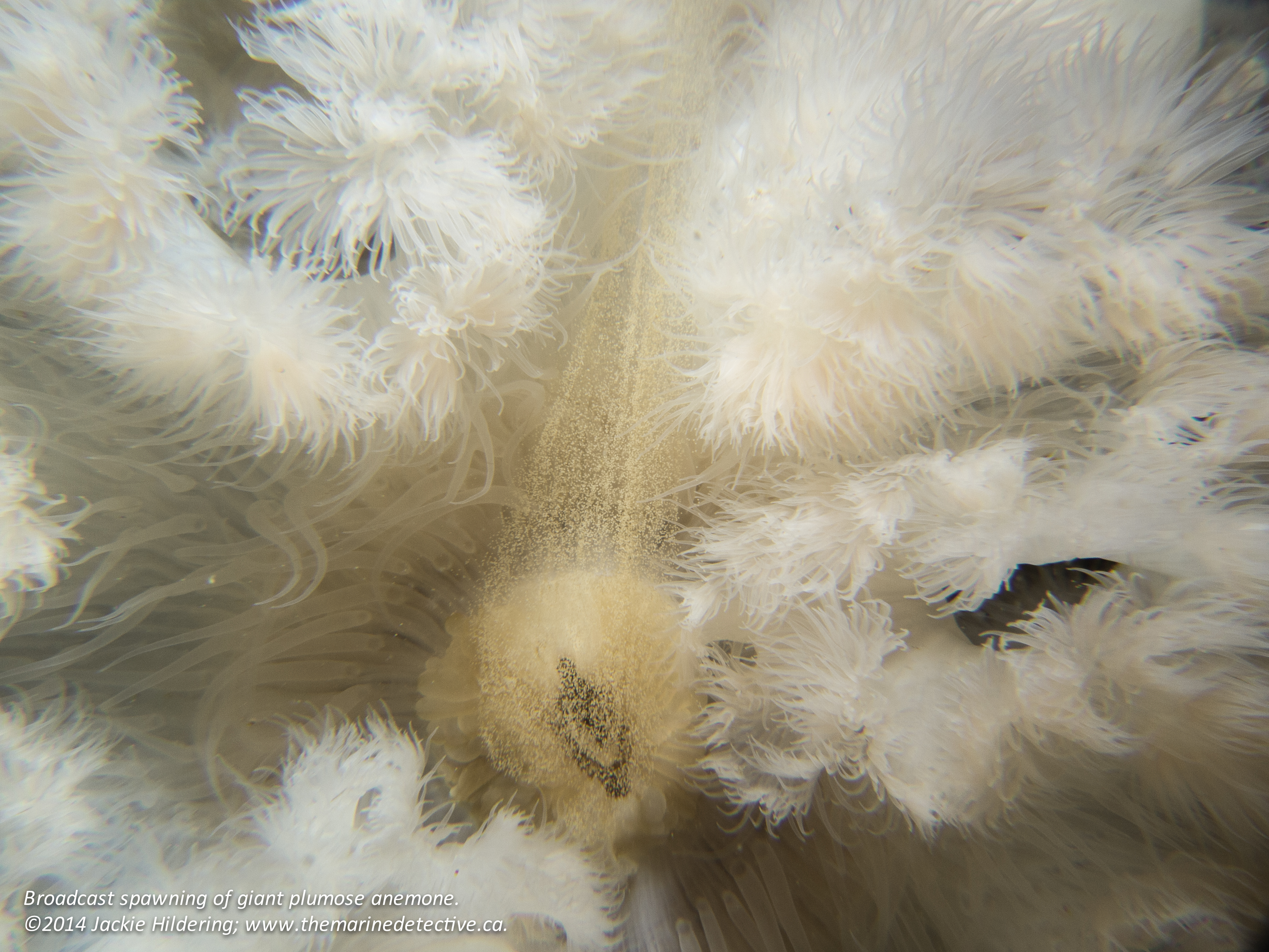
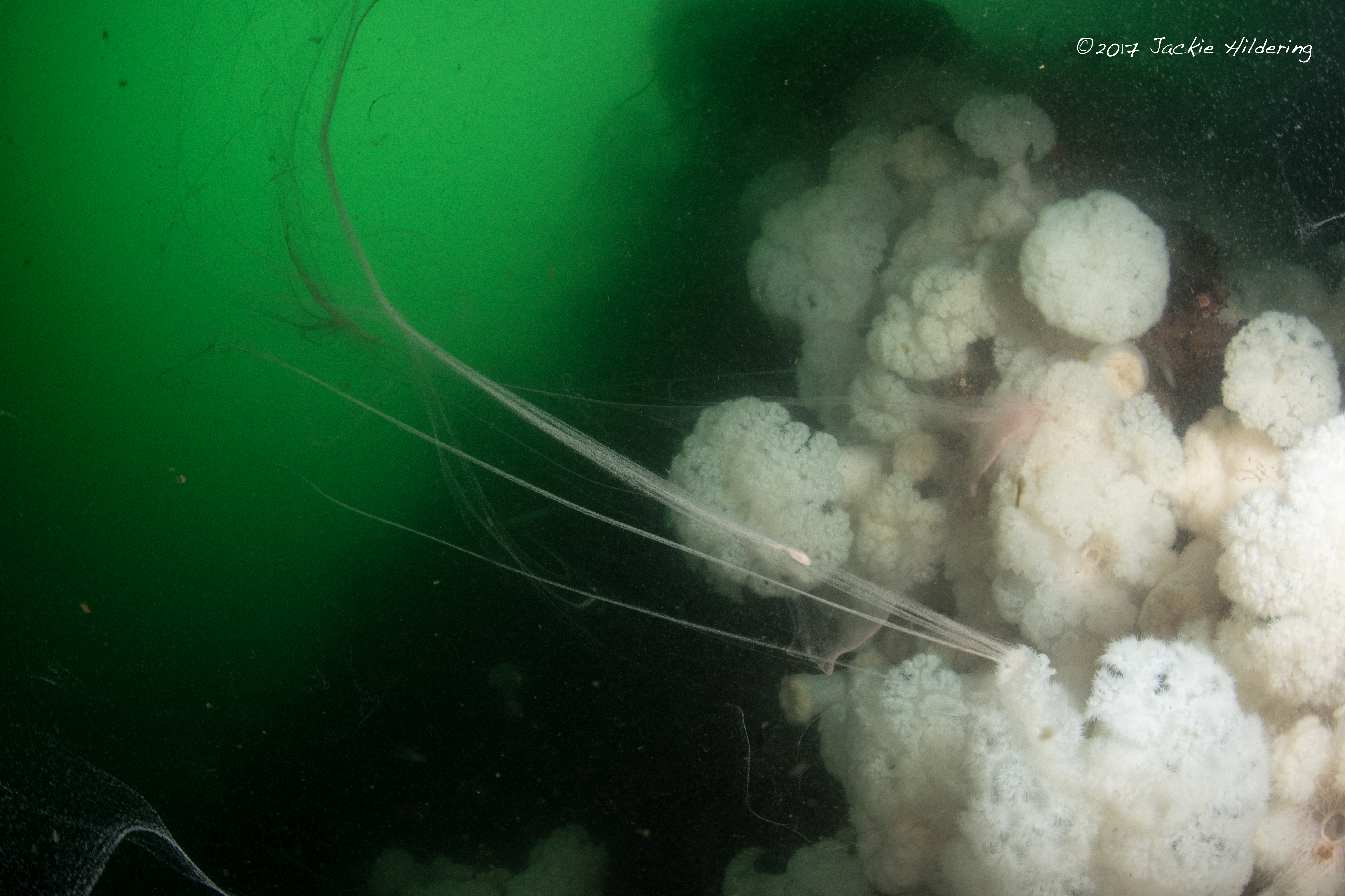
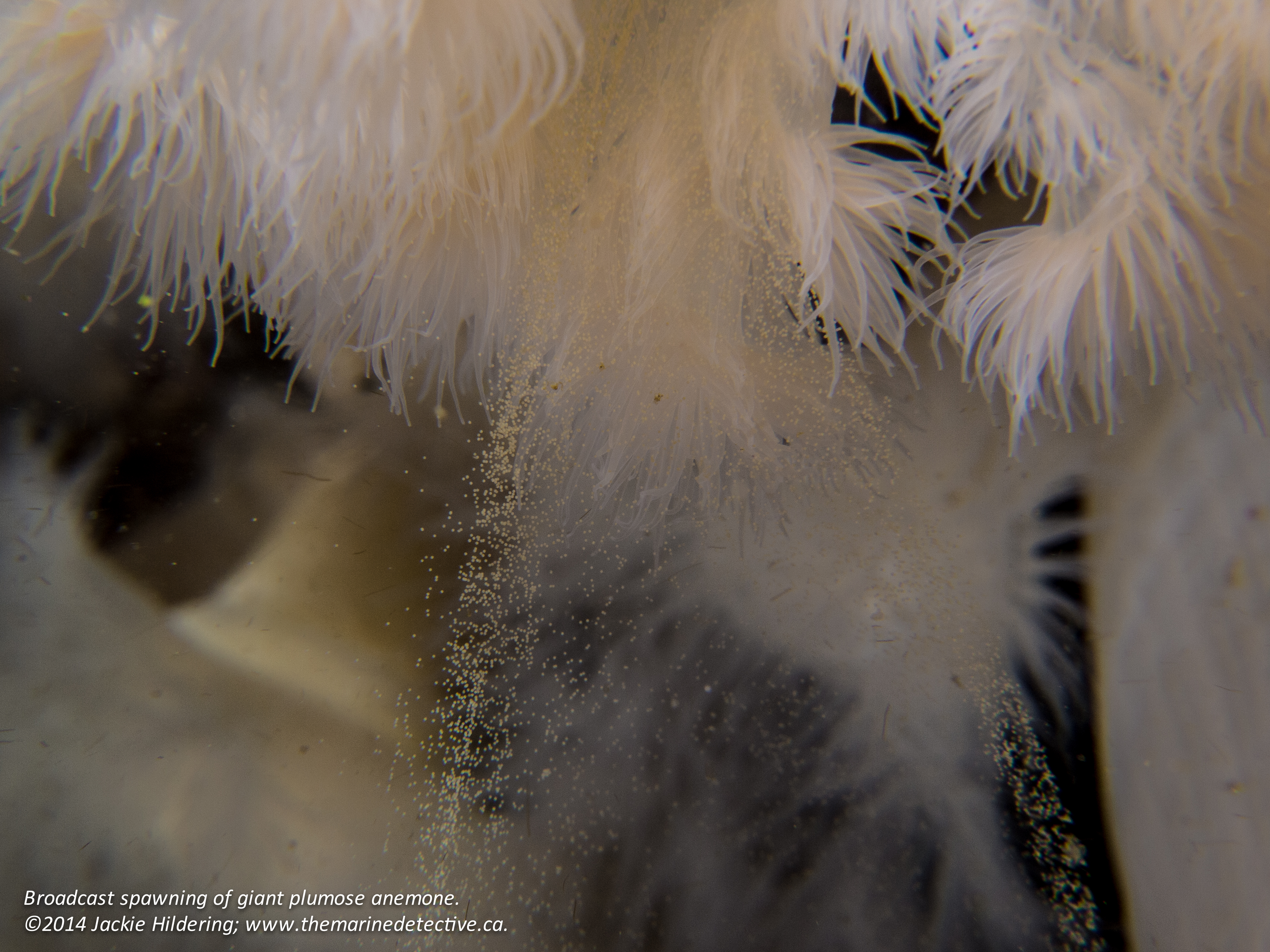
Not only was it the male Orange Sea Cucumbers that were making the cloudy with their astounding numbers of gametes. The Giant Plumose Anemones were broadcast spawning too. Males releasing slow, white jets of their sperm and females then releasing their pinker egg masses. (Note that Giant Plumose Anemones can reproduce asexually as well by pedal laceration but broadcast spawning allows for diversity through sexual reproduction).

Spawning giant plumose anemone. Click to enlarge. © 2014 Jackie Hildering; www.themarinedetective.ca
Spawning male Giant Plumose Anemone. 
Giant Plumose Anemones spawning. Males release the whiter masses of gametes while the females’ masses of eggs have a pinkish colour. See them here? 
Giant plumose anemone releasing gametes. Click to enlarge. © 2014 Jackie Hildering; www.themarinedetective.ca
Close-up of a male Plumose Anemone spawning. 

It is of course a good strategy to have males and females living in close proximity and that timing is everything! The spawn must be synchronized. To release sex cells when others of your kind are not doing so, would be a very failed reproductive strategy indeed.  Probable cues for spawning are ocean temperature; the number of days/hours of sunlight (cumulative temperature); and/or the presence of a plankton bloom.

Apparently for both Orange Sea Cucumbers and Giant Plumose Anemones, the males are the first to release their gametes, triggering the females to spawn.

Research has also found that, in the case of Orange Sea Cucumbers, females release around 130,000 eggs packaged in buoyant egg pellets. The egg pellets drift to the surface and dissociate into the individual eggs after about 20 minutes. Spawning in Orange Sea Cucumbers most often happens within 1.5 hours after slack low tide which adds to the success by allowing for a greater concentration of sex cells, maximizing the chances of fertilization.

Through these images, I hope I have been able to relay the awe I felt at witnessing this biological marvel that has allowed these species to survive on Earth for thousands of times longer than we humans have walked upright.

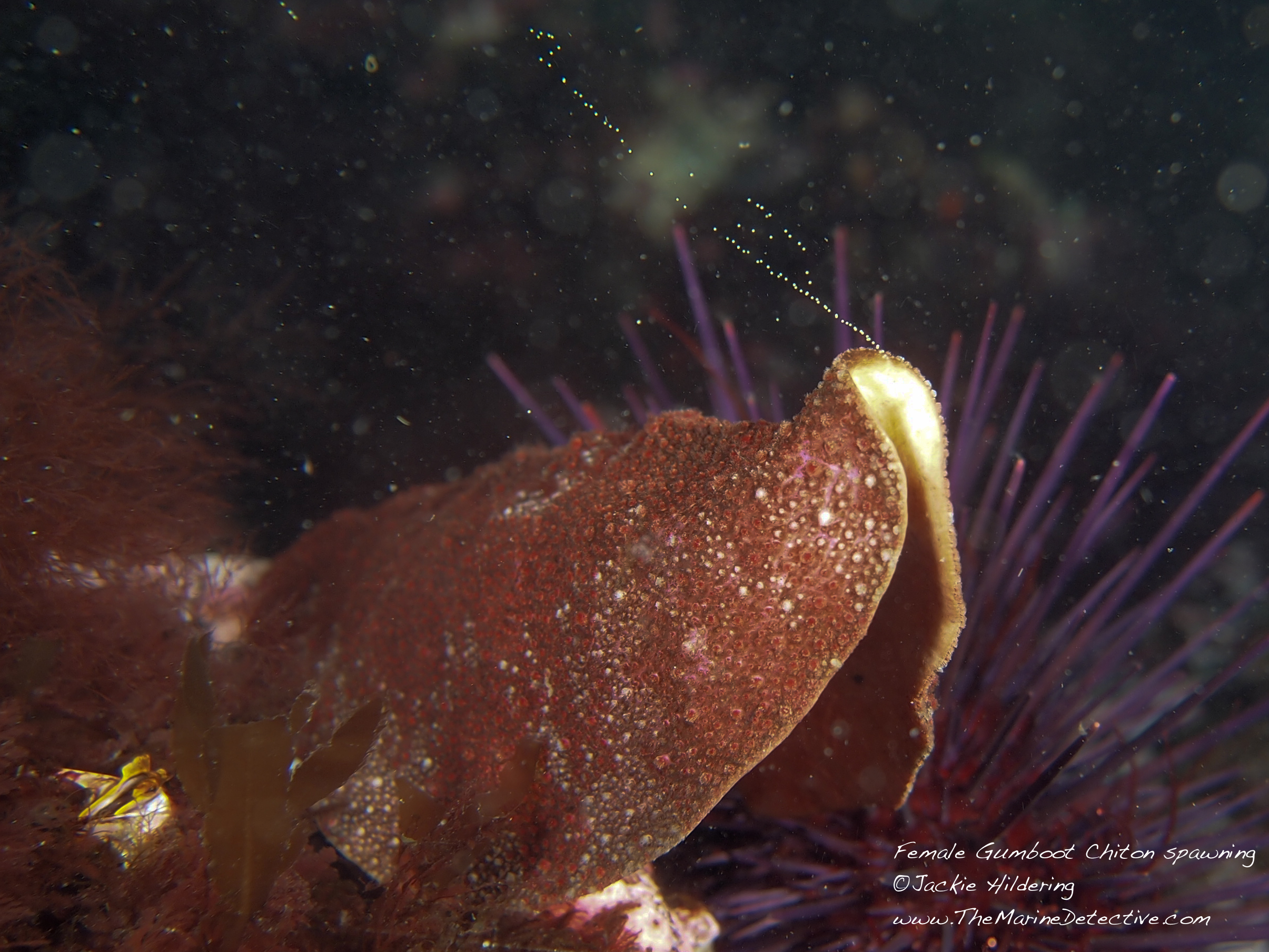
Female Gumboot Chiton spawning. Click this link for video and more information.
Giant Plumose Anemones spawning. Males releasing the whiter masses while females’ eggs have a pinkish colour. See the pink egg mass from a female on the right ?
Giant plumose anemone releasing gametes. Click to enlarge. © 2014 Jackie Hildering; www.themarinedetective.ca
Male Giant Plumose Anemone spawning.
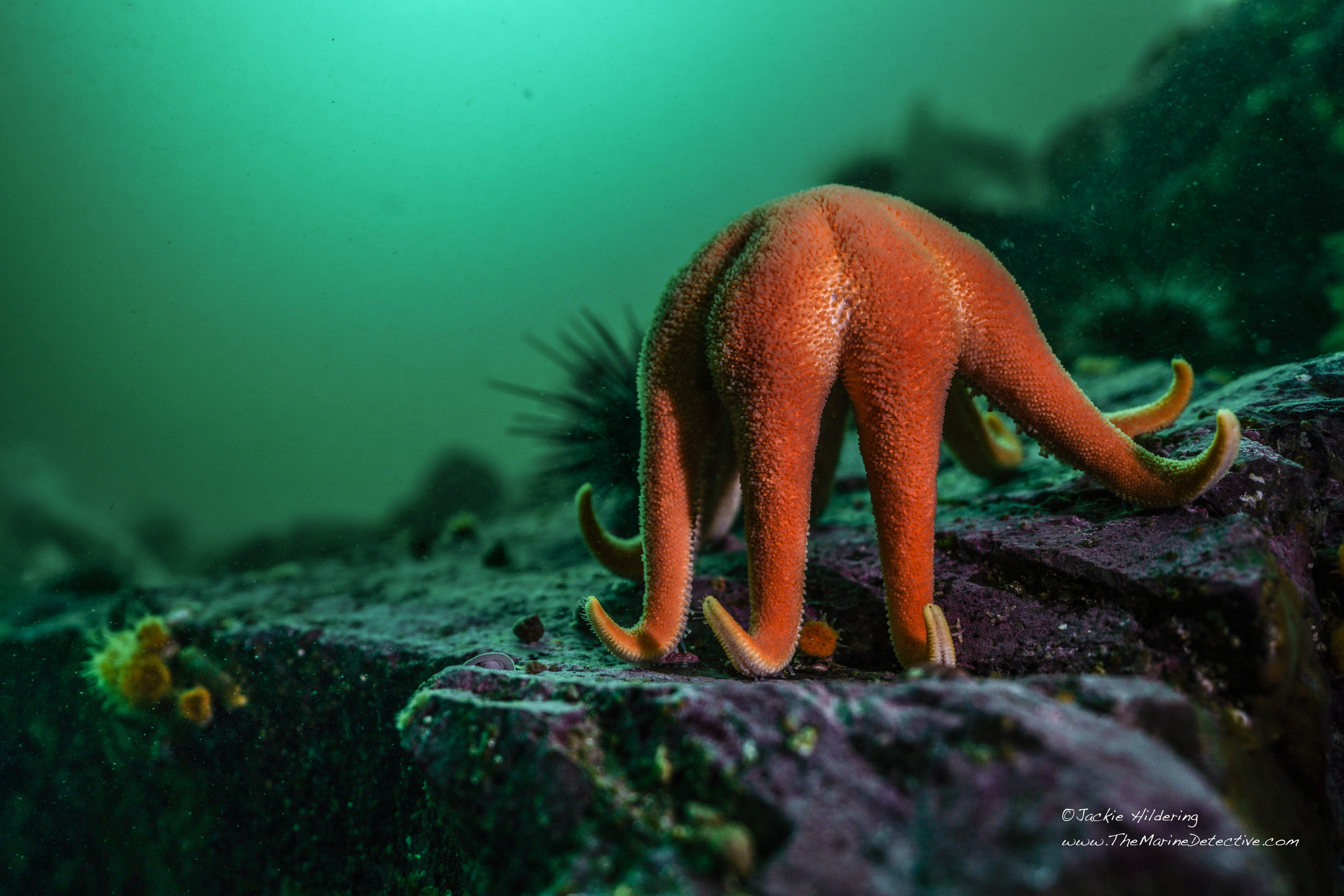
Spawning Orange Sea Star Solaster sp.

Related The Marine Detective posts:

Sources:

Attack of the Sea Slugs!

[Update March 2018 – There has been a reclassification of this species of nudibranch whereby Hermissenda crassicornis  is also being referenced as the “Thick-Horned Nudibranch. Please see my blog at this link for that information.]

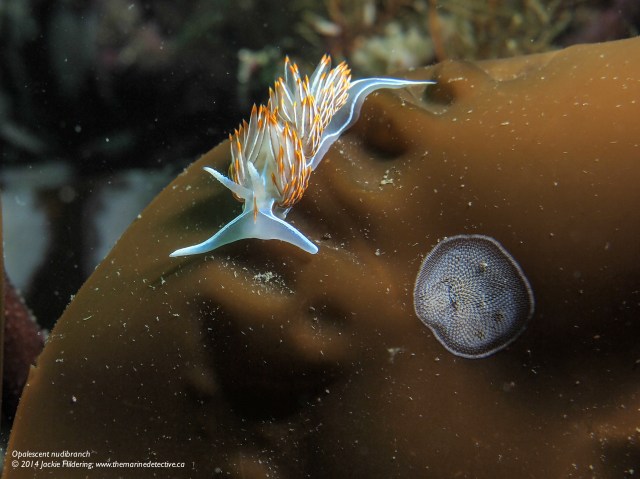
This is an Opalescent Nudibranch (Hermissenda crassicornis).

Opalescent nudibranch. The white batch is a colony of animals known as kelp-encrusting bryozoan. © 2014 Jackie Hildering; www.themarinedetective.ca

Opalescent nudibranch – species up to 8 cm long. The white patch on the right is a colony of animals known as “kelp-encrusting bryozoan”. © 2014 Jackie Hildering; http://www.themarinedetective.ca

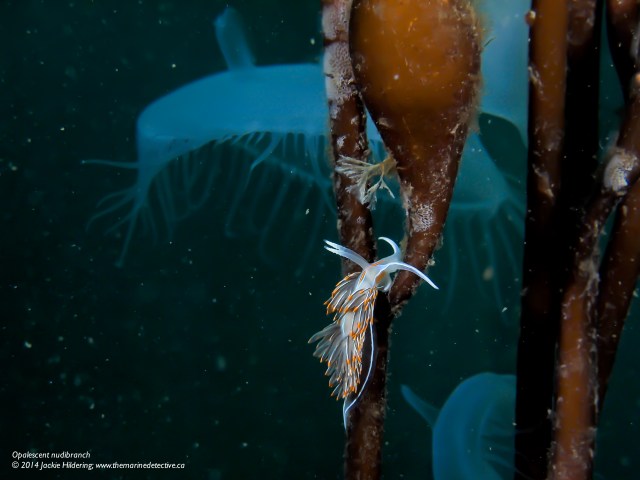
Here is one climbing giant kelp with hooded nudibranchs in the background.

Opalescent nudibranch © 2014 Jackie Hildering; www.themarinedetective.ca

   © 2014 Jackie Hildering; http://www.themarinedetective.ca

I know! Aren’t they astonishingly beautiful? Opalescent Nudibranchs are one of the most powerful ambassadors for shattering the misconception that warm waters are home to more colourful life. They truly help in raising awareness about the incredibly exotic and vibrant life hidden just below the surface in the dark, rich, cold waters of the NE Pacific.

But they help with something else too.

I recently received a video clip of Opalescent Nudibranchs from Tavish Campbell, taken while with Pacific Wild documenting the life that would be at risk if tanker traffic came to Caamano Sound. Tavish, who is a fellow-diver and appreciator of all things marine, asked, “Hey Marine Detective, what’s going on here?!”  What I saw led me to realize how this species is also a very powerful engager for addressing another default notion we humans seem to have.

We tend to bestow judgemental labels on animals depending on our interpretation of their beauty.  We are inclined to think beautiful animals are “nice”, “cute” and “benign”, and foreign looking animals are “mean”, “ugly” and/or “bad”.

While I appreciate that some organisms may be more aesthetically pleasing than others, there is no “ugly” in Nature and there certainly isn’t “bad”.  Organisms look and live as they do because it works. Their appearance and behaviours are the result of expanses of time longer than we humans, as newcomers, can truly appreciate. Organisms’ adaptation allow them to survive and fulfil their niche in Nature’s puzzle so that there is the greatest chance of balance. [Insert “God” instead of “Nature” if this is your preference.]

Therefore, for example, there are no “bad” kinds of orca but rather orca populations whose job in Nature is to eat other marine mammals. There are dolphins that sometimes kill other marine mammals without this being for the purposes of food (no matter how much this conflicts with the “Flipper-like” identities we have imposed on them). Sea otters do things that definitely are NOT cute and .  . . it also means that beautiful sea slugs will also do what they need to in order to survive.

I take such comfort in not needing to judge Nature. It just is. In contrast, human behaviours too often do NOT enhance the potential of balance in Nature or even the chances of our own survival.

So here’s the jaw-dropping video. Ready . . .?

Opalescent Nudibranchs in all their beauty, are extremely voracious predators and, as is evident in the video, will also attack their own kind. Reportedly, fights most often result when the animals come into contact head-to-head. The animal closest to the head or end of the other has the advantage of getting in the first bite and thereby the greater likelihood of killing their opponent and eating them.

But, they are hermaphrodites, they need one another to mate! As hermaphrodites, there is not even male-to-male competition for females! So why, when your chances of finding a mate as a sea slug are already pretty limited, would you kill another of your kind instead of mating with them?

I hypothesize that it would have to do with the balance between needing to eat and needing to mate and/or that there is some sort of genetic competition going on. That’s all I got. Insert rap awe and wonder here. I may not know why they do what they do but I do know, there has to be an advantage to their survival.

What I also know for sure is that this gives a whole new meaning to “slugging it out”!

Opalescent nudibranch egg mass. http://jackiehildering.smugmug.com/Underwater/Sea-slugs/

Opalescent Nudibranch egg mass. Every species of nudibranch has distinct egg masses i.e. they are species specific.  2014 Jackie Hildering; http://www.themarinedetective.ca

For the Birds! Lessons learned from exotic birds, and birders

Just another day on the sidewalk in front of my house.

Just another day on the sidewalk in front of my house.

It’s Saturday morning. I open the curtains. And there they are – three sets of binoculars pointed in my direction. Again.

It’s been like this for 2 months now**, leading neighbours to wonder what is going on and if I am okay.

I am, thanks. I’m just peachy; not a feather out of place. In fact, I have a bird’s eye view of something simply wonderous from which I have learned a great deal.

All the activity on my sidewalk – the binoculars; people coming from Kamloops, Calgary, Victoria, Vancouver and possibly further afield (with at least one person sleeping in his car till daylight so he could be the early bird) – it’s not about me at all. It’s about the birds. Against all odds, multiple species of really rare and exotic birds are here together in our little neighbourhood in Port McNeill.

We’re not used to having this kind of “vagrant” in the ‘hood!

It began in early December when, while on a conference call, I almost lost my mind when a brilliantly yellow coloured bird landed in the shrub in front of my home office window; near the feeder I leave out for the Anna’s Hummingbirds who spend the winter here.

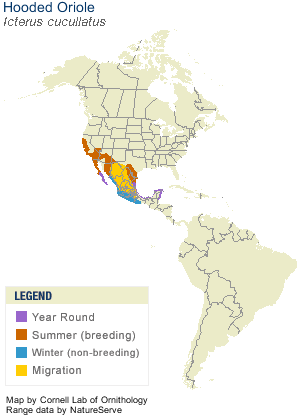
Winter range of Hooded Orioles marked in blue. Source: Cornell Lab of Ornithology -  - see this link for more information and a larger map    http://www.allaboutbirds.org/guide/Hooded_Oriole/id

Winter range of Hooded Orioles marked in blue. Source: Cornell Lab of Ornithology – see this link for more information and a larger map.

I scrambled for my camera uttering colourful nouns, thankfully having the sense to put the phone on mute. I got a picture.

I don’t know much about birds and therefore did not trust my ID. Could it be a . . . could it really be . . . a male Hooded Oriole?!

They are not supposed to be here. They should be in palm trees in the Baja in winter but I dared share the photo and my timid ID with those I know to be BC’s leading bird authorities. The responses came back pretty quickly.

They confirmed how rare this sighting was. Apparently, there have only been two previous recorded cases of Hooded Orioles making it through a BC winter – in Terrace in 1998 and in Prince Rupert in 2007. I was determined to do all I could to give this one a fighting chance since the odds of him finding his way “home” were infinitely small.

The photo I sent to the bird experts, timidly asking if indeed this was a male Hooded Oriole. Jeremy Gatten, would recount in his blog “I received an e-mail from Port McNeill resident Jackie Hildering about a bird that she thought might be a Hooded Oriole.  It's a good thing I was sitting on a couch because the attached photo would have knocked me to the floor if I was on a chair or stool!  The extremely crisp, full-frame shot showed a healthy, vibrant male Hooded Oriole in winter plumage.” http://naturalestnaturalist.blogspot.ca/2014/01/a-dick-and-hoor-longest-hardest-wettest.html

This is my first photo; the one I sent to the bird experts, asking if indeed this was a male Hooded Oriole. Jeremy Gatten, would recount in his blog “I received an e-mail from Port McNeill resident Jackie Hildering about a bird that she thought might be a Hooded Oriole. It’s a good thing I was sitting on a couch because the attached photo would have knocked me to the floor if I was on a chair or stool! The extremely crisp, full-frame shot showed a healthy, vibrant male Hooded Oriole in winter plumage.”

I slightly modified the hummingbird feeder. It appeared to meet his needs and he stayed. The word spread about how predictably such a rare bird could be sighted, and the birders started appearing.

Male Hooded Oriole at the feeder.  © 2014 Jackie Hildering

Male Hooded Oriole at the feeder. See his tongue? © 2014 Jackie Hildering

At first I was very worried about how the attention might disturb the Oriole (and me) but many could learn a thing or two from the nature viewing ethics of bird-watchers.

Winter range of Dickcissels marked in blue. Source: Cornell Lab of Ornithology -  - see this link for more information and a larger map    http://www.allaboutbirds.org/guide/Dickcissel/id

Winter range of Dickcissels marked in blue. Source: Cornell Lab of Ornithology – see this link for more information and a larger map.

They watch from a respectful distance, never setting foot on my property, truly wanting to witness natural behaviour. They rarely strive to get a photo to affirm their experience and certainly would not disturb the bird for the sake of getting the photo. They appear to “just” delight in seeing a rarity and being able to add a bird species to their list. Certainly there is no “get up and personal” – the phrase I loathe most in reference to wildlife viewing.

Then, things got even more exotic.

With all the birder expertise directed at the shrub with Mr. Oriole, a Harris’s Sparrow* was also spotted (winter range is the south central US), and a Yellow-Rumped Warbler (somewhat less noteworthy as this area is part of their summer range) and . . . a female Dickcissel.

Yes, that’s right – a Dickcissel. I too had no idea such a species existed and certainly would not have been able to discern her from the House Sparrows she often hangs out with. Neighbour Jim Nolan was the first to notice her, and teach me to spell “Dickcissel”! And how exotic is she? Her kind winters in Guatemala and Venezuela.

Female Dickcissel - quite difficult to discern her from the House Sparrows if the light is low and you can't see the yellow markings © 2014 Jackie Hildering

Female Dickcissel – quite difficult to discern her from the House Sparrows if the light is low and you can’t see the yellow markings © 2014 Jackie Hildering

Bring on more birders! And more binoculars on the sidewalk! And more neighbours wondering what on earth was going on.

Bird watchers reference this phenomenon as the  “Patagonia Picnic Table Effect”.  One rare bird attracts birders, who then find another rare bird, which brings in more birders . . . and so on!

In this case it is the “Port McNeill Shrub in Front of My House Effect” and how grateful I am for privilege of a front row seat to the birds, and the birders.

Female Yellow-Rumped Warbler. She's so territorial - chasing the Anna's Hummingbirds away and sometimes even bombs the much bigger Male Hooded Oriole. She is very often near the Oriole. © 2014 Jackie Hilderin

Female Yellow-Rumped Warbler. She’s so territorial – chasing the Anna’s Hummingbirds away and even dive-bombing the much bigger male Hooded Oriole. She is most often near him. © 2014 Jackie Hildering

They have made me reflect more on human behavior and expectations while viewing wild animals. I have become even more attuned to how extraordinary the wildlife of our area is and how, if you are especially watchful and respectful, the reward can be so great.

Clearly, the idiom “birds of a feather flock together” has also been challenged and I am greatly comforted that one rare bird can find another!

Not surprisingly, the birds have further heightened my wonder in Nature and, frankly, in life as well. Why that shrub? Why our neighbourhood in Port McNeill? Random chance? Ideal conditions? I will add this to the many things I will never know for sure.

What I will also allow myself to believe is that the appearance of the birds is evidence that colourful, rare and exotic beings can find my front door!

__________________________________________________

*I never saw the Harris’s Sparrow and have not heard of repeat sightings of this individual from birders.

Note that all photos were taken through the front windows of my home.

See end of blog for range maps for Yellow-Rumped Warblers and Harris’s Sparrows.

** Update April 6, 2014: The female Dickcissel is still a daily visitor. My last sighting of Mr. Hooded Oriole was March 29th. Presumably, he has moved on to new adventures, striving to join with his own kind and find a mate.

Male Hooded Oriole. © 2014 Jackie Hildering

Male Hooded Oriole. © 2014 Jackie Hildering

© 2014 Jackie Hildering -8883

Female Dickcissel © 2014 Jackie Hildering

Male Hooded Oriole in flight © 2014 Jackie Hildering

Male Hooded Oriole in flight © 2014 Jackie Hildering

Female Dickcissel - quite difficult to discern her from the House Sparrows if the light is low and you can't see the yellow markings © 2014 Jackie Hildering

Female Dickcissel – quite difficult to discern her from the House Sparrows if the light is low and you can’t see the yellow markings © 2014 Jackie Hildering

Male Hooded Oriole at the feeder. © 2014 Jackie Hildering

Male Hooded Oriole at the feeder. © 2014 Jackie Hildering

Winter range of Harris's Sparrows marked in blue. Source: Cornell Lab of Ornithology - see this link for more information and a larger map  http://www.allaboutbirds.org/guide/harriss_sparrow/id

Winter range of Harris’s Sparrows marked in blue. Source: Cornell Lab of Ornithology – see this link for more information and a larger map.

Winter range of Yellow-Rumped Warblers marked in blue. Source: Cornell Lab of Ornithology -  - see this link for more information and a larger map    http://www.allaboutbirds.org/guide/yellow-rumped_warbler/id

Winter range of Yellow-Rumped Warblers marked in blue. Source: Cornell Lab of Ornithology – see this link for more information and a larger map.

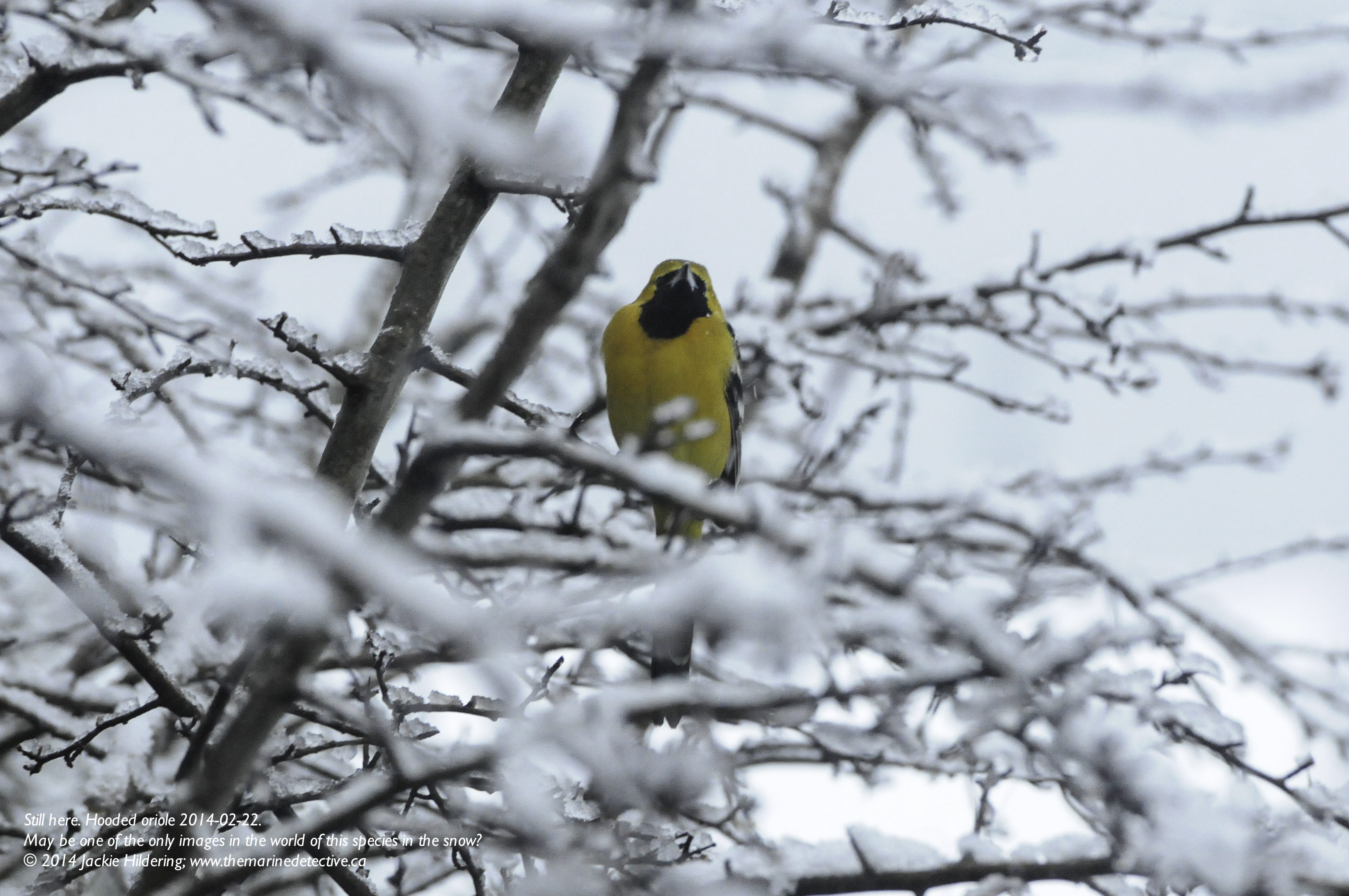
Still here- February 22nd, 2014. Maybe one of the only photos in the world of a Male Hooded Oriole in the snow? © 2014 Jackie Hildering

Still here- February 22nd, 2014. Maybe one of the only photos in the world of a Male Hooded Oriole in the snow? © 2014 Jackie Hildering

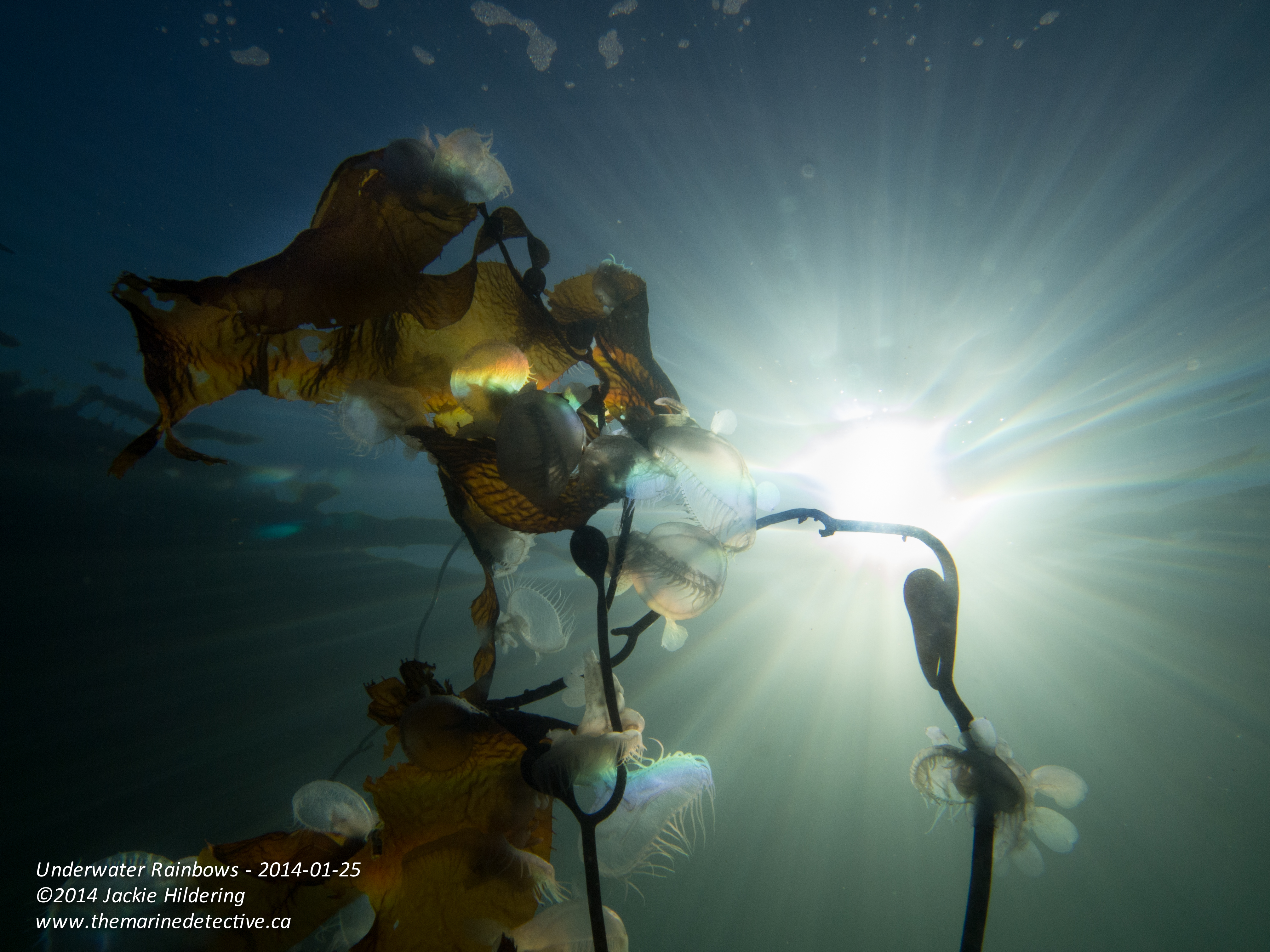
Underwater Rainbows

Do you see them?

The January sun streaming down, the light refracted against the hooded nudibranchs . . . the underwater rainbows?!

Hooded nudibranchs are already such ethereal, other-worldy creatures, to see the rainbows dancing against their translucent bodies made me catch my breath and desperately want to capture the beauty for you.

May you dream of underwater rainbows and – maybe- fall even a little bit deeper in love with the NE Pacific Ocean.

For information on hooded nubibranchs (includes images and video of them swimming and their eggs), please see my previous blogs at this link. 

Hooded nudibranchs on giant kelp at about 3 m. © 2014 Jackie Hildering

Hooded nudibranchs on giant kelp at about 3 m. © 2014 Jackie Hildering

Hooded nudibranchs on giant kelp at about 3 m. © 2014 Jackie Hildering

Hooded nudibranchs on giant kelp at about 3 m. © 2014 Jackie Hildering

Hooded nudibranchs on giant kelp at about 3 m. © 2014 Jackie Hildering

Hooded nudibranchs on giant kelp at about 3 m. © 2014 Jackie Hildering

Hooded nudibranchs on giant kelp at about 3 m. © 2014 Jackie Hildering

My 800th Dive. From Shiner to Shining?

Yesterday, I completed my 800th dive.

Today, I find myself reflecting on the remarkable journey from my first dives to now.

I dare share my thoughts with you here because  . . . diver or not, I believe there are elements of this life journey with which many can identify and because the feelings I express about “Mother Ocean” is what I think unites us here on The Marine Detective.  Oh – and also, it provides insight into why I tend to snarl when a minority of people, state “You must have a really good camera” after seeing my underwater images, suggesting that it is merely photo-equipment dependent to go deep and deliver evidence of the astounding and fragile life hidden in these cold waters.

I never could have anticipated how the cold NE Pacific would become the greatest force in my life and, as I think often is the case with the most important things in life, the journey has not been easy.

This is how it started.

Shiner . . . Image in my first dive log. Me just after my 37th birthday with "mask squeeze".

Shiner . . . Image in my first dive log. Me just after my 37th birthday with “mask squeeze”.

That’s me about a week after my 37th birthday. On my birthday itself, while on my 20th dive, I got “mask squeeze”. Every capillary in my eyes burst because I did not equalize the pressure in my dive mask as I descended. This was due to complications while I was learning to dive with a drysuit.

I delight in there now being an island on our coast informally named after me  . . . Shiner Rock. Far more important, however, are the lessons I learned from this dive, and the other 799.

I should acknowledge that 800 dives is not a big deal for some, especially if you are a warm-water diver and if you have been diving since your youth. My diving life has been from age 36 to age 50 and almost all these dives (the equivalent of 25 days underwater) have been here in about 6 to 10°C water, off the coast of NE Vancouver Island.

The decision to take a dive course seemed frivolous at the time but again, as it seems to go, some of our seemingly smallest decisions appear to give life the greatest meaning.

I began my first course in 1999, the year I returned to British Columbia after teaching in the Netherlands for 14 years. I aborted what many would consider an important career trajectory, knowing only that I had to get back to learning from Nature.  I had been working in big city Rotterdam at that time and had become so tired of hearing myself talk about Nature as if it were somewhere else. One surprise whale watching trip on NE Vancouver Island led to my moving here.

My dive course was not typical in many, many ways with my first ever dive being in a glacier fed river in a community that had ocean surrounding it. I will never understand why we did this. But, while in my father’s thin, old wetsuit, shivering uncontrollably and falling while trying to stand on algae-covered river rocks, I saw one salmon. I was in deep, right from the start.

Now, so many dives later, while the lessons don’t EVER stop, the artwork below captures what diving in these waters has brought to my life.

Shinier . . . Me?

Shinier . . . Me? Artwork by Jennifer Bonnell; presented to me at age 50 as an interpretation of who I am.

And apparently . . .  that is also how some people see me. That piece was given as a gift on my 50th birthday last April. . . as a portrait of me. Shining? Passionate? Mermaid-ian? Inspirational? Ocean advocate?

Please know how much I struggled to type that.

I am so moved, so grateful, and so much further incentivized when honoured by people using such references in relation to me. I know fully the personal journey it has been to go from “Shiner” to maybe appearing to be “Shining”. And I know too what diving has brought to my life . . . depth of understanding and and depth of purpose – wanting to shine a light of awareness on what lives in these waters and, thereby, help motivate greater conservation.

The Ocean is the source. The battle force. She is my inspiration. She is the beginning and she is the end. She is where I hide and where I am fully exposed. She has taught me my most valuable lessons and  . . . . I know it’s not over yet. Not by a long shot.

The plan is to do at least another 800 dives.

Thank you so to all of you who are part of the journey.

For a related post, with a poem written after my 600th dive 4 years ago, see Diving After the Storm  – My 600th Dive“.

With particular depth of gratitude to dive buddies Jacqui Engel and Natasha Dickinson and further members of the Top Island Econauts.