Join me in the cold, dark, life-sustaining NE Pacific Ocean to discover the great beauty, mystery and fragility hidden there.

When a Giant Falls . . . and people care.

© 2012 Caitlin Birdsall

This photo is of the juvenile male humpback whale that died in the early morning hours of June 12th on a beach in White Rock (some 40 km south of Vancouver).

Fellow Marine Education Research Society (MERS) director, Caitlin Birdsall was on site in her capacity with the British Columbia Cetacean Sightings Network and I have been haunted by her photos ever since she shared them with me.

While the images stir deep despair, they are also achingly beautiful and fill me with a great depth of hope.

People cared enough to place flowers on the deceased little whale.

People cared enough to stand in awe and respect.

People  . . . cared.

With this little whale dying on a beach in an urban centre, great public concern and national media attention were attracted, creating a potent opportunity for education.

The death of this whale illuminates how little we know about marine life, even the ocean’s giants.

Had anyone seen the whale before?  To date, no one has been able to identify this whale as an individual and thereby determine where he might have come from. We at MERS were not able to find this whale in our catalogue nor in that of the Department of Fisheries and Oceans.

How did the whale die?  The whale had an excruciatingly slow death from starvation due to entanglement in fishing gear. The gear had lacerated into the whale’s skin and had cut deep into the whale’s mouth. Ultimately, the young emaciated humpback became stuck on the beach at low tide and died there.

What type of fishing gear killed the whale? Fishing gear that was unfamiliar to local experts. Scott Landry, from the Provincetown Centre for Coastal Studies in Massachusetts, is one of the world’s foremost experts on entanglement and he shared with MERS director Christie McMillan that the line was very likely from offshore longline fisheries and was more difficult to recognize because the hooks had been in the water so long, they had corroded off the lines. Let’s truly absorb that for a moment – the whale may have been entangled so long that he outlasted the hooks on the fishing line.

Do humpback whales get entangled often? Entanglement is identified as a threat in the Recovery Strategy for the North Pacific Humpback Whale in Canada but the threat is very poorly understood.  Therefore, we at the Marine Education and Research Society have undertaken an entanglement scar study to determine how often humpback whale entanglement might occur. British Columbia’s vast coastline and relatively new Marine Mammal Response Network unquestionably lead to many undetected and unreported entanglements. Even in the Gulf of Maine where there is a well-established reporting network, studies have determined that less than 10% of large whale entanglements are witnessed or reported and only a fraction of deaths are detected. Scar studies in Southeast Alaska suggest that up to 78% of humpbacks are entangled at some point in their lives.

Are there solutions?  Humpback whales of the North Pacific must continue to receive protection under the Species at Risk Act. They are currently listed as “Threatened” but a 2011 assessment suggests they could be down-listed to being of “Special Concern”.  This is premature. Not enough is known about the population structure of the North Pacific humpbacks, let alone about threats such as entanglement.  With a better understanding of the incidence of entanglement, fisheries regulations could be adapted including gear modifications that allow nets and lines to break-away.

But the lessons here go beyond those relating specifically to humpbacks and to entanglement.

This “case” of an unidentified juvenile humpback dying in on a beach in an urban centre after months of agony, undetected and unreported, testifies to how little we know about our oceans and how easy it is to kill a giant, even with a bit of stray human-made fishing line.

The key to saving whales and the ecosystems for which they are ambassadors, is to retain the humility and connectedness we feel when we see pictures like this, letting it impact our consumer and electoral choices and our value systems.  We too often act as if we know it all; that we will be able to “manage” even unknown human impacts; and therefore, we relentlessly assault the oceans in favour of short-term economies.

Thanks to the efforts of many volunteers, coordinated by Jim and Mary Borrowman, this little humpback’s skeleton will come to hang in Telegraph Cove’s Whale Interpretive Centre. Maybe the powerful photograph will hang life-size behind it, adding to the potential of this whale’s death leading to some sort of positive gain for the environment and therefore . . . for ourselves.


Sources:

  • Neilson, J. L., J. M. Straley, C. M. Gabriele and S. Hills. 2009. Non-lethal entanglement of humpback whales (Megaptera novaeangliae) in fishing gear in northern Southeast Alaska.Journal of Biogeography 36:452–464.
  • Robbins, J. and D.K. Mattila. 2001. Monitoring entanglements of humpback whales (Megaptera novaeangliae) in the Gulf of Maine on the basis of caudal peduncle scarring. Unpublished Report to the 53rd Scientific Committee Meeting of the International Whaling Commission. Hammersmith, London. Document number SC/53/NAH25.
  • Robbins, J. and D.K. Mattila. 2004. Estimating humpback whale (Megaptera novaeangliae) entanglement rates on the basis of scar evidence. Report to the National Marine Fisheries Service. Order number 43ENNF030121. 22 pp.
  • Robbins, J. 2009 Scar-based inference into Gulf of Maine humpback whale entanglement: 2003-2006, pp. 40: Report to the National Marine Fisheries Service. Order Number EA133F04SE0998.
Follow-up:
Blog item by Jake Etzkorn of the Living Ocean’s Society on the work on this whale’s body so that the skeleton and baleen can be used for conservation and education purposes in Telegraph Cove’s Whale Interpretive Center.
Article stating origin of the fishing gear has not been determined. The Province; July 13, 2012;” Origin of the fishing gear that killed White Rock humpback unknown.” 

Strand of the fishing line that led to the death of the whale. © 2012 Caitlin Birdsall. Click to enlarge.

The Vancouver Aquarium’s Dr. Lance Barrett-Lennard takes questions from media. © 2012 Caitlin Birdsall. Click to enlarge.

© 2012 Caitlin Birdsall. Click to enlarge.

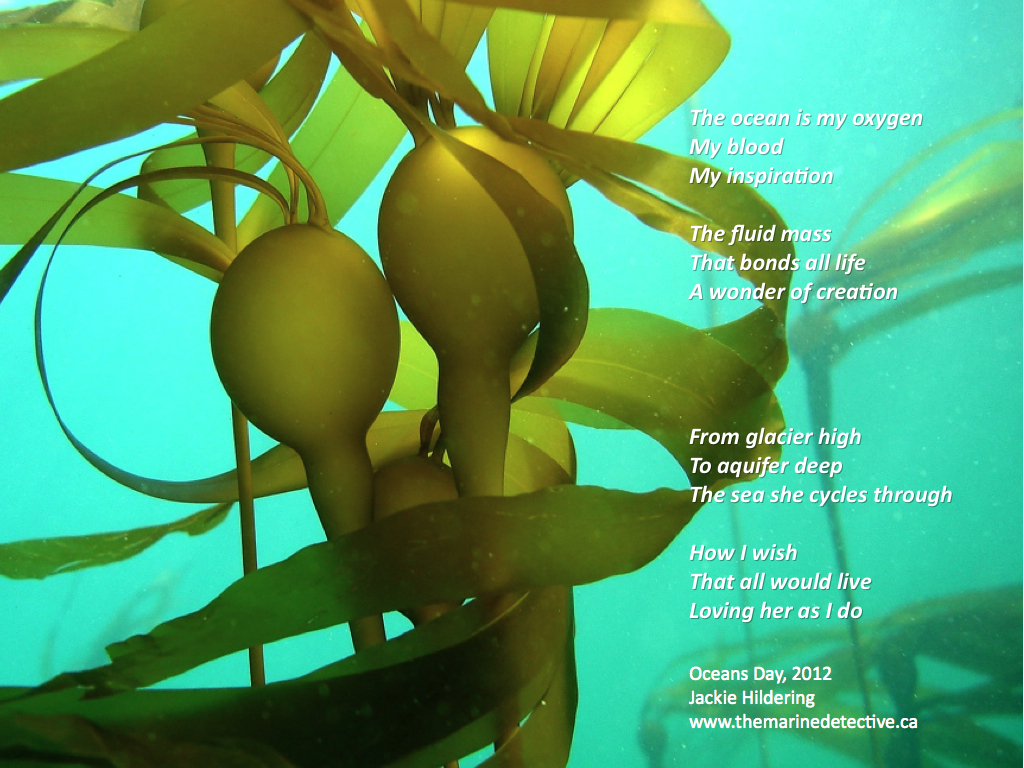
For You For Oceans Day – for you love her as I do.

Dear “The Marine Detective” Community,

An Oceans Day reflection for you. 

If you can’t read the text, please click the image to enlarge.

May we continue to work together to raise awareness about the great beauty and importance of our Ocean. For life on land cannot survive without the Ocean. The Ocean is the “circulatory, respiratory, and reproductive organs of our planet” (from “The Fate of the Ocean” by Julia Whitty).

More than 70% of the oxygen in our atmosphere comes from it. The Ocean feeds us and regulates our climate by buffering the greenhouse gas carbon dioxide and absorbing 85% of the Earth’s heat.

We depend on her for transportation, food, water, disposal, recreation, energy, oxygen, climate regulation and … inspiration.

Happy, healthy Oceans Day to you. 

Blacked Out – June 4, 2012

“Speak out in defence of two core Canadian values: Nature and Democracy”. See http://www.blackoutspeakout.ca

As a very wise man recently said, I too am “profoundly disturbed by the current political atmosphere.”

From where I sit, I see steamrollers coming in, clearing the way for short-term economic gain by systematically eliminating the environmental checks and balances that safeguard the health of Canada’s environment.  Environmental regulation is being weakened; scientific research is being silenced or eliminated; and the activities of environmental non-profits are being thwarted. 

For example:

  • Bill C-38 is a 452 page “budget implementation bill” which amends more than 60 diverse social and environmental acts including gutting the Canada’s Fisheries Act, undermining the Species at Risk Act, and repealing the Canadian Environmental Assessment Act. Ecojustice references this as “the most far-reaching and devolutionary reform of federal environmental governance attempted in any one bill ever”. See their analysis of the top environmental concerns of Bill C-38. The Bill also designates $8 million over the next two years to fund “education and compliance activities with respect to political activities by charities” – charities that Natural Resources Minister Joe Oliver has referenced as “environmental and other radical groups”. 
  • Bill 37, the B.C. Animal Health Act, has now been withdrawn due to public outrage but this appears to have been an attempt to prevent the public release of information related to disease outbreaks like infectious salmon anemia. The Act contained the language that “a person must refuse, despite the Freedom of Information and Protection of Privacy Act, to disclose . . . information that would reveal that a notifiable or reportable disease is or may be present in a specific place”. Furthermore, the Act would have made the reporting on such outbreaks punishable by fines of up to $75,000 and two years in prison.
  • Despite the knowledge that marine organisms will testify to the effects of chemical pollution first, 75 scientists are to be laid off from Canada’s ocean contaminants program. This will leave only 5 junior scientists to do ocean contaminants research in the country with more coastline than any other in the world.  In the words of Dr. Peter Ross, who is world renown for his work on the bioaccumulation of contaminants in killer whales, this move by government qualifies as a “wholesale axing of pollution research” in Canada. 

This is why I supported the BlackOutSpeakOut campaign on June 4th, 2012, wanting to do what I can to provide a powerful signal to government that we, the keepers of paradise, will not allow short-term economic “growth” to be at the cost of long-term environmental devastation. Click here for the top 5 reasons to Speak Out. 

Tag – you’re it dear readers. Please help raise awareness. 

Of Sea Whips and Sea Pens

[Last updated November 15, 2023]
This blog is about Sea Whips and Orange Sea Pens, the predators that stalk them, and how they can defend themselves.

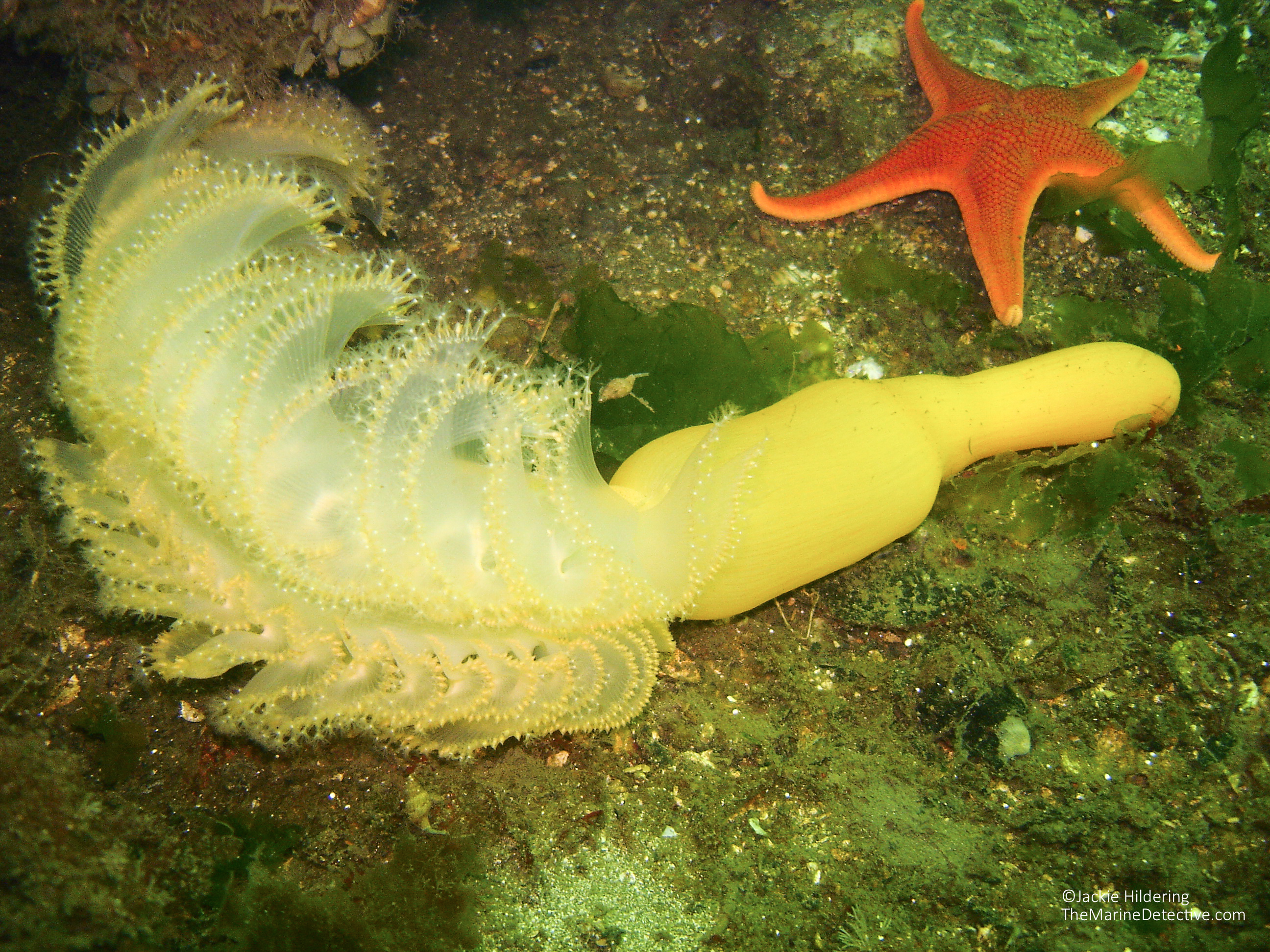
These are the most surreal-looking organisms. Both species are octocorals – colonies of 8-tentacled polyp-like animals. The polyps filter feed on plankton.

Sea Whips can reach a height of 2.5 meters (Balticina willemoesi).
Close-up on the feeding polyps of a Sea Whip.
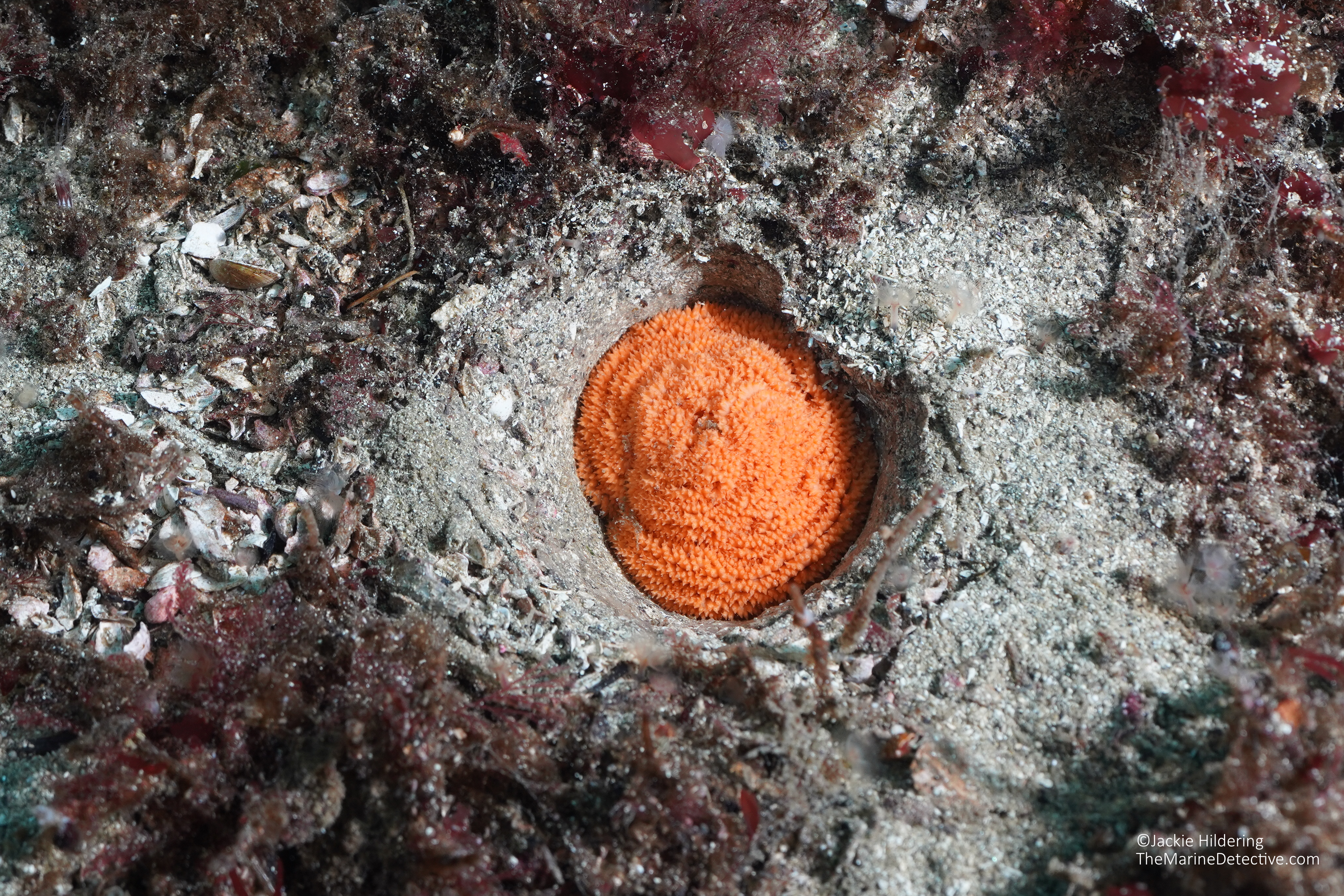
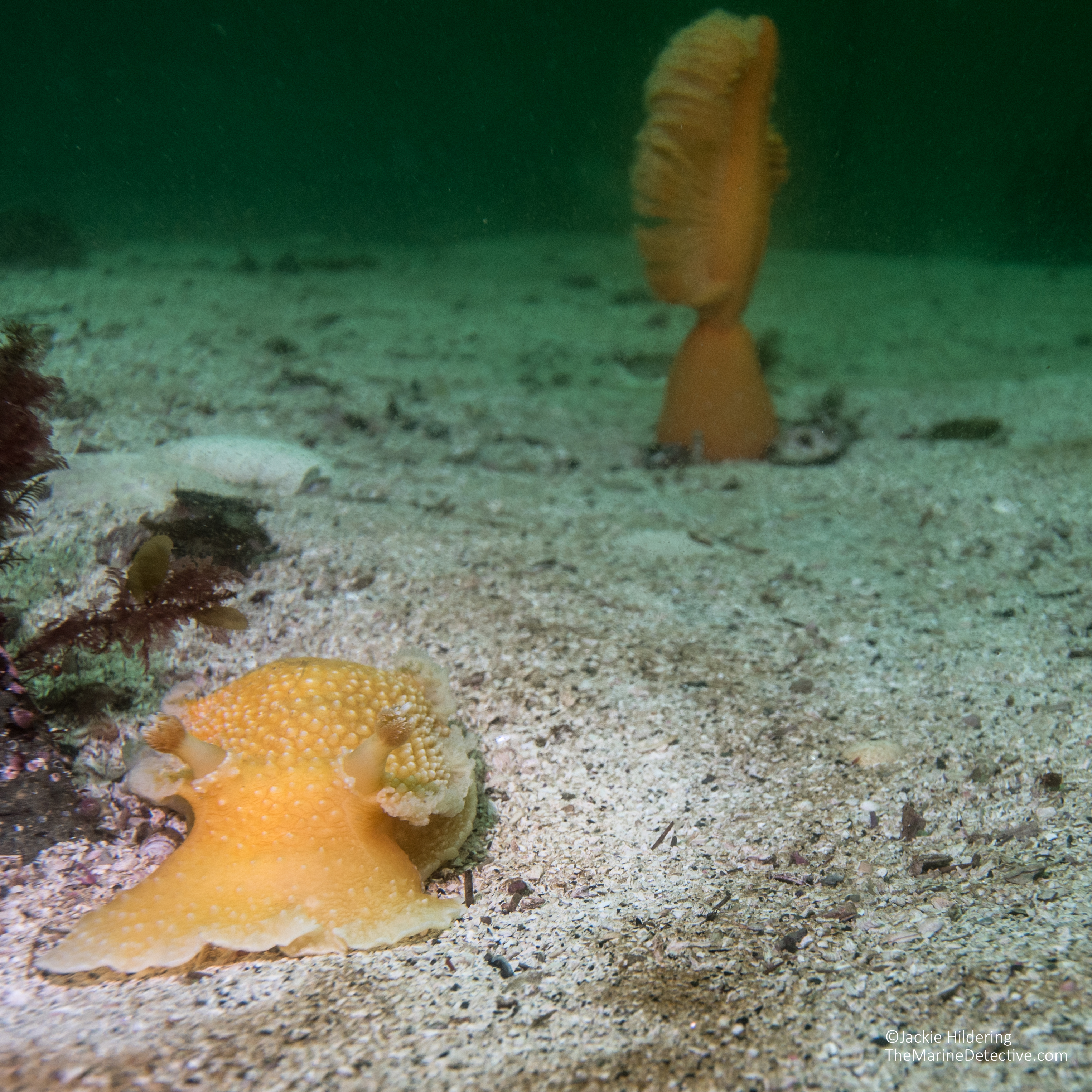
Orange Sea Pens can be up to 48 cm tall (Ptilosarcus gurney).
Close-up on the feeding polyps of an Orange Sea Pen.

Information on Orange Sea Pens from the Monterey Bay AquariumA graceful creature of the seafloor, this sea pen resembles a plump, old-fashioned quill pen. Its colors range from dark orange to yellow to white. Each sea pen is a colony of polyps (small anemonelike individuals) working together for the survival of the whole. The primary polyp loses its tentacles and becomes the stalk of the sea pen, with a bulb at its base—the bulb anchors the sea pen in the muddy or sandy bottom. The various secondary polyps form the sea pen’s “branches” and have specialized functions. Some polyps feed by using nematocysts to catch plankton; some polyps reproduce; and some force water in and out of canals that ventilate the colony.”

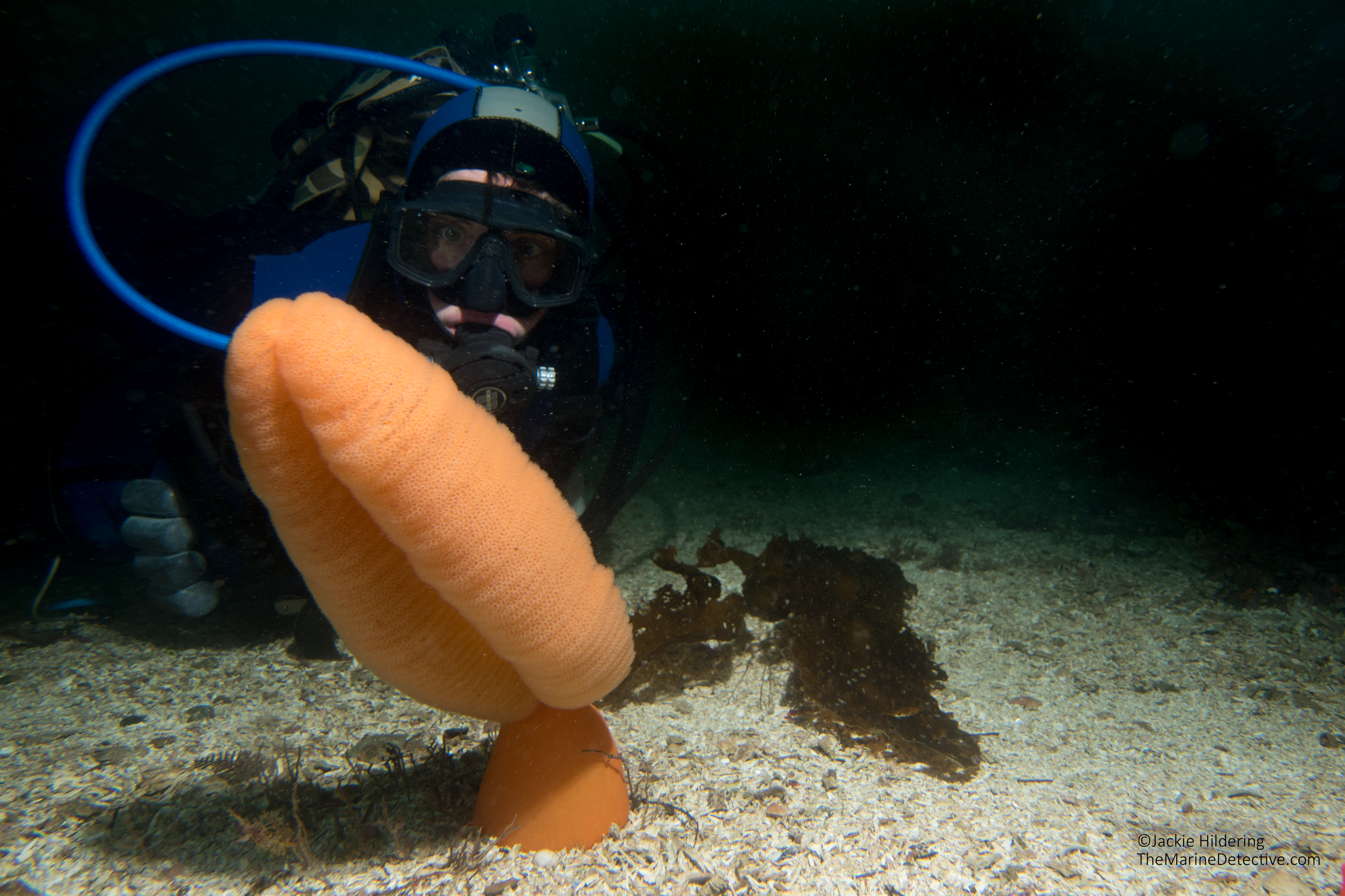
Dive buddy Natasha Dickinson with Orange Sea Pen
Remains of an Orange Sea Pen.

Orange Sea Pen Defences

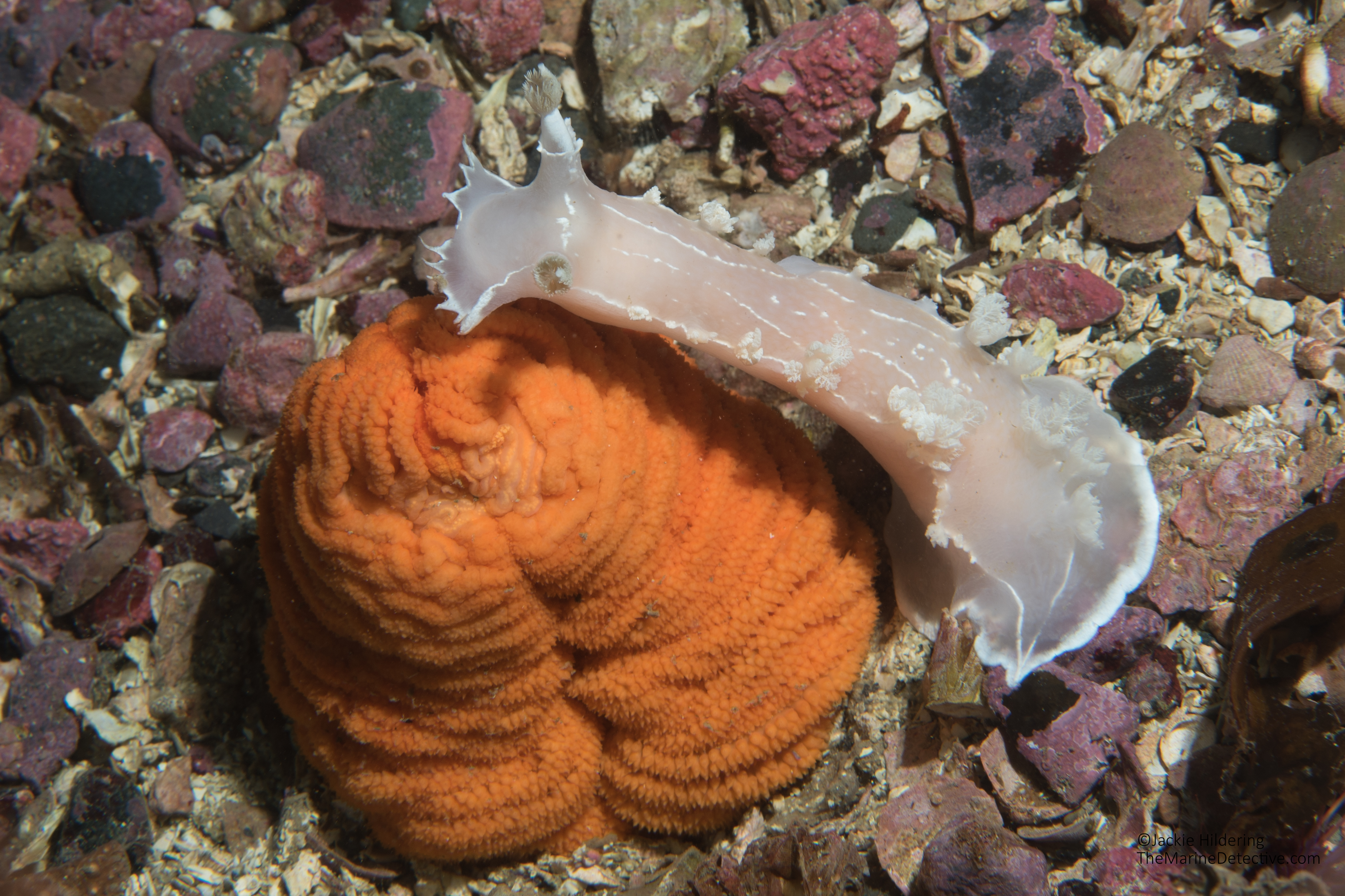
When confronted by sea star and nudibranch predators, Orange Sea Pens can:

1) Deflate, “shrinking” down and into the sand.
2) Inflate, to drift away.
3) Create bioluminescence – making a greenish-blue light that is assumed to somehow deter predators.
4) Produce a toxin but this is poorly understood.

And you thought humans were special! 😉

Deflated and retracted Orange Sea Pen. This can happen within about a minute of first contact from the predator (Wyeth & Willows, 2006 ). From “A Snail’s Odyssey: “A sea pen withdrawn into the sediment does not necessarily mean that it has been attacked or otherwise stimulated.  Studies in Puget Sound, Washington show that sea pens Ptilosarcus gurneyi may inflate and deflate several times a day, and at any given time as few as one-quarter of all individuals are up and feeding.”

From the excellent blog from the Washington State Department of Ecology:

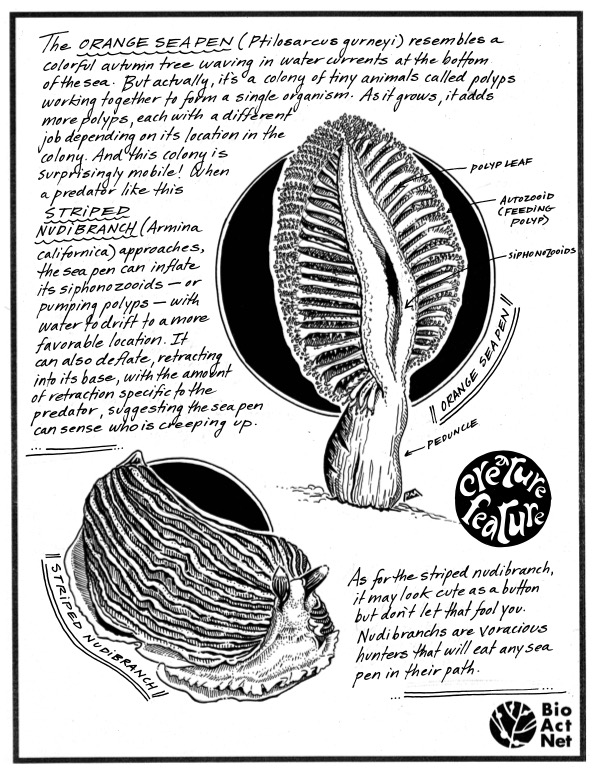
“The orange sea pen is surprisingly mobile, inflating its siphonozooids with water and drifting like a leaf on the wind when it wants to relocate. It can also deflate, partially retracting into its fleshy base when predators come calling. The amount of retraction has been shown to be specific to the approaching predator, which suggests that the pen can actually sense who is creeping up on it . . . Young sea pens are especially vulnerable to predation. They are incredibly slow-growing, taking over a year to reach about an inch tall. Orange Sea Pens increase their chances of survival with sheer numbers — a single pen can produce about a million eggs during its 10-year lifetime.”

Orange Sea Pen having a bad day?  There are 4 predators here and it looks like the Orange Sea Pen was trying to inflate and drift away! But, there was a LOT of current whereby it kept being pushed down. Predators here are a Vermillion Star, two Diamondback Nudibranchs and one Orange Peel Nudibranch.
Orange Sea Pen being attacked by an Orange Peel Nudibranch.
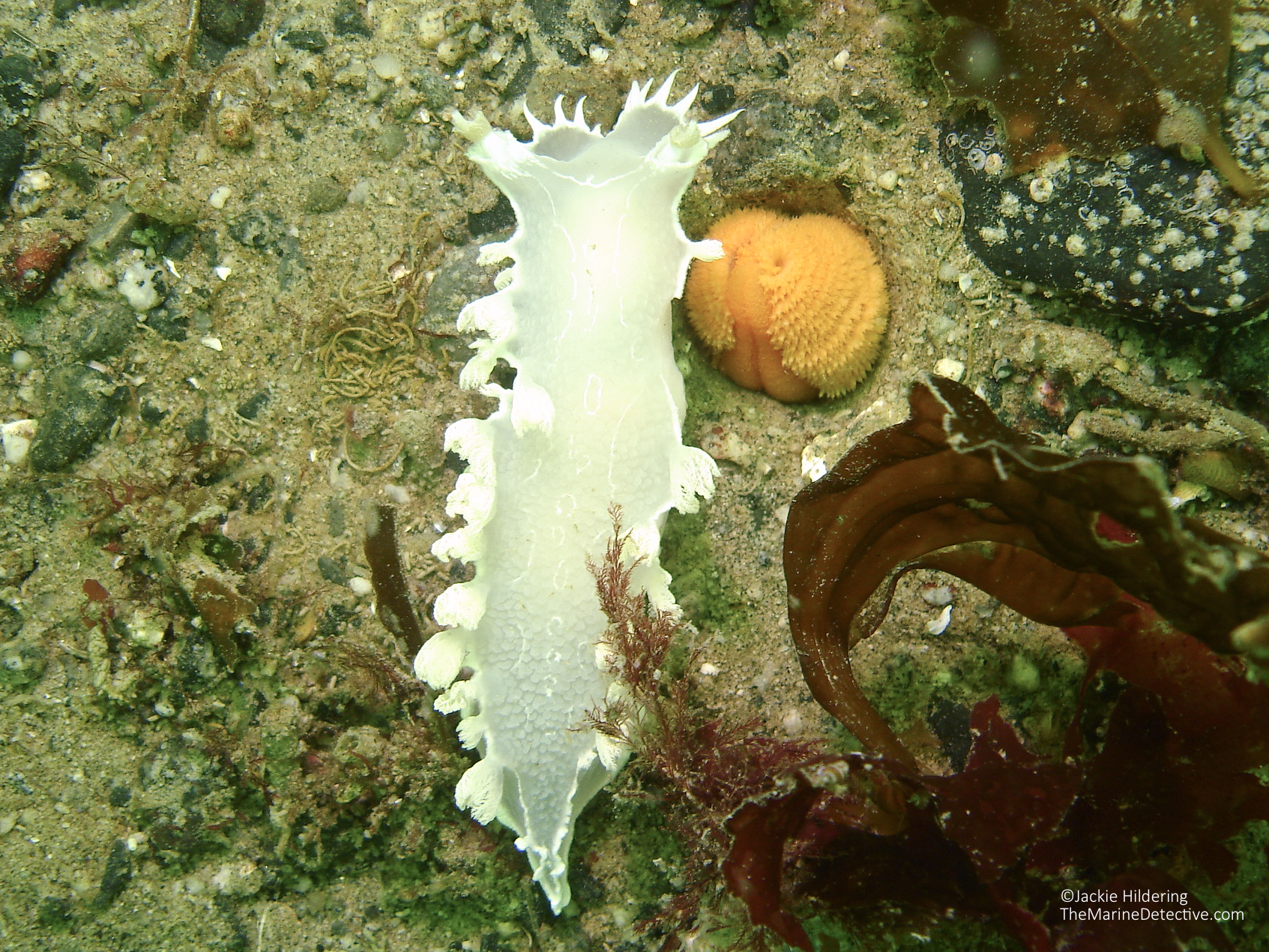
Diamondback Nudibranch (predator) and a partially retracted Orange Sea Pen.
Striped Nudibranch feeding on the “pen” of an Orange Sea Pen. Giant Sea Cucumber on left. 
By Romney McPhie. Click here for the PDF and more colouring sheets!
Orange Sea Pen with inflated base. May have escaped predation this way – inflating and drifting away from the predator.
Retracted Orange Sea Pen and Diamondback Nudibranch.

Inflated Orange Sea Pen and Vermillion Star.

Diamondback Nudibranch approaches its prey, the Orange Sea Pen. From the Washington State Department of Ecology: “The rows of feeding polyps on the feather-like structures “wave their 8 tentacles in the water to catch drifting plankton. These polyps [are] also responsible for producing eggs and sperm that get released into the water column. The siphonozooids, or pumping polyps, are found in the orange regions on the sides of the rachis [central stalk]. Their function is to take in or expel water, allowing the colony to inflate or deflate.”

Diamondback Nudibranch crawling away from a retracted Orange Sea Pen.

Orange Peel Nudibranch with Orange Sea Pen in the background.

The 2.5-minute clip below is of Sea Whips and Orange Sea Pens and the predators that stalk them.

Video: 1-minute of an Orange Sea Pen and Graceful Decorator Crab in the current in front of Port McNeill, BC.


The following BBC video below is from southwest Tasmania in Australia. This is not the sea pen species found in British Columbia. However, I have included it as it shows, with time-lapse photography, how sea pens can deflate and retract in response to predation attempts by nudibranchs.


Diamondback Nudibranch approaching and a White Sea Pen (Virgularia sp to 30 cm tall).


Note that I found very little information about the anti-predator responses of Sea Whips. From Malecha and Stone, 2009:

“For those colonies lying on the seafloor, most of the peduncles and the tissues of the rachis below the polyps (approximately 15 cm) were generally not consumed by Tritonia diomedea. Additionally, predation by nudibranchs on erect Halipteris willemoesi [now Balticina willemoesi ] in the abraded and control groups did not occur. The disinclination of T. diomedea to prey on the lower portion of sea whips lying on the seafloor and their inability to prey on erect colonies perhaps suggests that H. willemoesi [Balticina willemoesi ] may have structural and/or chemical defenses on the tissue above their peduncles that deter epibenthic predators. Typically, chemical defenses are concentrated at the distal portions of colonies where polyp density is greatest, whereas structural defenses are often concentrated near the base of colonies (Harvell & Fenical 1989, Wylie & Paul 1989). The distribution of defenses is perhaps an adaptation to various types of predators and their mode of attack. Therefore, if sea whips have evolved defensive structures located at the base of the colony that are specific to epibenthic, non-swimming predators such as nudibranchs and sea stars, the defenses certainly do not provide protection when sea whips are not erect. Disturbed animals, especially those lying on the seafloor, may be more vulnerable to predation from a wider array of predators since the defenses at their polyps may not be adaptively effective against non-swimming predators. Further study could examine the possible chemical and/or structural defenses of sea whips that are common among octocorals.”


For more information:


Very Rare Fish Find: King-of-the-Salmon (Trachipterus altivelis)

Last updated 2026-01-09
The original post below was about a sighting of this species in Port McNeill in 2012. The blog has since been updated with additional sightings and details (including video about the species astounding feeding adaptations).

King-of-the-Salmon at ~1.5m long. Photo: September 2017 by Collin Jay Johnson; near Tattoosh off Neah Bay Washington; depth ~100 fathoms (180 m).

See below for the extraordinary feeding method of the King-of-the-Salmon by which they extend their jaw. This member of the ribbonfish family belongs off our coast. To date I have not been able to verify if the origin of the name of the species is indeed from Makah legend. 


Here’s a finding to enhance your sense of wonder about the sea and how little we know about its inhabitants.

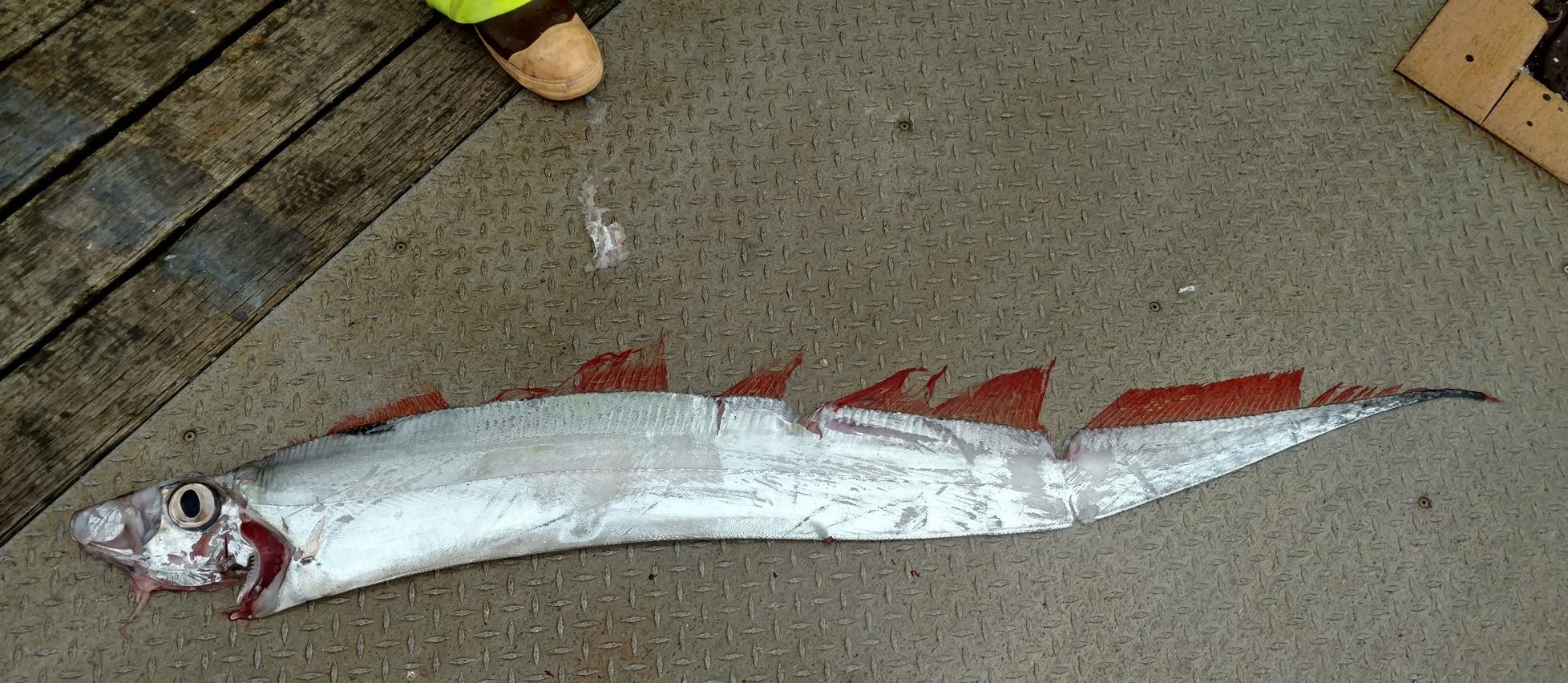
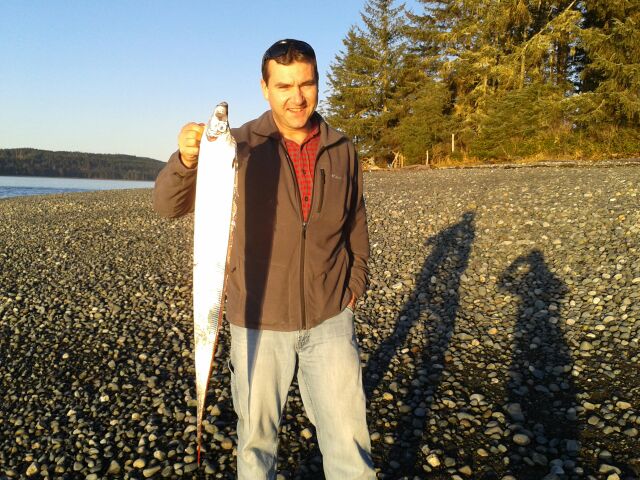
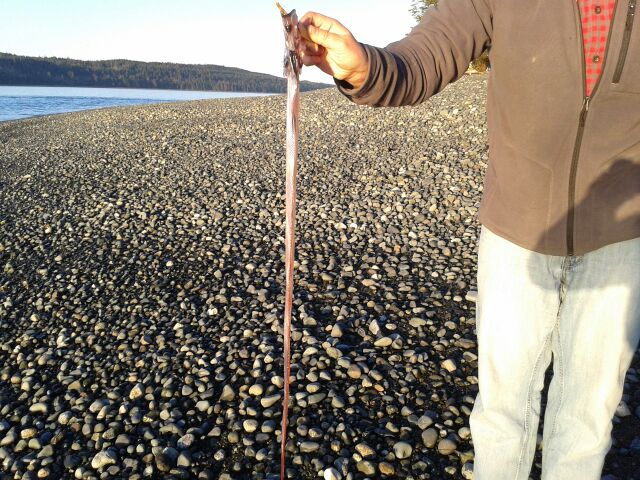
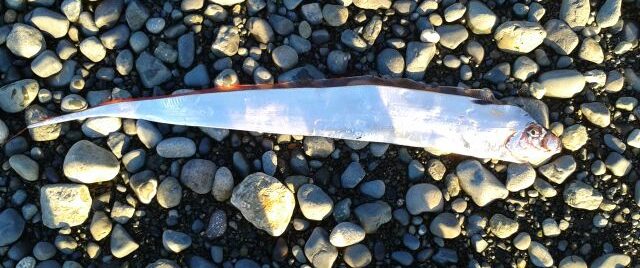
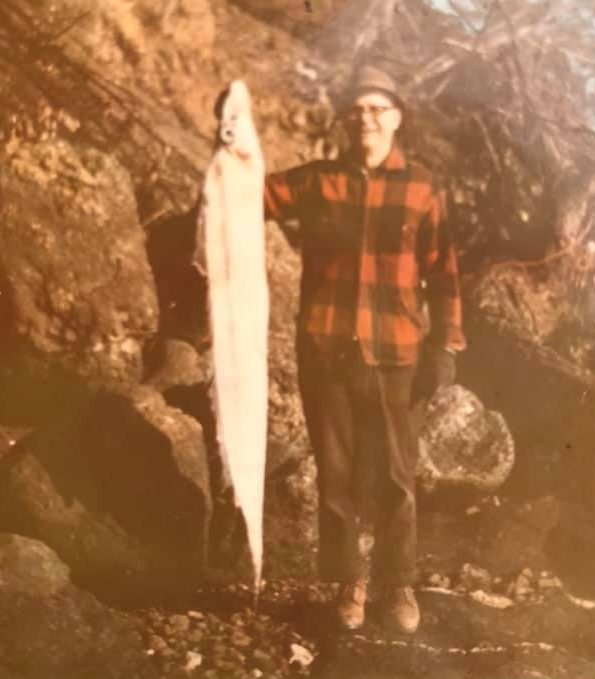
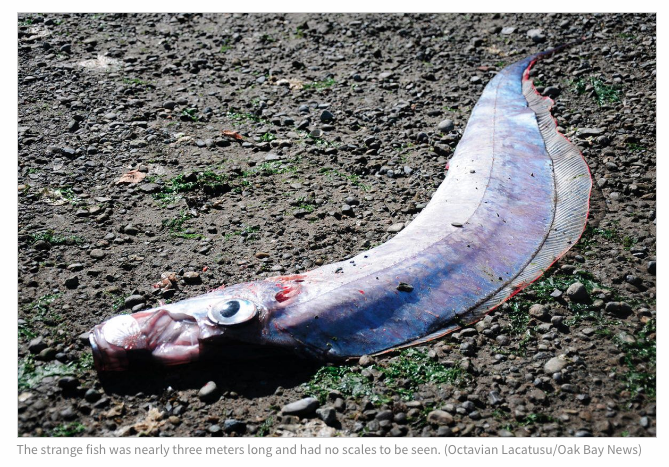
On March 23rd, 2012 Darren and Joanne Rowsell found this dead specimen on the beach at Lady Ellen Point, Port McNeill, British Columbia, Canada. When the photos landed in my inbox, I almost fell off my chair recognizing how rare a find this was. It’s a King-of-the-Salmon (Trachipterus altivelis). The adults feed in the open ocean at depths of 900+ m (3,000 feet) so they hardly ever wash ashore and I had never seen one before.

Darren Rowsell with the King-of-the-Salmon found on March 23rd, 2012 near Port McNeill. Photo Joanne Rowsell.
Easy to see why the King-of-the-Salmon belongs to the ribbonfish family. Photo Joanne Rowsell.

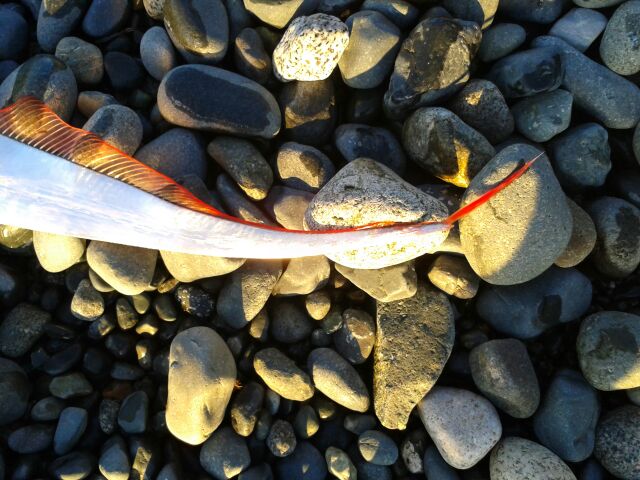
The King-of-the-Salmon belongs to the ribbonfish family (Trachipteridae). You’ll note from Joanne’s photos that the species is indeed very ribbon-like. It is extremely thin and maximum confirmed length is 2.45m (Savinykh and Baitalyuk. 2011). The long, high, crimson coloured dorsal fin is also very reminiscent of a ribbon, tapering down the full length of the fish’s back. These fish move in a snake-like fashion, undulating their long bodies.

The unique common name of the King-of-the-Salmon is said to originate from Makah First Nation legend. The legend is said to be that the fish was believed to be the “king” that would lead salmon back to their rivers to spawn and that to kill one was believed to bring bad luck, causing the death of the salmon.  The Makah, like other fisherfolk, must occasionally have caught one on their lines or in their nets. HOWEVER, I have never been able to verify if this is indeed a Makah legend.

King-of-the-Salmon. Photo Joanne Rowsell.
King-of-the-Salmon’s dorsal fin extends all the way down its back.
Photo Joanne Rowsell.

Video ©Josh Billauer showing the dorsal fin of a King-of-the-Salmon – November 2025 near San Diego.

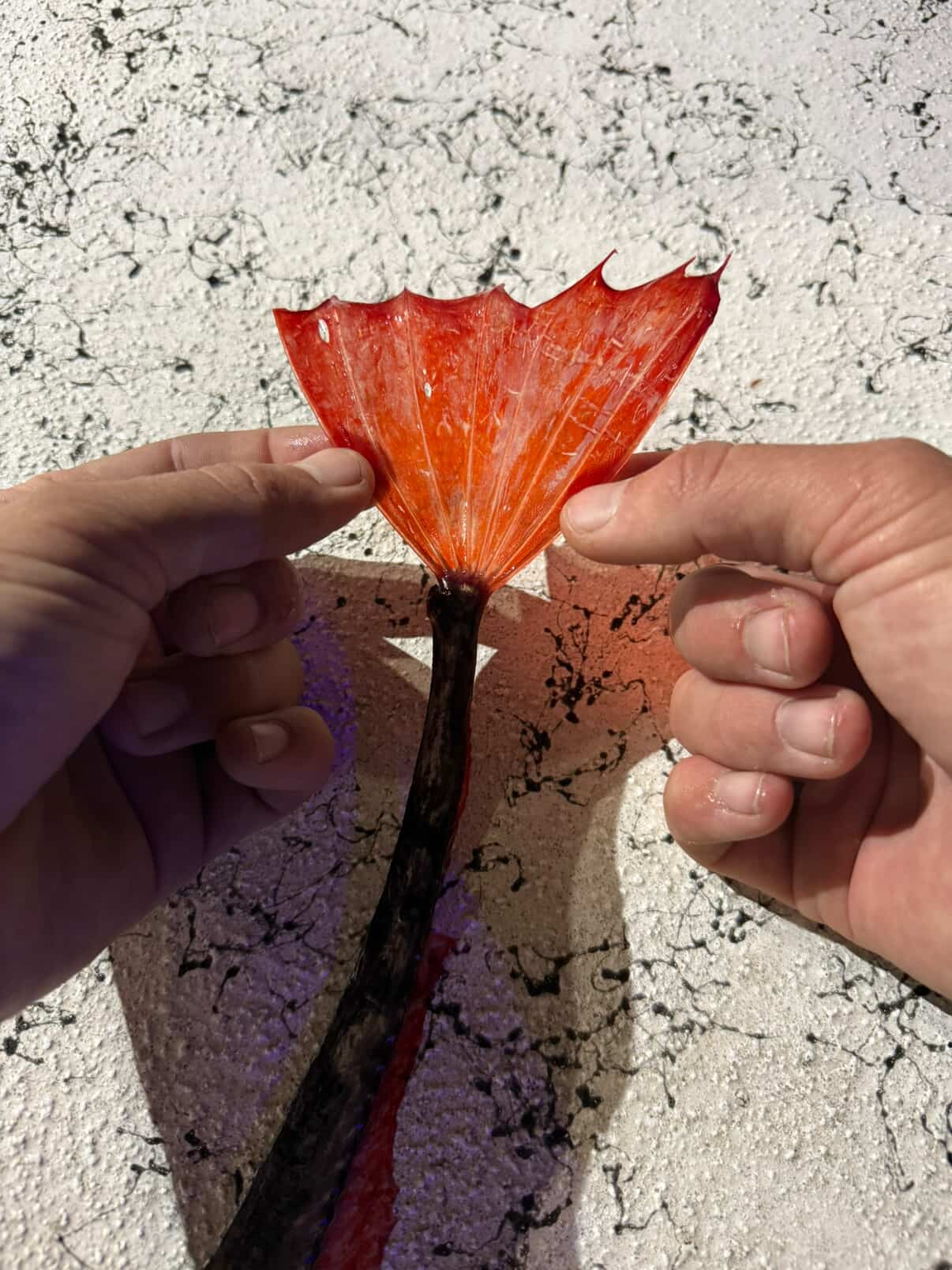
Caudal fin / tail of a King-of the-Salmon ©Josh Billauer – November 2025 near San Diego.

Range:

The species’ range is believed to be from the Gulf of Alaska to Chile.

King-of-the-Salmon found at Freshwater Bay, Clallam County, Washington in 1973, by Oscar Stigen. Photo provided by his daughter Jean Stigen.

Diet and Feeding Method:

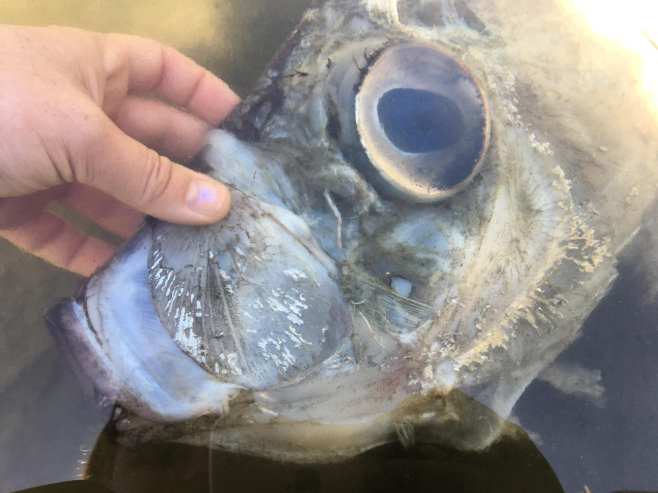
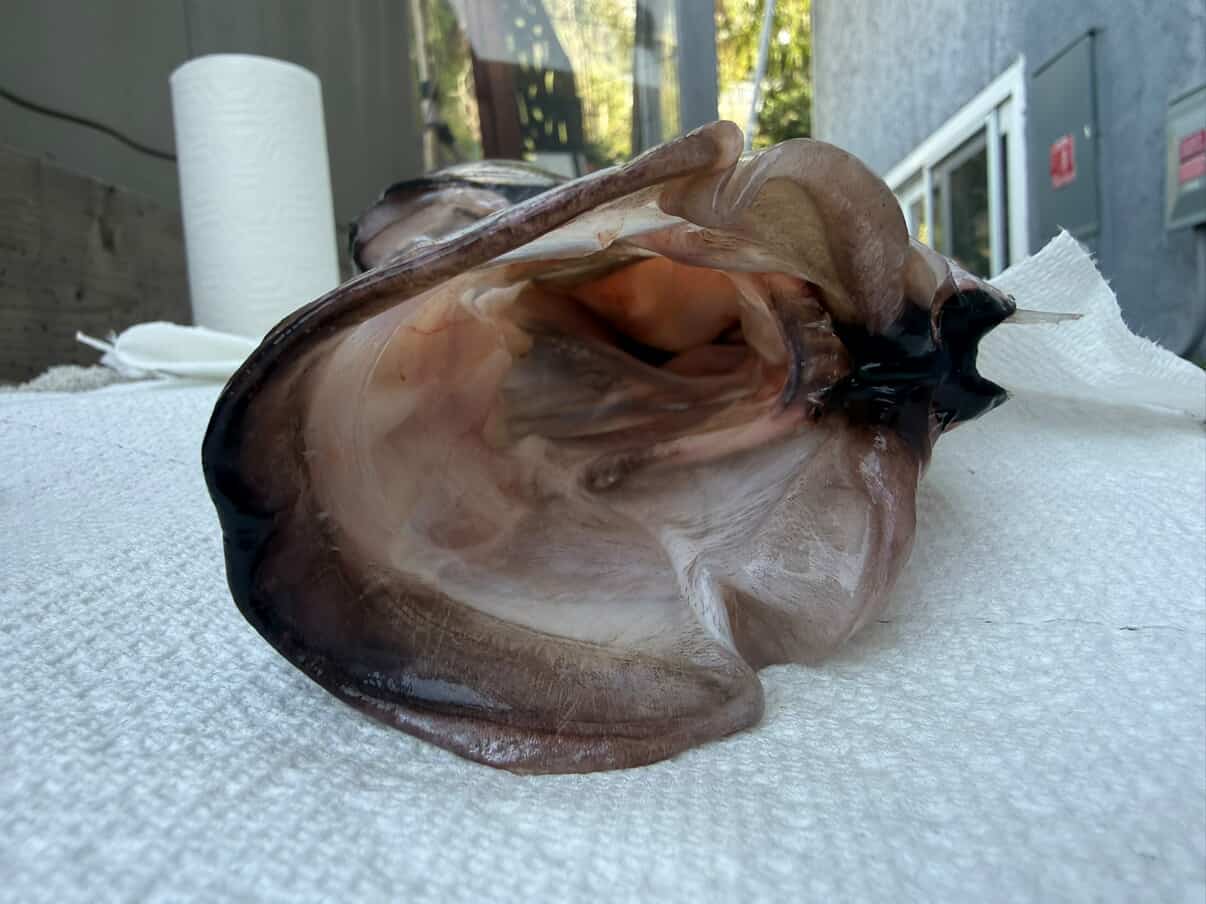
Smaller King-of-the-Salmon do feed closer to shore and their diet is known to include copepods, annelid worms, fish scales, and fish larvae. Larger individuals feed on copepods, krill (euphausids), polychaetes (bristle worms, small pelagic fish, young rockfish, squid, and octopus.  Part of what makes the species so unique is that they can capture (and process prey) by extreme protrusion of the upper jaw. See photos below.

From Ferry, et al (notably the ONLY research I could find on this species): “T. altivelis does appear to have earned the title of “most extreme”in terms of premaxillary protrusion. The distance to which the upper jaw is protruded anteriorly away from the head exceeds that of any other known species  . . .the gut was examined in an attempt to gain further insight into this speciesecology. The gut was empty, but the anatomy was unusual and potentially suggestive of extreme foraging habits. There were hundreds of very small diverticuli lining the gut, which suggest to us a mechanism for increasing digestive surface area and/or efficacy. This species has been described as a deep-midwater forager on crustacean zooplankton (Hart, 1973; Shenker, 1983), which is consistent with such mechanisms.”

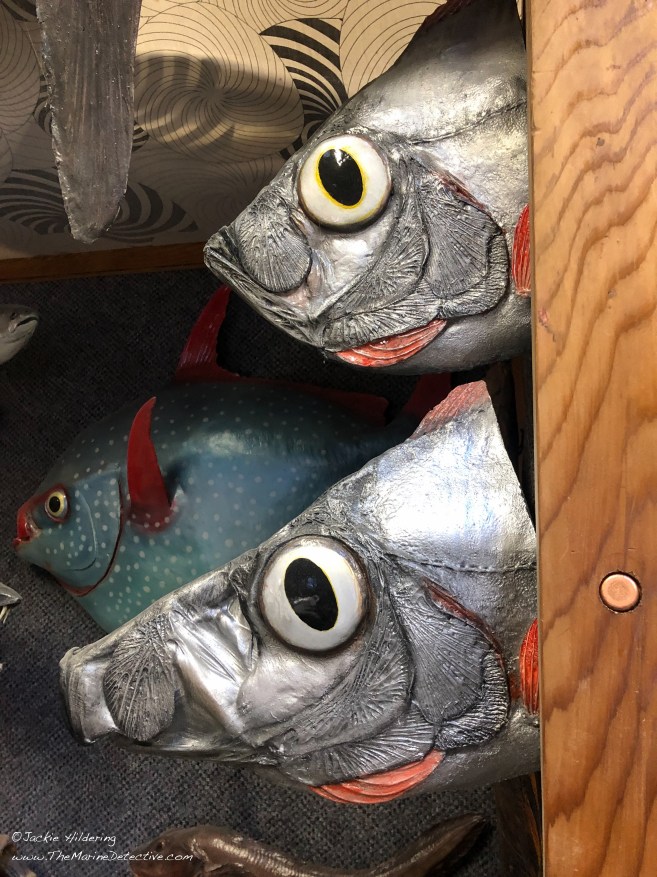
Replicas of the head of the same King-of-the-Salmon by Bilz Rockfish. Compare the top and bottom photo (cast from the SAME fish) to see the extreme capability of this fish to extend its jaw.  learned that the nose can push outward as you see by contrasting the top and bottom casts (from the same fish).
Photo: Harbor Wildwatch, June 8, 2020 which allows for insight into the protrusion method this fish uses to eat.

Video ©Josh Billauer showing how the King-of-the-Salmon can protrude its jaw – November 2025 near San Diego.

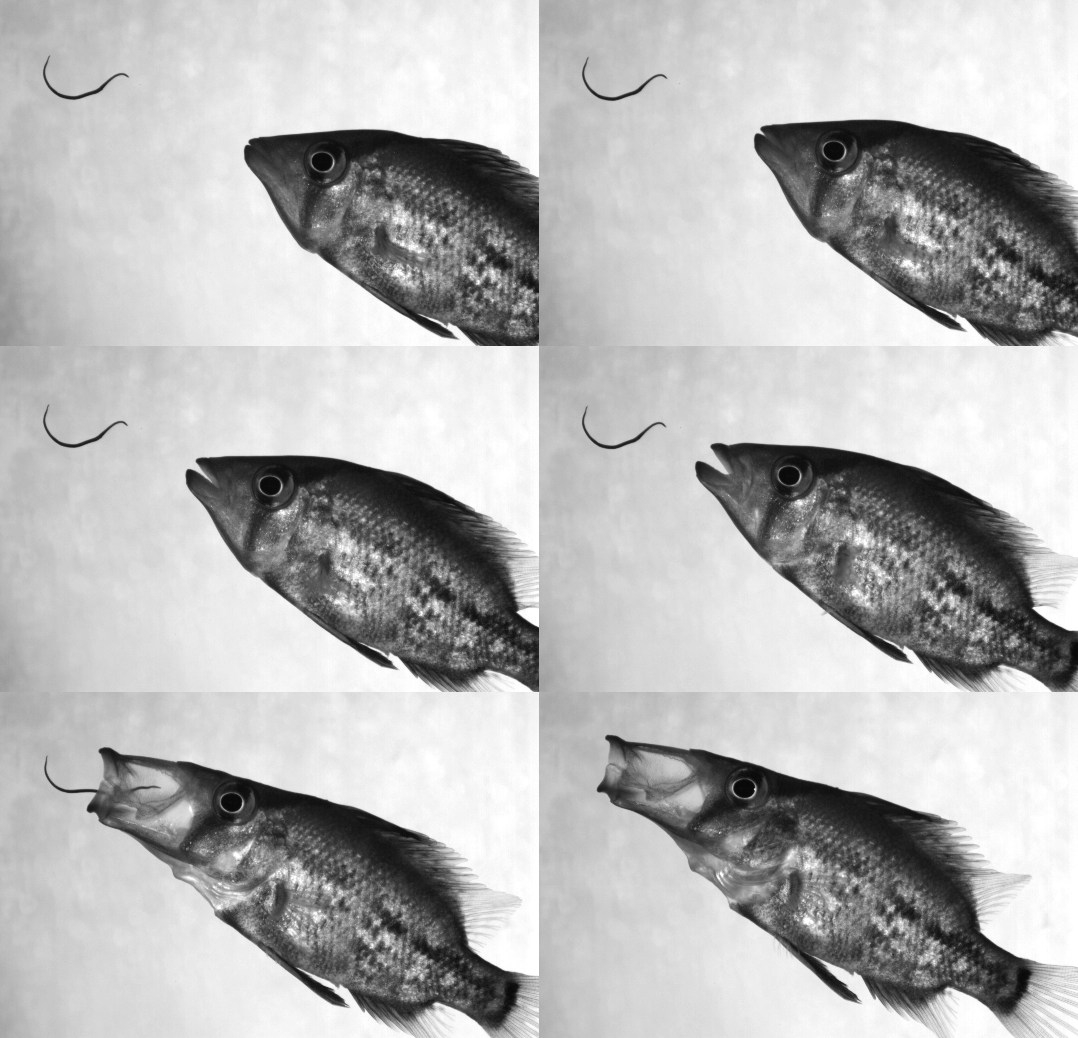
A different species but provides some insight into how fish jaws can protrude. Species in this slow-mo GIF is “the Neotropical cichlid, Caquetaia myersi, showing off its highly protrusible jaw while feeding on a black worm.” Source: Martinez et al.
Photo into the upper jaw of a King-of-the-Salmon ©Josh Billauer – November 2025 near San Diego.


Predation:

I presume that stomach content studies have allowed science to determine that the predators of the King-of-the-Salmon include the Bigeye Thresher Shark (Alopias superciloosus), and the Longnose Lancetfish (Alepisaurus ferox).

Swimming: 

From Dr. Gavin Hanke of the Royal BC Museum: “King-of-the-Salmon swim by passing a sine wave down their dorsal fin – they can get a fair bit of speed just by doing that. They can also reverse using the same fin flutter. They slowly turn by putting a curve in the body. However, in the first few seconds of the linked video you can see that they also swim in a more typical fishy way (using eel-like body oscillation) when they need a burst of speed or a really quick turn.” See video below of one swimming.


And THAT appears to be all that is known about the King-of-the-Salmon – yet another one of our remarkable marine neighbours.

From Ferry, et al (2019): ” While much work remains regarding the ecology of T. altivelisa nd its relatives, it is certain that this fish holds many surprises yet in store”. No doubt!


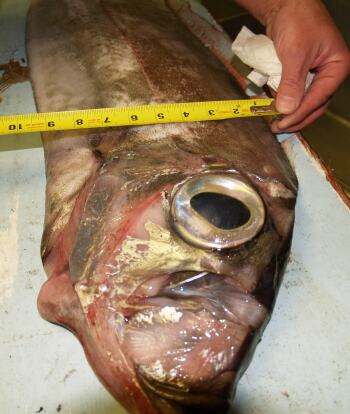
King-of-the-salmon found near Salem, Oregon in 2006. 1.83 m (6 foot) long and the head was about 23 cm (9 inches) wide. Source: Salem News; July 23, 2006; "Strange Fish Found on Beach Near Seaside" Click here to read the story.
King-of-the-Salmon found near Salem, Oregon in 2006. 1.83 m (6 foot) long and the head was about 23 cm (9 inches) wide. Source: Salem News; July 23, 2006; “Strange Fish Found on Beach Near Seaside”. Click here to read the story.

Sources:


Sightings from Washington and BC – photos and video.
NOT a comprehensive account of all sightings!


2021

May 12, 2021: King-of-the-Salmon washed up at Witty’s Lagoon near Mechosin documented by John Michael Thorne. 


2020

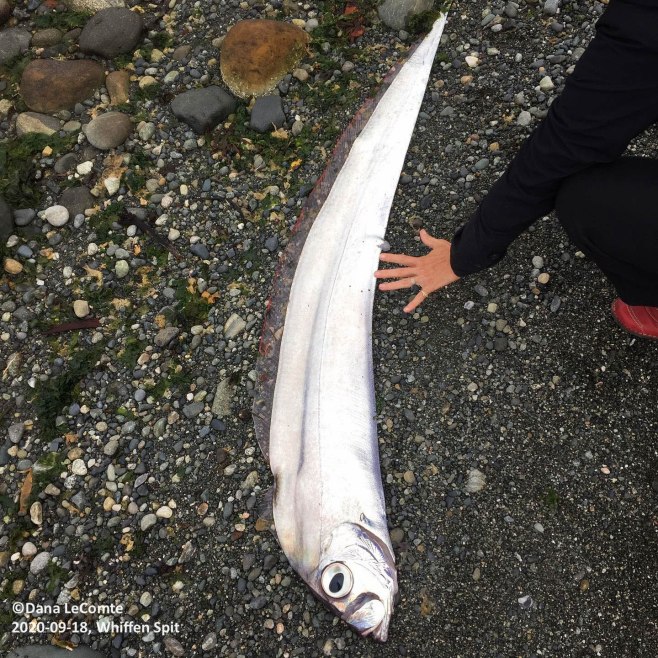
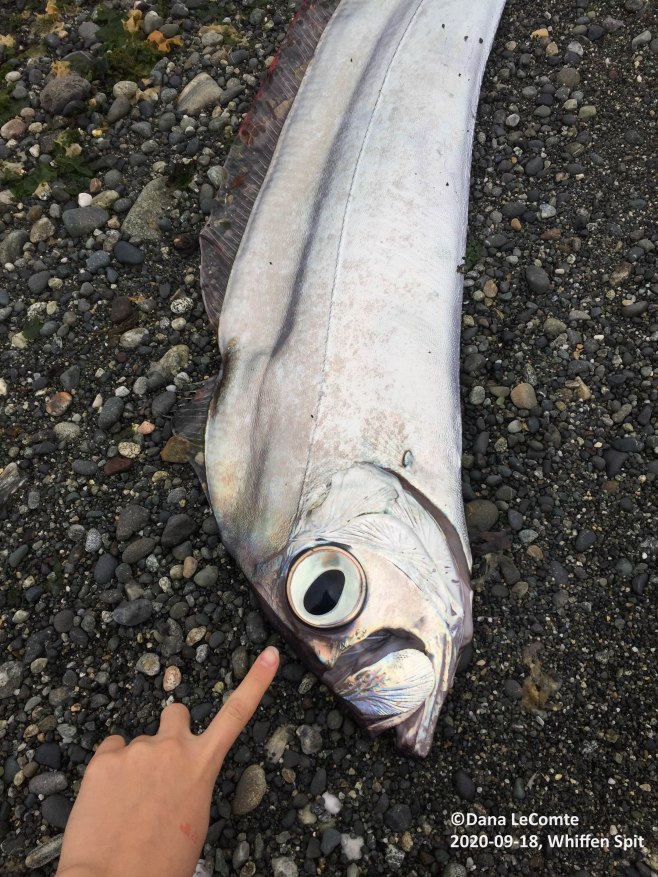
September 18, 2020: King-of-the-Salmon washed up at Whiffen Spit (Sooke) documented by Dana LeComte (photos below).

July 18, 2020: Live King-of-the-Salmon documented by Gary Bodine at Pillar Point, Washington. 

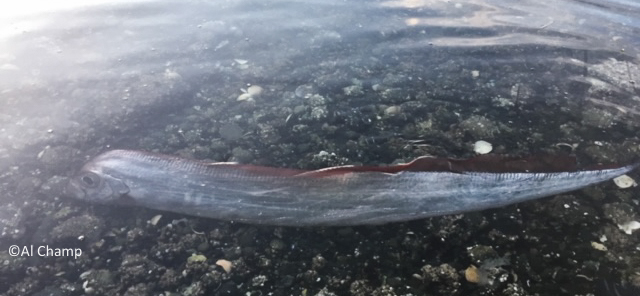
June 24, 2020: ~1.5 m long King-of-the-Salmon found struggling to stay upright by Al Champ and Wendy Cooper in East Sooke (photo below).

June 24, 2020 : ~1.5 m long King-of-the-Salmon in poor condition found by Al Champ and Wendy Cooper in East Sooke, across from the Sooke River. They strived to help it on its way but ran out of daylight, finding it was getting weaker and weaker and that it made no attempt to swim away.  

June 8, 2020: King-of-the-Salmon documented by Harbor WildWatch in Salt Creek, west of Port Angeles, Washington. They provided the insight that “We speculate that this individual swam too close to shore and was killed by the waves as there was no evidence of predation. These are thin delicate fish adapted to the deep ocean. The tide pushed it up into the creek where it was discovered.”


2019

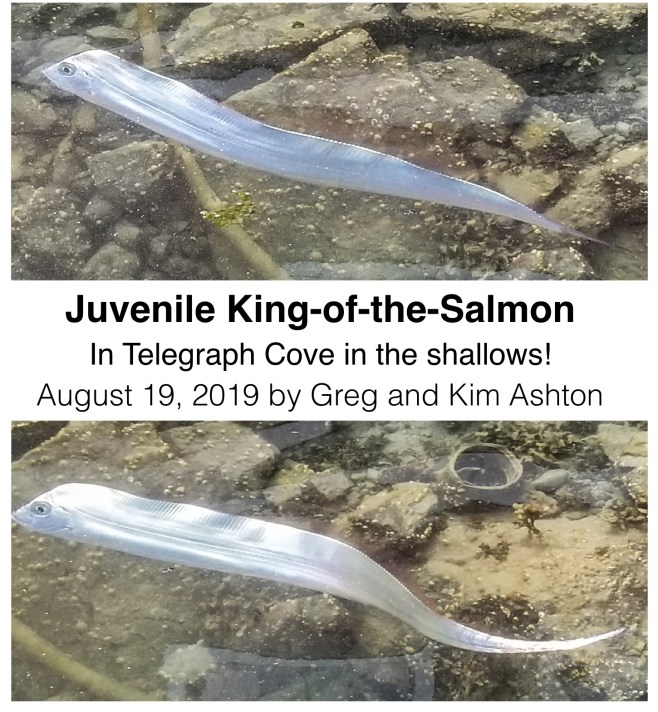
Sighting of a King-of-the-Salmon August 19, 2019 (at least 70 cm long). Greg and Kim Ashton relayed how “We had just tied up our boat in the marina and were walking to shore when Kim spotted what at first we thought was an eel, but quickly realized it wasn’t but some type of fish we had never seen before. It was in five to six feet [~2m] of water and then swam up into shallower water . . . I was amazed at how it seemed to be looking at us and how brightly colored chrome-like its body was . . .”. Video of this individual (below) reveals this individual may not have been healthy.

2017

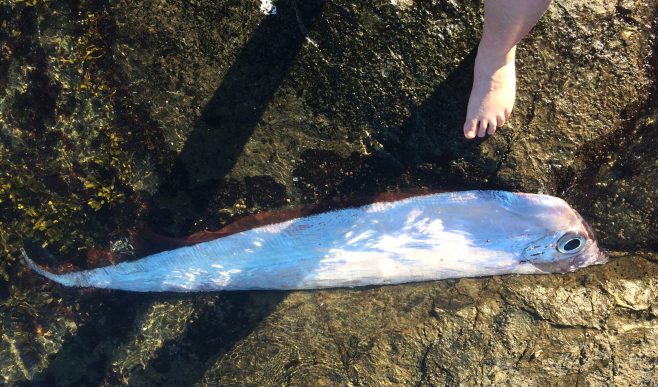
King-of-the-Salmon found near Oak Bay, British Columbia on September 21, 2017 by Ben Clinton Baker. It will end up on display in the Shaw Centre for the Salish Sea in Sidney, British Columbia. Photo: Oak Bay  

Second King-of-the-Salmon found near Oak Bay in September 2017. Photo: Emily Walsh, September 26, 2017.
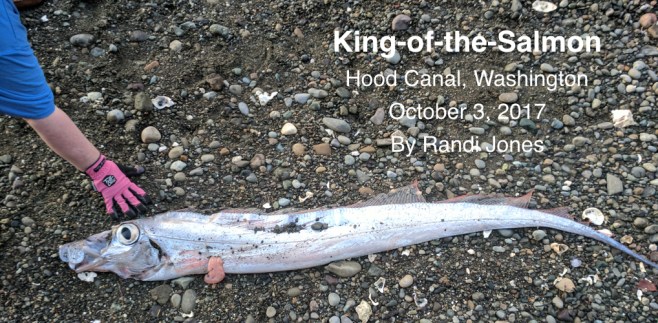
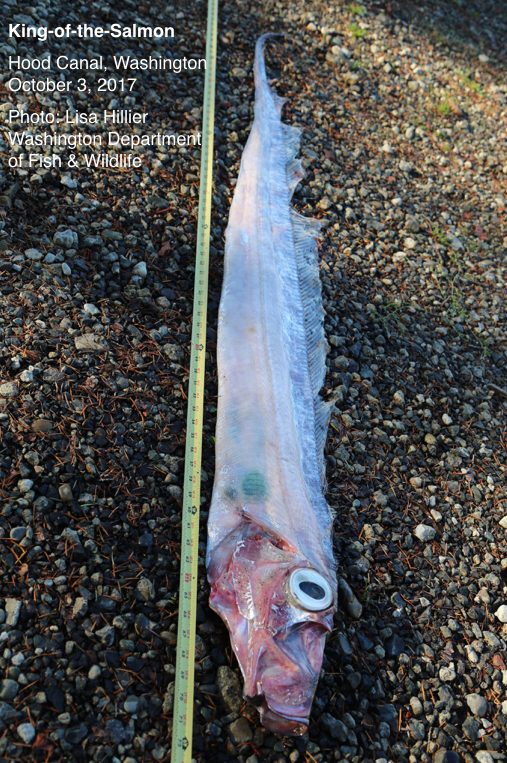
Third found: 1.8 m long female King-of-the-Salmon found on October 3rd, 2017 off Hood Canal, Washington by Chris and Randi Jones. As relayed to Randi by Davy Lowry of the Washington Department of Fish and Wildlife “this is the first reported occurrence of this species in Hood Canal ever, and the only other one found in Puget Sound was discovered on a beach back in the 1990s near Tacoma.”
Same fish as in the photo above. Female King-of-the-Salmon found off Hood Canal, Washington on October 3, 2017 by Chris and Randi Jones. It was 1.8 m long (71′) and 3.3 kg (7.25 lb) and necropsy found that “there was nothing in the gut to indicate it had eaten recently”.  and Photo: Lisa Hillier; Washington Department of Fish & Wildlife. 
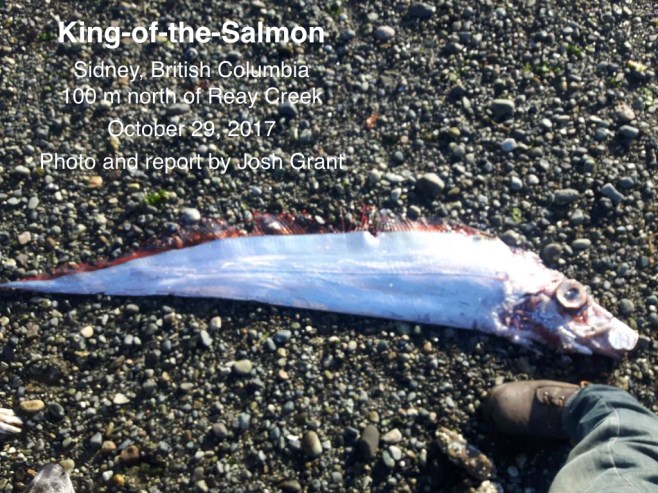
Fourth King-of-the-Salmon found in the fall of 2017 in southern British Columbia / northern Washington. This one was found on October 29th near Sidney British Columbia 100 m north of Reay Creek. Report and photo by Josh Grant. Coordinates: 48°38’03.3″N 123°24’22.7”W

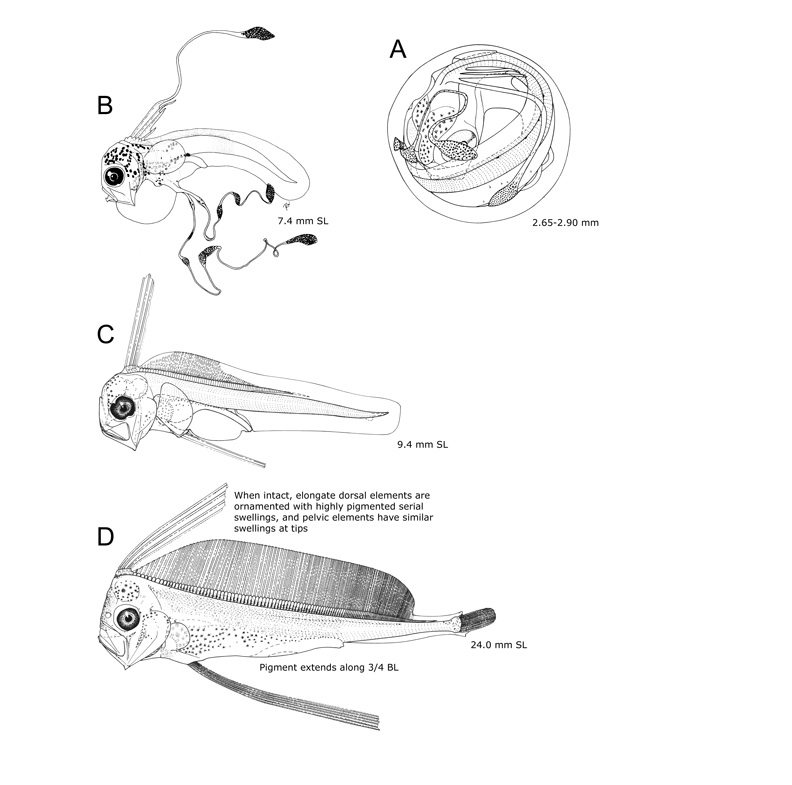
 Plankton life stages of the King-of-the-Salmon

Source: http://access.afsc.noaa.gov/ichthyo/LHDataIll.cfm?GSID=Trachipterus!altivelis
Credits:
A: Matarese, A.C., and E.M. Sandknop. 1984. Identification of fish eggs. In H.G. Moser, W.J. Richards, D.M. Cohen, M.P. Fahay, A.W. Kendall, Jr., and S.L Richardson (eds.), Ontogeny and systematics of fishes. Spec. Publ. 1, Am. Soc. Ichthyol. Herpetol., p. 27-31. Allen Press, Lawrence, KS, 760 p.
B: Charter, S.R., and H.G. Moser. 1996.Trachipteridae: Ribbonfishes. In H.G. Moser (ed.), The early stages of fishes in the California Current region. CalCOFI Atlas 33, p. 669-677. Allen Press, Lawrence, KS, 1505 p.
C and D: Matarese, A.C., A.W. Kendall, Jr., D.M. Blood, and B.M. Vinter. 1989.
Laboratory guide to early life history stages of Northeast Pacific fishes. NOAA Tech. Rep. NMFS 80, 652 p.

Otoliths / Ear Bones

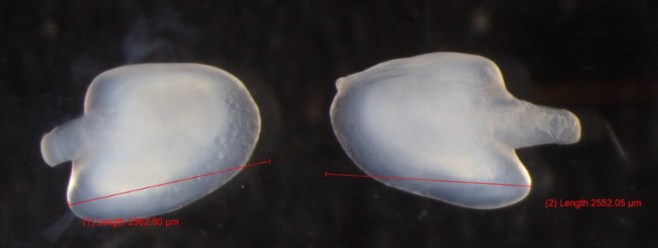
Photo above and the following information was shared by Micah Quindazzi who is a masters student at the University of Victoria studying the King-of-the-Salmon. He extracted the ear bones (otoliths) of two full-grown adult King-of-the-Salmon (the September 18, 2020 and February 6, 2019 individuals). The photo shows the left and right otoliths from the September 18th individual. He shared that it is notable that the otoliths are tiny in comparison to the body size of the fish.

“R” We Getting It? Reflections for Earth Day – April 22nd

Earthling design by Kitty Chan. The "Earthlings" were a school environmental group I had the joy of working with in the 1990s in Rotterdam. Kitty allowed me to use this as the logo for my company "Earthling Entreprises".

Reduce, Reuse, Recycle!

Reduce, Reuse, Recycle!

Like automatons we can chant out this slogan when asked what we can for environmental good, so successfully ingrained is the motto believed to date back to the first Earth Day on April 22nd, 1970. For many of us, the chanting is accompanied by visions of blue boxes and the logo with 3 arrows.

Is this good, or bad?

It is of course good that the solution for reducing waste is so well known. That the solution can be captured in just 3 words also certainly makes the point that it’s pretty simple to live more sustainably.

Except, something got lost along the way.

It is not Reduce, Reuse, Recycle.

It is REDUCE –> Reuse –> Recycle. The 3R slogan was born as the “waste hierarchy”. The 3 actions are not equal. “Reduce” is far, far more important than “Reuse” and the least impactful of the 3Rs is “Recycle”.

To use the case of the plastic water bottle to emphasize this, yes, you can recycle the bloody thing so it is not part of the legacy of plastics drifting and seeping around the planet BUT it shouldn’t even exist in the first place (at least in the developed world.) The tap water on northern Vancouver Island is of very high quality and by using it, you avoid the chemical and energy cost of the bottle being made, transported and . . . recycled.  If you have more urban tap-water, filtering can solve the issue of any taste you may not enjoy. 

Having the great privilege of working with children to help them feel empowered in a world with a lot of environmental gloom, I’ve polled them to find out what they believe to be the most important “R”. Almost always, the answer is “Recycle”.

Oops. This isn’t good. This really isn’t good. The shiny, most powerful, most hope-inspiring gem of environmental change has been misidentified. Striving to “Reduce” consumption of resources is the most powerful tool against all environmental problems; from waste management, to bioaccumulation and climate change. It is also the “R” that will give you the greatest bang for your buck – a buck you can cash in at the bank of happiness. Less misspent cash on disposable, nondurable and frivolous items and less wasted energy and other resources, means greater freedom from the consumer paradigm and a greater sense of hope for the future.

Earthling design by Kitty Chan.

How is that the most powerful “R” has become misidentified and that the whole concept of the 3R hierarchy has become lost? Is it because recycling is something tangible where it is difficult to visualize the action of “reducing”? I would argue that this should not be the case. 

“Reducing” should be the great green common denominator.

To use some examples applicable to teaching: we are leaving half the lights off in the classroom to use LESS energy; please use the paper in the recycling bin so we use LESS paper; close the door so we waste LESS heat; and how wonderful that you are using a reusable container for your lunch so there are LESS baggies bulging from school garbage cans and swirling around school yards. You get the idea.

Is it then because recycling allows us to have our plastic wrapped cake and eat it too? Certainly this is how the oh-so-powerful and oppressive consumer paradigm wishes to manipulate us i.e. “We’ll green-up making you feel less consumer guilt, but you’ve got to keep buying in the volume to which we’ve become accustomed”.

Or, are there many of us that don’t really believe how essential it is to get our act together for future generations and that by recycling we deliver an act of appeasement, just in case?

If you have read this far, thank you, for you are a significant player in creating positive environmental change. That’s the irony of writing an item such as this – it won’t reach the audience that needs to change the most; those who do not even recycle.

You care enough to want to refine what it is you already do.

Know that this is not about being perfect. It is about ensuring that our efforts have the greatest net gain and that we recognize the power that lies in “Reduce”.

Simply stated, less is more – more positive impact; more financial liberty; and more empowered, shiny-eyed, happy and healthy children in a future we cannot see.*

*Inspired by the quote “Children are the living messages we send to a time we will not see”  by John W. Whitehead. 

Earthling design by Kitty Chan.

Earthling design by Kitty Chan.

Buffalos Mating . . . Underwater!

That’s right, it’s mating season for buffalos   . . .  Buffalo SCULPINS that is!

Now that I’ve lured you to this posting with the procreation of a huge, shaggy terrestrial mammal on your mind  . . . let me show you the spawn of this wondrous fish.

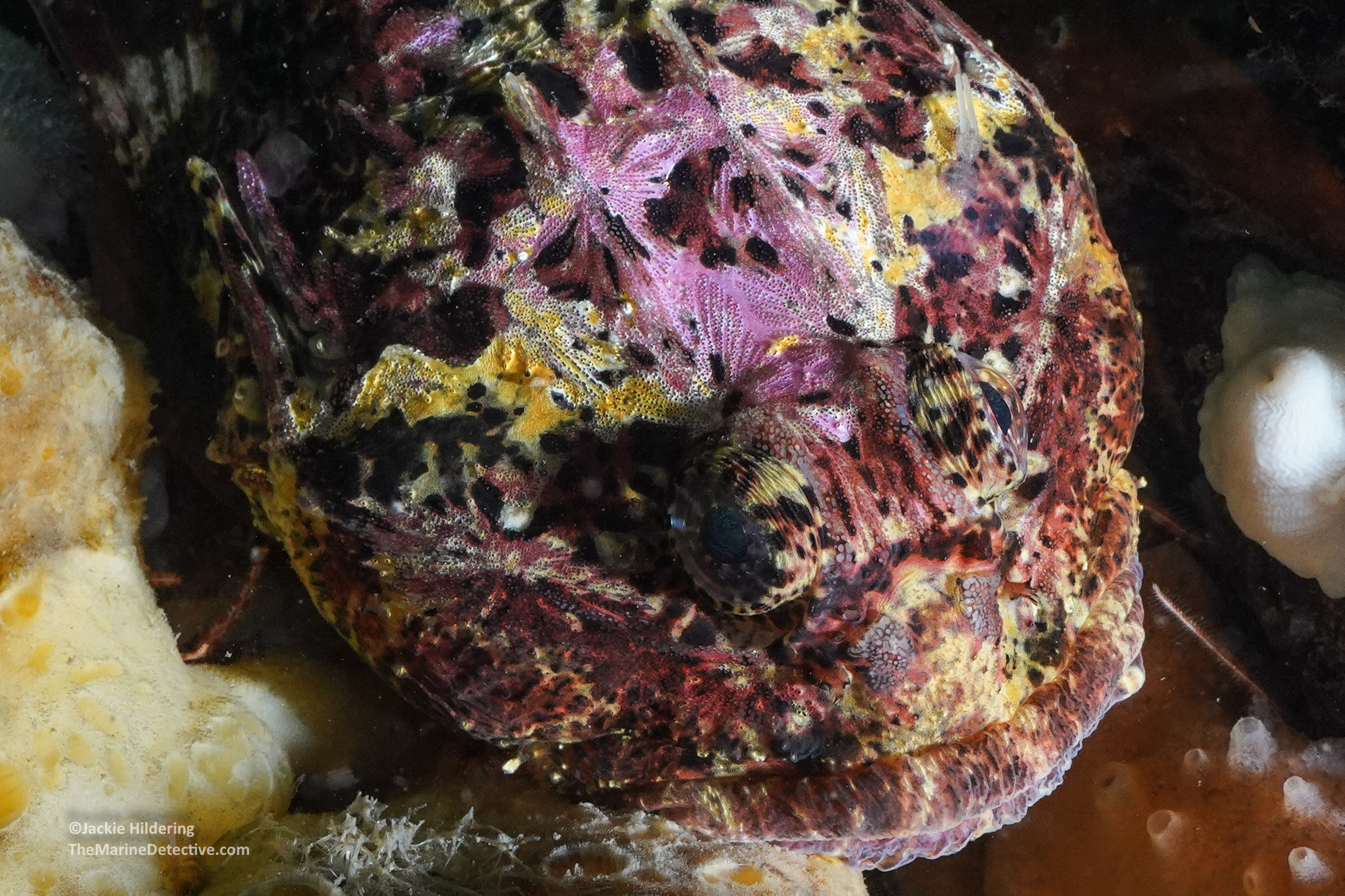
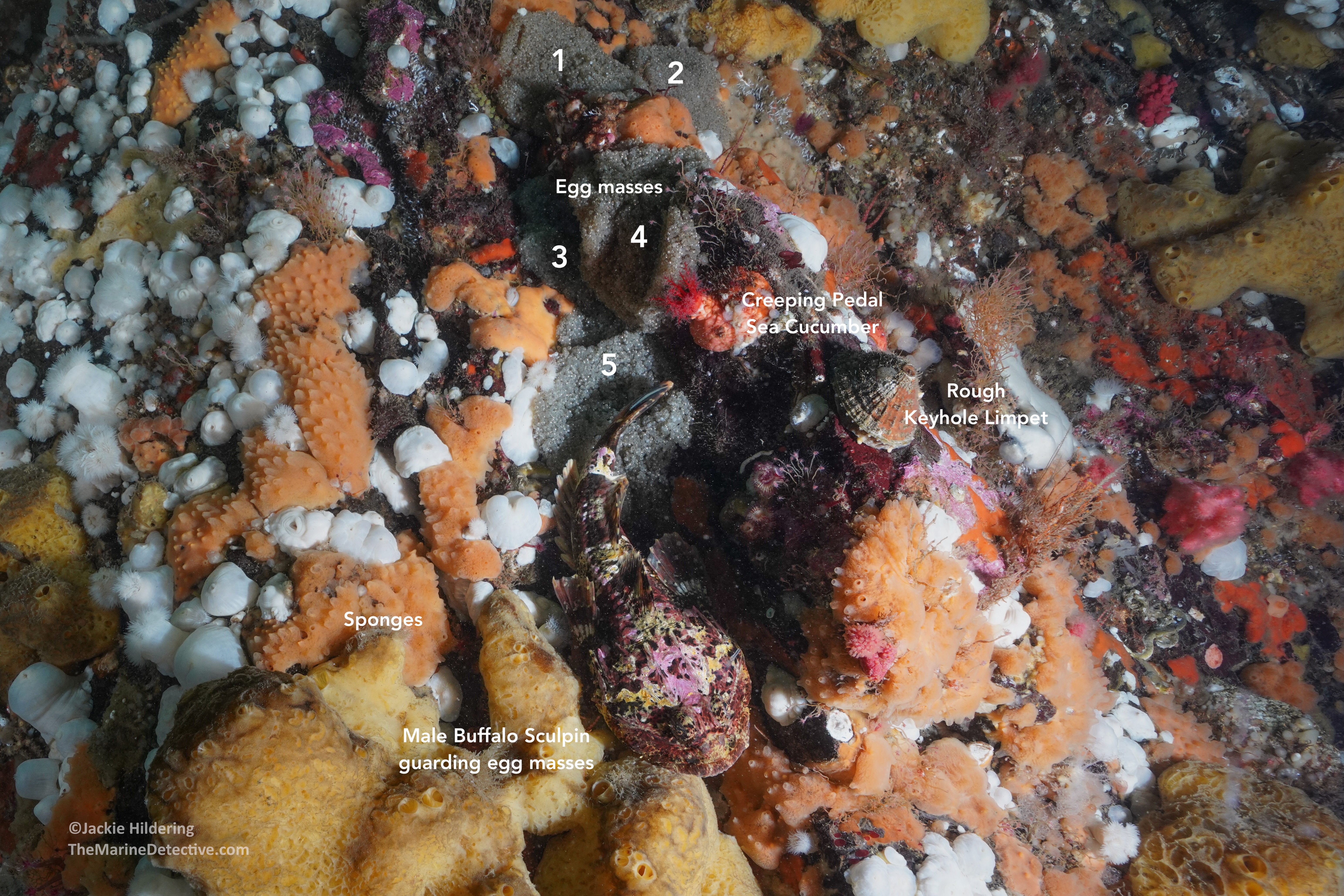
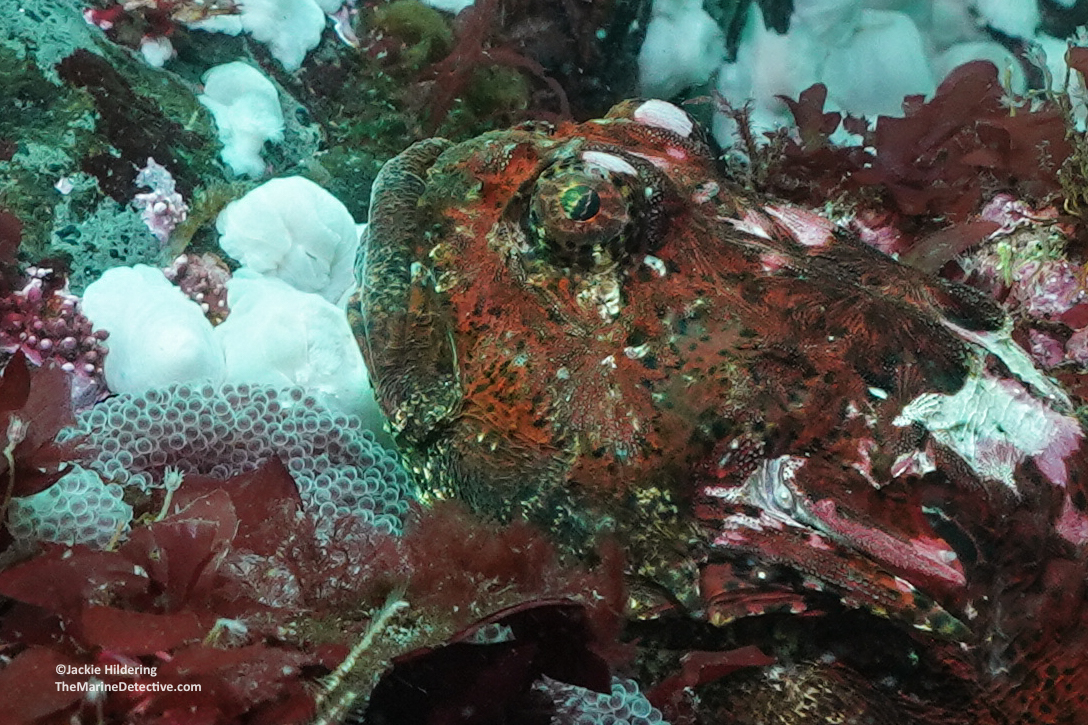
The Buffalo Sculpin –  Enophrys bison – has earned the association with buffalo/bison due to the horn-like spine found on each gill plate (operculum). The species can be up to 37 cm long.

Male Buffalo Sculpin guarding eggs © Jackie Hildering. 

As is the case for many species in the sculpin family, male Buffalo Sculpins guard the eggs from predators. They also fan the fertilized eggs with their pectoral fins to aerate them and stop growth of algae / bacteria.  Sometimes they guard the eggs laid by multiple females (see below for a male that appeared to be trying to guard EIGHT egg masses). When you consider that a female can lay between 19,000 and 32,000 eggs, the males have a lot of fertilizing and guarding work to do!  Their guard duty lasts 5 to 6 weeks until the eggs hatch. 

Another male guarding eggs. If you look carefully, you will see the horn-like spines on the fish’s right gill plate. It is these horn-shaped gill protrusions that led to this species getting both its scientific and common name. ©Jackie Hildering. 
Same male as in the image above. ©Jackie Hildering. 

Many of the photos below show how you the males lie with their flat heads directly upon a cascade of eggs. The clusters of eggs laid in the spring allow me to find this incredibly camouflaged fish much more easily than I normally could. When I see a golden, orange or greenish shiny mass of eggs, I know a male Buffalo Sculpin has to be very near by. The bright colour of the eggs suggests that they might be toxic to many species, further protecting them from predation. 

Very interestingly too, there is a species of fish known to parasitize on the care provided to the fertilized eggs by Buffalo Sculpins. Spinynose Sculpins (Asemichthys taylori)  will lay  their eggs on top of the Buffalo Sculpin eggs. The Spinynose Sculpin eggs will hatch faster and it is even possible that the presence of their eggs slows the development of the Buffalo Sculpin eggs.  This “nesting parasitism”, is a “behavior previously unknown among marine fishes.” (Kent, Fisher, & Marliave, 2011).

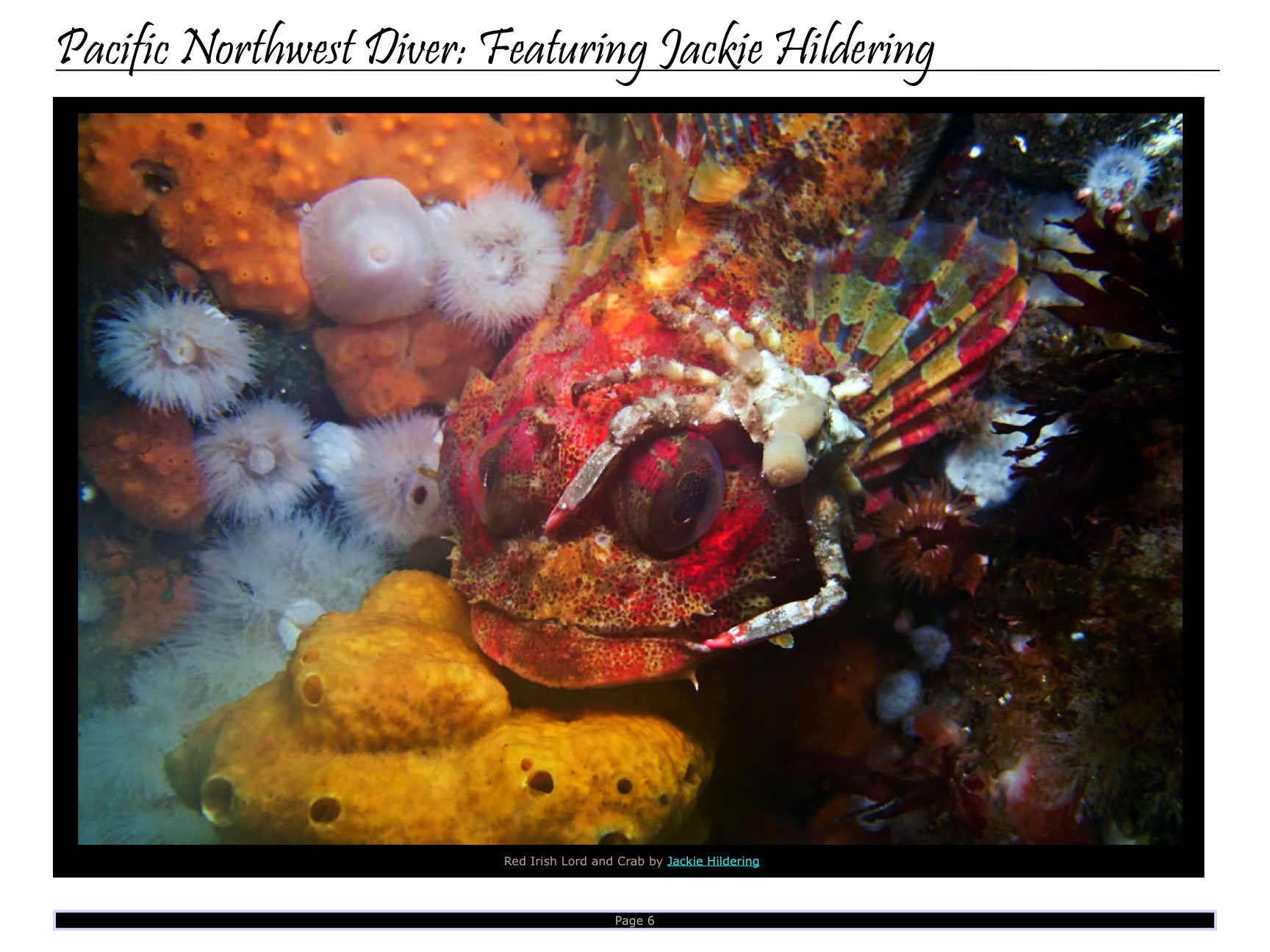
As you can see, Buffalo Sculpins’ red, brown and pink colouration makes them very difficult to discern from the similarly brilliantly coloured life around them.  They will remain absolutely still so as not to give away their presence. Their relative, the Red Irish Lord, has the same survival strategy. (See this previous blog item for photos and information on the Red Irish Lord.) 

The camouflage, in addition to reducing the risk of predation by bigger fish and seals, allows the Buffalo Sculpin to be a very successful ambush hunter of shrimp, crabs, amphipods and small fish. It has been suggested that they eat mainly algae since this has so often been found in their gut but I am willing to bet that the algae ends up in their stomachs as a result of the Buffalo Sculpins grabbing prey ON the algae!

A cascade of eggs below this brilliantly coloured male Buffalo sculpin’s chin, April 1st., 2012 See below. He as still guarding these eggs on April 21st and was guarding other eggs on May 6th, 2012. ©Jackie Hildering. 
The two differently coloured egg masses suggest that this male is guarding the eggs from two different females. April 1, 2012. ©Jackie Hildering. 
The same male guarding eggs 3 weeks later. April 21st, 2012.©Jackie Hildering. 
Same male with a new egg mass – May 6, 2012. Checked in on him on May 20th, 2012 and he was no longer guarding eggs. ©Jackie Hildering

Range: Monterey California to Kodiak Island, Gulf of Alaska. Most often found to a depth of 20 m but have been found to 227 m.

Spawn: February and March.

Sources: Kent, Daniel & Fisher, John & Marliave, Jeffrey. (2011). Interspecific nesting in marine fishes: Spawning of the spinynose sculpin, Asemichthys taylori, on the eggs of the buffalo sculpin, Enophrys bison. Ichthyological Research – ICHTHYOL RES. 58. 10.1007/s10228-011-0223-5.


Whoa! Photo below is of one male Buffalo Sculpin guarding the egg masses of at least 3 different females.
©Jackie Hildering. 

And here’s a male appearing to guard EIGHT egg masses. 
Find the Fish Friday Answers.001


The following photos of male Buffalo Sculpins guarding eggs are intended to show how varied both the colouration of the fish and the eggs can be.  All photos ©Jackie Hildering. 

DSC03226
_JH15078
DSC07368 2
JWH_2250
JWH_2263
JWH_2287
JWH_3438
OLYMPUS DIGITAL CAMERA
SEA&SEA 1200HD

Liebster Blog Award – Feel the Love!


On February 22nd, I received the following notification: “Dear Marine Detective, Your blog has won a Liebster Blog award from Seabed Habitats. See the nomination at this link. I am a big fan of yours.”


Award? For my blog?  The blog that I am propelled / compelled to write but that costs me so much time and effort that in darker moments I sometimes whisper . . .  why write?!


And . . . what’s a “Liebster”?!

In German Liebster is “dearest”, “darling” and “beloved”.

Hum . . . sounds good!  Yeah, I’ll accept that!

With a bit more research I discovered the “Liebster Award” is intended to be a gold star to further motivate bloggers like me – and maybe amplify our readership. What an honour!

And the Liebster is a darling that keeps on giving since the conditions of the award are that I am to pass on the Liebster love to 5 blogs that I consider particularly worthy and that have less than 200 subscribers.

I include the full Liebster rules at the end of this blog item but without further ado would like to spread the karma and share my 5 blog picks with you. Of course I would also like to give ocean deep thanks to Seabed Habitats for the great kindness of providing me with further motivation. I so appreciate it.

Water Blogged

“As the official blog of the Living Oceans Society, based in the small BC fishing community of Sointula, Water Blogged offers unique perspectives on local and global marine conservation issues. Water bloggers have also been known to write humorous and poignant accounts of coastal life, gripping marine mysteries and anything ocean-related that they just happen to find fascinating.”


Beneath the Looking Glass

“If the Ocean is a reflection of us,  as humanity, are we happy with what we see?   I invite you to follow me beneath the looking glass…   These will be non-scientific observations of a wild, wonderful world that is being dramatically altered by our every day choices. Every time you look in the mirror, ask yourself, were as many of those choices good for the Ocean (and the planet at large) as could have been? . . . By documenting and sharing the underwater world I hope to expand people’s awareness… People protect what they love… “


OrcaLab Blog


The depth of the dedication to whale conservation comes through with every word of these blog postings. “In 1970, Dr. Paul Spong founded OrcaLab, a small land based whale research station nestled against the evergreen forest of Hanson Island in the waters of the “Inside Passage” of northern Vancouver Island in British Columbia, Canada. The work of OrcaLab is centred on the philosophy that it is possible to study the wild without interfering with lives or habitat. A network of hydrophones, positioned around the orcas’ “core habitat”, helps us monitor their movements all year round. . . . OrcaLab’s work also includes vital conservation issues – preservation of orca habitat; release and rehabilitation of captive cetaceans, especially Corky; and bringing to an end the dismal era of commercial whaling.” Below – a stunning slideshow of 2011 images of OrcaLab’s wildlife and surrounding landscape set to David Gray’s inspirational song “Sail Away”.


The Salmon Guy

The Salmon Guy’s insights into salmon related government policy and conservation issues are deeply thoughtful and well-researched. He truly “gets” salmon and where we would be without this keystone species. “Contradictions, complexities, conflict abound around us. Here is an exploration of some those – synthesizing from various ways of thinking and relating. Not just a collection of thoughts and perspectives (and riffs and rants) on how we relate to wild salmon – this is also about how we relate to people and places within us and around us.”


Brandscaping Blog

Great tips for the likes of we bloggers on how to better get our message into the world. “The brandscaping.ca blog provides a loose variety of topics; marketing, advertising, and writing, as well as posts designed to help creative types find success in the freelance world.  Occasionally updated, sporadically funny, but purely Canadian.  Check it out today to see what’s going on in the brandscaping world.”


The rules of receiving a Liebster Award are as follows:


1. Show thanks to the blogger who gave you the award by linking back to them.
2. Reveal your top 5 picks (with less than 200 subscribers) and let them know by leaving a comment on their blog.
3. Post the award on your blog.
4. Bask in the love from some of the most supportive people on the internet—other writers and artists.
5. And best of all – have fun and spread the karma.

Where are the Whales?!

A member of the A12 matriline of Northern Resident Killer Whales spyhops in Johnstone Strait. Likely A55 (aka “Echo”); male born in 1990. Photo by Jackie Hildering.

Where are the whales?!

If I had a dollar for every time I have been asked that question, I could now purchase an E-Tec engine for my little research boat and live with a clearer and cleaner carbon conscience!

It is indeed the question most often asked of marine naturalists and suggests that there are those who believe that there is incredible predictability to viewing wild whales; that there may even be a single location where they will always be found.

I have found that this is particularly true in reference to Killer Whales and that a significant number of people appear to believe that the Michael Bigg (Robson Bight) Ecological Reserve in Johnstone Strait will always have Killer Whales within its boundaries (see here for information on beach-rubbing).

Of course, it does not help comprehension that the inshore fishing-eating populations of British Columbia have been named “Residents”. This leads to Northern Vancouver Island often being promoted as “home” to a population of some 300 [2016 estimate] members of the Northern Resident Population.

In answering “Where are the whales”, I will make the point that you can never quite know where wild whales are and, when I think I can get away with being a little bit cheeky – which thankfully is quite often – I will make this point by with the answer “The whales are underwater”.

But, it is of course true that Northern Vancouver Island is possibly the most predictable place on earth to see Killer Whales and that it is our extraordinary privilege to live in the area that is a mecca for those hoping to see them – and so much more marine wildlife. However, the Killer Whales are not “resident” and they are not in this area in the 100s.

My answer to “Where are the whales” must therefore also explain that Killer Whales have culture; they have evolved into discrete “ecotypes” whose lifestyles have been shaped by what they eat.

BC’s waters have two populations of highly vocal and social in-shore fish-eating killer whales that love to snack on salmon (the northern and southern “Residents”); a population of stealthy marine-mammal-eating killer whales (“Transients” also known as “Bigg’s Killer Whales”); and a fish-eating population that is more often off the continental shelf and whose diet includes sharks (“Offshores”).

In order to preserve the culture that allows them to specialize on different prey, none of these populations mate with one another. The predictability of seeing them is dependent on where their prey is and how stealthy they have to be to successfully hunt.

Johnstone Strait is the only waterway that allows full passage on the inside of Vancouver Island and therefore it is like a funnel for the salmon traveling to natal rivers further south to spawn. This is why, most often, there are some families (“matrilines”) of the Northern Resident Population in our area from July into October/November. This is when the salmon are running and the Killer Whales are especially present when there is the opportunity to pursue fatty Chinook salmon.

Sometimes, presumably when whale bellies are full enough, there will be some 100 madly socializing members of the Northern Resident Killer Whale population around Johnstone Strait. However, this is a rarity since the families have different affinities for areas of BC’s coast.  There are some families, like the A34s and the A30s, that have an extraordinary affinity for fishing in this area, while there are other families like the Hs and Rs that very rarely chase the salmon around Johnstone Strait. Sometimes we even have groups of Southern Residents transiting through the area – this is the endangered population that is more often found near Victoria.

In contrast to Residents, there is less seasonality in the movements of the marine-mammal-eating “Transient” killer whales since seals, sea lions, dolphins, porpoises, etc, can be here year round.  But, but, but . . . this does not mean that if you see a Killer Whale in our area in the winter, it is a Transient!

Resident killer whales can be here in the winter as well, but unlike at other times of the year, it is usually not for more than a day at a time and they likely are here to feed on other fish species like halibut. The OrcaLab on Hanson Island monitors whale vocals year round and, since every northern resident family’s calls are distinct, they can even conclude which families are in the area 

Despite all this knowledge, there is so much we do not know about BC’s Killer Whales and the threats that have necessitated all populations getting protection under Canada’s Species at Risk Act.

For Species at Risk Act “Status Reports” on the Pacific Northeast populations of Killer Whales – click the links below:


Fins Verses Feathers – Bigg’s Killer Whales Harass Rhinoceros Auklets

In the Northeast Pacific, “Bigg’s Killer Whales” (formerly known as “Transients”) are believed to have diverged from the “resident”  (inshore fish-eating) and “offshore” (offshore fish-eating) ecotypes some 700,000 years ago (Morin et al, 2010), to refine a culture of stealth and unpredictability in order to hunt their marine mammal prey.

I would suggest that we humans are the last species that should be judging others for how much they eat. However, often Bigg’s Killer Whales are profiled and misunderstood for interpretations of their feeding behaviour. This includes that they don’t always eat what they kill.

From Kuker and Barrett-Lennard (2010)  “Like many other predators, transient killer whales sometimes demonstrate ‘surplus killing’, killing greater numbers of prey than they consume (DelGiudice 1998, Wobeser 2000, Short et al. 2002). In surplus killing incidents, the whale plays with animals, such as sea birds (Stacey et al. 1990) and harbour seal pups (Gaydos et al. 2005). The whales may breach on the victim or toss and ram it until it dies, but it is not consumed. This behaviour could be part of the process of learning to hunt, in which adults are training young to capture and handle prey, or it could be simply play behaviour (Ford et al. 1998, Gaydos et al. 2005).”  

Below is my account of one such surplus killing events witnessed on August 31st, 2011. It was not a good day for some Rhinoceros Auklets (Cerorhinca monocerata) in Johnstone Strait, British Columbia, Canada.

Young Bigg’s Killer Whale grabs Rhinoceros Auklet. Photo: Hildering. All photos taken with telephoto lens and cropped.

That day, I witnessed a very socially active group of Bigg’s Killer Whales repeatedly harassing these birds – mouthing them and slapping them. At least 3  juvenile Rhinoceros Auklets were involved. Since these are diving birds, they cannot “alight” and escape the teeth and fins below them. Yet, I believe they survived.

Bigg’s Killer Whale surfaces right beside a Rhinoceros Auklet. Photo: Hildering.

I personally had never seen such a prolonged display of this play behaviour before. In fact, I had never seen Bigg’s Killer Whales socialize quite so rambunctiously! [Update 2020, now that seals and sea lions are more readily available, members of this population appear to be far less stealthy]. 

Clearly, when their bellies are full and social needs dominate, this type of Orca is anything but stealthy. On August 31st, this incredibly socially active group of 20+ Bigg’s took about 1.5 hours to travel only +/- 4.5 km (2.5 nautical miles) – slapping birds, rolling over one another, tail slapping, vocalizing and breaching along the way. The whales would go on to bound past the community of Alert Bay, Cormorant Island. I have have previously written about this in the blog item “Might As Well Jump.” 
Jared Towers of the Department of Fisheries and Ocean has confirmed the IDs of the Bigg’s Killer Whales in the August 31, 2011 encounter to be:  T010s, T034s, T035s, T037s, T046Bs, and T146s.

Insight into this behaviour is provided by Dr. John Ford and Graeme Ellis. The following interpretation of the behaviour is from the chapter “Seabirds: Playthings and Practice, or Between-Seal Snacks?” in Transients: Mammal-Hunting Killer Whales of British Columbia, Washington, and Southeastern Alaska, 1999. 

“It is not unusual to see transients chasing and harassing seabirds. During most of these incidents, the whales do not seem intent on eating the birds. Rather, they let the bird escape or they abandon it after it has been injured or killed. Seabird harassment appears to be a favourite activity of juvenile transients. The young whales will sometimes swim upside down and on their sides, looking for birds paddling at the surface above. Once a victim is sighted, they will try to slap it with their tail flukes, jump on it, or seize it in their mouth. This interaction may continue for several minutes, before the bird is eaten, incapacitated, or left dead in the whale’s wake. We and others have recorded at least 10 seabird species that have become casualties of transients. Frequent victims are common murres, which are flightless for several weeks during the late summer and are like “sitting ducks” for transients.  Other species include black brant, common loon, white-winged scoter, surf scoter, cormorant (species uncertain), western grebe, marbled murrelet, rhinoceros auklet, and red-breasted merganser.  Seabirds seem to be more important as objects of play or harassment than as a dietary item. Juveniles playing with seabirds no doubt learn useful skills in prey capture and handling that may enhance their success in hunting harbour seals and other wily prey.”  

Bigg’s Killer Whale tail-slapping a Rhinoceros Auklet. Photo: Hildering. 


Sources:

Barrett-Lennard, L.G., Heise, K. 2007. The Natural History and Ecology of Killer Whales: Foraging Specialization in a Generalist Predator. In Estes, J.A., Brownell, R.L., DeMaster, D.P., Doak, D.F., Williams, T.M.  Whales, whaling and ocean ecosystems. University of California Press, Berkely, C.A.

Ford, J.K.B., and Ellis, G.M. 1999. Transients: Mammal-Hunting Killer Whales of British Columbia, Washington, and Southeastern Alaska. UBC Press, Vancouver, and U. of Washington Press, Seattle. 96 pp

Kuker, Katie & Barrett-Lennard, Lance. (2010). A re‐evaluation of the role of killer whales Orcinus orca in a population decline of sea otters Enhydra lutris in the Aleutian Islands and a review of alternative hypotheses. Mammal Review. 40. 103 – 124. 10.1111/j.1365-2907.2009.00156.x.