Join me in the cold, dark, life-sustaining NE Pacific Ocean to discover the great beauty, mystery and fragility hidden there.

Posts from the ‘FISH – NE Pacific Ocean’ category

Fishy Fathers

There’s a whole lotta fish procreation going on in the NE Pacific Ocean right now. This might be a surprise to those who think mating is more of a spring-fling-kinda-thing.

It may be a further surprise that, for many marine fish species here, the males are the protectors of the next generation. The females leave after laying the eggs and the males remain, guarding the fertilized eggs from predators and often also fanning the eggs to ensure they are well aerated.

For a lot of these fish species, the male chooses the nesting site and entices multiple females to lay eggs there so that he can fertilize them. He then has the work of guarding these multiple egg masses and may need to be on the alert for sneak fertilization attempts by other males.

For species with nests of multiple egg masses, you can often tell how many females have laid eggs there because individual females have different coloured eggs. Therefore, the colour of fish eggs is not a good characteristic to determine the species that laid them. Instead, do a quick scan, chances are a piscine papa is somewhere near the eggs, staring at you.

Through the photos below, meet some of these fabulous fish fathers. No deadbeat dads here!

[Note that this is in no way a comprehensive list of NE Pacific Ocean fish species in which the males guard the eggs.]

Whitespotted Greenling

The encounter documented below shows how my dive buddy and I recently had a Whitespotted Greenling come after us, so intent was he on protecting his egg masses. I was very slow in cluing in that this was why he was swimming around us and deserved getting a little nip in the head.  Notice how small he is relative to us and yet how this did not deter him in trying to get rid of us.

Male White-Spotted Greenling shortly after he nipped my big head in his intensity to guard his egg masses. © 2013 Jackie Hildering

Male Whitespotted Greenling shortly after he nipped my big head in his intensity to guard his egg masses. 

Dive buddy Jacqui Engel pointing at the male White-Spotted Greenling before we clued in and got out of his territory with eggs. Image shows small the fish is compared to us and how big his drive to protect the egg masses that he would come after us. © 2013 Jackie Hildering

Dive buddy Jacqui Engel pointing at the male Whitespotted Greenling before I clued in and got out of his territory with eggs. Image shows how small the fish is compared to us and how big his drive to protect the egg masses must be that he would pursue us like he did. 

Male White-Spotted Greenling intensely guarding eggs. © 2013 Jackie Hildering

Here he is intensely guarding eggs. ©Jackie Hildering

Whitespotted Greenling (Hexagrammos stelleri)

  • Maximum recorded size: 48 cm
  • My observations of egg guarding on NE Vancouver Island: September to the end of December

Kelp Greenling

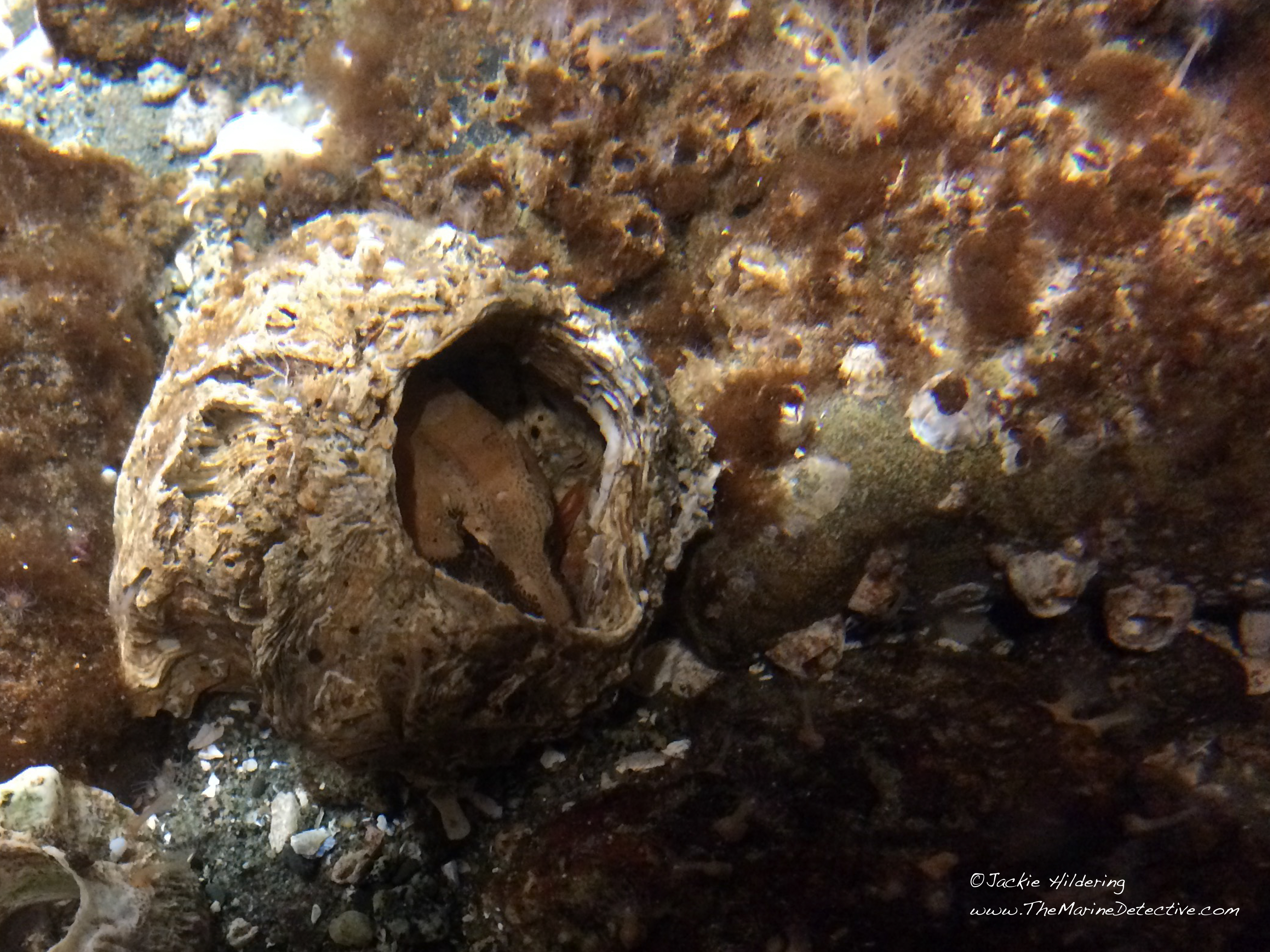
Most often Kelp Greenling eggs are in the empty shells of giant barnacles as shown below. Although they are a bigger member of the Greenling family, male Kelp Greenlings do not appear to protect their eggs quite as vigorously as Whitespotted Greenlings. They appear to have a really long breeding season in our area.

Male Kelp Greenling © 2013 Jackie Hildering

Male Kelp Greenling. ©Jackie Hildering

Eggs the male Kelp Greenling was guarding. Most often in giant barnacle tests (shells) like this. © 2013 Jackie Hildering

These are the eggs that the male Kelp Greenling in the above image was guarding. The eggs are most often laid in giant barnacle tests (shells) like this. ©Jackie Hildering

Kelp Greenling (Hexagrammos decagrammus)

  • Maximum recorded size: 61 cm
  • My observations of egg guarding on NE Vancouver Island: October to March
  • Below, slideshow of courting

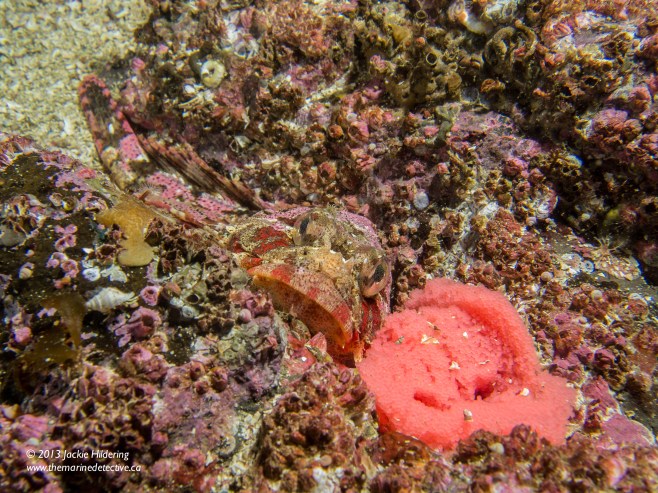
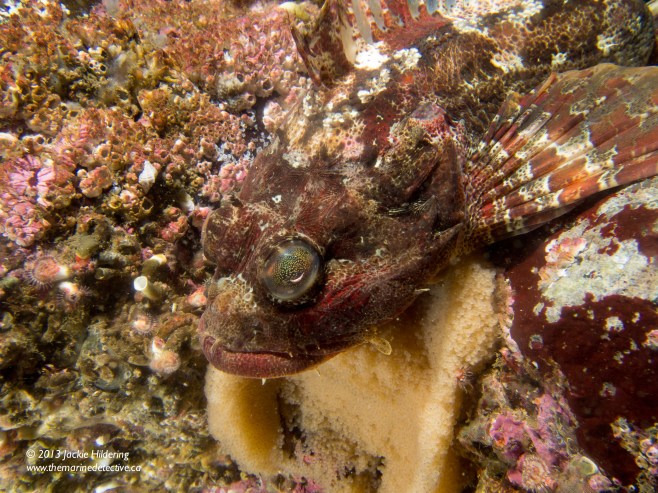
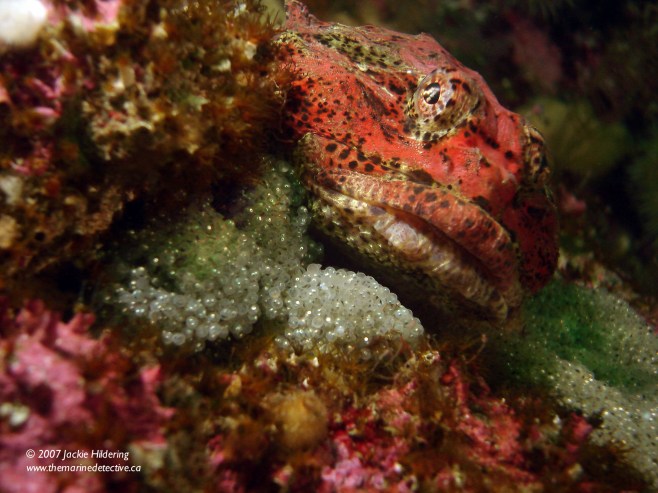
Red Irish Lord

Oh Red Irish Lords how I love thee. There is no better ambassador for how colourful life is in these waters since they are brilliant shades, yet astoundingly camouflaged. Red Irish Lords are often easier to find when guarding their eggs since these are less camouflaged. They most often egg guard with their heads positioned right atop the eggs, remaining absolutely motionless. It is commonly believed that the fathers guard the eggs but apparently it is more often the mothers but that the parents may take turns. Source: DeMartini and Sikkel 2006: ” Red Irish Lord exhibits primarily maternal and facultatively biparental guarding of the spawn.”

Another male Red Irish Lord guarding an egg mass - note the very different coloured eggs from the previous image. © 2013 Jackie Hildering

Red Irish Lord guarding an egg mass – note the very different coloured eggs in the following images. ©Jackie Hildering

Male Red Irish Lord guarding egg mass. © 2013 Jackie Hildering

Red Irish Lord guarding egg mass. ©Jackie Hildering

Female Red Irish Lord guarding egg mass. Species said to be sexually dimorphic during the breeding season (source: DEMARTINI, E. E., AND B. G. PA’ITEN. 1979. Egg guarding and reproductive biology of the red Irish lord, Hemilepidotus hemilepidotus).  ©Jackie Hildering

Red Irish Lord (Hemilepidotus hemilepidotus)

Note the variation in the colour of the fish too. More photos showing the diversity of colour at this link. 

Buffalo Sculpin

There are Buffalo Sculpin males guarding eggs at this time of year too but more mating appears to be happen in April and May. Usually, Buffalo Sculpins are even harder to spot than their Red Irish Lord cousins but the variably coloured, bright egg masses give away their location. They too have a strategy of staying right atop the eggs and remaining motionless when faced with annoying human divers.

Male Buffalo Sculpin guarding two egg masses - each from different females. © 2013 Jackie Hildering

Male Buffalo Sculpin guarding two egg masses – each from different females. ©Jackie Hildering

Male Buffalo Sculpin guarding egg mass. © 2013 Jackie Hildering

Male Buffalo Sculpin guarding egg mass. ©Jackie Hildering

Buffalo Sculpin (Enophrys bison)

  • Maximum recorded size: 37 cm
  • My observations of egg guarding on NE Vancouver Island: January to May
  • Previous TMD blog item on the species: Buffalos Mating Underwater

Lingcod

Soon we will be participating in the Vancouver Aquarium’s annual Lingcod Egg Mass Count. Armed with an underwater slate, we will join divers along the Coast in helping determine the health of lingcod populations by looking at the number and size of the egg masses and if they are being guarded by males. And oh what fastidious fathers lingcod males are! The dedication to protecting the egg masses does vary from male to male but, generally, they do not leave their watch until the eggs hatch which can be more than 24 days. They could be guarding masses from multiple females separated by more than 7 m, and if laid by a female 5 years old and older, the egg masses can be the size of a watermelon and weigh up to 14 kg! That’s a lot to protect! (As is also the case for many rockfish, the older the female lingcod, the more eggs she lays). My best lingcod story is that I was marking down “unguarded” on my slate only to have it knocked out of my hands by the male that was very much guarding the egg mass I had been observing! Lots more info on this species at my blog item Lingcod – Fastidious Fanged Fathers

Lingcod male guarding egg mass. Photo focus a bit fuzzy but the battle wound reveals the perils of egg guarding. © 2013 Jackie Hildering

Lingcod male guarding egg mass. Photo is a bit fuzzy but the battle wound reveals the perils of egg guarding and/or competition for females. ©Jackie Hildering

Lingcod male guarding egg mass (with a couple of shrimp on his back). ©Jackie Hildering

Lingcod (Ophiodon elongatus)

  • Maximum recorded size: 152 cm
  • My observations of egg guarding on NE Vancouver Island: January to April (Vancouver Aquarium’s Egg Mass Survey is from early February to the beginning of April).
  • Previous TMD blog item on the species: Lingcod – Fastidious Fanged Fathers 

Wolf-eel

Here’s a case where it is not just the male that guards the eggs. Mr. and Mrs. Wolf-Eel take turns wrapping their long tails around the large egg mass. I hope to one day have the opportunity to get a better image than this but, as a strategy for survival, the egg mass is often deep within the wolf eel couple’s den. Lots more information on this remarkable species at my previous blog item Wolf-Eel – No Ugly Fish!

Mr. and Mrs. Wolf Eel sharing duty in taking care of the egg mass. © 2013 Jackie Hildering

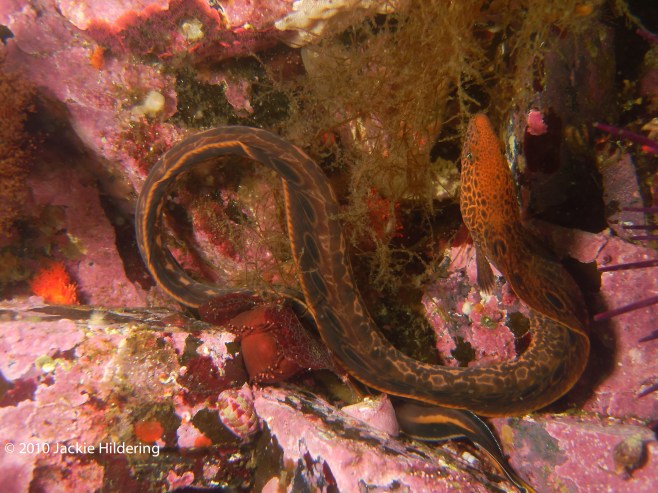
Mr. and Mrs. Wolf-Eel sharing duty in taking care of the egg mass. Female on left and male on right. ©Jackie Hildering

Wolf-Eel (Anarrhichthys ocellatus)

  • Maximum recorded size: 2.4 m
  • My observations of egg guarding on NE Vancouver Island: October to January
  • Previous TMD blog item on the species: Wolf-Eel – No Ugly Fish! 

Cabezon

I’ve only once been lucky enough to find a male of this huge sculpin species guarding eggs. They can apparently be very aggressive guarders but this very successful male (he was guarding the eggs of several females) was very tolerant of my presence. They have been documented to mate throughout the year. My one encounter with a male cabezon guarding eggs was in May.

Male Cabezon guarding egg masses from multiple females (egg masses different colours). © 2013 Jackie Hildering

Male Cabezon guarding egg masses from multiple females (egg masses different colours). ©Jackie Hildering

Cabezon (Scorpaenichthys marmoratus)

  • Maximum recorded size: 99 cm

Painted Greenling

In all these years of diving, I have yet to find a male Painted Greening guarding eggs so that I know for sure the eggs are from this species. Yet something else to be on the lookout for!

Painted greenling. © 2013 Jackie Hildering

Painted Greenling. ©Jackie Hildering

Painted Greenling (Oxylebius pictus)

  • Maximum recorded size: 25 cm

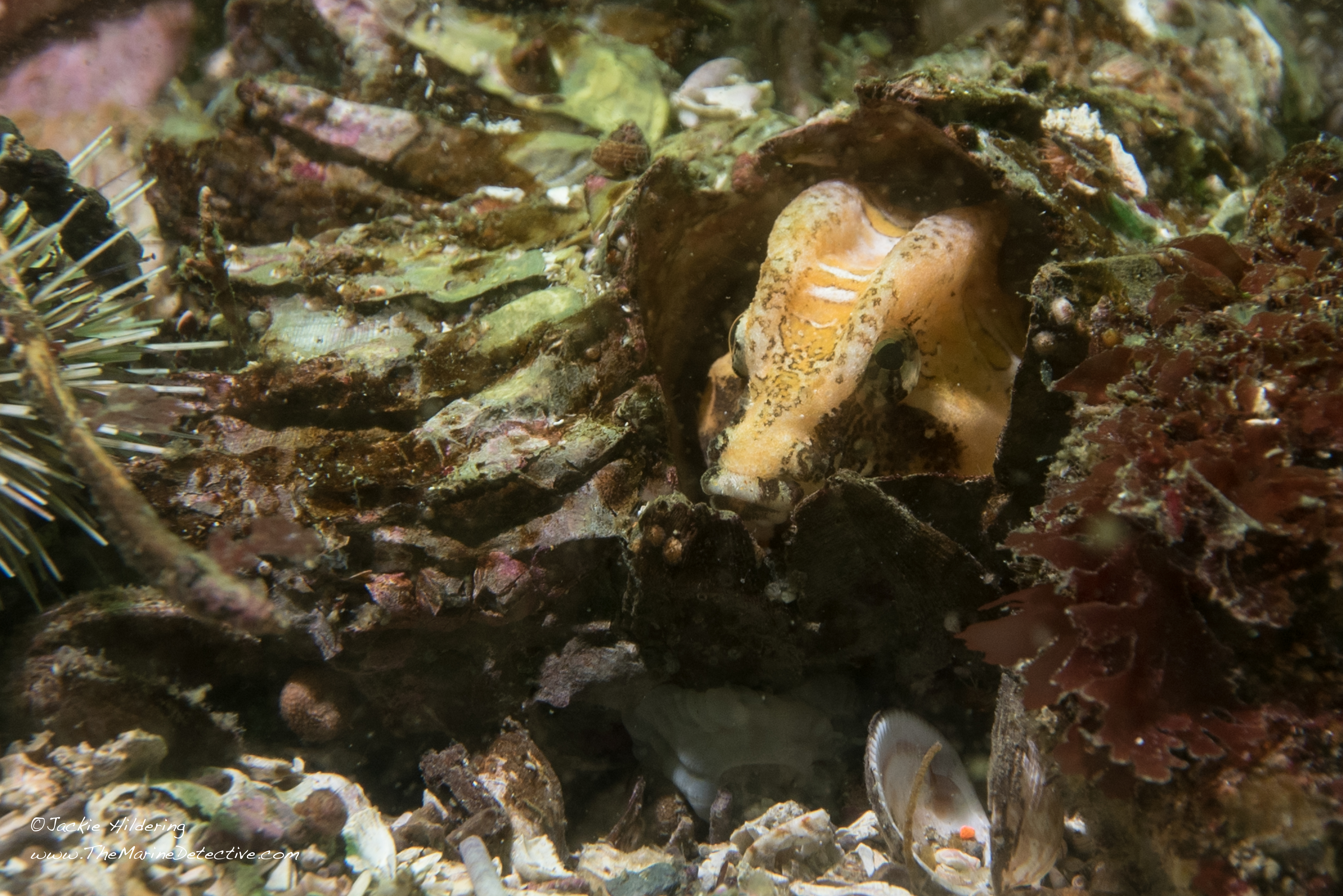
Grunt Sculpin

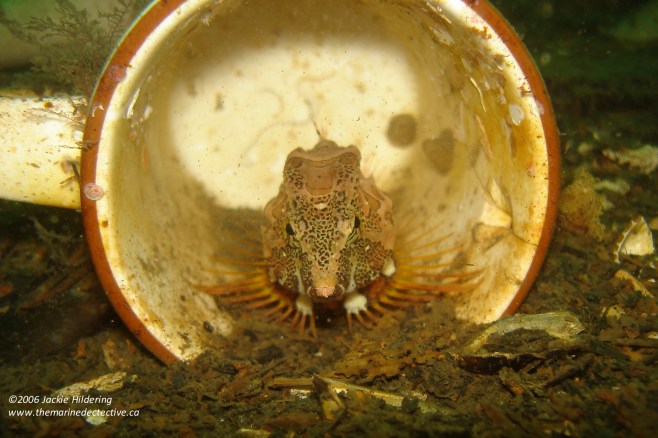
And, the stuff of dreams  . . .  to one day chance upon a male grunt sculpin while he is releasing the hatching eggs from  . . . his mouth! For more on that, see my previous blog item Grunt Sculpin – Little Fish, BIG AttitudeThe females apparently also do take on shifts in taking care of the eggs.

Grunt Sculpin. Most often found in empty barnacle tests (not cups!) © 2013 Jackie Hildering

Grunt Sculpin. Most often found in empty barnacle tests (not cups!) ©Jackie Hildering

Grant Sculpin (Rhamphocottus richardsonii)

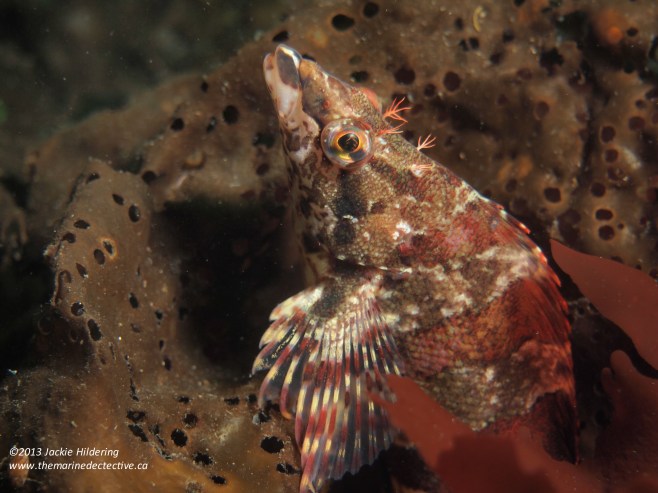
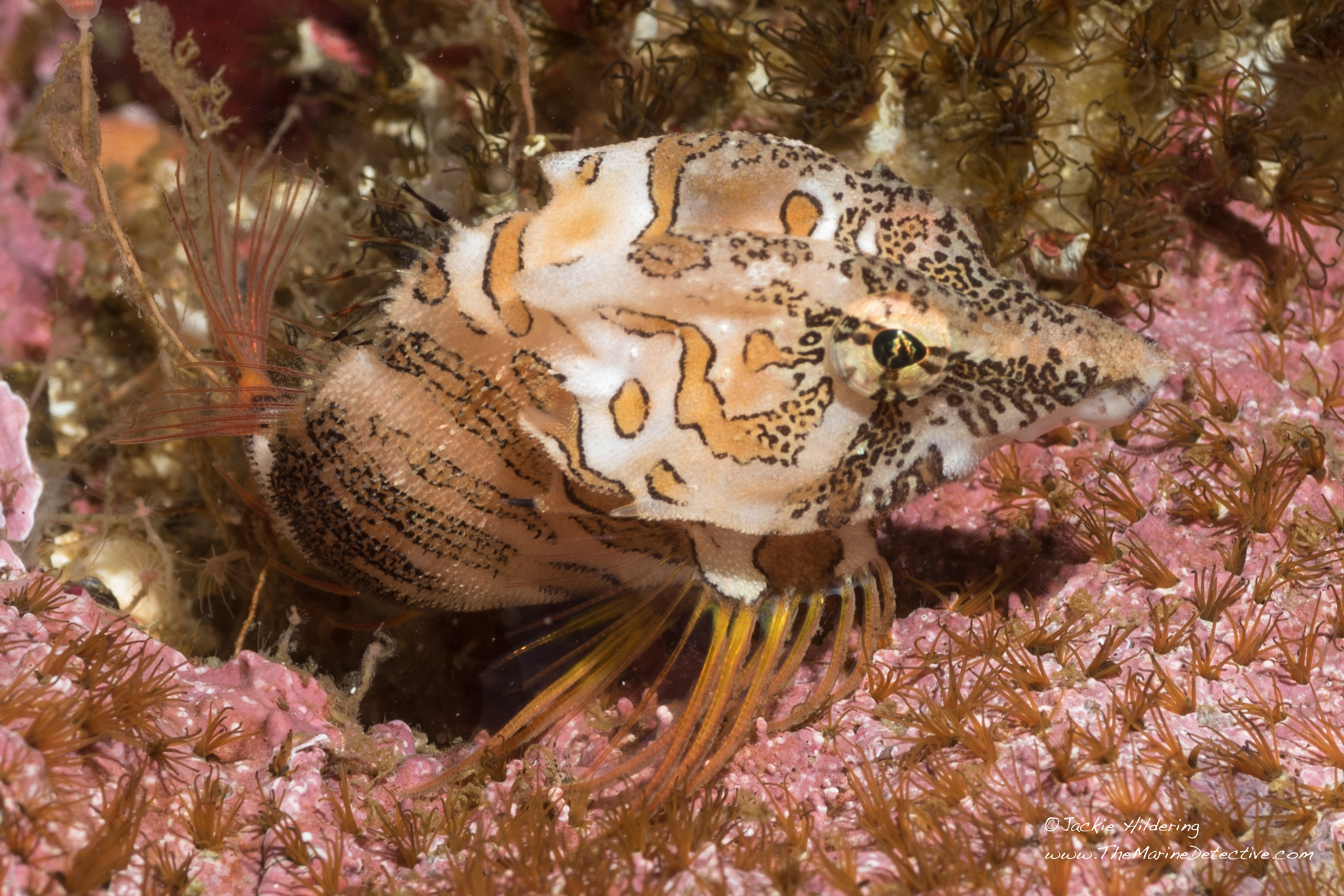
Scalyhead Sculpin

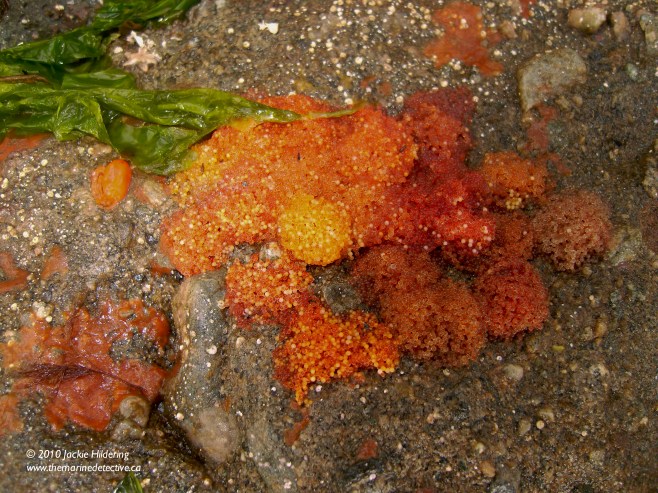
I have never seen scalyhead sculpin eggs while diving, likely because they are hidden away and because they are much smaller. The image of the eggs below was taken during a beach walk where students ensured they put the rock back as best they could to reduce the chances of the eggs drying out. Notice the different colours of the looney-sized egg masses? The eggs in this nest are from at least 4 females.

Very  interesting in this species is that fertilization is internal.

Male Scalyhead Sculpin in a giant barnacle test. © 2013 Jackie Hildering

Male Scalyhead Sculpin in a giant barnacle test. ©Jackie Hildering

Egg masses from at least 4 different female scalyhead sculpins (each female's eggs have a different colour). © 2013 Jackie Hildering

Photo taken while on a beach walk. Egg masses found under a rock and they are from at least 4 different females (each female’s eggs have a different colour). ©Jackie Hildering

Scalyhead Sculpin (Artedius harringtoni)

  • Max size: 10 cm
  • My observations of egg guarding on NE Vancouver Island: Spring.
  • One study showed that the eggs hatched after 11 and 15 days. This study also documented courtship where the males rolled their heads in a circle and flared their orange branchiostegal membranes (on the underside of their throat) which apparently are only orange during mating season. Females were seen to have no  response or to snap their heads horizontally in rapid succession, sometimes also quivering. During breeding season the males are also reported to  have red-brown spots inside their mouth and a brown anal fin with small yellowish-white spots.  (Source: Ragland, H., & Fischer, E. (1987). Internal Fertilization and Male Parental Care in the Scalyhead Sculpin, Artedius harringtoni. Copeia, 1987(4), 1059-1062. doi:10.2307/1445578)
  • Previous TMD blog item on the species: Who’s Your Daddy

Black Prickleback

If you find an ice cream scoop mound like this, you have likely found the eggs of the black prickleback and the guarding male is likely very near. When taking students on beach walks, I emphasize the importance of not displacing animals by using this species as an example. Fish like the black prickleback are adapted to being able to wait out the tide in very little water and if the well-intentioned pick up the fish to put him in deeper water, they could be moving papa away from the eggs he was guarding.

Male Black Prickleback guarding egg mass in a tide pool. © 2013 Jackie Hildering

Male Black Prickleback guarding egg mass in a tide pool. ©Jackie Hildering

Black Prickleback (Xiphister atropurpureus)

  • Max size: 32.7 cm
  • Records of egg guarding on NE Vancouver Island: Spring

_____________________________

Sources:

A World Without Salmon . . . .?!

 Spawning Sockeye salmon © 2006 Bruce Paterson

Spawning Sockeye salmon ©2006 Bruce Paterson

Dear readers, the following is a rework of a little rhyme I wrote in 2009.

Many of you will recall that 2009 was such a bad year for wild salmon in British Columbia that it led to the $26 million Cohen Inquiry into the Decline of the Fraser River Sockeye.

 Spawning Sockeye salmon © 2006 Bruce Paterson

Spawning Sockeye salmon ©2006 Bruce Paterson

And yet, there has been no solid action on the 75 recommendations resulting from that Inquiry and government has yet to take any sort of dedicated or meaningful action for the wild salmon – and all that depends on them.

The attempted messaging in my little poem may be all the more relevant now with the threat of tanker traffic coming to our fragile Coast.

The good news, I believe, is that with such threats more and more of us are united in understanding that, while resource use is a necessity, it has to be sustainable. It is impossible to have infinite economic growth on a finite planet.

With sincere apologies to Dr. Seuss:

A world without salmon would be oh so sad,
This is very important, so listen here Dad!

Without salmon, we will have broken the link,
That Nature intended to keep us in the Pink.
(And Sockeye, and Chum, and Chinook and Coho!)

Salmon bring the wealth of the ocean back to the Coast,
Right back to their birthplace so without them – we’re toast!

Their bodies are gifts to the future – that’s really key,
Delivering food for their babies and even the trees.

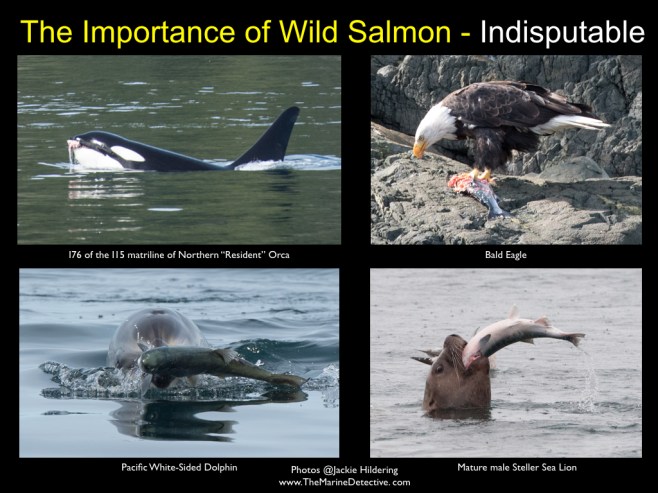
They feed fish-eating orca, sea lion and eagle,
Wolf, seal, deer, shark and . . . an occasional beagle!

They help bring the tourists. They fill fishers’ nets.
There ought to be enough so that all needs are met.

So little investment, so great the return.
Safe passage, and food – this, salmon surely earn?

But, instead of precaution, loud voices at desks,
Say, “Why it’s Nature that’s made this big mess.”

“It’s salinity, cycles . . . the phase of the moon!
Or some other reason we’ll think up real soon.”

What possible gain would justify such a gamble?
The cost of losing wild salmon would be so substantial.

Without salmon, grizzles stare into empty rivers,
No fat salmon to save them from winter shivers.

The orca diminish without their Chinook,
Peanut-shaped foreheads reveal this tragic truth.

And Bobby and Susie and even Aunt Myrtle,
Are left holding fishing poles, till they turn purple.

Shhhh can you hear that? No, I don’t hear a thing,
For without salmon, birds around rivers don’t sing.

The People of the Salmon were able to thrive.
Dance, song, carvings  . . . the wisdom to know what keeps us alive.

Salmon are the glue in a vastly connected web,
Why without them big trees would even be dead.

Then, there goes habitat, oxygen production and buffering of greenhouse gas.
Why to flirt with the health of salmon you would really have to be an  . . . . (you know).

The survival of salmon shows how we humans are doing.
Do we know our place on the planet? No. Nature is booing!

The solution is simple. It really isn’t hard.
It’s not tree hugger verses resource user. Let down your guard!

Logger, storekeeper, teacher, and you under that streetlight!
We keepers of paradise need to unite in what’s right.

Make a stand for the salmon, the whales, wolves and Coast.
We all know clean water and food is what matters most.

Choose for sustainability, not short-term economic gain.
Otherwise explaining things to our children could really be a pain.

Use vote, vision and voice, to help wild things grow.
And when it comes to gambling with salmon – just say “No!”

Then, because a whole lot of us care a whole awful lot,
It will be clear that BC’s natural splendour can’t be bought.

The importance of salmon ©2016 Jackie Hildering

The importance of salmon ©2016 Jackie Hildering

Since writing this blog, I have been asked “Salmon feed trees?”. Indeed, when they spawn in their natal rivers which can be more than a 1,000 km from the sea, salmon bring the richness of the ocean not only to animals but to plants.  The nutrients from their bodies feed the trees and plants including  . . . salmon berry! Animals like bears further the reach of salmon nutrients by taking spawned-out salmon from the rivers deeper into the forest where they can feed undisturbed. They eat their favourite bits and leave about 50% of the carcass in the forest which benefits the plants, song birds, and even animals like pine martens. Of course, bears also poop in the woods, which leaves more salmon nutrients in the forest. So the bears are like gardeners, bringing fertilizer much deeper into the forest!

It was initially Tom Reimchen’s research of the early 1990s that brought the knowledge of “Salmon Forests” to the world. He quantified how much salmon was in the trees by measuring the amount of “marine derived nitrogen”.  That research has expanded to where nitrogen and carbon isotopes are measured to quantify the uptake of salmon-derived nutrients by mosses, herbs, shrubs, trees, insects, songbirds, and wolves. So while salmon don’t grow on trees  . . . trees most definitely grow on salmon.

This knowledge solved the mystery of how you can have giant trees in a rain forest when nutrients get washed away by the rain. It’s the salmon who replenish the nutrients by delivering the richness of the sea through their spawning behaviour – just the way Nature intended. And of course, without those giant trees – imagine the reduced habitat and production of oxygen and buffering of carbon dioxide.

This makes clear how far reaching the role of salmon is; how interconnected the web of life is, and just how much depends on the health of wild salmon.  No better man to fully explain this “exquisite interconnectedness” than Dr. David Suzuki. See the 5 minute clip below. There is also a David Suzuki children’s book called “Salmon Forest.”

I have also been asked, “Deer eat salmon?!” They do. They feed directly on the spawned out carcasses of salmon and also benefit indirectly by feeding on the vegetation that has been fed by salmon.

Wolf-Eel – No Ugly Fish!

Don’t say it, please don’t say it. This is not an ugly fish. It hurts when people say this about Wolf-Eels. Such is the way when there is misunderstanding and disrespect for something you love. There is no ugly in Nature – only perfection. If the features of an animal appear foreign to you, it is because it fulfils a role in Nature that is truly awe-inspiring; possibly even beyond your imaginings.

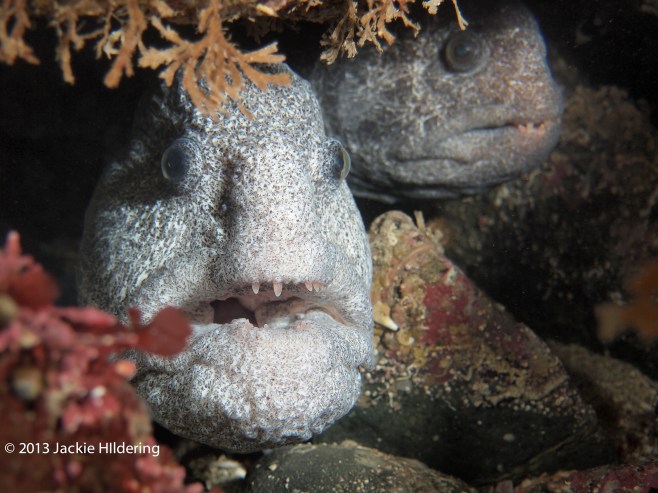
Mr. and Mrs. Wolf Eel on February 16, 2013 near Port Hardy. © 2013 Jackie Hildering

Mr. and Mrs. Wolf-Eel near Port Hardy ©Jackie Hildering.

I hope to make this point by sharing with you why the Wolf-Eel  is “designed” as it is and how very wrong many of us are in our perceptions about this species. The Wolf-Eel (Anarrhichthys ocellatus), which can be as long as 2.4 m, is not an eel. Wolf-Eels belong in the Wolf Fish family (Anarhichadidae). They are desperately misunderstood. Wolf-Eels are not dangerous nor “mean”. The opposite is true. They are reclusive, anything but ferocious, quite sedentary and slow moving.

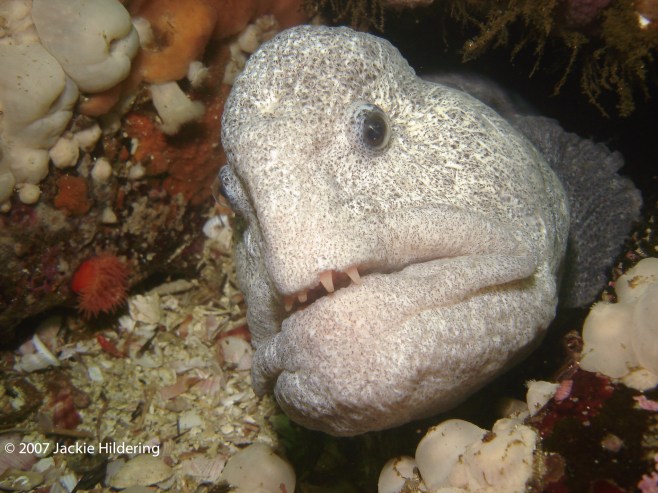
Mature male wolf-eel - about 2.2 m long. © 2008 Jackie Hildering

Mature male Wolf-Eel, about 2 m long. Can be 2.4 m ©Jackie Hildering.

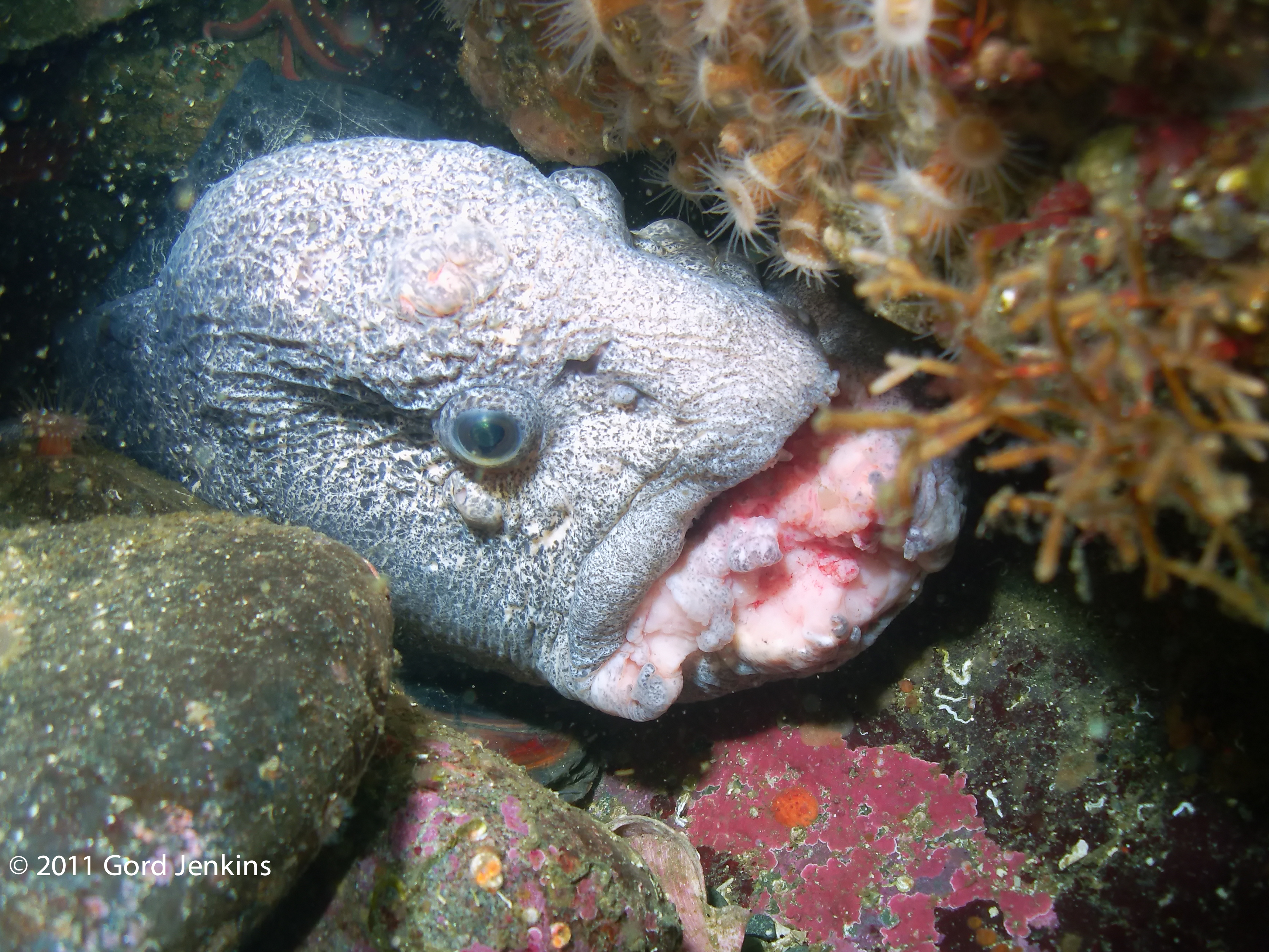
Yes, they have large, fleshy, ossified heads and the species has sharp teeth but this is so they can do what so few marine species can – they can feed on spiny sea urchins, snapping them effortlessly into pieces without suffering a single puncture. They also feed on other hard-shelled animals like shellfish and crabs. Even the roofs of Wolf-Eels’ mouths are impenetrable with ossified, tooth-like projections (see photo below).

Each wolf-eel has distinct spots around their eyes which helps recognize them as individuals. © 2012 Jackie Hildering

Mature males are bigger and have fleshier heads. Each Wolf-Eel has distinct spots around their eyes which helps recognize them as individuals ©Jackie Hildering.

The upper jaw of a wolf-eel. Impenetrable to even urchin spines! © 2005 Jackie Hildering

The upper jaw of a Wolf-Eel. Impenetrable to even urchin spines! ©Jackie Hildering.

To my knowledge there has never been an attack on a diver UNLESS, and here comes the predictable thing, we choose to habituate them. Wolf-Eels spend a great deal of time on the ocean bottom in dens where, as divers, we have the enormous privilege of  “visiting” the same spot and seeing the same individuals for years. It is not just their address that makes them recognizable as individuals. Each Wolf-Eel has a unique pattern of black spots near their eyes.

Grandpa Wolf-Eel on February 16, 2013 near Port Hardy. © 2013 Jackie Hildering

Grandpa Wolf Eel near Port Hardy ©Jackie Hildering.

Some divers choose to feed them, leading to the Wolf-Eels associating us with food and that’s where accidents can happen and where the wild behaviour that lets animals survive, becomes compromised. It also makes them tragically easy targets for any spear diver wanting to poach them. There is no legal fishery for this species but there is a demand for them in the Asian market which is why there are also attempts to farm Wolf-Eels i.e. aquaculture. Not surprisingly, Wolf-Eels might also be defensive when accidentally caught by anglers. I found one account from 1959 where a commercial fisherman was bitten and “The teeth penetrated the hip-waders and broke the skin on both sides of the ankle.”

Mature male bearing the scars of battle. © 2011 Gord Jenkins.

Mature male bearing the scars of battle ©2011 Gord Jenkins.

The mature males do carry battle wounds supporting that they don’t just hang out in dens waiting for a snack to come by, but rather that they will occasionally duke it out with other male Wolf-Eels.It was long thought that Wolf-Eels always mate for life but, this is not always the case. The males do compete for females who will sometimes opt to swap dens and go live with the competitor. Sound like any other species you know? Wonder if it happens at mid-life? 😉

Wolf-Eels have long-lasting pair bonds, coming together when they are around 4-years-old and having their first clutch when they are around 7. In aquariums, their life expectancy is known to be at least 28 years. Both male and female juveniles are brownish orange and look even more eel-like, lacking the big head of the adults. As adults, the females are smaller and a darker brownish grey (both remarkably camouflaged for when they are in their rocky dens).

They do also sometimes need to do battle for den space with a Giant Pacific Octopus.  This is likely another driver for the male’s having such fleshy heads – they are better able to survive the wounds inflicted by such battles.

Clearly, another unique feature about this species is their eel-like body. They are the only member of their family that have this body shape. The long tail serves in locomotion, powering them forward with big, slow, s-shaped waves while being stabilized with the long dorsal and pectoral fins (see video below). Having a long tail also allows them to den-up, curling up and around in narrow spaces between rocks and . . . wait for it . . . it lets them hold onto their eggs.

Mr and Mrs Wolf-Eel tending their egg mass © 2005 Jackie Hildering-

Mated pair tending their egg mass. Note how much darker and smaller the female is ©Jackie Hildering.

Female Wolf Eel guarding eggs. March 2016 @Jackie Hildering.

Female Wolf-Eel guarding eggs. ©Jackie Hildering.

Mating apparently most often occurs between October and December, with the female releasing eggs after the male prods against her swollen abdomen. He then wraps around her to fertilize the 7,000 to 10,000 white to yellow eggs that she will mould into a ball shape. This mass does not need to adhere to anything because the parents will take turns wrapping their tails around the mass, holding and turning it for good aeration until the +/- 3.5 cm young hatch some 13 to 16 weeks after fertilization.

Juvenile wolf eel. © 2010 Jackie Hildering-

Juvenile Wolf Eel ©Jackie Hildering.

The juveniles settle into the adult sedentary lifestyle between the ages of 6 months and 2 years (presumably dependent on food supply and den availability). One juvenile is even known to have travelled a minimum of 1,000 km; having been tagged in Port Hardy, BC and found back in Willapa Bay, Washington two years later. It was long thought that Wolf-Eels always mate for life but, this is not always the case. The males do compete for females who will sometimes opt to swap dens and go live with the competitor. Sound like any other species you know? Wonder if it happens at mid-life?

The Wolf-Eel is indeed akin to us in so many ways. It is a homebody that likes crunchy snacks and prefers that they come right by the front door; they are great parents and are docile unless fighting for home or partner. They invest in durable relationships and – they are only as strange looking as we terrestrial bipeds would appear to them.

And if all of that is not enough for you, see the photo below for the indisputable reasoning for by Wolf-Eels are NOT ugly fish!

Statler the Muppet is cute and loveable. Ergo - so are wolf-eels. Case closed!!

Statler the Muppet is cute and loveable. Ergo – so are Wolf-Eels. Case closed!!


Range: Sub-tidal to 226 m; Baja California (Mexico) to the Aleutian Islands (Alaska); west to Russia and south to the Sea of Japan.

Mr. and Mrs. Wolf Eel on February 16, 2013 near Port Hardy. © 2013 Jackie Hildering

Mated pair near Port Hardy ©Jackie Hildering.

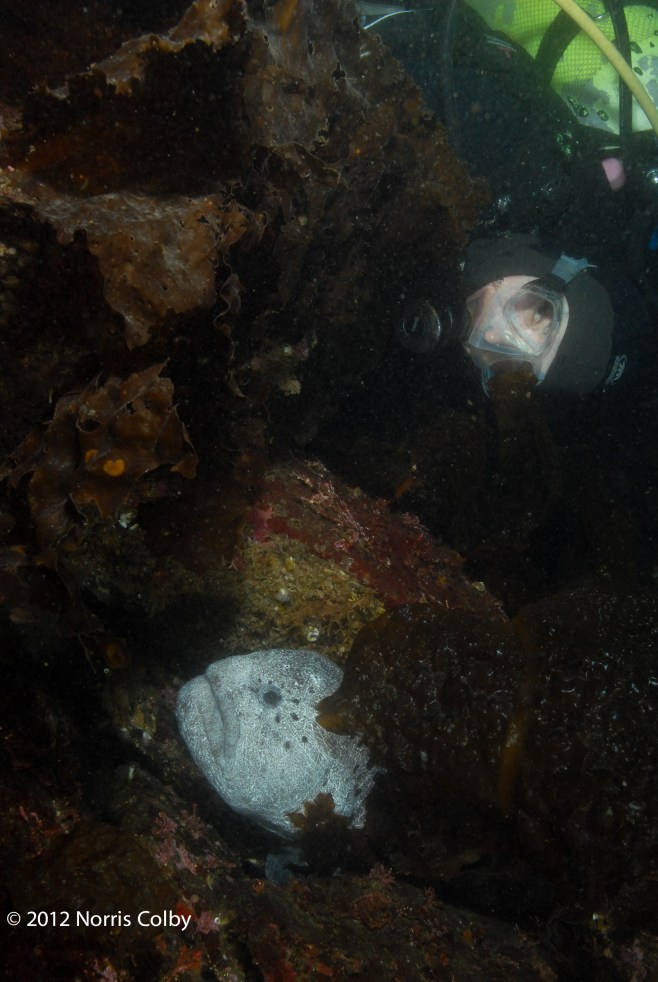
Me and a mature male wolf eel.

Me and a mature male Wolf-Eel ©2012 Norris Colby.

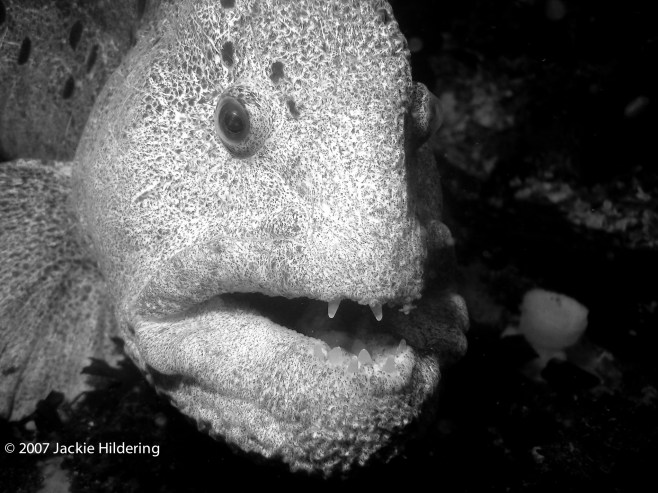
Mature male wolf-eel. © 2007 Jackie Hildering

Mature male Wolf-Eel ©Jackie Hildering.

Mature male wolf-eel. © 2007 Jackie Hildering

Mature male Wolf-Eel ©Jackie Hildering

For these and more images of the Wolf-Eel, please see my gallery at this link. 

Remarkable video of a mature male Wolf-Eel eating a Giant Pacific Octopus by Andrew Eve.

Sources:

Grunt Sculpin – Little Fish, BIG Attitude!

Last updated: March 4, 2024
Meet the fish that so often has people exclaiming “It lives HERE?!”

Yep, the tiny Grunt Sculpin is a powerful ambassador for raising awareness about the depth of biodiversity hidden in the cold, dark, rich waters of the north east Pacific. 

We are programmed to associate warm waters with exotic-looking fish species but read below for the Grunt Sculpin’s astounding adaptations and masterful mimicry. 

The species reaches only a maximum of ~9 cm.

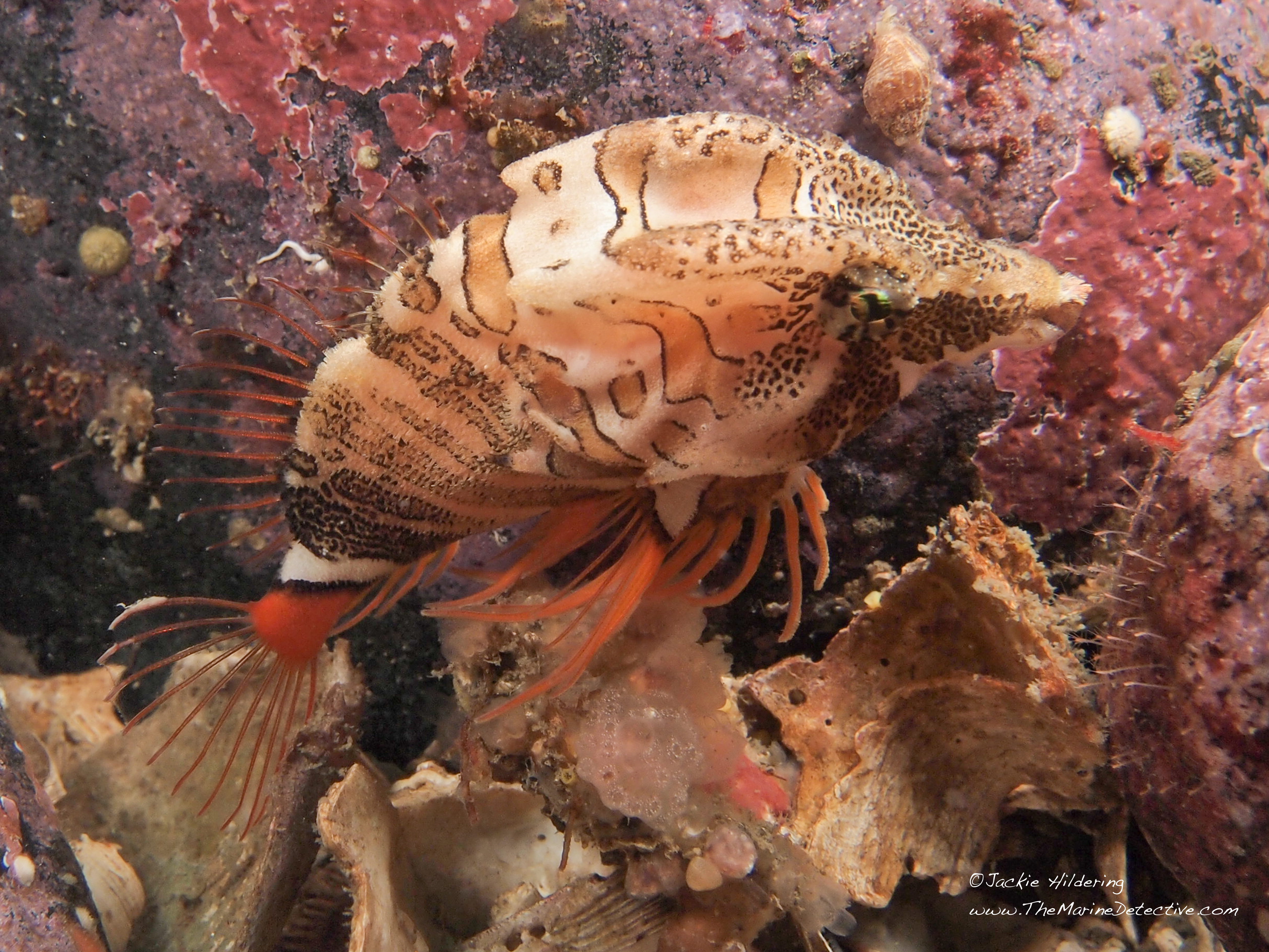
It is adapted to look like a Giant Acorn Barnacle (Balanus nubilis)!  When facing outward, its pointy nose looks like a closed Giant Acorn Barnacle and when the fish turns around, its tail looks like the foot of the barnacle that rakes in plankton.

Adapted to look like a Giant Acorn Barnacle!
Closed Giant Acorn Barnacles. See how similar this is to the nose of a Grunt Sculpin?
Foot of a Giant Acorn Barnacle. The tail of a Grunt Sculpin looks so much like this!

This little fish has giant attitude. It can be highly territorial, hopping around on its pectoral fins in a strutting, jerky fashion.

You may think the males are the master strutters? Ha! The female is as fierce as can be. Reportedly, she will chase a male into a crack, an empty barnacle shell, or another place of no escape and guard him there until she is ready to lay her eggs. When she has laid them, the male is released to do his duty.

She watches him to ensure he fertilizes the eggs (up to 150 at a time) and then, according to some sources – she saunters off leaving the male to care for the eggs but may return once in a while to take on a shift

If you can’t find an empty barnacle shell. A cup will apparently do!

From Casey Cook, aquarist with the Aquarium of the Pacific (pers com 2022-12-19): “The female often pushes the male into guarding so she can roam. She will get very vocal, and demanding – making sure he does the job!”

From Fishes of the Salish Sea – Volume Three: After the eggs are fertilized ” . . . she then moves off leaving the male behind to guard the nest, although she may return occasionally to help with parental duties. When the time for hatching approaches, the guarding fish takes the eggs inside its mouth, swims out of the nest, and spits out the eggs into the water column. This breaks the egg shells and frees the larvae that then swim off as zooplankton.”

Very young Grunt Sculpin. The Red-Gilled Nudibranch in the upper part of the image is only about 2 cm 

About Grunt Sculpins’ diet also from Fishes of the Salish Sea: “With its small, pointed mouth, it is adept at removing a wide variety of small invertebrates from the water column, especially copepods, amphipods, isopods and shrimps., but it also consumes significant numbers of fish eggs and larvae.”

The Grunt Sculpin’s pointy “bill-like” head is reflected in the species’ scientific name.

With regards to classification, the scientific name Rhamphocottus richardsonii reflects the Greek word for beak “rhamphos” which is appropriate for the Grunt Sculpin’s bill-like snout. This makes some people think that the species looks like a seahorse but note that they are not closely related at all. The Grunt Sculpin is the only member of its genus. It is truly one of a kind.

Juvenile Grunt Sculpin #1 of 3 photos.
Juvenile Grunt Sculpin #2 of 3 photos. 
Juvenile Grunt Sculpin #3 of 3 photos. 

Oh, and are you wondering about the name “Grunt” Sculpin? Apparently the species grunts when it is taken out of the ocean. You would too! Likely it also grunts when being defensive underwater. It is also the sound I make in my delight when I find one. It will be a very loud grunt indeed if I ever find one guarding eggs or with its tail-end extended out of a barnacle.


Below, more of my photos of Grunt Sculpins. 🙂

Grunt Sculpin next to a Gold Dirona (nudibranch species). See him /her?
Grunt Sculpin and a Clown Dorid (another nudibranch species).
A Grunt Sculpin “strutting” over the ocean bottom. See the cloud of silt lifted off as a result?
Another Grunt Sculpin in an empty barnacle shell.
And another.
You can’t see me.
Grunt Sculpin hiding in a broken mussel shell.
Juvenile Grunt Sculpin
I wonder if this one is female and about ready to lay her eggs?

And some more photos of individuals to show how similar their markings are.


Sources:
– Aquarium of the Pacific – Grunt Sculpin
– Fishbase – Grunt Sculpin
– Love, M. S. (2011). Certainly more than you want to know about the fishes of the Pacific Coast: A postmodern experience. Santa Barbara, Calif: Really Big Press.

Plankton Got Sole!

No, I have not mixed up my spelling of “soul” verses “sole”.

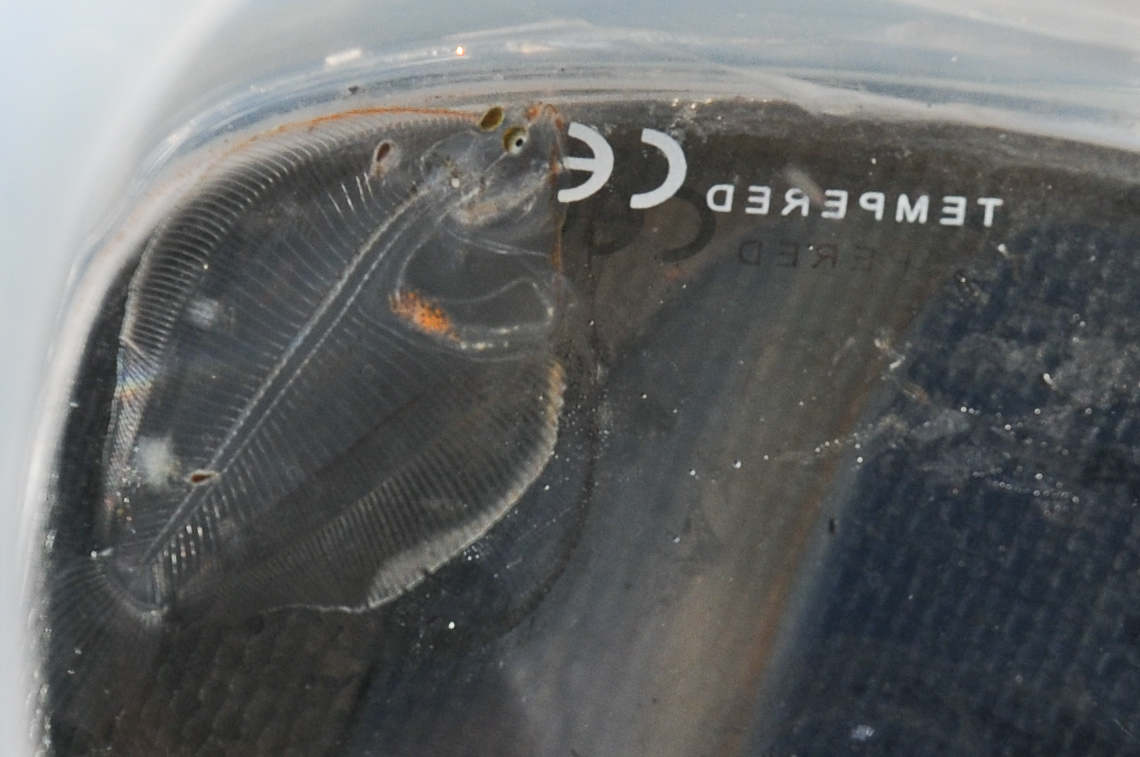
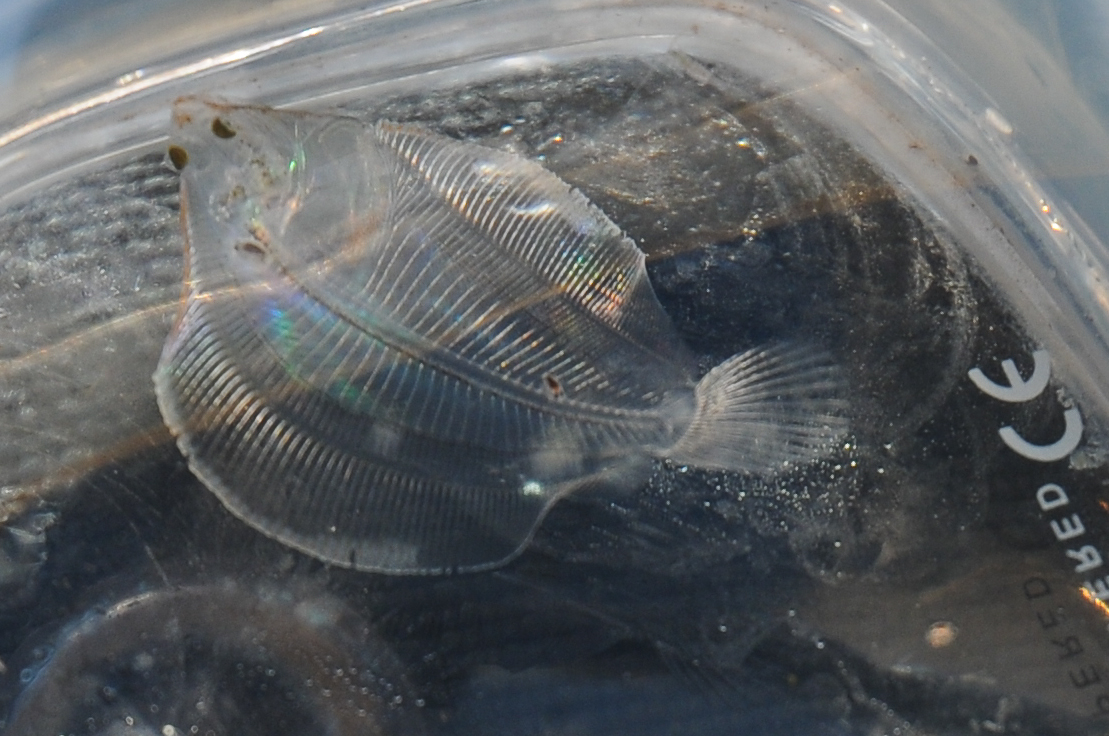
This last weekend, while watching herring feed on krill in a tide line, I suddenly noticed a very small transparent fish.

Upon closer inspection, I saw that it was a larval form of some species of flatfish.

I was able to dip the little guy / gal into my dive mask for a few pictures and, due to the size of the lettering in the mask, I know that the fish was only 2.7 cm.

Planktonic Sand Sole.  Only 2.7 cm. 
Photo: Jackie Hildering

I was in awe of how transparent s/he was; that I could see the bones and heart; and that this small, fragile planktonic stage could ever survive to grow into an adult.

These sorts of “finds” are as awe-inspiring to me as any sighting of a whale. The thick planktonic soup of our rich cold oceans is full of the larvae of so many species. Anemones, nudibranchs, sea stars, crabs, etc. – they all start off as zooplankton and the incidence of what sort of plankton are present often gives scientists an indication of what may be happening with the marine food web.

It is like a world of hidden secrets to me and of course I wanted to find out all I could.

What species of flatfish was this – halibut, sole, flounder?

Photo: Hildering

I do not have the expertise to know but, oh so thankfully, there are those out there willing to share their great knowledge.

Marie-Josée Gagnon of the Salmon Coast Research Station quickly steered me in the right direction, believing it was most likely a species of sole.

She connected me with zooplankton taxonomist  Moira Galbraith of the Institute of Ocean Sciences who confirmed that this was the larval form of a Pacific Sand Sole (Psettichthys melanostictus), a species that can grow to 63 cm. She also shared that the transparency of the larval fish serves as camouflage, reducing the chances of it being eaten before reaching the life stage where it settles to the ocean bottom and hides on and in the sand.

But wait, what are those two little zooplankton guys attached to the larval sole? They are copepods, but what kind of copepod?  What does their presence mean ?  Are they parasitic? And there I go down the marine id rabbit hole. 

One thing I know for sure though – and forgive me for the following pun because the emotion behind it is very sincere – how I hope this little planktonic fish will be a  . . . sole survivor.

Sources:


Update September 30, 2012:

  • This great item by Puget Sound Sea Life has been brought to my attention and includes the following: ” . . . within several days to weeks, depending on the species, the larva undergoes a radical metamorphosis. The right or left eye migrates from it’s normal position across the top of the head to the other side of the body changing some skull bones in the process . . . . After metamorphosis, the fish settles to the bottom on it’s left side, develops skin color on the right side and continues growth as a juvenile.  Adapting a bottom-dwelling life style allows flatfish to exploit a common habitat – flat sandy bottoms which are very common in the subtidal zone. Many fish avoid this habitat because of the lack of rocks or other features that would provide a hiding place. Flatfish can hide from predators by burrowing, leaving only their eyes above the surface. In addition the habitat is home to an abundance of prey such as worms and shrimp. With both eyes on the upper side they can use 3D vision to hunt and detect predators. There has been considerable controversy over the origin of flatfish, but recent discoveries of several fossil intermediate forms show that eye migration evolved gradually some fifty million years ago.”
  • With regard to the ectoparasites on the sand sole larva, Marie-Josée Gagnon and Moira Galbraith have again been very generous with their knowledge. It is impossible to know the species from my photo but, due to the size, it is likely a recent infection and could be (1) first stage Chalimus; (2) Lepeophtheirus bifidus – which, unlike most parasites of benthic marine species is host specific – only being found on the rock sole or possibly, (3) the isopod Gnathia.   I valued having affirmed too that adults and young live in different environments to eliminate competition for the same resources but also to provide a buffer or separation to prevent transfer of disease or parasites.

Rockfish Barotrauma

Update: September 2022
New paper – Hailey L. Davies, Shane Gross, Dana R. Haggarty, Francis Juanes (August, 2022)- PHOTO DIARY – Conserving Rockfishes: Barotrauma and Descending Devices in the Northeast Pacific, Fisheries Magazine.

Get the app that alerts you when you enter a Rockfish Conservation Area.

Update: Fisheries Notice March  25, 2019
The use of a descending device is now required by condition of licence to assist in the conservation and survivability of rockfish being returned to the water. Because of their closed swim bladders, rockfish brought to the surface suffer barotrauma, causing the swim bladder to inflate and reducing the probability of their survival upon release. Handle catch as little as possible, using wet hands to preserve the protective slime coat, and return to the water at depth of capture as quickly as possible (under two minutes). To avoid catching rockfish, move to another fishing location.”

_______________________________________________

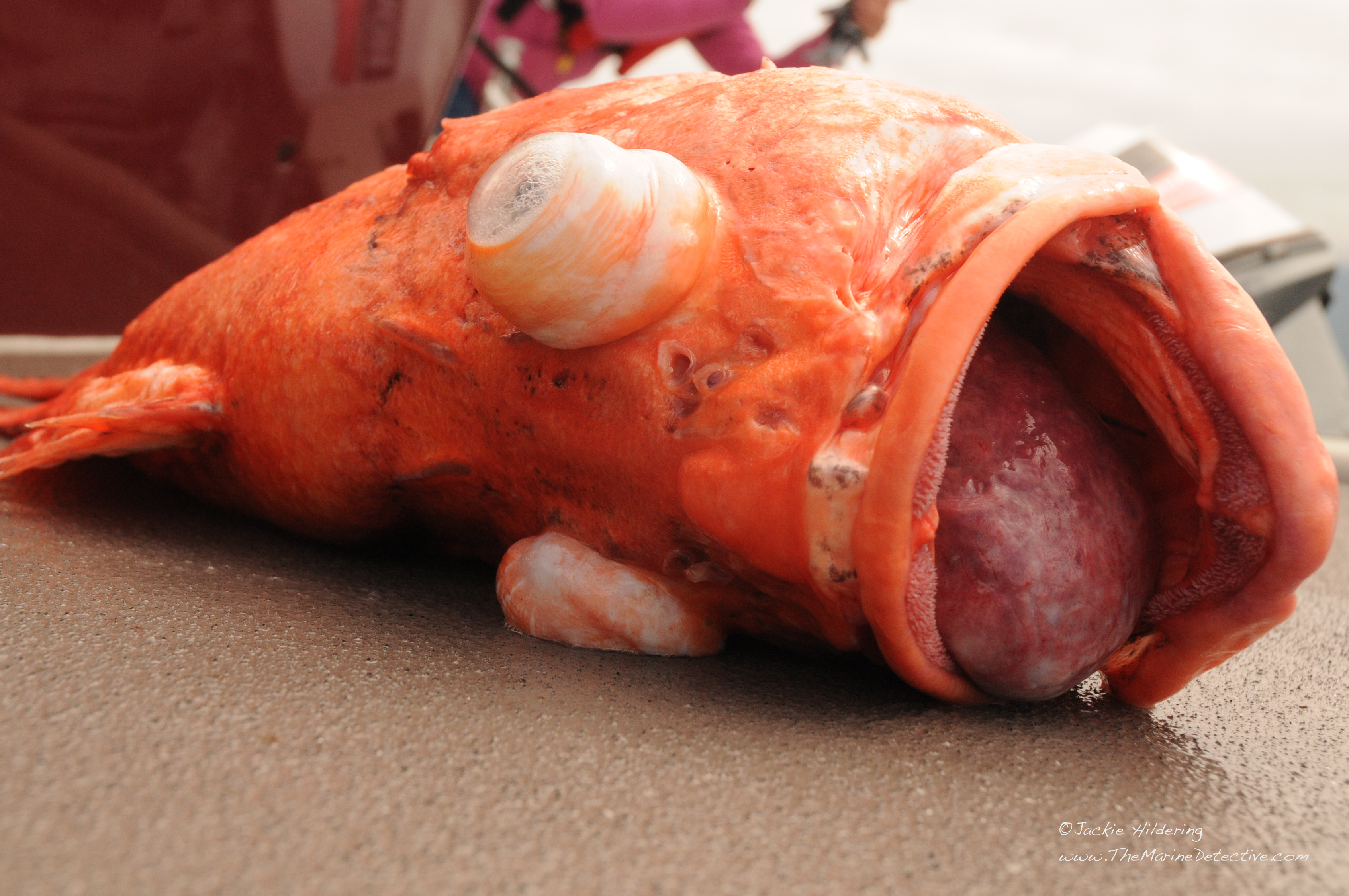
This photo is of a Yelloweye Rockfish that has died from barotrauma, also known as “pressure shock”. 

Yelloweye Rockfish that has died of barotrauma. Reduced water pressure causes the air in the swim bladder to expand and push out the esophagus and eyes. BUT this is a reversible condition whereby the fish can survive through use of a “fish descender”. Photo: Hildering. 

Many rockfish species are particularly sensitive to reductions in pressure since the air in their swim bladders expands substantially. The swim bladder is a buoyancy control organ and even when slowly reeled in from a depth of only 20 m (60’), a rockfish’s swim bladder can expand to three times its size, putting pressure on the fish’s organs.

As is the case with the Yelloweye Rockfish in the photo, the swim bladder can expand to the point of causing the fish’s eyes to bulge out of their sockets and its esophagus to be pushed out of its mouth (the esophagus is the first section of the digestive tract). I know this is likely a sight that may not enhance your appetite for your rockfish catch but please read on since, contrary to the thinking of many, this IS reversible whereby the rockfish stands a good chance of survival.

Colossal “management” errors were made with overfishing slow-growing rockfish. Many species are extremely long-lived, slow to sexually mature, and the big, old females are the most fertile – producing the most eggs and hatching the largest number of healthy young.

For example, Yelloweye Rockfish are believed to have a lifespan of up to 118 years. They don’t reproduce until they are at least 12 years old, and the old females can incubate up to 2.7 million eggs! Know that there are 38 species of rockfish off the coast of British Columbia. 

This means that species are very slow to reproduce whereby, if you catch lots, especially the big females, you can devastate populations very quickly.

Another nail in the coffin of rockfish is that many adults also have high site fidelity so that by fishing one area, you can wipe out a community of fish. Click here for my blog on having found back the SAME individual rockfish in the SAME spot after EIGHT YEARS. This is why Rockfish Conservation Areas (RCAs) are essential, where it is most often illegal to do any hook and line fishing (see restrictions here). 

But, what is you accidentally catch a rockfish outside these areas?

There are studies that support that if you were to quickly recompress the fish, it would stand a very good chance of survival, even where it appears dead at the surface. The fish could be brought back to depth with barbless weighted hooks, or commercial “fish descenders”.

This video make the life-saving potential of fish descenders very clear.

From Island Fisherman Magazine: “Common types of descending devices include a simple, inverted barbless hook, a spring-loaded clamp, and a pressure-release clamp. Of the different devices available, the most effective and simplest to use is a depth pressure activated release device, the Seaqualizer . . . Automatically opening at preset depth, the motion of the boat or the actions of the rockfish as it descends will not prematurely release the fish.

Examples of fish descenders:
Seaqualizer Fish Release Tool (~ $60 CAN)
(Recommended by various fishing organizations and publications)
Shelton Fish Descender (~$8 CAN) 
SeaQualizer SeaYaLater Fish-Release Hook (~$20 CAN)”

If you can act quickly enough (which is essential) you can even use and inverted, weighted milk crate. See clip below AND this link for making your own descending device.

How wonderful it would be if more people would undertake the effort to recompress the fish, knowing how dire the situation is for many rockfish species. Imagine the further positive impact if people would choose to return the depleted species to depth even when they haven’t reached their catch limit, especially the big, highly productive females.
But, even if there was to be such enlightenment, many rockfish populations are so depleted that they need far more protection.

Again, Rockfish Conservation Areas (RCAs) are essential. These should be areas known to be the territory of depleted rockfish populations. Since these are no-fishing zones, there is no chance of barotrauma and the rockfish populations that live in the area are given the time to rebuild to have more sexually mature fish and more big old super mamas.

In summary, it’s so easy to contribute to rockfish conservation:
(1) Respect Rockfish Conservation Areas knowing that you usually cannot do ANY hook and line fishing there; and
(2) Invest in a fish descender for rockfish caught outside RCAs.

Long live rockfish!

Fantastic video showing how rockfish that appear dead at the surface due to barotrauma fully can revive at depth! From the Coastside Fishing Club:

Video from Alaska Department of Fish and Wildlife showing a summary of homemade and commercial fish descenders. 

Entertaining and super informative video “How to save a life – a rockfish life” by fish guru Milton Love with a rap song by Ray Troll:

Source: Protecting Rockfish – Fisheries and Oceans Canada

Links
Get the app that alerts you when you enter a Rockfish Conservation Area

Government of Canada

Examples of fish descenders

Research on the effectiveness of fish descenders

Very Rare Fish Find: King-of-the-Salmon (Trachipterus altivelis)

Last updated 2026-01-09
The original post below was about a sighting of this species in Port McNeill in 2012. The blog has since been updated with additional sightings and details (including video about the species astounding feeding adaptations).

King-of-the-Salmon at ~1.5m long. Photo: September 2017 by Collin Jay Johnson; near Tattoosh off Neah Bay Washington; depth ~100 fathoms (180 m).

See below for the extraordinary feeding method of the King-of-the-Salmon by which they extend their jaw. This member of the ribbonfish family belongs off our coast. To date I have not been able to verify if the origin of the name of the species is indeed from Makah legend. 


Here’s a finding to enhance your sense of wonder about the sea and how little we know about its inhabitants.

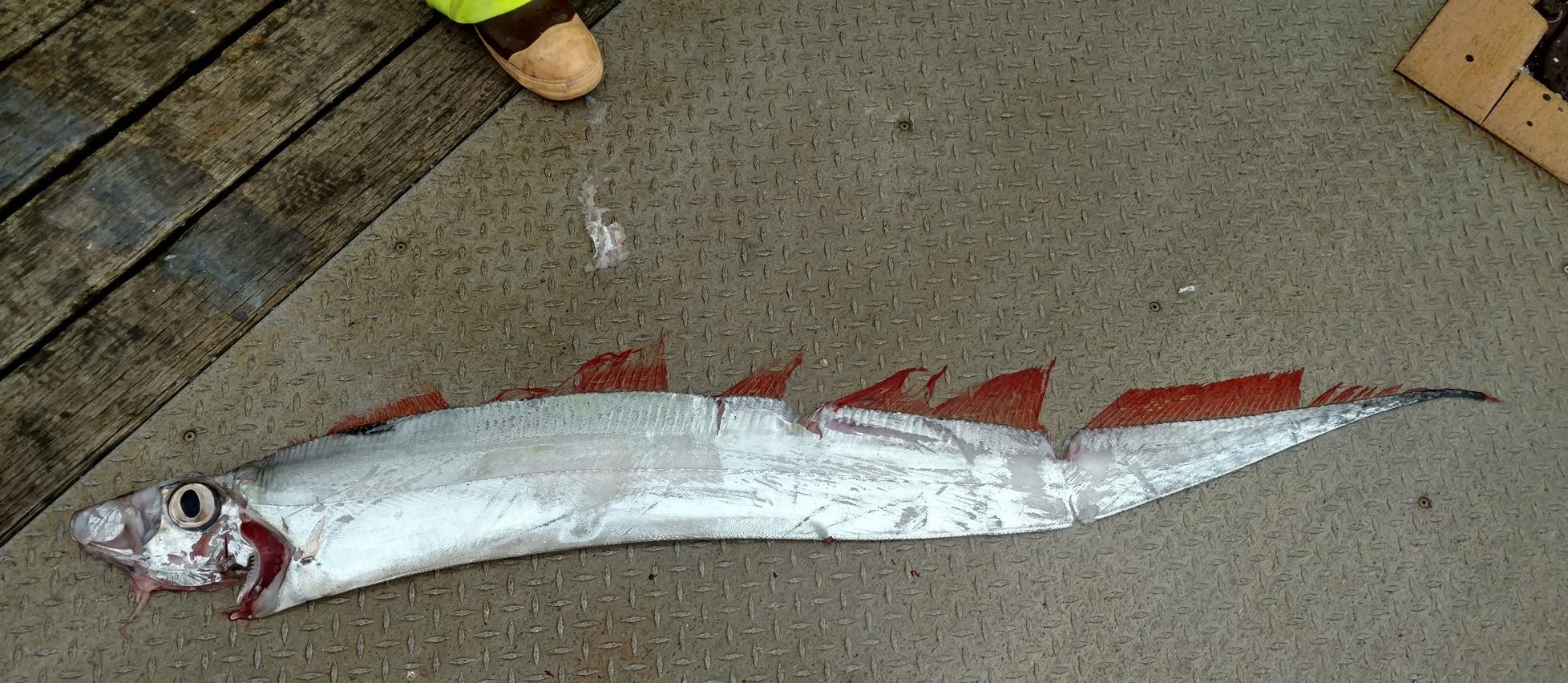
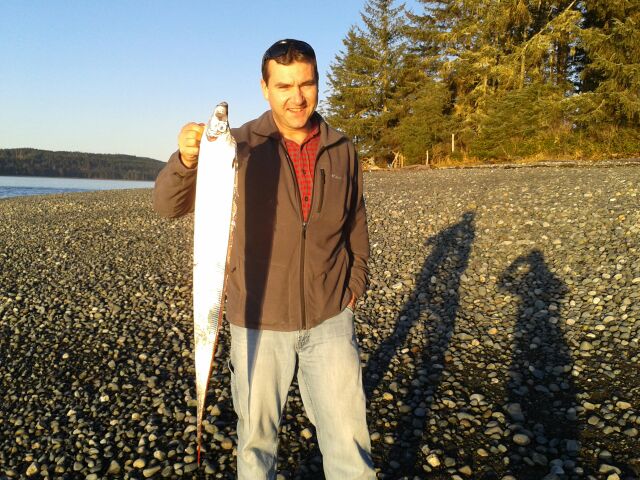
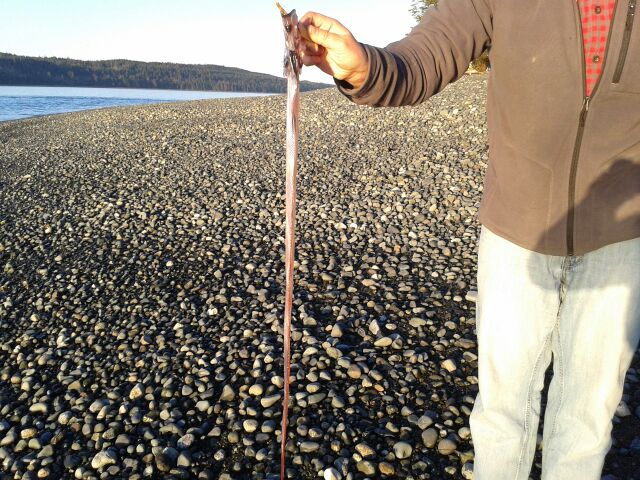
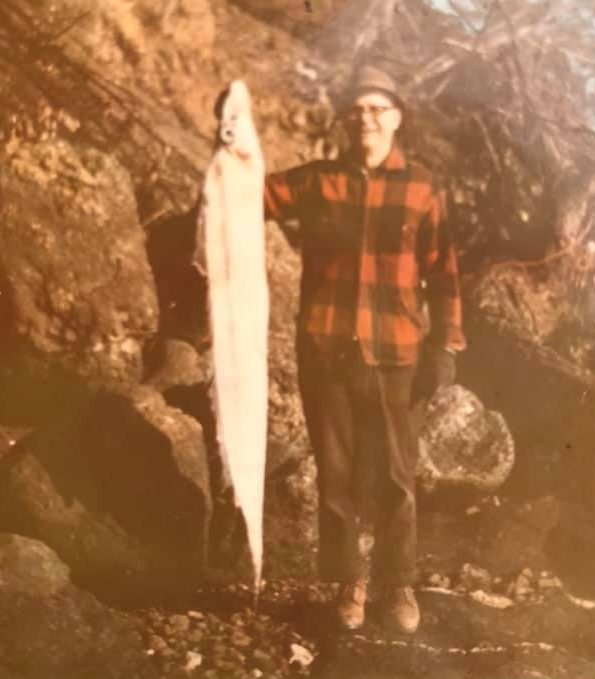
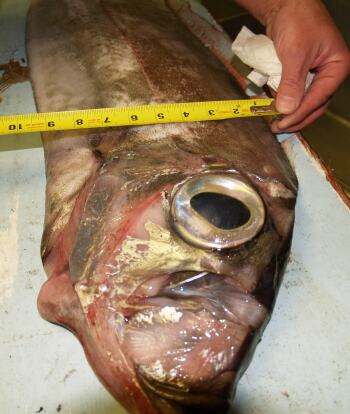
On March 23rd, 2012 Darren and Joanne Rowsell found this dead specimen on the beach at Lady Ellen Point, Port McNeill, British Columbia, Canada. When the photos landed in my inbox, I almost fell off my chair recognizing how rare a find this was. It’s a King-of-the-Salmon (Trachipterus altivelis). The adults feed in the open ocean at depths of 900+ m (3,000 feet) so they hardly ever wash ashore and I had never seen one before.

Darren Rowsell with the King-of-the-Salmon found on March 23rd, 2012 near Port McNeill. Photo Joanne Rowsell.
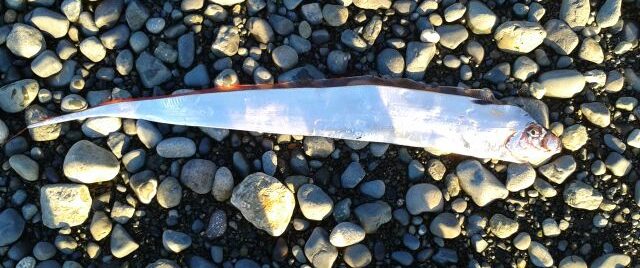
Easy to see why the King-of-the-Salmon belongs to the ribbonfish family. Photo Joanne Rowsell.

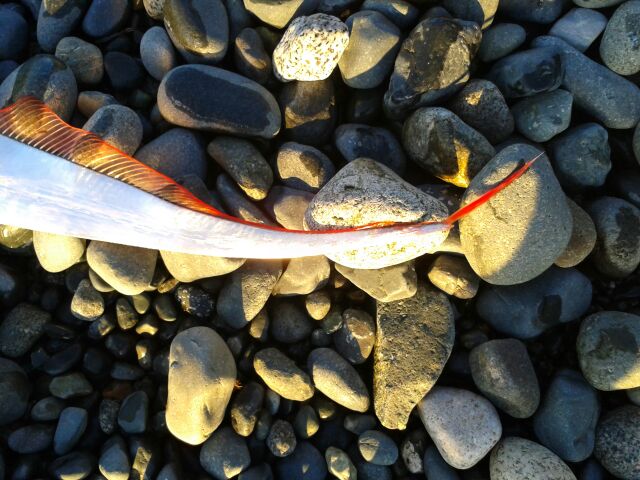
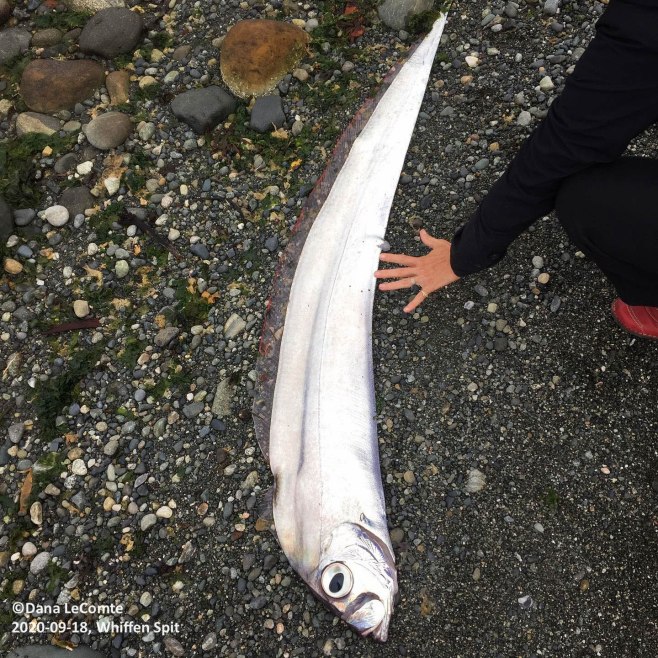
The King-of-the-Salmon belongs to the ribbonfish family (Trachipteridae). You’ll note from Joanne’s photos that the species is indeed very ribbon-like. It is extremely thin and maximum confirmed length is 2.45m (Savinykh and Baitalyuk. 2011). The long, high, crimson coloured dorsal fin is also very reminiscent of a ribbon, tapering down the full length of the fish’s back. These fish move in a snake-like fashion, undulating their long bodies.

The unique common name of the King-of-the-Salmon is said to originate from Makah First Nation legend. The legend is said to be that the fish was believed to be the “king” that would lead salmon back to their rivers to spawn and that to kill one was believed to bring bad luck, causing the death of the salmon.  The Makah, like other fisherfolk, must occasionally have caught one on their lines or in their nets. HOWEVER, I have never been able to verify if this is indeed a Makah legend.

King-of-the-Salmon. Photo Joanne Rowsell.
King-of-the-Salmon’s dorsal fin extends all the way down its back.
Photo Joanne Rowsell.

Video ©Josh Billauer showing the dorsal fin of a King-of-the-Salmon – November 2025 near San Diego.

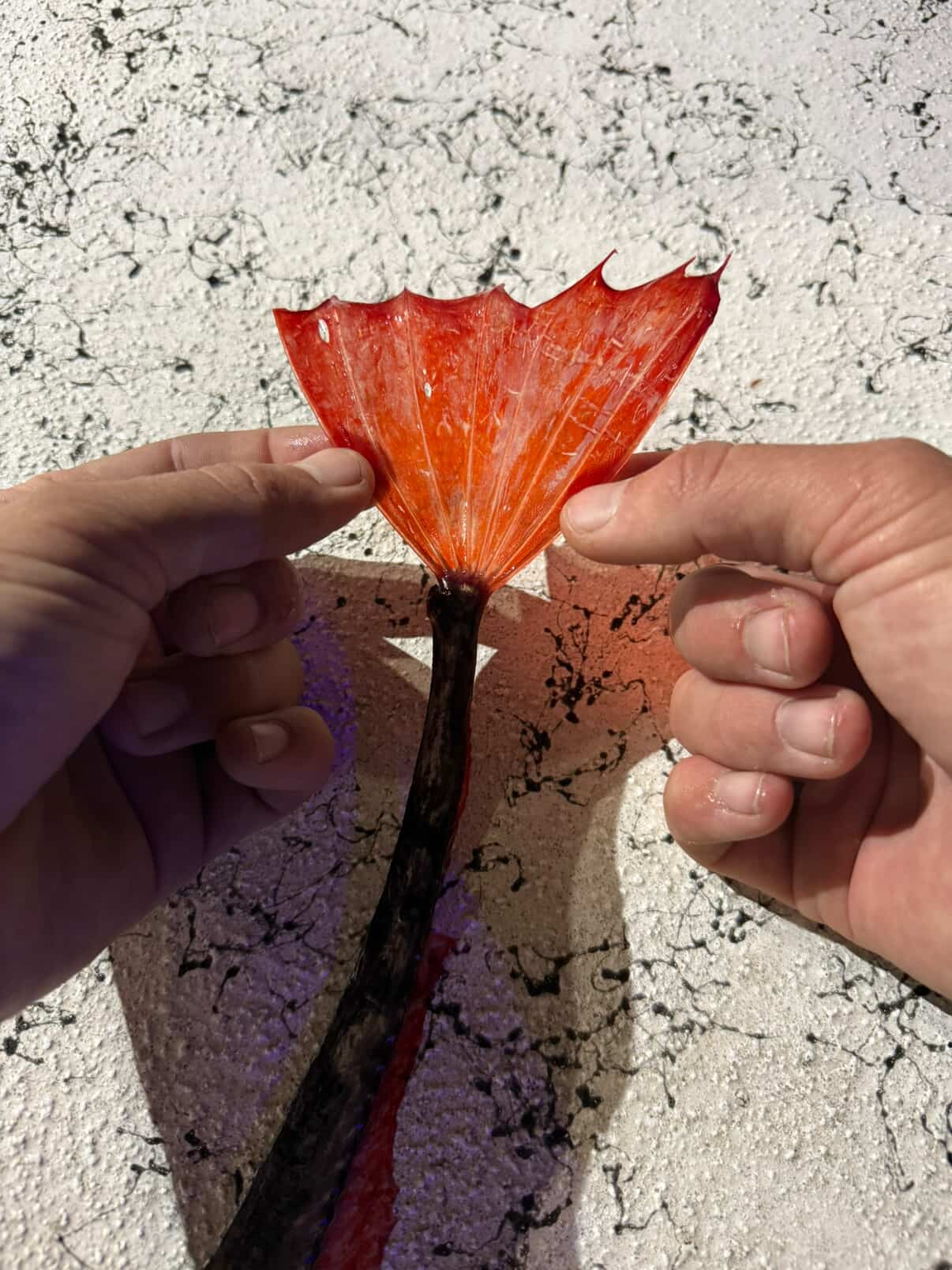
Caudal fin / tail of a King-of the-Salmon ©Josh Billauer – November 2025 near San Diego.

Range:

The species’ range is believed to be from the Gulf of Alaska to Chile.

King-of-the-Salmon found at Freshwater Bay, Clallam County, Washington in 1973, by Oscar Stigen. Photo provided by his daughter Jean Stigen.

Diet and Feeding Method:

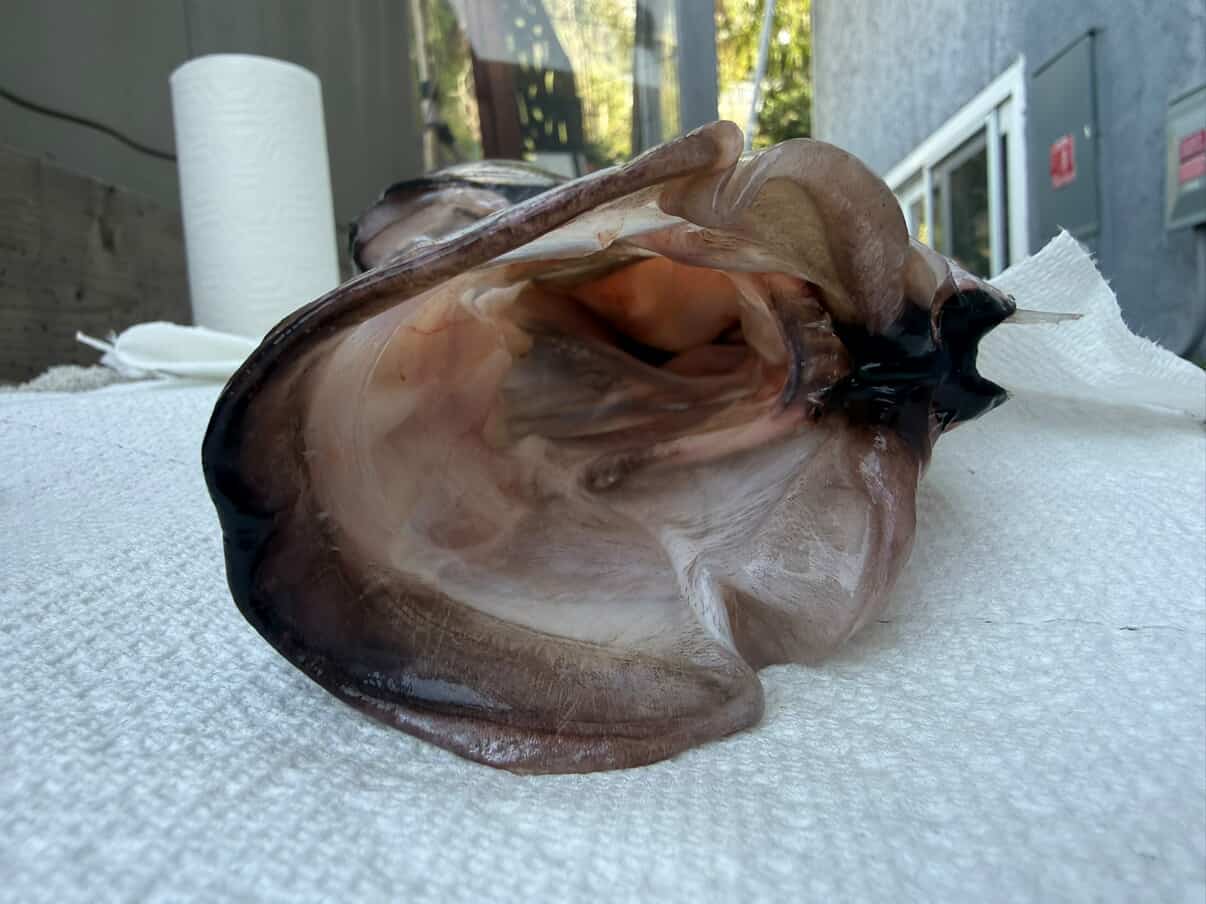
Smaller King-of-the-Salmon do feed closer to shore and their diet is known to include copepods, annelid worms, fish scales, and fish larvae. Larger individuals feed on copepods, krill (euphausids), polychaetes (bristle worms, small pelagic fish, young rockfish, squid, and octopus.  Part of what makes the species so unique is that they can capture (and process prey) by extreme protrusion of the upper jaw. See photos below.

From Ferry, et al (notably the ONLY research I could find on this species): “T. altivelis does appear to have earned the title of “most extreme”in terms of premaxillary protrusion. The distance to which the upper jaw is protruded anteriorly away from the head exceeds that of any other known species  . . .the gut was examined in an attempt to gain further insight into this speciesecology. The gut was empty, but the anatomy was unusual and potentially suggestive of extreme foraging habits. There were hundreds of very small diverticuli lining the gut, which suggest to us a mechanism for increasing digestive surface area and/or efficacy. This species has been described as a deep-midwater forager on crustacean zooplankton (Hart, 1973; Shenker, 1983), which is consistent with such mechanisms.”

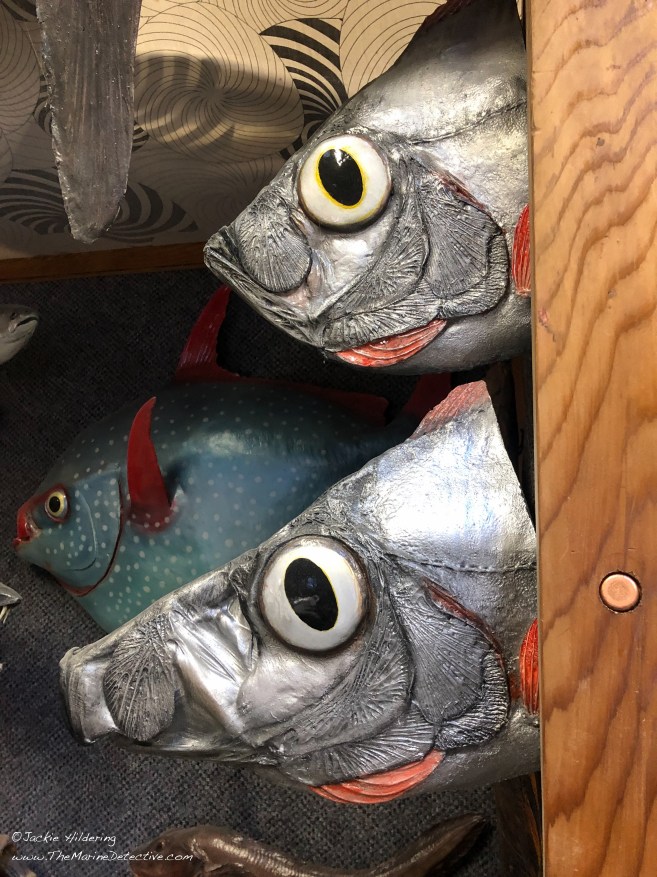
Replicas of the head of the same King-of-the-Salmon by Bilz Rockfish. Compare the top and bottom photo (cast from the SAME fish) to see the extreme capability of this fish to extend its jaw.  learned that the nose can push outward as you see by contrasting the top and bottom casts (from the same fish).
Photo: Harbor Wildwatch, June 8, 2020 which allows for insight into the protrusion method this fish uses to eat.

Video ©Josh Billauer showing how the King-of-the-Salmon can protrude its jaw – November 2025 near San Diego.

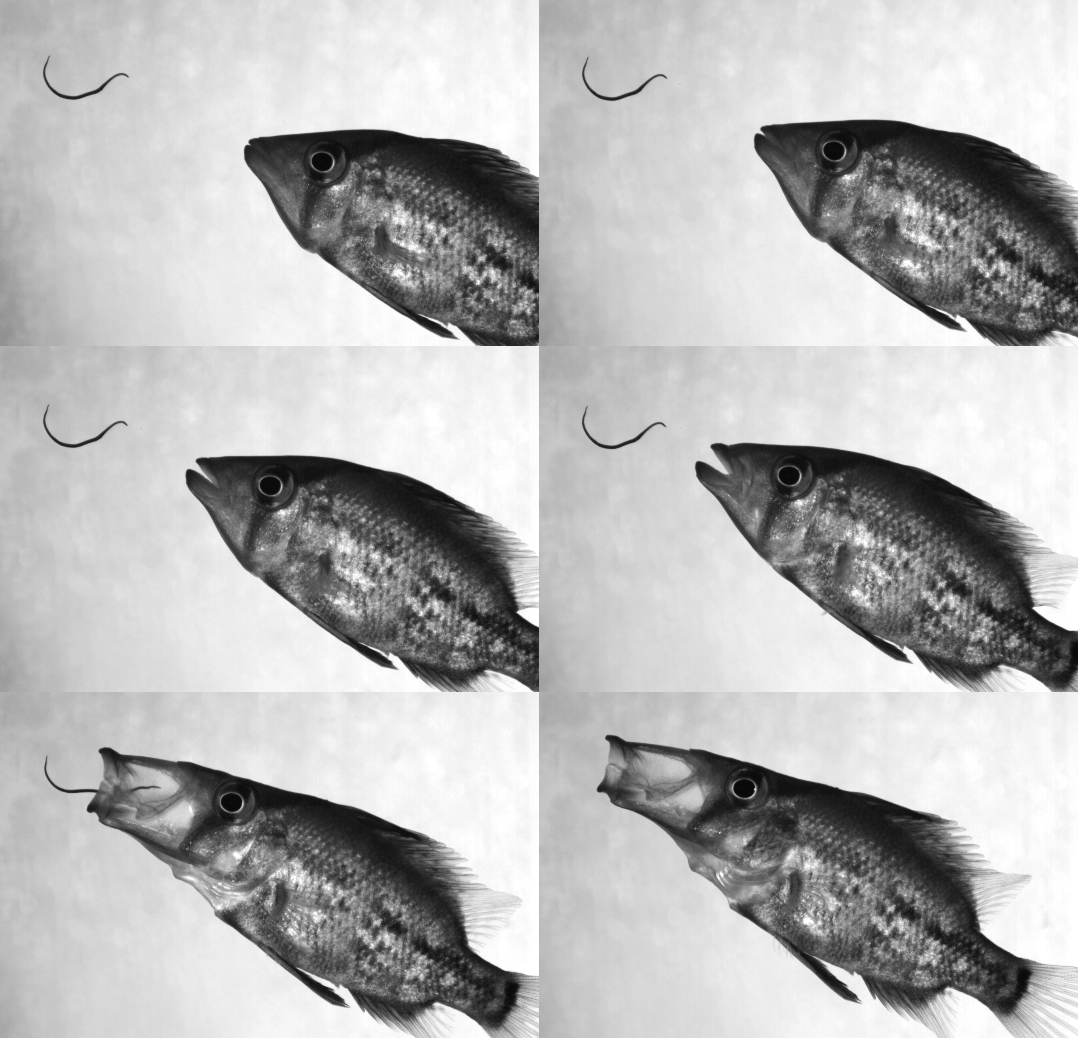
A different species but provides some insight into how fish jaws can protrude. Species in this slow-mo GIF is “the Neotropical cichlid, Caquetaia myersi, showing off its highly protrusible jaw while feeding on a black worm.” Source: Martinez et al.
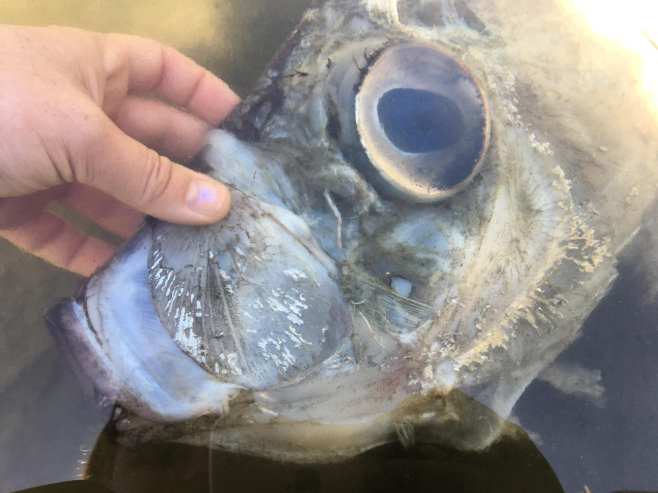
Photo into the upper jaw of a King-of-the-Salmon ©Josh Billauer – November 2025 near San Diego.


Predation:

I presume that stomach content studies have allowed science to determine that the predators of the King-of-the-Salmon include the Bigeye Thresher Shark (Alopias superciloosus), and the Longnose Lancetfish (Alepisaurus ferox).

Swimming: 

From Dr. Gavin Hanke of the Royal BC Museum: “King-of-the-Salmon swim by passing a sine wave down their dorsal fin – they can get a fair bit of speed just by doing that. They can also reverse using the same fin flutter. They slowly turn by putting a curve in the body. However, in the first few seconds of the linked video you can see that they also swim in a more typical fishy way (using eel-like body oscillation) when they need a burst of speed or a really quick turn.” See video below of one swimming.


And THAT appears to be all that is known about the King-of-the-Salmon – yet another one of our remarkable marine neighbours.

From Ferry, et al (2019): ” While much work remains regarding the ecology of T. altivelisa nd its relatives, it is certain that this fish holds many surprises yet in store”. No doubt!


King-of-the-salmon found near Salem, Oregon in 2006. 1.83 m (6 foot) long and the head was about 23 cm (9 inches) wide. Source: Salem News; July 23, 2006; "Strange Fish Found on Beach Near Seaside" Click here to read the story.
King-of-the-Salmon found near Salem, Oregon in 2006. 1.83 m (6 foot) long and the head was about 23 cm (9 inches) wide. Source: Salem News; July 23, 2006; “Strange Fish Found on Beach Near Seaside”. Click here to read the story.

Sources:


Sightings from Washington and BC – photos and video.
NOT a comprehensive account of all sightings!


2021

May 12, 2021: King-of-the-Salmon washed up at Witty’s Lagoon near Mechosin documented by John Michael Thorne. 


2020

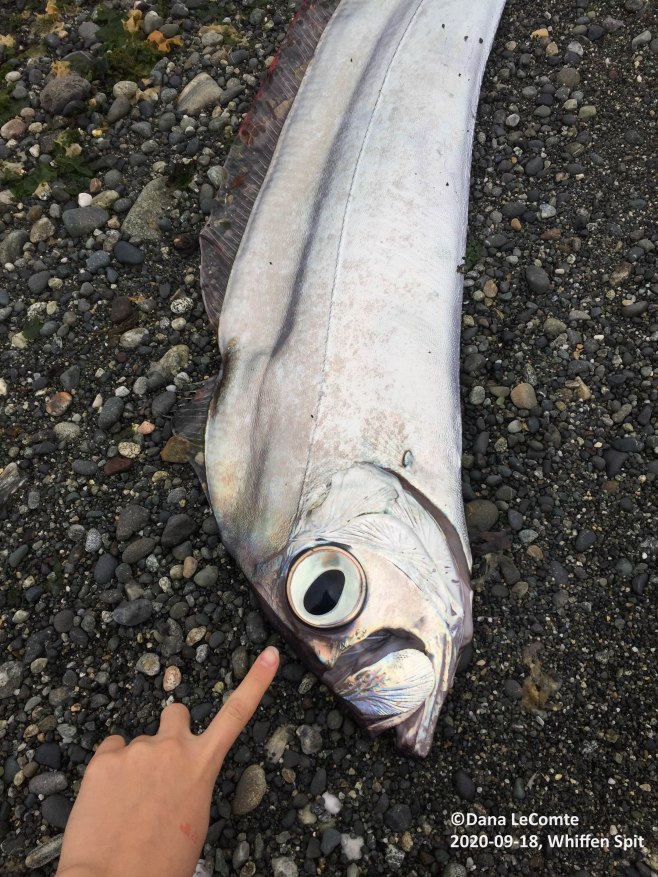
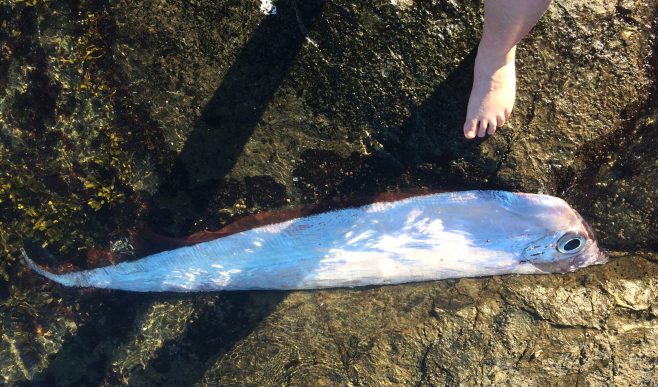
September 18, 2020: King-of-the-Salmon washed up at Whiffen Spit (Sooke) documented by Dana LeComte (photos below).

July 18, 2020: Live King-of-the-Salmon documented by Gary Bodine at Pillar Point, Washington. 

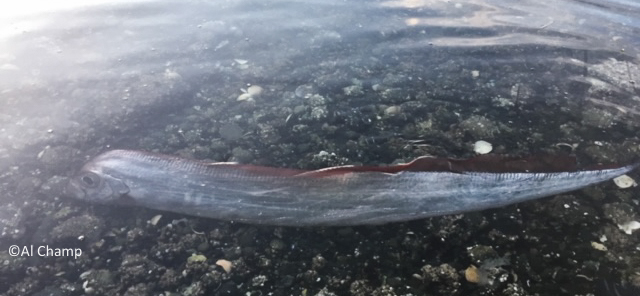
June 24, 2020: ~1.5 m long King-of-the-Salmon found struggling to stay upright by Al Champ and Wendy Cooper in East Sooke (photo below).

June 24, 2020 : ~1.5 m long King-of-the-Salmon in poor condition found by Al Champ and Wendy Cooper in East Sooke, across from the Sooke River. They strived to help it on its way but ran out of daylight, finding it was getting weaker and weaker and that it made no attempt to swim away.  

June 8, 2020: King-of-the-Salmon documented by Harbor WildWatch in Salt Creek, west of Port Angeles, Washington. They provided the insight that “We speculate that this individual swam too close to shore and was killed by the waves as there was no evidence of predation. These are thin delicate fish adapted to the deep ocean. The tide pushed it up into the creek where it was discovered.”


2019

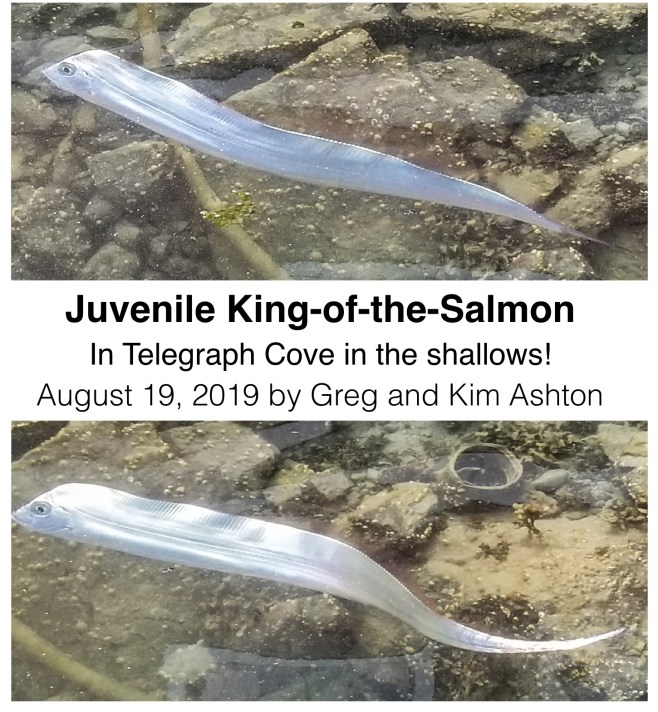
Sighting of a King-of-the-Salmon August 19, 2019 (at least 70 cm long). Greg and Kim Ashton relayed how “We had just tied up our boat in the marina and were walking to shore when Kim spotted what at first we thought was an eel, but quickly realized it wasn’t but some type of fish we had never seen before. It was in five to six feet [~2m] of water and then swam up into shallower water . . . I was amazed at how it seemed to be looking at us and how brightly colored chrome-like its body was . . .”. Video of this individual (below) reveals this individual may not have been healthy.

2017

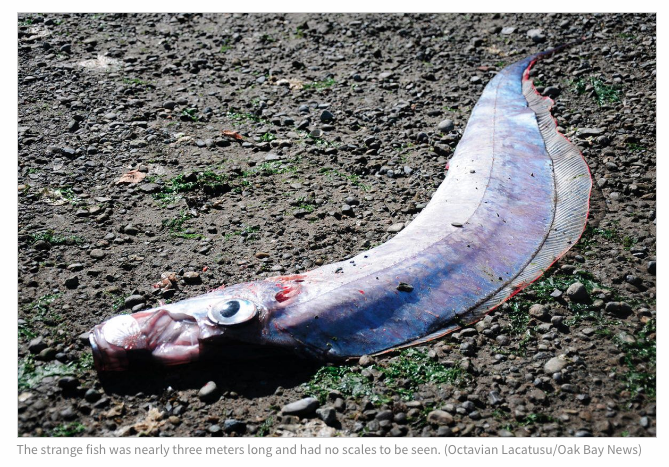
King-of-the-Salmon found near Oak Bay, British Columbia on September 21, 2017 by Ben Clinton Baker. It will end up on display in the Shaw Centre for the Salish Sea in Sidney, British Columbia. Photo: Oak Bay  

Second King-of-the-Salmon found near Oak Bay in September 2017. Photo: Emily Walsh, September 26, 2017.
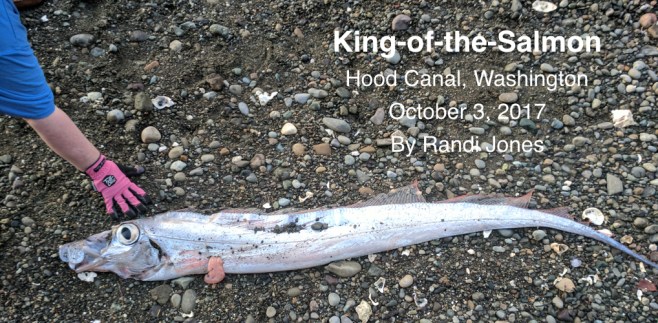
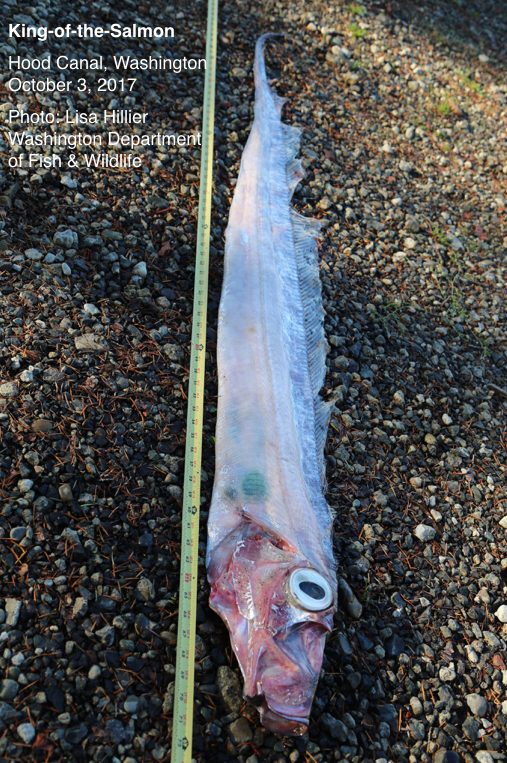
Third found: 1.8 m long female King-of-the-Salmon found on October 3rd, 2017 off Hood Canal, Washington by Chris and Randi Jones. As relayed to Randi by Davy Lowry of the Washington Department of Fish and Wildlife “this is the first reported occurrence of this species in Hood Canal ever, and the only other one found in Puget Sound was discovered on a beach back in the 1990s near Tacoma.”
Same fish as in the photo above. Female King-of-the-Salmon found off Hood Canal, Washington on October 3, 2017 by Chris and Randi Jones. It was 1.8 m long (71′) and 3.3 kg (7.25 lb) and necropsy found that “there was nothing in the gut to indicate it had eaten recently”.  and Photo: Lisa Hillier; Washington Department of Fish & Wildlife. 
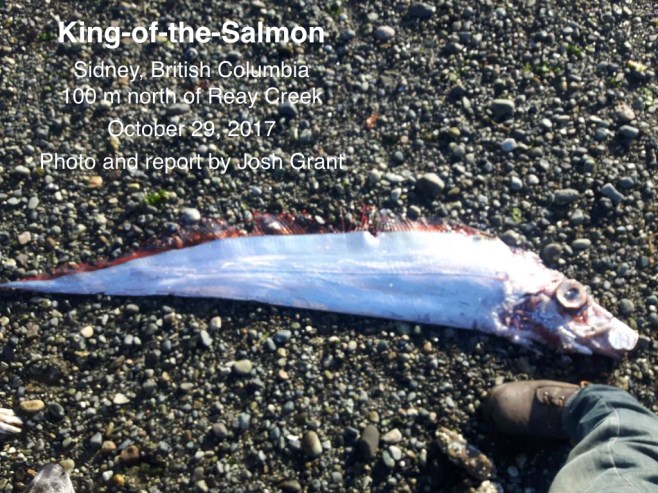
Fourth King-of-the-Salmon found in the fall of 2017 in southern British Columbia / northern Washington. This one was found on October 29th near Sidney British Columbia 100 m north of Reay Creek. Report and photo by Josh Grant. Coordinates: 48°38’03.3″N 123°24’22.7”W

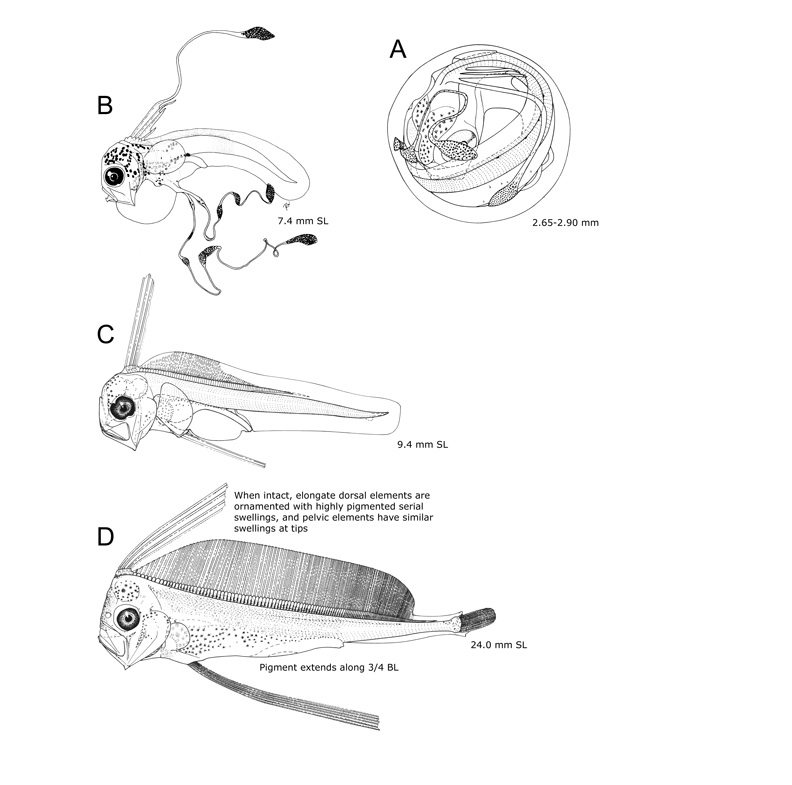
 Plankton life stages of the King-of-the-Salmon

Source: http://access.afsc.noaa.gov/ichthyo/LHDataIll.cfm?GSID=Trachipterus!altivelis
Credits:
A: Matarese, A.C., and E.M. Sandknop. 1984. Identification of fish eggs. In H.G. Moser, W.J. Richards, D.M. Cohen, M.P. Fahay, A.W. Kendall, Jr., and S.L Richardson (eds.), Ontogeny and systematics of fishes. Spec. Publ. 1, Am. Soc. Ichthyol. Herpetol., p. 27-31. Allen Press, Lawrence, KS, 760 p.
B: Charter, S.R., and H.G. Moser. 1996.Trachipteridae: Ribbonfishes. In H.G. Moser (ed.), The early stages of fishes in the California Current region. CalCOFI Atlas 33, p. 669-677. Allen Press, Lawrence, KS, 1505 p.
C and D: Matarese, A.C., A.W. Kendall, Jr., D.M. Blood, and B.M. Vinter. 1989.
Laboratory guide to early life history stages of Northeast Pacific fishes. NOAA Tech. Rep. NMFS 80, 652 p.

Otoliths / Ear Bones

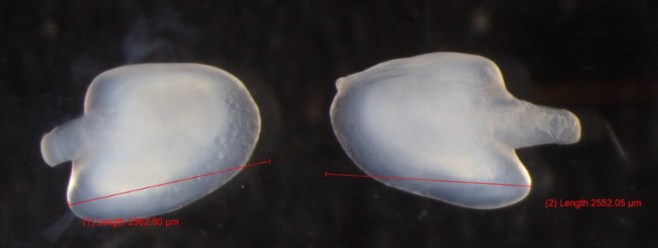
Photo above and the following information was shared by Micah Quindazzi who is a masters student at the University of Victoria studying the King-of-the-Salmon. He extracted the ear bones (otoliths) of two full-grown adult King-of-the-Salmon (the September 18, 2020 and February 6, 2019 individuals). The photo shows the left and right otoliths from the September 18th individual. He shared that it is notable that the otoliths are tiny in comparison to the body size of the fish.

Buffalos Mating . . . Underwater!

That’s right, it’s mating season for buffalos   . . .  Buffalo SCULPINS that is!

Now that I’ve lured you to this posting with the procreation of a huge, shaggy terrestrial mammal on your mind  . . . let me show you the spawn of this wondrous fish.

The Buffalo Sculpin –  Enophrys bison – has earned the association with buffalo/bison due to the horn-like spine found on each gill plate (operculum). The species can be up to 37 cm long.

Male Buffalo Sculpin guarding eggs © Jackie Hildering. 

As is the case for many species in the sculpin family, male Buffalo Sculpins guard the eggs from predators. They also fan the fertilized eggs with their pectoral fins to aerate them and stop growth of algae / bacteria.  Sometimes they guard the eggs laid by multiple females (see below for a male that appeared to be trying to guard EIGHT egg masses). When you consider that a female can lay between 19,000 and 32,000 eggs, the males have a lot of fertilizing and guarding work to do!  Their guard duty lasts 5 to 6 weeks until the eggs hatch. 

Another male guarding eggs. If you look carefully, you will see the horn-like spines on the fish’s right gill plate. It is these horn-shaped gill protrusions that led to this species getting both its scientific and common name. ©Jackie Hildering. 
Same male as in the image above. ©Jackie Hildering. 

Many of the photos below show how you the males lie with their flat heads directly upon a cascade of eggs. The clusters of eggs laid in the spring allow me to find this incredibly camouflaged fish much more easily than I normally could. When I see a golden, orange or greenish shiny mass of eggs, I know a male Buffalo Sculpin has to be very near by. The bright colour of the eggs suggests that they might be toxic to many species, further protecting them from predation. 

Very interestingly too, there is a species of fish known to parasitize on the care provided to the fertilized eggs by Buffalo Sculpins. Spinynose Sculpins (Asemichthys taylori)  will lay  their eggs on top of the Buffalo Sculpin eggs. The Spinynose Sculpin eggs will hatch faster and it is even possible that the presence of their eggs slows the development of the Buffalo Sculpin eggs.  This “nesting parasitism”, is a “behavior previously unknown among marine fishes.” (Kent, Fisher, & Marliave, 2011).

As you can see, Buffalo Sculpins’ red, brown and pink colouration makes them very difficult to discern from the similarly brilliantly coloured life around them.  They will remain absolutely still so as not to give away their presence. Their relative, the Red Irish Lord, has the same survival strategy. (See this previous blog item for photos and information on the Red Irish Lord.) 

The camouflage, in addition to reducing the risk of predation by bigger fish and seals, allows the Buffalo Sculpin to be a very successful ambush hunter of shrimp, crabs, amphipods and small fish. It has been suggested that they eat mainly algae since this has so often been found in their gut but I am willing to bet that the algae ends up in their stomachs as a result of the Buffalo Sculpins grabbing prey ON the algae!

A cascade of eggs below this brilliantly coloured male Buffalo sculpin’s chin, April 1st., 2012 See below. He as still guarding these eggs on April 21st and was guarding other eggs on May 6th, 2012. ©Jackie Hildering. 
The two differently coloured egg masses suggest that this male is guarding the eggs from two different females. April 1, 2012. ©Jackie Hildering. 
The same male guarding eggs 3 weeks later. April 21st, 2012.©Jackie Hildering. 
Same male with a new egg mass – May 6, 2012. Checked in on him on May 20th, 2012 and he was no longer guarding eggs. ©Jackie Hildering

Range: Monterey California to Kodiak Island, Gulf of Alaska. Most often found to a depth of 20 m but have been found to 227 m.

Spawn: February and March.

Sources: Kent, Daniel & Fisher, John & Marliave, Jeffrey. (2011). Interspecific nesting in marine fishes: Spawning of the spinynose sculpin, Asemichthys taylori, on the eggs of the buffalo sculpin, Enophrys bison. Ichthyological Research – ICHTHYOL RES. 58. 10.1007/s10228-011-0223-5.


Whoa! Photo below is of one male Buffalo Sculpin guarding the egg masses of at least 3 different females.
©Jackie Hildering. 

And here’s a male appearing to guard EIGHT egg masses. 
Find the Fish Friday Answers.001


The following photos of male Buffalo Sculpins guarding eggs are intended to show how varied both the colouration of the fish and the eggs can be.  All photos ©Jackie Hildering. 

DSC03226
_JH15078
DSC07368 2
JWH_2250
JWH_2263
JWH_2287
JWH_3438
OLYMPUS DIGITAL CAMERA
SEA&SEA 1200HD

Sharks Among Us #4 – The Salmon Shark

This is a Salmon Shark (Lamna ditropis) that washed up dead on a beach in Carrot Park in Port Hardy, B.C. on November 23rd, 2011. 

Salmon Shark found dead on Port Hardy beach on November 23, 2011. Photo: Mandy Ludlow.

Local Department of Fisheries and Oceans staff conducted an external examination and collected the unfortunate shark so that a full necropsy could be done at a later date.  Although salmon sharks are common in the North Pacific, examining the body may allow science to find out more about the species and how this individual died. 

The dead Salmon Shark was just over 1.5 metres (length from the nose to fork in the tail = fork length). The species can be 3.7 m and weigh up to 454 kg.

Cut in the pectoral fin suggesting the shark died as a result of by-catch in the longline fishery. Photo: Mandy Ludlow.

Salmon Sharks are of no threat to humans, however, the species does suffer impacts from humanity. 

The Port Hardy Salmon Shark had external injuries that suggest it may have been caught in a fishing net and possibly even shot.  It had a large cut on its tongue and on one of its pectoral fins and there was a circular hole behind the dorsal fin.  Many shark species suffer the threat of  by-catch in nets since they are targeting the same species we humans are fishing for.  

If it is determined that this shark indeed was caught in a net, this may be particularly interesting since I believe there are no openings for net fisheries at this time of year. 

Cut also found on the shark’s tongue. Photo: Mandy Ludlow.

Although Salmon Sharks feed on many species of fish, they are indeed a very successful predator of salmon.

Salmon Sharks can regulate their body temperatures to be higher than the temperature of the surrounding water. The Salmon Shark, in fact, has a higher body temperature than any other shark species. Apparently, even when the water is 2° C, their internal temperature can be 16° C.

This ability to thermoregulate is why, in part, Salmon Sharks can be incredibly fast. The US Navy has recorded speeds of up to 80 km/hr.  

I was heartened by the response of the majority of people to the death of this shark. It seems society might be moving beyond the “Jaws Effect” where we demonized sharks because we have bought into their fictitious portrayal.  

Many of us now seem to embrace shark fact rather than fiction, realizing that sharks pose little threat to humans; that they have been shaped by some 200 million years of evolution; that globally they are struggling to survive; and that they have an essential role in marine ecosystems.

Hole behind the dorsal fin. Photo: Mandy Ludlow.

Sharks, as top-level predators, strongly shape food webs.   Loss of such predators has proven to have profound effects on the number and diversity of other species.   

The unenlightened are still out there though. It may be an inevitability that sharks get caught in fishing nets but they need not then be shot or butchered. Locally, I have seen evidence of both. 

[Update: December 22nd, 2011 – The necropsy revealed that this was a female shark. It is also now known that the shark was caught in a hook and line sable fish fishery and that the hole behind the dorsal was the result of a hook. It is rare that there is shark bycatch in this type of non-net fishery.]

Skin parasite (ectoparasite). I have no expertise here but had suggested that this a copepod from the Caligidae family.

For further information on Salmon Sharks, please refer to the natural history information from ARKive below.  

Salmon shark image from ARKive site. Click image for two ARKive videos of salmon sharks hunting. Credit: BBC Natural History Unit.

Salmon Shark Information
from ARKive

Description

A formidable hunter, the salmon shark (Lamna ditropis) is sometimes mistaken for the white shark (Carcharodon carcharias), but can be distinguished by its shorter snout and the dusky blotches that mark the white abdomen of adults (3) (4). The rest of the salmon shark’s stocky, spindle-shaped body is dark bluish-grey or blackish, with white blotches around the base of the pectoral fins. The first dorsal fin is large, while the second dorsal and anal fins are tiny and are able to pivot. Its crescent-shaped tail gives it impressive propulsion through the water (2) (3), while its large, well-developed eyes enable it to spot potential prey (2), and its large, blade-like teeth are well suited to gripping slippery fish(2) (3).

Range

The salmon shark occurs in the North Pacific Ocean. From Japan, North Korea, South Korea and the Pacific coast of Russia, its distribution extends east to the Pacific coast of the U.S.A., Canada, and probably Mexico (3).  See this species on Google Earth.

Habitat

The salmon shark is a coastal and oceanic shark, inhabiting waters between 2.5 and 24 degrees Celsius, generally from the surface down to depths around 152 metres, although one individual has been recorded at 255 metres (3).

Biology

Occurring singly or in schools of several individuals (3), salmon sharks are long distance, high-speed predators (2), occasionally seen at or near the surface in some areas. They can maintain their body temperature well above that of the surrounding cold water of the North Pacific, and may have the highest body temperature of any shark (3). This allows them to maintain warm swimming muscles and internal organs, so they can still hunt effectively in cool waters (2).

The salmon shark is considered to be one of the main predators of the Pacific salmon, and its voracious feeding on this fish has earned it its common name (3). However, it is an opportunistic feeder that consumes a wide variety of fish that also includes (amongst many others) herring, sardines, pollock, Alaska cod, lanternfishes and mackerel. It also feeds on some squid and is sometimes attracted to by-catch dumped back into the ocean by shrimp trawlers (3).

After spending the summer in the north of their range, the salmon shark migrates south to breed. In the western North Pacific they migrate to Japanese waters whereas in the eastern North Pacific, the salmon shark breeds off the coast of Oregon and California, USA. The young are born in spring after a gestation period of around nine months (3). The salmon shark is ovoviviparous (young hatch inside the female; they are nourished by their yolk sac and then ‘born’ live), and oophagy (when the growing embryos eat unfertilized eggs to gain nutrients) has been recorded in this shark (4). Most litters contain between two and five young. Male salmon sharks are thought to mature at about five years and live to at least 27 years; females reach maturity at eight to ten years and are known to live to at least 20 years (3).

Threats

The salmon shark is often caught as by-catch in Japanese, United States and Canadian fisheries. When caught, often just the fins are taken for shark fin soup and the rest is discarded, although sometimes the flesh may be sold for consumption in Japan and the United States (4). Many fishermen view salmon sharks as pests, as they often damage fishing gear, making them more likely to be killed if captured (4). In addition to the threat of by-catch, some recreational fishing for this shark occurs in Alaskan and Canadian waters (4), and some commercial fishing has taken place in the past, such as in Prince William Sound, Alaska (5).

Conservation

In 1997, the Alaska Board of Fisheries closed all commercial shark fishing in state waters and implemented strict regulations in the state sports fishery for salmon sharks (4). Measures such as these are vital in protecting this species’ future, until further research can determine the conservation status of this magnificent predator.

Additional information:

Click here for two ARKIve videos showing Salmon Sharks hunting.

Click here for the petition to ban shark fin products in Canada and here for video by astounding 18-year-old Madison Stewart about the vilification of sharks and the atrocities of shark-finning . . . 73 million sharks killed/year for their fins = 190 sharks killed/minute.

Holy Mola!

Update February 2nd, 2021
This blog was written in 2011 reporting this to be a Mola mola.
I can now share that this is NOT a Mola mola. It is a Mola tecta! It is now known that there are two species of Mola in the NE Pacific Ocean. See the CBC news article announcing this here: Meet the Hoodwinker, the Ocean Sunfish we Misidentified for Years.

Mola tecta is the Hoodwinker Sunfish. See diagram at the end of this blog for the discerning characteristics.

As a result of writing this blog in 2011 (with the great photos taken by friends), I was contacted in 2020 by the researcher who could discern this species, Marianne Nyegaard who works in New Zealand. Now, in my role with the Marine Education and Research Society, we are helping get more sightings of Mola off the coast of BC to get a better sense of relative abundance. To relay sightings, please see this link.


Something very unexpected landed near the Port Hardy seaplane base on October 20th, 2011 – a dead Mola tecta. This species of ocean sunfish looks like a cartoon character rather than a relatively fast-moving, deep-diving fish whose design has been perfected by millions of years of evolution.

Chad Chrighton, the pilot who found the Mola tecta near the seaplane base. Photo credit: Mike D’Amour (North Island Gazette).

This fish species is aptly named since Mola means “millstone” in Latin and indeed this fish looks like a huge, flat, gray circle and has rough skin.  It appears to have no body, only a giant, round, flat head with a small beak-like mouth. It is propelled by two pointy fins (dorsal and anal) and is steered by a wide, rounded, rudder-like tail. 

Photo credit: Erika Grebeldinger.

Mola species were believed to be passive drifters who travelled only at the surface, wherever the current took them. However, satellite tracking studies have revealed that they dive deeper than 600 m and travel an average of 10 to 20 km per day, the same distance traveled by open-ocean shark species. 
 

Matthew Drake measuring the Mola tecta To give you get a sense of size, Matthew is 2m tall (6.5′). Photo credit: Erika Grebeldinger.

They are certainly a rarity on the inside of Vancouver Island however and I greatly appreciate that Matthew Drake let me know about this find and that he undertook a necropsy of the giant together with Louisa Clarke and Natasha Dickinson. 

This Mola tecta measured 2.00 m wide, from beak to tail fin, and 2.06 m long, from the tip of one pointy fin to the other. It may have weighed more than 200 kg. Remarkably, this is small for its kind. Mola tecta hold the record for being the largest bony fish on earth with an average mass of 1 tonne. The largest Mola mola (cousin to Mola tecta) ever recorded was 2,235 kg and 3.10 m by 4.26 m (it was struck by a boat near Australia in the early 1900s). Note that the whale shark can be more than 9 times bigger than this but, it is not a bony fish. 

Mouthparts. Photo credit: Mandy Ludlow.

Matt and the team concluded that the Port Hardy Mola tecta was female which meant that she could have up to 300 million eggs in her one ovary. This is another record for the species: having more eggs than any other animal with a backbone.  Another astounding fact is that the larvae could grow to be 60 million times their weight at hatching.

The investigation also revealed partially digested jellyfish in her gut, which is the typical prey of Molas / Sunfish. Their diet also includes small fish, eelgrass and crustaceans and they are able to spit out and pull in water and food with their unique mouthparts. As with all species that feed on jellies, a conservation concern is that they mistake plastic bags for their food. However, there was no evidence for this being the cause of death for this particular Mola tecta.  

Maybe parasites were a factor in her death? The team found lots of skin and intestinal parasites! Some of the round worms in the guts were even still alive. Parasites are common for Mola molas. In fact, it is now believed that the behaviour of “sunning” at the surface (hence, ocean “sunfish”) might be so that birds can feed on the skin parasites and that jumping more than 3 m out of the water might help dislodge some parasites too. Mola tectas are also found associated with drifting kelp patches, where small fish can clean away the pests.  

HOLY MOLA you never know what you are going to find in our amazing marine backyard. 

All the information collected was reported to oceansunfish.org and the mouth parts are on display in Telegraph Cove’s Whale Interpretive Centre. 


Beware!  Fabulous Mola tecta parasite pictures below! 

Advance only if you are NOT about to eat lunch and/or if you a biology-type like me who can view these kinds of photos in rapturous fascination anytime!


Photo by Erika Grebeldinger.

Sources: 

Links regarding other Mola species:


Her intestines were an astounding mass of worms. Likely the species include the parasitic flatworm, Nematobibothrioides histoidii which is thread-like but can grow to be over 12 m (40′). No one apparently knows just how long they can become, in part because dissections/necropsies on Mola mola are rare events. Photo credit: Natasha Dickinson. 

Parasites near the eye. Photo credit: Mandy Ludlow.

More great ectoparasites. Photo credit: Matthew Drake. 
Her single ovary. Can have 300 million eggs. Photo credit: Natasha Dickinson.