Did you know that stones are commonly found in the stomachs of Steller sea lions?
These stomach stones or “gastroliths” are as big as 12 cm!
Share your theories about why you think this might be after viewing the video below. It provides you with information to help with this Marine Detective case.
Happy sleuthing to you!
Note that yes, gastroliths have been found in the stomachs of other seal and sea lions species including the California Sea Lion, Zalophus californianus (Source: Drehmer and Oliverira).
Click here for SeaDoc footage of Steller Sea Lions playing with California Sea Cucumbers.
Abstract: “In summary, our opportunistic assessment of gastroliths in temporarily captive Steller sea lions showed that a large proportion of juvenile animals (e.g., one-third or more) may haveone or more stones at any given time. The regurgitation of gastroliths correlated best with leaner, but not poorer body conditions, and during the summer months, possibly indicating a weak association as a digestion aid. We found little evidence to suggest that they assist in buoyancy and satiation; it is even more unclear as to what drives an individual to regurgitate them. With a lack of strong conclusions relating to a particular use, we can only conclude that they appear to serve a function in sea lions and are not ingested accidentally. A combined assessment of regurgitated and in vivo gastrolith measurements may shed more light on the subject and allow for direct evaluation and conclusions as to their functionality in sea lions.”
“Gastroliths, defined as stones or concretions in the digestive tract, occur in many extant vertebrate taxa and throughout the fossil record of marine tetrapods (Wings 2007). Most information is anecdotal, with limited data on occurrence and size(e.g., Labansen et al. 2007). Adjusting buoyancy, alleviating hunger, and aiding in digestion are the most popular theories for the presence of gastroliths in marine mammals (Taylor 1993). Gastroliths have been described in all 3 families of pinnipeds including otariids (e.g., South American sea lions Otaria byronia—Drehmer and Oliveira 2003), phocids (e.g., harp seals Phoca groenlandica—Nordøy 1995), and odobenids (Gjertz and Wigg 1992)”
A note about the Marine Mammal Regulations in Canada
Amended Regulations (since July 2018) include that it is illegal to target marine mammals for the purposes of swimming with them (unless permitted by a research license). See the Marine Mammal Regulations at www.SeeABlowGoSlow.org.
Just another day on the sidewalk in front of my house.
It’s Saturday morning. I open the curtains. And there they are – three sets of binoculars pointed in my direction. Again.
It’s been like this for 2 months now**, leading neighbours to wonder what is going on and if I am okay.
I am, thanks. I’m just peachy; not a feather out of place. In fact, I have a bird’s eye view of something simply wonderous from which I have learned a great deal.
All the activity on my sidewalk – the binoculars; people coming from Kamloops, Calgary, Victoria, Vancouver and possibly further afield (with at least one person sleeping in his car till daylight so he could be the early bird) – it’s not about me at all. It’s about the birds. Against all odds, multiple species of really rare and exotic birds are here together in our little neighbourhood in Port McNeill.
We’re not used to having this kind of “vagrant” in the ‘hood!
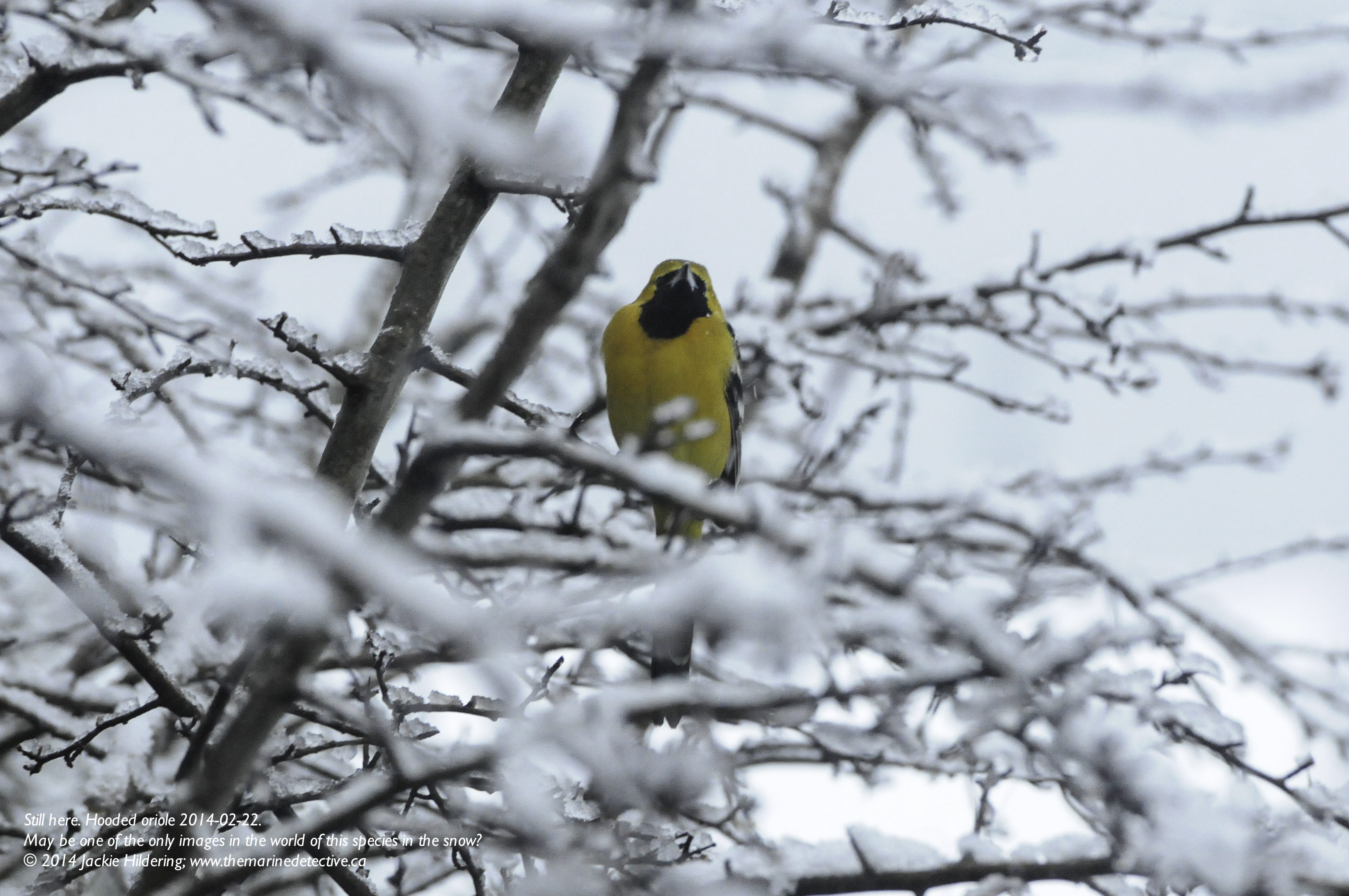
It began in early December when, while on a conference call, I almost lost my mind when a brilliantly yellow coloured bird landed in the shrub in front of my home office window; near the feeder I leave out for the Anna’s Hummingbirds who spend the winter here.
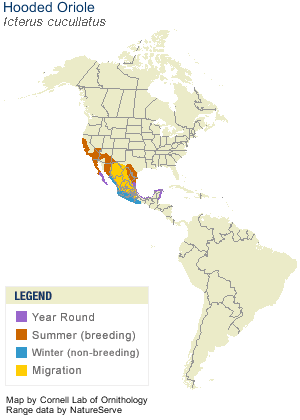
Winter range of Hooded Orioles marked in blue. Source: Cornell Lab of Ornithology – see this link for more information and a larger map.
I scrambled for my camera uttering colourful nouns, thankfully having the sense to put the phone on mute. I got a picture.
I don’t know much about birds and therefore did not trust my ID. Could it be a . . . could it really be . . . a male Hooded Oriole?!
They are not supposed to be here. They should be in palm trees in the Baja in winter but I dared share the photo and my timid ID with those I know to be BC’s leading bird authorities. The responses came back pretty quickly.
They confirmed how rare this sighting was. Apparently, there have only been two previous recorded cases of Hooded Orioles making it through a BC winter – in Terrace in 1998 and in Prince Rupert in 2007. I was determined to do all I could to give this one a fighting chance since the odds of him finding his way “home” were infinitely small.
This is my first photo; the one I sent to the bird experts, asking if indeed this was a male Hooded Oriole. Jeremy Gatten, would recount in his blog “I received an e-mail from Port McNeill resident Jackie Hildering about a bird that she thought might be a Hooded Oriole. It’s a good thing I was sitting on a couch because the attached photo would have knocked me to the floor if I was on a chair or stool! The extremely crisp, full-frame shot showed a healthy, vibrant male Hooded Oriole in winter plumage.”
I slightly modified the hummingbird feeder. It appeared to meet his needs and he stayed. The word spread about how predictably such a rare bird could be sighted, and the birders started appearing.
At first I was very worried about how the attention might disturb the Oriole (and me) but many could learn a thing or two from the nature viewing ethics of bird-watchers.
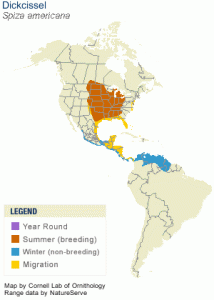
Winter range of Dickcissels marked in blue. Source: Cornell Lab of Ornithology – see this link for more information and a larger map.
They watch from a respectful distance, never setting foot on my property, truly wanting to witness natural behaviour. They rarely strive to get a photo to affirm their experience and certainly would not disturb the bird for the sake of getting the photo. They appear to “just” delight in seeing a rarity and being able to add a bird species to their list. Certainly there is no “get up and personal” – the phrase I loathe most in reference to wildlife viewing.
Then, things got even more exotic.
With all the birder expertise directed at the shrub with Mr. Oriole, a Harris’s Sparrow* was also spotted (winter range is the south central US), and a Yellow-Rumped Warbler (somewhat less noteworthy as this area is part of their summer range) and . . . a female Dickcissel.
Yes, that’s right – a Dickcissel. I too had no idea such a species existed and certainly would not have been able to discern her from the House Sparrows she often hangs out with. Neighbour Jim Nolan was the first to notice her, and teach me to spell “Dickcissel”! And how exotic is she? Her kind winters in Guatemala and Venezuela.
Bring on more birders! And more binoculars on the sidewalk! And more neighbours wondering what on earth was going on.
Bird watchers reference this phenomenon as the “Patagonia Picnic Table Effect”. One rare bird attracts birders, who then find another rare bird, which brings in more birders . . . and so on!
In this case it is the “Port McNeill Shrub in Front of My House Effect” and how grateful I am for privilege of a front row seat to the birds, and the birders.
They have made me reflect more on human behavior and expectations while viewing wild animals. I have become even more attuned to how extraordinary the wildlife of our area is and how, if you are especially watchful and respectful, the reward can be so great.
Clearly, the idiom “birds of a feather flock together” has also been challenged and I am greatly comforted that one rare bird can find another!
Not surprisingly, the birds have further heightened my wonder in Nature and, frankly, in life as well. Why that shrub? Why our neighbourhood in Port McNeill? Random chance? Ideal conditions? I will add this to the many things I will never know for sure.
What I will also allow myself to believe is that the appearance of the birds is evidence that colourful, rare and exotic beings can find my front door!
*I never saw the Harris’s Sparrow and have not heard of repeat sightings of this individual from birders.
Note that all photos were taken through the front windows of my home.
See end of blog for range maps for Yellow-Rumped Warblers and Harris’s Sparrows.
** Update April 6, 2014: The female Dickcissel is still a daily visitor. My last sighting of Mr. Hooded Oriole was March 29th. Presumably, he has moved on to new adventures, striving to join with his own kind and find a mate.
Apologies for a longer absence here. It has been a full summer of marine research, education and inspiration.
I will have the joy of sharing much with you in the coming months.
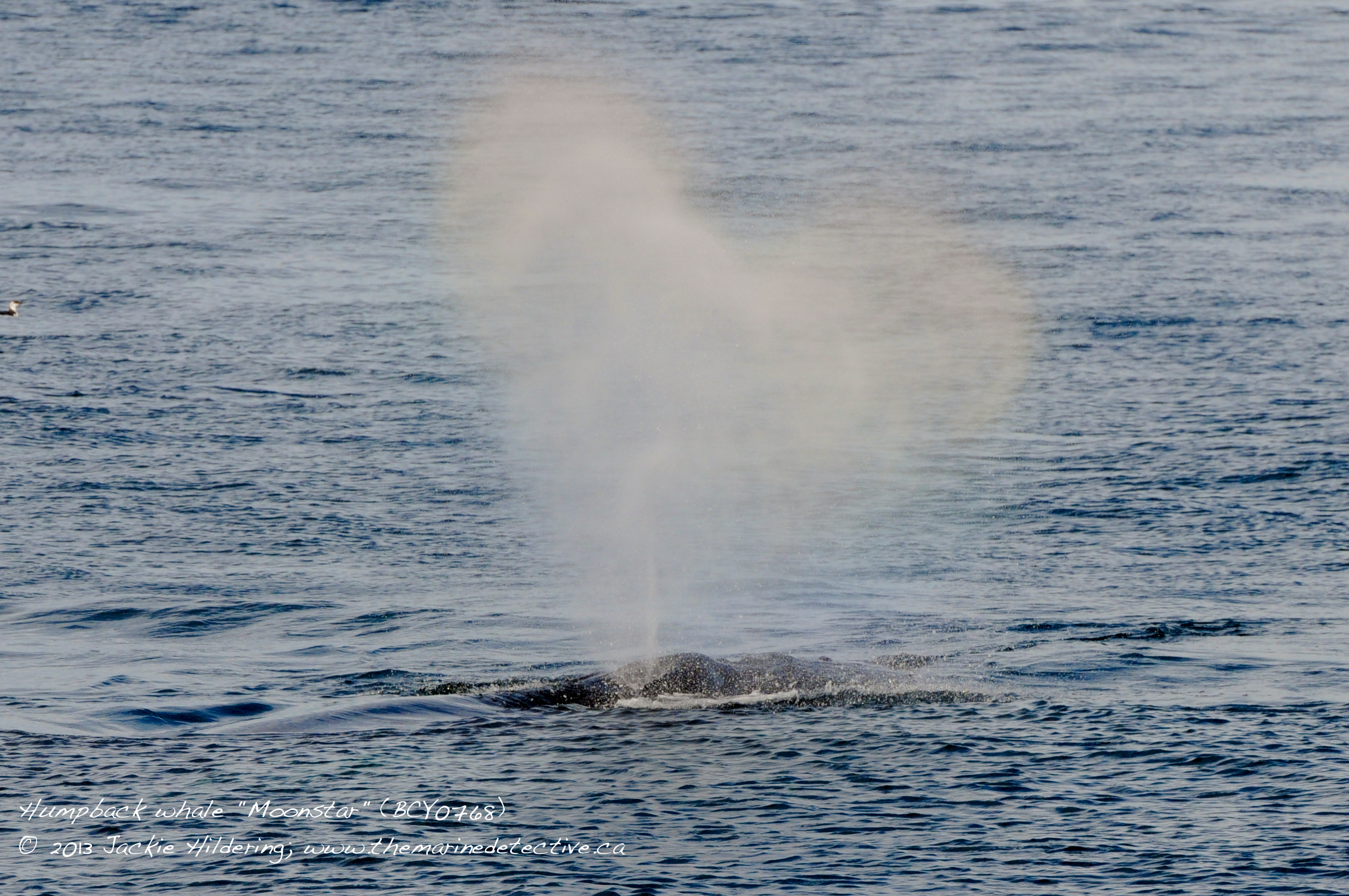
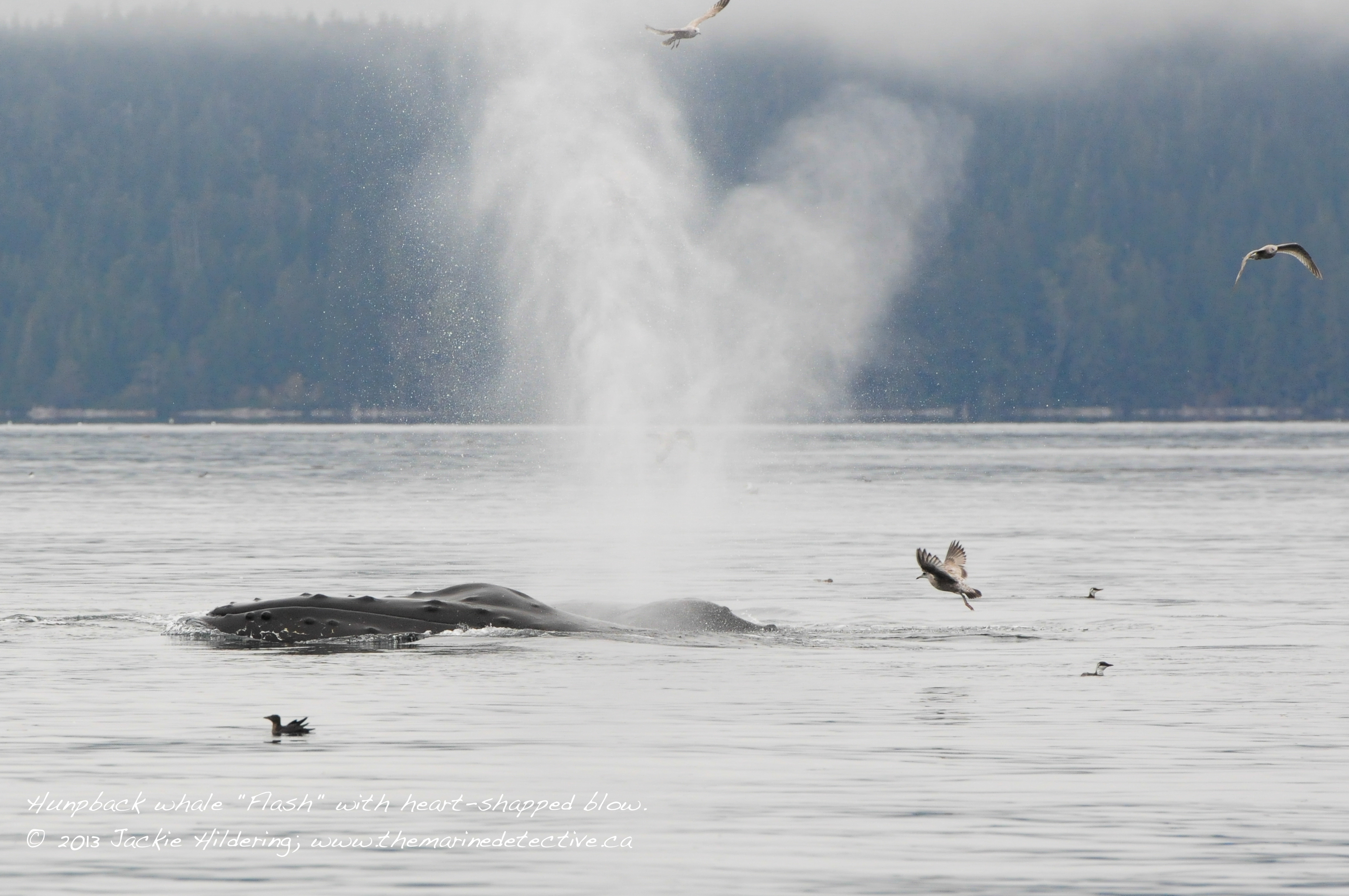
For now – three remarkable images taken in the last months where the whales’ blows are heart-shaped.
With whales being ambassadors for marine ecosystems in so many ways, these images may be particularly engaging – suggesting that we should love the Oceans as if our lives depend on them because . . . they do!
Also to make your heart sing, see the clip below (or access it at this link). I was able to capture the vocals of northern residents AND humpbacks from one of the most mind-blowing days I have ever had the privilege of experiencing on the water. Enjoy!
[These images and video were previously shared on the TMD FaceBook page].
Last updated on January 15, 2024 Will be updating this blog with the link to the recording from the symposium by Save the North Pacific Right Whale.
Current known number of sightings of North Pacific Right Whales in British Columbian waters since 1951 = five.
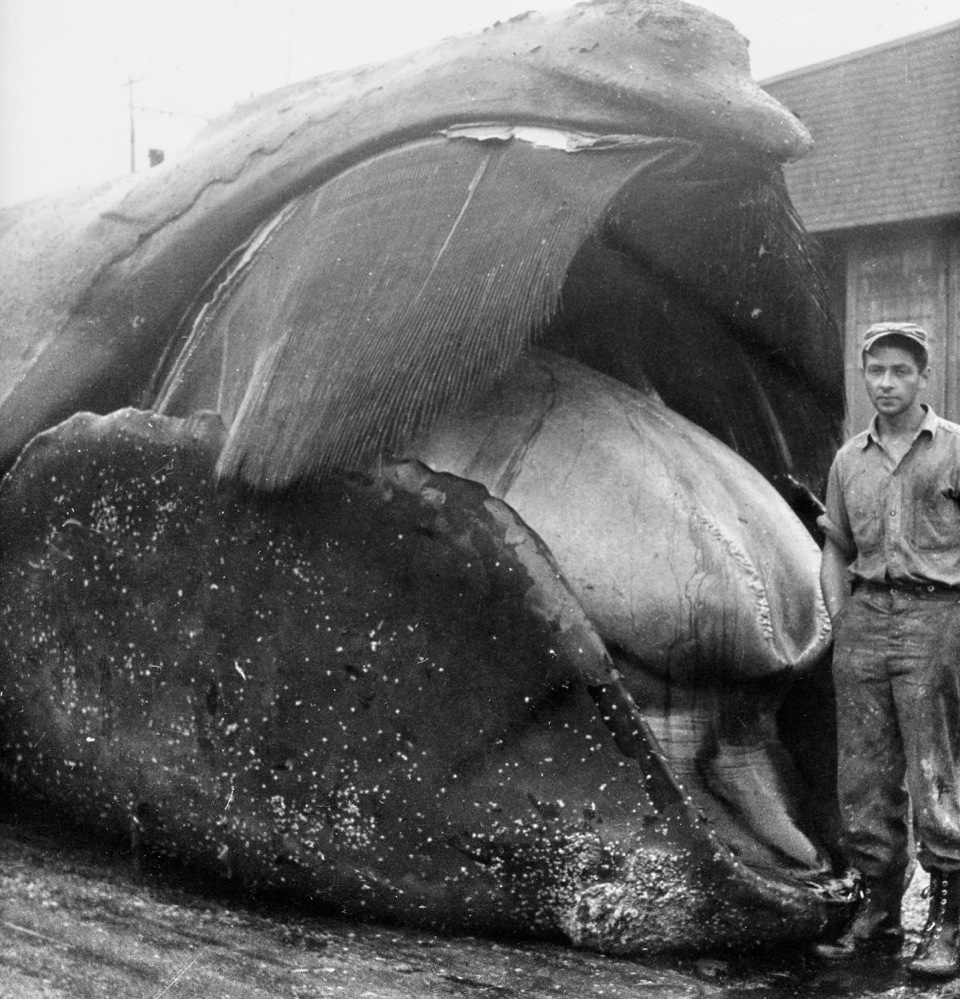
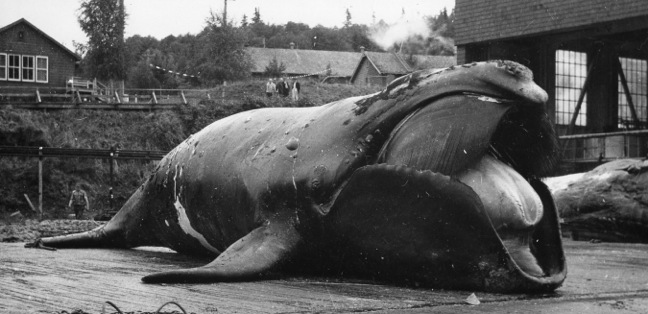
North Pacific Right Whale at the Coal Harbour whaling station in 1951. This was the last Right Whale seen in BC waters until June 2013. Photo: Gordon Pike, the DFO biologist responsible for monitoring whaling at Coal Harbour. Credit: Pacific Biological Station, DFO.
Update spring 2020 – another seen from the air. No ID photos.
Update June 19th, 2018 Right Whale sighting off the west coast of Haida Gwaii on June 4th. News items provided below. It’s only the 3rd North Pacific Right Whale documented off the coast of British Columbia in 67 years.
Update October 25th, 2013 2nd right whale sighting in BC waters (different whale that than the one seen in June). See news item below.
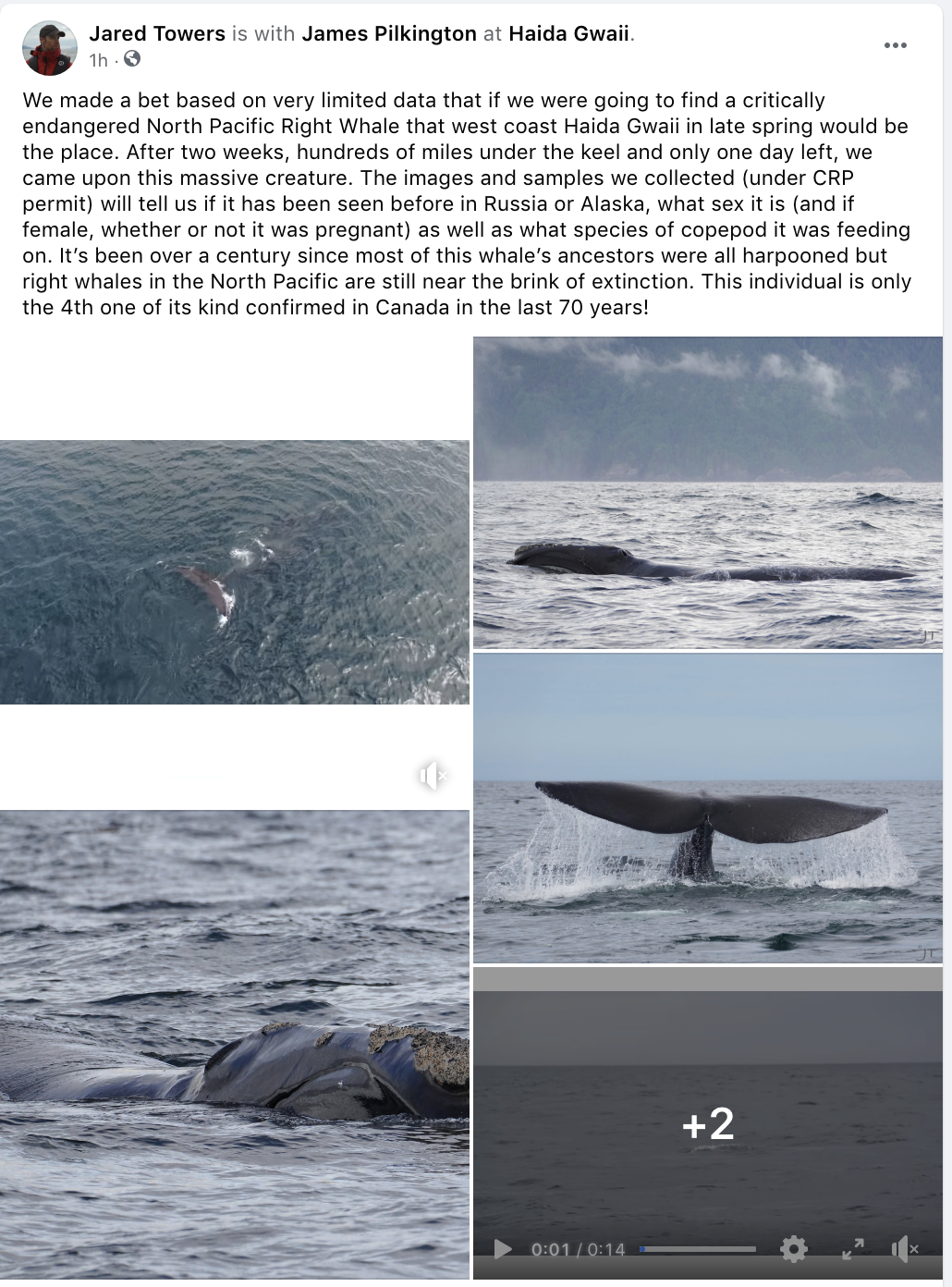
Original blog from June 2013: On June 9th 2013, while surveying off the west coast of Haida Gwaii for DFO’s Cetacean Research Program, biologist James Pilkington sighted one of the world’s most critically endangered mammals – a North Pacific Right Whale (Eubalaena japonica).
The species was once common but endured a catastrophic assault by whaling whereby there are now only about 30 left in the whole eastern North Pacific.
Reflecting on this whaling history makes clear how much positive change there has been in our attitudes to whales and this may have particular potency for those of us on Northern Vancouver Island due to BC’s last whaling station having operated in Coal Harbour from 1948 to 1967.
But, the devastation started far before that.
In 1835, intensive whaling began in the North Pacific and the most desirable target was the RIGHT whale. It was the right whale to kill since they were easy pickings with high reward.
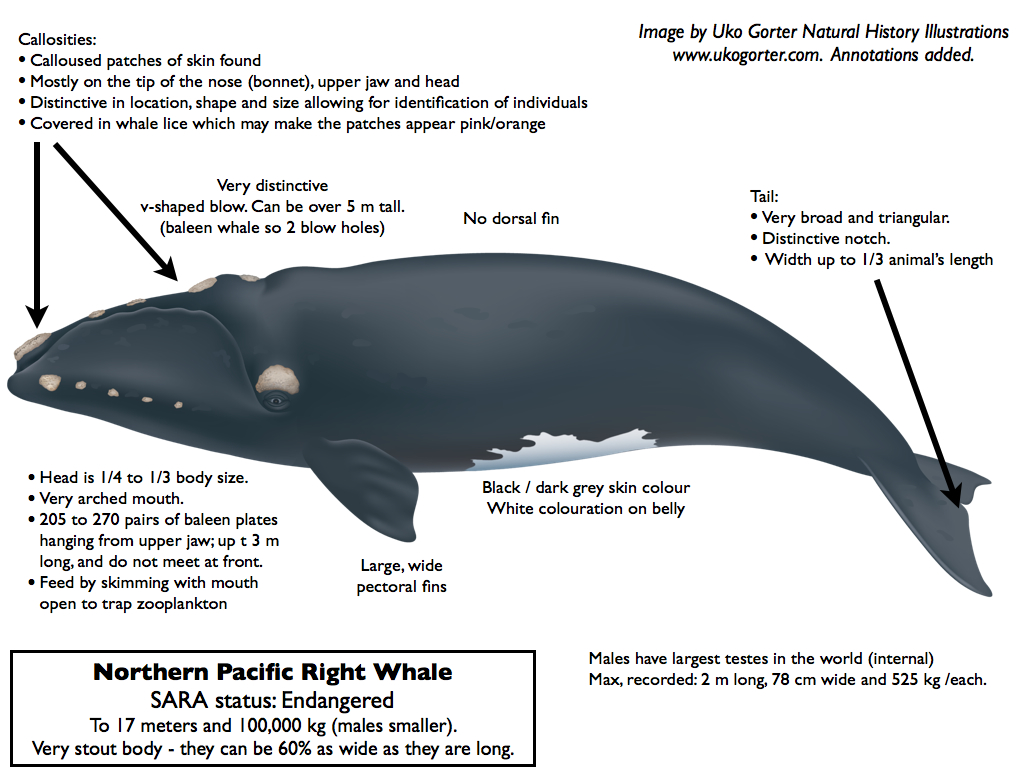
Right Whales feed by using their huge baleen plates (up to 3 m long) to skim zooplankton into their mouths, slowly powering themselves forward with massive tails. When feeding on the surface in this manner, they made life very easy for whalers – being slow moving, often near the coast and easy to approach. The long, fine baleen had very high commercial value as “whale bone”, largely used to stiffen women’s clothing.
Also making them a preferred species for whalers is that Right Whales are particularly stout, weighing as much 90,000 kg at about 17 m. They have very thick blubber which provided whalers with vast amounts of oil, desirable for lighting in that era. The large blubber layer also meant that right whales floated when killed, making them easier to harvest than other whale species.
Annotated diagram of a North Pacific Right Whale. Image by Uko Gorter Natural History Illustrations.
Being easy to kill and having high commercial value, meant the Right Whales of the world were done a great deal of wrong. For the North Pacific Right Whale alone, the estimate is that 11,000 were killed between 1835 and 1849 and that the species was determined to be “commercially extinct” by 1900.
Protection was very late for animals so very endangered. The first International Whaling Convention only came into effect in 1935 and was not ratified by Japan and Russia. An additional Convention came into effect in 1949 strengthening protection, but there was still illegal Soviet whaling in the North Pacific from 1961 to 1979.
In British Columbian waters, despite the knowledge that they were the rarest of the rare, BC whalers killed the only 6 confirmed North Pacific Right Whales sighted in the last century. Five of these were killed before 1933 and 1 was killed in 1951.
What might make this hit literally close to home is that the 1951 whale, a 12.5 m mature male was killed by Coal Harbour whalers (see photograph, 1951 North Pacific right whale with Gordon Pike, the DFO biologist responsible for monitoring whaling at Coal Harbour).
It was said to be an accident; that they did not know it was a North Pacific Right Whale but got the directive to kill him anyway.
What a difference 62 years makes.
North Pacific Right Whale at the Coal Harbour whaling station in 1951. Photo credit: Pacific Biological Station, DFO.
The last thing on the minds of those observing the North Pacific Right Whale in June 2013 was killing it. From the moment James Pilkington noted the distinct v-shaped blow, hope soared that the “holy grail of whales” had been found and that the opportunity to study it might aid conservation.
DFO’s cetacean researchers, Dr. John Ford and Graeme Ellis joined James and shot the whale with cameras not harpoons, allowing the whale (a sub-adult) to be identified as an individual from the raised patches of skin called callosities that are unique to every right whale. They managed to get DNA and scat samples. DNA confirmed the whale was a young female and had not been previously documented. She has been assigned the ID MML90 (See Ford et al).
And when the sighting was relayed to the media, the societal change became so very clear. What was once the right whale to kill, is now the right whale to provide us with hope about the resilience of nature.
However, I believe that to truly know the significance of this sighting, it may take another 62 years.
Will society then be able to look back with the same sense of positive change, having learned that there are still many ways to kill a whale and impact the ecosystems for which they are ambassadors?
Will we have significantly reduced our fossil fuel addiction that drives climate change, impacting the whales’ food supply? Will we have realized that our individual demand for energy literally fuels the threat of tanker traffic, and therefore oil spills, on our Coast? Will we have curbed our consumer lifestyles of disposable goods that lead to a literal sea of plastic?
With such changes, the potential increases for the recovery of North Pacific Right Whales and the health of the marine ecosystem on which we too depend. This will be our ultimate reward for better knowing right, from wrong.
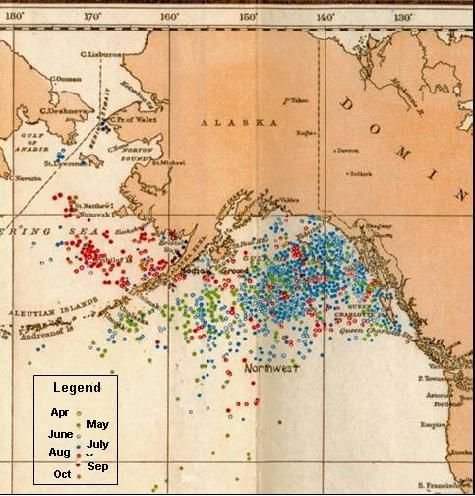
North Pacific Right Whale catches from 1785 to 1913 in the eastern North Pacific from the records of American whale ships. Photo by Environment and Climate Change Canada’s species at risk registry (via National Observer article at this link).
See video of the June 2013 sighting of the first North Pacific Right Whale in 62 years below. Narration is by Dr. John Ford.
Updated July 2025: Bigg’s Killer Whales now acknowledged as as distinct species (Orcinus orca rectipinnus) as per the Society for Marine Mammology’s List of Marine Mammal Species and Subspecies.
_____________________
Updated March 27, 2024. New research paper putting forward the case for Bigg’s and Resident Orca to be recognized as distinct species. See here.
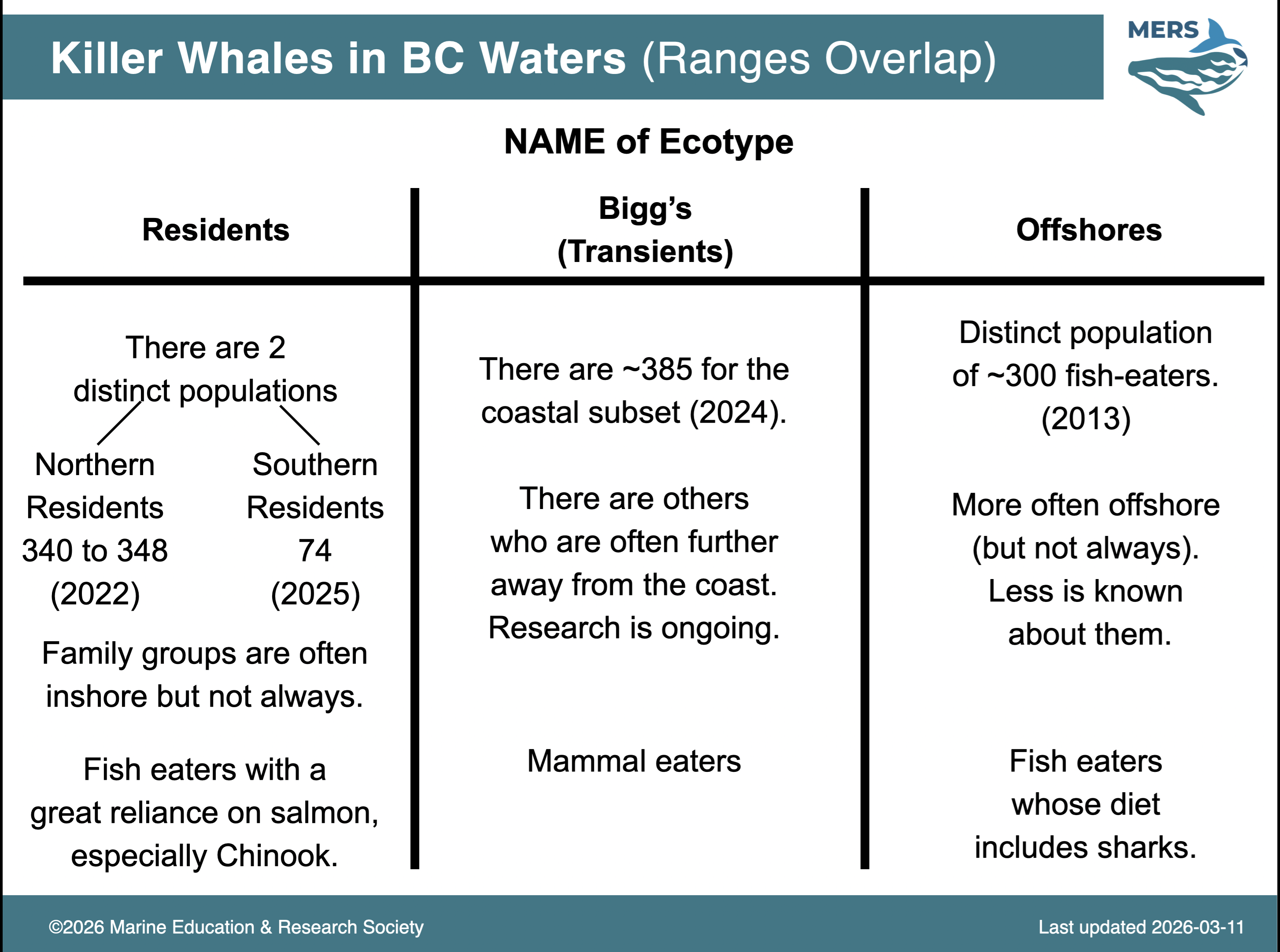
What’s the Bigg’s Deal? I’ve been asked this a lot lately: “Why are the mammal-hunting killer whales being referenced as “Bigg’s Killer Whales” rather than as “Transients” as they were previously known?”
This is because a 2010 study found that the mammal-hunting ecotype of Killer Whales / Orca diverged from the other ecotypes some 700,000 years ago and the researchers (Morin et al) put forward that they be recognized as a distinct species.
If they are to be recognized as such, many in whale-research-world believe it is only appropriate that the species be named in honour of the late and great Dr. Michael Bigg whose pioneering Killer Whale ID research in the eastern North Pacific in the 1970s – 1980s revealed that Killer Whales have distinct populations and that there are very limited numbers within these populations.
Ultimately, his research led to the understanding that Killer Whale populations have distinct cultures.
This knowledge of course had huge conservation implications. It was previously believed that there were abundant Killer Whales in the eastern North Pacific and that they all eat salmon in addition to marine mammals; rather than the reality that there are four at risk populations that are genetically and ecologically distinct:
1. Bigg’s Killer Whales are marine mammal-hunters (they also eat an occasional bird and, very rarely, a terrestrial mammal). When they are hunting marine mammals, they generally have to be stealthy and unpredictable since their prey can hear them. The population estimate for the members of this threatened population that more often feed near the coast of BC is ~349 individuals (end of 2022). Their behaviour has changed in recent years, as reported by colleague researchers at the Marine Education and Research Society. They are not so “transient” anymore. In some areas they are more commonly sighted than “Residents” and appear to be travelling, socializing and hunting in bigger groups. They also appear to be more vocal, especially after a kill. This is believed to be due to changes in the location and density of their prey. More seals and sea lions means that they do not have to be as stealthy (65% of the diet of Bigg’s who feed along BC’s coast is seals and sea lions). Status report and further information at this link. Note that there are no documented incidents of Bigg’s Killer Whales in the wild ever injuring a human.
“Residents” are inshore fish-eating Killer Whales (ingesting an occasional squid too) and there are two distinct populations. The vast majority of their fish diet is salmon and of the salmon species, their absolute favourite is Chinook. (Their diet is also known to include lingcod, halibut, herring, squid, rockfish, flounder). Because salmon is so predictable (salmon return to the river of their birth to spawn and die) and because fish have very bad hearing, these populations of Killer Whales can afford to be highly vocal and use echolocation a lot.
2. The Northern “Residents” are a threatened population of some ~332 whales (2021) more often found in northern British Columbia but also in southeastern Alaska and Washington State. Status report and further information here. For the story of one N. Resident Killer Whale family (the A23s) and what their story reveals about us, click here.
3. The Southern “Residents” are most often swimming around southern British Columbia and Washington State but are sometimes also in the waters of northern British Columbia, Oregon and California. At only ~73 individuals (2024), this population is recognized as being endangered. Status report and further information here.
4. Offshore Killer Whales are fish-eaters often found along the continental shelf from the Aleutian Islands to California. To date, published research has confirmed that their diet includes Pacific Sleeper Sharks and Pacific Halibut. The population estimate is 300 individuals (2013) and this too is a threatened population. Status report and further information here.
Through the research of Dr. Bigg, the Killer Whales of British Columbia have been studied as individuals longer than any other marine mammal species on the planet – and not only marine species have benefited from this. We all have.
Due to his work, whereby the age, gender, diet and range is known for almost every Killer Whale in British Columbia, these whales “tell the story” of global chemical pollution. The work of Dr. Peter Ross examines the toxins in the blubber and indeed the Killer Whales of BC are the “canaries in the coal mine” informing the science that should shape international policies and regulations regarding toxins.
However, there is also much that has NOT changed since the days of Dr. Bigg’s pioneering Killer Whale research.
At that time, Killer Whales were the scapegoat for declining salmon populations and the “gold rush” on their being put into captivity was likely perceived as a favourable management tool. Conservation costs money, not only for science and management, but also by limiting industries whose activities may negatively impact species at risk.
Flash forward some 40 years to 2013. Dr. Peter Ross’ work with Fisheries and Oceans Canada has been terminated as part of what can only be called the demise of Canada’s ocean contaminants research program and prior to his termination he, like so many other government scientists in Canada, has been constrained in being able to communicate about his research. (Update 2014: Dr. Ross now heads the Ocean Pollution Research Program at the Vancouver Aquarium).
The ultimate Bigg’s Deal is that one person can make a profound positive difference – replacing knowledge where fear and misunderstanding once dwelled.
However, to work against government forces that imperil our environment and suppress science in favour of short-term economic gain, it is going to take a very great many of us to make our voices and actions . . . Bigg-er.
Global News; February 5, 2014; “Epic ocean battle: Orca vs dolphin” [Video, with interpretation by DFO’s James Pilkington, of Bigg’s Killer Whales attacking Pacific White-Sided Dolphins outside Nanaimo on February 3rd, 2014.]
This is not a tall tale. If anything it is a short tail as in – deer tail.
First an orientation on Killer Whale (Orcinus orca) diet and how prey specialization has shaped distinct cultures over great expanses of time.
There are different “ecotypes” of Killer Whales that do not mate with one another because what works, for example, to chase salmon does not work to stalk seals. They have distinct cultures and distinct languages. [Click here for detail on the different ecotypes of Killer Whales off British Columbia, Canada.]
The fish-eating Killer Whale ecotypes in the NE Pacific Ocean (Northern and Southern “Residents” and “Offshores”) can afford to be extremely vocal because fish species often have poor hearing.
However, the mammal-hunting ecotype (“Bigg’s Killer Whales“, previously know as “Transients”) must generally live a life of stealth and unpredictability in order to successfully hunt their prey. To be vocal or be really surface active, when they are hungry, would have a high cost. It would be like ringing a dinner bell announcing “Hello, we’re here to eat you!”
In fact, recent research supports that the NE Pacific mammal-hunters diverged from the other ecotypes of Killer Whales some 700,000 years ago and puts forward that they should be recognized as a distinct species (Morin et al 2010).
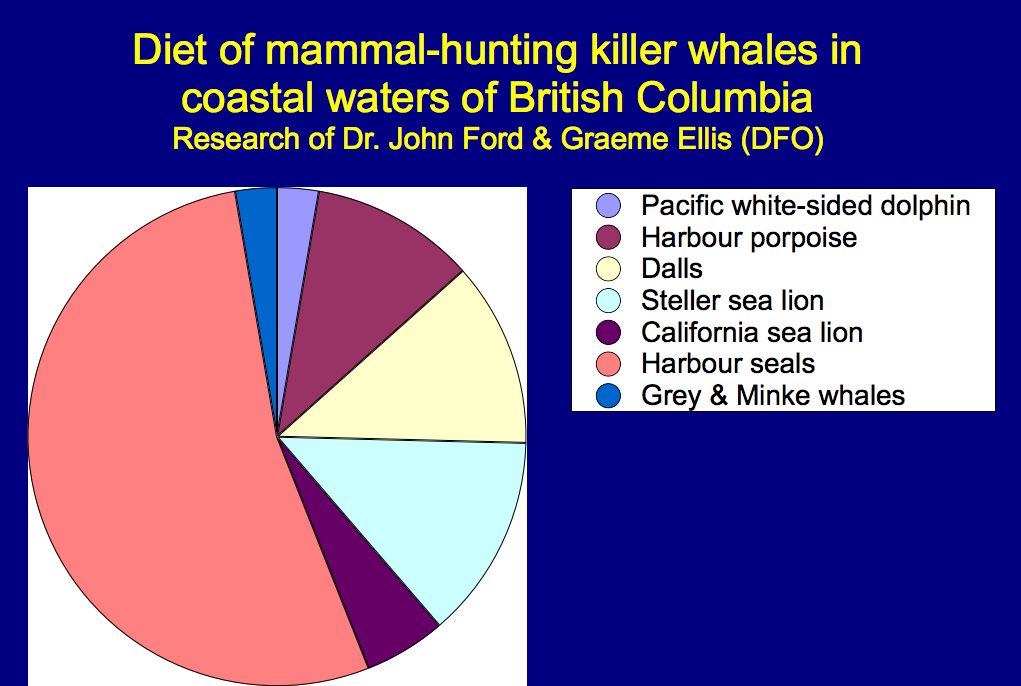
Research of Dr. John Ford & Graeme Ellis on the diet of mammal-hunting Killer Whales in the Northeast Pacific Ocean. Source: Presentation “The Complicated Predator” ; Dr. Lance Barrett-Lennard; October 2005.
Pacific Harbour Seals are predictable in where they haul out and they do not have defences like speed and sharp teeth. Therefore, it is not surprising that off the coast of British Columbia, Pacific Harbour Seals are documented to be the prey item of choice for the mammal-hunting Killer Whales (see graph above).
Far less commonly, these Killer Whales have also been documented to feed on River Otters, Northern Elephant Seals, Sea Otters and – VERY, VERY occasionally – a terrestrial mammal like deer.
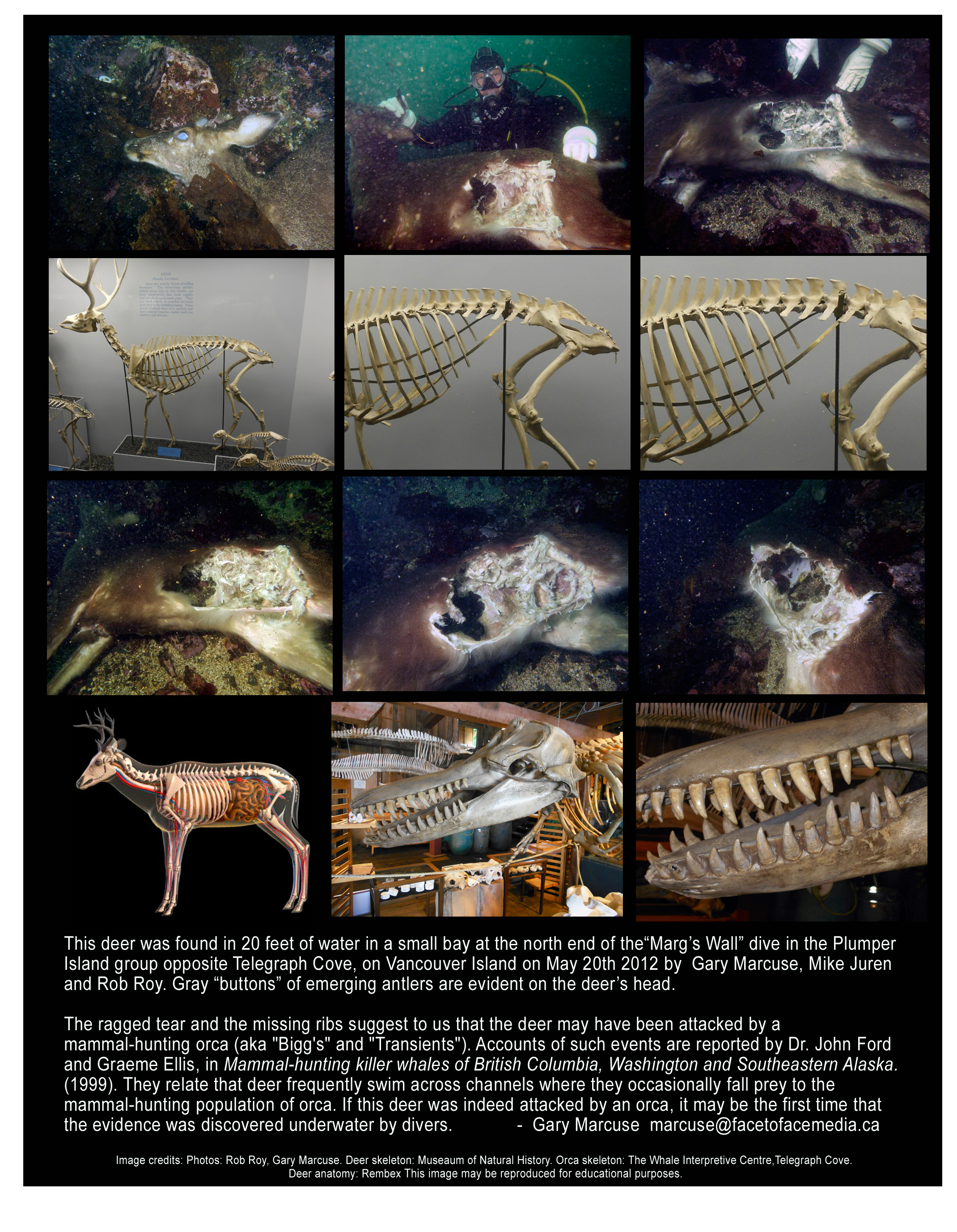
Please see below for images of a deer carcass found underwater by fellow divers Gary Marcuse, Rob Roy and Mike Juren in May of 2012. There is no way of knowing with certainty if that this deer was attacked by Killer Whales but it is plausible. Deer swim from island to island and are even more defenceless than a seal if they have the bad luck that stealthy mammal-eating Killer Whales find them.
Killer Whales are big dolphins – smart and social and even though they tend to be very conservative, doing what has worked for their kind for 100,000s of years, they also play – learning from interacting with their environment. I have reflected on this previously in my blog where I observed them mouthing and hitting diving birds. (Read “Fins vs. Feathers” by clicking here).
Deer could never make up a significant part of the diet of Bigg’s Killer Whales but they would learn from such an attack. If this deer did indeed meet its end in the mouth of a mammal-hunting Killer Whale, I would not be surprised if it was a juvenile mammal-hunting Killer Whale who undertook the “interaction”.
To share the expertise of Killer Whale researchers supreme, Dr. John Ford ad Graeme Ellis, from their 1999 publication “Transients -Mammal-Hunting Killer Whales” (and note that an attack on a moose has only ever been documented ONCE):
“Although the primary prey of transient [now Bigg’s] killer whales are marine mammals, the whales’ interest extends to other warm-blooded animals, including marine birds . . . and even terrestrial mammals. Our first record of land mammal predation dates from June 1961, when Canadian fishery officers observed killer whales feeding on a deer carcass in Jackson Pass on the central coast of British Columbia. Deer frequently swim from island to island along the inside passages, and it is probable that this one fell victim to a foraging group of transients. More recently, off the east coast of Vancouver Island, several killer whales were observed circling a small rock on which two deer had taken refuge. On another occasion, a lighthouse keeper assisted an exhausted deer out of the water as it was being pursued by killer whales. In these case, there has been no photographic confirmation that transients were involved, but it seems almost certainly the case.
Other land mammals are also of interest . . on occasion . . . a killer whale was observed to surge part way onto shore in an apparent attempt to attack a dog that was barking loudly at the passing group. . . .
One of the most surprising attacks on a terrestrial mammal took place in 1993 in Icy Strait, south-eastern Alaska. Two fishermen observed a group of three or four killer whales attack and kill one of a pair of moose that were swimming across the channel. The other moose managed to escape the attack but later became entangled in a kelp bed and drowned.”
So am I worried, as a very avid and very mammalian scuba diver, that I have the same chances of being attacked as a deer swimming between islands? Absolutely not. There has never been a case of Killer Whales in the wild killing a human.
To again relate John Ford and Graeme Ellis’ expertise:
“Divers in this region typically wear thick suits made of neoprene rubber, which contains acoustically reflective nitrogen bubbles. Thus, if a transient [Bigg’s killer whale] tries to inspect a diver with echolocation, its unlikely to get a typical mammalian echo. Although scuba divers may not appear appetizing to [them], this may not be the case for swimmers, so it is advisable to leave the water should transients [Bigg’s] appear in the vicinity.”
I also love the perspective of a fellow diver and friend, Peter Mieras, who states that Killer Whales “are too smart to go after junk food in wrappers.”
Oh deer!
Sources:
Barrett-Lennad L. 2005. “The Complicated Predator” – presentation
Update October 26, 2018. Additional Crittercam video of a calf nursing from CNRS/ Cétamada recorded on the breeding ground on the east coast of Madagascar at Ste Marie Island.
Update December 19, 2012: The National Geographic video I had posted below has been pulled from YouTube.
Explanation from D.Gold who posted it there: “Note to The Marine Detective and readers: Sorry to say, I removed this video from my youtube account today. I received a request. National Geographic has plans for broadcasting the footage. A scientist and producer asked that I take the youtube down for now. The quality will be much better when you see it on their channel anyway. I think they picked up on this getting a fair amount of attention thru this website and the social media in the past week. The reason I posted the video is expressed perfectly by the Marine Detective’s blog post, “Mind-Blowing Crittercam Video – Humpback Calf Nursing Underwater and Watching Mother Group Bubble-Net”. . . I feel much the same as you do . . .. I wanted to share the education of this presentation on my channel, but alas, this particular youtube will not be available. Keep searching and hopefully Nat Geo will show “The most goose-bump inducing, mind-blowing, awe-inspiring, consciousness-raising” footage.: “
Crittercam video screen grab showing humpback calf nursing underwater. Screen grab from Birgit Buhleier’s presentation.
My original post December 9, 2012:
The most goose-bump inducing, mind-blowing, awe-inspiring, consciousness-raising video I have ever seen I viewed in October 2009 in Quebec at the 18th Biennial Conference on the Biology of Marine Mammals, and I have been waiting for it to appear on-line ever since.
Today, I found it and think it will have the same impact on you.
The quality of the video is not ideal as it is the result of someone filming the original footage but – it will do!
What you will see, starting at time-stamp 2:50 is the result of Dr.Fred Sharpe’s research team having, rather randomly, put a Crittercam (camera on a suction cup) on a humpback whale calf in Alaska.
Crittercam video screen grab of calf watching his mother and 11 other adult humpbacks cooperative bubble-net feeding.
In 6 minutes of video, the 6 to 7 month-old calf “gifts” the world with the following:
Footage of him nursing underwater which reveals how synchronized this is, with mother tapping her calf with her tail seemingly to signal “and stop now”. You will even see the calf burp and, with streams of milk streaming past the calf, you will gain an understanding of how rich and copious the milk must be to support the incredible growth rate of baleen babies.
Then, at timestamp 5:48, you’ll see what caused the large international crowd of marine mammal scientists to collectively gasp when Fred Sharp shared this with us in 2009. The calf settles down at the ocean bottom at around 150 ‘ (46 m) and watches specter-like shapes rise to the surface . . . adult humpback whales, including mom, cooperative bubble-net feeding.
Only 6 minutes of video – such depth revealed.
The presentation that had been filmed was given by Birgit Buhleier, National Geographic’s naturalist and underwater video producer, aboard the National Geographic vessel “Sea Lion” in SE Alaska in the summer of 2012.
Please if you find the footage somewhere else, let me know!
Time stamp: 2:50 – Humpback calf nursing underwater; 5:48 calf watching mother group bubble net-feeding
How high can you get in seeing dolphins and humpbacks?
Captain Tavish Campbell knows.
The 1.5 minute clip below reveals his unique perspective from atop the 100′ mast of the beautiful schooner Maple Leaf.
From on high, he shares with us the view of hundreds of Pacific white-sided dolphins and a bubble-netting humpback whale.
I have the joy of sometimes serving as naturalist for Maple Leaf Adventures with Tavish. He allowed me to put together this clip for the David Suzuki Foundation’s Ocean Stories Campaign, both of us hoping that the breathtaking beauty might inspire people to undertake more positive action to protect the great biodiversity of the North Pacific.
What’s your Ocean Story? You can help inspire connection and positive change by sharing your story with DSF up to midnight on October 31st.
Something made me clap my hands and giggle in glee today.
Of course I want to share the cause with you but, first, a bit of context.
I am 49 years old.
I only started diving in 1999 at age 36.
I resisted taking underwater photos until 2006, not wanting to take my above-the-ocean marine photo addiction underwater with me.
Then I was gifted an underwater camera and very soon discovered the huge conservation power of sharing these photos with others, especially when coupled with my teaching.
In 2010, “The Marine Detective” erupted, better unifying my teacher, whale researcher, photographer, and conservationist selves and making it just a little easier to answer “So what is it you do?!”
Then there was that amazing Murray A. Newman Aquatic Conservation award from the Vancouver Aquarium . . .
And now, I feel another milestone has been reached in whatever path The Marine Detective is on.
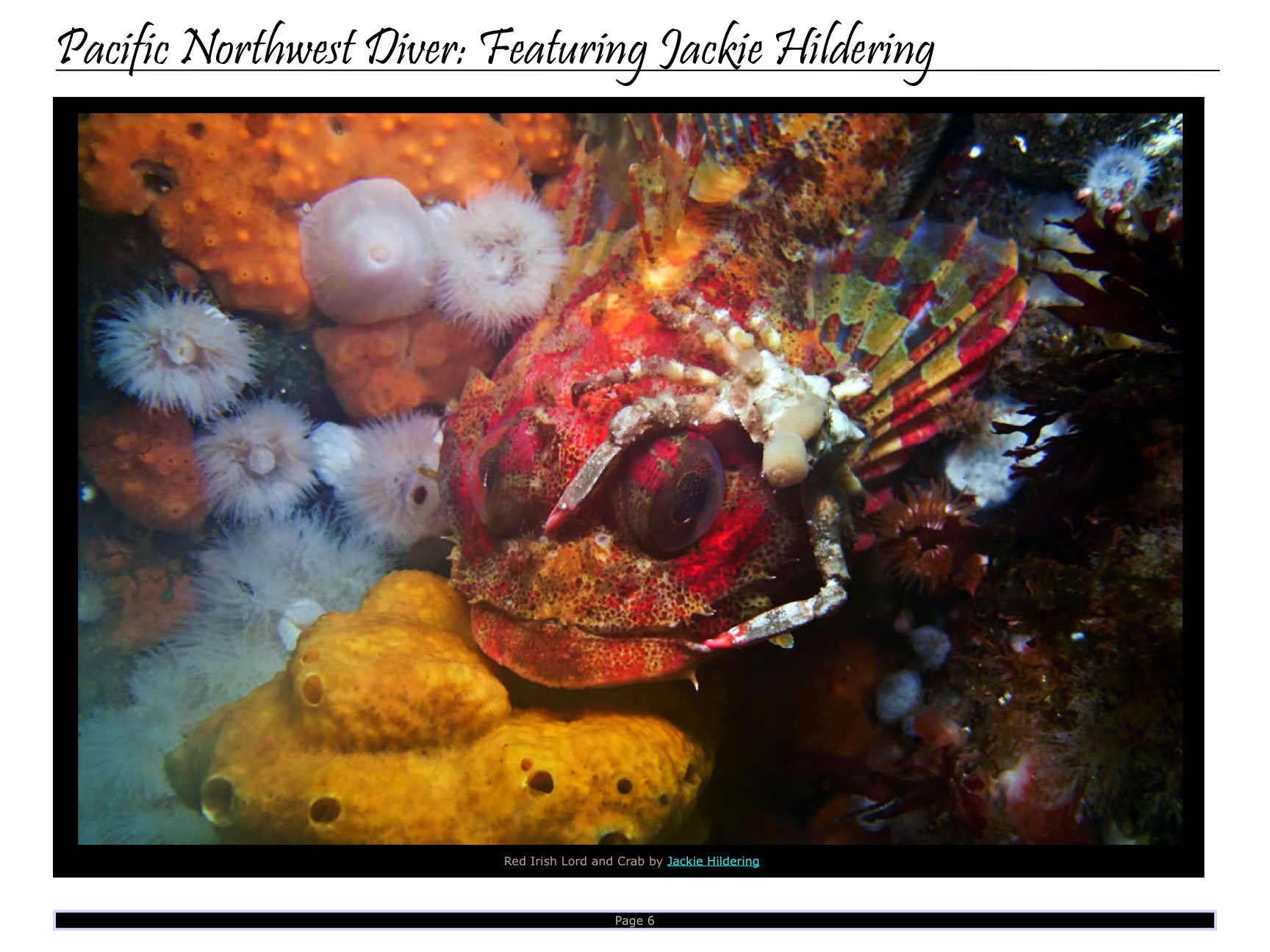
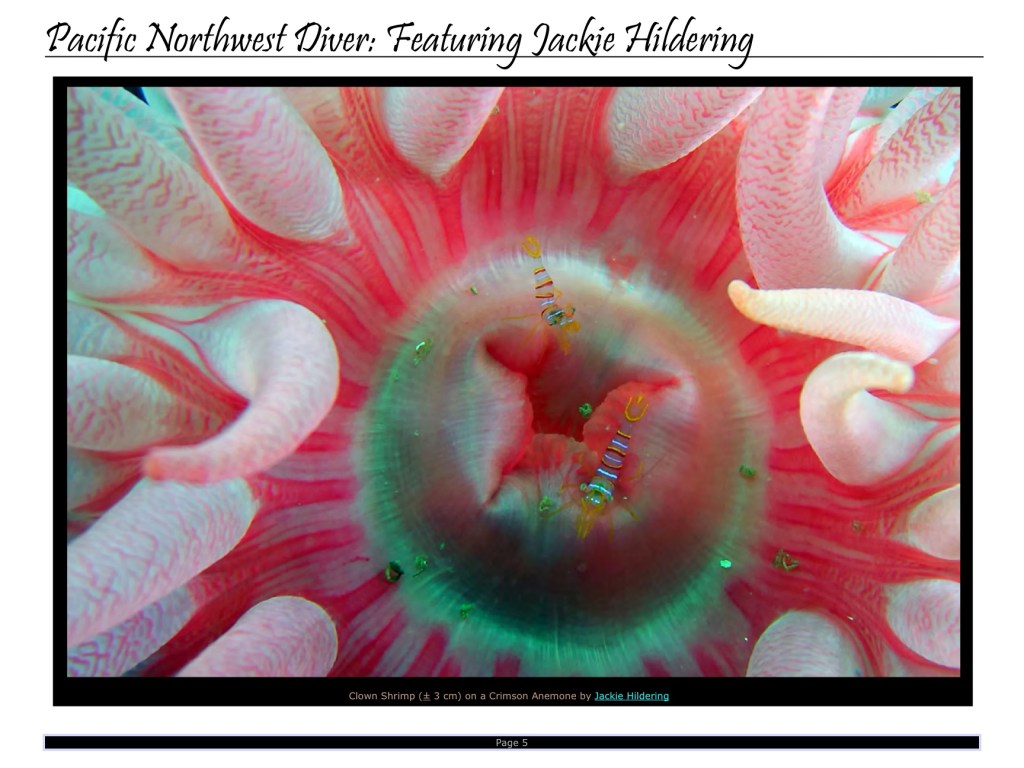
I am this month’s “Featured Photographer” in Pacific Northwest Diver Magazine.
I have had the great privilege of my photos getting used for a variety of conservation purposes prior to this but this magazine is put out by peers in the Pacific Northwest Underwater Photographic Society. The calibre of these underwater photographers humbles me, so it is a really big deal!
Please check out the write-up and my photos in Pacific Northwest Diver at this link.
The direct link to the e-magazine is right under my dolphin cover shot. Ooh, an additional draw for you to go to the website – the promise of a dolphin photo!
You can subscribe there too.
My huge thanks to editor Dan Clements for the honour, the opportunity to expand the reach of The Marine Detective, and this additional push to keep me going.
My huge thanks to you for giving me further reason to believe these efforts are worthwhile.
Clap! Clap! Giggle! Giggle!
The Marine Detective honoured to be the “Featured Photographer” in Pacific Northwest Diver.
This photo is of the juvenile male humpback whale that died in the early morning hours of June 12th on a beach in White Rock (some 40 km south of Vancouver).
While the images stir deep despair, they are also achingly beautiful and fill me with a great depth of hope.
People cared enough to place flowers on the deceased little whale.
People cared enough to stand in awe and respect.
People . . . cared.
With this little whale dying on a beach in an urban centre, great public concern and national media attention were attracted, creating a potent opportunity for education.
The death of this whale illuminates how little we know about marine life, even the ocean’s giants.
Had anyone seen the whale before? To date, no one has been able to identify this whale as an individual and thereby determine where he might have come from. We at MERS were not able to find this whale in our catalogue nor in that of the Department of Fisheries and Oceans.
How did the whale die? The whale had an excruciatingly slow death from starvation due to entanglement in fishing gear. The gear had lacerated into the whale’s skin and had cut deep into the whale’s mouth. Ultimately, the young emaciated humpback became stuck on the beach at low tide and died there.
What type of fishing gear killed the whale? Fishing gear that was unfamiliar to local experts. Scott Landry, from the Provincetown Centre for Coastal Studies in Massachusetts, is one of the world’s foremost experts on entanglement and he shared with MERS director Christie McMillan that the line was very likely from offshore longline fisheries and was more difficult to recognize because the hooks had been in the water so long, they had corroded off the lines. Let’s truly absorb that for a moment – the whale may have been entangled so long that he outlasted the hooks on the fishing line.
Do humpback whales get entangled often? Entanglement is identified as a threat in the Recovery Strategy for the North Pacific Humpback Whale in Canada but the threat is very poorly understood. Therefore, we at the Marine Education and Research Society have undertaken an entanglement scar study to determine how often humpback whale entanglement might occur. British Columbia’s vast coastline and relatively new Marine Mammal Response Network unquestionably lead to many undetected and unreported entanglements. Even in the Gulf of Maine where there is a well-established reporting network, studies have determined that less than 10% of large whale entanglements are witnessed or reported and only a fraction of deaths are detected. Scar studies in Southeast Alaska suggest that up to 78% of humpbacks are entangled at some point in their lives.
Are there solutions? Humpback whales of the North Pacific must continue to receive protection under the Species at Risk Act. They are currently listed as “Threatened” but a 2011 assessment suggests they could be down-listed to being of “Special Concern”. This is premature. Not enough is known about the population structure of the North Pacific humpbacks, let alone about threats such as entanglement. With a better understanding of the incidence of entanglement, fisheries regulations could be adapted including gear modifications that allow nets and lines to break-away.
But the lessons here go beyond those relating specifically to humpbacks and to entanglement.
This “case” of an unidentified juvenile humpback dying in on a beach in an urban centre after months of agony, undetected and unreported, testifies to how little we know about our oceans and how easy it is to kill a giant, even with a bit of stray human-made fishing line.
The key to saving whales and the ecosystems for which they are ambassadors, is to retain the humility and connectedness we feel when we see pictures like this, letting it impact our consumer and electoral choices and our value systems. We too often act as if we know it all; that we will be able to “manage” even unknown human impacts; and therefore, we relentlessly assault the oceans in favour of short-term economies.
Thanks to the efforts of many volunteers, coordinated by Jim and Mary Borrowman, this little humpback’s skeleton will come to hang in Telegraph Cove’s Whale Interpretive Centre. Maybe the powerful photograph will hang life-size behind it, adding to the potential of this whale’s death leading to some sort of positive gain for the environment and therefore . . . for ourselves.
Sources:
Neilson, J. L., J. M. Straley, C. M. Gabriele and S. Hills. 2009. Non-lethal entanglement of humpback whales (Megaptera novaeangliae) in fishing gear in northern Southeast Alaska.Journal of Biogeography 36:452–464.
Robbins, J. and D.K. Mattila. 2001. Monitoring entanglements of humpback whales (Megaptera novaeangliae) in the Gulf of Maine on the basis of caudal peduncle scarring. Unpublished Report to the 53rd Scientific Committee Meeting of the International Whaling Commission. Hammersmith, London. Document number SC/53/NAH25.
Robbins, J. and D.K. Mattila. 2004. Estimating humpback whale (Megaptera novaeangliae) entanglement rates on the basis of scar evidence. Report to the National Marine Fisheries Service. Order number 43ENNF030121. 22 pp.
Robbins, J. 2009 Scar-based inference into Gulf of Maine humpback whale entanglement: 2003-2006, pp. 40: Report to the National Marine Fisheries Service. Order Number EA133F04SE0998.