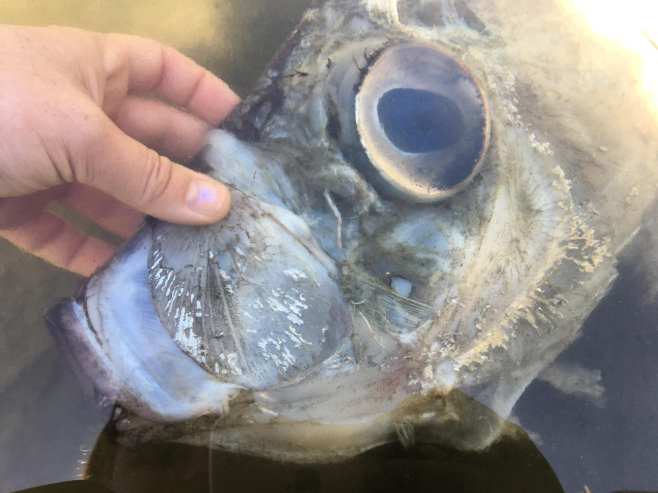
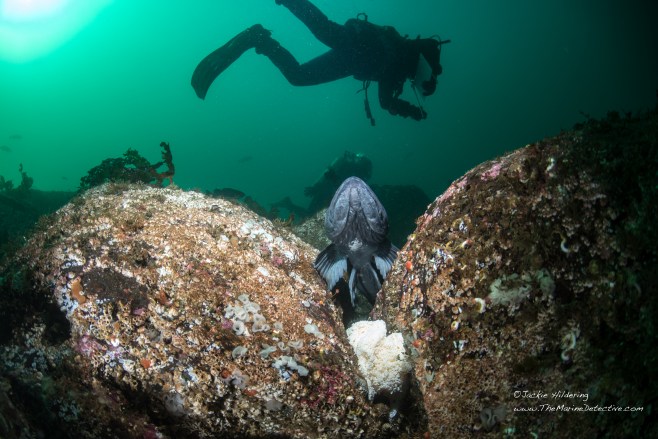
Let me start by saying . . . no one looks good when they are this dead.
Also, Halloween is nigh so that may have sparked some “spooky” speculations.
These photos of a dried up little fish created a lot of interest on the Field Naturalists of Vancouver Island Facebook page recently. Kendra Lukow found the fish at Race Rocks.
I think what led to confusion, misinterpretation, and maybe a few nightmares is that people may not realize that bony fish species have teeth in their throats. And, with this fish being so dried out, and thereby contorted, these teeth appear to be the main teeth in the “oral jaw”. But many of the teeth you see in these images are the “pharyngeal teeth”.
You may have noticed that fish do not have hands so how to hold onto your prey, chew it into smaller parts, and move it into your stomach? Evolution’s solution: the teeth you are more familiar with (in the oral jaw) hold onto the prey, while the secondary set of teeth in the throat (the pharyngeal jaw) chew and/or pull on the prey.
Even the fish species you are really familiar with, like salmon, have this second set of teeth. These teeth just look far more prominent in this dried up individual.
So which fish species did Kendra find? Even in having consulted some super fish experts, there is no certain ID. Some experts have put forward that the teeth and head shape look more like a large sculpin species e.g. Cabezon or Great Sculpin. Other experts reference that some photos show scales on the dry skin. Sculpins don’t have scales so that would make the ID of a greenling species more likely e.g. Lingcod or Rock Greenling.
Please note that motivation to make this blog is not to ID the very dry and dead fish. It’s to add to the awareness about this adaption in so many fish – the pharyngeal teeth. It’s to shift the “ew” to awe.
With great thanks to Andy Lamb, Dr. Milton Love and Gavin Hanke for their insights into the fish ID.
See below for a great TedEd animation explaining fish pharyngeal jaws.
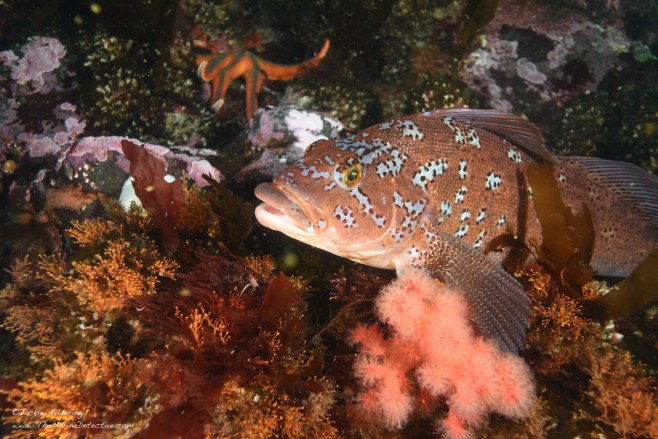
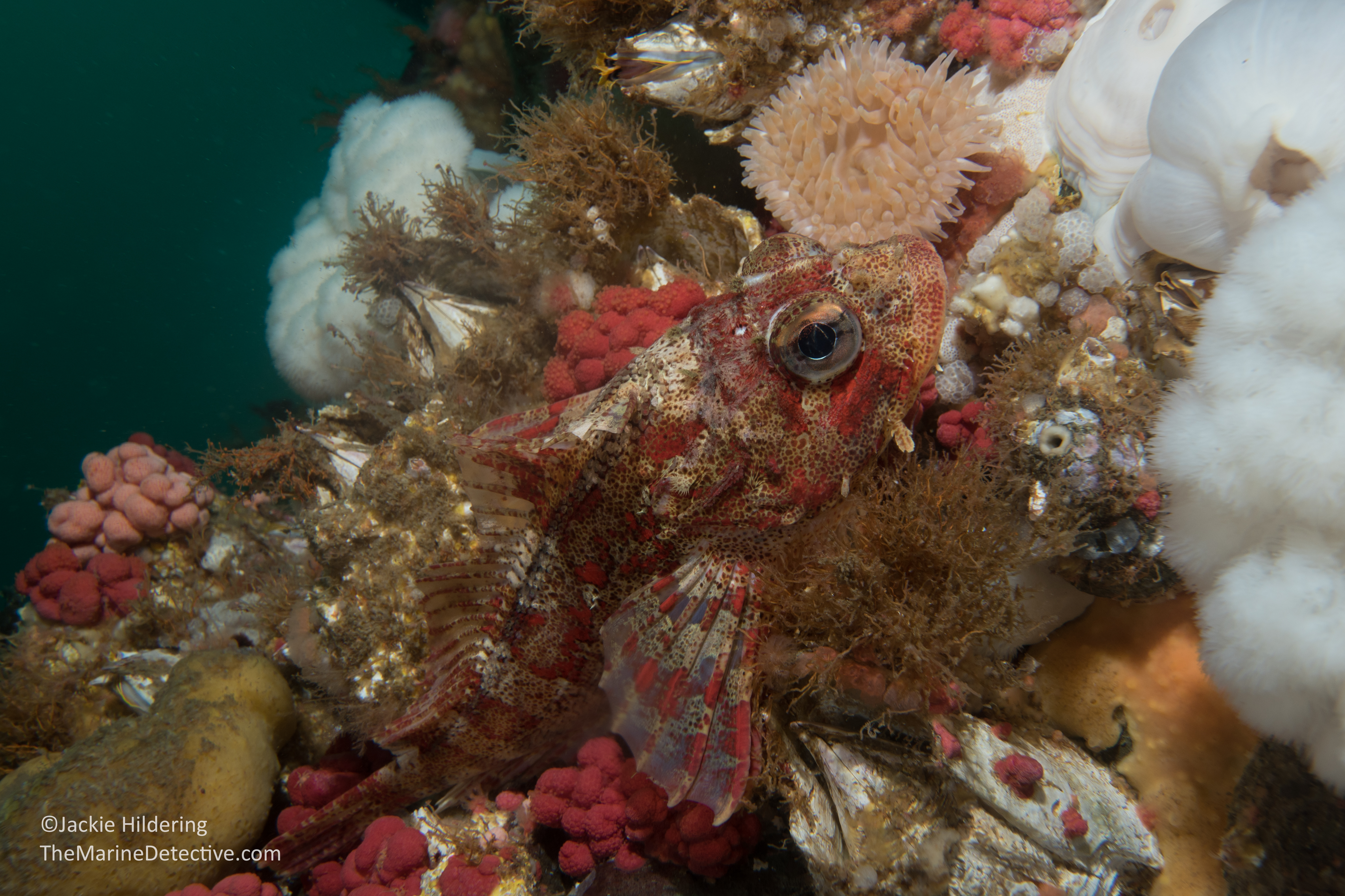
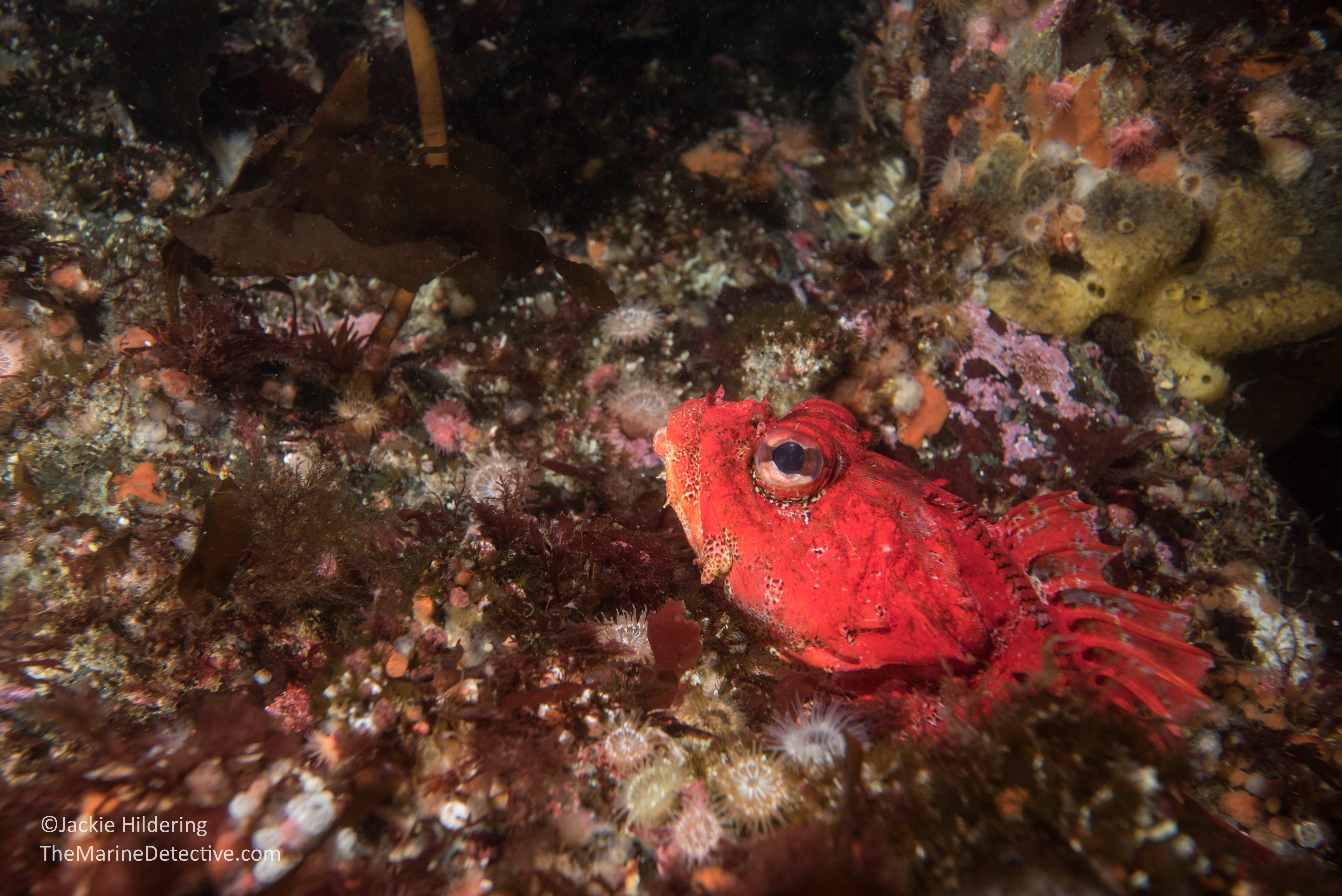
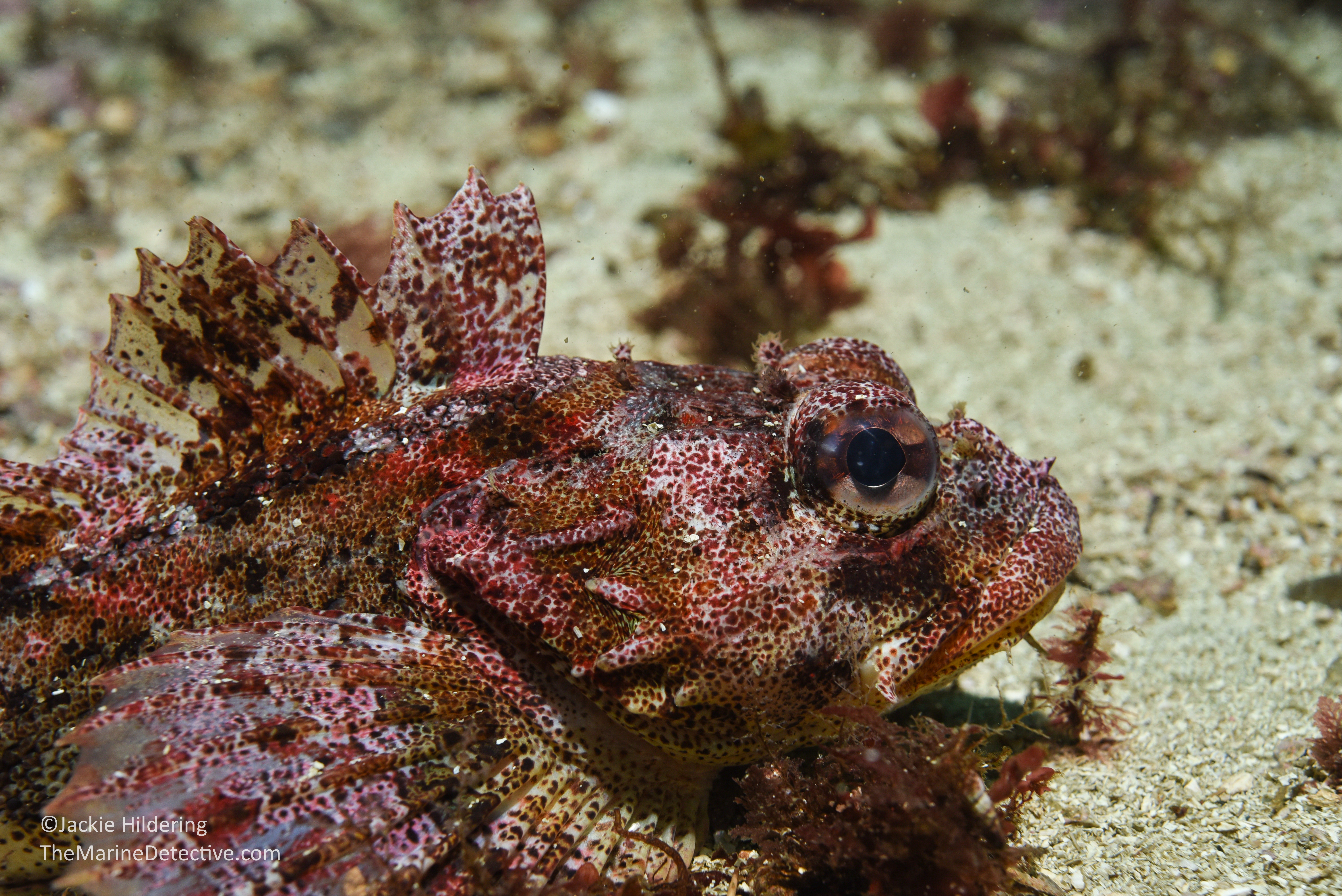
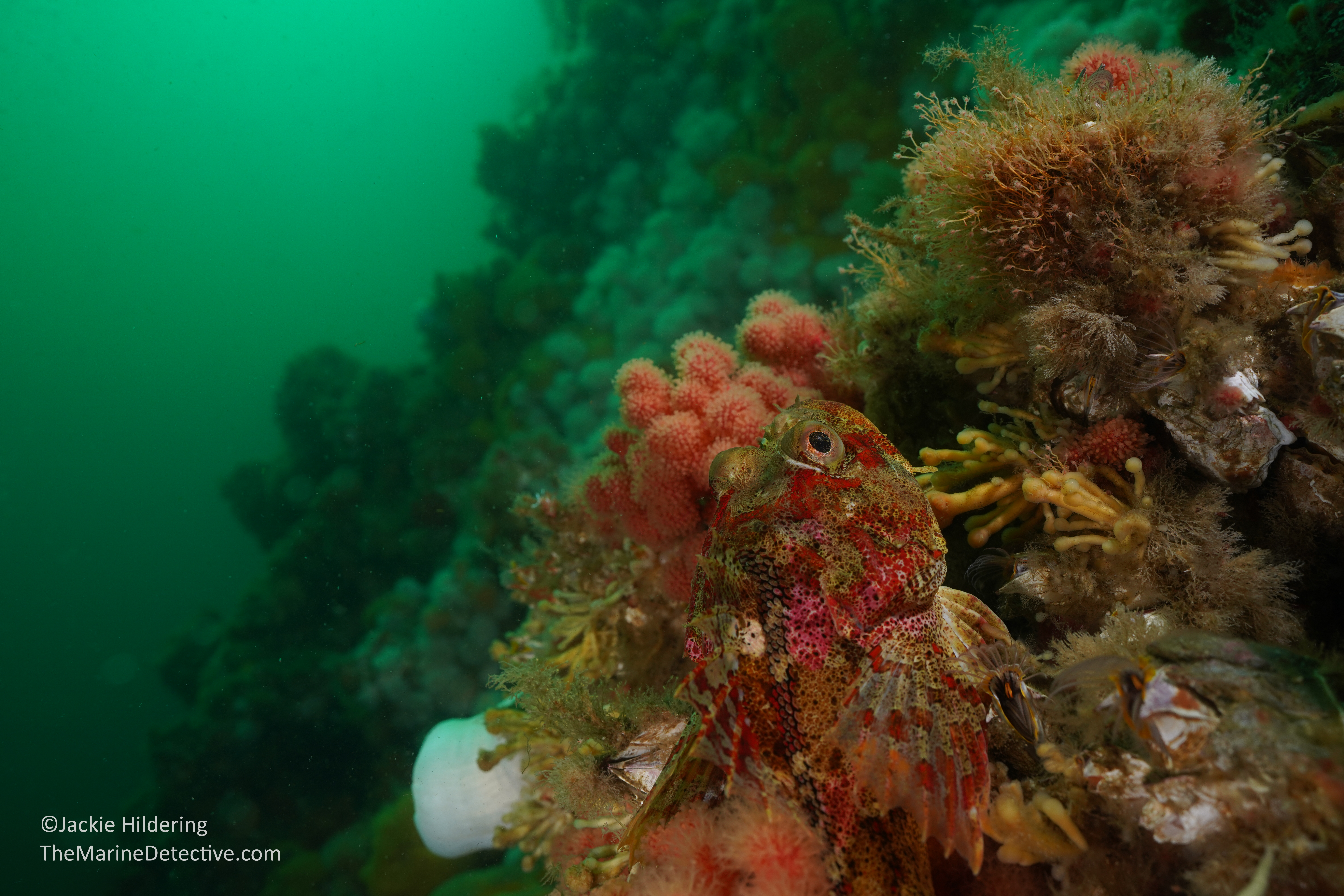
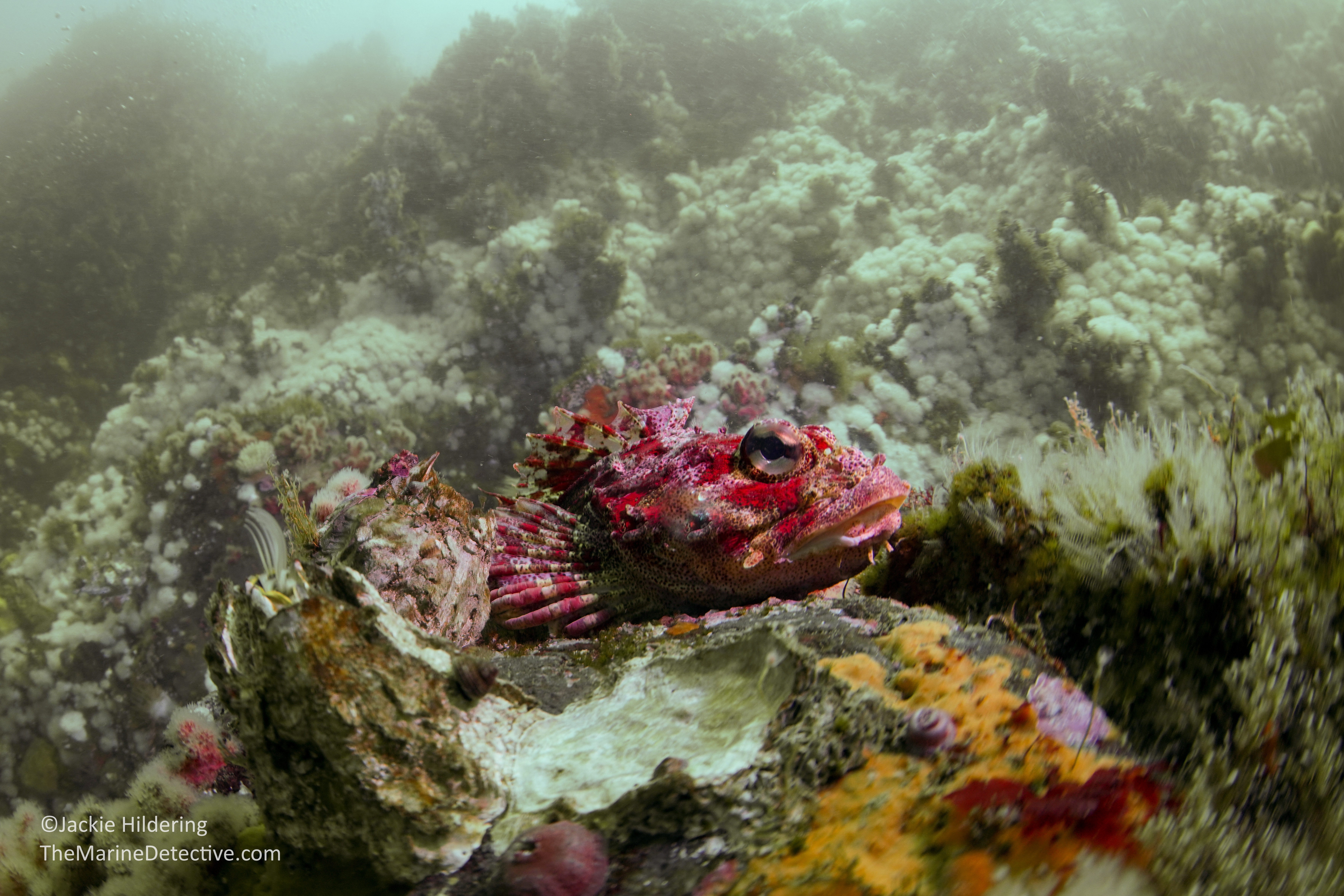
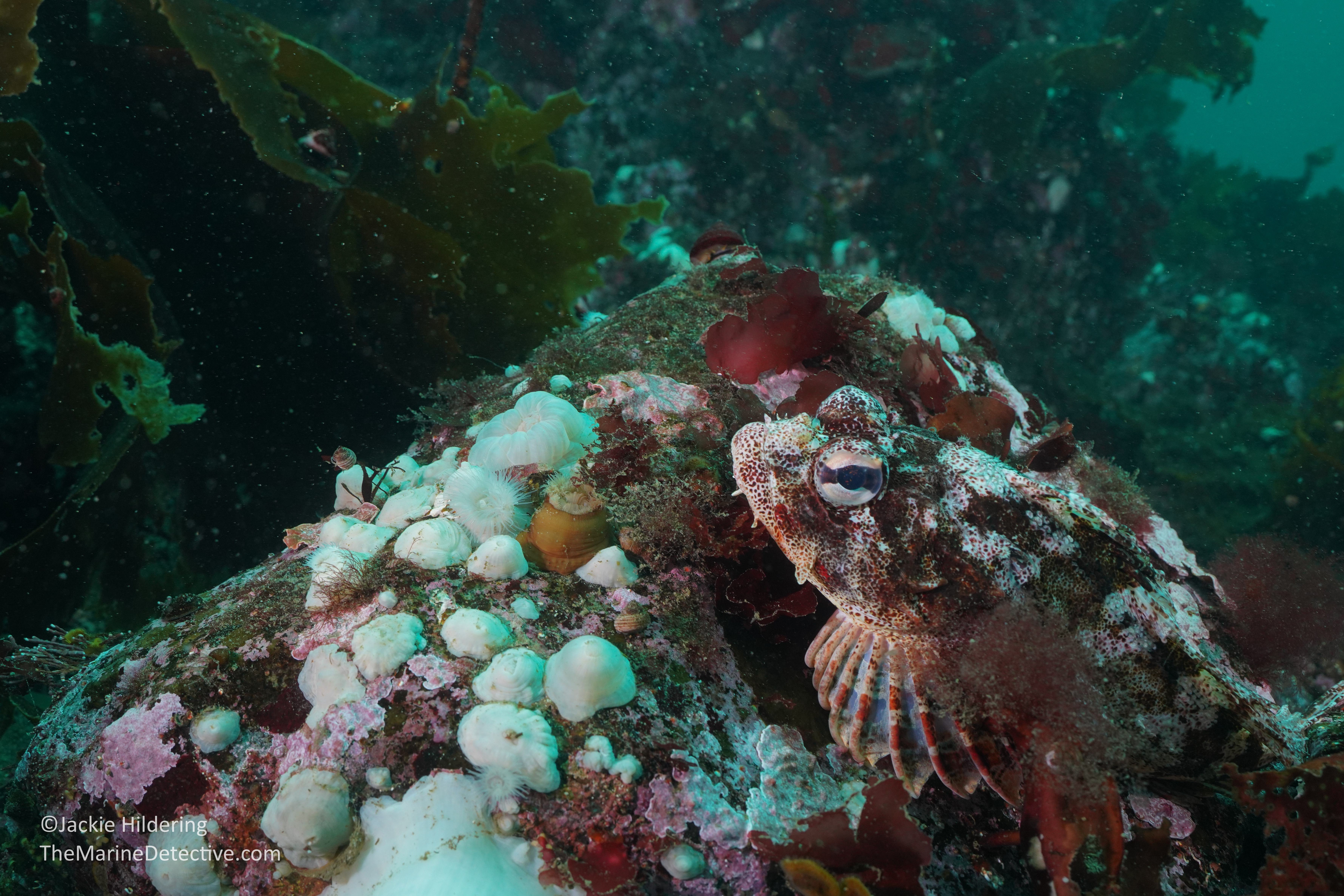
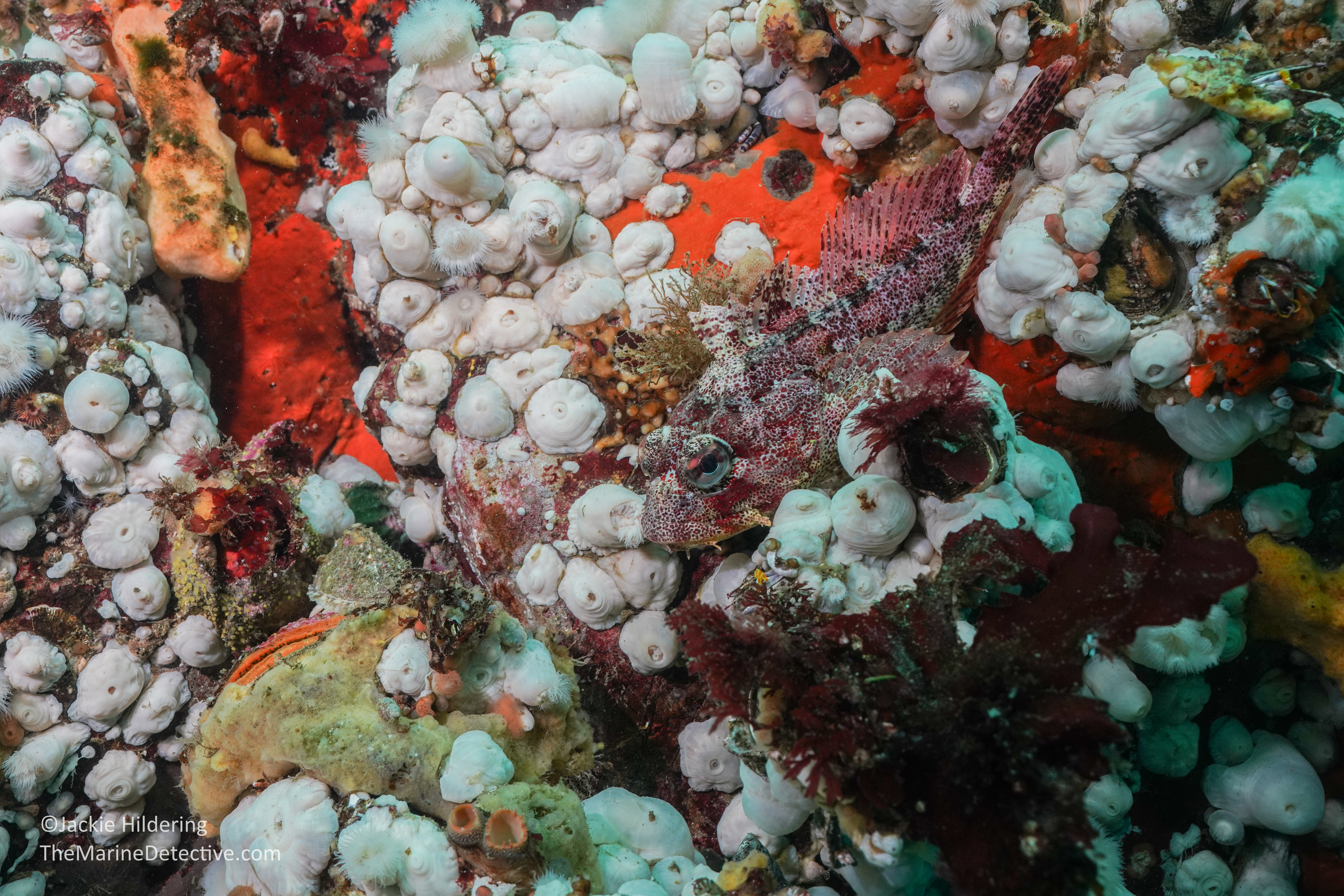
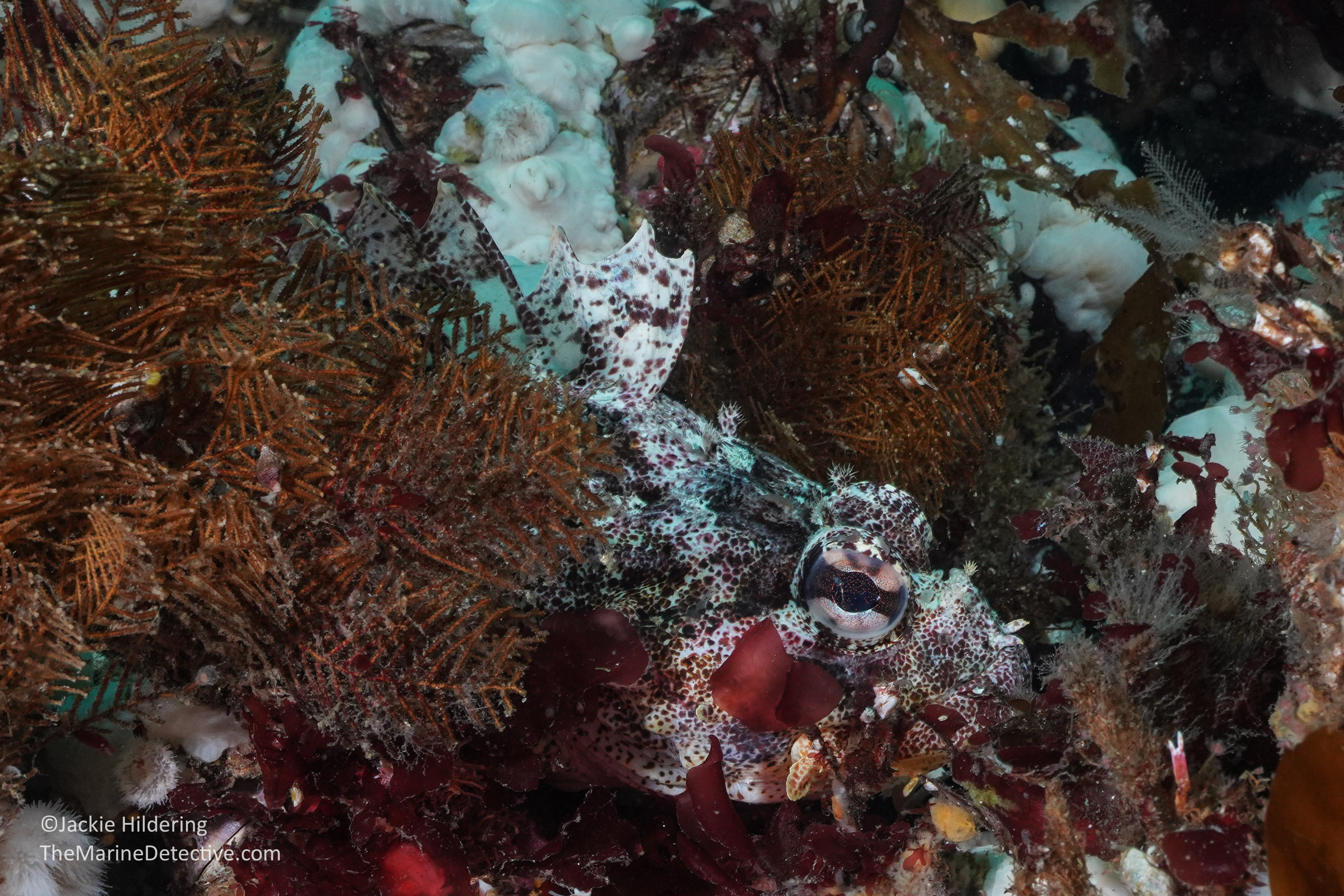
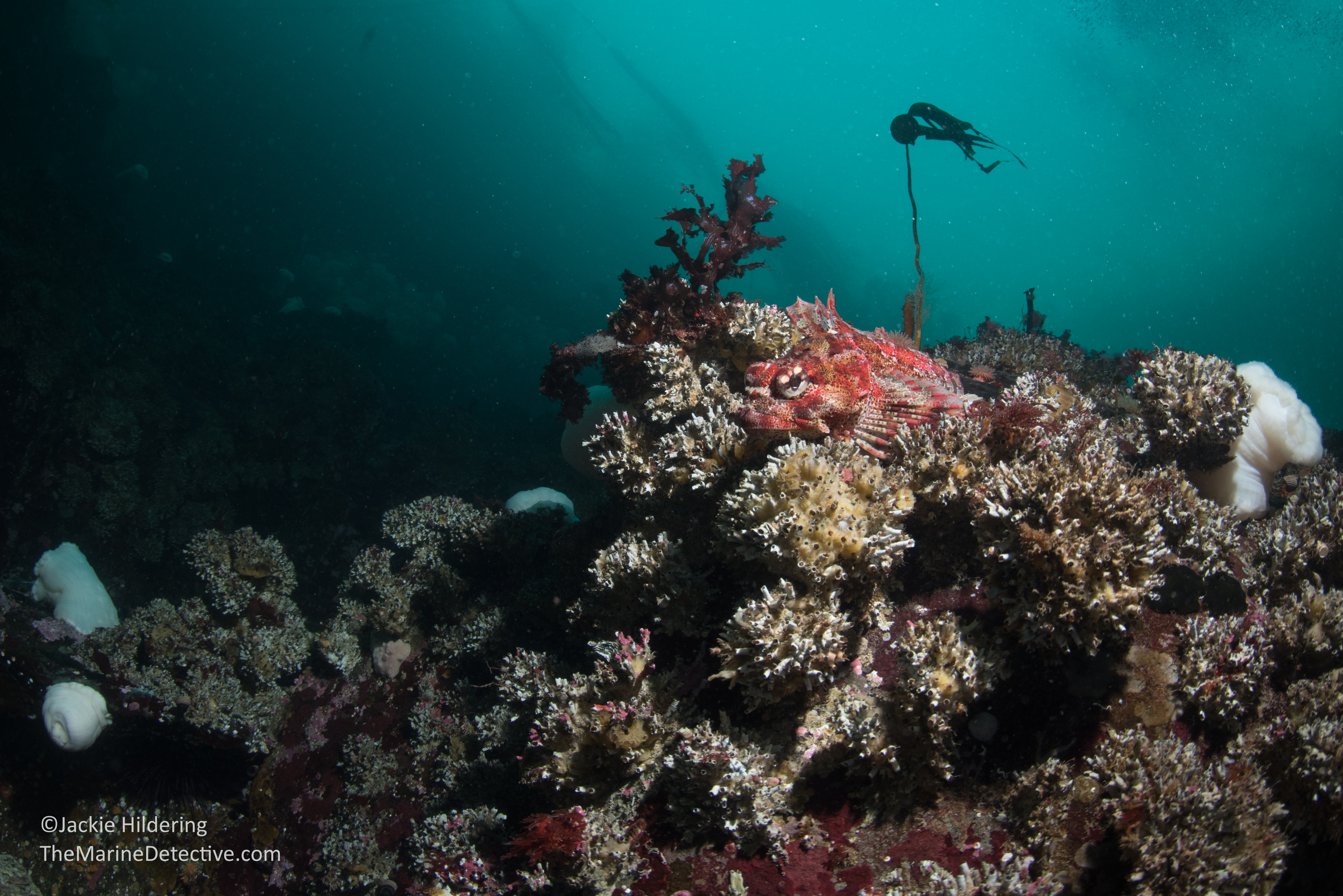
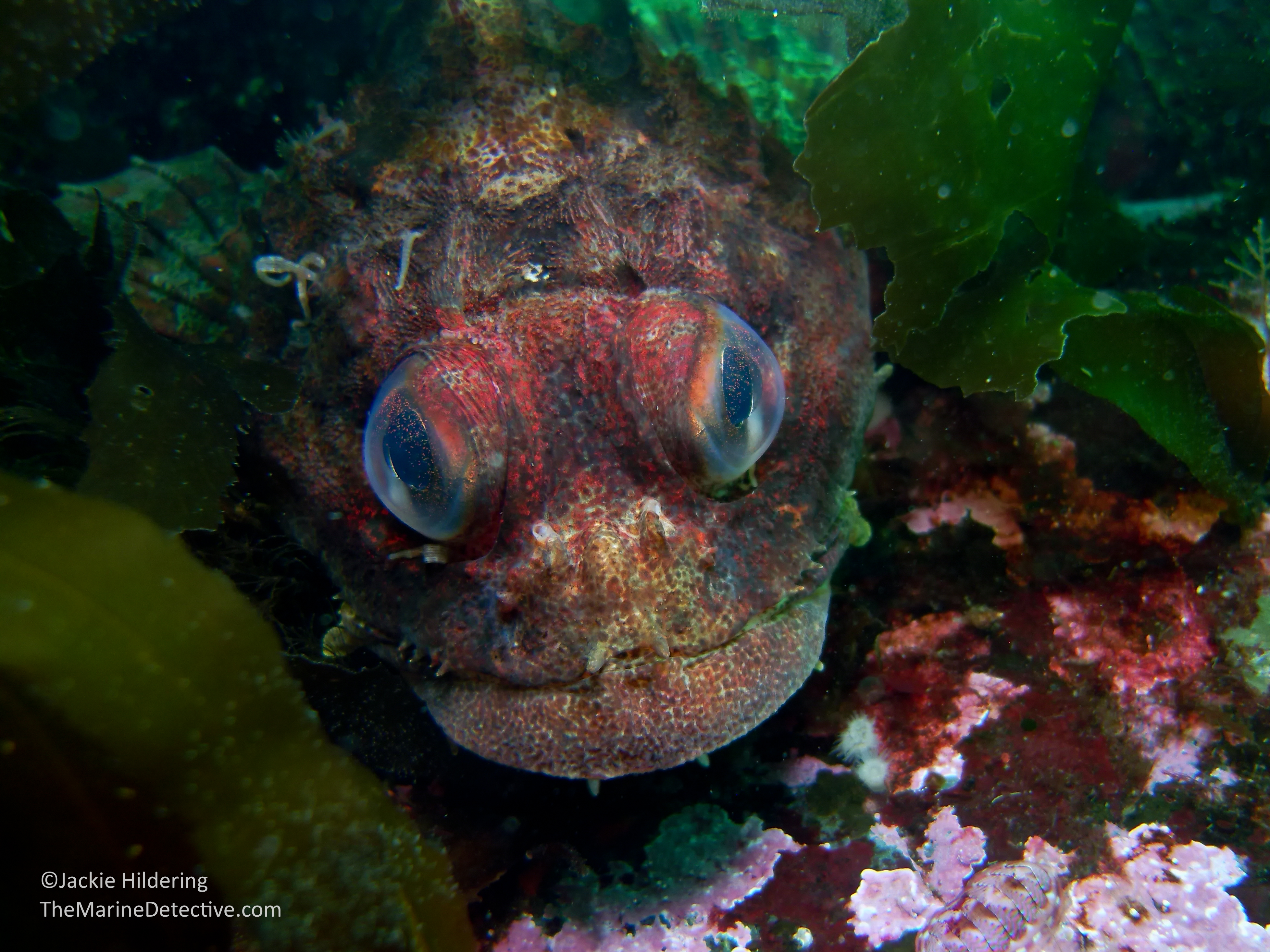
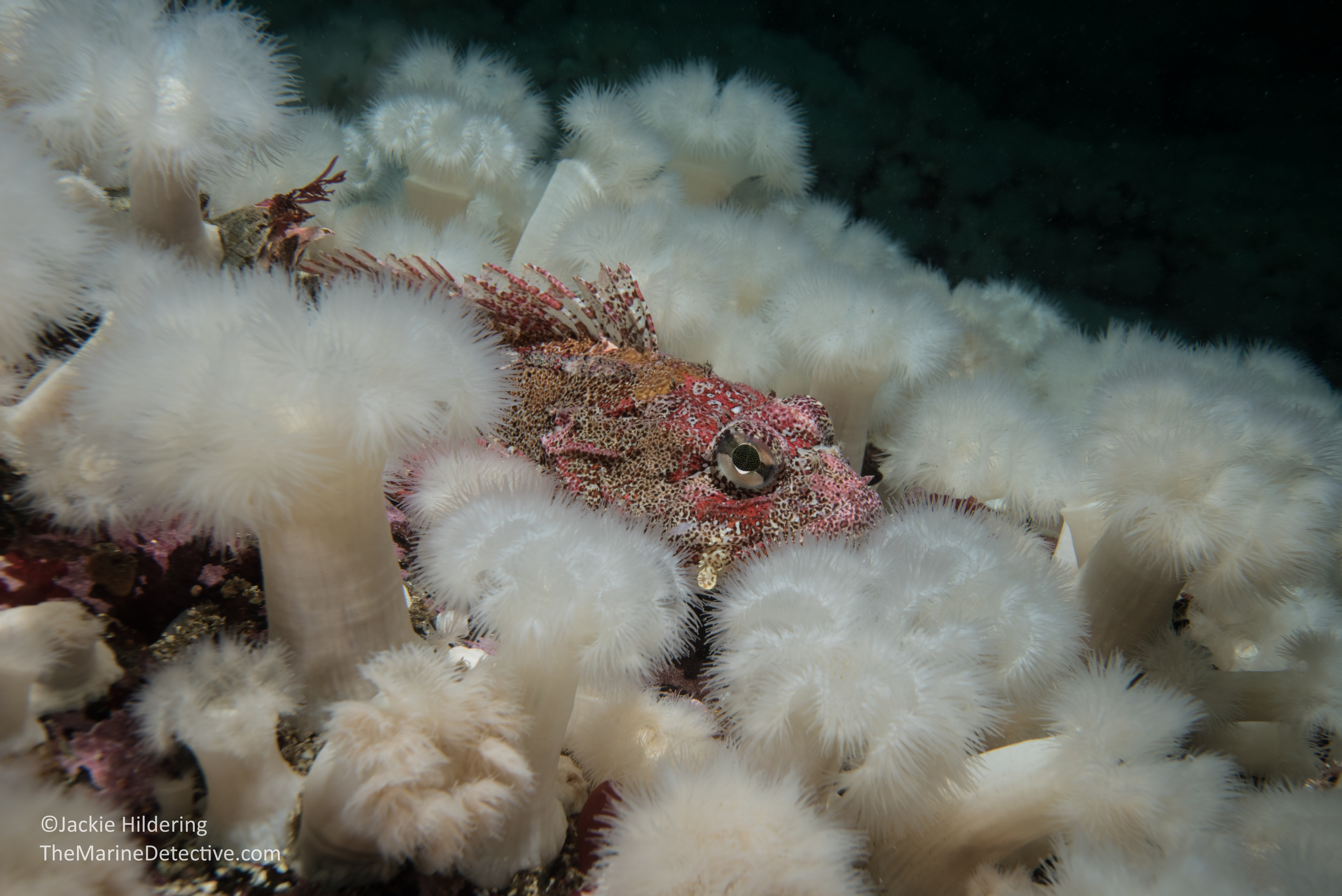
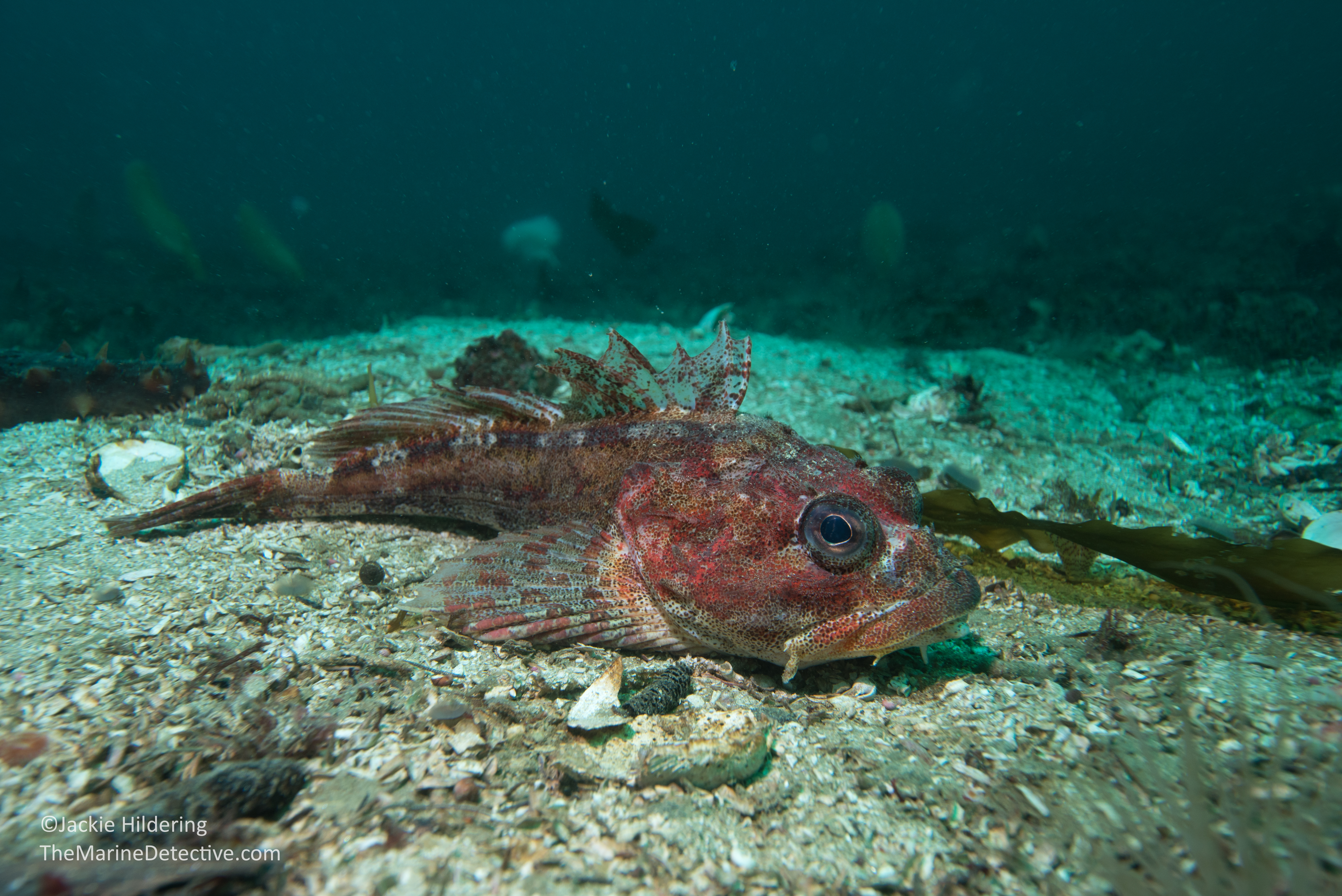
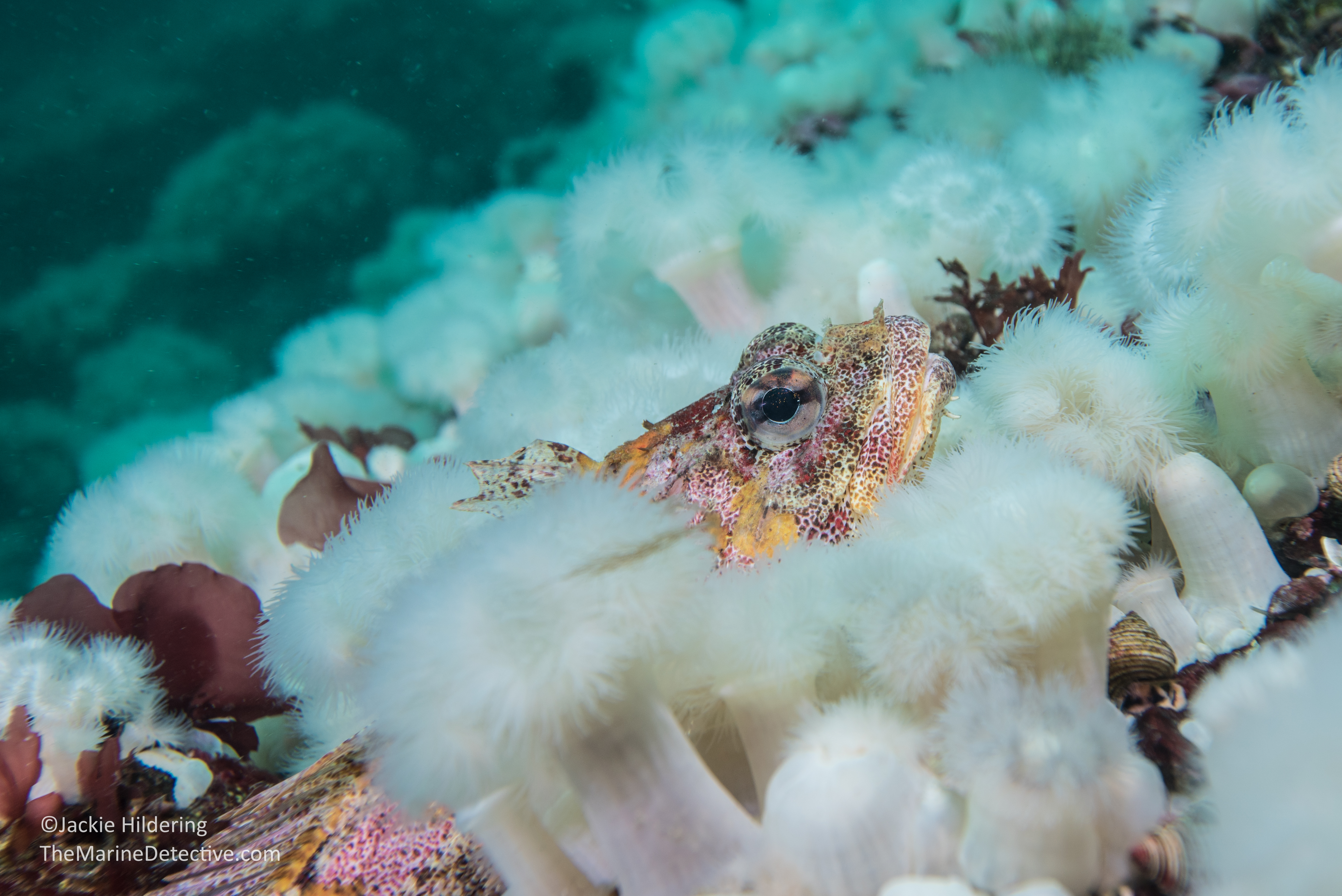
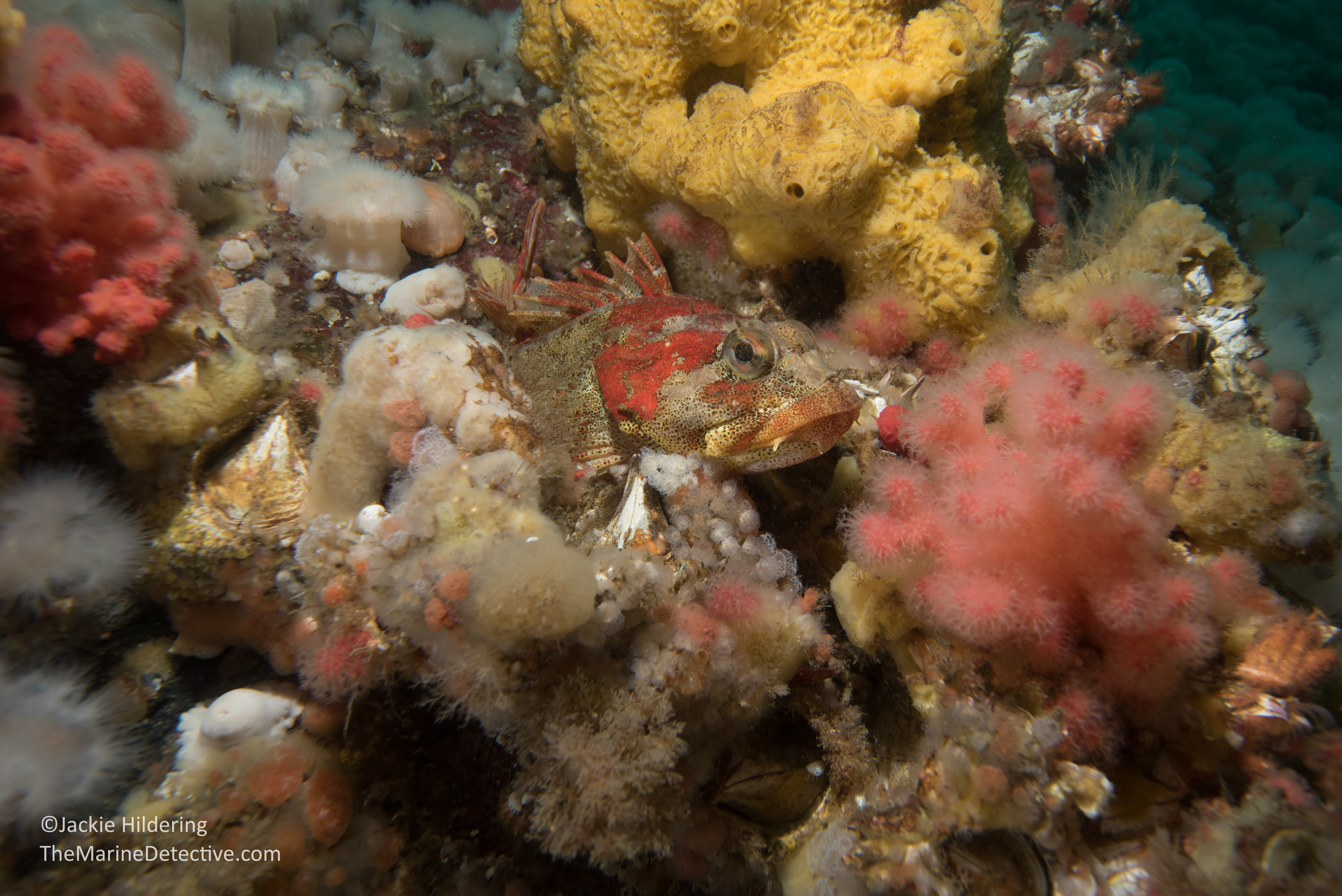
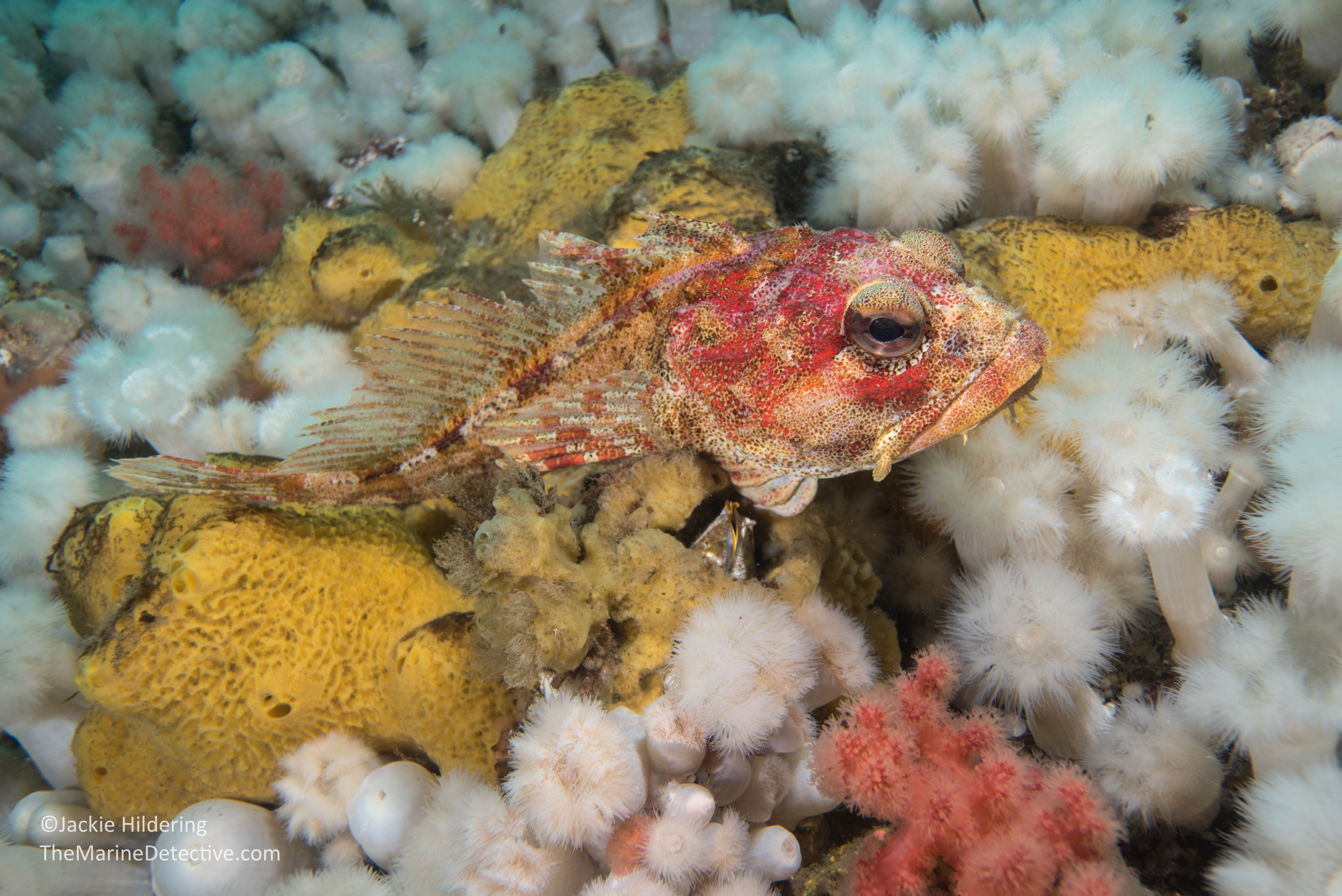
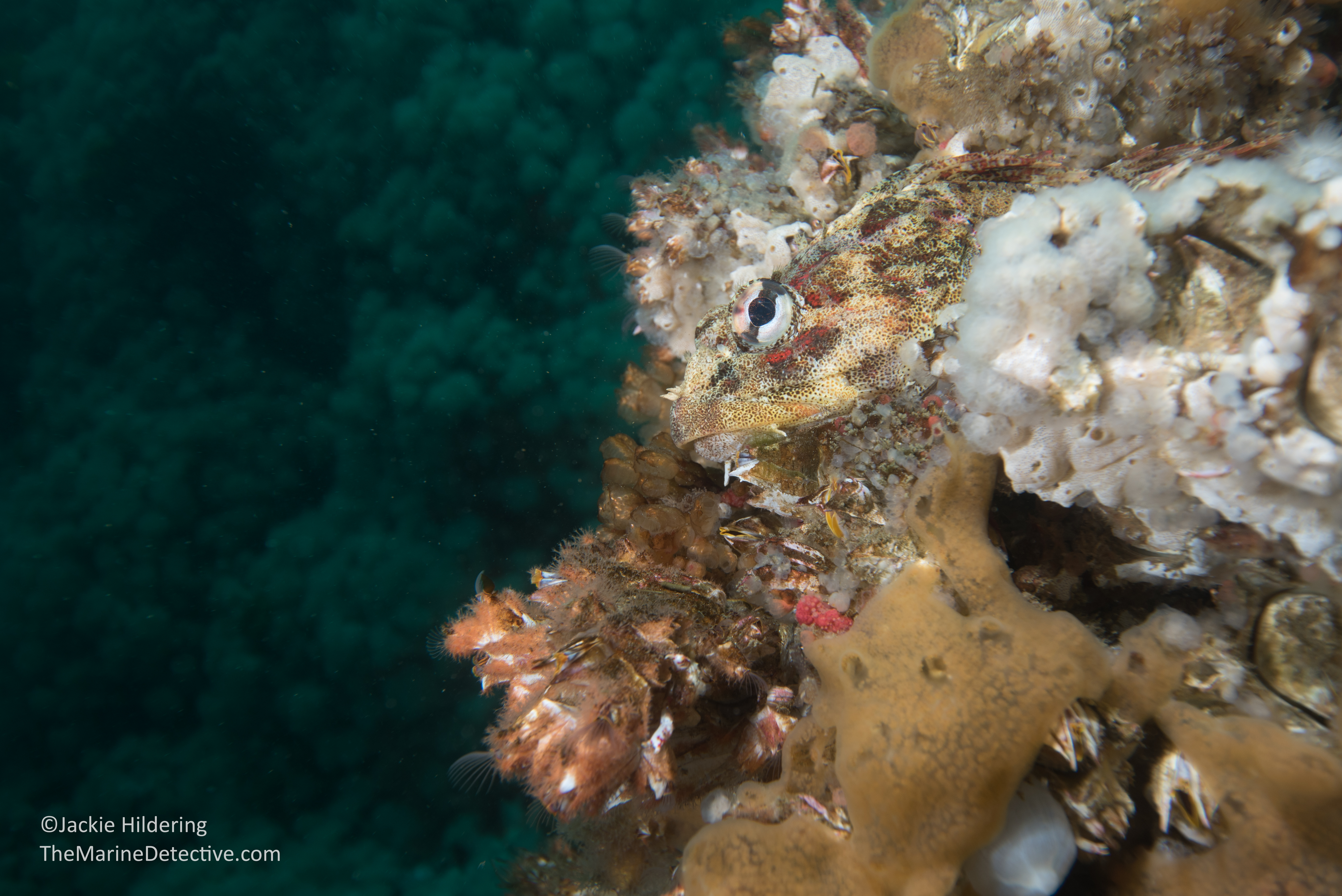
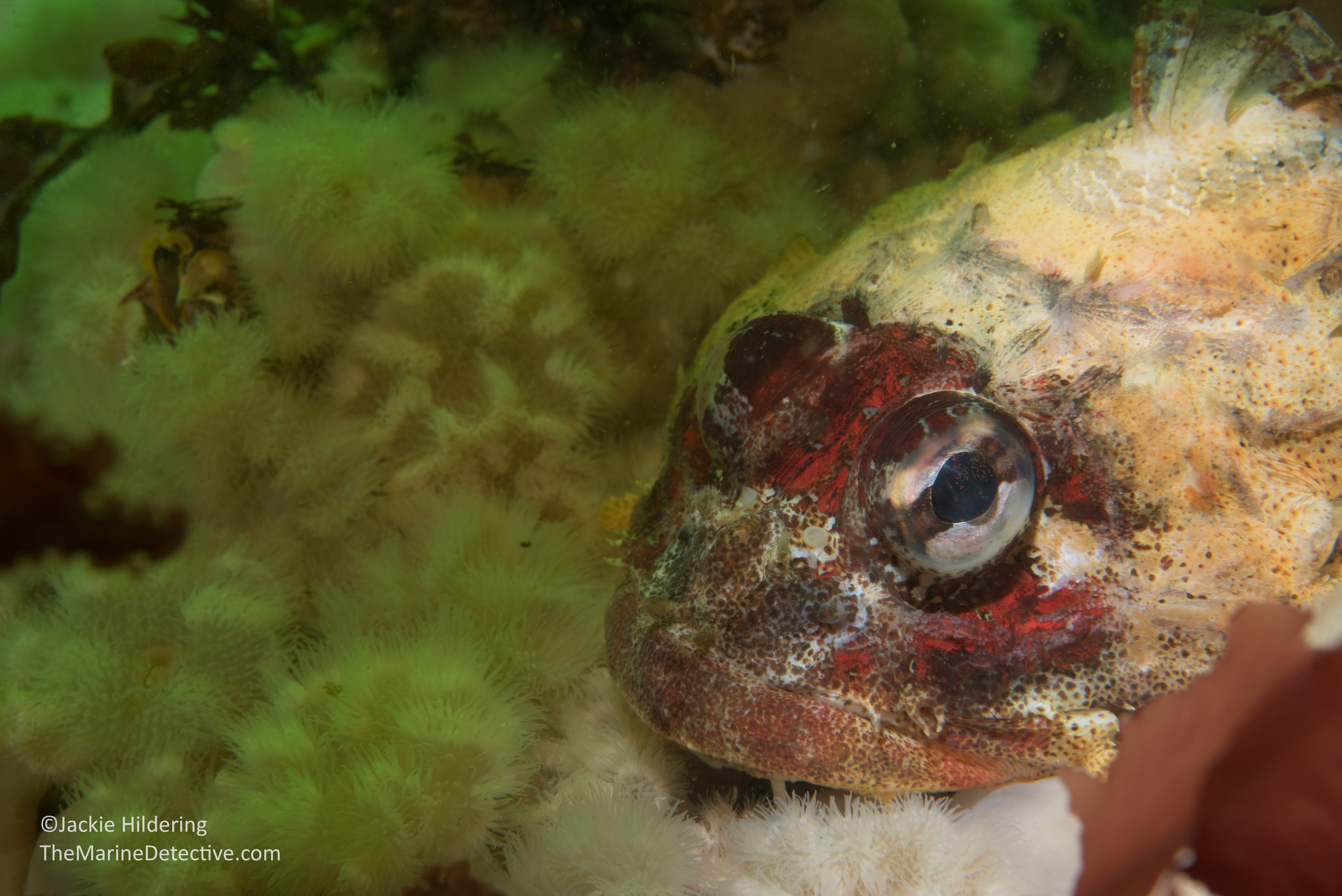
Here are just five fabulous fish faces from my dive on July 12. These are just the fish who tolerated my taking photos. I am sharing with you to add to the sense of biodiversity hidden in these waters.
Also, I really value what I feel is mirrored back from these fish . . . the “What the hell are YOU and what are you doing here?” It’s good to feel like a visitor in others’ habitat rather than than a human at the epicentre of the universe. It’s below the waves, with the fish, that I best know my place and where I best feel humility. I also feel apology, not just for the disturbance of taking photos but as an ambassador for my species.
Sometimes I think as I look at the life below the surface “I’m trying. Please know, I’m trying”.
Thank you for caring and for trying too.
[Please note that I did not realize when compiling these photos that I have a blog on every species represented here. I suggest that the most insight would be gained from reading this blog first and then accessing the further links I provide here showing video, etc.]
Fish #1
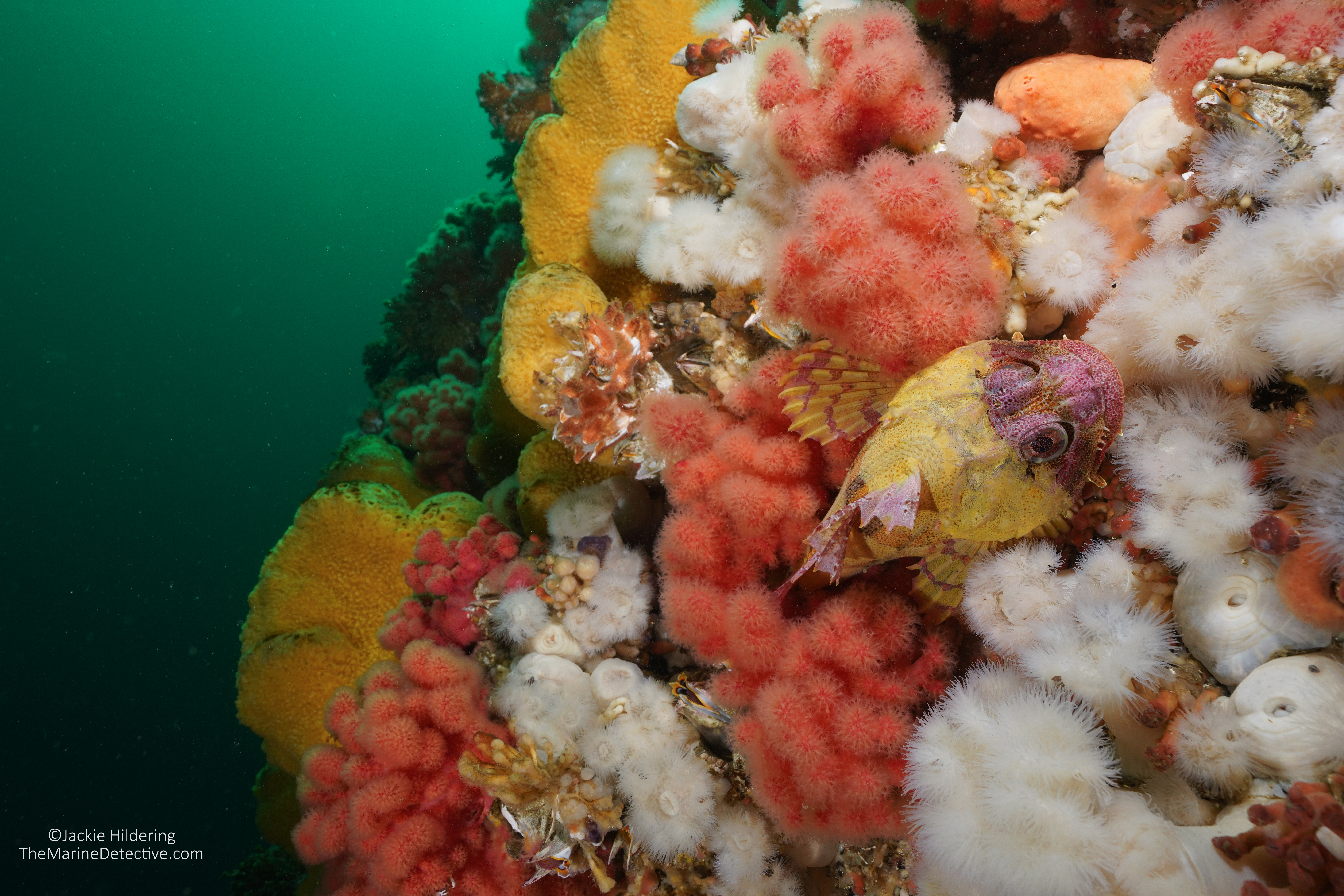
Male Kelp Greenling with a Striped Sunflower Star to his right.
This species seems to so often be chasing one another and they have extraordinary courtship where the males change colour. Males will guard the fertilized eggs.
Video of the courtship is in my blog “Kelp Greenling Colour and Courtship” at this link.
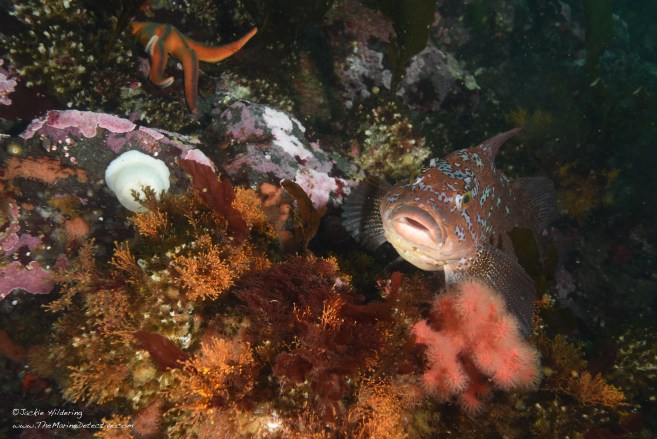
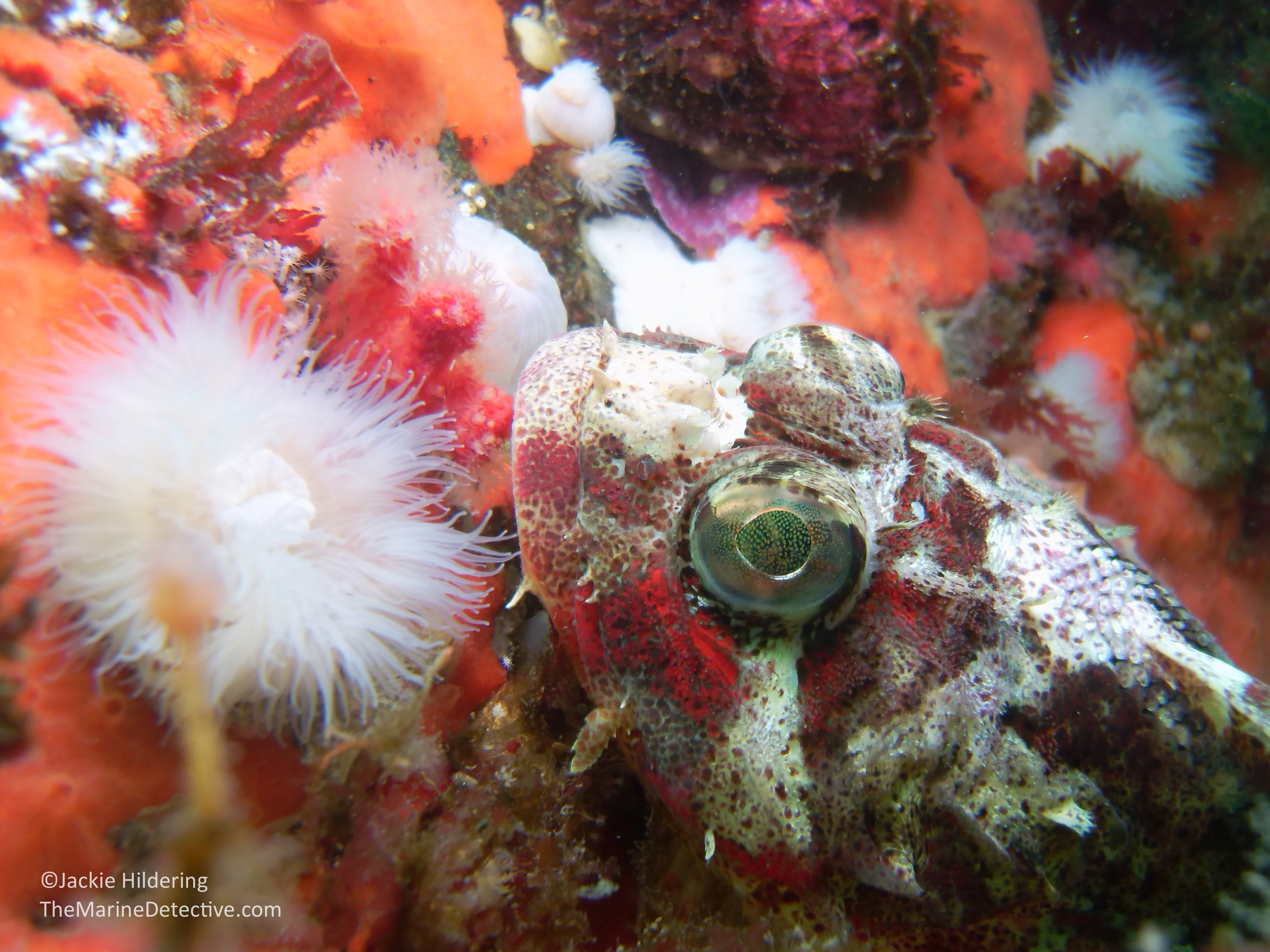
Photo above is another perspective on the same fish. Note that the bright orange life you see here are animals, not plants. They are Orange Hydroids. The soft coral beside the Kelp Greenling’s head is Red Soft Coral.
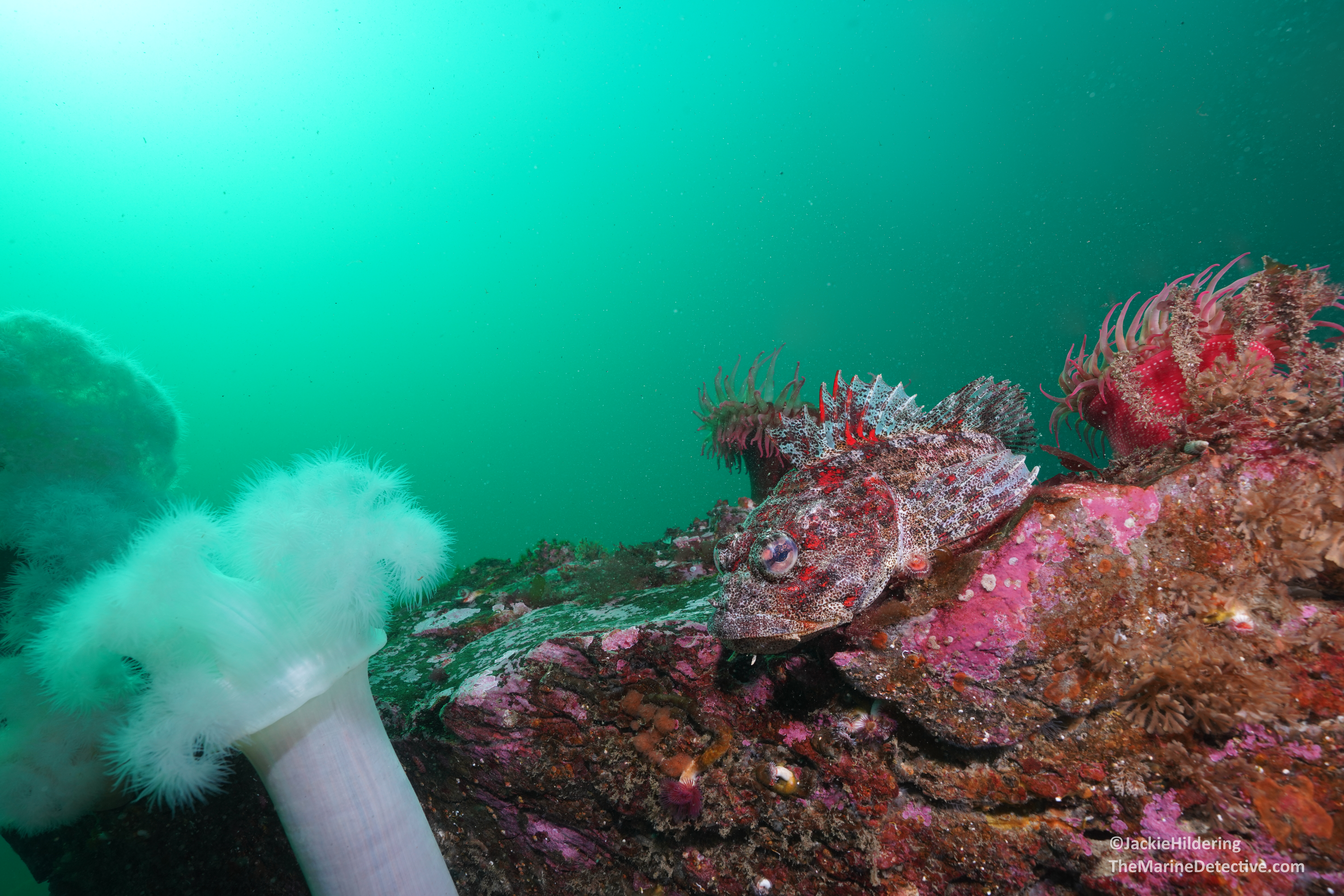
Fish #2 Quillback Rockfish
Quillbacks, like so many of BC’s 34 rockfish species, have been over-exploited.
Rockfish are slow to mature, and are very localized in where they live. Therefore, they are particularly vulnerable to overfishing.
As divers, we’ve seen how Rockfish Conservation Areas can make a real difference for the number, diversity and size of rockfish.
There is no egg-guarding in this species because the young develop inside the females and are born into the water i.e. they are viviparous.
Please see my previous blog “Rockfish Barotrauma” at this link on the importance of Rockfish Conservation Areas and also on how to reverse what happens to rockfish when they are brought up from depth i.e. how to easily reverse barotrauma.
Quillback Rockfish = Sebastes maliger to 61 cm.
Fish Face #3
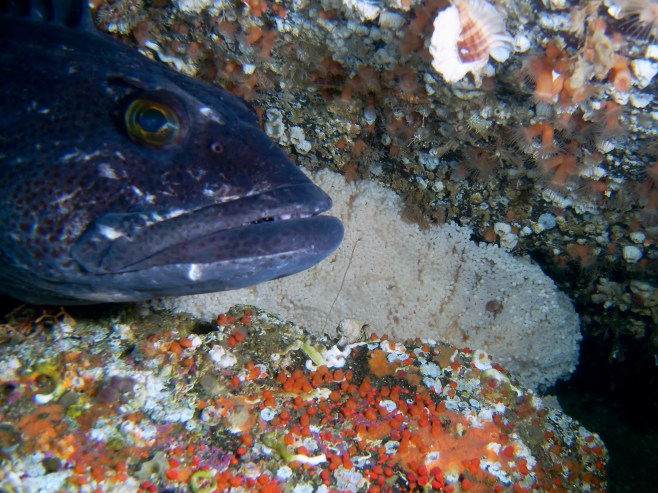
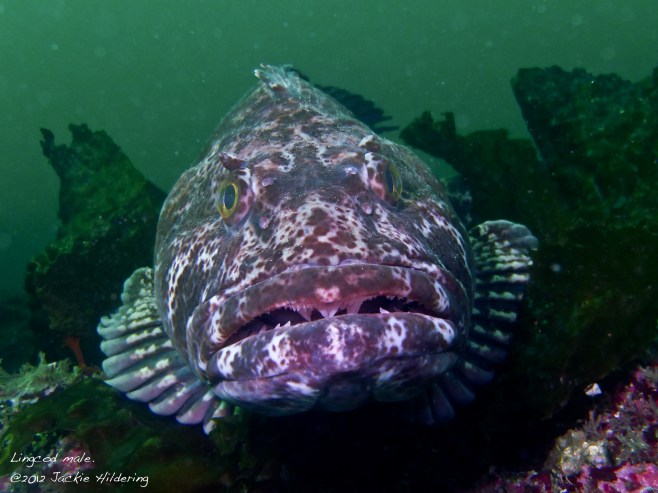
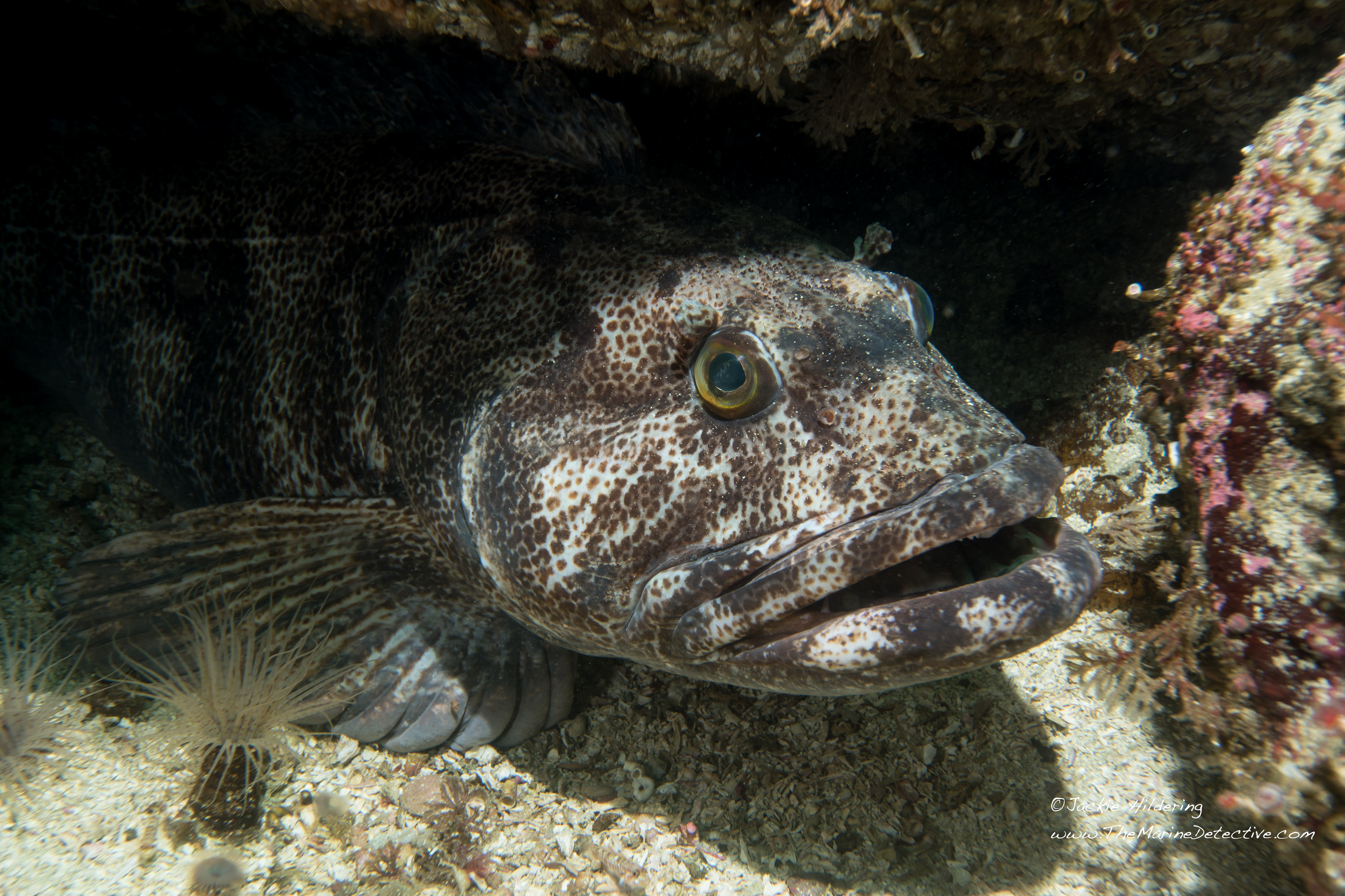
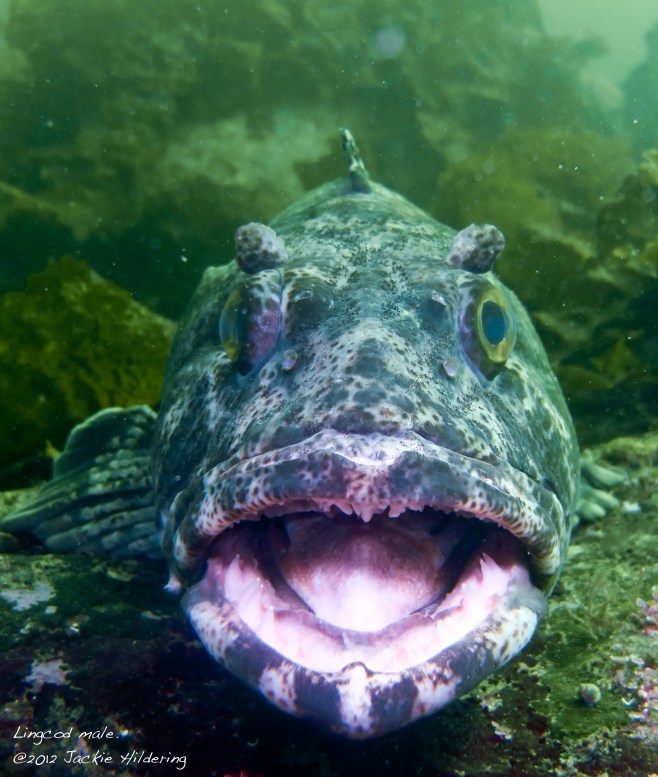
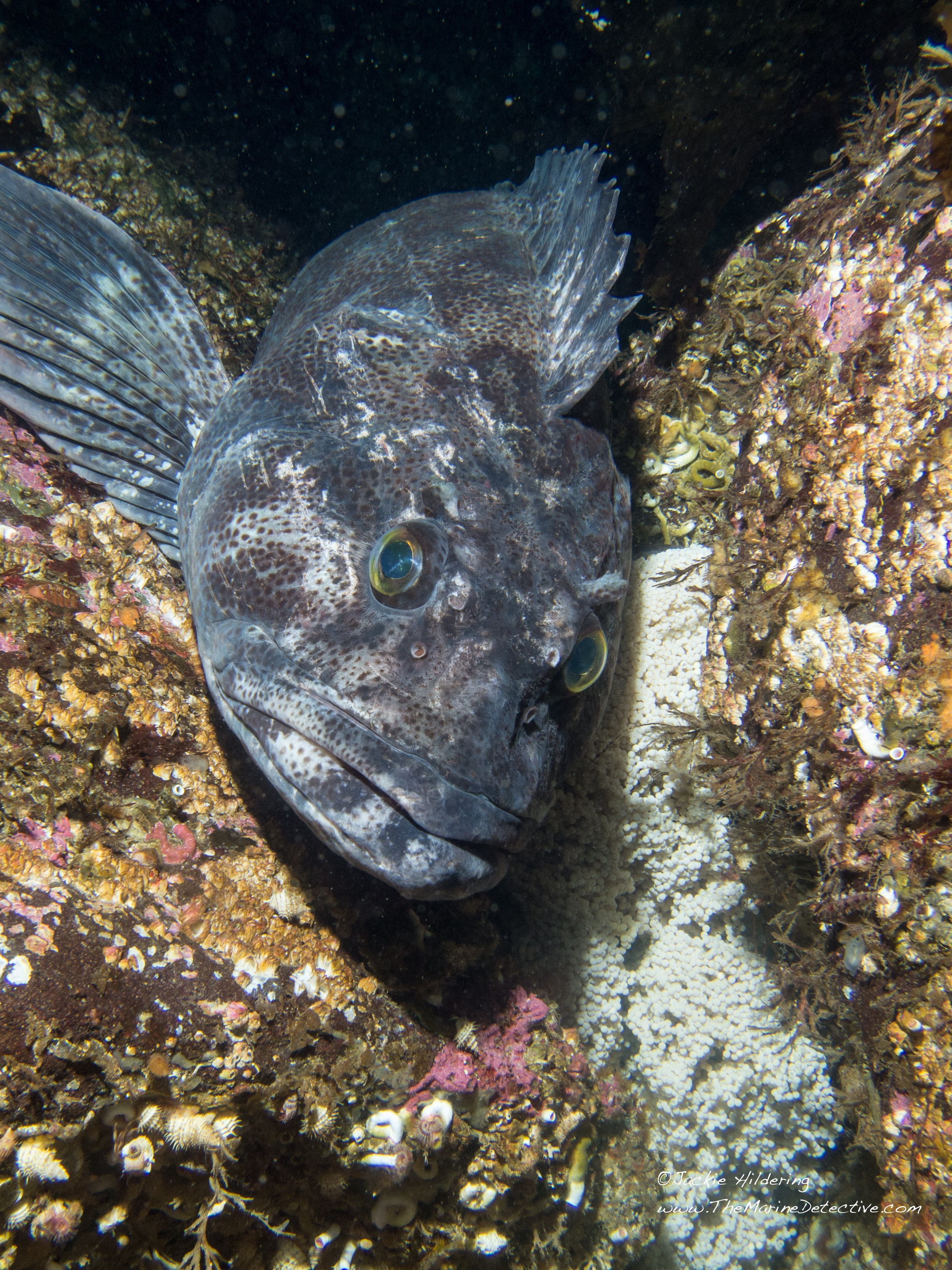
Lingcod
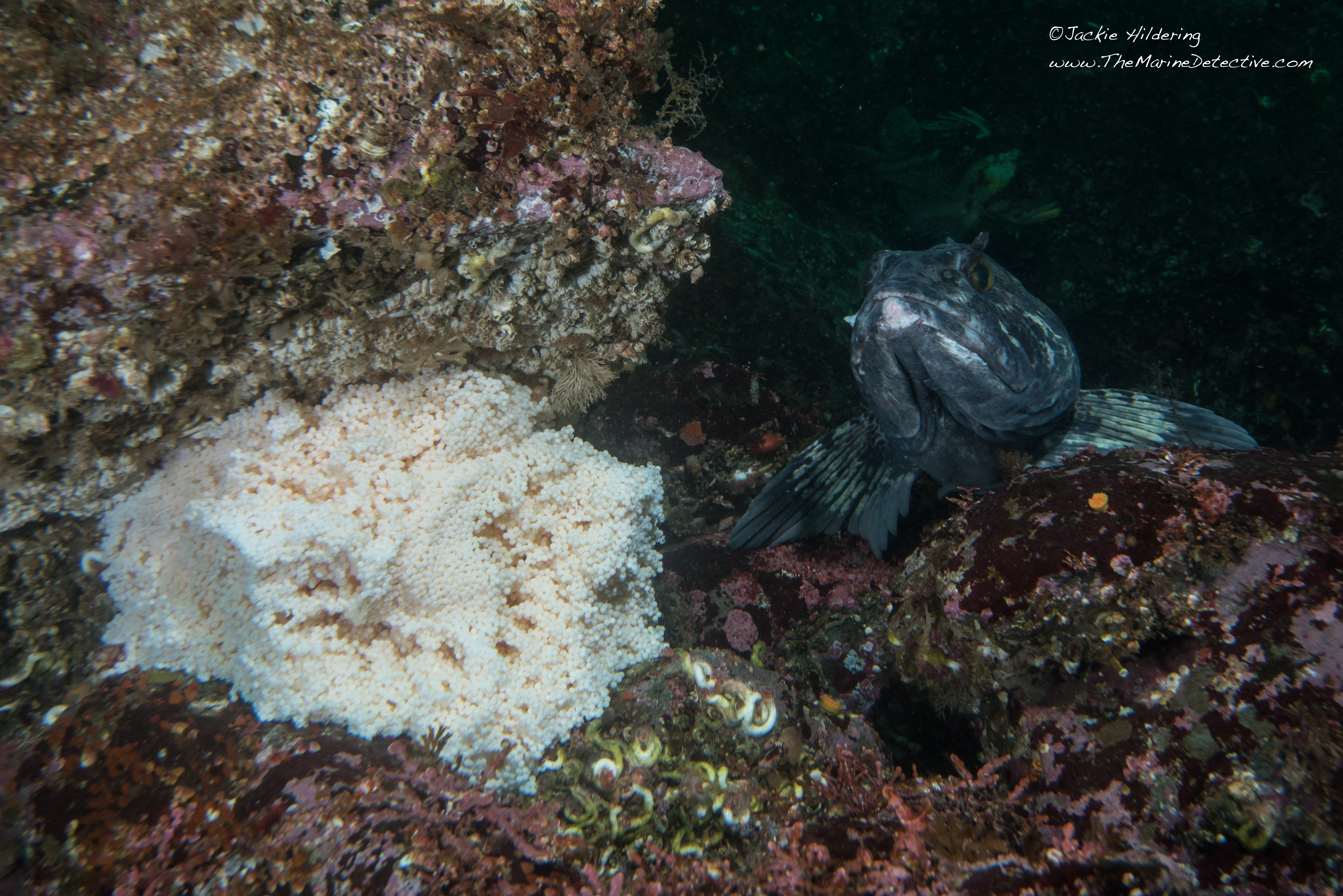
Lingcod males also guard the fertilized eggs. They are extraordinary large masses that look like Styrofoam. We survey for the egg masses each year to get a sense of potential recovery since this species was overexploited. It’s believed the same males guard eggs in the same spot year upon year. This again helps understanding of how many fish have homes whereby fishing intensely in one area can lead easily to overexploitation. My blog “Fastidious, Fanged Fathers” at this link shows the egg masses with information on Ocean Wise’s Lingcod Egg Mass Survey.
Lingcod = Ophiodon elongatus, females larger, to 1.5 m.
Fish Face #4
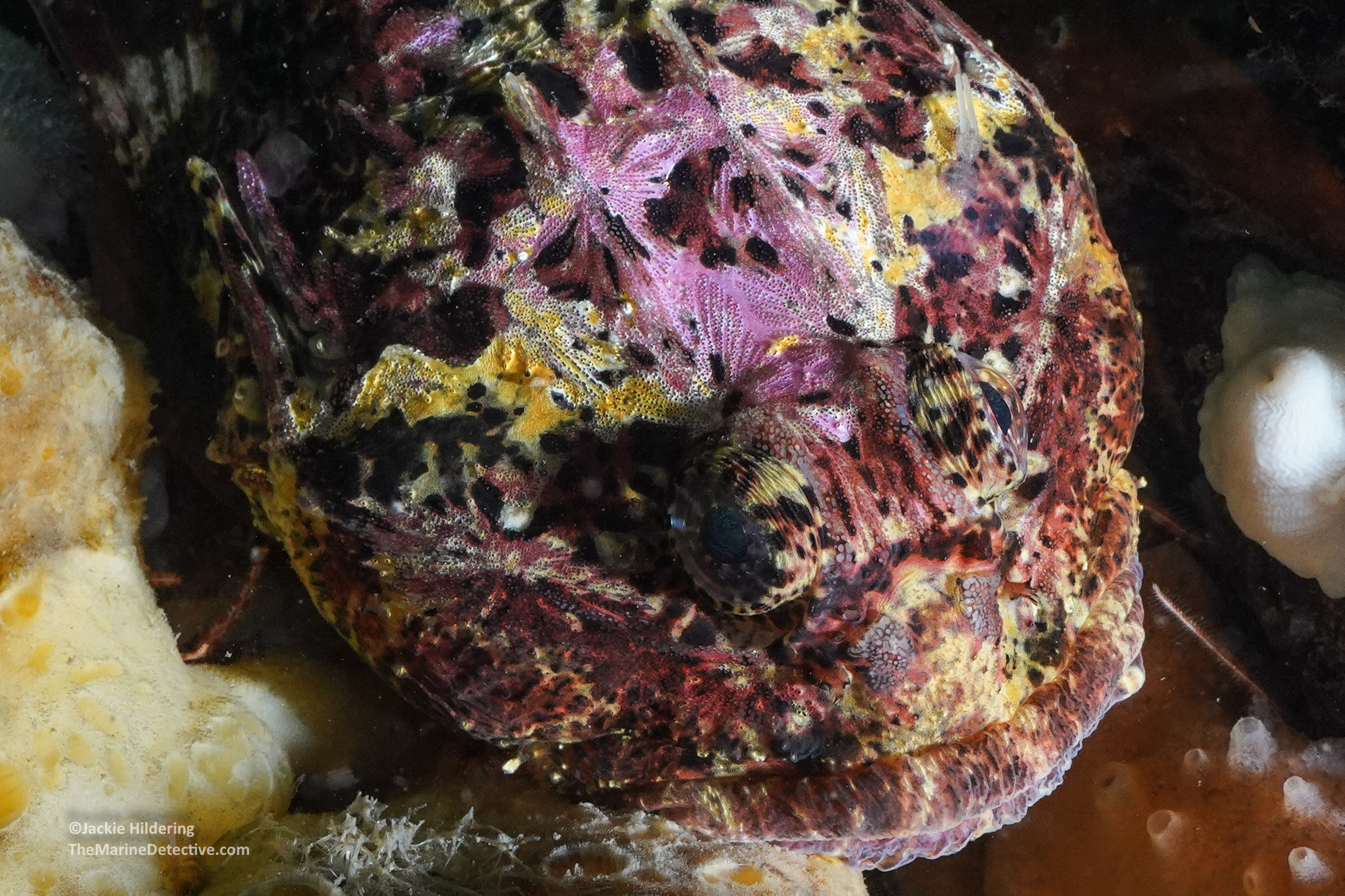
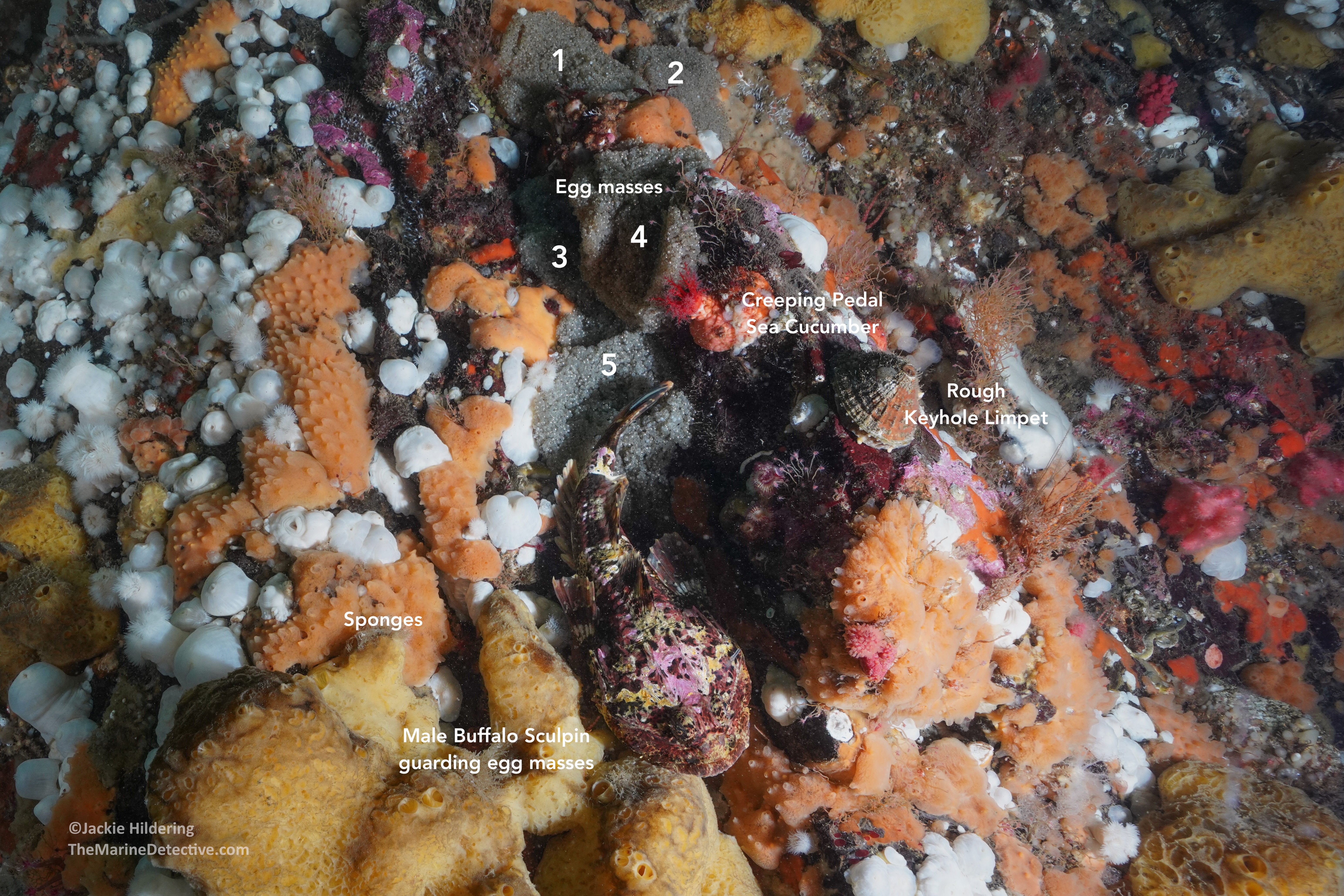
Buffalo Sculpin
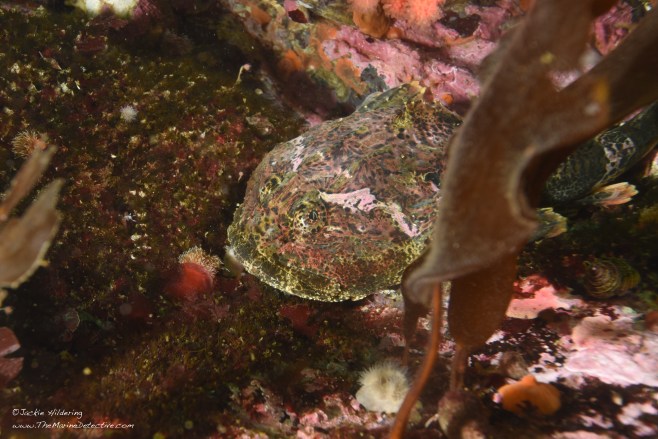
Yes, this is a fish, not a rock with eyes.
There is so little understanding about how species like this can change their colour as they do.
It won’t surprise you that the most research is done on “commercially important” species with regards to stock management. Males also guard the fertilized eggs in this species. See my blog “Buffalos Mating Underwater” at this link for photos showing the diversity of colour / camouflage and for photos of the eggs.
Buffalo Sculpin = Enophrys bison to 37 cm long.
Fish #5
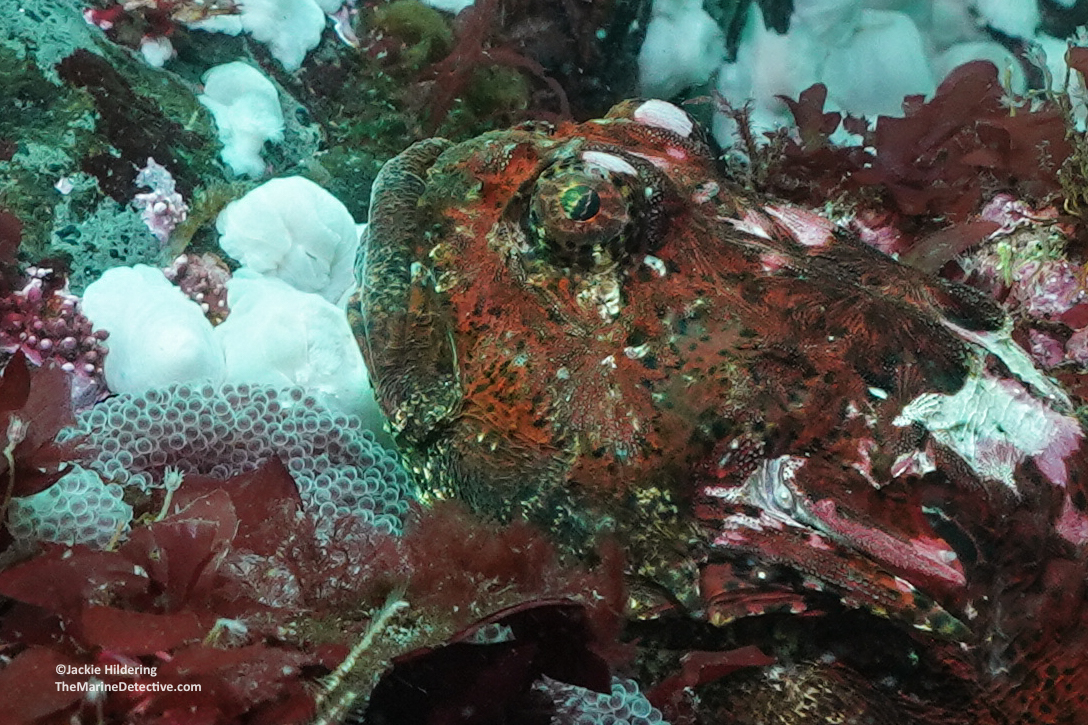
Red Irish Lord
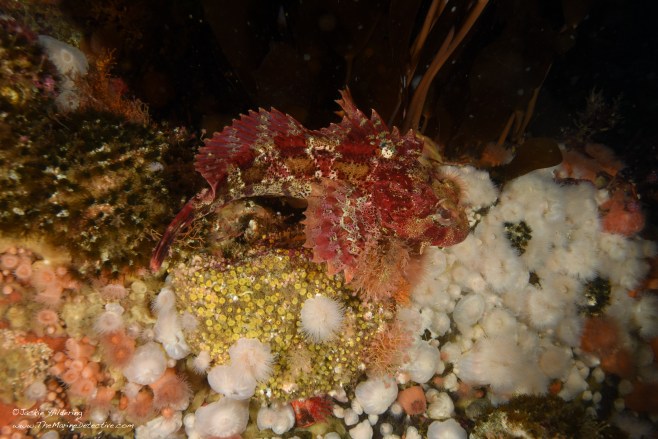
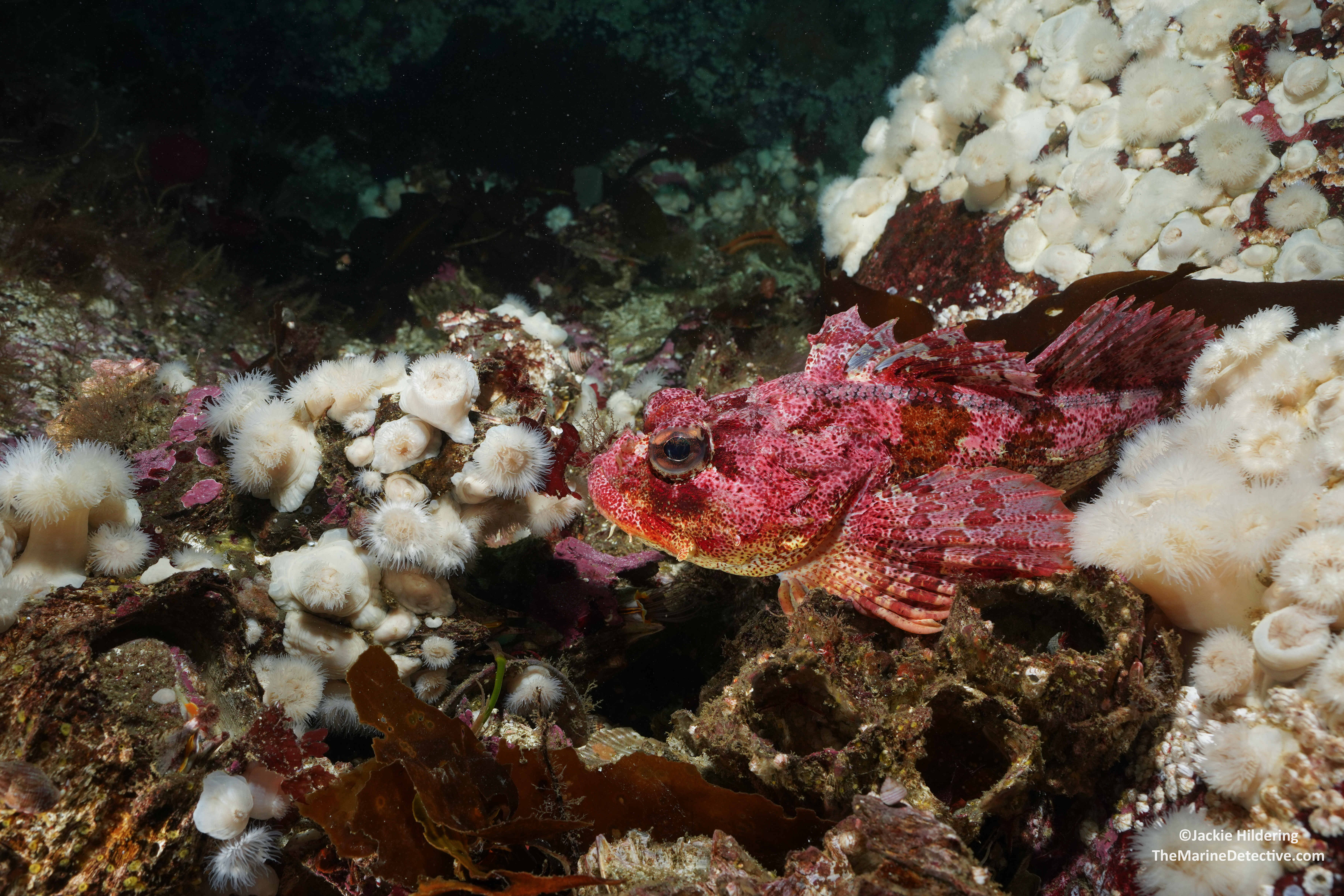
I must have disturbed this Red Irish Lord with my bubbles for him/ her to be easily visible like this. They are usually fully camouflaged.
Note the shell the Red Irish Lord is on. This is a Giant Rock Scallop whose shell has been drilled into by Boring Sponge. Astounding isn’t it to think that Giant Rock Scallops (Crassadoma gigantea to 25 cm across) start off as plankton; are free-swimming to ~2.5 cm; and then attach to the bottom with their right side and can grow to 25 cm. They may live as long as 50 years but there have been problems with human over-harvesting.
Red Irish Lord parents take turns caring for their fertilized eggs (Hemilepidotus hemilepidotus; up to 51 cm).
Please see my blog “In the Eye of the Lord – the Red Irish Lord That Is” at this link.
Lingcod = Hemilepidotus hemilepidotus, to 51 cm long.
And the final photo and thoughts for you dear reader:
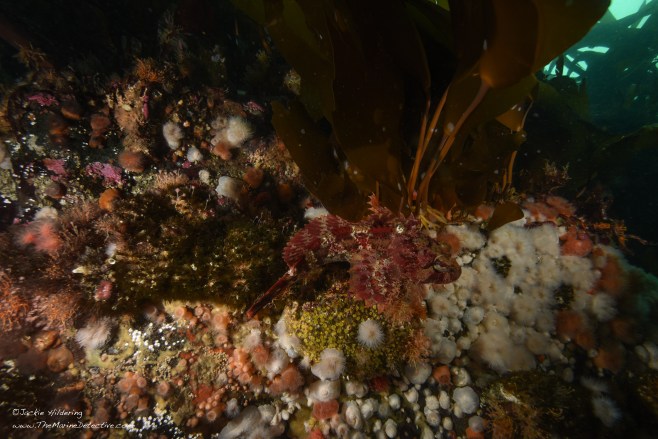
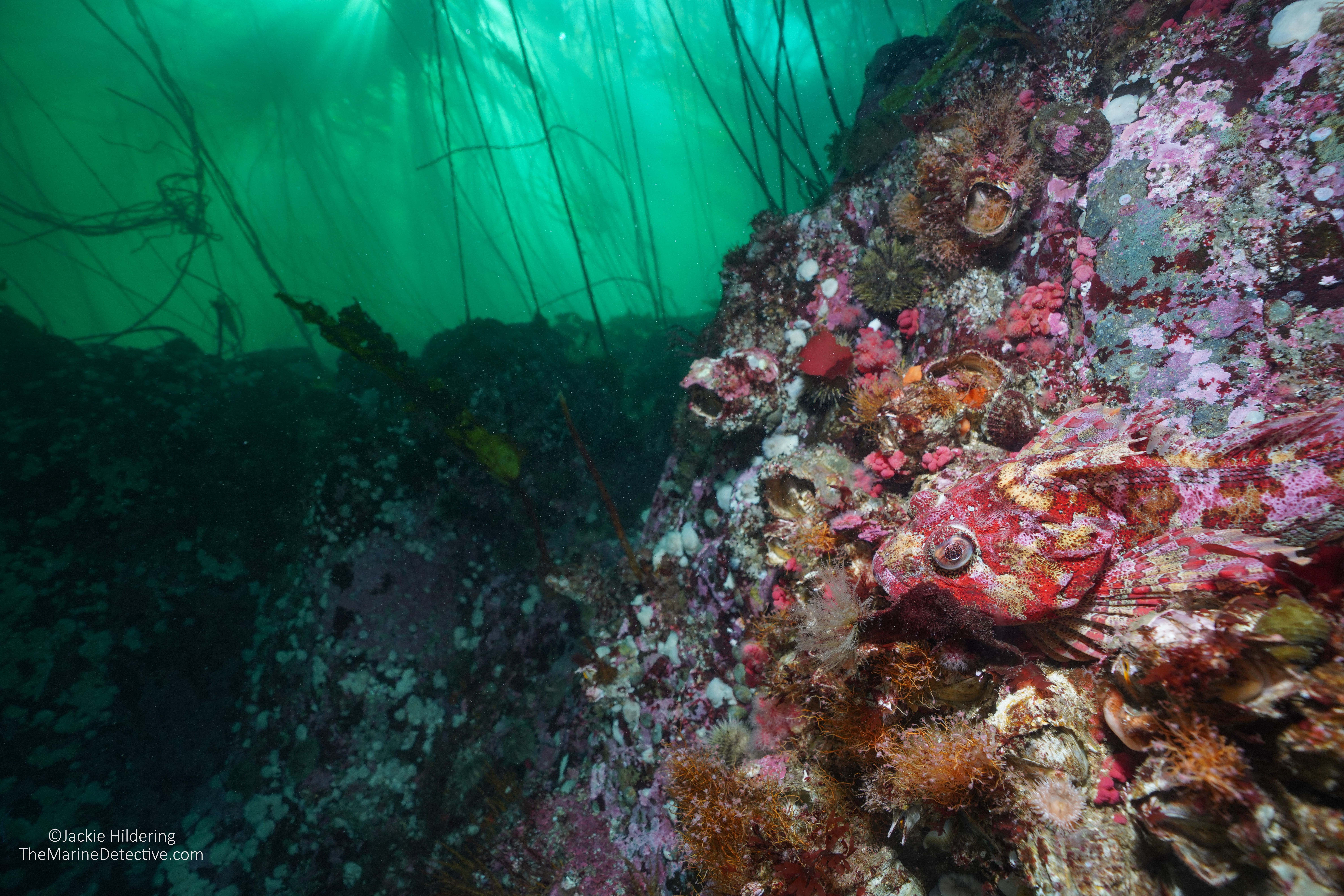
Same Red Irish Lord as in the photo above.
Under the canopy, beams of light shimmering through as they would in a forest of trees, bringing energy to the algae which feed the depths. This is all at only 5m depth. This is life you could imagine when you close your eyes and think of the dark sea off our coast. This is the world where Humpbacks feed, where families of Orca follow the same lineages of Chinook Salmon generation after generation, where species exist without our knowledge let alone our respect. This is their world. This is the world to which all life on earth is connected.
There’s a whole lotta fish procreation going on in the NE Pacific Ocean right now. This might be a surprise to those who think mating is more of a spring-fling-kinda-thing.
It may be a further surprise that, for many marine fish species here, the males are the protectors of the next generation. The females leave after laying the eggs and the males remain, guarding the fertilized eggs from predators and often also fanning the eggs to ensure they are well aerated.
For a lot of these fish species, the male chooses the nesting site and entices multiple females to lay eggs there so that he can fertilize them. He then has the work of guarding these multiple egg masses and may need to be on the alert for sneak fertilization attempts by other males.
For species with nests of multiple egg masses, you can often tell how many females have laid eggs there because individual females have different coloured eggs. Therefore, the colour of fish eggs is not a good characteristic to determine the species that laid them. Instead, do a quick scan, chances are a piscine papa is somewhere near the eggs, staring at you.
Through the photos below, meet some of these fabulous fish fathers. No deadbeat dads here!
[Note that this is in no way a comprehensive list of NE Pacific Ocean fish species in which the males guard the eggs.]
Whitespotted Greenling
The encounter documented below shows how my dive buddy and I recently had a Whitespotted Greenling come after us, so intent was he on protecting his egg masses. I was very slow in cluing in that this was why he was swimming around us and deserved getting a little nip in the head. Notice how small he is relative to us and yet how this did not deter him in trying to get rid of us.
Male Whitespotted Greenling shortly after he nipped my big head in his intensity to guard his egg masses.
Dive buddy Jacqui Engel pointing at the male Whitespotted Greenling before I clued in and got out of his territory with eggs. Image shows how small the fish is compared to us and how big his drive to protect the egg masses must be that he would pursue us like he did.
My observations of egg guarding on NE Vancouver Island: September to the end of December
Kelp Greenling
Most often Kelp Greenling eggs are in the empty shells of giant barnacles as shown below. Although they are a bigger member of the Greenling family, male Kelp Greenlings do not appear to protect their eggs quite as vigorously as Whitespotted Greenlings. They appear to have a really long breeding season in our area.
My observations of egg guarding on NE Vancouver Island: October to March
Below, slideshow of courting
Red Irish Lord
Oh Red Irish Lords how I love thee. There is no better ambassador for how colourful life is in these waters since they are brilliant shades, yet astoundingly camouflaged. Red Irish Lords are often easier to find when guarding their eggs since these are less camouflaged. They most often egg guard with their heads positioned right atop the eggs, remaining absolutely motionless. It is commonly believed that the fathers guard the eggs but apparently it is more often the mothers but that the parents may take turns. Source: DeMartini and Sikkel 2006: ” Red Irish Lord exhibits primarily maternal and facultatively biparental guarding of the spawn.”
Note the variation in the colour of the fish too. More photos showing the diversity of colour at this link.
Buffalo Sculpin
There are Buffalo Sculpin males guarding eggs at this time of year too but more mating appears to be happen in April and May. Usually, Buffalo Sculpins are even harder to spot than their Red Irish Lord cousins but the variably coloured, bright egg masses give away their location. They too have a strategy of staying right atop the eggs and remaining motionless when faced with annoying human divers.
Soon we will be participating in the Vancouver Aquarium’s annual Lingcod Egg Mass Count. Armed with an underwater slate, we will join divers along the Coast in helping determine the health of lingcod populations by looking at the number and size of the egg masses and if they are being guarded by males. And oh what fastidious fathers lingcod males are! The dedication to protecting the egg masses does vary from male to male but, generally, they do not leave their watch until the eggs hatch which can be more than 24 days. They could be guarding masses from multiple females separated by more than 7 m, and if laid by a female 5 years old and older, the egg masses can be the size of a watermelon and weigh up to 14 kg! That’s a lot to protect! (As is also the case for many rockfish, the older the female lingcod, the more eggs she lays). My best lingcod story is that I was marking down “unguarded” on my slate only to have it knocked out of my hands by the male that was very much guarding the egg mass I had been observing! Lots more info on this species at my blog item Lingcod – Fastidious Fanged Fathers.
My observations of egg guarding on NE Vancouver Island: January to April (Vancouver Aquarium’s Egg Mass Survey is from early February to the beginning of April).
Here’s a case where it is not just the male that guards the eggs. Mr. and Mrs. Wolf-Eel take turns wrapping their long tails around the large egg mass. I hope to one day have the opportunity to get a better image than this but, as a strategy for survival, the egg mass is often deep within the wolf eel couple’s den. Lots more information on this remarkable species at my previous blog item Wolf-Eel – No Ugly Fish!
I’ve only once been lucky enough to find a male of this huge sculpin species guarding eggs. They can apparently be very aggressive guarders but this very successful male (he was guarding the eggs of several females) was very tolerant of my presence. They have been documented to mate throughout the year. My one encounter with a male cabezon guarding eggs was in May.
In all these years of diving, I have yet to find a male Painted Greening guarding eggs so that I know for sure the eggs are from this species. Yet something else to be on the lookout for!
And, the stuff of dreams . . . to one day chance upon a male grunt sculpin while he is releasing the hatching eggs from . . . his mouth! For more on that, see my previous blog item Grunt Sculpin – Little Fish, BIG Attitude. The females apparently also do take on shifts in taking care of the eggs.
I have never seen scalyhead sculpin eggs while diving, likely because they are hidden away and because they are much smaller. The image of the eggs below was taken during a beach walk where students ensured they put the rock back as best they could to reduce the chances of the eggs drying out. Notice the different colours of the looney-sized egg masses? The eggs in this nest are from at least 4 females.
Very interesting in this species is that fertilization is internal.
My observations of egg guarding on NE Vancouver Island: Spring.
One study showed that the eggs hatched after 11 and 15 days. This study also documented courtship where the males rolled their heads in a circle and flared their orange branchiostegal membranes (on the underside of their throat) which apparently are only orange during mating season. Females were seen to have no response or to snap their heads horizontally in rapid succession, sometimes also quivering. During breeding season the males are also reported to have red-brown spots inside their mouth and a brown anal fin with small yellowish-white spots. (Source: Ragland, H., & Fischer, E. (1987). Internal Fertilization and Male Parental Care in the Scalyhead Sculpin, Artedius harringtoni.Copeia,1987(4), 1059-1062. doi:10.2307/1445578)
If you find an ice cream scoop mound like this, you have likely found the eggs of the black prickleback and the guarding male is likely very near. When taking students on beach walks, I emphasize the importance of not displacing animals by using this species as an example. Fish like the black prickleback are adapted to being able to wait out the tide in very little water and if the well-intentioned pick up the fish to put him in deeper water, they could be moving papa away from the eggs he was guarding.
Don’t say it, please don’t say it. This is not an ugly fish. It hurts when people say this about Wolf-Eels. Such is the way when there is misunderstanding and disrespect for something you love. There is no ugly in Nature – only perfection. If the features of an animal appear foreign to you, it is because it fulfils a role in Nature that is truly awe-inspiring; possibly even beyond your imaginings.
I hope to make this point by sharing with you why the Wolf-Eel is “designed” as it is and how very wrong many of us are in our perceptions about this species. The Wolf-Eel (Anarrhichthys ocellatus), which can be as long as 2.4 m, is not an eel. Wolf-Eels belong in the Wolf Fish family (Anarhichadidae). They are desperately misunderstood. Wolf-Eels are not dangerous nor “mean”. The opposite is true. They are reclusive, anything but ferocious, quite sedentary and slow moving.
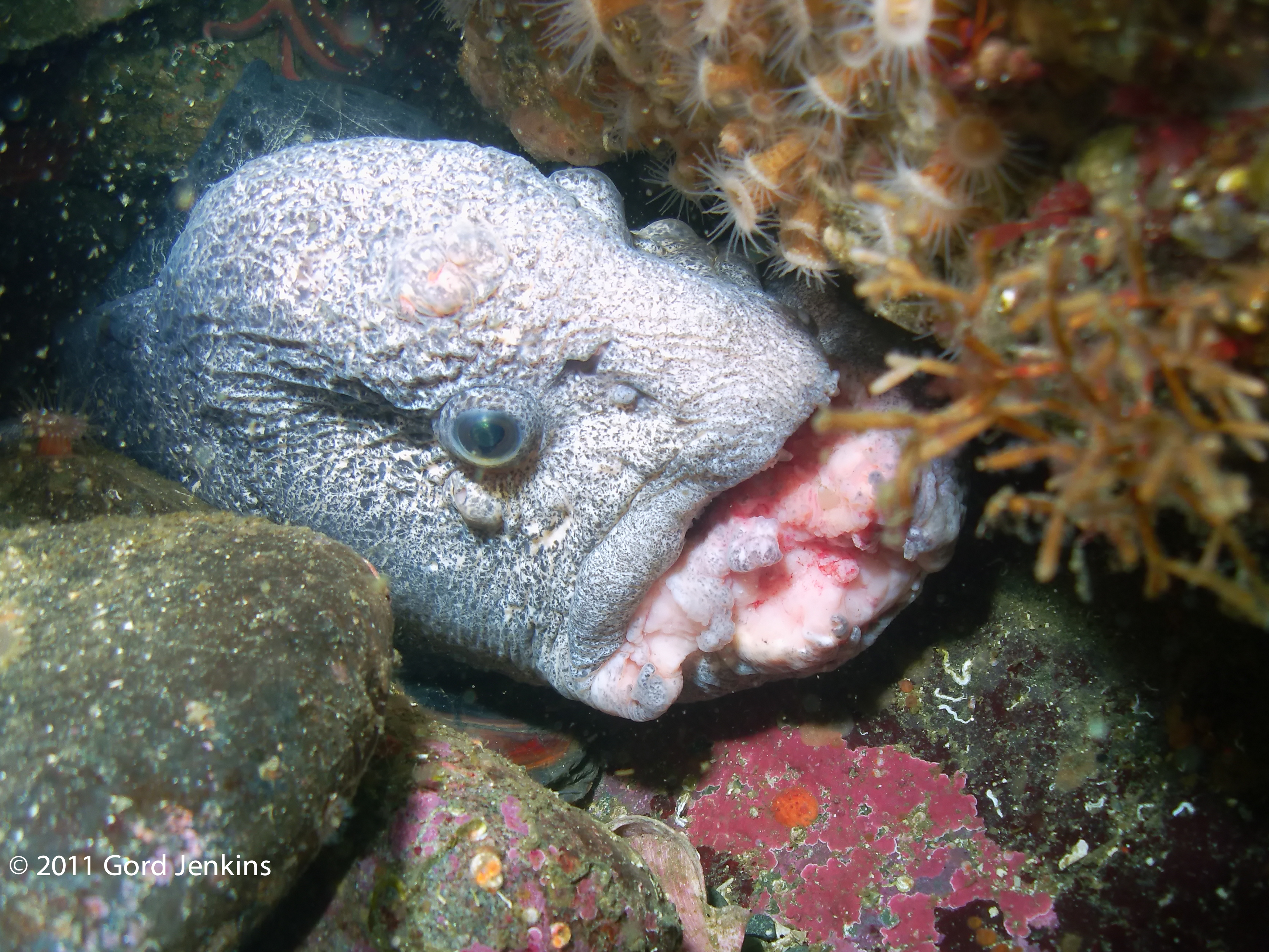
Yes, they have large, fleshy, ossified heads and the species has sharp teeth but this is so they can do what so few marine species can – they can feed on spiny sea urchins, snapping them effortlessly into pieces without suffering a single puncture. They also feed on other hard-shelled animals like shellfish and crabs. Even the roofs of Wolf-Eels’ mouths are impenetrable with ossified, tooth-like projections (see photo below).
To my knowledge there has never been an attack on a diver UNLESS, and here comes the predictable thing, we choose to habituate them. Wolf-Eels spend a great deal of time on the ocean bottom in dens where, as divers, we have the enormous privilege of “visiting” the same spot and seeing the same individuals for years. It is not just their address that makes them recognizable as individuals. Each Wolf-Eel has a unique pattern of black spots near their eyes.
Some divers choose to feed them, leading to the Wolf-Eels associating us with food and that’s where accidents can happen and where the wild behaviour that lets animals survive, becomes compromised. It also makes them tragically easy targets for any spear diver wanting to poach them. There is no legal fishery for this species but there is a demand for them in the Asian market which is why there are also attempts to farm Wolf-Eels i.e. aquaculture. Not surprisingly, Wolf-Eels might also be defensive when accidentally caught by anglers. I found one account from 1959 where a commercial fisherman was bitten and “The teeth penetrated the hip-waders and broke the skin on both sides of the ankle.”
The mature males do carry battle wounds supporting that they don’t just hang out in dens waiting for a snack to come by, but rather that they will occasionally duke it out with other male Wolf-Eels.It was long thought that Wolf-Eels always mate for life but, this is not always the case. The males do compete for females who will sometimes opt to swap dens and go live with the competitor. Sound like any other species you know? Wonder if it happens at mid-life? 😉
Wolf-Eels have long-lasting pair bonds, coming together when they are around 4-years-old and having their first clutch when they are around 7. In aquariums, their life expectancy is known to be at least 28 years. Both male and female juveniles are brownish orange and look even more eel-like, lacking the big head of the adults. As adults, the females are smaller and a darker brownish grey (both remarkably camouflaged for when they are in their rocky dens).
They do also sometimes need to do battle for den space with a Giant Pacific Octopus. This is likely another driver for the male’s having such fleshy heads – they are better able to survive the wounds inflicted by such battles.
Clearly, another unique feature about this species is their eel-like body. They are the only member of their family that have this body shape. The long tail serves in locomotion, powering them forward with big, slow, s-shaped waves while being stabilized with the long dorsal and pectoral fins (see video below). Having a long tail also allows them to den-up, curling up and around in narrow spaces between rocks and . . . wait for it . . . it lets them hold onto their eggs.
Mating apparently most often occurs between October and December, with the female releasing eggs after the male prods against her swollen abdomen. He then wraps around her to fertilize the 7,000 to 10,000 white to yellow eggs that she will mould into a ball shape. This mass does not need to adhere to anything because the parents will take turns wrapping their tails around the mass, holding and turning it for good aeration until the +/- 3.5 cm young hatch some 13 to 16 weeks after fertilization.
The juveniles settle into the adult sedentary lifestyle between the ages of 6 months and 2 years (presumably dependent on food supply and den availability). One juvenile is even known to have travelled a minimum of 1,000 km; having been tagged in Port Hardy, BC and found back in Willapa Bay, Washington two years later. It was long thought that Wolf-Eels always mate for life but, this is not always the case. The males do compete for females who will sometimes opt to swap dens and go live with the competitor. Sound like any other species you know? Wonder if it happens at mid-life?
The Wolf-Eel is indeed akin to us in so many ways. It is a homebody that likes crunchy snacks and prefers that they come right by the front door; they are great parents and are docile unless fighting for home or partner. They invest in durable relationships and – they are only as strange looking as we terrestrial bipeds would appear to them.
And if all of that is not enough for you, see the photo below for the indisputable reasoning for by Wolf-Eels are NOT ugly fish!
Statler the Muppet is cute and loveable. Ergo – so are Wolf-Eels. Case closed!!
Range: Sub-tidal to 226 m; Baja California (Mexico) to the Aleutian Islands (Alaska); west to Russia and south to the Sea of Japan.
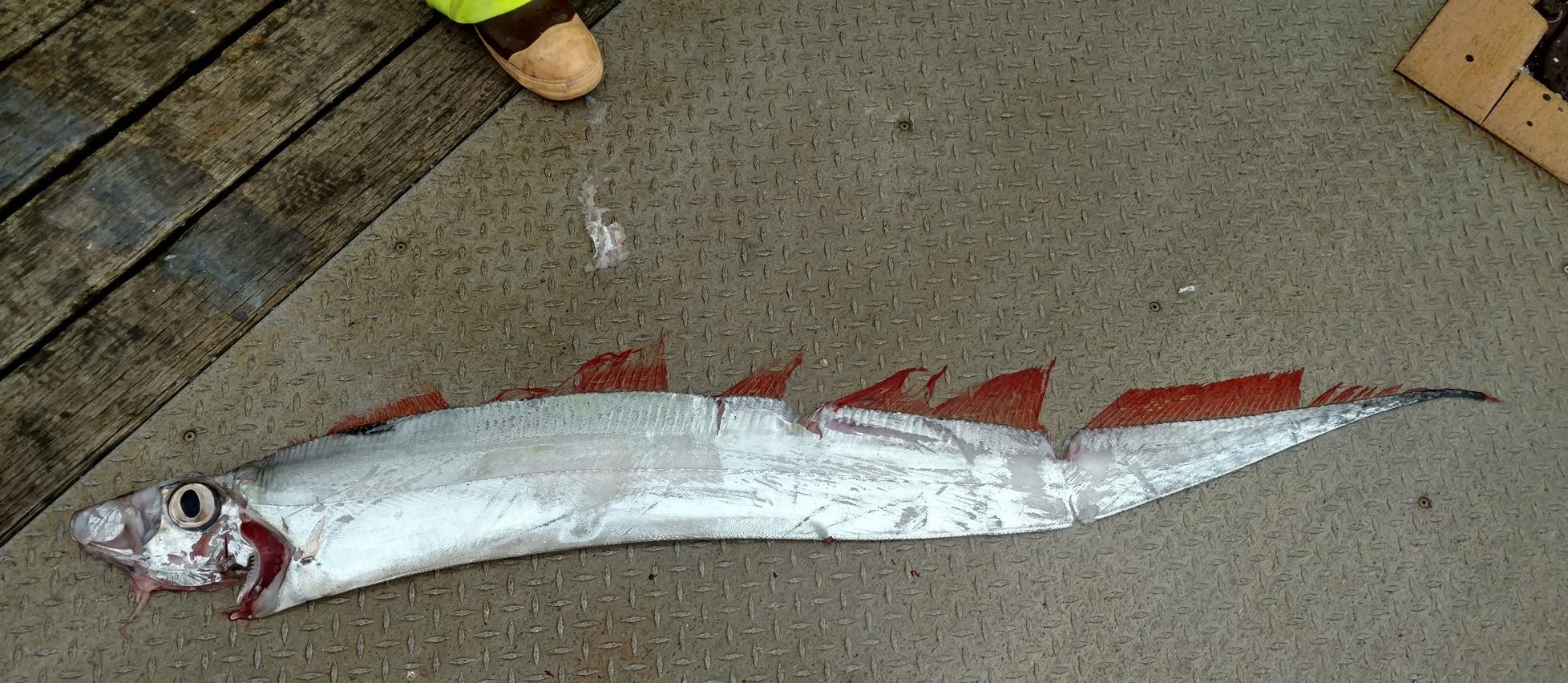
King-of-the-Salmon at ~1.5m long. Photo: September 2017 by Collin Jay Johnson; near Tattoosh off Neah Bay Washington; depth ~100 fathoms (180 m).
See below for the extraordinary feeding method of the King-of-the-Salmon by which they extend their jaw. This member of the ribbonfish family belongs off our coast. To date I have not been able to verify if the origin of the name of the species is indeed from Makah legend.
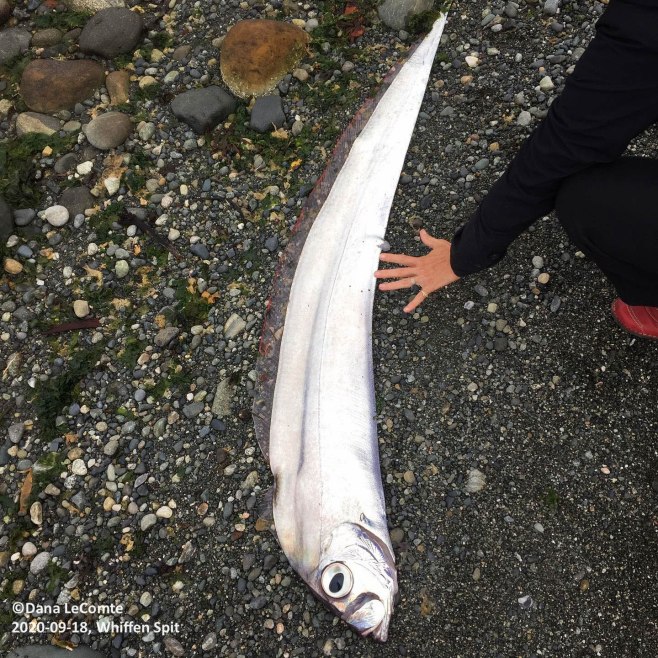
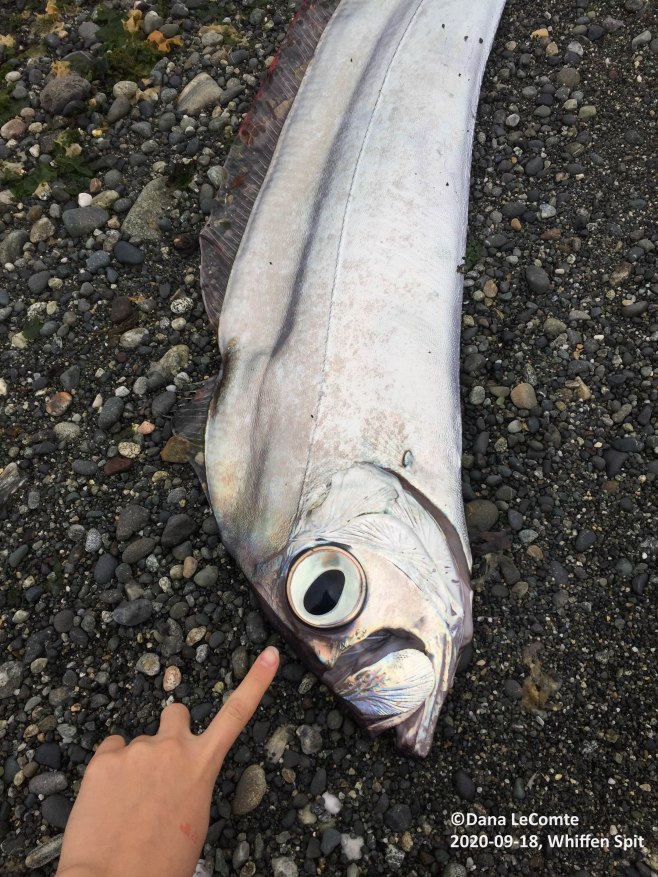
Update September 18, 2020: King-of-the-Salmon washed up at Whiffen Spit (Sooke) documented by Dana LeComte (photo below).
Update July 18, 2020: Live King-of-the Salmon documented by Gary Bodine at Pillar Point, Washington.
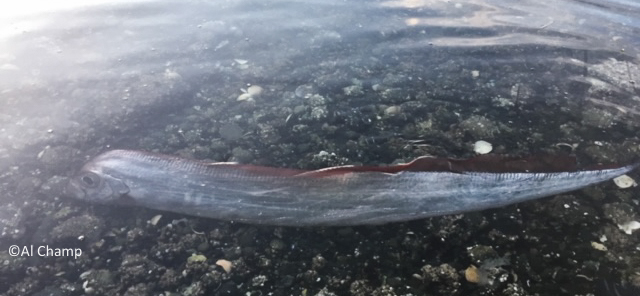
Update June 24, 2020: ~1.5 m long King-of-the-Salmon found struggling to stay upright by Al Champ and Wendy Cooper in East Sooke (photo and further details below).
Update June 8, 2020: King-of-the-Salmon documented by Harbor WildWatch in Salt Creek, west of Port Angeles, Washington. They provided the insight that “We speculate that this individual swam too close to shore and was killed by the waves as there was no evidence of predation. These are thin delicate fish adapted to the deep ocean. The tide pushed it up into the creek where it was discovered.”
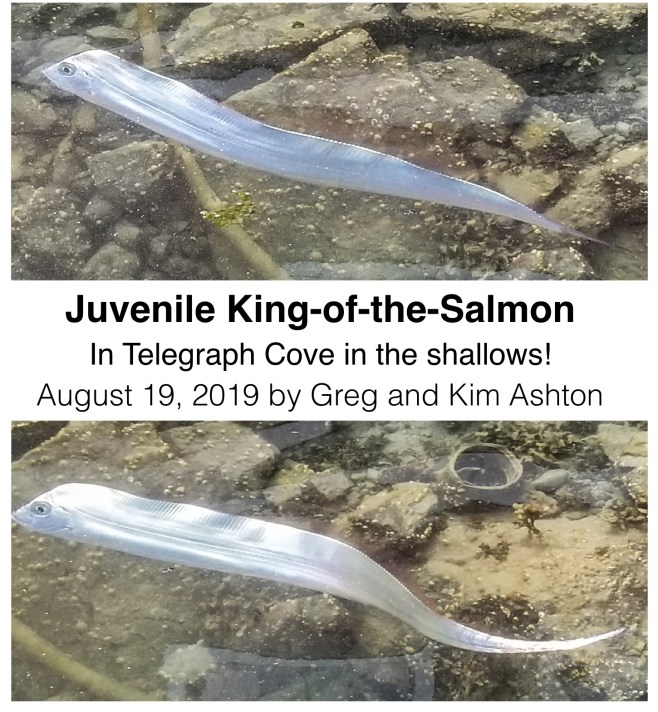
Update August 2019: King-of-the-Salmon sighted in the shallows in Telegraph Cove, British Columbia on August 19th. Sighting and photos by Greg and Kim Ashton. Photos below.
Update September / October 2017: There have been 4 known King-of-the-Salmon washed shore in southern British Columbia / northern Washington. See details and photos below.
Here’s a finding to enhance your sense of wonder about the sea and how little we know about its inhabitants.
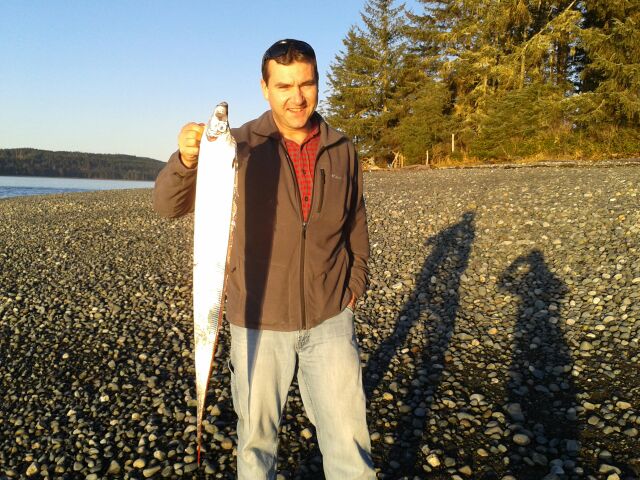
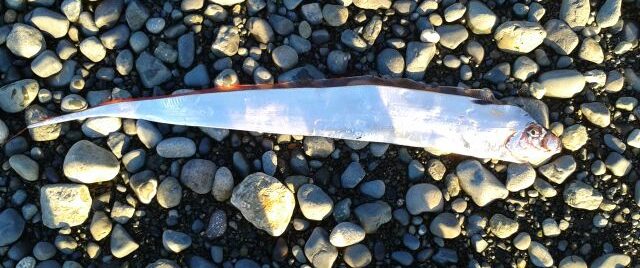
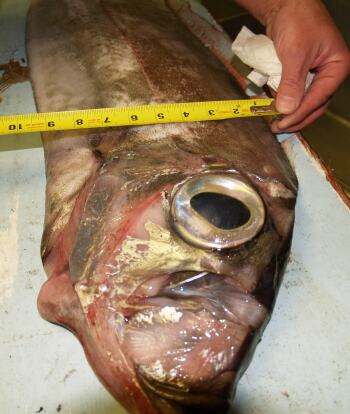
On March 23rd, 2012 Darren and Joanne Rowsell found this dead specimen on the beach at Lady Ellen Point, Port McNeill, British Columbia, Canada. When the photos landed in my inbox, I almost fell off my chair recognizing how rare a find this was. It’s a King-of-the Salmon (Trachipterus altivelis). The adults feed in the open ocean at depths of 900+ m (3,000 feet) so they hardly ever wash ashore and I had never seen one before.
Darren Rowsell with the King-of-the-Salmon found on March 23rd, 2012 near Port McNeill. Photo Joanne Rowsell.
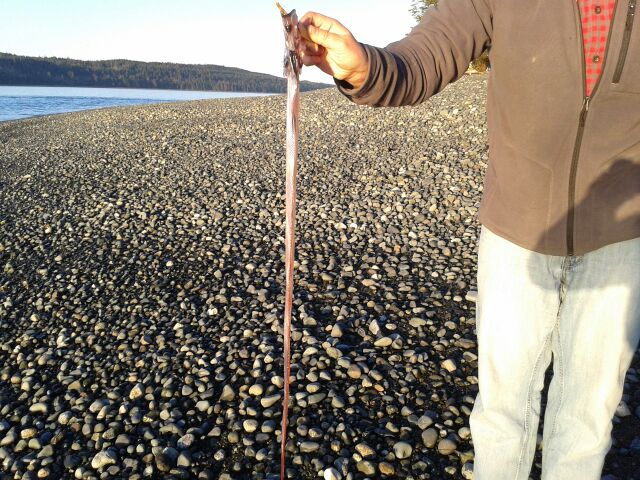
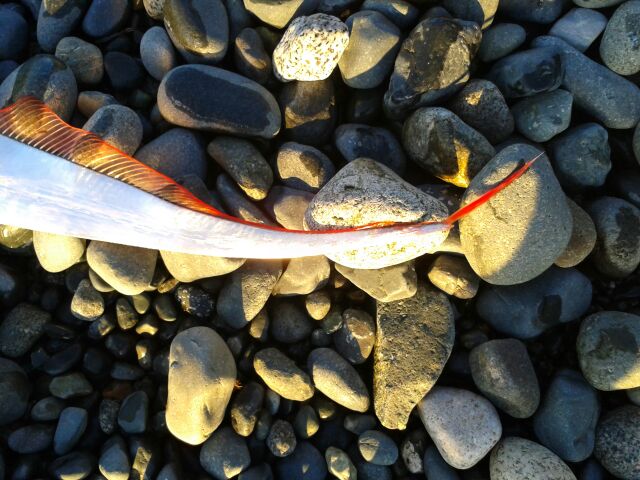
Easy to see why the King-of-the-Salmon belongs to the ribbonfish family. Photo Joanne Rowsell.
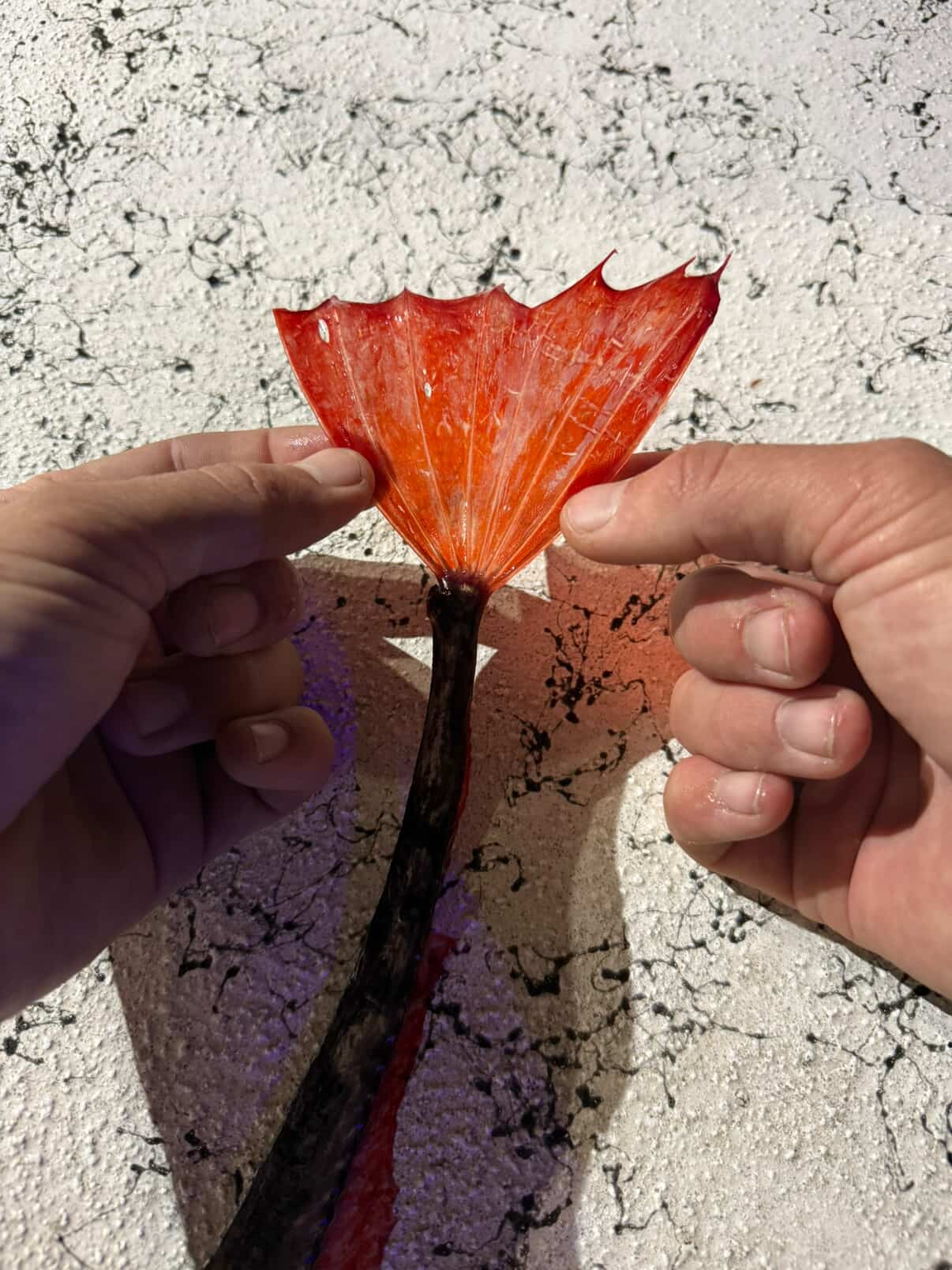
The King-of-the-Salmon belongs to the ribbonfish family (Trachipteridae). You’ll note from Joanne’s photos that the species is indeed very ribbon-like. It is extremely thin and maximum confirmed length is 2.45m (Savinykh and Baitalyuk. 2011). The long, high, crimson coloured dorsal fin is also very reminiscent of a ribbon, tapering down the full length of the fish’s back. These fish move in a snake-like fashion, undulating their long bodies.
The unique common name of the King-of-the-Salmon is said to originate from Makah First Nation legend. The legend is said to be that the fish was believed to be the “king” that would lead salmon back to their rivers to spawn and that to kill one was believed to bring bad luck, causing the death of the salmon. The Makah, like other fisherfolk, must occasionally have caught one on their lines or in their nets. HOWEVER, I have never been able to verify if this is indeed a Makah legend and am currently (September 2020) trying to find out if there is indeed validity to this.
King-of-the-Salmon. Photo Joanne Rowsell.
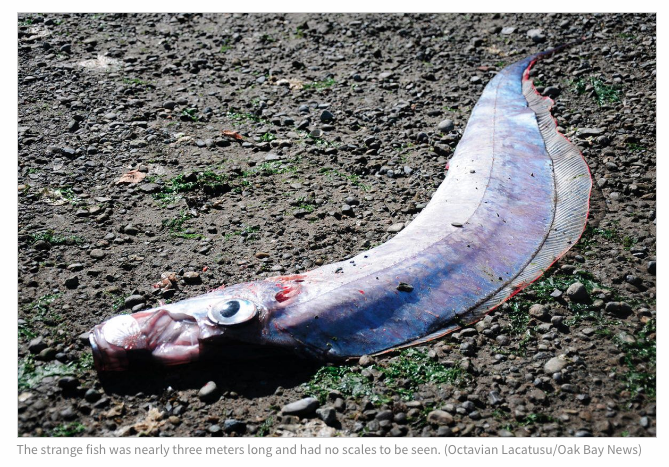
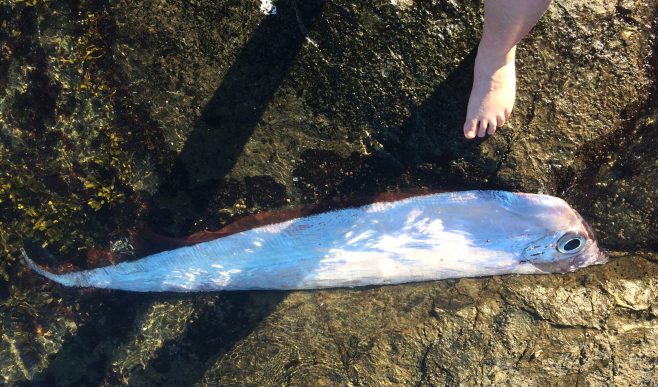
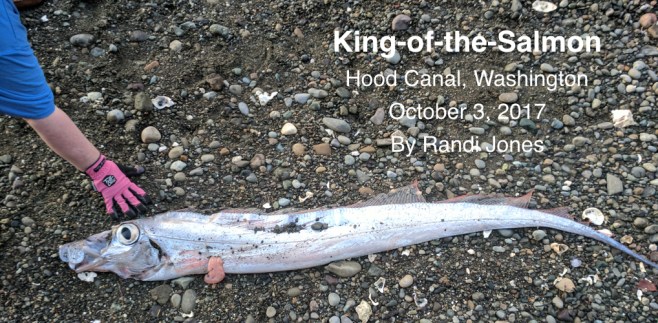
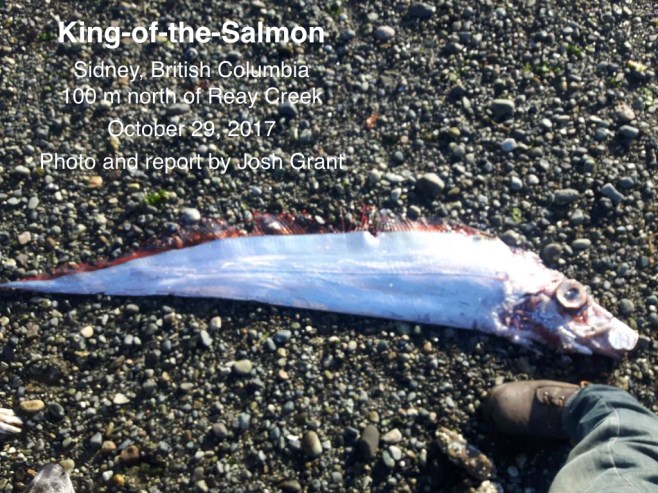
When one of these very rare and unique fish does wash ashore, it usually draws a lot of attention. See the video and photo below for a large King-of-the-Salmon found near Oak Bay, British Columbia on September 21st, 2017. A second one was also found near Oak Bay a few days later on September 26th. A third was found on a beach off Hood Canal, Washington on October 3rd, 2017. And a forth was found in Sidney, British Columbia on October 29th, 2017. (See photos below).
King-of-the-Salmon’s dorsal fin extends all the way down its back. Photo Joanne Rowsell.
Range: The species’ range is believed to be from the Gulf of Alaska to Chile.
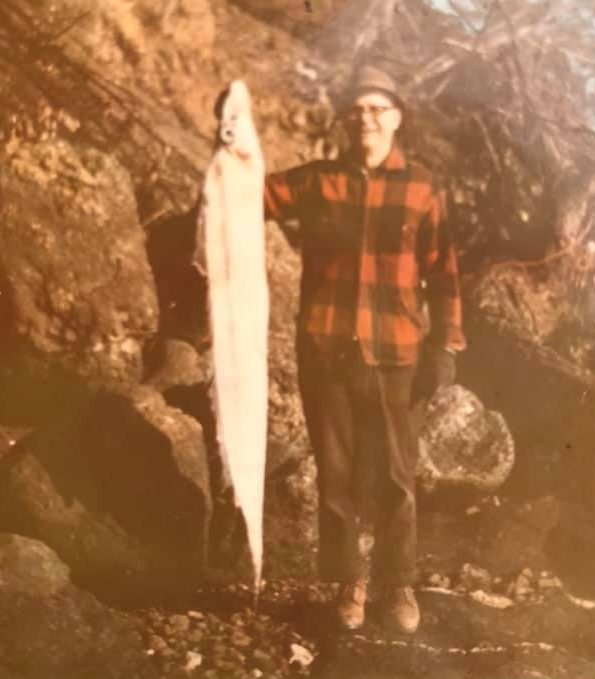
King-of-the-Salmon found at Freshwater Bay, Clallam County, Washington in 1973, by Oscar Stigen. Photo provided by his daughter Jean Stigen.
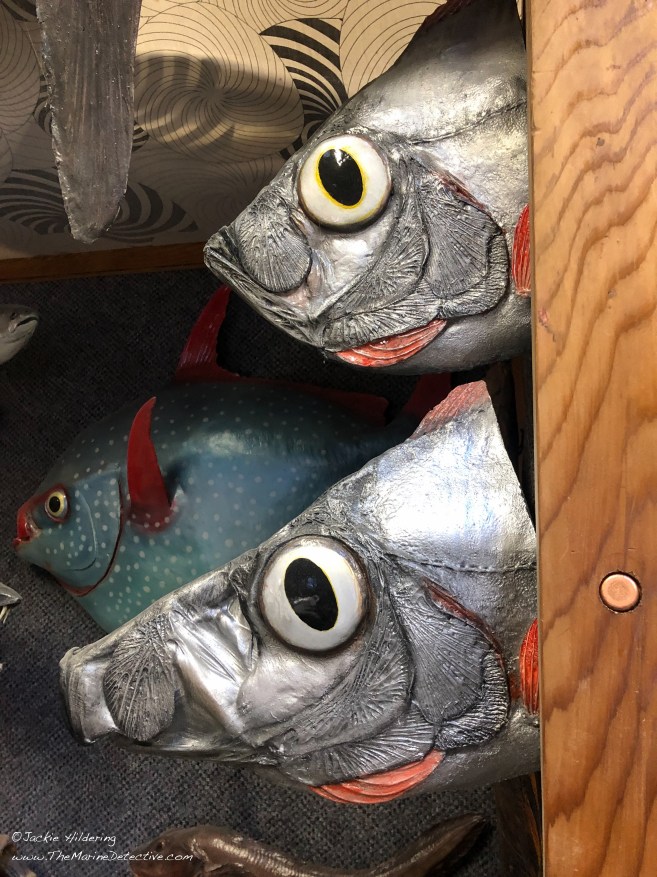
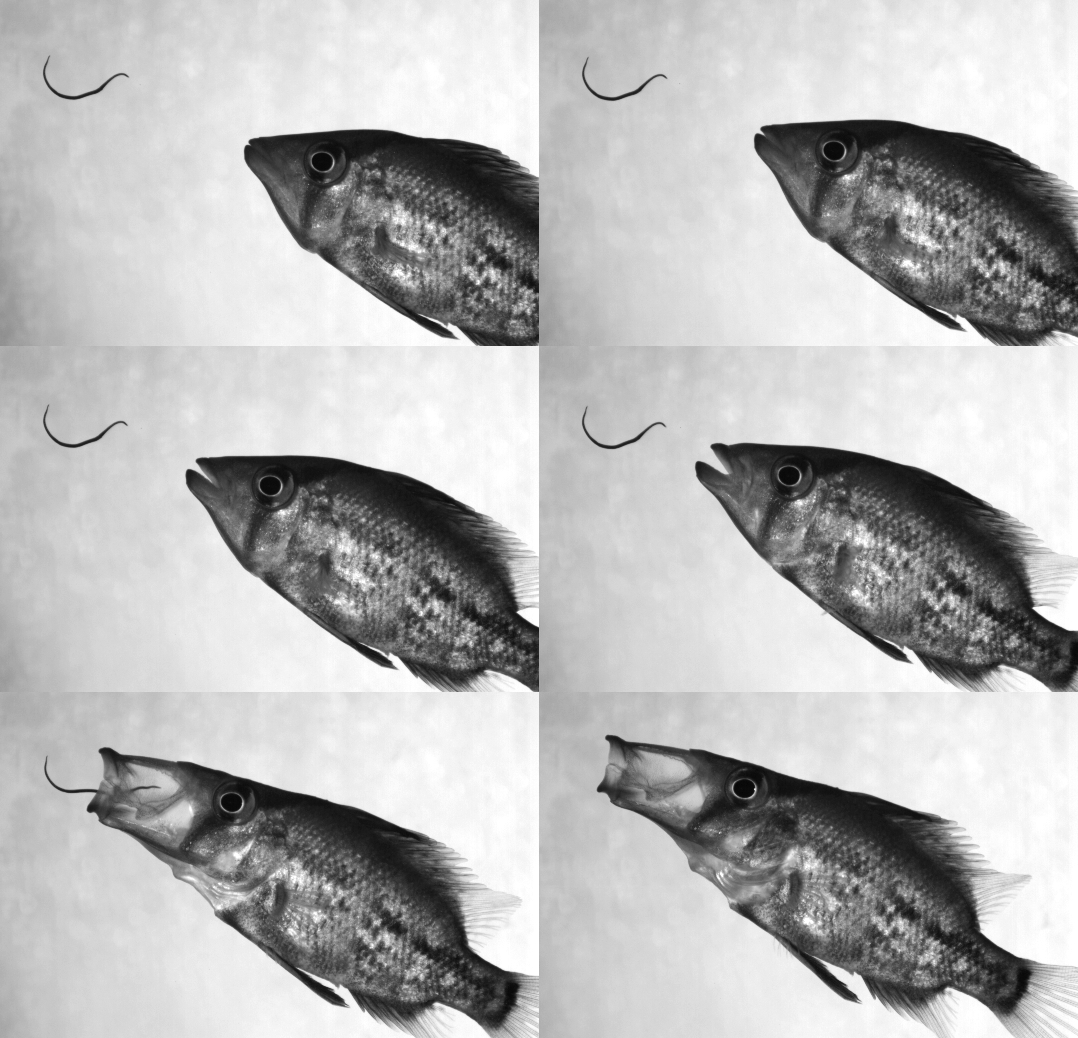
Diet and Feeding Method: Smaller King-of-the-Salmon do feed closer to shore and their diet is known to include copepods, annelid worms, fish scales, and fish larvae. Larger individuals feed on copepods, krill (euphausids), polychaetes (bristle worms, small pelagic fish, young rockfish, squid, and octopus. Part of what makes the species so unique is that they can capture (and process prey) by extreme protrusion of the upper jaw. See photos below.
From Ferry, et al (notably the ONLY research I could find on this species): “T. altivelis does appear to have earned the title of “most extreme”in terms of premaxillary protrusion. The distance to which the upper jaw is protruded anteriorly away from the head exceeds that of any other known species . . .the gut was examined in an attempt to gain further insight into this species’ecology. The gut was empty, but the anatomy was unusual and potentially suggestive of extreme foraging habits. There were hundreds of very small diverticuli lining the gut, which suggest to us a mechanism for increasing digestive surface area and/or efficacy. This species has been described as a deep-midwater forager on crustacean zooplankton (Hart, 1973; Shenker, 1983), which is consistent with such mechanisms.”
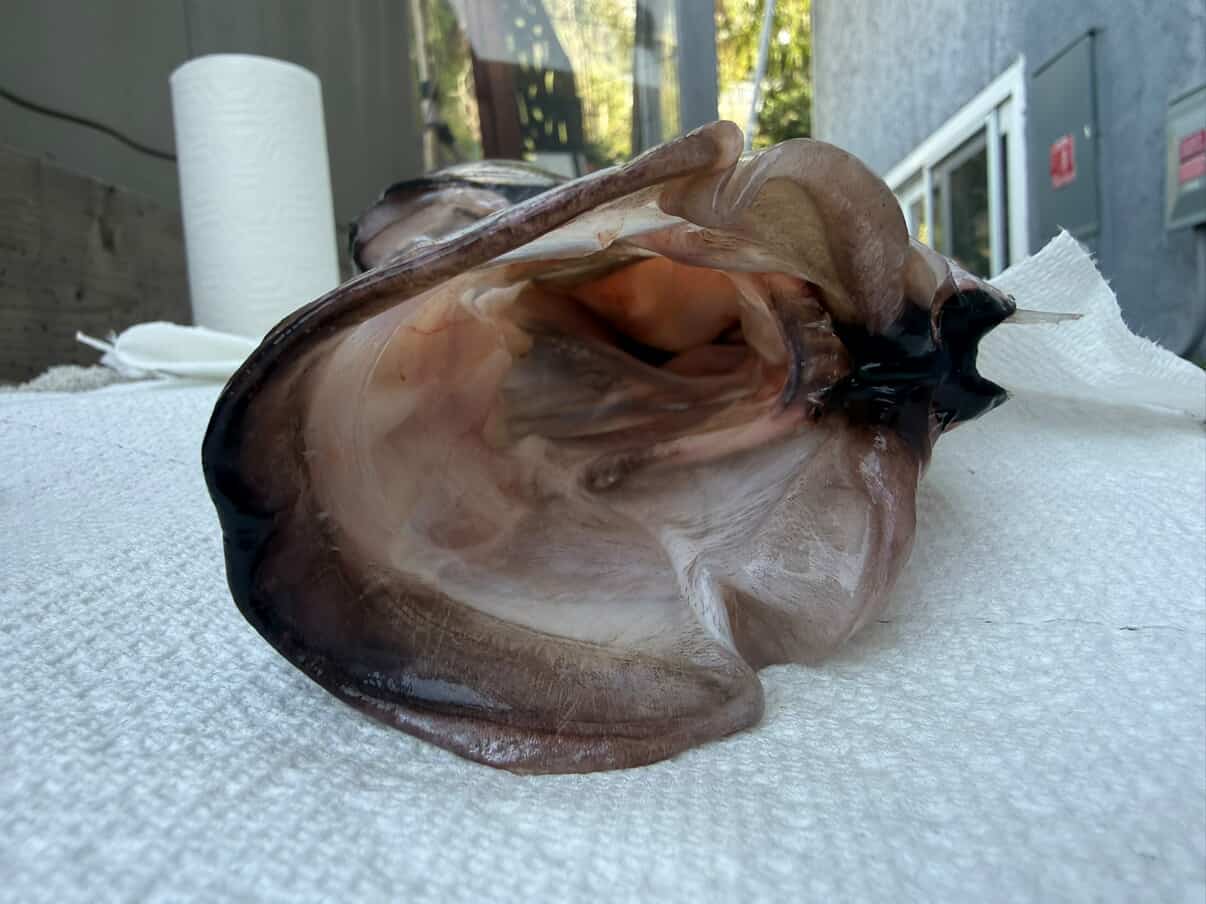
Replicas of the head of the same King-of-the-Salmon by Bilz Rockfish. Compare the top and bottom photo (cast from the SAME fish) to see the extreme capability of this fish to extend its jaw. learned that the nose can push outward as you see by contrasting the top and bottom casts (from the same fish).
Photo: Harbor Wildwatch, June 8, 2020 which allows for insight into the protrusion method this fish uses to eat.
A different species but provides some insight into how fish jaws can protrude. Species in this slow-mo GIF is “the Neotropical cichlid, Caquetaia myersi, showing off its highly protrusible jaw while feeding on a black worm.” Source: Martinez et al.
Predation: I presume that stomach content studies have allowed science to determine that the predators of the King-of-the-Salmon include the Bigeye Thresher Shark (Alopias superciloosus), and the Longnose Lancetfish (Alepisaurus ferox).
Swimming: From Dr. Gavin Hanke of the Royal BC Museum: “King-of-the-Salmon swim by passing a sine wave down their dorsal fin – they can get a fair bit of speed just by doing that. They can also reverse using the same fin flutter. They slowly turn by putting a curve in the body. However, in the first few seconds of the linked video you can see that they also swim in a more typical fishy way (using eel-like body oscillation) when they need a burst of speed or a really quick turn.” See video below of one swimming.
And THAT appears to be all that is known about the King-of-the-Salmon – yet another one of our remarkable marine neighbours.
From Ferry, et al (2019): ” While much work remains regarding the ecology ofT. altivelis and its relatives, it is certain that this fish holds many surprises yet in store”. No doubt.
Sightings photos and video.
King-of-the Salmon found near Oak Bay, British Columbia on September 21, 2017 by Ben Clinton Baker. It will end up on display in the Shaw Centre for the Salish Sea in Sidney, British Columbia. Photo: Oak Bay News. Click here for the story. Below, video of what is presumably this individual when still alive. Credit: Peter Rowand.
Second King-of-the-Salmon found near Oak Bay in September 2017. Photo: Emily Walsh, September 26, 2017.
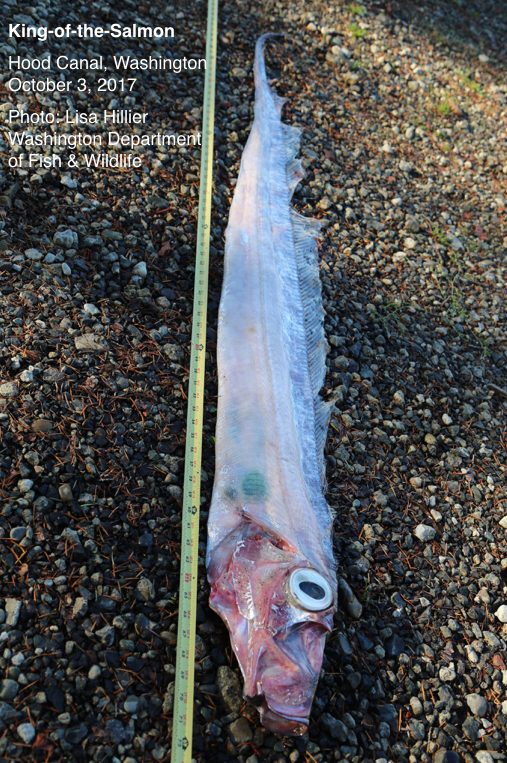
Third found: 1.8 m long female King-of-the-Salmon found on October 3rd, 2017 off Hood Canal, Washington by Chris and Randi Jones. As relayed to Randi by Davy Lowry of the Washington Department of Fish and Wildlife “this is the first reported occurrence of this species in Hood Canal ever, and the only other one found in Puget Sound was discovered on a beach back in the 1990s near Tacoma.”
Same fish as in the photo above. Female King-of-the-Salmon found off Hood Canal, Washington on October 3, 2017 by Chris and Randi Jones. It was 1.8 m long (71′) and 3.3 kg (7.25 lb) and necropsy found that “there was nothing in the gut to indicate it had eaten recently”. and Photo: Lisa Hillier; Washington Department of Fish & Wildlife.
Fourth King-of-the-Salmon found in the fall of 2017 in southern British Columbia / northern Washington. This one was found on October 29th near Sidney British Columbia 100 m north of Reay Creek. Report and photo by Josh Grant. Coordinates: 48°38’03.3″N 123°24’22.7”W
Sighting of a King-of-the-Salmon August 19, 2019 (at least 70 cm long). Greg and Kim Ashton relayed how “We had just tied up our boat in the marina and were walking to shore when Kim spotted what at first we thought was an eel, but quickly realized it wasn’t but some type of fish we had never seen before. It was in five to six feet [~2m] of water and then swam up into shallower water . . . I was amazed at how it seemed to be looking at us and how brightly colored chrome-like its body was . . .”. Video of this individual (below) reveals this individual may not have been healthy.
June 24, 2020 : ~1.5 m long King-of-the-Salmon in poor condition found by Al Champ and Wendy Cooper in East Sooke, across from the Sooke River. They strived to help it on its way but ran out of daylight, finding it was getting weaker and weaker and that it made no attempt to swim away.
King-of-the-Salmon found near Salem, Oregon in 2006. 1.83 m (6 foot) long and the head was about 23 cm (9 inches) wide. Source: Salem News; July 23, 2006; “Strange Fish Found on Beach Near Seaside” Click here to read the story.
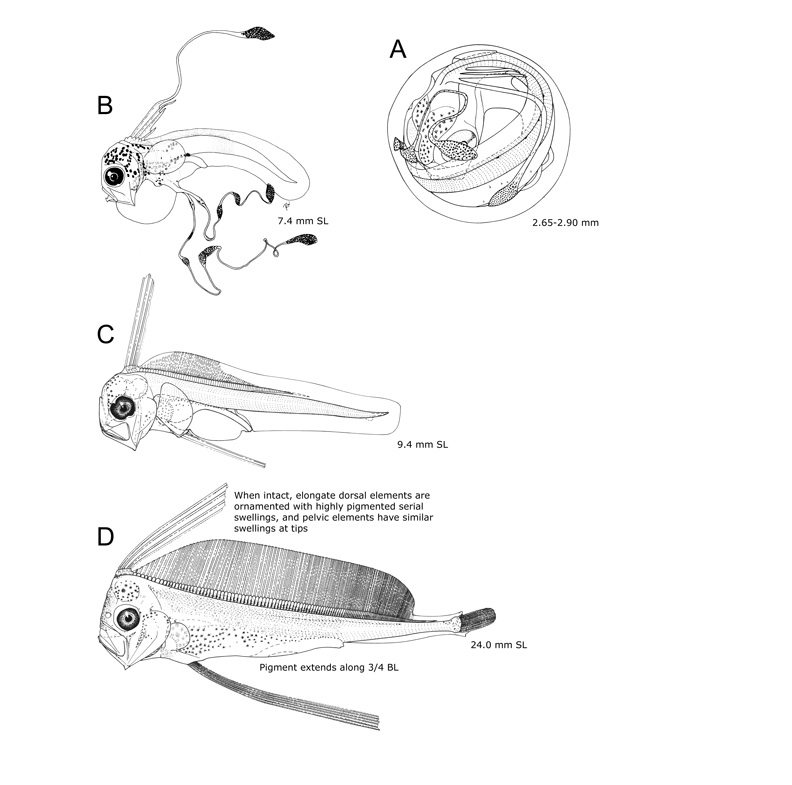
Plankton life stages of the King-of-the-salmon. Source: http://access.afsc.noaa.gov/ichthyo/LHDataIll.cfm?GSID=Trachipterus!altivelis Credits: A: Matarese, A.C., and E.M. Sandknop. 1984. Identification of fish eggs. In H.G. Moser, W.J. Richards, D.M. Cohen, M.P. Fahay, A.W. Kendall, Jr., and S.L Richardson (eds.), Ontogeny and systematics of fishes. Spec. Publ. 1, Am. Soc. Ichthyol. Herpetol., p. 27-31. Allen Press, Lawrence, KS, 760 p. B: Charter, S.R., and H.G. Moser. 1996.Trachipteridae: Ribbonfishes. In H.G. Moser (ed.), The early stages of fishes in the California Current region. CalCOFI Atlas 33, p. 669-677. Allen Press, Lawrence, KS, 1505 p. C and D: Matarese, A.C., A.W. Kendall, Jr., D.M. Blood, and B.M. Vinter. 1989. Laboratory guide to early life history stages of Northeast Pacific fishes. NOAA Tech. Rep. NMFS 80, 652 p.
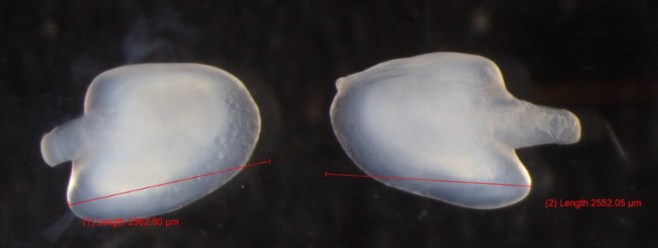
Photo above and the following information was shared by Micah Quindazzi who is a masters student at the University of Victoria studying the King-of-the-Salmon. He extracted the ear bones (otoliths) of two full-grown adult King-of-the-Salmon (the September 18, 2020 and February 6, 2019 individuals). The photo shows the left and right otoliths from the September 18th individual. He shared that it is notable that the otoliths are tiny in comparison to the body size of the fish.
Savinykh, V. F. and A. A. Baitalyuk. 2011. Taxonomic status of ribbonfishes of the genus Trachypterus (Trachipteridae) from the northern part of the Pacific Ocean. J. Ichthyol. 51:581–589.
That’s right, it’s mating season for buffalos . . . Buffalo SCULPINS that is!
Now that I’ve lured you to this posting with the procreation of a huge, shaggy terrestrial mammal on your mind . . . let me show you the spawn of this wondrous fish.
The Buffalo Sculpin – Enophrys bison – has earned the association with buffalo/bison due to the horn-like spine found on each gill plate (operculum). The species can be up to 37 cm long.
As is the case for many species in the sculpin family, male Buffalo Sculpins guard the eggs from predators. They also fan the fertilized eggs with their pectoral fins to aerate them and stop growth of algae / bacteria. Sometimes they guard the eggs laid by multiple females (see below for a male that appeared to be trying to guard EIGHT egg masses). When you consider that a female can lay between 19,000 and 32,000 eggs, the males have a lot of fertilizing and guarding work to do! Their guard duty lasts 5 to 6 weeks until the eggs hatch.
Many of the photos below show how you the males lie with their flat heads directly upon a cascade of eggs. The clusters of eggs laid in the spring allow me to find this incredibly camouflaged fish much more easily than I normally could. When I see a golden, orange or greenish shiny mass of eggs, I know a male Buffalo Sculpin has to be very near by. The bright colour of the eggs suggests that they might be toxic to many species, further protecting them from predation.
Very interestingly too, there is a species of fish known to parasitize on the care provided to the fertilized eggs by Buffalo Sculpins. Spinynose Sculpins (Asemichthys taylori) will lay their eggs on top of the Buffalo Sculpin eggs. The Spinynose Sculpin eggs will hatch faster and it is even possible that the presence of their eggs slows the development of the Buffalo Sculpin eggs. This “nesting parasitism”, is a “behavior previously unknown among marine fishes.” (Kent, Fisher, & Marliave, 2011).
As you can see, Buffalo Sculpins’ red, brown and pink colouration makes them very difficult to discern from the similarly brilliantly coloured life around them. They will remain absolutely still so as not to give away their presence. Their relative, the Red Irish Lord, has the same survival strategy. (See this previous blog item for photos and information on the Red Irish Lord.)
The camouflage, in addition to reducing the risk of predation by bigger fish and seals, allows the Buffalo Sculpin to be a very successful ambush hunter of shrimp, crabs, amphipods and small fish. It has been suggested that they eat mainly algae since this has so often been found in their gut but I am willing to bet that the algae ends up in their stomachs as a result of the Buffalo Sculpins grabbing prey ON the algae!
Update February 2nd, 2021
This blog was written in 2011 reporting this to be a Mola mola.
I can now share that this is NOT a Mola mola. It is a Mola tecta! It is now known that there are two species of Mola in the NE Pacific Ocean. See the CBC news article announcing this here: Meet the Hoodwinker, the Ocean Sunfish we Misidentified for Years.
Mola tecta is the Hoodwinker Sunfish. See diagram at the end of this blog for the discerning characteristics.
As a result of writing this blog in 2011 (with the great photos taken by friends), I was contacted in 2020 by the researcher who could discern this species, Marianne Nyegaard who works in New Zealand. Now, in my role with the Marine Education and Research Society, we are helping get more sightings of Mola off the coast of BC to get a better sense of relative abundance. To relay sightings, please see this link.
Something very unexpected landed near the Port Hardy seaplane base on October 20th, 2011 – a dead Mola tecta. This species of ocean sunfish looks like a cartoon character rather than a relatively fast-moving, deep-diving fish whose design has been perfected by millions of years of evolution.
Chad Chrighton, the pilot who found the Mola tecta near the seaplane base. Photo credit: Mike D’Amour (North Island Gazette).
This fish species is aptly named since Mola means “millstone” in Latin and indeed this fish looks like a huge, flat, gray circle and has rough skin. It appears to have no body, only a giant, round, flat head with a small beak-like mouth. It is propelled by two pointy fins (dorsal and anal) and is steered by a wide, rounded, rudder-like tail.
Photo credit: Erika Grebeldinger.
Mola species were believed to be passive drifters who travelled only at the surface, wherever the current took them. However, satellite tracking studies have revealed that they dive deeper than 600 m and travel an average of 10 to 20 km per day, the same distance traveled by open-ocean shark species.
Matthew Drake measuring the Mola tecta To give you get a sense of size, Matthew is 2m tall (6.5′). Photo credit: Erika Grebeldinger.
They are certainly a rarity on the inside of Vancouver Island however and I greatly appreciate that Matthew Drake let me know about this find and that he undertook a necropsy of the giant together with Louisa Clarke and Natasha Dickinson.
This Mola tecta measured 2.00 m wide, from beak to tail fin, and 2.06 m long, from the tip of one pointy fin to the other. It may have weighed more than 200 kg. Remarkably, this is small for its kind. Mola tecta hold the record for being the largest bony fish on earth with an average mass of 1 tonne. The largest Mola mola (cousin to Mola tecta) ever recorded was 2,235 kg and 3.10 m by 4.26 m (it was struck by a boat near Australia in the early 1900s). Note that the whale shark can be more than 9 times bigger than this but, it is not a bony fish.
Mouthparts. Photo credit: Mandy Ludlow.
Matt and the team concluded that the Port Hardy Mola tecta was female which meant that she could have up to 300 million eggs in her one ovary. This is another record for the species: having more eggs than any other animal with a backbone. Another astounding fact is that the larvae could grow to be 60 million times their weight at hatching.
The investigation also revealed partially digested jellyfish in her gut, which is the typical prey of Molas / Sunfish. Their diet also includes small fish, eelgrass and crustaceans and they are able to spit out and pull in water and food with their unique mouthparts. As with all species that feed on jellies, a conservation concern is that they mistake plastic bags for their food. However, there was no evidence for this being the cause of death for this particular Mola tecta.
Maybe parasites were a factor in her death? The team found lots of skin and intestinal parasites! Some of the round worms in the guts were even still alive. Parasites are common for Mola molas. In fact, it is now believed that the behaviour of “sunning” at the surface (hence, ocean “sunfish”) might be so that birds can feed on the skin parasites and that jumping more than 3 m out of the water might help dislodge some parasites too. Mola tectas are also found associated with drifting kelp patches, where small fish can clean away the pests.
HOLY MOLA you never know what you are going to find in our amazing marine backyard.
All the information collected was reported to oceansunfish.org and the mouth parts are on display in Telegraph Cove’s Whale Interpretive Centre.
Advance only if you are NOT about to eat lunch and/or if you a biology-type like me who can view these kinds of photos in rapturous fascination anytime!
Photo by Erika Grebeldinger.
Sources:
ARKive images. Click here to see an image of gulls cleaning a Mola mola. Click here for video.
oceansunfish.org (Where sightings should be reported in order to aid science)
Her intestines were an astounding mass of worms. Likely the species include the parasitic flatworm, Nematobibothrioides histoidii which is thread-like but can grow to be over 12 m (40′). No one apparently knows just how long they can become, in part because dissections/necropsies on Mola mola are rare events. Photo credit: Natasha Dickinson.
Parasites near the eye. Photo credit: Mandy Ludlow.
More great ectoparasites. Photo credit: Matthew Drake.
Her single ovary. Can have 300 million eggs. Photo credit: Natasha Dickinson.
The Red Irish Lord (Hemilepidotus hemilepidotus; up to 51 cm) is a fish of incredibly stunning diversity of colour. Right down to its flecked, bulging eyes, this ambush predator is a master of camouflage.
But how can you be camouflaged when you’re a fish of insane red and/or orange colouring? When you live in the rich, cold waters of the Northeast Pacific where Nature has doled out colour so liberally, you fade into the background even when so vibrantly coloured.
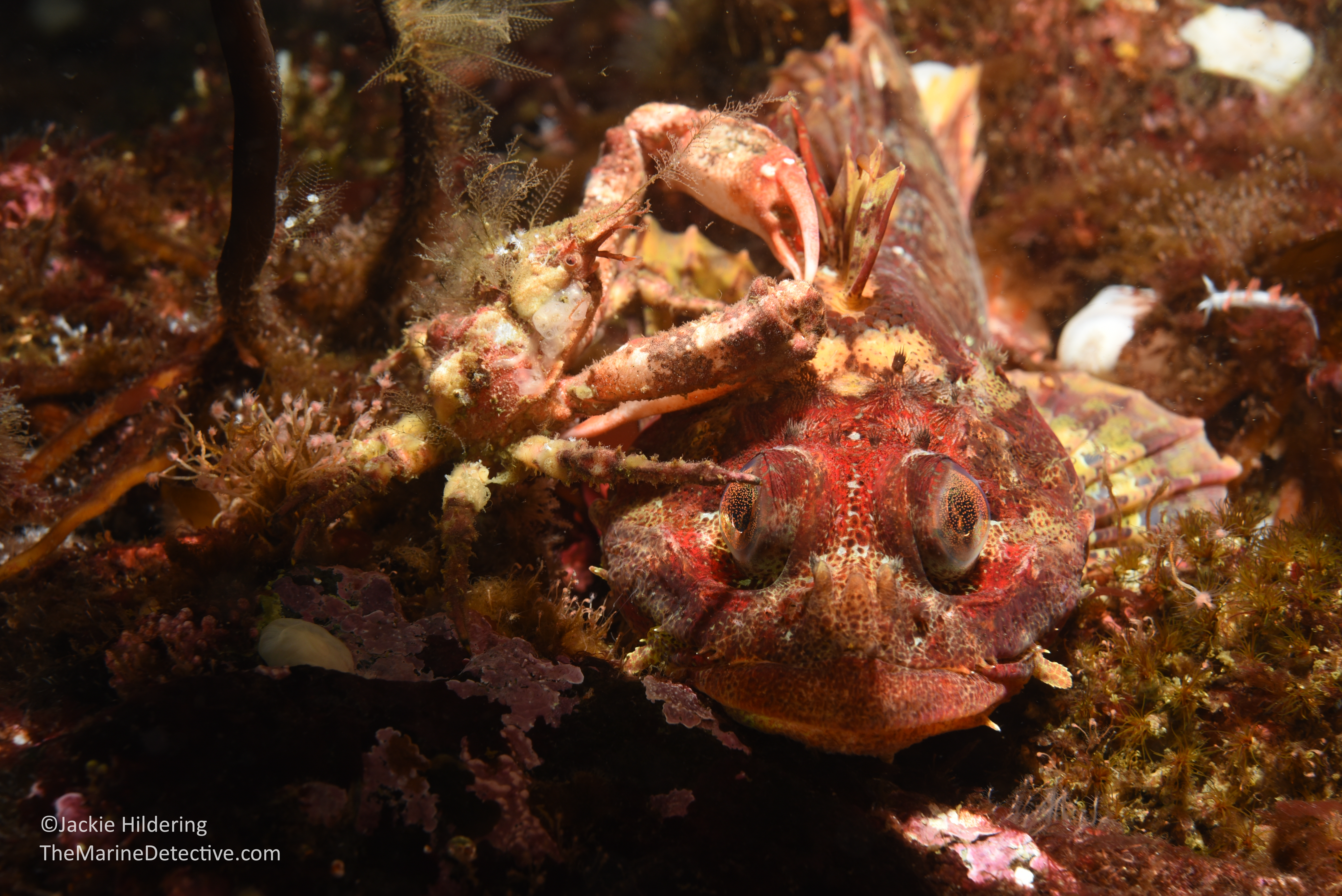
They are a favourite species for we underwater photographers since, as ambush hunters, they remain still even when annoying divers are flashing lights in their eyes or when a crab is sitting on their heads (see below).
The diversity of colour in this species is awe-inspiring. See below for examples of the diversity of colour and pattern and their ability to camouflage. You will even see that there are crabs that walk on their heads. I have a whole blog entitled “Crabs Making Bad Choices” dedicated to that at this link.
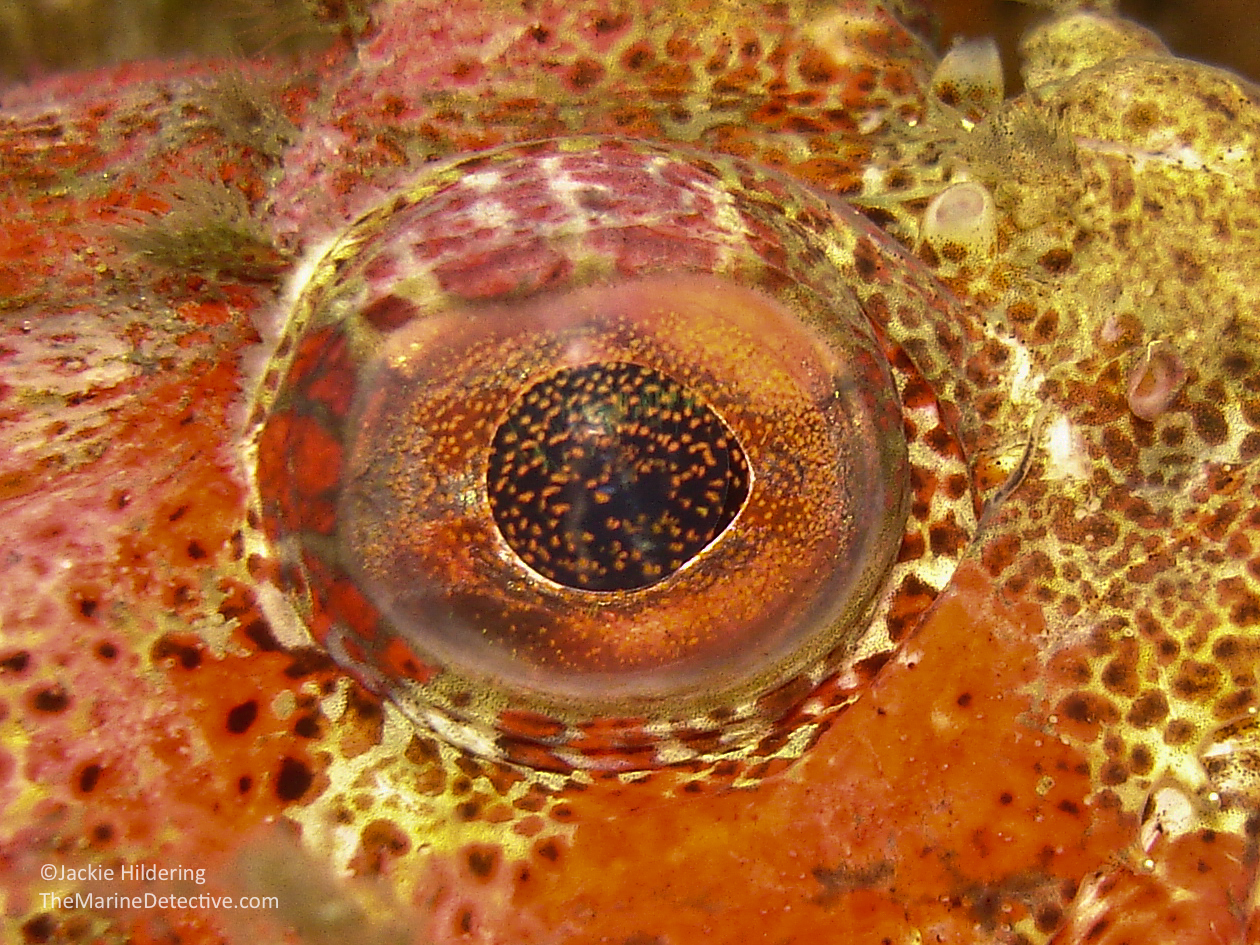
I hope that your sense of wonder is further stimulated in realizing that the Red Irish Lords are able to change even the colour of the flecks in their eyes to match their surroundings!
The remarkable eyes of the Red Irish Lord. The flecks you see are corneal chromatophores which can change colour to add the to species’ ability to camouflage.
See too how Red Irish Lords are among the fish who guard their fertilized eggs.
Both male and female Red Irish Lords guard the eggs. More information in my blog at this link.
A Red Irish Lord who is hoping the Sharpnose Crab inches down just a bit further so that s/he can feed (and that the annoying photographer would go away!). See my blog “Crabs Making Bad Choices” for more photos of such interactions at this link.
Another Red Irish Lord and a mature male Sharpnose Crab making bad choices.
Slide show and gallery of photos below give a further sense of the diversity of colour and camouflage in this species.
The survey is the result of concerns about the overfishing of this fish species and is conducted just after the spawn (January to February) when females leave the males to guard the egg masses from predation by species like sea stars. There are very few deadbeat dads in this species!
The data collected provide insight into the abundance and reproductive success of Lingcod in British Columbia and include: depth of the egg masses; their size (grapefruit, cantaloupe or watermelon sized); if the eggs are being guarded by a male; and their state of development (new, eyed or rotten). We are very fortunate that our area appears to have relatively abundant and large egg masses. At the end of this blog, you’ll find my 2.5 minute slide show of their life history.
But let me first take you on a wee retrospective journey.
My understanding of the behaviour of these magnificent fish has now evolved to where I now take photos of the extremely territorial males guarding their large orbs of fertilized eggs, but it certainly wasn’t always that way for me. The following is a much exaggerated perspective from when I was a very new diver doing their first Lingcod egg mass survey.
In 1999, I had only ever done 14 dives and had never even seen a Lingcod while diving. So, in preparation for the survey, I consulted my trusty field guide and felt well-prepared knowing the information below:
That first experience with the survey in 1999 led me to writing the following tongue-in-cheek “updated” field guide information in my dive log.
LINGCOD (Megadontos fishious)
Size: &%$#@ huge!!!!!
Description: Teeth sharp, large and fear inducing; species camouflaged for added surprise value; ability to make themselves appear even larger and more menacing by fanning out huge gill plates (opercula). Note: Wise for divers to retreat if this behaviour is observed.
Habitat: Adult males found anywhere that groups of dive slate carrying divers like to congregate.
Comment: Egg masses are said to have eyes at some stage of their development but no living diver can confirm that this is the case!
This is an awe-inspiring fish species indeed. I have even had a male knock my dive slate out of my hands during a survey. Ironically, I was recording “absent” under the column for whether a male was guarding the egg mass!
Update May 1, 2023: Original blog is from 2011. I have added photos of additional, known dead Sixgill Sharks at the end of this blog.
And yes, there is a personal connection to this species. While these huge sharks are often in very deep water, I have seen them while diving in at depths of even less than 10 metres. It’s difficult to express the wonder and connection that results from these privileged experiences. It’s somewhat like seeing a living dinosaur. Bluntnose Sixgill Sharks have been perfected by 200 million years of adaptation.
They are not a threat to us. We are a threat to them.
The awe-inspiring images below are of a pregnant female Bluntnose Sixgill Shark (Hexanchu griseus) who was found dead on a beach in Alberni Inlet on low tide in February of 2011. She was necropsied by Department of Fisheries and Oceans staff and there were no obvious indications of how or why she died.
The information below has been generously provided by shark biologist and friend, Romney McPhie. I am sharing in the hopes of increasing respect and understanding for these astounding, huge, deep-dwelling sharks who live off our coast.
4.2 m pregnant female Sixgill Shark – February 2011.
This female Sixgill was 4.2 metres and was estimated to weigh 569 kg (1,254 lbs). As a viviparous shark species, she carried her embryos through the entire gestation period which is thought to be over 2 years long (species does not lay eggs / egg cases).
She may have given birth to some prior to her death and still had 28 pups inside her. The young hatch inside the female’s body before entering the ocean (these sharks are “yolk-sac viviparous”).
Sixgill Sharks have been reported to be up to 4.8 metres in length with females being larger than males (males to 3.5 metres). Age of sexual maturity is estimated to be between age 11 to 14 for males and between 18 to 35 years for females. It is believed that life expectancy may be up to 80 years of age.
The Committee on the Status of Endangered Wildlife in Canada (COSEWIC) 2007 assessment report on the Bluntnose Sixgill puts into perspective how rare an opportunity it is to learn about a pregnant Sixgill. It relates that the number of pups carried by females is known from only three previous credible accounts (ranging from 47 to 108 pups which were 61 to 73 cm in size).
The Bluntnose Sixgill Shark is an extremely cryptic species that can dwell at depts up to 2,500 m. So little is known about them and (sigh) they are “near threatened” globally and are a species of “special concern” in Canada.
I have had the incredible privilege of seeing Bluntnose Sixgill Sharks while diving and felt like I was in the presence of greatness. They are living fossils, perfected by 200 million years of adaptation. They are amazingly graceful with large, luminous and intensely green eyes.
They are of absolutely no threat to humans and, like all sharks, have an essential role in marine ecosystems. As top-level predators, sharks strongly shape food webs and the loss of such predators has proven to have profound effects on the number and diversity of other species.
The unique teeth of Bluntnose Sixgill Sharks. Photo by Romney McPhie.
We, however, are a threat to them.
There were historical fisheries and bycatch remains a concern. From 2006 to 2009 there an estimated 1979 Bluntnose Sixgill Sharks were Commercial Hook and Line catch
There is no information on the survival rates from bycatch nor of the accuracy of bycatch reporting. Population size and reproductive rate are not known for this species.
“The primary threats identified for these species are entanglement and bycatch. Other threats identified include pollution, habitat loss or degradation, climate and oceanographic change, and harassment. Historic threats included directed fisheries and entanglement/bycatch. While these populations are migratory throughout the northeast Pacific, it is unknown whether threats occurring outside of Canadian Pacific waters have an impact on these populations.”
“The present population size and abundance trends are not known. The only available abundance index (encounter rates with immature Bluntnose Sixgill Sharks at a shallow site in the Strait of Georgia) has decreased significantly (>90%) in the last five years. This index is not likely representative of the overall abundance trend because only immature Bluntnose Sixgill Sharks are encountered and the site is shallow relative to the preferred depth range. The principal known threat to the species is fishing.
The Bluntnose Sixgill Shark has been the focus of at least three directed fisheries in Canadian waters, most recently in the late 1980s and early 1990s. It continues to be caught as bycatch, but survival of released sharks is unknown. Bluntnose Sixgill Sharks observed by divers sometimes show scars from entanglement in fishing gear.
Because of its late age of maturity (18 to 35 years for females), it is likely susceptible to overfishing even at low levels of mortality. Little is known about the abundance and movement patterns of this species elsewhere in the world, so the potential for a rescue effect is unknown.“
Sixgill Shark eye. This one died as a result of longline bycatch and was brought into Alert Bay in July of 2007. It was rumoured to be one of 12 sharks caught by only one local fishing boat. Photo: Jared Towers.
Sources for the biology, threats and conservation of Bluntnose Sixgill Sharks:
Photo #1 April 2023 – Dead pregnant Bluntnose Six-gill Shark, Hornby Island.
Photo #2 April 2023 – Dead pregnant Bluntnose Six-gill Shark, Hornby Island.
From the Vashon Nature Center: in Puget Sound – 4 Bluntnose Sixgill Sharks washed between January and March 2023. Two could not be necropsied. One died after longline bycatch and one died by swallowing a crab bait trap Blog article about the first necropsy at this link.