Join me in the cold, dark, life-sustaining NE Pacific Ocean to discover the great beauty, mystery and fragility hidden there.

Posts tagged ‘northern vancouver island’

Wolf-Eel – No Ugly Fish!

Don’t say it, please don’t say it. This is not an ugly fish. It hurts when people say this about Wolf-Eels. Such is the way when there is misunderstanding and disrespect for something you love. There is no ugly in Nature – only perfection. If the features of an animal appear foreign to you, it is because it fulfils a role in Nature that is truly awe-inspiring; possibly even beyond your imaginings.
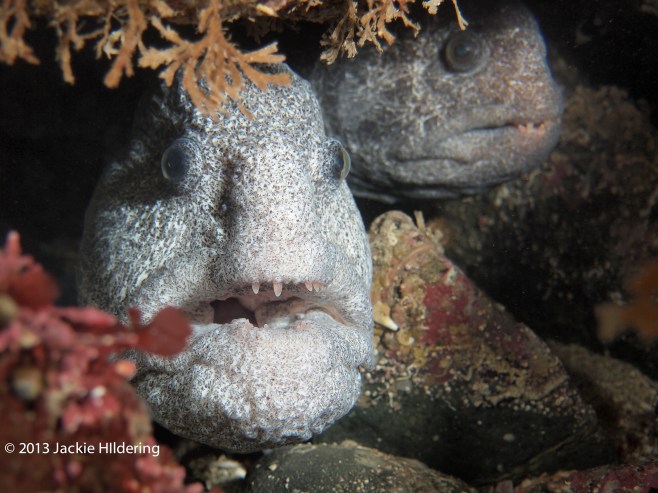
Mr. and Mrs. Wolf Eel on February 16, 2013 near Port Hardy. © 2013 Jackie Hildering

Mr. and Mrs. Wolf-Eel near Port Hardy ©Jackie Hildering.

I hope to make this point by sharing with you why the Wolf-Eel  is “designed” as it is and how very wrong many of us are in our perceptions about this species. The Wolf-Eel (Anarrhichthys ocellatus), which can be as long as 2.4 m, is not an eel. Wolf-Eels belong in the Wolf Fish family (Anarhichadidae). They are desperately misunderstood. Wolf-Eels are not dangerous nor “mean”. The opposite is true. They are reclusive, anything but ferocious, quite sedentary and slow moving.

Mature male wolf-eel - about 2.2 m long. © 2008 Jackie Hildering

Mature male Wolf-Eel, about 2 m long. Can be 2.4 m ©Jackie Hildering.

Yes, they have large, fleshy, ossified heads and the species has sharp teeth but this is so they can do what so few marine species can – they can feed on spiny sea urchins, snapping them effortlessly into pieces without suffering a single puncture. They also feed on other hard-shelled animals like shellfish and crabs. Even the roofs of Wolf-Eels’ mouths are impenetrable with ossified, tooth-like projections (see photo below).

Each wolf-eel has distinct spots around their eyes which helps recognize them as individuals. © 2012 Jackie Hildering

Mature males are bigger and have fleshier heads. Each Wolf-Eel has distinct spots around their eyes which helps recognize them as individuals ©Jackie Hildering.

The upper jaw of a wolf-eel. Impenetrable to even urchin spines! © 2005 Jackie Hildering

The upper jaw of a Wolf-Eel. Impenetrable to even urchin spines! ©Jackie Hildering.

To my knowledge there has never been an attack on a diver UNLESS, and here comes the predictable thing, we choose to habituate them. Wolf-Eels spend a great deal of time on the ocean bottom in dens where, as divers, we have the enormous privilege of  “visiting” the same spot and seeing the same individuals for years. It is not just their address that makes them recognizable as individuals. Each Wolf-Eel has a unique pattern of black spots near their eyes.

Grandpa Wolf-Eel on February 16, 2013 near Port Hardy. © 2013 Jackie Hildering

Grandpa Wolf Eel near Port Hardy ©Jackie Hildering.

Some divers choose to feed them, leading to the Wolf-Eels associating us with food and that’s where accidents can happen and where the wild behaviour that lets animals survive, becomes compromised. It also makes them tragically easy targets for any spear diver wanting to poach them. There is no legal fishery for this species but there is a demand for them in the Asian market which is why there are also attempts to farm Wolf-Eels i.e. aquaculture. Not surprisingly, Wolf-Eels might also be defensive when accidentally caught by anglers. I found one account from 1959 where a commercial fisherman was bitten and “The teeth penetrated the hip-waders and broke the skin on both sides of the ankle.”
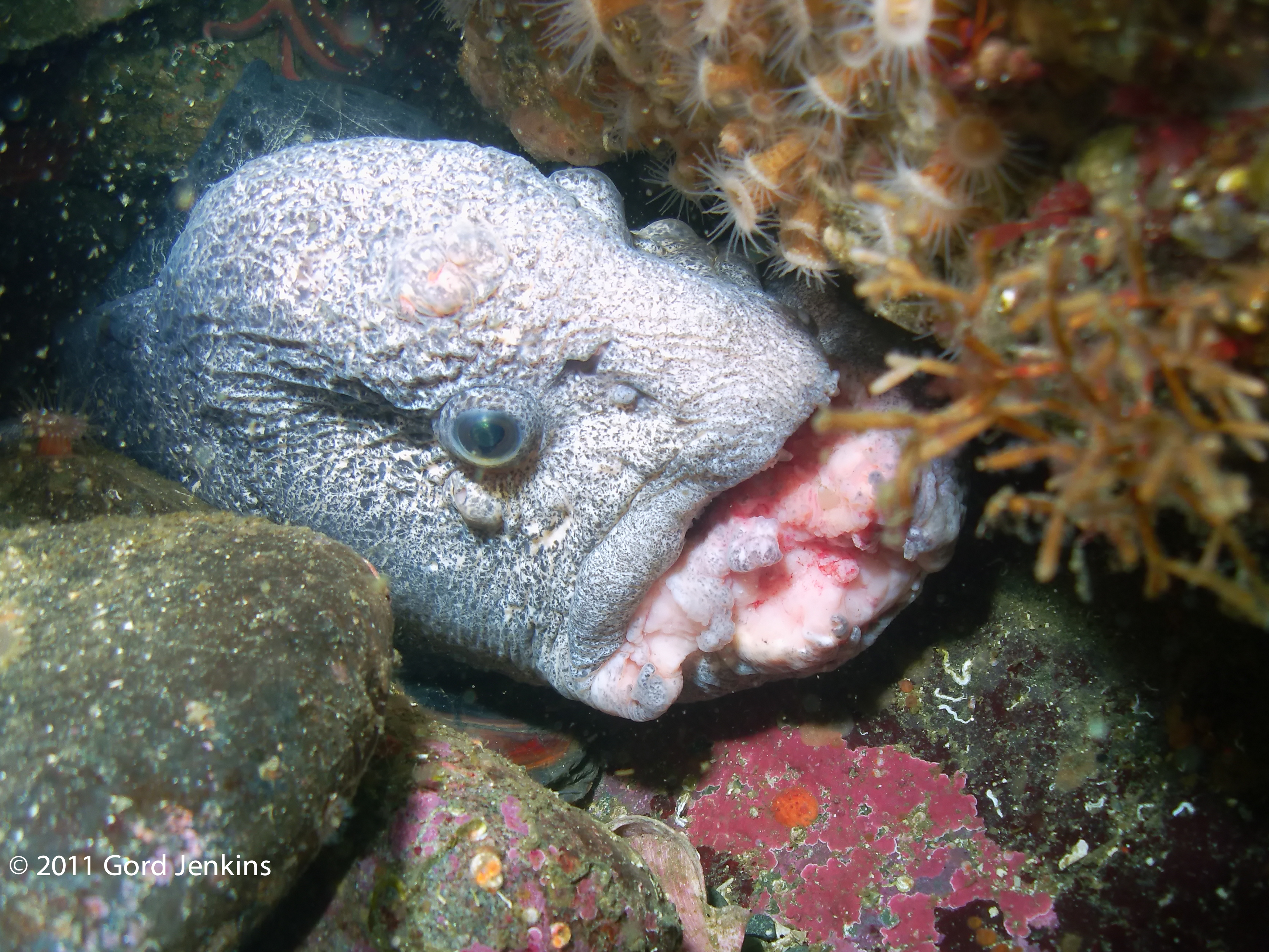
Mature male bearing the scars of battle. © 2011 Gord Jenkins.

Mature male bearing the scars of battle ©2011 Gord Jenkins.

The mature males do carry battle wounds supporting that they don’t just hang out in dens waiting for a snack to come by, but rather that they will occasionally duke it out with other male Wolf-Eels.It was long thought that Wolf-Eels always mate for life but, this is not always the case. The males do compete for females who will sometimes opt to swap dens and go live with the competitor. Sound like any other species you know? Wonder if it happens at mid-life? 😉

Wolf-Eels have long-lasting pair bonds, coming together when they are around 4-years-old and having their first clutch when they are around 7. In aquariums, their life expectancy is known to be at least 28 years. Both male and female juveniles are brownish orange and look even more eel-like, lacking the big head of the adults. As adults, the females are smaller and a darker brownish grey (both remarkably camouflaged for when they are in their rocky dens).

They do also sometimes need to do battle for den space with a Giant Pacific Octopus.  This is likely another driver for the male’s having such fleshy heads – they are better able to survive the wounds inflicted by such battles.

Clearly, another unique feature about this species is their eel-like body. They are the only member of their family that have this body shape. The long tail serves in locomotion, powering them forward with big, slow, s-shaped waves while being stabilized with the long dorsal and pectoral fins (see video below). Having a long tail also allows them to den-up, curling up and around in narrow spaces between rocks and . . . wait for it . . . it lets them hold onto their eggs.

Mr and Mrs Wolf-Eel tending their egg mass © 2005 Jackie Hildering-

Mated pair tending their egg mass. Note how much darker and smaller the female is ©Jackie Hildering.

Female Wolf Eel guarding eggs. March 2016 @Jackie Hildering.

Female Wolf-Eel guarding eggs. ©Jackie Hildering.

Mating apparently most often occurs between October and December, with the female releasing eggs after the male prods against her swollen abdomen. He then wraps around her to fertilize the 7,000 to 10,000 white to yellow eggs that she will mould into a ball shape. This mass does not need to adhere to anything because the parents will take turns wrapping their tails around the mass, holding and turning it for good aeration until the +/- 3.5 cm young hatch some 13 to 16 weeks after fertilization.
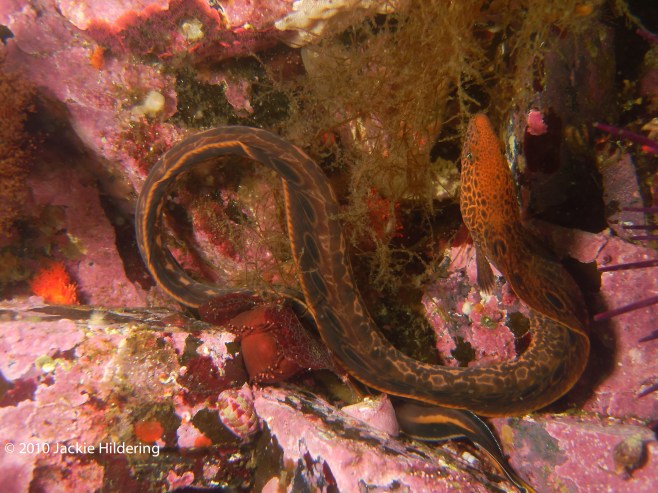
Juvenile wolf eel. © 2010 Jackie Hildering-

Juvenile Wolf Eel ©Jackie Hildering.

The juveniles settle into the adult sedentary lifestyle between the ages of 6 months and 2 years (presumably dependent on food supply and den availability). One juvenile is even known to have travelled a minimum of 1,000 km; having been tagged in Port Hardy, BC and found back in Willapa Bay, Washington two years later. It was long thought that Wolf-Eels always mate for life but, this is not always the case. The males do compete for females who will sometimes opt to swap dens and go live with the competitor. Sound like any other species you know? Wonder if it happens at mid-life?

The Wolf-Eel is indeed akin to us in so many ways. It is a homebody that likes crunchy snacks and prefers that they come right by the front door; they are great parents and are docile unless fighting for home or partner. They invest in durable relationships and – they are only as strange looking as we terrestrial bipeds would appear to them.

And if all of that is not enough for you, see the photo below for the indisputable reasoning for by Wolf-Eels are NOT ugly fish!

Statler the Muppet is cute and loveable. Ergo - so are wolf-eels. Case closed!!

Statler the Muppet is cute and loveable. Ergo – so are Wolf-Eels. Case closed!!


Range: Sub-tidal to 226 m; Baja California (Mexico) to the Aleutian Islands (Alaska); west to Russia and south to the Sea of Japan.

Mr. and Mrs. Wolf Eel on February 16, 2013 near Port Hardy. © 2013 Jackie Hildering

Mated pair near Port Hardy ©Jackie Hildering.
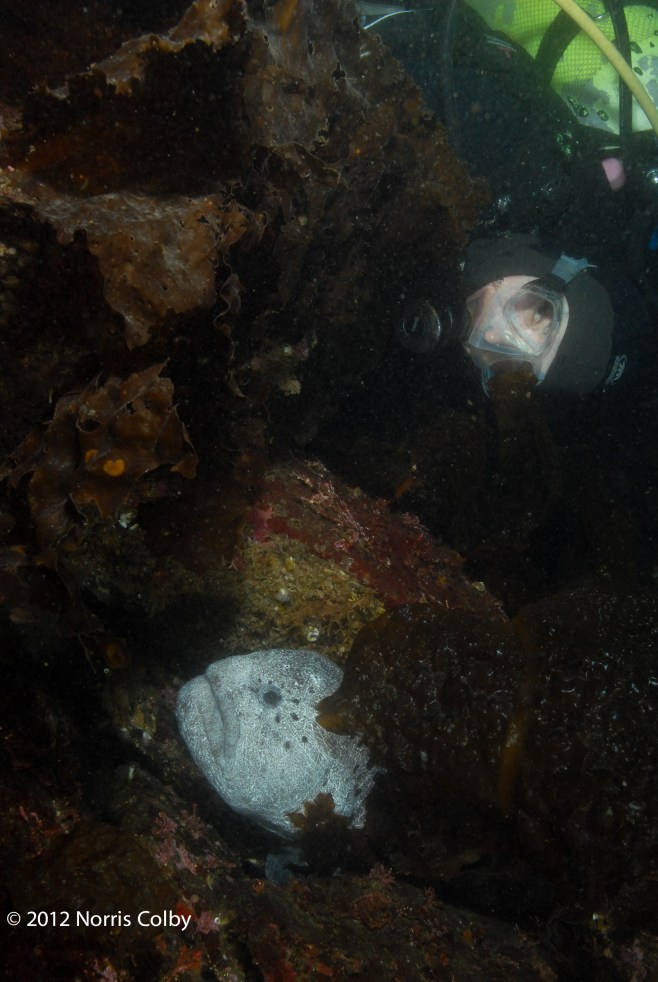
Me and a mature male wolf eel.

Me and a mature male Wolf-Eel ©2012 Norris Colby.
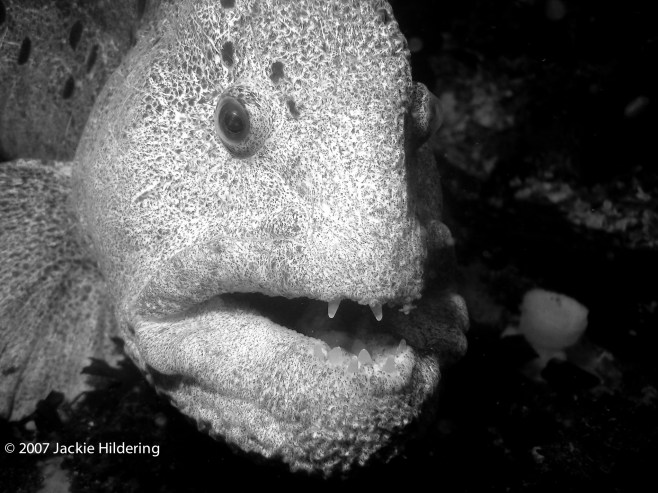
Mature male wolf-eel. © 2007 Jackie Hildering

Mature male Wolf-Eel ©Jackie Hildering.
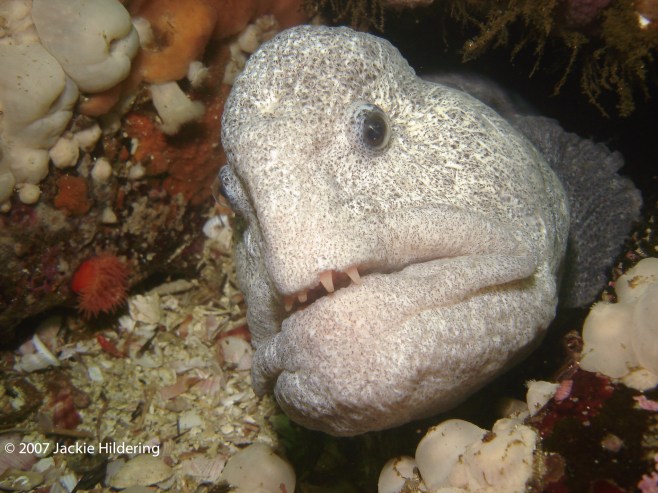
Mature male wolf-eel. © 2007 Jackie Hildering

Mature male Wolf-Eel ©Jackie Hildering

For these and more images of the Wolf-Eel, please see my gallery at this link. 

Remarkable video of a mature male Wolf-Eel eating a Giant Pacific Octopus by Andrew Eve.

Sources:

Every Breath You Take . . . .

XX

Er – sorry about that. Thanks to the blog title, you likely now have The Police’s stalker-ish lyrics playing annoyingly in your head.

Let me take the Sting out of that for you.

The only lines of the song that apply to this blog item are: “Every breath you take” and “Every move you make” because  . . . this blog is about marine algae.

giant kelp DSC06372

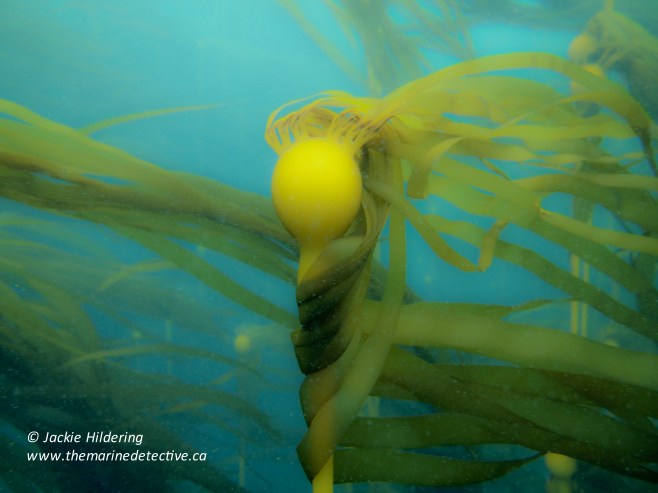
Fronds of kelp ©Jackie Hildering

Yes, that’s right – marine algae; the plant-like material of our oceans that ranges in size from the phytoplankton that give the NE Pacific Ocean its emerald colour and soupy richness, to the giant kelp species that provide habitat as ocean forests.

Breathe in.  A conservative 50% of the life-sustaining oxygen in that breath came from marine algae.

These organisms are also attempting to scrub away the devastating impacts of our fossil fuel addiction, photosynthesizing carbon dioxide into oxygen and serving as carbon sinks.

Bull Kelp Forest

One of the images that started it all. ©Jackie Hildering

Life on earth simply could not survive without marine algae and this conclusion is valid even without considering their role as the basis of ocean food webs (and recognize that an estimated 50% of all species on earth are marine).

Why then, while we seem to have some understanding of how dependent we are on the terrestrial plants living up here with us, do so many of us appear to be ignorant of the vital importance of the marine algae that inhabit 71% of the earth’s surface?

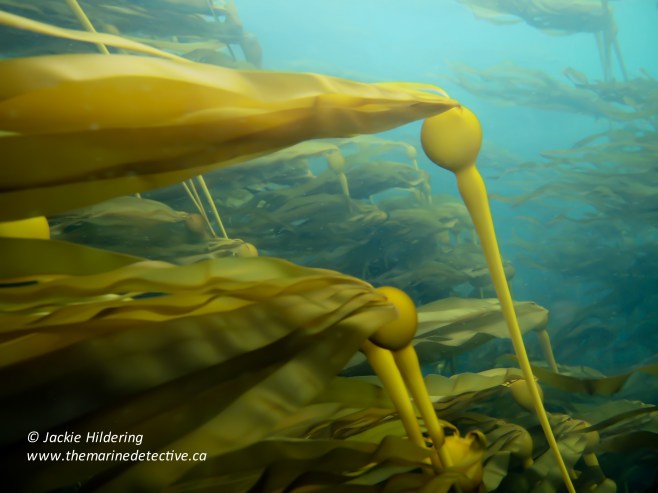
Bull kelp forest in current © Jackie Hildering

Bull kelp forest in current ©Jackie Hildering

Why are we seemingly not as driven to save marine algae from the impacts of pollution as we are to stop deforestation? Is it that damn illusion that land is separate from sea?

Or, somewhere deep within or briny beings, do we feel a connection?

I have experience that suggests this might be the case.

It’s an accidental discovery . . . I never really planned to become an underwater photographer. Having the great privilege of living in this beautiful place, initially I focused largely (quite literally) on photographing big marine mammals. I was using charismatic megafauna to try to inspire conservation.

 © Jackie Hildering

But then  . . . I was gifted an underwater camera and quite early on, I started photographing kelp.

For me, kelp is the entry point into the marine world into which I love to disappear and its beauty has long intoxicated me. In fact, I have a kelp forest tattooed on my lower left leg!

But never, ever could I have anticipated the way the images would be received by non-divers. They have proven to be vital tools in “taking” people underwater with me and I believe no whale image I have taken has done as much to engage, create wonder, appreciation and, hopefully, respect and positive action for what lies below the surface.

© 2012 Jackie Hildering-5121314

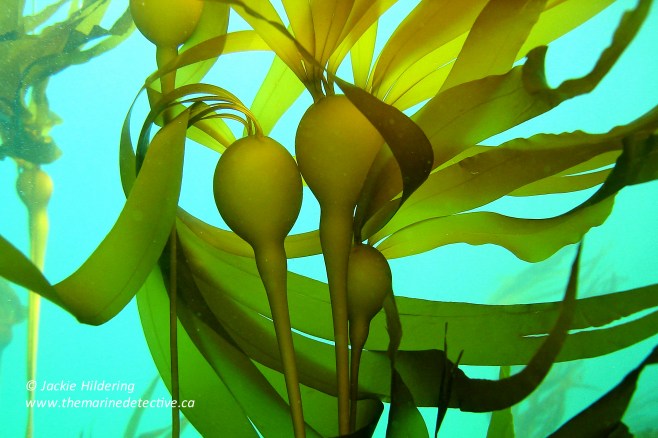
Sun streaming through bull kelp forest ©Jackie Hildering

Why are these images received as they are?  Many answers are possible from a pure aesthetic appreciation of kelp’s form and colour to the fact that kelp forests are literally at the surface, recognizable but submerged in mystery.

But, maybe, just maybe there’s a deep connection born out of knowing that we are dependent on marine algae for every breath we take.

And that – gives me hope.

For more kelp images, please click here for my gallery.

Note: Seaweeds, kelp and phytoplankton photosynthesize but are (most often) not classified as plants. They are algae. For an explanation of the classification, distinction and scientific debate, see:  “The Seaweed Site – “What are algae?” 

What’s At Stake – Images Speaking Louder Than Words

Three minutes of images speaking louder than words . . .

This short slide show of my images testifies to the astonishing marine biodiversity of Northern Vancouver Island and what is put at risk with projects like the Enbridge Northern Gateway Project which would bring super-tanker traffic of toxic bitumen and condensate to B.C.’s fragile coast, and to the waters on which we depend for oxygen, food, buffering of climate change gases, aesthetics and so much more.

I have submitted this slide show for inclusion on “Hope, the Whale”, a 25′ whale sculpture being brought to the Vancouver Enbridge public hearings (January 14 to 18, 2013) “to symbolize the expansive and growing community of people with a vision of an oil-free coast in BC. The sculpture is designed to be a welcoming, collaborative, visual, interactive and peaceful approach to supporting a healthy environment. The whale will amplify our a collective messages of hope and a vision for a healthy ocean, water, land, communities, green economy, cultures and people.” See this link to contribute your message.

For more information, see my testimony to the Joint Review Panel included in my blog item “Super Natural or Super Tanker?” at this link.

Success! No Tidal Turbines in Whale Epicentre

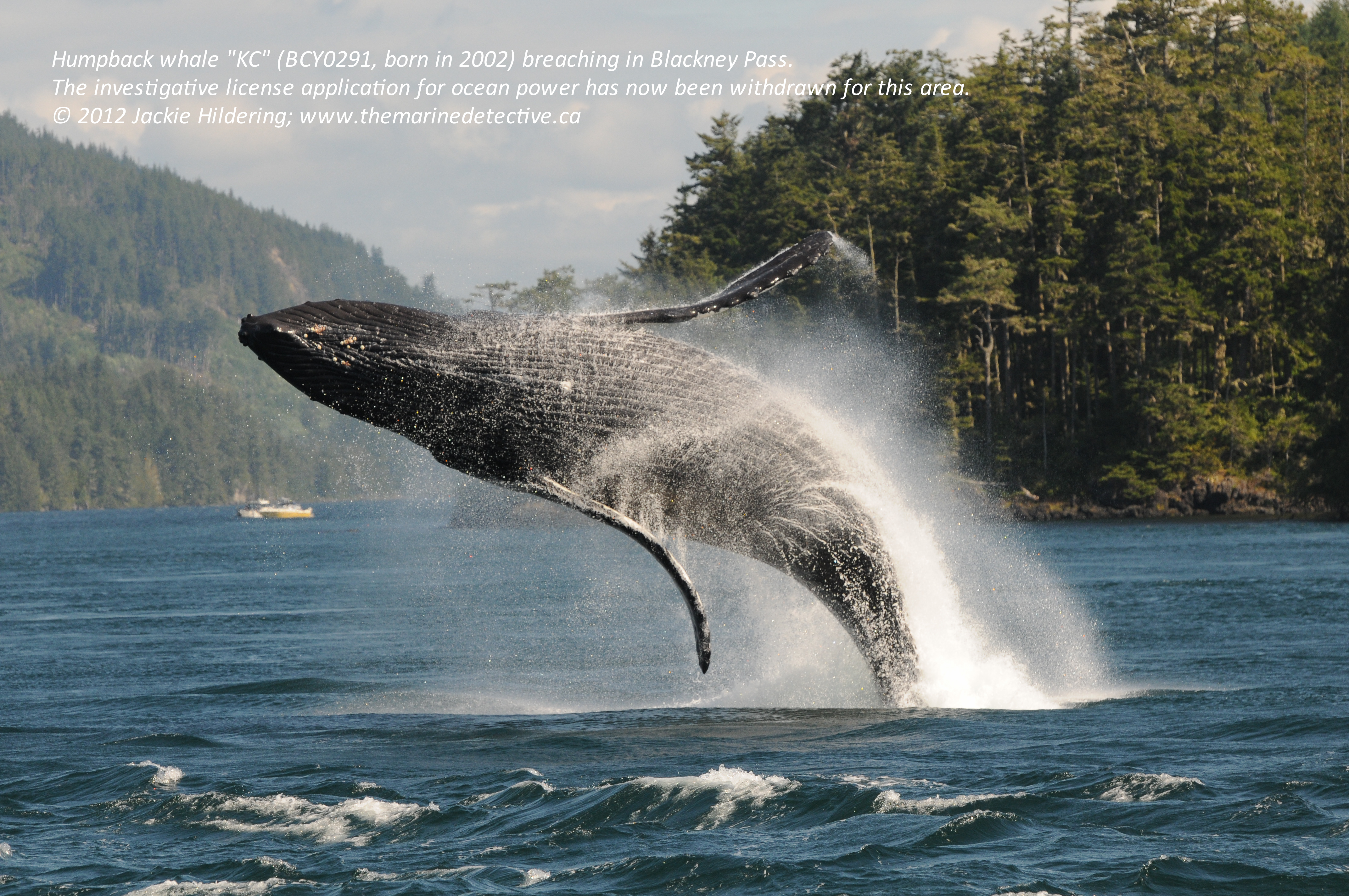
“KC” breaches in Blackney Pass. Photo: Hildering

As follow-up to last week’s call to action, “Tidal Turbines in Whale Epicentre? Hell No!” , I am so pleased to relay the following media release from myself, the OrcaLab and the proponent, SRM Projects Ltd

The short of it is, due to the efforts of many (including you) and the integrity and ethics of the proponent – the application for an investigative license for ocean power in whale critical habitat has been withdrawn. 

Please read further below.

 Media Coverage:

For details of how this resolve was achieved see this OrcaLab blog item. 

Humpback whale “KC” (BCY0291, born in 2002) breaching in Blackney Pass.
The investigative license application for ocean power has now been withdrawn for this area.
© 2012 Jackie Hildering; http://www.themarinedetective.ca

Tidal Turbines in Whale Epicentre? Hell No!

[Updates: November 18, 2012 – the application for an investigative license for ocean power in whale critical habitat has been withdrawn. Please see the media release at this link.
November 14, 2012 – To our surprise, the deadline to provide comment regarding the land tenure has been extended, it is now also December 2nd.
November 13, 2012 – As testimony to how serious this is – international Whale and Dolphin Conservation (WDC) has picked this up and put out an action alert.]


For a bundling of media items on this see the end of the blog.] 

There are times when expletives like “Hell No!” are justified and I am sure you will agree this is one of those very unfortunate times and – your action is needed.

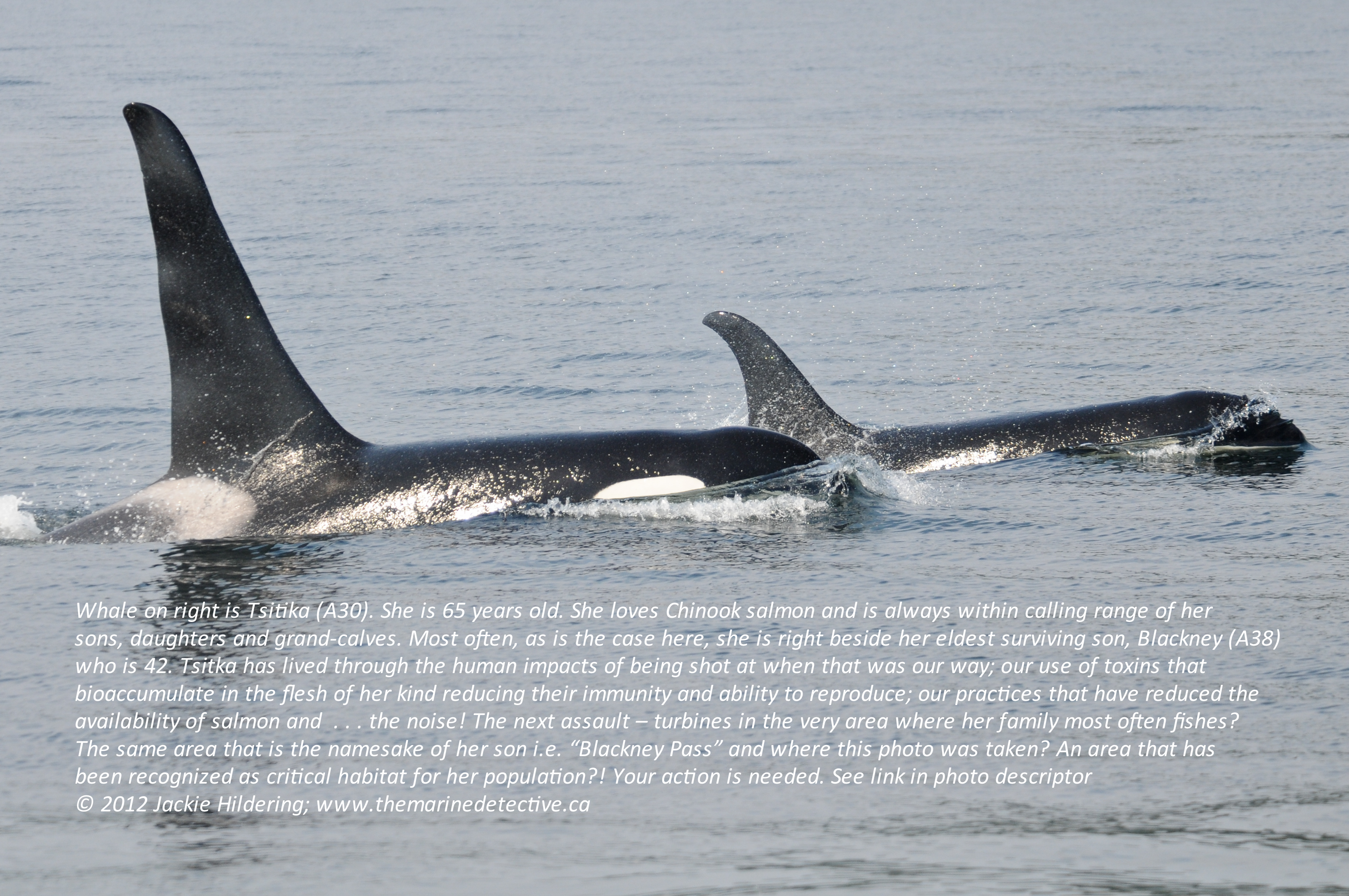
Blackney Pass off Johnstone Strait is an epicentre of whale activity and there is an application for an “Investigative License of Occupation – Ocean Power ” for this very area. Yep, that’s right . . . an application for “actual installment of technical investigative and monitoring equipment” that could lead to turbines being in critical whale habitat. The proponent is SRM Projects Ltd of Nanaimo, B.C.

While I of course support initiatives to reduce the use of climate-changing fossil fuels, to have turbines in critical whale habitat would be pure, simple, total, utter insanity. No matter how advanced the turbine technology, no amount of mitigation could compensate for the noise, prey reduction, and other disturbance to the whales.

The deadline for your two quick submissions is December 2nd. Below, I have strived to make commenting very expeditious for you, but first, a bit more on how preposterous the application is, just to fuel you up for those comments. 

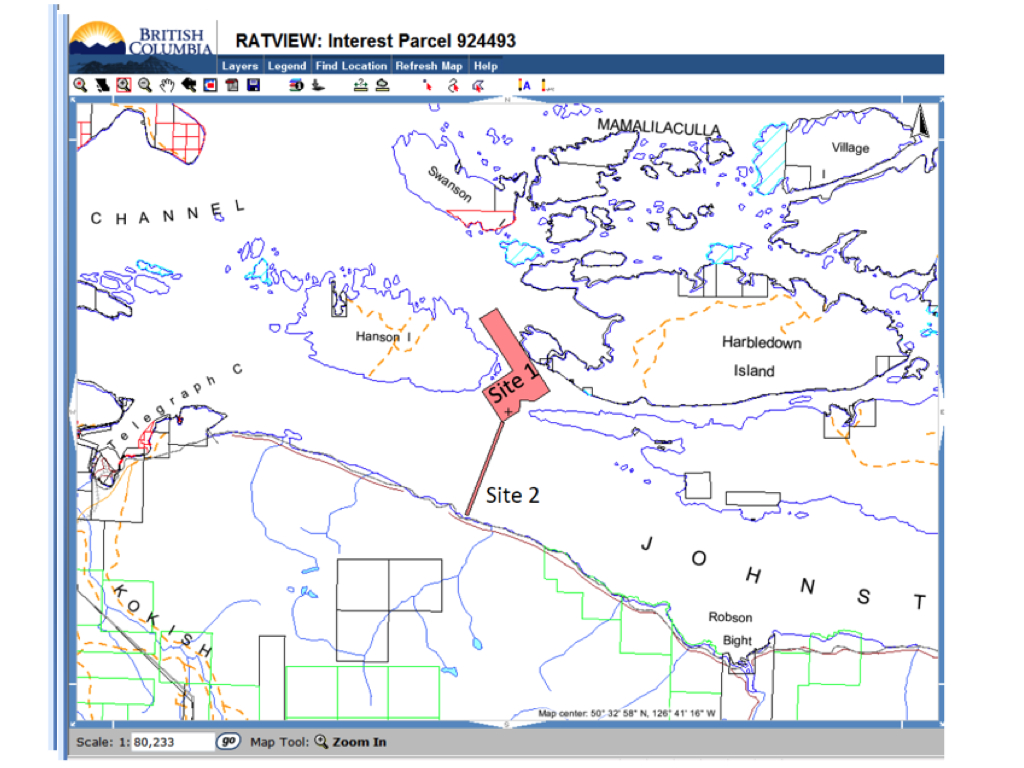
Here is the map showing the area for the “license of occupation“.

Source: Application for OCEAN ENERGY/INVESTIGATIVE AND MONITORING by SRM Projects Ltd of Nanaimo, B.C.  Click image to enlarge.

Here is the map showing the application site relative to the critical habitat map for northern resident killer whales from the Final Amended Recovery Strategy for Northern and Southern Resident Killer Whales in Canada. [Why was it amended you might ask? Because the federal government had to be taken to court TWICE to enforce their legal obligation to protect killer whale habitat – first ruling December 7, 2010; appeal ruling February 9th, 2011.]

Proposed site (red) relative to acknowledged northern resident killer whale critical habitat (cross hatched area). Source Amended Recovery Strategy for Northern and Southern Resident Killer Whales in Canada. Click image to enlarge.

The very ocean current that makes this area of interest for staking a claim for ocean energy is what makes this such a rich area for marine life. Multiple currents collide causing a merry-go-round in which plankton and fish are concentrated. The threatened northern resident killer whales feed here with great regularity, as do members of the threatened population of humpback whales, Steller sea lions, Dall’s porpoise, etc.

The importance of this area for killer whales can be supported by almost 4 decades of data collected by Department of Fisheries and Oceans and the OrcaLab. More recently, with regard to the humpbacks, I and my fellow researchers from the Marine Education and Research Society, can testify to how often these giants are in this area.

But it is the whales that speak with the most convincing voices of all. Here is the OrcaLab’s September 16th, 2012 visual and acoustic recording of the I15 and A30 matrilines of northern resident killer whales in the very area “in question”.

For researchers, whale watchers and on-line followers of the OrcaLab’s monitoring of whales, we all know that this kind of activity is not exceptional in this area and we know what is at stake.

As final stark evidence of how often there are whales in this area, note where, of all the places the OrcaLab could have put their whale-monitoring cameras and hydrophones, they are positioned. Then again, note the location of the proposed ocean power project.

Proposed site (red) relative to positions of the OrcaLab, and their hydrophones and cameras. Testimony to just how often there are whales here. Click image to enlarge.


One would hope that government agencies would surely deny this application but  . . . we have so many recent examples of this being tragically misplaced faith and we cannot count on there being any legislation in place for sound environmental assessment that would confirm environmental impacts. May I point out again that the government had to be taken to court TWICE to be order to acknowledge and protect killer whale critical habitat?!

Therefore, we collectively need to make our “Hell No!” heard now.

Essential action needed by December 2nd – submission to two government agencies. 

  1. By December 2nd, regarding the land tenure,  click this link, go to the bottom of this Integrated Land Management Bureau page, and comment on the project. Sample text below in green. [Note that, to our surprise, this deadline changed on November 14th, the date that was the initial deadline for comment to this agency.]
  2. By December 2nd, regarding the license of occupation, click this link and email your comment to Forests, Lands and Natural Resources Operations. You could use the same text as you did for the above.

If you can, come to the Port McNeill “community information session” given by the proponent, SRM Projects Ltd of Nanaimo, on November 20th in Room 4 of the Old School from 6:30 to 7:45 PM. There will also be an information session in Campbell River on November 22nd but this will focus on SRM’s proposals for the Discovery Passage and Seymour Narrows. It will be in the Rivercorp Boardroom, 900 Alder Street from 7:00 to 8:30 PM.

  • Sample text for both of the above. “With regard to Land File Number 1412946, the application for SRM Project Ltd’s “Investigative License of Occupation – Ocean Power” in the Blackney Passage / Johnstone Strait area, I write you to express that this application must not be granted. This is scientifically confirmed critical habitat for northern resident killer whales and it has been legally ruled that this must be protected as per Canada’s Species at Risk Act. In addition, the area is of great importance to humpback whales and many other marine species. No matter how advanced the turbine technology, no amount of mitigation could compensate for the noise, prey reduction, and other disturbance to the whales.”  You may even want to reference this blog and provide the link e.g. “For further details of the reasons for my great objection to this application see the rationale and resources provided at http://wp.me/pPW6V-LE.”

With this application being so ludicrous, I can’t help but wonder if I am missing something. Is this just part of a staking frenzy or is it some sort of distractor so that attention is taken away from something else?

SRM LTD’s projects are listed here. Again, reductions to our voracious fossil fuel consumption are very much needed but, at the cost of having turbines in whale critical habitat? Unequivocally – no. 

So much insanity  . . . so little time.  Sigh.

Huge gratitude and respect to Angela Smith for being the one to take note of the notification of this application and to Leah Robinson for ensuring I had many of the details I needed for this blog.

Media items:

References:

This posting on my FaceBook page has had success in creating further awareness. Feel free to share! Whale on right is Tsitika (A30). She is 65 years old. She loves Chinook salmon and is always within calling range of her sons, daughters and grand-calves. Most often, as is the case here, she is right beside her eldest surviving son, Blackney (A38) who is 42. Tsitka has lived through the human impacts of being shot at when that was our way; our use of toxins that bioaccumulate in the flesh of her kind reducing their immunity and ability to reproduce; our practices that have reduced the availability of salmon and . . . the noise! The next assault – turbines in the very area where her family most often fishes? The same area that is the namesake of her son i.e. “Blackney Pass” and where this photo was taken? The area that is designated as critical habitat for her population?

I, Mermaid. You Too?

Northeast Pacific mermaid. Even underwater they are dedicated to marine conservation. Photo: Jacqui Engel.

So I don’t look much like the mermaids of folklore, but I am absolutely the real thing.

I, in fact, look more like a Steller sea lion when suited up in my dive gear (not that they are convinced).

This resemblance to sea lions may even soon be strengthened if the joys of menopause lead to my growing long, stiff facial hairs like their vibrissae. Hum, maybe that won’t be all bad since I will be able to sense vibrations in water from afar .  . . but back to the topic at hand.

Northeast Pacific mermaid displaying underwater euphoria. Photo: Jacqui Engel.

In having now painted anything but the image of a waifish, goddess-like denzin of the deep for you, I will likely need to provide some very strong evidence that I am indeed – a mermaid.

Not that I need you to believe me.

The important thing is for you to be able recognize if YOU are a mer-person too. In fact, a great deal is at stake if you don’t recognize it.

No doubt that you are infinitely thankful that I am here to help since there’s a lot of misinformation out there about we mer-people. You know – all that tail-like-a-fish, having no immortal soul, must marry a human stuff.

Mermaid 3

Note mermaid blissed-out expression even when only near the Ocean’s surface. Photo: Peter Jucker.

Reality is, we look pretty much like other people . . . most of the time.

However, if, for some terrible reason, we are removed from the sight and smell of the ocean for any significant period, this provides one of the two times when it is really easy to identify a mer-person.

The clues?  Agitation, a predilection to negativity, perpetual longing references to “Mother Ocean”, dry coughing, eating lots of salty chocolate, combative if blocked from getting back into or onto the Ocean and, indeed when in this state, we will deal out many a curse and could even drag someone underwater.

The only other time it is really easy to tell we are mer-people is when we have just returned from Mother Ocean. The contrast to our non-marine state is apparently extreme. We present as being deeply peaceful, patient, centered, highly eloquent, rational, and blissed-out.

Rare two-headed mermaid. Head on right = Jacqui Engel who may not be so happy with me after I post this photo.

The physiology behind this has been the subject of many scientific studies. The research shows that mer-people’s heart rate and blood pressure is reduced by 31.721% when in or on the Ocean and that the endorphin content of our blood also rises by 47.913% (give or take a thousandth of a percent). 

As a mermaid, I of course know how I feel when submerging into the Ocean or when I drift on her surface. It feels like escaping from the insanity of terrestrial human life for a while; living raptly in the moment; and returning to quiet, extreme beauty, and sensibility.

Extraordinarily rare 3-headed mermaid. Head on left = Terina Hancock. Head in middle = Natasha Dickinson. Here too there may be some issues with the other heads not being so happy with me. Photo: Jacqui Engel.

It was a surprise to me though how quickly those around me understood my mermaid needs. Many is the time I have been told “Jackie, you need to go diving” or “Jackie, I think you need to go study humpback whales today”.  Conversely, I will get to hear “You seem better today. Did you go diving?”

Why, after having gone diving, I apparently even have a much better sense of humour and a tendency to engage in a bit of self-mockery. Hum, I wonder if this might be apparent here since I did go diving yesterday?

Can you believe it?! Another 3-headed mermaid! Head on left = Jacqui Engel. Head in centre = Natasha Dickinson. Photo by mermaid with very long arms.

Does any of this sound like it applies to you? Ask those around you to confirm if you manifest the signs.  Look around your home. Do you see many marine symbols and/or artifacts? 

I suspect that there are many fellow mer-people here in the demographic of the “The Marine Detective” community.

Speaking from my own experience, it is very important that your mer-personness gets diagnosed as soon as possible.

It’s not only for your own good and the sanity of the humans around you. It’s for the health of our Ocean.

As mer-people, we above all others know the essential soul-calming, life-giving, inspiration-inducing, positive and essential source that is Mother Ocean.

While on land, make it count! Be the walking protectors for all that is dependent upon the sea.

Speak for our marine brethren who cannot speak for themselves!

Mer-people unite!


Grunt Sculpin – Little Fish, BIG Attitude!

Last updated: March 4, 2024
Meet the fish that so often has people exclaiming “It lives HERE?!”

Yep, the tiny Grunt Sculpin is a powerful ambassador for raising awareness about the depth of biodiversity hidden in the cold, dark, rich waters of the north east Pacific. 

We are programmed to associate warm waters with exotic-looking fish species but read below for the Grunt Sculpin’s astounding adaptations and masterful mimicry. 

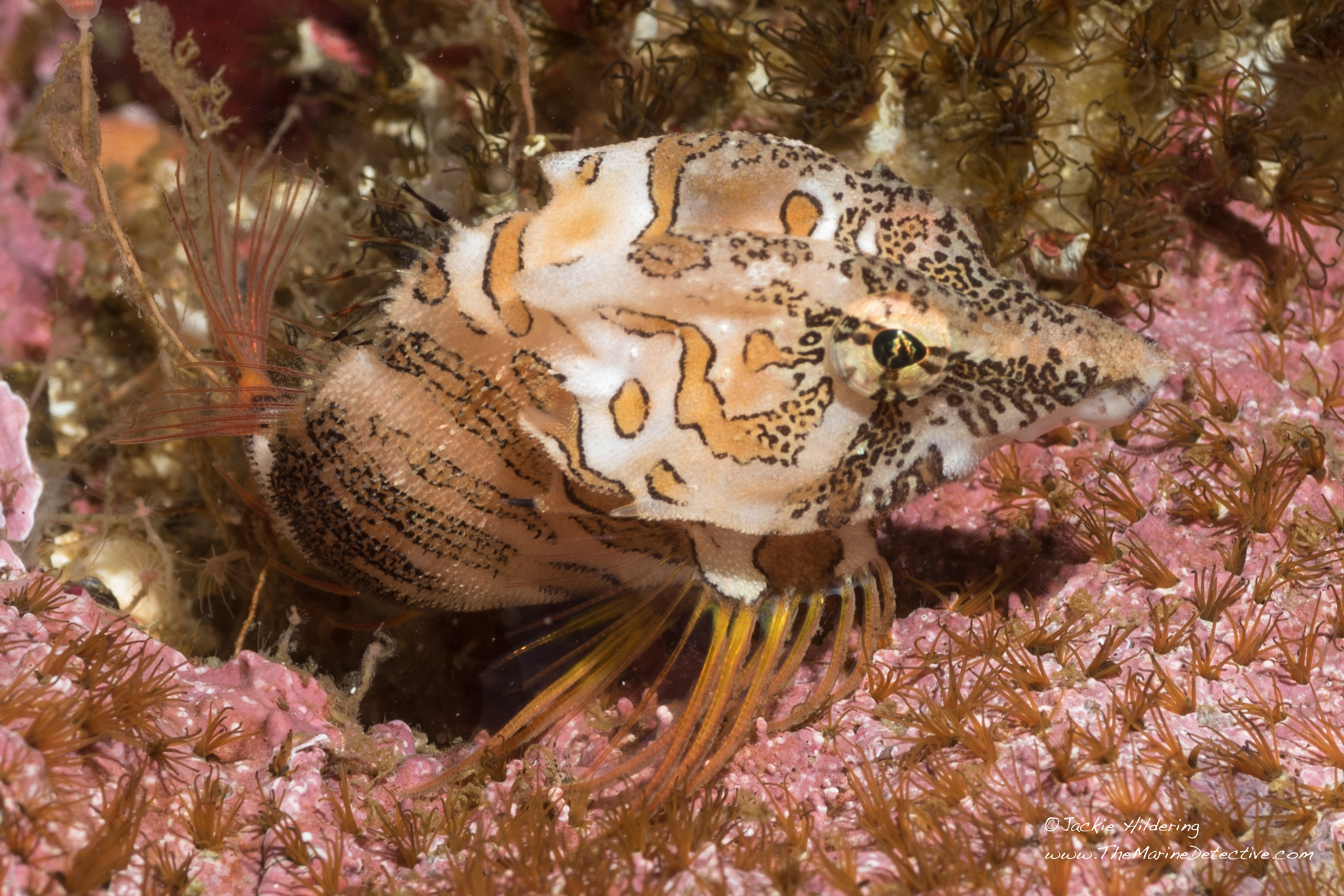
The species reaches only a maximum of ~9 cm.

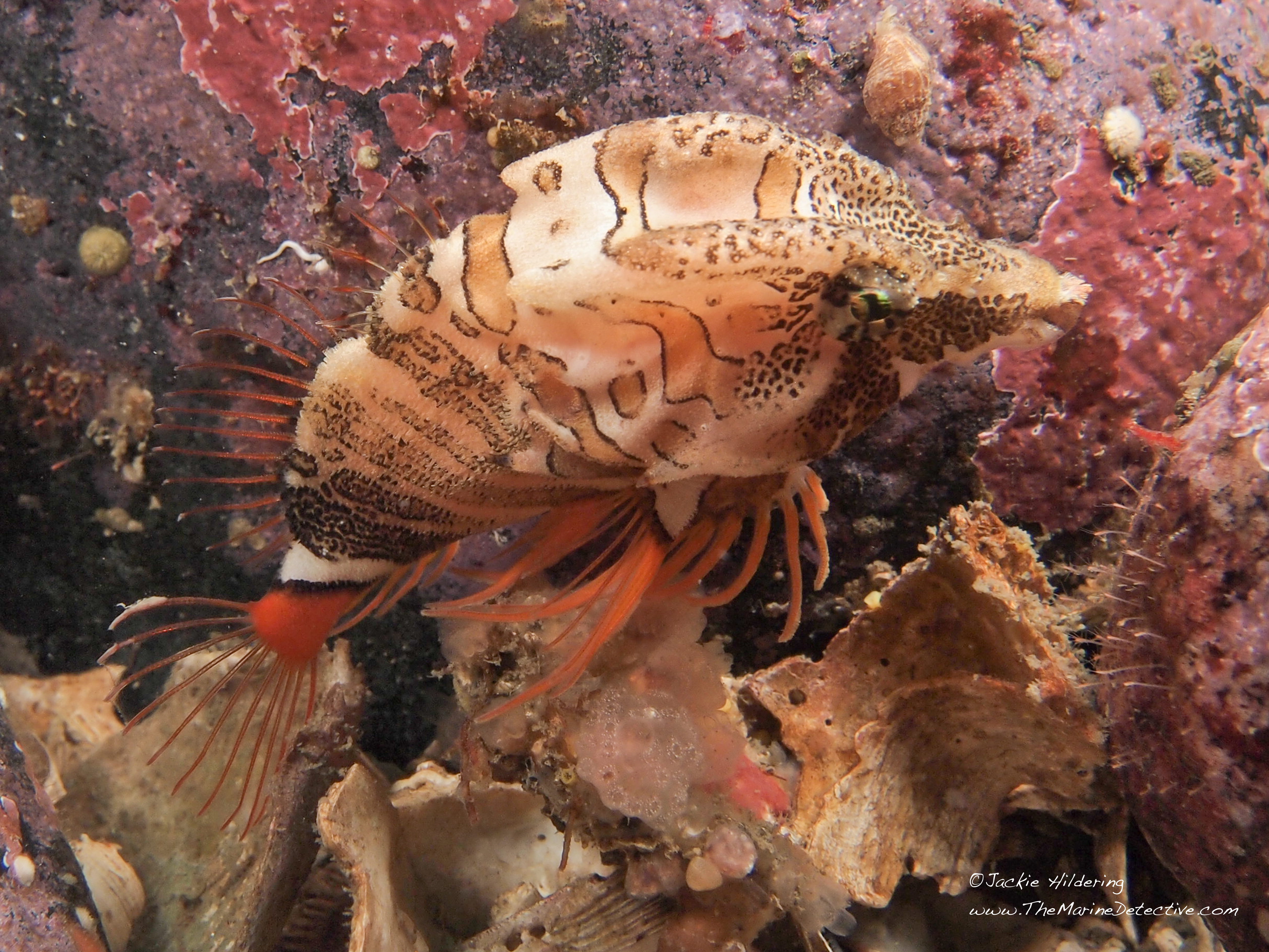
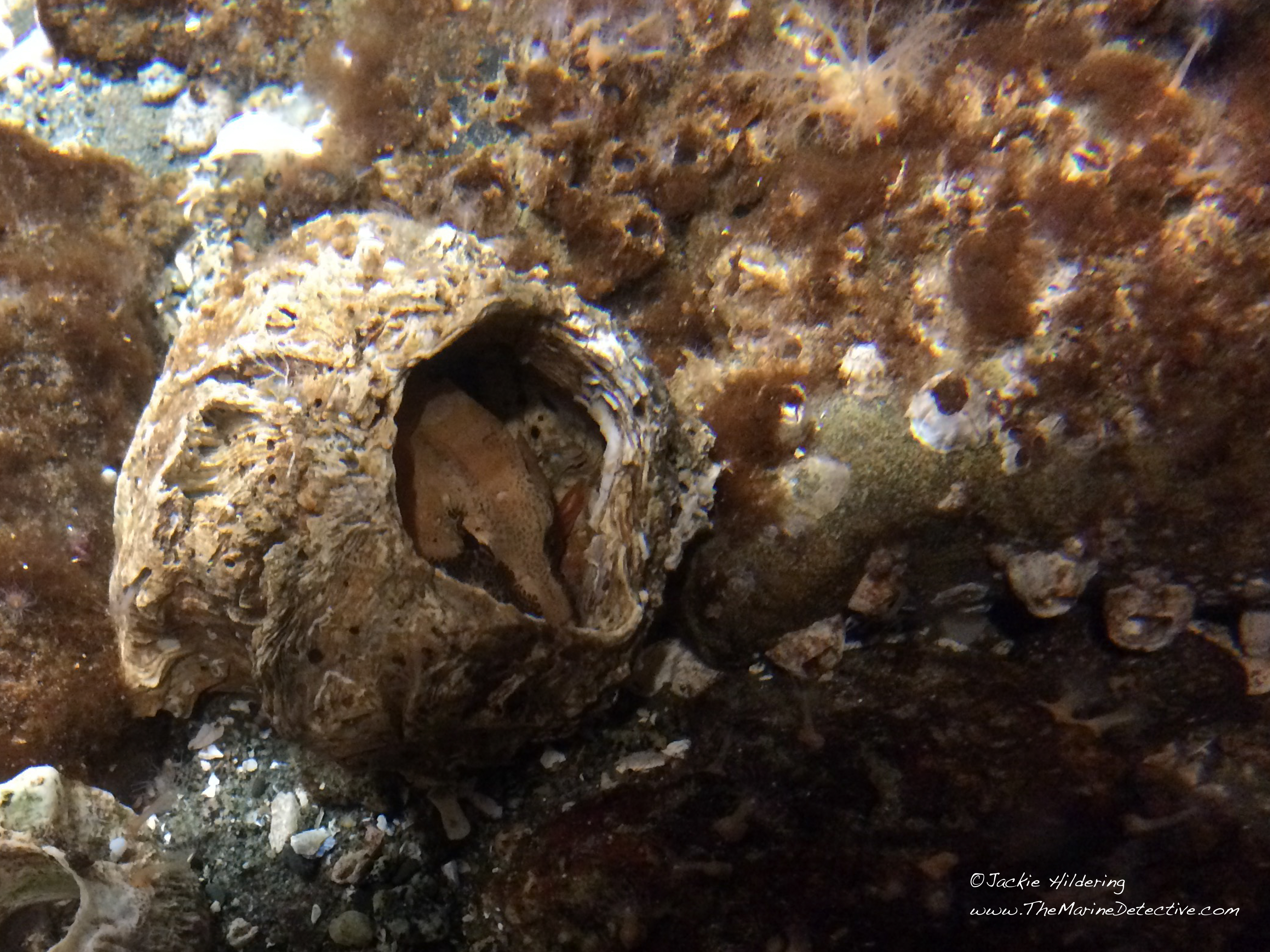
It is adapted to look like a Giant Acorn Barnacle (Balanus nubilis)!  When facing outward, its pointy nose looks like a closed Giant Acorn Barnacle and when the fish turns around, its tail looks like the foot of the barnacle that rakes in plankton.

Adapted to look like a Giant Acorn Barnacle!
Closed Giant Acorn Barnacles. See how similar this is to the nose of a Grunt Sculpin?
Foot of a Giant Acorn Barnacle. The tail of a Grunt Sculpin looks so much like this!

This little fish has giant attitude. It can be highly territorial, hopping around on its pectoral fins in a strutting, jerky fashion.

You may think the males are the master strutters? Ha! The female is as fierce as can be. Reportedly, she will chase a male into a crack, an empty barnacle shell, or another place of no escape and guard him there until she is ready to lay her eggs. When she has laid them, the male is released to do his duty.

She watches him to ensure he fertilizes the eggs (up to 150 at a time) and then, according to some sources – she saunters off leaving the male to care for the eggs but may return once in a while to take on a shift

If you can’t find an empty barnacle shell. A cup will apparently do!

From Casey Cook, aquarist with the Aquarium of the Pacific (pers com 2022-12-19): “The female often pushes the male into guarding so she can roam. She will get very vocal, and demanding – making sure he does the job!”

From Fishes of the Salish Sea – Volume Three: After the eggs are fertilized ” . . . she then moves off leaving the male behind to guard the nest, although she may return occasionally to help with parental duties. When the time for hatching approaches, the guarding fish takes the eggs inside its mouth, swims out of the nest, and spits out the eggs into the water column. This breaks the egg shells and frees the larvae that then swim off as zooplankton.”

Very young Grunt Sculpin. The Red-Gilled Nudibranch in the upper part of the image is only about 2 cm 

About Grunt Sculpins’ diet also from Fishes of the Salish Sea: “With its small, pointed mouth, it is adept at removing a wide variety of small invertebrates from the water column, especially copepods, amphipods, isopods and shrimps., but it also consumes significant numbers of fish eggs and larvae.”

The Grunt Sculpin’s pointy “bill-like” head is reflected in the species’ scientific name.

With regards to classification, the scientific name Rhamphocottus richardsonii reflects the Greek word for beak “rhamphos” which is appropriate for the Grunt Sculpin’s bill-like snout. This makes some people think that the species looks like a seahorse but note that they are not closely related at all. The Grunt Sculpin is the only member of its genus. It is truly one of a kind.

Juvenile Grunt Sculpin #1 of 3 photos.
Juvenile Grunt Sculpin #2 of 3 photos. 
Juvenile Grunt Sculpin #3 of 3 photos. 

Oh, and are you wondering about the name “Grunt” Sculpin? Apparently the species grunts when it is taken out of the ocean. You would too! Likely it also grunts when being defensive underwater. It is also the sound I make in my delight when I find one. It will be a very loud grunt indeed if I ever find one guarding eggs or with its tail-end extended out of a barnacle.


Below, more of my photos of Grunt Sculpins. 🙂

Grunt Sculpin next to a Gold Dirona (nudibranch species). See him /her?
Grunt Sculpin and a Clown Dorid (another nudibranch species).
A Grunt Sculpin “strutting” over the ocean bottom. See the cloud of silt lifted off as a result?
Another Grunt Sculpin in an empty barnacle shell.
And another.
You can’t see me.
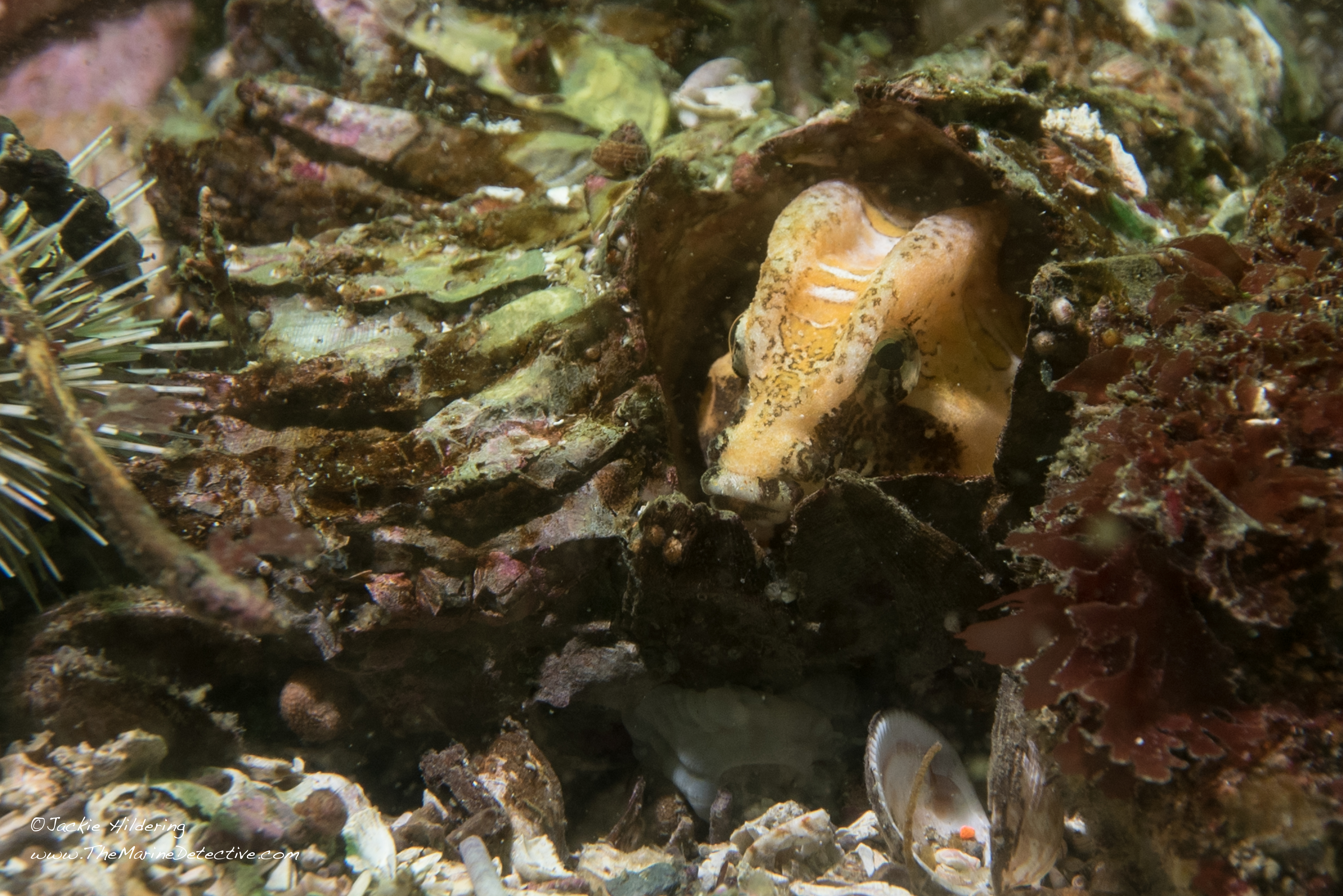
Grunt Sculpin hiding in a broken mussel shell.
Juvenile Grunt Sculpin
I wonder if this one is female and about ready to lay her eggs?

And some more photos of individuals to show how similar their markings are.


Sources:
– Aquarium of the Pacific – Grunt Sculpin
– Fishbase – Grunt Sculpin
– Love, M. S. (2011). Certainly more than you want to know about the fishes of the Pacific Coast: A postmodern experience. Santa Barbara, Calif: Really Big Press.

Gumboot Chitons Spawning!

I’m excited to share video with you of Gumboot Chitons spawning. These marine neighbours most often seem quite inanimate – having a life where they keep their undersides protected by sucking down hard on rocks but, when it’s time to mate . . . . . 

Female gumboot chiton

Female! © Jackie Hildering

First just a little background: “Chitons” are marine molluscs (soft bodied animals) that, rather than having one of more shells to protect themselves, they have 8 armoured plates surrounded by a thick band of muscle. This allows them to suction onto surfaces very effectively since the 8-plates give such flexibility that they can even get a good grip on surfaces that are not flat.

There are many members of the the chiton class but the Gumboot Chiton (Cryptochiton steller; aka Giant Pacific Chiton) is very unique in its appearance.

It’s another “the biggest of its kind in the world” that inhabits the cold, rich waters of the northeast Pacific. It can be 35 cm long and about 2 kg. They are very slow growing and very long lived! This source reports that chitons that are 15 cm long are likely 20 years old and that they may live to be more than 25. That’s one old gumboot!

The Gumboot Chiton is also the only chiton species that has flesh completely covering the 8 plates. The texture and colour of this “girdle” offers them great camouflage and is where the “gumboot” descriptor comes from. The genus name “Cryptochiton” relates to this camouflage and that the 8 plates are hidden under the girdle. These plates are very uniquely shaped, and well-described with the name “butterfly shells”.

Smaller dead Gumboot Chiton. Image shows the thick band of muscle with which Gumboot Chitons secure themselves. Fish species is Longfin Sculpin. ©Jackie Hildering.

Small dead Gumboot Chiton. Image shows the thick band of muscle with which Gumboot Chitons secure themselves. Fish in this image is a Longfin Sculpin. ©Jackie Hildering.

Apparently some First Nations did sometimes chew on this species but I am SURE that this is not the cultural origin of some people referring to this species as “wandering meatloaf”!

I don’t know where I picked this up, but I believe that one of the First Nations’ names for gumboot chitons translates (very) loosely, into “stuck on rock with face forever”. This would be an incredibly good descriptor since most chitons stay “face” down, grazing on algae by scraping with the sharp teeth-like structures of their radula. Thereby, they don’t expose their soft bodies and reduce the chance of predation. 

jackie-hildering-one-time-use-as-specified-15308

Gumboot Chitons feeding on dead Bull Kelp. ©Jackie Hildering.

I once found a Gumboot Chiton that had been dislodged by a predator at low tide. It is then that I learned that they have the ability to curl up on themselves like a pill bug!

But outside of a rare experience like this, you don’t often get a chance to see how very alive and animal-like they are.

Unless . . . they are spawning. 

Then, up came the bodies of the Gumboot Chitons, into a very unique funnel-like shape. The “gonadal pores” are near the bottom end of the animals, but by positioning themselves in this shape, they channel the sex cells upward.

When spawning, you can clearly see which Gumboot Chitons are male and which are female!

It was just remarkable to see this, feeling truly as if some secret world was being revealed, and the coordinated timing of the spawning was astonishing.

Of course when you are a broadcast spawner, you need to release copious amounts of sex cells and need to do so at the same time or there will be even less chance that egg meets sperm. You can imagine how many eggs need to be fertilized if any of your zooplankton offspring are going to survive since so many animals feed on plankton.

To my knowledge, science has not concluded exactly what the cues are for “Hey fellow Gumbooot Chitons, it’s spawn time NOW!”  It has to be temperature, light, tide and/or amount of food that determines the time is right.

Hum . . . seems to me that those cues may be significant between individuals of our species too!

Additional images:

Chiton plates on the right are those of the Gumboot Chiton.

Chiton plates on the right are those of the Gumboot Chiton.

OLYMPUS DIGITAL CAMERA

Sometimes individuals have this mottled colour pattern. ©Jackie Hildering.

Gumboot Chiton predated on by Sunflower Star

Gumboot Chiton being ingested by a Sunflower Star. Unknown if this was the result of predation or if it is scavenging i.e. that the Gumboot Chiton was already dead. ©Jackie Hildering.

jackie-hildering-one-time-use-as-specified-03443

NOTE: I would normally NEVER disrupt a chiton as this would potentially damage the animal. The Gumboot Chiton in this image had been dislodged by a predator and was lying upside down. Used it as an opportunity to discuss ethics with the Sunset School students. We decided to right it and put it on a rock so that s/he could be protected again by sucking down ©Jackie Hildering.

The Reason You Can’t See to the Bottom . . . .

The 1.5 minute video below is my attempt to bring the astounding biodiversity of the cold, rich waters of the NE Pacific Ocean to the surface.

If there is one thing I hope to achieve with my photography, it is to shatter the perception that — because you can’t see to the bottom — there must not be much life in these waters.

The opposite it true.

The reason you can’t see to the bottom is because there is SO much life.

Please feel free to share the video widely. Hopefully it will enhance people feeling a connection to the ocean, wanting to undertake further conservation, and understanding what is at stake with high risk projects that worship short term-economic gain at the cost of long-term environmental devastation — like increasing tanker traffic along British Columbia’s precious coast.


Very Rare Fish Find: King-of-the-Salmon (Trachipterus altivelis)

Last updated 2026-01-09
The original post below was about a sighting of this species in Port McNeill in 2012. The blog has since been updated with additional sightings and details (including video about the species astounding feeding adaptations).

King-of-the-Salmon at ~1.5m long. Photo: September 2017 by Collin Jay Johnson; near Tattoosh off Neah Bay Washington; depth ~100 fathoms (180 m).

See below for the extraordinary feeding method of the King-of-the-Salmon by which they extend their jaw. This member of the ribbonfish family belongs off our coast. To date I have not been able to verify if the origin of the name of the species is indeed from Makah legend. 


Here’s a finding to enhance your sense of wonder about the sea and how little we know about its inhabitants.

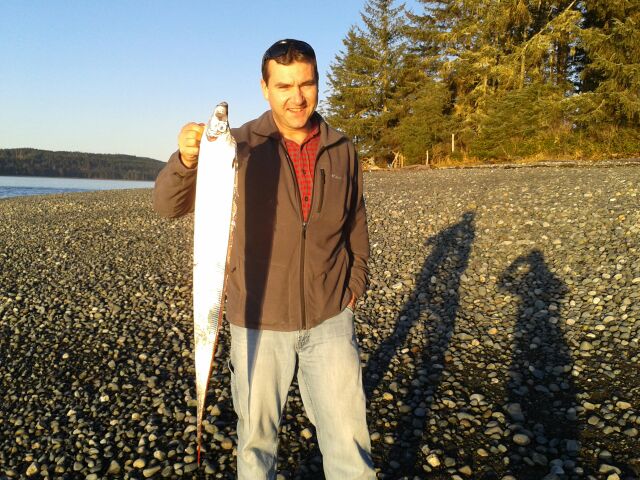
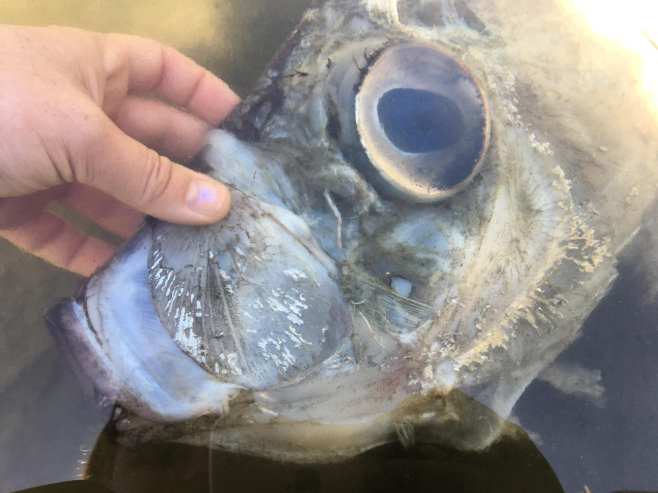
On March 23rd, 2012 Darren and Joanne Rowsell found this dead specimen on the beach at Lady Ellen Point, Port McNeill, British Columbia, Canada. When the photos landed in my inbox, I almost fell off my chair recognizing how rare a find this was. It’s a King-of-the-Salmon (Trachipterus altivelis). The adults feed in the open ocean at depths of 900+ m (3,000 feet) so they hardly ever wash ashore and I had never seen one before.

Darren Rowsell with the King-of-the-Salmon found on March 23rd, 2012 near Port McNeill. Photo Joanne Rowsell.
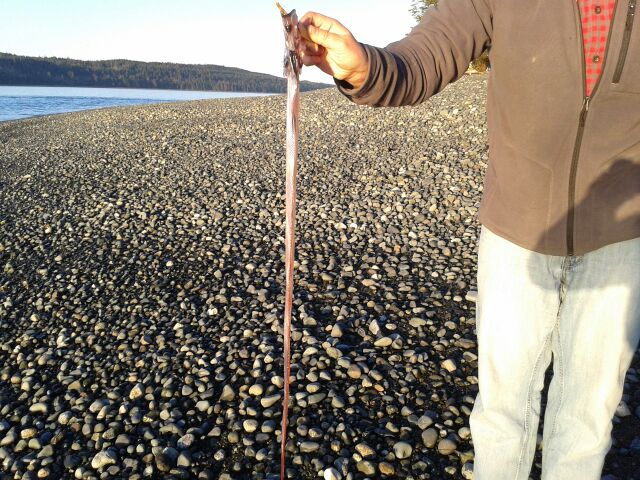
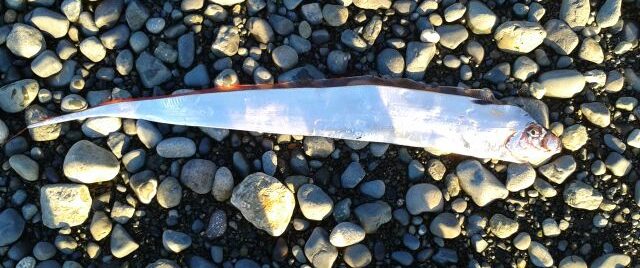
Easy to see why the King-of-the-Salmon belongs to the ribbonfish family. Photo Joanne Rowsell.

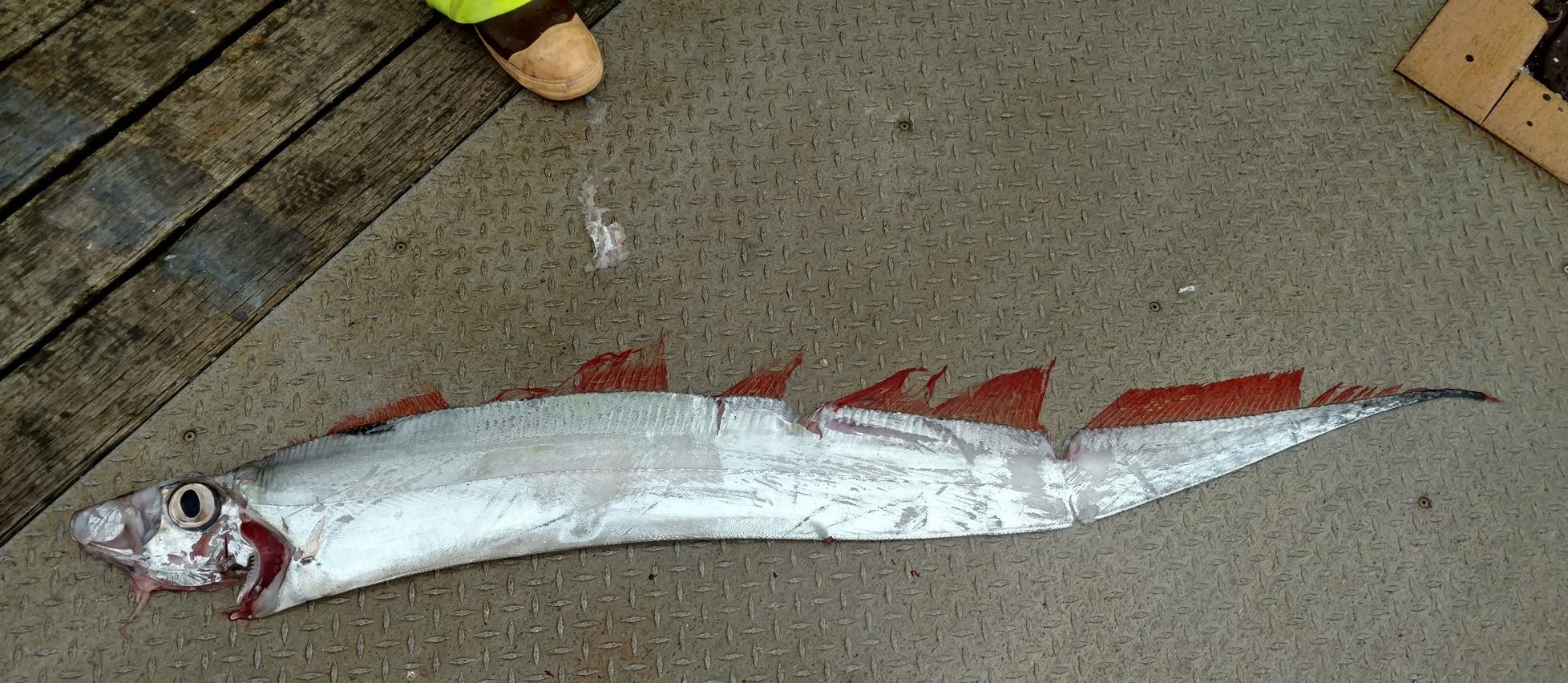
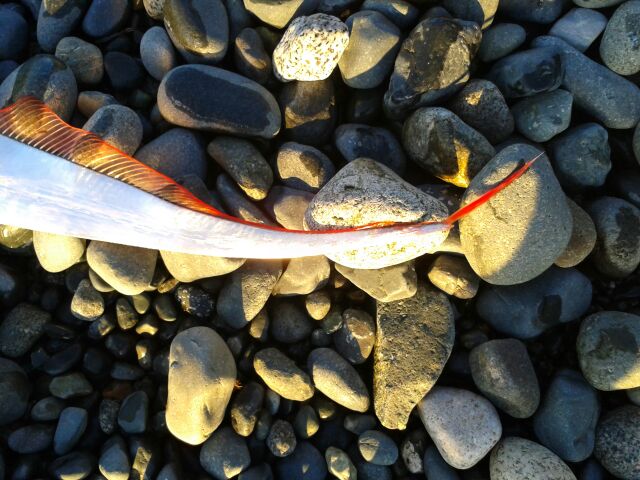
The King-of-the-Salmon belongs to the ribbonfish family (Trachipteridae). You’ll note from Joanne’s photos that the species is indeed very ribbon-like. It is extremely thin and maximum confirmed length is 2.45m (Savinykh and Baitalyuk. 2011). The long, high, crimson coloured dorsal fin is also very reminiscent of a ribbon, tapering down the full length of the fish’s back. These fish move in a snake-like fashion, undulating their long bodies.

The unique common name of the King-of-the-Salmon is said to originate from Makah First Nation legend. The legend is said to be that the fish was believed to be the “king” that would lead salmon back to their rivers to spawn and that to kill one was believed to bring bad luck, causing the death of the salmon.  The Makah, like other fisherfolk, must occasionally have caught one on their lines or in their nets. HOWEVER, I have never been able to verify if this is indeed a Makah legend.

King-of-the-Salmon. Photo Joanne Rowsell.
King-of-the-Salmon’s dorsal fin extends all the way down its back.
Photo Joanne Rowsell.

Video ©Josh Billauer showing the dorsal fin of a King-of-the-Salmon – November 2025 near San Diego.

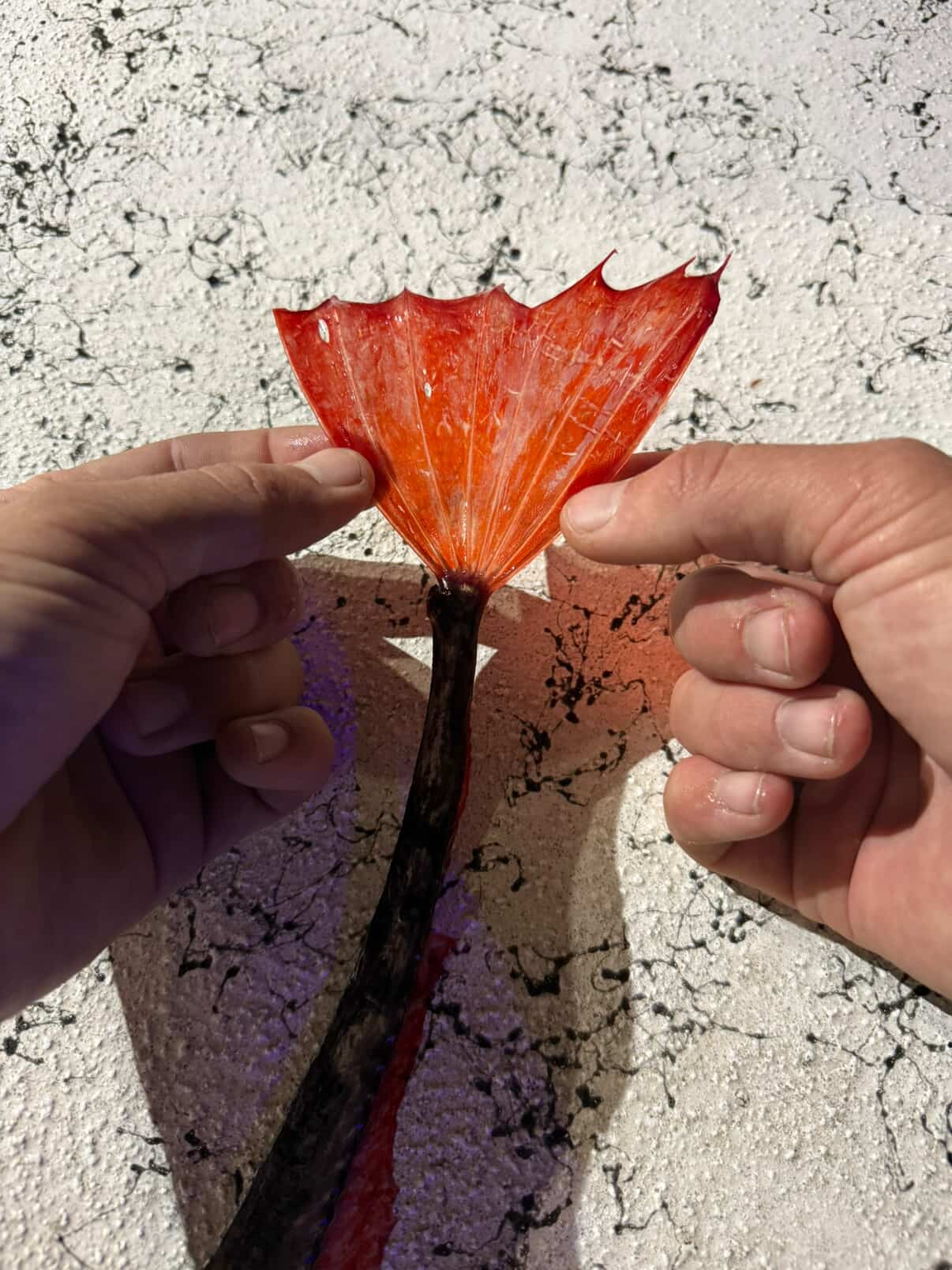
Caudal fin / tail of a King-of the-Salmon ©Josh Billauer – November 2025 near San Diego.

Range:

The species’ range is believed to be from the Gulf of Alaska to Chile.

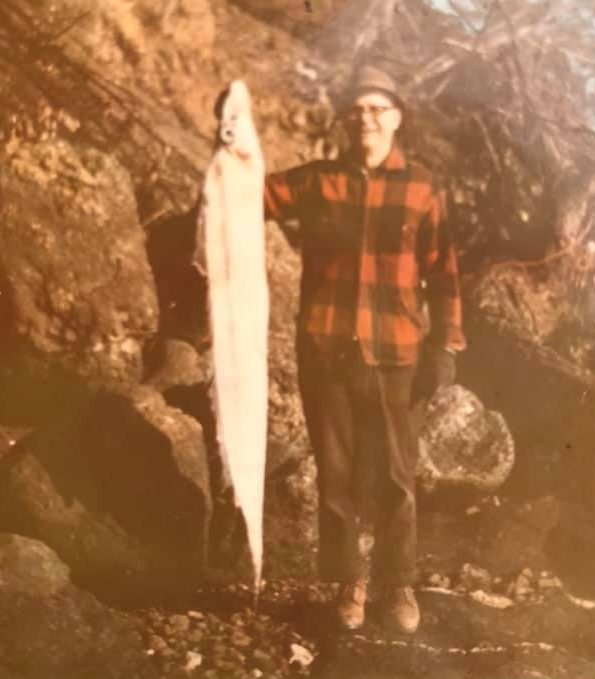
King-of-the-Salmon found at Freshwater Bay, Clallam County, Washington in 1973, by Oscar Stigen. Photo provided by his daughter Jean Stigen.

Diet and Feeding Method:

Smaller King-of-the-Salmon do feed closer to shore and their diet is known to include copepods, annelid worms, fish scales, and fish larvae. Larger individuals feed on copepods, krill (euphausids), polychaetes (bristle worms, small pelagic fish, young rockfish, squid, and octopus.  Part of what makes the species so unique is that they can capture (and process prey) by extreme protrusion of the upper jaw. See photos below.

From Ferry, et al (notably the ONLY research I could find on this species): “T. altivelis does appear to have earned the title of “most extreme”in terms of premaxillary protrusion. The distance to which the upper jaw is protruded anteriorly away from the head exceeds that of any other known species  . . .the gut was examined in an attempt to gain further insight into this speciesecology. The gut was empty, but the anatomy was unusual and potentially suggestive of extreme foraging habits. There were hundreds of very small diverticuli lining the gut, which suggest to us a mechanism for increasing digestive surface area and/or efficacy. This species has been described as a deep-midwater forager on crustacean zooplankton (Hart, 1973; Shenker, 1983), which is consistent with such mechanisms.”

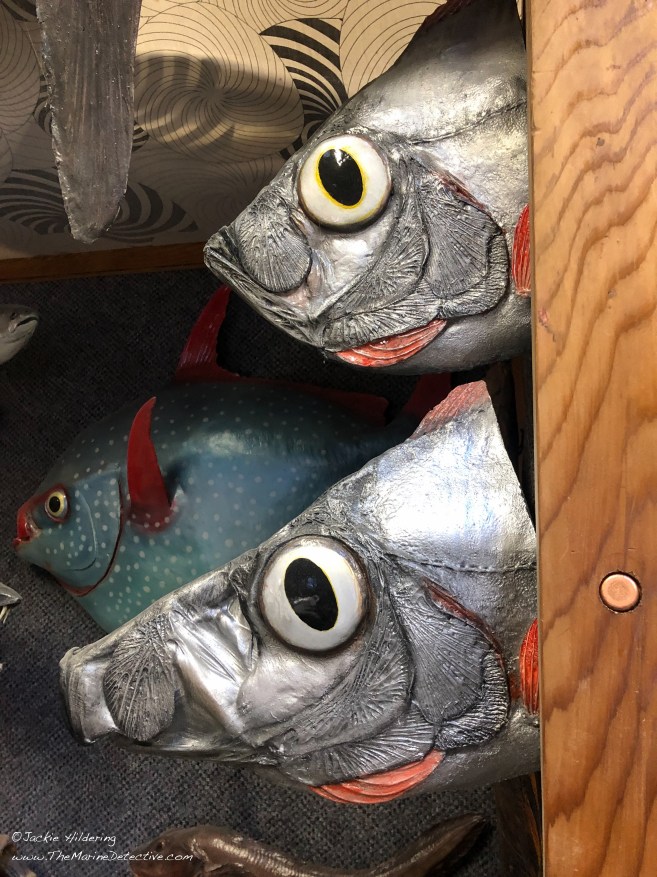
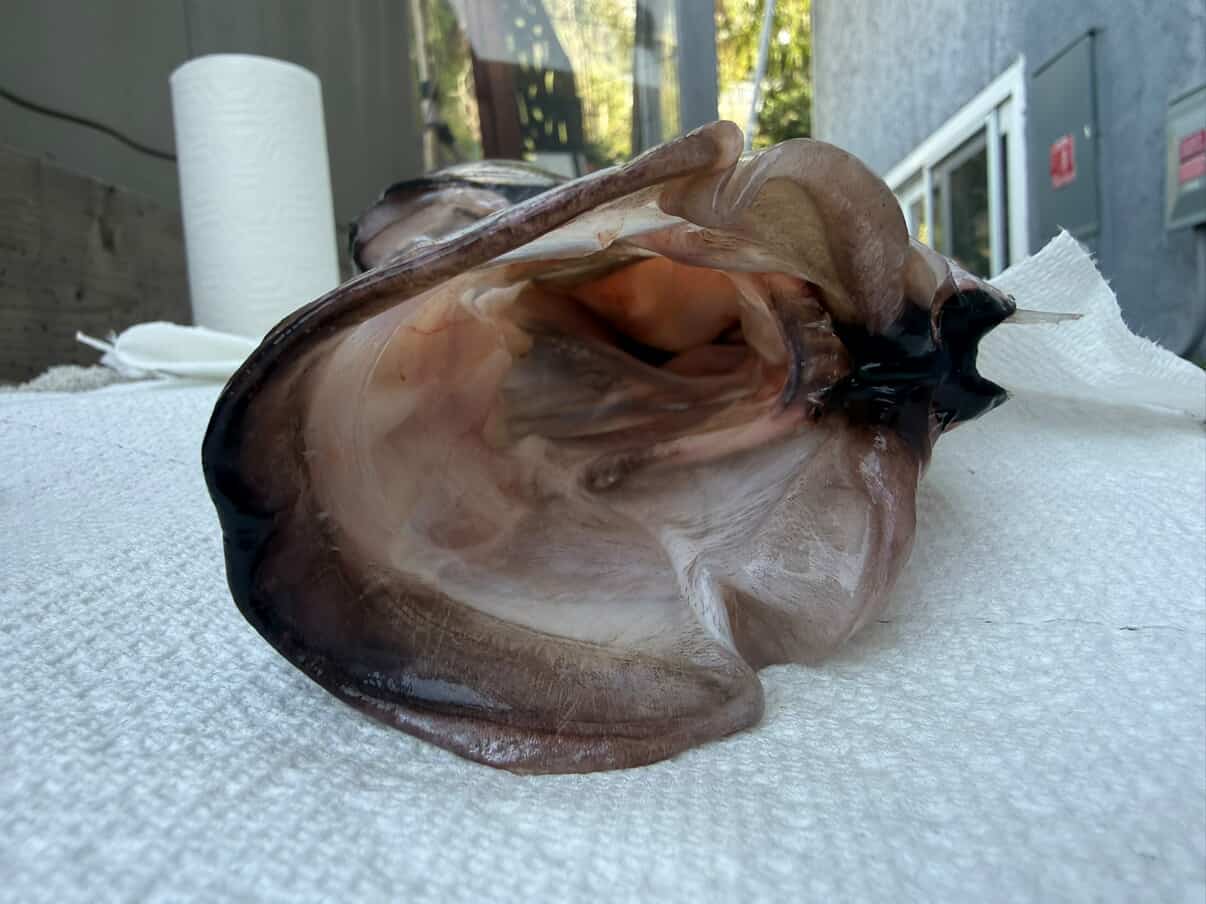
Replicas of the head of the same King-of-the-Salmon by Bilz Rockfish. Compare the top and bottom photo (cast from the SAME fish) to see the extreme capability of this fish to extend its jaw.  learned that the nose can push outward as you see by contrasting the top and bottom casts (from the same fish).
Photo: Harbor Wildwatch, June 8, 2020 which allows for insight into the protrusion method this fish uses to eat.

Video ©Josh Billauer showing how the King-of-the-Salmon can protrude its jaw – November 2025 near San Diego.

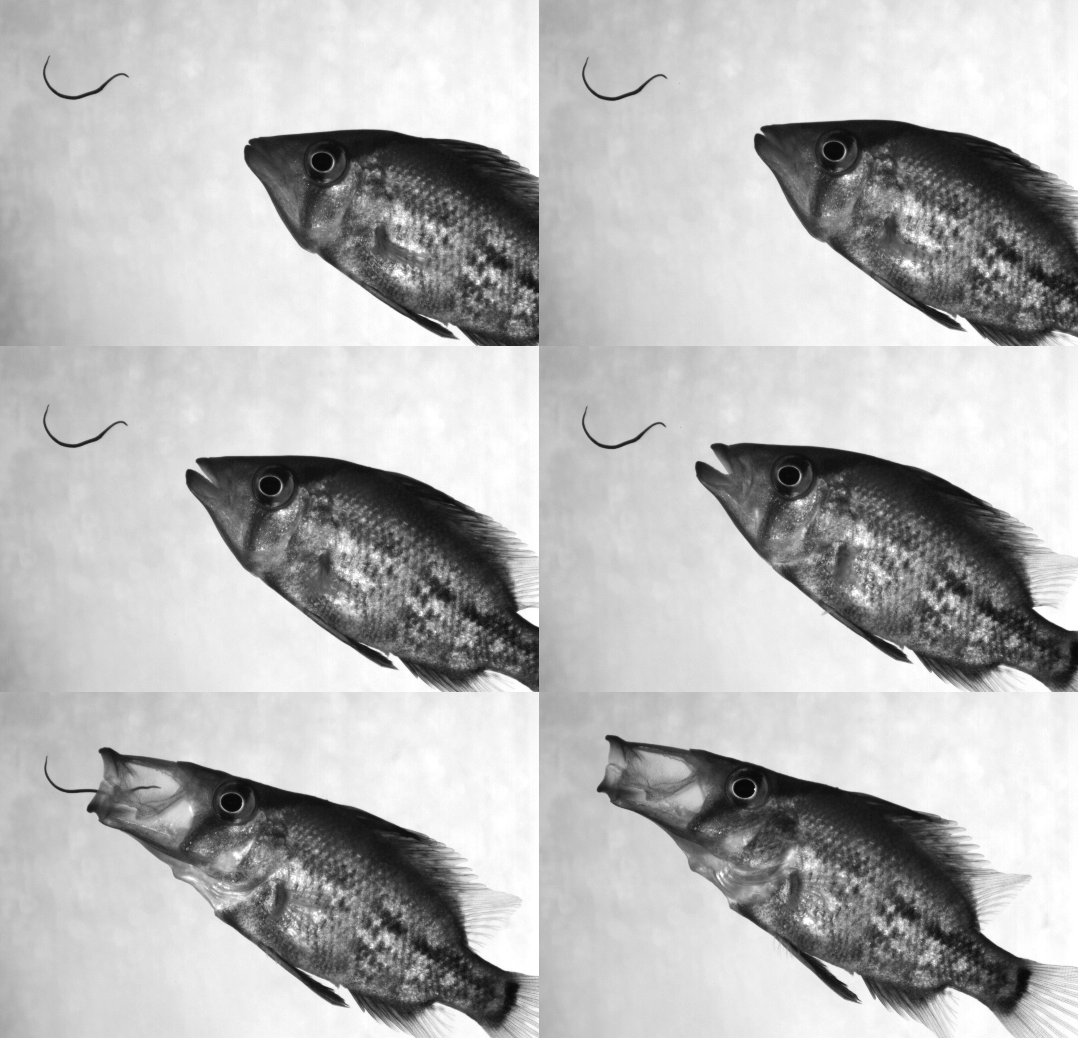
A different species but provides some insight into how fish jaws can protrude. Species in this slow-mo GIF is “the Neotropical cichlid, Caquetaia myersi, showing off its highly protrusible jaw while feeding on a black worm.” Source: Martinez et al.
Photo into the upper jaw of a King-of-the-Salmon ©Josh Billauer – November 2025 near San Diego.


Predation:

I presume that stomach content studies have allowed science to determine that the predators of the King-of-the-Salmon include the Bigeye Thresher Shark (Alopias superciloosus), and the Longnose Lancetfish (Alepisaurus ferox).

Swimming: 

From Dr. Gavin Hanke of the Royal BC Museum: “King-of-the-Salmon swim by passing a sine wave down their dorsal fin – they can get a fair bit of speed just by doing that. They can also reverse using the same fin flutter. They slowly turn by putting a curve in the body. However, in the first few seconds of the linked video you can see that they also swim in a more typical fishy way (using eel-like body oscillation) when they need a burst of speed or a really quick turn.” See video below of one swimming.


And THAT appears to be all that is known about the King-of-the-Salmon – yet another one of our remarkable marine neighbours.

From Ferry, et al (2019): ” While much work remains regarding the ecology of T. altivelisa nd its relatives, it is certain that this fish holds many surprises yet in store”. No doubt!


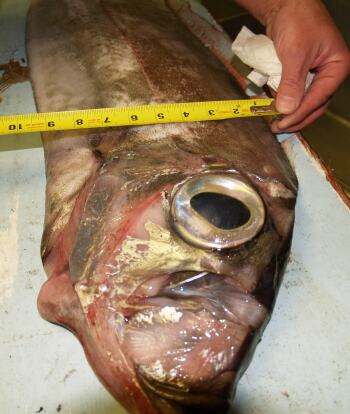
King-of-the-salmon found near Salem, Oregon in 2006. 1.83 m (6 foot) long and the head was about 23 cm (9 inches) wide. Source: Salem News; July 23, 2006; "Strange Fish Found on Beach Near Seaside" Click here to read the story.
King-of-the-Salmon found near Salem, Oregon in 2006. 1.83 m (6 foot) long and the head was about 23 cm (9 inches) wide. Source: Salem News; July 23, 2006; “Strange Fish Found on Beach Near Seaside”. Click here to read the story.

Sources:


Sightings from Washington and BC – photos and video.
NOT a comprehensive account of all sightings!


2021

May 12, 2021: King-of-the-Salmon washed up at Witty’s Lagoon near Mechosin documented by John Michael Thorne. 


2020

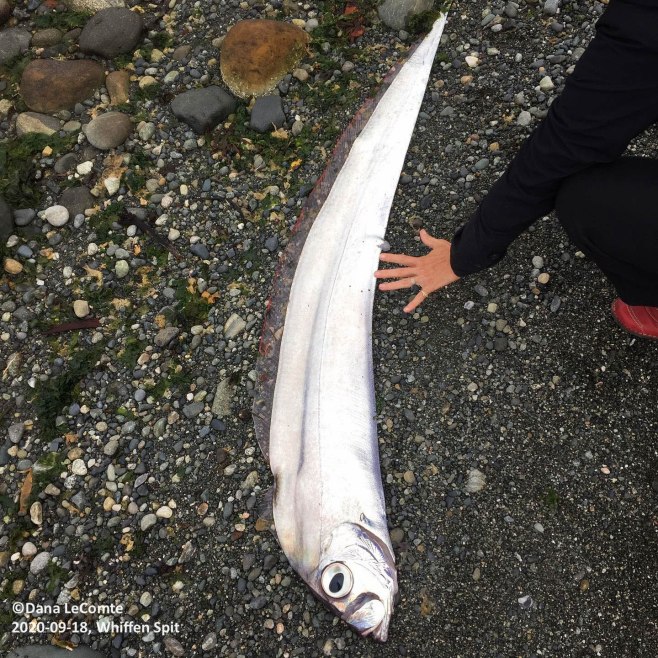
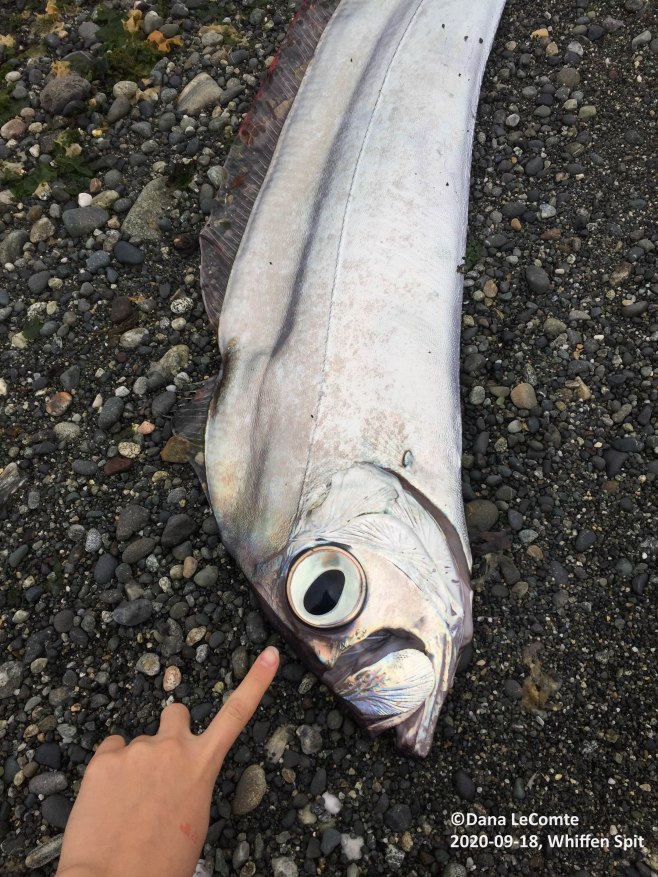
September 18, 2020: King-of-the-Salmon washed up at Whiffen Spit (Sooke) documented by Dana LeComte (photos below).

July 18, 2020: Live King-of-the-Salmon documented by Gary Bodine at Pillar Point, Washington. 

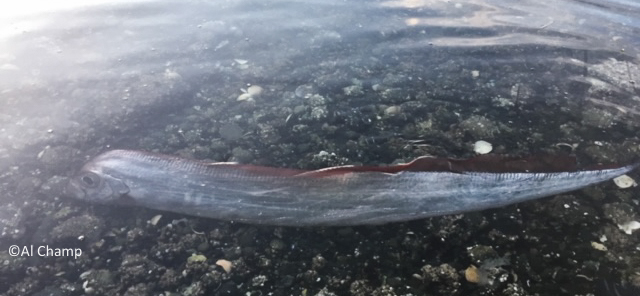
June 24, 2020: ~1.5 m long King-of-the-Salmon found struggling to stay upright by Al Champ and Wendy Cooper in East Sooke (photo below).

June 24, 2020 : ~1.5 m long King-of-the-Salmon in poor condition found by Al Champ and Wendy Cooper in East Sooke, across from the Sooke River. They strived to help it on its way but ran out of daylight, finding it was getting weaker and weaker and that it made no attempt to swim away.  

June 8, 2020: King-of-the-Salmon documented by Harbor WildWatch in Salt Creek, west of Port Angeles, Washington. They provided the insight that “We speculate that this individual swam too close to shore and was killed by the waves as there was no evidence of predation. These are thin delicate fish adapted to the deep ocean. The tide pushed it up into the creek where it was discovered.”


2019

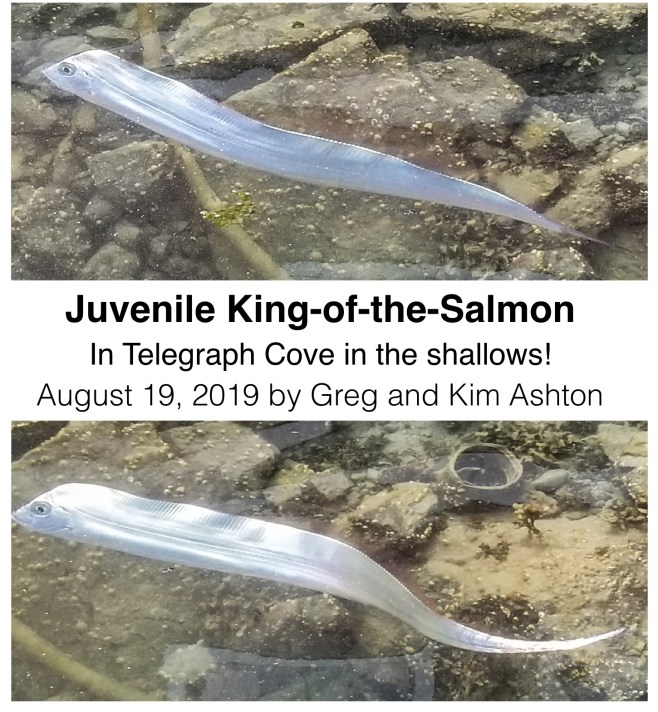
Sighting of a King-of-the-Salmon August 19, 2019 (at least 70 cm long). Greg and Kim Ashton relayed how “We had just tied up our boat in the marina and were walking to shore when Kim spotted what at first we thought was an eel, but quickly realized it wasn’t but some type of fish we had never seen before. It was in five to six feet [~2m] of water and then swam up into shallower water . . . I was amazed at how it seemed to be looking at us and how brightly colored chrome-like its body was . . .”. Video of this individual (below) reveals this individual may not have been healthy.

2017

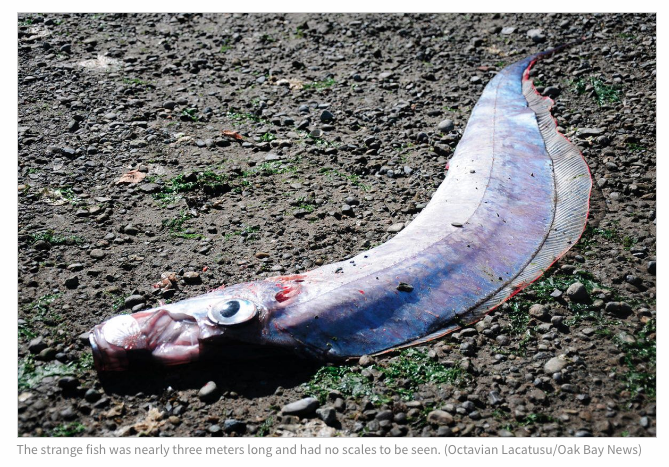
King-of-the-Salmon found near Oak Bay, British Columbia on September 21, 2017 by Ben Clinton Baker. It will end up on display in the Shaw Centre for the Salish Sea in Sidney, British Columbia. Photo: Oak Bay  

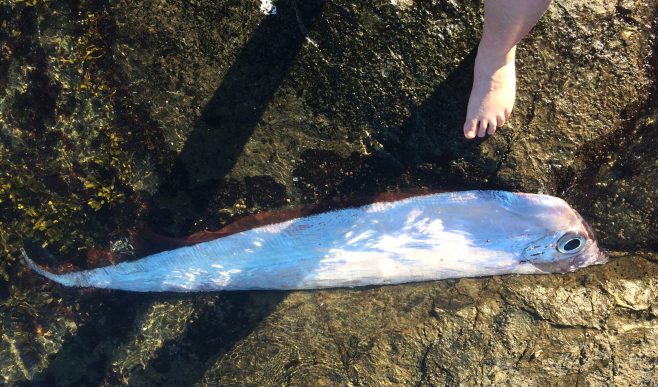
Second King-of-the-Salmon found near Oak Bay in September 2017. Photo: Emily Walsh, September 26, 2017.
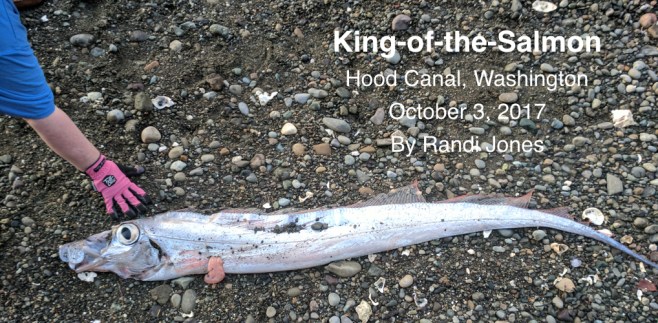
Third found: 1.8 m long female King-of-the-Salmon found on October 3rd, 2017 off Hood Canal, Washington by Chris and Randi Jones. As relayed to Randi by Davy Lowry of the Washington Department of Fish and Wildlife “this is the first reported occurrence of this species in Hood Canal ever, and the only other one found in Puget Sound was discovered on a beach back in the 1990s near Tacoma.”
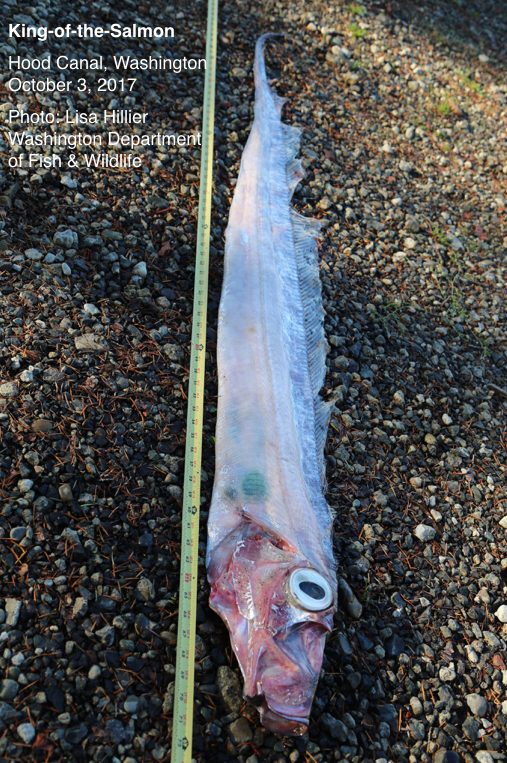
Same fish as in the photo above. Female King-of-the-Salmon found off Hood Canal, Washington on October 3, 2017 by Chris and Randi Jones. It was 1.8 m long (71′) and 3.3 kg (7.25 lb) and necropsy found that “there was nothing in the gut to indicate it had eaten recently”.  and Photo: Lisa Hillier; Washington Department of Fish & Wildlife. 
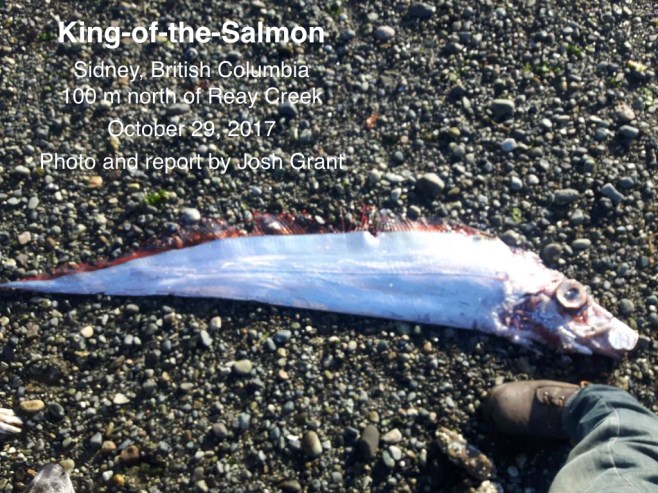
Fourth King-of-the-Salmon found in the fall of 2017 in southern British Columbia / northern Washington. This one was found on October 29th near Sidney British Columbia 100 m north of Reay Creek. Report and photo by Josh Grant. Coordinates: 48°38’03.3″N 123°24’22.7”W

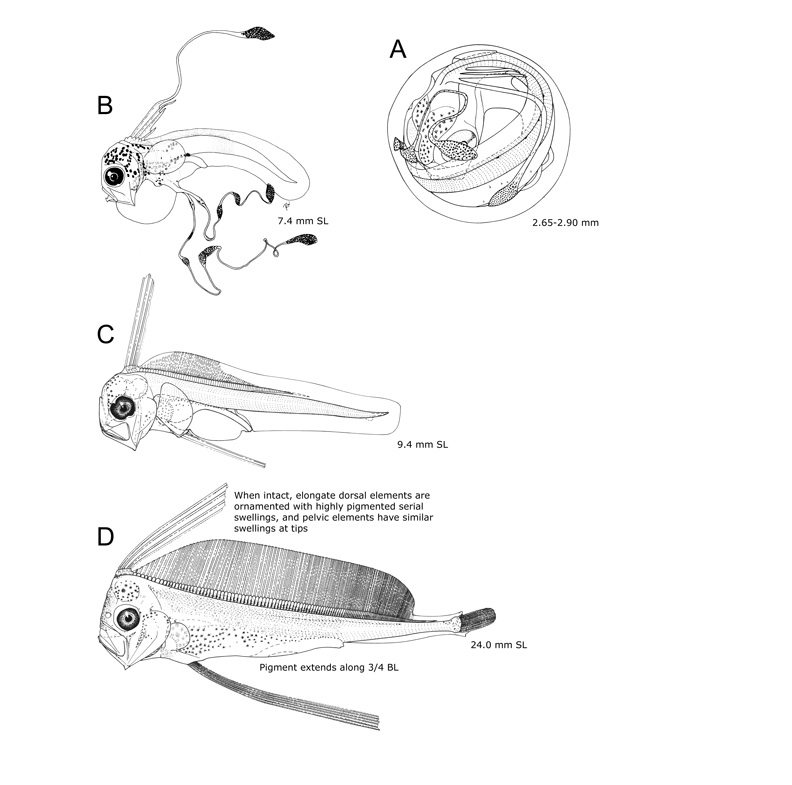
 Plankton life stages of the King-of-the-Salmon

Source: http://access.afsc.noaa.gov/ichthyo/LHDataIll.cfm?GSID=Trachipterus!altivelis
Credits:
A: Matarese, A.C., and E.M. Sandknop. 1984. Identification of fish eggs. In H.G. Moser, W.J. Richards, D.M. Cohen, M.P. Fahay, A.W. Kendall, Jr., and S.L Richardson (eds.), Ontogeny and systematics of fishes. Spec. Publ. 1, Am. Soc. Ichthyol. Herpetol., p. 27-31. Allen Press, Lawrence, KS, 760 p.
B: Charter, S.R., and H.G. Moser. 1996.Trachipteridae: Ribbonfishes. In H.G. Moser (ed.), The early stages of fishes in the California Current region. CalCOFI Atlas 33, p. 669-677. Allen Press, Lawrence, KS, 1505 p.
C and D: Matarese, A.C., A.W. Kendall, Jr., D.M. Blood, and B.M. Vinter. 1989.
Laboratory guide to early life history stages of Northeast Pacific fishes. NOAA Tech. Rep. NMFS 80, 652 p.

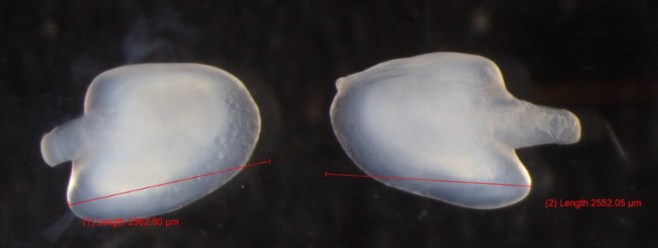
Otoliths / Ear Bones

Photo above and the following information was shared by Micah Quindazzi who is a masters student at the University of Victoria studying the King-of-the-Salmon. He extracted the ear bones (otoliths) of two full-grown adult King-of-the-Salmon (the September 18, 2020 and February 6, 2019 individuals). The photo shows the left and right otoliths from the September 18th individual. He shared that it is notable that the otoliths are tiny in comparison to the body size of the fish.