Join me in the cold, dark, life-sustaining NE Pacific Ocean to discover the great beauty, mystery and fragility hidden there.

Posts by The Marine Detective

Success! No Tidal Turbines in Whale Epicentre

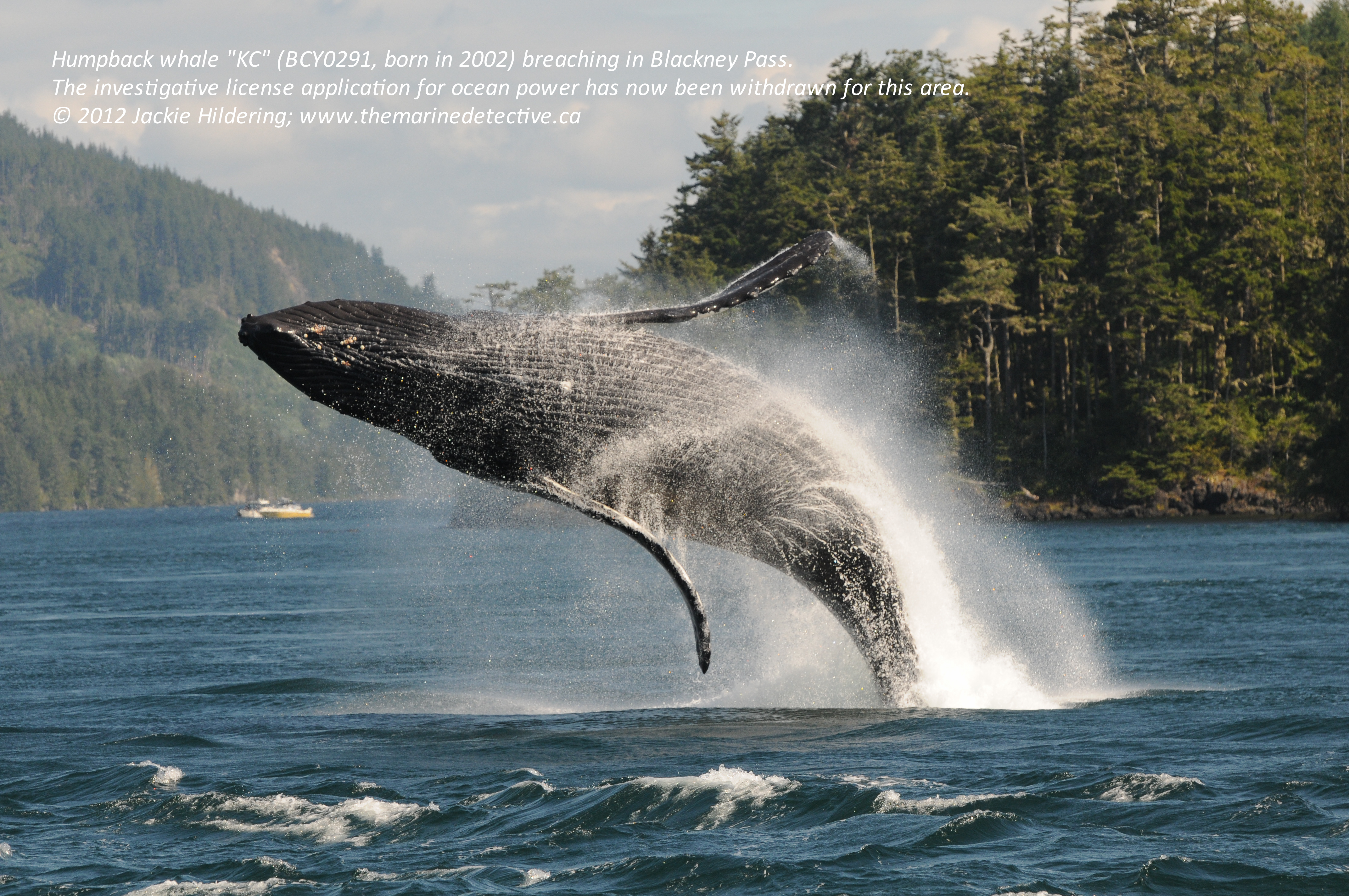
“KC” breaches in Blackney Pass. Photo: Hildering

As follow-up to last week’s call to action, “Tidal Turbines in Whale Epicentre? Hell No!” , I am so pleased to relay the following media release from myself, the OrcaLab and the proponent, SRM Projects Ltd

The short of it is, due to the efforts of many (including you) and the integrity and ethics of the proponent – the application for an investigative license for ocean power in whale critical habitat has been withdrawn. 

Please read further below.

 Media Coverage:

For details of how this resolve was achieved see this OrcaLab blog item. 

Humpback whale “KC” (BCY0291, born in 2002) breaching in Blackney Pass.
The investigative license application for ocean power has now been withdrawn for this area.
© 2012 Jackie Hildering; http://www.themarinedetective.ca

Tidal Turbines in Whale Epicentre? Hell No!

[Updates: November 18, 2012 – the application for an investigative license for ocean power in whale critical habitat has been withdrawn. Please see the media release at this link.
November 14, 2012 – To our surprise, the deadline to provide comment regarding the land tenure has been extended, it is now also December 2nd.
November 13, 2012 – As testimony to how serious this is – international Whale and Dolphin Conservation (WDC) has picked this up and put out an action alert.]


For a bundling of media items on this see the end of the blog.] 

There are times when expletives like “Hell No!” are justified and I am sure you will agree this is one of those very unfortunate times and – your action is needed.

Blackney Pass off Johnstone Strait is an epicentre of whale activity and there is an application for an “Investigative License of Occupation – Ocean Power ” for this very area. Yep, that’s right . . . an application for “actual installment of technical investigative and monitoring equipment” that could lead to turbines being in critical whale habitat. The proponent is SRM Projects Ltd of Nanaimo, B.C.

While I of course support initiatives to reduce the use of climate-changing fossil fuels, to have turbines in critical whale habitat would be pure, simple, total, utter insanity. No matter how advanced the turbine technology, no amount of mitigation could compensate for the noise, prey reduction, and other disturbance to the whales.

The deadline for your two quick submissions is December 2nd. Below, I have strived to make commenting very expeditious for you, but first, a bit more on how preposterous the application is, just to fuel you up for those comments. 

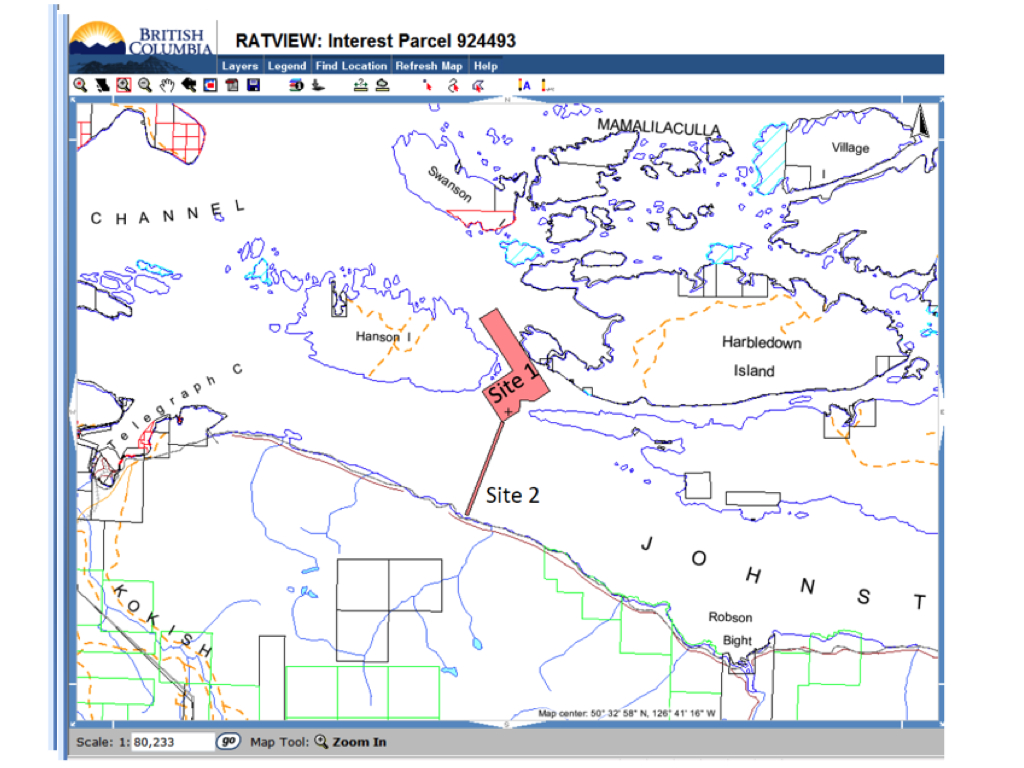
Here is the map showing the area for the “license of occupation“.

Source: Application for OCEAN ENERGY/INVESTIGATIVE AND MONITORING by SRM Projects Ltd of Nanaimo, B.C.  Click image to enlarge.

Here is the map showing the application site relative to the critical habitat map for northern resident killer whales from the Final Amended Recovery Strategy for Northern and Southern Resident Killer Whales in Canada. [Why was it amended you might ask? Because the federal government had to be taken to court TWICE to enforce their legal obligation to protect killer whale habitat – first ruling December 7, 2010; appeal ruling February 9th, 2011.]

Proposed site (red) relative to acknowledged northern resident killer whale critical habitat (cross hatched area). Source Amended Recovery Strategy for Northern and Southern Resident Killer Whales in Canada. Click image to enlarge.

The very ocean current that makes this area of interest for staking a claim for ocean energy is what makes this such a rich area for marine life. Multiple currents collide causing a merry-go-round in which plankton and fish are concentrated. The threatened northern resident killer whales feed here with great regularity, as do members of the threatened population of humpback whales, Steller sea lions, Dall’s porpoise, etc.

The importance of this area for killer whales can be supported by almost 4 decades of data collected by Department of Fisheries and Oceans and the OrcaLab. More recently, with regard to the humpbacks, I and my fellow researchers from the Marine Education and Research Society, can testify to how often these giants are in this area.

But it is the whales that speak with the most convincing voices of all. Here is the OrcaLab’s September 16th, 2012 visual and acoustic recording of the I15 and A30 matrilines of northern resident killer whales in the very area “in question”.

For researchers, whale watchers and on-line followers of the OrcaLab’s monitoring of whales, we all know that this kind of activity is not exceptional in this area and we know what is at stake.

As final stark evidence of how often there are whales in this area, note where, of all the places the OrcaLab could have put their whale-monitoring cameras and hydrophones, they are positioned. Then again, note the location of the proposed ocean power project.

Proposed site (red) relative to positions of the OrcaLab, and their hydrophones and cameras. Testimony to just how often there are whales here. Click image to enlarge.


One would hope that government agencies would surely deny this application but  . . . we have so many recent examples of this being tragically misplaced faith and we cannot count on there being any legislation in place for sound environmental assessment that would confirm environmental impacts. May I point out again that the government had to be taken to court TWICE to be order to acknowledge and protect killer whale critical habitat?!

Therefore, we collectively need to make our “Hell No!” heard now.

Essential action needed by December 2nd – submission to two government agencies. 

  1. By December 2nd, regarding the land tenure,  click this link, go to the bottom of this Integrated Land Management Bureau page, and comment on the project. Sample text below in green. [Note that, to our surprise, this deadline changed on November 14th, the date that was the initial deadline for comment to this agency.]
  2. By December 2nd, regarding the license of occupation, click this link and email your comment to Forests, Lands and Natural Resources Operations. You could use the same text as you did for the above.

If you can, come to the Port McNeill “community information session” given by the proponent, SRM Projects Ltd of Nanaimo, on November 20th in Room 4 of the Old School from 6:30 to 7:45 PM. There will also be an information session in Campbell River on November 22nd but this will focus on SRM’s proposals for the Discovery Passage and Seymour Narrows. It will be in the Rivercorp Boardroom, 900 Alder Street from 7:00 to 8:30 PM.

  • Sample text for both of the above. “With regard to Land File Number 1412946, the application for SRM Project Ltd’s “Investigative License of Occupation – Ocean Power” in the Blackney Passage / Johnstone Strait area, I write you to express that this application must not be granted. This is scientifically confirmed critical habitat for northern resident killer whales and it has been legally ruled that this must be protected as per Canada’s Species at Risk Act. In addition, the area is of great importance to humpback whales and many other marine species. No matter how advanced the turbine technology, no amount of mitigation could compensate for the noise, prey reduction, and other disturbance to the whales.”  You may even want to reference this blog and provide the link e.g. “For further details of the reasons for my great objection to this application see the rationale and resources provided at http://wp.me/pPW6V-LE.”

With this application being so ludicrous, I can’t help but wonder if I am missing something. Is this just part of a staking frenzy or is it some sort of distractor so that attention is taken away from something else?

SRM LTD’s projects are listed here. Again, reductions to our voracious fossil fuel consumption are very much needed but, at the cost of having turbines in whale critical habitat? Unequivocally – no. 

So much insanity  . . . so little time.  Sigh.

Huge gratitude and respect to Angela Smith for being the one to take note of the notification of this application and to Leah Robinson for ensuring I had many of the details I needed for this blog.

Media items:

References:

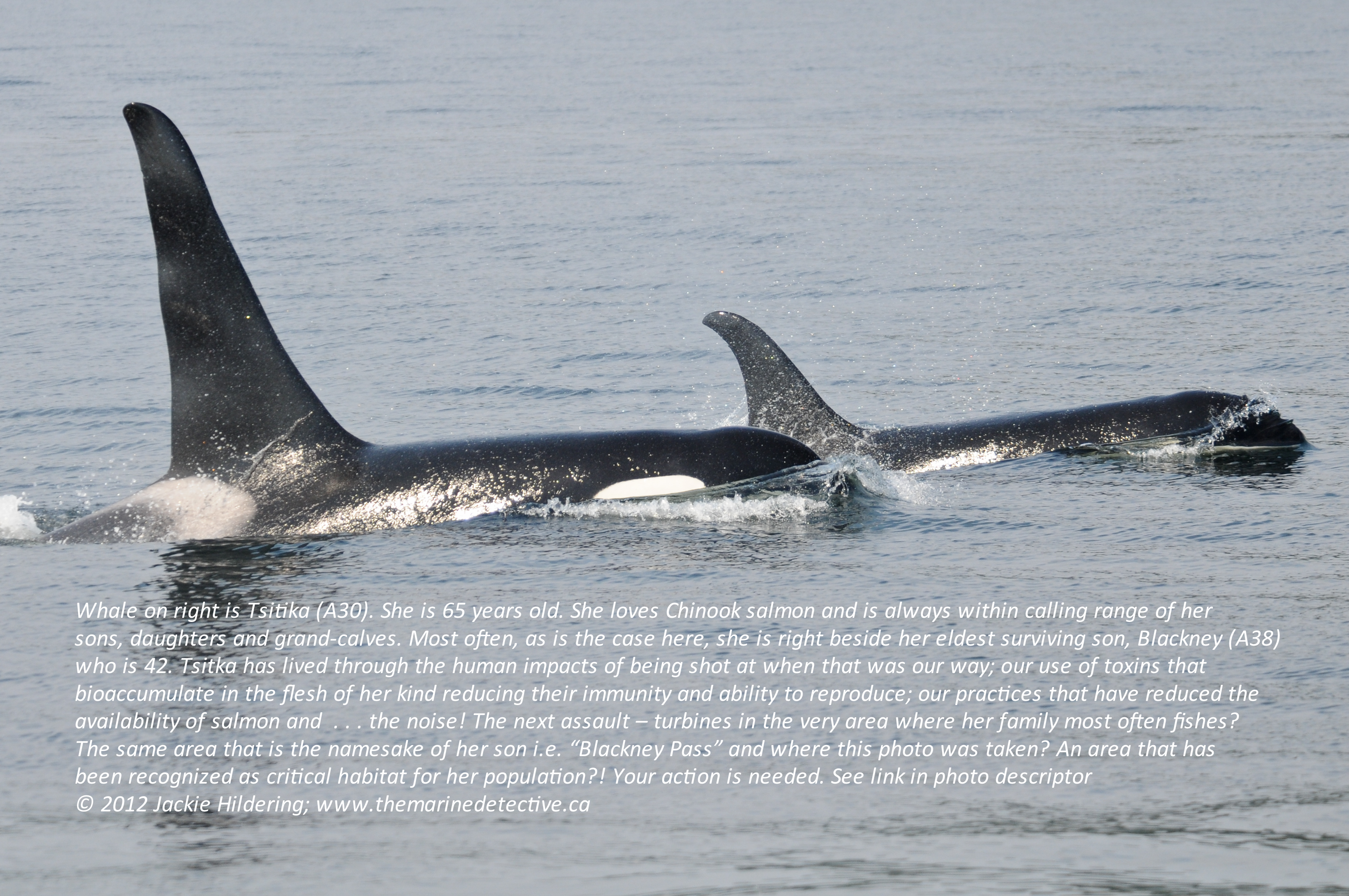
This posting on my FaceBook page has had success in creating further awareness. Feel free to share! Whale on right is Tsitika (A30). She is 65 years old. She loves Chinook salmon and is always within calling range of her sons, daughters and grand-calves. Most often, as is the case here, she is right beside her eldest surviving son, Blackney (A38) who is 42. Tsitka has lived through the human impacts of being shot at when that was our way; our use of toxins that bioaccumulate in the flesh of her kind reducing their immunity and ability to reproduce; our practices that have reduced the availability of salmon and . . . the noise! The next assault – turbines in the very area where her family most often fishes? The same area that is the namesake of her son i.e. “Blackney Pass” and where this photo was taken? The area that is designated as critical habitat for her population?

I, Mermaid. You Too?

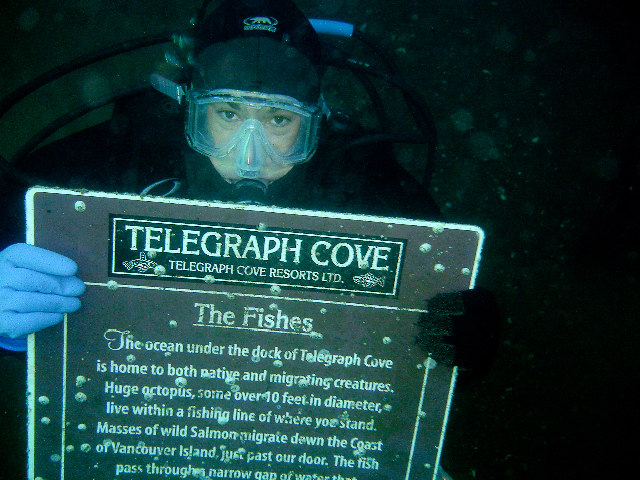
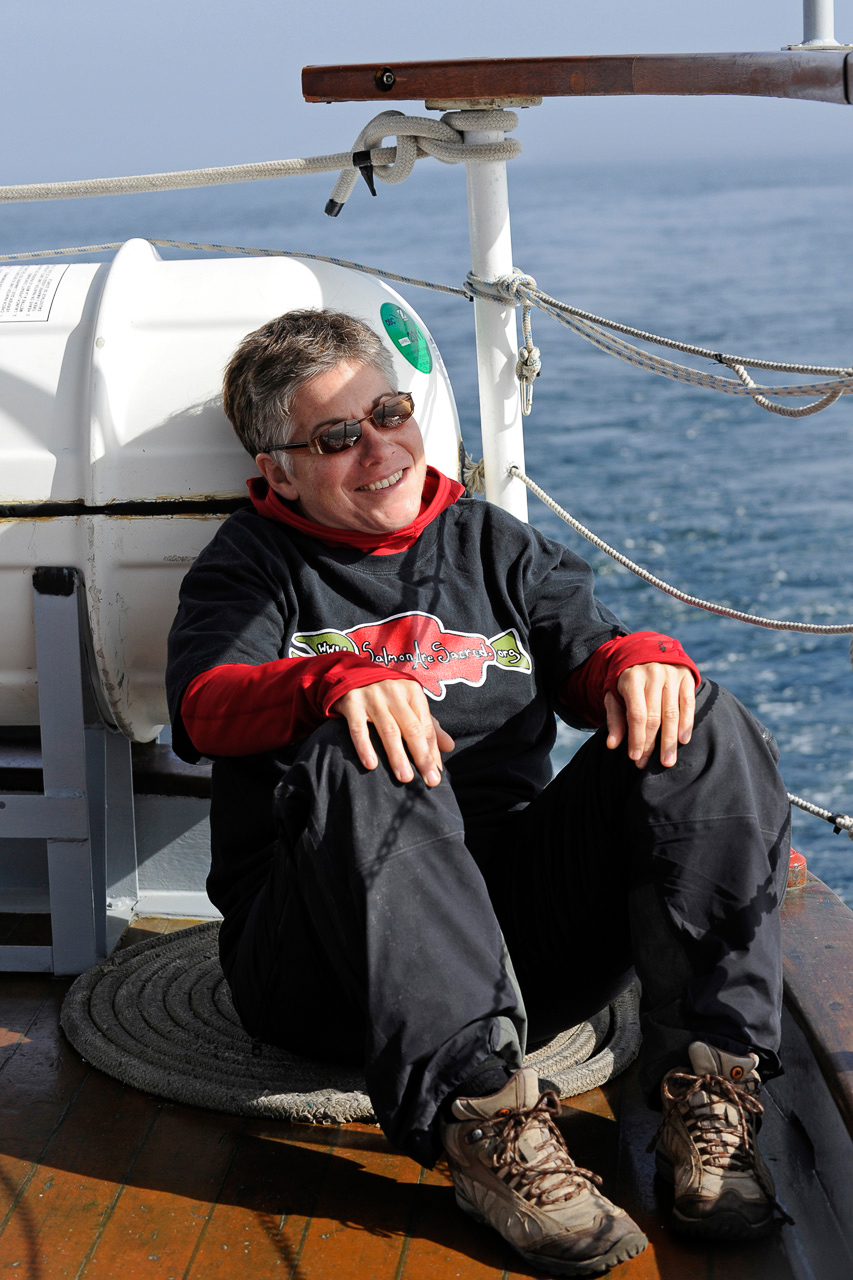
Northeast Pacific mermaid. Even underwater they are dedicated to marine conservation. Photo: Jacqui Engel.

So I don’t look much like the mermaids of folklore, but I am absolutely the real thing.

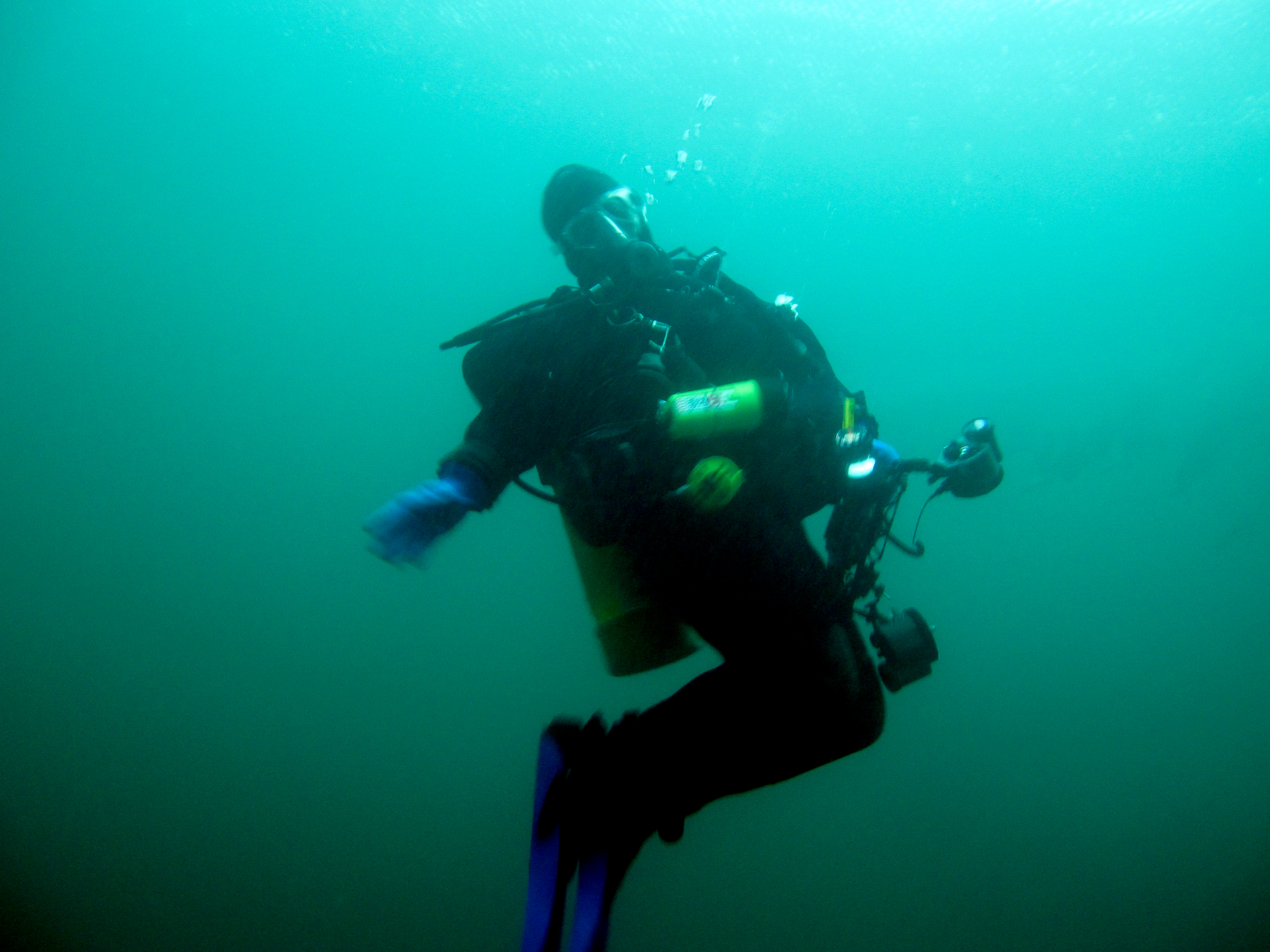
I, in fact, look more like a Steller sea lion when suited up in my dive gear (not that they are convinced).

This resemblance to sea lions may even soon be strengthened if the joys of menopause lead to my growing long, stiff facial hairs like their vibrissae. Hum, maybe that won’t be all bad since I will be able to sense vibrations in water from afar .  . . but back to the topic at hand.

Northeast Pacific mermaid displaying underwater euphoria. Photo: Jacqui Engel.

In having now painted anything but the image of a waifish, goddess-like denzin of the deep for you, I will likely need to provide some very strong evidence that I am indeed – a mermaid.

Not that I need you to believe me.

The important thing is for you to be able recognize if YOU are a mer-person too. In fact, a great deal is at stake if you don’t recognize it.

No doubt that you are infinitely thankful that I am here to help since there’s a lot of misinformation out there about we mer-people. You know – all that tail-like-a-fish, having no immortal soul, must marry a human stuff.

Mermaid 3

Note mermaid blissed-out expression even when only near the Ocean’s surface. Photo: Peter Jucker.

Reality is, we look pretty much like other people . . . most of the time.

However, if, for some terrible reason, we are removed from the sight and smell of the ocean for any significant period, this provides one of the two times when it is really easy to identify a mer-person.

The clues?  Agitation, a predilection to negativity, perpetual longing references to “Mother Ocean”, dry coughing, eating lots of salty chocolate, combative if blocked from getting back into or onto the Ocean and, indeed when in this state, we will deal out many a curse and could even drag someone underwater.

The only other time it is really easy to tell we are mer-people is when we have just returned from Mother Ocean. The contrast to our non-marine state is apparently extreme. We present as being deeply peaceful, patient, centered, highly eloquent, rational, and blissed-out.

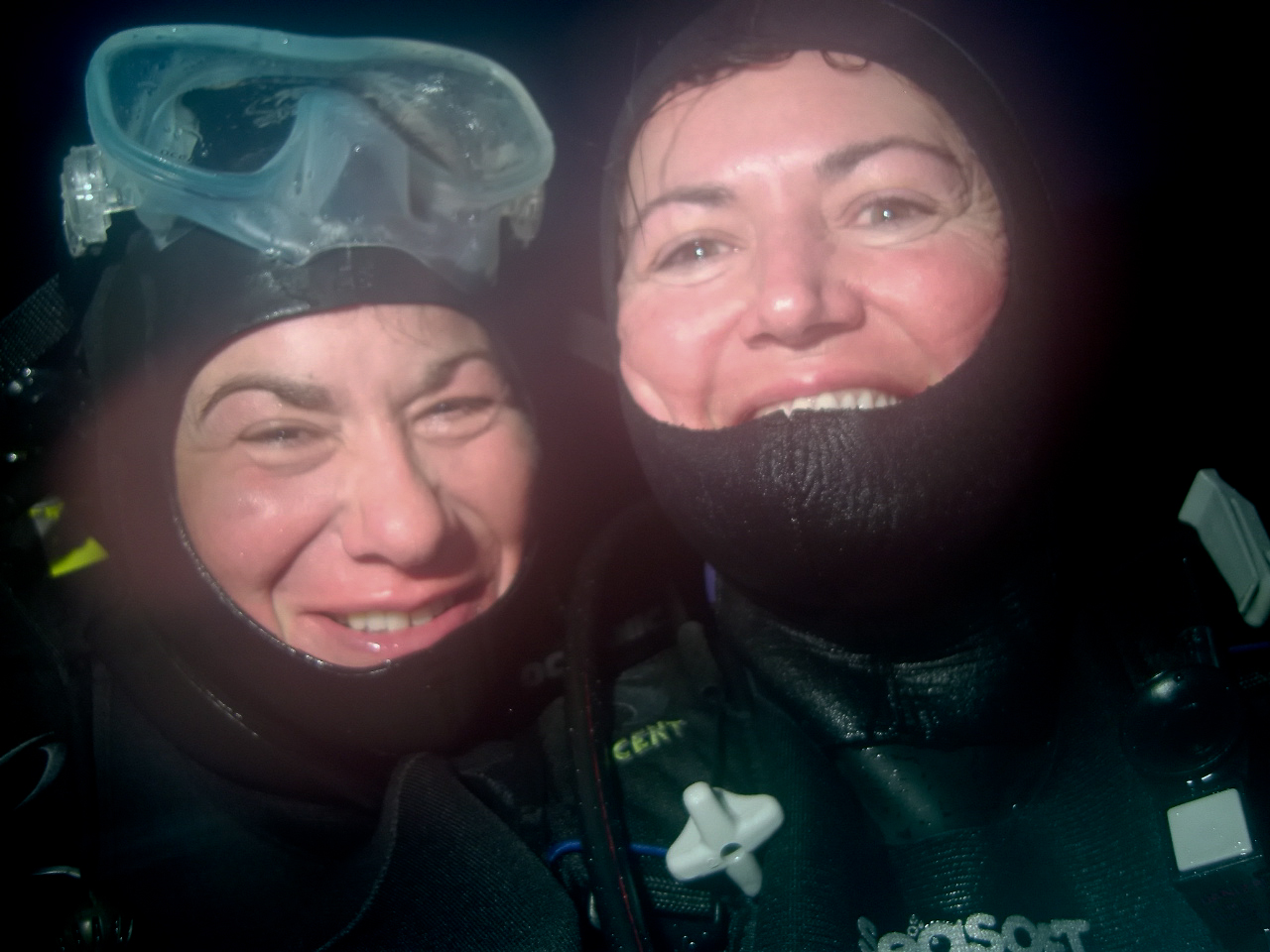
Rare two-headed mermaid. Head on right = Jacqui Engel who may not be so happy with me after I post this photo.

The physiology behind this has been the subject of many scientific studies. The research shows that mer-people’s heart rate and blood pressure is reduced by 31.721% when in or on the Ocean and that the endorphin content of our blood also rises by 47.913% (give or take a thousandth of a percent). 

As a mermaid, I of course know how I feel when submerging into the Ocean or when I drift on her surface. It feels like escaping from the insanity of terrestrial human life for a while; living raptly in the moment; and returning to quiet, extreme beauty, and sensibility.

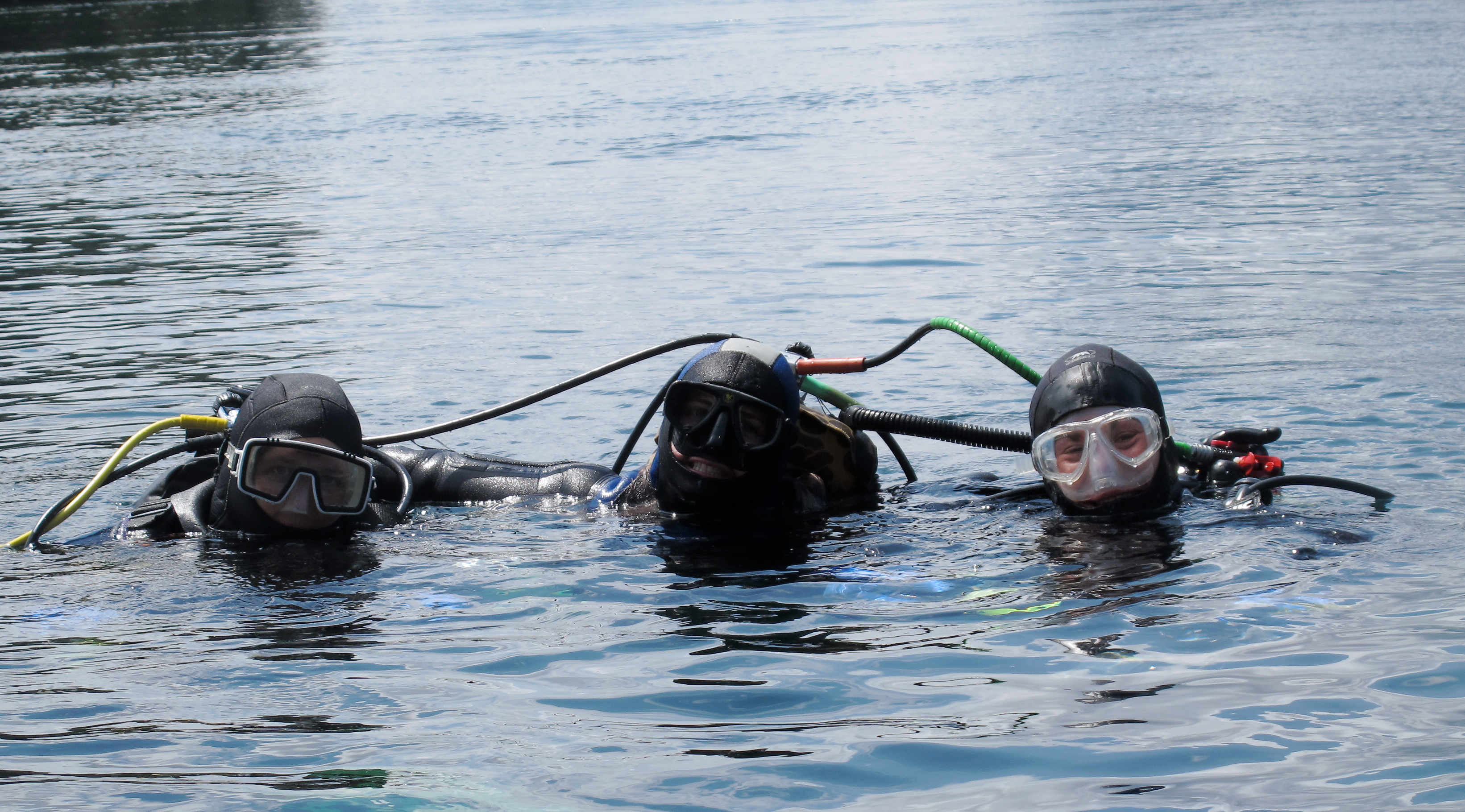
Extraordinarily rare 3-headed mermaid. Head on left = Terina Hancock. Head in middle = Natasha Dickinson. Here too there may be some issues with the other heads not being so happy with me. Photo: Jacqui Engel.

It was a surprise to me though how quickly those around me understood my mermaid needs. Many is the time I have been told “Jackie, you need to go diving” or “Jackie, I think you need to go study humpback whales today”.  Conversely, I will get to hear “You seem better today. Did you go diving?”

Why, after having gone diving, I apparently even have a much better sense of humour and a tendency to engage in a bit of self-mockery. Hum, I wonder if this might be apparent here since I did go diving yesterday?

Can you believe it?! Another 3-headed mermaid! Head on left = Jacqui Engel. Head in centre = Natasha Dickinson. Photo by mermaid with very long arms.

Does any of this sound like it applies to you? Ask those around you to confirm if you manifest the signs.  Look around your home. Do you see many marine symbols and/or artifacts? 

I suspect that there are many fellow mer-people here in the demographic of the “The Marine Detective” community.

Speaking from my own experience, it is very important that your mer-personness gets diagnosed as soon as possible.

It’s not only for your own good and the sanity of the humans around you. It’s for the health of our Ocean.

As mer-people, we above all others know the essential soul-calming, life-giving, inspiration-inducing, positive and essential source that is Mother Ocean.

While on land, make it count! Be the walking protectors for all that is dependent upon the sea.

Speak for our marine brethren who cannot speak for themselves!

Mer-people unite!


Grunt Sculpin – Little Fish, BIG Attitude!

Last updated: March 4, 2024
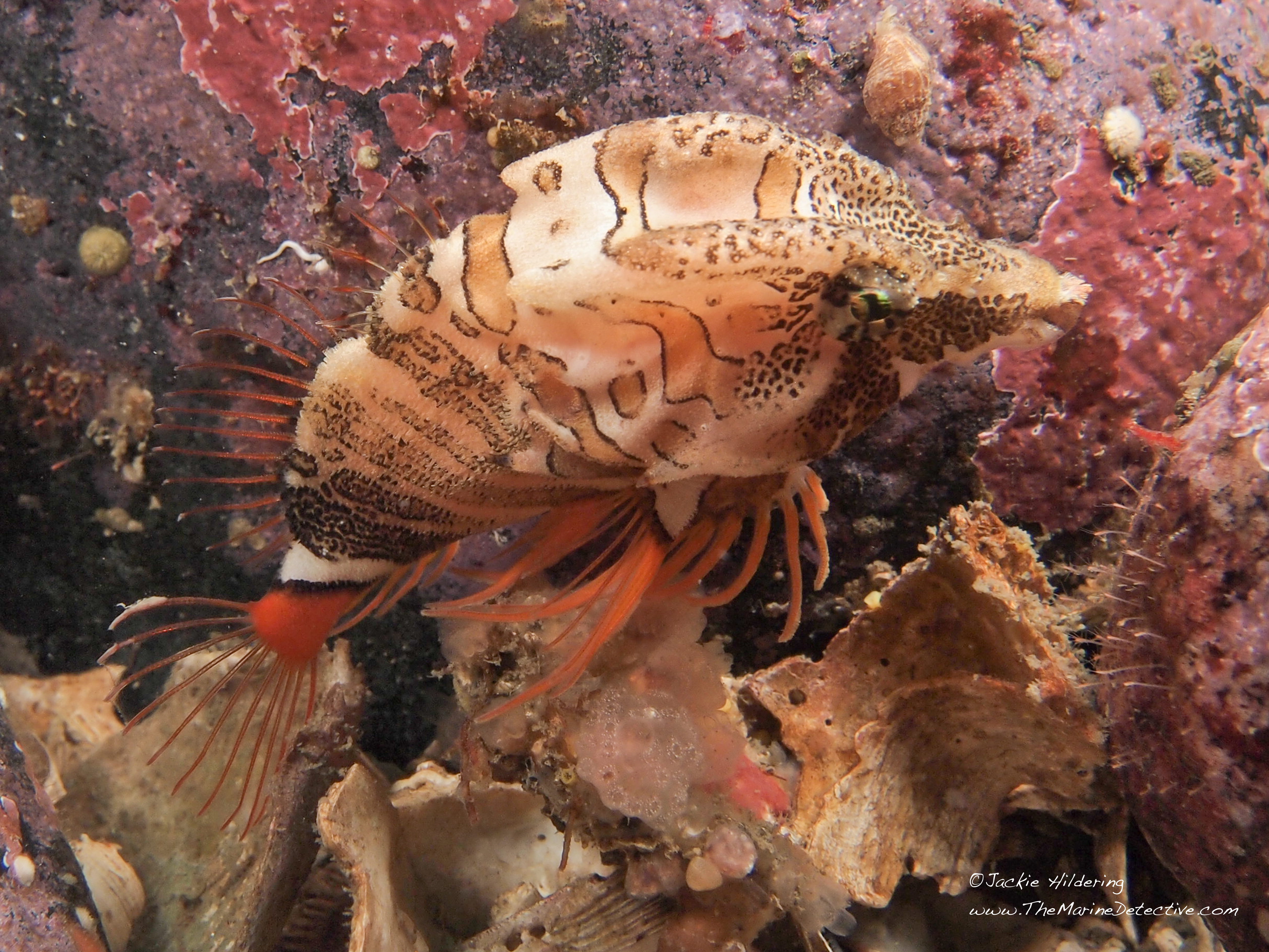
Meet the fish that so often has people exclaiming “It lives HERE?!”

Yep, the tiny Grunt Sculpin is a powerful ambassador for raising awareness about the depth of biodiversity hidden in the cold, dark, rich waters of the north east Pacific. 

We are programmed to associate warm waters with exotic-looking fish species but read below for the Grunt Sculpin’s astounding adaptations and masterful mimicry. 

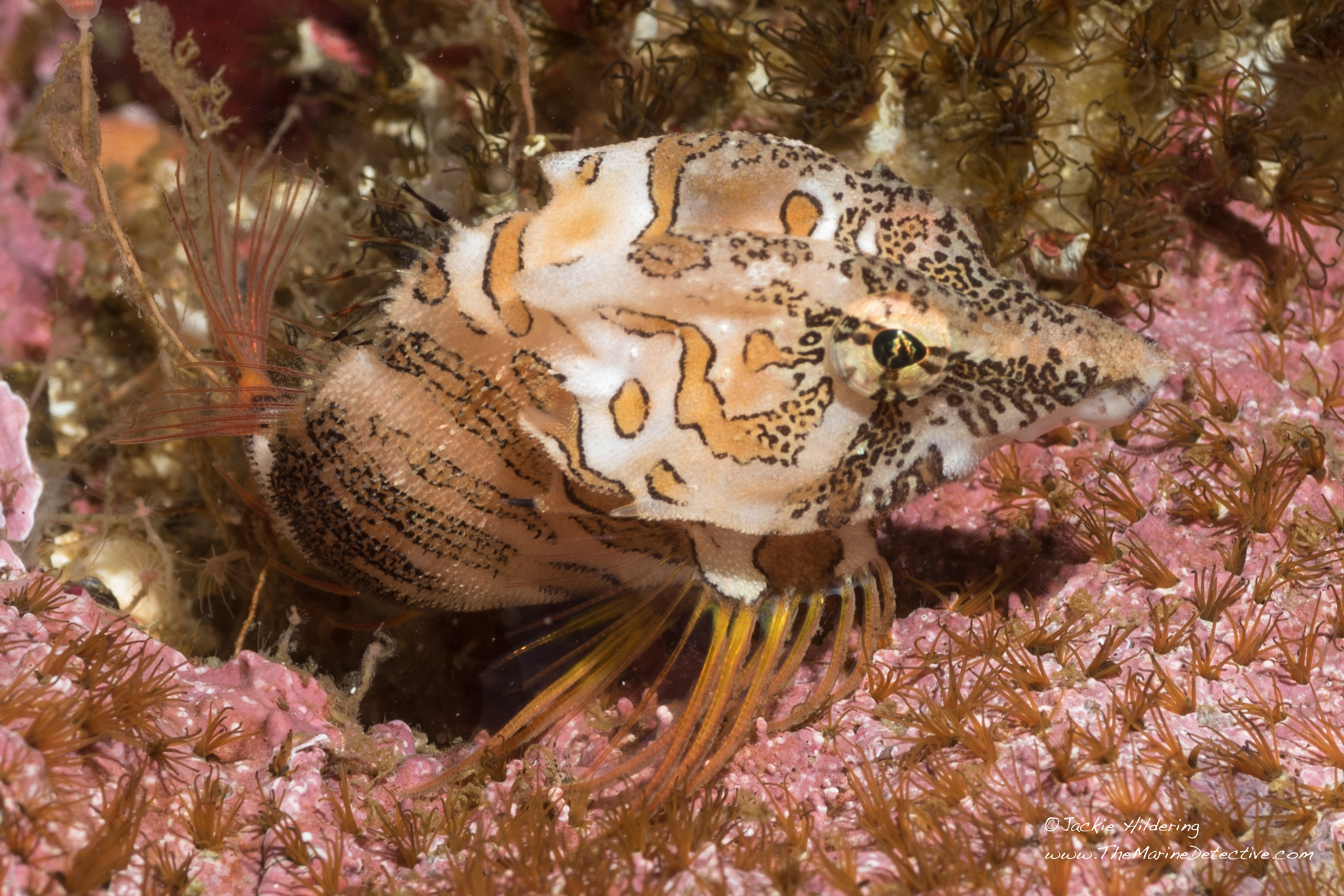
The species reaches only a maximum of ~9 cm.

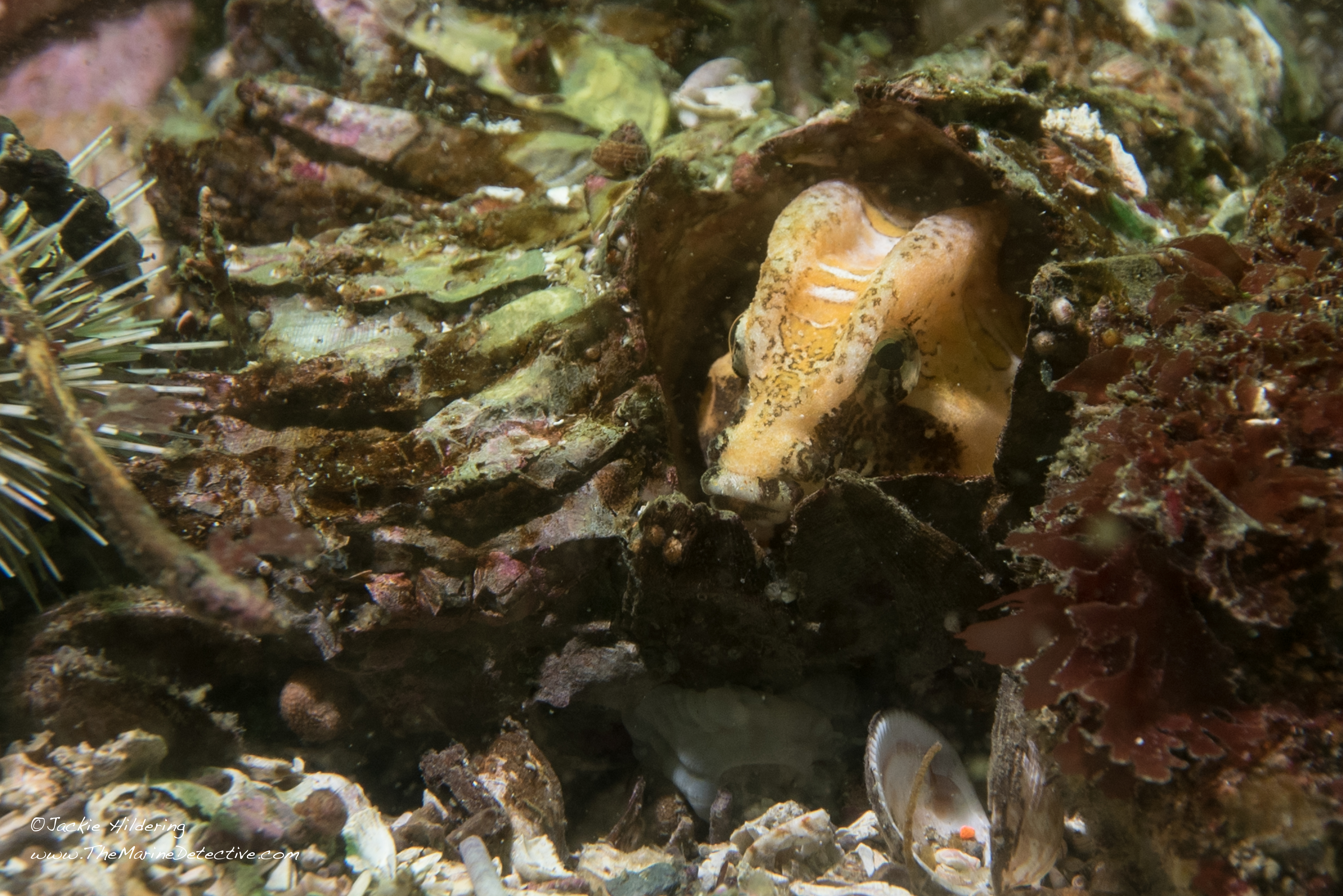
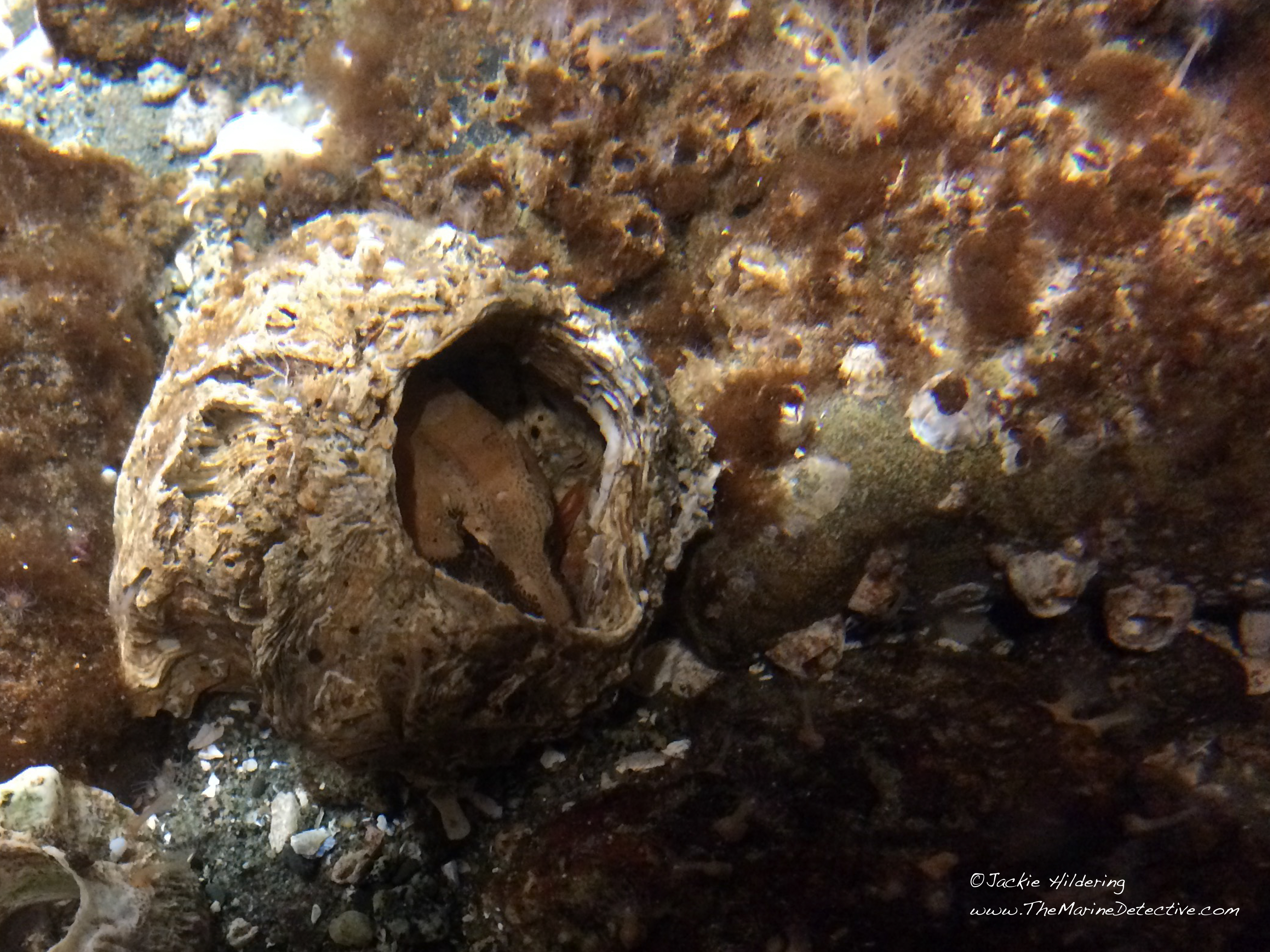
It is adapted to look like a Giant Acorn Barnacle (Balanus nubilis)!  When facing outward, its pointy nose looks like a closed Giant Acorn Barnacle and when the fish turns around, its tail looks like the foot of the barnacle that rakes in plankton.

Adapted to look like a Giant Acorn Barnacle!
Closed Giant Acorn Barnacles. See how similar this is to the nose of a Grunt Sculpin?
Foot of a Giant Acorn Barnacle. The tail of a Grunt Sculpin looks so much like this!

This little fish has giant attitude. It can be highly territorial, hopping around on its pectoral fins in a strutting, jerky fashion.

You may think the males are the master strutters? Ha! The female is as fierce as can be. Reportedly, she will chase a male into a crack, an empty barnacle shell, or another place of no escape and guard him there until she is ready to lay her eggs. When she has laid them, the male is released to do his duty.

She watches him to ensure he fertilizes the eggs (up to 150 at a time) and then, according to some sources – she saunters off leaving the male to care for the eggs but may return once in a while to take on a shift

If you can’t find an empty barnacle shell. A cup will apparently do!

From Casey Cook, aquarist with the Aquarium of the Pacific (pers com 2022-12-19): “The female often pushes the male into guarding so she can roam. She will get very vocal, and demanding – making sure he does the job!”

From Fishes of the Salish Sea – Volume Three: After the eggs are fertilized ” . . . she then moves off leaving the male behind to guard the nest, although she may return occasionally to help with parental duties. When the time for hatching approaches, the guarding fish takes the eggs inside its mouth, swims out of the nest, and spits out the eggs into the water column. This breaks the egg shells and frees the larvae that then swim off as zooplankton.”

Very young Grunt Sculpin. The Red-Gilled Nudibranch in the upper part of the image is only about 2 cm 

About Grunt Sculpins’ diet also from Fishes of the Salish Sea: “With its small, pointed mouth, it is adept at removing a wide variety of small invertebrates from the water column, especially copepods, amphipods, isopods and shrimps., but it also consumes significant numbers of fish eggs and larvae.”

The Grunt Sculpin’s pointy “bill-like” head is reflected in the species’ scientific name.

With regards to classification, the scientific name Rhamphocottus richardsonii reflects the Greek word for beak “rhamphos” which is appropriate for the Grunt Sculpin’s bill-like snout. This makes some people think that the species looks like a seahorse but note that they are not closely related at all. The Grunt Sculpin is the only member of its genus. It is truly one of a kind.

Juvenile Grunt Sculpin #1 of 3 photos.
Juvenile Grunt Sculpin #2 of 3 photos. 
Juvenile Grunt Sculpin #3 of 3 photos. 

Oh, and are you wondering about the name “Grunt” Sculpin? Apparently the species grunts when it is taken out of the ocean. You would too! Likely it also grunts when being defensive underwater. It is also the sound I make in my delight when I find one. It will be a very loud grunt indeed if I ever find one guarding eggs or with its tail-end extended out of a barnacle.


Below, more of my photos of Grunt Sculpins. 🙂

Grunt Sculpin next to a Gold Dirona (nudibranch species). See him /her?
Grunt Sculpin and a Clown Dorid (another nudibranch species).
A Grunt Sculpin “strutting” over the ocean bottom. See the cloud of silt lifted off as a result?
Another Grunt Sculpin in an empty barnacle shell.
And another.
You can’t see me.
Grunt Sculpin hiding in a broken mussel shell.
Juvenile Grunt Sculpin
I wonder if this one is female and about ready to lay her eggs?

And some more photos of individuals to show how similar their markings are.


Sources:
– Aquarium of the Pacific – Grunt Sculpin
– Fishbase – Grunt Sculpin
– Love, M. S. (2011). Certainly more than you want to know about the fishes of the Pacific Coast: A postmodern experience. Santa Barbara, Calif: Really Big Press.

Views from the Mast

How high can you get in seeing dolphins and humpbacks?

Captain Tavish Campbell knows.

The 1.5 minute clip below reveals his unique perspective from atop the 100′ mast of the beautiful schooner Maple Leaf.

From on high, he shares with us the view of hundreds of Pacific white-sided dolphins and a bubble-netting humpback whale.

I have the joy of sometimes serving as naturalist for Maple Leaf Adventures with Tavish. He allowed me to put together this clip for the David Suzuki Foundation’s Ocean Stories Campaign, both of us hoping that the breathtaking beauty might inspire people to undertake more positive action to protect the great biodiversity of the North Pacific.

What’s your Ocean Story?  You can help inspire connection and positive change by sharing your story with DSF up to midnight on October 31st. 

Gumboot Chitons Spawning!

I’m excited to share video with you of Gumboot Chitons spawning. These marine neighbours most often seem quite inanimate – having a life where they keep their undersides protected by sucking down hard on rocks but, when it’s time to mate . . . . . 

Female gumboot chiton

Female! © Jackie Hildering

First just a little background: “Chitons” are marine molluscs (soft bodied animals) that, rather than having one of more shells to protect themselves, they have 8 armoured plates surrounded by a thick band of muscle. This allows them to suction onto surfaces very effectively since the 8-plates give such flexibility that they can even get a good grip on surfaces that are not flat.

There are many members of the the chiton class but the Gumboot Chiton (Cryptochiton steller; aka Giant Pacific Chiton) is very unique in its appearance.

It’s another “the biggest of its kind in the world” that inhabits the cold, rich waters of the northeast Pacific. It can be 35 cm long and about 2 kg. They are very slow growing and very long lived! This source reports that chitons that are 15 cm long are likely 20 years old and that they may live to be more than 25. That’s one old gumboot!

The Gumboot Chiton is also the only chiton species that has flesh completely covering the 8 plates. The texture and colour of this “girdle” offers them great camouflage and is where the “gumboot” descriptor comes from. The genus name “Cryptochiton” relates to this camouflage and that the 8 plates are hidden under the girdle. These plates are very uniquely shaped, and well-described with the name “butterfly shells”.

Smaller dead Gumboot Chiton. Image shows the thick band of muscle with which Gumboot Chitons secure themselves. Fish species is Longfin Sculpin. ©Jackie Hildering.

Small dead Gumboot Chiton. Image shows the thick band of muscle with which Gumboot Chitons secure themselves. Fish in this image is a Longfin Sculpin. ©Jackie Hildering.

Apparently some First Nations did sometimes chew on this species but I am SURE that this is not the cultural origin of some people referring to this species as “wandering meatloaf”!

I don’t know where I picked this up, but I believe that one of the First Nations’ names for gumboot chitons translates (very) loosely, into “stuck on rock with face forever”. This would be an incredibly good descriptor since most chitons stay “face” down, grazing on algae by scraping with the sharp teeth-like structures of their radula. Thereby, they don’t expose their soft bodies and reduce the chance of predation. 

jackie-hildering-one-time-use-as-specified-15308

Gumboot Chitons feeding on dead Bull Kelp. ©Jackie Hildering.

I once found a Gumboot Chiton that had been dislodged by a predator at low tide. It is then that I learned that they have the ability to curl up on themselves like a pill bug!

But outside of a rare experience like this, you don’t often get a chance to see how very alive and animal-like they are.

Unless . . . they are spawning. 

Then, up came the bodies of the Gumboot Chitons, into a very unique funnel-like shape. The “gonadal pores” are near the bottom end of the animals, but by positioning themselves in this shape, they channel the sex cells upward.

When spawning, you can clearly see which Gumboot Chitons are male and which are female!

It was just remarkable to see this, feeling truly as if some secret world was being revealed, and the coordinated timing of the spawning was astonishing.

Of course when you are a broadcast spawner, you need to release copious amounts of sex cells and need to do so at the same time or there will be even less chance that egg meets sperm. You can imagine how many eggs need to be fertilized if any of your zooplankton offspring are going to survive since so many animals feed on plankton.

To my knowledge, science has not concluded exactly what the cues are for “Hey fellow Gumbooot Chitons, it’s spawn time NOW!”  It has to be temperature, light, tide and/or amount of food that determines the time is right.

Hum . . . seems to me that those cues may be significant between individuals of our species too!

Additional images:

Chiton plates on the right are those of the Gumboot Chiton.

Chiton plates on the right are those of the Gumboot Chiton.

OLYMPUS DIGITAL CAMERA

Sometimes individuals have this mottled colour pattern. ©Jackie Hildering.

Gumboot Chiton predated on by Sunflower Star

Gumboot Chiton being ingested by a Sunflower Star. Unknown if this was the result of predation or if it is scavenging i.e. that the Gumboot Chiton was already dead. ©Jackie Hildering.

jackie-hildering-one-time-use-as-specified-03443

NOTE: I would normally NEVER disrupt a chiton as this would potentially damage the animal. The Gumboot Chiton in this image had been dislodged by a predator and was lying upside down. Used it as an opportunity to discuss ethics with the Sunset School students. We decided to right it and put it on a rock so that s/he could be protected again by sucking down ©Jackie Hildering.

NOT “Plenty of Fish”!

“Plenty of Fish”?! Not at my trophic level!

[Note: This blog was published in 2012].

So this may be one of the most daring things I ever do and it is certainly the most uncontrolled experiment I have ever conducted.

This blog item is not about the state of the oceans but about dating sites like “Plenty of Fish” and my reality as a vibrant, single 49-year-old woman.

As any reader of “The Marine Detective” knows, there are NOT plenty of fish in the sea. There are massive conservation and management efforts needed for marine ecosystems before it is too late.

I perceive the metaphor with regard to relationships to be equality untrue. There are not “Plenty of Fish”, at least not at my trophic level in the ecosystem in which I want to continue to live.

I of course respect the utility of such online dating sites and recognize that there are many out there that have met the love of their lives in this way.

It’s not for me though.

I would prefer a site named “Deep Sea Bottom Trawling” where the first thing you do, to increase efficiency in finding those of like intentions, would be to choose your method of “fishing” i.e. catch and release (one night stands); bottom trawling (indiscriminate and destructive); seining (slowly closing a net of no escape); long-lining (many hooks in the water); trolling (more selective due to using appropriate hooks for your target catch) . . . you get the idea AND some flavour of my sense of humour.
By virtue of my unique name and lifestyle, and my on-line presence as “The Marine Detective”, I would have little hope on a dating site of finding balance between revealing anything about myself and preserving some anonymity.  This has led to my thinking, why not take things entirely into my own hands and put my “single, very happy but wanting it all” status out in a world of those who have a sense of what I am about?

I hope the humanity of this has you smiling as a reader and not thinking “Ooooh – this is awkward!”

So here goes:

  • My good traits?  They are revealed in all things related to The Marine Detective – I am passionate, driven to make a positive difference, adventurous, independent, introspective, articulate, funny, creative, strong; honest, hard-working, and accomplished.
  • My negative traits? They are the same as the list above but would be perceived by someone who does not have the same value system; who does not have a strong sense of self; and /or is feeling weakened by middle age as my being: intense, uncompromising, demanding, scattered, blunt, workaholic, and eek  . . . a feminist! (As if equality would be a bad thing for either gender).

So that’s it folks, my hopes are likely no different than many of yours. 

Despite the scarring and lessons-learned of previous relationships, I still have the hope of being able to have it all and that somehow, maybe as a result of my daring to write this blog, that I will end up with a man with whom I have a deep connection, and can build a partnership where we swim in a sea of love, truth, passion, and mutual respect.

I want to share this extraordinary, privileged life with a very rare fish with a rich life of his own.

If you know of one, please throw him a line!


Plankton Got Sole!

No, I have not mixed up my spelling of “soul” verses “sole”.

This last weekend, while watching herring feed on krill in a tide line, I suddenly noticed a very small transparent fish.

Upon closer inspection, I saw that it was a larval form of some species of flatfish.

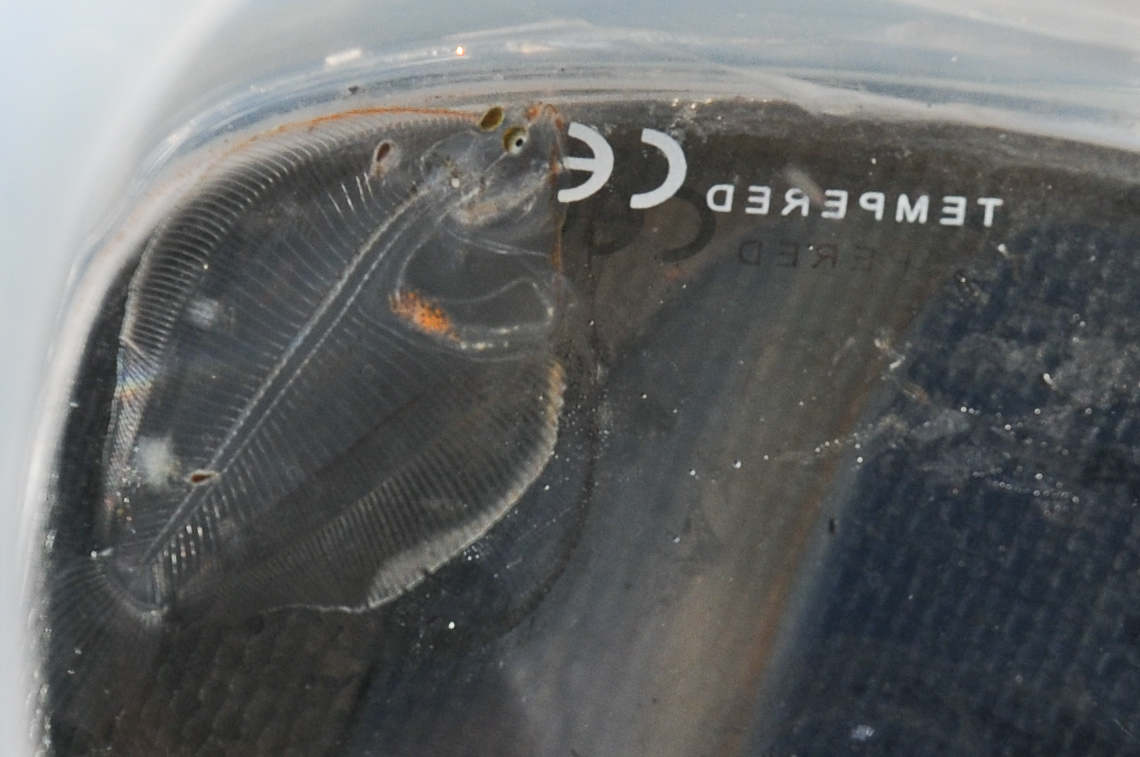
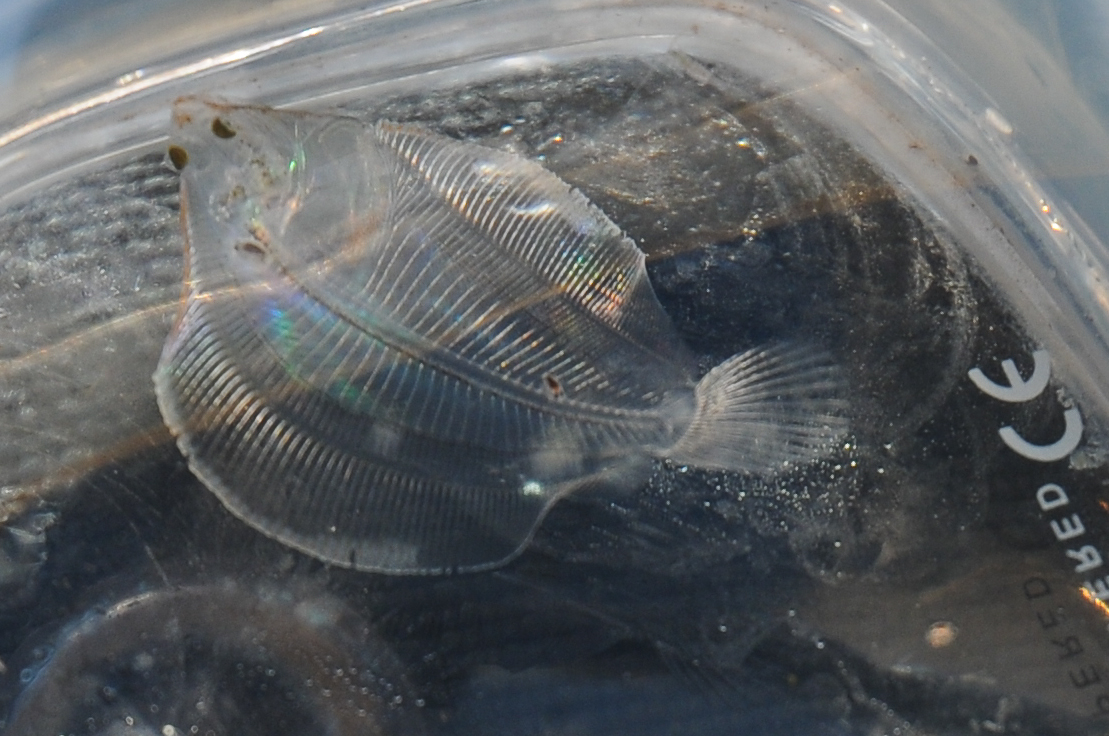
I was able to dip the little guy / gal into my dive mask for a few pictures and, due to the size of the lettering in the mask, I know that the fish was only 2.7 cm.

Planktonic Sand Sole.  Only 2.7 cm. 
Photo: Jackie Hildering

I was in awe of how transparent s/he was; that I could see the bones and heart; and that this small, fragile planktonic stage could ever survive to grow into an adult.

These sorts of “finds” are as awe-inspiring to me as any sighting of a whale. The thick planktonic soup of our rich cold oceans is full of the larvae of so many species. Anemones, nudibranchs, sea stars, crabs, etc. – they all start off as zooplankton and the incidence of what sort of plankton are present often gives scientists an indication of what may be happening with the marine food web.

It is like a world of hidden secrets to me and of course I wanted to find out all I could.

What species of flatfish was this – halibut, sole, flounder?

Photo: Hildering

I do not have the expertise to know but, oh so thankfully, there are those out there willing to share their great knowledge.

Marie-Josée Gagnon of the Salmon Coast Research Station quickly steered me in the right direction, believing it was most likely a species of sole.

She connected me with zooplankton taxonomist  Moira Galbraith of the Institute of Ocean Sciences who confirmed that this was the larval form of a Pacific Sand Sole (Psettichthys melanostictus), a species that can grow to 63 cm. She also shared that the transparency of the larval fish serves as camouflage, reducing the chances of it being eaten before reaching the life stage where it settles to the ocean bottom and hides on and in the sand.

But wait, what are those two little zooplankton guys attached to the larval sole? They are copepods, but what kind of copepod?  What does their presence mean ?  Are they parasitic? And there I go down the marine id rabbit hole. 

One thing I know for sure though – and forgive me for the following pun because the emotion behind it is very sincere – how I hope this little planktonic fish will be a  . . . sole survivor.

Sources:


Update September 30, 2012:

  • This great item by Puget Sound Sea Life has been brought to my attention and includes the following: ” . . . within several days to weeks, depending on the species, the larva undergoes a radical metamorphosis. The right or left eye migrates from it’s normal position across the top of the head to the other side of the body changing some skull bones in the process . . . . After metamorphosis, the fish settles to the bottom on it’s left side, develops skin color on the right side and continues growth as a juvenile.  Adapting a bottom-dwelling life style allows flatfish to exploit a common habitat – flat sandy bottoms which are very common in the subtidal zone. Many fish avoid this habitat because of the lack of rocks or other features that would provide a hiding place. Flatfish can hide from predators by burrowing, leaving only their eyes above the surface. In addition the habitat is home to an abundance of prey such as worms and shrimp. With both eyes on the upper side they can use 3D vision to hunt and detect predators. There has been considerable controversy over the origin of flatfish, but recent discoveries of several fossil intermediate forms show that eye migration evolved gradually some fifty million years ago.”
  • With regard to the ectoparasites on the sand sole larva, Marie-Josée Gagnon and Moira Galbraith have again been very generous with their knowledge. It is impossible to know the species from my photo but, due to the size, it is likely a recent infection and could be (1) first stage Chalimus; (2) Lepeophtheirus bifidus – which, unlike most parasites of benthic marine species is host specific – only being found on the rock sole or possibly, (3) the isopod Gnathia.   I valued having affirmed too that adults and young live in different environments to eliminate competition for the same resources but also to provide a buffer or separation to prevent transfer of disease or parasites.

Lion’s Mane Jellyfish – Sherlock You Are Wrong!

I had a wonderful opportunity to photograph and film a lion’s mane jellyfish (Cyanea ferruginea) today.


The 1.5 minute annotated video clip below will give context to my “Sherlock – You Are Wrong” statement.  
Enjoy!

Click here to see a short clip of the other big jelly species that can be found in our waters – the egg yolk jelly (Phacellophora camtschatica) at up to “only” 60 cm across. 

The Reason You Can’t See to the Bottom . . . .

The 1.5 minute video below is my attempt to bring the astounding biodiversity of the cold, rich waters of the NE Pacific Ocean to the surface.

If there is one thing I hope to achieve with my photography, it is to shatter the perception that — because you can’t see to the bottom — there must not be much life in these waters.

The opposite it true.

The reason you can’t see to the bottom is because there is SO much life.

Please feel free to share the video widely. Hopefully it will enhance people feeling a connection to the ocean, wanting to undertake further conservation, and understanding what is at stake with high risk projects that worship short term-economic gain at the cost of long-term environmental devastation — like increasing tanker traffic along British Columbia’s precious coast.