Join me in the cold, dark, life-sustaining NE Pacific Ocean to discover the great beauty, mystery and fragility hidden there.

Grunt Sculpin – Little Fish, BIG Attitude!

Last updated: March 4, 2024
Meet the fish that so often has people exclaiming “It lives HERE?!”

Yep, the tiny Grunt Sculpin is a powerful ambassador for raising awareness about the depth of biodiversity hidden in the cold, dark, rich waters of the north east Pacific. 

We are programmed to associate warm waters with exotic-looking fish species but read below for the Grunt Sculpin’s astounding adaptations and masterful mimicry. 

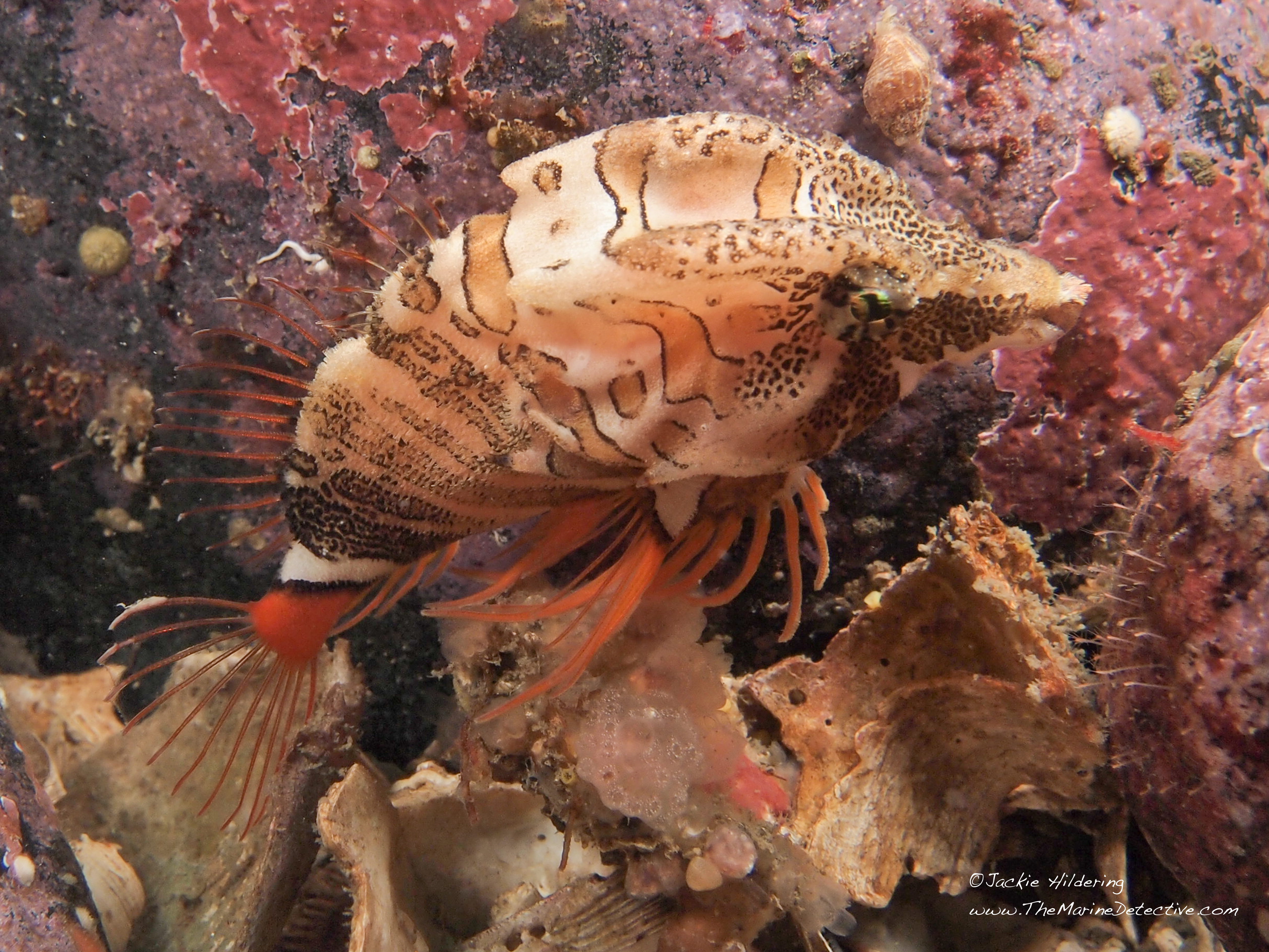
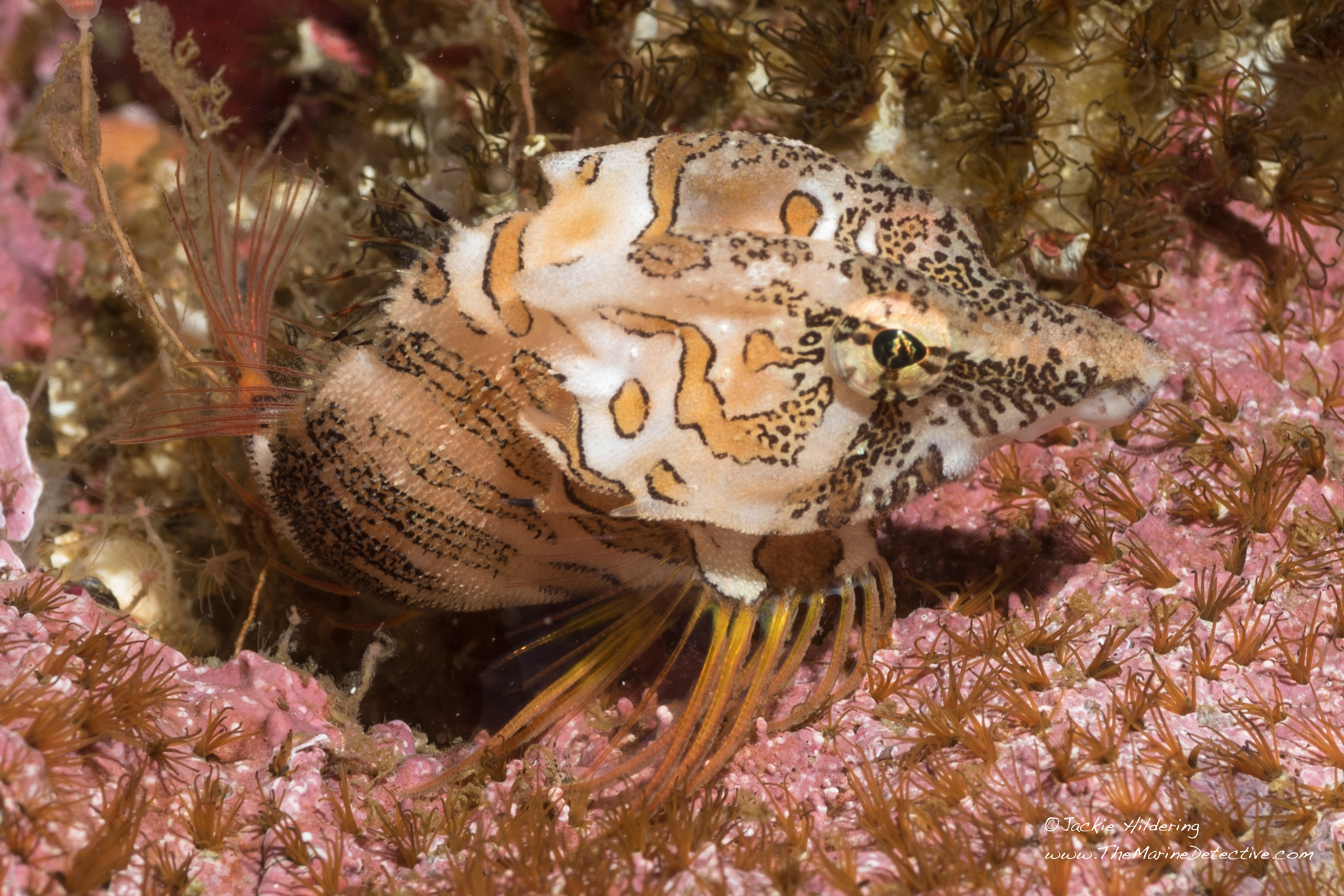
The species reaches only a maximum of ~9 cm.

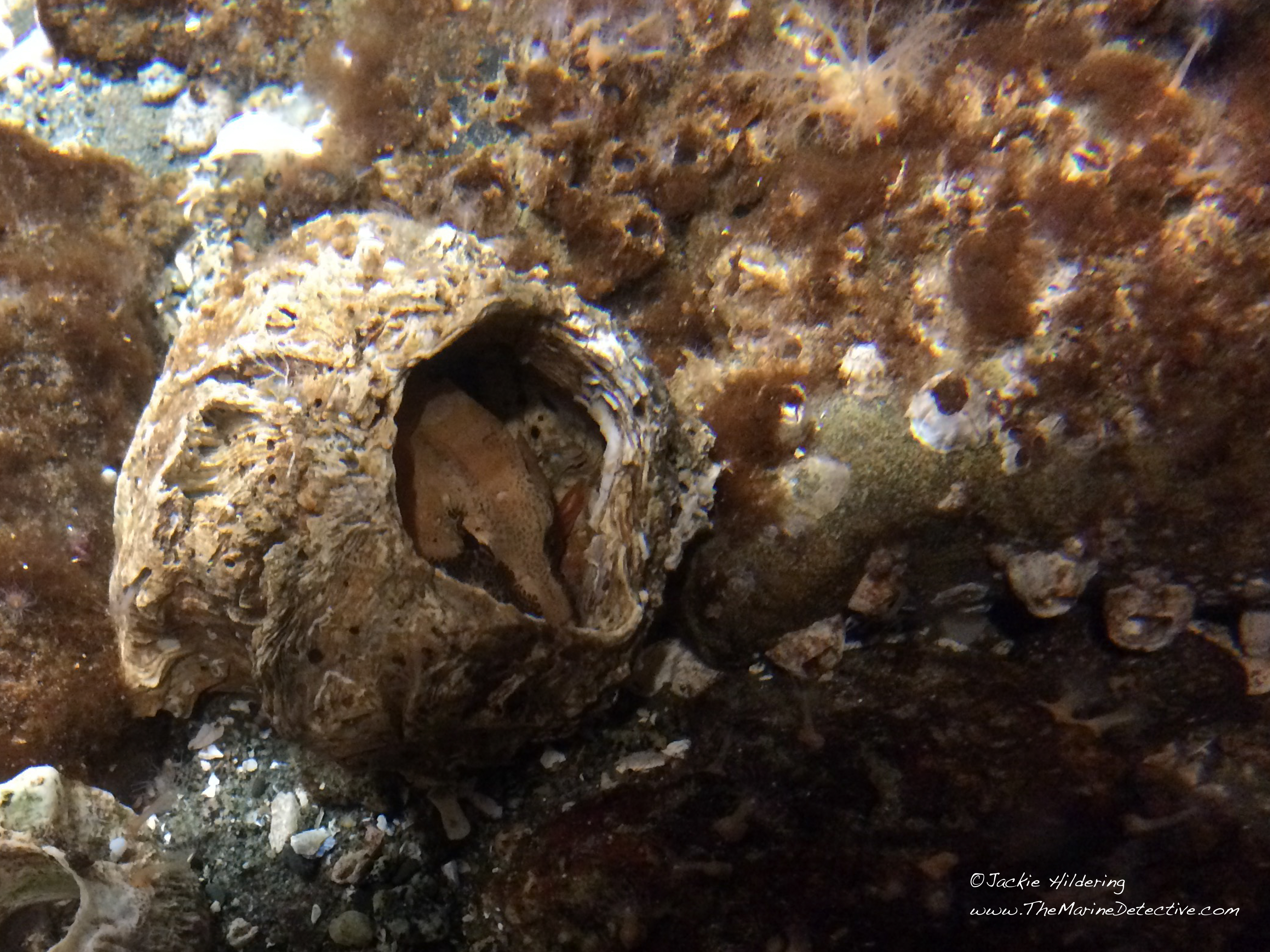
It is adapted to look like a Giant Acorn Barnacle (Balanus nubilis)!  When facing outward, its pointy nose looks like a closed Giant Acorn Barnacle and when the fish turns around, its tail looks like the foot of the barnacle that rakes in plankton.

Adapted to look like a Giant Acorn Barnacle!
Closed Giant Acorn Barnacles. See how similar this is to the nose of a Grunt Sculpin?
Foot of a Giant Acorn Barnacle. The tail of a Grunt Sculpin looks so much like this!

This little fish has giant attitude. It can be highly territorial, hopping around on its pectoral fins in a strutting, jerky fashion.

You may think the males are the master strutters? Ha! The female is as fierce as can be. Reportedly, she will chase a male into a crack, an empty barnacle shell, or another place of no escape and guard him there until she is ready to lay her eggs. When she has laid them, the male is released to do his duty.

She watches him to ensure he fertilizes the eggs (up to 150 at a time) and then, according to some sources – she saunters off leaving the male to care for the eggs but may return once in a while to take on a shift

If you can’t find an empty barnacle shell. A cup will apparently do!

From Casey Cook, aquarist with the Aquarium of the Pacific (pers com 2022-12-19): “The female often pushes the male into guarding so she can roam. She will get very vocal, and demanding – making sure he does the job!”

From Fishes of the Salish Sea – Volume Three: After the eggs are fertilized ” . . . she then moves off leaving the male behind to guard the nest, although she may return occasionally to help with parental duties. When the time for hatching approaches, the guarding fish takes the eggs inside its mouth, swims out of the nest, and spits out the eggs into the water column. This breaks the egg shells and frees the larvae that then swim off as zooplankton.”

Very young Grunt Sculpin. The Red-Gilled Nudibranch in the upper part of the image is only about 2 cm 

About Grunt Sculpins’ diet also from Fishes of the Salish Sea: “With its small, pointed mouth, it is adept at removing a wide variety of small invertebrates from the water column, especially copepods, amphipods, isopods and shrimps., but it also consumes significant numbers of fish eggs and larvae.”

The Grunt Sculpin’s pointy “bill-like” head is reflected in the species’ scientific name.

With regards to classification, the scientific name Rhamphocottus richardsonii reflects the Greek word for beak “rhamphos” which is appropriate for the Grunt Sculpin’s bill-like snout. This makes some people think that the species looks like a seahorse but note that they are not closely related at all. The Grunt Sculpin is the only member of its genus. It is truly one of a kind.

Juvenile Grunt Sculpin #1 of 3 photos.
Juvenile Grunt Sculpin #2 of 3 photos. 
Juvenile Grunt Sculpin #3 of 3 photos. 

Oh, and are you wondering about the name “Grunt” Sculpin? Apparently the species grunts when it is taken out of the ocean. You would too! Likely it also grunts when being defensive underwater. It is also the sound I make in my delight when I find one. It will be a very loud grunt indeed if I ever find one guarding eggs or with its tail-end extended out of a barnacle.


Below, more of my photos of Grunt Sculpins. 🙂

Grunt Sculpin next to a Gold Dirona (nudibranch species). See him /her?
Grunt Sculpin and a Clown Dorid (another nudibranch species).
A Grunt Sculpin “strutting” over the ocean bottom. See the cloud of silt lifted off as a result?
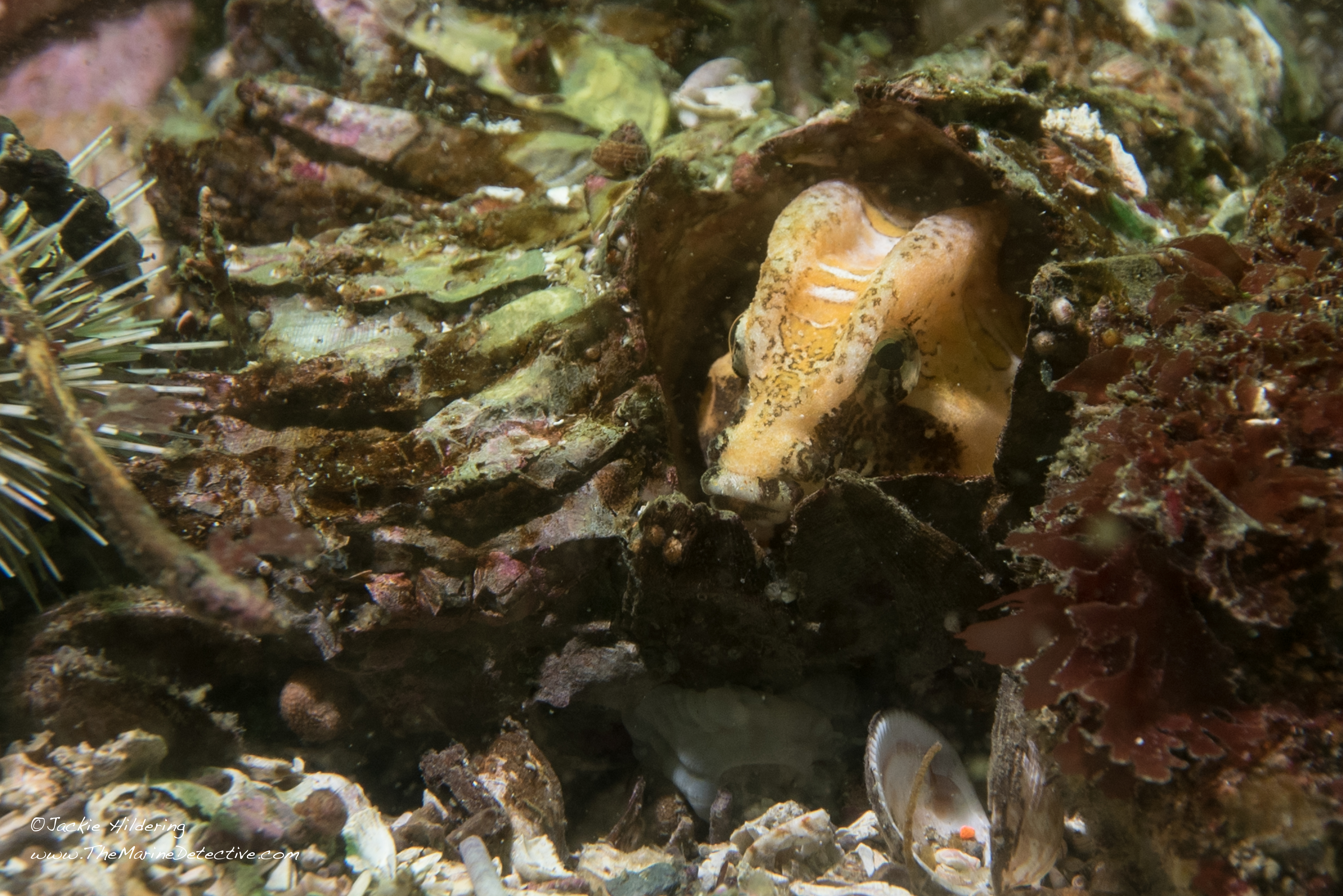
Another Grunt Sculpin in an empty barnacle shell.
And another.
You can’t see me.
Grunt Sculpin hiding in a broken mussel shell.
Juvenile Grunt Sculpin
I wonder if this one is female and about ready to lay her eggs?

And some more photos of individuals to show how similar their markings are.


Sources:
– Aquarium of the Pacific – Grunt Sculpin
– Fishbase – Grunt Sculpin
– Love, M. S. (2011). Certainly more than you want to know about the fishes of the Pacific Coast: A postmodern experience. Santa Barbara, Calif: Really Big Press.

Views from the Mast

How high can you get in seeing dolphins and humpbacks?

Captain Tavish Campbell knows.

The 1.5 minute clip below reveals his unique perspective from atop the 100′ mast of the beautiful schooner Maple Leaf.

From on high, he shares with us the view of hundreds of Pacific white-sided dolphins and a bubble-netting humpback whale.

I have the joy of sometimes serving as naturalist for Maple Leaf Adventures with Tavish. He allowed me to put together this clip for the David Suzuki Foundation’s Ocean Stories Campaign, both of us hoping that the breathtaking beauty might inspire people to undertake more positive action to protect the great biodiversity of the North Pacific.

What’s your Ocean Story?  You can help inspire connection and positive change by sharing your story with DSF up to midnight on October 31st. 

Gumboot Chitons Spawning!

I’m excited to share video with you of Gumboot Chitons spawning. These marine neighbours most often seem quite inanimate – having a life where they keep their undersides protected by sucking down hard on rocks but, when it’s time to mate . . . . . 

Female gumboot chiton

Female! © Jackie Hildering

First just a little background: “Chitons” are marine molluscs (soft bodied animals) that, rather than having one of more shells to protect themselves, they have 8 armoured plates surrounded by a thick band of muscle. This allows them to suction onto surfaces very effectively since the 8-plates give such flexibility that they can even get a good grip on surfaces that are not flat.

There are many members of the the chiton class but the Gumboot Chiton (Cryptochiton steller; aka Giant Pacific Chiton) is very unique in its appearance.

It’s another “the biggest of its kind in the world” that inhabits the cold, rich waters of the northeast Pacific. It can be 35 cm long and about 2 kg. They are very slow growing and very long lived! This source reports that chitons that are 15 cm long are likely 20 years old and that they may live to be more than 25. That’s one old gumboot!

The Gumboot Chiton is also the only chiton species that has flesh completely covering the 8 plates. The texture and colour of this “girdle” offers them great camouflage and is where the “gumboot” descriptor comes from. The genus name “Cryptochiton” relates to this camouflage and that the 8 plates are hidden under the girdle. These plates are very uniquely shaped, and well-described with the name “butterfly shells”.

Smaller dead Gumboot Chiton. Image shows the thick band of muscle with which Gumboot Chitons secure themselves. Fish species is Longfin Sculpin. ©Jackie Hildering.

Small dead Gumboot Chiton. Image shows the thick band of muscle with which Gumboot Chitons secure themselves. Fish in this image is a Longfin Sculpin. ©Jackie Hildering.

Apparently some First Nations did sometimes chew on this species but I am SURE that this is not the cultural origin of some people referring to this species as “wandering meatloaf”!

I don’t know where I picked this up, but I believe that one of the First Nations’ names for gumboot chitons translates (very) loosely, into “stuck on rock with face forever”. This would be an incredibly good descriptor since most chitons stay “face” down, grazing on algae by scraping with the sharp teeth-like structures of their radula. Thereby, they don’t expose their soft bodies and reduce the chance of predation. 

jackie-hildering-one-time-use-as-specified-15308

Gumboot Chitons feeding on dead Bull Kelp. ©Jackie Hildering.

I once found a Gumboot Chiton that had been dislodged by a predator at low tide. It is then that I learned that they have the ability to curl up on themselves like a pill bug!

But outside of a rare experience like this, you don’t often get a chance to see how very alive and animal-like they are.

Unless . . . they are spawning. 

Then, up came the bodies of the Gumboot Chitons, into a very unique funnel-like shape. The “gonadal pores” are near the bottom end of the animals, but by positioning themselves in this shape, they channel the sex cells upward.

When spawning, you can clearly see which Gumboot Chitons are male and which are female!

It was just remarkable to see this, feeling truly as if some secret world was being revealed, and the coordinated timing of the spawning was astonishing.

Of course when you are a broadcast spawner, you need to release copious amounts of sex cells and need to do so at the same time or there will be even less chance that egg meets sperm. You can imagine how many eggs need to be fertilized if any of your zooplankton offspring are going to survive since so many animals feed on plankton.

To my knowledge, science has not concluded exactly what the cues are for “Hey fellow Gumbooot Chitons, it’s spawn time NOW!”  It has to be temperature, light, tide and/or amount of food that determines the time is right.

Hum . . . seems to me that those cues may be significant between individuals of our species too!

Additional images:

Chiton plates on the right are those of the Gumboot Chiton.

Chiton plates on the right are those of the Gumboot Chiton.

OLYMPUS DIGITAL CAMERA

Sometimes individuals have this mottled colour pattern. ©Jackie Hildering.

Gumboot Chiton predated on by Sunflower Star

Gumboot Chiton being ingested by a Sunflower Star. Unknown if this was the result of predation or if it is scavenging i.e. that the Gumboot Chiton was already dead. ©Jackie Hildering.

jackie-hildering-one-time-use-as-specified-03443

NOTE: I would normally NEVER disrupt a chiton as this would potentially damage the animal. The Gumboot Chiton in this image had been dislodged by a predator and was lying upside down. Used it as an opportunity to discuss ethics with the Sunset School students. We decided to right it and put it on a rock so that s/he could be protected again by sucking down ©Jackie Hildering.

NOT “Plenty of Fish”!

“Plenty of Fish”?! Not at my trophic level!

[Note: This blog was published in 2012].

So this may be one of the most daring things I ever do and it is certainly the most uncontrolled experiment I have ever conducted.

This blog item is not about the state of the oceans but about dating sites like “Plenty of Fish” and my reality as a vibrant, single 49-year-old woman.

As any reader of “The Marine Detective” knows, there are NOT plenty of fish in the sea. There are massive conservation and management efforts needed for marine ecosystems before it is too late.

I perceive the metaphor with regard to relationships to be equality untrue. There are not “Plenty of Fish”, at least not at my trophic level in the ecosystem in which I want to continue to live.

I of course respect the utility of such online dating sites and recognize that there are many out there that have met the love of their lives in this way.

It’s not for me though.

I would prefer a site named “Deep Sea Bottom Trawling” where the first thing you do, to increase efficiency in finding those of like intentions, would be to choose your method of “fishing” i.e. catch and release (one night stands); bottom trawling (indiscriminate and destructive); seining (slowly closing a net of no escape); long-lining (many hooks in the water); trolling (more selective due to using appropriate hooks for your target catch) . . . you get the idea AND some flavour of my sense of humour.

By virtue of my unique name and lifestyle, and my on-line presence as “The Marine Detective”, I would have little hope on a dating site of finding balance between revealing anything about myself and preserving some anonymity.  This has led to my thinking, why not take things entirely into my own hands and put my “single, very happy but wanting it all” status out in a world of those who have a sense of what I am about?

I hope the humanity of this has you smiling as a reader and not thinking “Ooooh – this is awkward!”

So here goes:

  • My good traits?  They are revealed in all things related to The Marine Detective – I am passionate, driven to make a positive difference, adventurous, independent, introspective, articulate, funny, creative, strong; honest, hard-working, and accomplished.
  • My negative traits? They are the same as the list above but would be perceived by someone who does not have the same value system; who does not have a strong sense of self; and /or is feeling weakened by middle age as my being: intense, uncompromising, demanding, scattered, blunt, workaholic, and eek  . . . a feminist! (As if equality would be a bad thing for either gender).

So that’s it folks, my hopes are likely no different than many of yours. 

Despite the scarring and lessons-learned of previous relationships, I still have the hope of being able to have it all and that somehow, maybe as a result of my daring to write this blog, that I will end up with a man with whom I have a deep connection, and can build a partnership where we swim in a sea of love, truth, passion, and mutual respect.

I want to share this extraordinary, privileged life with a very rare fish with a rich life of his own.

If you know of one, please throw him a line!


Plankton Got Sole!

No, I have not mixed up my spelling of “soul” verses “sole”.

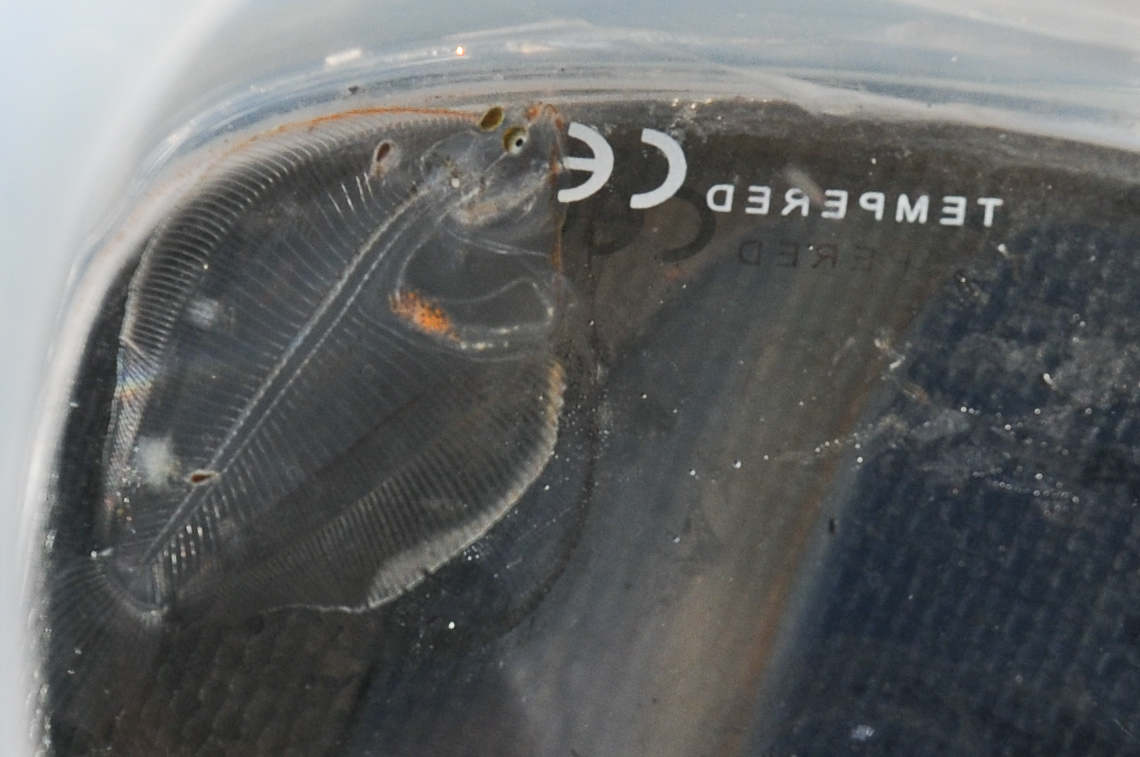
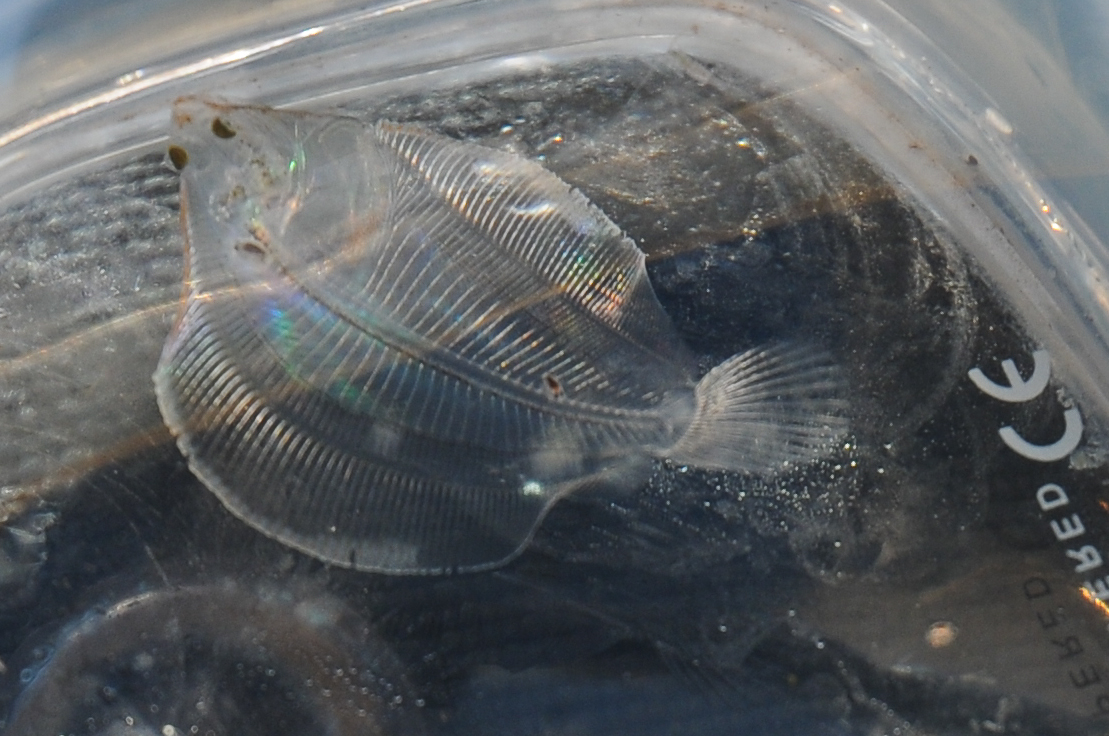
This last weekend, while watching herring feed on krill in a tide line, I suddenly noticed a very small transparent fish.

Upon closer inspection, I saw that it was a larval form of some species of flatfish.

I was able to dip the little guy / gal into my dive mask for a few pictures and, due to the size of the lettering in the mask, I know that the fish was only 2.7 cm.

Planktonic Sand Sole.  Only 2.7 cm. 
Photo: Jackie Hildering

I was in awe of how transparent s/he was; that I could see the bones and heart; and that this small, fragile planktonic stage could ever survive to grow into an adult.

These sorts of “finds” are as awe-inspiring to me as any sighting of a whale. The thick planktonic soup of our rich cold oceans is full of the larvae of so many species. Anemones, nudibranchs, sea stars, crabs, etc. – they all start off as zooplankton and the incidence of what sort of plankton are present often gives scientists an indication of what may be happening with the marine food web.

It is like a world of hidden secrets to me and of course I wanted to find out all I could.

What species of flatfish was this – halibut, sole, flounder?

Photo: Hildering

I do not have the expertise to know but, oh so thankfully, there are those out there willing to share their great knowledge.

Marie-Josée Gagnon of the Salmon Coast Research Station quickly steered me in the right direction, believing it was most likely a species of sole.

She connected me with zooplankton taxonomist  Moira Galbraith of the Institute of Ocean Sciences who confirmed that this was the larval form of a Pacific Sand Sole (Psettichthys melanostictus), a species that can grow to 63 cm. She also shared that the transparency of the larval fish serves as camouflage, reducing the chances of it being eaten before reaching the life stage where it settles to the ocean bottom and hides on and in the sand.

But wait, what are those two little zooplankton guys attached to the larval sole? They are copepods, but what kind of copepod?  What does their presence mean ?  Are they parasitic? And there I go down the marine id rabbit hole. 

One thing I know for sure though – and forgive me for the following pun because the emotion behind it is very sincere – how I hope this little planktonic fish will be a  . . . sole survivor.

Sources:


Update September 30, 2012:

  • This great item by Puget Sound Sea Life has been brought to my attention and includes the following: ” . . . within several days to weeks, depending on the species, the larva undergoes a radical metamorphosis. The right or left eye migrates from it’s normal position across the top of the head to the other side of the body changing some skull bones in the process . . . . After metamorphosis, the fish settles to the bottom on it’s left side, develops skin color on the right side and continues growth as a juvenile.  Adapting a bottom-dwelling life style allows flatfish to exploit a common habitat – flat sandy bottoms which are very common in the subtidal zone. Many fish avoid this habitat because of the lack of rocks or other features that would provide a hiding place. Flatfish can hide from predators by burrowing, leaving only their eyes above the surface. In addition the habitat is home to an abundance of prey such as worms and shrimp. With both eyes on the upper side they can use 3D vision to hunt and detect predators. There has been considerable controversy over the origin of flatfish, but recent discoveries of several fossil intermediate forms show that eye migration evolved gradually some fifty million years ago.”
  • With regard to the ectoparasites on the sand sole larva, Marie-Josée Gagnon and Moira Galbraith have again been very generous with their knowledge. It is impossible to know the species from my photo but, due to the size, it is likely a recent infection and could be (1) first stage Chalimus; (2) Lepeophtheirus bifidus – which, unlike most parasites of benthic marine species is host specific – only being found on the rock sole or possibly, (3) the isopod Gnathia.   I valued having affirmed too that adults and young live in different environments to eliminate competition for the same resources but also to provide a buffer or separation to prevent transfer of disease or parasites.

Lion’s Mane Jellyfish – Sherlock You Are Wrong!

I had a wonderful opportunity to photograph and film a lion’s mane jellyfish (Cyanea ferruginea) today.


The 1.5 minute annotated video clip below will give context to my “Sherlock – You Are Wrong” statement.  
Enjoy!

Click here to see a short clip of the other big jelly species that can be found in our waters – the egg yolk jelly (Phacellophora camtschatica) at up to “only” 60 cm across. 

The Reason You Can’t See to the Bottom . . . .

The 1.5 minute video below is my attempt to bring the astounding biodiversity of the cold, rich waters of the NE Pacific Ocean to the surface.

If there is one thing I hope to achieve with my photography, it is to shatter the perception that — because you can’t see to the bottom — there must not be much life in these waters.

The opposite it true.

The reason you can’t see to the bottom is because there is SO much life.

Please feel free to share the video widely. Hopefully it will enhance people feeling a connection to the ocean, wanting to undertake further conservation, and understanding what is at stake with high risk projects that worship short term-economic gain at the cost of long-term environmental devastation — like increasing tanker traffic along British Columbia’s precious coast.


Super Natural or Super Tanker?

Northern Resident Killer Whale R12 (male born in 1967) in Caamano Sound – part of the proposed tanker route that would carry bitumen crude along B.C.’s fragile coast. Photo by James Pilkington taken during the time he spent 3 seasons at a remote outpost documenting the biodiversity of the area for the North Coast Cetacean Society. http://www.cetacealab.org/

August 8, 2012: Last night and this afternoon concerned Northern Vancouver Islanders resolutely, passionately, creatively, eloquently and unequivocally said “NO” to the Enbridge Northern Gateway Project. Below, is the text that I used to guide my testimony to the Joint Review Panel:  

My name is Jackie Hildering and I speak from the perspective of a marine educator who has lived in this area for 13.5 years. I moved here after a 14-year international teaching career choosing B.C.’s Coast specifically because of its extraordinary marine biodiversity and what I perceived to be the potential to leverage this biodiversity to motivate people to undertake positive environmental change.    In my years here:

  • I have worked as a whale watching naturalist for a company serving some 10,000 guests a year of which a conservative estimate is that 65% come from outside British Columbia;
  • For 8 years, I was DFO’s Education Coordinator for this area;
  • I am a humpback whale researcher; and
  • I am a very avid cold-water scuba diver using my underwater experiences and photographs, in addition to the marine mammal engagers, in my education and conservation efforts.

I am the 2010 recipient of the Vancouver Aquarium’s Murray A. Newman Award for Excellence in Aquatic Conservation and have received written commendation for my work from DFO’s Director of Oceans, Habitat and Enhancement. I share this depth of personal background with you to fortify my testimony:

  • On how extraordinary the marine biodiversity of this area is;  
  • The value of the resources being put at risk; and
  • That this risk is simply too great to allow the marine transport of bitumen in the proposed area.

It is an inescapable conclusion that the transport of bitumen crude along our Coast constitutes a massive gamble where human ingenuity is being pitted against the resilience of Nature and our dependence on it. I can testify that this marine ecosystem is extraordinary on a global scale. I have photographed invertebrates that were previously unknown to science, and have participated in documenting rare organisms such a corals and glass sponge reefs at depths much shallower than what had been previously documented.   I acknowledge however, that when there is such absence of knowledge, it is more difficult to make the case for how the life hidden below the surface may be impacted by this Project. Therefore, I will use the marine mammals and what we do know about them as ambassadors for the fragility of the other life below the surface. The marine mammals that have been acknowledged to be at risk in the area are the:

  • Species of Special Concern – the harbour porpoise, gray whale, Steller sea lion, and sea otter;
  • Species recognized as being Threatened – humpback whale, fin whale, northern resident, and transient killer whales; and
  • The Endangered southern resident killer whales and potentially, blue whales and sei whales.

In fact, bitumen transport would take place through what has been acknowledged by government to be critical habitat for humpback whales, and what is candidate critical habitat for northern resident killer whales and fin whales. The marine mammals, to varying degrees, have survived culling and whaling but continue to experience the treats of reduced prey availability, bioaccumulation of toxins, ocean acidification and further impacts of climate change, noise, vessel strike, entanglement, and more. The anthropogenic impacts on these species’ survival would indisputably be amplified further by this Project due to chronic noise and increased risk of ship strike. As a humpback researcher, I can attest to how oblivious this species can be to boats. I have watched them surface directly in front of motorized vessels after previously having been 400 plus meters away. When one considers the size of the tankers, how narrow the inlets are, the difficulty in adjusting the course of these large vessels, the density of humpback whales, and the potential weather conditions – vessel strike of humpbacks is a very real risk and one that cannot be mitigated by the presence of marine mammal observers. The humpbacks are going to be there.  Then what? Outside of concerns about the noise and further traffic impacts to the marine life, and what this means to their survival, the potential losses that would result from a spill are simply the stuff of nightmares.  When something goes wrong – then what?  It is my understanding that, at best, when there is a spill there would be 15% recovery. And we can’t hope for “at best” – seen Enbridge’s performance record; the likely wind and wave action that would be associated with a spill; that the federal government is closing B.C.’s command centre for emergency oil spills and centralizing operations in . . . Quebec; and that the closure of a Coast Guard base and three marine communication centres in B.C. will leave only two marine communication centres to monitor B.C.’s 27,000 kilometres of coastline.  And after the spill, with irreversible and catastrophic loses, what mechanism is there to hold industry accountable? What is there when, concurrent with the review of a Project such as this with the potential for devastating impacts, the government is atrophying or removing the checks and balances the would allow appropriate assessment of risk? The latest Harper statement is that science, not politics, will drive decision making around such projects. How?

  • The ocean contaminants program will be all but be shut down;
  • Government researchers, whose work has been paid for by the taxpayer, are stifled in their communications;
  • Bill C-38 has gutted Canada’s Fisheries Act, undermined the Species at Risk Act and repealed the Canadian Environmental Assessment Act and it was done in such a way that even the Conservatives could not vote against it since, to defeat an omnibus budget bill is to defeat one’s own government;
  • Testimony at the Cohen Inquiry into the Decline of Fraser River Sockeye has made clear how government bodies are made to work with industry rather than safeguard our natural resources – even a keystone species; and
  • Environmental governmental organizations are more overwhelmed than ever as a result of these many attacks against science and the environment in addition to now struggling under the needless scrutiny and vilification by our federal government.

This current government climate is the epitome of decision-making based on short-term economic gain over long-term environmental health. I solidly believe there is another economic path that does not put our resources at risk in the way that marine bitumen transport would and where there is so much to lose economically, socially, and culturally. As a result of my work, I believe we have not come close appreciating nor maximizing the economics of the international attraction of British Columbia for its natural splendor. Outside of the First Nations, our culture has largely been one of being gold-rushers, and I think we, the keepers of paradise, often don’t know that we are in it. We don’t fully recognize how extraordinary B.C.’s Coast is and therefore don’t understand adequately what is being put at risk.   There is certainly an element of taking our resources for granted, and increasingly, that society does not appreciate our connection and dependency on them. Therefore, we fall short in our ability to attract and capitalize on B.C.’s international wild appeal and we are not inclined to move toward a greener economy nor to adequately protect our environment. I can testify to the potency of our Coast to attract those looking to connect to the wild, to view giants, and breath in the sense of space and raw beauty of this area and how I believe this can be capitalized upon economically, while creating societal good. It is of course so difficult to measure, but I will also dare state, based on my experience in the trenches of conservation, that the connection to the wild positively impacts, inspires, fortifies and empowers humanity in a way that cannot be achieved in an urbanized setting. [And this is where I virtually lost it and needed to choke out the remaining words.] We simply need places like this and can’t expose them to this kind of risk. My position on the decisions Panel should make is:

  • The potential of environmental impact is too great and cannot be mitigated for;
  • There is too much at risk – environmentally, economically, culturally and socially; and
  • That therefore, transport of bitumen crude cannot take place along B.C.’s fragile and extraordinary coast and the Enbridge Project must not be approved.   

Simply, we should be capitalizing on this being Super Natural British Columbia, not Super Tanker British Columbia. 


Rockfish Barotrauma

Update: September 2022
New paper – Hailey L. Davies, Shane Gross, Dana R. Haggarty, Francis Juanes (August, 2022)- PHOTO DIARY – Conserving Rockfishes: Barotrauma and Descending Devices in the Northeast Pacific, Fisheries Magazine.

Get the app that alerts you when you enter a Rockfish Conservation Area.

Update: Fisheries Notice March  25, 2019
The use of a descending device is now required by condition of licence to assist in the conservation and survivability of rockfish being returned to the water. Because of their closed swim bladders, rockfish brought to the surface suffer barotrauma, causing the swim bladder to inflate and reducing the probability of their survival upon release. Handle catch as little as possible, using wet hands to preserve the protective slime coat, and return to the water at depth of capture as quickly as possible (under two minutes). To avoid catching rockfish, move to another fishing location.”

_______________________________________________

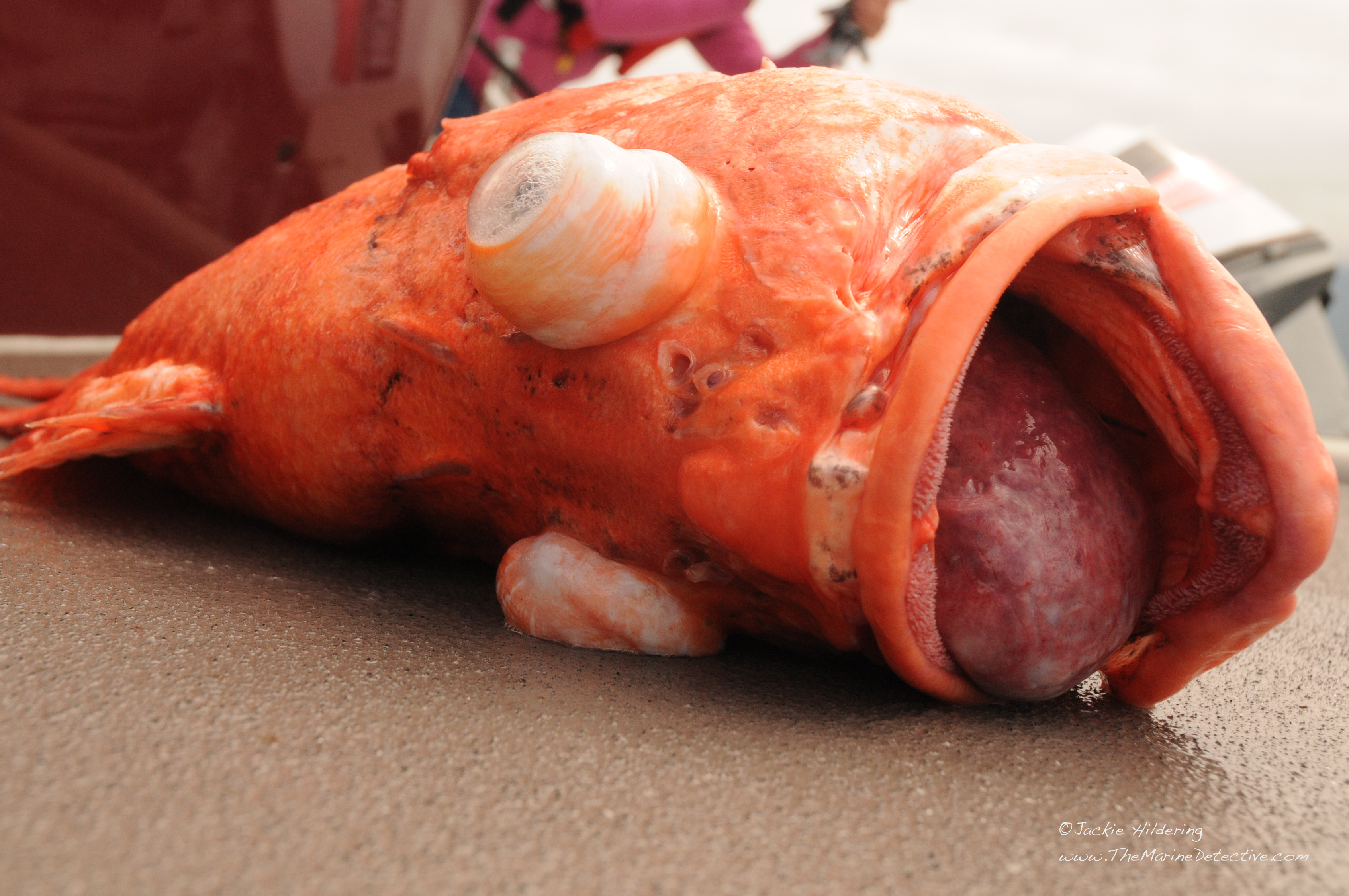
This photo is of a Yelloweye Rockfish that has died from barotrauma, also known as “pressure shock”. 

Yelloweye Rockfish that has died of barotrauma. Reduced water pressure causes the air in the swim bladder to expand and push out the esophagus and eyes. BUT this is a reversible condition whereby the fish can survive through use of a “fish descender”. Photo: Hildering. 

Many rockfish species are particularly sensitive to reductions in pressure since the air in their swim bladders expands substantially. The swim bladder is a buoyancy control organ and even when slowly reeled in from a depth of only 20 m (60’), a rockfish’s swim bladder can expand to three times its size, putting pressure on the fish’s organs.

As is the case with the Yelloweye Rockfish in the photo, the swim bladder can expand to the point of causing the fish’s eyes to bulge out of their sockets and its esophagus to be pushed out of its mouth (the esophagus is the first section of the digestive tract). I know this is likely a sight that may not enhance your appetite for your rockfish catch but please read on since, contrary to the thinking of many, this IS reversible whereby the rockfish stands a good chance of survival.

Colossal “management” errors were made with overfishing slow-growing rockfish. Many species are extremely long-lived, slow to sexually mature, and the big, old females are the most fertile – producing the most eggs and hatching the largest number of healthy young.

For example, Yelloweye Rockfish are believed to have a lifespan of up to 118 years. They don’t reproduce until they are at least 12 years old, and the old females can incubate up to 2.7 million eggs! Know that there are 38 species of rockfish off the coast of British Columbia. 

This means that species are very slow to reproduce whereby, if you catch lots, especially the big females, you can devastate populations very quickly.

Another nail in the coffin of rockfish is that many adults also have high site fidelity so that by fishing one area, you can wipe out a community of fish. Click here for my blog on having found back the SAME individual rockfish in the SAME spot after EIGHT YEARS. This is why Rockfish Conservation Areas (RCAs) are essential, where it is most often illegal to do any hook and line fishing (see restrictions here). 

But, what is you accidentally catch a rockfish outside these areas?

There are studies that support that if you were to quickly recompress the fish, it would stand a very good chance of survival, even where it appears dead at the surface. The fish could be brought back to depth with barbless weighted hooks, or commercial “fish descenders”.

This video make the life-saving potential of fish descenders very clear.

From Island Fisherman Magazine: “Common types of descending devices include a simple, inverted barbless hook, a spring-loaded clamp, and a pressure-release clamp. Of the different devices available, the most effective and simplest to use is a depth pressure activated release device, the Seaqualizer . . . Automatically opening at preset depth, the motion of the boat or the actions of the rockfish as it descends will not prematurely release the fish.

Examples of fish descenders:
Seaqualizer Fish Release Tool (~ $60 CAN)
(Recommended by various fishing organizations and publications)
Shelton Fish Descender (~$8 CAN) 
SeaQualizer SeaYaLater Fish-Release Hook (~$20 CAN)”

If you can act quickly enough (which is essential) you can even use and inverted, weighted milk crate. See clip below AND this link for making your own descending device.

How wonderful it would be if more people would undertake the effort to recompress the fish, knowing how dire the situation is for many rockfish species. Imagine the further positive impact if people would choose to return the depleted species to depth even when they haven’t reached their catch limit, especially the big, highly productive females.

But, even if there was to be such enlightenment, many rockfish populations are so depleted that they need far more protection.

Again, Rockfish Conservation Areas (RCAs) are essential. These should be areas known to be the territory of depleted rockfish populations. Since these are no-fishing zones, there is no chance of barotrauma and the rockfish populations that live in the area are given the time to rebuild to have more sexually mature fish and more big old super mamas.

In summary, it’s so easy to contribute to rockfish conservation:
(1) Respect Rockfish Conservation Areas knowing that you usually cannot do ANY hook and line fishing there; and
(2) Invest in a fish descender for rockfish caught outside RCAs.

Long live rockfish!

Fantastic video showing how rockfish that appear dead at the surface due to barotrauma fully can revive at depth! From the Coastside Fishing Club:

Video from Alaska Department of Fish and Wildlife showing a summary of homemade and commercial fish descenders. 

Entertaining and super informative video “How to save a life – a rockfish life” by fish guru Milton Love with a rap song by Ray Troll:

Source: Protecting Rockfish – Fisheries and Oceans Canada

Links
Get the app that alerts you when you enter a Rockfish Conservation Area

Government of Canada

Examples of fish descenders

Research on the effectiveness of fish descenders

An Honour – Pacific Northwest Diver “Featured Photographer”

Something made me clap my hands and giggle in glee today.

Of course I want to share the cause with you but, first, a bit of context. 

I am 49 years old.

I only started diving in 1999 at age 36.

I resisted taking underwater photos until 2006, not wanting to take my above-the-ocean marine photo addiction underwater with me.

Then I was gifted an underwater camera and very soon discovered the huge conservation power of sharing these photos with others, especially when coupled with my teaching.

In 2010, “The Marine Detective” erupted, better unifying my teacher, whale researcher, photographer, and  conservationist selves and making it just a little easier to answer “So what is it you do?!”

Then there was that amazing Murray A. Newman Aquatic Conservation award  from the Vancouver Aquarium . . .

And now, I feel another milestone has been reached in whatever path The Marine Detective is on.

I am this month’s “Featured Photographer” in Pacific Northwest Diver Magazine. 

I have had the great privilege of my photos getting used for a variety of conservation purposes prior to this but this magazine is put out by peers in the Pacific Northwest Underwater Photographic Society.  The calibre of these underwater photographers humbles me, so it is a really big deal!  

Please check out the write-up and my photos in Pacific Northwest Diver at this link. 

The direct link to the e-magazine is right under my dolphin cover shot. Ooh, an additional draw for you to go to the website – the promise of a dolphin photo! 

You can subscribe there too. 

My huge thanks to editor Dan Clements for the honour, the opportunity to expand the reach of The Marine Detective, and this additional push to keep me going.

My huge thanks to you for giving me further reason to believe these efforts are worthwhile.  

Clap! Clap!  Giggle! Giggle! 

The Marine Detective honoured to be the “Featured Photographer” in Pacific Northwest Diver.