Did you know that stones are commonly found in the stomachs of Steller sea lions?
These stomach stones or “gastroliths” are as big as 12 cm!
Share your theories about why you think this might be after viewing the video below. It provides you with information to help with this Marine Detective case.
Happy sleuthing to you!
Note that yes, gastroliths have been found in the stomachs of other seal and sea lions species including the California Sea Lion, Zalophus californianus (Source: Drehmer and Oliverira).
Click here for SeaDoc footage of Steller Sea Lions playing with California Sea Cucumbers.
Abstract: “In summary, our opportunistic assessment of gastroliths in temporarily captive Steller sea lions showed that a large proportion of juvenile animals (e.g., one-third or more) may haveone or more stones at any given time. The regurgitation of gastroliths correlated best with leaner, but not poorer body conditions, and during the summer months, possibly indicating a weak association as a digestion aid. We found little evidence to suggest that they assist in buoyancy and satiation; it is even more unclear as to what drives an individual to regurgitate them. With a lack of strong conclusions relating to a particular use, we can only conclude that they appear to serve a function in sea lions and are not ingested accidentally. A combined assessment of regurgitated and in vivo gastrolith measurements may shed more light on the subject and allow for direct evaluation and conclusions as to their functionality in sea lions.”
“Gastroliths, defined as stones or concretions in the digestive tract, occur in many extant vertebrate taxa and throughout the fossil record of marine tetrapods (Wings 2007). Most information is anecdotal, with limited data on occurrence and size(e.g., Labansen et al. 2007). Adjusting buoyancy, alleviating hunger, and aiding in digestion are the most popular theories for the presence of gastroliths in marine mammals (Taylor 1993). Gastroliths have been described in all 3 families of pinnipeds including otariids (e.g., South American sea lions Otaria byronia—Drehmer and Oliveira 2003), phocids (e.g., harp seals Phoca groenlandica—Nordøy 1995), and odobenids (Gjertz and Wigg 1992)”
A note about the Marine Mammal Regulations in Canada
Amended Regulations (since July 2018) include that it is illegal to target marine mammals for the purposes of swimming with them (unless permitted by a research license). See the Marine Mammal Regulations at www.SeeABlowGoSlow.org.
Most often, divers prefer good visibility. But oh to have the good fortune to happen to be in the water when marine invertebrates are spawning!
I’ll never forget the first time the seas suddenly turned white and these green packets drifted by my mask.
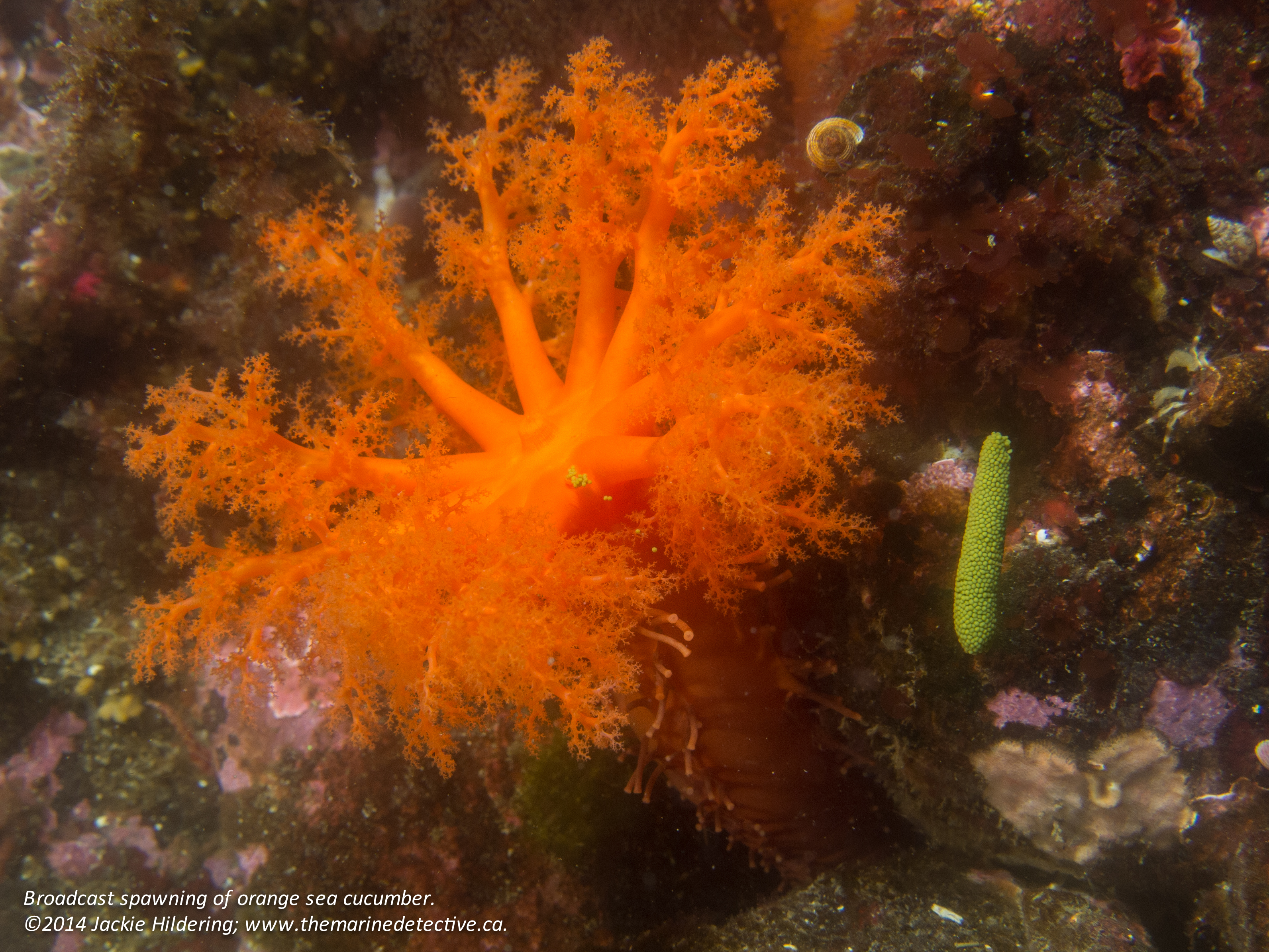
Egg pellet from an Orange Sea Cucumber.
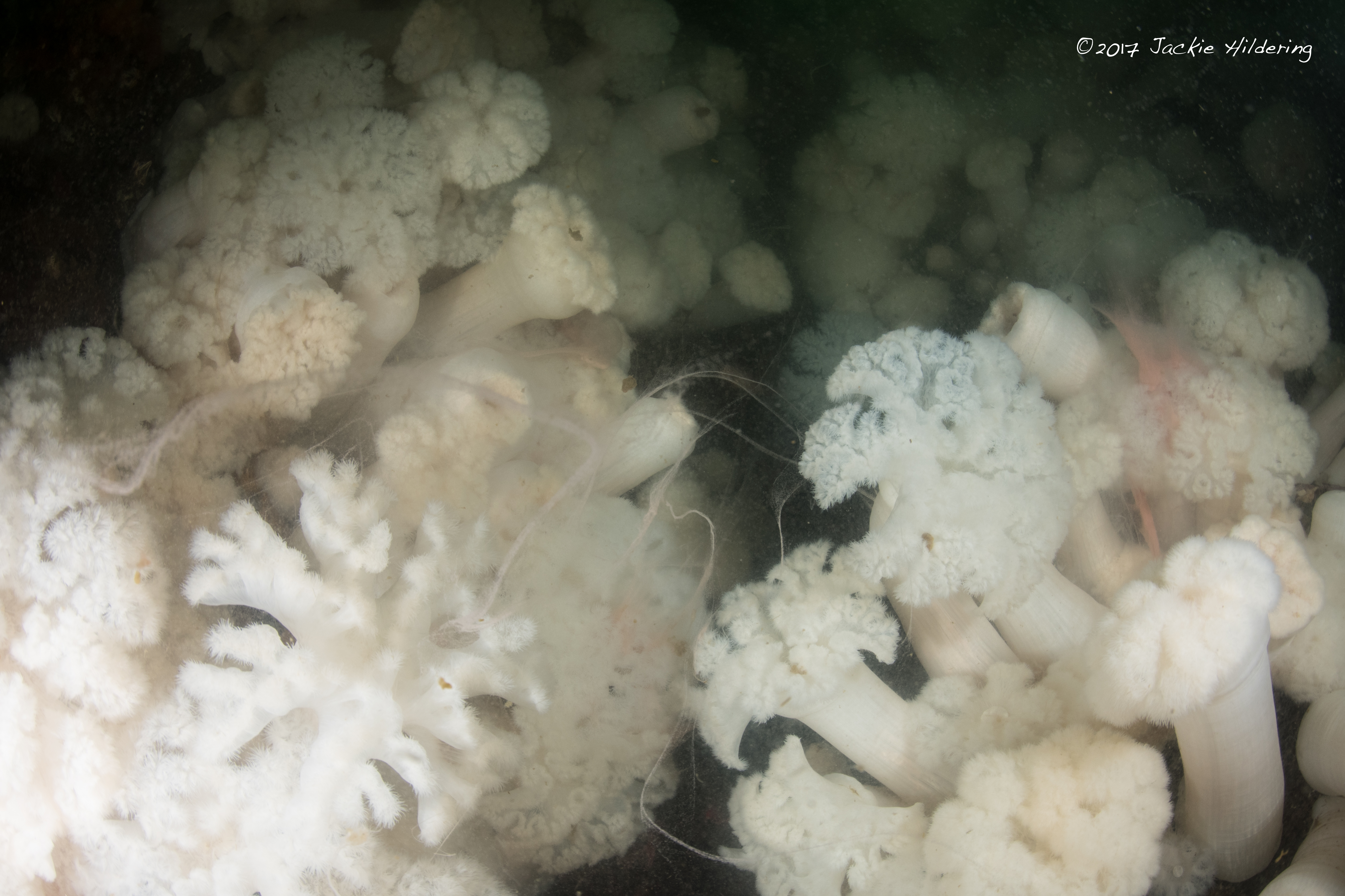
I was euphoric that I happened to be in the water when Orange Sea Cucumbers (Cucumaria miniata) and Giant Plumose Anemones (Metridium farcimen) were broadcast spawning. Witnessing the magnitude of this great force that ensures these species will survive is as awe-inspiring as witnessing the annual spawn of herring or salmon.
Female Orange Sea Cucumber about to release an egg pellet.
The same female Orange Sea Cucumber 1 minute later, releasing the egg pellet.
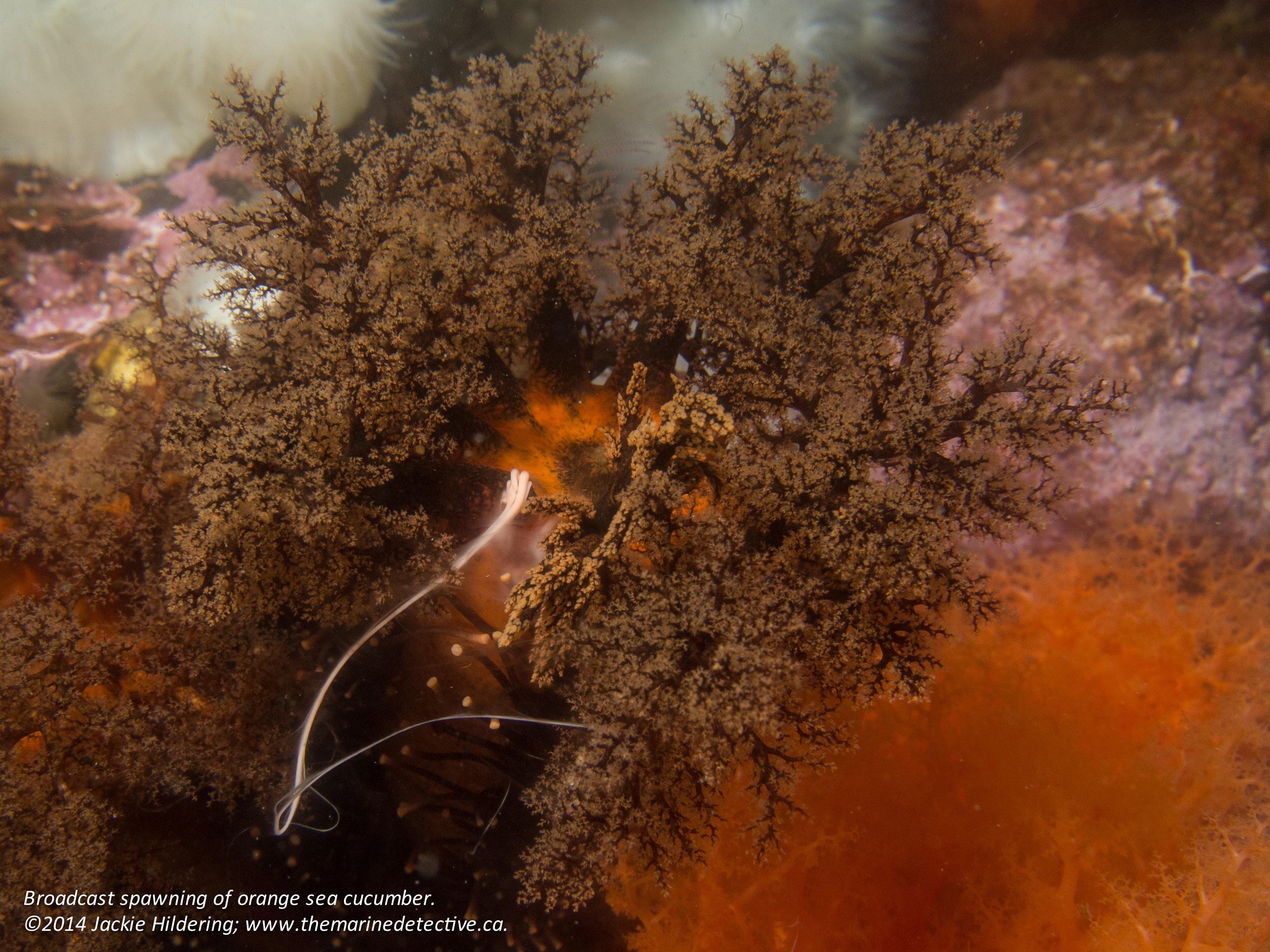
Spawning male Orange Sea Cucumber. Species can also be this darker, brownish colour.
During broadcast spawning, invertebrate males and females each release their sex cells into the water column – in astoundingly copious amounts.
You can imagine how many gametes must be released for there to be a chance of fertilization and for enough of the resulting larvae to survive and not to be eaten by the many filter feeders such as barnacles, anemones and sea cucumbers!
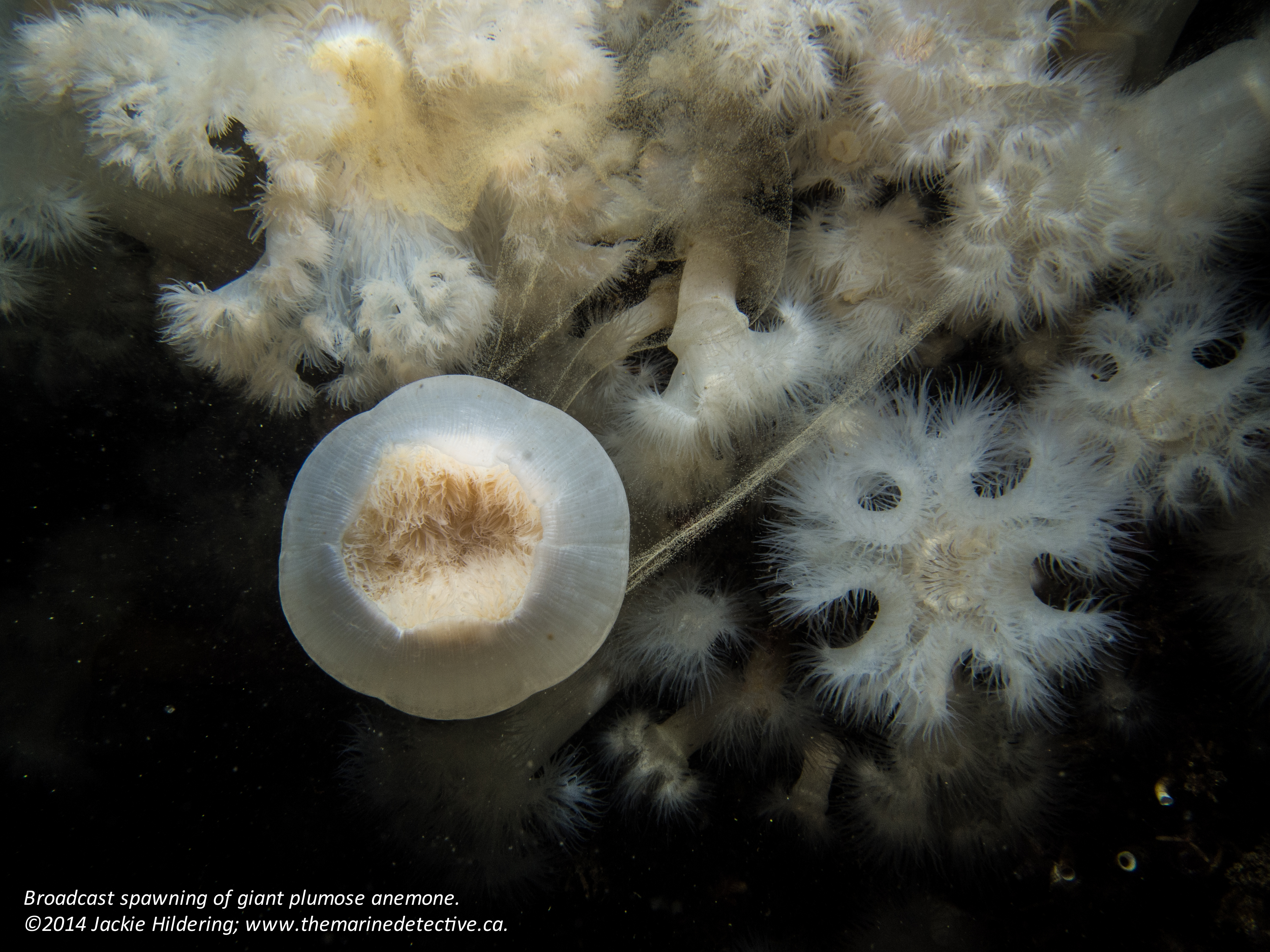
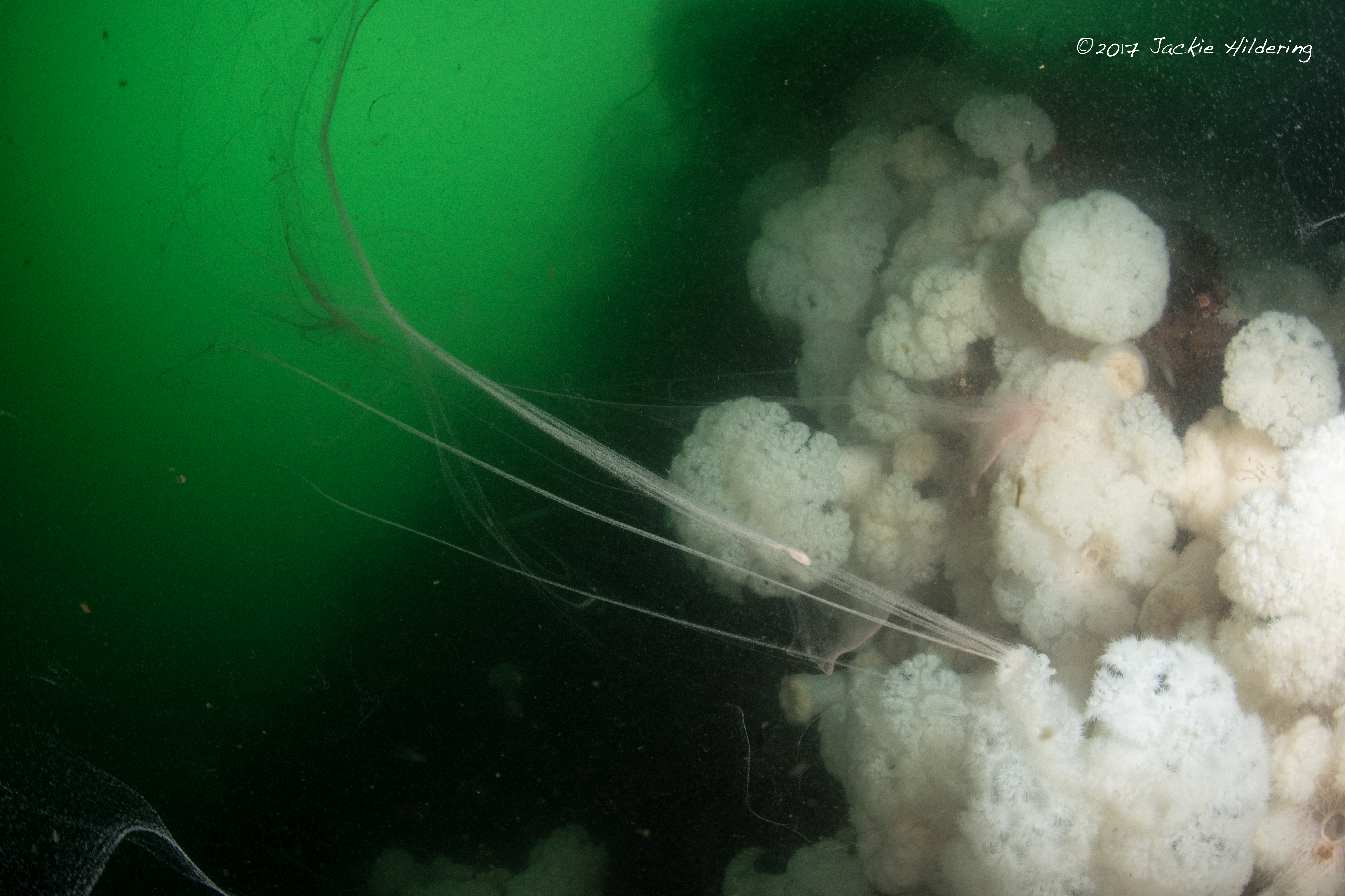
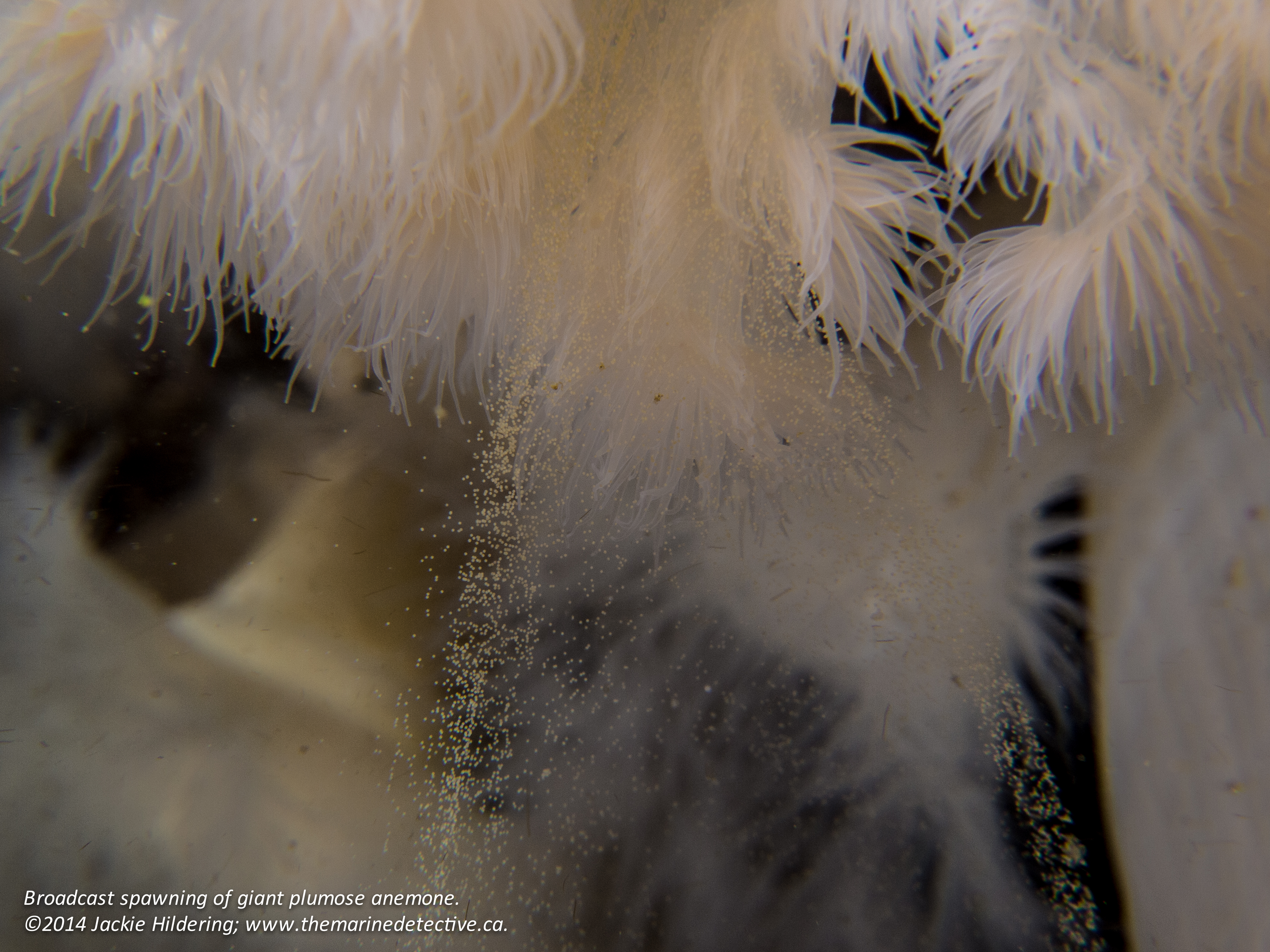
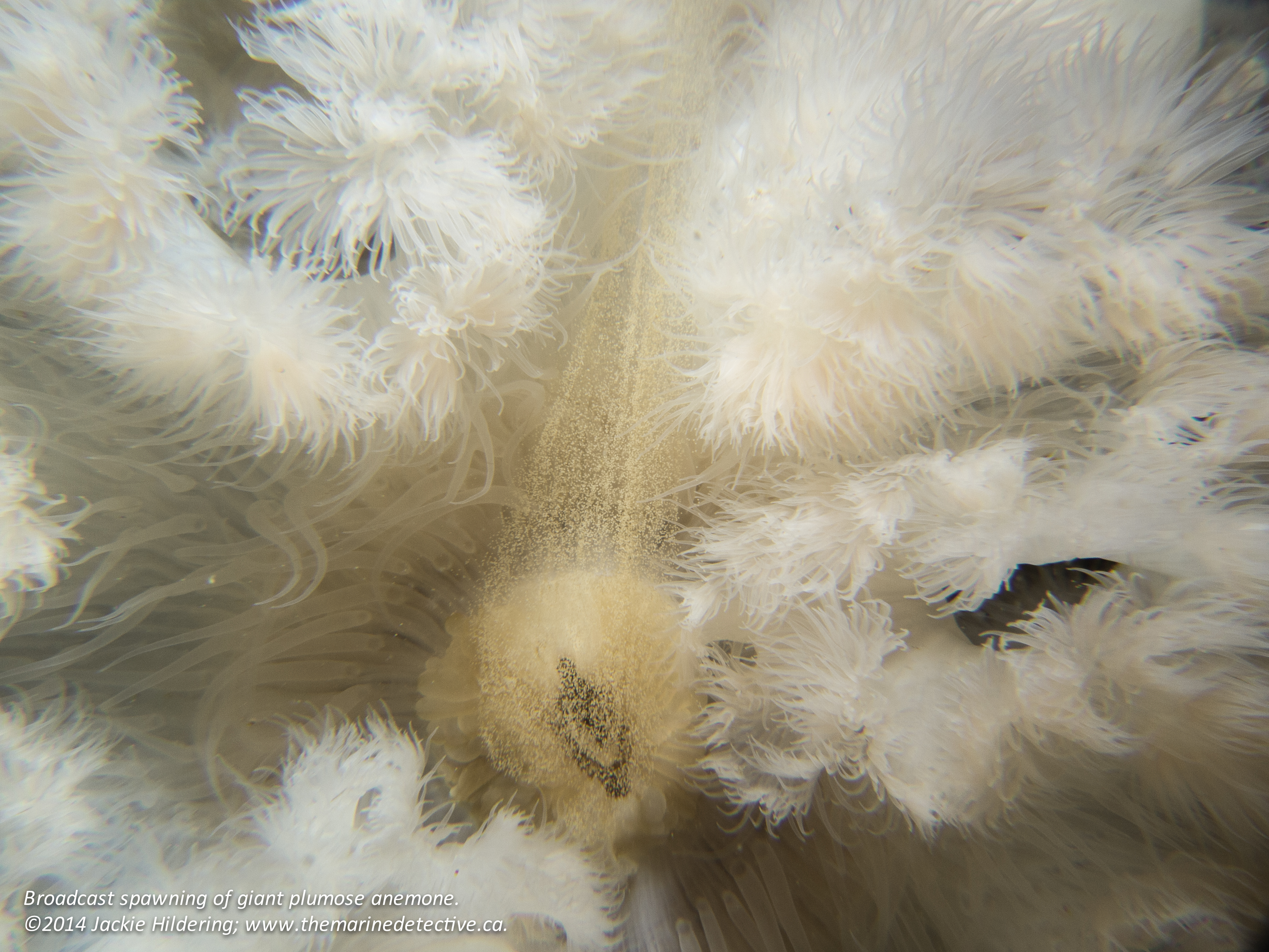
Not only was it the male Orange Sea Cucumbers that were making the cloudy with their astounding numbers of gametes. The Giant Plumose Anemones were broadcast spawning too. Males releasing slow, white jets of their sperm and females then releasing their pinker egg masses. (Note that Giant Plumose Anemones can reproduce asexually as well by pedal laceration but broadcast spawning allows for diversity through sexual reproduction).
Spawning male Giant Plumose Anemone.
Giant Plumose Anemones spawning. Males release the whiter masses of gametes while the females’ masses of eggs have a pinkish colour. See them here?
Close-up of a male Plumose Anemone spawning.
It is of course a good strategy to have males and females living in close proximity and that timing is everything! The spawn must be synchronized. To release sex cells when others of your kind are not doing so, would be a very failed reproductive strategy indeed. Probable cues for spawning are ocean temperature; the number of days/hours of sunlight (cumulative temperature); and/or the presence of a plankton bloom.
Apparently for both Orange Sea Cucumbers and Giant Plumose Anemones, the males are the first to release their gametes, triggering the females to spawn.
Research has also found that, in the case of Orange Sea Cucumbers, females release around 130,000 eggs packaged in buoyant egg pellets. The egg pellets drift to the surface and dissociate into the individual eggs after about 20 minutes. Spawning in Orange Sea Cucumbers most often happens within 1.5 hours after slack low tide which adds to the success by allowing for a greater concentration of sex cells, maximizing the chances of fertilization.
Through these images, I hope I have been able to relay the awe I felt at witnessing this biological marvel that has allowed these species to survive on Earth for thousands of times longer than we humans have walked upright.
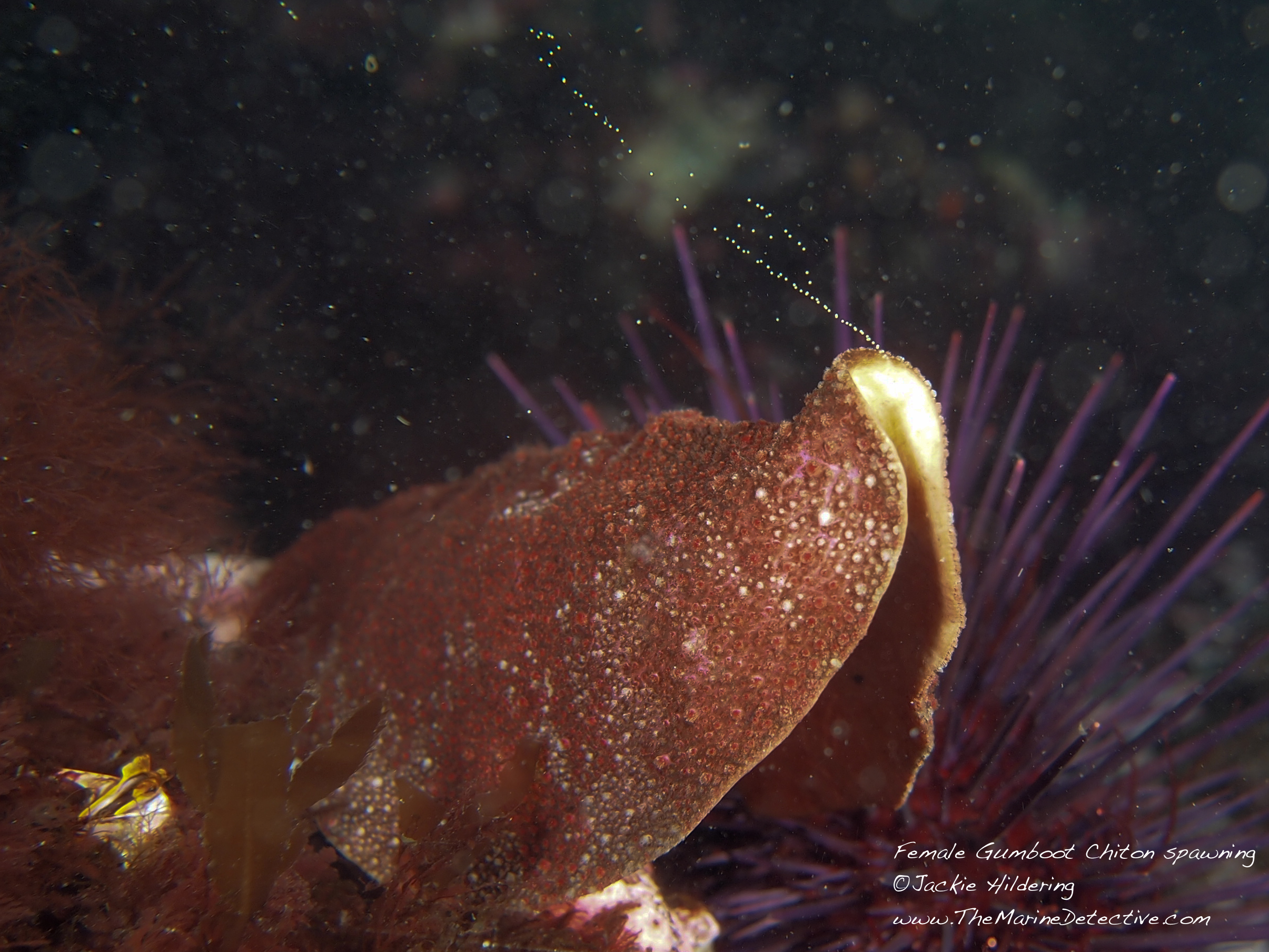
Female Gumboot Chiton spawning. Click this link for video and more information.
Giant Plumose Anemones spawning. Males releasing the whiter masses while females’ eggs have a pinkish colour. See the pink egg mass from a female on the right ?
[Update March 2018 – There has been a reclassification of this species of nudibranch whereby Hermissenda crassicornis is also being referenced as the “Thick-Horned Nudibranch. Please see my blog at this link for that information.]
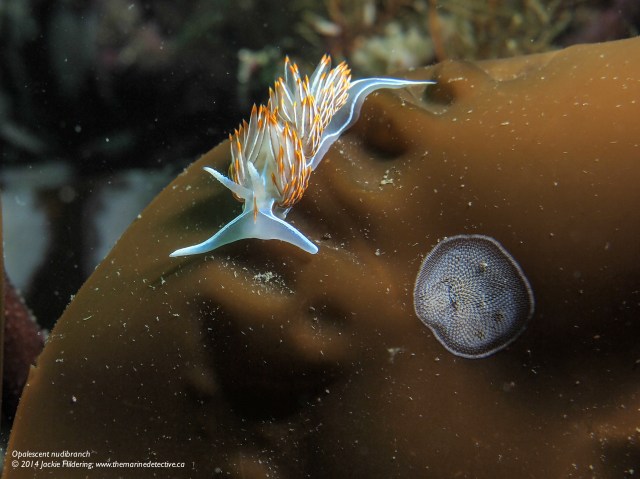
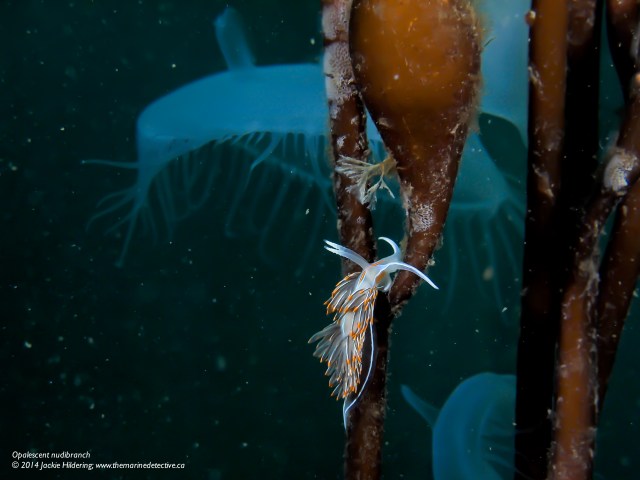
This is an Opalescent Nudibranch (Hermissenda crassicornis).
I know! Aren’t they astonishingly beautiful? Opalescent Nudibranchs are one of the most powerful ambassadors for shattering the misconception that warm waters are home to more colourful life. They truly help in raising awareness about the incredibly exotic and vibrant life hidden just below the surface in the dark, rich, cold waters of the NE Pacific.
But they help with something else too.
I recently received a video clip of Opalescent Nudibranchs from Tavish Campbell, taken while with Pacific Wild documenting the life that would be at risk if tanker traffic came to Caamano Sound. Tavish, who is a fellow-diver and appreciator of all things marine, asked, “Hey Marine Detective, what’s going on here?!” What I saw led me to realize how this species is also a very powerful engager for addressing another default notion we humans seem to have.
We tend to bestow judgemental labels on animals depending on our interpretation of their beauty. We are inclined to think beautiful animals are “nice”, “cute” and “benign”, and foreign looking animals are “mean”, “ugly” and/or “bad”.
While I appreciate that some organisms may be more aesthetically pleasing than others, there is no “ugly” in Nature and there certainly isn’t “bad”. Organisms look and live as they do because it works. Their appearance and behaviours are the result of expanses of time longer than we humans, as newcomers, can truly appreciate. Organisms’ adaptation allow them to survive and fulfil their niche in Nature’s puzzle so that there is the greatest chance of balance. [Insert “God” instead of “Nature” if this is your preference.]
Therefore, for example, there are no “bad” kinds of orca but rather orca populations whose job in Nature is to eat other marine mammals. There are dolphins that sometimes kill other marine mammals without this being for the purposes of food (no matter how much this conflicts with the “Flipper-like” identities we have imposed on them). Sea otters do things that definitely are NOT cute and . . . it also means that beautiful sea slugs will also do what they need to in order to survive.
I take such comfort in not needing to judge Nature. It just is. In contrast, human behaviours too often do NOT enhance the potential of balance in Nature or even the chances of our own survival.
So here’s the jaw-dropping video. Ready . . .?
Opalescent Nudibranchs in all their beauty, are extremely voracious predators and, as is evident in the video, will also attack their own kind. Reportedly, fights most often result when the animals come into contact head-to-head. The animal closest to the head or end of the other has the advantage of getting in the first bite and thereby the greater likelihood of killing their opponent and eating them.
But, they are hermaphrodites, they need one another to mate! As hermaphrodites, there is not even male-to-male competition for females! So why, when your chances of finding a mate as a sea slug are already pretty limited, would you kill another of your kind instead of mating with them?
I hypothesize that it would have to do with the balance between needing to eat and needing to mate and/or that there is some sort of genetic competition going on. That’s all I got. Insert rap awe and wonder here. I may not know why they do what they do but I do know, there has to be an advantage to their survival.
What I also know for sure is that this gives a whole new meaning to “slugging it out”!
Opalescent Nudibranch egg mass. Every species of nudibranch has distinct egg masses i.e. they are species specific. 2014 Jackie Hildering; http://www.themarinedetective.ca
Just another day on the sidewalk in front of my house.
It’s Saturday morning. I open the curtains. And there they are – three sets of binoculars pointed in my direction. Again.
It’s been like this for 2 months now**, leading neighbours to wonder what is going on and if I am okay.
I am, thanks. I’m just peachy; not a feather out of place. In fact, I have a bird’s eye view of something simply wonderous from which I have learned a great deal.
All the activity on my sidewalk – the binoculars; people coming from Kamloops, Calgary, Victoria, Vancouver and possibly further afield (with at least one person sleeping in his car till daylight so he could be the early bird) – it’s not about me at all. It’s about the birds. Against all odds, multiple species of really rare and exotic birds are here together in our little neighbourhood in Port McNeill.
We’re not used to having this kind of “vagrant” in the ‘hood!
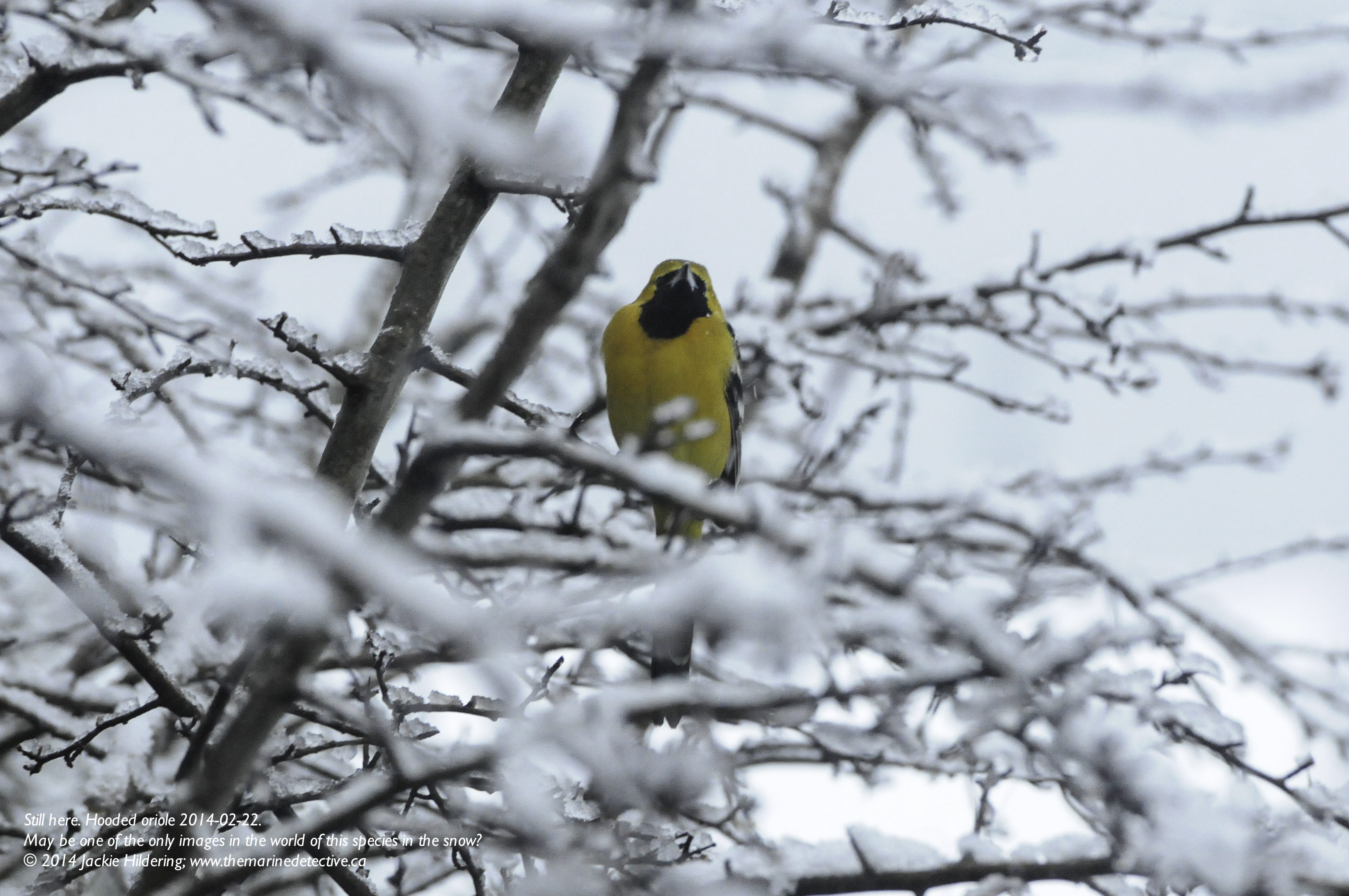
It began in early December when, while on a conference call, I almost lost my mind when a brilliantly yellow coloured bird landed in the shrub in front of my home office window; near the feeder I leave out for the Anna’s Hummingbirds who spend the winter here.
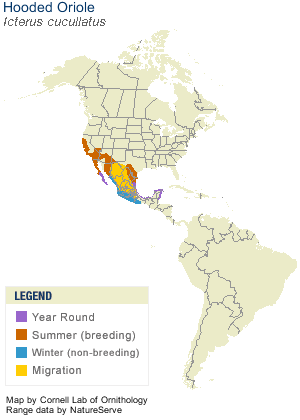
Winter range of Hooded Orioles marked in blue. Source: Cornell Lab of Ornithology – see this link for more information and a larger map.
I scrambled for my camera uttering colourful nouns, thankfully having the sense to put the phone on mute. I got a picture.
I don’t know much about birds and therefore did not trust my ID. Could it be a . . . could it really be . . . a male Hooded Oriole?!
They are not supposed to be here. They should be in palm trees in the Baja in winter but I dared share the photo and my timid ID with those I know to be BC’s leading bird authorities. The responses came back pretty quickly.
They confirmed how rare this sighting was. Apparently, there have only been two previous recorded cases of Hooded Orioles making it through a BC winter – in Terrace in 1998 and in Prince Rupert in 2007. I was determined to do all I could to give this one a fighting chance since the odds of him finding his way “home” were infinitely small.
This is my first photo; the one I sent to the bird experts, asking if indeed this was a male Hooded Oriole. Jeremy Gatten, would recount in his blog “I received an e-mail from Port McNeill resident Jackie Hildering about a bird that she thought might be a Hooded Oriole. It’s a good thing I was sitting on a couch because the attached photo would have knocked me to the floor if I was on a chair or stool! The extremely crisp, full-frame shot showed a healthy, vibrant male Hooded Oriole in winter plumage.”
I slightly modified the hummingbird feeder. It appeared to meet his needs and he stayed. The word spread about how predictably such a rare bird could be sighted, and the birders started appearing.
At first I was very worried about how the attention might disturb the Oriole (and me) but many could learn a thing or two from the nature viewing ethics of bird-watchers.
Winter range of Dickcissels marked in blue. Source: Cornell Lab of Ornithology – see this link for more information and a larger map.
They watch from a respectful distance, never setting foot on my property, truly wanting to witness natural behaviour. They rarely strive to get a photo to affirm their experience and certainly would not disturb the bird for the sake of getting the photo. They appear to “just” delight in seeing a rarity and being able to add a bird species to their list. Certainly there is no “get up and personal” – the phrase I loathe most in reference to wildlife viewing.
Then, things got even more exotic.
With all the birder expertise directed at the shrub with Mr. Oriole, a Harris’s Sparrow* was also spotted (winter range is the south central US), and a Yellow-Rumped Warbler (somewhat less noteworthy as this area is part of their summer range) and . . . a female Dickcissel.
Yes, that’s right – a Dickcissel. I too had no idea such a species existed and certainly would not have been able to discern her from the House Sparrows she often hangs out with. Neighbour Jim Nolan was the first to notice her, and teach me to spell “Dickcissel”! And how exotic is she? Her kind winters in Guatemala and Venezuela.
Bring on more birders! And more binoculars on the sidewalk! And more neighbours wondering what on earth was going on.
Bird watchers reference this phenomenon as the “Patagonia Picnic Table Effect”. One rare bird attracts birders, who then find another rare bird, which brings in more birders . . . and so on!
In this case it is the “Port McNeill Shrub in Front of My House Effect” and how grateful I am for privilege of a front row seat to the birds, and the birders.
They have made me reflect more on human behavior and expectations while viewing wild animals. I have become even more attuned to how extraordinary the wildlife of our area is and how, if you are especially watchful and respectful, the reward can be so great.
Clearly, the idiom “birds of a feather flock together” has also been challenged and I am greatly comforted that one rare bird can find another!
Not surprisingly, the birds have further heightened my wonder in Nature and, frankly, in life as well. Why that shrub? Why our neighbourhood in Port McNeill? Random chance? Ideal conditions? I will add this to the many things I will never know for sure.
What I will also allow myself to believe is that the appearance of the birds is evidence that colourful, rare and exotic beings can find my front door!
*I never saw the Harris’s Sparrow and have not heard of repeat sightings of this individual from birders.
Note that all photos were taken through the front windows of my home.
See end of blog for range maps for Yellow-Rumped Warblers and Harris’s Sparrows.
** Update April 6, 2014: The female Dickcissel is still a daily visitor. My last sighting of Mr. Hooded Oriole was March 29th. Presumably, he has moved on to new adventures, striving to join with his own kind and find a mate.
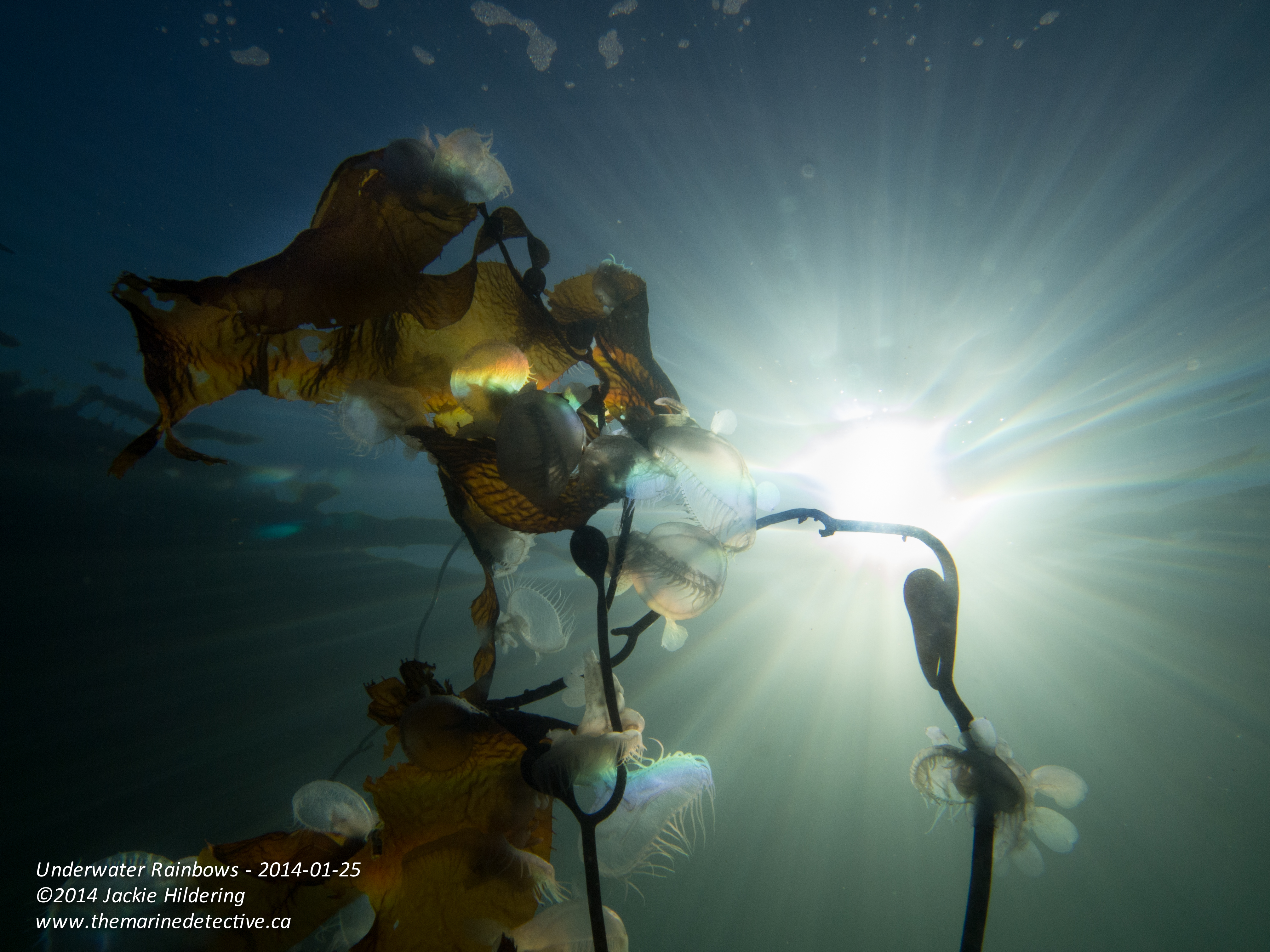
The January sun streaming down, the light refracted against the hooded nudibranchs . . . the underwater rainbows?!
Hooded nudibranchs are already such ethereal, other-worldy creatures, to see the rainbows dancing against their translucent bodies made me catch my breath and desperately want to capture the beauty for you.
May you dream of underwater rainbows and – maybe- fall even a little bit deeper in love with the NE Pacific Ocean.
For information on hooded nubibranchs (includes images and video of them swimming and their eggs), please see my previous blogsat this link.
Today, I find myself reflecting on the remarkable journey from my first dives to now.
I dare share my thoughts with you here because . . . diver or not, I believe there are elements of this life journey with which many can identify and because the feelings I express about “Mother Ocean” is what I think unites us here on The Marine Detective. Oh – and also, it provides insight into why I tend to snarl when a minority of people, state “You must have a really good camera” after seeing my underwater images, suggesting that it is merely photo-equipment dependent to go deep and deliver evidence of the astounding and fragile life hidden in these cold waters.
I never could have anticipated how the cold NE Pacific would become the greatest force in my life and, as I think often is the case with the most important things in life, the journey has not been easy.
This is how it started.
Shiner . . . Image in my first dive log. Me just after my 37th birthday with “mask squeeze”.
That’s me about a week after my 37th birthday. On my birthday itself, while on my 20th dive, I got “mask squeeze”. Every capillary in my eyes burst because I did not equalize the pressure in my dive mask as I descended. This was due to complications while I was learning to dive with a drysuit.
I delight in there now being an island on our coast informally named after me . . . Shiner Rock. Far more important, however, are the lessons I learned from this dive, and the other 799.
I should acknowledge that 800 dives is not a big deal for some, especially if you are a warm-water diver and if you have been diving since your youth. My diving life has been from age 36 to age 50 and almost all these dives (the equivalent of 25 days underwater) have been here in about 6 to 10°C water, off the coast of NE Vancouver Island.
The decision to take a dive course seemed frivolous at the time but again, as it seems to go, some of our seemingly smallest decisions appear to give life the greatest meaning.
I began my first course in 1999, the year I returned to British Columbia after teaching in the Netherlands for 14 years. I aborted what many would consider an important career trajectory, knowing only that I had to get back to learning from Nature. I had been working in big city Rotterdam at that time and had become so tired of hearing myself talk about Nature as if it were somewhere else. One surprise whale watching trip on NE Vancouver Island led to my moving here.
My dive course was not typical in many, many ways with my first ever dive being in a glacier fed river in a community that had ocean surrounding it. I will never understand why we did this. But, while in my father’s thin, old wetsuit, shivering uncontrollably and falling while trying to stand on algae-covered river rocks, I saw one salmon. I was in deep, right from the start.
Now, so many dives later, while the lessons don’t EVER stop, the artwork below captures what diving in these waters has brought to my life.
Shinier . . . Me? Artwork by Jennifer Bonnell; presented to me at age 50 as an interpretation of who I am.
And apparently . . . that is also how some people see me. That piece was given as a gift on my 50th birthday last April. . . as a portrait of me. Shining? Passionate? Mermaid-ian? Inspirational? Ocean advocate?
Please know how much I struggled to type that.
I am so moved, so grateful, and so much further incentivized when honoured by people using such references in relation to me. I know fully the personal journey it has been to go from “Shiner” to maybe appearing to be “Shining”. And I know too what diving has brought to my life . . . depth of understanding and and depth of purpose – wanting to shine a light of awareness on what lives in these waters and, thereby, help motivate greater conservation.
The Ocean is the source. The battle force. She is my inspiration. She is the beginning and she is the end. She is where I hide and where I am fully exposed. She has taught me my most valuable lessons and . . . . I know it’s not over yet. Not by a long shot.
The plan is to do at least another 800 dives.
Thank you so to all of you who are part of the journey.
There’s a whole lotta fish procreation going on in the NE Pacific Ocean right now. This might be a surprise to those who think mating is more of a spring-fling-kinda-thing.
It may be a further surprise that, for many marine fish species here, the males are the protectors of the next generation. The females leave after laying the eggs and the males remain, guarding the fertilized eggs from predators and often also fanning the eggs to ensure they are well aerated.
For a lot of these fish species, the male chooses the nesting site and entices multiple females to lay eggs there so that he can fertilize them. He then has the work of guarding these multiple egg masses and may need to be on the alert for sneak fertilization attempts by other males.
For species with nests of multiple egg masses, you can often tell how many females have laid eggs there because individual females have different coloured eggs. Therefore, the colour of fish eggs is not a good characteristic to determine the species that laid them. Instead, do a quick scan, chances are a piscine papa is somewhere near the eggs, staring at you.
Through the photos below, meet some of these fabulous fish fathers. No deadbeat dads here!
[Note that this is in no way a comprehensive list of NE Pacific Ocean fish species in which the males guard the eggs.]
Whitespotted Greenling
The encounter documented below shows how my dive buddy and I recently had a Whitespotted Greenling come after us, so intent was he on protecting his egg masses. I was very slow in cluing in that this was why he was swimming around us and deserved getting a little nip in the head. Notice how small he is relative to us and yet how this did not deter him in trying to get rid of us.
Male Whitespotted Greenling shortly after he nipped my big head in his intensity to guard his egg masses.
Dive buddy Jacqui Engel pointing at the male Whitespotted Greenling before I clued in and got out of his territory with eggs. Image shows how small the fish is compared to us and how big his drive to protect the egg masses must be that he would pursue us like he did.
My observations of egg guarding on NE Vancouver Island: September to the end of December
Kelp Greenling
Most often Kelp Greenling eggs are in the empty shells of giant barnacles as shown below. Although they are a bigger member of the Greenling family, male Kelp Greenlings do not appear to protect their eggs quite as vigorously as Whitespotted Greenlings. They appear to have a really long breeding season in our area.
My observations of egg guarding on NE Vancouver Island: October to March
Below, slideshow of courting
Red Irish Lord
Oh Red Irish Lords how I love thee. There is no better ambassador for how colourful life is in these waters since they are brilliant shades, yet astoundingly camouflaged. Red Irish Lords are often easier to find when guarding their eggs since these are less camouflaged. They most often egg guard with their heads positioned right atop the eggs, remaining absolutely motionless. It is commonly believed that the fathers guard the eggs but apparently it is more often the mothers but that the parents may take turns. Source: DeMartini and Sikkel 2006: ” Red Irish Lord exhibits primarily maternal and facultatively biparental guarding of the spawn.”
Note the variation in the colour of the fish too. More photos showing the diversity of colour at this link.
Buffalo Sculpin
There are Buffalo Sculpin males guarding eggs at this time of year too but more mating appears to be happen in April and May. Usually, Buffalo Sculpins are even harder to spot than their Red Irish Lord cousins but the variably coloured, bright egg masses give away their location. They too have a strategy of staying right atop the eggs and remaining motionless when faced with annoying human divers.
Soon we will be participating in the Vancouver Aquarium’s annual Lingcod Egg Mass Count. Armed with an underwater slate, we will join divers along the Coast in helping determine the health of lingcod populations by looking at the number and size of the egg masses and if they are being guarded by males. And oh what fastidious fathers lingcod males are! The dedication to protecting the egg masses does vary from male to male but, generally, they do not leave their watch until the eggs hatch which can be more than 24 days. They could be guarding masses from multiple females separated by more than 7 m, and if laid by a female 5 years old and older, the egg masses can be the size of a watermelon and weigh up to 14 kg! That’s a lot to protect! (As is also the case for many rockfish, the older the female lingcod, the more eggs she lays). My best lingcod story is that I was marking down “unguarded” on my slate only to have it knocked out of my hands by the male that was very much guarding the egg mass I had been observing! Lots more info on this species at my blog item Lingcod – Fastidious Fanged Fathers.
My observations of egg guarding on NE Vancouver Island: January to April (Vancouver Aquarium’s Egg Mass Survey is from early February to the beginning of April).
Here’s a case where it is not just the male that guards the eggs. Mr. and Mrs. Wolf-Eel take turns wrapping their long tails around the large egg mass. I hope to one day have the opportunity to get a better image than this but, as a strategy for survival, the egg mass is often deep within the wolf eel couple’s den. Lots more information on this remarkable species at my previous blog item Wolf-Eel – No Ugly Fish!
I’ve only once been lucky enough to find a male of this huge sculpin species guarding eggs. They can apparently be very aggressive guarders but this very successful male (he was guarding the eggs of several females) was very tolerant of my presence. They have been documented to mate throughout the year. My one encounter with a male cabezon guarding eggs was in May.
In all these years of diving, I have yet to find a male Painted Greening guarding eggs so that I know for sure the eggs are from this species. Yet something else to be on the lookout for!
And, the stuff of dreams . . . to one day chance upon a male grunt sculpin while he is releasing the hatching eggs from . . . his mouth! For more on that, see my previous blog item Grunt Sculpin – Little Fish, BIG Attitude. The females apparently also do take on shifts in taking care of the eggs.
I have never seen scalyhead sculpin eggs while diving, likely because they are hidden away and because they are much smaller. The image of the eggs below was taken during a beach walk where students ensured they put the rock back as best they could to reduce the chances of the eggs drying out. Notice the different colours of the looney-sized egg masses? The eggs in this nest are from at least 4 females.
Very interesting in this species is that fertilization is internal.
My observations of egg guarding on NE Vancouver Island: Spring.
One study showed that the eggs hatched after 11 and 15 days. This study also documented courtship where the males rolled their heads in a circle and flared their orange branchiostegal membranes (on the underside of their throat) which apparently are only orange during mating season. Females were seen to have no response or to snap their heads horizontally in rapid succession, sometimes also quivering. During breeding season the males are also reported to have red-brown spots inside their mouth and a brown anal fin with small yellowish-white spots. (Source: Ragland, H., & Fischer, E. (1987). Internal Fertilization and Male Parental Care in the Scalyhead Sculpin, Artedius harringtoni.Copeia,1987(4), 1059-1062. doi:10.2307/1445578)
If you find an ice cream scoop mound like this, you have likely found the eggs of the black prickleback and the guarding male is likely very near. When taking students on beach walks, I emphasize the importance of not displacing animals by using this species as an example. Fish like the black prickleback are adapted to being able to wait out the tide in very little water and if the well-intentioned pick up the fish to put him in deeper water, they could be moving papa away from the eggs he was guarding.
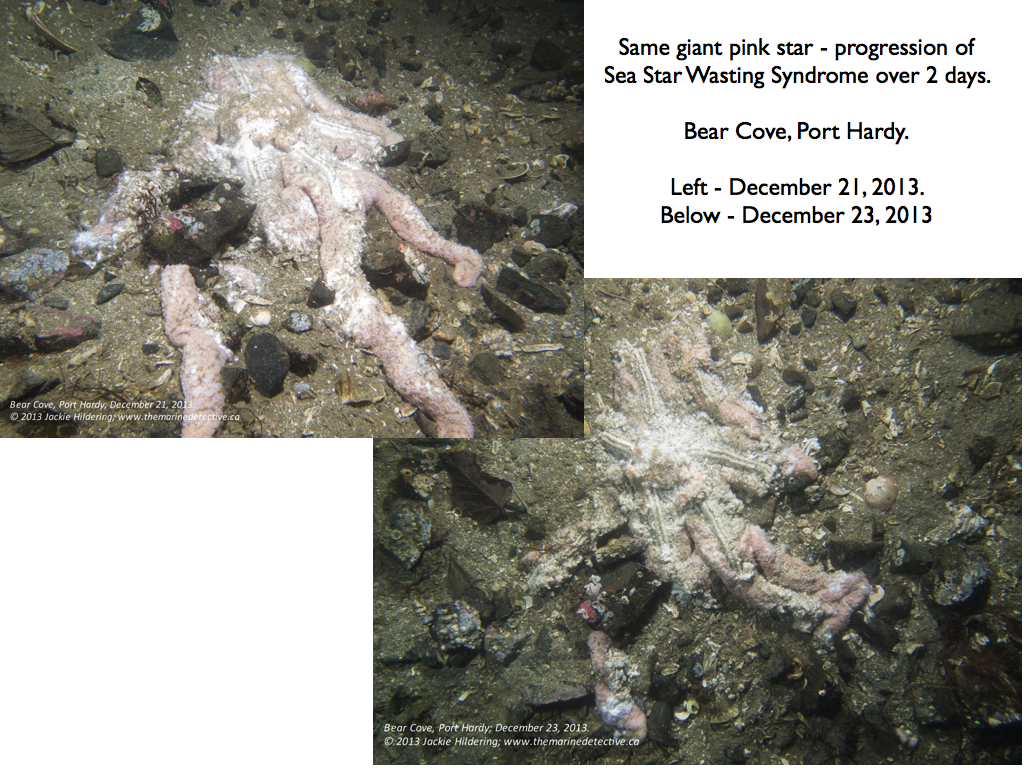
[Update: November 18, 2014 Study published today – cause of Sea Star Wasting Syndrome a densovirus that has been present for at least 72 years? Why has it led to mass mortality now? What makes sense is that, like any virus, the incidents of “pathogenicity” depends on stressors (e.g. temperature change) and proximity of individuals. The virus has also been found in other echinoderms like urchins and sand dollars and it persists in sediment = can be transmitted by those vectors and there is the potential that the other echinoderms are/will be affected. See the study by Cornell University at the link below (lead author Ian Hewson). Includes “If SSaDV is the cause of the current SSWD event, it is unclear why the virus did not elicit wide disease outbreaks in the past during periods in which it was detected; however, there are several possible reasons why the current SSWD event is broader and more intense than previous occurrences. SSaDV may have been present at lower prevalence for decades and only became an epidemic recently due to unmeasured environmental factors not present in previous years that affect animal susceptibility or enhance transmission.” http://www.pnas.org/content/early/2014/11/12/1416625111.abstract]
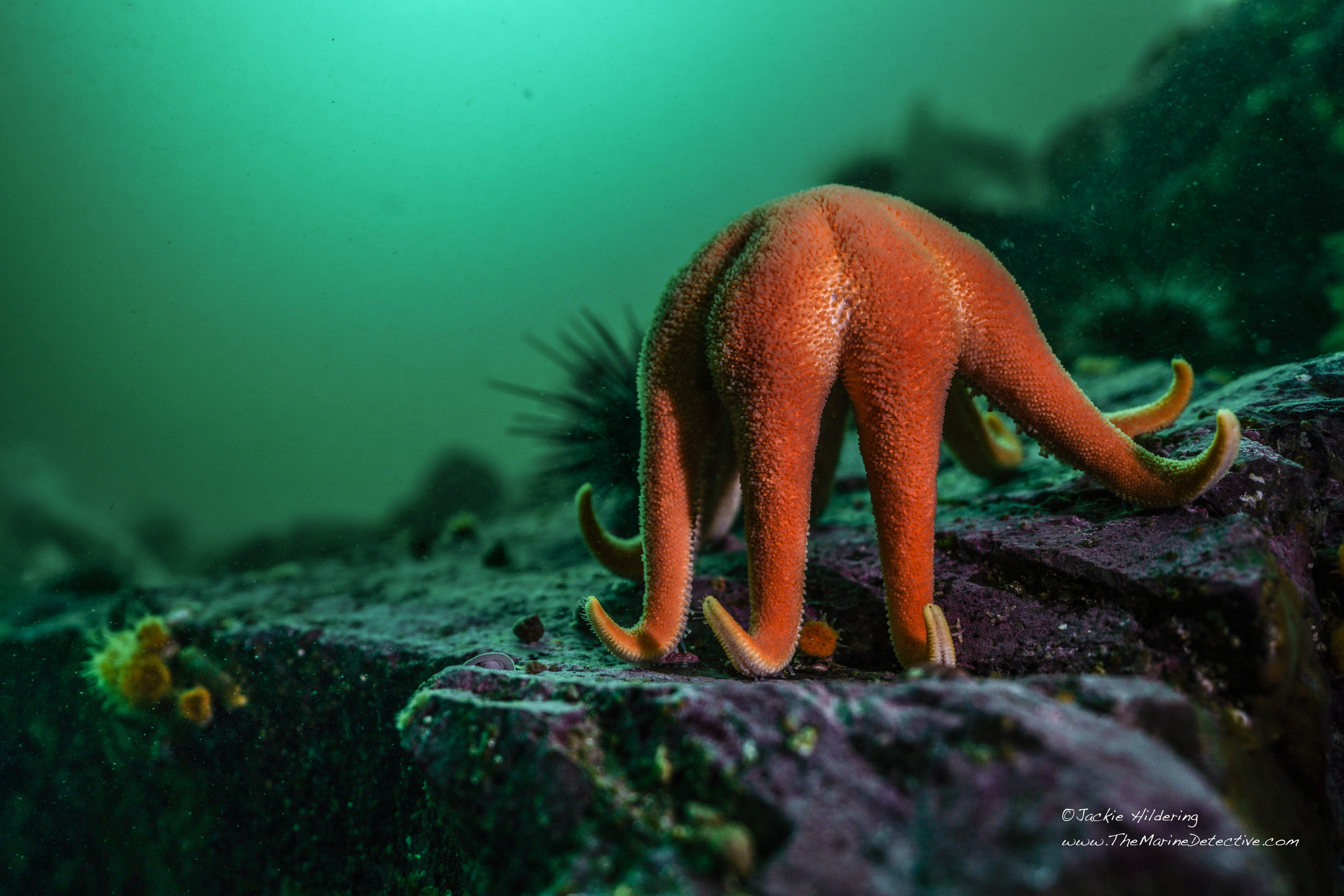
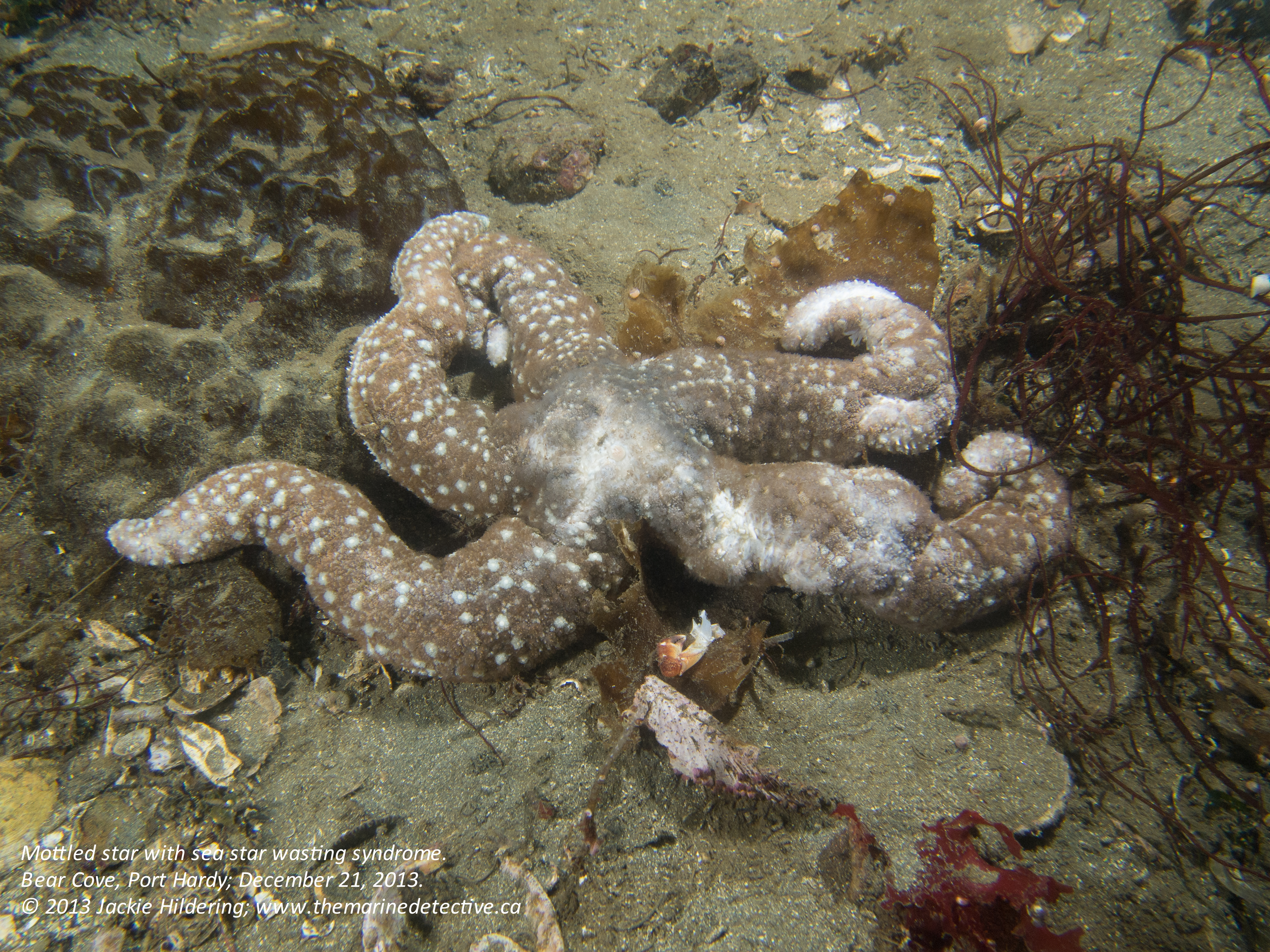
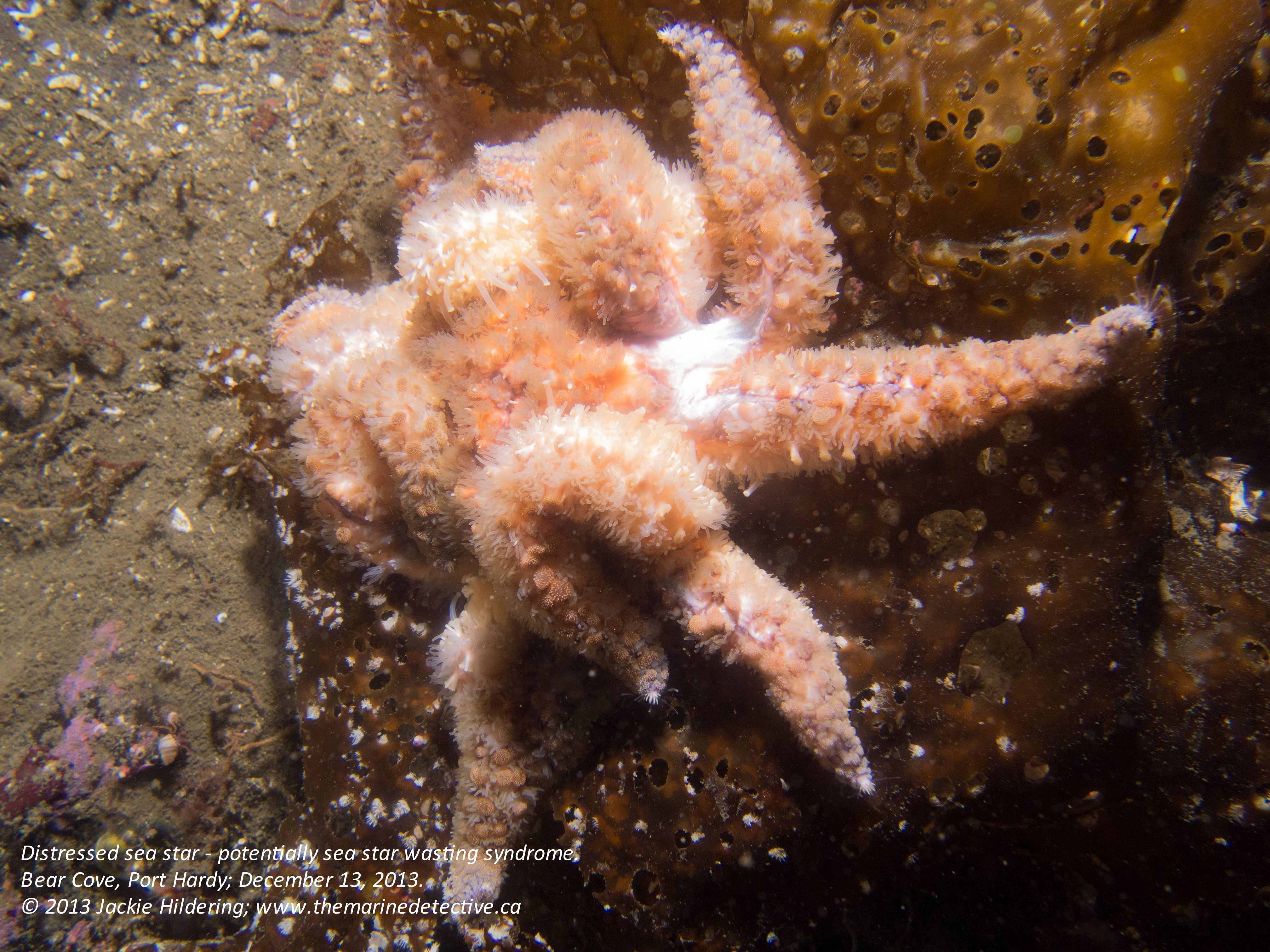
I am very sad to report that Sea Star Wasting Syndrome is now on NE Vancouver Island.
I first detected symptoms of the Syndrome at Bear Cove in Port Hardy on December 13th. Please see table at the end of this blog for how the species affected appears to be quite different from further to the south. Leather stars seem particularly affected and the Syndrome appears to advance much more slowly.
I have tried to think up a terrestrial analogy for what is happening to the sea stars so that non-divers might better get a sense of the weight and ecosystem importance of it. However, I can’t come up with a good terrestrial equivalent of an abundant group of highly visible, apex predators. My best attempt is to suggest you think of sea stars like birds of prey. Imagine what you would feel like if you were to notice they were dying, bodies deflating . . . then melting away and that this would progress very quickly and spread like wildfire.
The meltdown of sea stars was first detected in June 2013 in Washington State in ochre stars and in sunflower stars in Howe Sound (BC) in late August 2013 but has now been reported at sites from Alaska to the Mexican border.
The number of sea stars impacted is orders of magnitude greater than any previous known outbreak.
Most likely due to a pathogen (virus and or/bacteria). Cornell University is doing the genomic work. Toxins and environmental conditions have not been ruled out as the cause (or compounding factors).
If it is a pathogen, how quickly it spreads is influenced by the number of animals and if they are stressed. There are likely to be layers of stressors.
It has put forward by the scientific community that this could be a normal mechanism for overpopulation in sea stars.
While radioactivity certainly is an environmental stressor, the Fukushima Disaster has not been implicated in Sea Star Wasting Syndrome – really! From a January 30, 2014 Earth Fix article “scientists see Fukushima as an unlikely culprit because the die-offs are patchy, popping up in certain places like Seattle and Santa Barbara and not in others, such as coastal Oregon, where wasting has only been reported at one location.” (Also see January 19th, 2014 article “Half-Lives and Half-Truths – Discovering the truth about five of the most widespread myths of the Fukushima disaster” and scroll to the sources at the end of this article for scientific papers on the potential impacts of Fukushima).
The 1-minute time-lapse video below shows the progression of the Syndrome in a sunflower star over 7 hours.
Yep, it’s terrible.
However, I believe very strongly that, in attempting to raise awareness about marine environmental issues, I must always reflect on “what you can do”. If I do not, I contribute to the spread of a devastating human syndrome: Eco-paralysis. Symptoms include people becoming despondent, overwhelmed, and underactive in undertaking positive socio-environmental change, and often saying “It’s all hopeless”. The cause? This I do know. Eco-paralysis is the result of not seeing the common solutions between environmental problems.
Sea Star Wasting Syndrome is a solid indicator of how little we know about our life-sustaining oceans. It emphasizes the importance of humility and precaution in decision-making around the environment and how we are all empowered to reduce environmental stressors (with emphasis on reducing fossil fuel consumption and chemical use).
Having witnessed what I have over the last many weeks, I am all the more driven to assist others in (1) falling deeper in love with the NE Pacific Ocean by revealing the beauty below her surface and (2) feeling the joy that comes from creating change that is better for the environment and, therefore, ourselves.
We were in the right place, at the right time, doing the right thing, and were able to save a woman who had become very disoriented while mushroom picking. Had she continued in the direction she thought she needed to go, she would have moved further and further away from where her partner was. When we found her, there was only about another 1.5 hours of daylight left and it is unlikely that any other boats would have been in the area, let alone that they would have heard or seen her.
I am compelled to write about this because I learned a thing or two about enhancing one’s chances for rescue and survival today and it may be of value to share that here. But also, candidly, writing about this helps me reflect on the many “what ifs” around this experience. (Note that I will not share the name of the individual nor the location as I feel this would be a violation of her privacy.)
Of course no one plans to get lost in the woods nor to have an accident but what was shocking to me was how easily we could have missed her.
This individual was quite outdoor savvy and had a system for checking in with her partner; they had radios (they failed); and she had a dog with her (who decided to go home).
She was lost and managed to make her way out of the dense and isolated forest to the edge of the ocean, bettering her chances of someone seeing her . . . but only if a boat went by.
We did go by on our way to the dive site but heard and saw nothing. The engine was on, we were about 1.3 km away, and she was dressed in dark blue and green.
The dive was not even supposed to happen today! It was planned for yesterday but the weather was predicted to be poor so it was rescheduled for this afternoon.
But then, we only had two divers available meaning there was no one to drive the boat. Had Club member and fellow diver Gord Jenkins not selflessly offered to drive that boat so that Andy Hanke and I could dive, we would never have been on the water today.
But THEN . . . we had trouble with the Dive Club boat’s engines whereby we decided it would not be safe enough to take out that boat. We were just going to dive from shore.
But then, I suggested that we could take out my little 17′ vessel named “Fluke” (this is poetic – you’ll see). If we had we had more than 3 people, there is no way we would have had the option to do this. My boat is too small.
And then, there was the decision of which dive to do. Randomly (?) . . . .we chose for the site that ended up being closest to where the lost woman would emerge from the forest.
AND THEN, while Andy and I were diving, Gord heard something far away – some strange bird, a seal, a bear cub? It was a one syllable “blaring like” sound. She would not even have been able to see the boat from where she was, and yet she called.
When we surfaced (the tender boat cannot leave divers), Gord slowly idled the boat toward where he thought he had heard the sound. He was a bit apologetic, not sure if he had really heard something from so far away. We stopped the engine, then Andy and I heard it too – a one syllable sound. A bird?! I made the comment that it sounded like such a “plaintive” call. I got out my binoculars, I could see nothing. We proceeded and then shut off the engine again to make sure we were still heading in the right direction. We heard the one syllable call again. Still, even with binoculars I saw nothing.
Not until we were about 30 m away did we see her – the source of the sound, the woman whose story you have now already heard. Gord saved her life.
I don’t know how he could have heard her, initially from so far away. This dear woman has very powerful lungs and was calling to save her life but still, the acoustics of the area proved to be very favourable allowing Gord to hear her from such a distance.
What if that had not been the case? What if Gord had dismissed the sound he thought he heard? What if we had dived yesterday (we saw no other boats the whole time we were out today)? What if we had more than 3 people and had not been able to take my boat out? Fluke? I don’t know. This is when my science brain gets all dizzy. I just don’t know.
Oh yeah, and then when we had her in my boat and were heading out to take her back to her partner . . . about 50 Pacific White-Sided Dolphins happened to storm the boat, leaping in front and alongside it. Despite the stress of what we had just experienced, it made me laugh out in glee. Really, that happened. I can’t make this stuff up. As if my brain wasn’t dizzy enough already.
There is so much I can’t explain here, about synchronicity, chance, “what ifs”, and the feelings for which I cannot even find words.
But what I can clearly express is what I learned today, which is that the easiest way to save a life is – to save your own.
I strongly abide by the guidelines for safety and survival on the water. But, in learning from this experience, the importance of the following is so very clear:
When in the woods wear (or having something with you that has) very bright, non-camouflage colours;
Always carry a whistle;
Carry a light, mirror and/or small flares, and matches;
Always have a waterproof layer of clothing with you;
Take a compass or have access to GPS;
If needing to cry out – use more than one syllable; and
Like the woman from today who is now warm and dry, no matter how distant or how small the chance of rescue . . . never give up.
Dear readers, the following is a rework of a little rhyme I wrote in 2009.
Many of you will recall that 2009 was such a bad year for wild salmon in British Columbia that it led to the $26 million Cohen Inquiry into the Decline of the Fraser River Sockeye.
The attempted messaging in my little poem may be all the more relevant now with the threat of tanker traffic coming to our fragile Coast.
The good news, I believe, is that with such threats more and more of us are united in understanding that, while resource use is a necessity, it has to be sustainable. It is impossible to have infinite economic growth on a finite planet.
With sincere apologies to Dr. Seuss:
A world without salmon would be oh so sad, This is very important, so listen here Dad!
Without salmon, we will have broken the link, That Nature intended to keep us in the Pink. (And Sockeye, and Chum, and Chinook and Coho!)
Salmon bring the wealth of the ocean back to the Coast, Right back to their birthplace so without them – we’re toast!
Their bodies are gifts to the future – that’s really key, Delivering food for their babies and even the trees.
They feed fish-eating orca, sea lion and eagle, Wolf, seal, deer, shark and . . . an occasional beagle!
They help bring the tourists. They fill fishers’ nets. There ought to be enough so that all needs are met.
So little investment, so great the return. Safe passage, and food – this, salmon surely earn?
But, instead of precaution, loud voices at desks, Say, “Why it’s Nature that’s made this big mess.”
“It’s salinity, cycles . . . the phase of the moon! Or some other reason we’ll think up real soon.”
What possible gain would justify such a gamble? The cost of losing wild salmon would be so substantial.
Without salmon, grizzles stare into empty rivers, No fat salmon to save them from winter shivers.
The orca diminish without their Chinook, Peanut-shaped foreheads reveal this tragic truth.
And Bobby and Susie and even Aunt Myrtle, Are left holding fishing poles, till they turn purple.
Shhhh can you hear that? No, I don’t hear a thing, For without salmon, birds around rivers don’t sing.
The People of the Salmon were able to thrive. Dance, song, carvings . . . the wisdom to know what keeps us alive.
Salmon are the glue in a vastly connected web, Why without them big trees would even be dead.
Then, there goes habitat, oxygen production and buffering of greenhouse gas. Why to flirt with the health of salmon you would really have to be an . . . . (you know).
The survival of salmon shows how we humans are doing. Do we know our place on the planet? No. Nature is booing!
The solution is simple. It really isn’t hard. It’s not tree hugger verses resource user. Let down your guard!
Logger, storekeeper, teacher, and you under that streetlight! We keepers of paradise need to unite in what’s right.
Make a stand for the salmon, the whales, wolves and Coast. We all know clean water and food is what matters most.
Choose for sustainability, not short-term economic gain. Otherwise explaining things to our children could really be a pain.
Use vote, vision and voice, to help wild things grow. And when it comes to gambling with salmon – just say “No!”
Then, because a whole lot of us care a whole awful lot, It will be clear that BC’s natural splendour can’t be bought.
Since writing this blog, I have been asked “Salmon feed trees?”. Indeed, when they spawn in their natal rivers which can be more than a 1,000 km from the sea, salmon bring the richness of the ocean not only to animals but to plants. The nutrients from their bodies feed the trees and plants including . . . salmon berry! Animals like bears further the reach of salmon nutrients by taking spawned-out salmon from the rivers deeper into the forest where they can feed undisturbed. They eat their favourite bits and leave about 50% of the carcass in the forest which benefits the plants, song birds, and even animals like pine martens. Of course, bears also poop in the woods, which leaves more salmon nutrients in the forest. So the bears are like gardeners, bringing fertilizer much deeper into the forest!
It was initially Tom Reimchen’s research of the early 1990s that brought the knowledge of “Salmon Forests” to the world. He quantified how much salmon was in the trees by measuring the amount of “marine derived nitrogen”. That research has expanded to where nitrogen and carbon isotopes are measured to quantify the uptake of salmon-derived nutrients by mosses, herbs, shrubs, trees, insects, songbirds, and wolves. So while salmon don’t grow on trees . . . trees most definitely grow on salmon.
This knowledge solved the mystery of how you can have giant trees in a rain forest when nutrients get washed away by the rain. It’s the salmon who replenish the nutrients by delivering the richness of the sea through their spawning behaviour – just the way Nature intended. And of course, without those giant trees – imagine the reduced habitat and production of oxygen and buffering of carbon dioxide.
This makes clear how far reaching the role of salmon is; how interconnected the web of life is, and just how much depends on the health of wild salmon. No better man to fully explain this “exquisite interconnectedness” than Dr. David Suzuki. See the 5 minute clip below. There is also a David Suzuki children’s book called “Salmon Forest.”
I have also been asked, “Deer eat salmon?!” They do. They feed directly on the spawned out carcasses of salmon and also benefit indirectly by feeding on the vegetation that has been fed by salmon.













 The Marine Detective