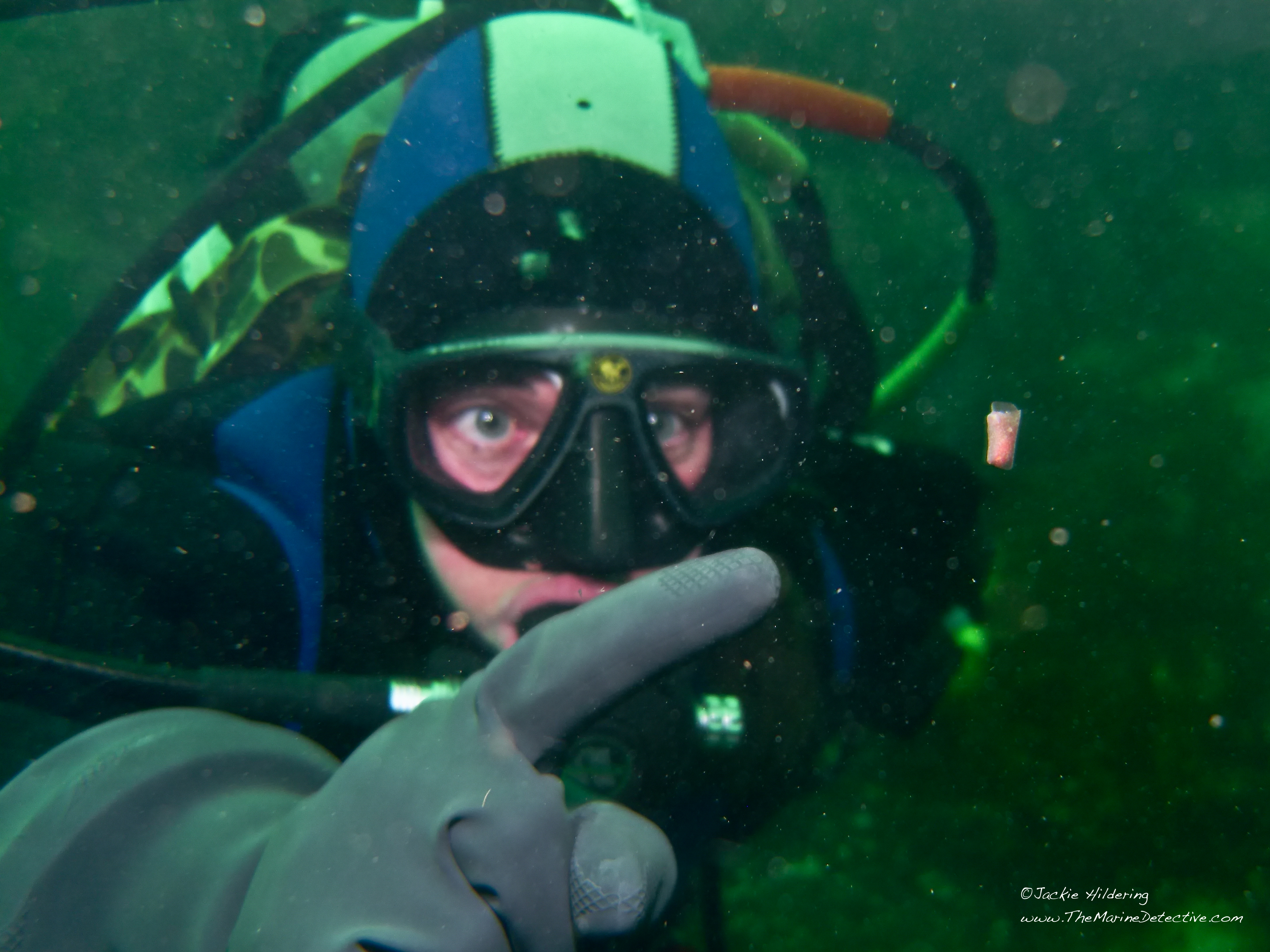
That’s not usually a good conversation starter is it?
But, read on. It’s worth it! If you are fascinated by adaptations and the interconnectedness of species . . . even when it involves parasites.
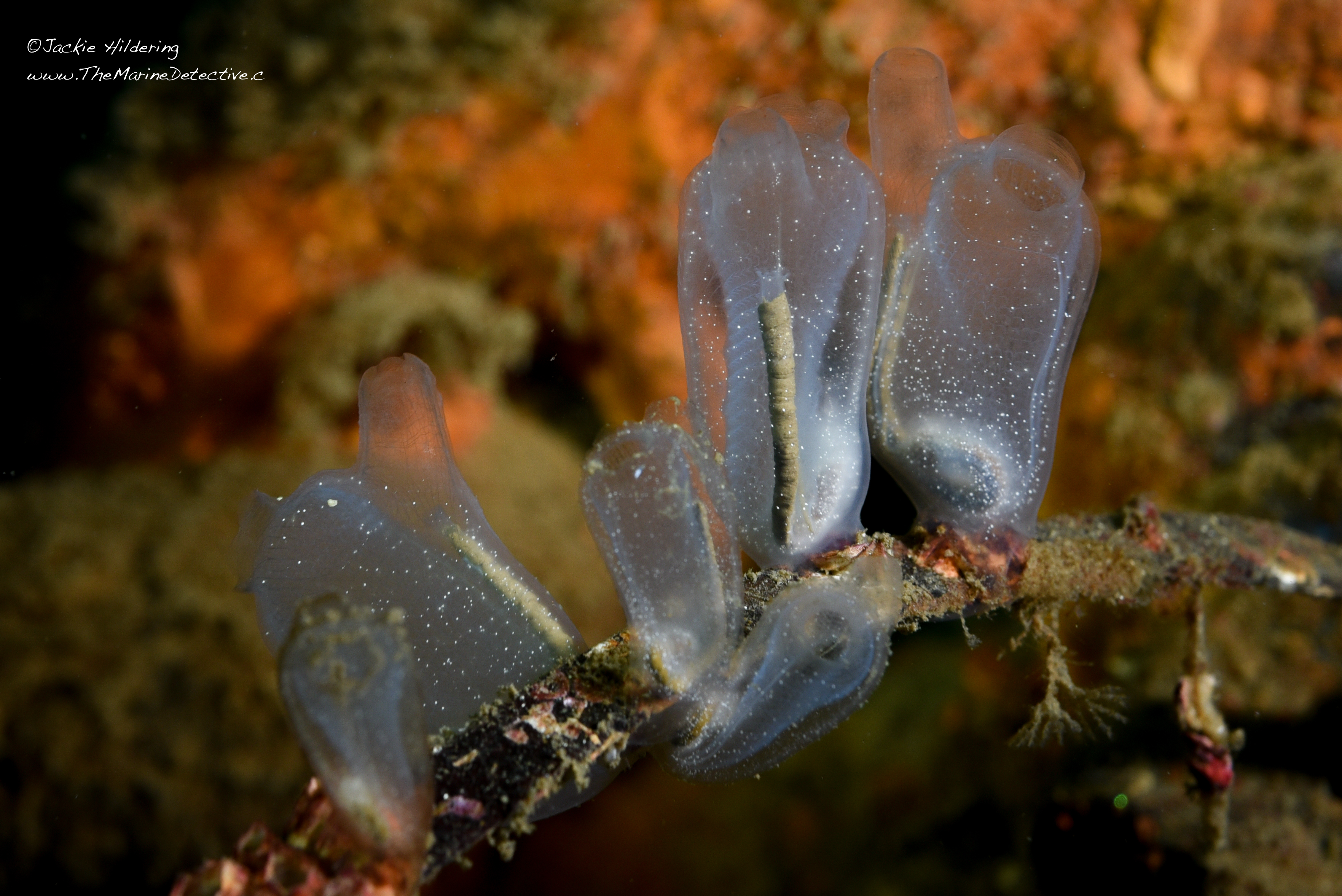
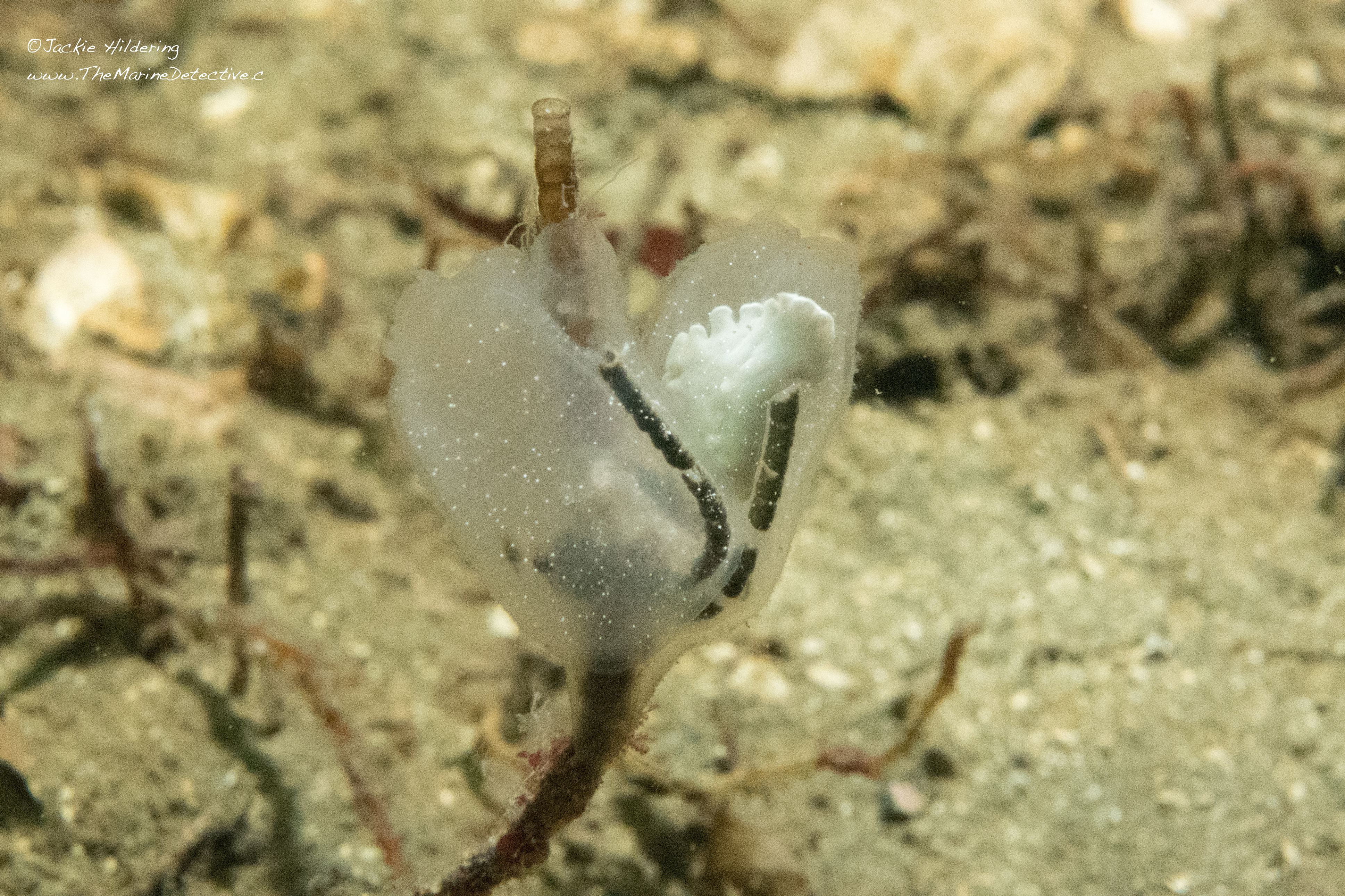
These are Transparent Tunicates (aka Transparent Sea Squirts). They are not parasites. They are highly evolved animals with a primitive backbone. They take in food particles through one siphon in their strong “tunic” and expel waste through the other siphon. See the siphons?
The dark you see here is the waste inside their rectums. Yep, they are filter feeders and clearly take in some sand too. What’s this then about parasites?
This species gets invaded by a wicked parasite (as opposed to all those gentle and meek parasites out there) . . . the Spotted Flatworm! This species of flatworm curls up, sneaks in through the tunicate’s branchial siphon, unrolls, eats the tunicate’s internal organs over 3 to 7 days and then moves on, leaving behind the empty tunic.
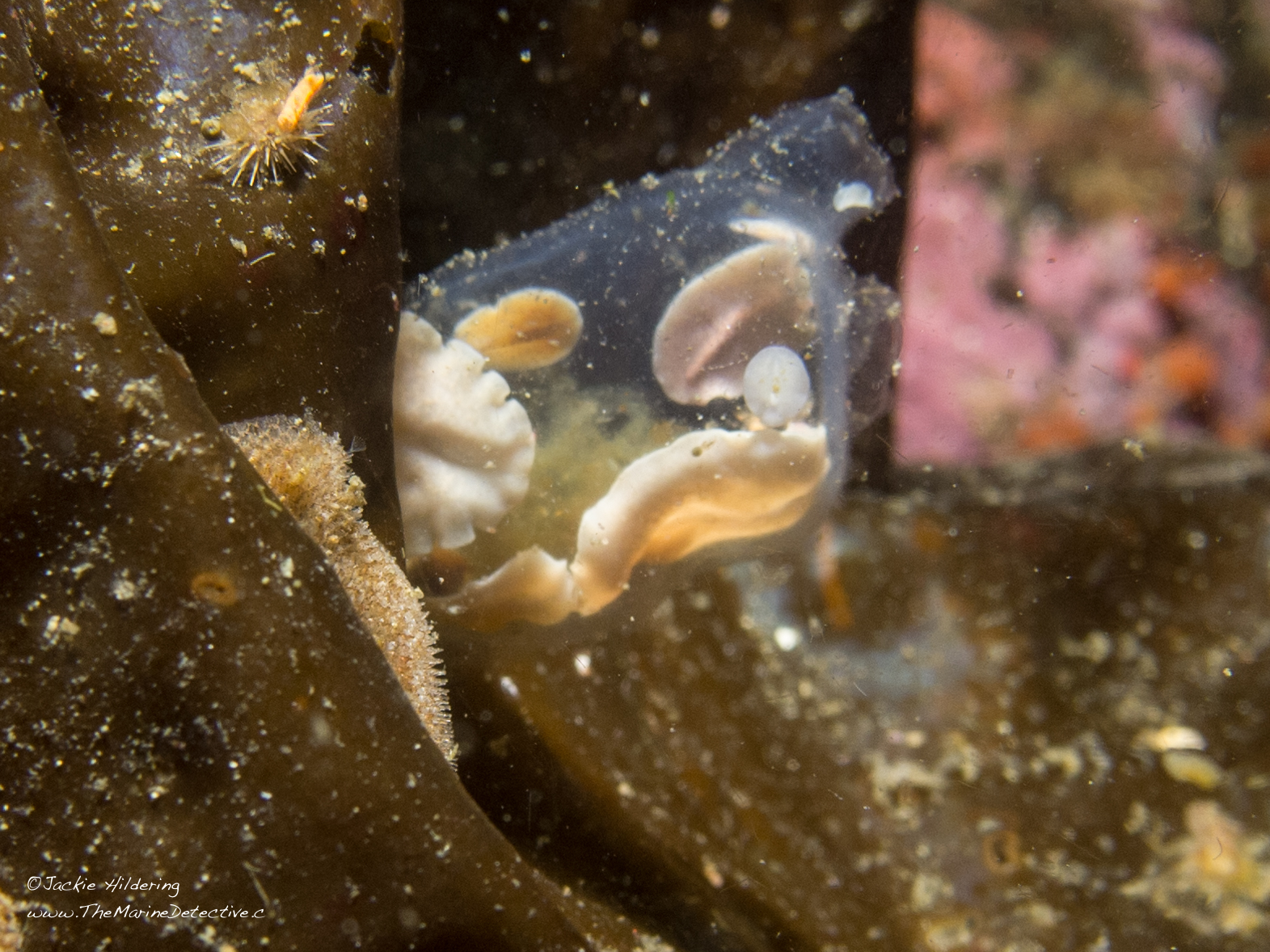
They are species specific parasites, apparently specializing in invading Transparent Tunicates. The following photos clearly show you the Spotted Flatworm presence there and the tunicates are now mere shells of their former selves.
All the internal organs are gone in the heavily invested individual in the photo below.
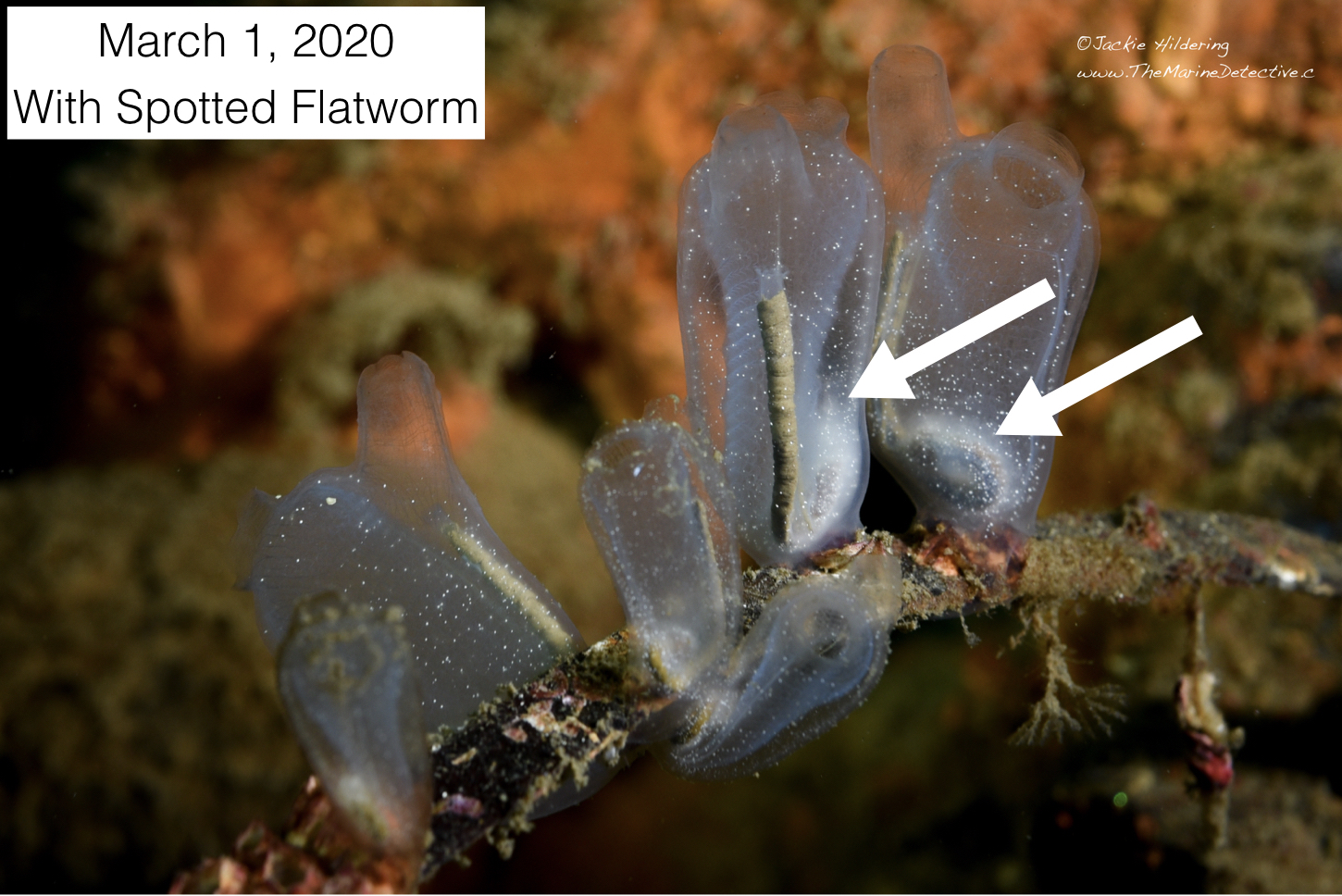
In having the privilege of learning even from individual animals by diving the same areas frequently. I recently saw the progression for individual Transparent Tunicates and the Spotted Flatworms that had invested them. The following photo is from March 1st, 2020. I’ve now added arrows to show the parasites.
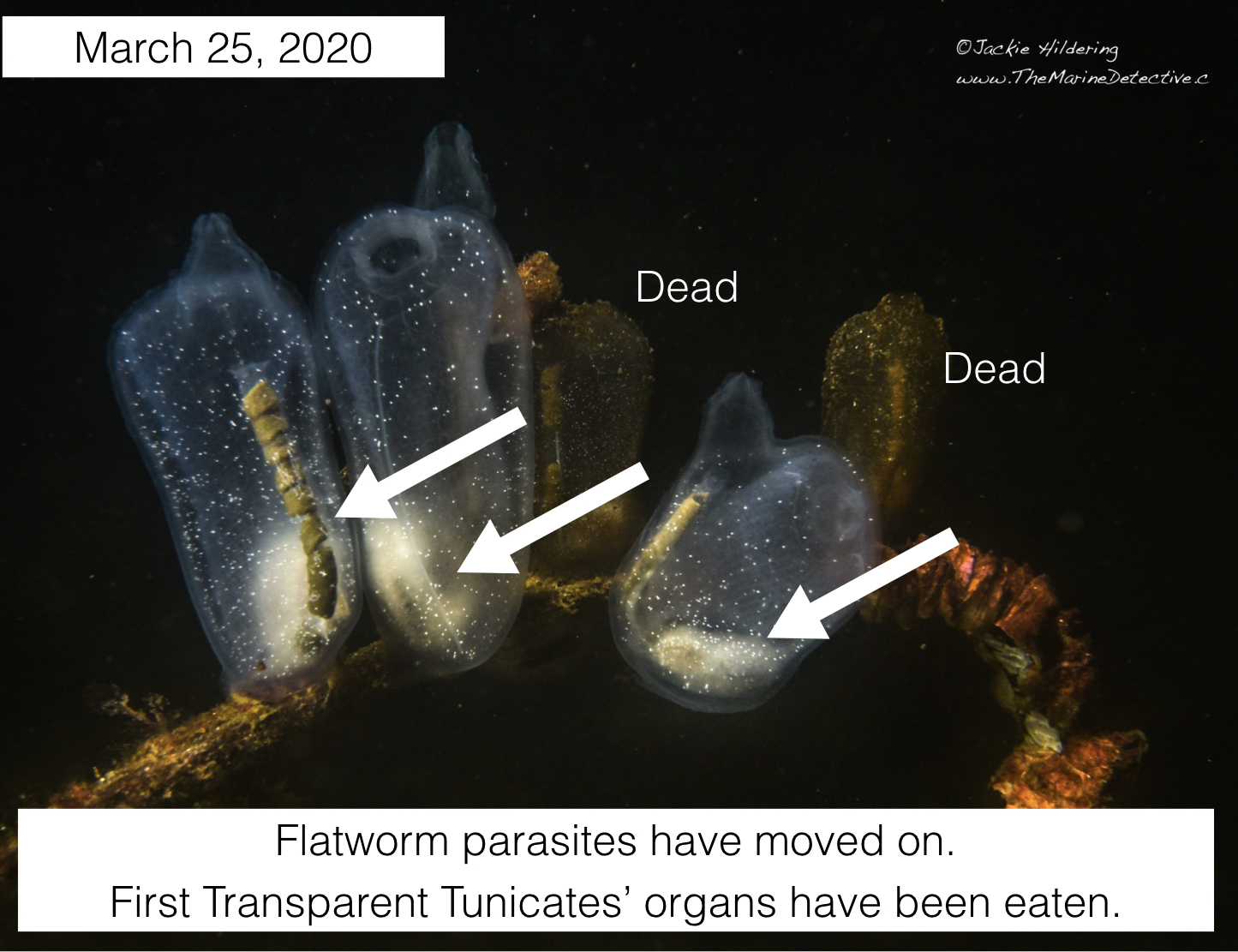
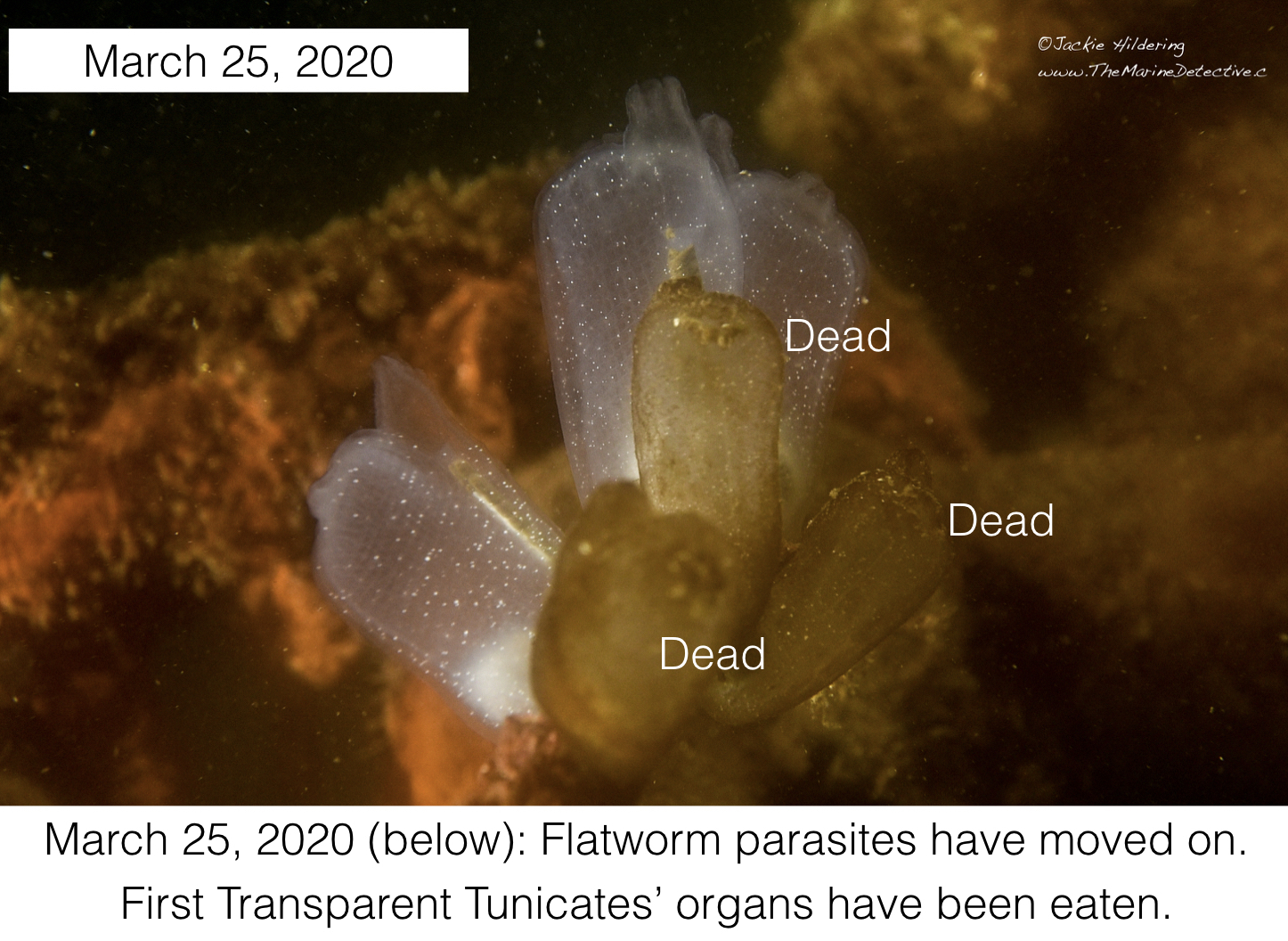
The following two photos show you reality 24 days later. The originally invested Transparent Tunicates are dead and the Spotted Flatworms have moved into their neighbours.
Below is another perspective on the same individuals.
I truly hope that in these times where our own species is facing extreme challenges, that this information still creates awe, connection and respect for the lives of others. Maybe it’s more important than ever.
Wishing you health, resilience, and strength of community.
Transparent Tunicate = Corella willmeriana to 7.5 cm.
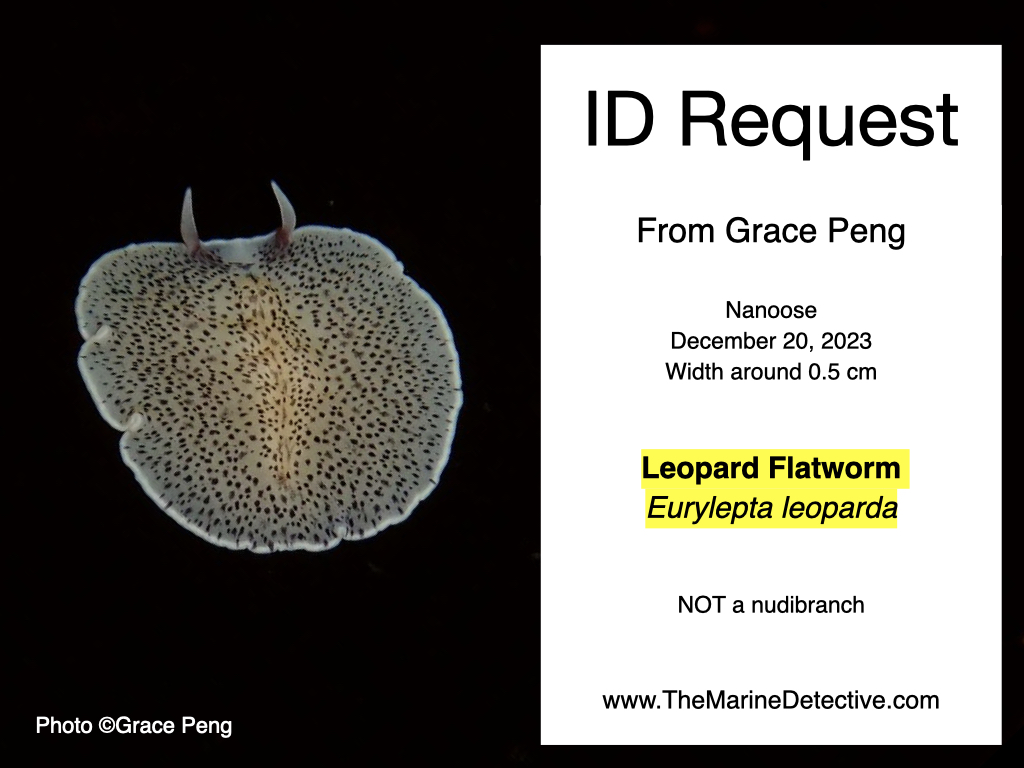
Spotted Flatworm = Eurylepta leoparda to 2.5 m.
___________________
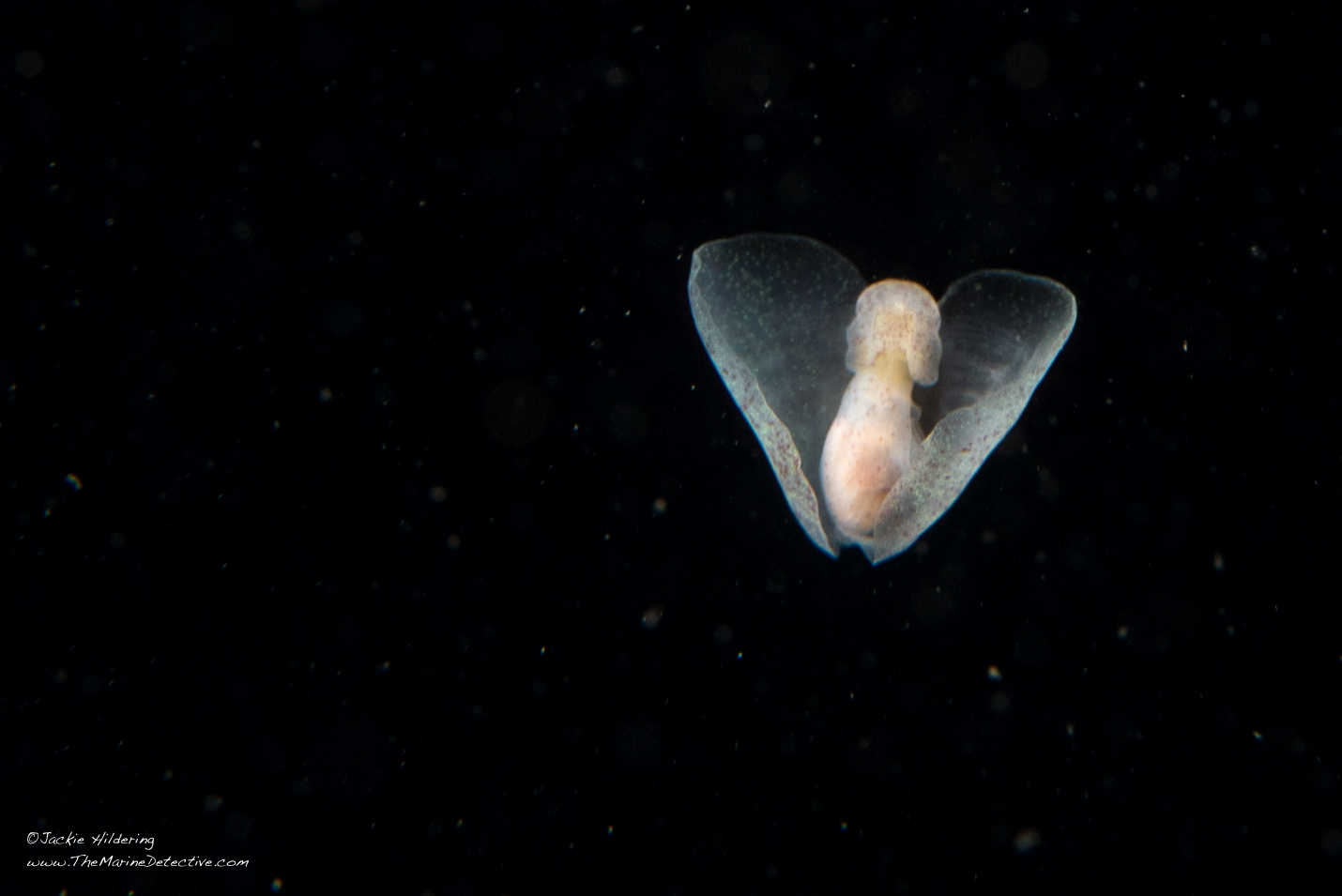
Photo showing what a Spotted Flatworm looks like when not in a Transparent Tunicate.
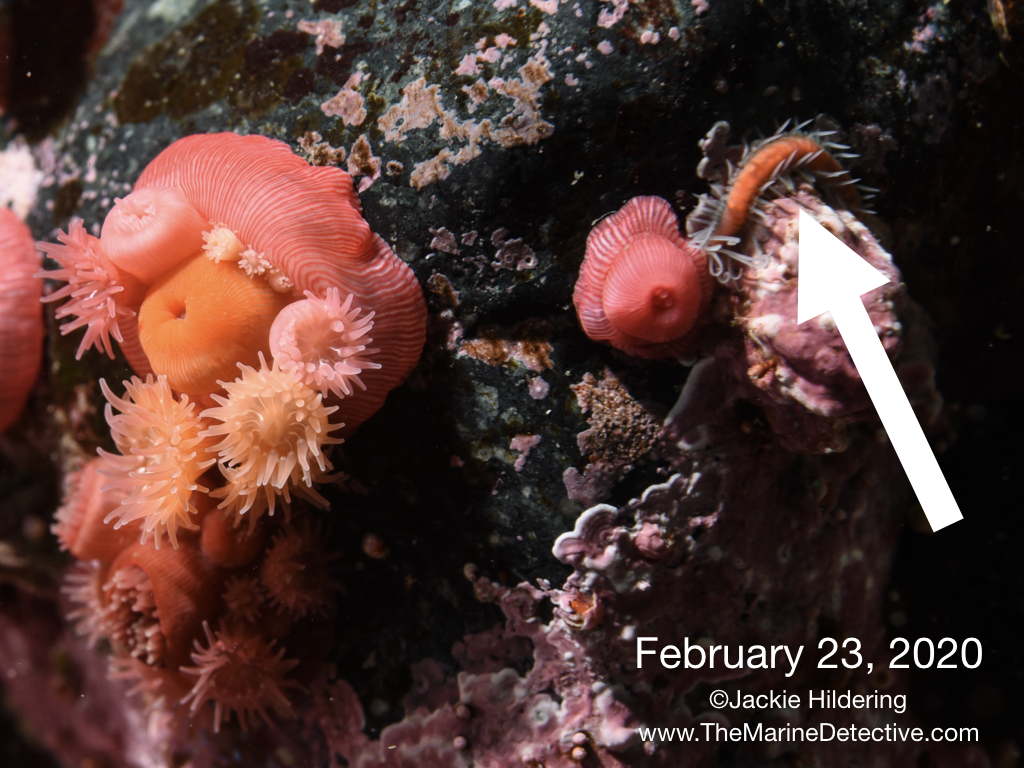
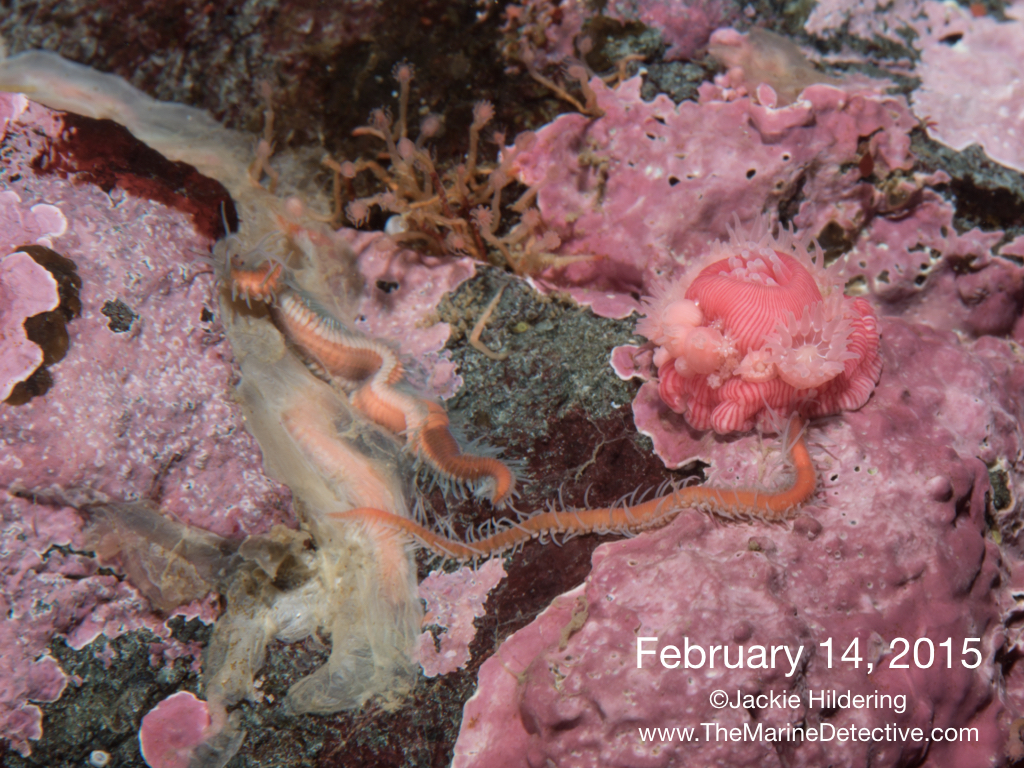
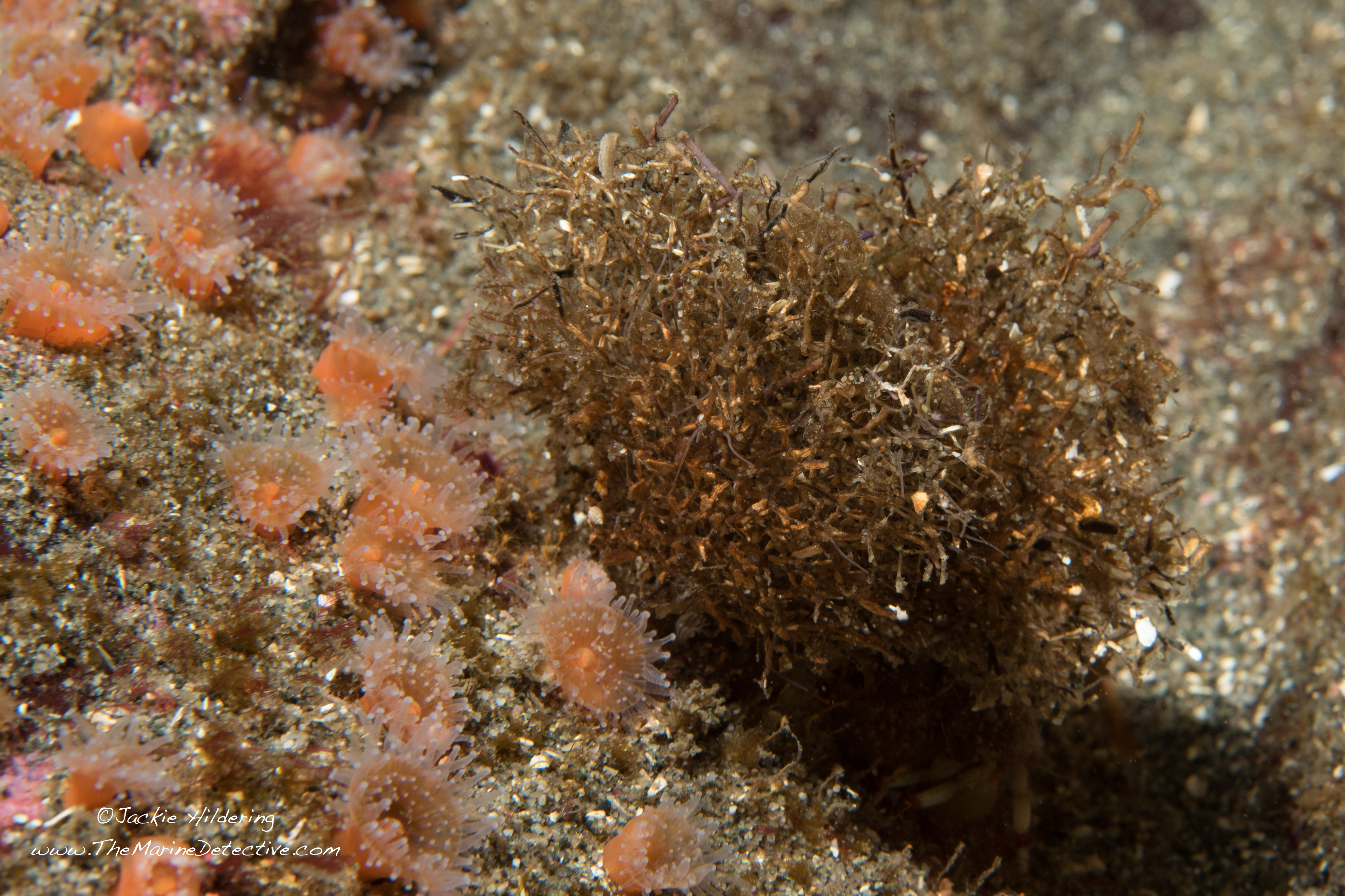
The species of necklace-worm in the following two photos has, to my knowledge, not yet been identified by science. My latest sighting of it was yesterday.
I am sharing the images to illuminate anew how little we know even of species in the shallows.
I have only documented this species 3 times and in each case it has been in less than 8 metres / 25 feet of water. Interestingly, it was near Proliferating Anemones in each case which makes me wonder if the might prey on them. I am perplexed too by the slime encasements evident in the second photo.
I believe it has also only been documented around the Plumper Islands area off NE Vancouver Island.
I have relayed the observations to polychaete worm experts.
To be clear, I did not discover the species.
I have only found individuals of this necklace-worm that has previously been recognized by experts as being an unidentified species.
In Andy Lamb and Bernie Hanby’s “Marine Life of the Pacific Northwest”, it is species AN22. They state: “While diving the Plumper Islands near Port McNeill, BC, we found this mystery necklace-worm. Significant numbers of this small (5 cm / 2 in long) creature were crawling about in the open, completely exposed. Such behaviour would seem to invite predation. Unfortunately, without a specimen . . . accurate identification is not possible. Detailed examination of the palps, teeth, cirri (finger-like projections) and chaetae (bristles) are required for species determination . . . It looks diminutive, but this mysterious worm is actually large compared to most necklace-worms.” Further from their update on KnowBC; “Some interesting observations can be made, however. The tentacular cirri near the head are much longer than their dorsal counterparts in the middle of the body: the latter appear to be shorter than the worm’s body width. It is not clear, though, whether these cirri are annulated (ringed) or smooth. The specimen’s eyes are evident as are some sensory organs located just behind them. Intriguing features are the two faint but obvious transverse structures on each segment that appear to be ciliated (hairy).”
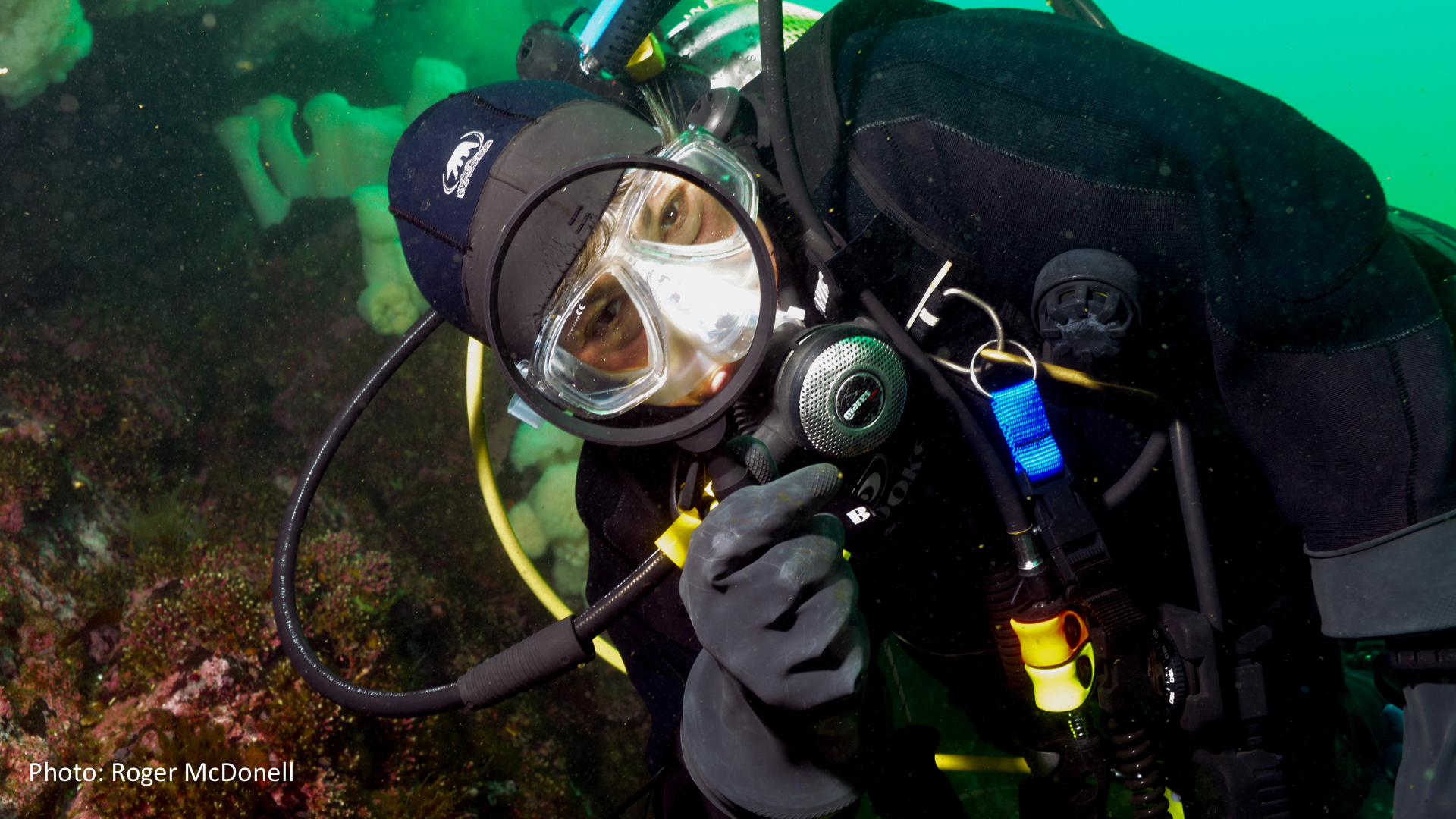
Oh and because truth, humility and self-mockery are virtues I try to stand for, know that I had no idea I had photographed the species yesterday. I only saw it when I was processing my photos of the Proliferating Anemones. There are good reasons I dive with a magnifying glass.
Below, please find photos of just a few of the other species of marine worm that I have photographed around NE Vancouver Island.
I am sharing these to add to the wonder of worms found in the NE Pacific Ocean.
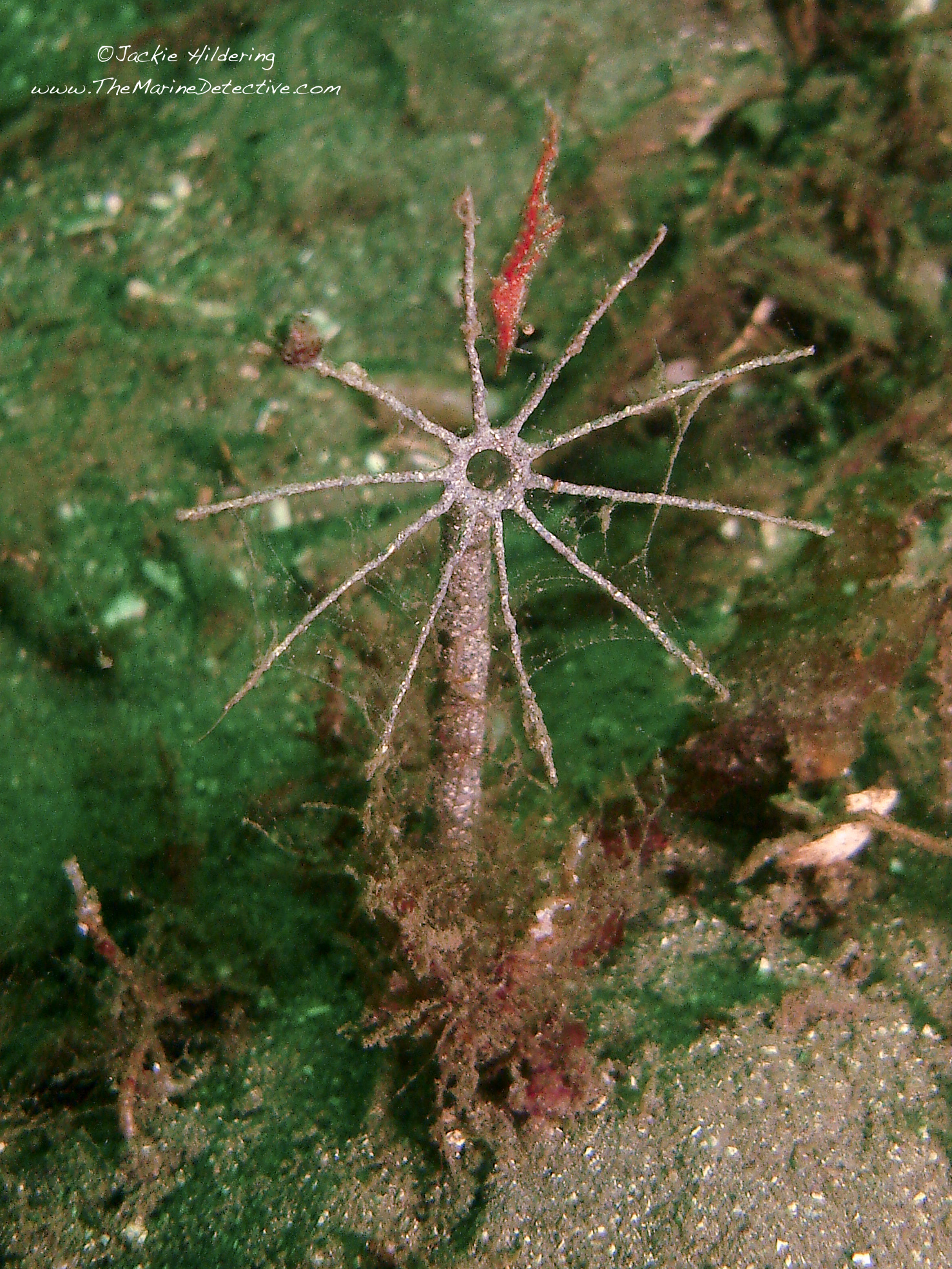
#1 Windmill Bamboo Worm Praxillura maculata to 25 cm long.
This species makes 6 to 12 “vanes”/spokes at the end of its protective tube and then strings a web-like net of mucus between to capture bits of food. After a time, the worm comes OUT of its tube and eats the mucus and food! Yep, it seines for its dinner! See this link for photos by Ronald Schmek of the worm coming out of its tube to harvest dinner.
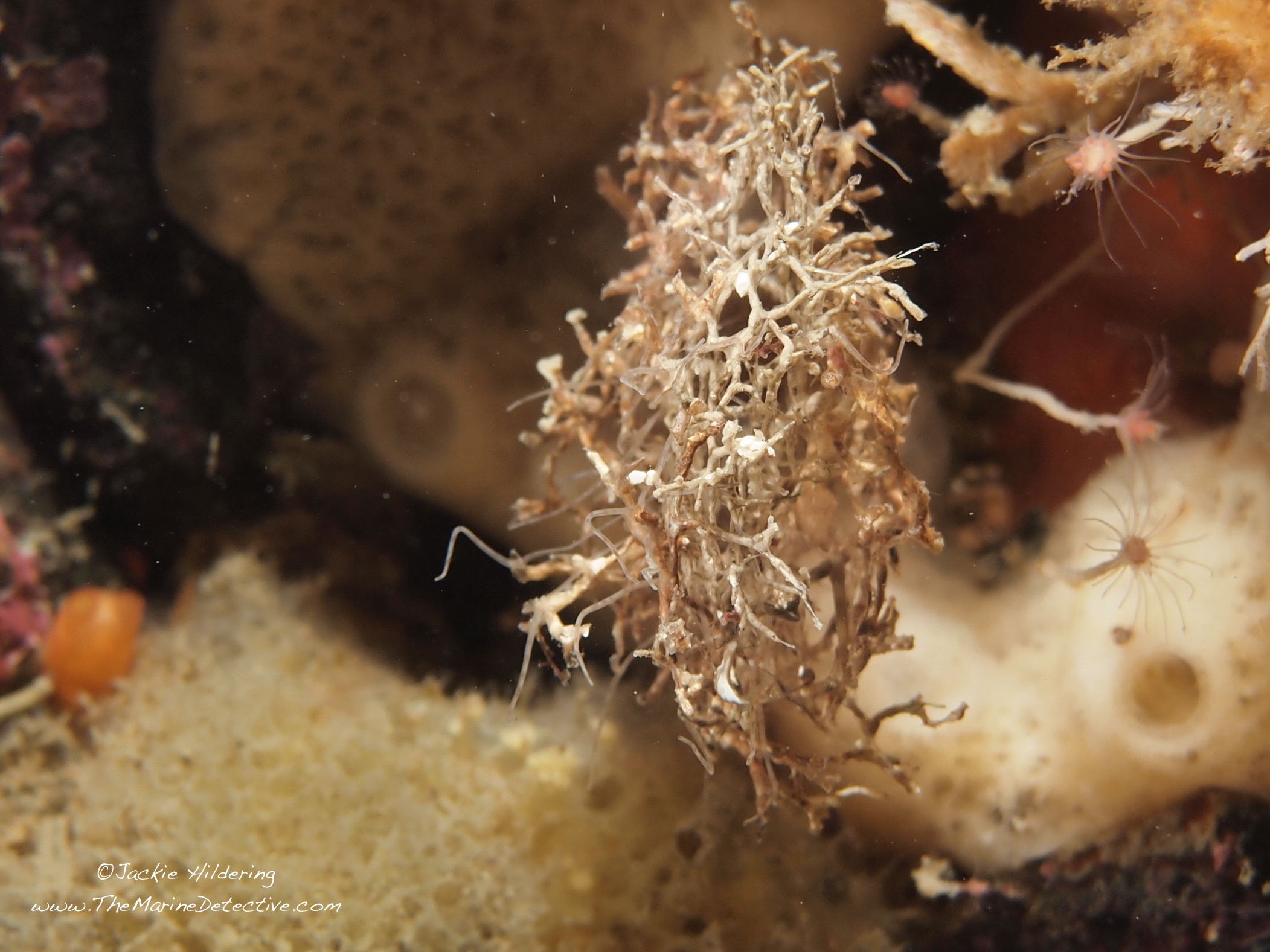
#2 Basket-Top Spaghetti-Worm Pista elongata to 21 cm long
The Basket-Top Spaghetti-Worm builds a tube AND A BASKET from bits of debris and extends its tentacles through the basket to feed. So little is known about it.
From Lamb and Hanby: “The lower part of the tube, where the worm resides, is coated with shell fragments and pebbles. Is the purpose of this extravagant tube solely to camouflage and protect the worm . . . or to increase its access to food? The worm extends its long tentacles through the basket to gather food particles selectively . . . The basket-top may also function as a sieve, filtering out particles brought by currents. Elevating the tube above the rocky substrate may provide the elongate, and tree-like branchia (gills), hidden in the basket, with a good supply of oxygenated water.”
#3 Calcarious Tubeworms
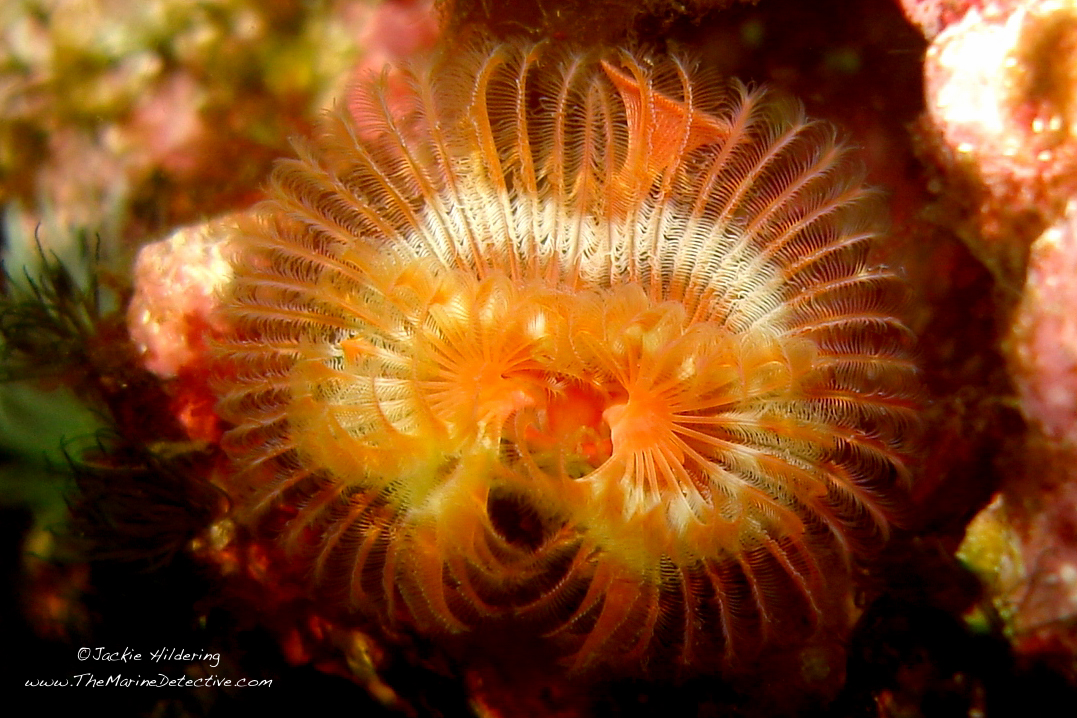
There are a variety of Calcareous Tubeworms species in the NE Pacific Ocean. I believe those in the following photos are “Red-Trumpet Calcareous Tubeworms” (Serpula coumbiana to 6.5 cm long). You’ve probably deduced that with that large surface area, they dust for plankton snacks with their crowns. These structures also allow the animals to respire.
See the trumpet-like structures (which need not be red as the common name suggests)? That is the “operculum”. It functions like a door that pulls closed after the tubeworm retracts. Thereby the worm is further protected in its hard, shell-like tube of a home
I am always thrilled when I succeed in photographing this species since, with any disturbance, the crown Immediately retracts as of result of they eye spots detecting the change in light / shadow.
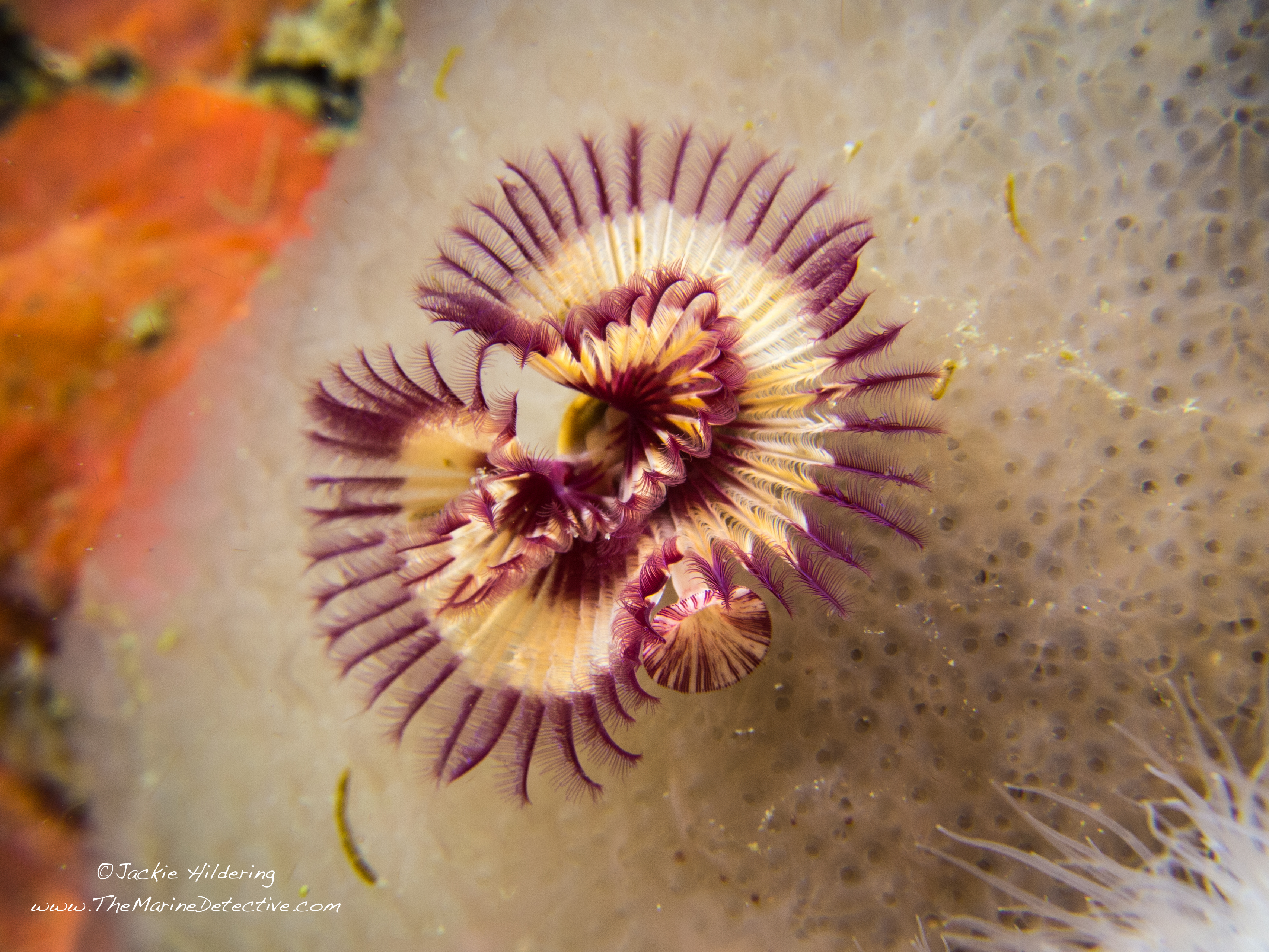
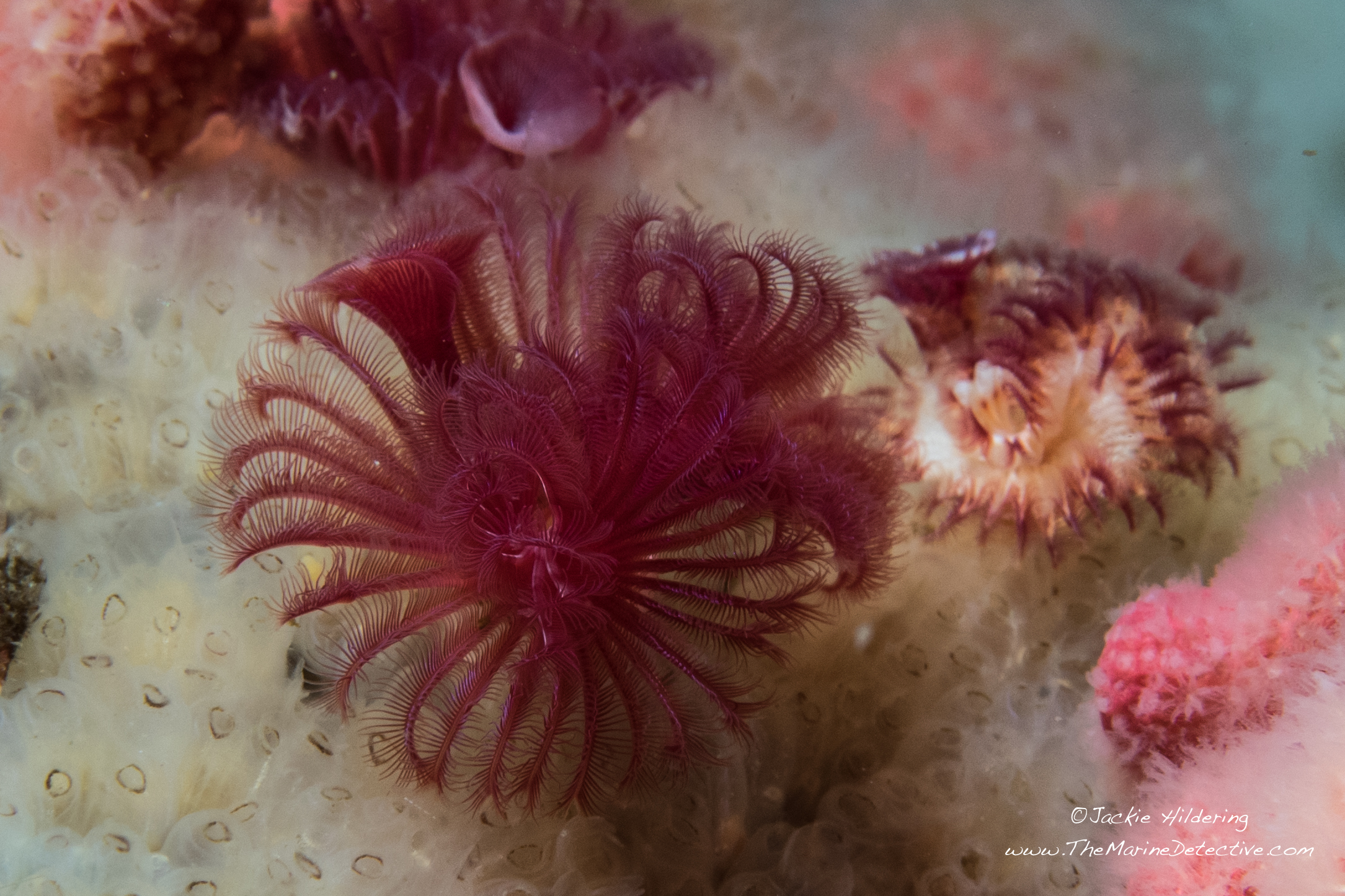
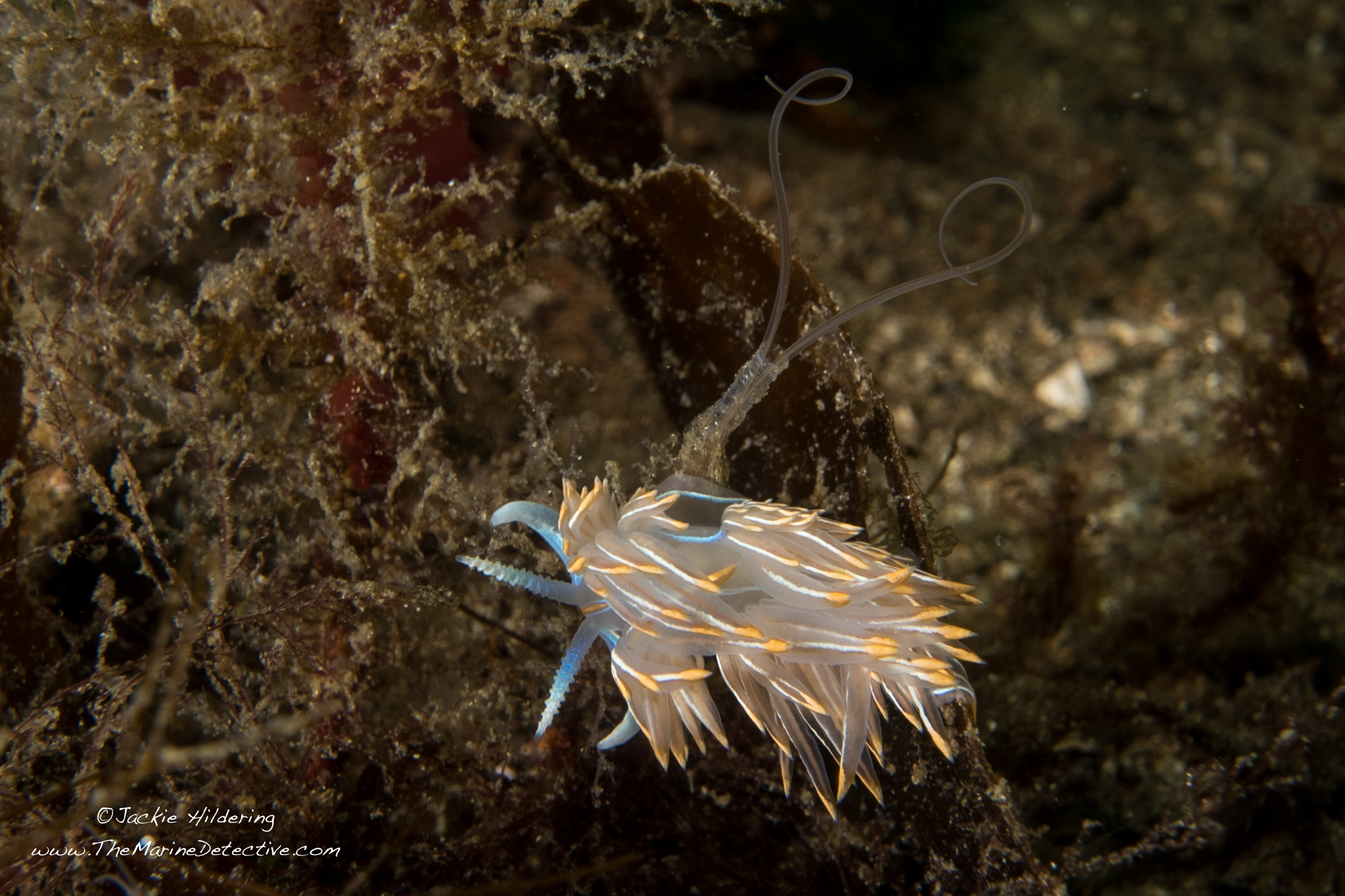
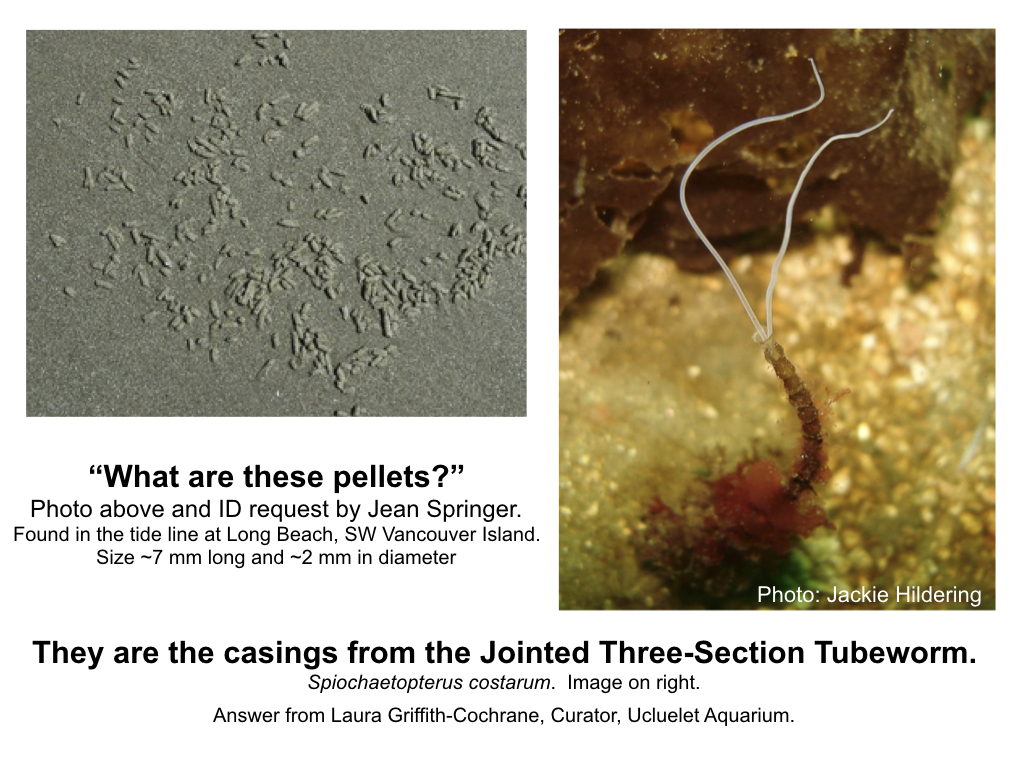
#4 Jointed Three-Section Tubeworm Spiochaetopterus costarum to 48 cm long
Jointed Three-Section Tubworms are filter feeders that create mucus bags inside their bodies through which water is passed due to the beating of cilia. As the water passes through the mucus, plankton and detritus particles are sieved out. The long polyps you see in my first photo below, remove the pellets and keep the opening of the worm clear. Notice how thin the worm is and therefore how spacious the tube it has constructed? The second photo shows you what the pellets look like.
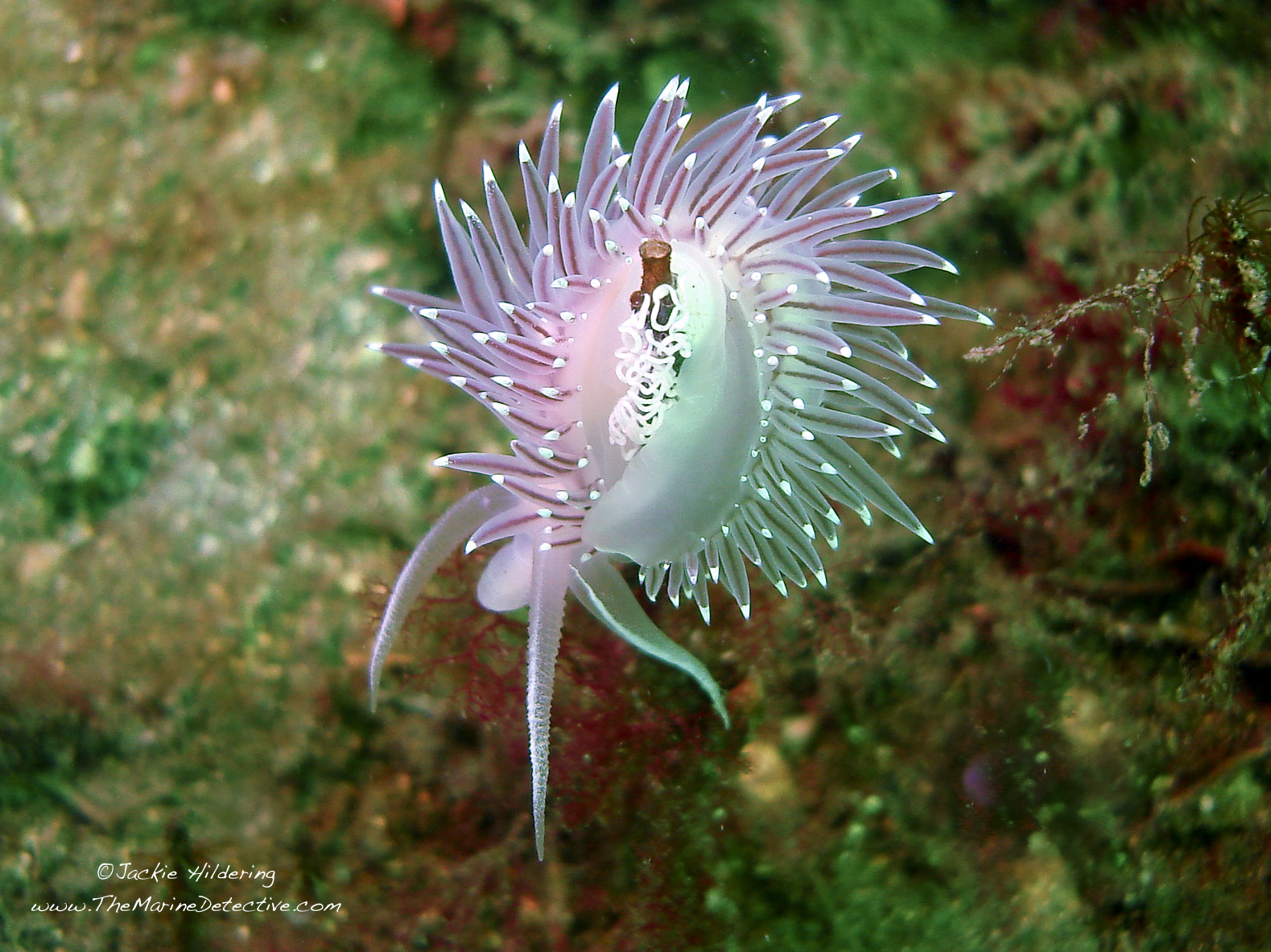
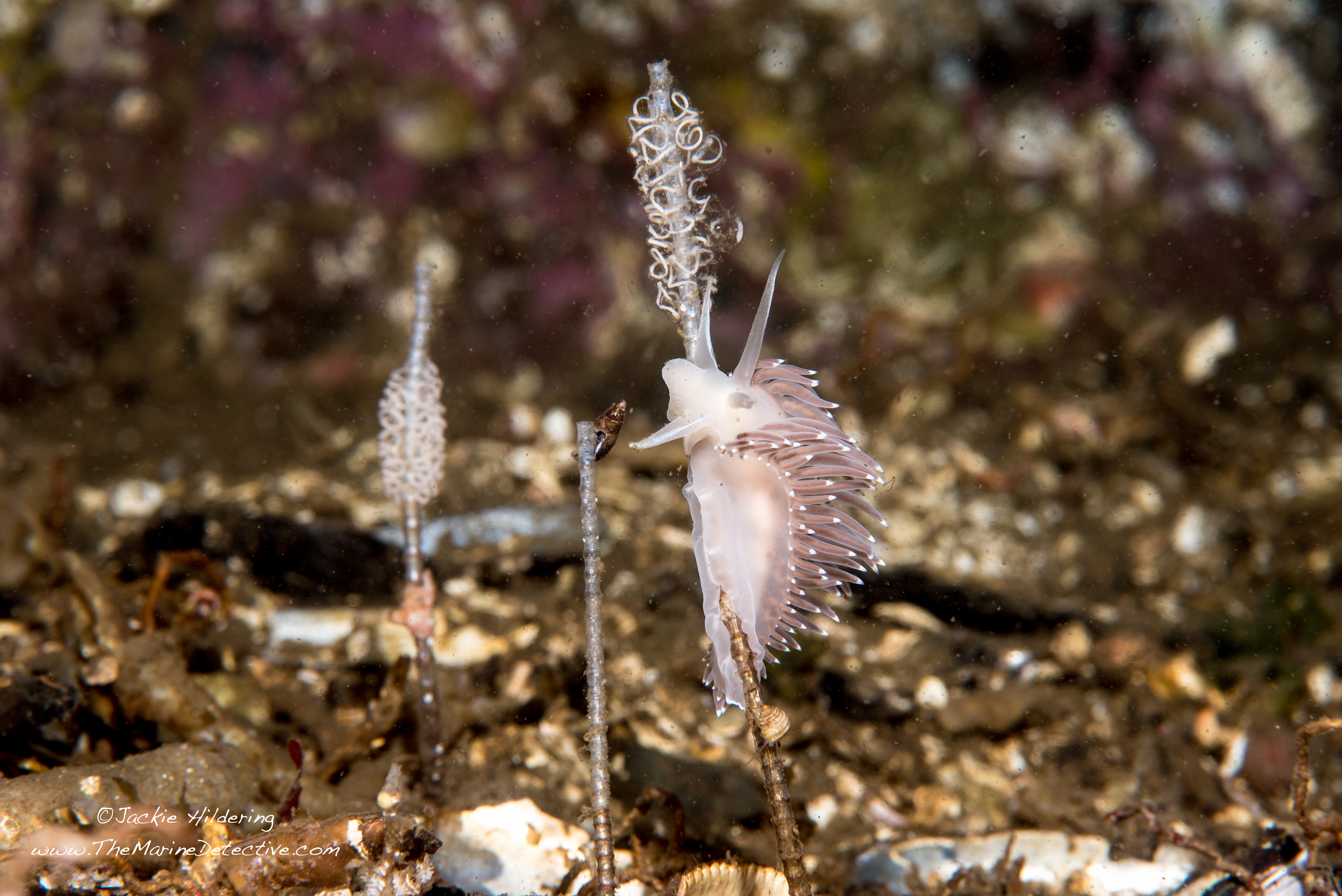
The nudibranch species in the first images is an Opalescent Nudibranch which is likely feeding on a species of hydroid on the outside of the worm’s tube.
The nudibranch species in the third and fourth photo is Himatina trophina which not only feeds on hydroids on the outside of the tube but also, as you can see, lays its egg ribbons there.
#5 Slime-Tube Feather Duster Worms Myxicola infundibulum to 9 cm long
This species can also detect shadow and retreat into their mucus homes with lightning speed. All you then see is the jiggly jello-like top of their tubes. (Yes, it took me a long time to get a photo of them!) Where other marine tube-worms make a parchment or shell-like tube, worms of the Myxicola genus secrete themselves a mucus home. “Myxicola” in fact translates into “living in slime” so don’t name your child that . They suspension feed on plankton and other bits of organic bits with their funnel-like crowns ( = “radioles”).
#6 Feather Duster Tube-Worms
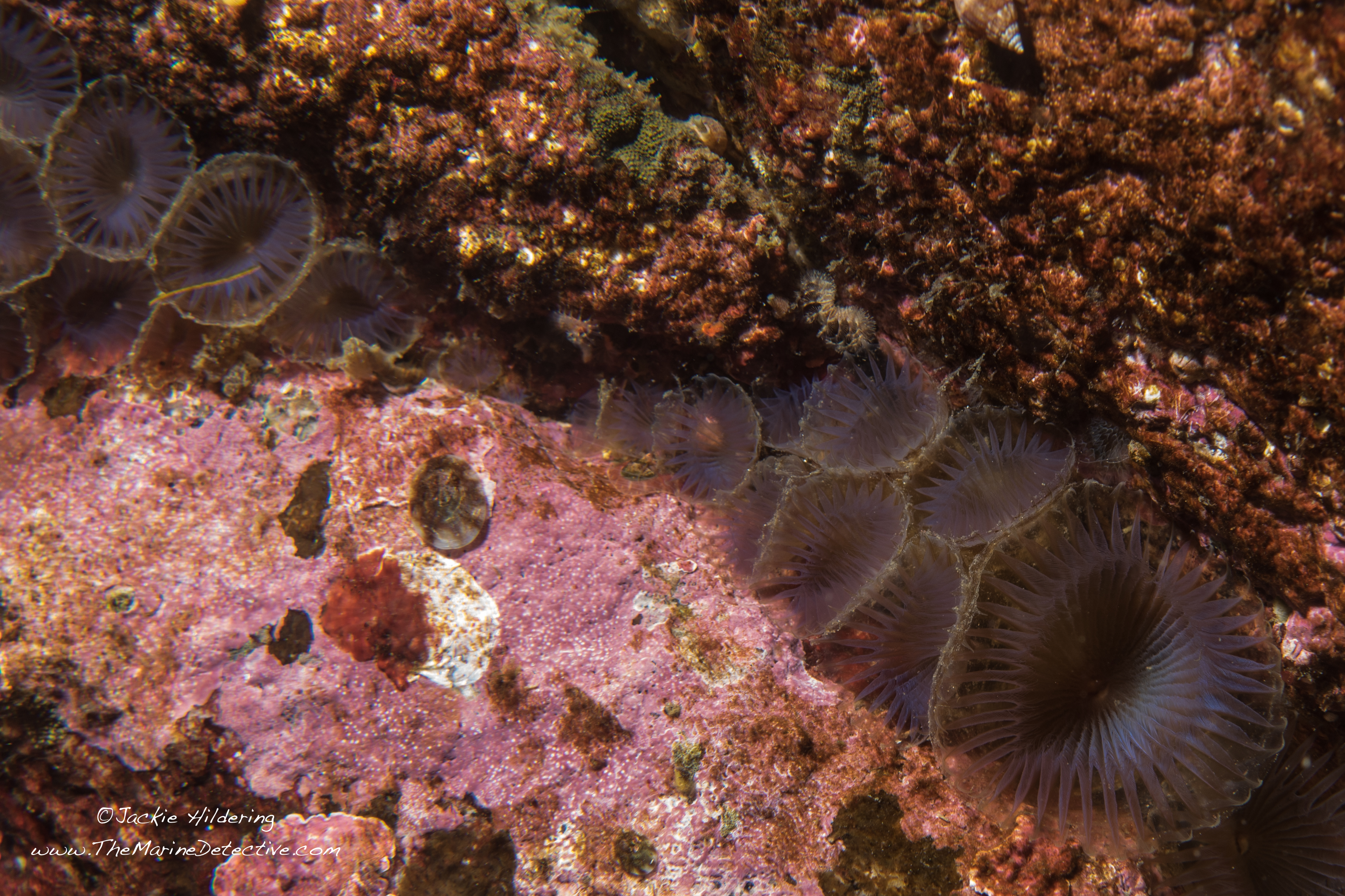
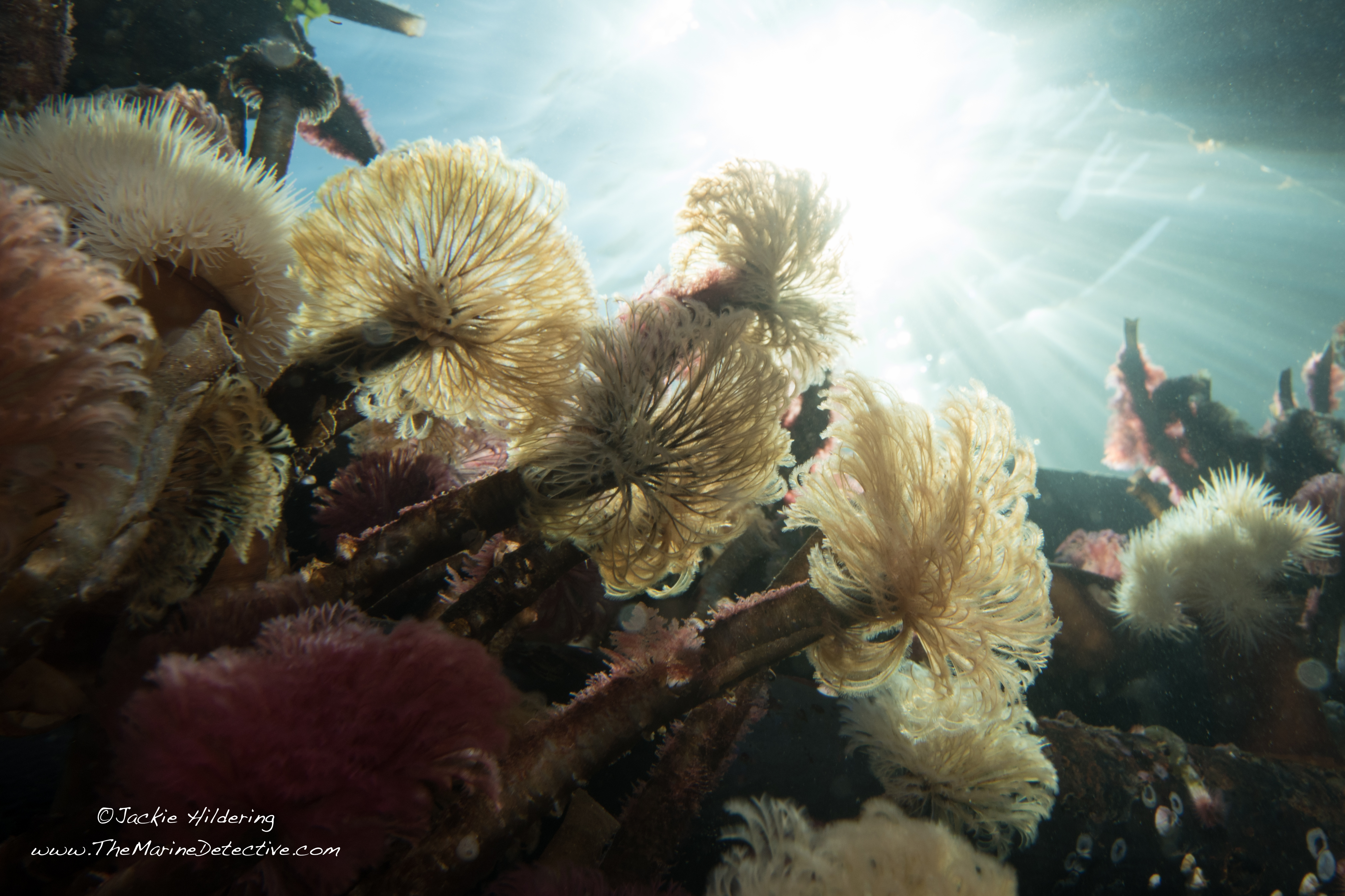
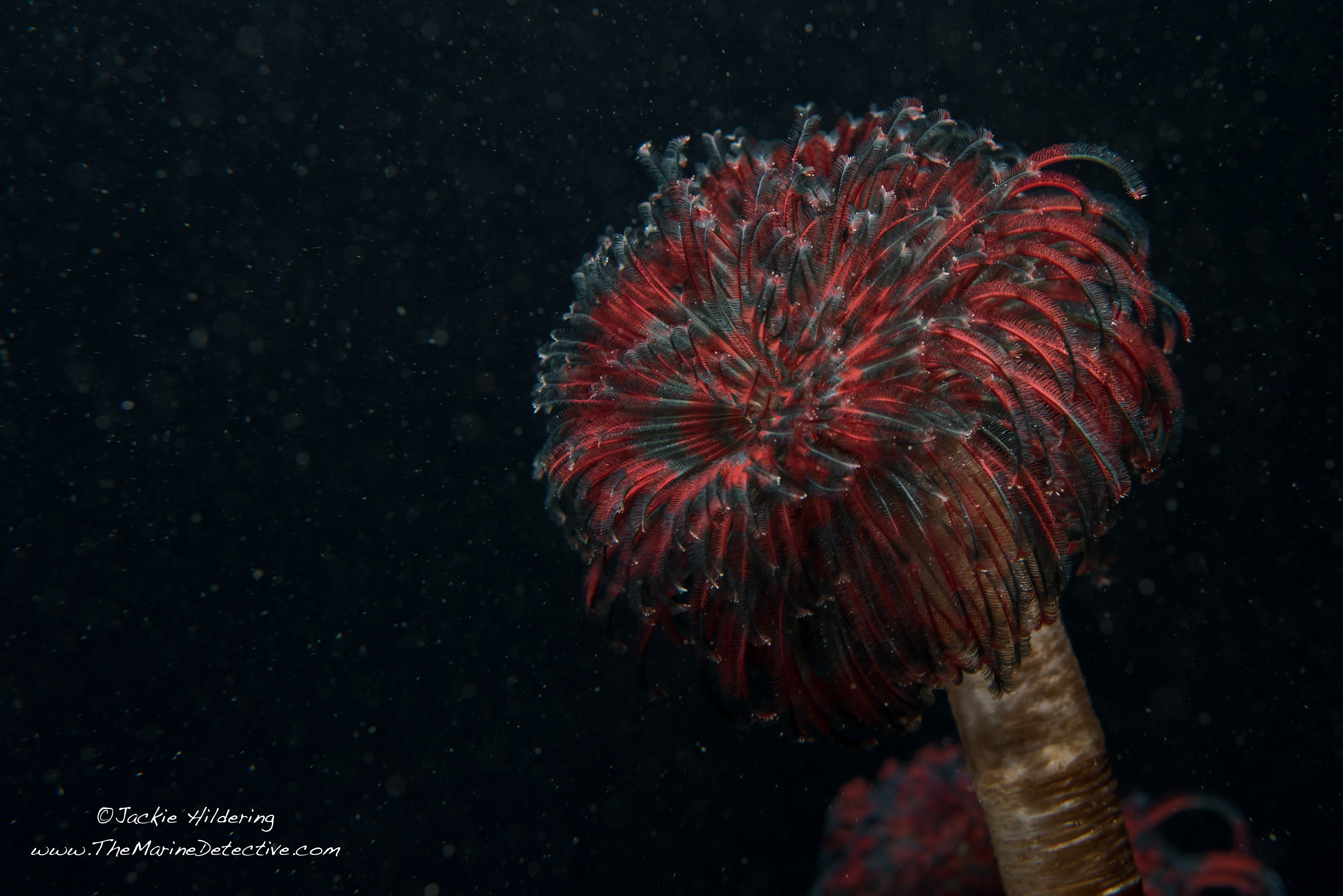
It is very easy to see why these are known as “feather duster” worms. Their crowns have huge surface area to “dust” the ocean for food. They live in parchment tubes and feed on plankton with their bushy crowns.
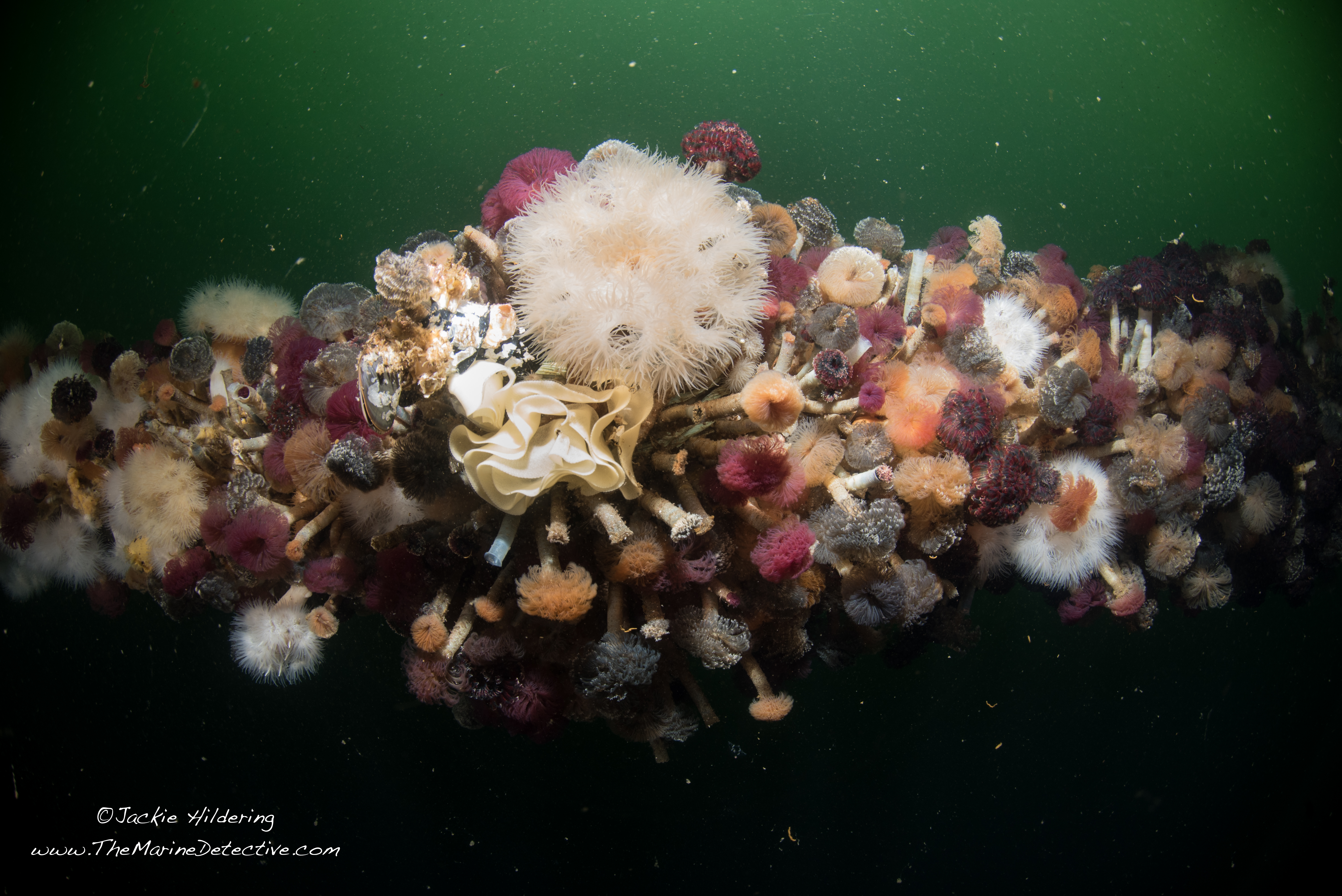
The banded blue and purple ones with the thicker tubes are the Vancouver Feather-Duster (Eudistylia vancouveri to 25 cm long). The pink, grey and tan ones are Split-Branch Feather-Dusters (Schizobranchia insignis to 15.8 cm long).
Vancouver Feather-Duster and Split-Branch Feather-Dusters. See the nudibranch egg mass under the biggest Plumose Anemone? Those are from a Monterey Dorid.
Split-Branch Feather-Dusters (Schizobranchia insignis to 15.8 cm long).
Vancouver Feather-Duster (Eudistylia vancouveri to 25 cm long).
#7 Sea Nymphs / Nereidae Worms
There are more than 20 species of nereida worms in the NE Pacific Ocean and the one that I am asked about most often is the “Giant Pile Worm” (Alitta brandti). It is indeed giant at up to 1.5 long and causes wonder and confusion; even getting misidentified as being an eel instead of a worm.
The video below shows a male spawning at the surface.
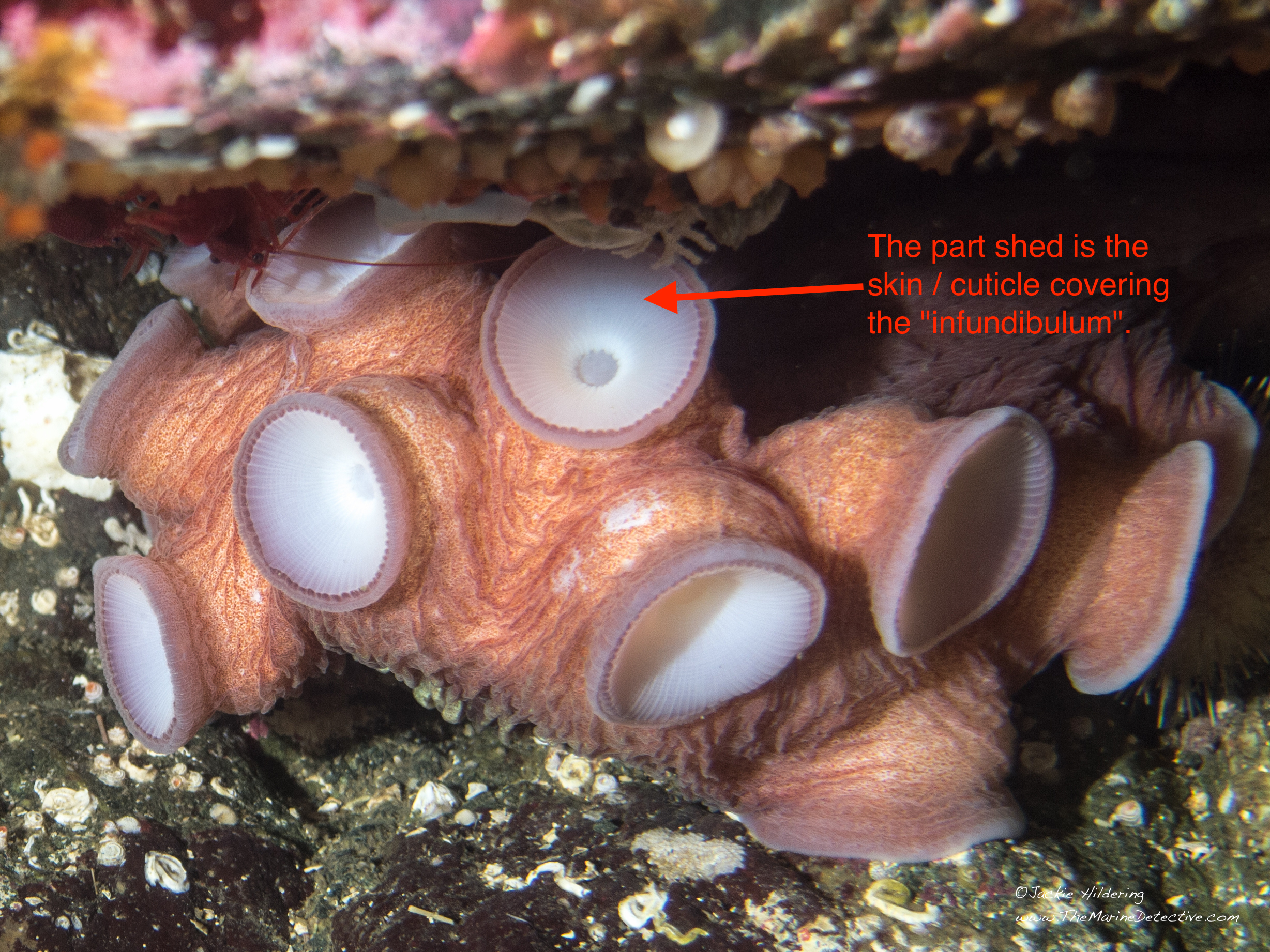
While I was diving today, I saw these structures, like large snowflakes drifting out of a crack between two rocks.
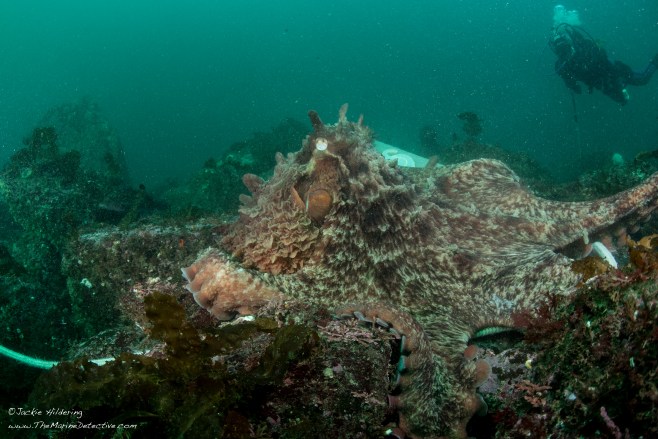
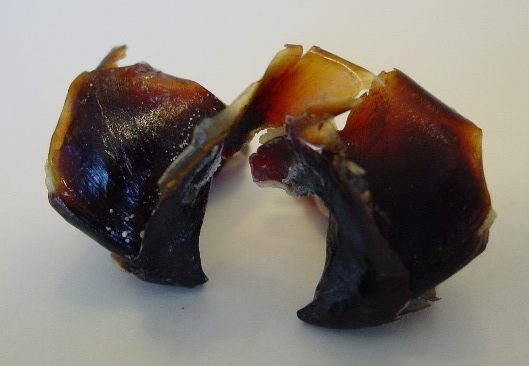
And I knew there had to be a Giant Pacific Octopus there BECAUSE this is the skin at the end of the octopus’ suckers.
Octopuses shed this skin periodically and, possibly, from all their suckers at the same time! The skin grows continuously.
With Giant Pacific Octopuses having about 2,000 suckers (up to ~2,240 in females and 2,140 in males), you can imagine how many of these were drifting out of its den as the octopus exhaled, causing an upward current.
This skin is referenced as the sucker lining or “chitinous cuticle” and you can deduce from the photo below how the skin being shed would be of varying sizes.
I could peer into the crack and see the octopus that was shedding but s/he was too deep into the den to be able to get a photo.
How wonderful it would be to be able to provide you video of an octopus shedding its suckers in the wild. But, not surprising, it is easier to capture this with octopuses in captivity.
Below is a video of a captive Giant Pacific Octopus named Marylyn shedding her sucker linings (Video source: Christie Rajcic, “Octopus Shedding Suckers”).
I hope this adds to your sense of wonder of our marine neighbours. It also provides a whole new association to the words “So long suckers!” 😉
It’s difficult to explain the joy it gives to not have disregarded these little white bits but to know they were a clue to where there was an octopus.
Oh, and if you enjoyed this, you definitely will want to benefit from my life-enhancing blog “How Octopuses Poo“.
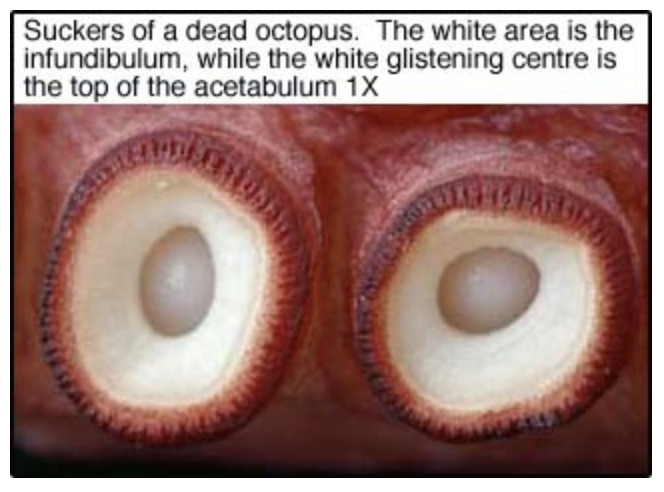
For you super nerds (hello!), the cuticle covers the “infundibulum”. See images below from “A Snail’s Odyssey“.
William M. Kier, Andrew M. Smith, The Structure and Adhesive Mechanism of Octopus Suckers, Integrative and Comparative Biology, Volume 42, Issue 6, December 2002, Pages 1146–1153, https://doi.org/10.1093/icb/42.6.1146
[Update in 2021: CLEARLY I had no idea what a globally and colossally crap year 2020 was going to be when I wrote this blog. May the thoughts and information about octopus eyes still provide vision 🙂 ].
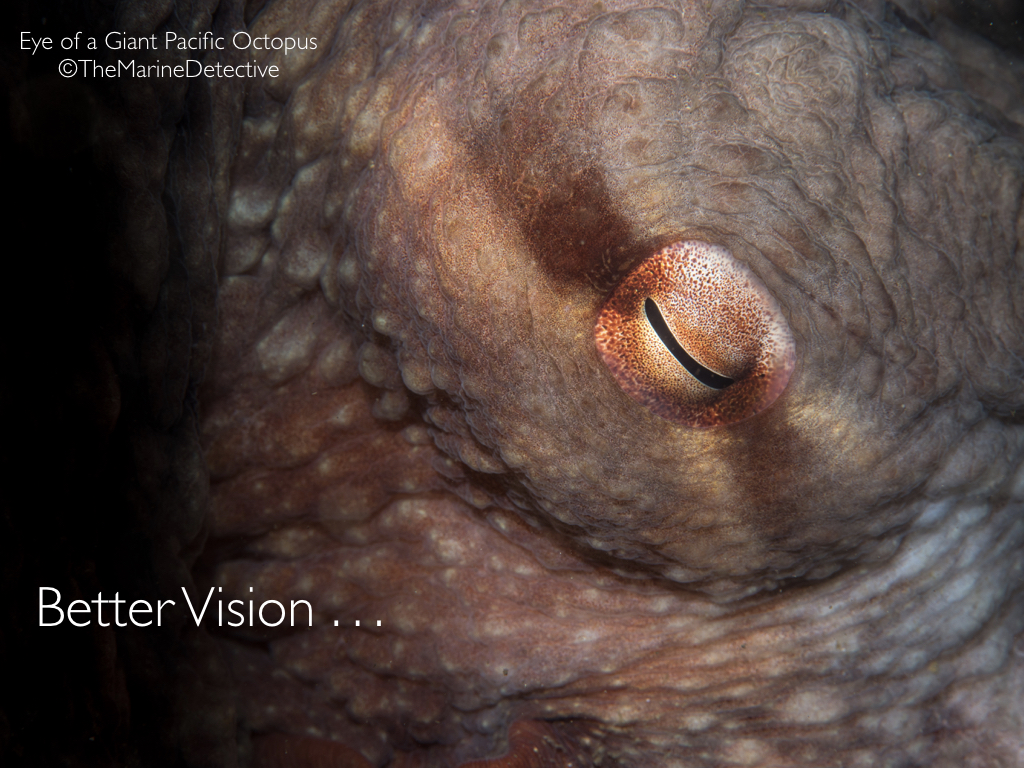
Here’s an unlikely combination of introspection and natural history. It’s what results when you bring together a photo of a Giant Pacific Octopus’ eye with the bad word play of “2020 vision” regarding the new year.
Introspection: In a human lifetime, you don’t get to cross the threshold into all too many decades. Like many of you, it makes me take pause . . . wanting to understand where we are and how to move forward with focus. It’s what happens when you want to make sense of a world which appears to have increasing numbers of cartoon-character-like heads of state. It makes me think about the state of heads, and how to find one’s way without despondency, denial and inaction.
I write these words largely to solidify my resolve and vision in this decadal transition but share them here in the hopes that they may be of use to you.
Better vision for better futures:
The paradigm: Realizing why there are forces in the world who would rather flirt with the health of future generations than undertake action that would benefit their own grandchildren. They are those who have benefited the most from lack of equality, fossil-fuel use, rampant consumerism, and use of disposables. Despite the enormity of their power, positive change is happening and in the death throes of the paradigm, the very nature of truth is being challenged. When one shouts loudly, it is not likely they are more correct. It is an attempt to drown out the truth. They are the spasmodic utterances of the entitled. The aims are confusion, distraction, discontent (just keep buying more little girl and happiness will be yours), despondency, overwhelm and (of course) the blunt tool of FEAR. The hope is that we shut down and not notice the steps forward toward a paradigm based on greater equality and sustainability.
Less is more: These are words I have shared so often. Above a true level of need, using less is not about loss. It’s about gain. The more we steer away from the myth that owning more and/or bigger is best or that it equates to “success”, the more liberation we have from being enslaved to $. We do know where true happiness lies. It is where there is greater sense connection, health and time for who and what we love.What a world it would be if more of us saw that gain and realized just how empowered we are to create change through our consumer and voter action. Using less fossil fuels, dangerous chemicals and disposables positively impacts so many socio-environmental issues.
The way forward: You’ve seen it haven’t you? The uprising, the unblinking truth . . . the power of youth who know the way. How excited I am for power shifting further toward them, their technologies and lifestyles fuelled by values of equality and sustainability. In no way does that mean we stand idle and wait for them to be of the age to vote. For me it is to be in service of them, the next generation. It is to help others see the way, to know their place in nature, to know their power, to find their voice, and to shield them from despondency, and fear.
And here’s the natural history and marine mystery bit relating to the photo of the octopus’ eye (note that she was in her den and that I used a zoom lens).
Octopus vision:
You see that the pupil’s shape is very different from ours. Their retina is very different too.
Octopuses and other cephalopods have only one kind of photoreceptor cell while we have rod cells and three types of cone cells allowing us to see in colour. So how can cephalopods discern colour when they have only one kind of light receptor in their eyes? And they must be able to discern differences in colour. Consider how they signal with colour and how they camouflage.
Research from 2016* puts forward that their uniquely shaped pupils act like prisms, scattering light into different wavelengths (chromatic aberration), rather than focussing the light into a beam onto the retina.The hypothesis, tested with computer modelling, is that cephalopods can then focus the different wavelengths onto their retina separately by changing the distance between the lens and the retina, thereby separating the stimuli and discerning colour. Note that the sharpness of their vision is believed to be different for different wavelengths / colours.
Even with their eyes closed, octopuses can detect light with their skin. This is tied to their ability to camouflage with the photoreceptors in their skin responding to specific wavelengths of light (different wavelengths = different colours).
Note too that octopuses do not have eyelids. They have have a ring-shaped muscular fold of skin around the eye that closes in the way of an eyelid (especially when some annoying human is taking photos).
There, I feel much better now. Bring on the New Year.
Here’s to all the colour, marvellous mysteries, clear vision, and solid action ahead.
Go ahead, say that 5 times “abseiling sea snail, abseiling sea snail, abseiling sea snail . . .”
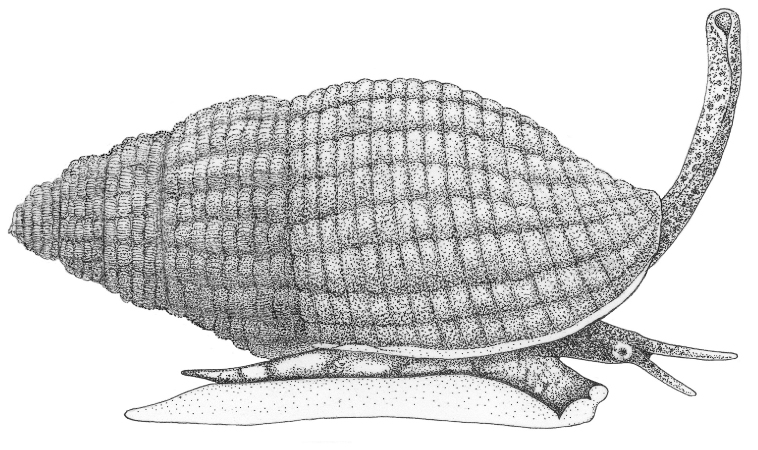
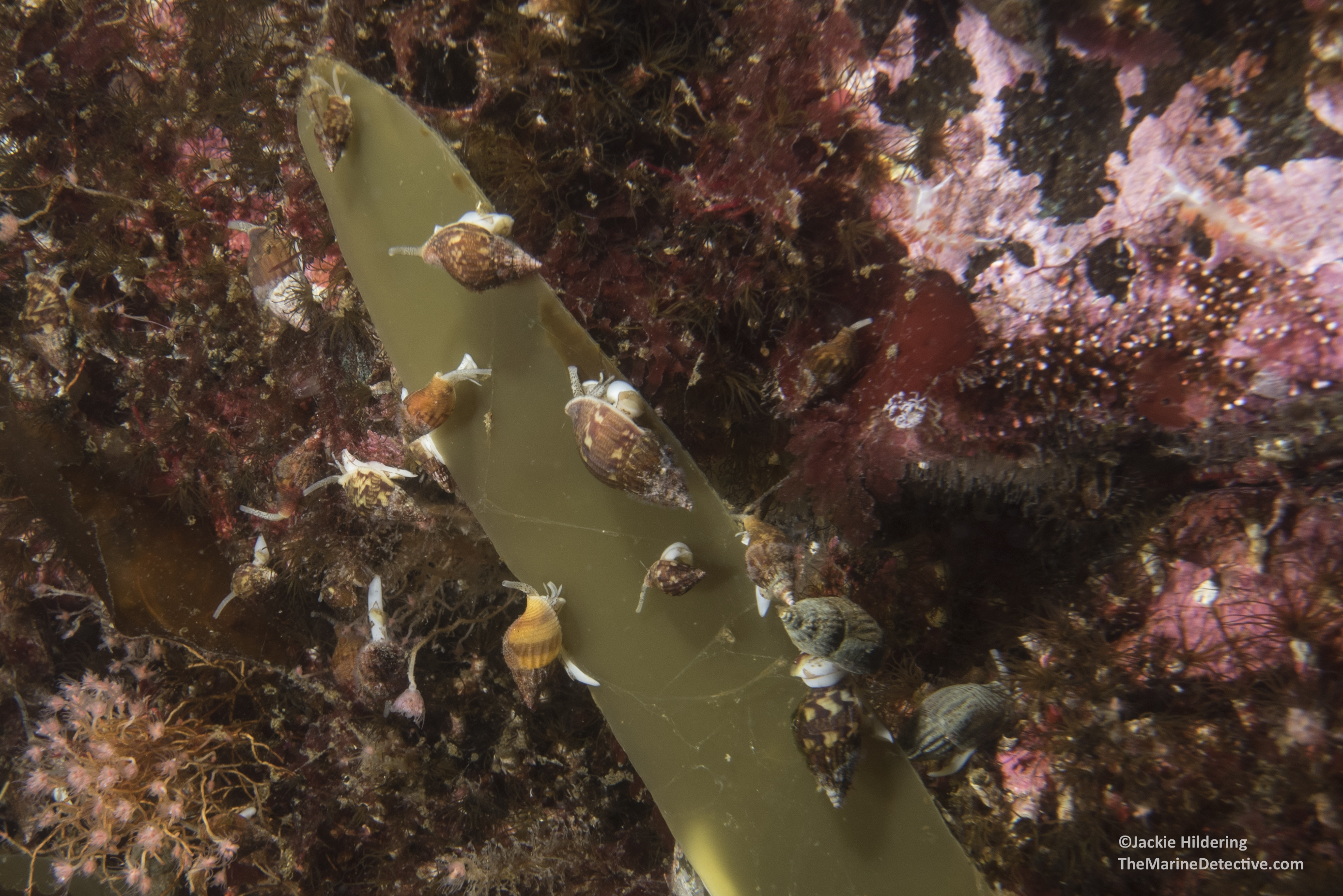
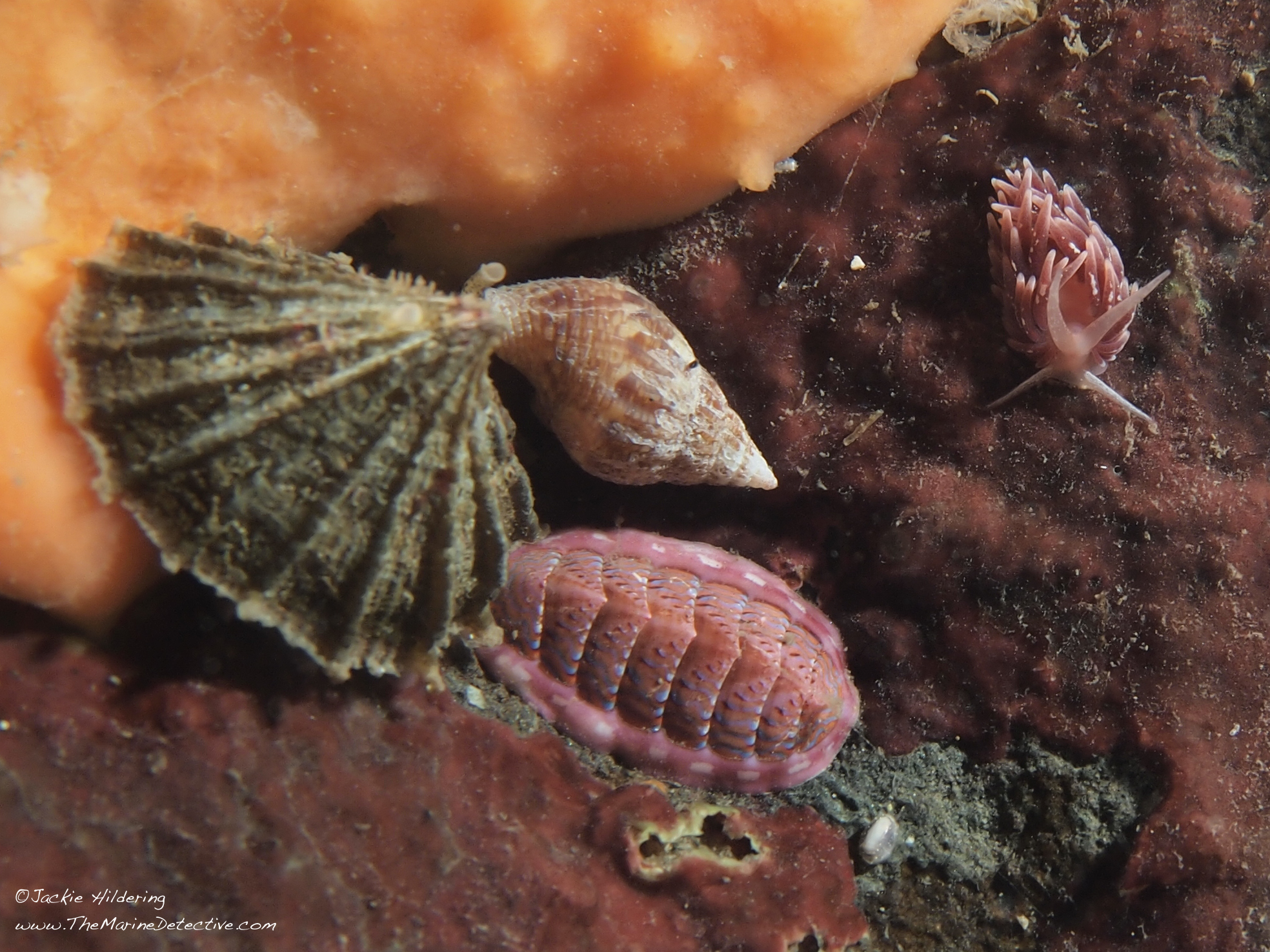
Now that you’ve warmed up and possibly developed a lisp, meet the Wrinkled Amphissa (Amphissa columbiana). They are also known as “Wrinkled Dove Snails”.
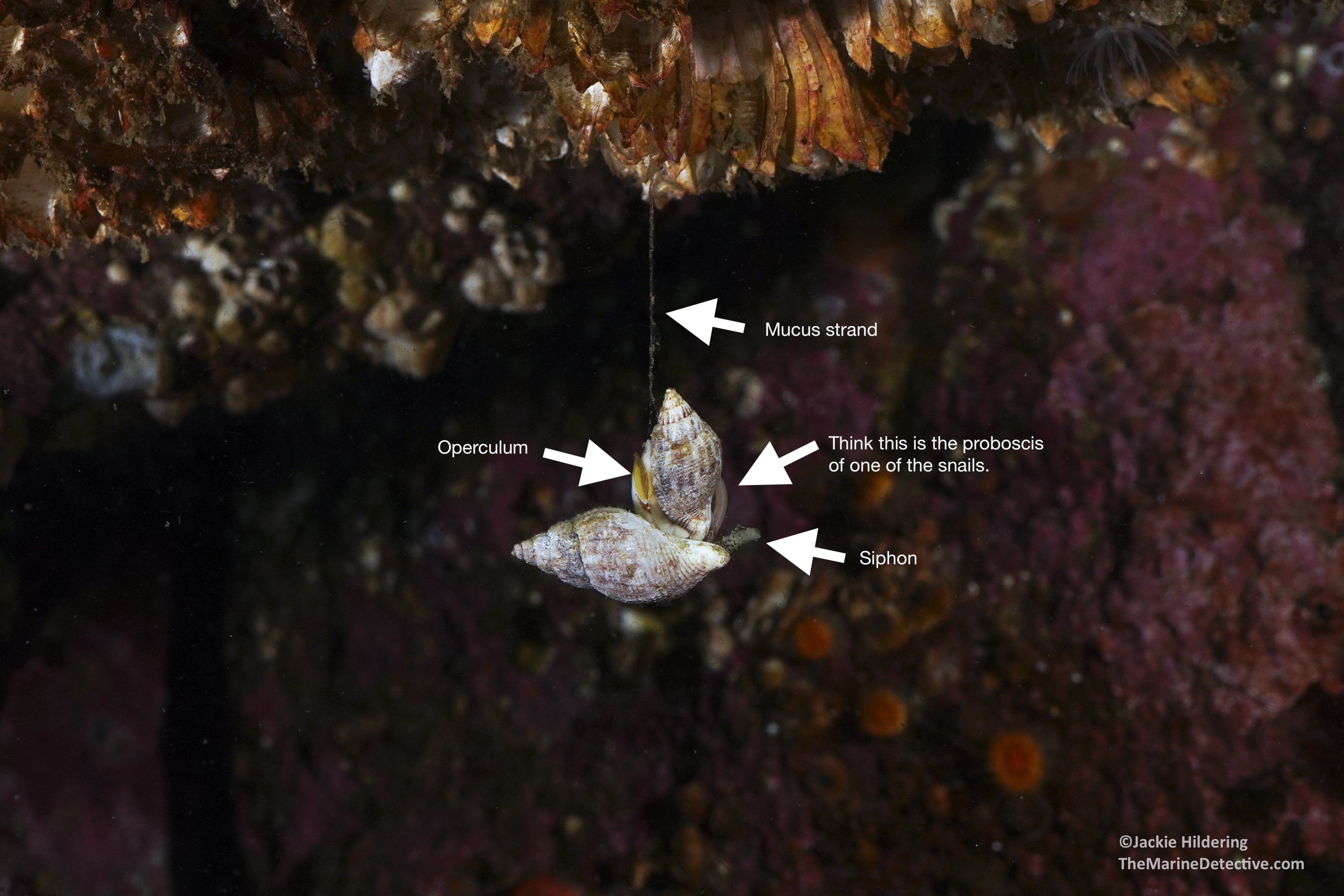
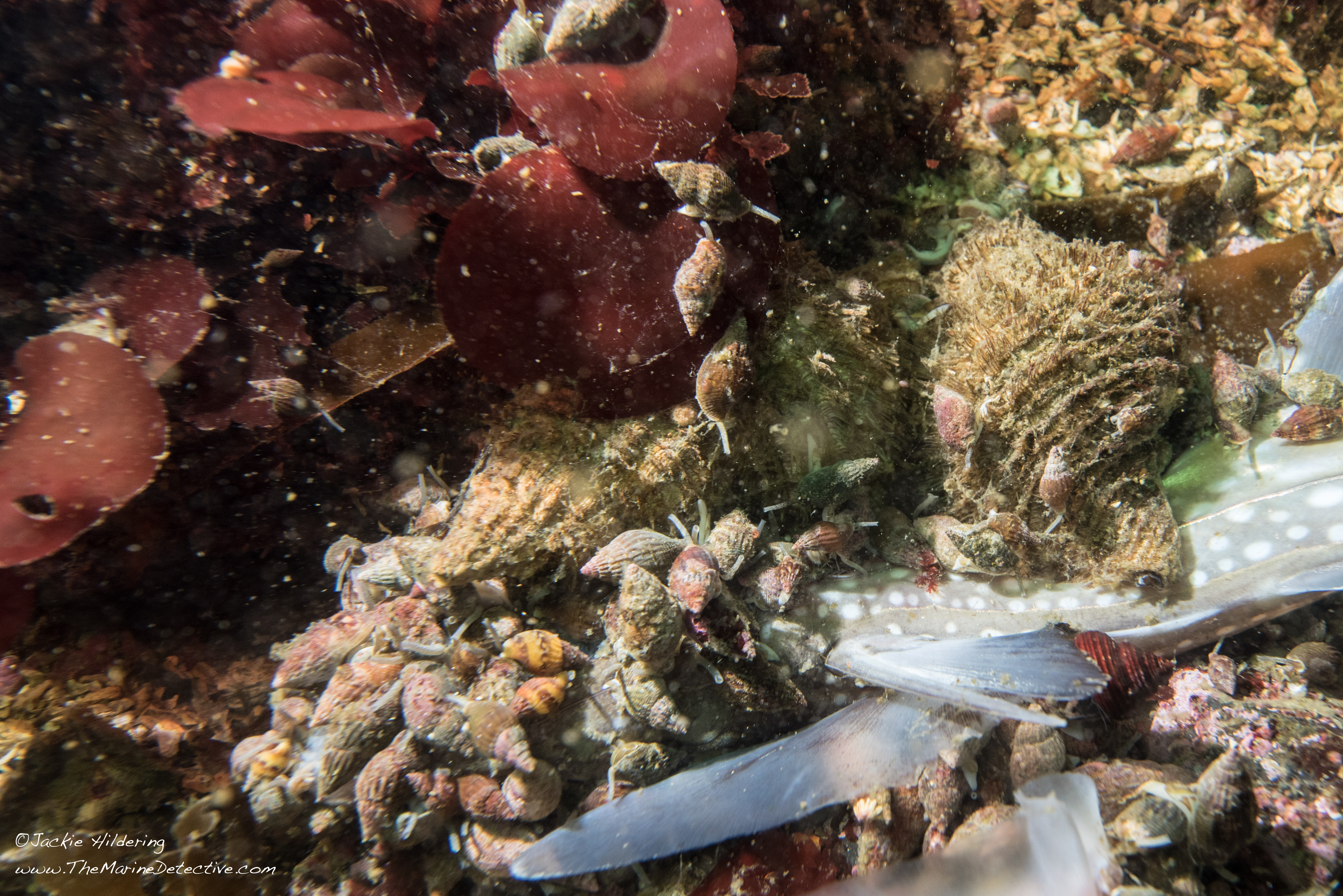
This species of marine snails is so fabulously wicked. A gland near their foot can secrete thick mucus allowing them to climb up and down to where they smell food and suspend themselves. See that strand above the two Wrinkled Amphissas in the photo?
At only up to 3 cm long, they can also deter MUCH bigger sea stars. Read on!
In this species, a gland near the foot secretes thick mucus that allows them to climb up and down and suspend themselves in the sea.
Where are they abseiling to? These marine snails are big-time scavengers and are very active, using their long siphon to smell out dead animals and algae.
“Characteristic searching posture of A. columbiana with the siphon extended and sweeping back and forth to test the waters (illustration by L.F. Braithwaite).”
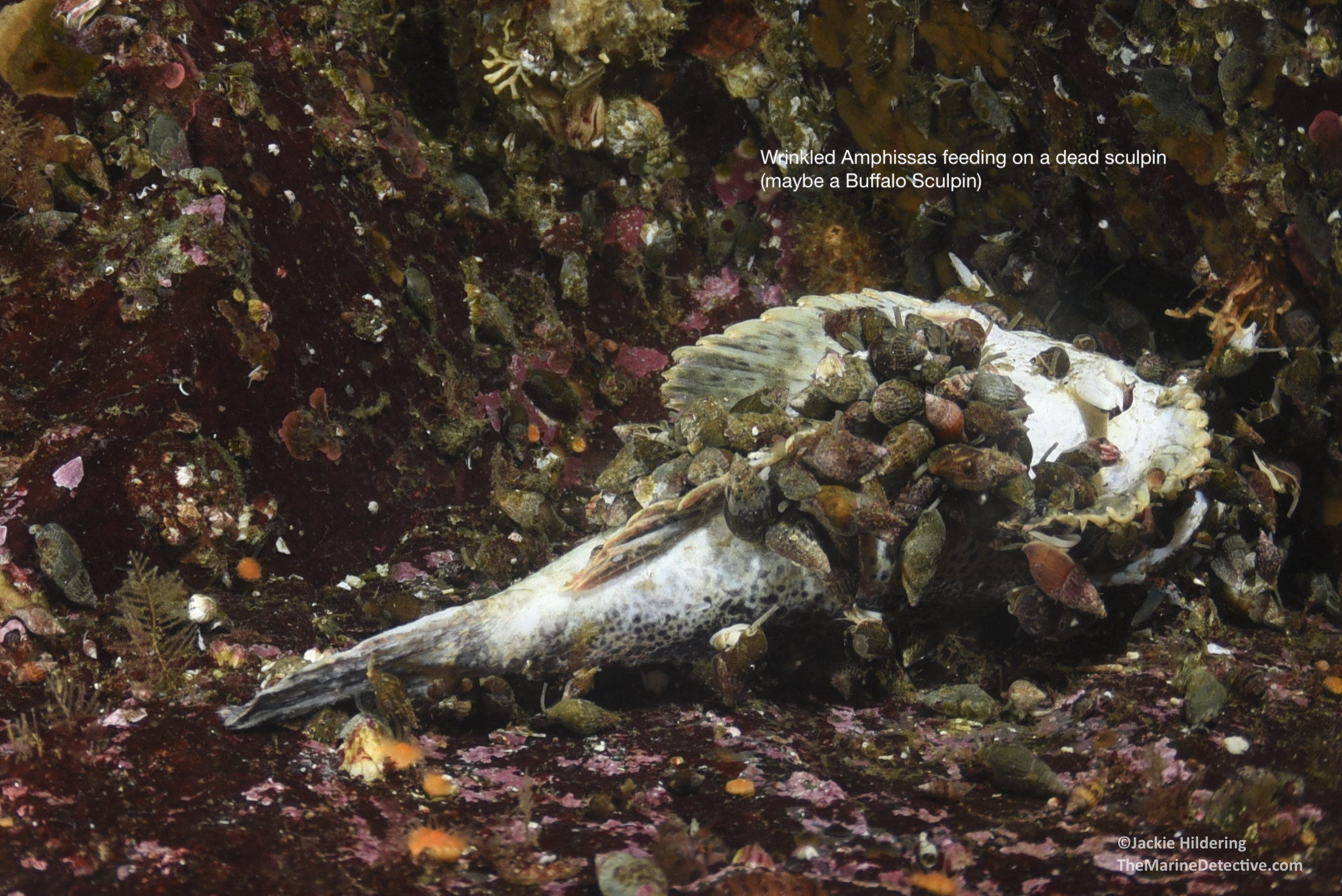
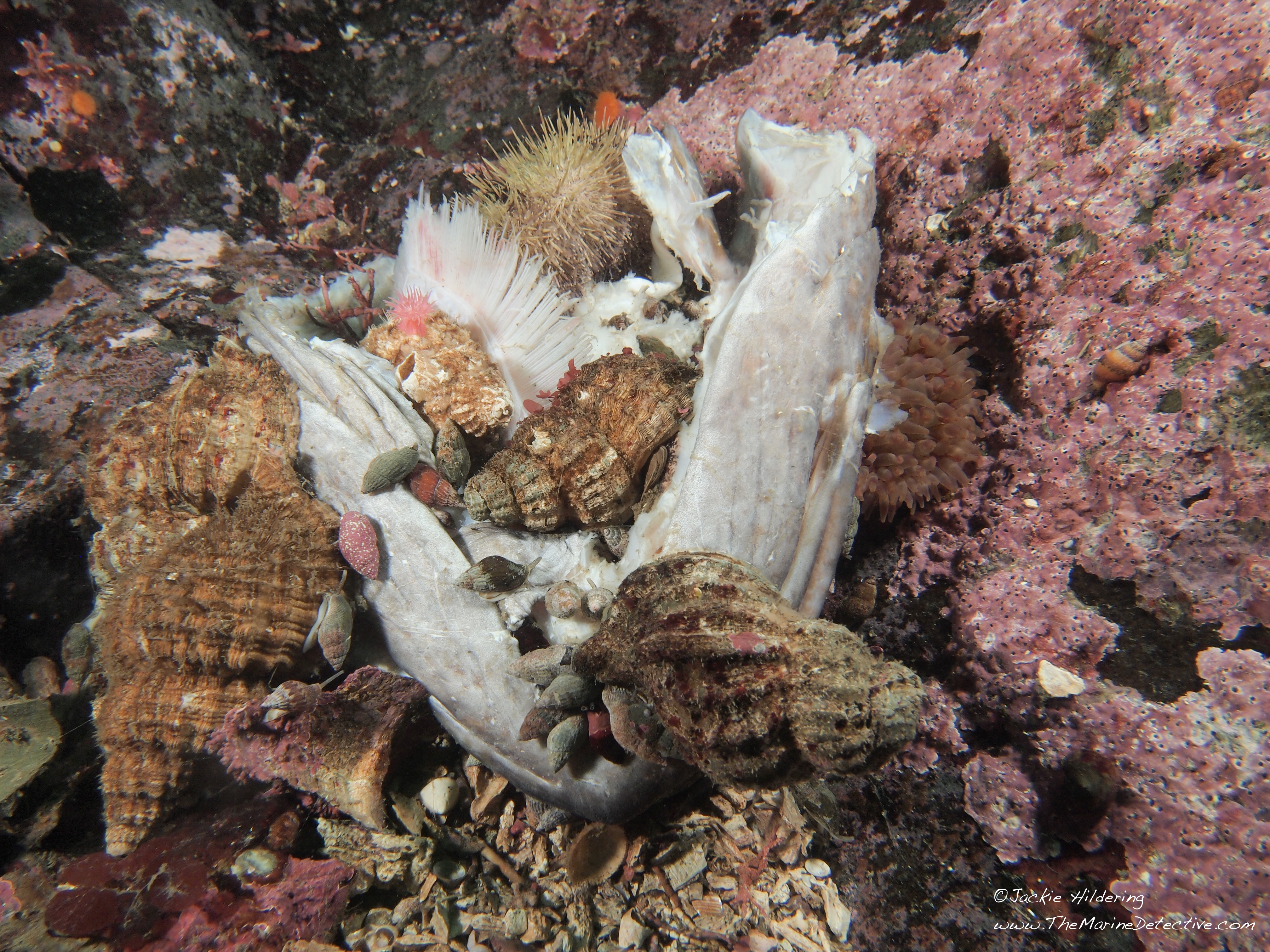
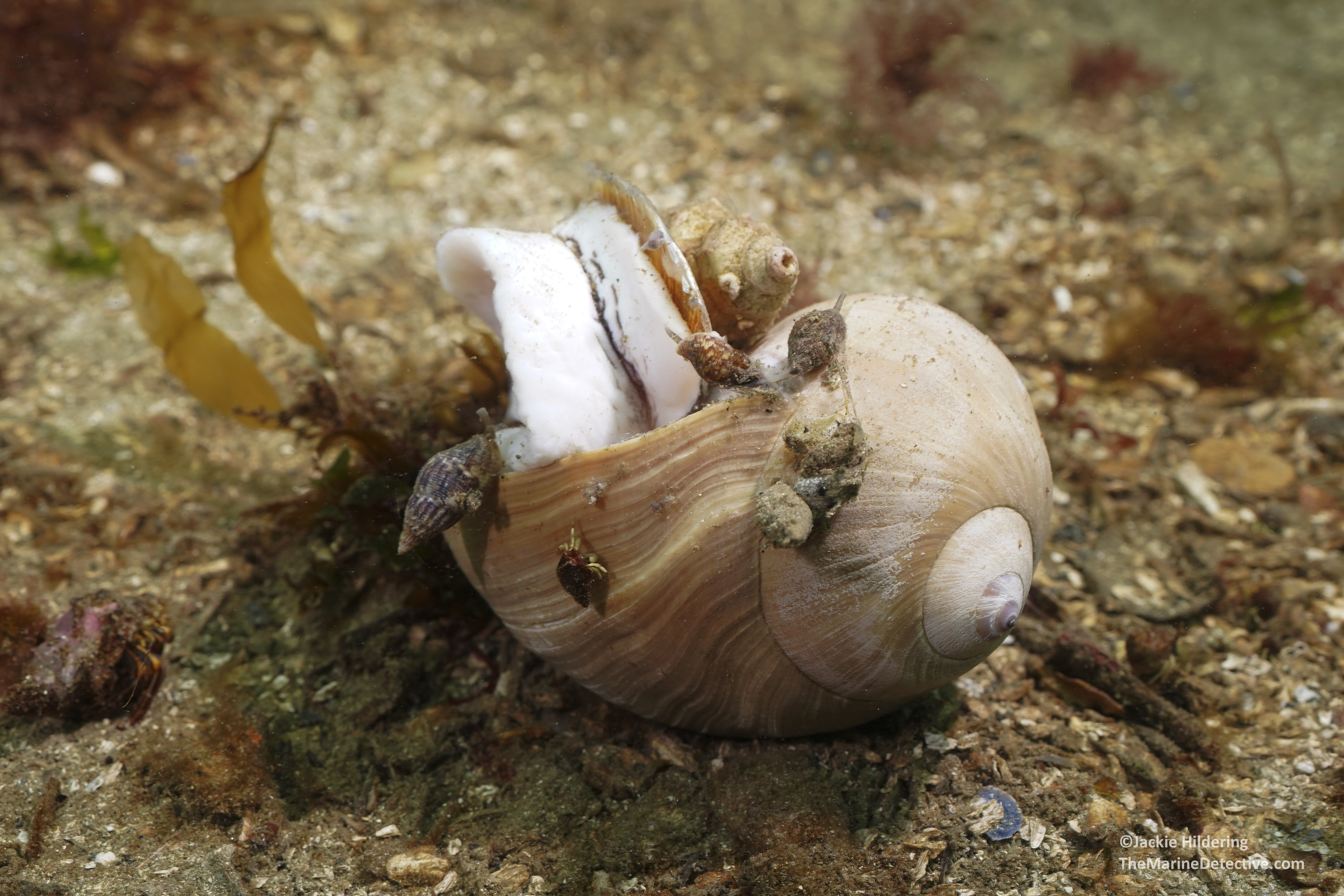
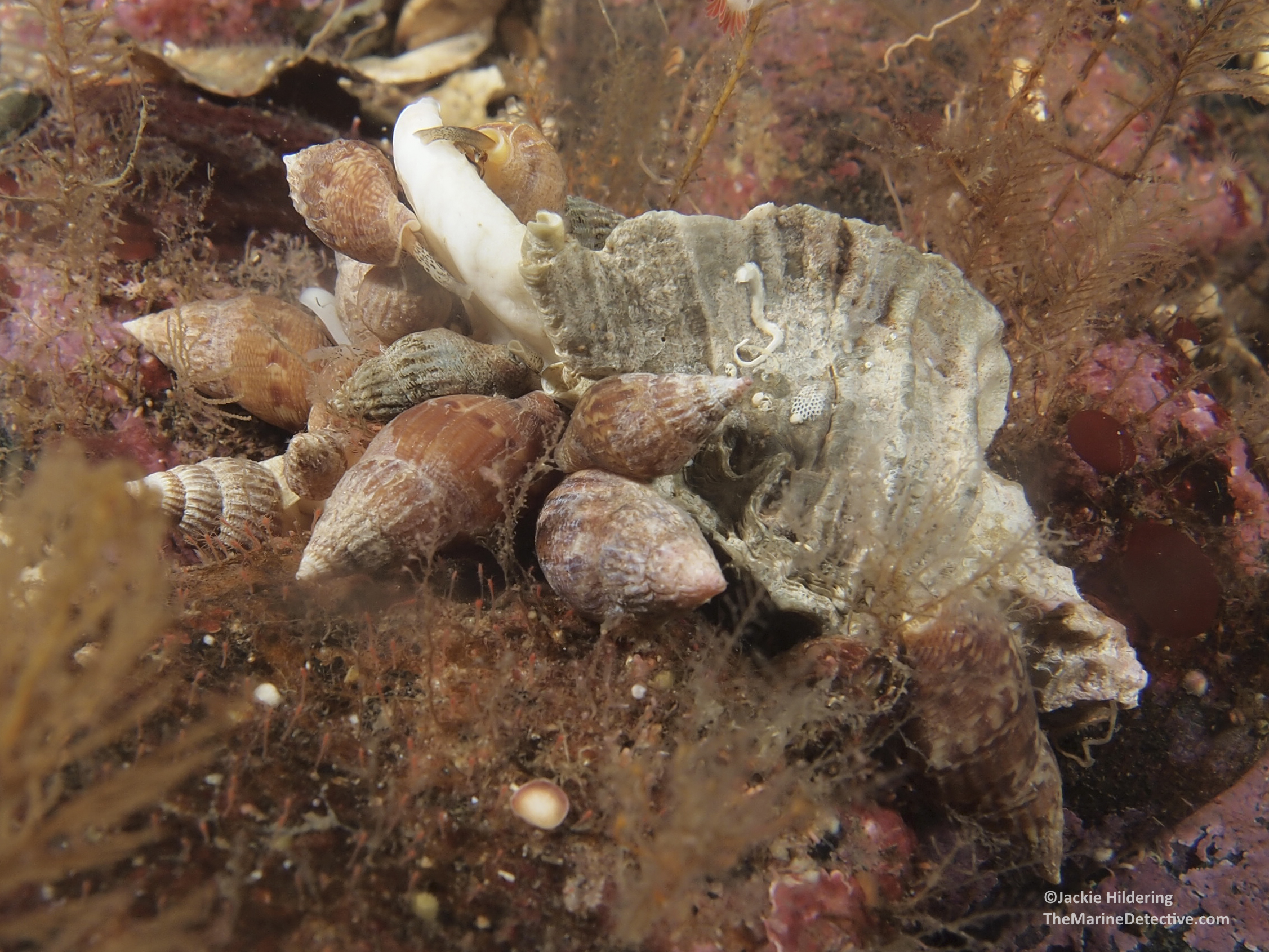
It appears they can detect the chemicals of decay incredibly well and they also follow the mucus trails of others of their kind. Often a pile of them are scavenging together as you seen in the photos below.
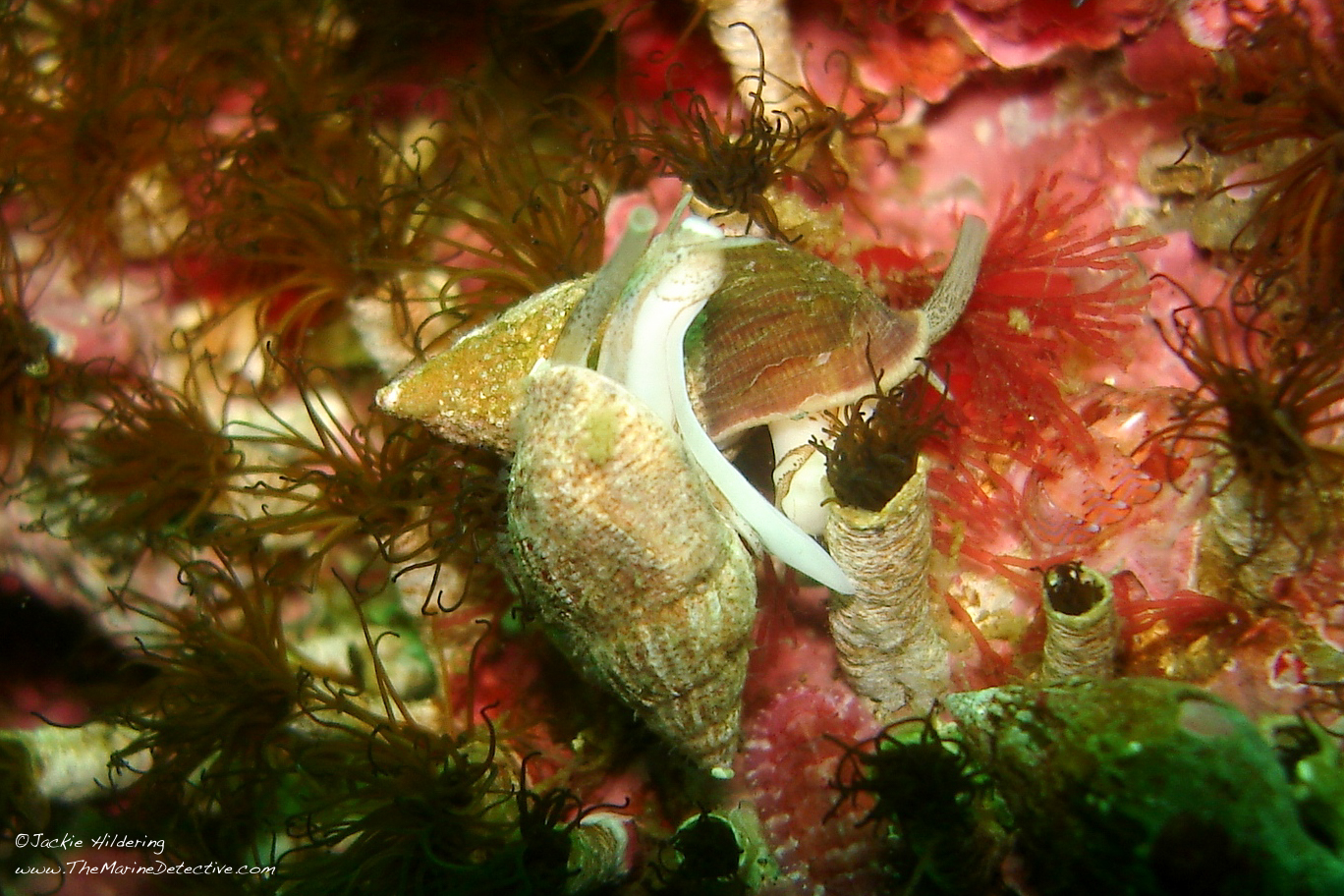
Wrinkled Amphissa aggregation scavenging on a dead Rat Fish. The much larger snails feeding here are Oregon Tritons (Fusitron oregonensis to 13 cm long).The Tritons might follow the scent trails of the Amphissas to the food!
From Braidwaithe et al., 2017 regarding feeding. “They appear to locate food resources primarily through chemosensory cues, often following conspecific mucus trails and sometimes congregating around actively feeding sea stars. The chemical cues that draw A. columbiana to food act as feeding stimulants; the addition of scent from a damaged animal induced the snails to feed on healthy prey. The ability to sense chemical cues from damaged animals, including those being consumed by feeding sea stars, creates scavenging opportunities other gastropods may be unable to exploit.”
Biting
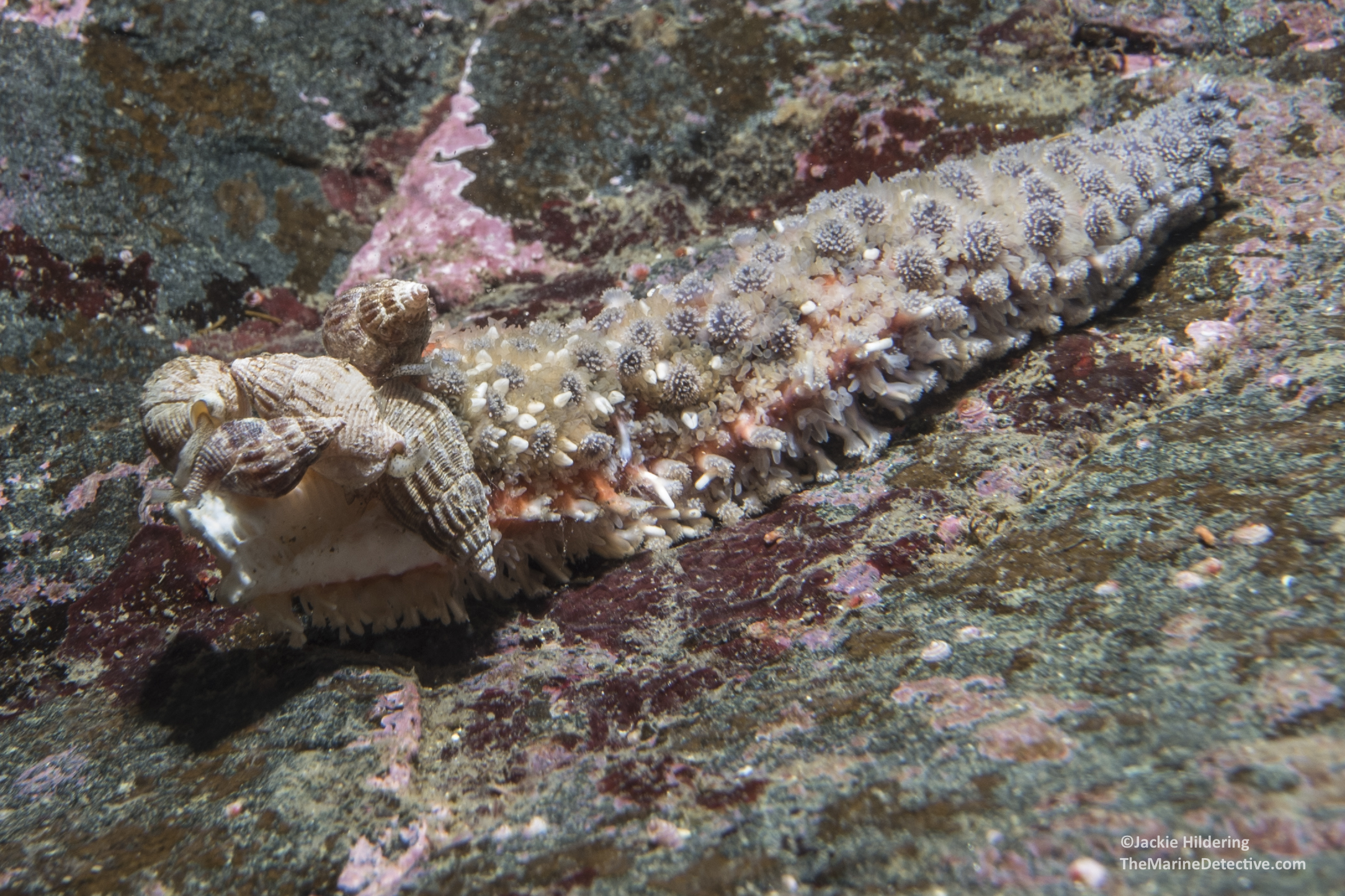
They also have a wicked defence against sea stars where they insert their very long mouth part (the proboscis can be more than 2.5 times the lenght of the shell) into one of the grooves on the underside of the arms of predatory sea stars, biting a nerve.
From Braidwaithe et al., 2010 “The injury, which generally repelled the attacking sea star, immobilized the affected arm, rendering it useless for several days. The biting defense appears to be effective against several sea star species and may reduce predation on A. columbiana.” Some crab species do feed on Wrinkled Amphissas.
Such remarkable adaptations in a sea of remarkable organisms which means I will be writing blogs and allotting abundant alliteration for a long, long time to come.
Adapting over thousands of years
I am sharing the photo below to give a sense of the diversity in the mollusc phylum to which snails belong.
“Mollis” means soft in Latin and the molluscs are our soft-bodied terrestrial and marine invertebrate neighbours. Their phylum is the second largest (the insects take first place). Note that all the organisms in this photo start off as larvae in the planktonic soup of the Ocean.
You can imagine how excited I was to chance upon 5 highly diverse marine mollusc species in one small area.
Details about the species in the above photo:
– To the left of the Wrinkled Amphissa is a Keyhole Limpet who makes its own hat-like shell and grazes on rocks (preferred diet is bryozoans). Limpet species need to suction down hard on a flat surface because they do not have a shell to cover its underside. The individual here is in a risky position as a predator could easily flip and consume limpet. Too cool not to share with you is that engineers have found that the “teeth” of limpets (the radula) are made of the strongest biological material ever tested (and the teeth are less than a millimetre long)! Note that marine snails like the Wrinkled Amphissa are protected not only by a shell, but they have an operculum which serves like a door to close the entrance to the shell when the snails withdrawn into its shell.
– Below the Wrinkled Amphissa, a Blue-Lined Chiton. Chitons make 8 plates to protect themselves. They are grazers like limpets. They too need to be able to suction down to protect themselves but do not need to be on a flat surface since the plates allow them to “contour” onto the surface.
– To the right of the Wrinkled Amphissa is a species of sea slug known as the Pomegranate Aeolid. It has “naked gills” and is therefore in the group of sea slugs known as “nudibranchs”. Sea slugs are marine mollusc without ANY shell or plates for protection. They are protected by feeding on animals with stinging cells (nematocysts) which become incorporated into those structures on its back (they are called cerata and also function as the naked gills for respiration). Specifically, Pomegranate Aeolids feed on Raspberry Hydroids which were only acknowledged as a new species in 2013. Scientific name is “Zyzzyzus rubusidaeus” and again, I do NOT make up these names. 🙂 See photo below.
– Below the chiton, if you look very carefully, is a very tiny sea slug species. I believe this is a Sea Cherub – a type of sea slug that swims and does not have naked gills (and therefore is not a nudibranch).
Not in the photo but to be considered too in the incredible diversity among marine molluscs are – octopuses!
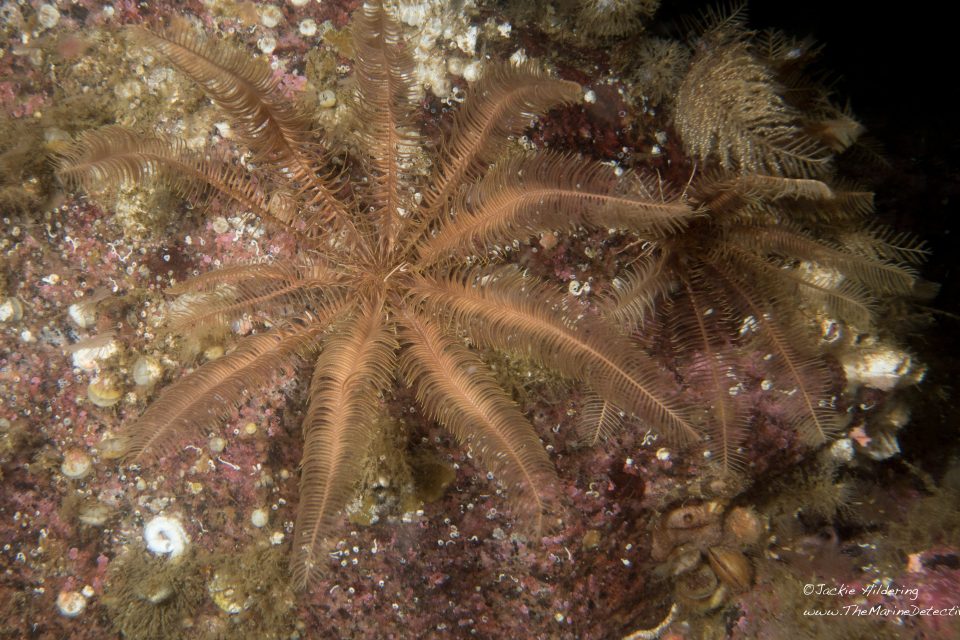
The lineage of “feather stars” (members of the crinoid class) goes back 485 million years, give or take a million. They crawl around. They swim in the most extraordinary way. You’ll see. 🙂
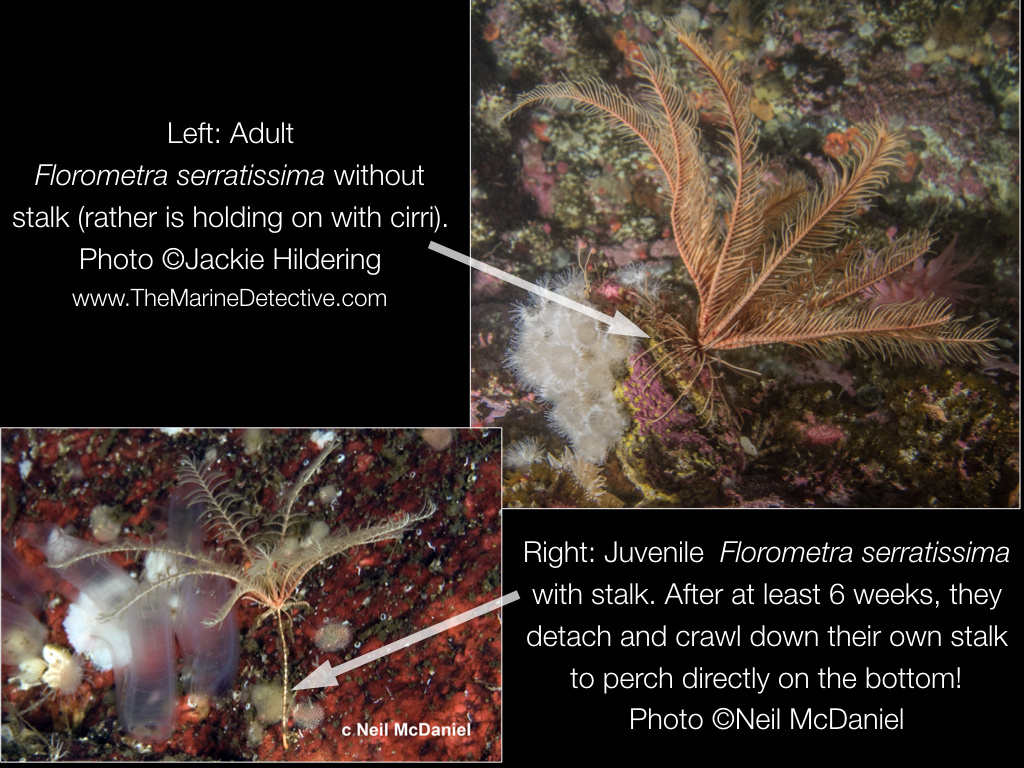
Another non-scientific name used for feather stars is “sea lilies” but I avoid that. As pretty as the name is, I believe it adds to confusion. These are animals, not plants. They are echinoderms, relatives to sea stars, brittle stars, sea urchins and sea cucumbers. Also “sea lily” is a name more often used for the crinoid relatives that have a stalk into adulthood. Only juvenile feather stars have a stalk. Then, get this . . . they detach and crawl down their own stalk to perch directly on the bottom! (Source: A Snail’s Odyssey). See below.
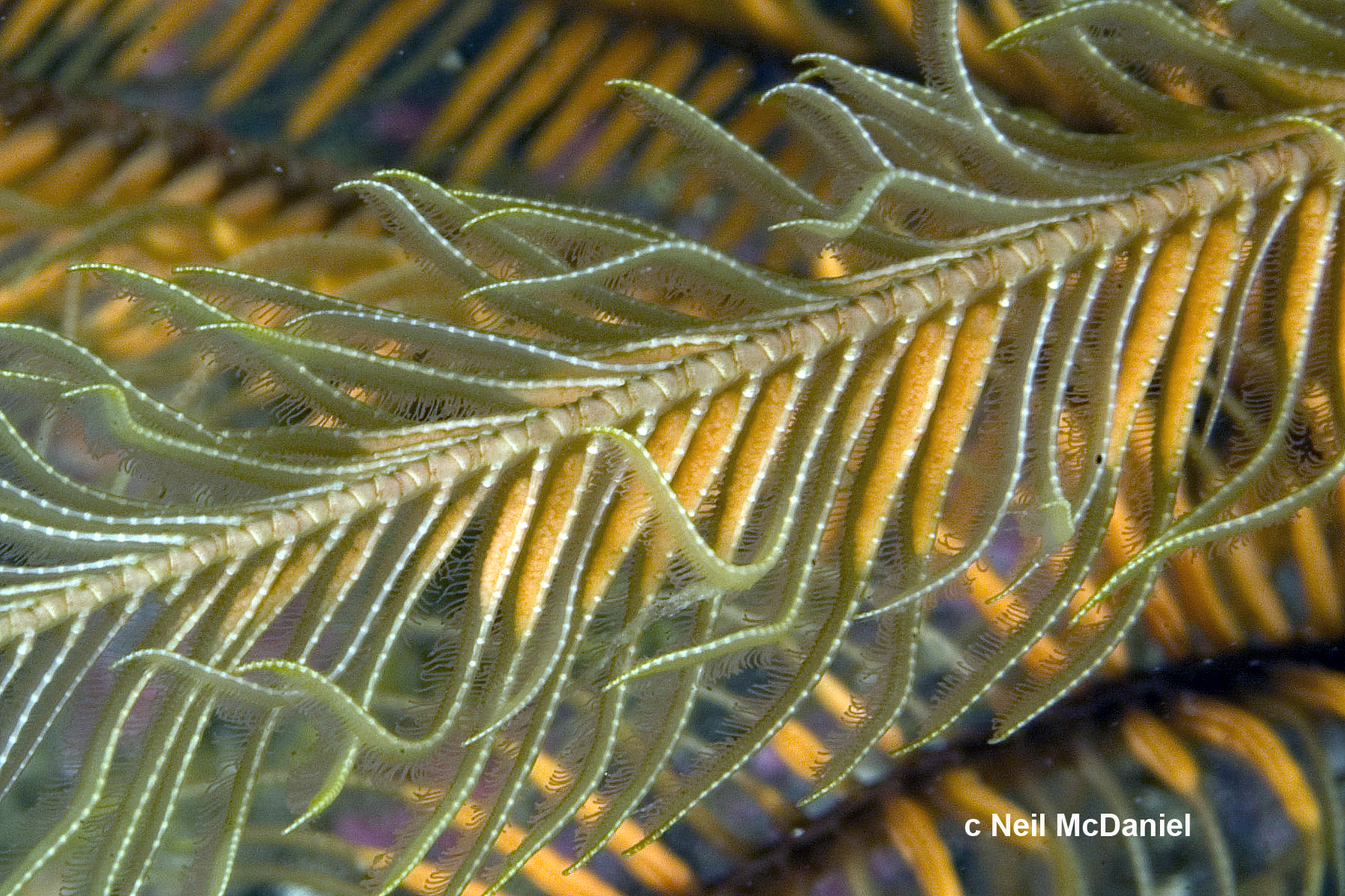
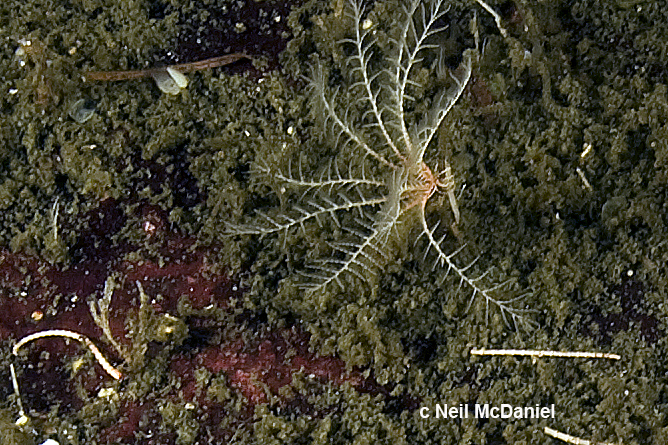
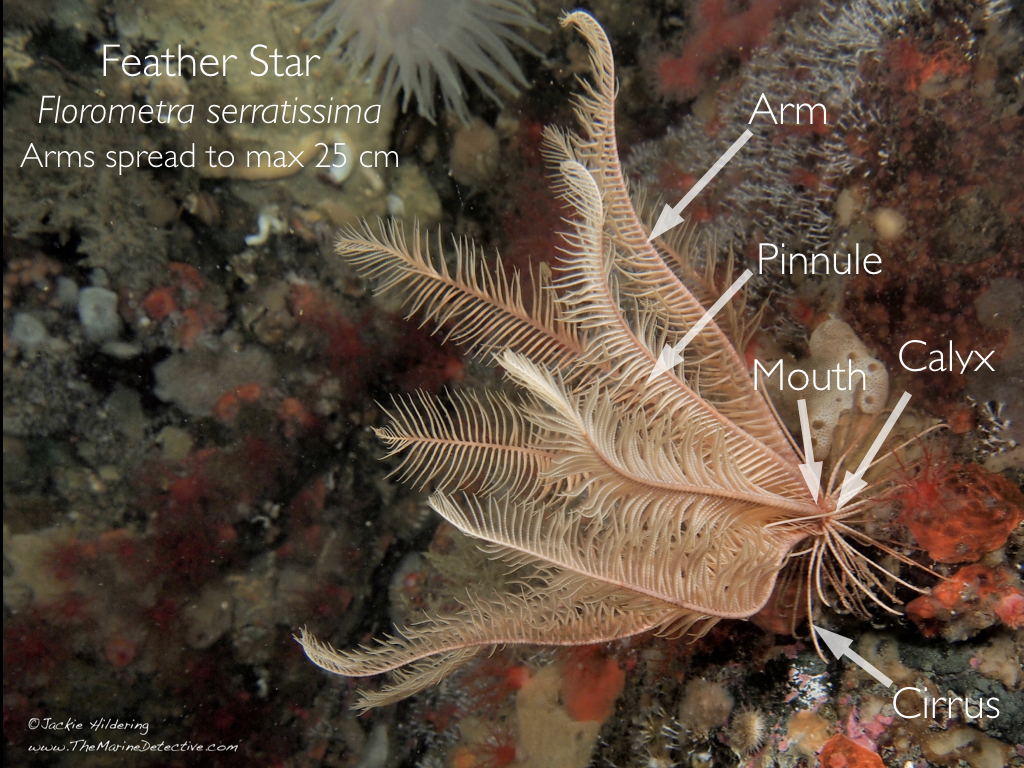
There are many feather star species in the world but the detail here is about the species commonly found in shallow water off the coast of British Columbia – Florometra serratissima (range is from the Aleutian Islands to Baja California).
Feather stars have 5 feathery arms that split to form 10 or more arm branches that are used to gather bits of organic matter (snacks) out of the water. With arm’s outreached, Florometra serratissima is up to 25 cm wide and they are up to 31 cm tall. Feather stars also use their arms to swim as recently captured in this video by dive buddy, Brenda Irving. They swim as if “walking up an invisible staircase” (quote from Lamb and Handby).
Phenomenal – right?
The following detail on their locomotion is largely compiled from the brilliant resource “A Snail’s Odyssey“ by Tom Carefoot, Professor Emeritus, Department of Zoology, University of British Columbia.
How do they swim?
“Florometra serratissima is the only swimming species of crinoid on the west coast of North America. It swims by graceful undulation of its arms in 3 sets, each set moving successively but overlapping. Thus, while about one-third of the arms are in power stroke, another third are in recovery, and the last third somewhere in between. During the power stroke the arms extend out maximally for greatest frictional resistance, while during the recovery stroke they bend inwards to minimise resistance.”
“The sets comprise two triplets and one quadruplet, are their composition with respect to specific arms is invariable (see sequence below). In the scenario shown, swimming is initiated by the blue triplet making a downstroke, followed 1sec later by the green quadruplet, and 2 seconds later by the orange triplet. An entire sequence is completed, then, in about 3 seconds, and the pattern may be repeated for up to 30 seconds.” (Source: A Snail’s Odyssey).
After several strokes to move vertically (to a mean height of 29 cm at an average speed of 5.4 cm/sec), individuals often turn 90 degrees and swim horizontally. If there is current, they will swim with the current. Horizontal swimming is achieved by the 5 arms furthest away from the bottom making stronger downward pulses than the arms closest to the bottom. (Source: Shaw and Fontaine. See Figure 3 at this link if you wish to better understand the horizontal movement).
Swim speed was found to occur in “short, repeatable bursts of 10 to 30 seconds. Continuous swimming beyond 4 minutes provokes a refractory period lasting 5 to 17 minutes during which individuals are incapable of swimming.” (Source: Shaw and Fontaine).
Feather stars end up back on the ocean bottom by stopping movement, and then “parachuting” down (as can be seen at the end of the video above).
Swimming and crawling can be stimulated by current and touch from predators such as Sunflower Stars (Pycnopodia helianthoides) and crabs. Research supports that if touched by a Sunflower Star, there is about a 5 second delay followed by “several power strokes carrying the stimulated individual 1 to 3 metres away. This cycle can be repeated several times and capture by a sea star is actually thought to be rare.” (Source: A Snail’s Odyssey).
Crawling has been found to be feather stars’ main means of getting around with swimming being only in response to a predator or touch.
“Stalkless crinoids such as Florometra serratissima anchor to the substratum [ocean bottom] using flexible cirri [these have been described as holding on like bird’s feet do]. The cirri are jointed and can slowly bend and straighten. . . . ” (Source: A Snail’s Odyssey).
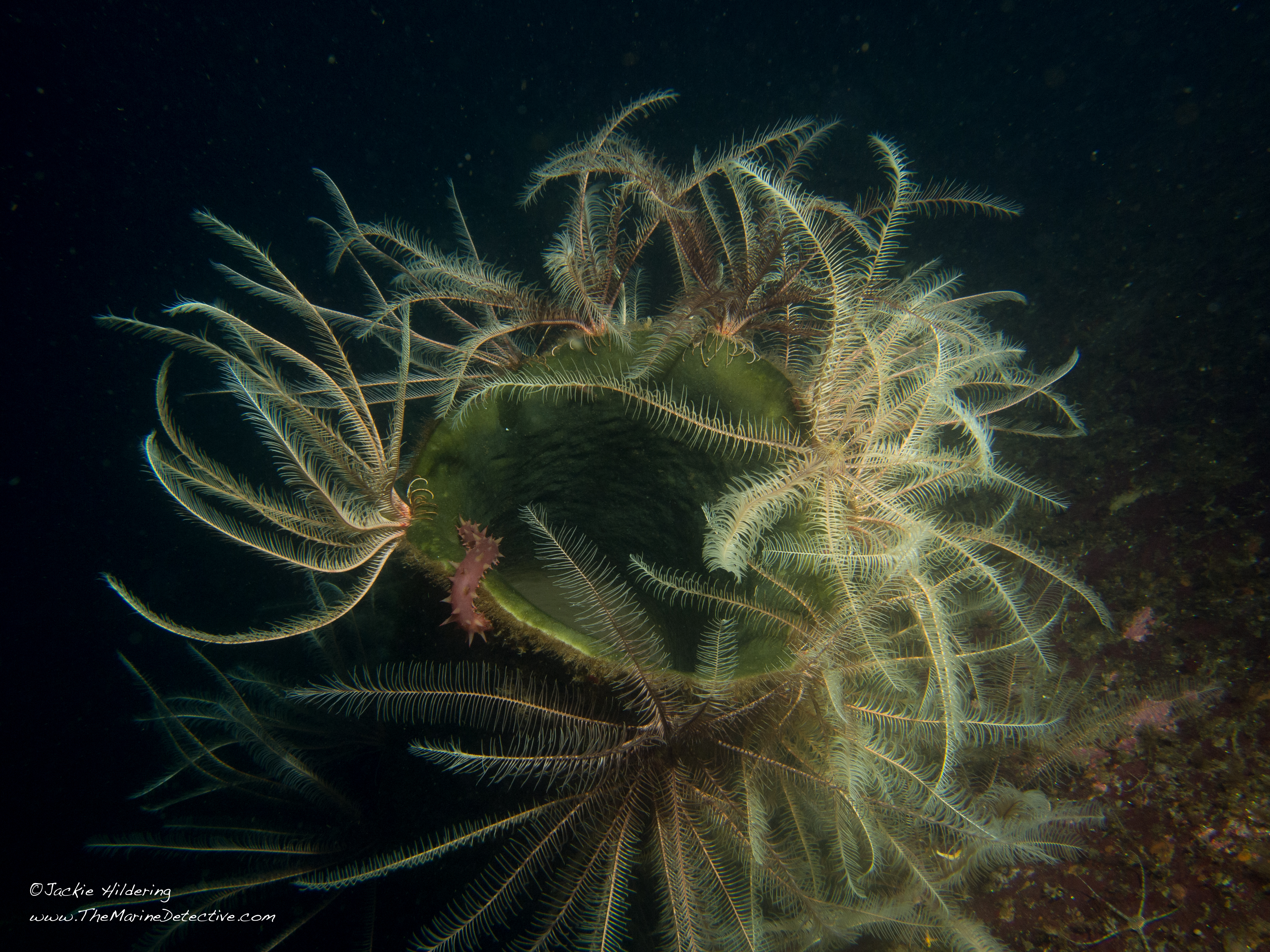
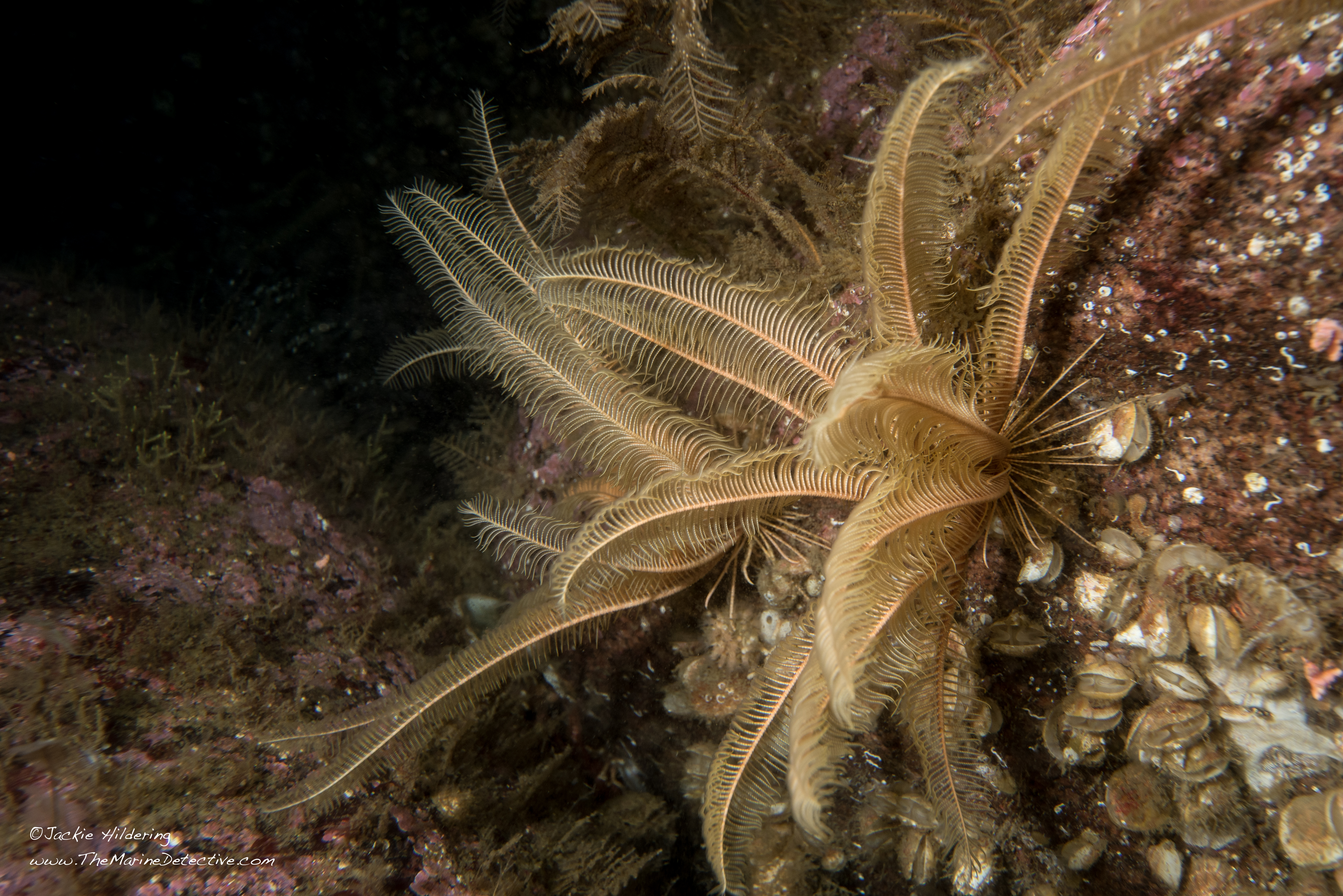
The arms are also involved in crawling around. The 10 arms attach to the bottom with small hooks, the central part of the feather star’s body (the calyx and cirri) is lifted. “The arms then contract and extend on opposite sides of the body, which moves it in one direction or the other. Repetition of this behaviour will gradually move the individual to a new location.” (Source: A Snail’s Odyssey)
What a remarkable species with relatives dating back 485 million years and defences including: (1) being able to regenerate arms; (2) having a body that has little nutritional content, is hard, and may taste bad AND; (3) is strong enough to withstand the current that delivers snacks, but light enough to allow swimming as an escape response.
Above: This remarkable photo by Neil McDaniel shows an individual with eggs (orange) and allows you to see the incredible fine details of the “feathers” – the pinnules of Florometra serratissima.
Above: Another fantastic capture by Neil McDaniel. Florometra serratissima climbing down his/her stalk to live an an adult, moving around on its cirri and swimming.
Round Lipped Boot Sponge (1 m tall) near Powell River, festooned with feather stars (Florometra serratissima). Also, see the juvenile Giant Sea Cucumbers?
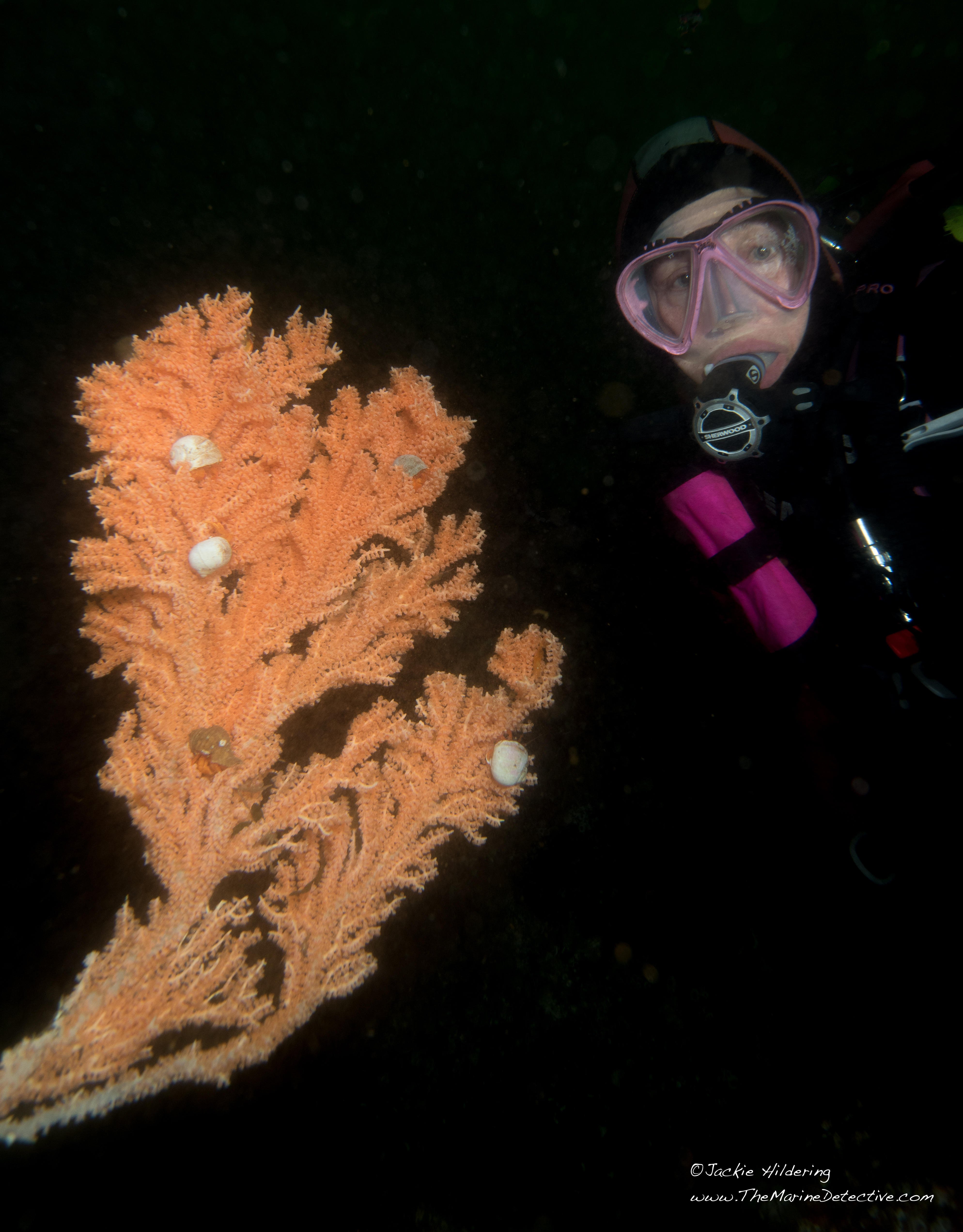
Above: Dive buddy, Brenda Irving, just before taking the video above. Here with the coral Primnoa pacifica which is usually found at great depth but the upwellings at this site in Knight Inlet lead to it occurring much shallower too, up to ~15 m. The animals on the coral in this image are Orange Hermit Crabs. Detail on this species of coral and this extraordinary site can be read at “A Proposal to Create a Marine Refuge at the Knight Inlet Sill, British Columbia to Protect Unique Gorgonian Coral Habitat” by Neil McDaniel. Click here.
It happened when we placed a memorial for a dear departed friend, Markus Kronwitter.
My primary reason for sharing this is for Markus’ family and friends but, I think others will find something here too.
You see, a Giant Pacific Octopus attended and sat right atop the memorial.
Let me recount using photos.
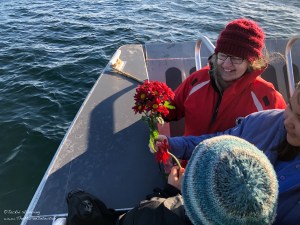
Memorial made by Stephanie Lacasse.
Markus owned and operated North Island Diving in Port Hardy. He was a dear friend and incredibly important to our dive club, the Top Island Econauts. He died more than 3 years ago and the memorial today was to honour him and maybe offer some comfort to his wife Cecelia and his two daughters, Rosie and Jennifer.
The location was Five Fathom Rock just outside Port Hardy. Part of Markus’ legacy is that he fought for this rocky reef to be recognized as a Rockfish Conservation Area. (More about the significance of that in my eulogy at the end of this blog).
After we shared thoughts about Markus at the surface, down we went to the highest point of the reef. We would wait there till the memorial was carefully descended by Steve Lacasse of Sun Fun Divers using a lift bag and rope.
We wanted to position the memorial there, near a sunken metal beer keg. The keg used to be a mooring float on this site. It was put there by Markus but, by mysterious means, had sunk to the bottom.
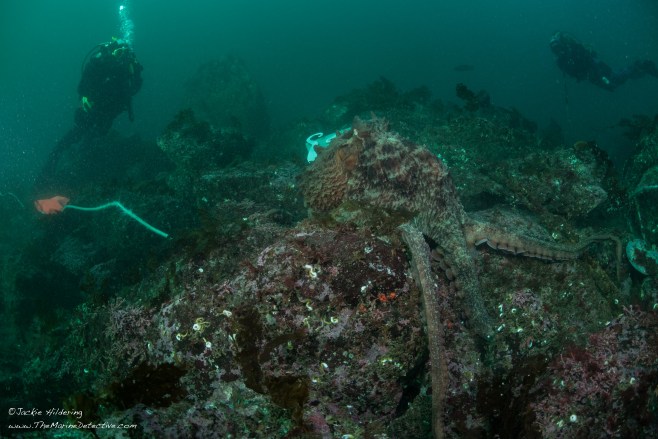
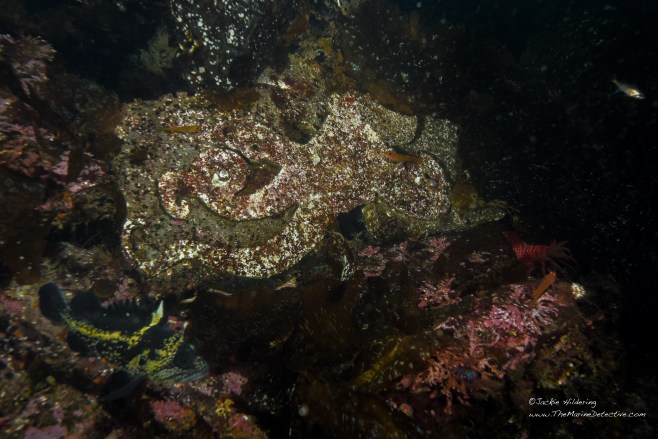
As soon as we got to where the memorial was to be placed, I saw a Giant Pacific Octopus, fully out in the open.
You can even see the beer keg right in the background.
After about 5 minutes, he retreated partially into his den, likely because of some annoying underwater photographer with flashing lights.
Note that I do know this was a male Giant Pacific Octopus because the third arm on the right was a “hectocotylus arm”. Only males have the hectocotylus which stores sperm. More on that at this link. (This individual also had an injured arm. It was only about half length but will regrow. Yes, some of the awe that is octopuses, is that they can regenerate limbs.
Giant Pacific Octopus in his den.
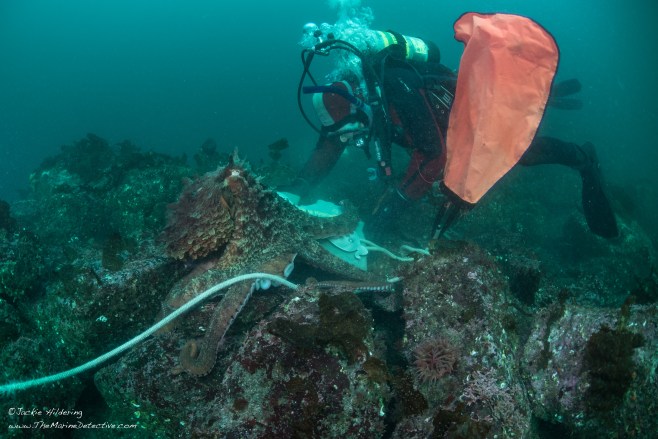
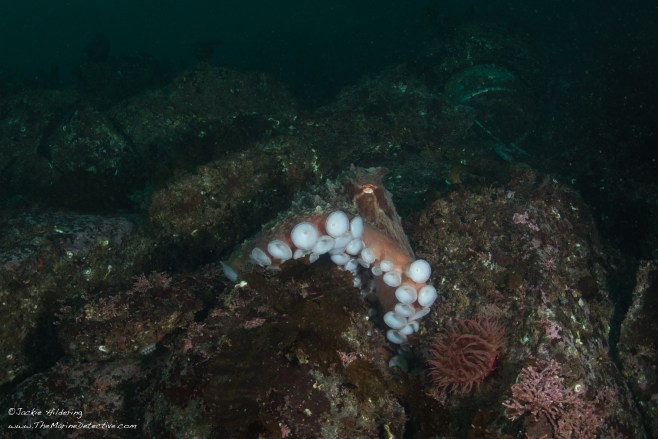
But then . . . when Steve arrived with the memorial, the Giant Pacific Octopus darted out of his den, landed right atop the memorial and started flashing white. See the memorial under the octopus in the photos below?
Steve Lacasse with the octopus on the memorial which was still attached to the rope and lift bag.
You can imagine how we marvelled as this unfolded and that some pretty big emotions were felt.
Eventually, the Giant Pacific Octopus moved away. Then, the memorial could be positioned as we had intended, but not before a mature male Wolf-Eel also went swimming by.
There’s no photo of that I am afraid. I was a little overwhelmed.
Memorial positioned.
Dive club members from left to right: Dwayne Rudy, Steve Lacasse, Natasha Dickinson, Gord Jenkins and Andy Hanke.
Somewhat dizzied by emotion, we continued with the dive.
Below, I include some photos of what we saw, especially to give Markus’ loved ones a sense of what this site is like and what he fought for.
Mature male Wolf-Eel in his den, very near the memorial.
One of 100s of Black Rockfish at this site (and a Mottled Star).
Male Lingcod guarding an egg mass with 100s of eggs.
Male Ling Cod. The boulders here give an indication of why this is such ideal fish habitat. There are so many crevices to hide in and rocks to lounge upon.
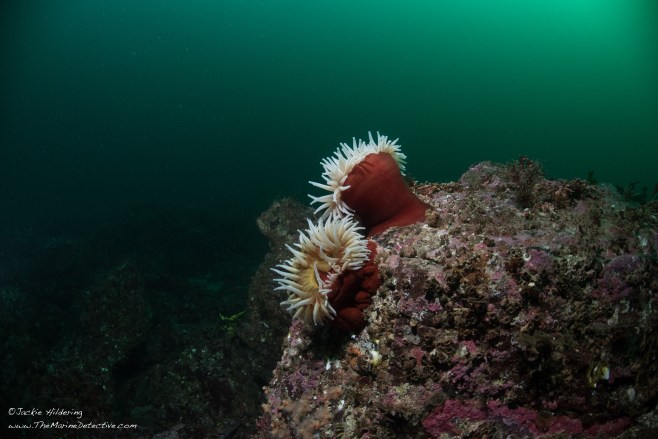
Rose Anemones aka Fish-Eating Telias. Sun shining down from the surface, five fathoms above us.
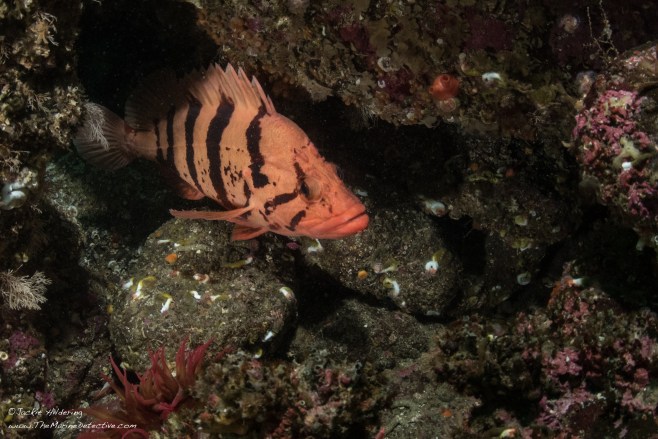
Tiger Rockfish – longevity can be 116 years WHEN given a chance.
See the male Lingcod under the huge mass of eggs? He’s got a lot to protect!
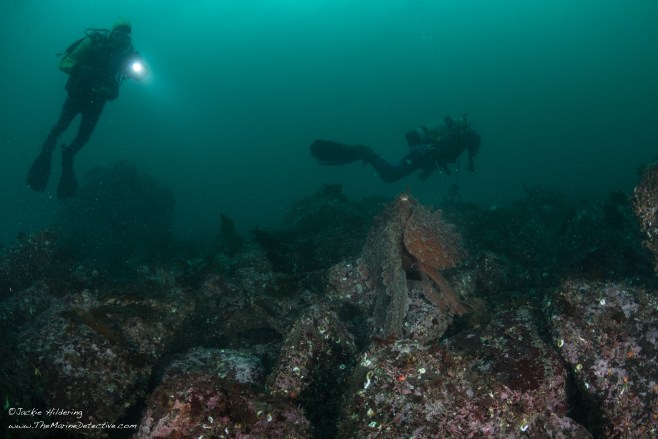
And then . . . just as we were about to ascend, there he was again – the same Giant Pacific Octopus.
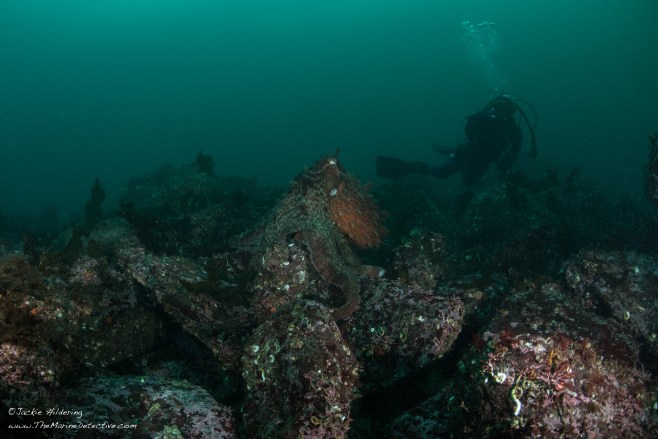
The Giant Pacific Octopus with dive buddy, Natasha Dickinson.
How I wish we could have stayed longer. We had to surface to a far less mysterious world, but with hearts full and so much to tell Cecelia, Jenny and Rosie.
Goodbye Markus.
We’ll be visiting again soon.
Image below is of the memorial 20 months later, October 2020. It has become part of the seascape and it appears a China Rockfish is living very near.
My Eulogy for Markus.
It’s my great honour to say a few words before we dive on Five Fathom Rock to position Markus’ memorial.
I of course found it excruciating to try to find the words fitting of Markus, because you have to tap into the emotion to find the words.
It’s been more than 3 years since Markus died. Cecelia, Jenny and Rosie you need the words and, even more, you need this place where your thoughts and feelings can be anchored.
In trying to find the words, I dared remember what it felt like to be around Markus. I don’t think that I know anyone else who was quite like him in knowing the right thing to do, no matter how hard it would be and no matter how many injustices he had suffered.
Markus was about making things better and standing up for what was right. He was a man of truth and science. He appeared unflinching in facing reality. He did not suffer fools. He saw through people with crystalline clarity. He walked his own path – in red “holely soles” and multi-coloured pants – and had the wisdom to stop to have Cecelia join to walk beside him.
He made hard decisions.
He . . . was . . . a . . . fighter.
He fought to be here on northern Vancouver Island.
He fought for his girls.
He fought for our dive club.
He fought for the fishes, now flourishing beneath us.
He fought for his life.
[When diagnosed with cancer, he was told he had 2 years to live. He lived for 14 years post diagnosis].
And he has left an extraordinary legacy.
Part of this, is the legacy of Five Fathom Rock.
Markus fought for this to be a Rockfish Conservation Area so that the fish that live here might get a chance to grow bigger, reproduce more, and to thrive.
And there’s success. It’s so beautiful down there Rosie, Jenny and Cecelia. The fishes are thriving – there are clouds of rockfish and it’s so powerful to think that some, like the Tiger Rockfish, might get a chance to live to be more than 100-years-old.
If there were any place where I could picture Markus, it would be here darting around with yellow fins, fish-like himself. Clearly so at home . . . here.
His efforts for Five Fathom included trying to have a mooring here and his creativity was to use a big metal beer keg. It’s down there now, on the highest part of the reef , close to where there are 2 Wolf-Eels. It’s where we’ll attach the memorial.
And how perfect that this will happen at a time when the Lingcod fathers are protecting the next generation, standing guard, not suffering fools, making very clear when you’re trying to get too close without good intent. Fiercely fighting for the next generation, with an extraordinary sense of place.
He loved it here.
It’s impossible to forget him here.
Not that there is any possibility of forgetting Markus or what he stood for.
His legacy of course includes you Rosie, Jenny and Cecelia. He loved you so much and I can’t even imagine how hard he fought wanting to be here still to protect you, to make sure you would always be okay.
Jennifer and Rosie, you are fighters like your Papa Markus.
Jenny – I also think you have his sense of purpose.
Rosie – I think you have his sense of place.
Cecelia – the love in your eyes makes clear how you carry Markus with you always.
Markus Kronwitter. It is here on Northern Vancouver Island that he found his wild. It is with you three, that he found love.
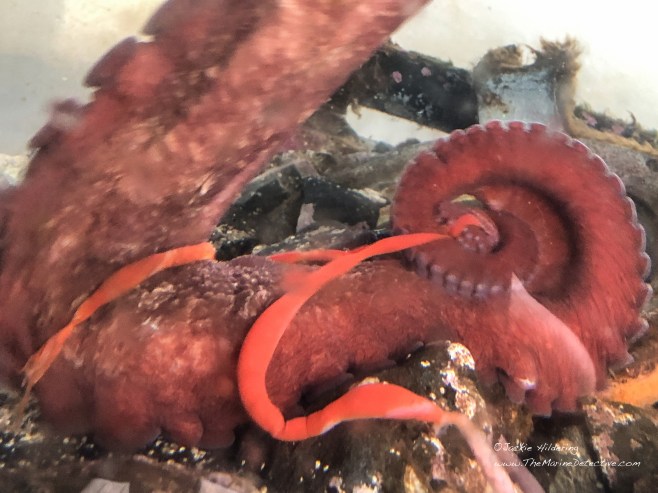
It’s one of the characteristics that unifies every living thing on the planet – we all need to get rid of waste.
How do octopuses do it? See the video and explanation below.
Why share? Because I solidly believe the world can be a better place through understanding and respecting the commonalities and differences of others AND through marvelling at the natural world.
“The first structure for food gathering [in octopuses] is the interbrachial web, the umbrella-like membrane between the arms that the octopus used to enfold food such as crabs, shrimps and sometimes even fishes and birds.The web forms a bag-like container that holds prey close the the mouth . . .
The second structure is the mouth. An octopus has two pair of salivary glads, anterior (front) and posterior (rear). The posterior salivary glans produce a toxin called cephalotoxin. in giant Pacific octopuses this is not known to be deadly to humans, whereas in the blue-ringed octopus of the South Pacific it has killed people. When an octopus captures food in its web, it secretes cephalotoxin into the water, where it is absorbed through the gills of its prey. The neurotoxin affects the nervous system and causes the prey to lose consciousness and stop struggling. The octopus can then use its suckers to aid in dismembering prey such as crab.
The beak, the hardest part of the octopus, is made largely of chiton, and looks like the beak of a parrot. The mouth also has a specialized tongue called a radula. The file-like organ is covered with tiny, sharp teeth that are replaced when they wear down, much as sharks regrow teeth. The radular teeth shred the prey’s tissue once the beak has bitten the food into chunks. Working together with the beak and radula are secretions of the anterior (front) salivary gland. The gland produces a mixture of substances called enzymes, which cause the food to break down quickly into a jelly-like substance that can be easily digested. A combination of the enzymes and the radula enables an octopus to remove even the tiniest bit of tissue out of the tip of a crab’s leg.
Giant Pacific Octopus beak. It’s primarily made of chitin.
Once the food is captured, eaten and swallowed, it travels along a short tube called the esophagus (similar to the throat in a human) to a structure called the crop. This is not exactly the same as a bird’s crop, but it does function as a storage place for undigested food.
If the stomach is empty, food passed immediately from the crop to the stomach, which despite distinct differences, functions much like our stomach. In the giant Pacific octopus the digestive enzymes do not come from the wall of the stomach but are produced by the liver and introduced into the stomach through ducts. These enzymes cause the food to break down into small molecules that the blood absorbs and transports back to the liver. There they are processed and distributed to the cells of the body. This dual-function liver is different from a human’s whose liver primarily deals with the products of digested food.
Summary of octopus digestion. Source: Super Suckers by James Cosgrove and Neil McDaniel Harbour Publishing. Illustration by Adrienne Atkins.
Now we find another major difference from vertebrates such as humans and also from squids. Once the food in the octopus stomach is digested, the waste material has to be evacuated. The octopus stomach, however, has only a single tube leading in and out. This means that the waste material must be evacuated through the same tube the food entered before more food can be introduced for digestion. You might call this the “digestion on the instalment plan.” The waste comes out of the stomach into the intestine, which encapsulates it and moves it along till it eventually reaches the end of the intestine located at the entrance to the funnel [aka siphon]. Octopus poop, ejected from the funnel, looks a bit like a slender . . . ribbon . . . .
In giant Pacific octopuses the processing of food, depending on what is being eaten, can take many hours. On average these octopuses make six hunting trips a day, reposing in their den most of the time while they process food.”
Below, video of a giant Pacific octopus hunting. In this encounter, the octopus passes directly over a mature male Wolf-Eel in his den. THEN, a Decorator Warbonnet emerges as well.
Diagram below names addition octopus anatomy.
Further octopus anatomy. Source: Super Suckers by James Cosgrove and Neil McDaniel Harbour Publishing. Illustration by Adrienne Atkins.
Defecation by Pearl the Giant Pacific Octopus at the Sitka Science Marine Science Center. Her diet has a lot of shrimp and crab in it and likely accounts for the colour of the faeces.
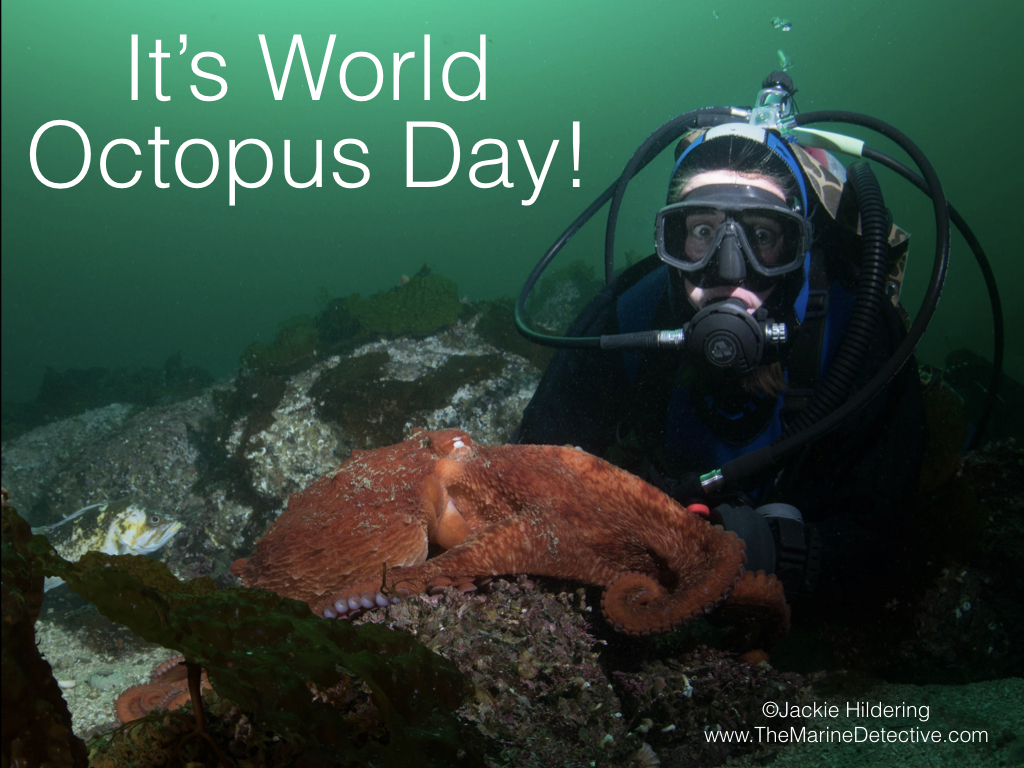
It’s Canadian Thanksgiving and World Octopus Day (OCTOber 8th = get it?).
There’s so much to be grateful for. The health and freedom that allows me to live this life of depth; the love and support of buddies, family and community; AND the lessons learned, ESPECIALLY from octopuses.
What essential life lessons have I learned from them?
Do not fear what may look foreign;
Respect alternative intelligences;
If necessary, blend in to escape detection;
When you know what you want, hold on tight;
Trust in your ability to squeeze through tight spaces and come out okay on the other side;
Ink out the negative in your life and jet away, leaving it behind you;
Know your home and keep the garbage outside; and
Be big-hearted (octopuses have three), guard the next generation, and use your beak when needed!
And thankful for YOU that you care enough to read this blog and help make my efforts feel so worthwhile. I’ll stay at it till I am an octogenarian (and beyond).
Last update: January 18, 2026. Note that instead of calling the species most likely on the coast of British Columbia (Hermissenda crassicornis) by the common name “Thick-horned Nudibranch”, many have taken to calling it the “Northern Opalescent“. This includes me. ______________________
As a result of making the following post on social media, I learned that there has been a change in classifying the “Opalescent Nudibranch”. With the reclassification, I will be referencing the species found in British Columbia waters as the “Northern Opalescent Nudibranch” rather than the “Thick-horned Nudibranch”. Because . . . who wants to be thick when you can be opalescent? ☺️
It was Robin Agarwal who educated me and shared the following incredible photo from Monterey, California.
As you can see, the species on the left is more similar to the one I posted and which we call the “Opalescent Nudibranch” in British Columbia.
However, it has been determined (2016) that there are 3 species in the “Hermissenda” genus (all are up to about 9 cm long). One is found in the Northwest Pacific Ocean from Japan to the Russian Far East so there is no worry about confusing that one on our coast. But, for the other two species, their range overlaps in Northern California where Robin took the photo.
This has of course led to the need for two common names to differentiate them there. The species on the right is being referenced as the “Opalescent Nudibranch” (reinstating the species name Hermissenda opalescens). The one on the left has retained the name Hermissenda crassicornis and is being referenced as the “Thick-Horned Nudibranch” where the species ranges overlap.
However, off British Columbia’s coast we are only likely to see the species on the left with its range being from Alaska to Northern California. Thereby, I anticipate this beautiful species will keep on being referenced as the “Opalescent Nudibranch” in the vernacular.
The table is just for you my fellow nudibranch nerds.
But, I’ll cut to the conclusion. Don’t be fooled by the colour of the two species found in the Northeast Pacific Ocean. The colour of the cerata in BOTH species can vary from light brown to dark brown to bright orange. Cerata are the structures on some sea slugs species’ backs that have both a respiratory and defence function. The tips contain the stinging cells (nematocysts) of the nudibranch’s prey e.g. hydroids.
The easy way to differentiate the two Hermissenda species in the Northeast Pacific Ocean, is to look for white lines on the cerata. The species most often found off the BC Coast has white lines. The other does not. See my photo below to note this easily identifiable feature (and, if you need some amusement, have a look for the little hermit crab).
See my previous blog at the link for “Attack of the Sea Slugs” in which one Northern Opalescent Nudibranch attacks another.
Photos below of the Northern Opalescent Nudibranch (Hermissenda crassicornis). I share these to show the variation of colour in the species. But also, because by any name and classification, there can never be enough photos of such a stunning ambassador for the colour and biodiversity found in these cold, dark seas.